Which one do you think will win?
Copyright © Ted C. MacRae 2010


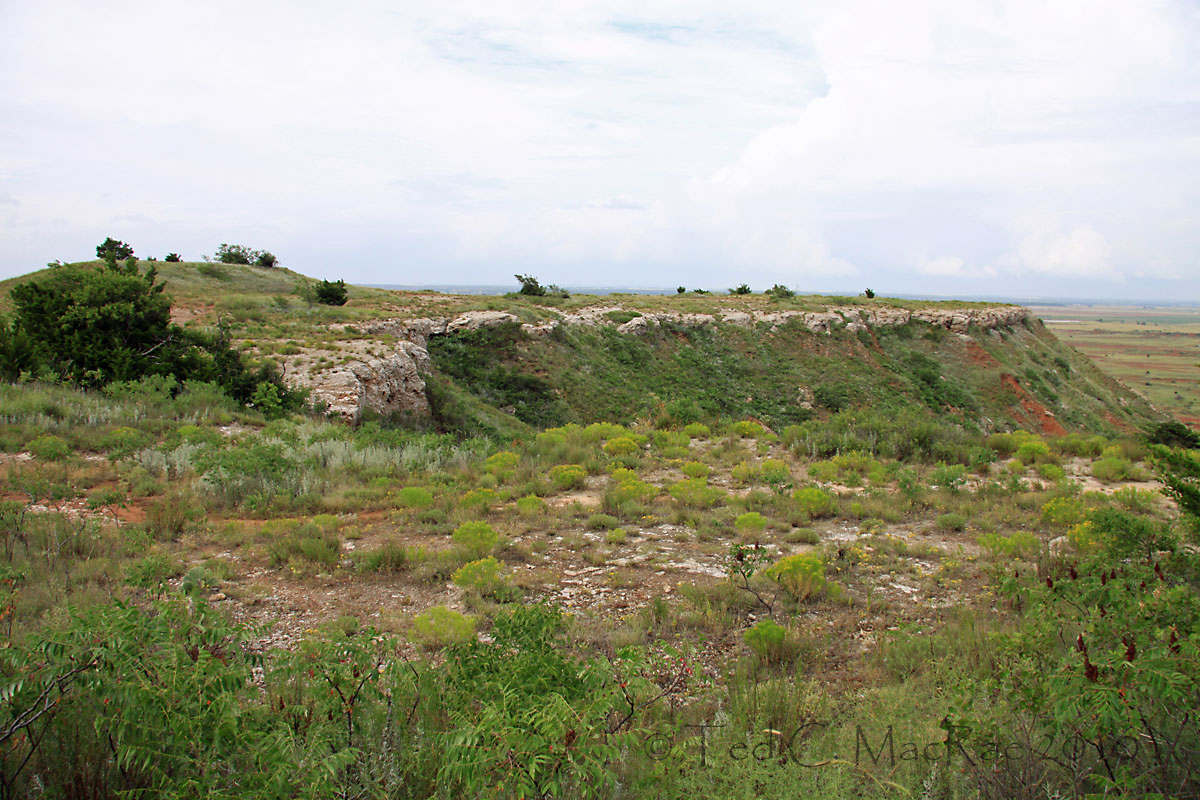 A few weeks ago, while waiting to begin my nocturnal hunt for the Great Plains giant tiger beetle (Amblycheila cylindriformis) in northwestern Oklahoma, I spent the daytime atop one of the red flat-topped mesas that meander through the area in nearby Gloss Mountain State Park. Although my trip was all about seeing this giant of a tiger beetle in the wild for the first time (I could hardly wait for dusk to begin my search), I found enough splendid insects of other types atop the mesa to occupy my interest until that time. One of these was the still-robust population of the Swift Tiger Beetle (Cylindera celeripes) that I discovered last summer and delighted in photographing yet again, while another was North America’s largest robber fly – Microstylum morosum! I had just finished photographing one of the tiger beetles near the edge of the mesa when I turned and saw one of these impressively large flies sitting calmly on the ground nearby.
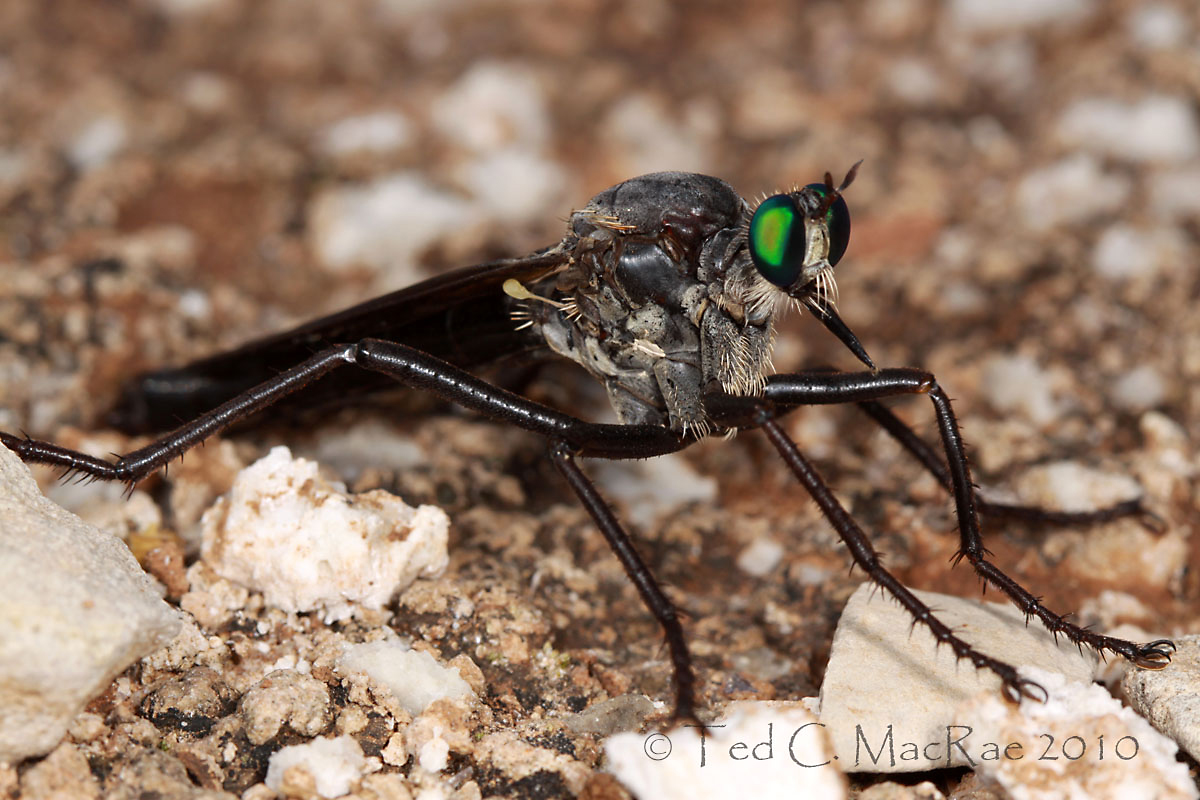 I first encountered this species last year in southwestern Missouri (a new state record!), so there was no question about its identity. I also remembered how skittish they were and how difficult it was to get even the two mediocre photographs that I included in the resultant post. Expecting the same, I kept my eye on the ground-sitter while preparing the camera and approached it with extreme caution. To my surprise, it showed no sign of being alarmed or wanting to take flight. I crouched down low and marveled at its monstrous impressiveness as I took frame after ever closer frame – eventually zeroing in on the head and its stunningly magnificent emerald-green eyes.
 Satisfied that somewhere in the dozen and a half frames that I shot was at least one or two winners, I sat up and probed towards it with my finger to see how quickly it took flight. It just sat there tenaciously until my touch caused it to finally take wing. Winds were gusty atop the mesa, which may have accounted for its cooperativeness. Standing up, I noted a few scattered eastern redcedars (Juniperus virginiana) in the mixed-grass prairie at the highest point of the mesa. I recalled that robber flies are fond of “hilltopping” – a mating strategy whereby males fly to the highest point in their immediate landscape to defend a small territory or perch that provides a good vantage for spotting females and competing males (see Hilltopping by Eric Eaton at Bug Eric for a good discussion about this) – and my own experience with this species in Missouri and the way it tended to perch in the trees scattered across the upper part of the rocky, dolomite glade where I found them. I wandered up to the redcedars, and as soon as I came close enough to one of them I saw another individual take flight – looking like some super-sized mosquito with it’s long legs spread wide as it clumsily flew to another tree. As it turned out, I saw a number of individuals and mating pairs perching and flying among the trees on top of the mesa, each more spectacular than the previous.
Until recently, Microstylum morosum was considered a Texas-endemic. However, Beckemeyer and Carlton (2000) documented this species to be much more broadly distributed in the southern Great Plains (from Texas up into Oklahoma and Kansas and west into New Mexico, Arizona, and Colorado), and Warriner (2004) recorded it shortly afterwards in Arkansas. Although the species apparently occurs throughout Oklahoma (Beckemeyer and Carlton recorded from 13 counties across the state), my observation of it in Major County does seem to represent a new county record for the species. There is another U.S. species in the genus, M. galactodes, and it has also been recorded from Oklahoma (the closest record is in nearby Woodward County). However, it is easily distinguished by its generally smaller size, milky white wing membranes, reddish-brown body, and head and thoracic dorsum evenly covered with whitish pruinescence, while M. morosum has the wings and body black to brown and thoracic pruinescence restricted to the lateral margins (Beckemeyer and Carlton 2000). I’m not sure I would have recognized that species for what it was had I seen it, but if it is anywhere near as impressive as M. morosum then I hope I have the fortune to find it someday as well.
Photo Details:
Landscape: Canon 50D w/ 17-85mm wide-angle lens (17mm), ISO 100, 1/100 sec, f/10, ambient light. Typical post-processing (levels, unsharp mask).
Insects: Canon 50D w/ 100mm macro lens, ISO 100, 1/250 sec, f/10 (photo 1), f/18 (photo 2), Canon MT-24EX flash (1/4 ratio) w/ Sto-Fen diffusers. Typical post-processing (levels, minor cropping, unsharp mask).
REFERENCES:
Beckemeyer, R. J. and R. E. Carlton. 2000. Distribution of Microstylum morosum and M. galactoides (Diptera: Asilidae): significant extensions to previously reported ranges. Entomological News 111(2):84–96.
Warriner, M. D. 2004. First Arkansas record of the robber fly Microstylum morosum (Diptera: Asilidae). The Southwestern Naturalist 49(1):83–84.
Copyright © Ted C. MacRae 2010


Last summer, while looking for North America’s most beautiful longhorned beetle in the dolomite glades of southwest Missouri’s White River Hills, I also came across good numbers of a tiger beetle species that I had previously considered rather uncommon in the state – Cicindela rufiventris (eastern red-bellied tiger beetle). While I have seen this species at numerous localities throughout the Ozark Highlands, I had not seen them in such numbers as were present along a rocky 2-track leading through one of the glades and into the adjacent dry upland forest. I had intended to post about them much sooner than now, but they took a backseat to the photos I obtained of the stunning Plinthocoelium suaveolens and the fantastic diversity of Floridian tiger beetles that I encountered in the following weeks. I had, in fact, completely forgotten that I had these photos until Steve Willson, author of Blue Jay Barrens, presented two posts with some excellent behavioral observations of this species in Ohio (see his posts Eastern Red-Bellied Tiger Beetle and Tiger Beetle Behavior).
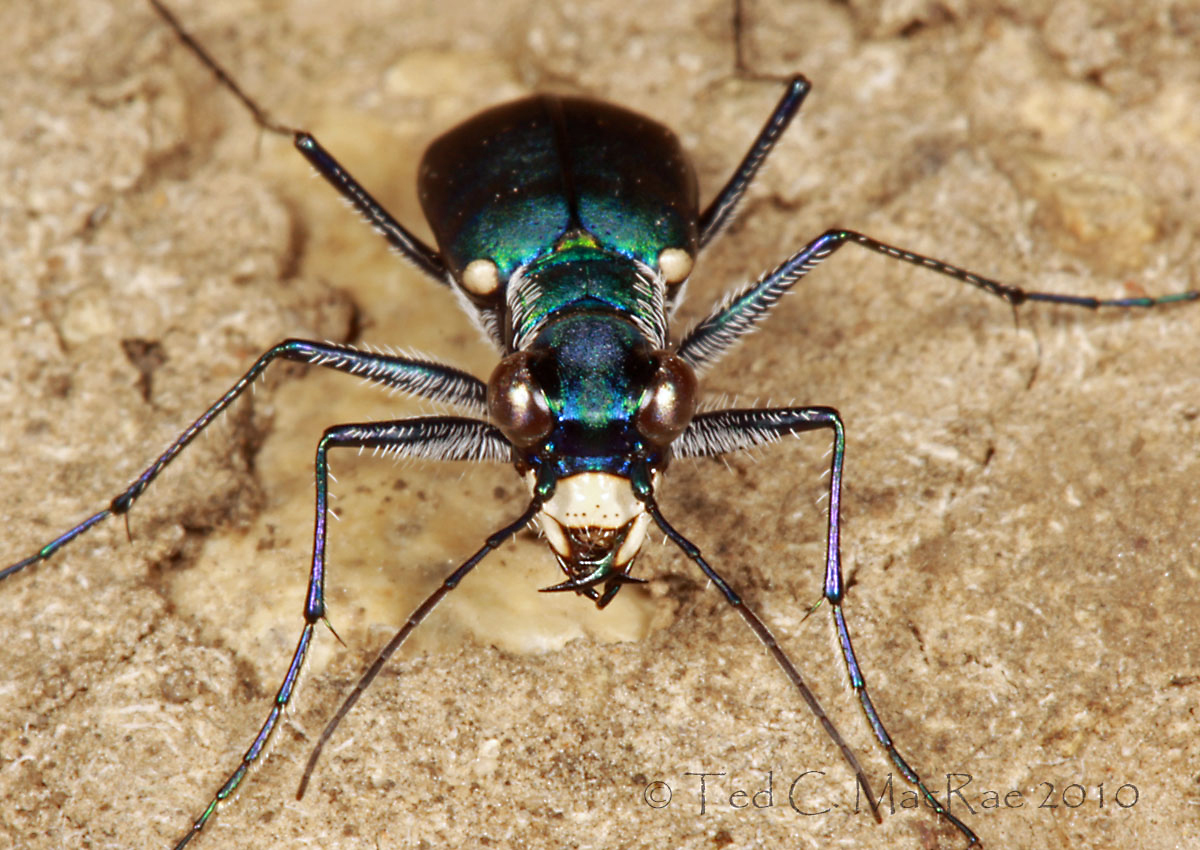
In Missouri, I have found this species exclusively in the Ozark Highlands region, primarily along rocky clay exposures along roadsides and on trails and 2-tracks through open pine forests on sandstone substrates. As I mentioned, however, I never saw large numbers of individuals – just a few here and there. On this rocky, dolomite 2-track though, the species was quite abundant, to the point that I was able to pick and choose the more “cooperative” subjects for photography instead of stalking interminably behind a precious skittish few. In my second trip to the region two weeks later, I would find the species again abundant along trails winding through the region’s finest and most extensive dolomite glade systems at Hercules Glades Wilderness. In previous years I haven’t spent much time in the extreme southern Ozarks during July and August, since by then most woodboring beetle activity has largely ceased – this probably explains why I’ve not seen this summer active species more abundantly before now.
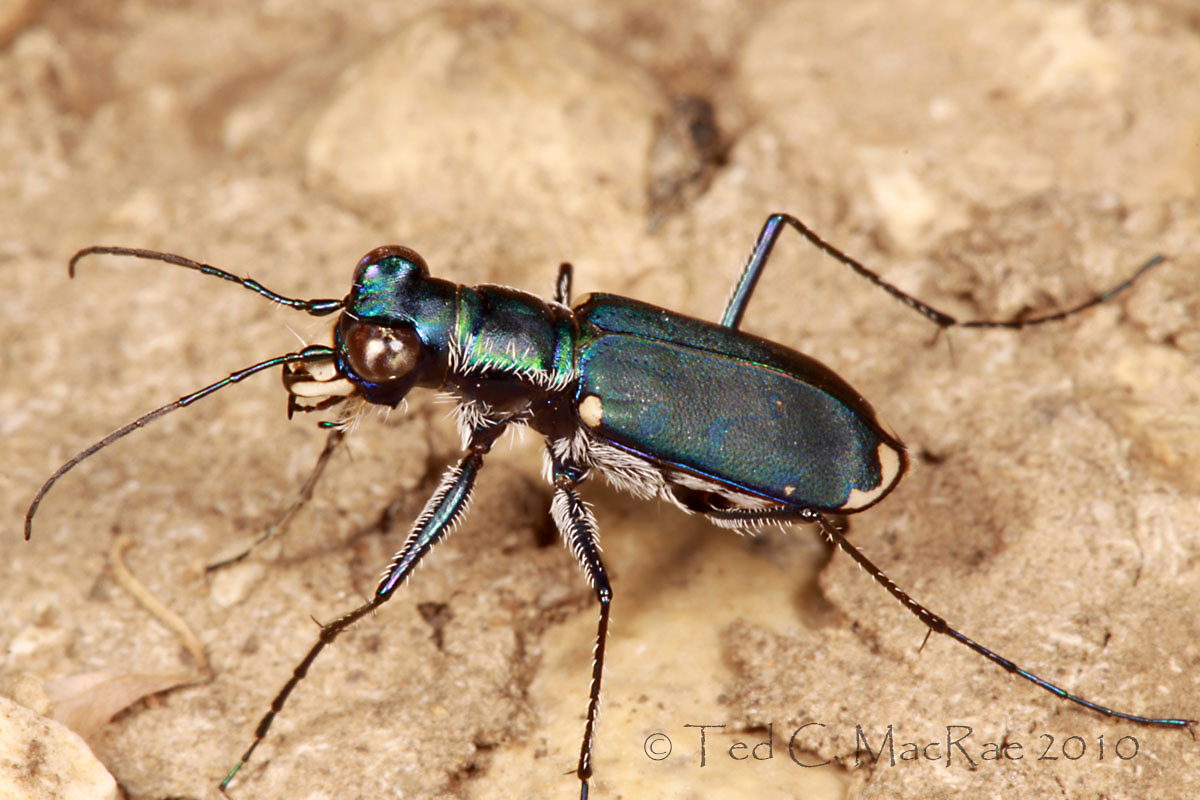
Cicindela rufiventris is quite closely related to C. ubiquita¹, both of which are included in the subgenus Cicindela (Cicindelidia), dubbed the “American Tiger Beetles” by Pearson et al. (2006). It is immediately recognizable, however, by its red-orange abdomen – hints of which can be seen in these photos and which is fully exposed during flight. It also lacks the distinct sutural row of green punctures on the elytra exhibited by the latter, and the upper body coloration tends to be a little more variable in Missouri, ranging from dull dark brown or black to dark blue. According to Pearson et al. (2006), populations in southern Missouri represent the northern fringe of an intergrade between the nominate subspecies to the east and subspecies cumatilis ranging from southwestern Louisiana into eastern Texas. The distinction between these two subspecies is a matter of degree, with the latter exhibiting reduced maculations and a blue rather than brown or black upper body. The influence of cumatilis can be clearly seen in the individual shown in the first three photographs, while the individual in the photo below is much more “nominate” in appearance. For taxonomic purposes, individuals from these populations are probably best classified as “Cicindela (Cicindelidia) rufiventris rufiventris x rufiventris cumatilis intergrades.” Such nomenclature implies that these individuals represent hybrids between two geographically distinct populations, since subspecies in the strictest sense represent genetically divergent populations made allopatric or near-allopatric as a result of isolating geographical barriers. However, tiger beetle taxonomy is replete with “subspecies” that more likely represent extremes of clinal variation, of which cumatilis appears to be one example. The opposite expression of this cline can be found in a few isolated populations near Boston, in which the elytral maculation is at its most developed – these populations have been designated as subspecies hentzi.
¹ Referred to by most authors as Cicindela punctulata.
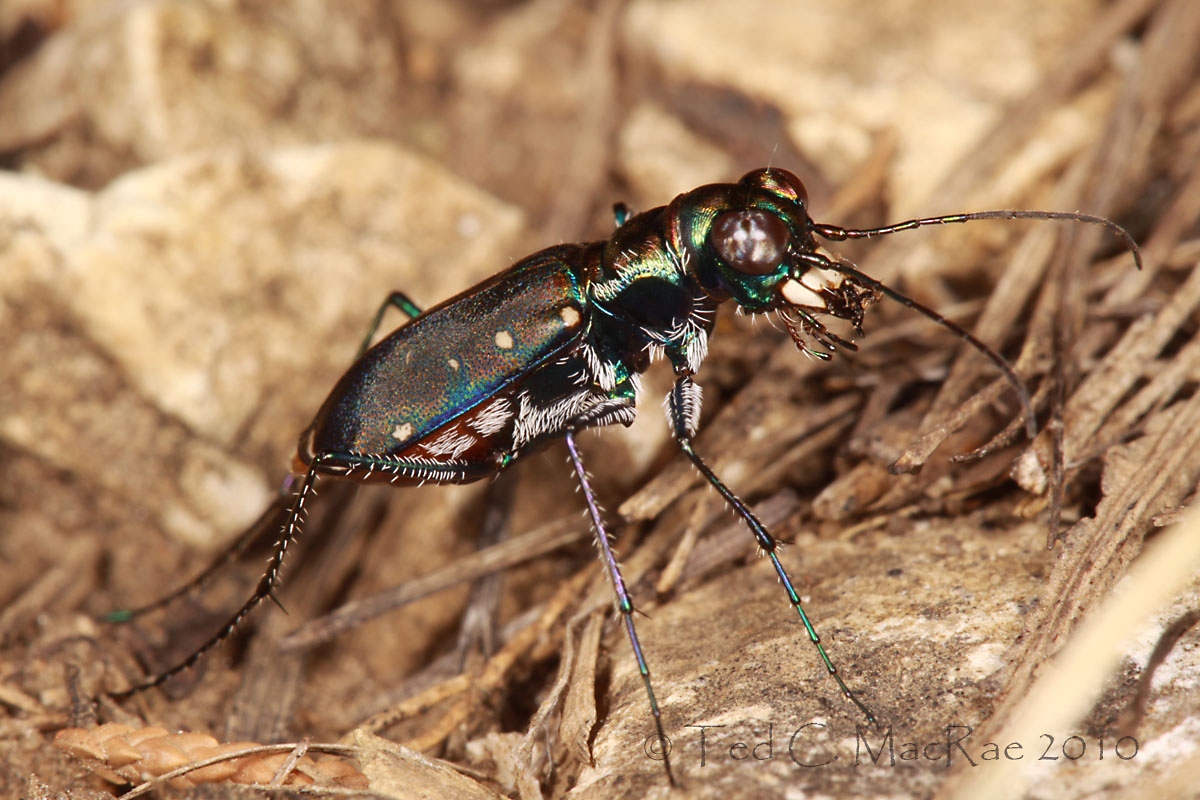
Photo Details: Canon 50D w/ 100mm macro lens, ISO 100, 1/250 sec, f/25 (photos 1-2), f/29 (photo 3), f/18 (photo 4), Canon MT-24EX flash (1/4 ratio) w/ Sto-Fen diffusers. Typical post-processing (contrast and unsharp mask).
REFERENCES:
Pearson, D. L., C. B. Knisley and C. J. Kazilek. 2006. A Field Guide to the Tiger Beetles of the United States and Canada. Oxford University Press, New York, 227 pp.
Copyright © Ted C. MacRae 2010


 Beetles In The Bush