Although I’ve been collecting insects since I was a kid (and seriously for nearly three decades), it has only been in more recent years that fall has become an important part of the collecting season for me. With the notable exception of Fall 1978, when the Systematic Entomology course I was enrolled in sent me on a frantic quest to become one of the few undergraduate members of the exclusive “200 family” club (I got 205!), I long viewed fall as a time to hang up the net and begin the winter-long process of mounting, labeling, and curating the hundreds – sometimes thousands – of specimens I had collected earlier in the year during spring and summer. This has primarily been a reflection of my taxonomic interest – woodboring beetles in the families Buprestidae and Cerambycidae, which occur at their overwhelmingly greatest abundance and diversity throughout most of North America during spring and summer but are found only sparingly later in the season. Tiger beetles (family Cicindelidae) changed all that, and when I first began serious study of the group around 10 years ago, I found the combination of gorgeous weather and multitude of “spring/fall” species that emerge briefly during fall an irresistible siren call to the field. I’ve not looked back, and the Annual Fall Tiger Beetle Collecting Trip™ is now an established and eagerly anticipated event.

Cicindela obsoleta vulturina - the prairie tiger beetle (Blackjack Knob, Taney Co., Missouri).

Blackjack Knob is part of an extensive xeric dolomite prairie complex (commonly referred to as cedar glades, though the term is not precisely accurate) in the White River Hills subsection of the Ozark Highlands, providing habitat for prairie tiger beetles and other typically southwestern plants and animals.

Steve Spomer and yours truly at Cane Creek Rd. site.
- Individuals mostly dark olive-green – no black individuals.
- Elytral maculations more completely developed.
- Adults active in late summer/early fall rather than summer.
These features, in particular coloration and maculation, have fueled speculation that this isolated population might be subspecifically distinct (Pearson et al. 2006). A recent review of material from throughout its range found these color characters of limited use in unequivocally diagnosing individuals from the Missouri and Arkansas population as a separate subspecific taxon (Mawdsley 2009); however, a molecular systematics approach ultimately may be needed to resolve the status of this population. Presumably, the Missouri/Arkansas disjunct population represents a hypsithermal relict, left behind when the return of cooler, moister conditions caused a retreat of the formerly more expansive grasslands to their current position. If true, then the Missouri/Arkansas population has been isolated from the parent population for ~6,000 years. I suspect that the late summer/early fall adult phenology is an adaptation to local precipitation patterns, relying on more predictable late summer rains to trigger adult emergence after the generally droughty months of July and August. In this regard it differs fundamentally from the true “fall” species, which emerge briefly in the fall as sexually immature adults before overwintering and re-emerging in the spring for mating and oviposition. These Missouri/Arkansas disjuncts do not re-emerge in spring, but instead mate and lay eggs in the fall before the onset of cold weather. The eggs hatch as well (based on my growth chamber observations of this species), so winter also is passed as a larva – either as newly-hatched 1st instars, or as later instars that hatched during the previous year(s) – rather than as adults.
I have noted considerable variation in the coloration and maculations of individuals in this population. The individual in the first photograph above is typical of the population – dark olive-green with thin but nearly complete maculations. That individual comes from Blackjack Knob (Taney Co.), which is near the heart of the White River Hills region. However, the degree to which the maculations are developed is variable, ranging from rather incomplete to even more fully developed due to the presence of a marginal connection. Additionally, a few individuals can be found that show greater or lesser suffusion of brown on the head, pronotum, and elytra. At another location in the county closer to the northern distributional limit (Hwy 160/Cane Creek Rd.), this brown suffusion is more common and variably expressed from minimal to nearly complete. The photographs below show five individuals from this site expressing differing degrees of brown as well as the variable macular development seen throughout the population:

Male (Hwy 160/Cane Creek Rd.) - green w/ trace brown, marginal band incomplete, median band complete.

Female (Hwy 160/Cane Creek Rd.) - green w/ slight brown, marginal band complete, median band incomplete.
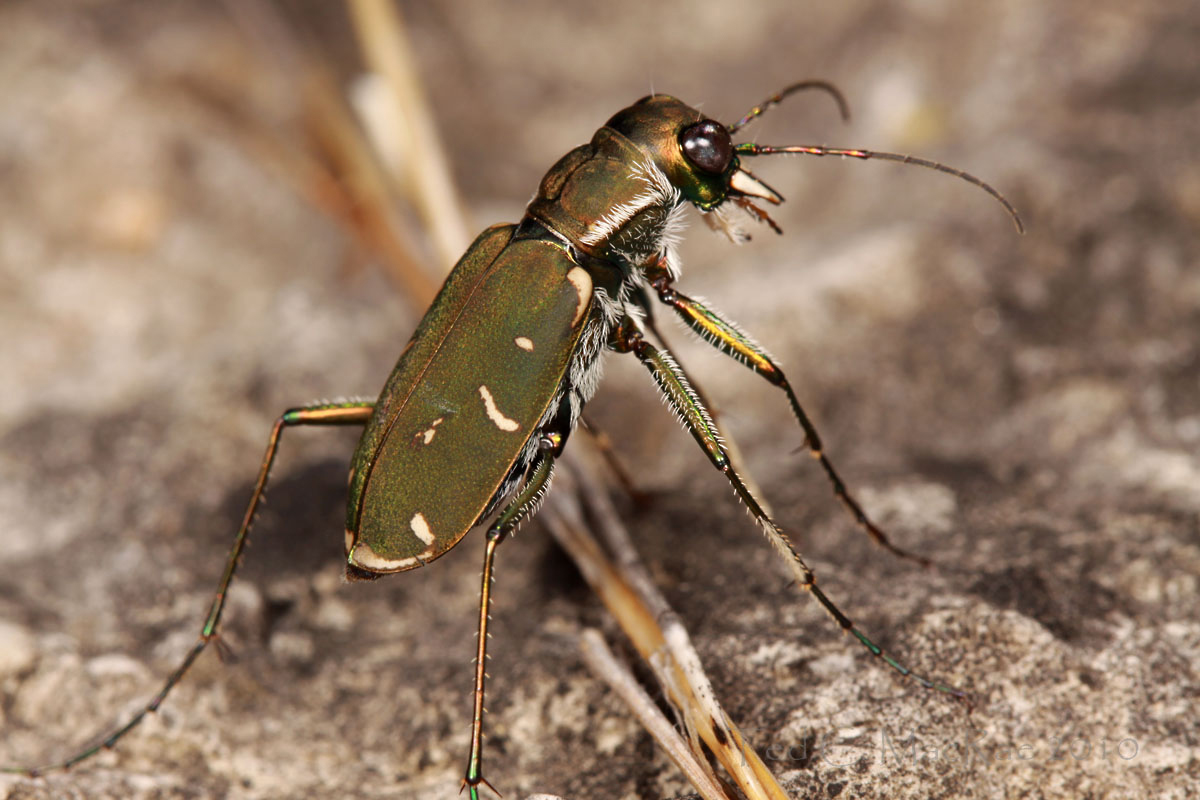
Male (Hwy 160/Cane Creek Rd.) - green w/ moderate brown, marginal band incomplete, median band incomplete.

Male (Hwy 160/Cane Creek Rd.) - green w/ heavy brown, marginal band complete, median band complete.
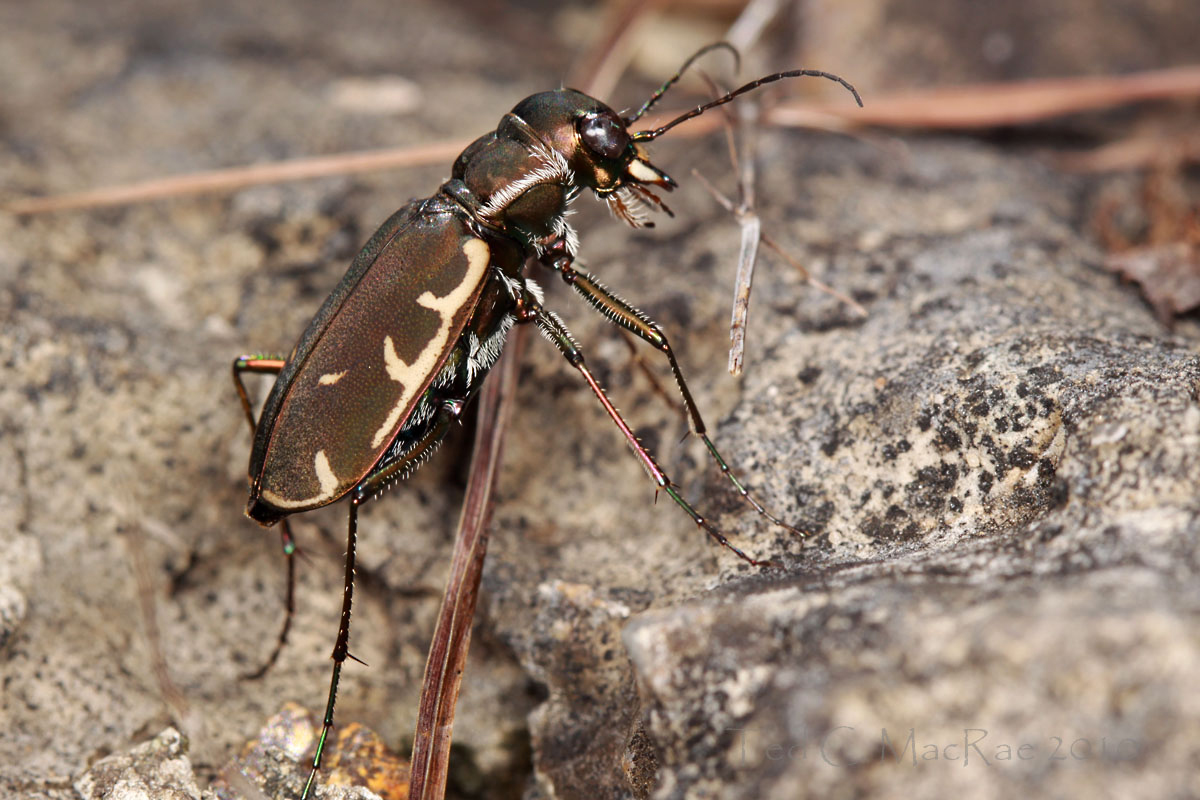
Female (Hwy 160/Cane Creek Rd.) - completely brown, marginal band complete, median band incomplete.

Male (Merriam Woods) - brown, marginal band incomplete, median band complete.

Thinly soiled dolomite exposures punctuate the glades in the White River Hills. Prairie tiger beetles are found in these exposures.

Dark green-black lichens encrust the thin black soils overlaying the dolomite exposures. Prairie tiger beetle adult coloration closely matches the coloration of the lichens and soil.
Currently, I have 3rd-instar larvae that I collected from their burrows at Blackjack Knob (adults mostly green) and Merriam Woods (adults mostly brown) and hope the rear them to adulthood next year. If I succeed in getting virgin adults from the two sites, I think it would be interesting to do some single-pair crossings and rear the progeny to see how coloration is expressed. A long term project, for sure, as these beetles probably require at least two seasons to reach adulthood, but rearing them is fun! A more difficult, yet far more interesting, project would be to secure virgin adults from the mostly black main population in Texas – or even the bright green, thickly-maculated santaclarae subspecies from Arizona – to see how interbreeding them with these Missouri disjuncts would affect coloration and maculation in their progeny – they could be some of the most unusual appearing large grassland tiger beetles ever seen (not to mention their tongue-twisting taxonomic moniker of Cicindela (Cicindelidia) obsoleta vulturina [Missouri disjunct] x obsoleta santaclarae!). Timing would be a difficulty, since the Texas and Arizona populations exhibit a more normal summer adult phenology, but it would be worth a try if I could secure a source of larvae for rearing. Anybody?

A male sports his impressive pair of choppers.
Photo Details (insects): Canon 50D w/ 100mm macro lens (ISO 100, 1/250 sec, f/13-22), Canon MT-24EX flash (1/4-1/2 ratio) w/ Sto-Fen + GFPuffer diffusers. Typical post-processing (levels, minor cropping, unsharp mask).
REFERENCES:
Mawdsley, J. R. 2009. Geographic variation in U. S. populations of the tiger beetle Cicindela obsoleta Say (Coleoptera: Cicindelidae). Insecta Mundi 0094:1–10.
Pearson, D. L., C. B. Knisley and C. J. Kazilek. 2006. A Field Guide to the Tiger Beetles of the United States and Canada. Oxford University Press, New York, 227 pp.
Copyright © Ted C. MacRae 2010



 Beetles In The Bush