Memories of summer – Neoclytus scutellaris

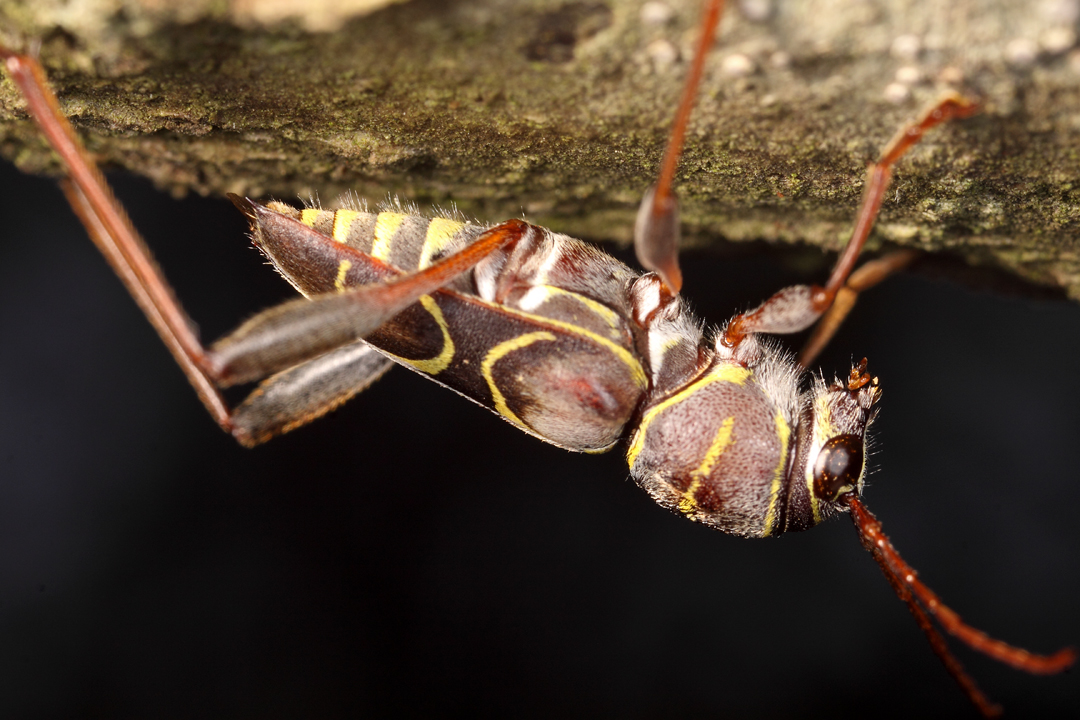
Neoclytus scutellaris | 9 July 2011, Wayne Co., Missouri

During the short, cold days of winter it’s nice to take a break from the curatorial activities that dominate the season and look back on some of the insects seen during the previous summer. This is Neoclytus scutellaris, a longhorned beetle associated almost exlusively with dead/dying oaks in the eastern U.S. The species is sometimes confused with the very similar N. mucronatus but is distinguished by the transverse yellow band on the pronotum and its host (the latter being associated with hickory and hackberry).

Copyright © Ted C. MacRae 2011

Something for Adrian

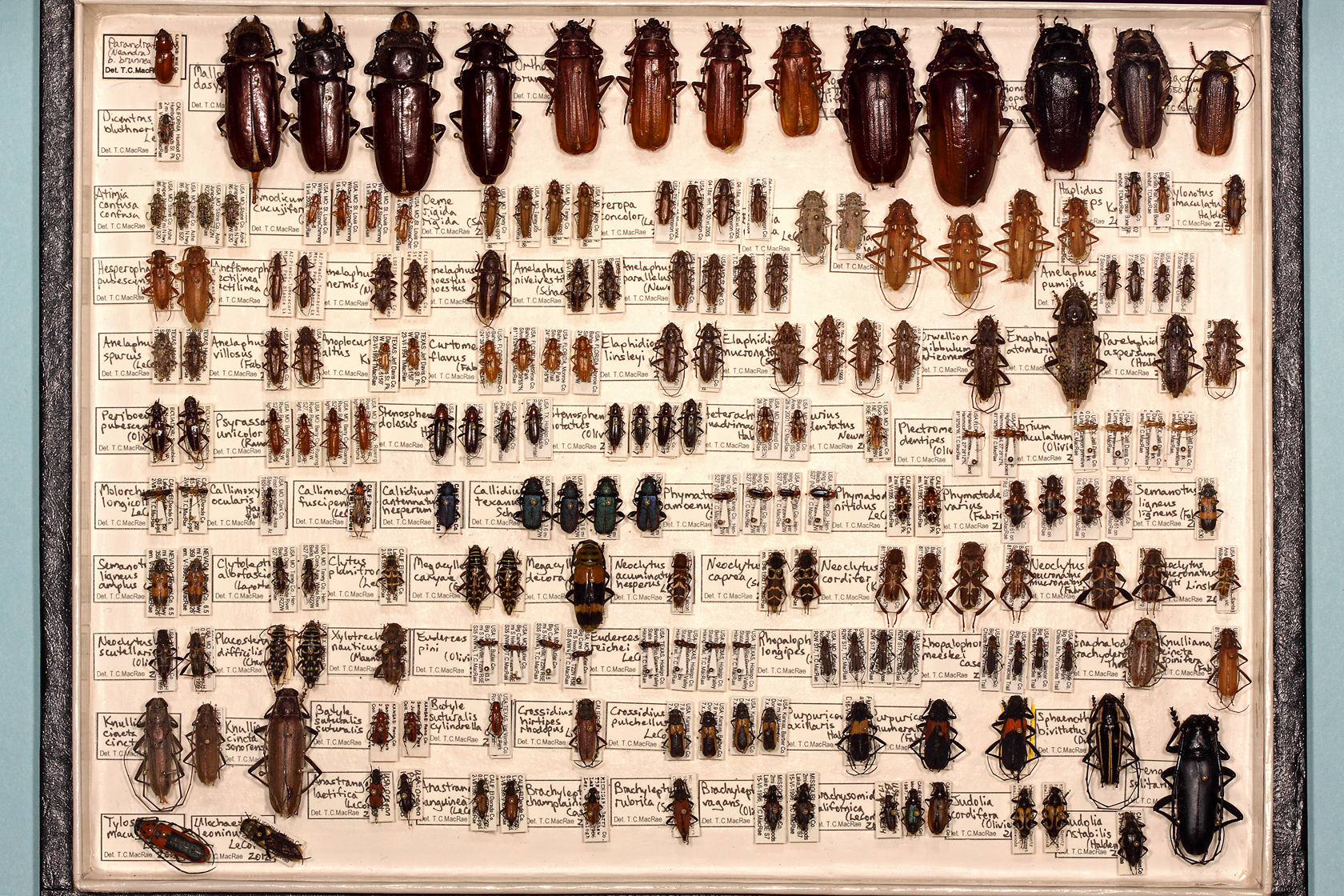
Miscellaneous North American Cerambycidae - click for larger version (1680 x 1120).

In a comment on my  post, Adrian Thysse asked to see hi-res images of specimen drawers from my own collection. Like any good North American entomologist, Adrian was a little bothered by the card-mounting technique used by the sender of the specimen box featured in that post and wanted to see what a nice collection of properly pinned specimens might look like. It’s actually not the first time he’s made this request—back when I first moved this blog to WordPress (more than three years ago) he did so when I put up my Collection page featuring a photo of my “Oh wow!” insect drawer. I’ve thought about doing this ever since he first made this request, but the problem, or at least my problem, with photographing specimen drawers from my main collection is a combination of large drawer size (reducing the size of the specimens in an image of the drawer) and long series of a relatively small number of species in the same genus or closely related genera (making the drawer contents look rather uniform in appearance). I suppose some might still be interested in seeing drawers from a “working collection” such as mine, but I just never had enough motivation to start pulling out drawers and taking photos.

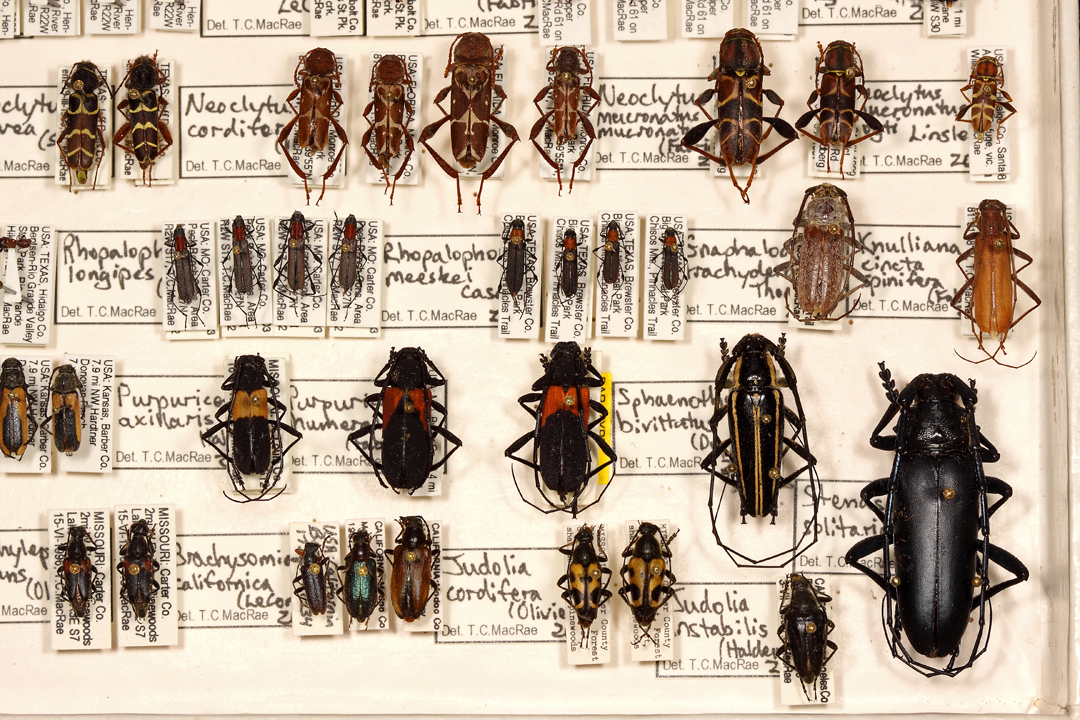
Adrian is in luck, however, as I just happened to be putting together a shipment of miscellaneous North American Cerambycidae for a collector in Europe (to whom I’ve owed insects for longer than I like to admit). The box I’m using for the shipment is smaller than a normal collection drawer and is packed with close to 100 species of this diverse beetle family. There might be a specimen here and there that was collected by someone else, but the vast majority were collected, mounted, labeled, and identified by me. I show this as an example of my curatorial technique, and as a bonus the above image is linked to a fairly large version (1680 x 1120) for those who might be interested in getting a really close look at the specimens and their labels. Here also are closer looks at the specimens in the bottom left and bottom right corners, respectively:

Hmm, is that a wasp at the bottom?

What species is that without the ''normal'' ID label?

Copyright © Ted C. MacRae 2012

ID Challenge #15

Who am I, and where do I live?

It’s been almost a month since the last challenge, and since Alex got back to his roots I think I’ll do likewise. This is a straight up identification—the order and family are obvious (or should be), so I’m going to limit ID points to genus and species. However, to make up for this loss of higher taxa points I’ll be awarding points for correctly guessing/deducing/intuiting where this little beastie lives or providing any unique comments on its natural history. As always, standard challenge rules apply, including moderated comments to give everyone a chance to submit their answers.  Bonus points will be awarded to for answering first in the case of multiple correct answers, and discretionary bonus points are also up for grabs. Good luck!

Copyright © Ted C. MacRae 2012

Buprestidae exchange

With my queue of specimen identifications now clear, I can turn my attention to another major backlog that I haven’t been able to give proper attention recently—exchanges. For those of you not into insect collecting, exchanging is something that most collectors eventually end up doing, especially if the goal is to build a taxonomic reference collection within one’s chosen group that has broad representation of species and higher taxa from multiple geographical regions. Truthfully, I don’t do nearly as much exchanging as some collectors I know. It’s not that I don’t want to, but simply a matter of time—receiving and incorporating shipments while preparing and sending out returns is not as quick and easy as it might seem, not to mention the time involved in mining and corresponding with prospective exchange partners. I wish I could do more, but since I can’t I deal with it by limiting myself almost exclusively to exchanging Buprestidae (although I’ve been known to do a tiger beetle exchange or two). I focus on Buprestidae because that is my primary group of taxonomic interest.

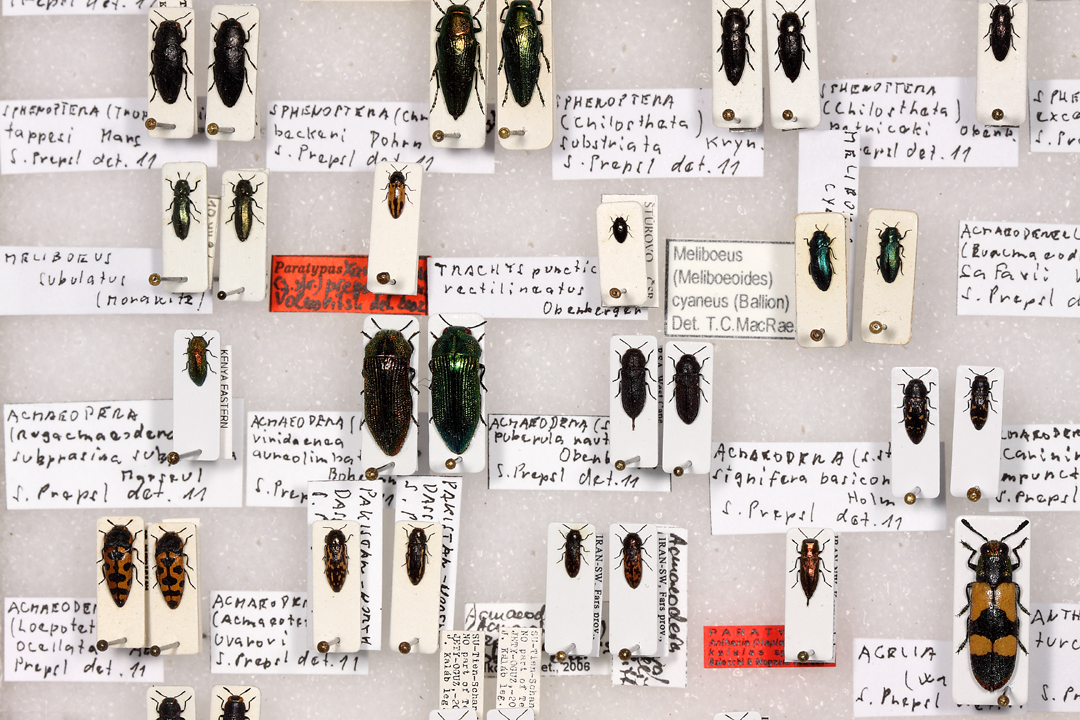
Buprestidae received in exchange from Stanislav Prepsl, Czech Republic

These photos show some of the Buprestidae I received this past year, this particular box coming from Stanislav Prepsl in the Czech Republic. This is the first time that I’ve exchanged with Stan, and I must say I am impressed with the quality and taxonomic diversity of his buprestid holdings. In this exchange, I received 73 species, most of which are represented by a male/female pair and four represented by paratype specimens. These are all Old World species, and while a few are from the well-known fauna of Europe most were collected in countries seldom visited by (or even off limits to) American collectors such as the former USSR, Iran, Pakistan, Kurdistan, Turkey, etc. There are a nice few species also from Namibia, Kenya and Ethiopia. In return, I sent to Stan more than 100 species of Buprestidae from mostly the southwestern U.S. and Mexico where I have done a large part of my collecting. Stan was less demanding about receiving both one male and one female for each species, thus the larger number of species I was able to send him for approximately equal numbers of specimens.

Close-up view of lower left corner of box

Some collectors avoid Buprestidae because of their taxonomic difficulty and the overwhelming numbers of small, difficult-to-identify species. I think this is exactly why I like the group, and though many of the species are small they are certainly no less beautiful than their larger, flashier, more ostentatious brethren. I include this close-up view (you might recognize the specimen in the lower right corner as the previously featured Agelia lordi) to show the meticulous preparation of the specimens included in the shipment—an example of a well-curated collection by someone who knows what they are doing. Incidentally, the cards on which the specimens are mounted are standard fare among European collectors, and although as an American I prefer direct pinning of larger specimens and mounting smaller specimens on points versus cards, I’ve come to appreciate the exacting care with which some Europeans practice this card-mounting technique.

It’ll take me a few hours of dedicated attention to move all of these specimens into the main collection—not only must their proper placement be determined, but there is usually a lot of reshuffling of specimens within and amongst unit trays whenever such a large number of specimens is incorporated into it. With 15,000 described species and counting, this sending of Buprestidae represents only a modest increase (0.5%) in my representation of species; however, it adds representation from geographical areas that previously had virtually no representation in my collection at all. I hope Stan is as pleased with the material that I sent to him as I am with this material, and I look forward to the opportunity to exchange again with him in the near future.

Copyright © Ted C. MacRae 2012

Extreme sexual dimorphism in Buprestidae: Xenorhipis hidalgoensis

Yesterday I received in the mail a package of specimens for identification from Dan Heffern in Houston, Texas. I first began corresponding with Dan about 25 years ago—not long after I myself became interested in Coleoptera, and as an avid collector of longhorned beetles (family Cerambycidae) Dan knows a thing or two about jewel beetles (family Buprestidae) as well. Over the years, Dan has come up with a number of great buprestid species from Texas, especially through rearing, many of which he has graciously sent to me examples for my cabinet.

Xenorhipis hidalgoensis (male, length 5.3 mm) | Hidalgo Co., Texas

The present package was no exception, as it contained a male/female pair of one of North America’s least frequently encountered buprestids, Xenorhipis hidalgoensis. Dan had reared them from dead branches of Condalia obovata collected in south Texas as part of a multi-year beetle survey in the Lower Rio Grande Valley. He had mentioned to me that he would be including them in the sending, but that did nothing to diminish my excitement upon seeing the specimens when I opened the box. The species was first described from Hidalgo Co., Texas (Knull 1952), and other than a single record from the neighboring Mexican state of Tamaulipas (Nelson et al. 1981) subsequent mentions of the species have been limited to catalogue listings and inclusion in keys to species. Thus, these specimens represent not only a nice addition to my collection, but also the first reported larval host for the species.

Xenorhipis hidalgoensis belongs to the tribe Xenorhipini, the males of which exhibit a distinctive specialization of their antennae in that the distal segments are highly modified into a very extended flabellate or lamellate condition. Females, in contrast, retain the serrate antennal condition that is more typical throughout the family.  Differences in antennal morphology aren’t the only sexual differences exhibited by members of the tribe, as males and females often exhibit differences in coloration as well. This is especially true in the genus Xenorhipis, and I’m not aware of a more striking example of this than X. hidalgoensis (compare these photos to those of male/female pairs of X. bajacalifornica, X. brendeli and X. osborni in A new species of Xenorhipus from Baja California).

Xenorhipis hidalgoensis (female, length 6.4 mm) | Hidalgo Co., Texas

The highly modified male antennae are interesting from both an evolutionary and functional standpoint. Similarly modified male antennae are found in a few other groups of Buprestidae, including the genus Knowltonia in western North America (four species), the monotypic genera Mendizabalia and Australorhipis in South America and Australia, respectively, and two species in the enormous Australian genus Castiarina (Bellamy and Nylander 2007). The Xenorhipini, however, with 20 species distributed throughout the Western Hemisphere, is by far the most diverse group exhibiting the condition. Despite the similarity of their antennae, the taxonomic distance between these groups and differences in the detailed structure of the numerous olfactory sensillae that cover the modified segments (Volkovitsh 2001) suggest that the modifications have arisen and evolved independently in these several disparate taxa.

All Buprestidae exhibit sensory structures on their antennae, presumably with olfactory and/or thermosensory functions; however, Wellso (1966) provided strong evidence that females of X. brendeli release pheromones that are highly attractive to males and detected by their elaborate antennae. Caging studies with virgin and mated females revealed that males were highly attracted to virgin but not mated females, and that mated males were not attracted to either virgin or mated females and died shortly thereafter.  Further, more than 80% of males were attracted within a 1-hour period just past midday. It is assumed that chemoreceptors for detecting female pheromones are located on the male antennae, as males with their antennae removed were not attracted to caged virgin females but were able to mate when caged with them. This suggests that the male antennae evolved in response to selection for greater surface area, which allows placement of more sensillae to detect female pheromone. Wellso observed also that adults are very short-lived, with no individuals living longer than 48 hours (perhaps due to reliance on pheromone attraction rather than longevity for mate location). This, along with their very short daily activity period, may explain  why adults of species in this tribe are so seldom encountered in the field.

Male with highly flabellate antennae

Female with unmodified serrate antennae


REFERENCES:

Bellamy, C. L. and U. Nylander. 2007. New genus-group synonymy in Stigmoderini (Coleoptera: Buprestidae). The Coleopterists Bulletin 61(3):423–427.

Knull, J. N. 1952. A new species of Xenorhipis from Texas (Coleoptera: Buprestidae). Entomological News 63(7):177–178.

Nelson, G. H., D. S. Verity, and R. L. Westcott. 1981. Additional notes on the biology and distribution of Buprestidae (Coleoptera) of North America. The Coleopterists Bulletin 35(2):129–152.

Volkovitsh, M. G. 2001. The comparative morphology of antennal structures in Buprestidae (Coleoptera): evolutionary trends, taxonomic and phylogenetic implications. Part 1. Acta Musei Moraviae, Scientiae biologicae (Brno) 86:43-169.

Wellso, S. G. 1966. Sexual attraction and biology of Xenorhipis brendeli (Coleoptera: LeConte). Journal of the Kansas Entomological Society 39(2):242–245.

Copyright © Ted C. MacRae 2012
2,171 pieces of chitin…

Specimen boxes ready to ship out.

There are many reasons to look forward to the Holiday Season—time with family and friends, a break from the normal routine, the chance to engage in favorite activities leisure and otherwise, or maybe just kick back and not do much of anything. Okay, that last one is so not me—I really have a hard time sitting around and doing nothing no matter how tired I am. It makes me antsy. What did I do on my Holiday Break (a nice generous chunk of time starting the day before Christmas Eve and ending the day after New Years)? I spent lots of time with my family immediate and extended. I had quality time with a few close friends (including a 10-mile hike on the Ozark Trail with my friend Rich). I rode my bike. Lots! (315 miles precisely.) And (here comes the best part), I identified beetles. Lots! When I wasn’t riding or hiking or making merry, I was in my man cave with football on Tivo, beetles under the scope, and primary taxonomic literature sprawled all over the place. Maybe not the average Joe’s idea of a relaxing break, but it works for me.

Truth be told, I actually depend on the period between Thanksgiving and New Years Day to kick-start my winter curatorial season. As an entomologist with taxonomic leanings living in a temperate region, there is a seasonality to my activities. Summer is field season, and no matter what good intentions I may have for accomplishing other things, the constant siren call of the field makes this all but impossible. Reprints pile up. Boxes of specimens received for identification or exchange accumulate in the various nooks and crannies of the room. All the while I’m out collecting even more beetles! By the time fall arrives I’m well inundated and looking forward to the onset of winter so I can actually accomplish something other than growing the backlog.

It’s a new year, and with my plate now cleared of beetles needing identification, the specimens—all 2,171  of them—can be returned to their rightful owners. I’ve said it to each of them individually, but it bears repeating here that I truly appreciate the opportunity they give me to look at their material. Their specimens fuel my research with new data, allow me to gradually increase species representation in my collection, and occasionally even bring to light undescribed species. Without this network of collaborators, from full professors to citizen scientists, the Holidays for me would be just a bit too boring.

Copyright © Ted C. MacRae 2012

I am an Entomologist

In my last post (Best of BitB 2011), I showed my favorite 13 insect (mostly) macrophotographs from 2011. Such “Best of …” posts have become an annual tradition here at BitB, and I like them because they give me a chance to review my photographs for the year and assess my progress as an insect macrophotographer. Others seem to like them also, as previous editions remain among this blog’s most popular posts despite the passage of time. Hopefully this latest edition will achieve similar popularity, and if it does I will be truly grateful.

Despite this, however, I find that I still have trouble considering myself a true “insect macrophotographer” rather than an “entomologist with a camera.” It’s not that I don’t want or hope to achieve such a moniker, and I’ve been thinking lately about why this should the case. I’ve realized that it really has less to do with self-opinion and more to do with the importance I still place on and satisfaction I get out of my other entomological pursuits. Not only have I been fortunate to find stable employment conducting entomology research, but I’ve also managed to find satisfying outlets for my avocational entomological interests. I am an Entomologist (with a capital ‘E’), and although I’ve enjoyed immensely my recent growth as an insect macrophotographer, I did have other other, purely entomological accomplishments in 2011 that I think also deserve mention:

  • Managing Editor of The Pan-Pacific Entomologist. It has been my life-long goal to become editor of a major entomology journal, and this past April I was presented with just such an opportunity with The Pan-Pacific EntomologistMy seven prior years as the journal’s Coleoptera Subject Editor prepared me well for the role (and further confirmed for me that the chief role was something I wanted to do), and in the seven months since I took over, the Editorial Board and I have processed 50 manuscripts, are about to submit files for our 4th issue, and have shaved more than two months off of the deficit that separates us from our eventual goal of on-schedule publishing.
  • Five papers published. With co-authors Chris Brown and Kent Fothergill, 2011 saw the publication of our series of papers assessing the conservation status of the tiger beetles Habroscelimorpha circumpicta johnsonii, Dromochorus pruinina, Tetracha carolina, and Cylindera cursitans in Missouri and Cylindera celeripes in the eastern Great Plains. Survey work for these species dominated my field activities during the past decade and formed the basis for these papers, and it was immensely satisfying to finally see the results of all that work finally appear in print. The real impact of this work, however, will be seen in the coming years as I work with conservation stakeholders who will utilize the information that we have gathered.
  • First seminar presented fully in Spanish. I don’t talk much about my professional activities—part of being an industry entomologist is the necessity to maintain company confidentiality. I have mentioned, however, my role in soybean entomology research and my recent travels to Argentina as part of this work. In November I finally realized one of my professional goals of giving a seminar fully in Spanish. It was a long time coming—I took Spanish lessons for a short time in the late 1990s but have otherwise had only one or two trips per year to Argentina and Mexico with which to improve my skills. It was during my trip to Argentina this past March that something finally ‘clicked’ and I found myself for the first time able to engage fully in conversation. My colleagues in Argentina must have noticed this as well, as it was they who requested that I not only give a seminar during my November visit, but that I do so in Spanish. The presentation went well, and I now find myself more motivated than ever to pursue what before seemed only a pipe dream—full fluency.
  • Senior Research Entomologist. After three decades of working as an entomologist—the last two in industry, I now can add “Senior” to my title. What this means in practice I’m not quite sure—I’m still doing largely what I have been doing for the past few years, and in this environment compensation is linked more to accomplishments than title. Maybe it’s just recognition of dogged persistence. Still, it sounds cool and looks good in the email signature line!
  • 32 species/subspecies of tiger beetles! This is the fun stuff! Nothing is more enjoyable for me than locating, observing, and photographing tiger beetles in their native habitats. It’s even better when they are uncommonly observed or rare endemic species. In 2011 I looked for tiger beetles in seven states (Arkansas, Colorado, Florida, Idaho, Missouri, Oklahoma and Utah), and of the 32 total species and subspecies that I found (listed below) the highlights must include three of North America’s rarest tiger beetle species: Cicindela albissima (Coral Pink Sand Dune Tiger Beetle), Cicindela arenicola (St. Anthony Dune Tiger Beetle), and the recently rediscovered Cicindelidia floridana (Miami Tiger Beetle).  Another eight endemic or highly restricted species and subspecies were also found, and I was able to obtain in situ photographs of all eleven in their native habitat (as well as most of the non-endemics that I had not already photographed). In the list that follows, bold text indicates endemics, and links to any photographs I posted are provided when available:
    • Genus Cicindela
      • Cicindela albissima Rumpp, 1962 [photos]
      • Cicindela arenicola Rumpp, 1967 [photos]
      • Cicindela formosa formosa Say, 1817
      • Cicindela formosa generosa Dejean, 1831 [photos]
      • Cicindela formosa gibsoni Brown, 1940 [photos]
      • Cicindela lengi lengi W. Horn, 1908
      • Cicindela purpurea audubonii LeConte, 1845
      • Cicindela scutellaris scutellaris Say, 1823
      • Cicindela scutellaris yampae Rumpp, 1986 [photos]
      • Cicindela sexguttata Fabricius, 1775
      • Cicindela splendida Hentz, 1830
      • Cicindela theatina Rotger, 1944 [photos pending]
      • Cicindela tranquebarica borealis E. D. Harris, 1911
      • Cicindela tranquebarica kirbyi LeConte, 1866
      • Cicindela tranquebarica tranquebarica Herbst, 1806 [photos]
    • Genus Cicindelidia
      • Cicindelidia floridana (Cartwright, 1939) [photos]
      • Cicindelidia haemorrhagica haemorrhagica (LeConte, 1851)
      • Cicindelidia obsoleta vulturina (LeConte, 1853) [photos pending]
      • Cicindelidia punctulata punctulata (Olivier, 1790)
      • Cicindelidia rufiventris rufiventris (Dejean, 1825)
      • Cicindelidia scabrosa (Schaupp, 1884) [photos]
    • Genus Cylindera
      • Cylindera (Cylindera) curistans (LeConte, 1860) [photos]
      • Cylindera (Cylindera) unipunctata (Fabricius, 1775) [photos]
    • Genus Ellipsoptera
      • Ellipsoptera hamata lacerata (Chaudoir, 1854) [photos, photos, photos, photos]
      • Ellipsoptera hirtilabris (LeConte, 1875)
      • Ellipsoptera marginata (Fabricius, 1775)
    • Genus Habroscelimorpha
      • Habroscelimorpha dorsalis saulcyi (Guérin-Méneville, 1840)
      • Habroscelimorpha severa severa (LaFerté-Sénectère, 1841)
      • Habroscelimorpha striga (LeConte, 1875) [photos]
    • Genus Tetracha
      • Tetracha (Tetrachacarolina carolina (Linnaeus, 1767) [photos]
      • Tetracha (Tetrachafloridana Leng & Mutchler, 1916 [photos, photos]
      • Tetracha (Tetrachavirginica (Linnaeus, 1767)

Copyright © Ted C. MacRae 2012