I’m still getting submissions for ID Challenge #19 and don’t quite have the followup post ready yet, so I’ll give it a couple more days. In the meantime, I’d like to re-share the photo below, originally shown a few weeks ago in my post Dicerca pugionata – safe and sound! A few people commented that this was their favorite photo in the series—perhaps like me they are suckers for face shots, but I think this photo succeeds in large part because of its soft-green background. This was actually one of several similar face shots that I took, each differing the other almost exclusively in the choice of background. In the end, I chose the green background to include in the post, not only because it was the most aesthetically pleasing, but also because I felt it best represented the environment of the beetle—ensconced within the foliage of its preferred host plant, ninebark (Physocarpus opulifolius).

Green background—achieved by placing a leaf some distance behind the subject.
Such background is easily achieved in full-flash macro photography by placing a green leaf some distance behind the subject, although in practice this can be a little tricky—you want the leaf far enough away from the subject that it is completely out of focus, eliminating distracting details, but close enough so that it actually reflects light from the flash and shows up as green. This becomes trickier still if the photographer is already holding the subject (as I was, or at least the branch on which the subject was sitting), as the distance between the subject and the background must be adjusted by moving the subject (and hence the camera), rather than the leaf.
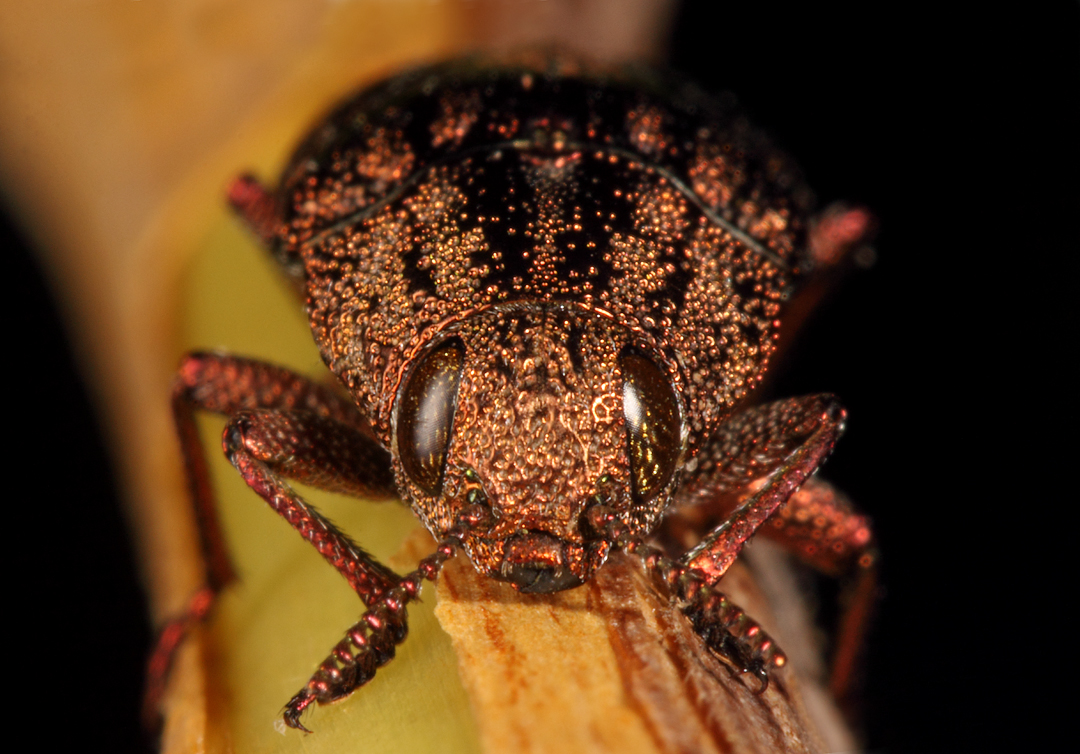
Black background—the typical background of full-flash macrophotography.
Here is a similar shot of the beetle without placing anything in the background. This is full-flash lighting because I’m using small apertures and high shutter speeds to prevent motion blur and maximize depth-of-field. As a result, only objects in the vicinity of the subject and illuminated by the flash will show up in the exposure. This results in the almost-trademark black background of typical full-flash illuminated macrophotography. Despite what you may read or hear, there is nothing wrong with a black background. Some consider it boring—probably because it is so common in macrophotography. However, there are times when it truly is the best choice of backgrounds—especially with a white or light-colored subject (for example, see this photo of the white-flowered Great Plains ladies’-tresses orchid, Spiranthes magnicamporum). With darker subjects, however, black may not be the most appealing choice of backgrounds, so it’s good to keep this in mind and choose accordingly.

Blue background—bump the ISO up to 320 and point the subject to the brightest part of the sky.
Of course, there is one way to avoid a black background without placing an object behind the subject (or placing the subject in front of an object), and that is to use the open sky to achieve a nice, blue background. This is one of the trickier of the background techniques, as it relies on finding a fine balance between ISO, aperture and shutter speed. For this photo, I bumped the ISO up to 320 (normally I use 160) and slightly opened up the aperture (f/13 rather than f/16). These settings, combined with pointing the subject to the very brightest part of the sky (excluding the sun!) allowed me to keep the shutter speed reasonably fast (1/200 sec). I find that lower shutter speeds nearly always result in some motion blur (all of my photos are hand-held), so I avoid reducing shutter speed if at all possible. I also find that ISO settings above 320 result in unacceptable graininess, so I will back down on the aperture (even down to f/11 or f/10) if I have to in order to avoid going above ISO 320 and below 1/200 sec exposure. On especially bright days, areas of the sky closest to the sun will provide enough light that you can use aperture to fine-tune the background to the desired intensity of blue—the smaller the aperture the more intense and darker the blue will be (along with providing greater depth of field). While a blue background works for this subject, I simply like the green background better. I find that blue background shots are most pleasing with foliage and flower-feeding insects, adding a touch of realism to the photo without the cluttered, distracting look of other natural backgrounds or the “studio” feel of black background shots. This photo of the South American weevil, Megabaris quadriguttatus, is perhaps my favorite example of the use of blue background.
By now, the more technically oriented photographer types among you might have noticed something that all three photos have in common (besides the subject), and that is the difference in specular highlighting exhibited by the left and right eyes of the subject. Reverse engineering suggests that I had two sources of light (which is true, I use Canon’s MT24-EX twin macro flash), and that the light source illuminating the beetle’s right side either had a much larger diffuser or was placed much closer to the subject. In fact, it was the latter, as I simply detached the left flash unit and held it much closer to the subject to confirm for myself what effect this has. Because the flash unit is closer to the subject, it has much larger apparent size, resulting in more even lighting over that side of the subject and, accordingly, softer specular highlights. If I had a third arm I would have done the same with the second light source (and a fourth arm would allow me to also hold a green leaf behind the subject!). Unfortunately, additional appendages are not an option, so I’m going to have to figure out an efficient, light, easy way to get my light sources as close to the subject as possible. Snoot diffusers are one option, but they have limited flexibility to make fine adjustments to the subject-distance as camera distance changes. Going to a single light source and holding it off-camera is another option, but hand-holding a light source leaves one less hand to hold other things (like the subject), and I do prefer the reduction of shadows provided by multiple light sources. I’ve already discussed the use of extension tubes for better lighting, and I do have some other ideas that I’m working on as well. However, your ideas also would be most welcome!
Copyright © Ted C. MacRae 2012



 Beetles In The Bush