Skulls on my wall

While I have specialized in the science of entomology, I am at heart a general naturalist. My whole life, I’ve collected not only insects but many other natural history objects—both biological (e.g., bones, rocks, etc.) and man-made (e.g., books and literature). The latter category, for the past 25 years now, has also included something else—replicas of fossil hominid skulls and crania! This all stated when I had a chance to visit the “Broom Room” at the Transvaal Museum in Pretoria, South Africa, which only came about because of my lifelong interest in the subject of evolution, especially human evolution. I am nowhere close to being an expert in the field; however, I am likely as well versed as can be expected for an avocational enthusiast.

Since that visit to the Broom Room, my collection of hominid skulls and crania has grown slowly (good quality replicas are rather pricey!), but after a quarter-century it has grown to 10 items representing nine of the roughly two dozen known species of extinct humans. The first several sat on my desk—a nod to the now defunct tradition among 18th and 19th century scientists, and as I acquired more I moved them to the tops of bookcases. However, what I have always really wanted to do is display them on a wall arranged to show their putative evolutionary relationships and span of existence in time. With ten examples in hand (and more almost certain to be obtained in the future), now seems like a good time to turn wish into reality.

The wall I have in mind in my study is currently occupied by three beautiful, custom, cherry insect cabinets, with the space above measuring 45″ tall × 75″ wide, large enough I think to accommodate the display that I have in mind. Before I can start assembling the display, however, I needed to prepare a Powerpoint mockup of the display to ensure that it accomplishes what I want it to—i.e., 1) the span of time each species existed are shown, 2) their putative relationships are indicated, 3) each species is labeled with the species name, 4) the display is aesthetically pleasing, and 5) most importantly, everything fits within the available space! The 1/10th scale mockup above is what I’ve come up with, with images in the mockup as placeholders for where the actual skull/cranium will be placed. I decided on a vertical axis of time covering the past 7 million years, a horizontal axis indicating “evolutionary grade,” a black vertical bar for each species to indicate the known span of existence (solid representing likely span and dashed representing possible extensions), and lines between species to indicate possible (dashed) or likely (solid) evolutionary relationships. You may quibble with some of my decisions, but the bars and lines represent the spans and relationships that seem most congruent to me. (That said, if you have better information and good sources, please let me know.)

I may still do a little bit of additional tinkering with the mockup, but the next step will be to make the display. My wife has a cricket that we can use to create the bars, lines, and species names, and I can mount small platforms on which to set the skulls/crania in their respective positions. I’ll certainly follow up with a photograph of the actual display when I complete it.

Now, time to start stripping wallpaper!

© Ted C. MacRae 2025

Gift parade

[Note: this is the 1,000th post on Beetles in the Bush!]

Here is one of the gifts that I received for Christmas last month, a vintage copy of Gulliver in the Bush — Adventures of an Australian Entomologist, published in 1933 by H. J. Carter.

You may have already noticed the striking similarity of the title of this book to the name of this blog (Beetles in the Bush — Experiences and Reflections of a Missouri Entomologist) and its themes (tales of entomological exploits in our native lands). You would also be forgiven if you assumed that I named my blog after this book. In reality, the similarity of names is purely coincidental—I’d never heard of this book when I started writing this blog back in 2008, and in fact it was just this past year (while writing a review of the newly published Jewel Beetles of Australia—look for my review of this very nice book to be published in the next issue of The Coleopterists Bulletin) that I even became aware of the book’s existence. Once I did, however, I had to have it, and I love my wife for finding a copy of it and giving it to me for Christmas.

I’m looking forward to reading through the books nearly century-old pages and reading of Carter’s exploits in what surely must have been a much wilder and unspoiled world than the one I have been able to explore. Nevertheless, I am sure I will also find many similarities in our experiences—-observing the fascinating bounty nature up close and personal, discovering new species (whether just to me or to science as a whole), and reveling in the “thrill of the hunt.” Beyond enjoying the book itself, however, the eerie similarity of book/blog titles and themes only further convinces me of something that have been considering for a while—that I should condense and the writings on my blog and assemble them into a book of my own, one titled after this blog and detailing the experiences of an entomologist one century after and half a world removed from Carter. Perhaps, if I do this, some future entomologist will receive an old copy of my book as a gift in the 22nd century!

©️ Ted C. MacRae 2025

Sometimes the best collecting…

…is in other people’s collections!

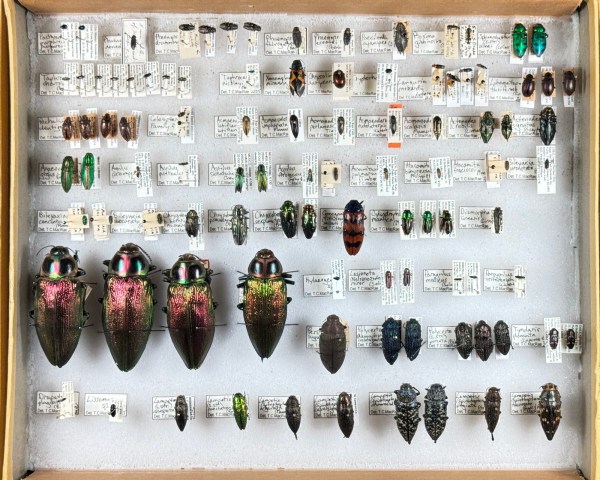
Buprestidae (plus one Elateridae) selected from specimens in the insect collection at the Illinois Natural History Survey sent for identification.

I’ve been working hard the past couple of weeks on one of three batches of Buprestidae in the insect collection at the Illinois Natural History Survey sent to me for identification. I’ve already completed one of these batches, which included all specimens strictly from Illinois. This second batch includes specimens from the not only the rest of North America (sensu lato), but South America and the West Indies as well. Out of ~450 total specimens, in this batch, I identified 167 species, with eight new state and two new country records.

Why do I do it? While I’d like to say it’s because I’m just a nice guy, and I do genuinely enjoy helping to improve the level to which public insect collections are curated, my motives aren’t completely unselfish. First, it is a chance for me to glean the specimens for new data in the form of unknown distributional and host plant records. This is a main area of interest for me, and the data provide fuel for my publications on the subject. Second, and perhaps, it is a chance to encounter species that are absent or poorly represented in my cabinets. Most public collections allow specialists to retain a certain number of duplicates of the species they identify. This allows me to increase the representation of species in my collection, which in turn increases its usefulness as a resource for even further identifications. (In this particular case, the INHS collection manager graciously allowed me even to retain a handful of singletons in exchange for some other species that helped to improved the representation in their collection.) Finally (and perhaps most importantly), regularly examining new material helps to continually refine my understanding of species concepts. Sometimes this causes me to reassess a previous identification in light of an improved understanding (a reference collection is only useful if its representatives are correctly identified).

For those wondering, here is what 165 species of Buprestidae looks like:

INHS Buprestidae .
INHS Buprestidae .
INHS Buprestidae .

©️ Ted C. MacRae 2025

Detective work

I’ve been spending time lately identifying beetles sent to me from the collection of the Illinois Natural History Survey in Champaign-Urbana. There are a lot of old specimens in the batch, which means I not only have to identify the beetles themselves, but also interpret their often cryptic, handwritten labels (a common feature of insects collected before the advent of computers and word processing programs). This particular specimen (and its label) had me confounded for quite a while before I finally figured it out.

I recognized the species instantly as Euchroma giganteum, perhaps the largest jewel beetle in the world (interestingly, there is a related but slightly smaller species called Euchroma goliath), and the obviously very old locality label on it stated simply “Peru”. That wasn’t the problem—the species is known to occur there, but the unusually dark coloration and near absence of any pubescence (hairs) on the underside are atypical for the species. There are, however, several described subspecies, including two occurring in Peru, and I suspected it might represent one of them. Unfortunately, I had no identified specimens of any of the subspecies with which I could compare the specimen, nor was I able to find images of any of the subspecies online. All I had was the literature, and most of it was written in German and French and published more than 100 years ago! However, as fortune would have it, a fellow jewel beetle enthusiast (Joshua Basham) had recently sent me translated summaries of the key papers, and after considerable study comparing the characters of the specimen with the descriptions in the literature, I decided that the specimen must represent the subspecies Euchroma giganteum harperi. There was a problem, however—that subspecies doesn’t occur anywhere near Peru. Instead, it is found in the West Indies and extreme northeastern South America (Guyana). This meant that either my identification was wrong, or the specimen is mislabeled. The latter is not an uncommon occurrence with old specimens in old collections and of uncertain provenance. Still, I could not be sure either way. Perhaps the second, much more cryptic label on the specimen could provide clues to help confirm my identification.

The first two lines clearly state the species name, but the rest of the label was simply too illegible to decipher. I studied the label with a magnifying glass, but that didn’t help, nor did putting it under a dissecting scope. As a last resort, I took a photograph of the label to post online and ask for help in deciphering it. As I was preparing the post, I noticed the “har-“ at the end of the third line, and it dawned on me that this was the first part of the subspecies name that I had determined the specimen to represent. The rest of the label then quickly fell into place— the full subspecies name with authors (Euchroma giganteum L. [= “Linnaeus”] ss. [= “subspecies”] harperi Sharp). (Now that I know this, I cannot look at the label and not see it.) With this, I felt much more confident with my identification, so much so that I took the final step and placed my own (much more legible) identification label on the specimen (along with an annotation noting the locality error). In all, I probably spent an entire hour on this specimen, but the benefit (besides the satisfaction of finally succeeding) is that I gained a much firmer understanding of the species and subspecies distinctions, which allowed me to revise the identifications of a few specimens in my own collection (though I still lack the other subspecies).

©️ Ted C. MacRae 2025