North America’s largest robber fly

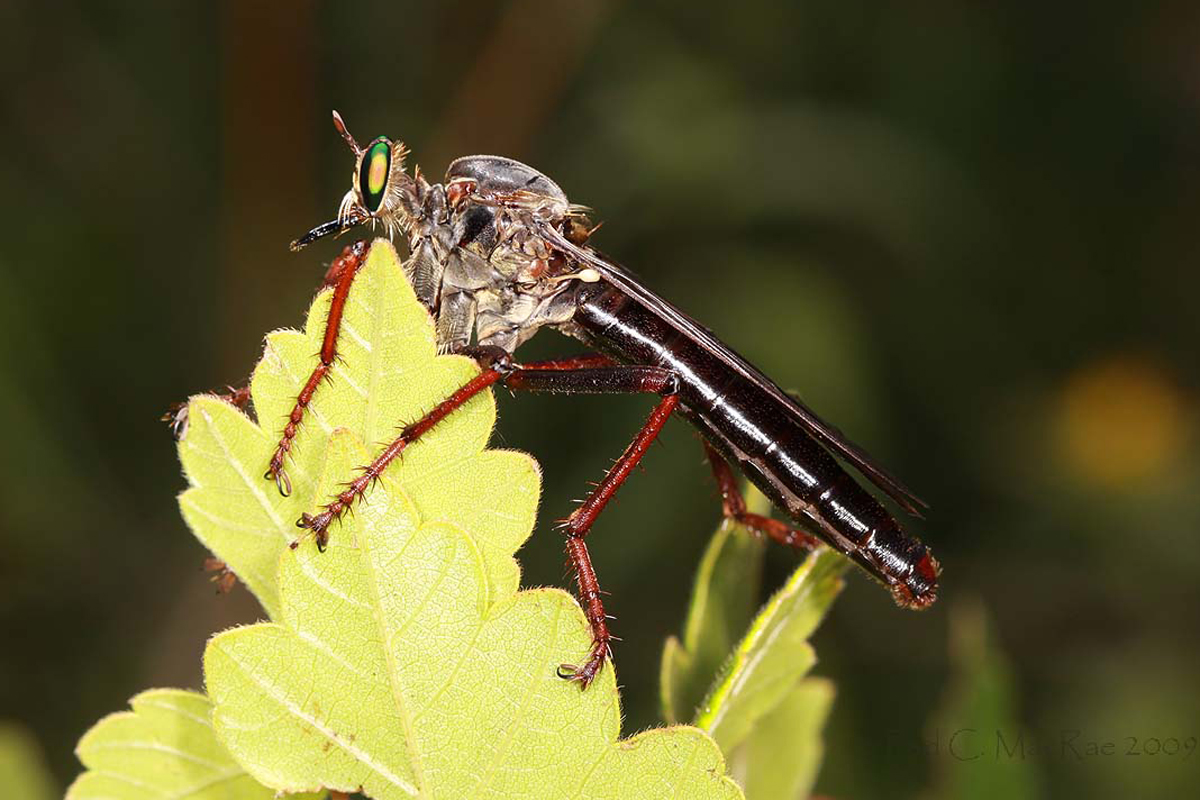
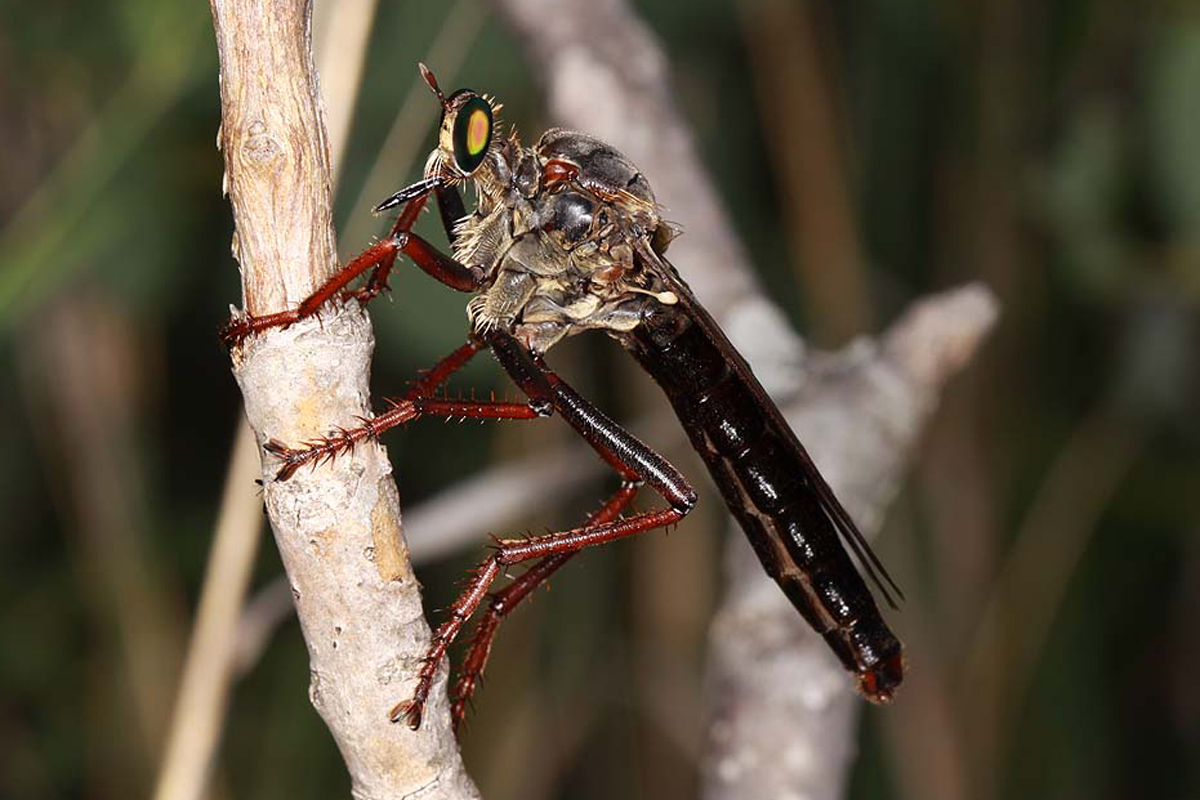
Female Microstylum morosum perched on fragrant sumac (Rhus aromatica) bush

Female Microstylum morosum perched on fragrant sumac (Rhus aromatica)

A few days ago, I featured Promachus hinei, one of the so-called “giant robber flies” and a common inhabitant of the glades and grasslands that dot Missouri’s largely forested landscape. That individual was seen at Long Bald Glade Natural Area in Caney Mountain Conservation Area, one of the many limestone glades that are a prominent feature of extreme southwestern Missouri’s White River Hills, as it snacked on a small carpenter bee (Ceratina sp.) and posed obligingly for a series of super close-up photographs. Promachus and its congeners are impressively large; however, I would see an even larger robber fly that day. I didn’t know what it was at the time, but I knew that never before had I seen such a magnificent fly, with its large, shimmering, emerald eyes, streamlined body almost devoid of setae (hairs), and ludicrously large size. These monsters were actually quite common at the glade, so I failed to appreciate the significance of what I was seeing as I chased one after another – more intent on securing photographs than specimens. This was not an easy task – they were extremely wary, rarely allowing me to approach within 12 feet no matter how cautiously and slowly I moved. Not one to back down from such a challenge (remember, I stalk tiger beetles), I persisted, traversing the rough, rock-strewn terrain amidst clumps of big bluestem (Andropogon gerardii), Indian grass (Sorghastrum nutans), and fragrant sumac (Rhus aromatica) until, at last, I got within striking distance of the impressive female shown in these photos. Taking flight before I felt assured of a good shot, I followed her repeated long, loping escape flights until I was able to get another few shots and she disappeared for good.
Same individual as in previous photo after flying to another perch.

Same individual as in previous photo after flying to another perch.

It didn’t take long after I returned home to figure out what I had seen, as there is really nothing that can be mistaken for Microstylum morosum, North America’s largest robber fly (Back 1909)¹. At 35–40 mm of length, this individual didn’t quite match the astounding 50-mm upper body length for the species (that’s 2 inches, folks!). Nonetheless, it was an impressive beast indeed! It is not surprising that North America’s largest robber fly should be a species of Microstylum, as it is this same genus that contains the world’s largest robber fly – the aptly named M. magnum from Madagascar, with a body length of 60 mm and an almost preposterous wingspan of up to 84 mm (that’s over 3 inches folks!). I don’t know if any flies exist that are larger than this, but certainly none can be more imposing.  While I’m happy with the photos that I did obtain, I must confess some disappointment that I wasn’t able to get more than these basic lateral profile shots.  Of the several photographs of this species that can be found on the web, this female, photographed by Greg Lavaty of Houston, Texas, is (in my humble opinion) certainly the most stunning.

¹ Puzzled by the use of the prefix “micro” in the genus name – hardly seeming appropriate for such an enormous fly – I asked Eric Fisher (retired, California Department of Food and Agriculture) about the name’s derivation, to which he replied, “The name refers to the quite small ‘stylus’ of the antenna apex; Macquart specifically mentions this character in his 1838 original description of the genus. (This is not a very helpful diagnostic character, as many asilids share this feature…).”

Even more significant than its size, however, was its very occurrence on this glade. Like Ospriocerus abdominalis, which I had seen just a few weeks earlier in the Loess Hills of extreme northwestern Missouri, M. morosum is a denizen of the Great Plains, and also like that species it has until now not been known from Missouri. That’s right – another new state record!  Unlike O. abdominalis, however, the Missouri occurrence of M. morosus represents a significant northeastern extension of its known range.  The species was long considered a Texas endemic until Beckemeyer and Charlton (2000) confirmed its occurrence in southeastern Arizona and documented significant range extensions into Oklahoma, Kansas, extreme southeastern Colorado, and extreme northeastern New Mexico.  Its eastern distributional limit was thought to occur along a north-south line from Douglas County, Kansas to Mayes County, Oklahoma to Brazoria County, Texas; however, Warriner (2004) documented its occurrence some 200 miles east of this line in the blackland prairies of southwestern Arkansas.  The occurrence of M. morosum in the White River Hills of Missouri represents yet another significant eastern extension of its known range – Long Bald Glade lies 185 miles NNE of the collection site in Arkansas and 155 miles ENE of the nearest known record in Mayes County, Oklahoma (Locust Grove), making it the easternmost known locality for this species.

As in Arkansas, where the collection site represents one of the highest quality blackland prairie remants in the state, Long Bald Glade represents a high quality remnant of the limestone glades that once occurrred much more extensively within Missouri’s White River Hills.  Like the blackland prairie of Arkansas, the limestone glades of the White River Hills have been dramatically reduced since EuroAmerican settlement due to land use conversion, and fire suppression and overgrazing of the remaining tracts have resulted in significant woody encroachment – chiefly by eastern red-cedar (Juniperus virginiana) – and loss of vegetational diversity. This has caused dramatic reductions in populations of the many Great Plains plant and animal species that are found here and nowhere else in the state.  Considering the overall distribution of M. morosum, it is unlikely that it occurs more extensively within Missouri than the White River Hills, emphasizing the importance of continued conservation and restoration activities in this unique part of Missouri.  However, since the White River Hills extend into northwestern Arkansas, M. morosum may occur in that part of Arkansas as well as the southwestern part of the state.

I thank Eric Fisher and Herschel Raney for confirming the identity of this species and its status as a new record for Missouri.

Photo details: Canon 100mm macro lens on Canon EOS 50D (manual mode), ISO-100, 1/250 sec, f/10-11, MT-24EX flash 1/2 power through diffuser caps.

REFERENCES:

Back, E. A. 1909. The robberflies of America, north of Mexico, belonging to the subfamilies Leptograstrinae and Dasypogoninae. Transactions of the American Entomological Society 35:137–400.

Beckemeyer, R. J. and R. E. Carlton.  2000.  Distribution of Microstylum morosum and M. galactoides (Diptera: Asilidae): significant extensions to previously reported ranges.  Entomological News 111(2):84–96.

Warriner, M. D.  2004.  First Arkansas record of the robber fly Microstylum morosum (Diptera: Asilidae).  The Southwestern Naturalist 49(1):83–84.

Copyright © Ted C. MacRae 2009

Add to FacebookAdd to NewsvineAdd to DiggAdd to Del.icio.usAdd to StumbleuponAdd to RedditAdd to BlinklistAdd to Ma.gnoliaAdd to TechnoratiAdd to Furl

Prey bee mine

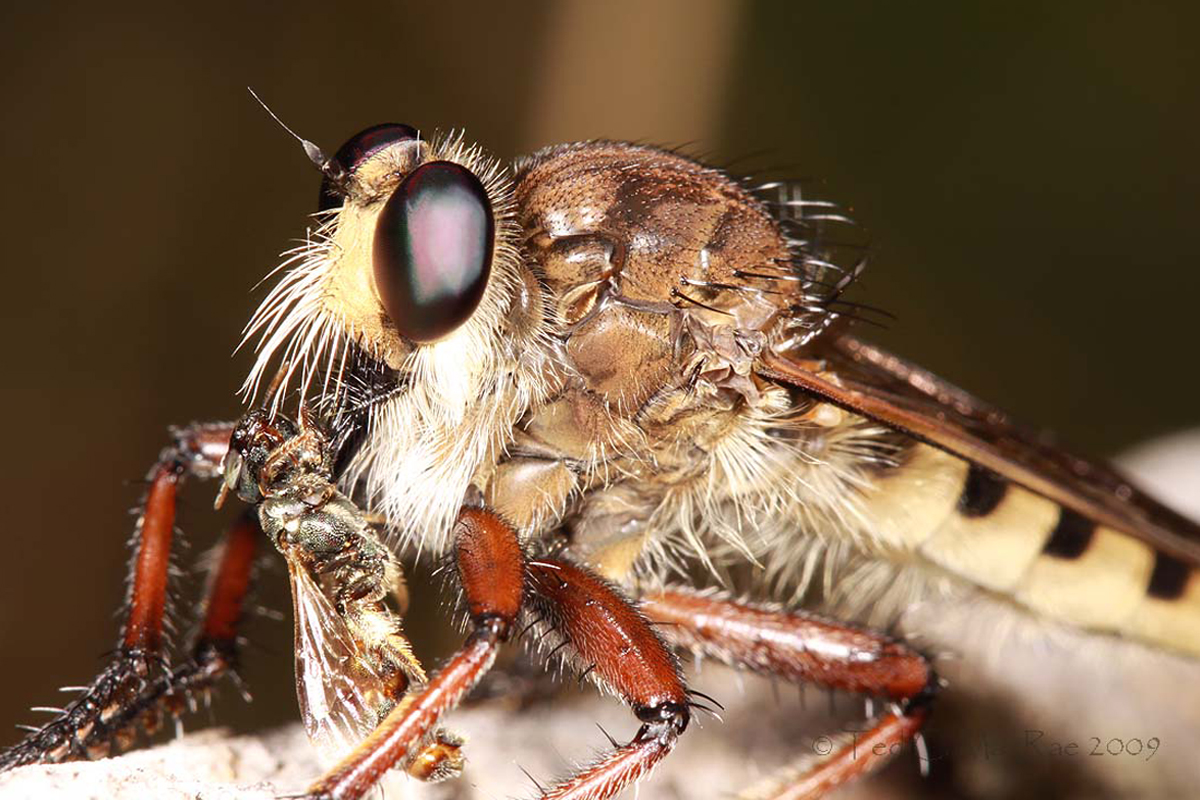
Promachus hinei preying upon a small carpenter bee

Promachus hinei preying upon a small carpenter bee

Robber flies of the genus Promachus – the so-called “giant robber flies” – are among the more conspicuous and fearless predators seen in Missouri’s glades. Able to capture almost any flying insect regardless of size, this individual – seen at Long Bald Glade Natural Area in Caney Mountain Conservation Area – was found snacking on what, according to my hymenopterist friend Mike Arduser, appears to be a female individual of the genus Ceratina (the so-called small carpenter bees in the family Apidae). Of the three “tiger-striped” (referring to the yellow and black striping of the abdomen) species of Promachus in the eastern U.S. species, P. hinei is the most common in Missouri. It is distinguished from the more southeastern P. rufipes by its reddish versus black femora and from the more northern P. vertebratus by the larger dark areas dorsally on the abdominal segments and distinctly contrasting two-toned legs. Despite their common name and impressive size, however, they are not the largest robber flies that can be seen in these glades…

Photo details: Canon 100mm macro lens on Canon EOS 50D (manual mode), ISO-100, 1/250 sec, f/13, MT-24EX flash 1/4 power through diffuser caps.

Copyright © Ted C. MacRae 2009

Add to FacebookAdd to NewsvineAdd to DiggAdd to Del.icio.usAdd to StumbleuponAdd to RedditAdd to BlinklistAdd to Ma.gnoliaAdd to TechnoratiAdd to Furl

Ant-like Tiger Beetle

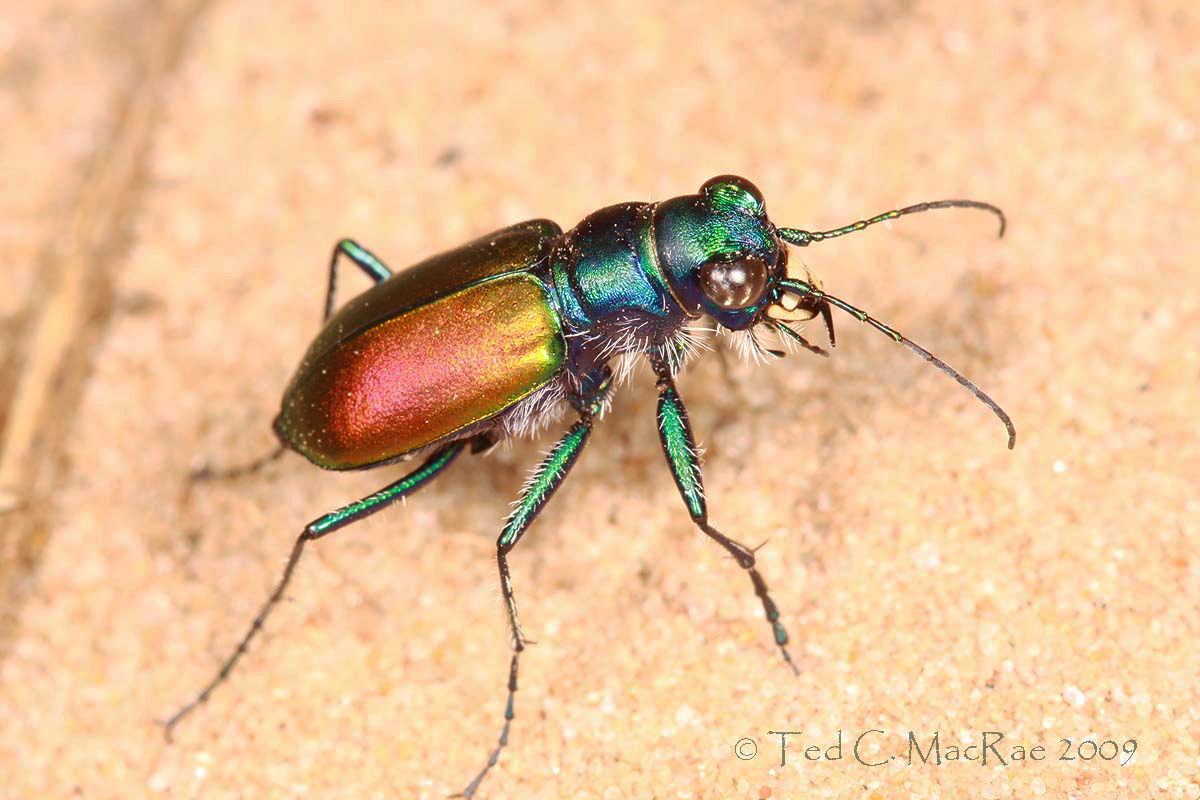
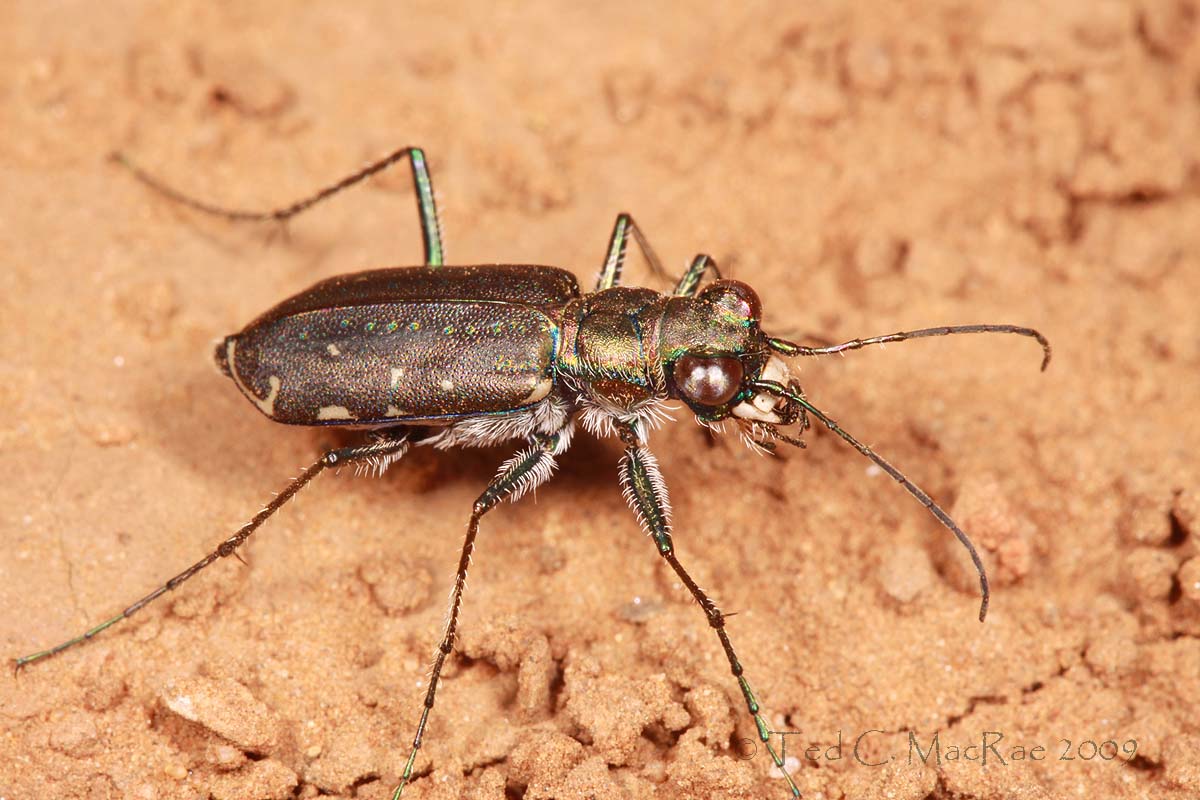
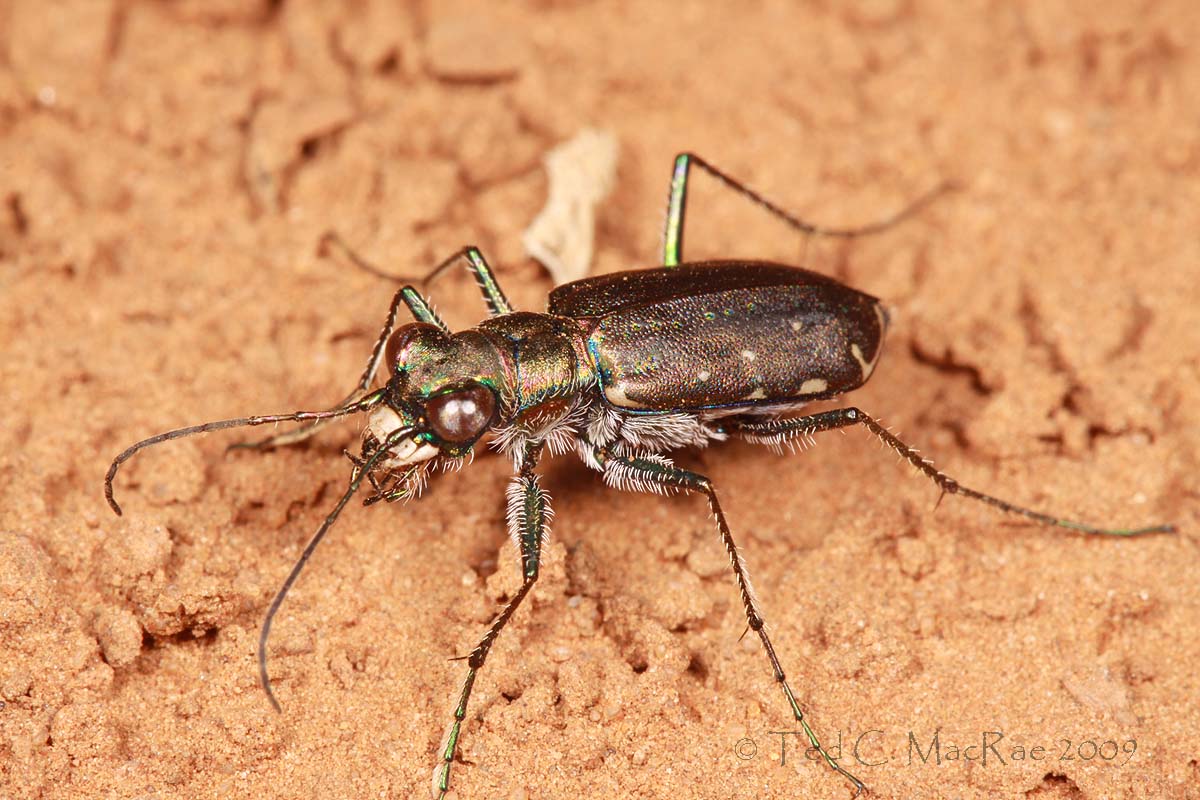
Fig. 1.  Adult female Cylindera cursitans

Fig. 1. Adult female Cylindera cursitans

One of the more recent of the 24 species of tiger beetles that we’ve collected in Missouri is Cylindera cursitans (Ant-like Tiger Beetle).  Although not yet formally recorded from the state, we’ve known about its occurrence here for some time now based on a single specimen deposited in the Enns Entomology Museum (University of Missouri).  With no more locality information to go on than the frustratingly vague “nr. Portageville,” my colleague Chris Brown and I made several attempts over the years to look for this species – eventually deciding that one particular spot where the highway stretched east of Portageville and dead-ended at the Mississippi River was the most likely collection site.  This locality, which we would come to call the “end of the hiway” spot (I suspect that every state with at least one tiger beetle aficionado has one or more so-named spots), proved to be a true tiger beetle “hot-spot,” with no less than 8 species of tiger beetles found along its sandy banks in our first few surveys.  However, C. cursitans was not among them, and success would only come with a little bit of serendipity when I received an email in 2007 from Kent Fothergill.  Kent explained that he had learned of me from my Missouri Tigers article (MacRae and Brown 2001), offered some comments about the tiger beetles that he had been finding since his recent move to southeast Missouri, and included full label data from the tiger beetles in the small collection of the Delta Research Center where his then-fianceé had secured a position as a research entomologist.  I wrote Kent back, thanked him for the data, and added this plea for assistance:

There is a single specimen of Cicindela cursitans in the UMC collection, it was collected in “nr. Portageville” on July 7, 1991.  We have tried several times without success to locate this species in Missouri – it’s the only species that we have not relocated.  If you have any interest in looking for it that would be great.  Attached is a pdf of recent paper describing its habits and biology in Nebraska.

Fig. 2.  Adult female Cylindera cursitans ovipositing into substrate.

Fig. 2. Adult female Cylindera cursitans ovipositing in moist sand/loam substrate.

Little did I know how catalytic that comment would be – the very next day I received an email from Kent not only stating that he found it, but that he found it at the “end of the hiway” spot where we thought it might be.  A digital photo confirmed its identity, and the that weekend I blasted down to meet Kent and see the beetle for myself.  I would see just two beetles that day, but both were at a new locality about one mile south of where Kent had originally spotted them.  Kent would later find them at yet another locality further north along the Mississippi River, and in 2008 the three of us (Kent, Chris, and myself) conducted an intensive survey of potential habitats in southeastern Missouri that identified additional populations both north and south of the original localities.  We concluded that populations of C. cursitans, were restricted in southeast Missouri to the ribbons of wet bottomland forest that occupy the narrow corridor between the Mississippi River and the levees that confine it. However, the populations appeared secure and likely did not require any immediate conservation measures to ensure their long-term survival within the state. 

Fig. 3.  Adult male Cylindera cursitans.

Fig. 3. Adult male Cylindera cursitans.

The bottomland forests that harbor C. cursitans in southeast Missouri (Fig. 3) contrast sharply with the wet meadow habitats reported for populations in Nebraska (Brust et al. 2005a). Within these habitats, the beetles themselves are very easily overlooked because of their small size and rapid running capabilities.  In addition, adult activity peaks in June and begin to wane in July.  The combination of these factors explains our initial difficulty in finding the beetle; however, with a proper search image and better understanding of its temporal occurrence and habitat preference, we have since found the beetles to be rather easily located.  A lingering question from last year’s survey is, how far north along the Mississippi River does C. cursitans occur? Furthermore, might the species also occur in northeast Missouri due to its proximity to the Nebraska populations?  Most of Missouri straddles a curious distributional gap that separates the bottomland forest dwelling populations in the southeast from the wet meadow dwelling populations in the upper Great Plains (Hoback and Riggins 2001). This has led some authors to suggest that the observed distribution represents two disjunct forms and potentially two species (Ron Huber, pers. comm.). Additional surveys of potential habitat further north along the Mississippi River and in northwest Missouri along the Missouri River could prove useful in confirming or refuting that suggestion. 

Fig. 3.  Habitat for Cylindera cursitans, along Mississippi River, vic. Donaldson Point Conservation Area, New Madrid Co., Missouri.

Fig. 4. Habitat for Cylindera cursitans, along Mississippi River, vic. Donaldson Point Conservation Area, New Madrid Co., Missouri.

While such surveys were not possible this year, long-time fieldmate Rich Thoma and I were able to visit the Southeastern Lowlands in June to examine a few habitats along the Mississippi River found a little further north of the northernmost extent of our 2008 survey area. We succeeded in finding another population at one of these sites near the northern limit of the Southeastern Lowlands.  The individuals shown here (Figs. 1-3) were collected from that location (extreme northeastern Mississippi Co.), confined on local sand/loam substrate, and photographed a few days later.  In one of the photos (Fig. 2), a female can be seen in the act of ovipositing into a hole dug into the substrate with her ovipositor.  The more observant readers might notice a strong resemblance between this species and another species to which I have devoted several posts, Cylindera celeripes (Swift Tiger Beetle).  These two species are, in fact, quite closely related and can be distinguished by characters of the elytra (posterior portion not or only slightly expanded and lateral white maculations complete in cursitans, distinctly expanded and maculations reduced in celeripes) (Pearson et al. 2006), habitat (cursitans in moist lowland sites, celeripes in dry upland sites), and distribution (southeast Nebraska/southwest Iowa is the only area where the distributions of these two species overlap, although C. celeripes has not been seen in Nebraska for nearly 100 years! (Brust et al. 2005b)).

Photo details:
Figs. 1-3: Canon 100mm macro lens with Kenco extension tubes (68mm) on Canon EOS 50D (manual mode), ISO-100, 1/250 sec, f/18, MT-24EX flash 1/2 power through diffuser caps.
Fig. 4: Panasonic DMC-FX3 (landscape mode), ISO-100, 1/25 sec, f/2.8, natural light.

REFERENCES:

Brust, M., W. Hoback and C. B. Knisley.  2005a.  Biology, habitat preference, and larval description of Cicindela cursitans LeConte (Coleoptera: Carabidae: Cicindelinae).  The Coleopterists Bulletin 59(3):379-390.

Brust, M. L., S. M. Spomer and W. W. Hoback.  2005b.  Tiger Beetles of Nebraska.  University of Nebraska at Kearney.  http://www.unk.edu (Version 5APR2005).


Hoback, W. W. and J. L. Riggins.  2001.  Tiger beetles of the United States.  Jamestown, ND: Northern Prairie Wildlife Research Center Online.  http://www.npwrc.usgs.gov/resource/distr/insects/tigb/index.htm (Version 12DEC2003).

MacRae, T. C., and C. R. Brown. 2001. Missouri Tigers. Missouri Conservationist 62(6):14–19.

Pearson, D. L., C. B. Knisley and C. J. Kazilek. 2006. A Field Guide to the Tiger Beetles of the United States and Canada. Oxford University Press, New York, 227 pp.

Copyright © Ted C. MacRae 2009

Add to FacebookAdd to NewsvineAdd to DiggAdd to Del.icio.usAdd to StumbleuponAdd to RedditAdd to BlinklistAdd to Ma.gnoliaAdd to TechnoratiAdd to Furl

A bit of housekeeping

I hope you’ll forgive the lack of pretty bug pictures and witty prose in today’s post – I have a few updates and adminstrative issues that I’d like to take care of.

Circus of the Spineless
This notice is a few days late, but Circus of the Spineless # 43 is up at Wanderin’ Weeta.  Susannah has done a great job of assembling blog posts on a diversity of invertebrates from anemones to annelids, bryozoans to barnacles, decapods to gastropods, and of course – insects.  In the latter group, all of the major orders are covered (including beetles by some guy that likes tiger beetles).

Expanded Blogroll
It has been quite a while since I last made mention of new additions to my ever-expanding blogroll.  I’m trying to maintain a fairly comprehensive list of blogs that either focus primarily on insects or feature compelling natural history discussions, and it seems that almost every week I find another one that either began recently or somehow escaped my earlier attention.  A few of these more recent additions deserve special mention for their interesting subjects, superior writing, quality photographic content, etc.

Rate My Posts
WordPress has a new widget that allows readers to rate the quality of posts.  I thought I would open myself up to this potential for praise or criticism and have activated this feature on this blog (and also my other blog, Bikes Bugs and Bones).  It’s a little jickery in that the “comments” link must be clicked in order to see the rating widget, which appears at the bottom of the post as 5 blank stars.  It’s a typical rating scale, with 1 star being the worst and 5 stars being the best.  I know a lot of readers don’t like to leave comments (although I heartily encourage them), but perhaps you would be willing to provide feedback in the form of a rating.  The ratings are completely anonymous – no IP addresses are recorded by the rating widget, so there is no way for me to know who voted or how.  Over time, as ratings accumulate for posts, I will be able to see what kinds of posts people really like (and which they really don’t).  This can be your way to contribute to the future direction of this blog!

  • 5 Stars = Excellent – use this for my very best pieces.
  • 4 Stars = Very Good – you really liked it, maybe just minor criticisms.
  • 3 Stars = Average – not bad, not great, it did the job.
  • 2 Stars = Fair – not one of my better pieces, a bad day perhaps.
  • 1 Star = Poor – well, let’s just hope I don’t get too many of these.

Editorial Duties
One of my long term goals is to be Managing Editor for an entomological journal.  Despite the volunteer nature of such a position, it’s not one that somebody can just walk into – dues must be paid.  I got a foot in the door a few years ago when I began serving as Coleoptera Subject Editor for The Pan-Pacific Entomologist, the journal of the Pacific Coast Entomological Society (we would welcome your manuscript dealing with western entomology in any aspect).  It has been an enjoyable experience, and I guess I’m doing a decent job since I was invited this summer to join the editorial team of the online journal Zootaxa.  This “mega-journal for zoological taxonomists in the world” has quickly become the leading journal for new taxa and taxonomic or nomenclatural acts, based on the coverage and indexing of Zoological Record since 2004.  This is possible only because of its team of 141 editors that cover the entire breadth of animal taxa – 17 of which (including me) handle the vast insect order Coleoptera.  Ever the glutton for punishment, I’ve also just accepted an invitation by the Webster Groves Nature Study Society to take over editorship of their monthly newsletter, Nature Notes.  I suppose the combination of these three editorial positions will let me know if I really want to pursue full editorship of a major journal at some point!

Okay, I can’t leave you without any kind of photograph – here are a couple of shots of Cicindela scutellaris, or festive tiger beetle. This male individual represents the stunningly beautiful nominotypical subspecies occupying the western part of the species’ range – it was photographed on sand exposures in shinnery oak shrubland habitat at Packsaddle Wildlife Management Area in extreme northwestern Oklahoma this past June.

IMG_0540_1200x800_enh

IMG_0547_1200x800

Photo details: Canon 100mm macro lens on Canon EOS 50D (manual mode), ISO-100, 1/250 sec, f/14-16, MT-24EX flash 1/4 power through diffuser caps.

Copyright © Ted C. MacRae

Add to FacebookAdd to NewsvineAdd to DiggAdd to Del.icio.usAdd to StumbleuponAdd to RedditAdd to BlinklistAdd to Ma.gnoliaAdd to TechnoratiAdd to Furl

North America’s smallest rattlesnake

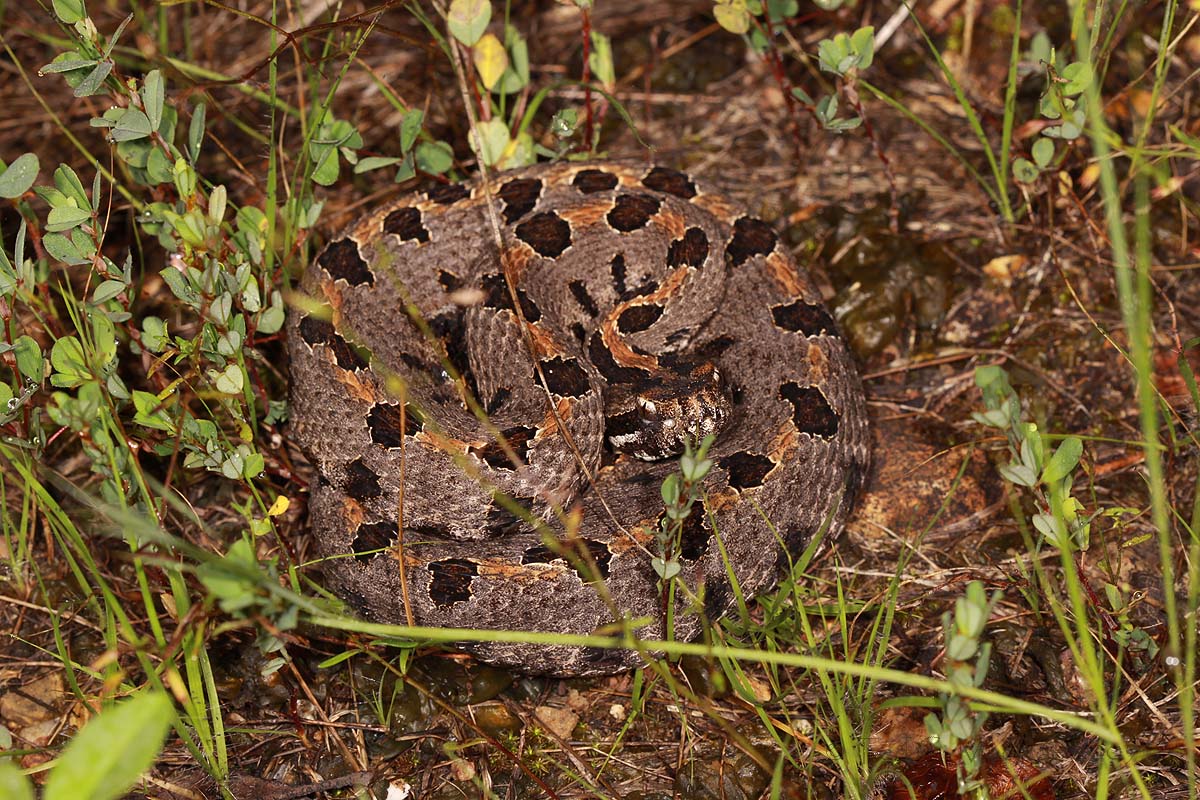
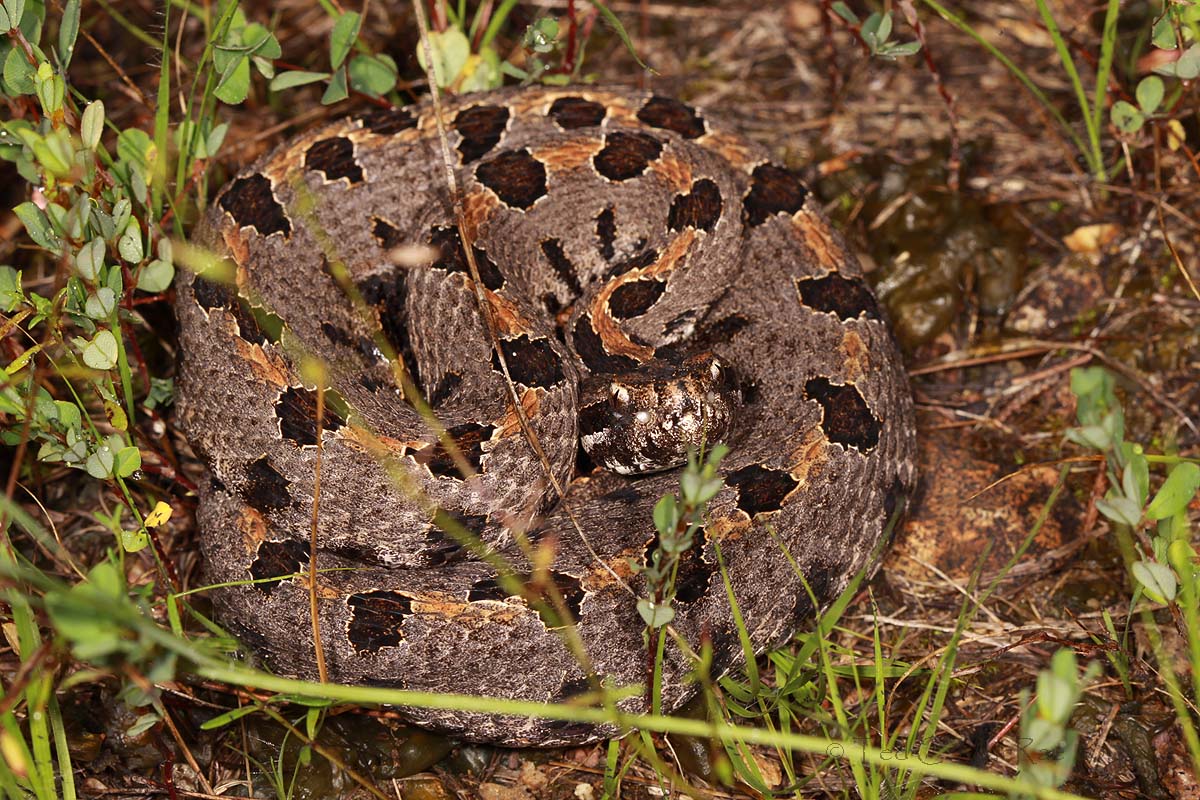
Despite tramping through the brush with great frequency during most of my life, I haven’t really seen that many noteworthy reptiles.  I don’t know whether its because I’ve failed to actually encounter them or whether my singleminded obsession with insects above all other things natural has instead prevented me from seeing what was right in front of me.  Regardless of the reason, all that has seemed to change during the past two seasons (strangely coincident with my decision to start carrying a camera), and I now seem to be enjoying a bit of a reptile bonanza.  Last summer I featured a super-aggressive prairie rattlesnake from a trip to the Black Hills of South Dakota and an uncooperative dusty hognosed snake from Missouri’s critically imperiled sand prairies (both first-time sightings for me).  The reptilian treats continued this year – I saw my first juvenile Osage copperhead in May to go along with the several adults that I’ve encountered, and shortly afterwards during a June trip to northwestern Oklahoma I was treated to a gorgeous male eastern collard lizard, two Texas horned lizards, and a much more cooperative western hognosed snake (the last two being first-time sightings for me).  There was another herp that I saw during that Oklahoma trip, but I did not feature it here because I had stupidly declined to strap the camera bag to my back during a quick look at a roadside habitat.  That sighting was another first-timer for me – a western pygmy rattlesnake (Sistrurus miliaris streckeri).  I’m no herp expert, so wasn’t sure what it was at the time, but I later learned that its small size and distinctive markings were quite diagnostic.

IMG_1014_1200x800
Western pygmy rattlesnake – Sistrurus miliarius streckeri

Amazingly, I encountered this same species again just a few weeks later during a visit to the White River Hills of extreme southwestern Missouri.  It was during the second of two trips to the region to search for the stunningly beautiful bumelia longhorned beetle, Plinthocoelium suaveolens plicatum (family Cerambycidae), and the weather during that day – continuous drizzle and low, threatening clouds – had not been at all conducive for finding such a sun loving beetle.  After searching an area where I knew the beetles occurred, without success, daughter Madison and I resigned that the drizzle was here to stay and decided to pass the rest of the day with some hiking at one of Missouri’s most spectacularly wild and beautiful places, Hercules Glades Wilderness.  A splendid mix of post oak savannahs and limestone glades intersperses through the oak/hickory forests in these rugged hills, creating some of Missouri’s most scenic vistas.  Near the end of the hike at the edge of one of these glades on the high point of Coy Bald, I saw this little individual coiled up underneath an eastern red-cedar (Juniperus virginiana) tree.  Unlike the terrifyingly aggressive prairie rattlesnakes I encountered in South Dakota last fall, this snake seem to be relying upon its cryptic coloration to avoid detection, rattling only after I had approached quite closely… or maybe it was only then I could actually hear the rattle, which was barely audible and sounded much like the buzz of a small katydid.

Pygmy rattlesnakes are the smallest rattlesnakes in North America, growing to around 15-25 inches long – this individual looked to be about 18-20 inches in length.  They are one of only two U.S. species in the primitive rattlesnake genus Sistrurus – the other being the larger wet prairie inhabiting massasauga (S. catenatus).  All other rattlesnakes (28 species, 13 in the U.S.) belong to the genus Crotalus (Smith et al. 2001).  Western pygmy rattlesnakes are not really a western U.S. species, but rather the westernmost subspecies of this southeastern U.S. species (with subspecies miliarius and streckeri occupying the northeastern and southeastern portions, respectively, of its range).  In Missouri, it is not nearly as common as the timber rattlesnake (Crotalus horridus), occurring only in the extreme southern Ozarks along the border with Arkansas and up into the St. Francois Mountains of the eastern Ozarks (Johnson 1997).  Although no known human deaths have ever been caused by this species, known locally as the “ground rattler,” it is nevertheless poisonous and worthy of respect.  I must admit to having been lulled a little bit by its calmness – much like the juvenile copperhead I photographed in May – and found myself tempted to approach ever closer for photographs.  The photograph below represents the closest that I was able to get before it began “striking” at me – whether these were bluff strikes intended to frighten or actual attempts to bite I do not know.  Suffice it to say that I “got the message” and ended my attempts to get even closer.  Daughter Madison watched in nervous amazement as all this was going on, and afterwards I tried to impress upon her young, virgin mind what a rare and wonderful experience we’d just had.  Perhaps I succeeded, as this was the first story she told to her head-shaking mother upon our return home the following evening!

IMG_1016_1200x800

Photo details: Canon 100mm macro lens on Canon EOS 50D, ISO 100, 1/250 sec, f/9-10, MT-24EX flash 1/2 power through diffuser caps.

REFERENCES:

Johnson, T. R. 1997. The Amphibians and Reptiles of Missouri. Missouri Department of Conservation, Jefferson City, 368 pp.

Smith, H. M., E. D. Brodie, D. M. Dennis and S. Barlowe. 2001. Reptiles of North America: A Guide to Field Identification. Golden Field Guide from St. Martin’s Press, New York, 240 pp.

Copyright © Ted C. MacRae 2009

Add to FacebookAdd to NewsvineAdd to DiggAdd to Del.icio.usAdd to StumbleuponAdd to RedditAdd to BlinklistAdd to Ma.gnoliaAdd to TechnoratiAdd to Furl

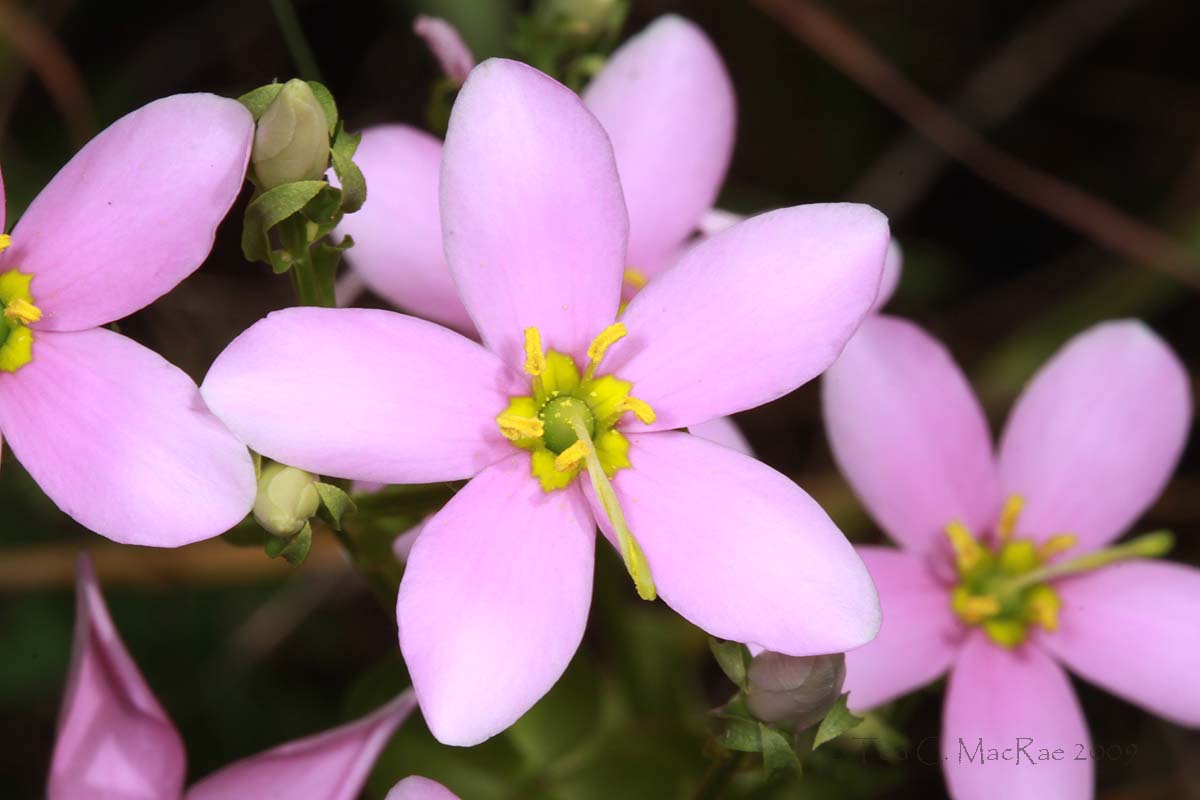
Friday flower – Sabatia angularis

Photo details: Canon 100mm macro lens on Canon EOS 50D, ISO 100, 1/60 sec, f/22, MT-24EX flash 1/4 power w/ diffuser caps.

Photo details: Canon 100mm macro lens on Canon EOS 50D, ISO 100, 1/60 sec, f/22, MT-24EX flash 1/4 power w/ diffuser caps.

During my explorations of the glades in the White River Hills in southwestern Missouri this past July, I noticed large populations of a flower that I couldn’t recall having ever seen before.  Vivid, striking pink petals with contrasting yellow anthers and a curiously recurved style, it seemed difficult to believe that I had simply overlooked it during my many previous visits to the area over the past 25 years.  Perhaps it was the time of year – I’ve generally avoided these glades during the month of July – normally hot, dry, and baked to a crisp.  This year and the last, however, have been different, with timely rains resulting in unusually lush July vegetation.  I also had no clue as to the identity of the plant – the square stems and opposite branching suggested a mint of some kind, but the flowers were definitely not “minty.”  I would have to simply take photographs and hope that I captured enough key characters to allow its identification once I returned home.

As it turns out, I was able to easily identify the plant as Sabatia angularis¹ (rose pink, rose gentian) using the late Dan Tenaglia’s excellent Missouri Plants website, and I wasn’t the only person to notice an apparent population explosion of this beautiful species across the Missouri Ozarks (see Justin Thomas’ excellent essay, A Sabatia Induced Rant).  As suggested by the common name, this species is in the family Gentianaceae, but it doesn’t resemble other gentians in general appearance, especially the iconic Gentianopsis crinita (greater fringed gentian) and, closer to home, Gentiana puberulenta (downy gentian), that usually come to mind upon mention of this plant family.

¹ Sabatia, for Liberato Sabbati, an 18th Century Italian botanist; angularis, Latin for angular, referring to the angled stem.

This plant occurs in the eastern U.S. west to Wisconsin in the north and Texas in the south.  Denison (1978) and Kurz (1999) both mention a preference by this species for acid soils, usually in rocky open woods, glades, old fields, and upland ridges – habitats which occur primarily across southern Missouri.  The opposite pattern of branching distinguishes this species from the alternately branched, somewhat smaller, and much less commonly encountered S. campestris (prairie rose gentian), which is most commonly encountered in the unglaciated plains of west-central Missouri.

These plants were common throughout the many glades that I visited during my two trips to the White River Hills in July, adding a vibrant splash of color to the glades after most of the other flowering plants found in these habitats have long flowered out and contrasting beautifully against the green background of uncommonly lush July grasses.

REFERENCES:

Denison, E.  1978.  Missouri Wildflowers.  A Field Guide to Wildflowers of Missouri and Adjacent Areas, 3rd revised edition.  Missouri Department of Conservation, Jefferson City, 286 pp.

Kurz, D.  1999.  Ozark Wildflowers.  A Field Guide.  Globe Pequot Press, Guilford, Connecticutt, 262 pp.

Copyright © Ted C. MacRae 2009
Add to FacebookAdd to NewsvineAdd to DiggAdd to Del.icio.usAdd to StumbleuponAdd to RedditAdd to BlinklistAdd to Ma.gnoliaAdd to TechnoratiAdd to Furl

The ubiquitous tiger beetle

Cicindela ubiquita

Cicindela ubiquita - ubiquitous tiger beetle

Back in early June as I began my exploration of The Nature Conservancy’s Four Canyon Preserve in northwestern Oklahoma, one of the very first insect species that I encountered was Cicindela ubiquita¹ (the ubiquitous tiger beetle).  This ubiquitous species is restricted to nearly the entire North American continent and is found only in just about any habitat you can imagine.  It seems to especially favor wet or dry areas in lowland or upland habitats with little or lots of vegetation.  At Four Canyon Preserve, it showed a distinct preference for dry upland sand and clay sites and wet bottomland sand sites.  I did not find it in wet bottomland clay sites – probably because no such habitat exists within the preserve.

¹ Originally described as Cicindela punctulata (punctured tiger beetle) by Olivier (1790).  This name has been accepted by virtually all subsequent authors and is still used in such recent works as Freitag (1999), Pearson et al. (2006), and Erwin and Pearson (2008).

IMG_0371_1200x800I had seen this species previously in Missouri on just about every collecting trip I’ve ever taken within that state.  Populations in Missouri seem to look exactly like the population here at Four Canyon Preserve but favor other habitats, including lawns, soybean fields, any dirt road, gravel parking lots, and cement sidewalks (although I have so far failed to find larval burrows in the latter, suggesting a greater level of habitat selectivity during the larval stage).  Based on examination of specimens in both my collection and that of the Enns Entomology Museum at the University of Missouri-Columbia, I can’t seem to find any county in Missouri where this beetle does not occur.

IMG_0372_1200x800An interesting feature of this species is that its adult activity period seems to exclude the winter months.  Thus far, I have only succeeded in finding active adults during those months when temperatures routinely surpass the freezing point (April through November).  It also apparently has been unable to colonize the Pacific Coast of North America – the reasons for this extreme selectivity will remain unclear until further research can be done.

Despite the common usage of the name Cicindela punctulata for this species, the following quotes are offered to support my contention that the valid name of this species should be Cicindela ubiquita:

The ubiquitous Cicindela (Cicindelidia) punctulata battling ants. — somatochlora.

This species and C. repanda are the most common and ubiquitous in the state. — Graves (1963).

C. punctulata punculata is almost ubiquitous in Colorado. — J. P. Schmidt

Notes: Abundant statewide; ubiquitous… — Mike Reese

this same pond were the ubiquitous C. repanda Dejean and C. punctulata Olivier. — Charlton and Kopper (2000).

Photo details: Canon 100mm macro lens on Canon EOS 50D, ISO 100, 1/250 sec, f/16, MT-24EX flash 1/4 power through diffuser caps.

REFERENCES:

Charlton, R. E. and B. J. Kopper.  2000.  An unexpected range extension for Cicindela trifasciata F. (Coleoptera: Carabidae: Cicindelinae).  The Coleopterists Bulletin 54(2):266-268.

Erwin, T. L. and D. L. Pearson. 2008. A Treatise on the Western Hemisphere Caraboidea (Coleoptera). Their classification, distributions, and ways of life. Volume II (Carabidae-Nebriiformes 2-Cicindelitae). Pensoft Series Faunistica 84. Pensoft Publishers, Sofia, 400 pp.

Freitag, R.  1999.  Catalogue of the tiger beetles of Canada and the United States.  National Research Council Canada, Ottawa, Ontario, 195 pp.

Graves, R. C.  1963.  The Cicindelidae of Michigan (Coleoptera).  American Midland Naturalist 69(2):492-507.

Olivier, G. A.  1790.  Entomologie ou histoire naturelle des insectos.  Paris, 2, 1-32.

Pearson, D. L., C. B. Knisley and C. J. Kazilek. 2006. A Field Guide to the Tiger Beetles of the United States and Canada. Oxford University Press, New York, 227 pp.

Copyright © Ted C. MacRae 2009

Add to FacebookAdd to NewsvineAdd to DiggAdd to Del.icio.usAdd to StumbleuponAdd to RedditAdd to BlinklistAdd to Ma.gnoliaAdd to TechnoratiAdd to Furl

North America’s longest insect

This past June might be the most successful month entomologically that I’ve ever had.  The excitement of discovering a robust population of Cylindera celeripes (swift tiger beetle) (previously considered one of North America’s rarest tiger beetles) in northwestern Oklahoma lasted only two weeks before being eclipsed by our long-awaited success at finding this same species also in Missouri.  Icing on the cake was provided by finding Ellipsoptera macra (sandy stream tiger beetle) – the last tiger beetle species we had yet to encounter in Missouri, and significant new records for the tiny prairie cicada, Beameria venosa, and the impressive robber fly, Ospriocerus abdominalis, in Missouri’s critically imperiled loess hilltop prairies.  With that rapid-succession-success, my thoughts immediately turned to another of Missouri’s unique natural communities – the dolomite glades of the White River Hills in the extreme southwestern part of the state.  In fact, I had already been yearning to return to the White River Hills, having last visited some years ago and recalling – from the perspective now as an insect photographer – the many photogenic insect species that I’ve encountered there.  Chief among them is Plinthocoelium suaveolens (bumelia borer), a spectacularly beautiful longhorned beetle of neotropical affinity that must be seen to be believed and which I had observed here several years ago in fair numbers as they perched on the lower trunks of their presumed larval host, Sideroxylon (= Bumelia) lanuginosa of the family Sapotaceae.  I had even mentioned to my colleague Chris Brown, as we began the first day of our planned multi-weekend search for C. celeripes and C. macra in northwestern Missouri, that my dream scenario was that we would find both celeripes and macra on that first weekend, negating the need for additional survey the following weekends, in which case we could shoot down to the White River Hills to look for Plinthocoelium.  Who knew how prescient that comment would be!

Megaphasma denticrus - giant walkingstick

Megaphasma denticrus - giant walkingstick

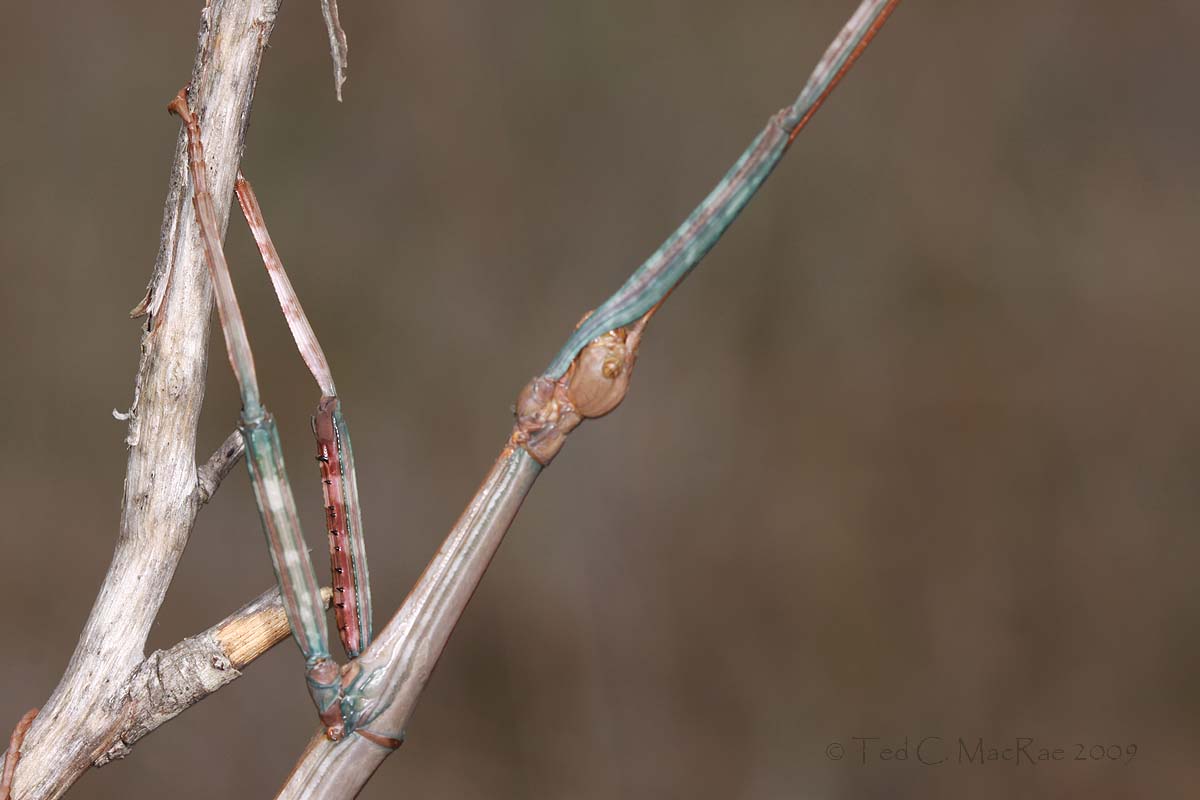
I won’t keep you in suspense – I succeeded in finding and photographing Plinthocoelium, although (happily) there is more to the story than just that.  I’ll share that experience here soon, but first I want to discuss another insect I saw on the first of my two July visits to the White River Hills – Megaphasma denticrus¹ (giant walkingstick).  As implied by its common name, this walkingstick is enormous – females (typically larger than males) can reach lengths of 150+ mm (that’s 6 inches, folks!), making it officially the longest insect species in all of North America.  IMG_0909_1200x800The female I feature here was solidly in that range, and with her front legs held outstretched in front of her (as pictured above), total length exceeded 8 inches.  Of course, this pales in comparison to a related species from Borneo, individuals of which have been documented measuring more than 18 inches in length!  The giant walkingstick is distributed primarily in the south-central U.S. – especially Texas, although records do exist from as far north and east as Iowa, Wisconsin, and Indiana (Arment 2005). I have encountered this species a few times before – always in the White River Hills, but Arment (2005) also records the species from several other counties in the Ozark Highlands across southern Missouri and Arkansas.  In addition to its great size, both sexes of this species can be distinguished from other walkingsticks by the rows of numerous teeth on the underside of the middle (meso-) femur (easily seen in the enlarged view of Photo 2 above) and by the very long antennae (longer than the front femur).  Color is variable – other individuals I have seen are tan with bright red dorsal stripes on the thoracic segments.

¹ Formerly classified with grasshoppers and their kin in the order Orthoptera, walkingsticks are now placed their own order, Phasmatodea, the name being derived from the Greek phasma (apparition, ghost) in reference to their cryptic appearance and behavior (the alternative spellings Phasmodea and Phasmida are improper formations from the Greek root – see Grimaldi and Engel 2005).  The genus name, Megaphasma, thus means “giant walkingstick.”  The specific epithet, denticrus, is derived from the Latin den (tooth) and crus (leg), presumably a reference to the toothed underside of the mesofemur. Many authors, including even some taxonomists (e.g., Beamer 1932), have mispelled the name as “dentricus” – nonsensical in Latin – with some even using both spellings in the same paper (e.g., Maginnis et al. 2008)!

Of course, an outstanding feature of this species, and all walkingsticks in general, is its uncanny resemblance to sticks and twigs.  This cryptic appearance is further augmented behaviorally by the habit of “swaying” back and forth to simulate movement in a gentle breeze.  I must confess that I did not even notice this large female individual – less than two feet away on a low branch – until she started moving about.  Once spotted, a walkingstick of this size would seem to be a tasty – and defenseless – morsel for some avian predator; however, they have another defensive tactic up their sleeve – autotomy (i.e., the ability to shed appendages in response to predatory attack). IMG_0913_1200x800While it may seem that their long, delicate-looking legs are simply “pulled off” by the predator, fortuitously allowing the walkingstick to clamber to safety, leg shed is actually controlled by the central nervous system in response to external stimuli (e.g., grabbing of the leg).  Breakage occurs at predetermined abcission points, which are rapidly sealed after shedding to prevent excessive loss of body fluids.  I experienced this first hand – lacking any container large enough to hold the enormous female, I gently placed her into my net and gingerly carried her back to the truck, only to find a hind leg already shed by the time I got back.  I decided the effort to glue one (or more) legs in place to acheive a well-curated specimen exceeded my interest in starting a collection of this particular group of insects, so I let her go.  Presumably she crawled away to safety, though sadly no longer the ‘perfect’ specimen that I first encountered.

Photo details:
Photo 1 (full insect): Canon 100mm macro lens on Canon EOS 50D (auto mode), ISO 200, 1/320 sec, f/5.6, natural light.
Photos 2 (midrange) and 3 (closeup): same except (manual mode), ISO 100, 1/60 (Photo 2) or 1/250 (Photo 3) sec, f/10 (Photo 2) or f/20 (Photo 3), MT-24EX flash 1/4 power w/ diffuser caps.

REFERENCES:

Arment, C. 2005. Stick Insects of the Continental United States and Canada: Species and Early Studies. Coachwhip Publications, Landisville, Pennsylvania, 202 pp.

Beamer, R. H. 1932. The giant walking-stick (Megaphasma dentricus (Stal.)) found in Kansas. Journal of the Kansas Entomological Society 5(1):28.

Grimaldi, D. and M. S. Engel. 2005. Evolution of the Insects. Cambridge University Press, New York, xv + 755 pp.

Maginnis, T. L., Cool, C. L. and J. L. Muniz. 2008. Some observations on the mating behavior of the giant walkingstick, Megaphasma dentricus (Orthoptera: Phasmidae). Texas Journal of Science 60(1):57-62.

Copyright © Ted C. MacRae 2009

Add to FacebookAdd to NewsvineAdd to DiggAdd to Del.icio.usAdd to StumbleuponAdd to RedditAdd to BlinklistAdd to Ma.gnoliaAdd to TechnoratiAdd to Furl