Super Crop Challenge #12

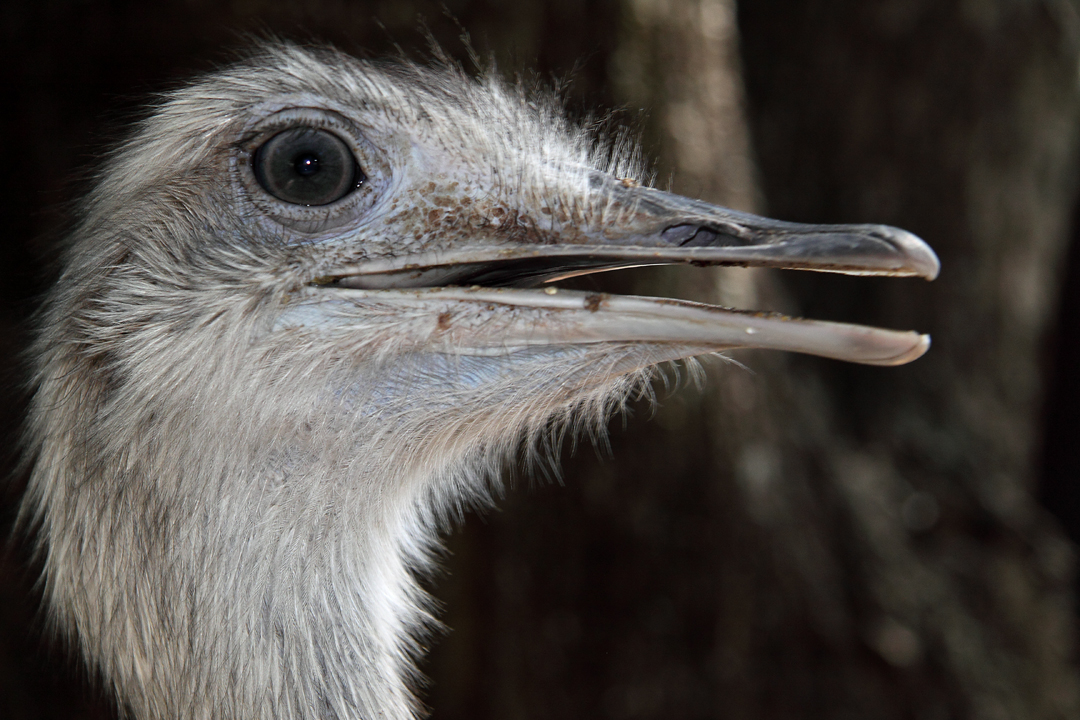
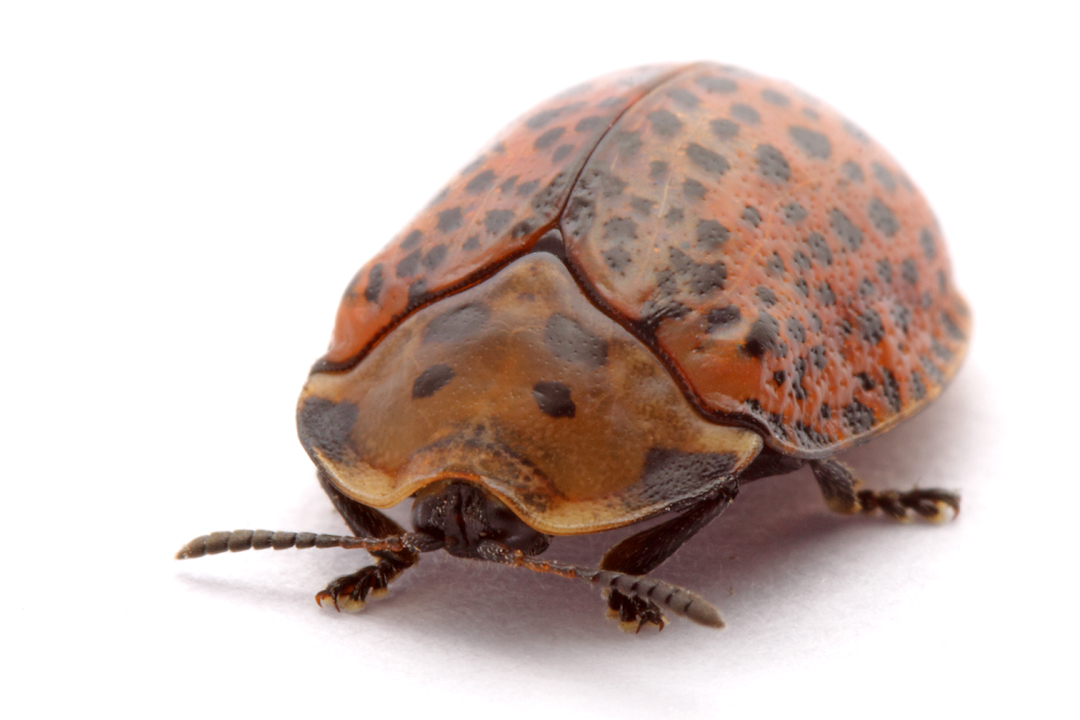
It’s time for a new BitB Challenge Session, and to begin the 6th edition we start off with a Super Crop Challenge. This is a combination challenge, with points on tap for naming the organism (order, family, genus) and visible structures. As always, standard challenge rules apply, including moderated comments, tie-breaker points for first correct answers, and possible bonus pts for additional relevant information at my discretion. Mr. Phidippus ran away with BitB Challenge Session #5, but Tim Eisele and Dennis Haines fought to the end for podium honors. Will one of them de-throne Mr. Phidippus, or will somebody else make a surprise run? Or, perhaps, 3-time champ Ben Coulter will return to stake his claim as the true BitB Challenge Session champion. Let’s get started!

Copyright © Ted C. MacRae 2012

Pseudomyrmex in Corrientes, Argentina

Early April is early autumn in northeastern Argentina, but seasons just south of the Tropic of Capricorn bear little resemblance to the well-defined spring, summer, fall and winter that we are accustomed to in eastern North America. Early fall here is not a riot of color, pungent smells, and sharp shadows cast from an oblique sun, but rather dull greens and browns, muted and dusty after eight months under a searing overhead sun with only the sparsest of rains for the past two. Such conditions are generally not conducive to insect life, and for the most part insects that live in warm, seasonally wet environments adapt by timing their adult activity (the time for reproduction) to the moist seasons—which in this part of Argentina means September through January. Thus, despite warm temperatures and a subtropical environment, early April is not the best time to be looking for insects here.

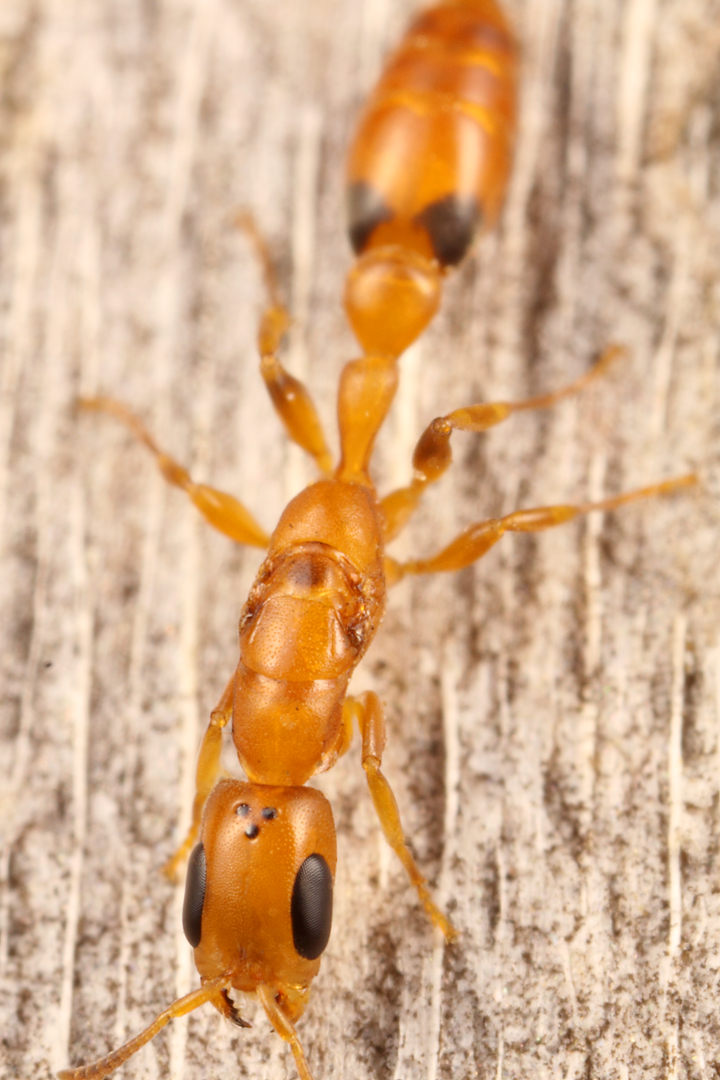
Pseudomyrmex sp. | Corrientes, Argentina

Nevertheless, not all insect groups respond in this fashion, and one in particular is as ubiquitous and diverse now as at any other time of year—ants! I had to trek into sand and mud along the Rio Paraná to find tiger beetles (a few), and it took some dedicated searching to ferret out a few stands of late-season blooming plants and fresh-cut woodpiles to encounter a small diversity of longhorned beetles. I think I may have even seen a single jewel beetle, a chrysobothrine of some type, as it landed on and then flash flew away from the same woodpile with which I had modest longhorned beetle success. The ants, however, have been everywhere—no tree, shrub, or square meter of ground is without them in astounding diversity of size and form.

At this point it appeared to be eating something it plucked from the bark.

I probably shouldn’t admit this, as I hear rumor there are a few myrmecologists that frequent this blog, but I have a hard time getting excited about ants. I know, their unique social structures and evolutionary history are among the most fascinating in the insect world, and watching their behaviors is a lesson in charisma beyond reproach. Still, however, for me there are just so many of them and their taxonomy so completely foreign to me that every time I try digging further I feel immediately overwhelmed. Coleopteran taxonomy may be an order of magnitude more diverse, but since I only pay attention to about 1.5% of the order, it’s as comfortable to me as an old shoe.

Close...

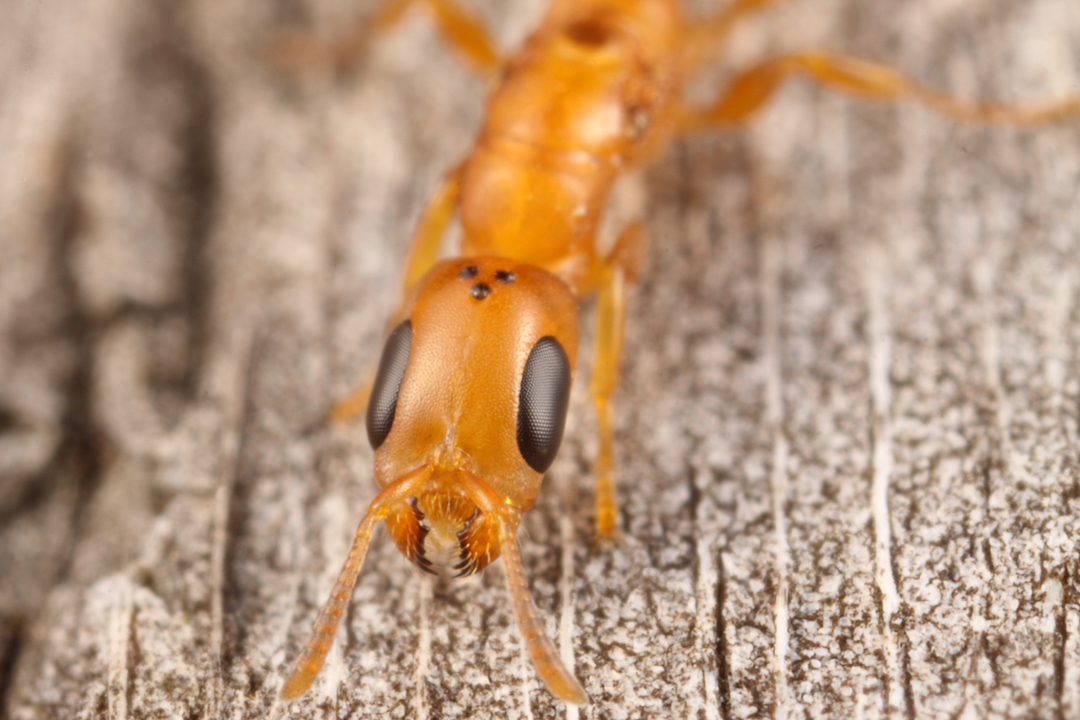
There is one group of ants that I do find endlessly fascinating—the genus Pseudomyrmex. I don’t know why that should be the case—there are plenty of other ant genera that seem to have the tools and structures that usually grab my attention (e.g., grossly oversized mandibles, sharp spines, heavy duty surface sculpturing, etc.). Pseudomyrmex spp. have none of these morphological gimmicks—just a simple, elongate, wasp-like form. Perhaps it’s their association with branches (like wood-boring beetles) rather than the ground—nope, tiger beetles are decidedly ground dwellers and I dig them (Get it? Heh!). No, it must be their super-sized eyes. Most ants have beady little eyes that make it hard to look into their soul. Pseudomyrmex eyes have charisma—you can see them looking at you (and almost read their thoughts).

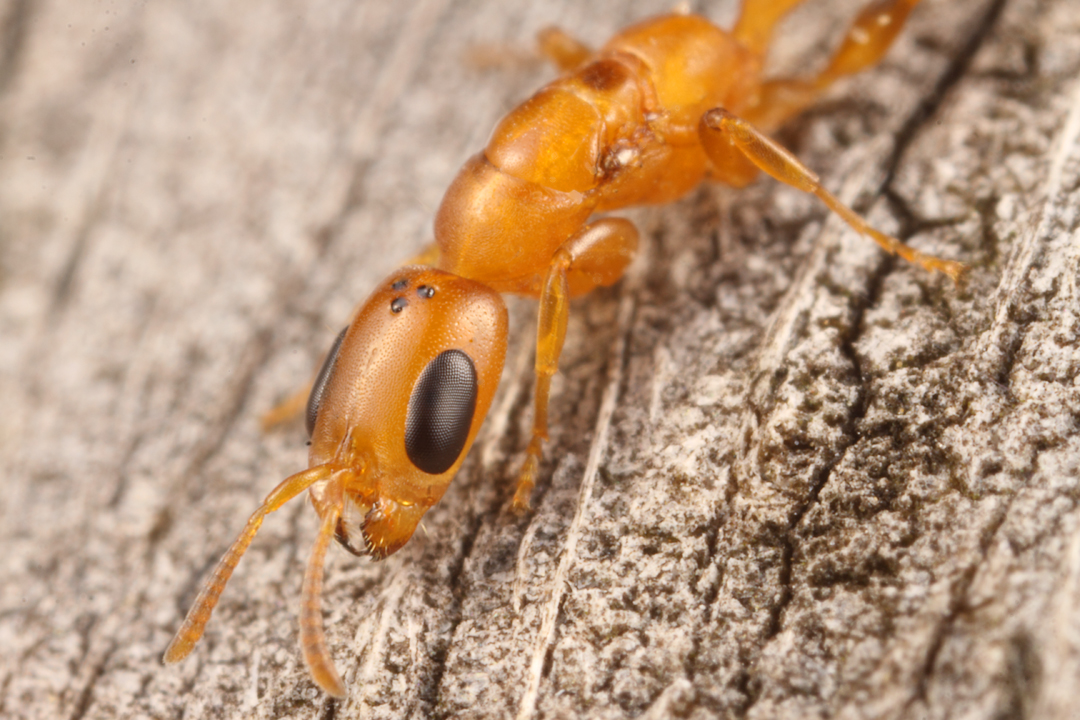
closer...

Anyway, among the many ants that I’ve noted wandering the banks of the Rio Paraná here in Corrientes are these smallish, orangish Pseudomyrmex spp. This particular individual was the first one I saw, revealed when I happened to pull away a bark chip from trunk of the palm tree on which it was hiding. It wandered all over the palm trunk for the next 15 minutes or so as I chased after it with my 65mm lens. For such tenaciously crawling subjects I’ve found that simply firing off shot after shot as you track it in the view-finder rather than waiting for it to pause and trying to compose each shot is the best way to get some usable images. It’s simply a numbers game—the more shots you fire off, the better chance you have that at least some will be in-focus, nicely composed, and well-lit. These are the ones I was happiest with from the session. (And, OMG, did I really just give advice on how to photograph ants?)

Closest!

It goes without saying that a more specific ID, if possible, would be greatly appreciated (should any prominent myrmecologists happen across these photos). There are scads of species in this genus right across the river in Paraguay, and presumably the diversity in Argentina is similarly high.

Copyright © Ted C. MacRae 2012

“Is blogging dead?” – Another view

Yesterday Alex asked the question that has been on my mind for some time: Is Blogging Dead? He had some nice charts and graphs to illustrate the point, but in the end he thought not. Rather, he speculated, blogging provided an early social network structure that is now better served by Facebook and Google+. While some in blogging have left for these other platforms, there remains a dedicated contingent for whom blogging is the best platform to serve their needs.

There must have been a reason, however, that Alex asked the question in the first place, and in fact he is just the latest of many who have asked this same question with increasing frequency. The rise to pervasive dominance by Facebook (even better than sex) is an obvious factor, and although Google+ struggles to gain share, its better graphics-friendliness has cultivated a small but loyal following (hmm, sounds a little like another IBM vs. Mac). I don’t share Alex’s optimism about the future of blogging. I think social networks have not only pulled share from blogging platforms, but also made blogging irrelevant. The World Wide Web is now chock full of choices for information and entertainment, so much so that it is impossible to look at every site that might be of interest. Blogging takes too much time—why spend time reading long, prattling accounts of one person’s exploits when the short quips of 50 people can be read in the same amount of time? Limiting blogs to being primarily photo showcases doesn’t solve the problem—why spend time clicking through numerous individual sites to see photos that maybe you will like when all can be seen collated on a single page like Google+? Even the capability for interaction between the blogger and reader are better served by social networks—no logging in or word verification gauntlets; instead just a quick click of the “Like” button or, if the photo really struck a chord, a quick comment (“Cool photo!”). Gone are the long, interactive discussions following a post, having been replaced by greater reliance on use of the “Like” button for readers to indicate their approval. The sharp decline in appearance of new blogs and increasing dormancy of formerly active blogs (at least in the natural history realm) further illustrate the decline of blogging in the face of other online choices.

Where am I going with this? Obviously, as writer of ‘Beetles in the Bush’ I have a vested interest in the relevance of blogging. I’m beginning to feel, however, a little old school—like the Mom and Pop hardware store, offering an intimate, interactive experience to an increasingly hurried public that simply doesn’t have time for it. I’d like to know what your thoughts are? Is blogging really on the way out? Is Facebook-level quality for photos really just good enough, and if not is the showing of photos and exchange of ideas really better and more efficiently accomplished on Google+? Is all the extra information about natural history, learnings, etc. just an exercise in self-indulgence? I realize, of course, that any commentary received here will be skewed towards those still inclined to do such, and the thoughts of those who have already abandoned blogging for Facebook and Google+ will remain unknown—perhaps to the point that even this post was another exercise in self-indulgence. At any rate, I’ve been increasingly contemplating the future of individual blogs (and specifically natural history blogs, especially those by enthusiastic specialists) and what purpose they do/can/will/should serve. If everything I’ve said above is true, I personally don’t see how blogging per se can readily adapt to such realities—they essentially become a Facebook or Google+ stream of one!

p.s. These are expressions of an evolving thought process. Don’t expect any drastic changes here at BitB, at least in the near future!

Copyright © Ted C. MacRae 2012

Animals Alarmed!

''La Costanera'' | Corrientes, Argentina

Today was my first full day of vacation in Corrientes, Argentina. It was great! I slept late, drank coffee on the balcony, frittered a while on the computer, and then headed for the “Costanera”—a beautiful stretch of green space along the banks of the massive Rio Paraná. I first visited Corrientes in 2000, spending a week collecting insects in Corrientes and neighboring Chaco Provinces on the front end of a business trip, and I’m thrilled to be back in this, one of my favorite cities in Argentina.

Of course, change is inevitable, and not everything has changed for the better since I was last here. The southern coast has been developed (photo above), so gone is a wet, muddy area above the beach where I fondly remember two local boys “helping” me collect tiger beetles (one actually caught one!). Still, the area had a few surprises in store for me, one of which was the presence of a small zoological park that I had somehow missed on my previous visit. I have mixed feelings about zoos—their mission in promoting conservation and providing refuge for rescued animals is beyond reproach, but somehow I always feel a little sad (and guilty) when I visit one. I can’t escape the feeling that I’m looking at prisoners. US zoos have done much to minimize this quandary by providing spacious, naturalized habitats and minimizing the use of or visibility of bars and cages. Still, watching the polar bear relentlessly pacing back and forth on its well-practiced path reminds you of just how bored the animals get even in these modern confines. A cage is a cage. Nevertheless, animals are always interesting to look at, and seeing animals in a Southern Hemisphere zoo is a unique opportunity that most Americans never experience. Predictably, the zoo harkened back to the older zoos of the US, with animals confined in small spaces enclosed prominently with bars and chain link fencing. There is actually an upside to this, as it allows one to get extraordinarily close to the animals. Ever try to photograph a lion in a US zoo? Maybe with an 800mm telephoto lens you can get a shot that looks like more than a little brown blob in a sea of brown, and even then the elevated position looking down into the “den” makes for very unspectacular views (getting down on the same level as your subject, or even lower, results in much more interesting views). I never even think about taking photos of animals at US zoos for this reason. Today’s experience, however, was much more intimate despite the chain links and even provided for some comical reactions by the animals as I lifted to glass to within a few feet of their faces. I present here a few of the more interesting ones:

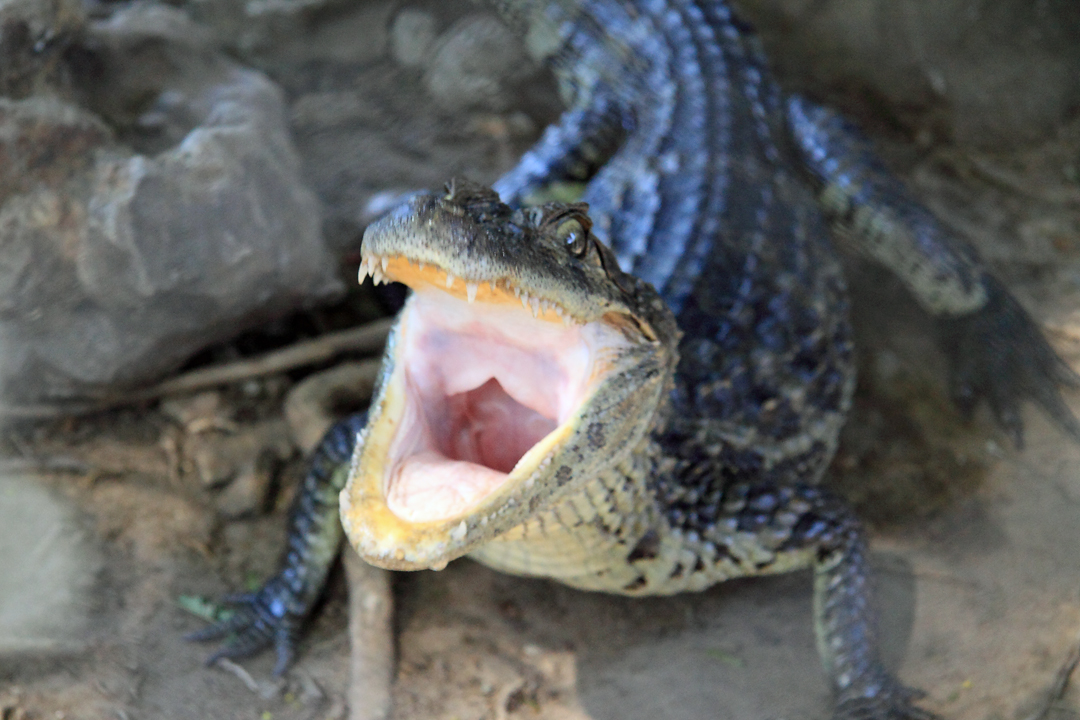
Yacaré Caimen (Caiman yacare)

Normally when you see this, you’ve already screwed up!

Burrowing owl, or ''Lechuza'' (Athene cunicularia)

The closer I got, the lower he got—spreading his wings and “snapping” his beak.

Greater Rhea (Rhea americana)

That moment of indecision between “fight” or “flight” (I’m talking about me, not the bird!).

Copyright © Ted C. MacRae 2012

The backwards firefly

Aspisoma sp. | Buenos Aires Province, Argentina

The beetle in these photos was another “gift” from my colleagues in Fontezuela, Argentina—brought to me shortly after I found the first gift on my desk during my first week at the station. This is obviously a firefly, but I also recognized it as the same species as (or very close to) one I had photographed in a soybean field during last year’s March visit. I only got off one shot of the one in the soybean field before it took flight, so here are some better views of the species—enhanced by the cleanliness inside the pearly white confines of a styrofoam cooler.

A little closer...

My attempts to identify the species last year were fruitless (though admittedly cursory). This year I tried a different tact—I went to the website Lampyridae de Argentina (which is really just a list of species based on Blackwelder’s Neotropical beetles checklist) and did a Google image search on each genus in the list (combined with the term “Lampyridae”) until I encountered something that looked pretty close in the genus Aspisoma (tribe Photinini) in the Lampyridae photo gallery at PyBio.org (Paraguay Biodiversidad). The page contains excellent dorsal habitat photographs of a number of species in the genus; however, unfortunately the majority of them are labeled simply as Aspisoma sp. (it should not be surprising that the state of lampyrid taxonomy in South America is still far from complete). The individual shown here is a dead ringer for Aspisoma sp. #8, but spp. #51, 52, and 53 cannot be discounted. I sent the photos to cantharoid beetle expert Santiago Zaragosa Caballero, who confirmed the species appeared to be a member of the genus Aspisoma but admitted to not knowing the South American fauna well enough to offer a species ID. Nevertheless, a genus ID is better than nothing, and my thanks to Santiago for his confirmatory ID.

...and finally, the requisite ''face'' shot.

It’s no secret that I love face shots! The above photo, however, was the best I could do for this species due to its highly explanate (flanged) pronotal hood and the typical firefly habit of hunkering down and using their flange to protect their softer underparts when feeling threatened. I call this the “backwards” firefly because everything about it seems opposite to my concept of fireflies in eastern North America—yellow with black markings instead of black with yellow markings and active during the day instead of at night, which I most easily ascribe to its occurrence opposite to the Northern Hemisphere! (wink)

Copyright © Ted C. MacRae 2012

Seeing the unseen

While trying to nab a cicada from the small trees planted on the grounds at our experiment station here in Fontezuela, Argentina, I happened to notice a bit of movement on one of the branches nearest to me (while the cicada flew off with a screech and a clatter). A closer look revealed what looked like a slight protuberance of the branch to be a nymphal planthopper (family Fulgoridae), and at ~15 mm in length a pretty good-sized one at that. I would have never noticed it had it not moved, so good was its camouflage, but I didn’t have the time to spend trying to photograph it right then and there. Instead, I popped it into a vial (you do always carry a vial with you, don’t you?) and continued my fruitless quest for cicadas.

Undet. fulgorid nymph | northwestern Buenos Aires Province, Argentina

Later that evening I placed it on a palm tree in the hotel courtyard (not really the appropriate host, but it was the only real tree available). I took the standard dorsal view photo, and while not as good a color match as the (still undetermined) tree upon which I found it one still gets a sense for how difficult it might have been to see this nymph flattened against the slightly greenish bark.

A lateral profile view makes the bug much more visible.

One thing I’ve learned from much better photographers than myself is to get down and low relative to the subject—even to the point of looking up at it if possible. This provides views that are far more interesting than the typical looking-down-from-above shots. In the case of this nymph, the above and following low-angle shots really brought it to life and emphasize its unusual form.

Even lower. How did I get the nymph to "prop" itself?

Of course, with the nymph on the side of a fairly large tree, one can only get so low. To get even lower, I placed the nymph on a small stick and used hand-holding and bracing techniques to get even lower. I took quite a few shots experimenting with composition, and the shots I ended up liking the best were frontal-oblique from slightly below bug-level with the stick rather sharply angled down and the bug slightly propped up on its front legs. Easier said than done—this nymph was loathe to stop crawling once I moved it to the stick and tended to be negatively geotactic (crawled upwards). As a result, every time I angled the stick downward it would turn around and start crawling the other way, and in any case when it did stop it tended to flatten itself against the branch. Through trial and error, I learned that if I braced my thumb and forefinger against its head/pronotum to stop its progress and held it in place for awhile it would stay put. I also learned that if I slightly blew on its face when it was flattened against the branch that it would prop itself upwards a bit. Thus, for this shot it was a matter of letting it crawl upwards almost to the end of the stick (to eliminate excess stick that poke into the camera with a frontal-oblique angle), bracing it for a moment, inverting the stick downward and pointing slightly towards the camera, and then blowing on its face a bit—simple, huh? The black transverse band on the lower face adds a lot of character to the shot.

The obligatory face-on shot

The face-on shot is a staple for me, but even with this shot the angle is important—angle the back of the stick down too much and you get the all black background (not in itself bad, just not what I wanted for this shot), angle it too high and too much of the back of the bug shows up as blurred clutter in the background). The foreward projecting “nose” of this nymph prevented me from getting both the tip of the nose and the eyes in focus (without using excessively small aperatures), so I opted for the latter (I’ve never seen a good face shot of an insect in which at least the eyes were not in focus).

Unfortunately, family-level identification is as good as it is going to get for this individual. I sent the photos to fulgorid expert Lois O’Brien, who eliminated several options but couldn’t narrow down further among several remaining possible genera (“Our ignorance of nymphs is abysmal…”). Her recommendation was to go back to the tree and try to find adults, and apparently some species tend to live on the same tree for years and years. I’ll be returning to Fontezuela later in April—hopefully the fall season will not have advanced to far by then.

Copyright © Ted C. MacRae 2012

A tortoise beetle gift

Chelymorpha varians | northwestern Buenos Aires Province, Argentina

A few days after returning from travel through northern Argentina, I found a jar on my desk with this beetle in it. One of my colleagues has seen it in the field while I was away and figured I would be interested in seeing it. Although I’m half-a-world away from home, I immediately thought of our North American species Chelymorpha cassidea when I saw it. Armed with this hunch, I typed “Chelymorpha Argentina” into Google, and the first result that came up was a paper by Hamity & Neder de Román (2008) about the species Chelymorpha varians in Argentina and its potential as a biocontrol agent for the widespread weed Convolvulus arvensis. Included in the paper was a plate showing variability of coloration and maculation in the adults, and my individual was a dead ringer for the species. Still, getting a species ID on the very first hit of the very first search attempt just seemed too easy, so I consulted the wonderfully comprehensive Cassidinae of the world – an interactive manual. This site, too, contained multiple images of Chelymorpha varians showing an extraordinary range of variability in color (from yellow to red) and degree of maculation (from immaculate to heavily maculated). A quick perusal of other species indicated as similar or also occurring in Argentina turned up nothing nearly as similar and convinced me that I had, indeed, arrived at a correct ID.

As the name suggests, markings are highly variable in shape and degree of development.

As indicated in the above cited paper, and like our own C. cassidea, species in the genus Chelymorpha are associated almost exclusively with plants in the genus Convolvulus. I would have preferred to photograph the beetle on foliage of this plant, but not knowing precisely where I might find it I decided to do white box instead. I got some printer paper and was looking for a cardboard box to line the inside with it when I spotted a styrofoam cooler of just the right size.

The scientific name translates literally to ''variable turtle-body''

These are okay white box photos, but I’ve decided if I want to do white box right I need to get a larger flash unit that is a little easier to work with off the camera. Right now I have only the small twin-flash heads from my MT-24EX—their small size makes them difficult to manipulate off the camera, and leaving them attached to their bracket limits the directions in which they can be oriented relative to the subject. As a result, I had to use more heavy-handed post-processing in these photos than I normally like to do in order to get the levels right. Hmm, I have a birthday coming up in about a month…

REFERENCE:

Hamity, V. C. & L. E. Neder de Román. 2008. Aspectos bioecológicos de Chelymorpha varians Blanchard (Coleoptera: Chrysomelidae, Cassidinae) defoliador de convolvuláceas. Idesia 26(2):69–73.

Copyright © Ted C. MacRae 2012

Retrachydes thoracicus – times four!

Disclaimer—these are not great photos!

A few days ago I posted this little quip as my status on Facebook: “Cool! Found a Retrachydes thoracicus thoracicus on the sidewalk outside my hotel!” I chuckled a little as I posted it, knowing that only a select few who read it would know what the heck I was talking about (of course, a right click to select “Search with Google” reveals the answer instantly). Of course, it is a species of longhorned beetle (family Cerambycidae) that apparently is found commonly in South America. I wanted to take some photographs of the beetle to show those who didn’t do the Google search just what it looked like. Unfortunately, the beetle was already somewhat moribund when I found it, and no matter how much I coaxed and prodded it on the stick I placed it on, it just looked… well, dumb. Legs out of position, antennae hanging limply, and the beetle itself laying prostrate on the branch, as if it barely had the strength to hang on (which actually was the case). Shame—it sure is an attractive species, with its densely pubescent and transversely gibbous pronotum (obviously the source of its name) and striking orange-banded antennae. C’est la vie!

Lately I’ve been trying to get a better handle on choosing backgrounds when I photograph insects, no longer content with the often busy and distracting backgrounds that show up in photographs taken completely in situ. It’s often a simple matter to hold the object on which the insect is sitting in front of something that gives the desired background effect, and having this perfectly calm yet strikingly attractive beetle to work with seemed to invite experimentation. I’m also trying to get a better feel for how to use higher ISO settings to make it easier to get these various “non-black” backgrounds while still using flash to get acceptable depth of field with the subject itself. Below are four of the better shots that came out of the session (yes—sadly, these are the “better” ones). I’m loathe to go below 1/160 sec exposure because of motion blur and would like to keep aperture settings quite small, so fairly high ISO settings are required to get the background effects I’m looking for. I think I’ve learned that ISO 1000 is about as high as I can go before the background gets unacceptably noisy—at small sizes the photos look fine, but open them up larger size and you’ll see what I mean. Anyway, ignoring the composition and noise issues, which background do you like best?

ISO 1000, 1/160 sec, f/14 - cloudy sky background

ISO 1600, 1/160 sec, f/14 - pavement background (close)

ISO 1600, 1/160 sec, f/14 - pavement background (more distant)

ISO 1600, 1/160 sec, f/14 - pavement background (foliage)

Copyright © Ted C. MacRae 2012