“Puente de la Mujer”

One of my favorite sites in the heart of Buenos Aires, I’ve never actually seen Puente de la Mujer (“Womans Bridge”) lit up at night until this trip.  A short distance to the north lies Rio de la Plata and La Reserva Ecológica Costanera Sur (“South Coast Ecological Reserve), where I spent the majority of the day this past Sunday.  Yes, more photographs of “bichos Argentinos” forthcoming.

Copyright © Ted C. MacRae 2011

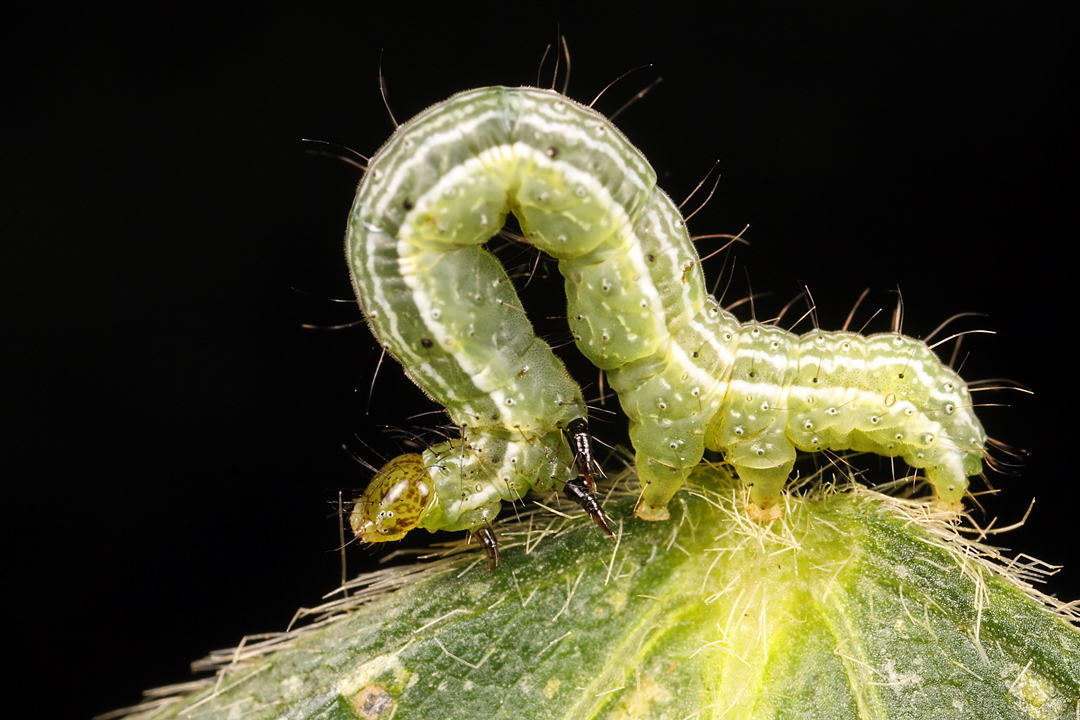
“Sunflower looper” – Rachiplusia nu

Rachiplusia nu ''oruga medidora'' | Santa Fe Province, Argentina

With a planted area approaching 20 million hectares, soybean has become Argentina’s most important agricultural crop.  Most of the planted area is located within the so-called “Humid Pampas” region of central Argentina (Buenos Aires, Córdoba, Santa Fe and Entre Rios Provinces), but the crop continues to expand in the northestern part of the country as well (Chaco, Tucumán and Salta Provinces).  More than any other crop in Argentina (except perhaps cotton), soybean is attacked by a tremendous diversity of insects.  The most important of these are the defoliating Lepidoptera, primarily species in the family Noctuidae.  Anticarsia gemmatalis (velvetbean caterpillar) is the most consistent and widespread defoliator, but an increasingly important species in Argentina is Rachiplusia nu (“oruga medidora del girasol,” or sunflower looper).

Eggs are laid primarily on the undersides of leaves

Rachiplusia nu belongs to the noctuid subfamily Plusiinae, the larvae of which can be recognized by having three pairs of prolegs and the “looping” manner by which they walk.  Chrysodeixis includens¹ (soybean looper), much better known because of its status as a major pest of soybean in the southeastern United States (and of growing importance in Brazil as well), also belongs to this group, and in fact the larvae of the two species are quite similar in appearance.  While R. nu is the primary plusiine species affecting soybean in Argentina, C. includens has appeared with increased frequency on soybean in Argentina in recent years, primarily in the more northern, subtropical growing regions adjacent to those areas in Brazil where it is now a major pest of the crop.

¹ Although still widely referred to in the literature as Pseudoplusia includens, the genus Pseudoplusia was synonymized under Chrysodeixis some eight years ago by Goater et al. (2003).  More recently the synonymy was accepted and formally applied to the North American fauna by Lafontaine and Schmidt (2010). 

Neonate larva on soybean

Despite their similarity of appearance, larvae of the two species can be rather conclusively distinguished by the shape of their spinneret (Angulo and Weigert 1975).  This is not a very convenient character for use in the field, however, leading to misidentifications in areas where the two species co-occur.  This is not an insignificant problem, as the two species exhibit differing susceptibilities to pesticides labeled for their control (C. includens especially having become resistant to a number of pesticides).  The result is control failures and subsequent application of even more pesticides in an effort by farmers to protect their crops.  While not as conclusive as the shape of the spinneret, in my experience R. nu larvae (at least older larvae) tend to have a darker, smoky-blue cast to the color (compared to the bright yellow-green of C. includens) and rather distinct patches of tiny black asperites on the thoracic ventors that are not apparent in C. includens.

Younger larvae consume only the lower surface between veins, resulting in ''window paning''

As the common name implies, soybean is not the only crop attacked by R. nu.  Early season infestations tend to occur in alfalfa and flax, after which the populations spread to soybean and sunflower.  The latter crop especially is heavily attacked by this insect, primarily in the drier western regions in Córdoba Province.  Dry conditions seem to favor an increase in the populations of this species, while moist conditions promote increased incidence of pathogenic fungi that are very effective at suppressing R. nu larval populations.
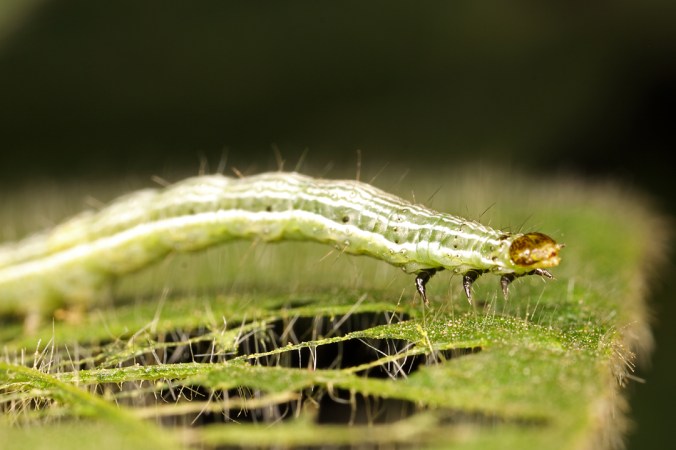
Older larvae consume entire tissues but still avoid veins, resulting in a ''skeletonized'' appearance

Like many defoliating lepidopterans, eggs tend to be laid on the undersides of leaves, where the larvae begin feeding after they hatch.  Young larvae consume only the lower epidermal layer of the foliage between the veins, leading to an appearance in the foliage called “window paning”.  As they larvae grow they begin consuming the entire tissue layer but still preferentially avoid vascular tissue, resulting in a skeletonized appearance to the foliage.  A single larvae can consume more than 100 cm² of soybean foliage, which translates to several trifoliates.  As a result, it doesn’t take many larvae to cause significant loss of foliage on the plant.  Soybean has the ability to compensate for loss of foliage due to increased photosynthesis in lower foliage exposed by feeding in the upper part of the plant, but losses exceeding around 15% during the later reproductive stages of plant growth are enough to significantly reduce yields (and it is during these reproductive stages of growth that R. nu infestations tend to occur).

Rachiplusia nu adult | Buenos Aires Province, Argentina

Rachiplusia nu is the most widely distributed of three South American species in the genus, occurring in Argentina, Bolivia, Brazil, Chili, Paraguay, Peru and Uruguay, while a fourth species, R. ou, is widely distributed throughout North and Central America (Barbut 2008).  Unlike R. nu, its North American counterpart R. ou has not gained status as a pest of soybean or other crops.

In a BitB Challenge first, nobody was able to correctly ID the larva of this species beyond the level of subfamily.  This, despite the huge Argentina hint bomb that I dropped when I posted the challenge and my well-known vocation as a soybean entomologist.  I figured the answer would be forthcoming as quickly as one could Google the search phrase “Argentina soybean Plusiinae” (which, in fact, shows the following except for the very first result “Pseudoplusia includens is the most common soybean Plusiinae in the Americas (Herzog, 1980). Rachiplusia nu in southern Brazil, Uruguay and Argentina, and…” [emphasis mine]). Most participants guessed, predictably, soybean looper, while only a few were fooled into guessing Geometridae (the true loopers, and distinguished by having only two pairs of prolegs).  As a result, I’m not declaring a winner for ID Challenge #14, although the appropriate points will still be awarded (when I get around to assigning them, that is.  Hey, I’m working in Argentina right now—it was enough for me just to get this post out!).

REFERENCES:

Angulo, A. O. and G. T. H. Wiegert. 1975. Estados inmaduros de lepidópteros noctuidos de importance economica en Chile y claves para su determinación. Sociedad Biologico Concepción, Publicación Especial 1:1–153.

Barbut, J. 2008. Révision du genre Rachiplusia Hampson, 1913 (Lepidoptera, Noctuidae, Plusiinae). Bulletin de la Société entomologique de France113(4):445–452.

Goater, B., L. Ronkay and M. Fibiger. 2003. Noctuidae Europaeae. Vol. 10, Catocalinae, Plusiinae. Entomological Press, Sorø, 452 pp.

Lafontaine, J. D. and B. C. Schmidt. 2010. Annotated check list of the Noctuoidea (Insecta, Lepidoptera) of North America north of Mexico. ZooKeys 40: 1–239.

Copyright © Ted C. MacRae 2011

ID Challenge #14

I’ll be leaving soon for another trip to Argentina.  While the process of traveling to the Land of Gauchos (and back) is exhausting, I adore Argentina and look forward to my visits there with great anticipation.  In celebration of my pending return, I’m starting off a new BitB Challenge Session (#5) with a traditional ID challenge—for 2 pts each can you identify the order (a gimme), family, genus, and species of the critter in the photo below?  Say something about the situation for the possibility of bonus points.  Standard challenge rules apply, including moderated comments during the challenge period (you don’t have to be first to score points), early-bird points to those who do arrive at the correct answer before others, etc.

Copyright © Ted C. MacRae 2011
A Brazilian longhorned beetle – Oxymerus aculeatus

Oxymerus aculeatus aculeatus | January 2011 | nr. Campinas, São Paulo, Brazil

I was going through photographs from my visit to Brazil this past January and came across this forgotten photo of a longhorned beetle taken near Campinas in São Paulo.  Although I didn’t recognize the genus immediately, I was rather sure it belonged to the great tribe Trachyderini, generally characterized by medium to large-sized, brightly colored, diurnal (active during the day) species.  Knowing this it didn’t take me long to identify the species as Oxymerus aculeatus, occurring from Nicaragua and the West Indies south to Bolivia and Uruguay and, thus, the most widely distributed of the ten species in this exclusively Neotropical genus. As is typical with such widespread species, a few subspecies have also been described—this one should be the nominate subspecies, widely distributed throughout central, eastern, and southeastern Brazil (Hingrid et al 2010).

Like most other members of the family Cerambycidae, O. aculeatus is presumed to utilize dead or dying wood for larval development, but little else is known regarding its habits and host plants. Members of the tribe are often found frequenting flowers, although this and a few other individuals were encountered resting on the underside of foliage on an unidentified tree. The Florida Department of Agriculture & Consumer Services has become concerned about the possible establishment of this species in the U.S. after two recent collections of the West Indian subspecies in south Florida (Thomas 2006). Whether it goes on to have any economic impact remains to be seen, but if recent history with other wood boring beetles is any indication (e.g., Asian longhorned beetle, Anoplophora glabripennis; emerald ash borer, Agrilus planipennis; etc.) the concern may be warranted.

REFERENCE:

Hingrid Y. S. Q., J. P. Botero R. and M. L. Monné. 2010. Insecta, Coleoptera, Cerambycidae, Cerambycinae, Trachyderini: New state and country records from South America. Checklist 6(3):364–376.

Thomas, M. C. 2006. Another Neotropical longhorn beetle (Coleoptera: Cerambycidae) apparently new to the mainland of Florida. UF/IFAS Pest Alert (website accessed 7 Nov 2011).

Copyright © Ted C. MacRae 2011

New comment policy

In the nearly three years since moving ‘Beetles in the Bush’ to WordPress, I’ve enjoyed an almost spam-free existence.  Rarely did I ever get more than just a few spam comments per day, and whatever spam I did get was flagged with nearly 100% accuracy by WordPress’ Akismet spam filter.  So minor was the issue that I’ve been able to leave comment settings for the blog at their least restrictive—anonymous comments allowed with no comment moderation.  Spam comments were held for review, while legitimate comments were published immediately.  It was a simple matter to review the few spam comments that accumulated each day, confirm that they were indeed spam, then send them on to cyberoblivion.  Occasionally a legitimate comment or two would also get flagged as spam (primarily for including more than one hyperlink in the comment—a common feature of spam comments), but I would find these during review and approve accordingly.

Until now, that is.  Last month I had a post selected for WordPress’ ‘Freshly Pressed’ feature.  It’s kind of a big deal to be featured on Freshly Pressed, as exposure to the whole WordPress community typically results in a surge of traffic.  The surge is short-lived but commonly nets at least a few new readers, some of whom may become regulars.  It’s the fourth time I’ve had a post selected for Freshly Pressed; however, unlike the previous three times, this time saw also a concordant sudden surge in spam comments.  While the traffic has returned to more normal levels, unfortunately the spam comments have not—in the month since being Freshly Pressed I’ve been flooded with nearly 7,000 spam comments.  That’s about 230 per day compared to only a handful of legitimate comments.  I have neither the time nor the inclination to review several hundred spam comments every day just so I can rescue the occasional legitimate comment.

WordPress Support has no explanation for the surge in spam (I recall they made some reference to “the price of fame”).  So, and I really hate to do this, I’m implementing some moderate restrictions on who can leave comments.  I’m trying to do this, at least initially, in a way that legitimate commentors will notice hardly or not at all.  You’ll have the least inconvenience if you are logged into your WordPress, Twitter, or Facebook account and already have an approved comment somewhere on this blog.  For you nothing changes—you leave a comment and it is published immediately.  If you are logged into one of these accounts but have not yet left a comment here, your first comment will be held for moderation.  Once I approve it you get a free pass through approval from that point on and will see any future comments published immediately.  If you are not logged into one of these accounts, you can either login using the buttons on the comment form, or alternatively you can complete the fields for your name, email address, and website. Only the website field is optional; your name and email address will be required information (but please note that your email will not be shown publicly!).  Again, if you already have an approved comment on the site your comment will be published immediately, otherwise it will be held in moderation until I approve it (which then gives you a free pass for any future comments).  Sadly, anonymous comments are no longer allowed.

I hope these restrictions don’t cause undue inconvenience, and I would be most grateful for your feedback if you find that these restrictions have affected your willingness to leave comments.

Copyright © Ted C. MacRae 2011
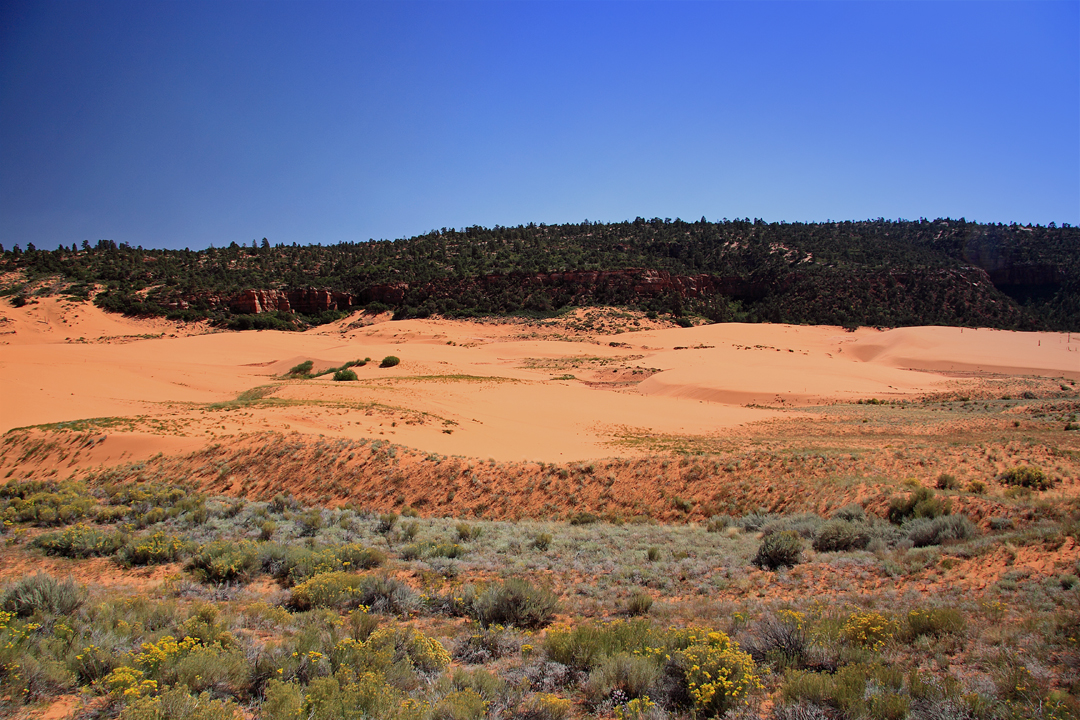
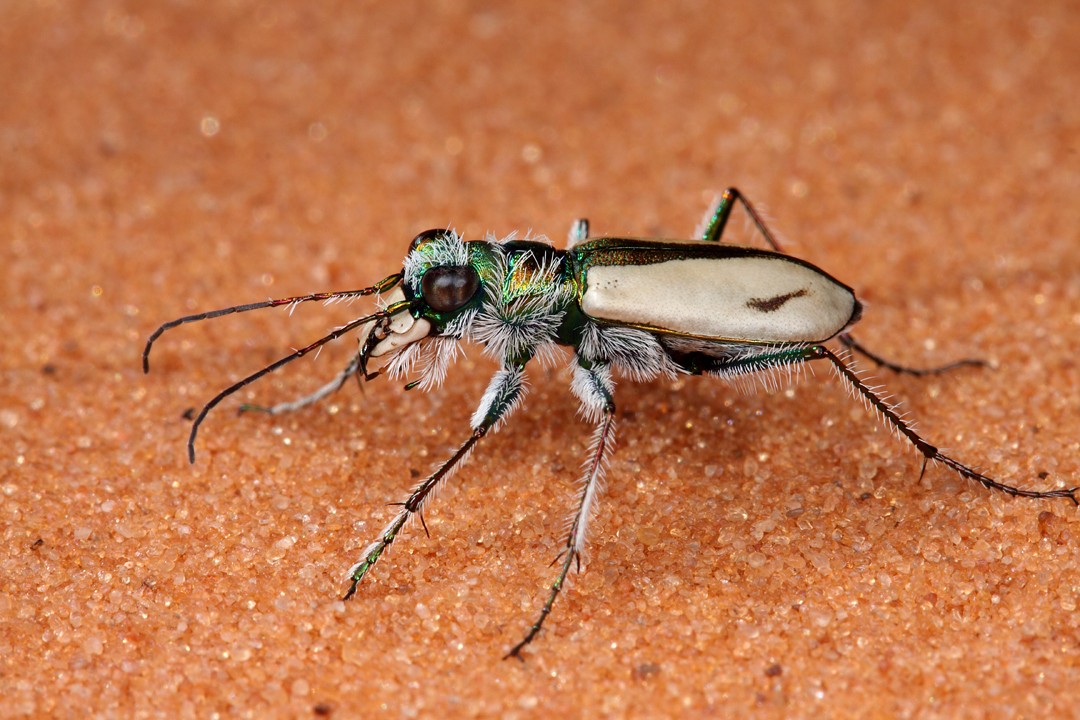
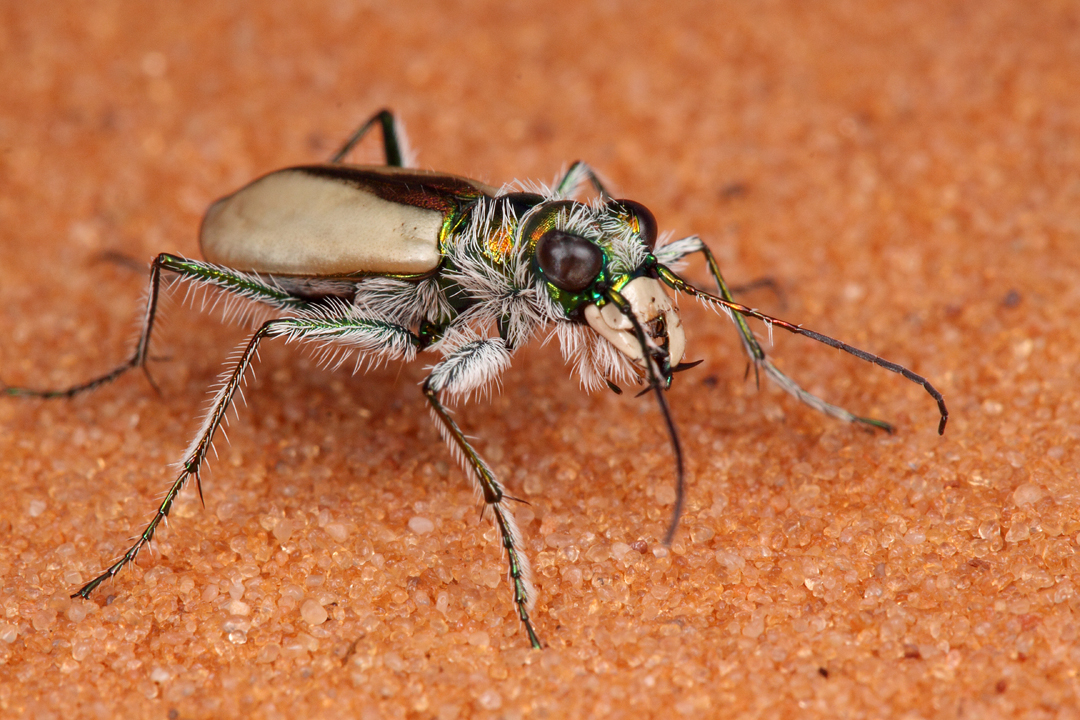
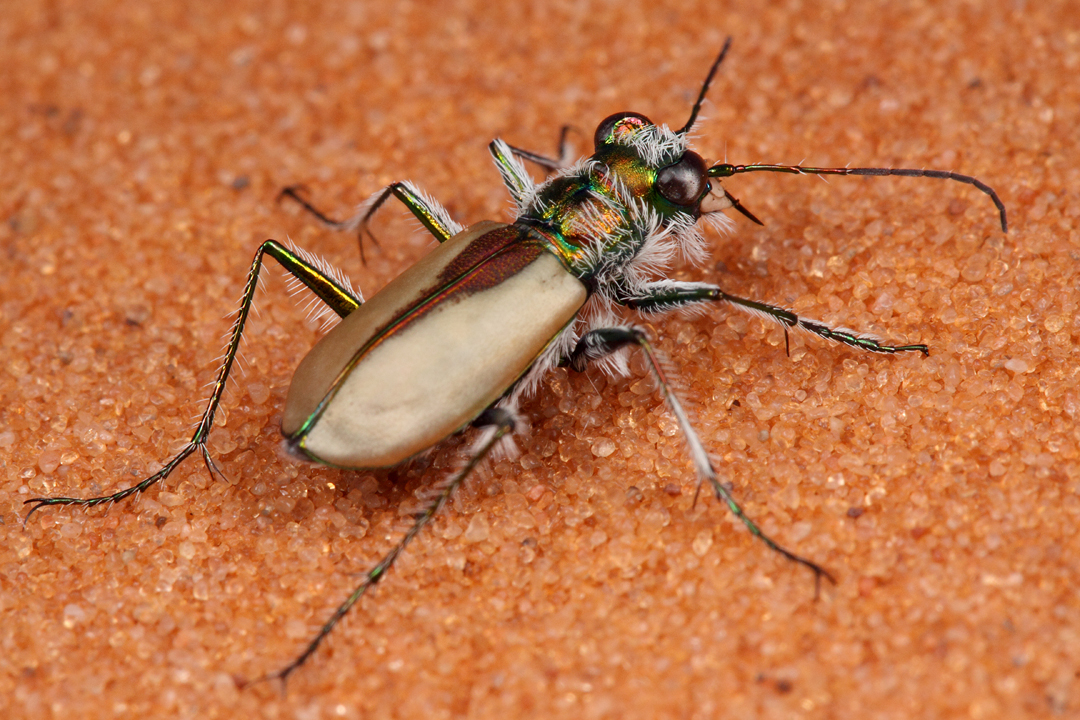
Cicindela albissima—The Coral Pink Sand Dunes Tiger Beetle

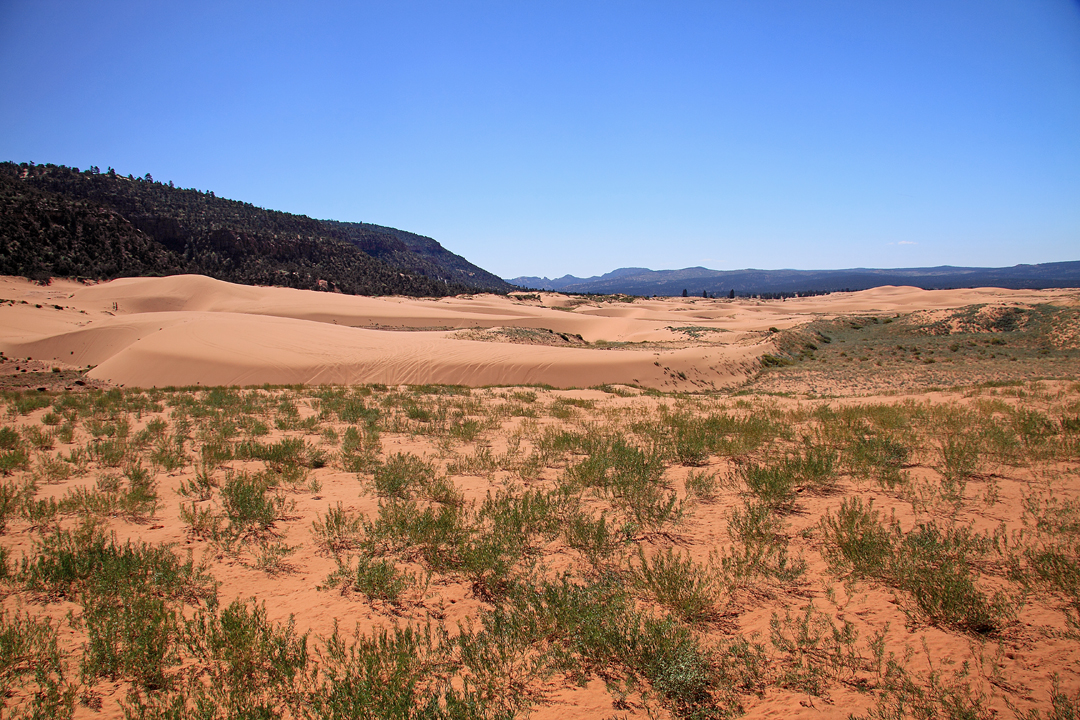
Coral Pink Sand Dunes State Park, Utah

The week had started off good, with three species of western sand dune endemic tiger beetles (Cicindela formosa gibsoni, C. scutellaris yampae, and C. arenicola) and a variety of sometimes spectacular Crossidius longhorned beeltes having been encountered.  Mid-week, however, had brought a lull in our success—the long drive to southwestern Idaho was not rewarded with finding C. waynei, endemic only to Bruneau Sand Dunes State Park, and an even longer drive was required to backtrack and then drop down to the southwestern corner of Utah in hopes of finding the equally rare and restricted C. albissima.  Had it not been for our continued success with different species and subspecies of Crossidius longhorns the drive might have felt like a lesson in futility.  Still, on a collecting trip a new day and new locality brings new hope, and anticipation grew as we passed through lodgepole pine forests on stunning black lava fields and wind-carved red sandstones on the final approach to Coral Pink Sand Dunes State Park.

Colored pink by iron oxide minerals, the dunes are estimated at 10,000 to 15,000 years old.

Words cannot describe the stunningly spectacular landscape that unfolded before us as we entered the park.  The scenery alone makes Coral Pink Sand Dunes worthy, in my humble opinion, of National Park status, but it is C. albissima—occurring only on the park’s vivid pink dunes and nowhere else in the world—that makes this place truly special.  Precisely where in the park the beetle lives is a matter of public record, as Chris Wirth (author of the intermittent but highly focused blog Cicindela) and Randolph-Macon College Professor Emeritus Barry Knisley have produced a wonderfully detailed and well illustrated brochure about the beetle and its life history, population trends, and limiting factors.  What remained to be determined was whether the beetles would be active during the brief window of time available to look for it.  Cicindela albissima is a so-called “spring-fall” species in reference to the bimodal adult activity period, but activity in the fall is much less predictable than in the spring depending on moisture availability.  The day was perfect—temperatures in the 70s by mid-morning, only a light breeze, and a sharp, blue, cloudless sky.  All we could do was look.

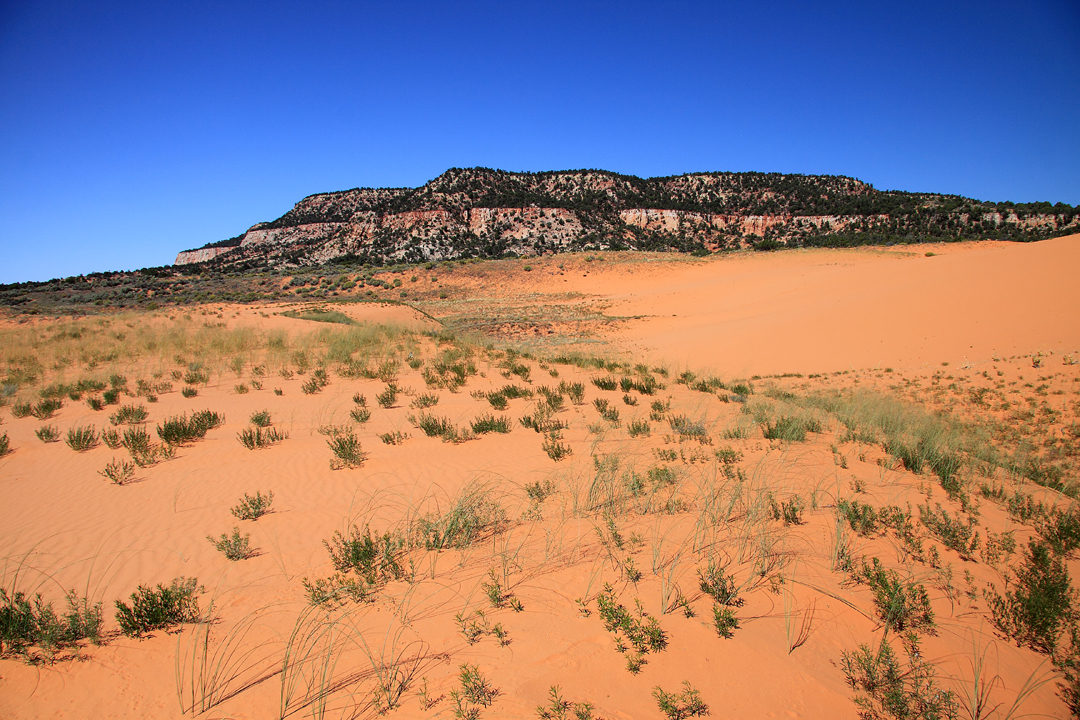
Adult beetles were found on the northern edge of this dune. A majority were seen amongst sparse vegetation rather than barren areas.

It didn’t take long really to find them, as the adults were already out in encouragingly strong numbers. Of the several dozen adults we saw, all but one were seen atop the northern edge of one particular sparsely vegetated dune.  I suspect the larval burrows were at the bottom of the steep northern dune escarpment in the more stable wind-scoured sandstone clays that lay between individual dunes.  Vivid white and floating across the sand on long delicate legs, the elegance of their beauty was a stark contrast to the harshness of the surrounding landscape.  With a miniscule range of only 400 hectares, C. albissima is one of North America’s rarest tiger beetles, and I felt truly priviledged to join the small ranks of those who have seen this beetle alive in its native habitat and could appreciate the significance of the event.  Of course, the sense of accomplishment would not be complete unless I also succeeded in photographing the species in the field, and although the adults were quite wary and active, I was happy with several of the photos that I ended up with.  Similar to what I observed with C. arenicola, adults amongst the vegetation seemed slightly less skittish than those out in the open, so it was in the vegetated areas that I concentrated my efforts.  My only regret was not adding extension tubes to allow some real closeup portraiture, but the beetles seemed far too wary to have put up with the decrease in working distance that would have entailed.  At any rate, here are some of my favorites:


What the future holds for C. albissima remains unclear.  Designation of the beetle’s home range as a preserve (albeit tiny) would seem to offer long term protection, but a  large portion of this area is open to off-road vehicular traffic (although not a single one was seen during the time that we were there).  An even greater threat exists in the potential for extended drought affecting the entire population, and as greenhouse gases continue to accumulate in the atmosphere the chance of impacts from unusual weather events only grows. I feel lucky to be among the few that have witnessed this beautiful species in nature, but I sincerely hope I am not among the last.

ORV tracks can be seen just outside the conservation area boundary

Copyright © Ted C. MacRae 2011
Isn’t she splendid?!

Cicindela splendida | Bald Hill Glade Natural Area, Ripley Co., Missouri

This gorgeous female Cicindela splendida emerged recently from one of my rearing containers.  She was one of several 3rd instar larvae that I collected this past June from their burrows in a dolomite glade in southeastern Missouri.  I had suspected they might represent this species because of the bright, metallic sheen on their heads and decided to rear them out to find out for sure.  Rearing tiger beetles is fun and easy—all you have to do is fill a container with native soil, make a “starter” burrow¹ and drop them in. In this case, I also partially sunk a native rock into the soil in the center of the container, something I have started doing recently as it gives the emerged adult an elevated and more visually appealing surface on which to perch than the soil should I desire to take photographs.

¹ Larvae will dig new burrows on their own, but starter burrows allow you to place the burrow where you want it.  They are essential if more than one larva is introduced to the container, as wandering larvae will fight when they encounter each other. I like to start the burrow in a corner of the container (a pencil works great for this) and push down to the bottom of the container so I can see into the burrow from outside to monitor the larva as it develops.  After introducing the larva to its burrow, I push the soil around the entrance to seal it lightly to keep the larva from immediately crawling back out.  The larva will eventually reopen the burrow but generally accepts it, digging it out further to its liking and shaping the entrance to precisely fit the size and shape of its head.

Reared from 3rd instar larva, burrow in sparsely vegetated clay exposure of dolomite glade.

With tiger beetle rearing, feeding time is fun time! Our lab rears insects for testing in abundance, and there are always leftovers. Really just about any insect that can be pulled into the burrow will be acceptable as prey, but lepidopteran caterpillars are my favorite. I use mostly early instar tobacco hornworm larvae, choosing the size as appropriate for the size of the tiger beetle larva—the big ones (e.g. 3rd instar Tetracha) can handle caterpillars 35-40 mm in length and 6-8 mm in diameter, while neonates must be used for the smallest ones (e.g. 1st instar Cylindera celeripes and C. cursitans). I find it endlessly entertaining to sneak up on the larva sitting at the entrance of its burrow, slowly position a caterpillar above the burrow entrance with forceps, and dangle it to entice the tiger beetle larva to lurch out, grab the caterpillar, and drag it down into its burrow—all in a split second! If the larva drops down from the burrow entrance during my approach I just drop the caterpillar into the burrow (though this isn’t nearly as much fun).

Copyright © Ted C. MacRae 2011
ID Challenge #13 results and Session #4 final standings

Points have been tallied for ID Challenge #13 and its addendum.  Congratulations to Mr. Phidippus, who’s 16 pts edged out Roy (14 pts) and Ben Coulter (13 pts) for the win in IDC13.  Ben Coulter, however, stayed comfortably atop the overall standings in the final challenge of this 4th BitB Challenge Session, earning 78 pts along the way and thus reclaiming his overall championship.  Congratulations to him and also to Mr. Phidippus and Roy, who finish on the 2nd and 3rd steps of the overall podium.  An honorable mention goes to Tim Eisele, who was the only other participant besides our three podium finishers to score points in all six Session #4 challenges.

Complete standings are shown below, and Mr. Coulter, I owe you some loot!

Place Commentor IDC#10 SSC#8 SSC#9 IDC#11 IDC#12 IDC#13 Total
1 Ben Coulter 14 8 13 14 16 13 78
2 Mr. Phidippus 10 8 8 13 15 16 70
3 Roy 8 9 6 5 11 14 53
4 Tim Eisele 5 1 5 5 7 10 33
5 George Sims 2       12 7 21
6 Tracy Morman 3       15   18
  Morgan Jackson   11 7       18
8 Doug Taron         17   17
  Jon Q 4       7 6 17
10 Mike Baker     4 3 6 3 16
11 HBG Dave   9   2   4 15
12 Dave Hubble 12         2 14
13 Troy Bartlett   6   7     13
14 FlaPack 10           10
  Charley Eiseman 4         6 10
16 Matt Brust 9           9
  Bill Meyers         9   9
18 James Trager        6   2 8
19 Crystal Ernst 1     6     7
  itsybitsybeetle         7   7
21 Alex Wild       6     6
  Lee Jaszlics       6     6
23 Traci 5           5
  Laurie Knight   1     4   5
25 Adrian Thysse         4   4
26           2 2
27 Johnson Sau       1     1

Copyright © Ted C. MacRae 2011