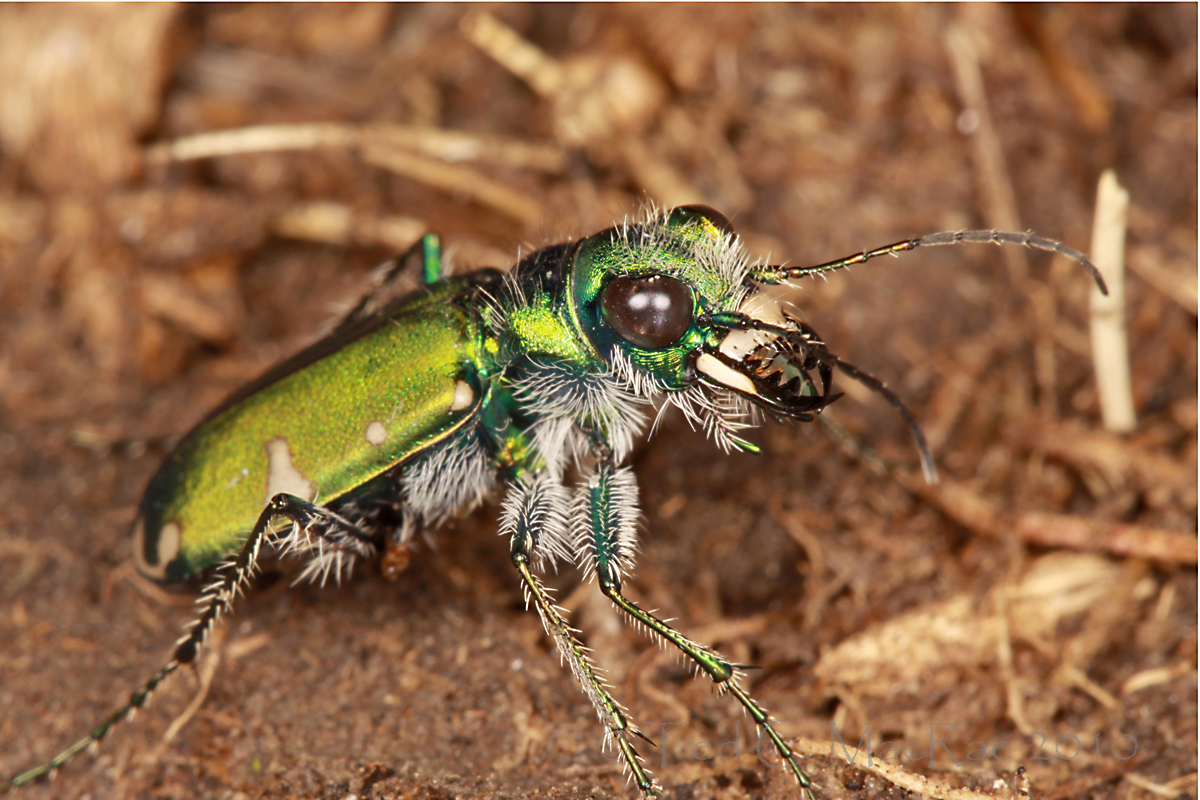
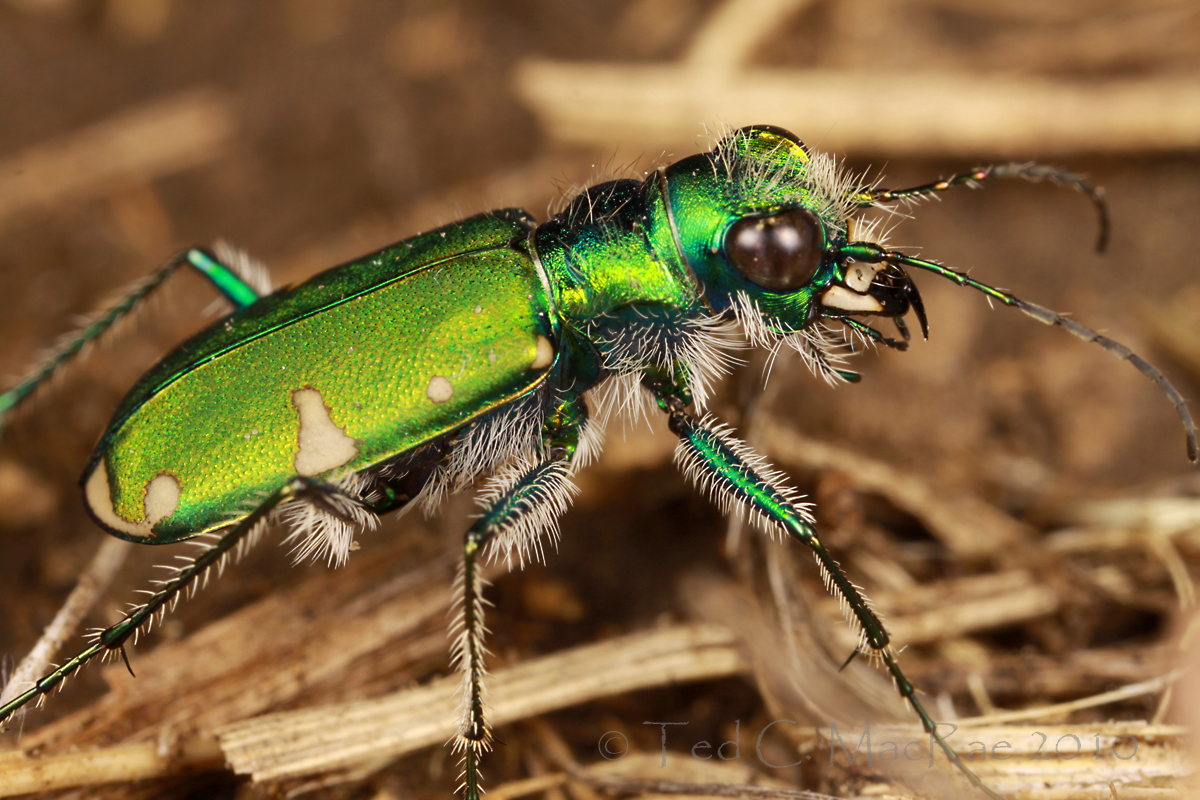
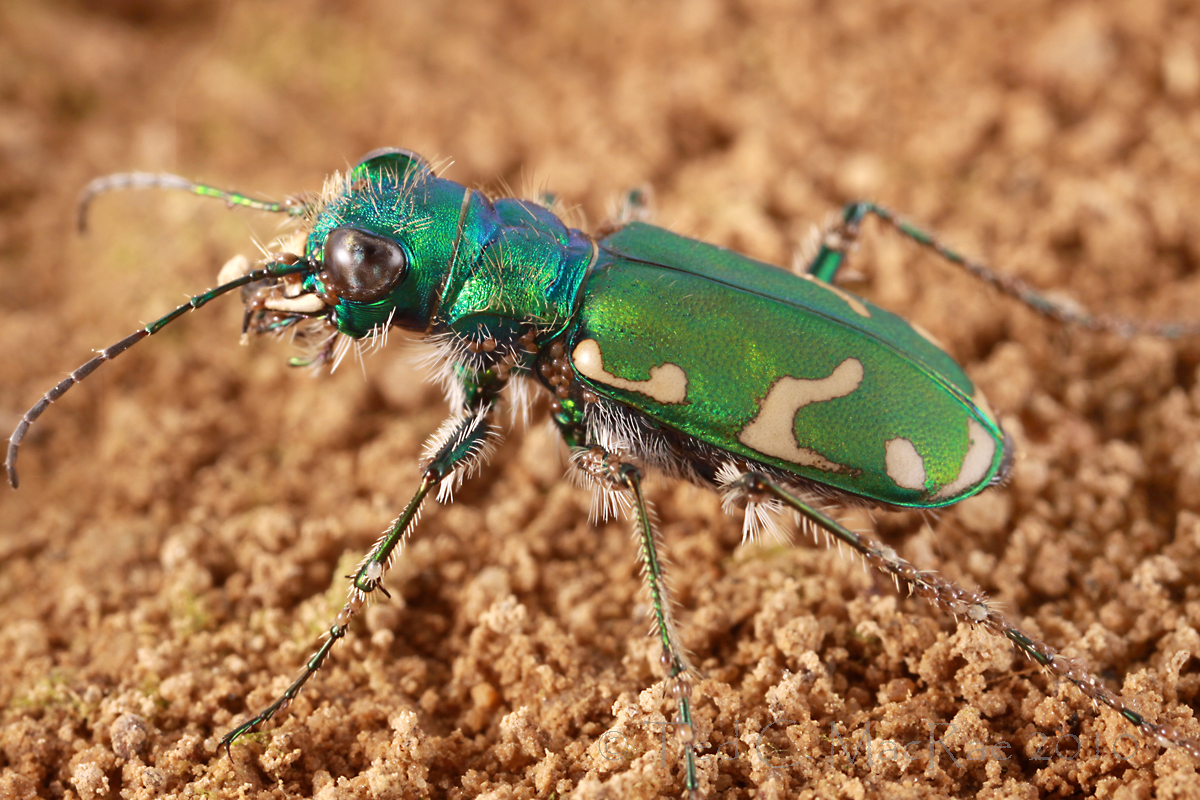
ID Challenge #2

Here is another straight-up ID Challenge. Standard rules apply:

  • Points awarded for correctly naming the order, family, genus, and species (2 pts each).
  • Bonus points may be given (at my discretion) for providing additional relevant information (e.g., diagnostic characters, biological/ecological uniquities, clever jokes, etc.).¹
  • Comments will be moderated during the 1- to 2-day open challenge period to allow all a chance to participate (you don’t have to be first to win!).
  • Submitted answers will be posted at the end of the challenge period along with the number of points earned.

¹ Don’t ignore the opportunity for bonus points – they often determine the winner in these challenges!

Good luck!

Copyright © Ted C. MacRae 2011

Monroe Canyon epilogue – Audubon’s tiger beetle

Cicindela purpurea audubonii (Audubon's tiger beetle) - green morph

In my first post about Monroe Canyon in the Pine Ridge of northwestern Nebraska, I featured the sumptuous Cicindela lengi (blowout tiger beetle) – a target species for the trip and one of six tiger beetle species that Chris Brown and I would find at this quarter-mile long sandy roadside embankment.  Another species we found there was C. denverensis (green claybank tiger beetle), unexpected given its preference for clay soils, but like C. lengi also a target species and thus a welcome find.  We also saw some more common species – the nominotypical forms of C. formosa (big sand tiger beetle) and C. scutellaris (festive tiger beetle), both reliable residents of sand habitats throughout the Great Plains, as well as a few individuals of the often ubiquitous C. punctulata (punctured tiger beetle).  The most numerous of all, however, was C. purpurea audubonii (Audubon’s tiger beetle).  Despite being uncommon in other parts of its range (in fact, nominotypical populations are feared extirpated in some parts of the eastern U.S.), C. purpurea audubonii is one of the most commonly encountered tiger beetles in grassland habitats throughout the central Great Plains and Rocky Mountains.  This species belongs to a complex of several that are generally green in color and fond of clay soil habitats, such as C. denverensis, C. decemnotata (badlands tiger beetle), C. limbalis (common claybank tiger beetle), and C. splendida (splendid tiger beetle).  All of these species can co-occur with C. purpurea audubonii in the Great Plains, but the latter is distinguished by its faint purple tinge and distinct metallic purple border around the edge of the elytra and its reduced elytral markings consisting of a short, oblique middle line and a white rear tip at the edge of the elytra (Pearson et al. 2006).  All of these characters can be seen easily in classic pose in the above photograph.

Cicindela purpurea audubonii (Audubon's tiger beetle) - black morph

Despite its commonness, however, I actually did look forward to seeing this species – the reason being the occurrence of occasional all-black individuals in the population.  Tiger beetles as a whole are a variable lot – polytopism (geographically based variability) is the rule!  Despite this, for the most part individuals within a given population usually exhibit a fairly uniform appearance.  Occasionally, populations of some species – generally those at intergrade zones where different subspecies meet – will show variation on a continuum between two extremes.  The occurrence of two distinct morphs within a population, however, is rather unusual.  I lacked good field photographs of the all-black morph of C. purpurea audubonii (and also the green morph, for that matter), so I was pleased to encounter several individuals of the black morph while we were at Monroe Canyon.  As can be seen in the above photograph, black morph individuals are truly all-black, perhaps with a purple reflection but without a trace of green anywhere on the body.  They do retain the same pattern of reduced white markings exhibited by the green morphs.  As a result, these individuals can be confused with some other black species that also occur in the Great Plains, such as C. nebraskana (prairie long-lipped tiger beetle) and, at higher elevations, C. longilabris (boreal long-lipped tiger beetle).  These latter species were also targets for our trip, so we had to pay close attention to any black morphs that we saw to confirm their identity (C. purpurea audubonii black morphs are distinguished by their distinctly hairy frons).

Chris Brown waits patiently to photograph a burrowing wolf spider at the entrance of its burrow.

I’ve not been able to find any additional information about these black morph individuals and the possible causes for their occurrence.  Cicindela purpurea is a so-called “spring-fall” species, emerging in the fall as sexually immature adults and then spending the winter in burrows before re-emerging in the spring to mate and lay eggs.  As spring-fall species go, it is one of the earliest to appear in the spring and last to disappear in the fall.¹  This immediately brings to my mind a possible thermoregulatory function.  Low temperatures may be a challenge for the adults during early spring and late fall, and the black coloration could be an adaptation to maximize absorption of solar radiation for heat gain. This idea seems to be supported by the fact that the incidence of black morphs is greater at more northern latitudes and in the higher elevations of the western part of the subspecies’ range (as much as 20-40%), where overall lower temperatures would be expected to occur.

¹ Karl Werner even amusingly stated that this species “rather delights in chilly weather” (Acorn 2001).

REFERENCES:

Acorn, J.  2001. Tiger Beetles of Alberta: Killers on the Clay, Stalkers on the Sand. The University of Alberta Press, Edmonton, xix + 120 pp.

Pearson, D. L., C. B. Knisley and C. J. Kazilek. 2006. A Field Guide to the Tiger Beetles of the United States and Canada. Oxford University Press, New York, 227 pp.

Copyright © Ted C. MacRae 2011

BitB Top 10 of 2010

Welcome to the 3rd Annual BitB Top 10, where I pick my 10 (more or less) favorite photographs of the year.  My goal for 2010 was to continue the progress that I began the previous year in my quest to become a bona fide insect macrophotographer.  I’m not in the big leagues yet, but I have gotten more comfortable with using my equipment for in situ field photographs and am gaining a better understanding of lighting and the use of flash.  I also began experimenting with different lighting techniques (e.g. white box) and diffusers and am putting more effort into post-processing techniques to enhance the final appearance of my photographs.  I invite you to judge for yourself how successful I’ve been toward those goals by comparing the following selections with those from 2009 and 2008 – constructive feedback is always welcome:


Best Tiger Beetle

Cicindela denverensis - green claybank tiger beetle

From ID Challenge #1 (posted December 23).  With numerous species photographed during the year and several of these dramatic “face on” shots, this was a hard choice.  I chose this one because of the metallic colors, good focus throughout the face, and evenly blurred “halo” of hair in a relatively uncluttered background.


Best Jewel Beetle

Buprestis rufipes - red-legged buprestis

From Special Delivery (posted July 13).  I didn’t have that many jewel beetles photos to choose from, but this one would have risen to the top no matter how many others I had.  The use of a white box shows off the brilliant (and difficult-to-photograph) metallic colors well, and I like the animated look of the slightly cocked head.


Best Longhorned Beetle

Desmocerus palliatus - elderberry borer

From Desmocerus palliatus – elderberry borer (posted November 18).  I like the mix of colors in this photograph, and even though it’s a straight dorsal view from the top, the partial dark background adds depth to the photo to prevent it from looking “flat.”


Best “Other” Beetle

Enoclerus ichneumoneus - orange-banded checkered beetle

From Orange-banded checkered beetle (posted April 22).  The even gray background compliments the colors of the beetle and highlights its fuzziness.  It was achieved entirely by accident – the trunk of the large, downed hickory tree on which I found this beetle happened to be a couple of feet behind the twig on which it was resting.


Best Non-Beetle Insect

Euhagenia nebraskae - a clearwing moth

From Euhagena nebraskae… again (posted October 21).  I photographed this species once before, but those photos failed to capture the boldness of color and detail of the scales that can be seen in this photo.


Best “Posed” Insect

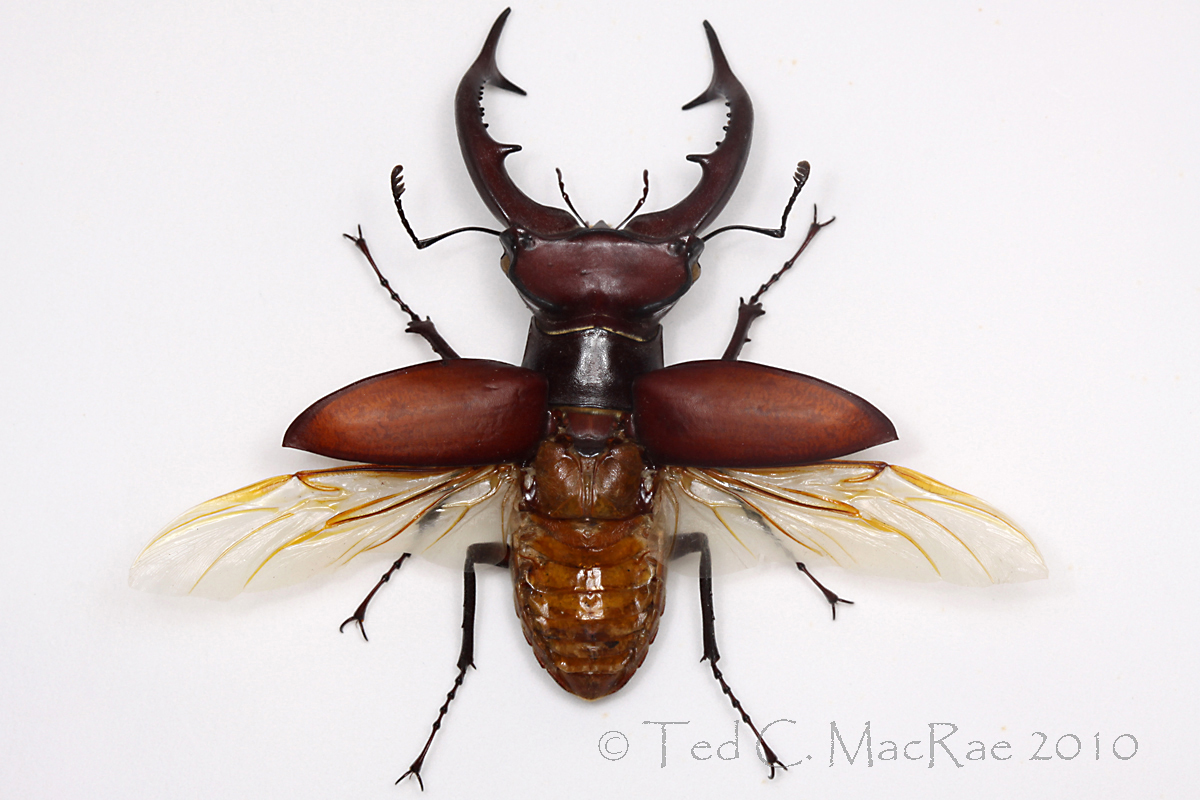
Lucanus elaphus - giant stag beetle

From North America’s largest stag beetle (posted December 30).  I’ve just started experimenting with photographing posed, preserved specimens, and in fact this male giant stag beetle represents only my second attempt.  It’s hard to imagine, however, a more perfect subject than this impressively stunning species.


Best Non-Insect Arthropod

Scolopendra heros - giant desert centipede

From North America’s largest centipede (posted September 7).  Centipedes are notoriously difficult to photograph due to their elongate, narrow form and highly active manner.  The use of a glass bowl and white box allowed me to capture this nicely composed image of North America’s most spectacular centipede species.


Best Wildflower

Hamamelis vernalis - Ozark witch hazel

From Friday Flower – Ozark Witch Hazel (posted March 26).  The bizarre form and striking contrast of colors with the dark background make this my favorite wildflower photograph for the year.


Best Non-Arthropod

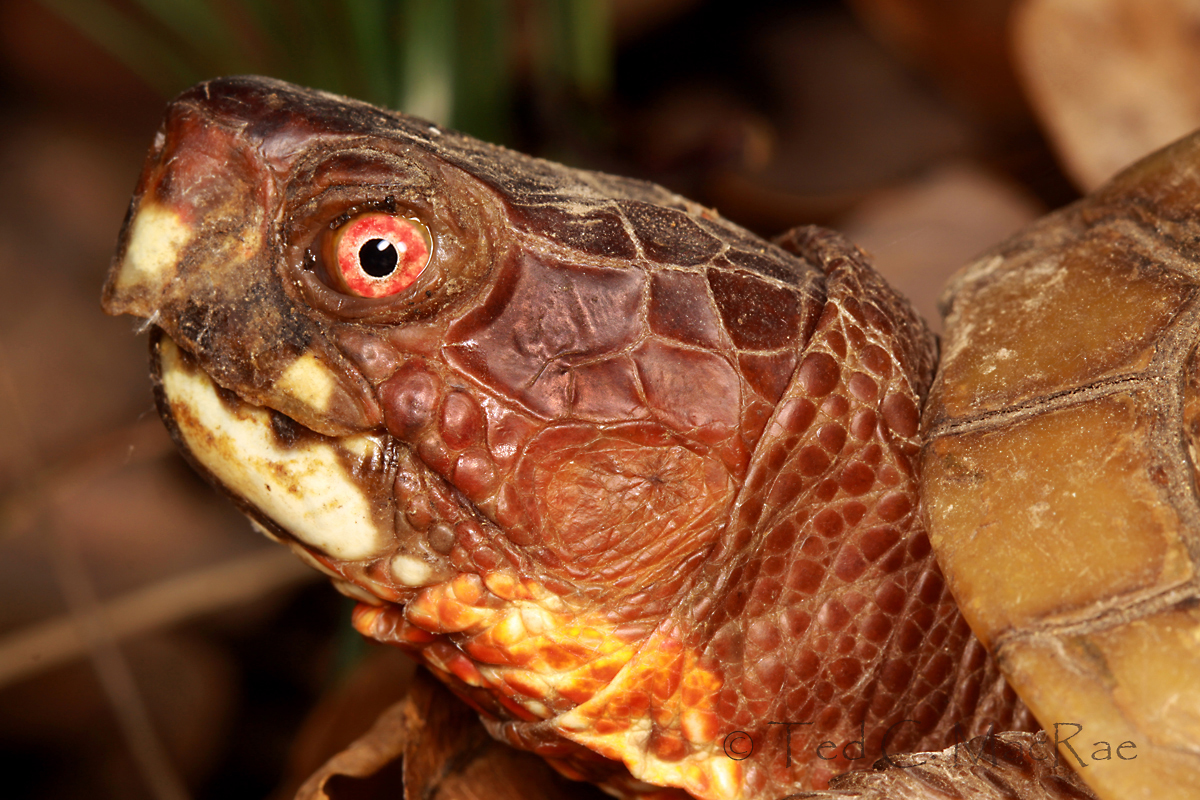
Terrapene carolina triunguis - three-toed box turtle

From Eye of the Turtle (posted December 10).  I had a hard time deciding on this category, but the striking red eye in an otherwise elegantly simple photograph won me over.  It was also one of two BitB posts featured this past year on Freshly Pressed.


Best “Super Macro”

Phidippus apacheanus - a jumping spider

From Jeepers Creepers, where’d ya get those multilayered retinae? (posted October 5).  I’m not anywhere close to Thomas Shahan (yet!), but this super close-up of the diminutive and delightfully colored Phidippus apacheanus is my best jumping spider attempt to date.  A new diffuser system and increasing comfort with using the MP-E lens in the field at higher magnification levels should allow even better photos this coming season.


Copyright © Ted C. MacRae 2011

North America’s largest stag beetle


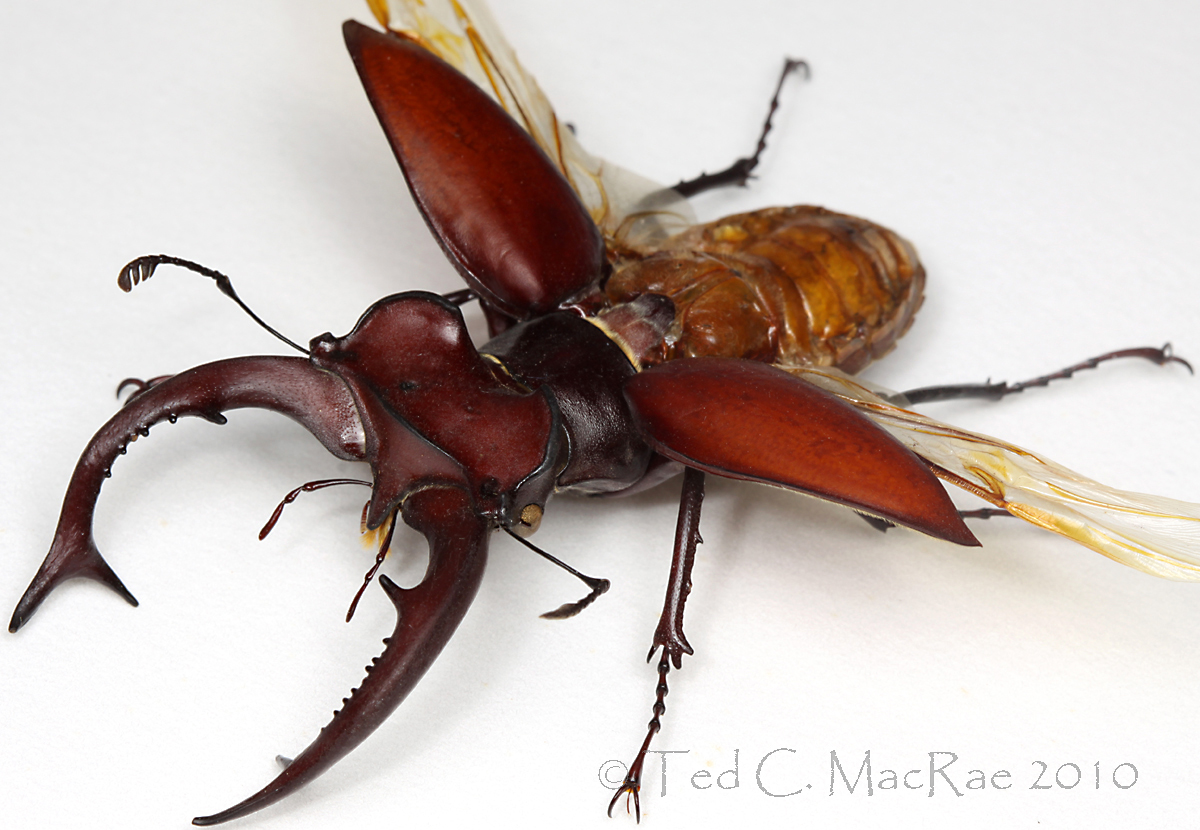
Here is the full-sized photo that provided the image for yesterday’s Super Crop Challenge #3.  The insect in the photo is, of course, a fine example of a male Lucanus elaphus – the giant stag beetle (family Lucanidae).  This striking insect is easily among North America’s most distinctive and recognizable species by virtue of the enormously super-sized mandibles sported by the males.  Its fearsome appearance belies the true nature of this harmless beetle, which spends its days feeding on sap that flows from wounds on the trunks and roots of trees.  Males use their massive mandibles in combat with other males, not for “biting,” but rather as tools to pry and lift their adversaries before dropping them to the ground.  Some marvelous photos of this behavior in a related European species can be seen at Stag Beetles Lucanus cervus Mating Behaviour.

I collected this specimen many years ago at an ultraviolet light (“blacklight”) that I had setup in the pine/oak forests at Pinewoods Lake, Carter Co., in the southeastern Ozarks – one of my favorite 1980’s beetle collecting spots.  This was in my early days of studying beetles, during which time I was actively collecting material as part of my statewide surveys for the families Buprestidae (MacRae 1991) and Cerambycidae (MacRae 1994).  Lucanus elaphus is not a commonly encountered species, especially in the western reaches of its distribution here in Missouri, and I’ll never forget my rabid excitement when I encountered this fine major male at my blacklight sheet.  For many years afterward it remained the only individual that I had ever encountered, until a few years ago when I came across a group of two males and one female feeding on a sap flow in a wet bottomland forest along the Mississippi River in the lowlands of southeastern Missouri.  I encountered another male the following year at a nearby location “rafting” on debris in floodwaters from the nearby river, and two weeks later at that same site I picked up several males and females in a fermenting bait trap.¹  Like most “uncommon” species with broad distribution across the eastern U.S., I suspect that its apparent rarity is an artifact due to habits that make it infrequently encountered rather than being truely scarce.

¹ I have used fermenting bait traps to collect a wide variety of beetles, but especially longhorned beetles.  My recipe is based on that described by Champlain and Knull (1932) – bring 12 oz. dark molasses and 12 oz. beer up to 1 gal. with water, mix well and add a packet of dry baker’s yeast to get the fermentation started.  Hang a 1/2-gallon milk jug with big holes cut in the sides in a tree along the edge of a woods and add ~1 quart of fresh liquid.  It generally takes 2-3 days for the liquid to really start fermenting and become attractive, and it will remain so for about another week or so.  Check traps every 2-3 days by pouring the liquid through a kitchen strainer into another container – reuse or replace as necesssary. Place the collected specimens in vials of water to wash off the molasses residues, and either pin immediately afterward or transfer to 70% ethanol for longer term storage.  Some of the more desireable species I’ve collected in this manner, besides L. elaphus, are Plinthocoelium suaveolens, Purpuricenus axillaris, P. humeralis, P. paraxillaris, Stenocorus cylindricollis, S. shaumii, Sarosesthes fulminans, Stenelytrana emarginata [= Leptura emarginata], and S. gigas [= Leptura gigas].


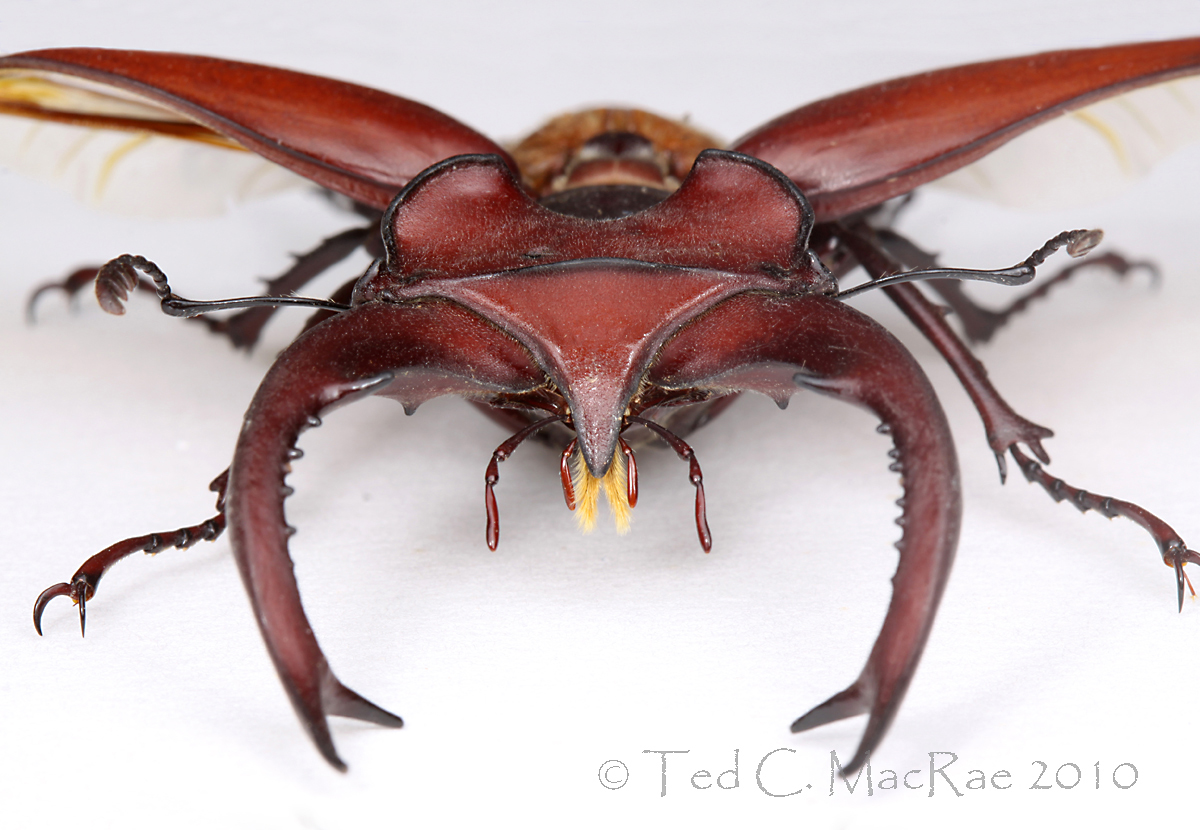
Congratulations to Ben Coulter and Janet Creamer, both of whom correctly identified the species and most of the mouthparts.  Each earned 14 pts and, thus, tied for the win, while JasonC. earned 5 pts. to take the final podium spot.  The pointed structure is the labrum (its shape distinguishing it from other North American species of the genus), and it is flanked on each side by the fuzzy yellow galeae (derived from the maxillae) and the labial palps.  Nobody correctly named the galeae, which seem to be greatly elongated and hairy in stag beetles as a function of their sap feeding behavior.  A portion of the left maxillary palpus can also be seen in the corner of the photograph, but nobody scored those points either.  Brady Richards just missed the podium, but his witty reference to Gene Shalit (if not immediately picked up on by me) earns him an honorable mention.

With points being formally awarded now beginning with the previous competition (ID Challenge #1), I’ll start keeping an overall leaders board, and with wins in both competitions Ben takes a commanding lead in the overalls with 23 pts, followed by Janet Creamer at 14 pts and TGIQ at 8 pts.  I guess I should start thinking of some sort of tangible prize for winners periodically – suggestions welcome.  Stay tuned for another issue of Super Crop Challenge or ID Challenge in the near future.

REFERENCES:

Champlain, A. B. and J. N. Knull.  1932. Fermenting bait traps for trapping Elateridae and Cerambycidae (Coleop.).  Entomological News 43(10):253–257.

MacRae, T. C. 1991. The Buprestidae (Coleoptera) of Missouri.  Insecta Mundi 5(2):101–126.

MacRae, T. C. 1994. Annotated checklist of the longhorned beetles (Coleoptera: Cerambycidae and Disteniidae) known to occur in Missouri. Insecta Mundi 7(4) (1993):223–252.

Copyright © Ted C. MacRae 2010

Super Crop Challenge #3

There are lots of points up for grabs with this one, what with several body parts to name as well as the organism to which they belong needing to be identified.  Rules and points will be awarded roughly as outlined in the inaugural ID Challenge – i.e., points are not mutually exclusive, with comment moderation turned on while the challenge is open to allow all a chance to participate (no advantage to those with trigger fingers).  Points will be awarded for correct taxonomic identifications (order, family, genus, and species – 2 pts each) and for each body part correctly names (2 pts each).  Bonus points may be awarded at my discretion for .

We’ll give this a day or so, depending on how quickly the answers come in…

Copyright © Ted C. MacRae 2010

My MT-24EX flash diffuser

When I purchased my insect macrophotography rig two summers ago, I already knew that one of the biggest challenges I would face (besides a steep learning curve) was lighting.  While it is possible to do insect macrophotography using only natural light, this generally requires the use of a tripod and reflector for all but the largest of insects.  Unfortunately, such devices aren’t very practical for field photographs of the tiger beetles that I have come to enjoy stalking (and I already have enough to carry as it is without adding such incumbrances).  Supplemental flash lighting is a more attractive alternative for me – not only does it minimize the amount of equipment I must carry, but the high shutter speeds and small apertures it allows are perfect for ‘freezing’ subjects prone to quick movements while maintaining good depth-of-field. There are many flash units to choose from, but I went with the Canon MT-24EX Macro Twin Lite Flash for its dual light sources (eliminating the “flatness” of a traditional ring flash) and lightweight, front-of-lens mounted bracket (no need for heavy bracket extenders).  Combined with Canon’s 100mm f/2.8 (up to 1X magnification) or MP-E 65mm (1-5X magnification) macro lens, this flash unit has become quite popular in recent years for insect macrophotography. 

The problem with flash, of course, is the harsh, unnatural light that it produces.  With natural lighting, illumination comes from all directions, while with flash it is essentially unidirectional.  This is especially problematic with beetles, many of which have a smooth, shiny integument that reflects the flash to produce strong specular highlights.  Diffusion and maximizing the apparent size of the light source are key to achieving good results with flash units, and a variety of diffusers are commonly used to achieve this. Unfortunately, the small size of the MT-24EX flash heads and their placement at the front of the lens creates some unique challenges for diffusing their light.  The only commercially available diffusers for the MT-24EX (that I’m aware of) are the Stofen OM-24XSET, which are translucent plastic caps that fit over the unit heads.  I used these during my first season of photography, and while better than nothing they still leave much to be desired.  The problem is that they do nothing to increase the apparent size of the light source, and it is an even worse problem with the 100mm lens than the 65mm because of its longer working distance.  Much better results have been achieved by Kurt (Up Close with Nature) with his concave foam diffuser and Alex (Myrmecos) with his tracing paper diffuser.  Unfortunately, these diffusers only work with short focal length lenses such as the 65mm, while it is the 100mm lens that I use most often for tiger beetles (1.0-1.5X range).  For most of this past season, I tried a Gary Fong Puffer + Sto-Fen combo diffuser based on an idea by Dalantech, but again that setup seemed only slightly better than Sto-Fens alone with the 100mm.  As the season progressed, I continued to mull over various contraptions and ideas to extend the flash heads out in front of the lens to increase apparent light size.  Most of those ideas were expensive and bulky, but at the end of the season I came up with an idea that seemed like it might work and went with it.  The following photographs are the first iteration of that idea.

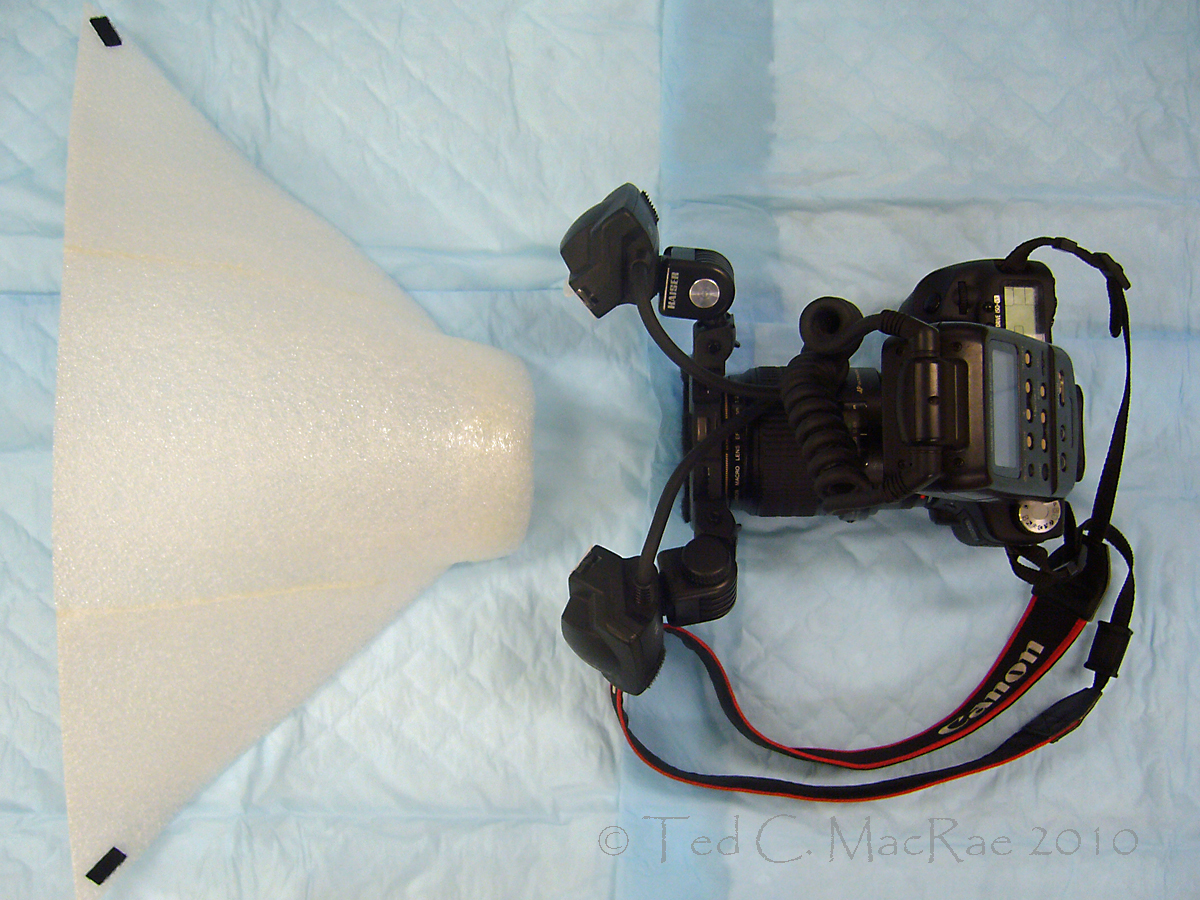
Canon MT-24EX flash and 100mm macro lens with DIY oversized concave diffuser.

The diffuser is a larger version of Kurt’s do-it-yourself (DIY) concave diffuser.  It uses thick polypropylene foam (used as padding in cardboard shipping boxes) that is sturdy enough to hold its shape but flexible enough to curl back and over the top of the flash heads, essentially forming a large “soft box” in front of both flash heads.

Diffuser is ultralight and lays almost flat when not installed - easily carried in camera backpack.

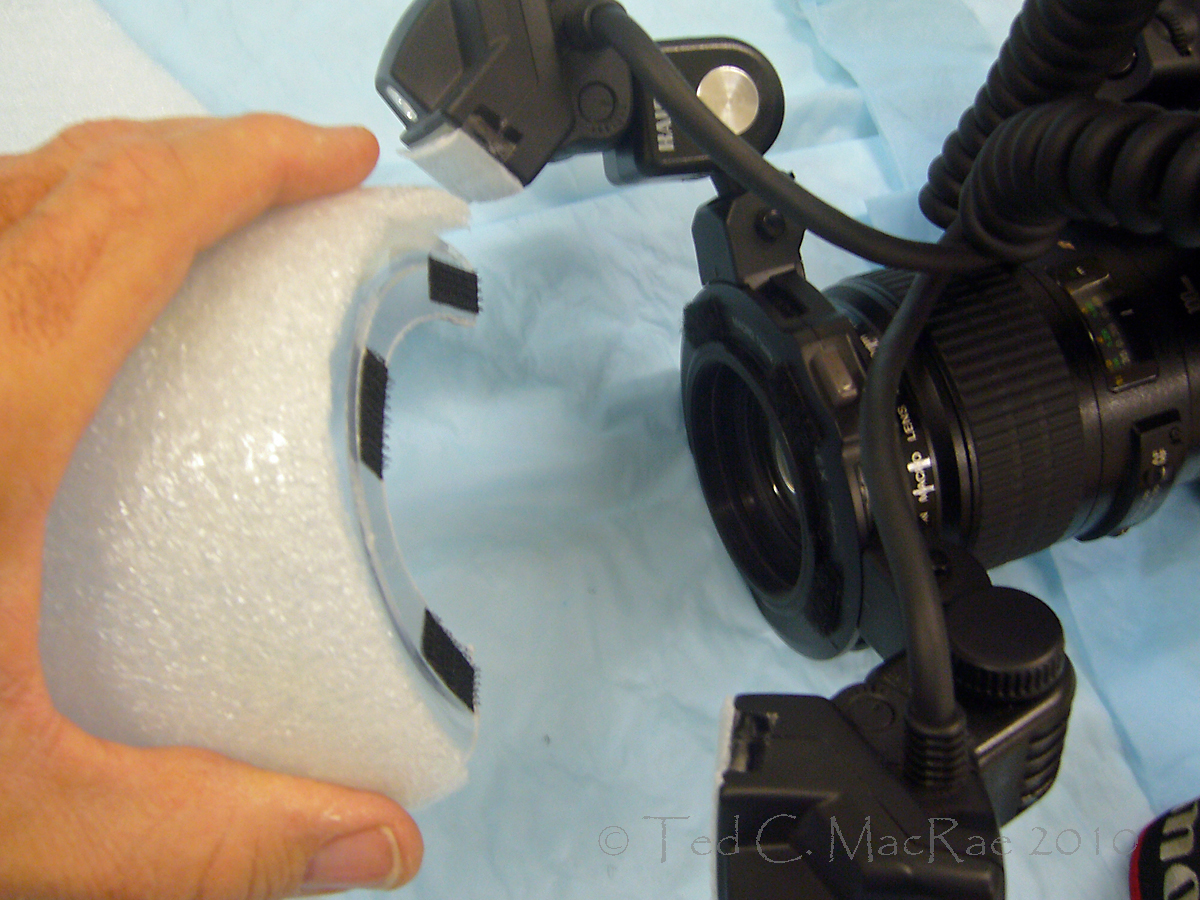
I cut the bottom inch off of a a 1,000-mL polypropylene beaker (the prototype used a 500-mL beaker, but that was too small).  I then cut the center out of the beaker bottom so that the hole size matched the lens opening of the flash head bracket, and then cut the beaker bottom in half.  This forms a sturdy but translucent, semi-circular frame to hold the polypropylene foam against the flash head bracket on the front of the lens.  The piece of foam measures 21″ (front) x 7″ (back) x 9″ (front to back) and is attached to the polypropylene frame using hot glue.

Flash heads extended forward w/ Kaiser shoes. Thin polypropylene foam layer taped over flash head.

I also used Kaiser shoes to extend the flash heads a little further forward in front of the lens, and I taped a small piece of thin polypropylene foam over front of each flash head to provide some initial diffusion.  This helps to increase the apparent light size by reducing the distance between the flash heads and the subject.  I snugged the pivot screw on the Kaiser shoes just enough to hold the flash head in place but still allow me to adjust their aim.

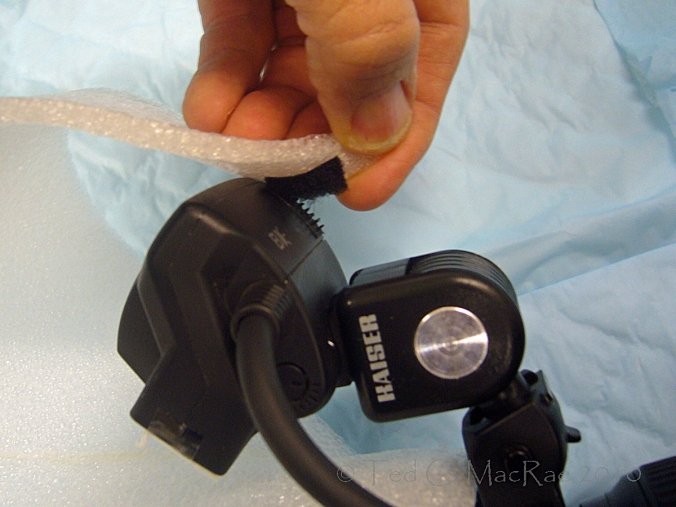
Diffuser attaches to front of flash bracket using Velcro strips.

The diffuser frame is attached to the front of the flash head bracket using pieces of Velcro strips.  It’s not a tight, sturdy connection, but so far I have not had any problems with the diffuser falling off.  This system allows me to quickly and easily switch out similar diffusers of different sizes (I have a smaller one that I made for the 65mm lens).

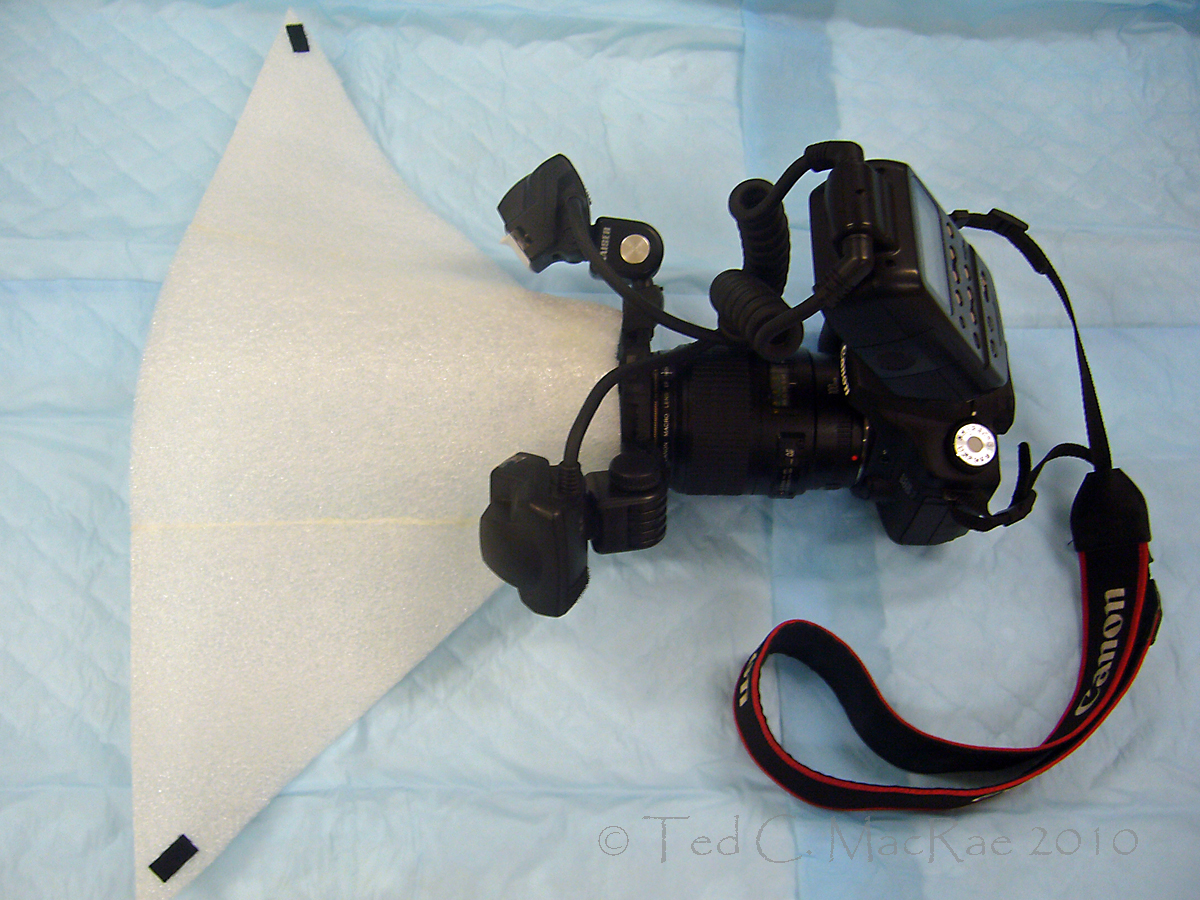
Diffuser attached to flash bracket.
Diffuser is curled back and corners attached to back of flash heads using Velcro.

Pieces of Velcro strip are also attached the corners of the diffuser and the back of the flash heads to hold the diffuser foam in position after attaching the bracket to the flash head bracket.
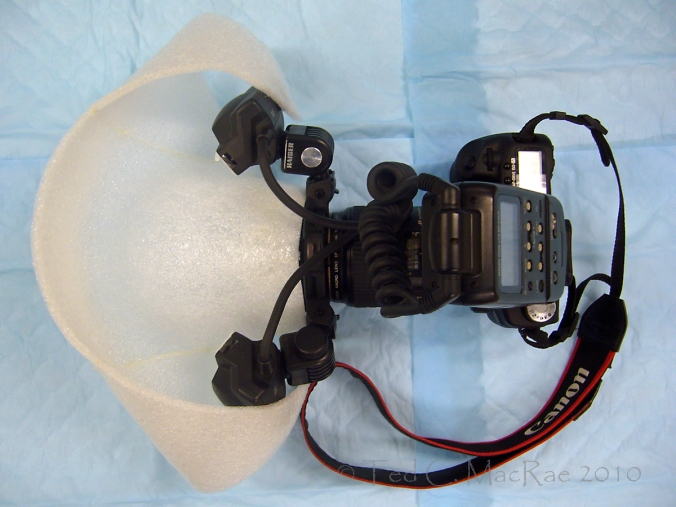
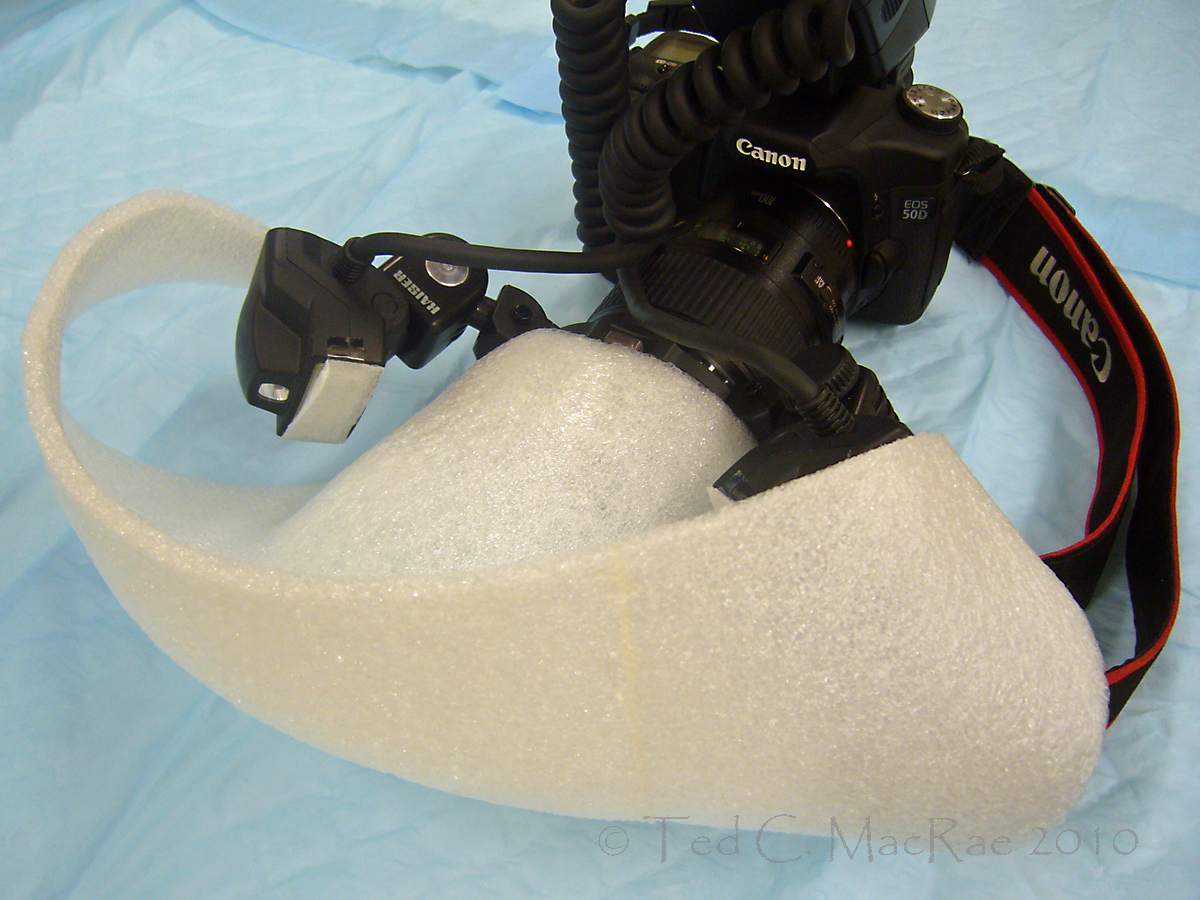
Diffuser in position and ready for use.

Diffuser remains properly positioned regardless of flash head position or lens changes.

I have since added additional Velcro strips along the front edge of the foam to allow it to be pulled back closer to the flash heads, depending on the distance to subject. 

One nice thing about this diffuser is that it does also work with the 65mm lens as long as there is nothing to get in the way of the diffuser.  It is simply a matter of angling the flash heads back closer to the lens and adjusting their aim according to the subject distance, then pulling the foam layer back closer toward them.  Or, just swap out with a smaller version.  When detached, the diffuser can be folded to lay flat in the backpack.

Of course, the proof is in the pudding, and none of this means anything if it doesn’t actually do the job.  I’m now immersed in the depths of a Midwestern winter, so I haven’t yet had a chance to test the diffuser in the field.  I have, however, done a fair amount of testing here in the laboratory using both live and dead insects and have been quite pleased with the results so far.  Those photographs can be seen in the following posts.  This coming season I’ll put it to the test in the field to see if it actually has the usability and durability that I have hoping for.

Copyright © Ted C. MacRae 2010

The 12 Years of Christmas

This post first appeared on Beetles in the Bush on Christmas Day 2008. Two years have passed, but the sentiment remains stronger than ever. I reprint it here as BitB‘s single evergreen post. Merry Christmas!

p1020457_2

Merry Christmas - from our backyard to yours!

They came from completely different backgrounds. She had grown up in a middle class family, her father an educated professional, her mother a professional homemaker – “Ward and June”, as their now-grown children jokingly call them. He grew up on welfare, the family breaking up while he was still in elementary school. She was a popular student – cheerleader, debate team, gymnastics. He was the introverted science nerd, invisible to the popular, living quietly with his books. Religion was an important part of her life, growing up Catholic and remaining devoted to the church. He grew up Catholic but knew even as a child that religion would not provide the answers he was looking for, eventually finding a private spirituality in the Creation itself.

Despite these separate paths they found each other and fell in love, and despite their different lives they both wanted the same thing – a family. Such a simple desire, however, would prove to be difficult to achieve. When fertility drugs didn’t work, they turned to adoption. The first match failed. So did the second. They understood completely how the birth mothers could change their minds, but that didn’t ease their pain or calm their fears. Ultimately, they looked to Russia, a new democracy with old attitudes about orphans. In the fall of their 6th year of marriage, they learned that little Anastasia was waiting for them. They traveled to Russia before Christmas and became a family after New Years. In between, they visited little Anastasia every day – one hour at a time – and experienced the joy of being a parent, a feeling they had feared would ever elude them. On Christmas Day, they could not see little Anastasia, but in a small, gray apartment on the outskirts of Moscow, they celebrated her coming with their gracious host family. Ten days later, their family was born, and twelve months later they celebrated their first Christmas together at home.

Christmas meant little to me for much of my life. Yes, it was a time to relax and enjoy the company of family and friends, and the presents were nice. But my own approach to spirituality has little in common with traditional reflections of the season. Tonight, as I watched 12-year old Mollie Anastasia laughing with her cousins, hugging her nanny and papa, and teasing her uncle and his partner, I thought back to those cold, snowy days in Russia when my heart became warm for the first time. I recalled our second trip to Russia six years later, when she and little Madison Irina each met their sister for the first time. On this Christmas Day, as I have done for 12 years now, I thought about how lucky we are to have these two beautiful little girls that are unquestionably our own. Christmas means a lot to me now, and that is a gift that not even five golden rings could beat.

Copyright © Ted C. MacRae 2010

Cicindela denverensis – green claybank tiger beetle

Cicindela denverensis (green claybank tiger beetle) | Sioux Co., Nebraska.

Here are a few more photographs of the insect featured in ID Challenge #1, which is, in fact, Cicindela denverensis (green claybank tiger beetle).  Nearly every commentor got the first 6 points easy enough (2 pts each for order, family, and genus), but only Ben Coulter correctly identified the species.  A bonus point for proper italicization of the binomen (and a favorable ruling on a technicality) gave him 9 points and the win.  Second place goes to TGIQ, who smartly picked up bonuses to earn 8 points and edge the pack.  Charley Eiseman, Christopher Taylor, Delbert La Rue, jason, and Techuser crowd the final podium spot with 7 points each.

Distinguished by its green color, hairy frons, reduced maculations, and grassland occurrence.

Cicindela denverensis occurs in short- and mixed-grass prairie habitats in the central and western Great Plains, especially sites with clay soils.  It can be distinguished from a number of similar-looking species by its uniformly green color, hairy frons, often reduced maculations, and occurrence in grassland habitats.  Cicindela sexguttata is also uniformly green, but the frons in that species is glabrous, and it occurs further east in woodland habitats.  Cicindela decemnotata is also similar, but it usually has broad maculations and a shinier, oily appearance – often with some degree of red tinting.  Some subspecies of C. scutellaris are also green, but only rugifrons bears maculations and can be distinguished by it’s stockier form and Atlantic Coastal Plain distribution. Cicindela denverensis is actually most closely related to C. purpurea (cowpath tiger beetle), C. limbalis (common claybank tiger beetle), and C. splendida (splendid tiger beetle) – especially the latter two.  All three of these species exhibit some degree of purple or red on the pronotum, elytra, and/or legs that distinguish them from C. denverensis in most parts of their range.   There is, in fact, some disagreement about whether C. denverensis, C. limbalis, and C. splendida even represent distinct species, all of which demonstrate a similar preference for clay substrates but segregate into three partially allopatric populations – northern C. limbalis, southern C. splendida, and western C. denverensis.  Hybrid individuals can be encountered in areas where their distributions overlap, and this is especially so in central Nebraska – one of just a few spots where all three species occur together.  Schincariol & Freytag (1991) conceded a close relationship between the three based on morphometric analysis but still considered them distinct based on differences in elytral color, pattern, and percentage maculation and the number of non-sensory setae.  However, a recent phylogenetic analysis based on mitochrondrial DNA sequences strongly supports a single species hypothesis (Woodcock & Knisley 2009).  From an academic perspective, more thorough systematic analyses of the claybank group of tiger beetles would be of great interest (although I suspect many cicindelophiles with strictly philatelic interests will not be happy to see three species sunk into one).

Ponderosa pine mingles with prairie grasses on the Nebraska Pine Ridge escarpment.

The individual in the above photos was found at Monroe Canyon in the Pine Ridge escarpment of western Nebraska (Sioux Co.).  It was the only individual of this species that we saw there and was a bit of a surprise finding because of the generally sandy soils that characterize the spot – perhaps it was a vagrant individual that had found its way into the canyon from the more clay-based shortgrass prairie above.  We’ve seen greater numbers of this species further east in central Nebraska (Sherman Co.) along vertical roadside clay banks. The photograph below is one of those individuals and exhibits somewhat more complete maculations.  Note the sharp bend, or “knee,” on the median maculation that allows the species to be differentiated from C. limbalis (all-green forms of this species can be found at the northern limit of distribution for C. denverensis in North Dakota).  This individual also displays something else of interest – anybody?

Individual with more complete maculations | Sherman Co., Nebraska.

REFERENCES:

Schincariol, L. A. and R. Freitag. 1991. Biological character analysis, classification, and history of the North American Cicindela splendida Hentz group taxa (Coleoptera: Cicindelidae). The Canadian Entomologist 123(6):1327-1353.

Woodcock, R. M. and C. B. Knisley. 2009. Genetic analysis of an unusual population of the problematic tiger beetle group, Cicindela spendida/C. limbalis, from Virginia, USA (Coleoptera: Cicindelidae) using mtDNA. Entomological News 120(4):341-348.

Copyright © Ted C. MacRae 2010