Entomology is, of course, a wide and varied discipline that touches any number of human endeavors – from the practical (agriculture, food production, public health) to the esoteric (genetics, ecology, cultural symbolism). Despite this far-reach, however, entomologists themselves are not all that common, and the number of people who know a fair amount about insects without actually being an entomologist is rather small. Compare this to ornithology, where the number of people who know a good deal about birds exceeds by great measure the number of actual ornithologists. This is merely an observation and not a criticism – insects are just simply too small and too diverse for most lay people to even attempt identification. That’s good for me, as those who have an interest in insects but not the expertise to identify them often turn to me for help. For most of my adult life, I’ve been “the bug guy” at social gatherings, often leading to questions such as, “I’ve got this green bug on my bushes – what is it?” Sometimes the insect or its situation are described well enough that I can offer a guess (just a guess!), more often I can only say, “I’d have to see it to know for sure.” Despite not always being able to answer the question, I really do enjoy serving as this very direct link between the science of entomology and the general public, as it gives me a chance to present insects and their study in a favorable light and with a sense of passion.
The level of this interaction has increased greatly during the past two years since launching Beetles in the Bush. Now, my “clients” include not just family, friends, their friends, etc., but an unrestricted internet audience. I am regularly contacted by those who stumble upon this blog during a Google search in their attempt to identify some insect they’ve encountered. Again, I’m not always able to answer their queries, but I do try to offer my best guess. Such was the case recently when I was contacted by a resident of southwestern Missouri, who had this to say:
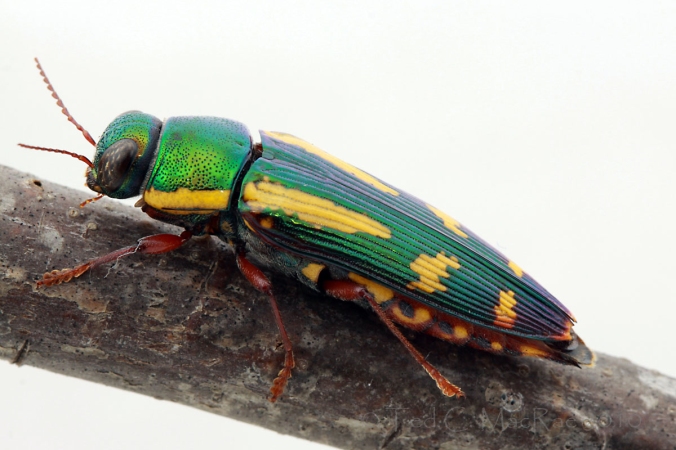
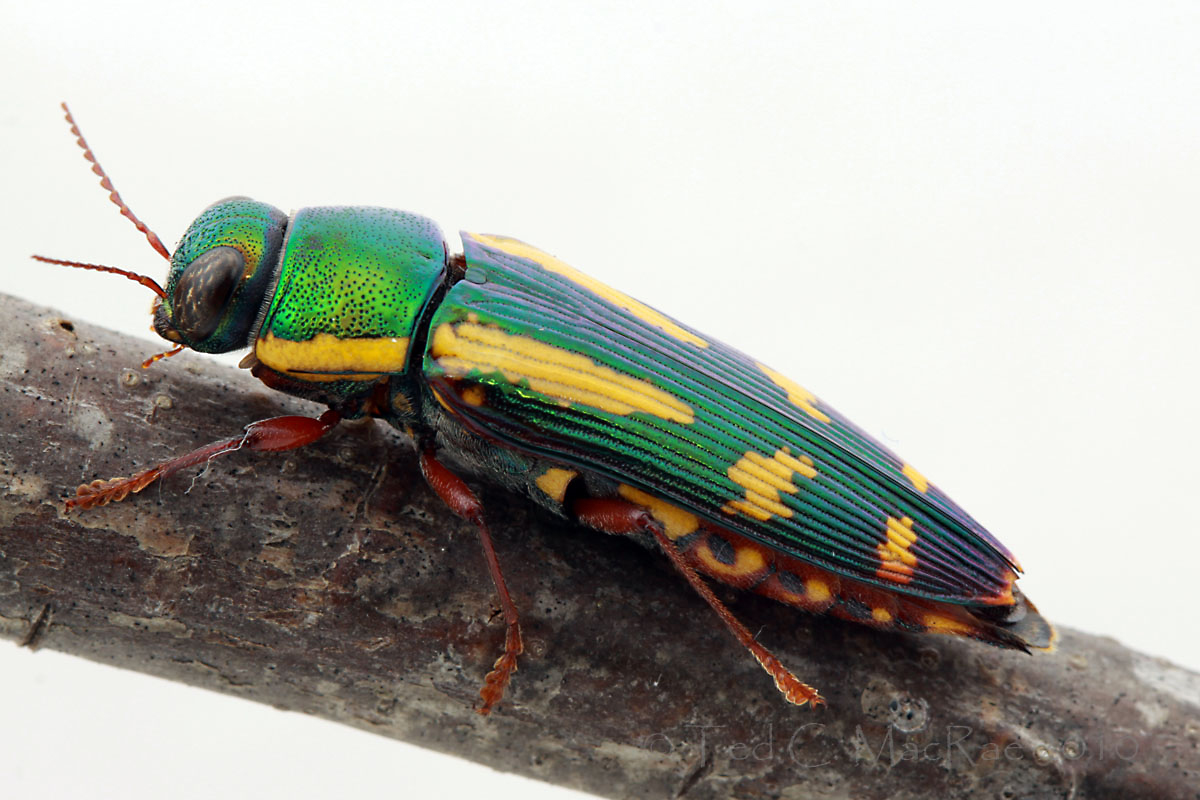
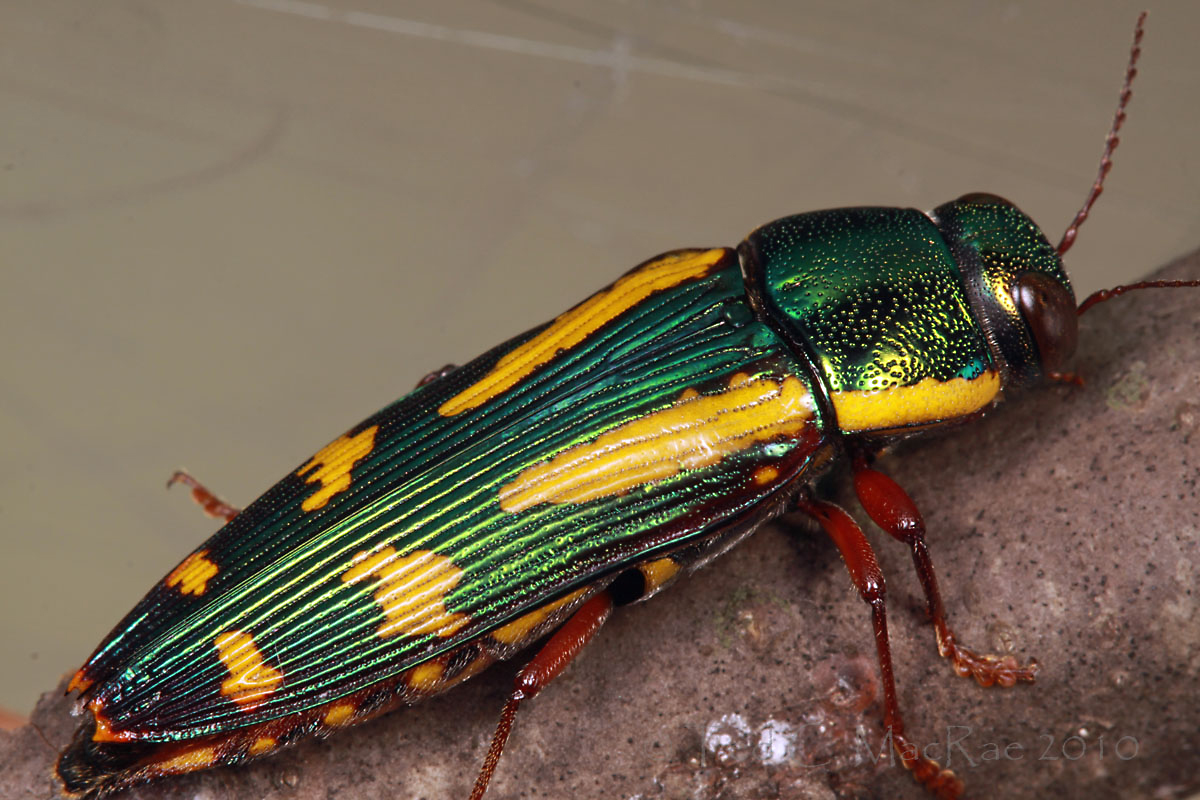
While messing around here in the yard this morning I came upon a beetle I thought interesting. First time I have seen one like this. I Have a Simon and Schusters Guide to insects guide and attempted to look up the beetle. Closest thing I could find was a flat-headed borer (BUPRESTIS GIBBSI) from the Pacific Northwest. Emerald green with yellow slash or stripe along the side of the head. four matching yellow spots on the wing covers, first pair closest to the front of the covers elongated. Second set smaller, third set smaller yet and then tiny sopts on the wing cover tips. Yellow center pattern along the bottom from head to tail. Bettle length almost 2.5 cm. I am not much of a insect man but when I get something stuck in my head I need to know what I have. Can you help me and if you do not have one in your collection do you want this one?
This is perhaps the best, most detailed description of an insect I’ve ever received from a non-specialist wanting an identification, but the reference to it resembling Buprestis gibbsii was enough to immediately bring to mind an eastern U.S. relative – B. rufipes. I responded that it was likely the latter, and since they had offered to send it to me I would be happy to receive it and confirm its identity. I instructed them to wrap the beetle loosely in a square of toilet paper, put that in a film canister or other small, sturdy box, and slip that inside a padded envelope and mail it to me. A few days later a small padded envelope arrived at my office, and inside was a film canister. I popped the lid to find it stuffed full with tissue paper, but I noted that the tissue seemed all chewed up. I pulled out the tissue and unfolded it, and there was no beetle – oh no, was it alive, and did it chew it’s way out? I looked inside the canister, almost expecting to see a hole chewed though it, and there at the bottom sat a most stunning example of B. rufipes (literally meaning red-legged buprestis). I hadn’t expected the specimen to be sent alive when I gave my mailing instructions (but I did not, after all, specify that it should be otherwise), and I felt a little sorry for the beast when I saw it drinking eagerly after I put it in a terrarium with wood chips and a stick and misted it with water. Once it was rehydrated, I was glad to have this unexpected opportunity to photograph a living individual of this beautiful species.
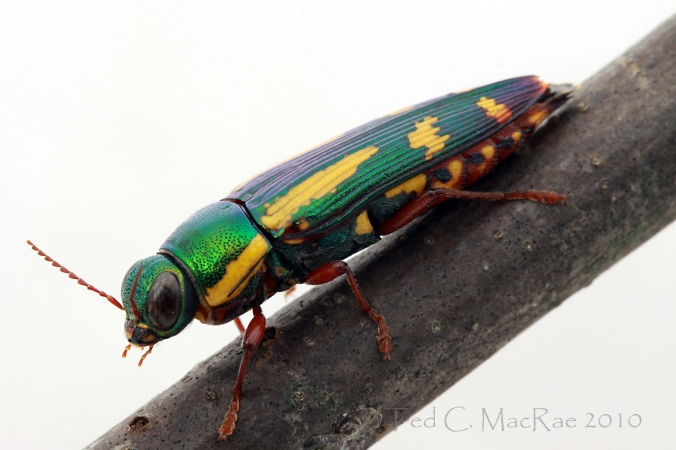
Buprestis rufipes is not a rare species, but it is certainly not very commonly encountered either. For many years the only specimens in my collectioni were two dead adults that I found in Japanese beetle traps that I monitored during my early days with the Department of Agriculture. I finally cued into this species when I chopped some big buprestid larvae out of the trunk sapwood of a very large, standing dead slippery elm (Ulmus rubra). They resembled the larvae of Chrysobothris but were larger and not so flattened, so I retrieved my chain saw from the truck and extricated the lower 6ft of the 6-8″ diameter trunk from the swamp in which it was growing. My efforts were rewarded with a nice series of this species, and I have since reared it from even larger trunk sections of Acer saccharum and Quercus palustris. In each case, the wood was in early stages of decay with the bark partly sloughed and the outer wood layer slightly softened (MacRae and Nelson 2003, MacRae 2006). Knull (1925) recorded this species breeding in a variety of other hardwoods, thus, it would seem that the size and condition of the wood are more important than the species.
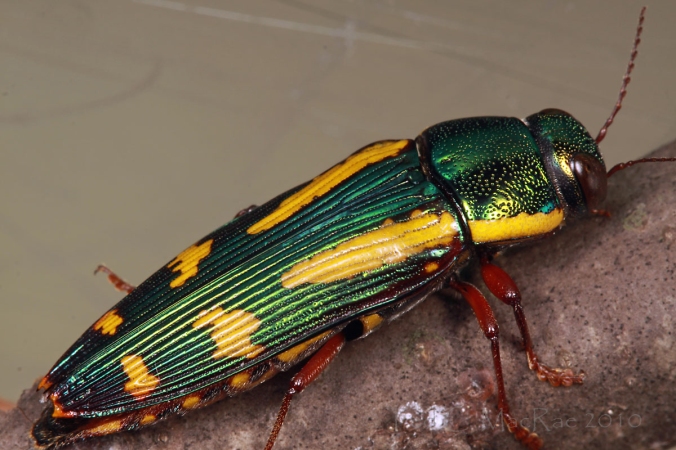
Photo Details: Canon 50D (ISO 100, 1/250 sec), Canon 100mm macro lens, Canon MT-24EX flash (1/4 power).
Photos 1-2: f/13, indirect flash in white box.
Photo 3: f/16, double diffused flash.
Typical post-processing (minor cropping, levels and unsharp mask).
REFERENCES:
Knull, J. N. 1925. The Buprestidae of Pennsylvania (Coleoptera). Ohio State University Studies 2(2):1–71.
MacRae, T. C., and G. H. Nelson. 2003. Distributional and biological notes on Buprestidae (Coleoptera) in North and Central America and the West Indies, with validation of one species. The Coleopterists Bulletin57(1):57–70.
MacRae, T. C. 2006. Distributional and biological notes on North American Buprestidae (Coleoptera), with comments on variation in Anthaxia (Haplanthaxia) viridicornis (Say) and A. (H.) viridfrons Gory. The Pan-Pacific Entomologist 82(2):166–199.
Copyright © Ted C. MacRae 2010


 Email to a friend








 Beetles In The Bush