CotS #50 – the Mantis Shrimp Edition

Circus of the Spineless turns 50 (issues) this month, and this special edition is hosted by Mike Bok at Arthropoda.  This is Mike’s first blog carnival hosting gig, but there is nothing rookie about his presentation – the 19 submissions are skillfully organized with visual appeal and just  enough hook to invite clicking.  Stop on by and see a sampling of the latest in invertebrate blogging (and don’t forget to tip the waiter).

As a caveat, I feel I’ve been a bit remiss in not featuring Mike’s blog when I first found it a few months ago, as it has quickly became one of the regular stops on my rounds.  Mike is a graduate student at University of Maryland, and while his primary  interest is in the mantis shrimp visual system, his posts span the breath of the Arthropoda (my phavorite phylum!).  I enjoy his generally casual tone while covering fairly academic subject matter.  One thing I’ve learned after reading Arthropoda for awhile – mantis shrimp are hecka cool!  If you don’t believe me, check out this video of the pseudopupil of a mantis shrimp eye in action (look for it at 0:14-0:18).

Copyright © Ted C. MacRae 2010

Add to FacebookAdd to DiggAdd to Del.icio.usAdd to StumbleuponAdd to RedditAdd to BlinklistAdd to TwitterAdd to TechnoratiAdd to Yahoo BuzzAdd to Newsvine

Email to a friend

Monday Moth – Trichaeta pterophorina

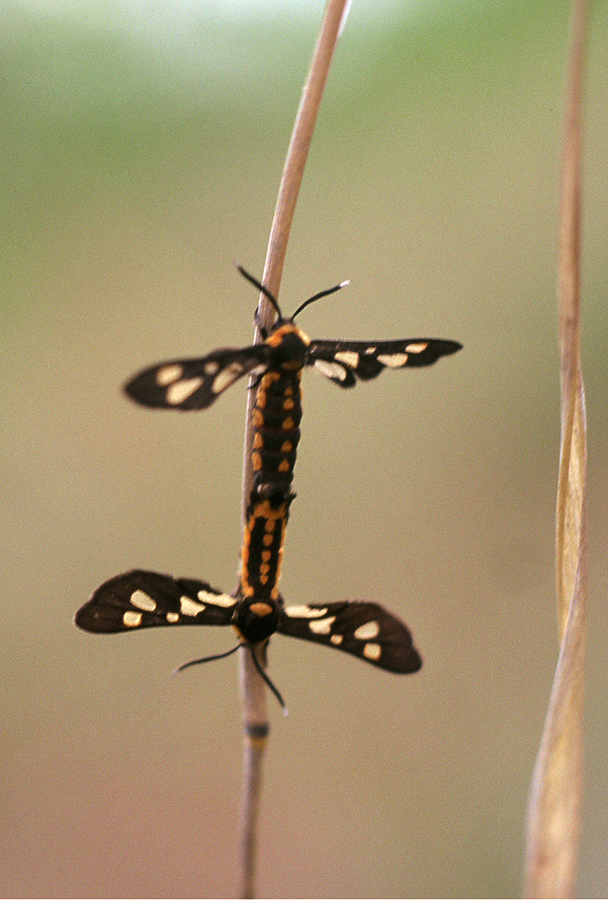
 Trichaeta pterophorina – Borakalalo National Park, South Africa

Another photo from the South Africa files, and one that continues the mimicry theme that has been featured in several recent posts. It’s not a great photograph – the focus is off – but the colors these moths sport are dazzling, and there is a nice symmetry to their tail-to-tail mating position.

Roy Goff, author of the website African Moths, tells me this species is the Simple Maiden (Amata simplex) in the family Arctiidae (whose ~2,000 species worldwide are increasingly considered a subfamily of the already enormous Noctuidae) [update 6/20/2012—Martin in a comment considers these moths to actually represent Trichaeta pterophorina in the same subfamily].  Its gestalt – greatly resembling a stinging wasp – brings to mind the so-called “wasp moths” of North America (subtribe Euchromiina); however, maidens belong to the exclusively Old World Syntomina.  Like the wasp moths, most maidens are exceptionally colorful and exhibit clearly aposematic patterns.  While these might seem to be textbook examples of Batesian mimicry, most species in this group are also protected by distasteful secondary plant compounds that they sequester through feeding, making them Mullerian rather than Batesian mimics.  These compounds are not only acquired by larvae from their food plants, but also by adult moths who imbibe them from fluid regurgitated through their proboscis onto dried parts of plants containing the compounds and into which they dissolve.

Their aposematism is not limited to strictly visual cues.  An Australian species, Amata annulata, is known to regularly emit ultrasonic clicks when flying, thought to be aposematic behavior to warn bats of its distastefulness in the same way that that its coloration warns daytime predators. Additional defensive characters that have been described for species in the group include frothing and extrusion of defensive processes. Clearly, maidens are leaders in the arms race among the insects!

Copyright © Ted C. MacRae 2010

Add to FacebookAdd to DiggAdd to Del.icio.usAdd to StumbleuponAdd to RedditAdd to BlinklistAdd to TwitterAdd to TechnoratiAdd to Yahoo BuzzAdd to Newsvine

Email to a friend

Friday Flower: Red Buckeye

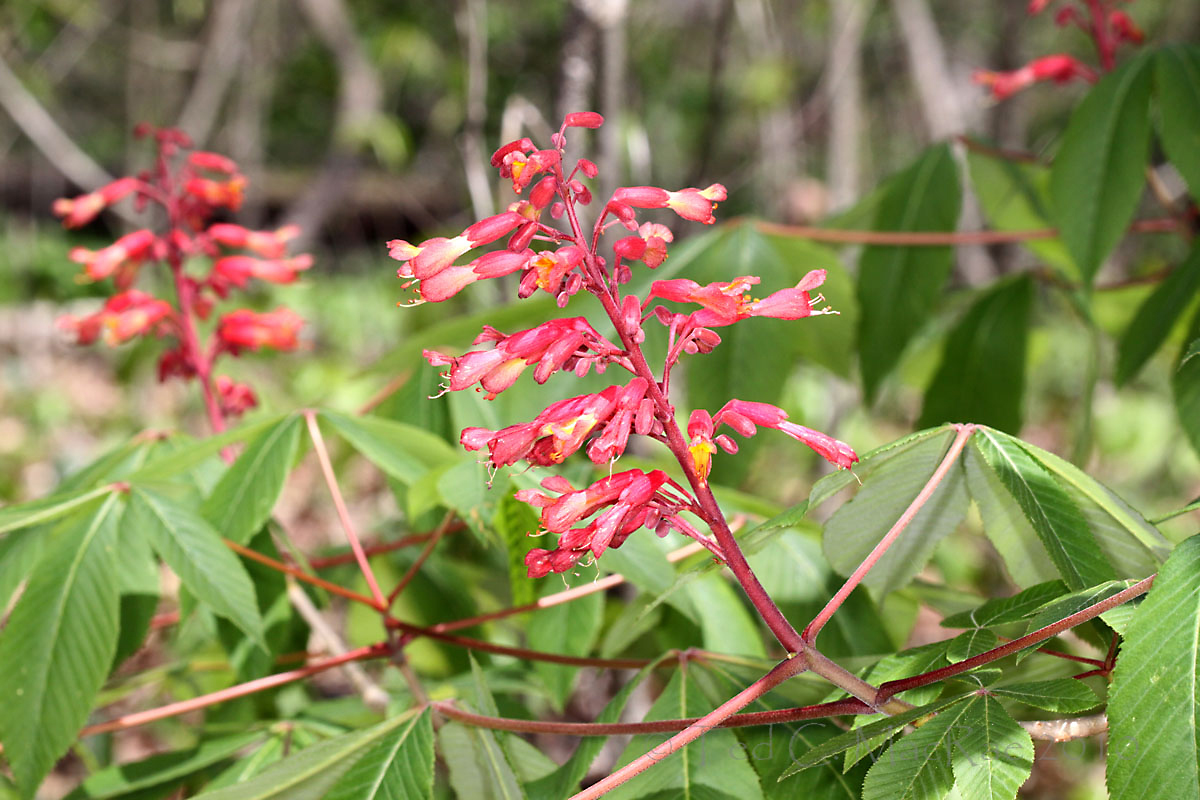
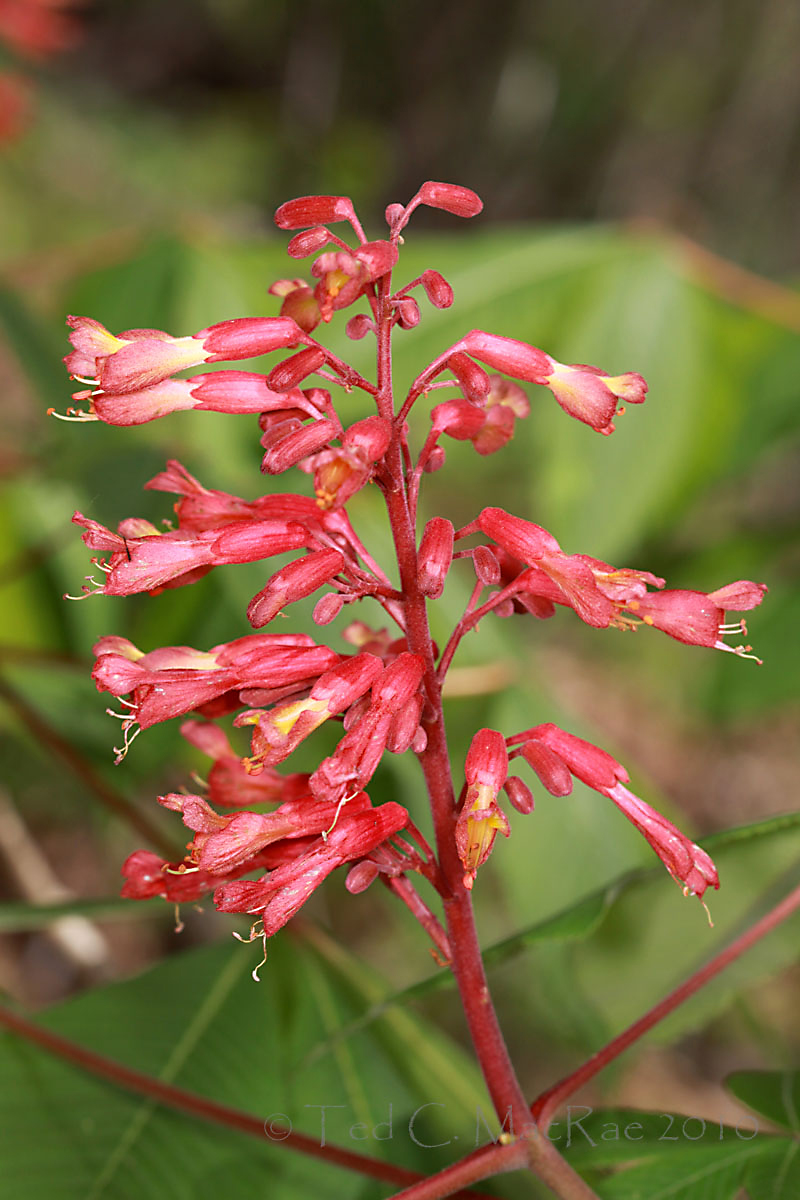
Beetles, spiders, and snakes were not the only delights that Rich and I saw as we hiked the lower stretch of the Ozark Trail’s Wappapello Section in early April.  Entering the rich, moist, east-facing slopes overlooking the Black River valley, the oaks and hickories were still in the early stages of bud break. A lush, green understory, however, spread out before us, punctuated by the striking inflorescences of red buckeye, Aesculus pavia (family Hippocastanaceae). Among the first trees to bloom in spring, red buckeye is unmistakable in the field due to its red flowers and palmately divided leaves.

Red buckeye is native to the southeastern U.S., just reaching Missouri in the southeastern Ozarks (though cultivated further north). This makes it less well-known than the more widely distributed Ohio buckeye, Aesculus glabra (absent only from the southeastern lowlands and northwestern corner of the state, and easily distinguished by its white inflorescences, larger size, and spreading growth habit).  Like that species, the seeds and young foliage especially are poisonous if eaten due to glycosidic alkaloids and saponins.  Native Americans roasted, peeled and mashed the nuts into a meal called “Hetuck.”

I first encountered this species in 2001 along Fox Creek in the White River Hills of extreme southwestern Missouri.  It was one of several species that I had selectively “cut” and left in situ for a season to allow infestation by wood boring beetles.  I retrieved the wood the following spring and reared five species of longhorned beetles (family Cerambycidae) from the dead branches, including Astyleiopus variegatus, Hyperplatys maculata, Leptostylus transversus, Lepturges angulatus, and the prize – the very uncommonly encountered Lepturges regularis. All of these represented new larval host records; however, it was not until after I published those records (MacRae and Rice 2007) that I realized the plant itself was not known by Steyermark (1963) to occur naturally outside of the southeastern Ozark Highlands.

Speaking of early spring flowers, many such delights can be found at Berry Go Round #27 which is now up at Mary Farmer’s A Neotropical Savanna. It’s not just spring ephemerals, however, as another Missouri blogger and I show that winter has it’s own botanical charms. Stop by and enjoy the feast!

REFERENCES:

MacRae, T. C. and M. E. Rice. 2007. Distributional and biological observations on North American Cerambycidae (Coleoptera). The Coleopterists Bulletin 61(2):227–263.

Steyermark, J. A. 1963. Flora of Missouri.  The Iowa State University Press, Ames, 1728 pp.

Copyright © Ted C. MacRae 2010

Add to FacebookAdd to DiggAdd to Del.icio.usAdd to StumbleuponAdd to RedditAdd to BlinklistAdd to TwitterAdd to TechnoratiAdd to Yahoo BuzzAdd to Newsvine

Email to a friend

Rough Green Snake

My string of good herp luck looks like it might continue in 2010.  You may recall the super-aggressive prairie rattlesnake and uncooperative dusty hognosed snake that I featured in 2008 (or not – my readership was rather minuscule back then), followed by the juvenile Osage copperhead, gorgeous male eastern collard lizard, bizarre Texas horned lizards, death-feigning western hognosed snake, super rare Florida scrub lizard, and – finally – cute little western pygmy rattlesnake in 2009. All but the copperhead and collared lizard were first-time sightings for me, and now in 2010 I have yet another first-time sighting to present – the rough green snake (Opheodrys aestivus aestivus).

Rough green snake (Opheodrys aestivus aestivus)

My friend Rich and I spotted this long and slender snake during our early April hike of the lower Wappapello Section of the Ozark Trail (soon after photographing the jumping spider). We would never have seen it, so effective was its green camouflage, had it not been disturbed by our close approach along the trail and tried to flee.  The moist bottomland habitat where we found it was thick with greenbrier (Smilax sp.), making tracking the snake a thorny affair, but I managed to head it off and start taking a few photos of it.  It was surprisingly calm during the early part of the photo session, but I just wasn’t getting the lighting and exposure that I wanted.  Eventually, it started fleeing again, and my efforts to rip through the greenbriers to stay close became too much for my arms to bear.  When it started climbing a tree, I said “enough is enough” and captured him, brought him back out to the comfort and openness of the trail, and had Rich hold him while I worked on getting some better photographs.  The one above is my favorite of the bunch.

Rough green snakes are found in Missouri primarily south of the Missouri River in the Ozark Highlands, where they feed on insects such as grasshoppers, crickets, and especially smooth caterpillars.  A second green snake occurs in Missouri as well, the smooth green snake (Opheodrys vernalis), which differs from the rough green snake by having smooth scales and a more northern distribution within the state. Sadly, the smooth green snake has not been seen in the state for a number of years now, probably because of loss of habitat resulting from the near complete agricultural conversion of that part of the state.

Photo Details: Canon 100 mm macro lens on Canon 50D, ISO 400, 1/60 sec, f/4.5, Canon MT-24EX flash w/ Sto-Fen diffusers. Minimal post-processing.

Copyright © Ted C. MacRae 2010

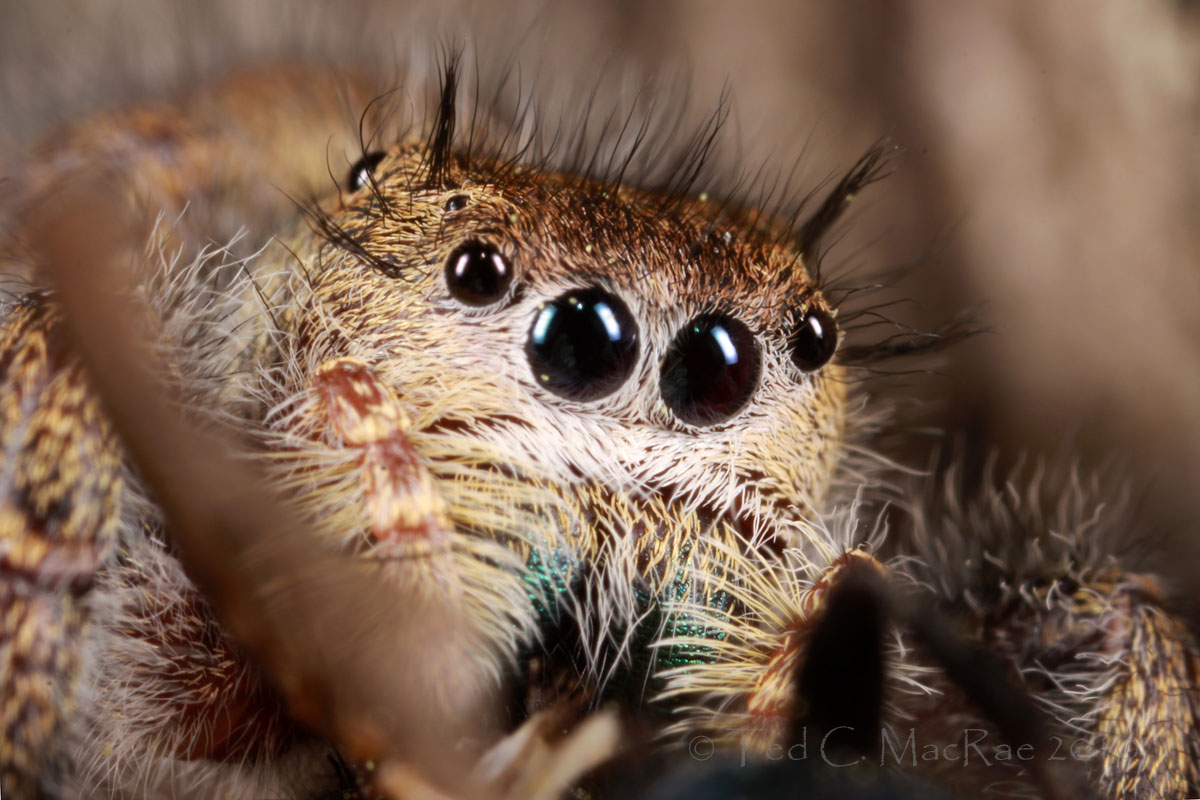
My first jumping spider

As a long-time professional and avocational entomologist, I find beauty and fascination in all manner of joint-legged creatures. Of course, beauty is in the eye of the beholder, and most people don’t exactly share my passion for these animals. Sure, butterflies enjoy almost universal approval, but beetles are just too crunchy, flies too filthy, wasps too aggressive, and cockroaches… well, eww! Even crabs and lobsters, tasty as they are, just move too robotically to engender any feelings of affection. None of these groups, however, seem to be as universally reviled as spiders – scuttling blurs of leg and fur with beady little eyes, just waiting to launch a sneak attack with their venomous gnashers. Few other coin-sized animals can cause an otherwise lucid adult to run screaming from their bathroom with such terror.

Except jumping spiders! Jumping spiders (family Salticidae) possess many of the same traits that condemn other spiders to the ranks of the creepy – hair and venom and lots of eyes; yet they have other unique qualities that make them nevertheless endearing, almost cuddly, to all but the most ardent of arachnophobes. Their human-like “face” featuring two large, forward-facing eyes and inquisitive nature give them a charisma that almost invites interaction. Approach any other spider, and it scampers back into the nearest crevice. Jumping spiders, on the other hand, turn and face the intruder – you can almost see them sizing you up – perhaps even moving forward a little to have a better look. It makes them seem, well… intelligent. Add to that their stunning diversity (~5,000 species), dazzling colors, and the sometimes impressively elongated choppers of the males, and you’ve got the perfect recipe for charm. Bouncy, furry, smart, cute, and big bright eyes – almost sounds like a kitten!

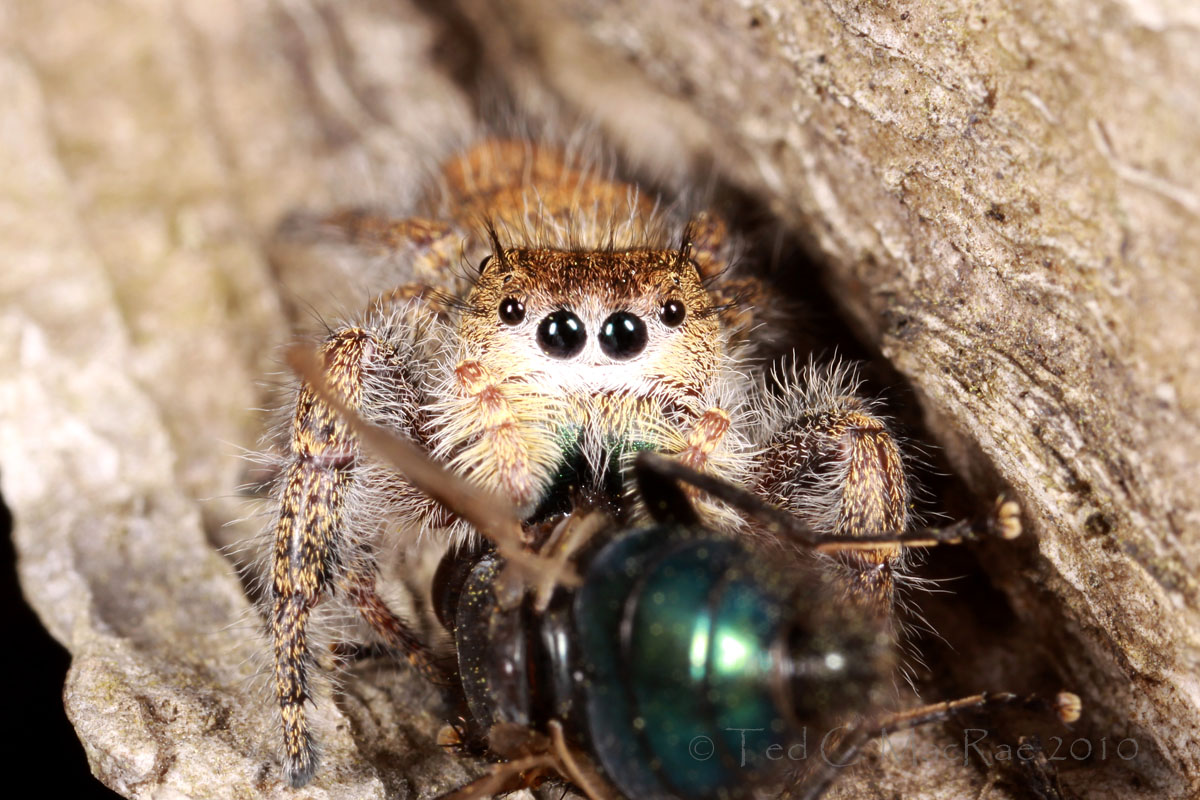
The result of all this charm is that jumping spiders are wildly popular subjects for macrophotography. Accordingly, there has been a veritable explosion of online photographs of jumping spiders, dominated by close-ups of that irresistible face. These shots here represent my first attempt to photograph one of these endearing creatures, and while I’m happy with them considering my relative newness to the field, they are a far cry from the spectacular images being produced by some other photographers. Perhaps the best of these is Thomas Shahan, whose focus-stacked facial shots of these spiders are among the most stunning that you will find. Another photographer who has produced some excellent photographs of Malaysian jumping spiders is Kurt at Up Close with Nature. Perhaps someday my jumping spider photographs will be considered on par with those that these two gentlemen are producing – if that day comes, you can say it began right here!

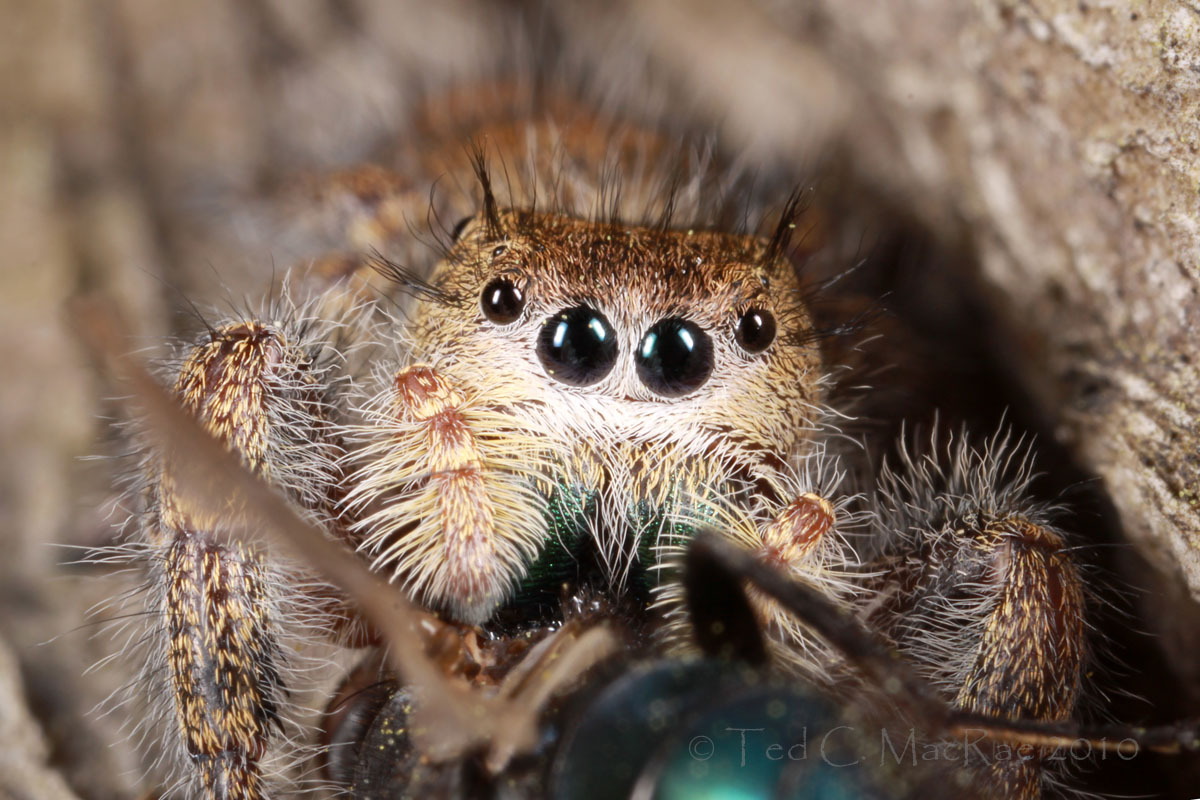
I’m a beetle-man, so except for a brief attempt at ant taxonomy my area of expertise lies with the Coleoptera. Nevertheless, perusing the well-stocked archives at BugGuide leads me to believe that the individual I photographed is a subadult female in the genus Phidippus – perhaps something in the putnami species-group.  I found her on a lower branch of sweetgum (Liquidamber styraciflua) in a wet-mesic bottomland forest along the Black River in Missouri’s southeastern Ozarks feeding on a blow fly (family Calliphoridae).  While relatively drably-colored compared to many other species in the family, a glimpse of her bright blue-green chelicerae (fangs) can still be seen.  I tried to get her to drop her prey to get a better look at the fangs, but she wasn’t having anything to do with that – mealtime is mealtime!

Photo Details: Canon MP-E 65 mm 1-5X macro lens on Canon 50D, ISO 100, 1/250 sec, f/13-14, MT-24EX flash 1/8 power w/ Sto-Fen diffusers. Minimal cropping and post-processing.

Copyright © Ted C. MacRae 2010

Add to FacebookAdd to DiggAdd to Del.icio.usAdd to StumbleuponAdd to RedditAdd to BlinklistAdd to TwitterAdd to TechnoratiAdd to Yahoo BuzzAdd to Newsvine

Email to a friend

Pseudomethoca simillima – a model for Enoclerus ichneumoneus?

Pseudomethoca simillima (family Mutillidae) - the model?

Enoclerus ichneumoneus (family Cleridae) - the mimic?

Last week, I posted the above photograph of Enoclerus ichneumoneus (orange-banded checkered beetle) and mentioned its possibly mimetic appearance to velvet ants in the family Mutillidae (order Hymenoptera).  By some stroke of serendipity, I encountered a species of Mutillidae the very next day in Missouri’s southeastern lowlands that seems to be a good candidate for one of, if not the, model species that E. ichneumoneus might have evolved to resemble.  Several individuals were encountered as they zigzagged urgently on dry sand deposits along the Mississippi River (where I had hoped, unsuccessfully, to find another locality for our intergrade population of Cicindela scutellaris).  Comparison of the individual in the photo with specimens in my collection (all identified by mutillid expert Kevin Williams, Utah State University) suggests this is Pseudomethoca simillima, and the photo is also a good match with other photographs of the species at BugGuide.  One thing that bothers me with the idea of this being a model for E. ichneumoneus is that I have not seen P. methoca commonly in Missouri (I have only three specimens in my collection), while E. ichneumoneus is one of our most common clerids.  There is another mutillid species in Missouri – Dasymutilla quadriquttata – that also seems to have potential as a model for E. ichneumoneus and that I have encountered much more commonly in the state.  However, D. quadriguttata is somewhat larger than E. ichneumoneus.  At any rate, other than the statement by Mawdsley (1994) that E. ichneumoneus seems to mimic mutillids, I can’t find that any more specific information has been recorded about the possible model(s) for that species.

As a caveat, I shall add that this mutillid was the… most… uncooperative… insect… that I have ever tried to photograph!  They really never stop moving, so you have to track the moving insect through the lens and fire shots when you think you’ve got it centered and focused.  Most of the time you don’t!  Using the Canon 1-5X macro lens for this did not make things any easier.  I tracked this female for quite a while and fired off a number of shots, only to get this one that I thought was fairly decent (and still just missed the focus on the near side of the pronotum).

Speaking of mutillids, I simply must photograph my specimen of Dasymutilla gloriosa (sometimes called the thistledown velvet ant) – you will not believe it!

Photo Details:
Pseudomethoca simillima: Canon MP-E 65 mm 1-5X macro lens on Canon 50D, ISO 100, 1/250 sec, f/14, MT-24EX flash 1/8 power w/ Sto-Fen diffusers. Minimal cropping and post-processing.
Enoclerus ichneumoneus: Canon 100mm macro lens on Canon 50D, ISO 100, 1/250 sec, f/14, MT-24EX flash 1/4 power w/ Sto-Fen diffusers. Minimal cropping and post-processing.

REFERENCE:

Mawdsley, J. R. 1994. Mimicry in Cleridae (Coleoptera).  The Coleopterists Bulletin 48(2):115-125.

Copyright © Ted C. MacRae

Add to FacebookAdd to DiggAdd to Del.icio.usAdd to StumbleuponAdd to RedditAdd to BlinklistAdd to TwitterAdd to TechnoratiAdd to Yahoo BuzzAdd to Newsvine

Email to a friend

Revision of the Formicidae of North America

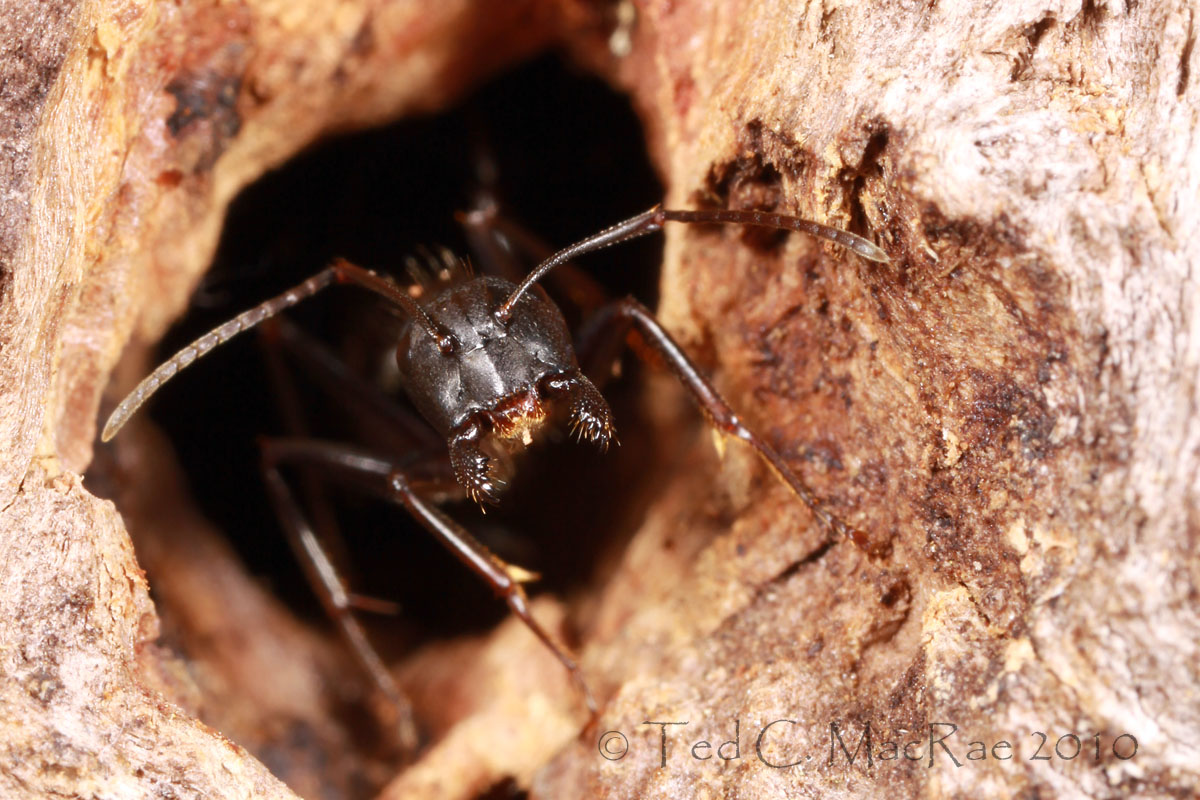
Formica meganigra guarding a nest entrance.

I recently came across this ant in the southeastern Missouri Ozarks sitting in a hole in the trunk of a standing dead black oak (Quercus velutinus) tree, apparently guarding the entrance to its nest. This big black ant is frequently associated with dead wood; however, this is the first time I’ve noticed one guarding the entrance to its nest. Other workers coming back to the nest were greeted by this individual by a quick rubbing of antennae and then allowed to pass. The close approach of my camera apparently was not very welcome by the ant, who responded by showing off his *her* impressive choppers.

In trying to determine the species name for this ant, it became clear to me that myrmecologists have made things far more complicated than they really need to be. When I was a kid, ant identification was easy – there were black ants and red ants, and within those two main guilds some were big, some were not so big, and some were really small.  Peter Yeeles alluded to this traditional classification in a recent comment at Fall to Climb, which the Geek herself later modified to recognize ants that were neither black nor red.  In that classification, this is clearly a big black ant; however, the myrmecologists have unnecessarily split this species up into multiple genera and species based on inconsequential characters such as punctures on the head, clypeal notches, hairy scapes, etc.  I propose to bring a measure of sanity back to ant identification in North America with a revised key to the family (below).  It is based on the traditional classification but also recognizes the introduction in recent years of an alien species that stings and has colonized a large part of the southern United States (we didn’t have those when I was a kid).  In offering this simplified classification, it is my hope that school children across the country – naturally curious about ants and other insects – will no longer have their budding interest squashed by the ponderous, complex ant identification system that has become so fashionable in recent years.

Photo Details: Canon MP-E 65mm 1-5X macro lens on Canon 50D, ISO 100, 1/250 sec, f/14, MT-24EX flash 1/8 power w/ Sto-Fen diffusers.

Revised Key to Formicidae of North America

.
1 Color black . . . . . . . . . . . . . . . . . . . . . . . . . . . . . . . . . . . . . . . . . . . . . . 2
1′ Color not black . . . . . . . . . . . . . . . . . . . . . . . . . . . . . . . . . . . . . . . . . . . 4
2 (1) Enormous. . . . . . . . . . . . . . . . . . . . . . Formica meganigra (big black ant)
2′ Not enormous. . . . . . . . . . . . . . . . . . . . . . . . . . . . . . . . . . . . . . . . . . . . 3
3 (2′) Regular size . . . . . . . . . . . . . . . . . . . . . . . . . . . Formica nigra (black ant)
3′ Tiny. . . . . . . . . . . . . . . . . . . . . . . . . . Formica micronigra (little black ant)
4 (1′) Color red. . . . . . . . . . . . . . . . . . . . . . . . . . . . . . . . . . . . . . . . . . . . . . . . 5
4′ Color yellow . . . . . . . . . . . . . . . . . . . . . . . . . . . . . . . . . . . . . . . . . . . . . 6
5 (4) Can sting. . . . . . . . . . . . . . . . . . . . . . . . . . . . Solenopsis invicta (fire ant)
5′ Can’t sting. . . . . . . . . . . . . . . . . . . . . . . . . . . . . . Formica rubra (red ant)
6 (4′) Regular size. . . . . . . . . . . . . . . . . . . . . . . . . . . Formica flava (yellow ant)
6′ Tiny . . . . . . . . . . . . . . . . . . . . . . . . . Formica microflava (little yellow ant)

Copyright © Ted C. MacRae 2010

Add to FacebookAdd to DiggAdd to Del.icio.usAdd to StumbleuponAdd to RedditAdd to BlinklistAdd to TwitterAdd to TechnoratiAdd to Yahoo BuzzAdd to Newsvine

Email to a friend

North America’s second-rarest pine

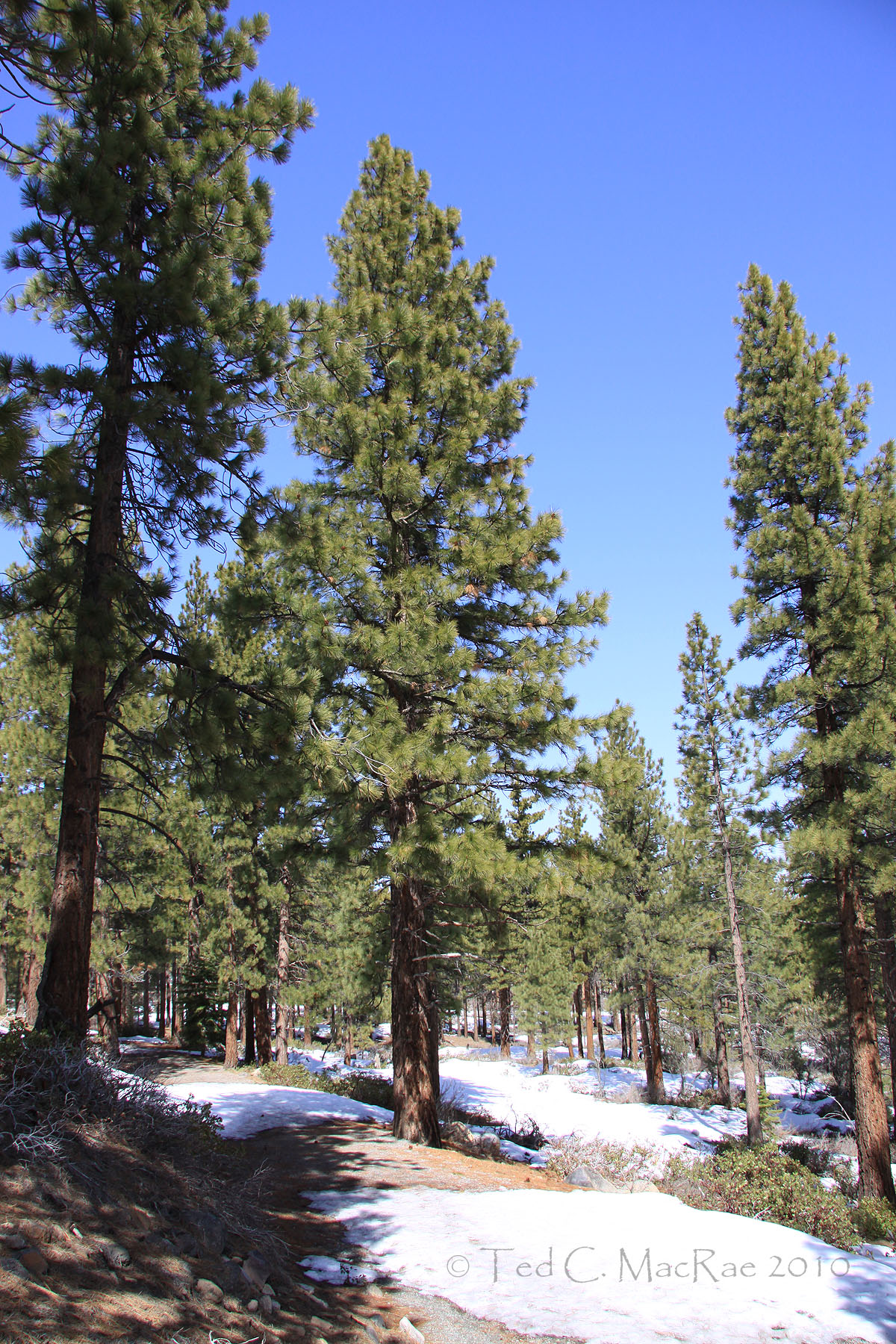
Jeffrey (L) and Washoe (R) pines at Galena Creek Park

During last year’s trip to Lake Tahoe, I made it a goal to find all of the 11 conifer species occurring naturally in the Lake Tahoe Basin.  It took some effort, some good references (Arno 1973, Graf 1999, Lanner 1999, and Peterson 1975), and the help of an especially knowledgeable associate at the U.S.D.A. Forest Service headquarters in South Lake Tahoe, but I succeeded in my quest and later wrote two posts covering the Lake Tahoe conifers (Trees of Lake Tahoe – The Pines, Trees of Lake Tahoe – The “Other” Conifers).  In the first of the posts covering the six species of pines, I added the following footnote:

Two additional species of pine – Washoe pine (Pinus washoensis) and single-leaf pinyon pine (P. monophylla) – are often treated as occurring in the Lake Tahoe area. However, they are of sporadic occurrence on the eastern slopes of Mount Rose, and thus do not occur within the Tahoe Basin proper.

Of these, I am quite familiar with single-leaf pinyon pine.  Widespread on isolated mountain ranges throughout the Great Basin into eastern and southern California and Baja California Norte, I have encountered it during many of my field trips out west and reared a number of buprestid species from its tough, scrubby branches (including 2 specimens of the rarely encountered Phaenops piniedulis).  The other species, Washoe pine, was a new one on me, and it is, in fact, the second-rarest species of pine in all of North America (Torrey pine, Pinus torreyana, being the rarest).  Well, that was all it took to make me commit to finding this species on this year’s return to Lake Tahoe.
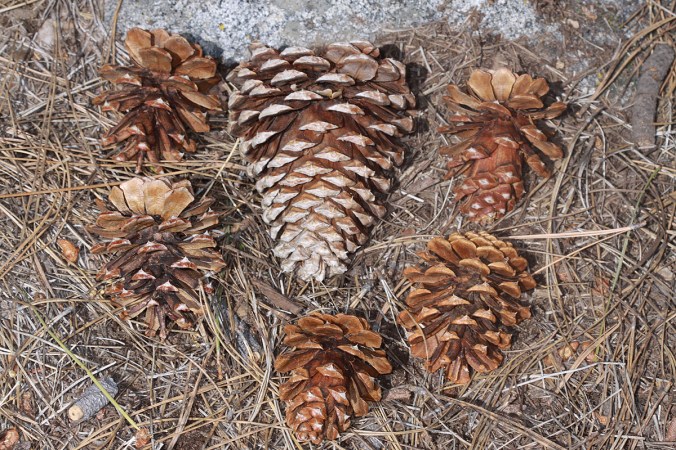
Washoe pine cones surround a larger Jeffrey pine cone.

Washoe pine grows only in a few locations, primarily in northern California with the best stands found in the Warner Mountains in Modoc County.  In the Tahoe area, Washoe pine grows only on the eastern slope of Mt. Rose in Nevada, where it is limited to the upper reaches of Galena Creek (Graf 1999, Lanner 1999).  It is apparently very similar to Jeffrey pine (P. jeffreyi) – the most common pine in the Tahoe area – but seems to be more closely related to ponderosa pine (P. ponderosa), which occurs at lower elevations and barely makes it up to the Tahoe area (some authorities even question the distinctiveness of this species, instead considering it a high elevation variety of ponderosa pine).  All three species are 3-needled and grow into tall, pyramidal trees with widely spaced horizontal branches.  Like ponderosa pine, the bark of mature trees forms broad yellowish plates separated by black fissures (the bark of Jeffrey pine is often more reddish with plate more narrowly separated).  The resin of Washoe pine is also chemically similar to that of ponderosa pine, both of which differ from the heptane-producing resin of Jeffrey pine.  However, Washoe pine cones more closely resemble those of Jeffrey pine, being somewhat smaller but sharing the “inward-curved” prickles on the scale tips that make them easy to handle (those of ponderosa pine point outwards, making them very prickly to handle).

Ponderosa (L) and Washoe (R) pine cones. Note smaller size and outward-pointing spines of ponderosa pine cone.

Jeffrey (L) and Washoe (R) pine cones. Both have inward-pointing spines, but Washoe pine cone is smaller and more loosely built.

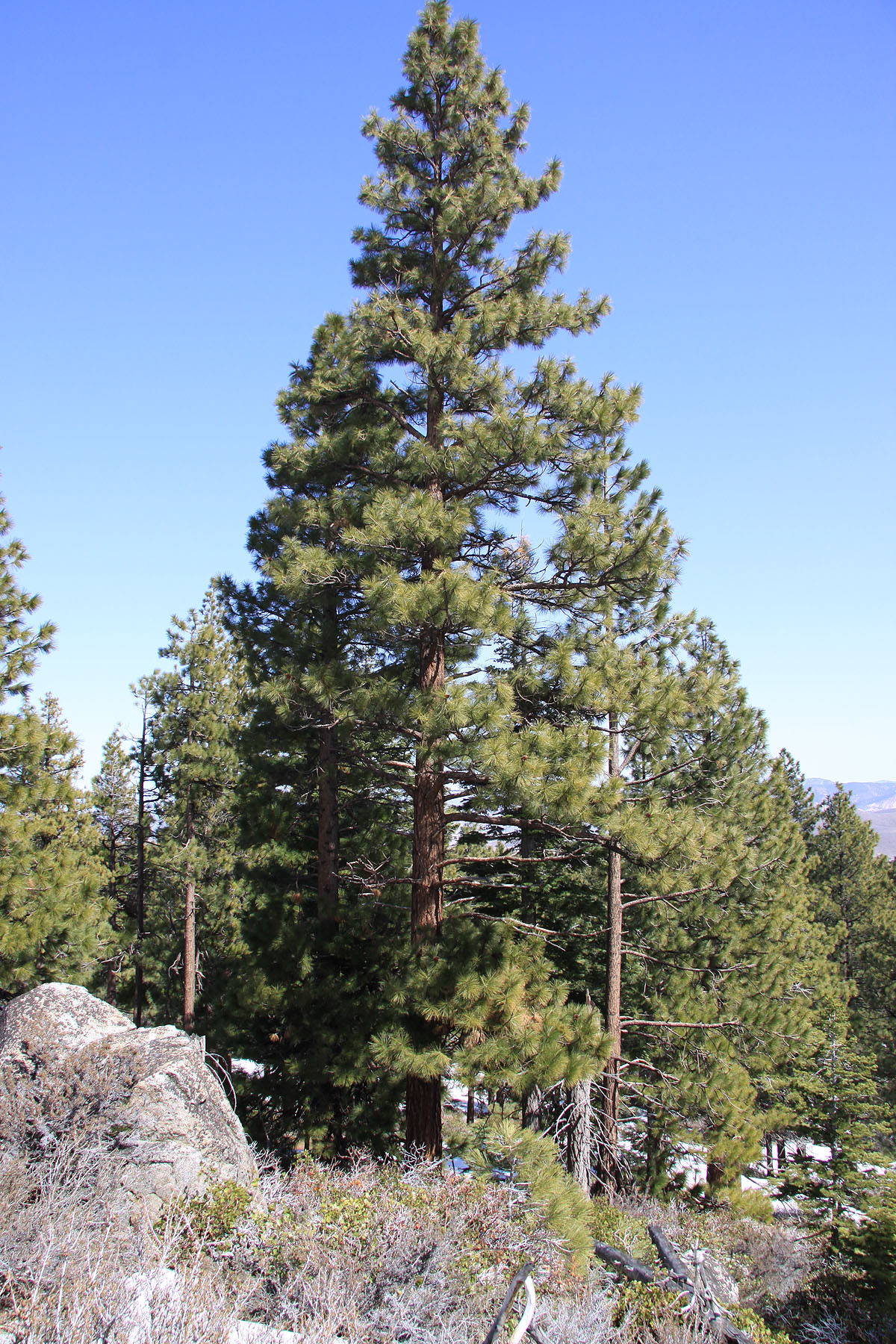
None of my references had any specific locality information for Washoe pine beyond what I’ve stated above, but a little bit of Google snooping through conservation action plan documents revealed that the species occurred at Galena Creek Park, so early in the morning daughter Madison and I made the one-hour drive from South Lake Tahoe to the park.  Arriving at the park, I was disappointed to find nobody manning the headquarters, no maps in the park information board – indeed, no information whatsoever about the occurrence of Washoe pine within the park and where it might be found.  The only clue that there was something special about the pines at this place were the wooden signs around the parking and picnic areas stating “Collection of pine cones prohibited.” I reasoned that it would be very difficult to distinguish the species by its needles, bark, or form, but that the pine cones should be easier to distinguish. I also had no idea whether the pines would occur close to the parking area or if we would need to hike into the area to find them.  So, we just began picking up pine cones.  For a time, all of the pine cones seemed to be typical Jeffrey pine (abundant in the area) with an occasional ponderosa pine (just making up the 6,200′ of elevation in this area).  Ever concerned that I might be missing a subtle difference, I studied each “Jeffrey” pine cone carefully looking for any reason to regard it as truely smaller than normal.  Within about 15 minutes, however, we found it!  Picking up the pine cone, it had the compact build and inward-pointing spines of a Jeffrey pine, but it was smaller and a little more loosely built.  I looked at the trees above and could see no difference from what I would expect for a Jeffrey pine.  Further looking revealed numerous cones of the same type – each tree we found them under was otherwise indistinguishable from Jeffrey pine (at least to this eastern U.S.-based wannabe botanist).  Nevertheless, it was clear that we had found Washoe pine, and that it was quite abundant within this small watershed that we were exploring.  Jeffrey pine was also common in the watershed, and an occasional ponderosa pine could be found.  I took photos of mature individuals of each of the three species, identified conclusively by way of the cones found underneath them, to show how similar in appearance the three species are.

Pinus ponderosa
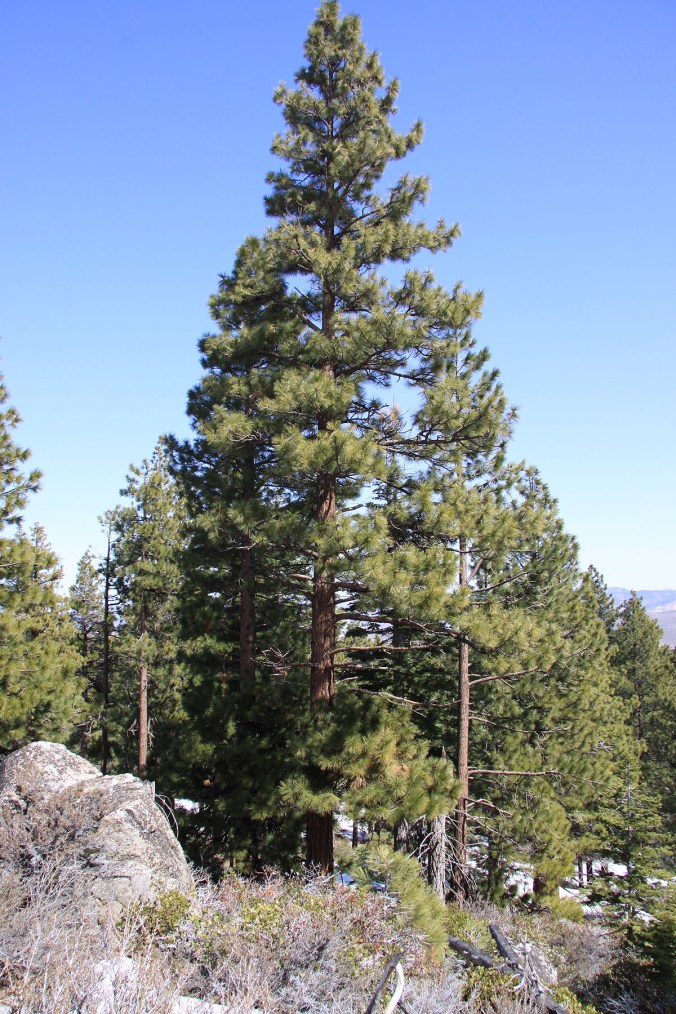
Pinus jeffreyi

Pinus washoensis

Madison and I later hiked out of the watershed into the higher elevations of Mt. Rose (from where these ants were photographed) – we noticed that almost immediately upon hiking out of the watershed the Washoe and ponderosa pines disappeared, and only Jeffrey pines were seen.  Although I have seen it many times before, I was still hoping to see single-leaf pinyon pine, but none were seen.
REFERENCES:

Arno, S. F. 1973. Discovering Sierra Trees. Yosemite Association, Yosemite National Park, California, 89 pp.

Graf, M.  1999. Plants of the Tahoe Basin.  Flowering Plants, Trees, and Ferns.  A Photographic Guide. California Native Plant Society Press, Berkeley, 308 pp.

Lanner, R. M.  1999. Conifers of California.  Cachuma Press, Los Olivos, California, 274 pp.

Peterson, P. V., and P. V. Peterson, Jr.  1975. Native Trees of the Sierra Nevada.  University of California Press, Berkeley, 147 pp.

Copyright © Ted C. MacRae 2010