It’s always a happy day…

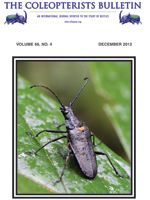
072_066_0400_cover…when the latest issue of The Coleopterists Bulletin arrives in my mailbox. On this occasion it was the December issue of Volume 66—nine papers and eight scientific notes filling 84 pages of beetle awesomeness. It’s pure elytral ecstasy! I presume I am like most subscribers—rapidly scanning the Table of Contents on the back cover to see if any deal directly with my preferred taxa. Yes! Two papers dealing with Buprestidae (jewel beetles), one on Cerambycidae (longhorned beetles), and one on Cicindelinae (tiger beetles)—a real bonanza. After that, a more cursory look through the rest of the Table of Contents to see what other papers look interesting enough to at least scan through.

For me the most interesting are the two Buprestidae papers, with Hansen et al. documenting new state records, larval hosts, and biological notes for 47 North American species and Westcott & Murray reporting the introduction into the U.S. of yet another Eurasian exotic (Trachys minutus) and its apparent establishment in Massachusetts. As the current “keeper” of distributional records and host plant associations for North American jewel beetles (along with Rick Westcott, Salem, Oregon), I will be busily updating my database over the next few days to reflect these new records. I am a great fan of “notes” papers such as these (and am, in fact, currently finishing a similar manuscript with co-author Joshua Basham, who is also a co-author on the Hansen et al. paper). However, I do have a few quibbles—Hansen et al. report Agrilus  quadriguttatatus as a new record for Tennessee, but it is already known from that state, and Cercis canadensis (eastern redbud) is reported as a new larval host for Anthaxia (Haplanthaxia) cyanella despite the prior records from that host by Knull (1920) and Hespenheide (1974). More puzzlingly, the authors record Agrilus lecontei celticola from locations in eastern Tennessee despite guidance from me on several occasions that this subspecies, while perhaps distinctive in Texas, transitions broadly across Louisiana and Mississippi  with the nominate subspecies. As such, material from eastern Tennessee cannot be regarded conclusively to represent this subspecies (and I remain unconvinced even that the subspecific distinction is warranted). Lastly, in recording Actenodes simi from Tennessee, the authors mention that the closest previous record is from Missouri with no specific locality mentioned (Fisher 1942), even though I recently recorded several specific locations for the species in eastern and southern Missouri (MacRae & Nelson 2003). The overall impression is that the authors are not fully versed in recent literature on Buprestidae and have instead relied exclusively on the recent Nelson et al. (2008) catalogue—known amongst buprestid workers to be incomplete and with errors—as the only source for determining the status of their records.

Among Cerambycidae, Raje et al. report the results of molecular analyses on two color forms of Sternidius alpha. This broadly distributed and highly variable species exhibits multiple color variants across its range, leading to the description of multiple subspecies that were eventually synonymized under the current name. Their analysis of the barcoding region of the cytochrome oxidase I gene, however, revealed three distinct clades among the two color forms, suggesting the potential for taxonomic significance. More work, of course, is needed from additional color morphs from different localities.

Finally, my friend Matt Brust and colleagues discuss the ovipositional behavior of numerous species of North American tiger beetles, unexpectedly finding that many oviposit only after digging some distance below the surface of the soil. This information is extremely valuable for those interested in rearing tiger beetles for description of larval stages, expanding the window of survey for species with limited temporal occurrence, and cross-breeding studies. To that end, and of greatest interest to me, they have included numerous observations from their own studies that have resulted in the development of successful protocols and rapid rearing of large numbers of larvae to adulthood.

cso 66-4Mco14.qxdActually, there is one more thing… For several years now the December issue, as a bonus, has been accompanied by the Patricia Vaurie Series Monograph as a supplement to that year’s volume. This year’s issue features a revision of the scarab genus Euphoria by Jesús Orozco, and although I have not studied it carefully it looks like a robust treatment of the group. Yes, I know that scarabs are not one of my primary interest groups, but show me a coleopterist that—regardless of the group they work on— does not stop and collect these gorgeous, colorful, flower-loving beetles whenever they encounter them and I’ll show you a coleopterist that is far too restrictive in their natural history interests! Based on examination of nearly 19,000 specimens from 67 collections, the work considers 59 valid species (ten of which are described as new) distributed throughout the Western Hemisphere. Complete with keys to species and, for each, synonymy, description, diagnosis, taxonomic history, natural history, temporal occurrence geographic distribution, and—of critical importance in my opinion—full data for all specimens examined, it is everything a good revision should be. Then there are the color plates—one full page for each species—with a large dorsal habitus view, closeups of the head, male genitalia, and color variants, a temporal distribution chart, and a map of its geographical distribution. Again, while I may not be a serious student of scarabs, you can bet that I’ll be going back through my holdings of Euphoria beetles and checking them to make sure they conform to this new standard of knowledge on the group.

REFERENCES:

Brust, M. L., C. B. Knisley, S. M. Spomer & K. Miwa. 2012. Observations of oviposition behavior among North American tiger beetle (Coleoptera: Carabidae: Cicindelinae) species and notes on mass rearing. The Coleopterists Bulletin 66(4):309–314.

Fisher, W. S. 1942. A revision of North American species of buprestid beetles belonging to the tribe Chrysobothrini. U. S. Department of Agriculture, Miscellaneous Publication 470, 1–275.

Hansen, J. A., J. P. Basham, J. B. Oliver, N. N. Youseef, W. E. Klingeman, J. K. Moulton & D. C. Fare. 2012. New state and host plant records for metallic woodboring beetles (Coleoptera: Buprestidae) in Tennessee, U.S.A. The Coleopterists Bulletin 66(4):337–343.

Hespenheide, H. A. 1974.  Notes on the ecology, distribution, and taxonomy of certain Buprestidae.  The Coleopterists Bulletin 27(4) [1973]:183–186.

Knull, J. N. 1920. Notes on Buprestidae with description of a new species (Coleop.). Entomological News 31(1):4–12.

MacRae, T. C. and G. H. Nelson. 2003. Distributional and biological notes on Buprestidae (Coleoptera) in North and Central America and the West Indies, with validation of one species. The Coleopterists Bulletin 57(1):57–70.

Nelson, G. H., G. C. Walters, Jr., R. D. Haines, & C. L. Bellamy.  2008.  A Catalogue and Bibliography of the Buprestoidea of America North of Mexico.  Coleopterists Society Special Publication No. 4, The Coleopterists Society, North Potomac, Maryland, 274 pp.

Orozco, J. 2012. Monographic revision of the American genus Euphoria Burmeister, 1842 (Coleoptera: Scarabaeidae: Cetoniinae). Coleopterists Society Monographs, Patricia Vaurie Series No. 11, 182 pp.

Raje, K. R., V. R. Ferris & J. D. Holland. 2012. Two color variants of Sternidius alpha (Say) (Coleoptera: Cerambycidae) show dissimilar cytochrome oxidase I genes. The Coleopterists Bulletin 66(4):333–336.

Westcott, R. L. & T. C. Murray. 2012. An exotic leafminer, Trachys minutus (L.) (Coleoptera: Buprestidae), found in Massachusetts, U.S.A. The Coleopterists Bulletin 66(4):360–361.

Copyright © Ted C. MacRae 2013

Let’s make a deal!

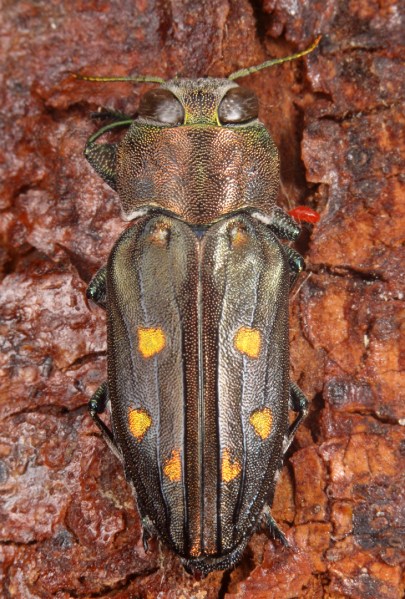
buprestid

Image source unknown

I recently conducted a complete reorganization of the jewel beetles (superfamily Buprestoidea) in my collection (TCMC). The primary purpose of this was to bring the nomenclature and arrangement of the collection into agreement with the recently published World Catalogue of Buprestoidea (Bellamy 2008) and accurately document the taxa represented in the collection and their numbers. In the short term this will be helpful not only in visualizing what is represented but also what is missing (particularly in North America), while longer term it lays the groundwork for the eventual donation of my collection to a public institution.

In an active, working collection, no inventory is ever fully up-to-date. In my case, the inventory includes only completely curated material that has been incorporated into the main cabinets. I still have several years worth of material in various states of curation—i.e., unmounted, mounted but unlabeled, or labeled but unidentified. That said, the main collection now contains more than 23,000 specimens of Buprestoidea representing 1,500+ species worldwide. Of the species represented, 37% are Nearctic (U.S./Canada), 22% Palearctic (Europe, North Africa, temperate Asia), 19% Neotropical (Latin America), 10% Afrotropical (Subsaharan Africa), 7% Indomalayan (tropical Asia) and 6% Australian (Australia/New Zealand). The collection also contains 492 paratype specimens representing 77 species. The inventory has been converted to  PDF and uploaded for access by the link below. It lists all of the species represented, with nomenclature updated and taxa arranged according to Bellamy (2008) and number of specimens  indicated for each. Also indicated are higher taxa not yet represented in the collection (shown in gray rather than black text) so that the collection holdings can be placed in context of a complete higher classification for the superfamily.

 Click to see full inventory of TCMC Buprestoidea

Of course, as a North American, the Nearctic fauna is the primary focus of my taxonomic and biological studies. As a result, I am keen to have the Nearctic fauna represented as completely as possible in my collection. Currently I have 75% (595) of the 790 species and non-nominate subspecies currently recognized in North America. Obviously, by now I’ve picked most of the low-hanging fruit, and the last 25% will be much more difficult to get. Many of these are truly rare species that I may never find (some are known only by the holotype), while others are more common but occur in areas that I have limited opportunity to visit. These species are also indicated in the above inventory (again, in gray text) but are also listed below for easy reference. If you have any of the species on this list, please let me know and also what you might like to receive in exchange for them. I have not only many species of Buprestidae from around the world to offer, but also beetles in other families such as longhorned beetles (Cerambycidae), tiger beetles (Cicindelinae), scarabs (Scarabaeoidea), and even non-beetles such as treehoppers (Membracidae) and cicadas (Cicadoidea). Let’s make a deal!

REFERENCE:

Bellamy, C. L. 2008. World Catalogue and Bibliography of the Jewel Beetles (Coleoptera: Buprestoidea),  Volumes 1–5. Pensoft Series Faunistica, 3125 pp.

Copyright © Ted C. MacRae 2013

T.C.MacRae Collection Desiderata

Family SCHIZOPODIDAE LeConte 1859
Subfamily SCHIZOPODINAE LeConte 1859
Tribe SCHIZOPODINI LeConte 1859

Genus Schizopus LeConte 1858
sallei ssp. sallei Horn 1885
sallei ssp. nigricans Nelson 1991
Genus Dystaxia LeConte 1866
elegans Fall 1905

Family BUPRESTIDAE Leach 1815
Subfamily POLYCESTINAE Lacordaire 1857
Acmaeoderioid lineage sensu Volkovitsh 2001
Tribe HAPLOSTETHINI LeConte 1861

Genus Mastogenius Solier 1849
arizonicus Bellamy 2002
puncticollis Schaeffer 1919

Tribe ACMAEODERINI Kerremans 1893
Subtribe ACMAEODEROIDINA Cobos 1955

Genus Acmaeoderoides Van Dyke 1942
cazieri Nelson 1968
depressus Nelson 1968

Subtribe ACMAEODERINA Kerremans 1893

Genus Acmaeodera Eschscholtz 1829
— Subgenus Acmaeodera (s. str.)
audreyae Westcott & Barr 2007
bryanti Van Dyke 1953
comata LeConte 1858
consors Horn 1878
cubaecola Jaquelin du Val 1857
discalis Cazier 1940
dolorosa ssp. liberta Fall 1922
fattigi Knull 1953
flavosticta Horn 1878
horni Fall 1899
inyoensis Cazier 1940
laticollis Kerremans 1902
morbosa Fall 1899
pubiventris ssp. panocheae Westcott 2001
recticolloides Westcott 1971
starrae Knull 1966
subbalteata LeConte 1863
thoracata Knull 1974
tildenorum Nelson & Westcott 1995
wheeleri Van Dyke 1919

Genus Acmaeoderopsis Barr 1974
prosopis Davidson 2006
rockefelleri (Cazier 1951)
varipilis (Van Dyke 1934)

Genus Anambodera Barr 1974
nebulosa (Horn 1894)
santarosae (Knull 1960)

Polyctesioid lineage sensu Volkovitsh 2001
Chrysophana generic group [tribal level] sensu Volkovitsh 2001

Genus Beerellus Nelson 1982
taxodii Nelson 1982

Polycestioid lineage sensu Volkovitsh 2001
Tribe POLYCESTINI Lacordaire 1857

Genus Polycesta Dejean 1833
— Subgenus Polycesta (s. str.)
angulosa Jacquelin du Val 1857
— Subgenus Polycesta (Arizonica) Cobos 1981
arizonica ssp. acidota Cazier 1951
— Subgenus Polycesta (Tularensia) Nelson 1997
crypta Barr 1949

Tribe TYNDARINI Cobos 1955
Subtribe TYNDARINA Cobos 1955

Genus Paratyndaris Fisher 1919
— Subgenus Paratyndaris (s. str.)
anomalis Knull 1937
crandalli Knull 1941
grassmani Parker 1947
quadrinotata Knull 1938

Subfamily CHRYSOCHROINAE Laporte 1835
Chrysochroid lineage sensu Bellamy 2003
Nanularia generic group [tribal level] sensu Volkovitsh 2001

Genus Nanularia Casey 1909
cupreofusca Casey 1909
pygmaea (Knull 1941)

Tribe CHRYSOCHROINI Laporte 1835
Subtribe CHALCOPHORINA Lacordaire 1857
Texania generic group sensu Volkovitsh 2001

Genus Texania Casey 1909
langeri (Chevrolat 1853)

Tribe POECILONOTINI Jakobson 1913
Subtribe POECILONOTINA Jakobson 1913

Genus Poecilonota Eschscholtz 1829
ferrea (Melsheimer 1845)
montana Chamberlin 1922
viridicyanea Nelson1997

Dicercioid lineage sensu Bellamy 2003
Tribe DICERCINI Gistel 1848
Subtribe HIPPOMELANINA Holynski 1993

Genus Hippomelas Laporte & Gory 1837
martini Nelson 1996
parkeri Nelson 1996

Genus Gyascutus LeConte 1858
— Subgenus Gyascutus (s. str.)
jeanae (Nelson 1988)
pacificus (Chamberlin 1938)

Genus Barrellus Nelson & Bellamy 1996
femoratus (Knull 1941)

Subtribe DICERCINA Gistel 1848
Dicerca generic group sensu Volkovitsh 2001

Genus Dicerca Eschscholtz 1829
dumolini (Laporte & Gory 1837)
hornii nelsoni Beer 1974
lugubris LeConte 1860
mutica LeConte 1860
sexualis Crotch 1873
spreta (Gory 1841)
tuberculata (Laporte & Gory 1837)

Subfamily BUPRESTINAE Leach 1815
Buprestioid lineage sensu Volkovitsh 2001
Buprestinioid branch sensu Volkovitsh 2001
Tribe BUPRESTINI Leach 1815
Subtribe TRACHYKELINA Holynski 1988

Genus Trachykele Marseul 1865
fattigi Knull 1954
opulenta Fall 1906

Subtribe BUPRESTINA Leach 1815

Genus Buprestis Linnaeus 1758
— Subgenus Buprestis (Cypriacis) Casey 1909
intricata Casey 1909
prospera Casey 1909
— Subgenus Buprestis (Knulliobuprestis) Kurosawa 1988
fremontiae Burke 1924
— Subgenus Buprestis (Stereosa) Casey 1909
apricans Herbst 1801
decora Fabricius 1775

Anthaxioid lineage sensu Volkovitsh 2001
Anthaxiinioid branch sensu Volkovitsh 2001
Tribe ANTHAXIINI Gory et Laporte 1839

Genus Anthaxia Eschscholtz 1829
— Subgenus Anthaxia (Haplanthaxia) Reitter 1911
carya Wellso & Jackman 2006
caseyi ssp. sublaevis Van Dyke 1916
— Subgenus Anthaxia (Melanthaxia) Rikhter 1944
barri Bílý 1995
californica Obenberger 1914
cupriola Barr 1971
emarginata Barr 1971
embrikstrandella Obenberger 1936
exasperans Cobos 1958
furnissi Barr 1971
helferiana Bílý 1995
hurdi Cobos 1958
nanula Casey 1884
neofunerula Obenberger 1942
nevadensis Obenberger 1928
oregonensis Obenberger 1942
porella Barr 1971
sculpturata Barr 1971
serripennis Obenberger 1936
strigata LeConte 1859
subprasina Cobos 1959
tarsalis Barr 1971
wallowae Obenberger 1942

Tribe XENORHIPIDINI Cobos 1986
Subtribe XENORHIPIDINA Cobos 1986

Genus Hesperorhipis Fall 1930
hyperbola ssp. californica Knull 1947
jacumbae Knull 1954
mirabilis ssp. mirabilis Knull 1947

Chrysobothrioid lineage sensu Volkovitsh 2001
Melanophilinioid branch sensu Volkovitsh 2001
Tribe MELANOPHILINI Bedel 1921
Subtribe MELANOPHILINA Bedel 1921

Genus Phaenops Dejean 1833
carolina (Manee 1913)
caseyi (Obenberger 1944)
obenbergeri (Knull 1952)
vandykei Obenberger 1944

Chrysobothrinioid branch sensu Volkovitsh 2001
Tribe ACTENODINI Gistel 1848

Genus Actenodes Dejean 1833
arizonicus Knull 1927
mimicus Knull 1964

Tribe CHRYSOBOTHRINI Gory et Laporte 1838

Genus Chrysobothris Eschscholtz 1829
— Subgenus Chrysobothris (s. str.)
aeneola LeConte 1860
bacchari Van Dyke 1923
bicolor Horn 1894
bisinuata Chamberlin 1938
bispinosa Schaeffer 1909
boharti Van Dyke 1934
breviloboides Barr 1969
caurina Horn 1886
chamberliniana Fisher 1948
costifrons ssp. costifrons Waterhouse 1887
culbersoniana Knull 1943
cupressicona Barr & Westcott 1976
deserta Horn 1886
dolata Horn 1886
fragariae Fisher 1930
grindeliae Van Dyke 1937
helferi Fisher 1942
hidalgoensis Knull 1951
horningi Barr 1969
hubbardi Fisher 1942
idahoensis Barr 1969
kelloggi Knull 1937
knulli Nelson 1975
nelsoni Westcott & Alten 2006
oregona Chamberlin 1934
orono Frost 1920
paragrindeliae Knull 1943
potentillae Barr 1969
pseudacutipennis Obenberger 1940
pubilineata Vogt 1949
purpurata Bland 1864
roguensis Beer 1967
schaefferi Obenberger 1934
schistomorion Westcott & Davidson 2001
scitula Gory 1841
sexfasciata ssp. sexfasciata Schaeffer 1919
sloicola Manley & Wellso 1976
smaragdula Fall 1976
socialis ssp. apache Westcott & Barr 2007
speculifer Horn 1886
subopaca Schaeffer 1904
vivida Knull 1952
westcotti Barr 1969
wickhami Fisher 1942

Genus Knowltonia Fisher 1935
alleni (Cazier 1938)
atrifasciata (LeConte 1878)

Subfamily AGRILINAE Laporte 1835
Tribe AGRILINI Laporte 1835
Subtribe AGRILINA Laporte 1835

Genus Agrilus Curtis 1825
— Subgenus Agrilus (s. str.)
hazardi Knull 1966
— Subgenus Agrilus (Engyaulus) Waterhouse 1889
inhabilis ssp. cuprinus Nelson 1996
utahensis Westcott 1996
— Subgenus Agrilus (Quercagrilus) Alexeev 1998
derasofasciatus Boisduval & Lacordaire 1835
— Subgenus Agrilus (Uragrilus) Semenov-Tian-Shanskij 1935
granulatus ssp. mojavei Knull 1952
sayi Saunders 1871
— Subgenus undefined
amelanchieri Knull 1944
arizonus Knull 1934
audax Horn 1891
aurilaterus Waterhouse 1889
bespencus Barr 2008
burkei Fisher 1917
catalinae Knull 1940
cercidii Knull 1937
cochisei Knull 1948
criddlei Frost 1920
davisi Knull 1941
delicatulus Waterhouse 1889
dozieri Fisher 1918
exiguellus Fisher 1928
floridanus Crotch 1873
funestus Gory 1841
geronimoi Knull 1950
gillespiensis Knull 1947
hazardi Knull 1966
horni Kerremans 1900
jacobinus Horn 1891
langei Obenberger 1935
latifrons Waterhouse 1889
montosae Barr 2008
neabditus Knull 1935
nevadensis Horn 1891
nigricans Gory 1841
obscurilineatus Vogt 1949
olivaceoniger Fisher 1928
ometauhtli Fisher 1938
palmerleei Knull 1944
parabductus Knull 1954
pilosicollis Fisher 1928
pseudocoryli Fisher 1928
pubifrons Fisher 1928
restrictus Waterhouse 1889
shoemakeri Knull 1938
sierrae Van Dyke 1923
snowi Fall 1905
torquatus LeConte 1860
waltersi Nelson 1985
wenzeli Knull 1934

Tribe TRACHYINI Laporte 1835
Subtribe BRACHYINA Cobos 1979

Genus Taphrocerus Solier 1833
floridanus Obenberger 1934

Subtribe PACHYSCHELINA Böving et Craighead 1931

Genus Pachyschelus Solier 1833
fisheri Vogt 1949
schwartzi Kerremans 1892
vogti Hespenheide 2003

Beautiful box of Buprestidae

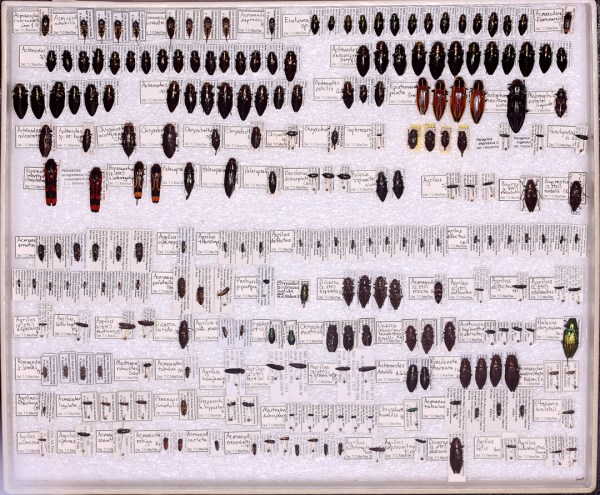
I’ve been working on identifying Buprestidae accumulated from a variety of sources over the past year—mostly exchanges and gifts, before beginning the processing specimens collected during this past season. Once identified, and combined with specimens gleaned from material submitted by other collectors for identification (I generally only retain examples of species that are poorly represented in my collection or specimens that represent and will serve as vouchers for significant new distributional records), they make for a very pretty box of Buprestidae! It’s kind of nice to keep them collected together like this for a little while, but I’ll soon incorporate them into the main collection where they will more securely protected and to free up the temporary box now containing them for new material as it moves through the process of labeling and identification. (Incidentally, I think I might like to do a series a posts over this winter covering my version of the specimen curation process).

There are some very cool Buprestidae in this box—88 species in all, that originated from a remarkable variety of locations across the U.S., Mexico/Central America, and South America. Do you see any species of particular interest?

236 specimens representing 88 species of Buprestidae

236 specimens representing 88 species of Buprestidae

Copyright © Ted C. MacRae 2012

Book Announcement: Field Guide to the Jewel Beetles (Coleoptera: Buprestidae) of Northeastern North America

It’s not often that I anticipate the release of a book as much as I have with the soon-to-be-released Field Guide to the Jewel Beetles (Coleoptera: Buprestidae) of Northeastern North America. Fortunately, the wait is now almost over—Morgan Jackson, author of Biodiversity in Focus and co-author of the book, has just announced its planned released in early 2013. Even better, he has provided a sneak peak at its contents that is as smartly designed as the book itself.

Obviously, as a serious student of the family Buprestidae, this book would make it into my bookshelf no matter what, and I plan to do a more detailed review of the book once I have a copy permanently in my hands. However, I can tell you that I am already very impressed with the design of the book and the quality of the product. I was fortunate to meet up with Morgan at last month’s Entomological Society of America meetings in Knoxville, Tennessee, and Morgan kindly allowed me to leaf through the carefully guarded copy he had with him (it was difficult handing it back to him). The Prezi preview for the book covers some of the more important features that will set this book apart from other field guides, but worthy of special mention are: 1) the minimum/maximum size silhouette figure in the upper left-hand corner of each species treatment—a tremendously useful feature, 2) inclusion of the both the author and date of the original description of the species (to keep us more taxonomically inclined happy), 3) super high quality dorsal and lateral habitus photographs and of additional key features to aid in identification, 4) geographical range maps coded to show both presumed and recorded ranges, and 5) keys to all treated species, richly augmented with high quality photographs.

There is another reason I am so excited about this book, and that is the authors chose my photograph of Buprestis rufipes (red-legged buprestis), one of North America’s most striking jewel beetle species, to grace the cover of the book. I also provided specimens of a number of uncommonly encountered species which were used for the photographs in their respective species treatments.

Quite remarkably, this book will be available at NO COST—including free shipping anywhere! As a consequence, the book will not be available from commercial book and literature sources. You can request your copy by emailing your mailing address to Morgan at morgandjackson@gmail.com. I don’t know how many copies of the book are being printed, but I have a feeling that supplies will not last long, and in the coming years one will have to beg/borrow/steal from a kindly old colleague to get a copy (you can have my copy when you pry it from my cold, dead fingers!).

Copyright © Ted C. MacRae 2012

Some recent publications

I’ve had a few papers published in recent months that may be of interest to some. After a string of papers in 2011 focused exclusively on tiger beetles (five in all), these latest three represent sort a return to my “roots”: taxonomy and biosystematics of woodboring beetles (Buprestidae and Cerambycidae). Summaries are provided below, and hyperlinks in the citations lead to downloadable PDFs for those wishing to see the gory details.

  • MacRae, T. C. & R. L. Westcott. 2012. Nomenclatural history of Melanophila drummondi ab. nicolayi Obenberger, 1944 (Coleoptera: Buprestidae), a change of authorship and synonymy under Phaenops drummondi (Kirby 1837), and a new distribution record and summary of larval hosts for the species. The Pan-Pacific Entomologist 88(1):87–91.
     
    This paper can be considered of the “taxonomic housekeeping” sort. It concerns an “aberration” of the common, widespread jewel beetle species Phaenops drummondi. The current version of the International Code of Zoological Nomenclature (ICZN 1999) considers aberrations and other infrasubspecific (rank lower than subspecies) taxa as unavailable names with no taxonomic standing. However, they may be considered valid depending on date of publication and how they were treated by subsequent authors. In the majority of cases the guidance is clear on whether a given aberration, variety, form, etc. is considered unavailable or valid. However, there are times when multiple, conflicting interpretations are possible. The case described in this paper is one example, and even though the taxon clearly falls within the range of variability exhibited by the parent species, careful study of multiple provisions of The Code were required to determine its proper status. In the end, a change of authorship followed by formal synonymy were deemed the best course of action. Updated information on the distribution of P. drummondi and a summary of known larval hosts are also provided.
     
  • MacRae, T. C., L. G. Bezark & I. Swift. 2012. Notes on distribution and host plants of Cerambycidae (Coleoptera) from southern México. The Pan-Pacific Entomologist 88(2):173–184.
     
    From 2004–2006 I made three collecting trips to México with my friend and colleague, Chuck Bellamy. Our main focus was the rich diversity of jewel beetles that occur in the relatively intact, dry, tropical thorn forests that stretch across the southern states of Guerrero, Michoacan, Oaxaca, and Puebla, and in this respect we were quite successful. I also have an interest in longhorned beetles, but I try to limit my scope in this family to the Nearctic fauna and didn’t specifically target these beetles during those trips. Still, many species were encountered during the course of beating potential jewel beetle host plants. As with jewel beetles, the longhorned beetle fauna of México is rich but very incompletely known, with distributional data below the country level and knowledge of host plants lacking or inadequate for most species. This paper presents specific distributional and host plant information for 78 species in 50 genera of longhorned beetles collected during those trips. Included within the data presented are 47 new state records, 47 new adult host records, and 60 new flower records.
     
  • Steury, B. W., T. C. MacRae & E. T. Oberg. 2012. Annotated list of the metallic wood-boring beetles (Insecta: Coleoptera: Buprestidae) of the George Washington Memorial Parkway, Fairfax County, Virginia.  Banisteria 39:71–75.
     
    Lead author Brent Steury of the U.S. National Park Service contacted me last year about identifying jewel beetles that had been collected at a number of units in the George Washington Memorial Parkway during recent BioBlitz surveys and as by-catch from studies targeting other arthropods. The surveys were worthy of reporting on, as 23 species in nine jewel beetle genera were represented in the material collected—including two species reported for the first time from Virginia: Paragrilus tenuis (LeConte) and Pachyschelus purpureus purpureus (Say). Information is also provided on the collecting methods used during the surveys, with Malaise traps, hand netting, and pan traps being the only ones successful in capturing jewel beetles (Lindgren funnel and pitfall traps did not capture any).

REFERENCE: 

International Commission on Zoological Nomenclature [ICZN]. 1999. International Code of Zoological Nomenclature, 4th Edition. The International Trust for Zoological Nomenclature, c/o Natural History Museum, London. xxix + 306 pp.

Copyright © Ted C. MacRae 2012

An uncommon fall-active Acmaeodera

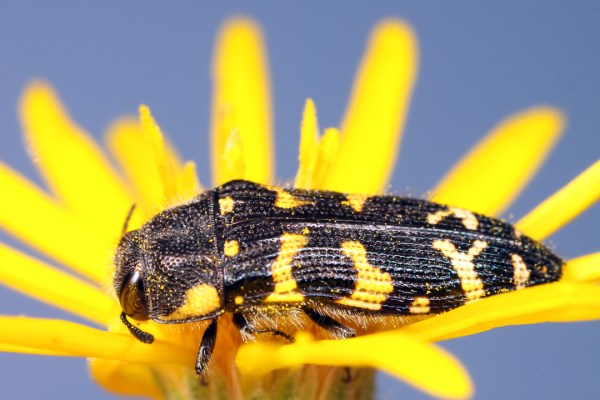
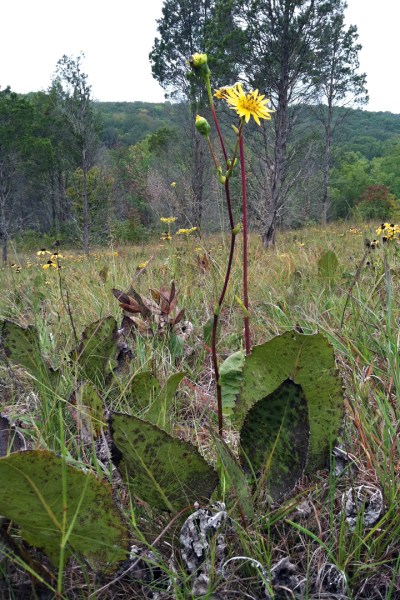
During last week’s visit to Alabaster Caverns State Park in northeastern Oklahoma (Woodward Co.), I saw a fair number of jewel beetles (family Buprestidae) representing a then-unidentified species of Acmaeodera. All of the individuals that I saw were visiting flowers of Heterotheca stenophylla (family Asteraceae), and had it not been fall I wouldn’t have thought much about it. However, fall activity is unusual among North American jewel beetles, particularly in the genus Acmaeodera. An occasional straggler from earlier in the season is one thing, but the numbers seen (perhaps close to two dozen) over the course of a couple hours left no doubt in my mind that these were newly active adults. In North America, most species of Acmaeodera are active during the spring and early summer months, during which time they visit a wide variety of flowers (but especially asteraceous species) to feed on pollen. They can also be found in late summer in southeast Arizona, but in that area nearly all jewel beetles (and a large number of other insect groups as well) occur in synchrony with the monsoonal season that begins in July. Only in southern Texas (and further south in México) have I seen truly fall-active jewel beetles, including several species of Acmaeodera.

This actually was not the first time I had seen this species during fall in Oklahoma. Last year I made a brief stop at Gloss Mountain State Park (about 30 miles southeast of Alabaster Caverns in Major Co.) on my way back from a late September collecting trip to Colorado/Utah/Idaho (still convinced that the Beautiful Tiger Beetle, Cicindela pulchra, might be there). Then, as now, I found more than a handful of adults (also visiting flowers of H. stenophylla), suggesting this was true fall activity and causing me to think, “Hmm, that’s weird.” I was pressed for time, however, and didn’t even grab my camera bag for the short hour or so that I had to look around, and once I returned home I quickly resumed my routine and forgot about trying to identify the beetles.

Acmaeodera macra | Woodward Co., Oklahoma

Returning home after this year’s trip I was not so inclined to forget, and when I mentioned it to my friend Chuck Bellamy he suggested that it might be the fall-active species, Acmaeodera macra (MCZ type specimen). Immediately I knew this was correct, as I had actually seen this species once before—a single specimen that I collected nearly 30 years ago  in south Texas at Bentsen-Rio Grandy Valley State Park on a Helianthus annuus flower (MacRae 2006). I don’t know why I didn’t think of that species when I saw it this time, other than perhaps I was still under the impression that this uncommonly encountered species was limited to the Rio Grande Valley and adjacent areas as stated by Vogt (1949) and Westcott et al. (1979). Recently, however, Westcott (2001) provided the first records of this species from outside of Texas—from Oklahoma!—and later recorded it also from Nuevo León, México (Westcott 2008).¹

¹ Nelson et al. (2008), in their North American catalogue of Buprestidae, also list Arizona in the distribution of this species. However, I am unaware of any supporting references for its occurrence there, and the catalogue is known to be frustratingly rife with errors and omissions. 

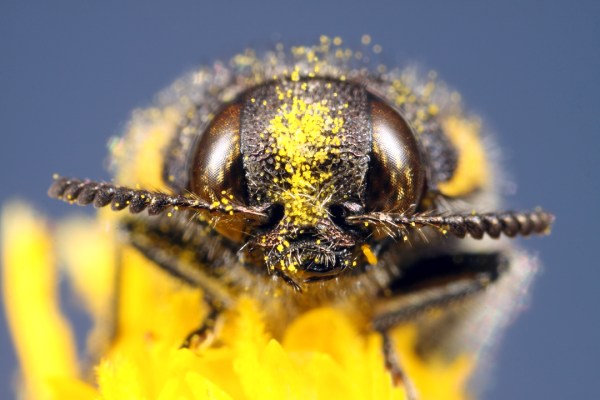
Bathed in pollen!

The Oklahoma records for this species given by Westcott (2001) include localities in Blaine, Cleveland, Greer, and Oklahoma Counties (with the latter taken on Grindelia sp., presumably flowers). Interestingly, with the exception of Greer Co. all of these counties lie along the Blaine Escarpment that separates the Gypsum Hills and Red Hills physiographic regions, and the two additional counties that I have now recorded for the species in Oklahoma (Major and Woodward) lie further to the north along this escarpment as well. With these new records, Alabaster Caverns now becomes the northernmost known outpost for A. macra. However, since Woodward Co. lies along the northern tier of counties in Oklahoma and the Blaine Escarpment extends further into south-central Kansas, it is possible that an even more northern outpost might eventually be found for the species. Little is known about the biology of this species—the only host records are for adults and include my sunflower record (MacRae 2006), Vogt’s (1949) mention of the species’ preference for “composite flowers” and records of adults on Acacia berlandieri and visiting flowers of Verbesina encelioides (Westcott et al. 1979). It’s anybody’s guess as to what the larval host is, but my guess is that in Oklahoma it’s restricted to vertical walls and talus slopes, since I never saw individuals outside of these specific situations despite the widespread occurrence of its H. stenophylla flower host.

REFERENCES:

MacRae, T. C. 2006. Distributional and biological notes on North American Buprestidae (Coleoptera), with comments on variation in Anthaxia (Haplanthaxia) viridicornis (Say) and A. (H.) viridfrons Gory. The Pan-Pacific Entomologist 82(2):166–199.

Nelson, G. H., G. C. Walters, Jr., R. D. Haines, & C. L. Bellamy.  2008.  A Catalogue and Bibliography of the Buprestoidea of American North of Mexico.  Coleopterists Society Special Publication No. 4, The Coleopterists Society, North Potomac, Maryland, 274 pp.

Vogt, G. H. 1949. A biologically annotated list of the Buprestidae of the Lower Rio Grande Valley, Texas. Annals of the Entomological Society of America 42(2): 192–202.

Westcott, R. L. 2001.  An interspecific hybrid in the genus Acmaeodera Eschscholta, a taxonomic note on Chrysobothris kelloggi Knull, and new distribution and host records for United States and Canadian species in these and other genera (Coleoptera: Buprestidae).  Jewel Beetles, 10:76-81.

Westcott, R. L., W. F. Barr, G. H. Nelson, & D. S. Verity.  1979.  Distributional and biological notes notes on North and Central American species of Acmaeodera (Coleoptera: Buprestidae).  The Coleopterists Bulletin, 33(2):169-181.

Copyright © Ted C. MacRae 2012

9th Annual Fall Tiger Beetle Trip: Day 3.1

I’d had a very enjoyable 2nd day on this year’s fall tiger beetle trip, but I couldn’t say it had been particularly successful. My primary reason for coming to the Glass Mountains in northwestern Oklahoma was to confirm a hunch that the stunningly beautiful Cicindela pulchra (Beautiful Tiger Beetle) might occur in the flats below the area’s red mesas. My hunch was based on the similarity of habitat to the nearby Red Hills in south-central Kansas, where the species does famously occur (MacRae 2006b). I’ve been here several times now and never found the species, and that did not change this time either. I did end up finding larval burrows and collecting the larvae of several other tiger beetle species (including the wonderfully ginormous Amblycheila cylindriformis), but again I could only consider this a moderate success. During the day, however, I had noted that eastern red-cedar (Juniperus virginiana) in the area was suffering branch and leader die back. Nearly every tree had at least one or more affected branches, and when I cut into a few of them I found evidence of fresh larval galleries of what I presumed were jewel beetles in the genus Chrysobothris. There are several species in this genus that breed in dead Juniperus, but I’m not familiar with any that attack living plants so pervasively as I was seeing here. Moreover, only a few of these species have been recorded from Oklahoma, so I made a mental note to return to the area in the morning and collect examples of dead/dying branches before driving to my Day 3 destination. I’ll put these up in rearing containers when I return home in an attempt to rear our the adult beetles.

Infested red-cedars atop main mesa.

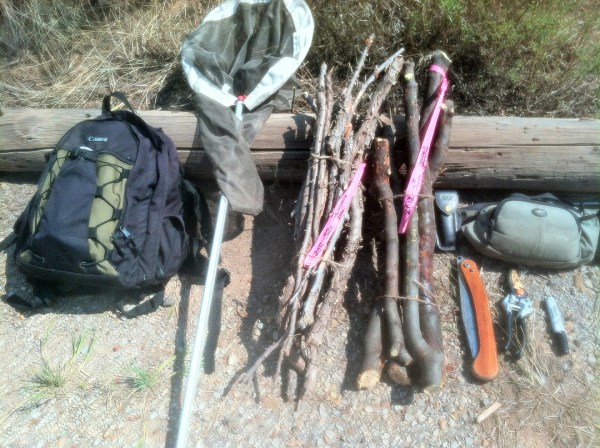
If you’ve never collected wood for rearing beetles before, all I can say is that it is hard and strenuous work. You have to get pretty good at discriminating infested wood in the field, because you don’t want to expend the effort to cut, de-twig, section, bundle, and carry back to the car batches of wood that don’t end up producing beetles. It was a little more effort than I anticipated to get a good sampling of Juniperus branches due to the hardness of the wood and dullness of my hand saw, along with not considering that I would have to hike up to the top of the mesa and then carry the wood all the way back down. Still, there is something enjoyable about this activity for me—perhaps because I’ve done so much in the past and reared so many great species as a result, and I’ll be anxious to see what species I am able to rear from this batch of wood and if they represent any significant new records.

Returning to the car with the wood, I passed by a mesquite tree (Prosopis glandulosa)—a common denizen of the desert southwest but probably near its northeastern limit of distribution here—and noticed bleeding on the main branches. A little bit of slicing with my knife confirmed my suspicion that this was also the work of jewel beetles in the genus Chrysobothris. In the desert southwest, these trees are attacked commonly by one species in particular, C. octocola, and I wondered if this might be the work of that beetle. I also had my suspicions that this species had not yet been recorded from Oklahoma (I later confirmed that it has not), and since I was already hot and sweaty from collecting the Juniperus wood I figured I might as well use my remaining strength to hack out a few limb sections with bleeding and bring them back as well. As I did this, what did I see on one of the branches but the critter itself! I had a decision to make—stop what I was doing and get out the camera to try to take photos (and risk the beetle flying away), or secure the beetle for now, continue with my hack job, and take photos later. I opted for the latter.

Chrysobothris octocola on stressed Prosopis glandulosa | Major Co., Oklahoma

I have to be honest—the beetle found the day’s travels too much to handle, and by the time I was able to take some photographs it was close to dead. As a result, these photos show the beetle in that dreadful flat-on-its-belly pose that I so detest. Still, only the most observant would know the beetle is not alive and well, and a reasonable photo of a dying beetle is better than no photo at all, no matter how live the beetle may be.

This individual represents a new state record for Oklahoma

As I mentioned, this species has not been previously recorded as occurring in Oklahoma, so this individual represents a new state record and an expansion of its known distributional range. That’s publishable data, so I’ll be adding the record to a manuscript currently in progress that details new distributional and biological observations for nearly 100 North American species. It’s the latest in a string of such papers that I begun under the tutelage of the late Gayle Nelson (Nelson and MacRae 1990, Nelson et al. 1996) and am now carrying on the tradition (MacRae and Nelson 2003, MacRae 2006b). 

A successful morning of wood collecting.

By the time I had finished cutting up and bundling the wood and hauling everything back to the truck, it was already well past noon. My quick little morning stop had consumed nearly half the day. However, with one new state record already under my belt and the possibility of others still hiding within the cedar and mesquite branches that I’d collected, I’d have to say this was already the most successful days of the trip. I couldn’t help notice the irony that, as with Day 1, the most significant find of the day was a jewel beetle on a trip that was supposed to be focused on tiger beetles. Hey, I’ll take success in any taxon on any trip.

REFERENCES:

Nelson, G. H., and T. C. MacRae. 1990. Additional notes on the biology and distribution of Buprestidae (Coleoptera) in North America, III. The Coleopterists Bulletin 44(3):349–354.

Nelson, G. H., R. L. Westcott and T. C. MacRae. 1996. Miscellaneous notes on Buprestidae and Schizopodidae occurring in the United States and Canada, including descriptions of previously unknown sexes of six Agrilus Curtis (Coleoptera). The Coleopterists Bulletin 50(2):183–191.

MacRae, T. C., and G. H. Nelson. 2003. Distributional and biological notes on Buprestidae (Coleoptera) in North and Central America and the West Indies, with validation of one species. The Coleopterists Bulletin 57(1):57–70.

MacRae, T. C. 2006a. Distributional and biological notes on North American Buprestidae (Coleoptera), with comments on variation in Anthaxia (Haplanthaxia) viridicornis (Say) and A. (H.) viridfrons Gory. The Pan-Pacific Entomologist 82(2):166–199.

MacRae, T. C. 2006b. Beetle bits: The “beautiful tiger beetle”. Nature Notes, Journal of the Webster Groves Nature Study Society 78(4):9–12.

Copyright © Ted C. MacRae 2012

9th Annual Fall Tiger Beetle Trip: Day 1

Once again, I have embarked upon my Annual Fall Tiger Beetle Trip, this being the ninth consecutive year that I have done such a trip. Unlike previous editions, however, the quarry on Day 1 (Sept. 15) was not a tiger beetle but a longhorned beetle. Ataxia hubbardi is not uncommon in the eastern and central U.S. and breeds in the living tissues of a variety of herbaceous plants, but especially certain species of Helianthus, Ambrosia, and Silphium in the family Asteraceae. I was hoping to see a distinctive population of this beetle that is associated with prairie dock (Silphium terebinthinaceum) in the dolomite glades just south of St. Louis. This population is interesting because individuals are smaller, darker, and narrower in form than is typical for the species, and I would like very much to get some photographs of the adults, which seem most abundant in the fall, on the tall flower stalks of their host plant.

Victoria Glades Natural Area | Jefferson Co., Missouri

I first discovered the population many years ago—back in the 1980s when I visited one particular glade, Victoria Glades Natural Area, almost weekly over a period of several years. I left Missouri for a few years in the early 1990s but returned in 1995, and during my absence fire was implemented in Victoria Glades and other glades in the area as a management practice for controlling invasion by woody plants (primarily eastern red-cedar, Juniperus virginiana). While the use of fire has certainly done much to restore the glades and improve its floral diversity, it seems more than coincidental that insect abundance and diversity on the glades is only a fraction of what I observed during my pre-burn collecting in the 1980s. There are a number of beetle species that I found at the glade historically that I have not seen now for more than 20 years; one of which is this distinctive population of A. hubbardi.

Prairie dock (Silphium terebinthinaceum) – host for Ataxia hubbardi

The prairie dock plants were at the height of bloom, but the flower stems seemed shorter and the normally large, spatulate basal leaves of the plants generally smaller than typical—perhaps a result of this summer’s severe drought. How such conditions affect the beetles is unknown. The day was also rather cool due to unbroken cloud cover and light drizzle, with temperatures in the low 70s during my visit. I spent the better part of two hours inspecting the stems of every prairie dock plant that I encountered and did not see a single beetle, so it has now been 23 years—almost a quarter century—since I’ve seen this once fairly common species at the glade. Can I prove that fire management has extirpated the beetle? No—populations might have been knocked down by the drought, or maybe the adults hide on cool, cloudy, drizzly days. Still, the pattern is too consistent to ignore, and I become increasingly worried that a special feature of these glades has now been lost.

Ninebark (Physocarpus opulifolius intermedius) – host for Dicerca pugionata

On the other hand, another quite rare beetle that I encountered abundantly at Victoria Glades in the past seems to have rebounded from its long absence—the jewel beetle Dicerca pugionata. This beautiful beetle is associated with the scraggly clumps of ninebark (Physocarpus opulifolius intermedius) that hang on in the moist toe slopes of the glades. I wrote about this species earlier this year after re-discovering it in the glades; however, I couldn’t resist taking a few more photographs of this stunningly gorgeous species. This species also makes its appearance in the fall as well as spring, and in the two hours I spent searching I counted 13 beetles—more than I’ve ever seen on any one day. Interestingly, most of these were associated with a stand of plants in an area at the south end of the glade that I had never searched before and that appears not to have been subjected to fire management (cedar removal has been effected instead with a chain saw). Only a few of the beetles were found in the much more abundant plants growing in the area of the glade I am more familiar with and that has obviously been subjected to repeated burning. It’s not proof, but I’m just saying…

Dicerca pugionata on ninebark branch.

Adult beetles are colored almost precisely the same as the bark of their host plant.

More even lighting in this face shot compared to my previous attempts.

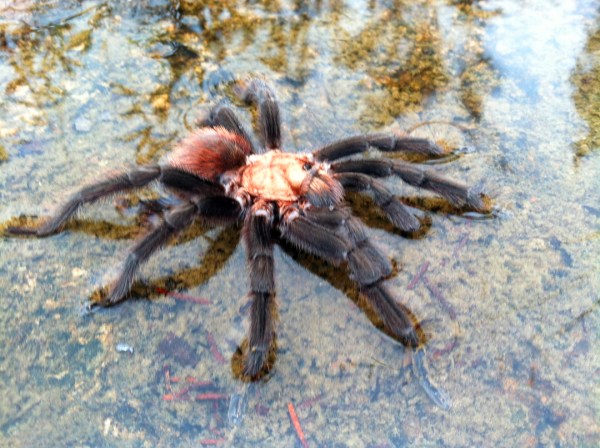
The cool temperatures and light drizzle were not conducive to much other insect activity, but while crossing the small, shallow creek that separates the south end of the glade from the main glade, the biggest male tarantula (Aphonopelma hentzi) that I have ever seen caught my attention as it crossed the creek. Situated only 30 miles south of St. Louis, Victoria Glades must represent the northeastern limit of distribution for the species, and although I once saw a tarantula crossing the road very near to this location, this is the first tarantula that I have actually seen in the glades that lie so close to St. Louis. Males are famous for their fall wanderings, presumably in search of the females that tend to stay within their burrows. This male was missing part of one of its hind legs but otherwise appeared quite healthy and robust. I hope he succeeds in finding a mate and sires many offspring and is not discovered by any of the poachers who regularly scour the glades and steal its more unusual inhabitants—the glades have already lost enough of their unique residents…

Can you find the tarantula crossing the creek? (Hint: 0.60X, 0.37Y)

Male Aphonopelma hentzi | Jefferson Co., Missouri

Copyright © Ted C. MacRae 2012