Tips for photographing shiny beetles on yellow flowers

I really hate starting off this post with the following photo—typically it is the first photo in a post that readers see in syndicated feeds; however, I use it in this post to make a point. This photo was taken back in May 2009 and is among the very first photographs that I took after getting my current dSLR camera setup. I was certainly happy enough with it at the time; however, in the following years I have learned a lot about lighting and composition. Such is the curse of any photographer—the further back one goes in their portfolio, the less satisfied they are with the photos taken at a particular point in time. What was then a pretty photo of a shiny, red longhorned beetle on a bright, yellow flower is now teaching material for what not to do when taking photos of shiny beetles on yellow flowers.

One of my first photos of Batyle suturalis, taken in May 2009 | Franklin Co., Missouri

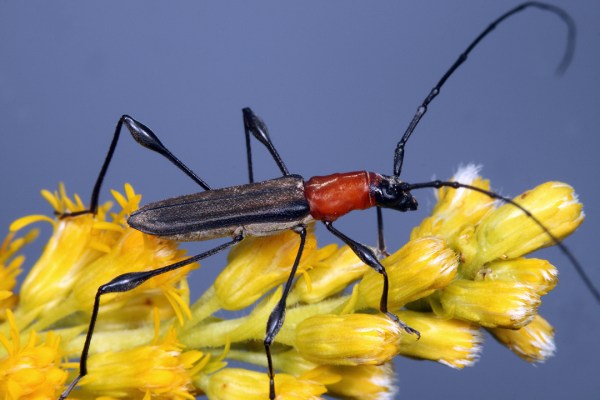
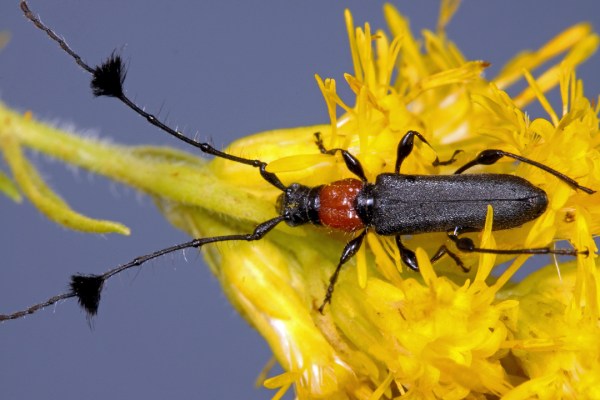
Batyle suturalis on Coreopsis lanceolata | Shaw Nature Preserve, Franklin Co., Missouri

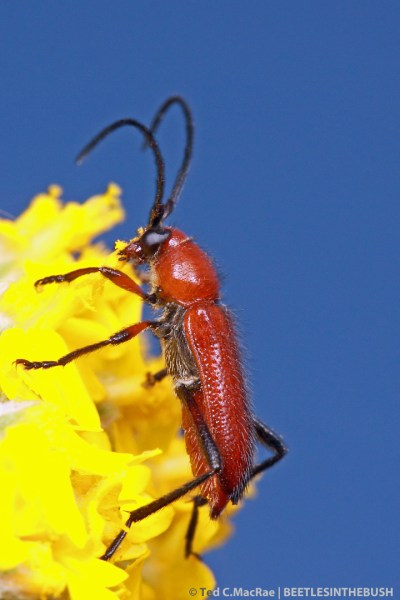
Compare the above with the following much more recently taken photos of the same beetle species from this past June. The beetle is the same, and while the flowers are a different species they are the same intense shade of yellow, but in nearly all respects the photos are far superior to the first. What are the problems with the first photo? First, the smooth and shiny surface of the beetle combined with poor diffusion of the flash has resulted in intense specular highlights on the body of the beetle. This is especially evident in the “twin highlights” on the pronotum of the beetle that is the signature mark of the Canon MT-24EX twin flash unit when used without some type of diffuser. Secondly, the darker color of the beetle requires more flash for adequate illumination than does the much brighter yellow flower—setting the flash power high enough to fully expose the beetle resulted in overexposure of the yellow flower. One cannot even see where one petal ends and another begins. Thirdly, the top-down perspective is, well… boring, no doubt because this is far and away the most commonly used composition in photographs of insects on flowers. Lastly, in my zeal to get as close as possible to the subject, I’ve not only eliminated elements from the background that could add interest in texture to the composition but also clipped the hind tarsus of the beetle itself.

Batyle suturalis on paperflower (Psilostrophe villosa) | Alabaster Caverns State Park, Woodward Co., Oklahoma

Batyle suturalis on Psilostrophe villosa | Alabaster Caverns State Park, Woodward Co., Oklahoma

The first problem is easily addressed by using a good diffuser. It is remarkable that both Canon and Nikon have produced such incredibly effective lenses and flash units for macrophotography, yet completely ignored the demand for diffusers designed to work with them. As a result, most insect macrophotographers have resorted to various do-it-yourself (DIY) designs to fill the void. The diversity in DIY diffuser designs is as large as the diversity of insect macrophotographers, and each person has their own favorite. I have tried many different versions myself, and my current design (admittedly a fusion of ideas stolen from and Alex Wild and Piotr Naskrecki) has produced quite good results. This is evidenced in the more recent photos shown here by the very soft highlights that are spread out evenly over the body of the beetle and not concentrated into intense spots or bands.

Batyle suturalis

Portrait orientation is under-utilized in ”bug on a flower” shots.

The second problem—that of overexposure of the flower to properly expose the beetle—is handled in a simple yet somewhat counter-intuitive manner. I find yellow flowers to be especially prone to overexposure. However, it is much easier to “fix” underexposed than overexposed areas of a photo in post-processing. When a photo is underexposed, all of the data regarding color and hue is still there. It is a simple matter to increase the brightness in the image processing software to restore underexposed areas to their natural brightness. Overexposure, however, is much more difficult to correct, as once the exposure is “blown” there is no data remaining regarding the true color and hue. The only way to fix blown highlights is with the laborious process of cloning over them with nearby areas of the photo that are not blown. Perhaps some can do this quickly and with good results, but I am not one of those people. I like to selectively increase the brightness of underexposed areas using “Lighten Shadows” tool in Photoshop. Be careful, as a light hand is all it takes—overly heavy-handed adjustments look  unnatural.

Batyle suturalis

Side profiles are more interesting than ”top down” shots and allow high color-contrast backgrounds.

Finally, think about more interesting compositions for your “bug on a flower” photos than the far too commonly used top-down perspective. Getting low relative to the beetle and looking at it from the side or front not only provides a less common view of the subject but also allows for far more creativity in the overall composition. My personal preference for insects on flowers is a blue sky background, which can add a lot of value contrast to photos compared to those in which the entire background consists only of the flower on which the insect is sitting. Use of blue sky background can also further help avoid overexposure of the yellow flower, as the slightly higher ISO and slightly lower aperture settings and shutter speeds used in that technique serve to increase the amount of ambient light contributing to the photo, thereby reducing the amount of illumination needed by the flash. Side views of the insect also facilitate use of portrait orientation—an important consideration if you are interested in producing photos for potential use on journal or magazine covers (nearly always printed in portrait). Also, as you compose your photo, try backing off a bit rather than trying to focus in on the subject as tightly as possible. Backed off views not only avoid the more straightforward problem of clipping parts of the insect but can also result in much more aesthetically pleasing photographs by allowing the incorporation of other elements in the composition for balance, scale, and even a sense of motion or dynamics (as exemplified by the partially buried grass blades in this photo of the Eastern Big Sand Tiger Beetle). Photos can always be cropped in post-processing, and while excessive cropping as a way to artificially increase magnification is to be avoided, there is nothing wrong at all with slight cropping to improve composition.

Copyright © Ted C. MacRae 2013

Observation and Bias in Biology

The following is a guest post by my friend Kent Fothergill. Read more of Kent’s musings at his blog, biologistsoup.


Observation is a key activity in scientific inquiry. People who work with insects can make many interesting observations from collected insects: distribution, phenology, etc. Observations can be documented and analyzed later from photographs. A collection of photographs can also yield information about: associations with other species, behavior, while providing the same information as collected specimens – as such photography is a new tool changing entomology. Of course, most observations are made using only human senses without photographic or specimen documentation, but all observations can be subject to biases.

Observer biases are our evolutionary legacy. Our brains evolved to process and interpret data based on patterns observed in previously processed data. Because of the vast amount of data flowing in from our five senses and our limited ability to focus on data, our brains let most data be background. Even the subset of data that we focus our attention on is filtered, who hasn’t taken a photograph and found something much more interesting in the photograph than the original subject (e.g., these mites on harvestmen)? All data, even the data subset we are focused on can be misinterpreted. When teaching scientific methods, my students always enjoyed the optical illusion exercises to demonstrate why objective analyses and accurate measurement are important.

Remember, that the brain also compares incoming data to previous data. This allows pattern recognition. Recently, Ted and I were blacklighting along the Mississippi River in Southeast Missouri. We found a pair of Elaphidion mucronatum (spiny oak borer) a very common insect in Southeast Missouri. So common that many would move on to other more interesting subjects at that point. The insects were in a mate guarding situation.  Because I had a name for the behavior, my brain put my observation in the mate guarding category. At this point I would have moved on, except Ted wished to document the subject with his camera rig, which meant I would do what any friend should: watch the insects while Ted ran to vehicle to get his camera so he would be able to photograph them. While Ted was gone things got interesting. The male was positioned above the female, who was more or less caged between his legs. The pair was moving in unison on the tree trunk with very little actual contact between the pair. This was interesting, but when the female E. mucronatum suddenly shot out from under the male ending up 10’ vertical below him on the side of the tree trunk I was stunned. The male covered this distance with amazing speed and recaptured the female. After a couple minutes the female again shot out from under went down a few feet and doubled back ending out of sight above the male. At this point the male remained motionless for a brief period. When Ted came back with his camera, I took my eyes off of the male to tell him about what I had seen, and the male had vacated the area. Later, on the very same tree, we saw a mate guarding pair (presumably the same individuals) coming down towards us.

I have viewed many mate guarding insects. Mate guarding is a male insect using its body to prevent other males from mating with this female. Evolutionary biologists will explain mate guarding behavior in terms of enhanced male reproductive success, and that is why mate guarding persists. I never questioned this explanation, but should have. The E. mucronatum observation caused me to see mate guarding in a new way and realize that mate guarding involves a male and female component – I know this seems obvious, but I had my own cultural bias to overcome in this regard. I had never considered that mate guarding could involve non-willing females.

Based on a 10 minute observation of a very common insect my new understanding of mate guarding now recognizes that mate guarding influences female fitness also. Mate guarding persists when it creates a change in fitness in the male and female such that there is a positive net change in fitness for reproductive output for all individuals involved. In the case I witnessed, there may actually be a reproductive cost for the female and that is why she tried to avoid/escape the mate guarding. I have much more to learn about mate guarding.

Science is a way of objectively seeing the world and testing what you have seen to approach truth. This observation of E. mucronatum was also a mirror that showed my cultural bias and how that bias influenced my interpretation of my observations. For me, this observation could be a watershed event.

The moral(s) of this story:

  1. Life is short: enjoy time in the field with friends.
  2. Pay attention. There are new and wonderful things to observe even in the common and mundane.
  3. Be aware of the biases that can keep you from the truth.
  4. Have fun out there!

Copyright © Kent Fothergill 2013

Plionoma suturalis in Oklahoma—a new state record!

When I returned from my vacation/insect collecting trip to western Oklahoma two weeks ago, most people upon learning where I went responded with a funny look that said, “Why would you want to go to Oklahoma?” Even entomologists familiar with my inclination for beetles merely assumed I went there to collect tiger beetles and were surprised to learn that, for this trip, I was actually targeting jewel beetles (family Buprestidae) and longhorned beetles (family Cerambycidae). Jewel beetles and longhorned beetles, of course, are largely associated with dead wood, and western Oklahoma is smack dab in the middle of the Great Plains. However, this does not mean that there are no trees in the area, or that whatever trees do exist are merely western examples of pedestrian eastern species with a depauperate beetle fauna. In fact, I came to this area precisely because previous visits had seemed to indicate high potential for interesting species of woodboring beetles. On my September 2011 visit, passing through on my way back from Colorado, I found several individuals of the unusual fall-active Acmaeodera macra (representing a northern range extension), and during last year’s fall visit I found a single Chrysobothris octocola adult on a dead mesquite (Prosopis glandulosa) branch—a northeastern range extension and new state record for Oklahoma! Interesting records for other species of beetles over the past few years also supported the idea that western Oklahoma was understudied and held the promise of more interesting new records for anyone willing to spend time in the area.

Plionoma suturalis (male) | Gloss Mountains, Major Co., Oklahoma

Plionoma suturalis (male) on mesquite (Prosopis glandulosa) | Gloss Mountains, Major Co., Oklahoma

Nearly all of these interesting records have been found in the Gloss Mountains, a fascinating system of gypsum capped, red clay mesas in Major Co. I now regard the Gloss Mountains State Park as my “portal” to northwestern Oklahoma and can’t imagine traveling to or through the area without stopping and spending time knocking around this fascinating, brick-red landscape. Such was the case during this year’s trip, and while I had decided to spend at least the first field day in and around the State Park, the collecting was so good that I stayed for a second day and returned for a third later in the week. The beetle shown in these photos is part (and only part) of the reason why. Arriving in the morning of the first day in the field, I headed straight for the mesquite tree on which I had found the C. octocola adult last fall. It’s a common species in the southwestern U.S. that normally wouldn’t warrant any special attention, but since the Oklahoma record was based on a single specimen I wanted to see if I could find additional individuals to confirm that the species was actually established in the area and that last year’s record wasn’t just a one-off. I whacked a dead branch, and onto my beating sheet fell a C. octocola adult! I whacked another dead branch, and off fell another adult! As it was, I would find the species as abundantly here, in strict association with mesquite, as I have seen it at other locations further to the southwest. Soon after collecting the first few C. octocola adults, however, I whacked a live branch on the same mesquite tree, and off fell two large, colorful longhorned beetles that I recognized instantly as representing the species Plionoma suturalis.

Plionoma suturalis (female) | Gloss Mountains, Major Co., Oklahoma

Plionoma suturalis (female) on mesquite flowers | Gloss Mountains, Major Co., Oklahoma

Plionoma suturalis belongs to the great tribe Trachyderini. Beetles in this tribe are known for the bright colors, attraction to flowers, and diurnal (day-active) tendencies, and while we have a few species in the eastern U.S. they are far more diverse in the southwestern states. Plionoma suturalis and another U.S. species (P. rubens) are known to occur from Texas west to California and south into northern Mexico, but I immediately had the feeling that finding this species in Oklahoma was a significant record. The beetles were abundant on the mesquite trees that lined the parking lot and dotted to landscape below the main mesa, with many observed feeding on the flowers (the trees were in full bloom) and numerous mating pairs also observed. Considering its abundance at the site and possible significance of the record, I collected several dozen specimens to serve as vouchers (not to mention I had only collected a handful of specimens in all of my previous years of collecting). Checking my database later that evening (I never leave home without my computer!) confirmed my suspicions—Oklahoma was not only a new state record, but a significant northeastern range extension. In fact, the closest previous record was by Lingafelter & Horner (1993), who recorded eight specimens from Wichita Co., Texas—just over 200 miles to the south! Further, the Wichita Co. specimens were all collected in 1956, and subsequent collecting had yielded no additional specimens, leading the authors to consider the status of this species in north-central Texas as doubtful.

The female feeds on flowers of mesquite (Prosopis glandulosa)

Large number of individuals were seen feeding on mesquite flowers.

Plionoma suturalis is one of only a handful of North American longhorned beetle species in which the adults exhibit bimodal seasonal activity, with adults appearing during the spring months, disappearing during the summer, and reappearing in the fall (see  for a previous example from Missouri) (Linsley 1962). In the Lower Rio Grande Valley of south Texas (where the activity of many species of longhorned beetles and other insects is distinctly bimodal to coincide with moderate temperatures and increased precipitation during spring and fall), this species has been found on fresh-cut mesquite and huisache (Acacia farnesiana) in the fall months and on the blossoms of fabaceous trees during spring and early summer (Hovore et al. 1987).

REFERENCES:

Hovore, F. T., R. L. Penrose & R. W. Neck. 1987. The Cerambycidae or longhorned beetles of Southern Texas: a faunal survey. Proceedings of the California Academy of Science 44(13):283–334, 20 figs.

Lingafelter, S. W. & N. V. Horner. 1993. The Cerambycidae of north-central Texas. The Coleopterists Bulletin 47(2):159–191, 7 figs.

Linsley, E. G. 1962. The Cerambycidae of North America. Part III. Taxonomy and classification of the subfamily Cerambycinae, tribes Opsimini through Megaderini. University of California Publicatons in Entomology 20:1–188, 56 figs.

Copyright © Ted C. MacRae 2013

Flatfaced longhorn: Leptostylus transversus

Leptostylus transversus | Holly Ridge Conservation Area, Stoddard Co., Missouri

Leptostylus transversus | Holly Ridge Conservation Area, Stoddard Co., Missouri

The longhorned beetle subfamily Lamiinae is one of the few subfamilies in the beetle world to have its own common name—flatfaced longhorns. This photo of one of its members, Leptostylus transversus, doesn’t show the character very well, but as with all members of the subfamily the face is completely vertical, a condition called “orthognathous” (mouthparts directed downwards), while all other longhorned beetles exhibit a more prognathous (mouthparts directed forward) condition. (A third possible condition, opisthognathous, refers to mouthparts directed backwards, a condition not occurring in longhorned beetles but common in leafmining species of jewel beetles and leaf beetles.)

I beat this individual this past May from dead branches at Holly Ridge Conservation Area in Stoddard Co., Missouri. Leptostylus transversus belongs to the tribe Acanthocinini, one of the largest tribes in the family and incredibly diverse in the tropics. Most members of this tribe are colored like mottled bark, as is this one, with many also exhibiting tubercles, erect setae or tufts of setae that combine to give the beetles a rather warty appearance. I presume the combination of coloration and irregular outline contributes to their overall cryptic appearance.

When I studied the longhorned beetle fauna of Missouri (MacRae 1994), this was one of the most common species that I encountered (268 specimens from throughout Missouri were examined). Despite its abundance, two interesting features were noted for this species. Firstly, it exhibits a distinctly bimodal temporal occurrence, with most of the specimens I examined being captured either during March through June or September through October and almost none during July or August. I am not aware or many (any?) other species, at least in Missouri, that exhibit such a strongly bimodal occurrence. There are several possible explanations, such as the occurrence of two generations per year or an adult “aestivation” (summer hibernation) period, but I think it more likely that adults emerge primarily during late summer and fall, overwinter as adults, and then become active again the following spring. This latter suggestion seems to be supported by reared specimens in my collection, the great majority of which have emerged from their hosts after mid-August.

The second interesting feature of this species is its extreme polyphagy. Many longhorned beetles are quite polyphagous, but most still utilize primarily angiosperms or gymnosperms and not both. Leptostylus transversus, on the other hand, shows no preference for either group—specimens in my collection have been reared from the angiosperms Amelanchier arborea (serviceberry), Carya ovata (shagbark hickory) and Diospyros virginiana (persimmon) and the gymnosperms Juniperus virginiana (eastern red-cedar), Pinus echinata (shortleaf pine), and P. sylvestris (Scots pine). In fact, even most species that prefer gymnosperms tend to utilize either pine or juniper but not both.

REFERENCE:

MacRae, T. C. 1994. Annotated checklist of the longhorned beetles (Coleoptera: Cerambycidae and Disteniidae) known to occur in Missouri. Insecta Mundi 7(4) (1993):223–252.

Copyright © Ted C. MacRae 2013

2013 Oklahoma Collecting Trip iReport

I’m back home after my week-long collecting trip to western Oklahoma, and at the risk of sounding hyperbolous I can only describe it as one of the most successful collecting trips I’ve ever had. Seriously! These kinds of trips don’t happen all that often for a variety of reasons—timing is off, rains didn’t happen, weather was uncooperative, etc. etc. Once in a while, though, everything comes together, and this was one of those times. The trip was also a return to my roots so to speak—I’ve been rather distracted in recent years with tiger beetles, but jewel beetles (family Buprestidae) and, to a lesser extent longhorned beetles (family Cerambycidae), are really the primary focus of my taxonomic studies. It had been several years since I’d had a good “jewel beetle trip,” so that was the focus of this trip. In planning the trip, I recalled seeing jewel beetle workings in several woody plant species in the same area during last September’s trip, and the occurrence of May rains seemed to bode well for my early June timing.

Gloss Mountains State Park, Major Co., Oklahoma

Gloss Mountains State Park, Major Co., Oklahoma

My instincts proved to be justified—in seven days in the field I collected an estimated 1000–1500 specimens representing at least two dozen species of Buprestidae and a dozen or more Cerambycidae. More important than the numbers, I collected a number of species in good series that I have either not or only rarely collected before, and in fact the second beetle that I collected turned out to be a new state record! Of course, I also brought along my full-sized camera and associated gear and photographed many of the species that I collected. I will feature these photos in future posts, but for this post I thought it might be fun to give a high level view of the trip illustrated only with photos taken with my iPhone (which I also carry religiously in the field with me). The iPhone is great for quick snaps of scenery and miscellaneous plants and animals for which I don’t feel like breaking out the big camera, or as a prelude to the big camera for something I’d like to share right away on Facebook. Moreover, there are some types of photos (landscapes and wide-angles) that iPhones actually do quite well (as long as there is sufficient light!).

Gloss Mountains State Park, Major Co., Oklahoma

Atop the main mesa at Gloss Mountains State Park, Major Co., Oklahoma

My first destination was Gloss Mountains State Park (Major Co.), a stunning system of gypsum-capped, red-clay mesas. I’ve already found a number of rare tiger beetles here such as Cylindera celeripes (Swift Tiger Beetle), Amblycheila cylindriformis (Great Plains Giant Tiger Beetle) and Dromochorus pruinina (Frosted Dromo Tiger Beetle), and in the past two falls I’ve found two interesting jewel beetle records: Chrysobothris octocola as a new state record, and Acmaeodera macra as a northern range extension. On this trip, I started out beating the mesquite  (Prosopis glandulosa) and immediately got the longhorned beetle Plionoma suturalis—a new state record! They were super abundant on the mesquite, and I collected several dozen specimens along with numerous C. octocola as well. I then moved over to the red-cedar (Juniperus virginiana), which was showing a high incidence of branch dieback, and collected nice series of several buprestids, including what I believe to be Chrysobothis ignicollis and C. texanus. Up on top of the mesa there are small stands of hackberry (Celtis laevigata) and soapberry (Sapindus saponaria), both of which are very good hosts for Buprestidae. Not much was on the soapberry, but I beat large series of several Buprestidae from the hackberry, including what I believe to be Chrysobothris caddo and—the real prize—Paratyndaris prosopis! My old friend C. celeripes was also out in abundance, so I collected a series to add to my previous vouchers from this site. Back down below, I marveled at a juvenile western diamondback rattlesnake (Crotalus atrox) in the area where I found some more A. cylindriformis larval burrows. Daylight ran out before I could dig them up, and after 11 hours in the field I was exhausted, so I returned the next morning and got one 1st- and two 3rd-instar larvae and went back up on top of the mesa and beat several more P. prosopis from the hackberry.
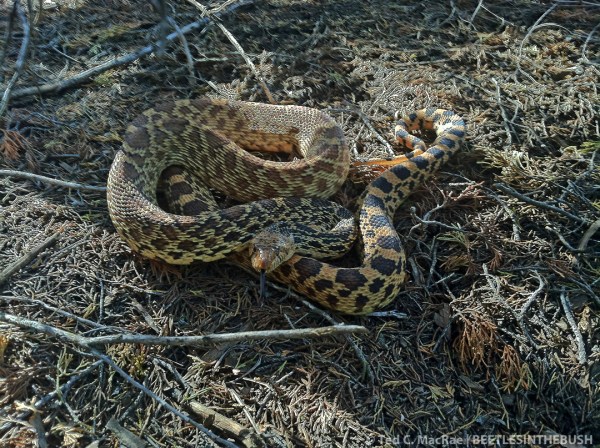
Bullsnake (Pituophis catenifer sayi) | Alabaster Cavern State Park, Woodward Co., Oklahoma

Bullsnake (Pituophis catenifer sayi) | Alabaster Cavern State Park, Woodward Co., Oklahoma

My second stop was at Alabaster Cavern State Park (Woodward Co.), where C. celeripes was again abundant on the gypsum-clay exposures surrounding an impressive gorge thought to be a collapsed cave complex. I focused on beating hackberry because of the success with buprestids on this plant at Gloss Mountains SP, and although they were not quite as abundant here as at Gloss Mountains I still managed to end up with good series of C. caddo and several species of Agrilus. Because I had spent the morning at Gloss Mountains, I had only a partial day to explore Alabaster Caverns and, still getting used to the weight of the camera bag on my back, decided to leave the big camera in the car. This was a mistake, as I encountered my first ever bullsnake (Pituophis catenifer sayi) and had to settle for iPhone photos of this species—the photo above being the best of the bunch. An approaching storm put an end to my second day after another 10 hours in the field, and I drove an hour to Woodward.

Moneilema sp. on Opuntia phaecantha | Alabaster Cavern State Park, Woodward Co., Oklahoma

Moneilema sp. on Opuntia macrorhiza | Alabaster Cavern State Park, Woodward Co., Oklahoma

My third day started out at nearby Boiling Springs State Park, a riparian oasis on sandy alluvium alongside the nearby Cimarron River. The woodlands are dominated by hackberry and American elm, and although a few buprestids were beaten from hackberry and honey locust (Gleditisia triacanthos), the numbers and diversity were not enough to hold my interest in the spot. After lunch, I decided to return to Alabaster Caverns SP and explore some other areas I had not had a chance to explore during the previous partial day. It’s a good thing that I did, as I ended up finding a nice population of longhorned cactus beetles in the genus Moneilema associated with prickly pear cactus (Opuntia macrorhiza). I collected a nice series of adults and also learned a few lessons in how to photograph these beetles on their viciously protective host plants. The photo above gives a taste of what will come in the photos that I took with the big camera. After eight hours in the field and darkness falling, I drove two hours to Forgan in Beaver Co.

Beaver Dunes State Park, Beaver Co., Oklahoma

Beaver Dunes State Park, Beaver Co., Oklahoma

Day 4 in the field started out cold and ominous, having stormed heavily during the previous night and with thick clouds still hanging in the sky. I feared the day might be a wash but decided to venture to Beaver Dunes State Park anyway and take my chances (beating can still be productive even in cold weather as long as the foliage is not wet). It’s a good thing that I did, as the buprestids were as numerous as I’ve ever seen them. The park’s central feature is a system of barren sand dunes that are frequented by ORV enthusiasts and surrounded by hackberry woodlands. The park also has a reservoir and campground, around which are growing a number of cottonwoods (Populus deltoides).

Hackberry Bend Campground, Beaver Dunes State Park, Beaver Co., Oklahoma

Hackberry Bend Campground, Beaver Dunes State Park, Beaver Co., Oklahoma

These hackberrys and cottonwoods proved to be extraordinarily productive. On the former I collected large series of several species of Chrysobothris and Agrilus, and while I collected fewer Buprestidae on the latter, these included Agrilus quadriguttatus and Poecilonota cyanipes! The latter species I had never collected until last year (from Cerceris fumipennis wasps), and beating the lower branches of the declining cottonwoods produced a series of about a dozen specimens. I also got one specimen on black willow (Salix nigra), along with a few Chrysobothris sp. and what I take to be Agrilus politus. Also in a low branch of one of the cottonwoods was a bird’s nest with a single egg that, according to Facebook comments, either represents the American Robin or a Gray Catbird. (I returned the next day and saw two eggs in the same nest.)
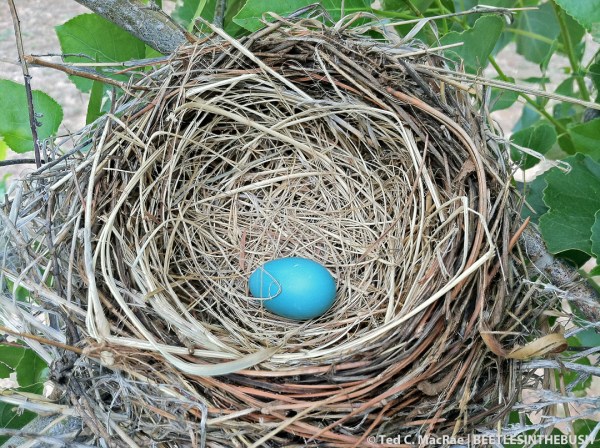
American Robin or Gray Catbird nest w/ egg | Beaver Dunes State Park, Beaver Co., Oklahoma

American Robin or Gray Catbird nest w/ egg | Beaver Dunes State Park, Beaver Co., Oklahoma

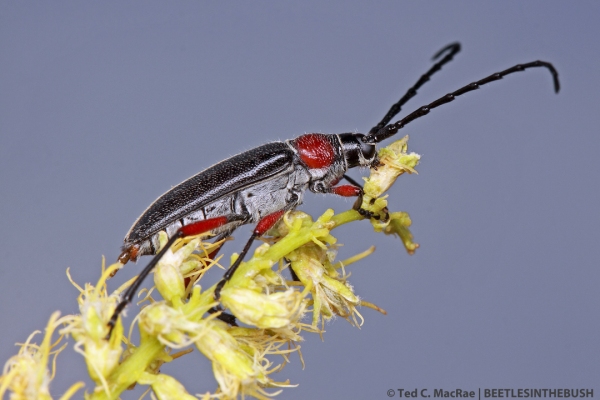
As the day drew to a close, I found two interesting longhorned beetle species at the edge of the dunes: one large, powdery gray Tetraopes sp. on milkweed (Asclepias sp.), and huge numbers of Batyle ignicollis evidently perched on the yellow spiked inflorescence of an as yet undetermined plant. I have seen this species on many occasions, but always in low numbers, yet here were literally hundreds of individuals on the plants, all having assumed a characteristic pose on the inflorescence suggesting that they had bedded down for the night. I only spent eight hours in the field on this day because of the late start, and as darkness approached I began the two-hour drive to Boise City.

Black Mesa landscape

Sculpted sandstone landscape in the vicinity of Black Mesa State Park, Cimarron Co., Oklahoma

The final two days in the field were supposed to be spent exploring the area around Black Mesa in the extreme northwest corner of Oklahoma, and another hour of driving was needed to get to the area from Boise City. I first went to Black Mesa State Park, and while the landscape was stunning (see above) the area was extremely dry. I feared the collecting would not be at all productive in this area but wanted to give the area a good effort before making a call. As I approached the entrance to the park, I saw a jeep parked by the side of the road with a license plate that read “Schinia,” which I recognized as a genus of noctuid moths that are very popular with collectors. I pulled over and talked to the driver, who was indeed a lepidopterist from Denver and had just arrived himself. We talked and exchanged contact information, and learning of my interest in beetles he directed me to a small stand of Gambel oak (Quercus gambelii) and one-seed juniper (Juniperus monosperma) on a sculpted sandstone escarpment not far from the park. I found the spot, and although I beat three Chrysobothris sp. from the first juniper tree that I whacked, another hour of beating produced only one more beetle from the juniper and nothing from the oak. I returned to the spot where we had met and encountered him again on his way out! We stopped and chatted again and found a few specimens of what I take to be Typocerus confluens on the yellow asters, but by then I was having my doubts about staying in the area. I told him I was going to check out a ravine in the park and then decide.

Petrified forest | Black Mesa State Park, Cimarron Co., Oklahoma

Petrified forest | Black Mesa State Park, Cimarron Co., Oklahoma

The petrified forest ended up being the only interesting thing I found in the ravine—the area was so dry that I think even the real trees were almost petrified! At any rate, it was clear that I was not going to have much success in this area. I looked at my watch, knowing that it would take three hours to drive back to Beaver Dunes, and estimated that if I left now I could get in about three hours of collecting at Beaver Dunes where I’d had so much success the previous day. Thus, I did what I rarely do on a collecting trip—drive during the afternoon!
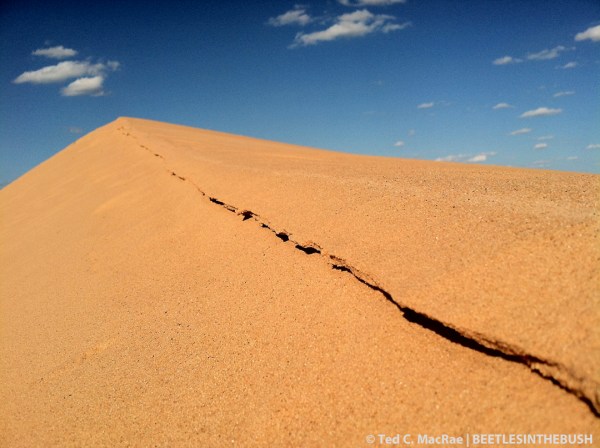
Beaver Dune

The main dune at Beaver Dunes State Park, Beaver Co., Oklahoma.

A chunky grasshopper nymph inhabiting the dune

A chunky grasshopper nymph inhabiting the main dune.

I arrived back at Beaver Dunes with several hours of daylight still remaining, so I decided to take a look around the main dunes before heading towards the woody plants. I’ve actually visited Beaver Dunes previously, on the tail end of a fall tiger beetle trip in 2011. At that time I had seen only the rather common and widespread species Cicindela formosa (Big Sand Tiger Beetle) and C. scutellaris (Festive Tiger Beetle), but I thought there could still be a chance to see the much less common C. lengi (Blowout Tiger Beetle). Early June, however, is a little late to see the spring tigers, and in fact I saw only a single C. formosa. Nevertheless, I find dune habitats irresistible—alien habitats occupied by strange plants and animals, and I spent a bit of time exploring the main dune before heading back towards where I had collected so many Buprestidae the previous day.

Low water levels in the reservoir at Beaver Dunes are a result of three years of drought.

Low water levels in the reservoir at Beaver Dunes are a result of three years of drought.

Western Oklahoma, like many parts of the central U.S., has suffered rather severe drought conditions for the past several years. This was evident not only in the large amount of branch dieback seen in the woody vegetation of the area (and probably a contributor to my success at collecting Buprestidae) but also the very low water level in the park reservoir. In the photo above the small cottonwood saplings in the foreground and large cottonwood trees in the left background indicate the normal water level. Cottonwoods, of course, like to keep their feet wet, and the trees around this reservoir—left high and dry by the drought—have responded with major branch dieback and lots of subsequent adventitious sprouting at the bases of the main branches. It was from this adventitious growth that I had beaten most of the Poecilonota cyanipes that I collected the previous day, so I repeated the cottonwood circuit in the hopes of collecting more. Not only did I collect more, but I collected twice as many as the previous day, so I ended up with a very nice series of more than two dozen individuals of the species from the two days collecting. I also did a little more beating of the hackberry trees which had produced well the previous day and collected several more Chrysobothris caddoC. purpureovittata, and Agrilus spp. such as A. leconteiA. paracelti, and perhaps others. When I arrived I was unsure whether I would stay here the following day, but eventually I decided I had sampled the area about as well as I could and that I would go back to the Gloss Mountains for my last day in Oklahoma. Thus, as the day began to wane I began hiking back to the car and spent the next two hours driving back to Woodward to spend the night.

Steep slope below the main mesa | Gloss Mountains State Park, Major Co., Oklahoma

Steep slope below the main mesa | Gloss Mountains State Park, Major Co., Oklahoma

Echinocereus sp. | Gloss Mountains State Park, Major Co., Oklahoma

Echinocereus sp. | Gloss Mountains State Park, Major Co., Oklahoma

Arriving at the Gloss Mountains the next morning was like coming home! I’ve spent so much time at this place and found so many great insects, yet every time I come here I find something new. Today, however, my goals were more modest—I wanted to improve on my series of Paratyndaris prosopis and Chrysobothris texanus, so I focused most of my time beating the hackberry and juniper on top of the mesa and continued beating the juniper down below as well. Success! I collected four more Paratyndaris off of the hackberry, but the C. texanus were far more abundant on this day than they were earlier in the week—I probably got another two dozen individuals of this species. Of course, I also got distracted taking photographs of a number of things, so the day went far more quickly than I realized. I wanted to leave around 6 pm and get in about three hours of driving so that I would have time to make it into Missouri the next morning and have a nice chunk of time to collect before finishing the drive and arriving home on Saturday night. It was actually closer to 7:30 pm before I hit the road, the reason for the delay being the subject of a future post (I will say that BioQuip’s extendable net handle comes in handy for much more than collecting tiger beetles!).
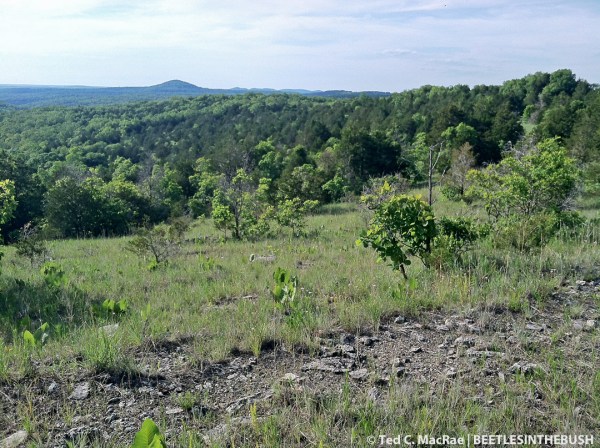
Dolomite glades | Hercules Glades Wilderness, Taney Co., Missouri

Dolomite glades | Hercules Glades Wilderness, Taney Co., Missouri

Long Creek | Hercules Glades Wilderness, Taney Co., Missouri

Long Creek | Hercules Glades Wilderness, Taney Co., Missouri

For my last day of collecting, I decided to stop by at one of my favorite spots in the White River Hills of extreme southwestern Missouri—Hercules Glades Wilderness in the Mark Twain National Forest. I’ve been to this place a number of times over the years, but in recent years my visits have usually been late in the season to look for the always thrilling to see Cicindelidia obsoleta vulturina (Prairie Tiger Beetle). It had actually been about 25 years since I’d visited these glades during the spring, and because of the success I’d had collecting in Oklahoma I was really optimistic that I would find the same here. Sadly (and inexplicably), insect activity was very low, and it didn’t take long for this to become apparent as branch after branch that I beat along the trail through the dry-mesic forest down to Long Creek yielded nothing. By the time I got to the creek I still had not collected a single beetle. A consolation prize was found along the creek, as beating the ninebark (Physocarpos opulifolius) produced a few specimens of the pretty little Dicerca pugionata, and a couple more consolation prizes were found further up the trail approaching the main glade when I saw a Cylindera unipunctata (One-spotted Tiger Beetle) run across the trail and then beat a single Agrilus fuscipennis from a small persimmon (Diospyros virginiana) tree at the edge of the glades. It had been about 25 years since I last collected the latter species, so I was very happy to see it, but no more were seen despite beating every persimmon tree that I saw during the rest of the day. At the end of the day, I had hiked seven miles and collected only six beetles—a rather inauspicious ending to what was otherwise a wonderfully successful trip.

A rare ''selfie''

The author takes a rare ”selfie” at Gloss Mountains State Park.

Arriving back at the car at the end of the day on the last day of an extended collecting trip is always a little depressing—despite the vagaries of travel, cheap hotel beds, meals on the go, and general exhaustion, I’m never happier than I am when I am in the field. Still, the success that I’d had during this trip did much to ease my depression, and arriving home late that night and seeing my girls again (who waited up for me!) finished off any remaining depression.

© Ted C. MacRae 2013
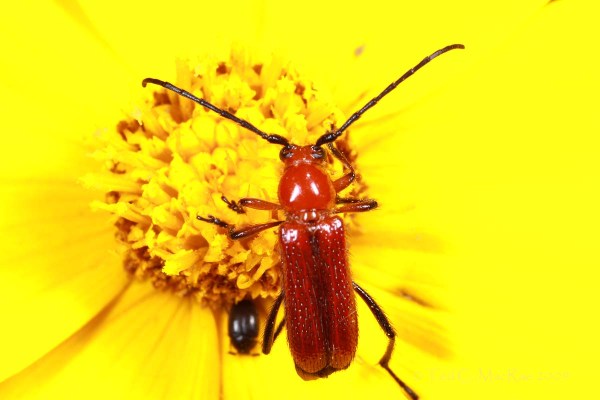
Meet Enus’ Meal

Phymatodes amoenus (Coleoptera: Cerambycidae) | Stoddard Co., Missouri

Phymatodes amoenus (Coleoptera: Cerambycidae) | Stoddard Co., Missouri

When Enus (Enoclerus ichneumoneus) was beaten from a dead grape vine in southeastern Missouri, he wasn’t alone. Along with him was this longhorned beetle representing Phymatodes amoenus (family Cerambycidae). Even though P. amoenus and E. ichneumoneus are both woodboring beetles, their association together on this dead grape vine was not purely coincidental. Phymatodes amoenus is associated exclusively with the genus Vitis (family Vitaceae), its larvae developing within the dead vines. Enoclerus ichneumoneus also bores through dead wood in the larval stage but is much less discriminating about the plant species. This is because E. ichneumoneus and most other checkered beetles (family Cleridae) don’t actually eat the wood within which they are tunneling, but rather prey upon the other woodboring beetle larvae that they encounter in the wood. The adult checkered beetles are thus attracted to dead wood not as a food source itself, but rather the woodboring larvae that will provide food for their offspring.

Phymatodes amoenus

Half an antenna and the left mesotarsus were the price to pay for rooming with Enus!

When I collected these two individuals, I put them together in a vial as I continued beating the vine to look for other individuals. None were found, but I had forgotten that adult checkered beetles also are predaceous. Needless to say, Enus found the cerambycid beetle to be easy pickings while they were confined together and managed to eat half of the cerambycid’s left antenna and left mesotarsus before I realized my oversight and rescued the poor thing.

Copyright © Ted C. MacRae 2013

North America’s itsiest bitsiest longhorned beetle

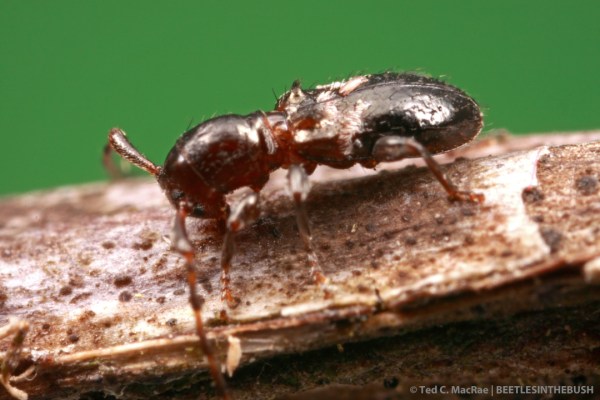
Longhorned beetles (family Cerambycidae) are generally regarded as medium to large-sized beetles, but that doesn’t mean the family is without its pip-squeeks! There are a number of species, primarily in the tribes Tillomorphini, Anaglyptini, and Clytini (all in the subfamily Cerambycinae) that are remarkably effective mimics of ants. Some of these, especially members of the genus Euderces, are quite small, but none are smaller than the absolutely diminutive Cyrtinus pygmaeus. Measuring only 2–3 millimeters in length, the adult beetles can be found on dead twigs and branches among equally small ants such as Lasius americanus.

Cyrtinus pygmaeus | Stoddard Co., Missouri

Cyrtinus pygmaeus | Stoddard Co., Missouri

The species is said to be widespread across eastern North America, having been recorded on a number of hardwood trees (Lingafelter 2007). I have no reason to doubt this, having reared a number of individuals from dead branches of river birch (Betula nigra), chinquapin oak (Quercus muhlenbergii), willow oak (Q. phellos) and black oak (Q. velutina) (MacRae & Rice 2007), but in the wild I have only encountered the species three times—each time as a single specimen that I noticed crawling on my arm after a bout of beating a variety of dead branches. The most recent occasion was two weekends ago during a visit to the Mississippi Lowlands of southeastern Missouri. I had done a bit of beating in a forest dominated by black oak, blackjack oak (Q. marilandica), and southern red oak (Q. falcata) and not found much when I felt a “tickle” on my right forearm. I looked down and was just about to flick the “ant” off my arm when something about the way it moved gave me pause. I stopped and looked closer, then recognizing what it was, instinctively called out “Oh cool, Cryrtinus pygmaeus!” My field partners for the day had never seen the species, so I let them look before I placed it in a vial. I was sure they would ogle at the incredibly tiny longhorned beetle, but their subdued “Hmm”s makes me think they were less impressed with the find than I was.

Cyrtinus pygmaeus

Like other ant-mimicking genera, the elytra of this species bear two prominent humps near their bases.

If the species is so common, why have I not seen them more commonly or on the beating sheet proper as soon as I beat them from their host plant? The answer, I believe, is that they are such effective mimics of the tiniest of ants that I simply overlook them! The series of specimens retrieved from my rearing cans could not be missed, as I combed through the contents every week during the beetle emergence period to make sure I found anything—longhorned beetle or otherwise—that emerged from the wood inside. In the field, however, my search image is queued for more “normal-sized” beetles and especially movement. Most other ant-mimicking longhorned beetles, even though they look very much like ants, still run like longhorned beetles—swiftly, almost frenetically, looking for the earliest opportunity to spread their elytra and take wing. Cyrtinus pygmaeus, on the other hand, is slow and clumsy, not a runner at all (slower even than the ants they mimic). If the three individuals I’ve encountered in the wild to date hadn’t happened to fall on my arm rather than the beating sheet and gotten stuck in my hair and perspiration I may never have noticed them.

Cyrtinus pygmaeus

Bands of white pubescence on the bases of the elytra give the illusion of a narrow-waisted ant.

I considered putting the beetle on a branch for photographs as soon as I found it, but since I had already pulled it off my arm I had already lost the chance to take true field photographs. Instead, I placed the beetle live in a vial and photographed it the next day at home. All of the photos were taken hand-held with an MP-E 65 mm macro lens at the upper end of its magnification capabilities. The green background is simply a colored file folder placed about four inches behind the beetle as I photographed it.

p.s. can you tell me what unusual feature this particular individual exhibits?

REFERENCES:

Lingafelter, S. W. 2007. Illustrated Key to the Longhorned Woodboring Beetles of the Eastern United States. Coleopterists Society Miscellaneous Publications, Special Publication No. 3, 206 pp.

MacRae, T. C. and M. E. Rice. 2007. Distributional and biological observations on North American Cerambycidae (Coleoptera). The Coleopterists Bulletin 61(2): 227–263.

Copyright © Ted C. MacRae 2013

Group mimicry in Cerambycidae… and more

During last year’s extended visit to Argentina, I had the chance to spend the early part of April in the northern province of Chaco. Though much of this hot, arid plain has been converted to agriculture, remnants of thorn forest remain along fence rows and in small patches of Chaco Forest. Despite the decidedly tropical latitude of the region, however, the profuse bloom of Chilean goldenrod, Solidago chilensis, along these fence rows during the Argentine autumn is reminiscent of crisp fall days here in the eastern U.S., and like the goldenrod here the ubiquitous stands of yellow blossoms stretching across the Chaco Plain are equally attractive to a multitude of insects. Among those insects are the Cerambycidae, or longhorned beetles, and while the eastern U.S. cerambycid fauna of goldenrod boasts only a few (albeit spectacular) species in the genus Megacyllene, the Argentine cerambycid fauna that I found on these flowers included at least three species in various genera belonging to two different tribes.

Rhopalophora collaris (Germar 1824) | Chaco Province, Argentina

Rhopalophora collaris (Germar 1824) | Chaco Province, Argentina

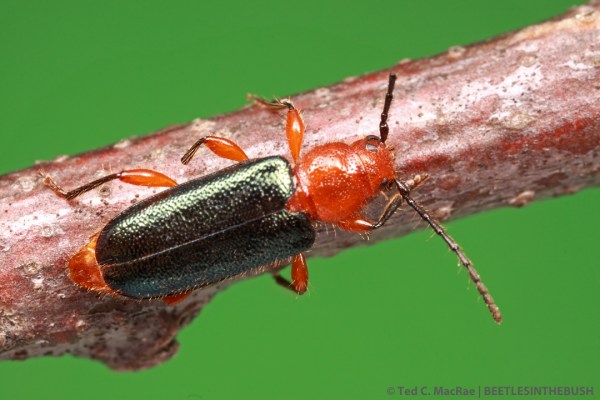
Two of the species I saw are shown here, and their similarity of appearance is no coincidence, as both belong to the tribe Rhopalophorini (coming from the Greek words rhopalon = club and phero = to bear, in reference to the distinctly clavate, or club-shaped, legs exhibited by nearly all members of the tribe). In fact, a great many species in this tribe exhibit the same general facies—slender in form and black in coloration with the head and/or pronotum red to some degree. Since all of these species are diurnal (active during the day) and frequently found on flowers, one can assume that the members of this tribe represent an example of what Linsley (1959) called ‘group mimicry.’ In this simple form of Batesian mimicry (harmless mimic with protected model), a group of related species within a genus or even a tribe have a general but nonspecific resemblance to those of some other group of insects—in this case presumably small, flower-visiting wasps. Although the tribe is largely Neotropical, the nominate genus Rhopalophora does extend northward with one eastern U.S. representative, R. longipes. Among the numerous species occurring in South America, the individuals I saw in Argentina can be placed as R. collaris due to the relative lengths of their antennal segments and uniquely shaped pronotum (Napp 2009).

Cosmisoma brullei (Mulsant 1863) | Chaco Province, Argentina

Cosmisoma brullei (Mulsant 1863) | Chaco Province, Argentina

The second species could easily be mistaken for another species of Rhopalophora were it not for the distinct tufts of hair surrounding the middle of the antennae. These tufts immediately identify the beetle as a member of the large, strictly Neotropical genus Cosmisoma (derived from the Greek words kosmos = ornament and soma = body, a direct reference to the tufts adorning the antennae of all members of this genus). Three species of the largely Brazilian genus are known from Argentina, with the black and red coloration of this individual easily identifying it as C. brullei (Bezark 2o13). In the years since this genus was described, additional related genera have been described that bear remarkably similar tufts of hair not on the antennae, but on the elongated hind legs. The great, 19th century naturalist Henry Walter Bates “tried in vain to discover the use of these curious brush-like decorations” (Bates 1863), and nearly a century later Linsley (1959) conceded that their function still remained unknown. Antennal tufts are actually quite common in Cerambycidae, especially in Australia, and while experimental evidence continues (to my knowledge) to be completely lacking, Belt (2004) records observing “Coremia hirtipes” (a synonym of C. plumipes) flourishing its leg tufts in the air (presumably in a manner similar to waving of antennae) and, thus, giving the impression of two black flies hovering above the branch on which the beetle was sitting. This seems also to suggest a function in defense, with the tufts perhaps serving as a distraction to potential predators in much the same way that many butterflies have bright spots near the tail to draw the predator’s attention away from the head.

REFERENCES:

Bates, H. W. 1863. The Naturalist on the River Amazons. Murray, London, 2 vols.

Belt, T. 2004. The Naturalist in Nicaragua. Project Guttenberg eBook.

Bezark, L. G. 2009. A Photographic Catalogue of the Cerambycidae of the World. Available at http://plant.cdfa.ca.gov/byciddb/

Linsley, E. G. 1959. Ecology of Cerambycidae. Annual Review of Entomology 4:99–138.

Napp, D. S. 2009. Revisão das espécies sul-americanas de Rhopalophora (Coleoptera: Cerambycidae). Zoologia (Curitiba) 26(2):343–356.

Copyright © Ted C. MacRae 2013