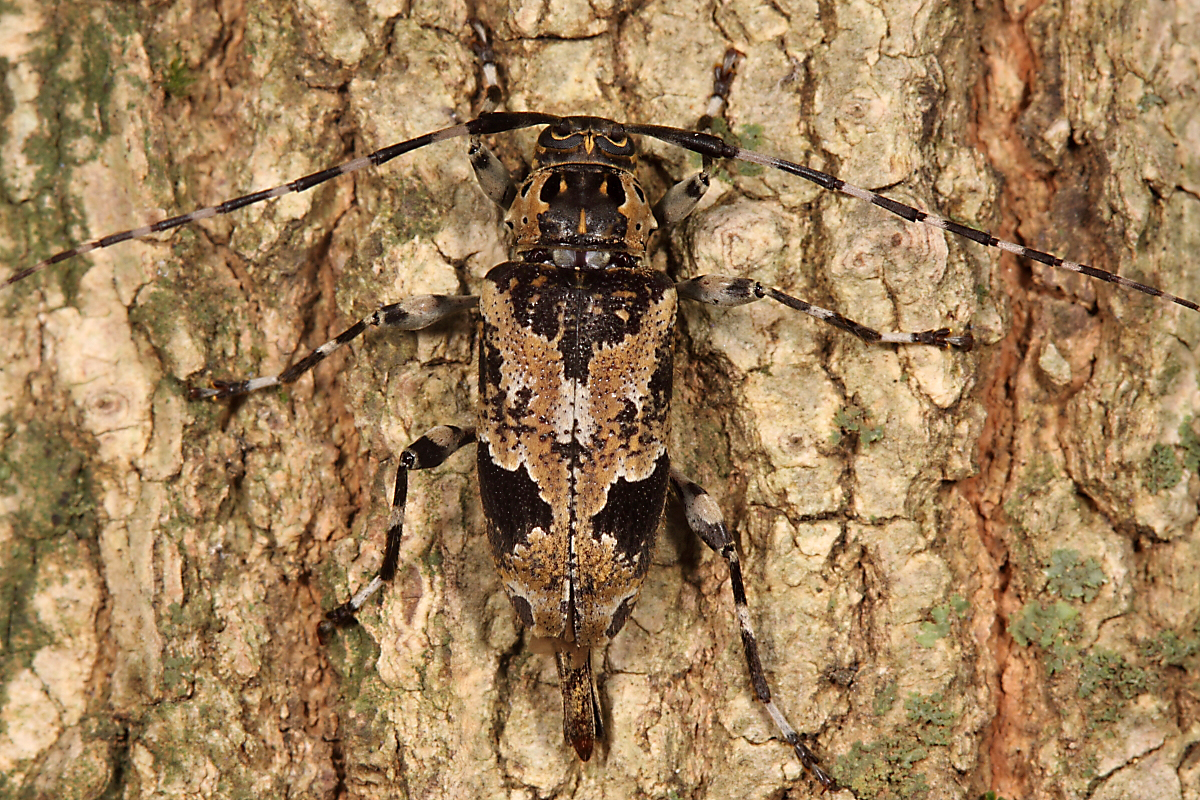
Something for Adrian

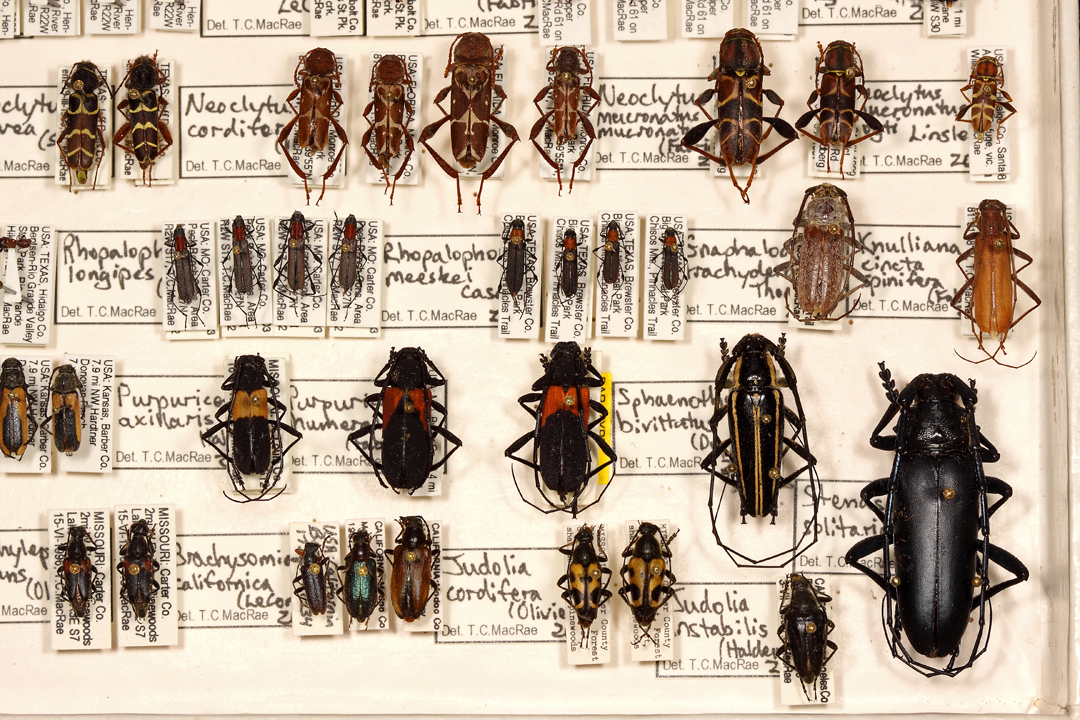
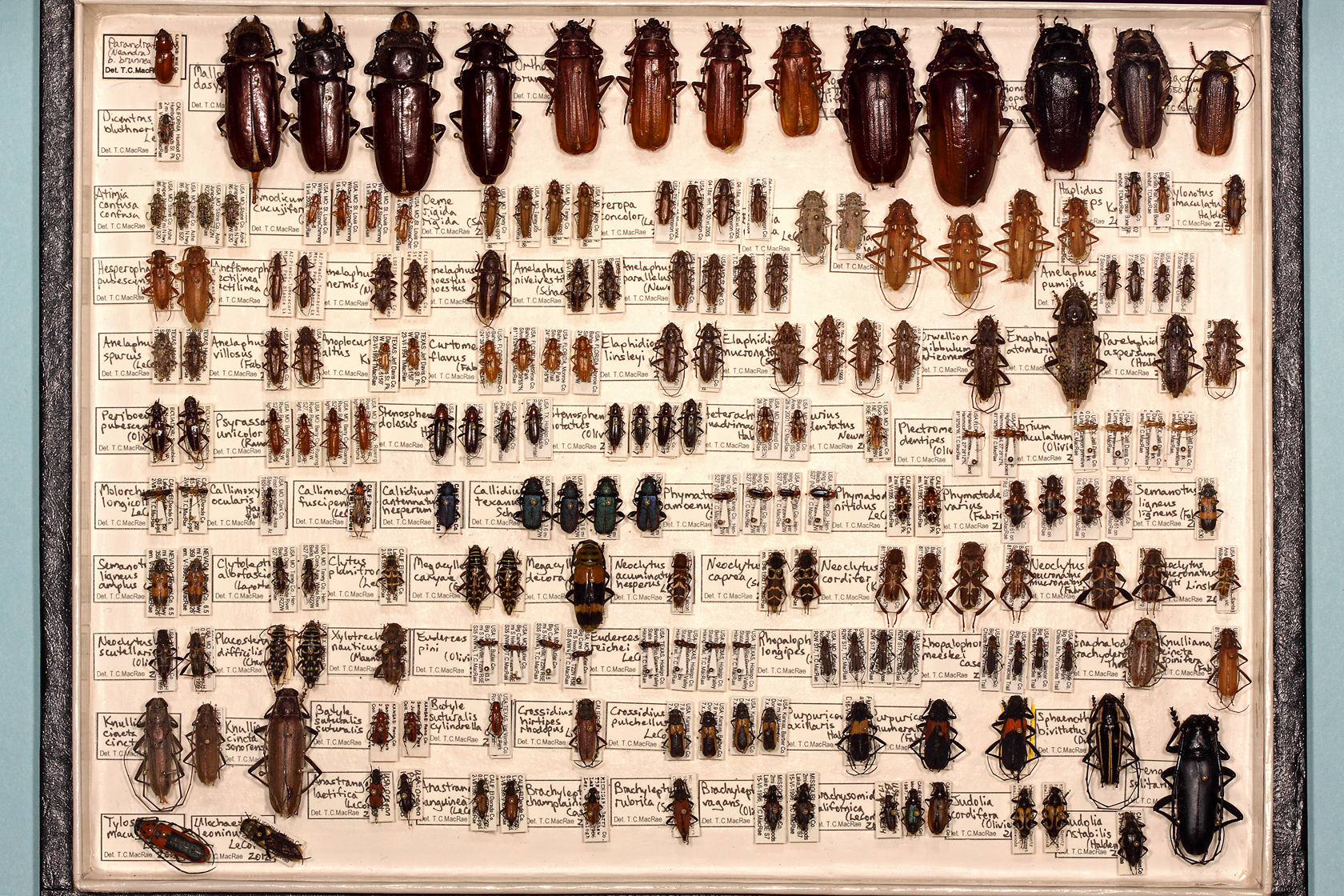
Miscellaneous North American Cerambycidae - click for larger version (1680 x 1120).

In a comment on my  post, Adrian Thysse asked to see hi-res images of specimen drawers from my own collection. Like any good North American entomologist, Adrian was a little bothered by the card-mounting technique used by the sender of the specimen box featured in that post and wanted to see what a nice collection of properly pinned specimens might look like. It’s actually not the first time he’s made this request—back when I first moved this blog to WordPress (more than three years ago) he did so when I put up my Collection page featuring a photo of my “Oh wow!” insect drawer. I’ve thought about doing this ever since he first made this request, but the problem, or at least my problem, with photographing specimen drawers from my main collection is a combination of large drawer size (reducing the size of the specimens in an image of the drawer) and long series of a relatively small number of species in the same genus or closely related genera (making the drawer contents look rather uniform in appearance). I suppose some might still be interested in seeing drawers from a “working collection” such as mine, but I just never had enough motivation to start pulling out drawers and taking photos.

Adrian is in luck, however, as I just happened to be putting together a shipment of miscellaneous North American Cerambycidae for a collector in Europe (to whom I’ve owed insects for longer than I like to admit). The box I’m using for the shipment is smaller than a normal collection drawer and is packed with close to 100 species of this diverse beetle family. There might be a specimen here and there that was collected by someone else, but the vast majority were collected, mounted, labeled, and identified by me. I show this as an example of my curatorial technique, and as a bonus the above image is linked to a fairly large version (1680 x 1120) for those who might be interested in getting a really close look at the specimens and their labels. Here also are closer looks at the specimens in the bottom left and bottom right corners, respectively:

Hmm, is that a wasp at the bottom?

What species is that without the ''normal'' ID label?

Copyright © Ted C. MacRae 2012

A Brazilian longhorned beetle – Oxymerus aculeatus

Oxymerus aculeatus aculeatus | January 2011 | nr. Campinas, São Paulo, Brazil

I was going through photographs from my visit to Brazil this past January and came across this forgotten photo of a longhorned beetle taken near Campinas in São Paulo.  Although I didn’t recognize the genus immediately, I was rather sure it belonged to the great tribe Trachyderini, generally characterized by medium to large-sized, brightly colored, diurnal (active during the day) species.  Knowing this it didn’t take me long to identify the species as Oxymerus aculeatus, occurring from Nicaragua and the West Indies south to Bolivia and Uruguay and, thus, the most widely distributed of the ten species in this exclusively Neotropical genus. As is typical with such widespread species, a few subspecies have also been described—this one should be the nominate subspecies, widely distributed throughout central, eastern, and southeastern Brazil (Hingrid et al 2010).

Like most other members of the family Cerambycidae, O. aculeatus is presumed to utilize dead or dying wood for larval development, but little else is known regarding its habits and host plants. Members of the tribe are often found frequenting flowers, although this and a few other individuals were encountered resting on the underside of foliage on an unidentified tree. The Florida Department of Agriculture & Consumer Services has become concerned about the possible establishment of this species in the U.S. after two recent collections of the West Indian subspecies in south Florida (Thomas 2006). Whether it goes on to have any economic impact remains to be seen, but if recent history with other wood boring beetles is any indication (e.g., Asian longhorned beetle, Anoplophora glabripennis; emerald ash borer, Agrilus planipennis; etc.) the concern may be warranted.

REFERENCE:

Hingrid Y. S. Q., J. P. Botero R. and M. L. Monné. 2010. Insecta, Coleoptera, Cerambycidae, Cerambycinae, Trachyderini: New state and country records from South America. Checklist 6(3):364–376.

Thomas, M. C. 2006. Another Neotropical longhorn beetle (Coleoptera: Cerambycidae) apparently new to the mainland of Florida. UF/IFAS Pest Alert (website accessed 7 Nov 2011).

Copyright © Ted C. MacRae 2011

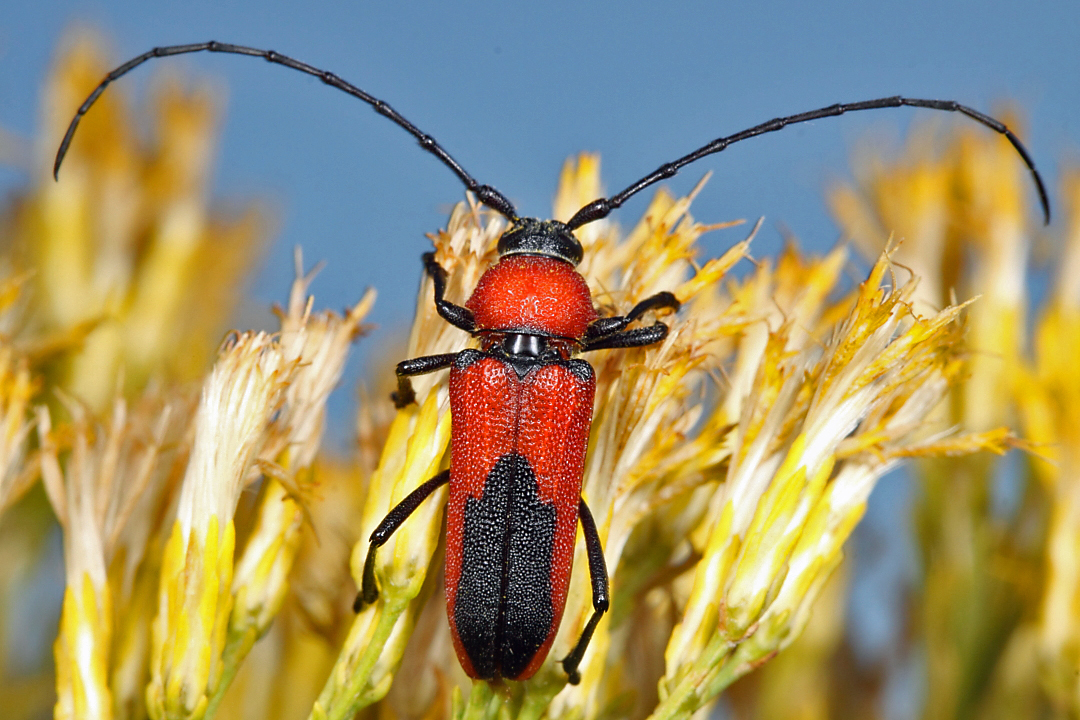
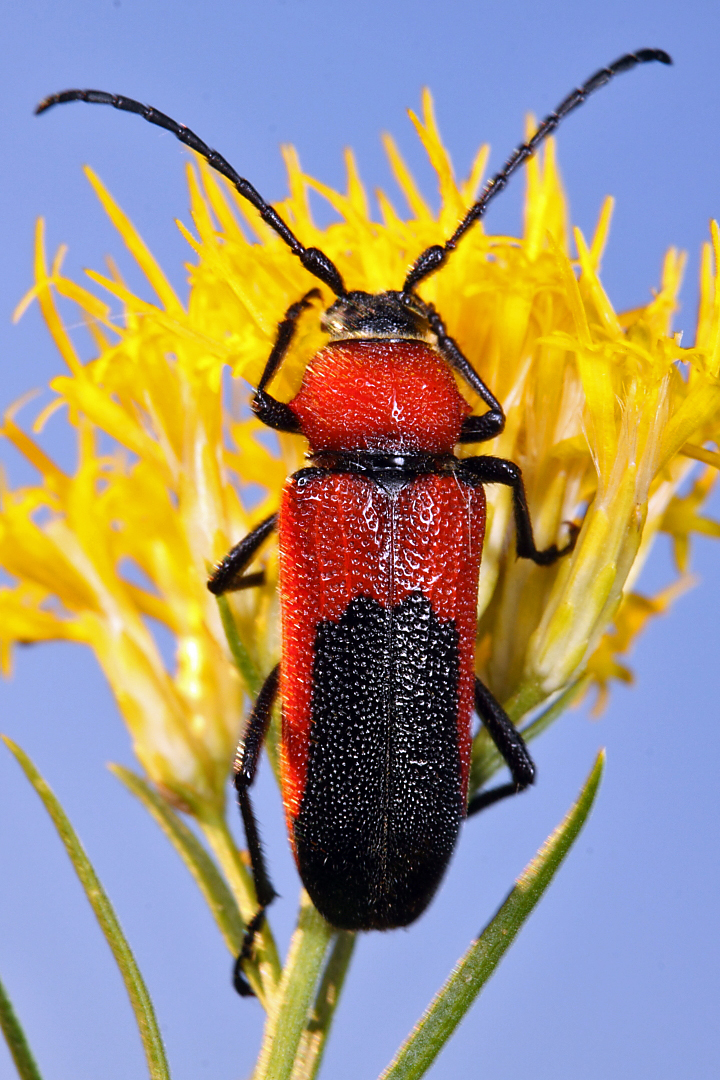
Crossidius coralinus fulgidus

Crossidius coralinus fulgidus | Uintah Co., Utah

Tiger beetles may have been the primary focus of last week’s 9-day, 10-state, 4,700-mile collecting trip; however, they were not the only beetles I was hoping to see. Longhorned beetles (family Cerambycidae) of the genus Crossidius are unusual in the family because of their fall rather than spring/summer adult activity period, and they just happen to occur in dizzying variety throughout the Great Basin and surrounding mountainous areas. Larvae of all species are presumed to feed on the roots of perennial, shrubby, fall-blooming composites, primarily in the genera Chrysothamnus, Ericameria, Gutierezzia, and Haplopappus (Linsley and Chemsak 1961), with the adult activity period undoubtedly timed to allow congregation and mating on the late-season blooms of their host plants.  Only 13 species are currently recognized, but these are further divided into 37 subspecies and innumerable locally distinct populations.  Not having spent much time in the mountain west during the fall, this group has till now been poorly represented in my collection.

The species shown here, Crossidius coralinus fulgidus, was among the first of many that we encountered during our trip.¹  This population was seen near Vernal in northeastern Utah.  It was late in the day and the adults had settled for the night onto the flowers of their host plant, Ericamera nauseosa.  Flower-visiting longhorned beetles are notoriously frustrating subjects to photograph, as their constant movement and long legs and antennae make focus and composition difficult.  These beetles had essentially ceased activity, allowing me to carefully compose and focus the shot, and the low sun in the western sky provided a bright blue eastern sky to use as a colorfully contrasting background.  The photo above (the very long antennae identify it as a male) was taken hand-held with my Canon 100mm macro lens at ISO 400 and 1/60 sec to allow exposure of the sky and flash at an aperture of f/16 to illuminate the subject and achieve good depth of field.  My only criticism of this photo is the small amount of blur seen in the distal antennal segments.

¹ “We” refers to myself and Jeff Huether from Geneva, NY. Jeff is primarily interested in Meloidae but like me also has an interest in Cerambycidae. I was fortunate to have Jeff with me on this trip, as he has collected extensively throughout the Great Basin region and encountered nearly all of North America’s named species and subspecies of Crossidius. It is only because of his prior experience with this group that I was able to find this and several others that we saw during the trip.

ISO 100, 1/200 sec

ISO 400, 1/200 sec

ISO 400, 1/60 sec

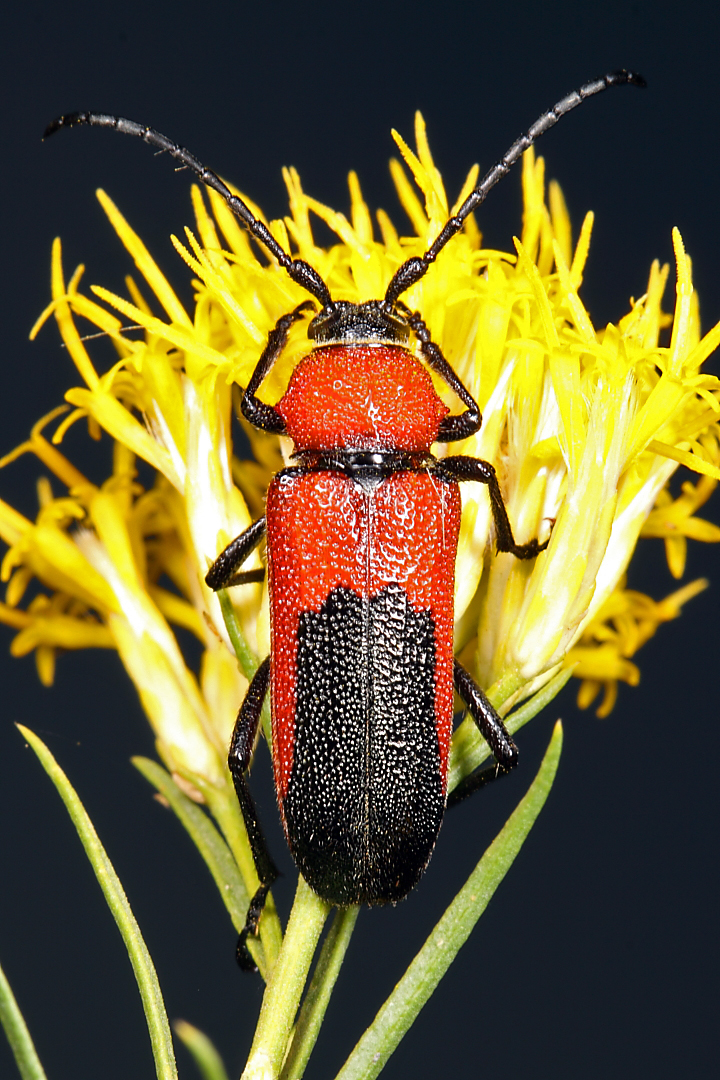
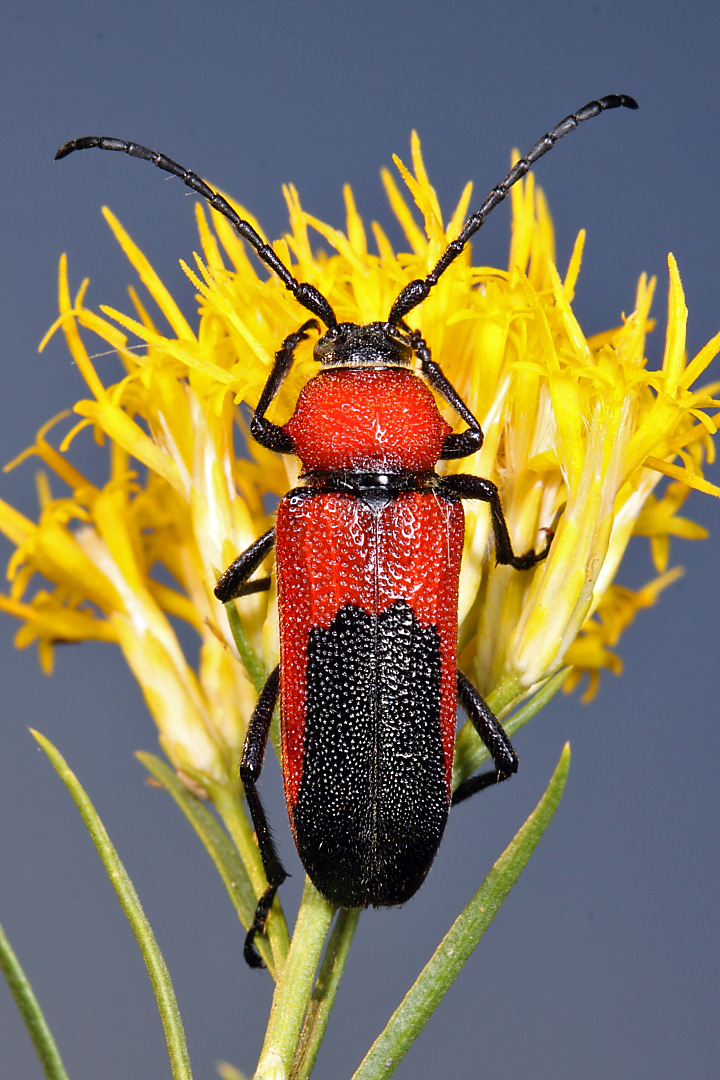
Because the beetles were so calm, I spent some time with this female individual trying different settings to see their effect on background color, subject illumination, and detail.  All were taken hand-held using the same lens at f/16, with the left photo also using my “typical” settings of ISO 100 and 1/200 sec.  The background is very dark (in post-processing I might choose to make it black)—good for some subjects but not this one, and although the focus is good the lighting is rather harsh (I had to decrease highlights in post-processing much more than I normally like).  The center photo was taken with ISO increased to 400 and results in a much more pleasing, if still not very natural-looking sky background.  Focus remains good and the shorter flash duration needed reduces the amount of highlighting that needs post-processing adjustment.  Overall I like this photo the best except that the sky is not true in color.  The right photo is also at ISO 400 but uses a slower shutter speed (1/60 sec).  The sky in this photo is the most natural-looking, and as might be expected problems with flash highlights are minimal—it almost looks like a natural light photograph.  However, some amount of motion blur can be detected, especially in the antennae.  Perhaps intermediate shutter speeds (e.g. 1/120 sec) or slightly higher ISO might effectively deal with this while still allowing the truest colors.  What do you think?

REFERENCE:

Linsley, E. G. and J. A. Chemsak.  1961.  A distributional and taxonomic study of the genus Crossidius (Coleoptera, Cerambycidae).  Miscellaneous Publications of the Entomological Society of America 3(2):26–64, 3 color plates.

Copyright © Ted C. MacRae 2011

Bumelia borer on white

Plinthocoelium suaveolens suaveolens | Ozark Co., Missouri

Last weekend I visited one of my favorite collecting spots in all of Missouri—Long Bald Glade Natural Area (part of Caney Mountain Conservation Area in Ozark Co.).  Nestled at the eastern edge of the White River Hills in southwestern Missouri, its deeply dissected hills are home to numerous plants and animals that are more typical of the southern Great Plains and which have found refuge in the xeric, thin-soiled calcareous prairies (commonly “cedar glades”) that cover the area’s southern- and western-facing slopes.  These include some rather impressive insects, such as a disjunct population of Cicindelidia obsoleta vulturina, which I just found here last year as the new northeasternmost extent of the population, as well as the marvelously monstrous Microstylum morosum, North America’s largest robber fly and so far known in Missouri only from Long Bald Glade where it was discovered in 2009. 

Another quite striking insect found at Long Bald Glades (though not restricted in Missouri to the White River Hills) is the bumelia borer, Plinthocoelium suaveolens.  This beetle occupied much of my time in July 2009 as I committed to photographing the species in the wild, and it was Long Bald Glade where I finally (if not completely satisfactorily) succeeded in that goal.  This time I was visiting the Glade to look for the earliest individuals of C. obsoleta vulturina and, hopefully, document additional glades within Caney Mountain that might support the beetle.  However, in the back of my mind I was also keeping a lookout for P. suaveolens—this species is primarily active during July and August in Missouri, but I do have records of it as late as September.  As I looked for (and found) tiger beetles, I also checked out each bumelia tree that I passed hoping to see a P. suaveolens adult perched on its lower trunk.  It was not until later in the afternoon that I heard a loud “buzz” approaching from behind and turned to see one of these beauties fly right past me—legs and antennae held outstretched—before landing on a nearby tree.  Now, over the years I’ve learned a few lessons, and one is that you don’t try to take in situ photographs of the first individual you encounter of a prized species.  More often than not it gets away before you even fire the first shot, and you’re left with nothing.  My standard procedure now is to procure the first individual immediately and keep it alive.  If attempts to photograph subsequent individuals are not successful (or none are seen), then at least I have a backup for studio shots (not my first choice, but better than nothing!).  Such was the case with this individual.

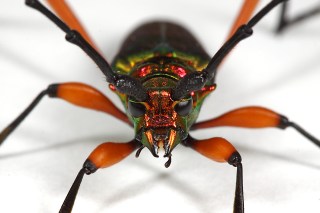
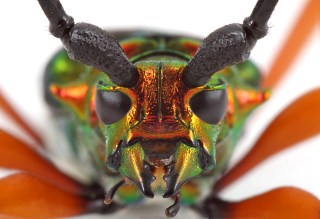
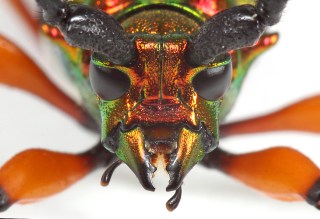
Although I still lack that “perfect” beetle-on-a-branch shot that I hope to eventually get for this species, it seemed a good subject for some white-box photography.  I’ve vacilated between true white-box w/ indirect flash versus getting a white-box effect by using direct, diffused flash with the subject on a white background.  I decided now was the time for a direct comparison of the two techniques.  All of the following photographs were taken with the Canon 100mm macro lens on a Canon 50D body at 160 ISO, 1/200 sec, and f/16.  For the closeups (photos 3 and 5 of each series), 68mm of extension tubes were added.  The photos on the left are true white-box photos, i.e. the flash heads were directed up and away from the subject placed inside a box lined with white tissue (Kim-Wipes laboratory wipers).  The photos on the right mimic the white-box effect by placing the subject on white filter paper, but the flash heads were pointed directly at the subject through my DIY concave diffuser (click on photos for 1200×800 versions):
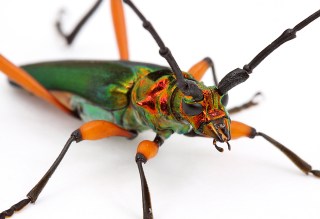
Indirect flash in white box
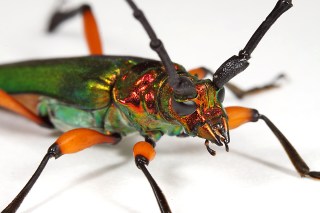
Direct flash w/ DIY diffuser
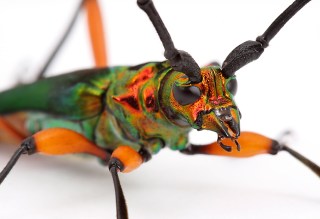
Indirect flash in white box

Direct flash w/ DIY diffuser

Indirect flash in white box

Direct flash w/ DIY diffuser
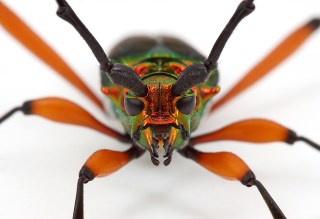
Indirect flash in white box
Direct flash w/ DIY diffuser
Indirect flash in white box
Direct flash w/ DIY diffuser

I must admit, looking at the photos on the camera playback screen I had the impression that I would like the direct-diffuser photos better, but after reviewing them on the computer and applying typical post-processing enhancements (e.g., levels, slight shadow reduction, and unsharp mask), the true white-box photos appear to have benefited from more even lighting, resulting in truer color, less shadowing, and minimal specular highlighting.  Not that the direct-diffuser photos are bad—they’re just not as good as the white-box photos.  I guess what this means is that my DIY diffuser, while a significant improvement over my previous diffusers, still could use some improvement (if ability to create white-box-like results is the ultimate test of a diffuser’s effectiveness).  I’d be interested in knowing your opinions based on these comparisons.

Congratulations to Ben Coulter, who wins yet another Super Crop Challenge and strengthens his lead in the overall standings of the current BitB Challenge Session #4 with 13 points.  Mr. Phidippus also correctly identified the species and takes 2nd place in the challenge with 8 points, keeping him in 2nd place in the overall standings as well.  Morgan Jackson takes 3rd place in the challenge with 7 points, but Roy’s retains 3rd place in the overall standings by way of his 6 points in this challenge.  Congratulations to these top points earners, and thanks to all who played.

Copyright © Ted C. MacRae 2011
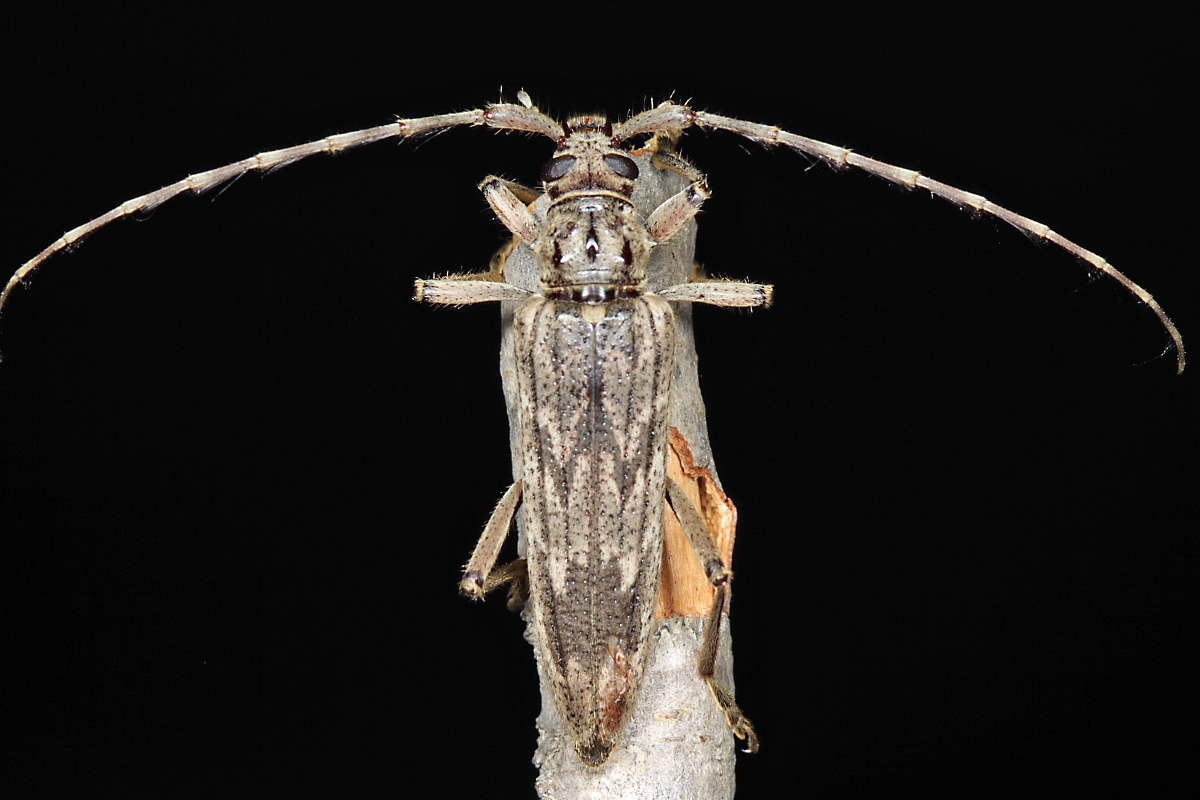
Speaking of Graphisurus

Graphisurus fasciatus | Sam A. Baker State Park, Missouri.

Graphisurus fasciatus is the commonest of the three species in this North American genus. It is easily distinguished from  by its smaller, narrower form, more mottled coloration, and lack of distinctive triangular-shaped black markings on the elytra. However, it can easily be confused with the third species in the genus G. despectus, which is nearly identical in size and coloration. From this latter species, G. fasciatus may be distinguished by the slightly darker ground color of the elytra (in G. despectus the elytra are more uniformly grayish) with the post-median dark marking of the elytra not very conspicuous (in G. despectus this marking and contrasts distinctly with the grayish elytra). Also, the tips of the elytra are distinctly emarginate (concave) in G. fasciatus but more subtruncate in G. despectus, and the scutellum in the former is pubescent (hairy) but glabrous (lacking hairs) in the latter.

Host plant is also a clue as to the identity of this individual (a male, as distinguished by its very long antennae and lack of distinctly elongate ovipositor extending from the tip of the abdomen), as it was found on the trunk of a very large, recently wind-thrown black oak (Quercus velutina)—its preferred host genus.  Graphisurus despectus, in contrast, appears to be associated almost exclusively with hickory (genus Carya).  Both species, despite their relatively modest size (generally 10–15mm in length, excluding the female ovipositor), seem to prefer dead wood from the trunk and main branches of larger trees for larval development, mining just beneath the bark rather than in the wood itself.

Copyright © Ted C. MacRae 2011
Graphisurus triangulifer in Missouri

Graphisurus triangulifer | Sam A. Baker State Park, Missouri

Of the three species of the genus Graphisurus occurring in Missouri, G. triangulifer is both the most attractive and the least commonly encountered.  Back when I surveyed the Cerambycidae of Missouri (MacRae 1994), I examined only 45 specimens of this species in the major public and private collections of the state, compared to slightly more of the equally uncommon G. despectus and a whopping 271 of the übercommon G. fasciatus.  Nearly all of the specimens I examined of this species were encountered at lights, and it has been in this manner almost exclusively that I have seen the species for myself.

The species is named for the dark triangular markings on the elytra.

The individual in these photos was seen at Sam A. Baker State Park in the southeastern Ozark Highlands of Missouri during early July, and—like most of the others I have seen—it was attracted to my blacklight. I really don’t like photographing insects directly on the white landing sheet that I use for blacklighting, so I moved the beetle to the trunk of a nearby boxelder tree (Acer negundo) for a more natural looking background. There are a few reports of the species utilizing Acer for larval development (Lingafelter 2007), so this could be a very natural setting; however, I have not seen any actual records of the species being reared from that host. More often the species has been recorded breeding in dead sugarberry (Celtis laevigata). While I have conducted many rearings from Celtis, I’ve not yet succeeded in rearing this species—I suspect it probably breeds in larger diameter branches given its relatively large size (12–17 mm in length).  This idea is bolstered by the fact that the one adult that I did not encounter at lights was found on the trunk of a large, dead sugarberry near San Antonio, Texas.  Hoffman et al. (2002) noted that the species exhibits a southern, lowland distribution extending from Long Island to central Georgia, thence west to Texas and northward in the interior as far north as Ohio and Indiana (it has also been recorded from Kansas and, of course, Missouri).  This distribution pattern agrees largely with that of Celtis laevigata in the eastern U.S., suggesting that this plant may indeed be its primary host.  A fairly restricted host range for G. triangulifer would not be unexpected, since each of the other two species in the genus also exhibits a fair degree of host fidelity—G. despectus breeds almost exclusively in hickory (Carya spp.), while G. fasciatus breeds primarily in oak (Quercus spp.).

REFERENCES:

Hoffman, R. L., S. M. Roble, and W. E. Steiner, Jr. 2002. Thirteen additions to the known beetle fauna of Virginia (Coleoptera: Scirtidae, Bothrideridae, Cleridae, Tenebrionidae, Melyridae, Callirhipidae, Cerambycidae, Chrysomelidae). Banisteria 20:53–61.

Lingafelter, S. W. 2007. Illustrated Key to the Longhorned Woodboring Beetles of the Eastern United States. Coleopterists Society Miscellaneous Publications, Special Publication No. 3, 206 pp.

MacRae, T. C. 1994. Annotated checklist of the longhorned beetles (Coleoptera: Cerambycidae and Disteniidae) known to occur in Missouri. Insecta Mundi 7(4) (1993):223–252.

Copyright © Ted C. MacRae 2011

Elytrimitatrix at my window


This evening as I was sitting in my comfy chair, I noticed Stitch (one of the cats) pawing at the window. We live in the woods, so it is common for insects to land on the outsides of the windows after dark, attracted to the lights from within our home. Stitch was especially interested in a rather large beetle crawling frantically on the window, which I recognized quickly as the cerambycid beetle, Orthosoma brunneum. This big brown beetle is a member of the root-boring subfamily Prioninae, and although it is perhaps one of the commonest longhorned beetles in our area during July and August, I’ve not yet photographed it. As I debated whether to do so, I noticed the distinctive silhouette of another cerambycid beetle sitting quietly lower down on the window—smaller than O. brunneum but still decent-sized. I opened the window a crack (to keep all the other insects from rushing in), reached my hand through the crack, grabbed the beetle and in pulled it inside. It was a fine specimen of what is now known as Elytrimitatrix undata. I forgot all about the Orthosoma beetle and decided to photograph Elytrimitatrix instead.

While a member of the longhorned beetle family Cerambycidae, the group to which this species belongs (subfamily Disteniinae) has long been treated as sort of the “red-headed stepchild” of the family due to disagreement about its affinities to other cerambycid groups. It has at times been considered a tribe of the subfamily Lepturinae, a tribe of the subfamily Cerambycinae, a subfamily of its own, and even a separate family. Much of this disagreement focuses on details of its morphology despite the great superficial resemblance of the adults to other cerambycids. For now, it seems most workers are satisfied to regard the group as a distinct subfamily within the Cerambycidae, even though its exact relationships to other subfamilies still remain unclear.

Despite numerous representatives in the Neotropics, E. undata is the only member of the subfamily in the U.S., occurring broadly across the eastern and central states. For many years it was known as “Disteniaundata but was recently split out of that genus by Santos-Silva & Hovore (2007). Larvae have been recorded breeding in the dead wood of a variety of hardwoods as well as pine (the ultimate generalist), and adults are regular visitors at lights during the warm, muggy months of summer. I have also taken the species in numbers in traps baited with fermenting liquid (1 part molasses, 1 part beer, 8 parts water, and a packet of dry yeast) (MacRae 1994).

REFERENCE:

MacRae, T. C. 1994. Annotated checklist of the longhorned beetles (Coleoptera: Cerambycidae and Disteniidae) known to occur in Missouri. Insecta Mundi 7(4) (1993):223–252.

Santos-Silva, A. & F.T. Hovore. 2007. Divisão do gênero Distenia Lepeletier & Audinet-Serville, notas sobre a venação alar em Disteniini, homonímias, sinonímia e redescrições (Coleoptera, Cerambycidae, Disteniinae). Papéis Avulsos de Zoologia 47:1–29.

More on ‘Conspicuous Crypsis’

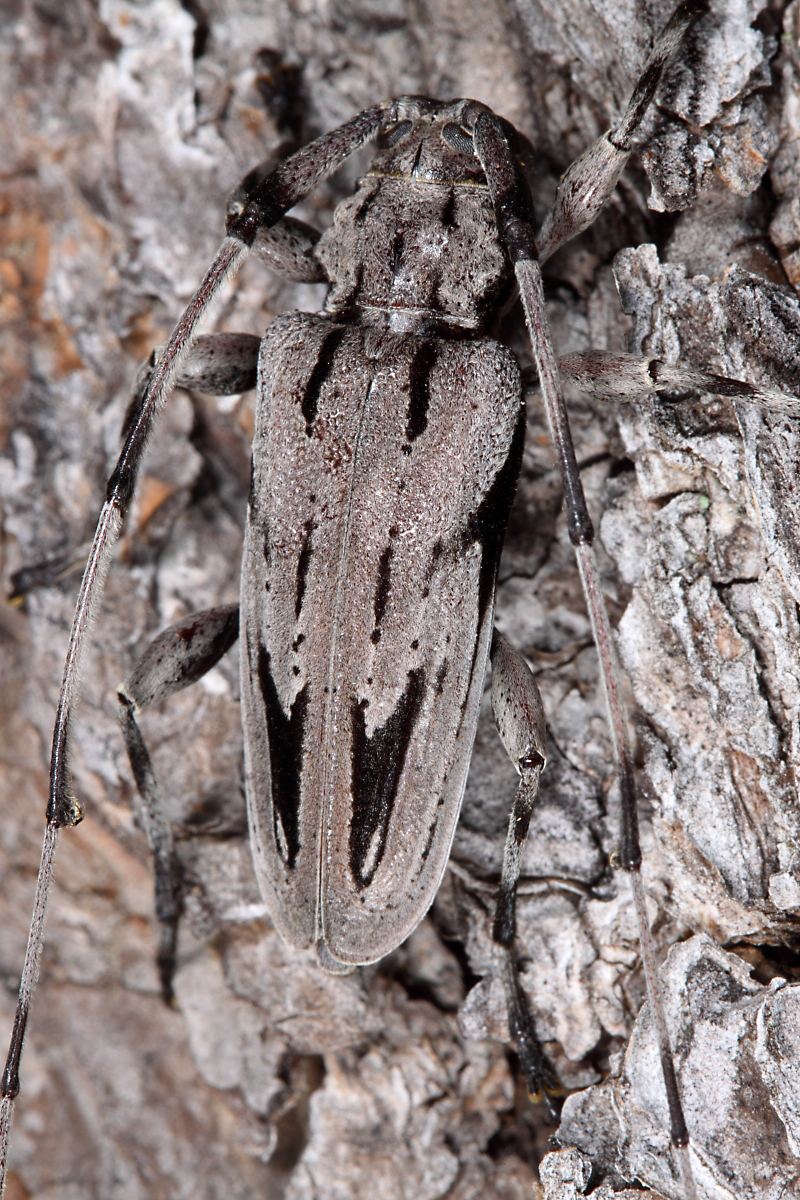
Acanthocinus nodosus on trunk of Pinus echinata | vic. Calico Rock, Arkansas

In my previous post (), I used the term ‘conspicuous crypsis’ to describe the sumptuously beautiful lichen grasshopper, Trimerotropis saxatilis, as an example of an insect that, despite strikingly conspicuous colors/patterns, blends in perfectly with its native surroundings. I don’t think this is a formally recognized ecological concept (and a quick search of the web and my limited ecology literature didn’t turn up anything about it) with any real biological/ecological relevance, but rather just a little irony that personally I find interesting.

The same individual in the above photograph in its original resting spot.

The photographs in this post were also taken during one of my June trips to the sandstone glade complex around Calico Rock, Arkansas and show another insect that I would describe as conspicuously cryptic. This is Acanthocinus nodosus, in my opinion one of eastern North America’s most attractive longhorned beetles (family Cerambycidae). This species occurs across the eastern U.S. (just sneaking up into southern Missouri), where the larvae mine the phloem beneath the bark of dead and dying pines (Linsley and Chemsak 1995). BugGuide describes it as “subtle, yet beautiful” with an antennal span in males reaching a spectacular 120 mm (that’s 5 inches, folks!). Perhaps others have encountered this beetle more commonly further south, but I have previously seen only single individuals on just three occasions—twice in the Ozark Highlands of southern Missouri (one at lights and another searching the trunk of a standing, decadent pine tree at night) and another at lights in Alabama. As a result, I was quite excited to find this individual clinging during the day to the trunk of a large shortleaf pine (Pinus echinata). The tree appeared healthy, but I found adults of several other wood boring beetles crawling on its trunk as well, suggesting that maybe the tree was stressed or in the initial stages of decline.

Subtle, yet beautiful!

I must confess that the first photograph above was staged—I had moved the beetle from its original resting spot and placed it on a part of the trunk where the bark color contrasted more strongly with the beetle to increase its visibility.  The second and third photos above and left show the beetle in its original resting spot and illustrate just how cryptic the beetle is when resting on older, more weathered pine bark.  Admittedly, the somber coloration of this species is not as extraordinary as the lichen-green of the lichen grasshopper, but I nevertheless find the slate gray with velvet black markings quite beautiful.  When mounted on pins and lined up neatly in a cabinet, individuals of this species are as attractive as any dead insect can be.  It was not until I saw this individual in Arkansas—and tried to photograph it during the day—that the cryptic function of its coloration and patterning became truly apparent to me.  Most species in the tribe Acanthocini (to which this species belongs) also exhibit somber coloration with variable black markings or mottling, although only a handful can be considered as ‘conspicuously cryptic’ as this one.

REFERENCE:

Linsley, E. G. and J. A. Chemsak.  1995. The Cerambycidae of North America. Part VII, No. 2: Taxonomy and classification of the subfamily Lamiinae, tribes Acanthocinini through Hemilophini. University of California Publications in Entomology 114:1–292.

Copyright © Ted C. MacRae 2011