Best of BitB 2014

Welcome to the 7th Annual “Best of BitB”, where I pick my favorite photographs from the past year. Before I do this, however, let me briefly recap the year 2014. The trend of increasing travel each year continued, with more days spent on the road than in any prior year. Travel for work over the past few years has settled into a familiar routine—touring soybean fields in Argentina in late February and early March, working in my own field trials at (previously three, now four) sites in Illinois and Tennessee from late May through late September, touring more soybean fields at sites across the southeastern U.S. during mid-September, returning to Argentina in October to finalize plans for field trials in the upcoming season, and—finally—attending/presenting at the Entomological Society of America (ESA) Meetings (this year in Portland, Oregon). This heavy travel load makes scheduling my own insect collecting trips a bit tricky, but I’m a persistent sort! In late May I traveled to Tennessee and Georgia with fellow buprestophile Joshua Basham and lab mate Nadeer Youseff to collect several rare jewel beetles, then in late June I collected prionids and jewel beetles in Colorado, New Mexico, and Oklahoma with Jeff Huether. In addition to these longer trips, I also managed to take advantage of my work travel to check out interesting natural habitats along the way to and from my field sites. I continue to give the occasional entomology seminar as well, speaking in March at “Day of Insects” in Ames, Iowa and here in St. Louis to the Entomology Natural History Group of the Webster Groves Nature Study Society in April and the Missouri Master Naturalists Confluence Chapter in December. On top of all this, I still managed to vacation with my family in Lake Tahoe during March and in Cabo San Lucas, Mexico during late July.

I say all this to highlight the fact that after all these years I still consider myself an entomologist with a camera rather than a bona fide insect photographer. The reason for this is that the science of entomology itself remains my primary focus—photography is simply one of the tools that I have come to use in my pursuit of the discipline. I don’t mean to imply that I don’t continue to work on my photography style and technique—because I do. But my style and technique are not goals in of themselves; rather, they are means to an end—that end being my entomological studies. With that said, I present my favorite BitB photographs from 2014. As in previous years, my photos are largely hand-held, in situ field shots that are intended to tell a natural history story in a (hopefully) aesthetic manner. Links to original posts are provided for each photo selection, and I welcome any comments you may have regarding which (if any) is your favorite and why—such feedback will be helpful for me as I continue to hone my craft. If you’re interested, here are my previous years’ picks for 2008, 2009, 2010, 2011, 2012 and 2013. Once again, thank you for your readership, and I hope to see you in 2015!


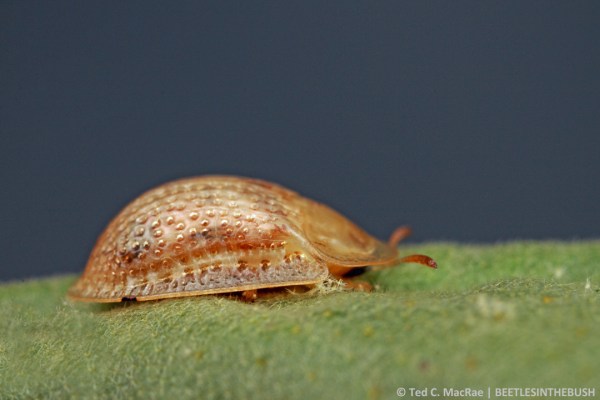
Paraselenis tersa? female guarding her eggs | Cordoba Prov., Argentina

Paraselenis tersa (Boheman, 1854) | Cordoba Prov., Argentina

From Tortoise beetles on the job (posted April 20). This photograph of a tortoise beetle female over her egg mass illustrates maternal guarding behavior—rare in insects. The perfect lateral profile shot and clean, blue sky background also give the photo a pleasing aesthetic quality.


Who likes mole crickets?

Scapteriscus borellii Giglio-Tos, 1894 | Emanuel Co., Georgia

From Who likes mole crickets? (posted June 6). This has to be the most comical expression ever on the face of an insect!


Chrysobothris orono Frost, 1920 | South Cumberland State Park, Tennessee

Chrysobothris orono Frost, 1920 | South Cumberland State Park, Grundy Co., Tennessee

From Chrysobothris orono in Tennessee (posted July 29). I found this rare jewel beetle for the first time this year with the help of Josh Basham and Nadeer Youseff. The beetle itself is beautiful enough, but photographing it on a pine root with a presumed adult emergence hole adds considerable natural history interest to the photo. Rock substrate behind the root adds a pleasingly blurred background.


Buprestis (Stereosa) salisburyensis Herbst, 1801 | South Cumberland State Park, Tennessee.

Buprestis (Stereosa) salisburyensis Herbst, 1801 | South Cumberland State Park, Tennessee.

From The Buprestis tree (posted August 10). This was another of several jewel beetles that I found for the first time after more than three decades of collecting this group. I like the value contrast in this photo from the striking, metallic colors of the beetle against the nicely blurred cinnamon-colored pine bark of the tree on which it is sitting.


A "super moon" watches over a parasitized hornworm caterpillar.

A “super moon” watches over a parasitized hornworm caterpillar.

From A time of reckoning (posted August 13). I fully admit this is a composite photograph. Nevertheless, it is a faithful recreation of a true sight, and I don’t consider the use of composite techniques to overcome equipment shortcomings to be unethical. There is a haunting symmetry between the blood red moon—considered by some as a sign of the second coming—and the sad, parasitized caterpillar waiting for its inevitable demise.
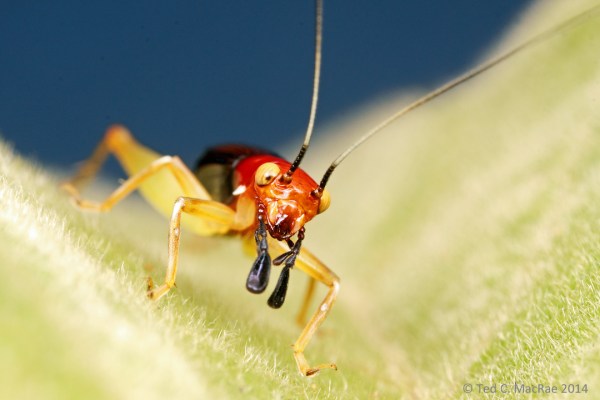

The greatly expanded palps are thought to mimic beetle mandibles or spider pedipalps.

Phyllopalpus pulchellus Uhler, 1864 | Hickman Co., Kentucky

From My, what busy palps you have! (posted September 2). I’ve become quite fond of insect photos with the subject “peering” at me, the photographer”, from some unusual vantage point. The “pupils” in the eyes of this red-headed bush cricket give the insect an almost quizzical look.


Acmaeodera immaculata Horn, 1881 | vic. Vogel Canyon, Otero Co., Colorado.

Acmaeodera immaculata Horn, 1878 | vic. Vogel Canyon, Otero Co., Colorado.

From Sunset beetles (posted September 30). Taking photos of insects at sunset is a challenging and ephemeral experience—one has only a few minutes to take advantage of the unusual and serene colors it offers, while at the same time trying to determine the best camera and flash settings to use in the rapidly fading light. Of the several that I’ve tried, this one is my favorite because of the softly complimentary colors of the beetle, the flower upon which it is sitting, and the dying orange sky behind it. If I had to choose, I would probably pick this one as my favorite of the year because of the unusual and serene colors.


Megacyllene decora (Olivier, 1795) | Stoddard Co., Missouri

Megacyllene decora (Olivier, 1795) | Stoddard Co., Missouri

From Amorpha borer on goldenrod (posted October 5). I featured this very same species in Best of BitB 2012 but can’t resist choosing this second attempt at photographing the spectacularly beautiful adult—this time on goldenrod. As with the previous version this is a true in situ field photograph, hand held and using the left-hand technique to achieve precise composition against a clear blue sky—difficult to do with an insect of this size and using a 100-mm lens, but well worth the effort.
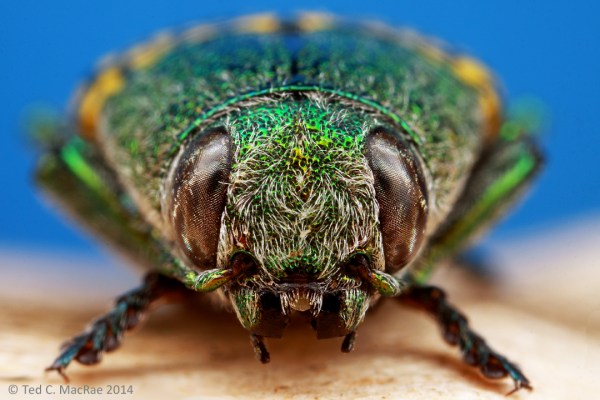

Buprestis (Knulliobuprestis) confluenta Say, 1823 | Woods Co., Oklahoma

Buprestis (Knulliobuprestis) confluenta Say, 1823 | Woods Co., Oklahoma

From A Buprestis hat-trick! (posted October 14). I didn’t take near as many of the classic “frontal portraits” this year, but this one of a jewel beetle that had eluded me for more than 30 years until this past June is perhaps my favorite of them all.
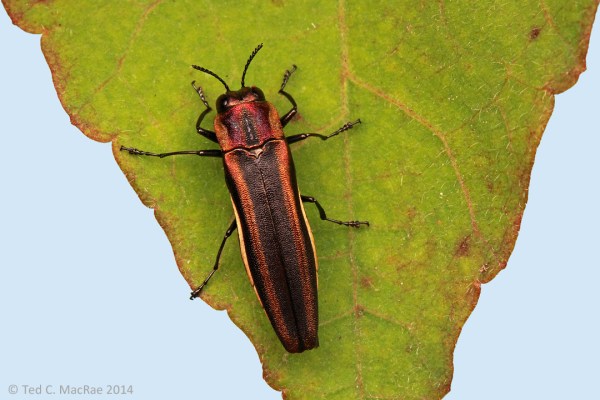

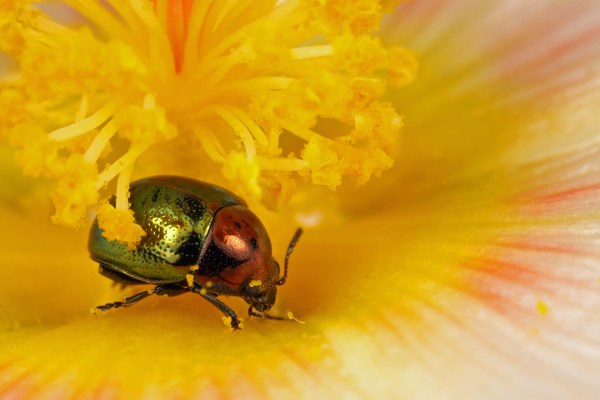
Agrilus concinnus  Horn, 1891 | Stoddard Co., Missouri

Agrilus concinnus Horn, 1891 | Stoddard Co., Missouri

From North America’s Most Beautiful Agrilus Jewel Beetle (posted October 19). There was a time when this beetle was considered one of North America’s rarest species of jewel beetle. Several years worth of hunting by me and others revealed this beetle’s association with mallow and its unusually late adult activity period—the two combining to make this beetle “seem” rare. This year I succeeded in photographing the spectacular adult beetle.


Cacama valvata female ovipositing

Cacama valvata (Uhler, 1888) | Vogel Canyon, Otero Co., Colorado

From Scorching plains, screaming cactus (posted December 5). Insect photos are always better when they also show some aspect of the subject’s natural history. I was lucky to find this female cactus dodger cicada in the act of ovipositing into the dry stem of cholla cactus—in a position where I could get a perfect lateral profile with a clean, blue sky background.
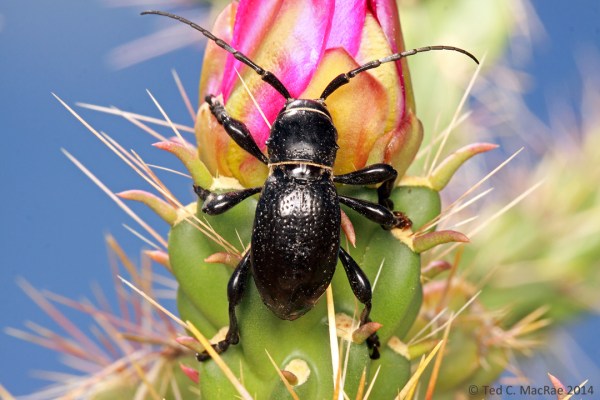

Moneilema armatum LeConte, 1853 | Vogel Canyon, Otero Co., Colorado

Moneilema armatum LeConte, 1853 | Vogel Canyon, Otero Co., Colorado

From Cactus beetle redux (posted December 20). Cactus beetles can be difficult to photograph, but sometimes they cooperate by nicely posing on a pleasing pink flower bud with a blue sky in the background and the cactus spines forming a nice, fuzzy “halo” around the jet black beetle. There were surprisingly few cactus spines impaled in the control unit of my flash after this photo session.


I hope you’ve enjoyed this 2014 version of “Best of BitB” and look forward to seeing everyone in 2015.

Copyright © Ted C. MacRae 2015

One-shot Wednesday: swamp milkweed leaf beetle

Labidomera clivicollis on Asclepias incarnata | Hickman Co., Kentucky

Labidomera clivicollis on Asclepias incarnata | Hickman Co., Kentucky

Technically this photograph of Labidomera clivicollis (swamp milkweed leaf beetle) doesn’t qualify as a “one-shot”, as I did take a few other shots as well. However, this was the only shot out of the handful that I didn’t throw away. It’s not perfect—the right front and left rear legs are raised awkwardly, and the lighting is a bit harsh. However, the important parts of the beetle are in focus, the composition is acceptable (with all parts of the beetle within the frame), and there is pleasing value contrast between the orange and black body of the beetle, the green plant on which it sits, and the clear blue sky in the background. The plant’s flowers have even added a smidgen of pink. All of the other photos lacked either focus or composition, neither of which are easily “fixable” in post-processing. The difficulty in getting a better photo is a result of the beetle’s refusal to settle down and stop walking and my lack of desire to spend an inordinate amount of time waiting for this to happen as opposed to finding the insect I was really looking for (more on that in a future post).

I found this beetle on swamp milkweed (Asclepias incarnata) in Hickman Co., Kentucky. As the common name suggests, swamp milkweed is one of the main hosts for this rather large beetle (at least, by leaf beetle standards). However, they can and do feed and develop on other milkweeds, especially common milkweed (A. syriaca), and even related genera such as swallow-wort (Cynanchum) and twinevine (Funastrum) (all belonging the family Asclepiadaceae).

Labidomera clivicollis is part of the orange and black milkweed mimicry complex, which includes monarch butterfly (Danaus plexippus), red milkweed beetles (Tetraopes spp.), large milkweed bug (Oncopeltus fasciatus), small milkweed bug (Lygaeus kalmii), milkweed assassin bug (Zelus longipes), and others. Most of these insects have evolved mechanisms for avoiding or detoxifying cardenolides (produced by milkweed as a defense against herbivores) and sequestering them within their bodies for their own defense against predators. This represents a classic example of a Müllerian mimicry ring, in which multiple insect species—sometimes from different families and even different orders—share a common warning color. Predators learn to avoid these colors and, thus, avoid all of the species within the mimicry ring.

© Ted C. MacRae 2014

Tortoise beetles on the job

Back in late February and early March I did my annual tour through the soybean growing regions of central and northern Argentina to look at insect efficacy trials (pretty amazing to me still when I think about it—I actually get paid to spend time in Argentina looking for insects!). Normally on such trips there is no shortage of soybean insects to occupy my attentions—of all the large-acre row crops, soybean probably has the greatest diversity of insect associates, and in South America it is rare for any soybean field to not experience pressure from at least one of them. Soybeans, however, are not the only plants that occur in soybean fields—there are also weeds, many of which also have their own suite of insect associates. Sometimes these weed-associated insects can be even more interesting than the soybean insects I’m look for.

Botanochara angulata?

Botanochara angulata? mating pair | Córdoba Prov., Argentina

On this particular day, as I walked through a soybean field in central Córdoba Province I noticed distinctive red and black tortoise beetles (family Chrysomelidae, subfamily Cassidinae) on some of the plants. I thought it odd that tortoise beetles would be on soybean, as I’m not aware of any soybean associates in the group. A closer look, however, quickly revealed that the beetles were not on the soybean plants themselves, but rather on vines that were weaving their way through the plants. The plant was akin to bindweed and obviously a member of the same plant family (Convolvulaceae), but none of my field mates knew which of the many weedy species of the family that occur in Argentina that this particular plant represented. Species of Convolvulaceae are, of course, fed upon by a great diversity of tortoise beetles—always a treat for this coleopterist to see, and it was all I could do to concentrate on the task at hand and finish doing what I needed to do so I could turn my attention to finding and photographing some of these beetles. Once I began photographing them I found them surprisingly uncooperative (not my normal experience with tortoise beetles), but I soon found a mating pair that was a little more cooperative (probably because they were mating), with the above photo being my favorite of the bunch.

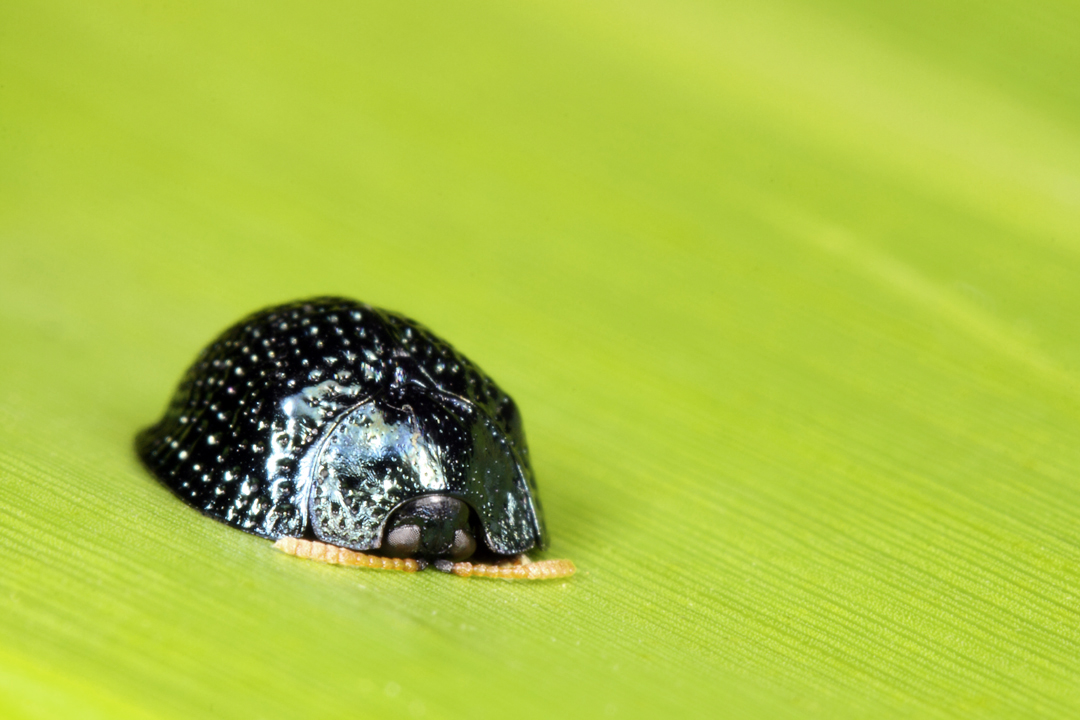
Paraselenis tersa?

Paraselenis tersa? female guarding her eggs | Córdoba Prov., Argentina

As I was searching for beetles to photograph, I encountered some yellow tortoise beetles associated with the same plant but that I had not noticed earlier. Unlike the conspicuously red and black colored species (which seems to best match Botanochara angulata according to Cassidinae of the World), the yellow species (which I presume represents Paraselenis tersa, also ID’d using the same site) seemed almost cryptically colored. When I finished taking photographs of B. angulata, I began searching for a P. tersa to photograph and encountered the female in the above photograph guarding her eggs—score!

Undetermined cassidine larvae.

A single tortoise beetle larva was encountered.

Tortoise beetle larvae are always a delight to see as well—their dinosaurian armature and fecal adornments, both obviously designed to dissuade potential predators, form one of the most ironic defensive combinations one can find. If additional tactics become necessary, they are among the few insects that are known to actually “circle the wagons” (the technical term for this being “cycloalexy“). While I only found a single larvae (of which species I don’t know), its presence seems to further suggest that at least one of the species represented an actively developing population and that the adults I found were not just hangers-on putzing around until winter (such as it is in central Argentina) forced them to shut down for the season.

Undetermined cassidine larva.

Spiky spines and a pile of poop make formidable defenses.

My impression is that tortoise beetles are by-and-large noxious to predators, thus explaining why so many species in the group exhibit aposematic coloration. However, the apparent cryptic coloration of Paraselenis makes me wonder if this is not universally true. It seems especially odd for two species to feed on the exact same species of plant but only one of the species to be noxious, which leads me to even more questions about how two species feeding on the same plant at the same time avoid direct competition with each other. I wondered if perhaps one species was on the wax while the other was on the wane (late February is well along into the latter part of the season in central Argentina), but the fact that both species were involved in reproductive activities (mating in Botanochara and egg guarding in Paraselenis) suggests this was not the case.

Ted MacRae photographing tortoise beetles.

A candid photo of me photographing tortoise beetles (and revealing my technique for getting “blue sky” background photographs).

© Ted C. MacRae 2014

ESA Insect Macrophotography Workshop

Today is the last day of the Entomological Society of America (ESA) Annual Meeting in Austin, Texas, and it has been an action packed week for me. Annual meetings such as this serve several purposes. In addition to seeing talks on a variety of subjects—in my case covering subjects ranging from insect resistance management to scientific outreach to beetle systematics—they also offer the chance to establish new connections with other entomologists that share common interests and reinforce existing ones. Of course, a major part of my interest in entomology revolves around insect macrophotography, and in recent years ESA has begun to cater to the entomological photographer contingent within the society. Last year’s meetings featured a macrophotography symposium titled, “Entomologists Beyond Borders” (for which I was one of the invited speakers), and this year featured an Insect Macrophotography Workshop led by Austin-based entomologist/photographer Ian Wright. Having done this for a few years now I figured a lot of the workshop might be review for me, but I still have much to learn and am willing to accept new ideas from any source. Besides, the workshop involved a field trip to a local habitat to try out our insect photography skills, and for a field junkie like me time in the field at an otherwise all-indoor event spanning close to a week is always welcome. The location of the meetings in Austin this year made this possible, as even in mid-November there still remain insects out and about that can be photographed if the weather cooperates (and it did).

This will be a somewhat different post than what I usually post here. Rather than featuring photos of a certain species and using them as a backdrop for a more detailed look at their taxonomy or natural history, I’m just going to post all the photos that I ended up keeping from the field trip portion of the workshop with just a comment or two about each. We went to the city’s nearby waste-water treatment facility, the grounds of which are wild and woolly enough to provide habitat for insects, and spent about an hour and a half seeing what we could find. For myself, it was a chance to photograph some insects I’ve not normally tried to photograph (i.e., dragonflies, ambush bugs) and get more practice on my blue sky technique. I did appreciate the chance to spend some time talking to Ian during while we traveled to the site and back, and I also ended up helping other participants with their camera equipment questions and technique suggestions. With that, here are the photos I took—I’ll be curious to see what readers think of this post format versus my more typical style.

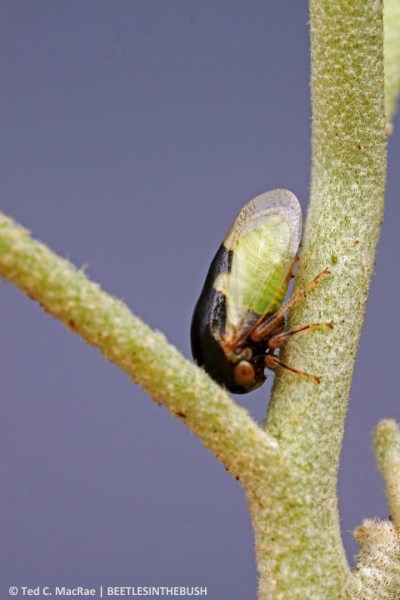
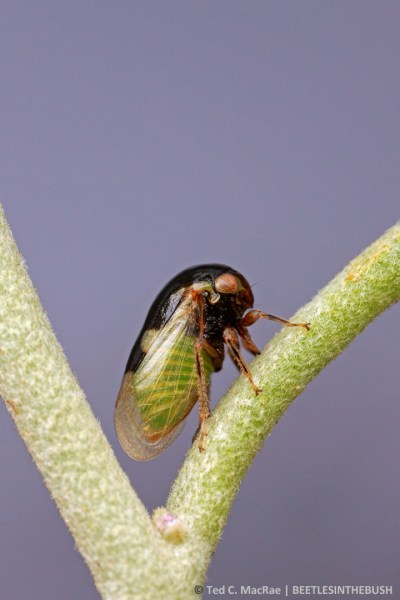
Micrutalis calva

Micrutalis calva (Hemiptera: Membracidae) on silverleaf nightshade (Solanum elaeagnifolium).

Micrutalis calva

This species of treehopper is restricted to herbaceous plant hosts.

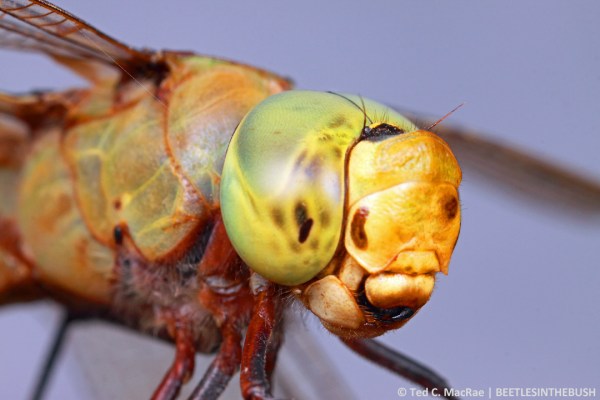
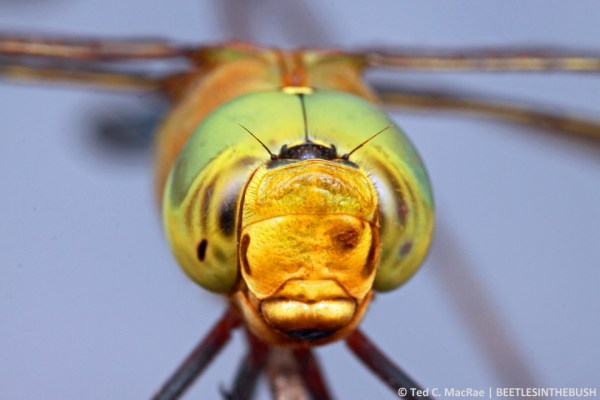
Anax junius

Anax junius (Odonata: Aeshnidae), one of the darner species of dragonfly.

Anax junius

This adult was perched on a dead twig tip and seemed to be “asleep.”

Anax junius

I clipped the perch and held it up for these “in-your-face” shots – it then awoke with a start and flew off.

Phymata sp.

Phymata sp. (Hemiptera: Reduviidae), one of the so-called “jagged ambush bugs.”

Phymata sp.

Formerly a separate family, ambush bugs are now combined with assassin bugs (family Reduviidae).

Acmaeodera flavomarginata

Acmaeodera flavomarginata (Coleoptera: Buprestidae).

Acmaeodera flavomarginata

This is one of a few species of jewel beetle in the southcentral US that are active during the fall.

Mecaphesa sp.

Mecaphesa sp. (Araneae: Thomisidae), one of the crab spiders

Mecaphesa sp.

Cryptic coloration allows the spider to lurk unseen by potential insect prey visiting the flower.

Gratiana pallidula

Gratiana pallidula (Coleoptera: Chrysomelidae) on silverleaf nightshade (Solanum eleagnifolium).

Gratiana pallidula

A type of tortoise beetle, adults “clamp” down against the leaf as a defense against predators.

Copyright © Ted C. MacRae 2013

Best of BitB 2012

Welcome to the 5th Annual “Best of BitB”, where I pick my favorite photographs from the past year. 2012 was one of the most intensive travel years I’ve ever had—I spent 8 weeks in Argentina from February through April, made separate trips to Puerto Rico and Arkansas in May (bracketing a personal week in California), traveled almost weekly to Illinois and Tennessee from June to September (interrupted by a personal week in Florida in July), toured the southeastern U.S. (Arkansas, Louisiana, Mississippi and Georgia—great food!) in early September, chased tiger beetles in Oklahoma, Texas and Arkansas in late September, went back to Argentina for a week in October, and capped off the travel year by attending the Entomological Society of America Annual Meetings in Knoxville, Tennessee (for the first time in more than 10 years!)—whew! While many would cringe at such a travel load, I am among the lucky few who actually get paid for doing something that is also my hobby—entomology! This gives me ample opportunity to further hone my photography skills (nine of the 13 photos I’ve selected below were actually taken while I was on business travel), resulting in two key accomplishments this year—my first ever photography talk at the ESA’s insect photography symposium and my first commercial sales (look for the BitB commercial site to go online in 2013).

Enough blather! Here are my favorite BitB photographs from 2012. Click the link in the text below the photo to see the original post. I would greatly appreciate knowing if you have a favorite (and why)—your feedback will be enormously helpful to me as I continue to learn and develop as a photographer.  For those interested, here are my previous year picks for 2008, 2009, 2010 and 2011. And, as always, thank you for your readership!


Spintherophyta (?) sp. in flower of Abutilon pauciflorum | Buenos Aires, Argentina

From  (posted 2 Feb). One of my 2012 learnings was that sometimes a photograph that is not so close is more effective than one that is as close as possible. In one of my earlier attempts at “not-so-close” macrophotgraphy, the soft colors of the flower compliment the brash shininess of the tiny leaf beetle that has been feeding on its pollen. Pink lines lead the eye directly to the subject and create a pleasing composition, and pollen grains stuck to the beetle—a distraction in some situations—add to the miniature natural history story of the photo.


Apiomerus flavipennis with stink bug prey and kleptoparasitic flies | Chaco Province, Argentina

From  (posted 11 Mar). I selected this photo solely for the complex natural history story drama it shows—stink bug (Piezodorus guildenii) feeding on soybean becomes prey of an assassin bug (Apiomerus flavipennis), with volatiles from the chemicals it emitted in a vain attempt to defend itself serving as cues to kleptoparasitic flies (families Milichiidae and Chloropidae) that benefit from the assassin bug’s labors.


Planthopper nymph | Buenos Aires Province, Argentina

From  (posted 26 Mar). Another learning that I began putting into practice in 2012 was the use of low perspective for compositional impact. The cryptic coloration of this planthopper nymph (family Fulgoridae) made it almost invisible on the branch on which it was sitting when viewed from a normal “top-down” human perspective. Getting “down under” it, however, brought the nymph to life and emphasized its unusual form.


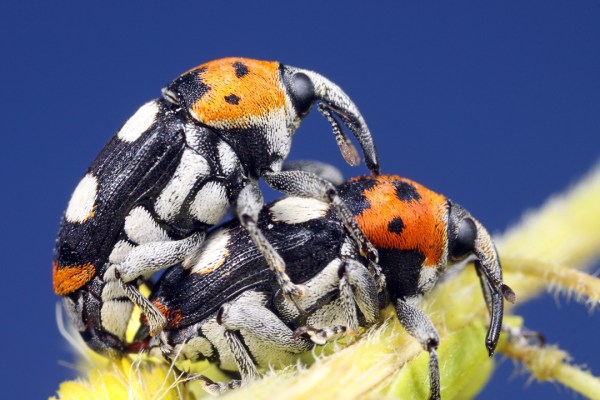
Megabaris quadriguttatus | Corrientes Province, Argentina

From  (posted 12 Apr). I spent much of 2012 working on the “blue sky background” technique, with these weevils from northern Argentina representing one of my better attempts. Macrophotography of insects with a blue sky background involves setting exposure, ISO, and aperture to achieve two separate exposures—full flash illumination of the subject for maximum depth-of-field, and ambient light from the sky to create a clean, uncluttered, natural-looking background. In this shot I managed to achieve an almost ideal shade of blue to compliment the wild black, white and red colors of the beetles. (My one criticism of the photo is having clipped one of the beetle’s feet.)


Bombylius sp. cf. mexicanus | Scott Co., Missouri

From  (posted 16 May). This photo is unusual if nothing else. Focus, lighting, depth-of-field, and composition are all better than can be hoped for in a single shot, but the subject—perfectly alive—is in a most unusual position. Read the original post to find out how this happened.


Perisphaerus sp. (a pill roach) | Vietnam (captive individual)

From  (posted 27 May). White-box photography is an excellent technique for clean, uncluttered photographs of insects, but it also isolates them from their natural surroundings and limits their natural history appeal. The best white-box photos are those that highlight a key feature or behavior of the subject—in this case a pill roach’s comically conglobulating defensive posture.


Micronaspis floridana (Florida intertidal firefly) larva | Pinellas Co., Florida

From  (posted 31 July). Here is another photo whose back story played a big part in its selection. This firefly larva not only represents a rare Florida-endemic species but was also first seen by my then 12-year old nephew, who willingly accompanied me through a dark, spooky salt marsh in the middle of a humid Florida night to see what he could learn. The lesson here for budding natural historians (and old-timers like me) cannot be overstated!


Arctosa littoralis (beach wolf spider) | Lewis Co., Missouri

From  (posted 23 Aug—prelude to  posted 28 Aug). Those who follow this blog know of my obsession with close-up portraits, and while tiger beetles are the subjects I most commonly photograph in this manner, I am always on the lookout for good subjects in other taxa. This wolf spider “face” almost looks human, with “two” eyes, two “nostrils” and a shiny upper lip above huge (albeit hairy) buck teeth! It’s enough fill-the-frame spidery goodness to melt (or explode) the heart of even the most ardent arachnophobe!


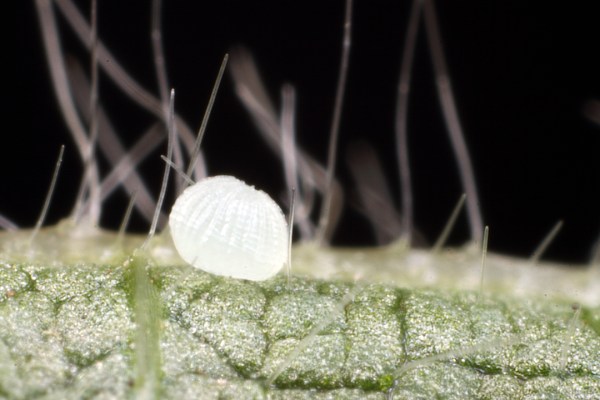
Anticarsia gemmatalis (velvetbean caterpillar) egg on soybean leaf

From Life at 8X—Guide to lepidopteran eggs on soybean (posted 3 Sep). “Life at 8X” was a new series I introduced this year, featuring insects photographed at magnifications testing the upper limit of my equipment and photographic skills. Diffraction is the chief difficulty with magnifications as high as this and is the primary flaw in the above photograph. Nevertheless, such view of a moth egg on the underside of a soybean leaf provides a spectacular view of the otherwise unseen micro-world that lives right beneath our noses.


Megacyllene decora (amorpha borer) on snakeroot flowers | Mississippi Co., Missouri

From  (posted 12 Sep). This second example of “blue sky background” was taken later in the year and was considerably more difficult to capture than the first because of the larger size of the subject and resulting need for a longer focal length macro lens. Getting a well-lit, focused, and composed image with a desirable shade of blue in the background depended not only on finding the proper camera settings, but also secure body and camera bracing techniques for this completely hand-held shot.


Cicindelidia politula politula (Limestone Tiger Beetle) | Montague Co., Texas

From  (posted 28 Sep). I will go ahead and say it—this is my favorite photograph of 2012. As discussed under the first entry, panning back from the subject can allow for some very interesting compositions. This photo combines charismatic pose by a wary subject with panning back and low perspective to create an image that scores high in both natural history and aesthetic appeal.


Calosoma sayi (black caterpillar hunter) | New Madrid Co., Missouri

From Black is beautiful! (posted 7 Nov). Of course, close-as-possible can also be used to create striking photos, especially if the subject exhibits features that are best seen up close. Anything with jaws fits the bill in my book, and highlighting the mandibular sculpturing of this caterpillar hunter (a type of ground beetle) required precise angling of the flash heads for maximum effect.


Cicindela repanda (Bronze Tiger Beetle) | St. Louis Co., Missouri

From  (12 Nov). This final selection is not a rare species, but it is as close as I have come to what I consider the “perfect” tiger beetle macrophotograph—a close, low angle, lateral profile of an adult in full-stilt posture (a thermoregulatory behavior), well lit, perfectly focused, and with a dynamic but pleasingly blurred background. It’s a perfect storm of a photo that took the better part of two hours to achieve—rarely do all of these elements come together in a hand-held photograph of an unconfined tiger beetle in its native habitat.


Well, there you have it. I hope you’ve enjoyed my selections, and again please do let me know if you have a personal favorite. See you in 2013!

Copyright © Ted C. MacRae 2012

Shooting 8X hand-held in the field

Just to prove it can be done, here is an uncropped photograph of the seed weevil Althaeus hibisci (or the closely related A. folkertsi) (order Coleoptera, family Chrysomelidae, subfamily Bruchinae). Adults of these species measure only 1.5–2.5 mm in length (Kingsolver 2004), yet this individual almost completely fills the frame:

Althaeus hibisci/folkertsi on Hibiscus moscheutos lasiocarpus | Route 66 State Park, St. Louis Co., Missouri

I achieved 8X magnification by stacking 68 mm of extension tubes under my Canon MP-E 65mm 1–5X macro lens and extending the bellows of the lens out to its maximum. Shooting 8X is not for the timid—the small subject to lens distance complicates lighting (full flash required), and even finding the subject in the viewfinder can be next to impossible. However, doing it hand-held in the field requires more than just courage and patience—good bracing techniques to minimize movement by and between the camera and the subject are essential. Here is how I do it:

  • I sit down, prop my knees up, and rest the camera in the crotch between my knees (the camera quickly becomes very heavy since it’s being held by only one hand—see next bullet) while positioning it near my face. If possible, I lean back against something as well to provide even more stability, although this is often not possible depending on field conditions.
  • I hold the leaf or flower supporting the subject in my left hand. Subjects this small are rarely going anywhere (or if they are skittish then I use the same slow, deliberate techniques that I use with larger skittish insects), so it is possible to hold the leaf or flower and position the subject right in front of the lens. Hand holding the subject’s support also affords the ability to micro-adjust the position and angle of the subject for optimum composition or to adjust for movement by the subject (easier than trying to track it by moving the lens). In this case of the photo featured here, I detached the leaf with the beetle from the plant (use small scissors to snip the leaf petiole, as this avoids the “jolt” that happens if you try to pick the leaf and which usually results in the subject fleeing). In other cases, I leave the leaf attached and carefully “pull” it towards me to hold it steady.
  • I look through the viewfinder and brace my left wrist (yes, the same hand that is holding the subject) on the underside of the lens, then slowly move the subject towards the lens with my fingers until I see movement and can micro-adjust for proper focus. Bracing your wrist against the lens is key—it is nearly impossible to hold the subject steady in front of the lens without bracing your wrist against it. In effect, this “fixes” the subject to the lens. Also, before I begin looking for the subject through the viewfinder I study its position on the leaf and look for “landmarks” that I can recognize when looking through the viewfinder to minimize the time needed to find the subject (the more time you spend looking for the subject, the greater the chance it will move or flee). Again, the subject to lens distance is very small, but with practice you’ll get a feel for precisely how far from the lens you need to place the subject.
  • I hold my breath and micro-adjust the subject position to nail the focus (usually on the eye) and then fire a shot. If it takes too long to get the focus I exhale and try again, as body shake will only get worse once it starts. Important: After taking the first shot, do not move the hand holding the subject as you look at the image preview and/or histogram—the first shot rarely has the settings precisely where you need them, and keeping the subject in place prevents a lot of re-searching after making the needed setting adjustments with the right hand.

Other than lighting, nailing the focus is the most difficult aspect of shooting hand-held at such high magnifications. The more relaxed and stable you can keep the rest of your body, the less hand movement you’ll experience while holding the subject and the greater chance you have of hitting the focus. Again, a fully extended MP-E lens on 68 mm of extension tubes becomes very heavy very quickly when held in one hand (even when resting on your knees), so expect your forearm muscles to give out quickly until you have a chance to strengthen them through practice.

I use these same techniques to some degree at lower magnifications as well—certainly for anything above 2X. I’m interested in doing a lot more 8X photography, however, because there is a whole world of tiny insects that are not being photographed due to their very small size. These insects are no less fascinating and beautiful than their larger, more oft photographed brethren.

Finally, you might be asking why I don’t just carry a tripod or collect subjects and bring them back to the studio for more controlled conditions. There are many photographers who advocate the use of tripods, but I’m not one of them. I am first and foremost an entomologist, and when I’m in the field I’m generally already carrying at least a net and other equipment for collecting insects. There are opportunity costs involved if I also try to lug a heavy tripod with me. What’s that? I could leave it in the car and then go get it when I need it? Honestly, I would pass on a lot of shots if I had to go back to the car to get something for it. The same goes for studio photography—there are many shots I would simply pass on if getting them meant that I needed to collect subjects, keep them in good condition for the duration of the trip (which might be days or more), and then setup in a studio. Moreover, there are many shots—specifically regarding behavior—that would be impossible with collected subjects. But really, it has mostly to do with what I want to be and portray as an insect photographer, and that is somebody who has the ability to photograph unconfined subjects exhibiting natural behaviors in their native habitats. Having the ability to shoot 8X hand-held in the field if I want to gives me more options and makes me a better photographer.

Do you have any special bracing or stabilizing techniques that you use for high-mag hand-held macrophotography? If so I’d love to hear about them.

REFERENCE:

Kingsolver, J. M. 2004. Handbook of the Bruchidae of the United States and Canada. U.S. Department of Agriculture, Technical Bulletin 1912, 2 volumes, 536 pp.
 
Copyright © Ted C. MacRae 2012

Working with Cerceris fumipennis—Epilogue

Cerceris fumipennis nest littered with Neochlamisus sp. beetles

In Working with Cerceris fumipennis Part 1 and Part 2, I talked about the use of this species as a biosurveillance tool for Buprestidae. These wasps are specialist predators of jewel beetles, which they capture almost exclusively and paralyze with their sting to use as food provisions for their offspring in underground nests. I also mentioned that there are other species of Cerceris, each specializing in its own distinct prey group, and at my site in east-central Missouri I found C. bicornis, a weevil specialist, almost as common as C. fumipennis. Thus, when I came upon this particular Cerceris wasp nest, I wondered it I had encountered yet another species in the genus, for littered around it were case-bearing leaf beetles in the genus Neochlamisus.

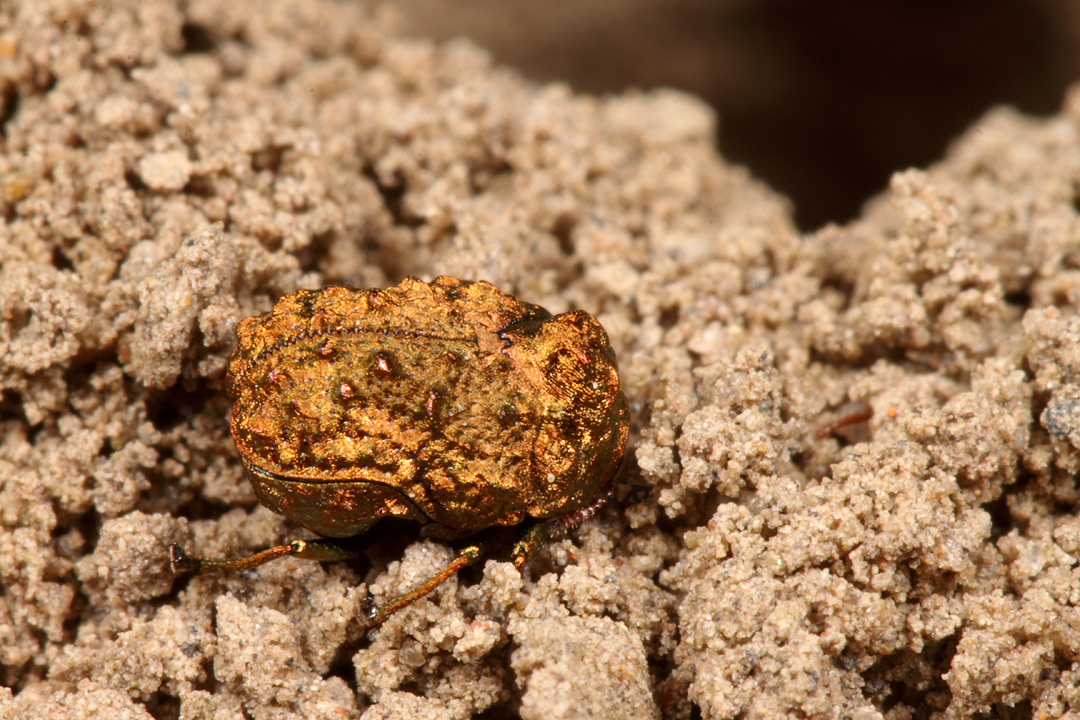
The bright coppery coloration suggests Neochlamisus platani

I counted 11 beetles lying on the diggings surrounding this nest, and as is typical with buprestids around C. fumipennis nests these beetles all appeared to represent the same species (I’ve done a little collecting of Neochlamisus beetles in Missouri—the especially bright coppery coloration suggests to me N. platani, a species found on eastern sycamore, Platanus occidentalis). I’ve also noted that C. fumipennis nests littered with beetles on the surface also have beetles—usually of the same species—freshly cached underground, so I decided to dig up the nest to see what might be in it. As I inserted the grass stem and started digging, I heard the distinctive buzzing indicating the wasp was still inside the nest, and when it appeared I noted the distinctive three yellow facial markings that identify it as a female C. fumipennis. As suspected, the nest contained another seven beetles of the same species, and I would later learn that C. fumipennis, while specializing on jewel beetles, does occasionally take other prey. Philip Careless and colleagues recorded two leaf beetles, including Neochlamisus bebbiana, and one weevil as hosts for this wasp at their Working with Cerceris fumipennis website. If my species ID of these beetles is confirmed, this should represent yet another non-buprestid host record for C. fumipennis, although I should also mention that out of several hundred observations this was the only non-buprestid prey I observed around or in a C. fumipennis nest.

Copyright © Ted C. MacRae 2012

Palmetto Tortoise Beetle, Hemisphaerota cyanea

Hemisphaerota cyanea (palmetto tortoise beetle) on saw palmetto (Serenoa repens)| Levy Co., Florida

While most leaf beetles (family Chrysomelidae) are found associated with herbaceous plant species, many members of the subfamily Hispinae—which includes leaf mining beetles and tortoise beetles—are found on the foliage of woody plants. In North America the most distinctive of tortoise beetles found on trees is the palmetto tortoise beetle, Hemisphaerota cyanea. These distinctive dark blue, hemispherical-shaped (hence, the genus name) beetles with yellow antennae are found in the deep southeastern U.S. on the fronds of saw palmetto, Serenoa repens, and other native and introduced palms. I found the beetles in these photographs near Cedar Key Scrub State Preserve in Levy Co., Florida while searching white sand 2-tracks through sand scrub habitat for the Florida-endemic Cicindelidia scabrosa (Scabrous Tiger Beetle).

Beetles scarify the leaf epidermis, leaving trough-like feeding marks.

I first saw this species during my first insect collecting trip to Florida back in 1986. I didn’t know much then (other than that I really, really enjoyed traveling to different parts of the county to collect insects!). I was in Everglades National Park (with a permit) when I first noticed them dotting saw palmetto fronds. I think I had actually noticed them for some time but thought they were some type of scale insect before eventually realizing it was actually not only a beetle, but a tortoise beetle (one of the many groups of insects in which I was interested during those early, formative days).

Specially modified tarsi and a hemispherical shape allow the beetle to clamp itself tightly against the leaf to repel attack by ants and other insect predators.

I also remember being struck by how difficult it was to pry the adults off of the leaves on which they were sitting. It turns out that these leaf beetles have specially modified tarsi with thousands of bristles tipped with adhesive pads on the undersides. Normally only a few of the pads contact the leaf surface, but when the beetle is threatened it clamps all of them against the leaf and secretes an oil that strengthens the adhesive capabilities of the pads. Thus secured, the beetle clamps its hemispherical-shaped body down tightly against the leaf and is able to resist the efforts of ants and other predators to pry it from the leaf.

Copyright © Ted C. MacRae 2012