Sunset beetles

Acmaeodera immaculata? | vic. Vogel Canyon, Colorado.

Acmaeodera immaculata? (family Buprestidae) | vic. Vogel Canyon, Colorado.

Regular readers of this blog know that I am fond of natural sky backgrounds for insects found during the day on flowers and foliage. Not only does the sky provide a clean, uncluttered background that allows the subject to stand out, it also gives the photo a more appropriate temporal flavor—i.e., photographs of diurnal insects should look like they were taken during the day. It’s a little bit tricky setting the camera to allow flash illumination of the subject while still allowing the sky to register as well, but I find such photographs more pleasing and interesting than those with a jet-black background, typical in flash macrophotography, and far more pleasing than those with a jumble of sticks and weeds cluttered behind the subject. These days my daytime insect photos almost always incorporate a blue-sky background (examples here and here) unless: 1) I actually photographed the subject at night (examples here and here); or 2) I wish to highlight an intensely white or delicately structured subject (examples here and here).

Aulicus sp. | vic. Black Mesa, Oklahoma

Trichodes oresterus? (family Cleridae) | vic. Black Mesa, Oklahoma

But what about in between day and night—specifically, sunset? Incorporating a sunset sky into a flash-illuminated macrophotograph is even trickier than incorporating a blue midday sky because the central problem—low light levels—is magnified. Blue sky photographs challenge the fast shutter speeds and high f-stops usually needed for macrophotographs, but relatively minor adjustments to ISO, shutter speed, and f-stop are usually sufficient to allow the sky to register while still being able to maintain depth of field and minimize motion blur. At sunset, however, because there is much less illumination of the sky, more aggressive settings are often required to allow the sky to register on the camera sensor—settings that can sometimes result in too much motion blur or insufficient depth of field. These problems can be mitigated to some degree with the use of a tripod (and very cooperative subjects), but for dedicated “hand-held” enthusiasts like myself this is not an option. Why bother? Because the results can be spectacular! The setting sun often creates stunning colors not seen at other times of the day and offer a change of pace from blue skies, which, like black backgrounds, can start looking rather monotonous if used exclusively in one’s portfolio.
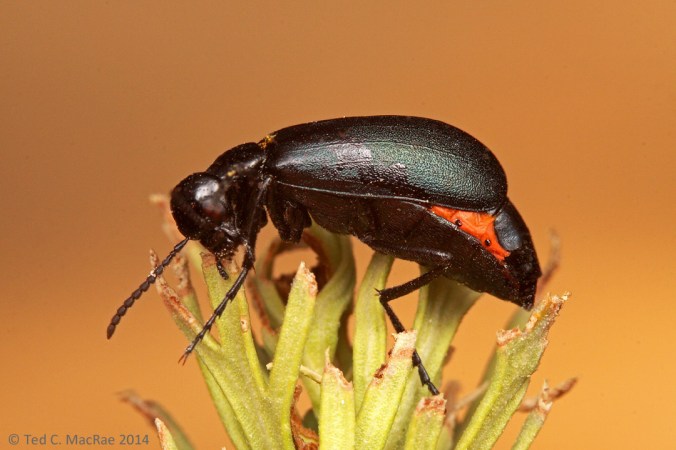
Linsleya convexa | vic. Vogel Canyon, Colorado

Linsleya convexa (family Meloidae) | vic. Vogel Canyon, Colorado

The photos featured in this post were taken during several sunsets on a trip earlier this past summer through Colorado and Oklahoma. I especially like the jewel beetle (Acmaeodera immaculata?) photograph—technically it has good focus and depth of field and a pleasing composition, but I really like the color coordination between the beetle, flower, and sky. The checkered beetle (Trichodes oresterus?) photograph is also very pleasing, especially the detail on the beetle, although the color of the sky is only somewhat different than a more typical daytime blue. The blister beetle (Linsleya convexa) photograph is probably the most problematic technically due to slight motion blur and being slightly off-focus at the eye—not surprising since of the three this photo had the lowest light conditions. However, the color contrast between the sky and subject make this a nevertheless striking image.

If you have experience with ambient light backgrounds in flash macrophotography, your comments on approaches you’ve taken to deal with reduced light situations will be most welcome.

© Ted C. MacRae 2014
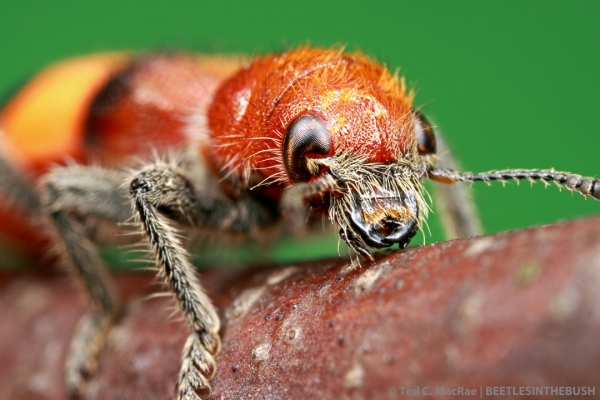
Meet Enus

It may be quiet here at Beetles in the Bush for the next week or so while Ted is off in the far corners of Oklahoma looking for beetles to photograph and add to his collection. In the meantime, meet Enus (full name Enoclerus ichneumoneus), a checkered beetle who was beaten from a dead grapevine (Vitis sp.) in southeastern Missouri and who has promised Ted he will keep a close eye on things while Ted is away.

Enoclerus ichneumoneus | Stoddard Co., Missouri

Enoclerus ichneumoneus | Stoddard Co., Missouri

Beetles in Oklahoma had better watch out!

© Ted C. MacRae 2013

BitB Top 10 of 2010

Welcome to the 3rd Annual BitB Top 10, where I pick my 10 (more or less) favorite photographs of the year.  My goal for 2010 was to continue the progress that I began the previous year in my quest to become a bona fide insect macrophotographer.  I’m not in the big leagues yet, but I have gotten more comfortable with using my equipment for in situ field photographs and am gaining a better understanding of lighting and the use of flash.  I also began experimenting with different lighting techniques (e.g. white box) and diffusers and am putting more effort into post-processing techniques to enhance the final appearance of my photographs.  I invite you to judge for yourself how successful I’ve been toward those goals by comparing the following selections with those from 2009 and 2008 – constructive feedback is always welcome:


Best Tiger Beetle

Cicindela denverensis - green claybank tiger beetle

From ID Challenge #1 (posted December 23).  With numerous species photographed during the year and several of these dramatic “face on” shots, this was a hard choice.  I chose this one because of the metallic colors, good focus throughout the face, and evenly blurred “halo” of hair in a relatively uncluttered background.


Best Jewel Beetle

Buprestis rufipes - red-legged buprestis

From Special Delivery (posted July 13).  I didn’t have that many jewel beetles photos to choose from, but this one would have risen to the top no matter how many others I had.  The use of a white box shows off the brilliant (and difficult-to-photograph) metallic colors well, and I like the animated look of the slightly cocked head.


Best Longhorned Beetle

Desmocerus palliatus - elderberry borer

From Desmocerus palliatus – elderberry borer (posted November 18).  I like the mix of colors in this photograph, and even though it’s a straight dorsal view from the top, the partial dark background adds depth to the photo to prevent it from looking “flat.”


Best “Other” Beetle

Enoclerus ichneumoneus - orange-banded checkered beetle

From Orange-banded checkered beetle (posted April 22).  The even gray background compliments the colors of the beetle and highlights its fuzziness.  It was achieved entirely by accident – the trunk of the large, downed hickory tree on which I found this beetle happened to be a couple of feet behind the twig on which it was resting.


Best Non-Beetle Insect

Euhagenia nebraskae - a clearwing moth

From Euhagena nebraskae… again (posted October 21).  I photographed this species once before, but those photos failed to capture the boldness of color and detail of the scales that can be seen in this photo.


Best “Posed” Insect

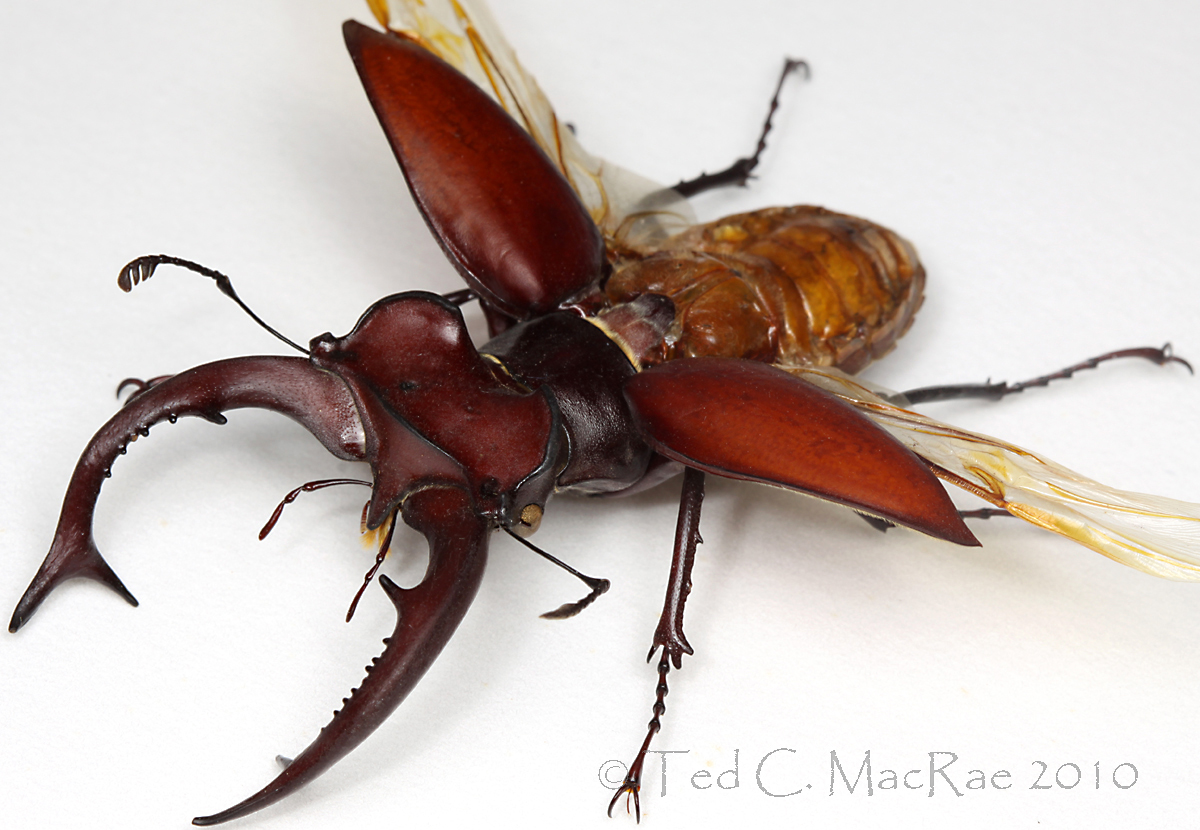
Lucanus elaphus - giant stag beetle

From North America’s largest stag beetle (posted December 30).  I’ve just started experimenting with photographing posed, preserved specimens, and in fact this male giant stag beetle represents only my second attempt.  It’s hard to imagine, however, a more perfect subject than this impressively stunning species.


Best Non-Insect Arthropod

Scolopendra heros - giant desert centipede

From North America’s largest centipede (posted September 7).  Centipedes are notoriously difficult to photograph due to their elongate, narrow form and highly active manner.  The use of a glass bowl and white box allowed me to capture this nicely composed image of North America’s most spectacular centipede species.


Best Wildflower

Hamamelis vernalis - Ozark witch hazel

From Friday Flower – Ozark Witch Hazel (posted March 26).  The bizarre form and striking contrast of colors with the dark background make this my favorite wildflower photograph for the year.


Best Non-Arthropod

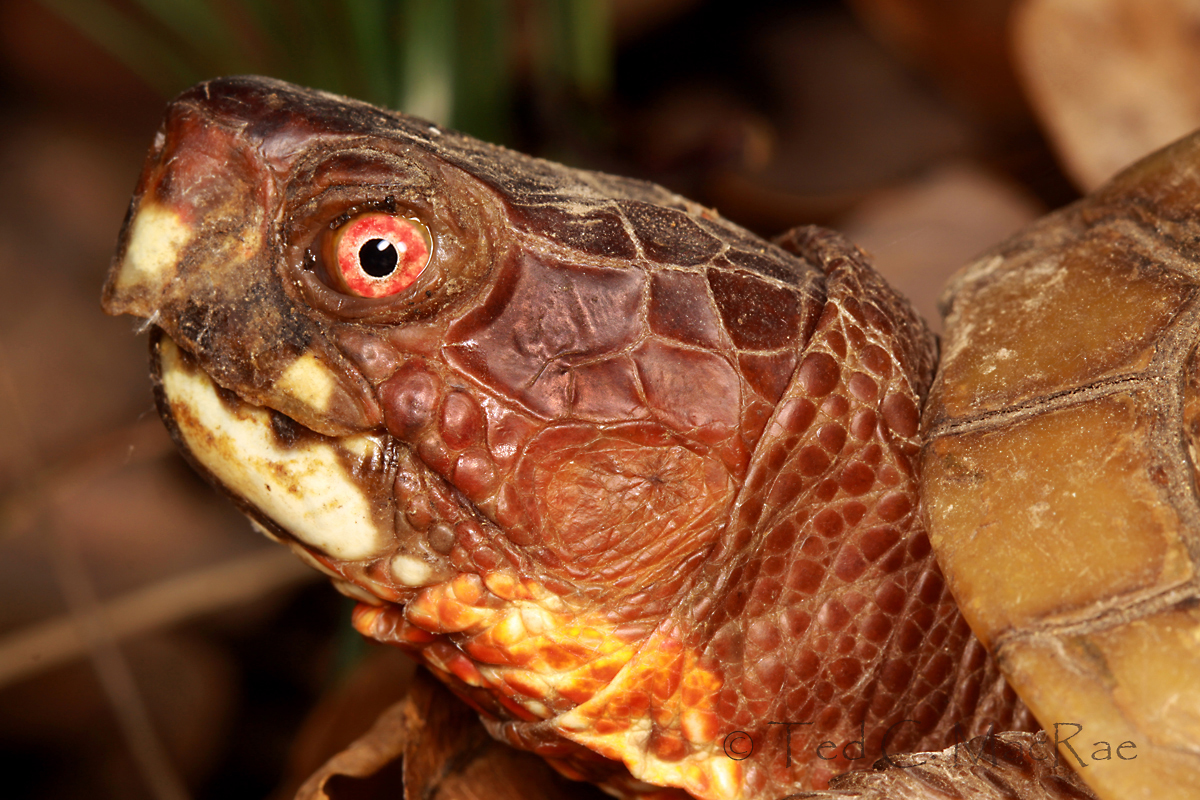
Terrapene carolina triunguis - three-toed box turtle

From Eye of the Turtle (posted December 10).  I had a hard time deciding on this category, but the striking red eye in an otherwise elegantly simple photograph won me over.  It was also one of two BitB posts featured this past year on Freshly Pressed.


Best “Super Macro”

Phidippus apacheanus - a jumping spider

From Jeepers Creepers, where’d ya get those multilayered retinae? (posted October 5).  I’m not anywhere close to Thomas Shahan (yet!), but this super close-up of the diminutive and delightfully colored Phidippus apacheanus is my best jumping spider attempt to date.  A new diffuser system and increasing comfort with using the MP-E lens in the field at higher magnification levels should allow even better photos this coming season.


Copyright © Ted C. MacRae 2011

Trichodes bibalteatus in Oklahoma

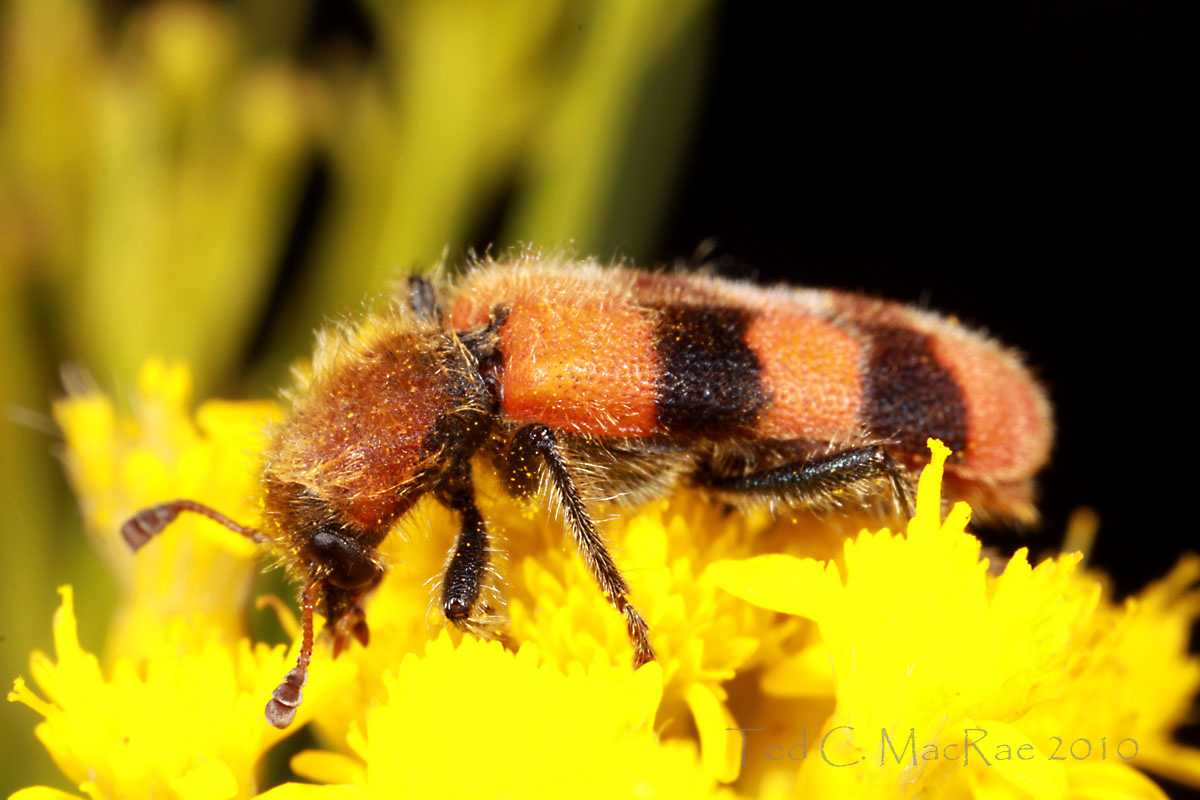
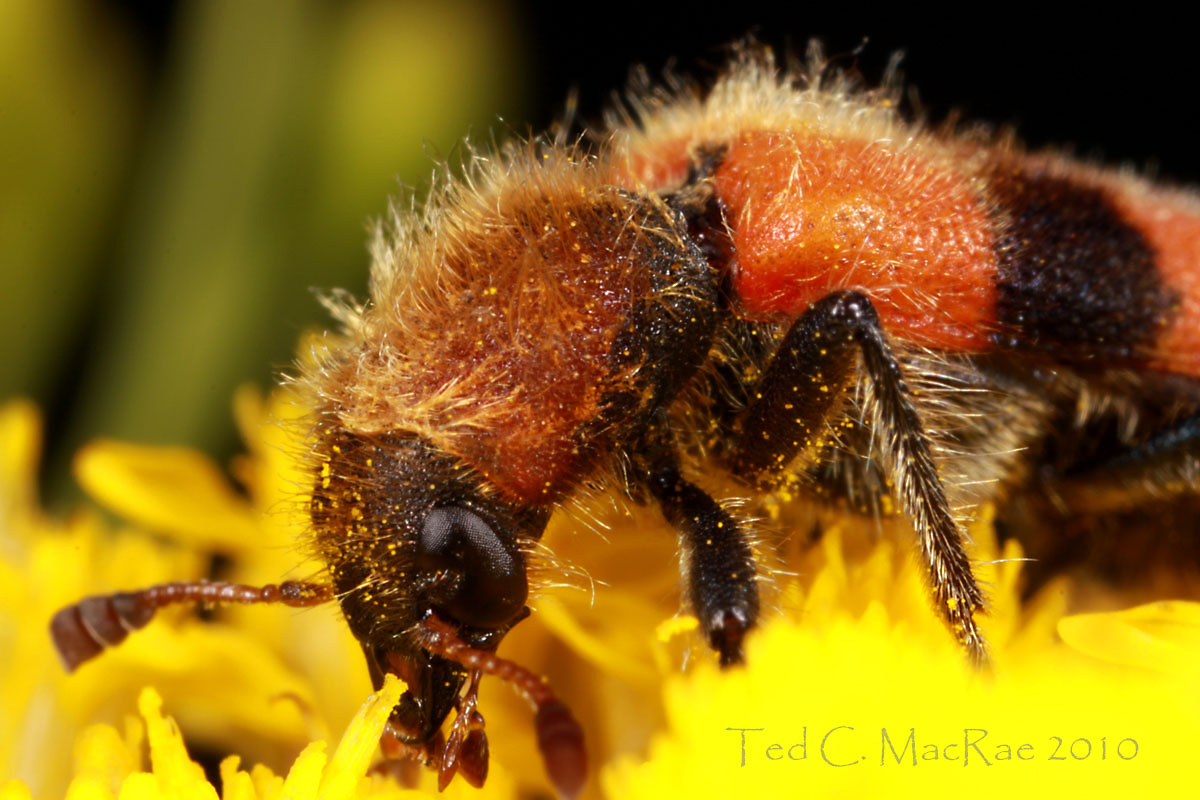
Among checkered beetles (family Cleridae), the genus Trichodes contains among the largest and most strikingly-colored species.  The 11 North American species of this predominantly Holarctic genus are primarily western in distribution, although two species (T. nuttalli and T. apivorus) do occur in the eastern U.S.  The individual in these photos was one of several I encountered feeding on the flowers of a yellow composite in the Gloss Mountains of northwestern Oklahoma during early July.  I take them to represent the species T. bibalteatus based on their close resemblance to the holotype of that species from the LeConte Collection in the Museum of Comparative Zoology at Harvard University.  While these photographs are admittedly far from perfect, they were about the best I could manage at the time considering the gusty post-storm winds that I encountered atop the mesa where these beetles were found (along with my continuing difficulty in achieving proper exposure with subjects on bright yellow flowers).

The striking colors of adult Trichodes and their frequent association with flowers for feeding and mating belies a more treacherous aspect of their life history.  While adults may serve as important pollinators of native plant species (Mawdsley 2004), they also lay their eggs on flowers.  The larvae that hatch from these eggs don’t eat the flower itself, but rather attach themselves to bees and wasps that visit the flower as they gather pollen for provisioning their own nests (Linsley & MacSwain 1943).  The larvae hitch a ride back to the hymenopteran’s nest, where they then prey on the developing brood and usurp pollen provisions for themselves.

Photo Details: Canon 50D w/ MP-E 65mm 1-5X macro lens (ISO 100, 1/250 sec, f/16), Canon MT-24EX flash (1/8 ratio) w/ Sto-Fen + GFPuffer diffusers. Typical post-processing (levels, minor cropping, unsharp mask).

REFERENCE:

Linsley, E. G. & J. W. MacSwain. 1943. Observations on the life history of Trichodes ornatus (Coleoptera, Cleridae), a larval predator in the nests of bees and wasps. Annals of the Entomological Society of America 36:589–601.

Mawdsley, J. R. 2004. Pollen transport by North American Trichodes Herbst (Coleoptera: Cleridae). Proceedings of the Entomological Society of Washington 106(1):199-201.

Copyright © Ted C. MacRae 2010

Pseudomethoca simillima – a model for Enoclerus ichneumoneus?

Pseudomethoca simillima (family Mutillidae) - the model?

Enoclerus ichneumoneus (family Cleridae) - the mimic?

Last week, I posted the above photograph of Enoclerus ichneumoneus (orange-banded checkered beetle) and mentioned its possibly mimetic appearance to velvet ants in the family Mutillidae (order Hymenoptera).  By some stroke of serendipity, I encountered a species of Mutillidae the very next day in Missouri’s southeastern lowlands that seems to be a good candidate for one of, if not the, model species that E. ichneumoneus might have evolved to resemble.  Several individuals were encountered as they zigzagged urgently on dry sand deposits along the Mississippi River (where I had hoped, unsuccessfully, to find another locality for our intergrade population of Cicindela scutellaris).  Comparison of the individual in the photo with specimens in my collection (all identified by mutillid expert Kevin Williams, Utah State University) suggests this is Pseudomethoca simillima, and the photo is also a good match with other photographs of the species at BugGuide.  One thing that bothers me with the idea of this being a model for E. ichneumoneus is that I have not seen P. methoca commonly in Missouri (I have only three specimens in my collection), while E. ichneumoneus is one of our most common clerids.  There is another mutillid species in Missouri – Dasymutilla quadriquttata – that also seems to have potential as a model for E. ichneumoneus and that I have encountered much more commonly in the state.  However, D. quadriguttata is somewhat larger than E. ichneumoneus.  At any rate, other than the statement by Mawdsley (1994) that E. ichneumoneus seems to mimic mutillids, I can’t find that any more specific information has been recorded about the possible model(s) for that species.

As a caveat, I shall add that this mutillid was the… most… uncooperative… insect… that I have ever tried to photograph!  They really never stop moving, so you have to track the moving insect through the lens and fire shots when you think you’ve got it centered and focused.  Most of the time you don’t!  Using the Canon 1-5X macro lens for this did not make things any easier.  I tracked this female for quite a while and fired off a number of shots, only to get this one that I thought was fairly decent (and still just missed the focus on the near side of the pronotum).

Speaking of mutillids, I simply must photograph my specimen of Dasymutilla gloriosa (sometimes called the thistledown velvet ant) – you will not believe it!

Photo Details:
Pseudomethoca simillima: Canon MP-E 65 mm 1-5X macro lens on Canon 50D, ISO 100, 1/250 sec, f/14, MT-24EX flash 1/8 power w/ Sto-Fen diffusers. Minimal cropping and post-processing.
Enoclerus ichneumoneus: Canon 100mm macro lens on Canon 50D, ISO 100, 1/250 sec, f/14, MT-24EX flash 1/4 power w/ Sto-Fen diffusers. Minimal cropping and post-processing.

REFERENCE:

Mawdsley, J. R. 1994. Mimicry in Cleridae (Coleoptera).  The Coleopterists Bulletin 48(2):115-125.

Copyright © Ted C. MacRae

Add to FacebookAdd to DiggAdd to Del.icio.usAdd to StumbleuponAdd to RedditAdd to BlinklistAdd to TwitterAdd to TechnoratiAdd to Yahoo BuzzAdd to Newsvine

Email to a friend

Orange-banded checkered beetle

As a student of woodboring beetles for more than a quarter-century now, I’ve had occasion to encounter a goodly number of checkered beetles (family Cleridae) – both in the field and as a result of rearing them from dead wood.  Checkered beetles are not as commonly encountered as other woodboring beetle families such as Buprestidae and Cerambycidae, and they also generally lack the size, diversity, and popularity with coleopterists that those aforementioned beetle families enjoy.  However, despite these shortcomings as a group, checkered beetles are among the most brightly colored and boldly patterned of beetles.  Unlike the beetles with which they often found, checkered beetles are not actually themselves woodboring beetles, but rather predators of such (particularly bark beetles in the weevil subfamily Scolytinae).

This particular species, Enoclerus ichneumoneus, is one of the more conspicuous members of the family in eastern North America.  Although the genus to which it belongs is the largest of the family (32 species in North America north of Mexico), the wide orange band across the middle of the elytra and elongate scutellum make this species distinctive and unlikely to be confused with any other.  I found this individual along the Ozark Trail in southern Missouri on a recently fallen mockernut hickory (Carya alba) – a number of other adult buprestid and cerambycid species were also found on this tree, all of which were mating, searching for mates, or laying eggs within the cracks and fissures on this new-found resource.  In the past I have encountered large numbers of adults of this species on dead willow (Salix caroliniana) from which I later reared an even larger number of a small willow-associated buprestid, Anthaxia viridicornis.  Whether the buprestid larvae served as prey for E. ichneumoneus is difficult to say, but no other potential prey beetle species were reared from the wood.

The bright, distinctive colors exhibited by many checkered beetles might seem to suggest aposematic, or warning, coloration to discourage predation; however, the question of checkered beetle palatability to predators has not been adequately studied (Mawdsley 1994).  The colors and patterns of many species, especially in the genus Enoclerus, seem to mimic species of velvet ants (family Mutillidae) and true ants, but other beetles (e.g. species of Chrysomelidae and Tenebrionidae) and even flies have also been suggested as models.  Still other checkered beetle species seem to be more cryptically than mimetically marked, and there are several tribes whose members seem to be chiefly nocturnal and are thus mostly somber-colored.

Of the 37 genera occurring in North America north of Mexico, I have in my collection representatives of more than 100 species in 23 of those genera.  The majority of that material has been reared from dead wood collected for rearing Buprestidae and Cerambycidae – much of it coming from Texas and Arizona as well as here in Missouri.

Photo Details: Canon 100mm macro lens on Canon 50D, ISO 100, 1/250 sec, f/14, MT-24EX flash 1/4 power w/ Sto-Fen diffusers, photo lightly cropped.

REFERENCE:

Mawdsley, J. R. 1994. Mimicry in Cleridae (Coleoptera).  The Coleopterists Bulletin 48(2):115-125.

Copyright © Ted C. MacRae

Add to FacebookAdd to DiggAdd to Del.icio.usAdd to StumbleuponAdd to RedditAdd to BlinklistAdd to TwitterAdd to TechnoratiAdd to Yahoo BuzzAdd to Newsvine

Email to a friend