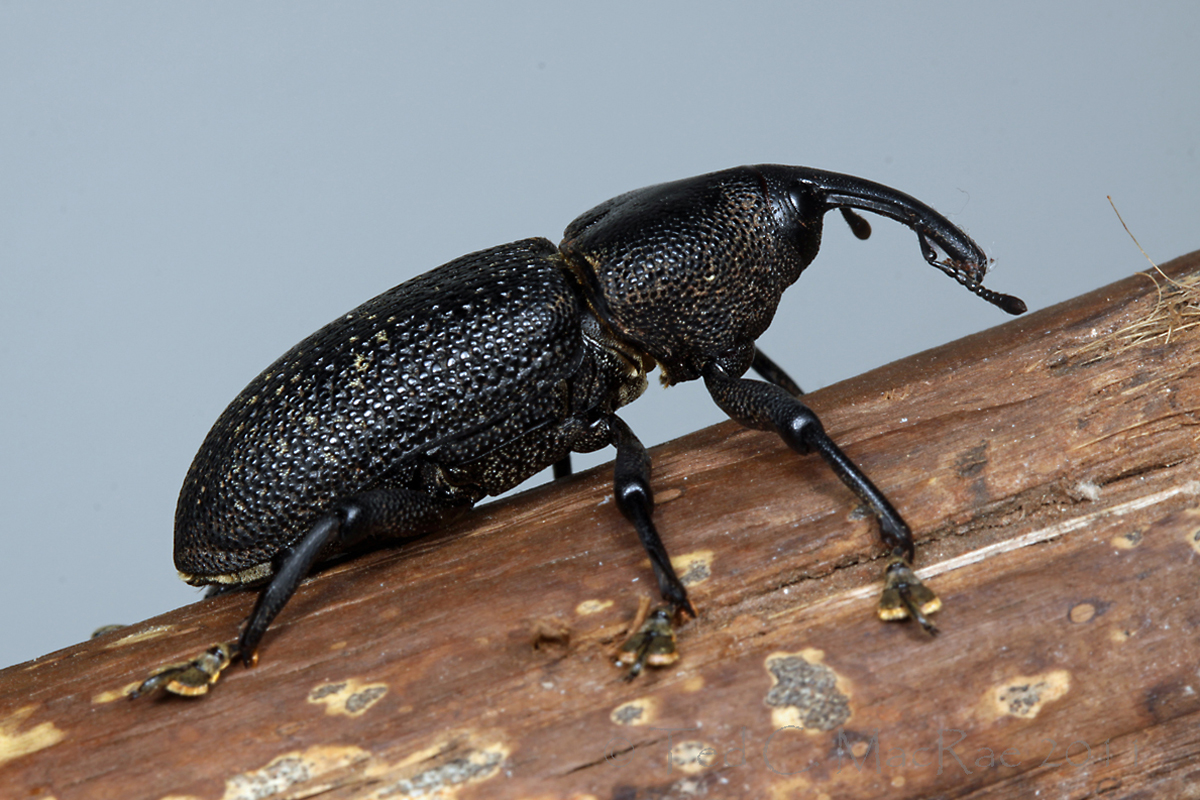
Bichos Argentinos #7 – Naupactus xanthographus

Naupactus xanthographus (South American fruit tree weevil) | Buenos Aires, Argentina

This weevil (family Curculionidae) was one of just a few beetle species that I encountered earlier this month in Buenos Aires, Argentina at La Reserva Ecológica Costanera Sur.  Weevils are, of course, one of the most taxonomically diverse and difficult groups of Coleoptera, making species IDs based purely on photographs quite challenging.  Nevertheless, I am reasonably confident that this individual represents Naupactus xanthographus, or the South American fruit tree weevil.  This name, it seems, has also been applied to a variety of other weevils photographed in South America and posted on the web, but the images I found at a few seemingly more authoratative sites give me confidence that this is the true N. xanthographus.  The narrow form suggests this individual is a male.

The genus, known collectively as “white-fringed weevils” is a large genus of exclusively Neotropical species – several of which have been introduced to North America (e.g., N. cervinus, Fuller rose beetle, and N. leucoloma) and which were, until recently, placed in a separate genus Graphognathus (Lanteri and Marvaldi 1995) (apparently the reduced humeri and lack of metathoracic wings were deemed insufficient for generic distinction).  In South America some of the species have become pests as well, with N. xanthographus becoming a problem for growers of grapes and other fruits and, thus, earning the names “burrito de la vid” (Chile) and “mulita de la vid” (Argentina) (both roughly translating to “grapevine little donkey”).

This was not an easy photograph to get – I found the weevil clinging to the underside of a leaf above my head.  It was impossible to photograph it in situ, so I moved it to a low twig away from other foliage where I could get the black background I desired.  Once moved, however, the weevil just never… stopped… crawling.  Snapping shots of an actively crawling insect is a crap shoot at best – not only are focus and framing more difficult to nail, but subjects photographed while moving almost always have one or two “bum” legs (lifted or cocked out of position).  A number of attempts were required to get a photo I was happy with (save for the slightly clipped antennal tip).  In such situations, I’ve found it best to track the beetle as it moves and as soon as the center focus point of the lens flashes take the shot.  This at least gives the best chance for nailing the focus, and then it’s simply a numbers game to get a shot with good framing and composition and all the body parts well placed.  Of course, I could’ve zoomed out and just cropped to perfection, but this feels a little like cheating – I’d rather put in the time and practice perfecting my game out in the field as much as possible.  An occasional clipped antenna, tarsus, etc. now will lead to better results down the line.

REFERENCE:

Lanteri, A. A. and A. E. Marvaldi. 1995. Graphognathus Buchanan a new synonym of Naupactus Dejean and systematics of the N. leucoloma species group (Coleoptera: Curculionidae). Coleopterists Bulletin 49(3): 206-228.

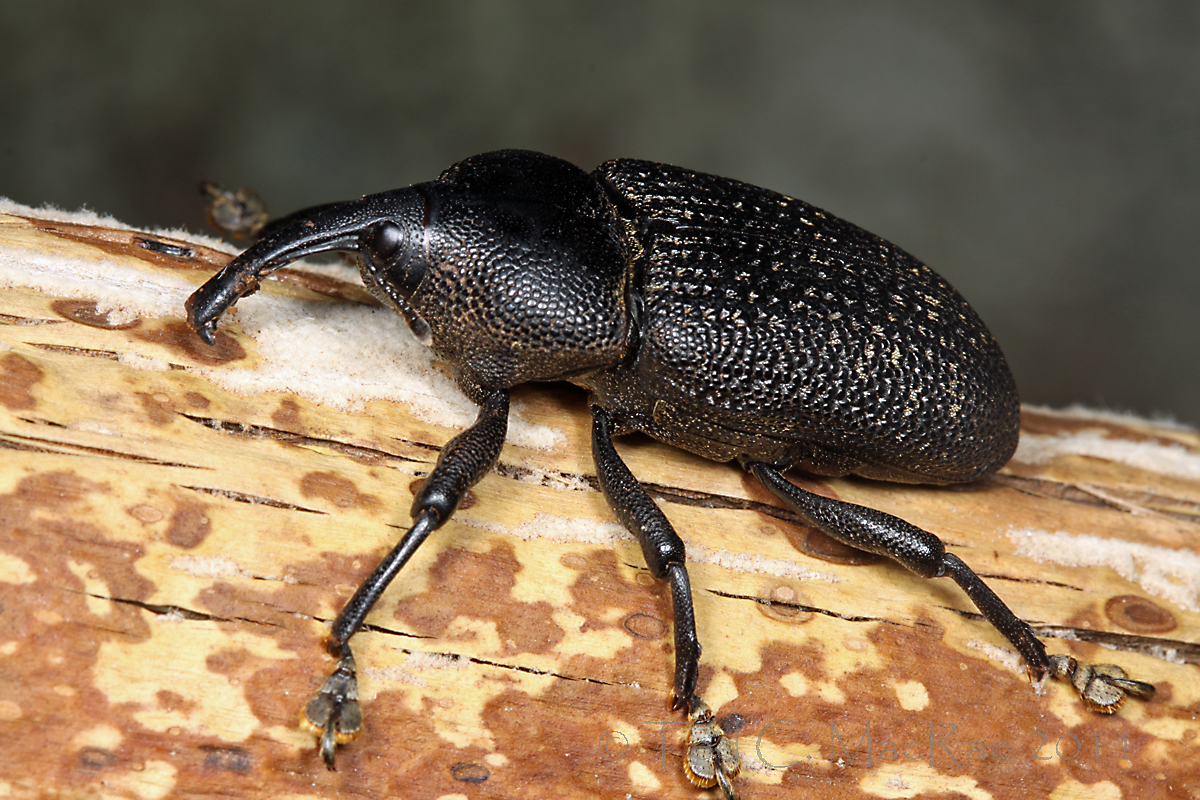
Brazil Bugs #3 – Gorgulho Enorme!

The second night at the hotel on the outskirts of Campinas (São Paulo, Brazil), I found this enormous weevil laying on the ground underneath some windows.  It was dead but completely relaxed and in perfect shape.  I wondered if it had been attracted to lights in the window the previous evening and flown there as its “last hurrah.”  This beast of a weevil – measuring a good 30mm from the tip of the snout to the apex of the elytra – immediately brought to my mind giant palm weevils of the genus Rhynchophorus (Coleoptera: Curculionidae).  I looked around and saw palm trees everywhere, so I figured that must be what it was.  I picked up one of the dead fronds from under a nearby palm tree and placed the weevil on the stem for a few photographs.  Given it’s freshness, it was quite easy to place in a lifelike pose, and I placed the stick in various positions to get a few different backgrounds.  As I was shooting, I noticed another, smaller, weevil on the ground near where I had found the first one – also dead and fresh.  Considering that Rhynchophorus often reaches pest status on palms, this further confirmed the ID in my mind.

Once back in the hotel room I smugly entered “giant palm weevil” into Google to bring up some images and confirm my ID (and also make sure my photos were at least on par with published images).  When the images came up, I saw immediately that my weevil was not a giant palm weevil at all.  While the South American species (R. palmarum) is black, the pronotum and elytra are much smoother and distinctly striate.  I don’t know if this weevil is a member of the same subfamily (Rhychophorinae) as the giant palm weevils, but it certainly not a member of that genus.  Still, considering its large size and distinctive appearance, I remained confident that an ID would come quickly.  Sadly, this has not proven to be the case – no search term I’ve tried involving the term “giant black weevil Brazil” or its many variations brings up anything remotely similar.  So, after spending much more time trying to identify this beetle than I should have, I leave it in the hands of my readers in the hopes that one of you will recognize it and provide a name.  Only when we have a name will it be possible to know something more about how this beetle lives (and if my placing it on a dead palm frond was a truly artificial setup).

Photo Details: Canon 50D w/ 100mm macro lens (ISO 100, 1/200 sec, f/16-18), Canon MT-24EX flash w/ oversized DIY concave diffuser. Typical post-processing (levels, minor cropping, unsharp mask).

Update 01/24/11: Thanks to Henry Hespenheide (via Facebook) and Art Evans, who clued me in to the genus Homalinotus (subfamily Cholinae).  I found a key to the 21 known species of this exclusively Neotropical genus (Vaurie 1973) and consider this individual to represent H. coriaceus – broca do cacho do coqueiro (black coconut bunch weevil).  This species breeds in the stems of old leaves of several native palms; however, it has adapted to the introduced coconut palm and apparently become a limiting factor in the commercial production of coconuts.  Thus, I can breathe easy now knowing that my photographs of this individual on the stem of a dead palm frond represent an entirely natural setting.

REFERENCE:

Vaurie, P.  1973.  The weevil genera Homalinotus and Ozopherus of the Neotropical Cholinae (Coleoptera, Curculionidae).  Bulletin of the American Museum of Natural History 152(1):1–49.

Copyright © Ted C. MacRae 2011

Two ladies from Ontario

What do bugs and snakes/lizards/frogs/turtles have in common? Yes, they’re both ectothermic, but that is the scientist’s answer. Most folks would say they’re just creepy – girls especially! Well, two ladies from Ontario are proving the latter notion wrong by hosting three blog carnivals that cater to these cold-blooded critters: House of Herps, An Inordinate Fondness, and The Moth and Me.

Most people approach their first blog carnival hosting gig with some trepidation, but the Geek in Question at Fall to Climb has embraced the challenge by volunteering to host two blog carnivals simultaneously.  What chutzpah!  Clearly, she was up to the task – for issue of An Inordinate Fondness, she introduces us to technical terms such as OMGSHINY and Coleappetite™ in Discovery Zone, with thirteen stories of beetley discovery. She then shows off her “slammer” talent in House of Herps #5: Slime Poetry – deftly pairing poems with prose.  I would love to see her do this live!

Seabrooke Leckie’s passion for moths is obvious – she is the founder of The Moth and Me and co-author of the soon-to-be-published Peterson Field Guide to Moths of Northeastern North America. Issue #10 of TMaM, Down to the letter, comes home to mama at the Marvelous in Nature – its 24 contributions almost enough to complete the alphabet! Recite your ABCs in lepidopterous fashion with this fine array of contributions.

Copyright © Ted C. MacRae 2010

Add to FacebookAdd to DiggAdd to Del.icio.usAdd to StumbleuponAdd to RedditAdd to BlinklistAdd to TwitterAdd to TechnoratiAdd to Yahoo BuzzAdd to Newsvine

Email to a friend