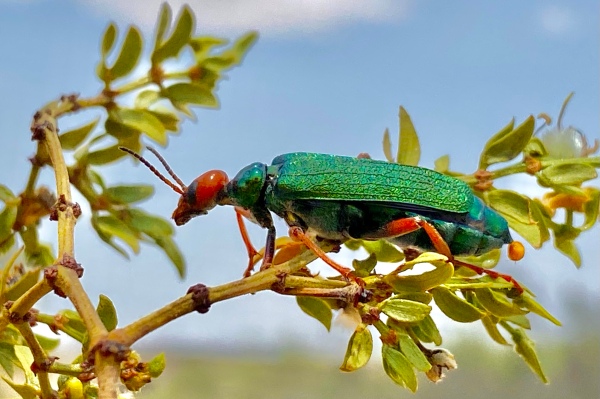
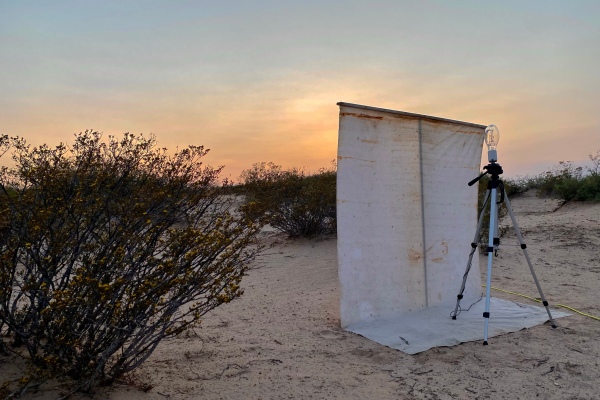
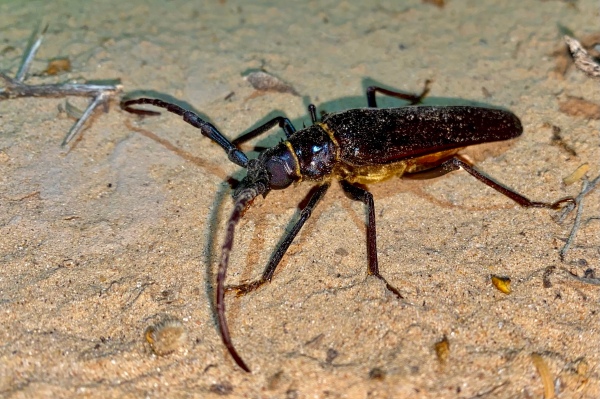
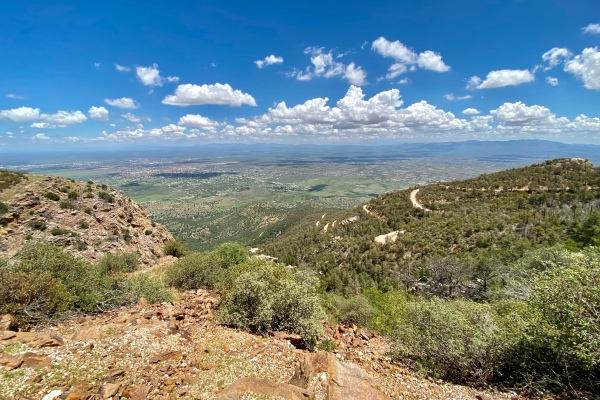
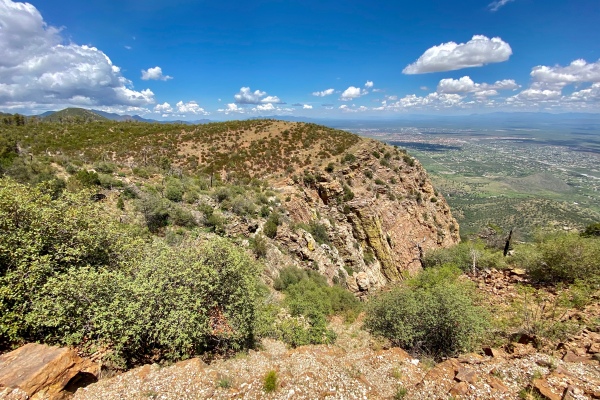
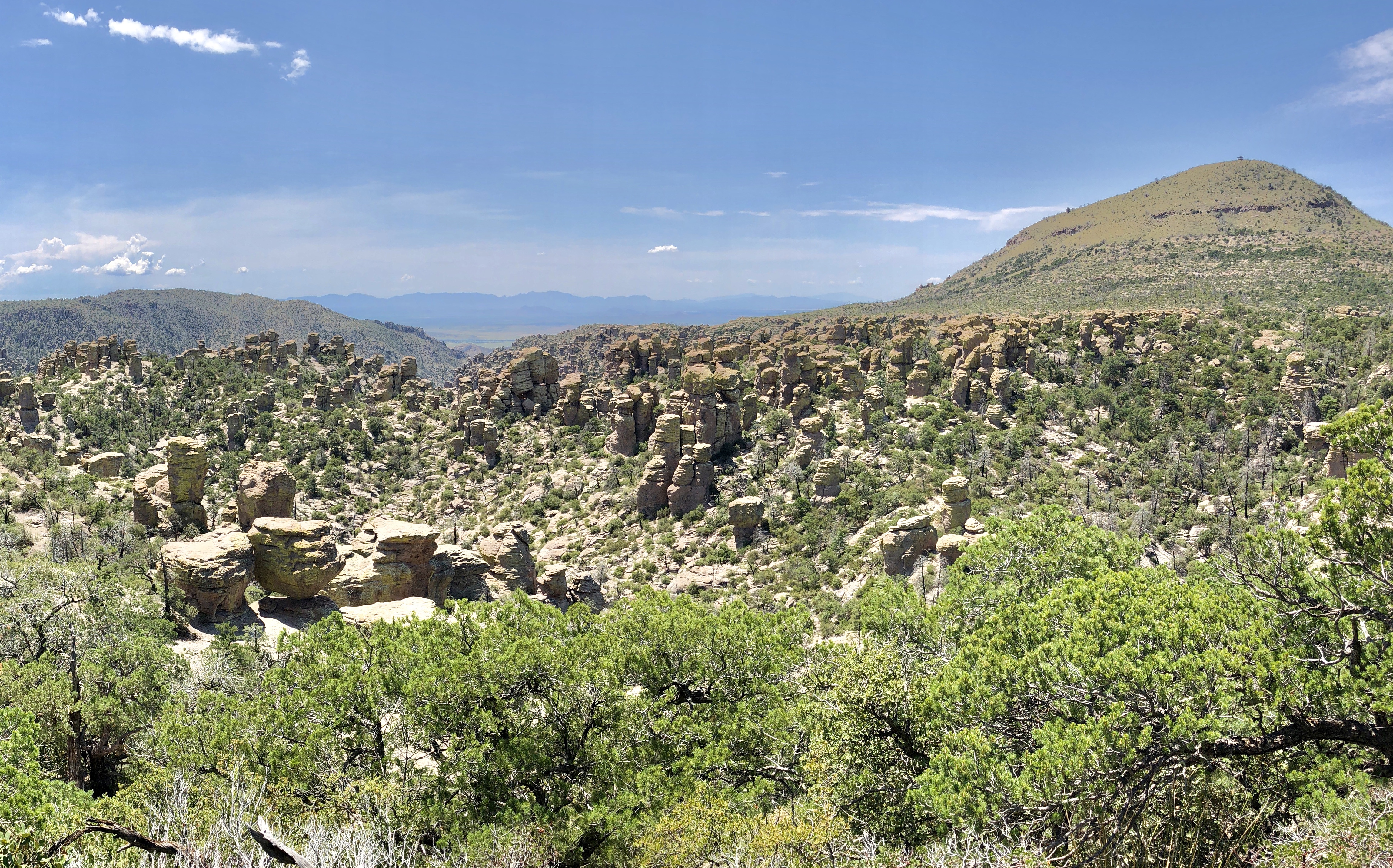
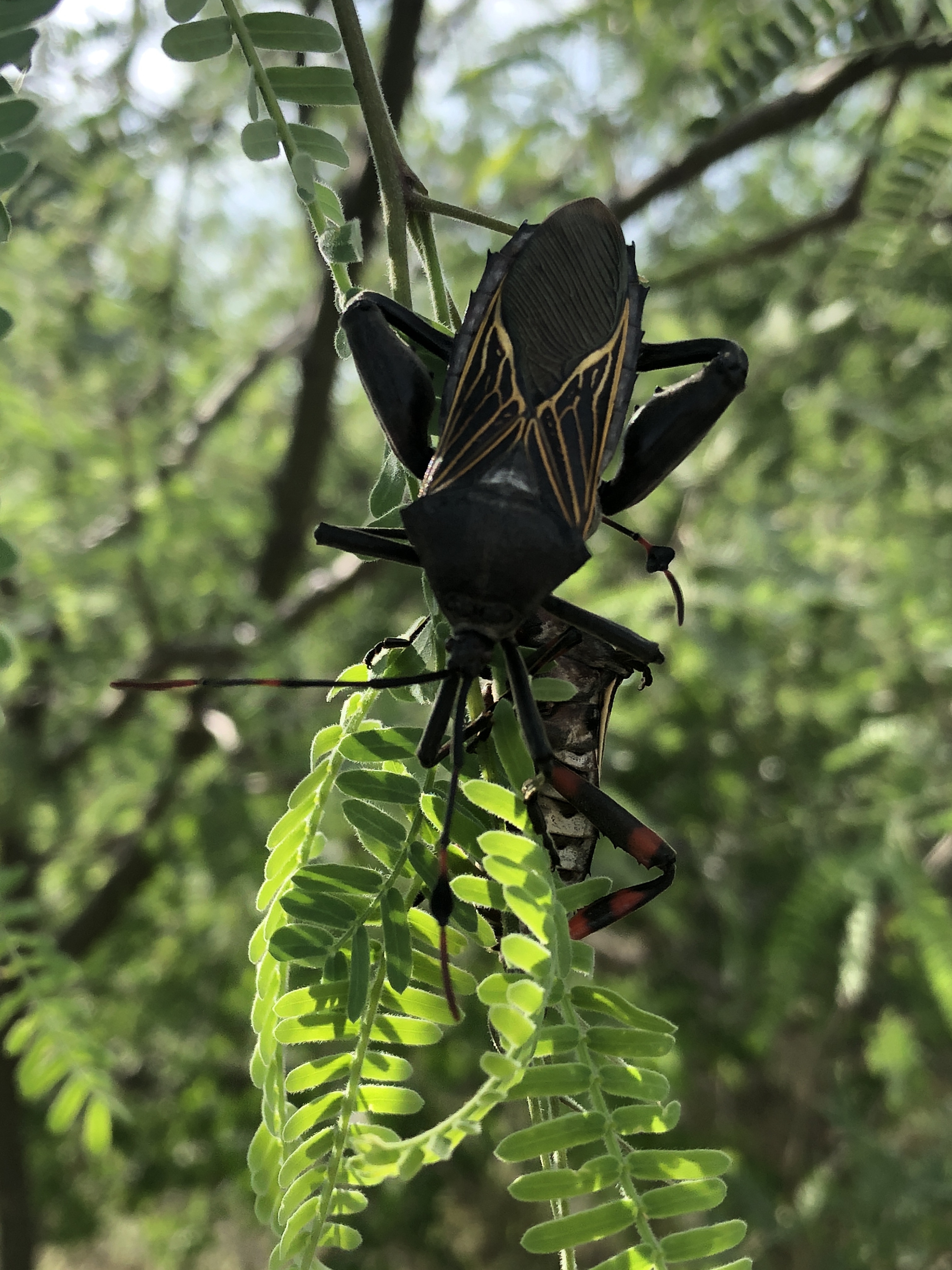
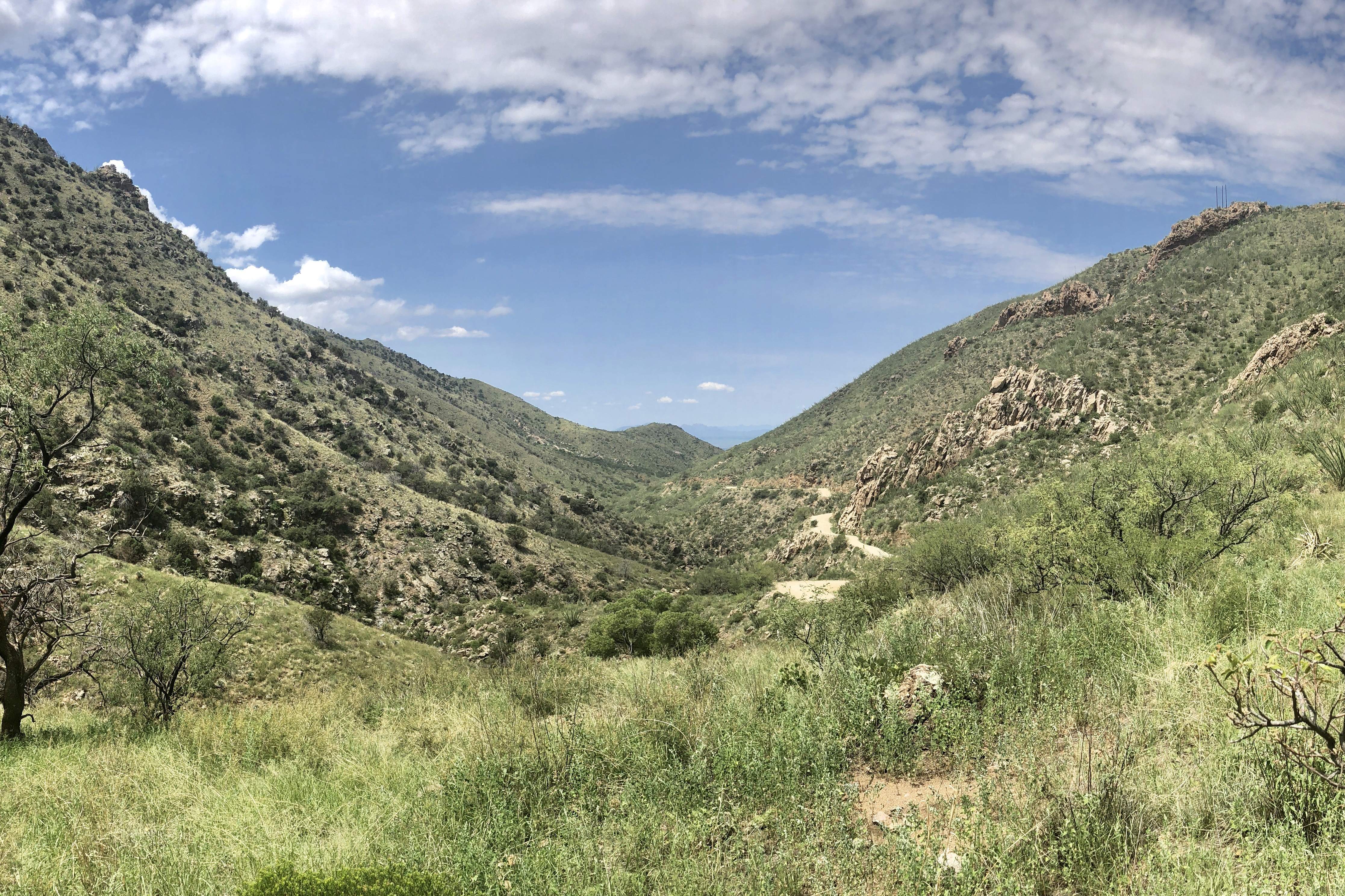
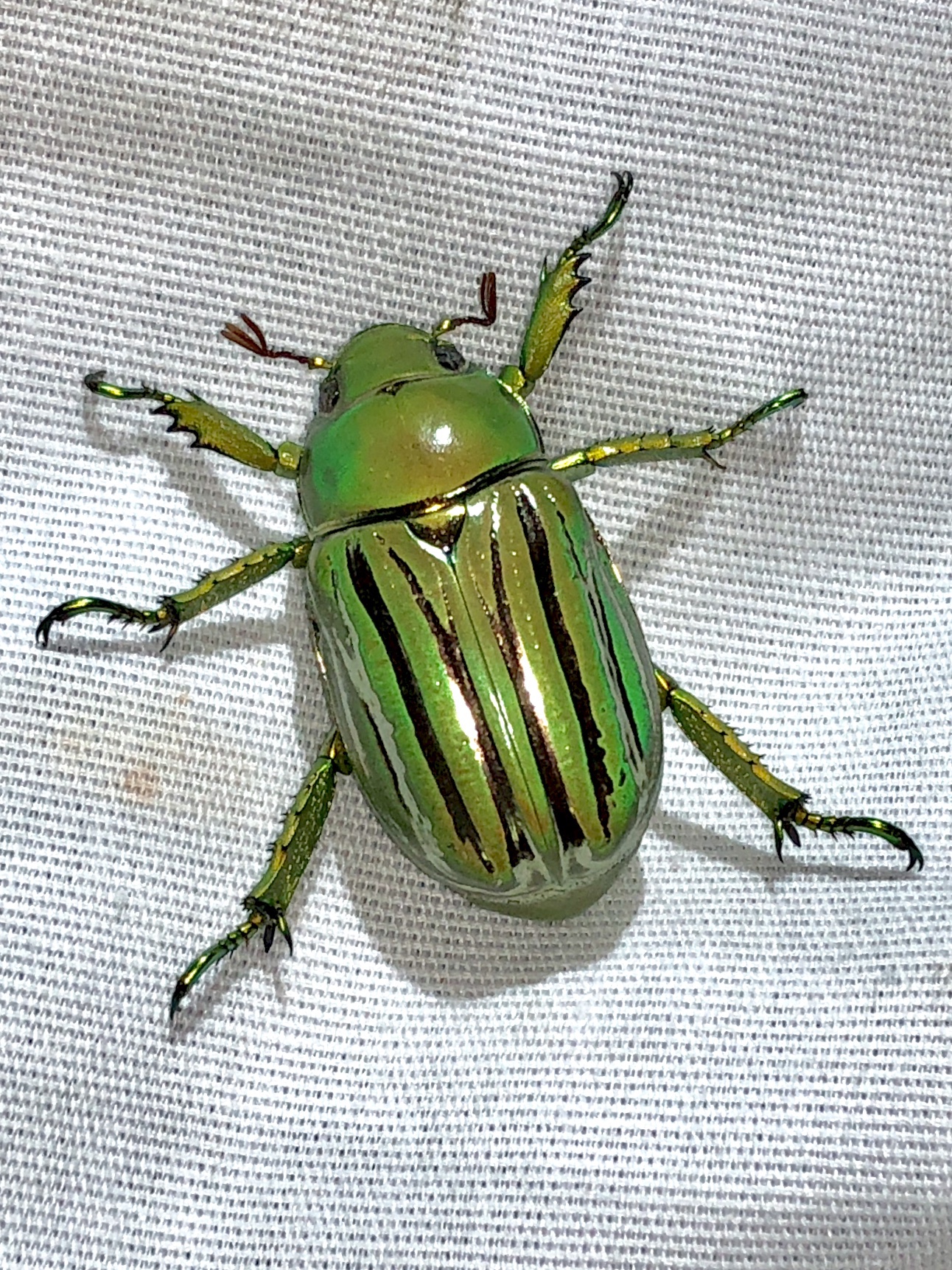
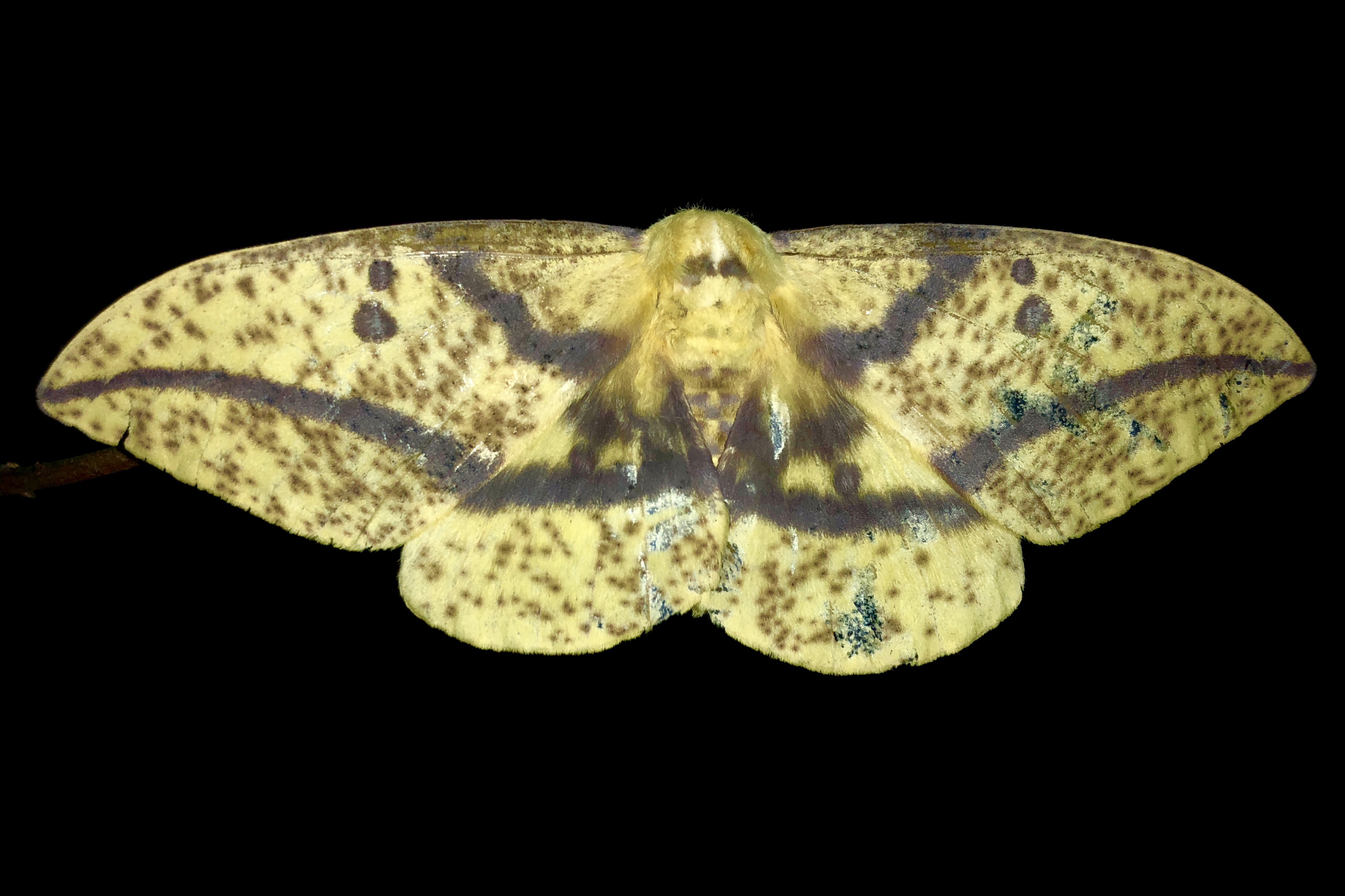
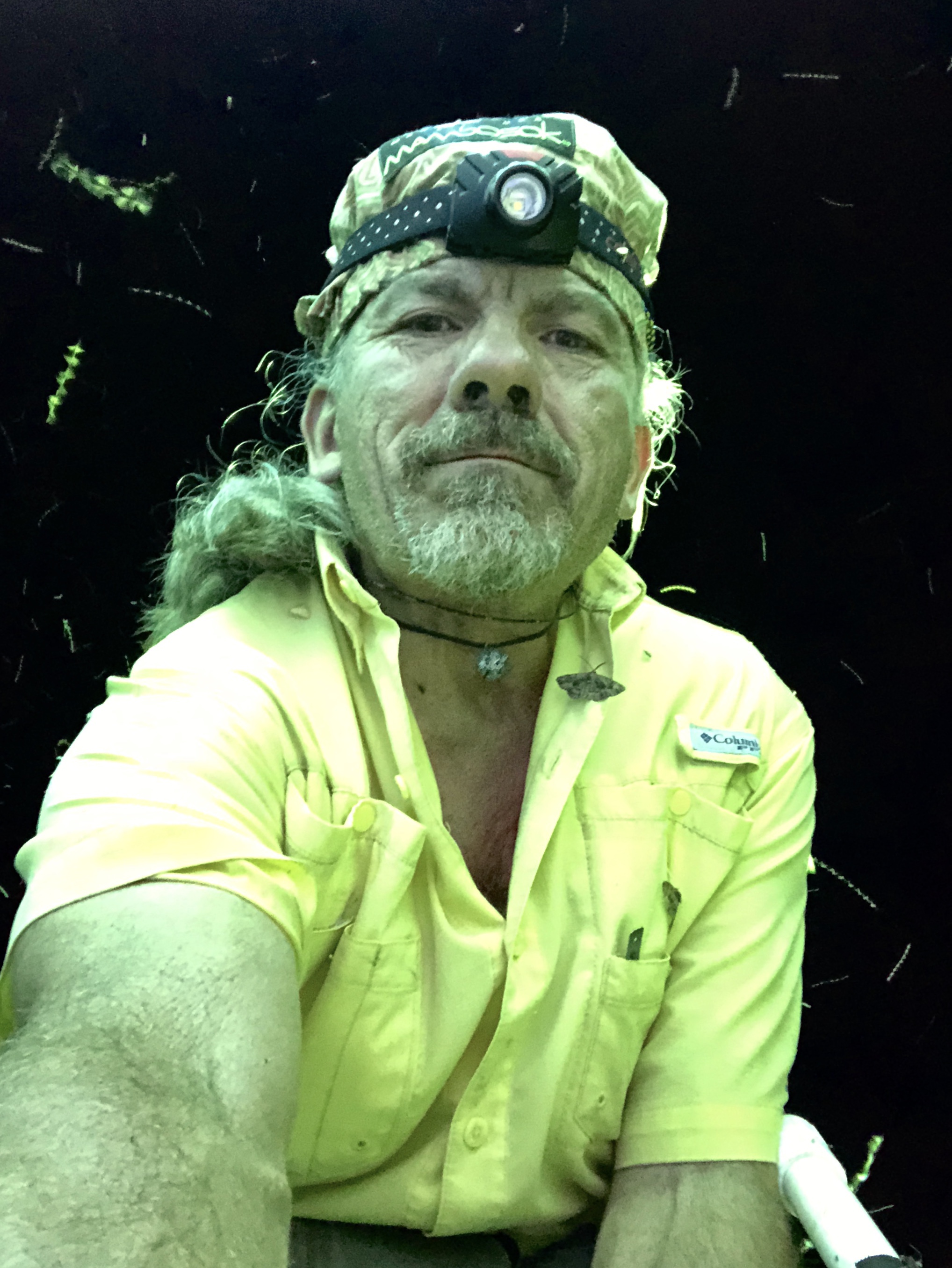
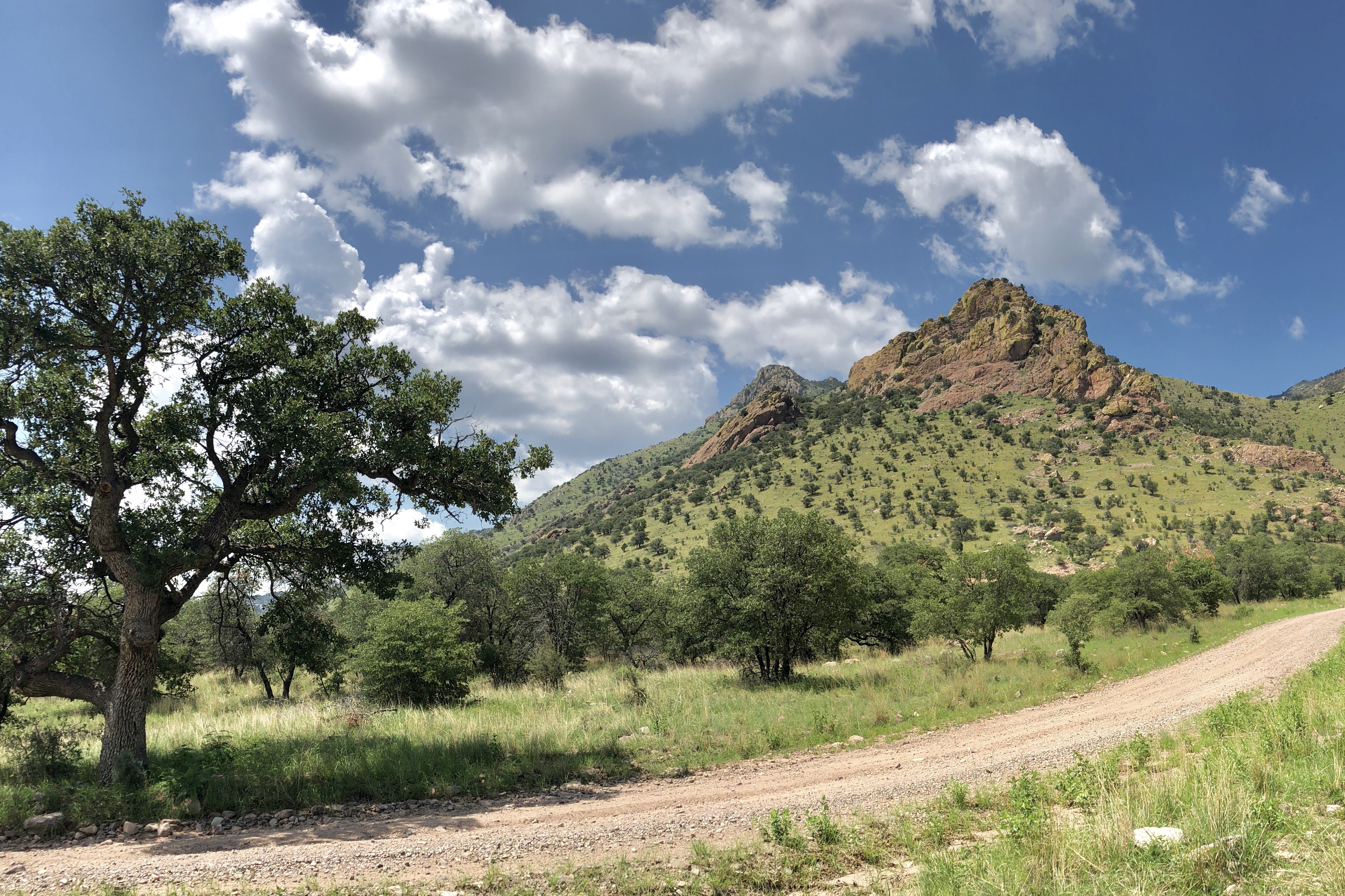
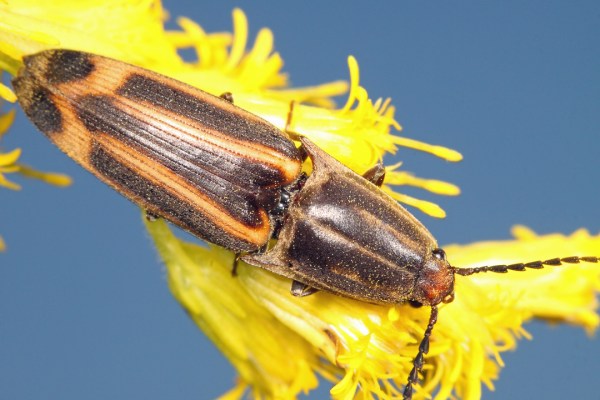
2025 Southwestern U.S. Insect Collecting Trip iReport: Act 1

Welcome to the 17th “Collecting Trip iReport” covering the first of two planned insect collecting trips to the southwestern U.S. this season—this first one occurring during June 4–13. This was another solo trip, and while it was not as long as I’d hoped, I still managed to visit 15 different localities—one in northwestern Oklahoma, six in northern Arizona, six in southern Utah, and two in southern Nevada.

Per usual, this report assembles field notes largely as they were generated during the trip. They have been lightly “polished” but not substantially modified based on subsequent examination of collected specimens unless expressly indicated by “[Edit…]” in square brackets. Again, I brought my “big” camera and took macro photographs of certain insects in the field that will be featured in future individual posts. However, this “iReport”, as always, features iPhone photographs exclusively. Previous collecting trip “iReports” are:
2013 Oklahoma
2013 Great Basin
2014 Great Plains
2015 Texas
2018 New Mexico/Texas
2018 Arizona
2019 Arkansas/Oklahoma
2019 Arizona/California
2021 West Texas
2021 Southwestern U.S.
2022 Oklahoma
2022 Southwestern U.S.
2023 Southwestern U.S.
2024 New Mexico: Act 1
2024 New Mexico: Act 2
– 2024 New Mexico: Finale


Day 1

I left Kansas City in the morning with two goals: 1) look for Acmaeodera robigo (family Buprestidae) in Texas Co., Oklahoma (based on a 2011 observation posted to BugGuide), and 2) make it to Black Mesa State Park in the far northwestern corner of the Oklahoma panhandle before sunset (to avoid having to set up camp in the dark). It was a long day of driving (mostly through heavy rain), but by the time I arrived at the A. robigo locality, skies were clear and the area was dry. Texas Co. is the largest (and seemingly flattest!) of the three Oklahoma panhandle counties, but I have not collected in the county previously because most of it has been converted to cultivated wheat. This particular location, however, lies within the Beaver River drainage and, thus, features native shortgrass prairie vegetation.
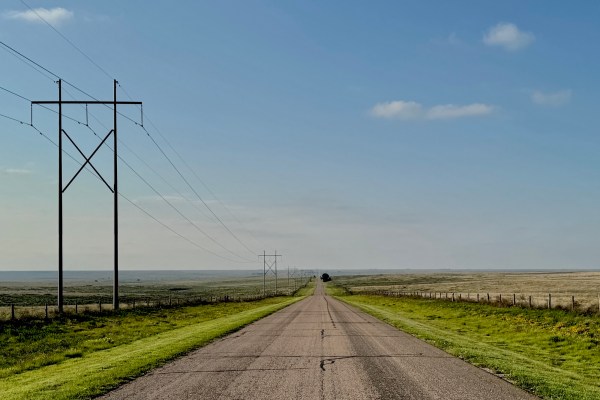
Beaver River drainage where Acmaeodera robigo was observed in 2011.

The host plant mentioned in the A. robigo observation, Melampodium lecanthemum (blackfoot daisy—family Asteraceae), was blooming abundantly along the roadsides, so I checked the flowers carefully up one side of the highway and down the other side.

Melampodium lecanthemum (blackfoot daisy).

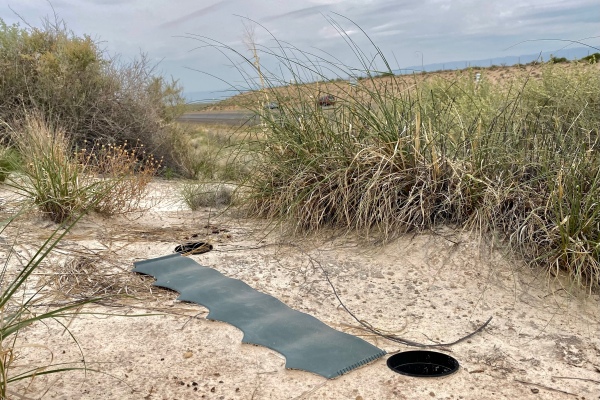
Nothing was seen on the flowers, but given the lateness of the hour and cool temps I did not expect to see anything. Still, I set three white bottle traps in the area within patches of M. leucanthemum and will plan on retrieving them up later this season. With luck, the traps will have attracted adults if the species as they visit the nearby flowers.

Bottle trap, antifreeze, and a spade are all that is needed to trap flower-visiting insects.

Moving west I quickly entered Cimarron Co.—I always enjoy seeing this double-line of utility poles stretching to a seemingly endless horizon at the border between Texas and Cimmaron Counties. The latter is not only the westernmost county in the state, it is also the only county in the U.S. that borders four other states (Texas, New Mexico, Colorado, and Kansas).
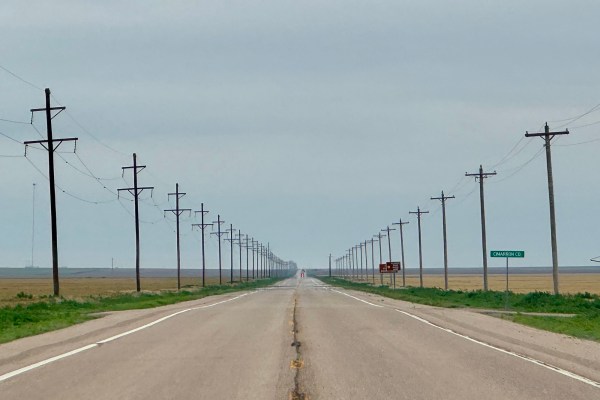
Entering Cimmaron Co., the westernmost county in Oklahoma.

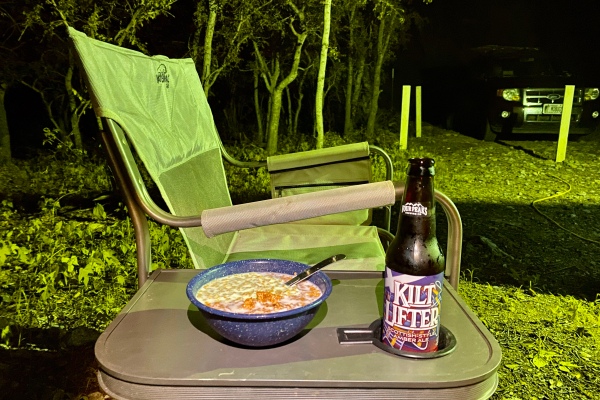
I made it to Black Mesa State Park with plenty of daylight left to set up camp. Per usual, after getting camp setup I enjoyed “refreshments” and waited for nightfall to walk the roads looking for nocturnal beetles (or any other critters that might be out and about). I did see an Eleodes sp. (darkling beetle—family Tenebrionidae) early in, but the night was chilly, and the onset of light drizzle put an end to the walk.

Ready for bed!

This would not be the end of my nighttime hiking, however—at 3am I was awakened by the drone of a motor, and it was loud enough that sleep would be impossible. Thinking it was an inconsiderate camper down at the RV campground, I decided to investigate and discovered it was a water pump within the campground. I decided if I couldn’t sleep, then somebody else would also have to be awakened, namely the campground host. It took the elderly woman a few minutes to come to the door after I rapped a few times on her RV, and I apologized for waking her before explaining the situation. She said she wouldn’t know anything about how to turn it off, to which I replied that I didn’t expect her to know that but I’ll bet somebody does and maybe she could make a call and figure out who that is or this wouldn’t be the last time somebody wakes her at 3am. I figured that would be the last of it, that I’d be awake until morning, and that I would have another nine hours of driving the next day on only three hours of sleep. But, to my relief, about a half hour later a park maintenance vehicle pulled up to the pump house, and a young man turned the motor off (I thanked him profusely). I did eventually get back to sleep and awoke to birdsong and clearing skies.


Day 2

There is a low water bridge at the south entrance to the park that crosses a normally dry creek. However, this time the creek was filled with water with lush growth of sedges and grasses along the water’s edge. This is a perfect situation for Taphrocerus species (family Buprestidae), and at this literal transition point from the eastern to the western fauna I’m not sure what species I might encounter there. Unfortunately, thorough sweeping of the sedges produced no beetles, so the question will for now remain unanswered.
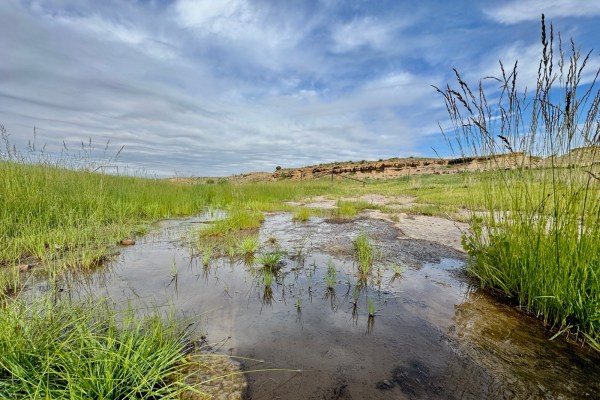
Creek at south entrance to Black Mesa State Park, Oklahoma.

Heading south and then west from the park takes you shortly into the northeastern reaches of New Mexico and the town of Clayton. Whenever I pass through Clayton I like to stop at Mock’s Crossroads Coffee Mill for a bag of freshly ground coffee.

Mock’s Crossroads Coffee Mill, Clayton, New Mexico.

Skimming across the northern reaches of New Mexico for the next several hours was uneventful with no indication of a repeat of the heavy rain that pounded me for much of my drive yesterday across Kansas and Oklahoma. The situation changed, however, as I crossed the Continental Divide on the approach to Farmington.

I think I’m going to get wet.
I’m sure I’m going to get wet.

Sure enough, I once again had the pleasure of driving through driving rain. In addition, I arrived at my next planned spot just north of town (Brown Springs Campground) to find the entrance and main road under several inches of water. No point in trying to collect there, so I continued on towards the next stop (Devils Canyon Campground) in southeast Utah (San Juan Co.) in hopes of arriving early enough to set up camp before dark. Things looked promising as I crossed through the southwestern corner of Colorado towards Monticello, Utah, as patchy clouds filled a sun-filled sky.

Near Dove Creek, Colorado.

The presence of large oval emergence holes in the lower part of the limb confirmed that this tree was, indeed, under attack by such, and stripping the bark around the holes revealed fresh workings from the larvae indicating that some of them may still be inside the tree.

By the time I reached the campground, however, the rain had returned—not hard, but steady. I didn’t relish the thought of setting up camp in the rain and did something I almost never do—heading back into town and spending the night in a motel! At least I was able to enjoy a burger cooked by someone else for a change.


Day 3

Day 3 started off gray and overcast with the threat of more rain, but looking at radar and the areas I was going further west had me optimistic that I would get out of the rain once and for all. My ultimate stop for the day would be Jacob Lake Campground in north-central Arizona (Cocconino Co.), and my plan was to stop at a number of places along the way. Devils Canyon Campground itself, however, was still under clouds, meaning that collecting there would likely not be very productive. Nevertheless, despite last night’s rainout and the continuing cool, wet conditions, I decided to place some traps that I could pick up later in the season and, thus, get at least a sample of the area’s beetle fauna.

Devils Canyon Campground, Utah.

The campground lies at ~7000 ft, and I found a ridge with ponderosa pine/gamble oak forest on the slope to one side and pinyon/juniper/oak woodland on the crest of the ridge to the other. On the ponderosa side I set a white bottle trap, and on the pinyon/juniper side I set a sweet red wine-baited jug trap. There wasn’t much in bloom at the time other than a few yellow composites and the occasional Oenothera cespitosa (tufted evening primrose—family Onagraceae) with blossoms still wide open despite the daylight hour due to the overcast, cool conditions.
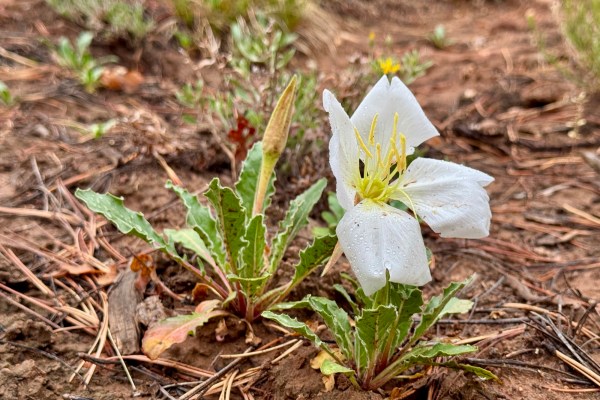
Oenothera cespitosa (tufted evening primrose).

Coming down off the plateau towards Bluff, Utah, thick low clouds gave way to higher broken clouds with warmer temps (mid-60s). I stopped a few miles west of town at a location where Mont Cazier once collected what was later described as Agrilus utahensis (family Buprestidae) and began sweeping roadside vegetation. While I was sweeping, I encountered three Amannus vittiger (family Cerambycidae) on the flowers of Sphaeralcea coccinea (scarlet globemallow—family Malvaceae) (along with a few meloids and bees for others). The record of A. utahensis was from quite a bit later in the season (late July), so I didn’t really expect to find it (although I was hopeful). However, I did sweep what appears to be Agrilus malvastri.
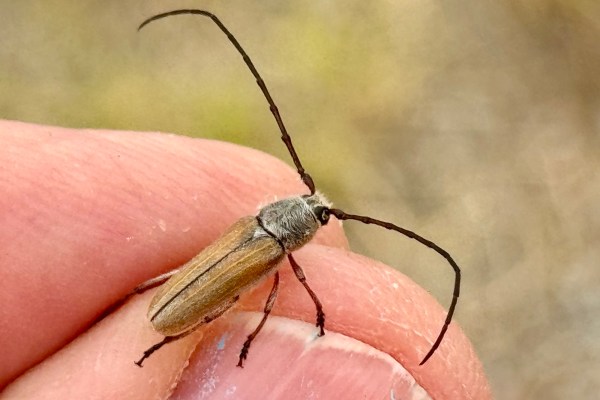
Amannus vittiger collected on flowers of Sphaeralcea coccinea (scarlet globemallow).
Sphaeralcea coccinea (scarlet globemallow).

A short distance west of the stop had me entering northeastern Arizona, and traveling west of Dennehotso on Hwy 160 I encountered patchy, low lying clouds though which beams of bright sunlight lit up the red rocks below and cast a reddish hue on the bottoms of the clouds.
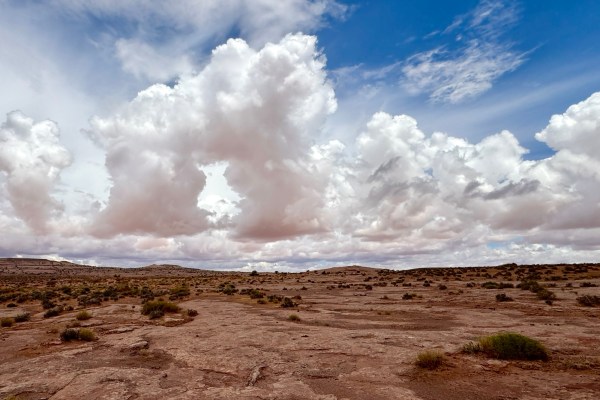
West of Dennehotso, Arizona on Hwy 160.

A bit further west on Hwy 160 is a formation apparently known as “Baby Rocks.”
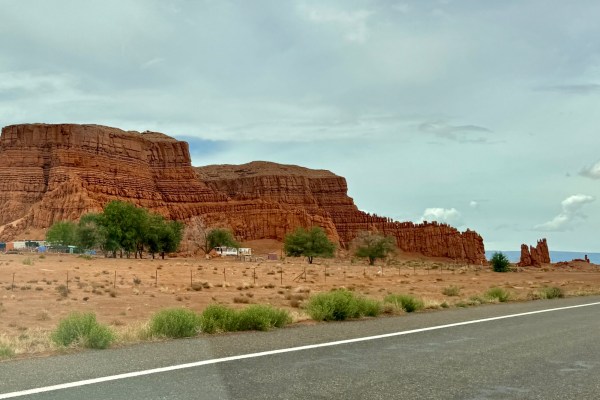
Baby Rocks, west of Dennehotso, Arizona,

As I drove, I kept my eye out for areas along the highway with stands of plants in bloom, and I found just such at a roadcut on Hwy 98 near mm 325 as I approached Page, Arizona (Cocconino Co.). There was a fair amount of Sphaeralcea coccinea in bloom, off which I collected a handful of Acmaeodera pubiventris lanata and one Amannus vittiger from the flowers. I swept the grasses and other roadside vegetation thoroughly, but that produced nothing. I returned my attention to the Sphaeralcea and swept it thoroughly as well to be sure I didn’t miss anything. Good thin I did, as that turned up one more each of A. p. lanata and A. vittiger as well as a few Agrilus sp. prob. malvastri.

Acmaeodera pubiventris lanata on flower of Sphaeralcea coccinea (scarlet globemallow).

After passing through Page, Arizona, rather than continuing straight west to Jacob Lake Campground, I veered north into Kane Co., Utah to revisit a locality I’d visited a couple of years ago about 23 mi northwest of Page on Hwy 89. The last time I stopped here (late June 2023), I found a few Nanularia brunneata (family Buprestidae) on the stems of Eriogonum inflatum (desert trumpet—family Polygonaceae). That visit was about three weeks later in the season than this time, and not only was the area dry (despite all the rain east of here), but there was very little new growth on any of the E. inflatum plants—just the dried stalks of last year’s growth. Still, there was fresh growth present at the spot, in the form of Ericameria nauseosa (gray rabbitbrush—family Asteraceae), on which I collected a single cryptocephaline leaf beetle, and along the roadside rain shadow in the form of Sphaeralcea parvifolia (small-leaved globemallow), on the flowers of which I collected several more Agrilus sp. prob. malvastri. Eventually, I did find a single E. inflatum plant with small sprouts of new growth on which I found several clytrine leaf beetles. Sweeping the S. parvifolia produced one more Agrilus sp. prob. malvastri, a single Acmaeodera navajoi—a species I collected here abundantly two years earlier, and a series of a very small chrysomelid leaf beetle species that I observed feeding on the foliage.

Once I got a bit further west, the landscape turned green again, indicating recent rains, so I checked iNaturalist for nearby records of E. inflatum that I could check for N. brunnea. There was one a few miles east of Kanab (Kane Co.) and on the way to Jacob Lake Campground, so I stopped by to see if I could find the plants. Unfortunately, the record turned out to be on private property, so I couldn’t go to the precise location. I looked around the area outside the property but didn’t see any plants; however, S. parviflora was blooming abundantly along the roadsides, and sweeping it produced a few more Agrilus sp. prob. malvastri and a couple of small bees (for Mike).
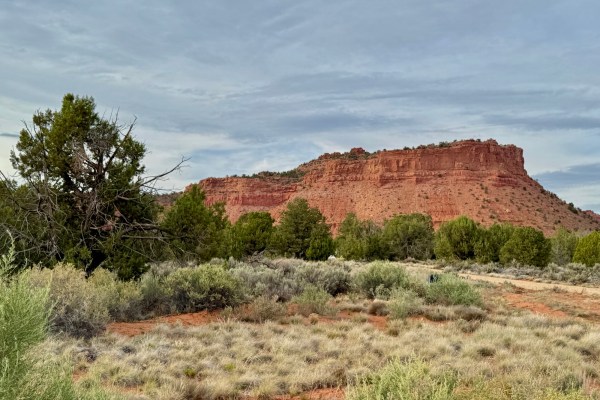
11 mi E of Kanab, Utah.

There were also several blooming Opuntia polyacantha var. erinacea (Mojave pricklypear—family Cactaceae), which I checked for Acmaeodera, but I found only one large bee (again, for Mike). With the sun by then dropping close to the horizon, I called it a day and headed for the campground.
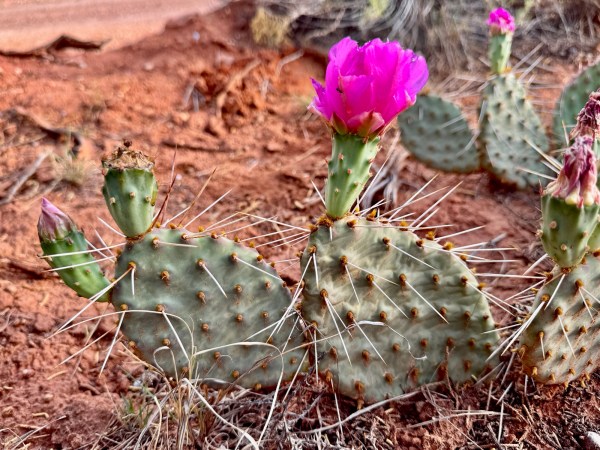
Opuntia polyacantha var. erinacea (Mojave pricklypear)—pink-flowered form.

I arrived at Jacob Lake Campground (Cocconino Co., Arizona) and got camp setup before dark, which settled in as I was cooking dinner. It was chilly at this relatively high elevation (7900 ft)—temps were already in the mid-50s and were forecast to drop down into the 40s by morning. Despite the chill, I found a Zopherus uteanus (family Zopheridae) and a smaller tenebrionid on a cut stump of Pinus ponderosa (ponderosa pine).
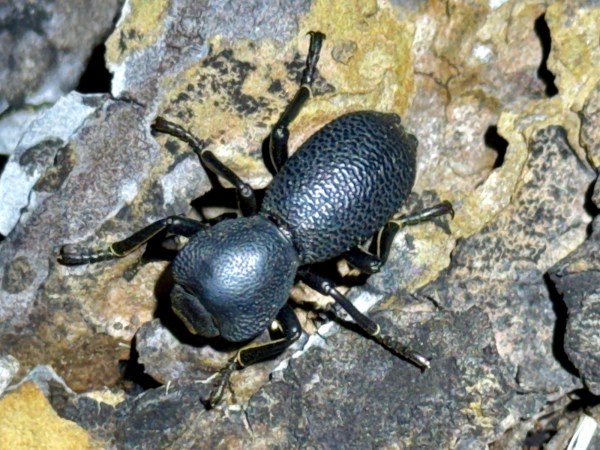
Zopherus uteanus on cut stump of Pinus ponderosa (ponderosa pine) at night.

Later, I walked the site—not really expecting to see much because of the chill, but I did find three Iphthiminus lewisii (family Tenebrionidae) on the trunk of a recently fallen P. ponderosa and saw two more on a pine stump.

Iphthiminus lewisii on trunk of recently fallen Pinus ponderosa (ponderosa pine) at night.

With three days of travel—the first two mostly rainy and today dry but still quite cool, I’m hoping the forecasted warmer, sunnier conditions for tomorrow and onward come true and I can get this collecting trip in high gear.
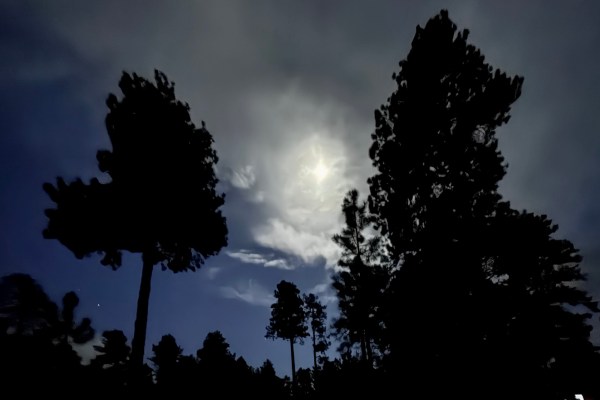
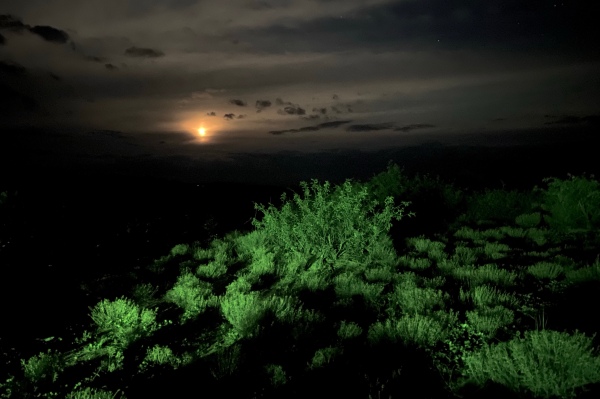
A waxing gibbous moon illuminates my camp at 7900’ in Jacob Lake Campground, Kaibab National Forest, Arizona.

Day 4

After morning coffee (and moving to a different campsite—long story!), I went back north a bit to the area near Lefevre Overlook that had been only lightly impacted by the widespread burns that occurred here a few years ago and is showing signs of recovery. It felt “early season” with patchy clouds, moderate temps in the low of mid 70s, and plenty of moisture in the soil with lots of plants in bloom. Insects were not abundant, but with continued beating I collected a couple of Anthaxia sp. (family Buprestidae) and a variety of small clytrines, cryptocepahlines, and curculionids off of Purshia standsburyana (Standsbury’s cliffrose—family Rosaceae) in flower.

Purshia standsburyana (Standsbury’s cliffrose).

As the morning warmed, insects seemed to become a bit more active, although the day continued to feel “early season.” Persistent visual searches and beating of a variety of plants turned up a few small black/yellow Pidonia? (family Cerambycidae), one Acmaeodera diffusa?, and one Anthaxia sp. on flowers of Hymenopappus filifolius (fine-leaved hymenopappus—family Asteraceae); one Agrilus sp. prob. malvastri, another Pidonia?, and one A. diffusa? on flowers of Sphaeralcea ambigua (desert globemallow); several small clytrine and cryptocephaline leaf beetles and curculionid weevils on Quercus gambelii (Gambel oak—family Fagaceae); and several A. diffusa? and a few Anthaxia sp. on flowers of Tetraneuris acaulis (four-nerve daisy—family Asteraceae). Sweeping through the area where the T. acaulis was growing produced nothing further of interest, so I placed a sweet red wine-baited jug trap and a yellow bottle trap in the area—hopefully they will each attract a variety of interesting beetles over the next few months.

Sweet red wine-baited jug trap hanging in a tree and a yellow bottle trap sunk into the ground below.
Phrynosoma hernandesi (greater short-horned lizard).

A bit further down, the mountain escaped the fire that ravaged many other parts of the mountain. I expected to see much more insect activity, but the opposite instead was the case. This may be related to the lower incidence and diversity of flowering plants, which were likely triggered at the previous spot by the fire. I did find a small area where Sphaeralcea ambigua was blooming abundantly and sweeping through them produced a fine series of Agrilus sp. prob. malvastri along with a few bees (for Mike). I walked up the slope a ways, but there was virtually nothing in bloom—unlike what I had seen at the previous spot. Eventually, I did find a few Hymenopappus filifolia and Tetraneuris acaulis, but the only I beetle I saw on any of them was a single Acmaeodera diffusa? on the latter.

Escobaria vivipara (viviparous foxtail cactus).

Without anything luring me further up the slope, I worked my way back down towards the car and was about ready to call it a day when I decided to take a gander a bit down the slope—just in case I might see something of interest. Nothing captured my attention, however, so I worked my way over a bit to take a different route back. That’s when I saw it! All day long I had been keeping my eye out for large Utah junipers (Juniperus osteosperma—family Cupressaceae) with thigh-sized main limbs—one of which was dying (not dead), possibly a result of woodboring beetles, and before me was just such a tree!
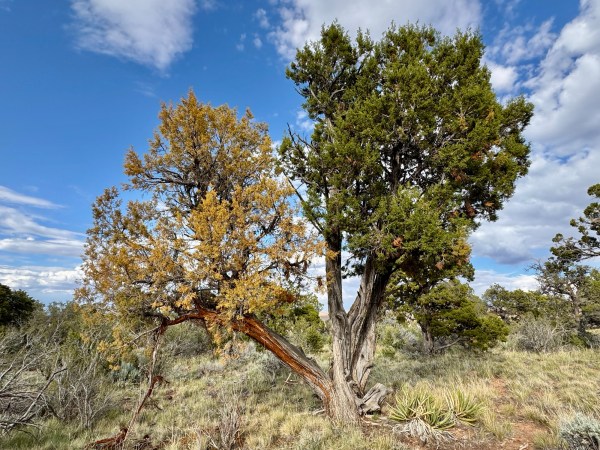
Juniperus osteosperma (Utah juniper) with dying main limb.

The presence of large oval emergence holes in the lower part of the limb confirmed that this tree was, indeed, under attack by such, and stripping the bark around the holes revealed fresh workings from the larvae indicating that some of them may still be inside the tree. 
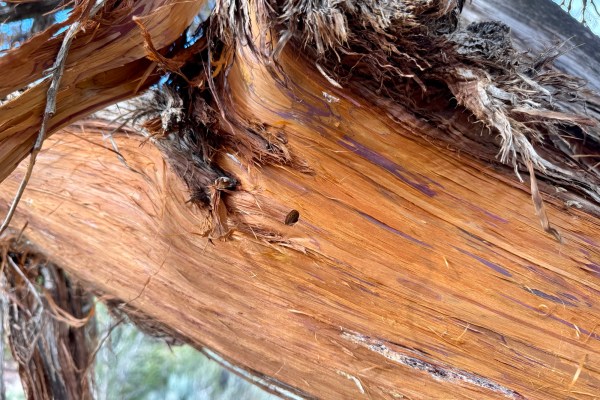
Large oval emergence hole caused by a species of longhorned beetle.
Fresh frass packed in the galleries by longhorned beetle larvae.

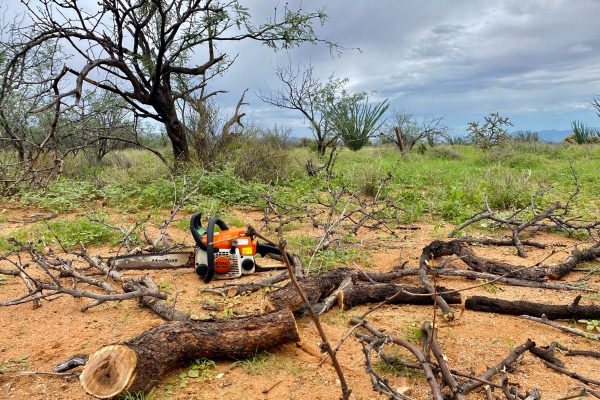
I hiked back to the car to get my chainsaw—brought along on the trip just for such an eventuality—and cut a portion of the infested limb out of the tree so I could bring it home and attempt to rear out the adults. My hope is that the species infesting the tree is Semanotus juniperi (family Cerambycidae), a very uncommonly encountered longhorned beetle that breeds in the large limbs of juniper in this area, so I’ll be keeping my fingers crossed. Hauling out the infested bolt along with the chainsaw was a struggle, but eventually I made it back to the car and celebrated a successful last act to what had up to that point been a not too spectacular first full day in the field.
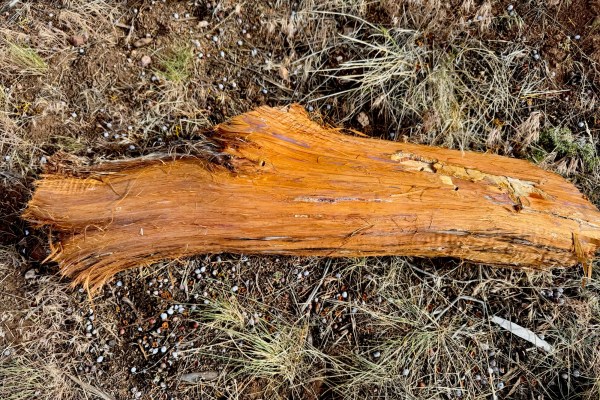
Bolt of Juniperus osteosperma (Utah juniper) infested with longhorned beetles.

I needed a break after working the chainsaw and hauling out the wood, so I went back to the campsite to enjoy an end-of-the-day “beverage” and eventually dinner. However, part of me was thinking Inshould have collected more of that infested juniper to increase my odds of successfully rearing whatever was infesting it, so I resolved to do exactly that in the morning.
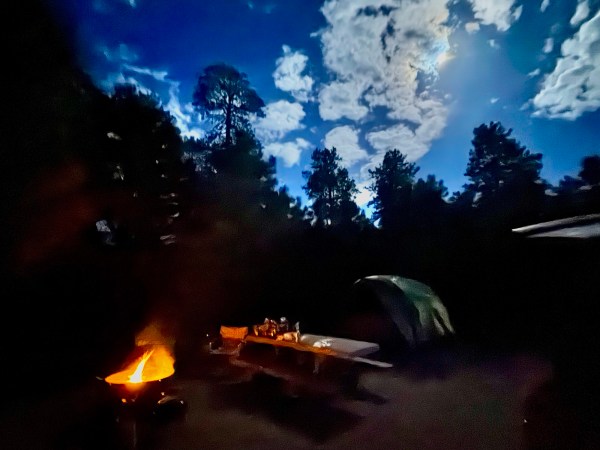
Dinner on the grill at Jacob Lake Campground.

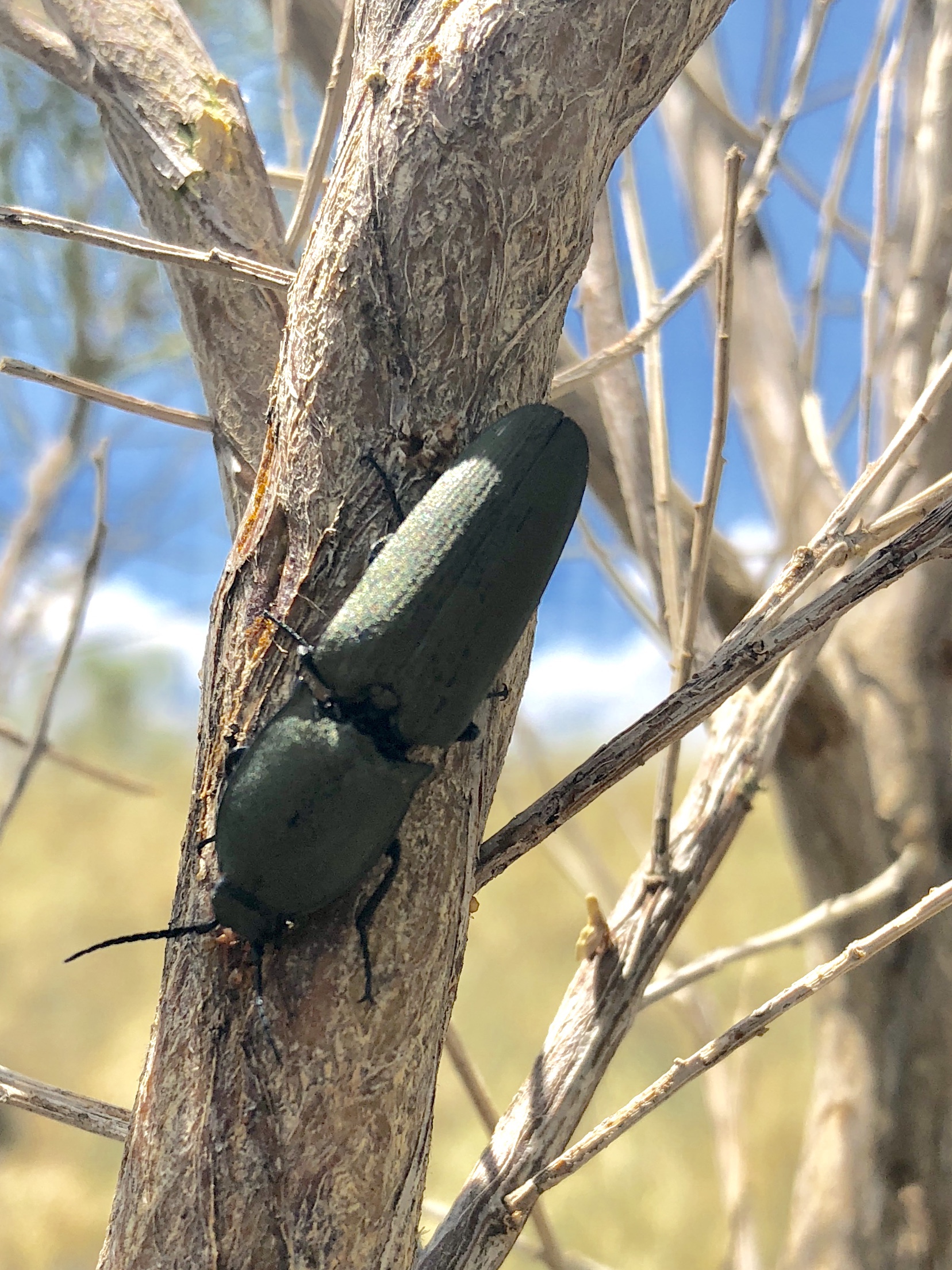
Before dinner as I was gathering kindling, I had noticed a large, fallen ponderosa pine behind the campsite and returned after dark to see if there might be any nocturnal beetles attracted to it. It seemed recently dead, but as I inspected the upper branches more closely I saw that it had been dead long enough that whatever would have been attracted to it had already come and gone. I thought maybe I could find beetles under the bark and began peeling the bark in the trunk. The bark was still intact but was just loose enough that I could peel it off in large sheets. Doing so, however, revealed only a couple of click beetles (family Elateridae). I didn’t see any other fallen or dead trees in the area, but on the trunks of large living ponderosa pines I found a tenebrionoid and several individuals of a Lecontia discicollis (burnt conifer bark beetle (family Boridae). [Edit: thanks to Alex Harmen for the identification on this one!] Nearby was a cut stump of a very large ponderosa pine, and peeling back the thick bark at the base of the stump revealed yet another elaterid species and two darkling beetles. I was hoping to find more Zopherus uteanus, but no such luck!

Lecontia discicollis (burnt conifer bark beetle) on trunk of Pinus ponderosa (ponderosa pine) at night.

Day 5

After a morning of the coffee ritual and observing campsite wildlife, I made an ice run at the nearby service station.

Callospermophilus lateralis (golden-mantled ground squirrel).
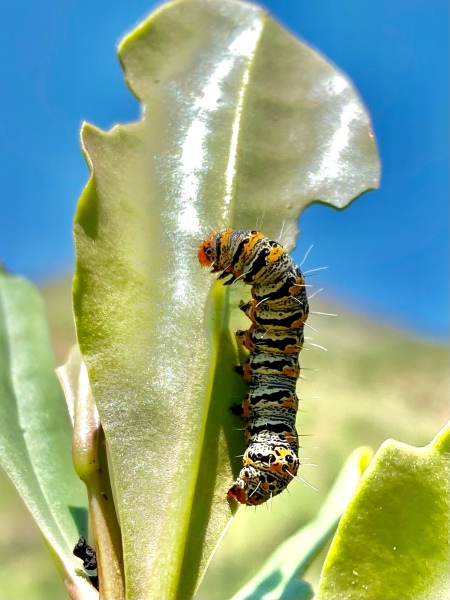
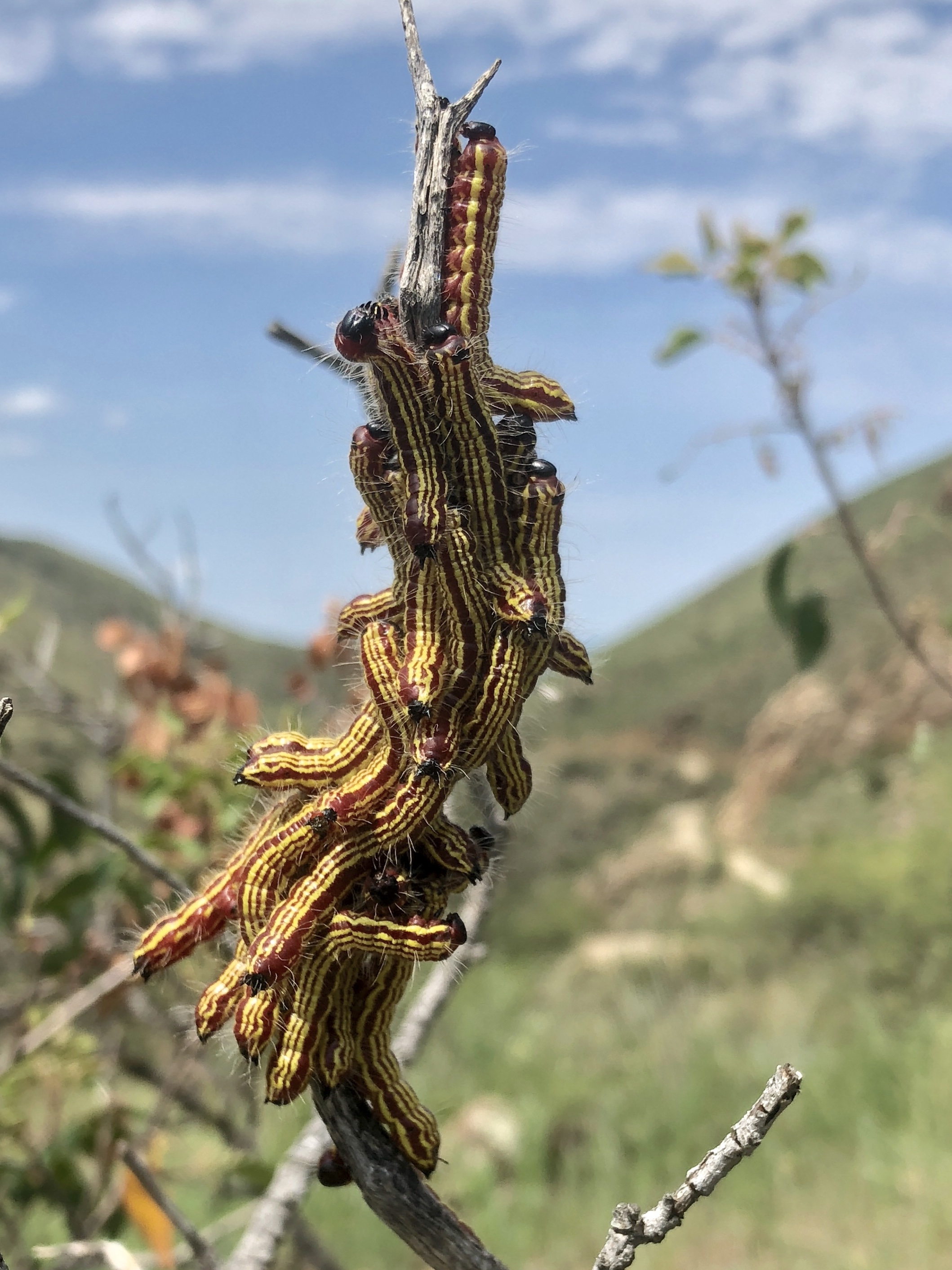
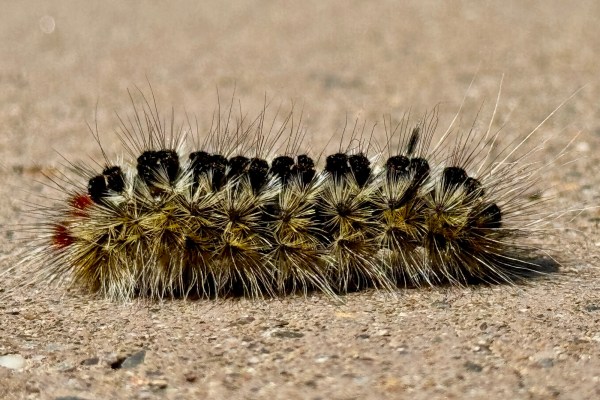
Lophocampa ingens (family Erebidae) larva.
Meanwhile, a century later…

I was having second thoughts about taking only a single bolt of wood from cerambycid-infested Utah juniper that I found at the end of yesterday’s collecting and decided to go back to get more of the infested wood to improve the likelihood of successfully rearing adults from the wood. It would not be an easy job—I’d have to haul the chainsaw down the the tree, cut off the two remaining infested bolts, cut the bolts down to cartable pieces, and then haul the chainsaw and wood bolts back to the car, likely requiring several trips. It was worth it, however, because as I was stripping bark to see where I needed to make the initial cut, I encountered an intact cadaver of one of the beetles that had died while trying to emerge from the wood. I carefully extracted the abdomen from the tree and found the head and pronotum in the bark and placed them in a vial, and they without a doubt represent the species I was hoping they were—Semanotus juniperi, a super rare species that very few people have ever collected [tip of the hat to Ron Alten for sharing his knowledge about this beetle with me and enabling me to find this beetle for myself!]. I’ll be able to put the beetle back together when I get home, and I’m hopeful I’ll rear at least a small series of beetles from the wood I’ve collected.
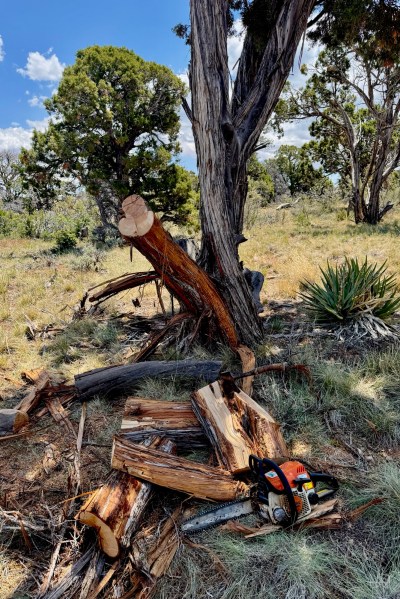
I love the smell of chainsaw in the morning!

Having carted the additional bolts of wood back to the car and confident in my ability to recognize the work of this species, I looked for—and found—a few more trees that the beetle had infested. However, in each case the workings were old and no beetles were encountered chopping into the wood. I also spent some time looking for much smaller emergence holes in the thick trunk bark of several junipers and carefully shaving the bark to see if I could find another rare longhorned beetle species, Atimia vandykei. I found several galleries that might have been this species, but no beetles or larvae were encountered, leading me to think I might have been a bit late and the adults have mostly emerged. A large, recently dead Pinus edulis (Colorado pinyon pine) also caught my attention, as it looked fresh enough to still contain wood boring beetles that might have infested it. The wood was very hard and difficult to chop into, but I didn’t encounter any larvae of any kind and elected not to collect a bolt or two for rearing. Lastly, I spent some time looking for dead Gambel oaks, which in this area could host Xylotrechus rainei (family Cerambycidae), a recently described species that few have collected. I found several dead stems of the shrubby oak species that contained workings consistent with those of Xylotrechus, but in each case the workings were old and no beetles or larvae were present. This string of “failures” might have seemed like the makings of a bad day, but the success with S. juniperi overshadowed those failures and I left the site happy (though exhausted!).

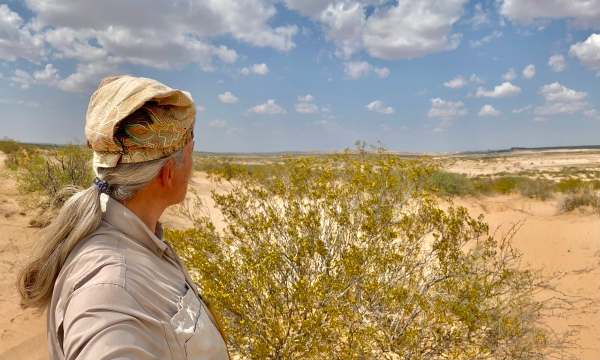
The author sports his new field hat (an early Fathers Day gift!).

I returned to the first stop of yesterday to see if I could find junipers in this area infested with S. juniperi, reasoning that since the area had burned a few years ago some of the still-living trees might be stressed, thus making them more vulnerable to infestation. I also wanted to see if the bottle and jug traps I placed yesterday had caught anything of interest (even though it had only been one day). Along the way I picked up a single Anthaxia sp. on the flower of Tetraneuris acaulis and a few Acmaeodera diffusa? on flowers of Sphaeralcea ambigua. There wasn’t anything of interest in either trap, so I set about looking for infested junipers. I found only one, but again the workings were old and no larvae or adults were encountered. I also examined a few dead stems of Gambel oak, but none showed signs of infestation. (I suspect they had been killed by the fire and the damage to the wood by the fire made the stems unsuitable for infestation.) I did, however, find a small more recently dead Colorado pinyon pine that showed signs of recent infestation all along the trunk and collected it for rearing. By then, the day had warmed considerably and I was already exhausted from the morning’s chainsaw session, leading to a loss of motivation to keep looking. I needed a change of pace and decided to head higher up the mountain back into the ponderosa pine forest for some more “traditional” woodboring beetle collecting.
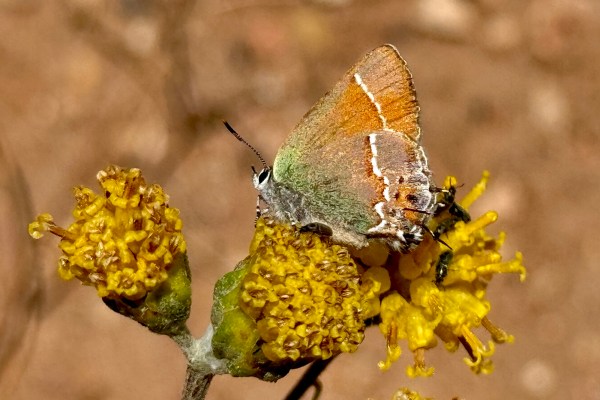
Callophrys gryneus (juniper hairstreak) on flowers of Hymenopappus filifolia (fine-leaved hymenopappus).

The forest at this site is dominated by ponderosa pine, and the strategy here was straightforward—look for large, dead or dying trees, either standing or recently wind-thrown, and inspect the examine the trunks for woodboring beetles. I came to this spot two years ago in early July, so this time was about four weeks earlier in the season. I had two specific targets (beyond woodboring beetles in general)—Chalcophora (family Buprestidae) and Monochamus (family Cerambycidae). Both of these genera are the subject of molecular studies being conducted by other researchers that I know, and I’ve been promising to send them fresh specimens killed and preserved in ethanol. The first wind-thrown tree I encountered was still green-needled, and I expected to find buprestid beetles all over it. Instead, all I saw were a few small Enoclerus sp. (family Cleridae). Large dead standing trees dotted the open forest, and I carefully approached and circled each one looking for beetles, paying special attention to those in full sunlight. Time after time, however, I was frustrated. Each time, I chopped into the wood a bit to examine what was going on underneath the bark, and while workings were plentiful I never encountered any larvae.
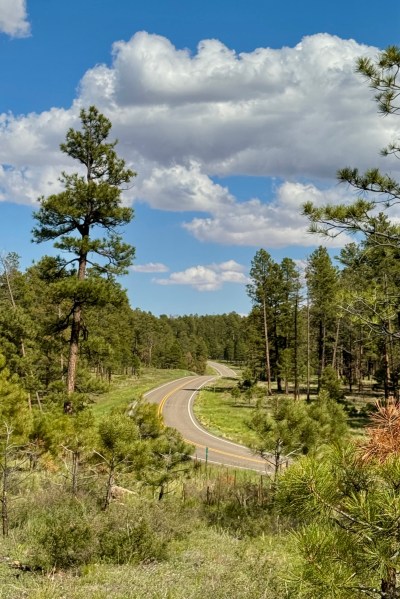

4.2 mi N Jacob Lake on Hwy 89A, Kaibab National Forest, Arizona.

Finally, I approached a large standing dead tree, and perched on its trunk in the sunlight was Chalcophora angulicollis (western sculptured pine borer). I’m happy to give this specimen up for DNA sequencing, especially since I already collected a specimen at this same spot two years ago (before the molecular study began).
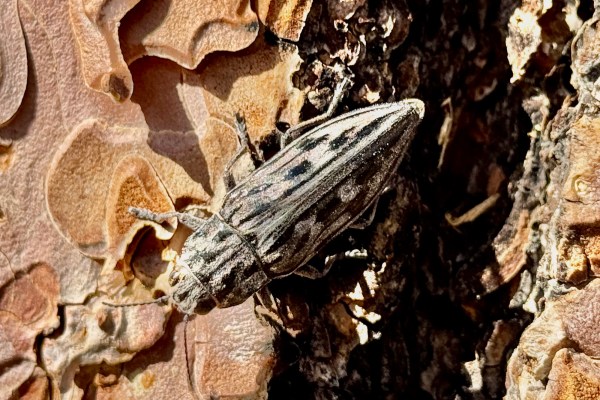
Chalcophora angulicollis (western sculptured pine borer) on trunk of dead Pinus ponderosa (ponderosa pine).

I peeled a good portion of bark of the tree it was perched on but found nothing except a large elaterid larva (I wonder if it was Alaus melanops [western eyed elater], a predator or woodboring beetle larvae).

Alaus melanops (western eyed elater) collected from under bark of dead Pinus ponderosa (ponderosa pine).

For a long time afterwards that would remain the only beetle I encountered until I found a large standing tree in the early stages of death (needles pale green but not brown) with a female Dicerca tenebrosa (family Buprestidae) searching the trunk, occasionally stopping to probe a crack or crevice with her ovipositor. Patiently waiting at the trunk rewarded me with a second individual within a short period of time.

Dicerca tenebrosa on trunk of dead Pinus ponderosa (ponderosa pine).

Another long period of nothingness ensued as I zigzagged from dead tree to dead tree, eventually retracing my steps to the only two trees on which I had found buprestids. Even that failed to produce additional beetles, but as I was standing at one of them I heard a woodpecker persistently pecking and searching and pecking on a nearby tree. The tree looked perfectly healthy at first glance, but I figured the woodpecker had to know something that I didn’t (I’m always willing to learn from locals!) and walked over to the tree. It was immense, and a closer look at the crown revealed a few browning needles scattered throughout the crown. Then a closer look at the trunk revealed several of the same small Enoclerus sp. I saw earlier crawling on it. Woodpeckers and checkered beetles don’t lie, and this tree was clearly under stress and under attack by woodboring beetles. An initial circling of the trunk revealed no other beetles, but then I noticed the gangly antennae and legs of a male/female pair of Monochamus clamator, the male apparently mate-guarding the female. I’ll be happy to contribute one of these specimens to my colleague for DNA sequencing and keep the other for my collection.

Monochamus clamator on trunk of stressed Pinus ponderosa (ponderosa pine).

By that time, the sun was starting to get rather low in the horizon and I was utterly exhausted after a full day of walking, chopping, chainsawing, and hauling. I passed by the two previously successful trees on the way back to the car, to no avail, and headed back to camp (stopping at the nearby market for a celebratory milkshake before going into the campground).

Caenochrysis sp. (family Chrysididae) on trunk of dead Pinus ponderosa (ponderosa pine).

Day 6

The day’s plan was to head north to the area around Coral Pink Sand Dunes system in southern Utah, but before I left I decided to go down the east slope of the Kaibab Plateau a bit to see it I could find a good transition zone (one that hadn’t burned) from the higher elevation ponderosa pine forest to the juniper/pinyon woodland just below. A few miles east of Jacob Lake, right as I hit 7000’ (there was even a sign to that effect) while descending into the canyon, I saw a small pulloff with ponderosa pine forest (and even some fir) on the east-facing slope to the right and juniper/pinyon/oak woodland on the west-facing slope to the left—perfect! It struck me as a good-looking spot to set some traps, so I set a blue bottle trap in an open area on the juniper/pinyon/oak side of the highway and hid a sweet red wine-baited jug trap in the woodland right above it. I then started beating the patches of Gamble oak hoping for Brachys (family Buprestidae) but finding only a single Anthaxia sp. and several species of clytrine leaf beetles and curculionid weevils. There was a patch of Sphaeralcea ambigua in flower near the pulloff, off which I collected several Acmaeodera diffusa? plus another of those small black /yellow lepturines (Pidonia? sp.) that I found yesterday, and I swept some chunky black dermestids and a couple of bees (for Mike) from the flowers of Hymenopappus filifolia. Next came a long period of nothingness! I found another Utah juniper with damage on the main trunk by Semanotus juniperi, but once again it was old with no larvae or adults encountered after another exhausting chopping session. At this point, I turned my attention to the ponderosa pine forest across the highway, as I’d noticed some large dying/dead trees here and there that I wanted to check for buprestids. Despite checking every dead or declining pine within eyeshot, I didn’t find a single beetle! This, combined with the earlier fruitless chopping session, sapped my motivation, and I started heading back towards the car. Only a few A. diffusa? on the flowers of Opuntia polyacantha var. erinacea and Heterotheca hirsutissima (harsh false goldenaster—family Asteraceae) momentarily captured my attention on the way back.

Opuntia polyacantha var. erinacea (Mojave pricklypear)—yellow-flowered form.
Heterotheca hirsutissima (harsh false goldenaster).

As I neared the car, I saw a nicely blooming Purshia stansburyana and beat a nice series of Anthaxia (Haplanthaxia) caseyi from it. I’m not sure if the population in this area is assignable to any of the currently recognized subspecies, so I’ll be interested to study them closer and compare them to other unassignable populations I’ve found in other parts of Utah and Arizona. Right before I reached the car, I saw another juniper that begged “chop me.” I complied and then hated myself for it, as the result was the same as all the other junipers I’ve chopped into since finding that first one with Semanotus juniperi in it. With that, I said goodbye to the Kaibab Plateau and headed north towards Ponderosa Grove Campground near Coral Pink Sand Dunes north of Kanab, Utah.
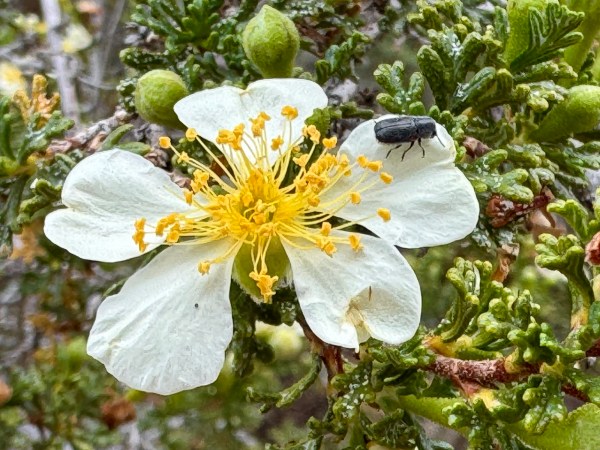
Clytrine leaf beetle on flower of Purshia stansburyana (Stansbury’s cliffrose).

I reached the area around Coral Pink Sand Dunes (Kane Co., Utah) by mid-afternoon. My favorite campground in that area is Ponderosa Grove Campground—it’s large, spacious campsites are not only well shaded by the namesake, unique-for-the-area grove of massive ponderosa pines, but it is also located right across the road from Moquith Mountain Wilderness Study Area, a BLM-managed area with easy access to the northern portion of the Coral Pink Sand Dunes system (for those who may be asking, this portion of the dune system lies outside the boundaries of Coral Pink Sand Dunes State Park, which protects the only known habitat of the highly vulnerable Coral Pink Sand Dunes tiger beetle, Cicindela albissima).

After picking a campsite (I was glad to see only a few sites occupied) and unloading my gear, I hightailed it to the dunes with one objective—find Chrysobothris nelsoni (family Buprestidae). I collected this species before on my previous trip here back in late June of 2023, but I spent a day and a half looking for it and managed to only a small handful of specimens. I thought the earlier timing might be better, but Norm Woodley was here a couple of weeks before and did not see the species, giving me reason to be also skeptical.
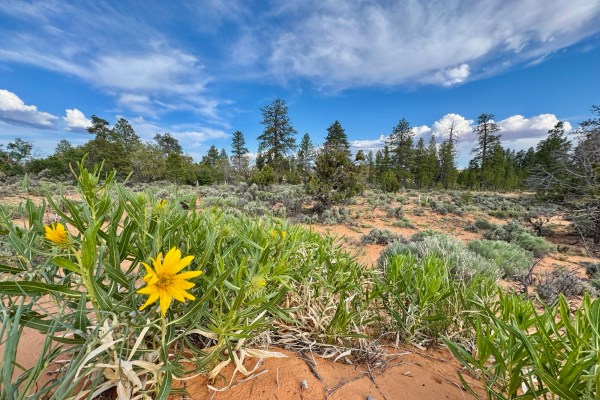
Looking across the dunes at Moquith Mountain Wilderness Study Area.

On the way to the dunes, I set out a yellow bottle trap and sweet red wine-baited jug trap in the sandy juniper/pine woodland bordering the dune. Upon entering the dunes, I immediately started seeing the host plant, Eriogonum alatum (winged buckwheat—family Polygonaceae), a distinctive plant with a basal rosette of linear leaves and, on some plants, a tall stem bearing the inflorescence. One plant in particular, right at the dune entrance, spoke to me saying “look at me.” I don’t know why, but I went over to it, tapped the basal rosette over my net, and off fell a nice large female C. nelsoni! Well, that was fast. I looked at a couple more plants and saw on a second adult (this one a smaller male) sitting head down at the base of the inflorescence stem—two specimens on the first three plants I looked at!

Chrysobothris nelsoni on basal rosette of Eriogonum alatum (winged buckwheat).
Chrysobothris nelsoni on stem base of Eriogonum alatum (winged buckwheat).

I found quite a few more (although not quite at that same frequency) over the next hour or so before they seemingly just disappeared. I noted the lateness of the hour and wondered if they have a ‘bedtime’—perhaps they burrow into the sand around the base of the plants for the night—and started back towards camp, picking up a few Eleodes caudifera lumbering across the surface of the sand along the way. I decided at that point, now that I had a nice series of the beetle, to bring the “big camera” over the next morning and try to get much nicer photos of the beetles on their host plant that what I can achieve with this iPhone.
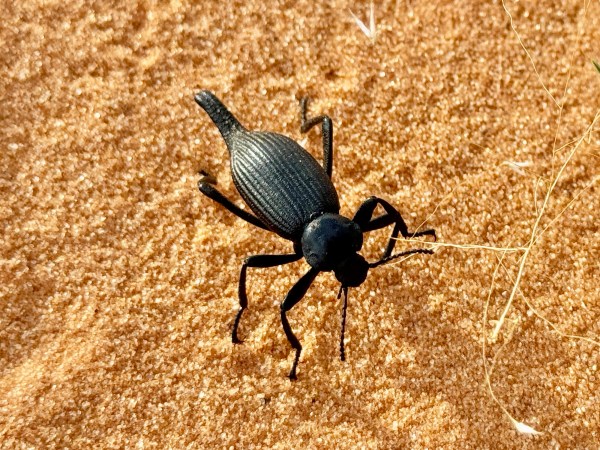
Eleodes caudifera lumbers across the sand.

It had been a long day by that point—I was both famished and exhausted and needed a bit of time to rest and refuel. I had brought two salmon filets along with me, which should have been enough for two meals, but I was so ravenously hungry that I cooked and ate both.

Chill time at Ponderosa Grove Campground.

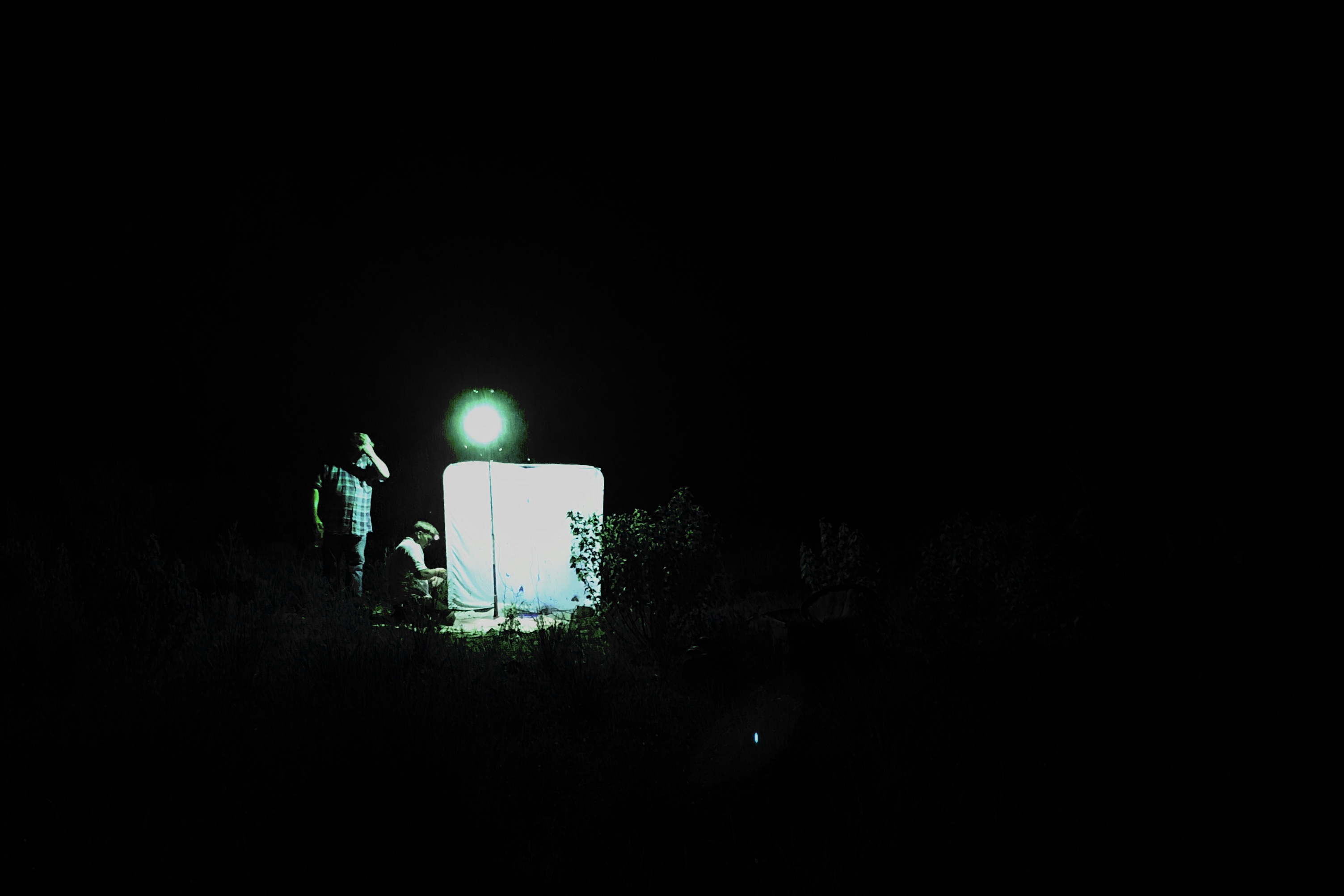
The rest and food gave me a bit of a spark, and as sunset approached I was inspired to set up the blacklights. Conditions were not close to ideal—a waxing gibbous, nearly full moon along with cool(ish) temperatures are usually enough to kill blacklighting. However, it was warmer than the past several nights at Jacob Lake (1300 ft higher elevation), so I compromised by setting up only the two ultraviolet lights (which I can run right off the car batter) but not the mercury-vapor lamp (which would have required hauling out and running the generator).

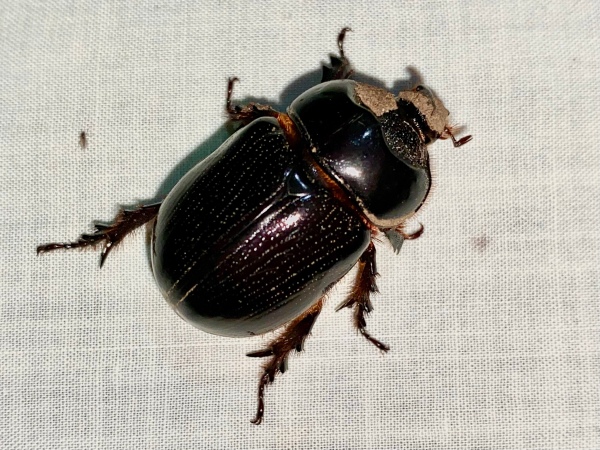
Not long after I turned the lights on, I noticed the bright, unmistakable glow of a mercury-vapor lamp at the far other end of the campground. I was like “That has to be an entomologist!” so hiked on down to introduce myself. As I entered the campsite, a man approached me and said “Hello, Ted.” Now I’m thinking okay we’ve met before, but I’m a dummy with poor social skills because I don’t recognize him. He said “My name is Mike.” The omission of his last name had me doubly thinking that I was an idiot because the mention of his name still wasn’t enough to trigger my memory of his last name or who he even was. When I asked him his last name, he said Rashko. I recognized that name instantly—he is the person who discovered Acmaeodera rashkoi, recently described by Rick Westcott and one of the species I had targeted on this trip. I told him of my plan and asked him how he knew who I was. It turns out he is a longtime follower of this blog and had seen my license plate (MOBUGS) earlier in the day. He was traveling from his home in Oregon to Flagstaff to meet his family and stopped here to spend the night and see what he could collect. We had a wonderful time chatting about the art of collecting and about colleagues we know (especially Rick, whose ears were burning I’m sure). I showed him the nice series of C. nelsoni that I’d gotten earlier in the day and told him we could go back in the morning before he left so that he could get some. We got so involved talking that we forgot to even look at his sheet to see what insects had come in until a Polyphylla uteanus (Coral Pink Dunes June beetle—family Scarabaeidae) smacked into his head and bumbled its way over to the sheet (Mike let me keep it). A large female Monochamus clamator also landed on the sheet (which Mike kept).

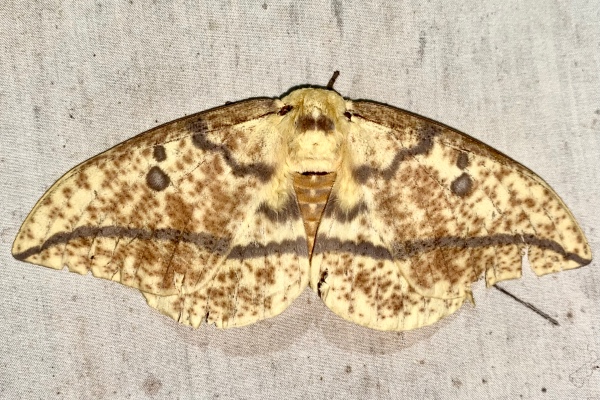
Eventually we said our goodbyes, and I wandered back to my campsite where I was mildly optimistic that my ultraviolet lights had brought in something. Sadly, there were no beetles of interest, but there was a stunning Hyalophora gloveri (Glover’s silk moth—family Saturniidae) and eventually two small white sphingid moths—all of which I kept for Rich Thoma back home. Success for me that night, however, was not yet out of sight. I made a round to inspect the massive trunks of the ponderosa pines dotting the campground and was rewarded with a nice little series of Zopherus uteanus.
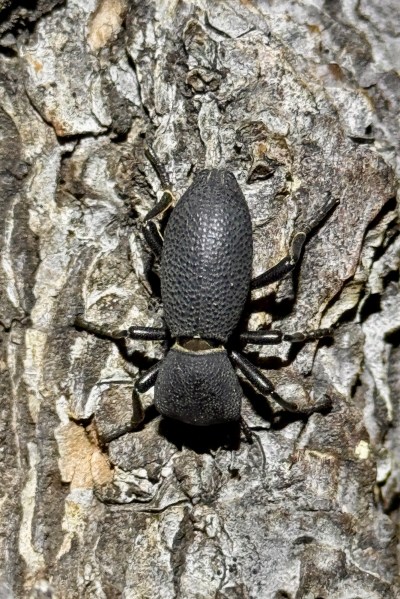
Zopherus uteanus on trunk of Pinus ponderosa (ponderosa pine) at night.

I also found a few of the weirdly explanate Embaphion glabrum (family Tenebrionidae) crawling on the ground beneath the trees. A second round to look at the trees yielded no additional beetles, however, so I turned the lights off and turned in.
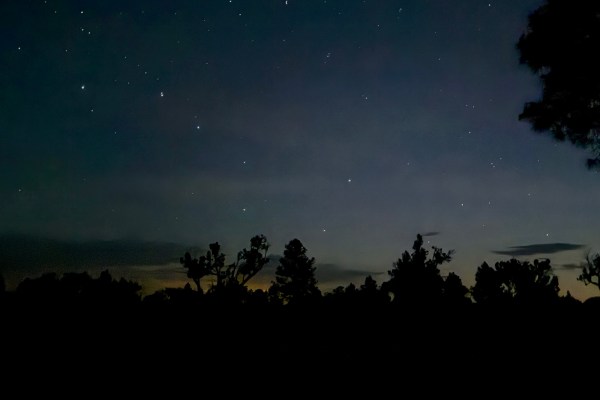
The “Big Dipper” prominently graces the western sky during the wee morning hours.

Day 8

Just as I had promised the night before, I wandered down to Mike’s campsite in the morning to see if he wanted to look for Chrysobothris nelsoni. He was already out looking for “beetles in the bush” around his campsite, and together we worked our way over to the dunes. It didn’t take long for me to see one of the beetles in its host plant, which I pointed out to Mike so he could see it and try to catch it himself. That beetle got away, but almost immediately he saw another one on a neighboring plant and succeeded in capturing it. We saw several more, but unlike the previous evening they were faster and more difficult to catch with the rising late-morning temps. Mike caught a couple more (and I one for the record) but had to leave, so we exchanged contact info and said our goodbyes.
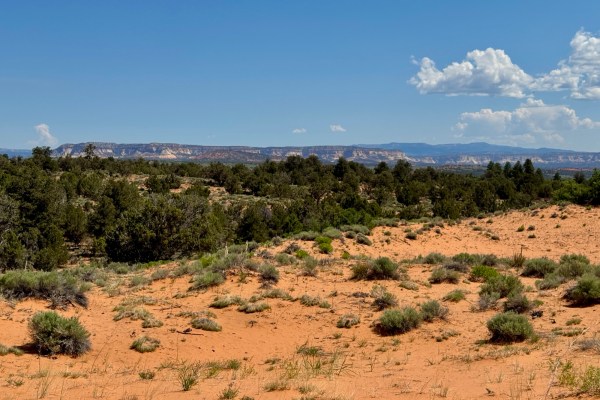
Morning on the dunes.
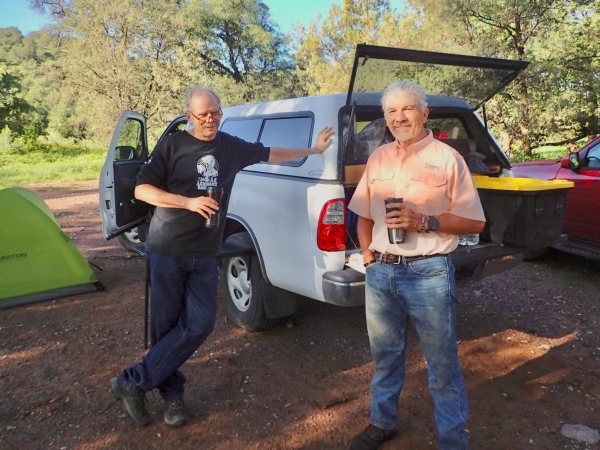
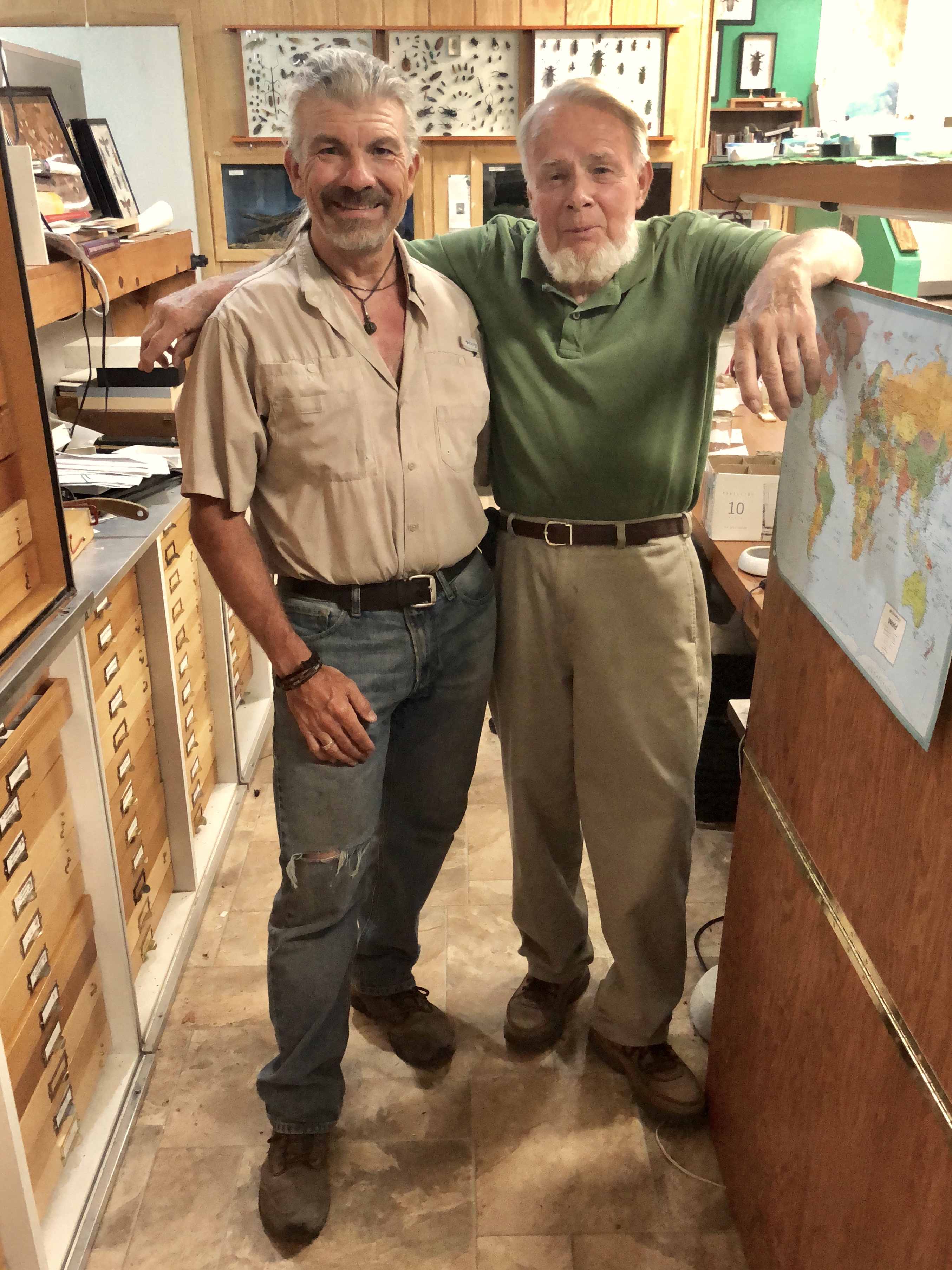
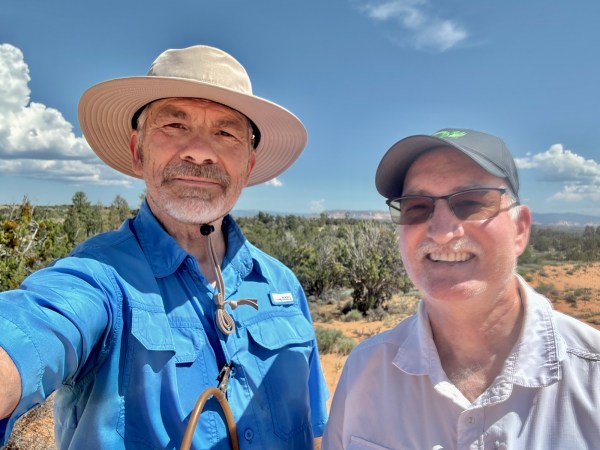
The author (left) with Mike Raschko (right).

Back at the campsite, I looked around a bit to see what else I might collect. There was a nice diversity of plants in bloom, many which could be expected to be visited by buprestid beetles—Sphaeralcea parviflora (small-leaf globemallow), Opuntia aurea (golden pricklypear cactus), Hymenopappus filifolia, etc., but no beetles were seen. There were clumps of Gamble oak and Amelanchier utahensis (Utah serviceberry—family Rosaceae), but beating them produced nothing. The only thing I found was a recently windthrown branch of Utah juniper, which, when I stripped back some of the bark, proved to be in the early stages of infestation by longhorned beetles, probably a Callidium sp. The lack of insect activity (except for C. nelsoni) presented a quandary—should I stay another night (as planned), or should I pack up and head to my next destination (either Leeds Canyon, Utah or Kyle Canyon, Nevada)? I decided it was already too late in the day to head somewhere else—by the time I got there it would be late in the day, and I didn’t relish the idea of searching for an available campsite late with no reservation at such a late hour. I decided I might as well stay put and make the best of it—which I could do by going back over to the dunes and look for more C. nelsoni. The day’s heat, however, was not only making the beetles very difficult to catch but also starting to get to me. Fortunately, distant thunderclouds came closer and closer until they were directly overhead. Rather than rain, however, it was virga, so I got the best of both worlds—an immediate cooling off that was not only comfortable for me but also settled the beetles down without the rain that would have sent me scurrying back to camp.
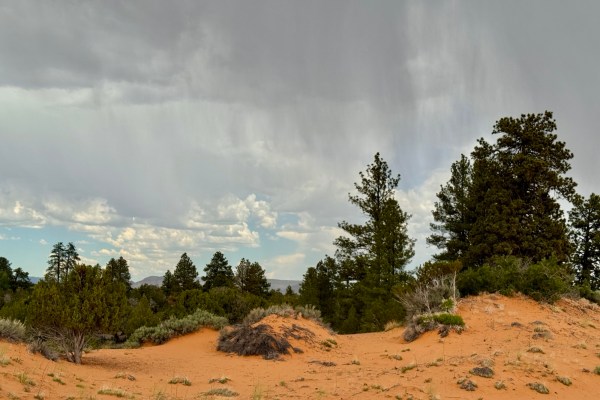
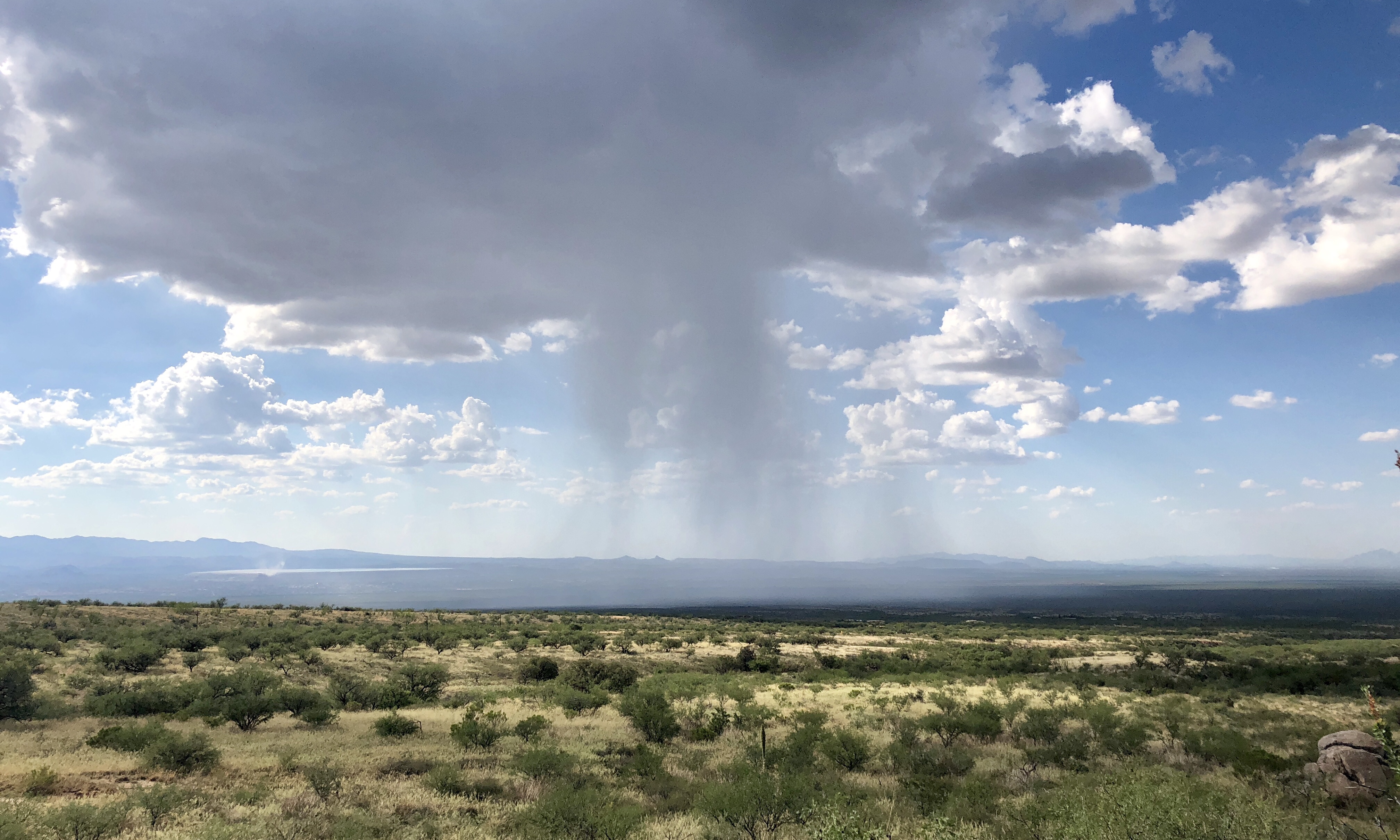
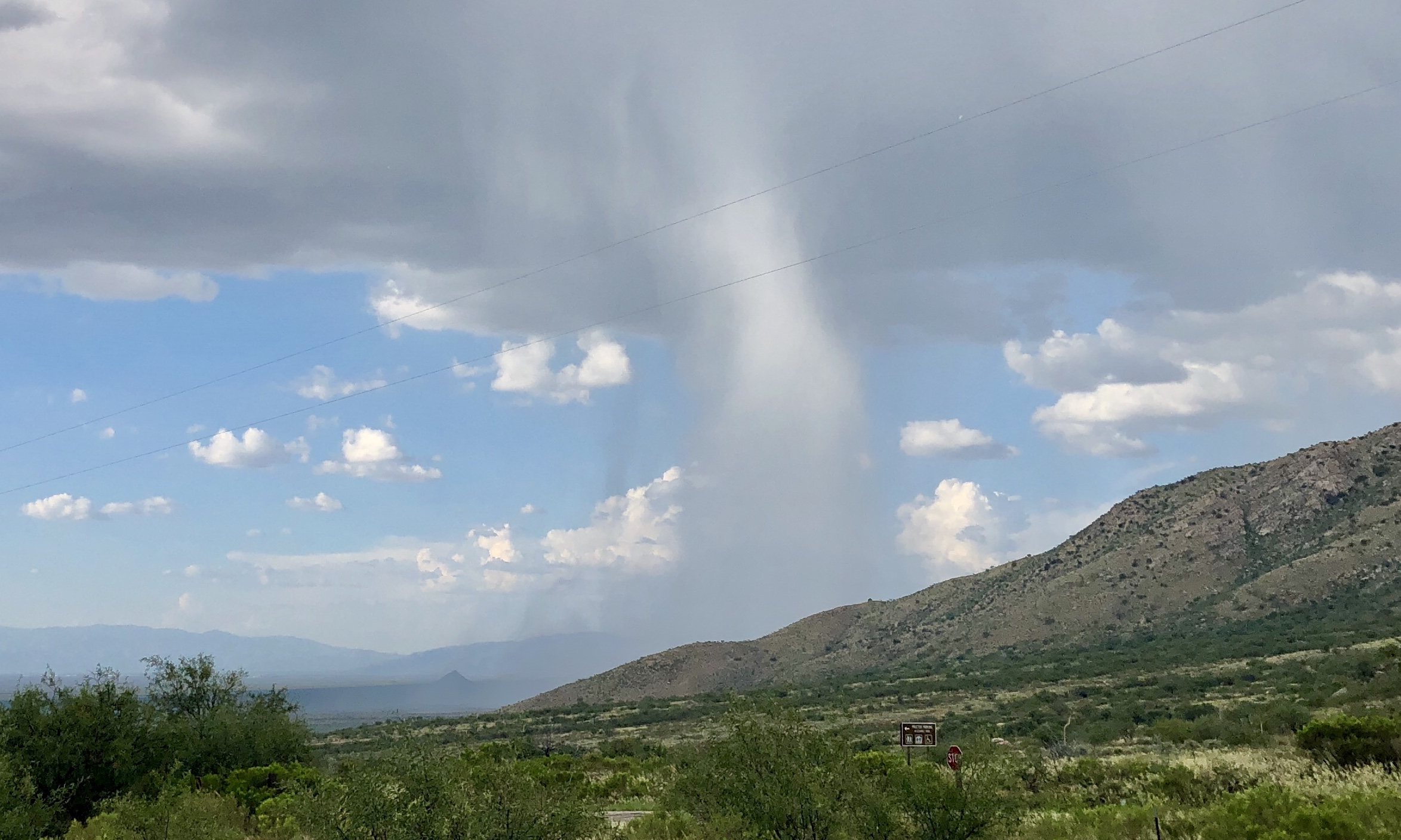
Virga brings relief from the heat to the dunes.

In the end, I succeeded in collecting another nice series of specimens.

Chrysobothris nelsoni on basal rosette of Eriogonum alatum (winged buckwheat).

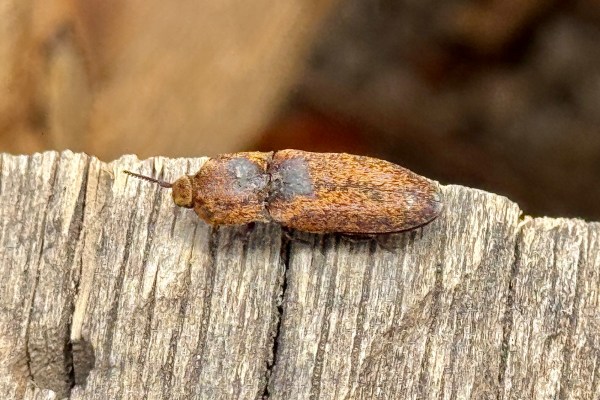
By then it was mid-afternoon and I was famished, so I headed back to camp to refresh, refuel, rehydrate, and catch up on my field notes. Comically, as I was writing my notes, I happened to be watching one of the common sagebrush lizards (Sceloporus graciosus) that had been hanging around the campsite as it bit at and then rejected some type of insect that was crawling on the logpile next to the firepit. I got up to see what it had rejected, and it turned out to be Danosoma brevicorne (family Elateridae), which I am happy to add to the collection.

Common sagebrush lizard (Sceloporus graciosus).
Danosoma brevicorne on woodpile.

After some chill time at the campsite [it was actually very busy—I wrote my field notes from earlier, charged all my devices using an inverter hooked up to the car battery, and downloaded photos from my “big camera” memory card to the computer], I went back to the dunes to see if I could get “big camera” photo of the beetles. It was touch-and-go at the start—shortly after reaching the dunes it started sprinkling and the wind started picking up. All I could do was wait it out, hope conditions improved, and be ready to bolt if the skies opened up. Just as quickly as it started up, however, it blew over, and I was able to start looking for beetles. As with every other time during this visit, it didn’t take long. The first beetle I found was a bit hidden within the crown of the plant, but I was able to carefully move the leaves out of the way without disturbing the beetle and got a nice series of shots. I was happy with the photos, but I wanted photos that were a little less “cluttered.” The perfect opportunity for such arose when I saw a beetle sitting out near the tip of a leaf. It was not in the best position—other leaves were partially blocking it from view, so I carefully grabbed the leaf at the base and gently pulled until it detached from the plant. Fortunately, the beetle wasn’t phased by the tugging and continued to sit calmly on the leaf. I wanted a blurred pink sand background, which I thought would look spectacular behind the brilliant green color of the beetle, so I stuck the base of the leaf in the sand to prop it up and adjusted the angle and distance in concert with my camera and flash settings until I achieved the desired effect. I’m super happy with how some of these photographs turned out, so look for them to appear in a future post. I’m probably lucky that the mini-storm moved through when it did, as the cool conditions likely calmed the beetles down and made them more willing subjects. By the time I finished photographing the second beetle, the sinking sun signaled a dinner bell, and I walked back to the campground super satisfied with how this visit had turned out.

After dinner, I turned the ultraviolet lights on despite the just-shy-of-full moon and customary coolish temperatures. I didn’t expect anything to show up, but you don’t know if you don’t try (nothing ever showed up!).
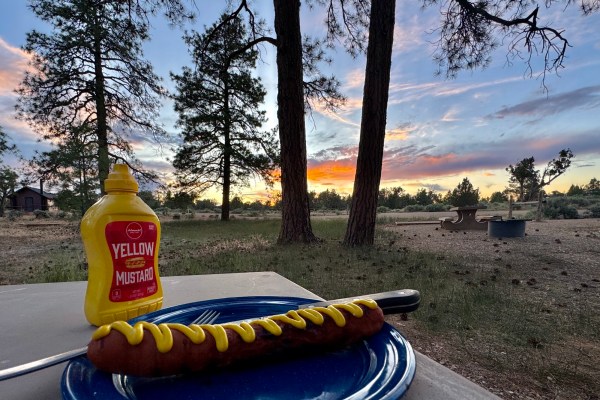
Mustard makes everything fancy in the field.

While waiting for nothing to come to the lights, I made several rounds of the large ponderosa pines, expanding the circuit to include some further toward the west end of the campground. As with the night before, I found a half dozen Zopherus uteanus crawling on the trunks (one was up too high to reach, though, and when I knocked it down with a stick it disappeared into the thick vegetation below the tree). I’d really like to know what these guys are up to during the day (hiding in the leaf litter at the base of the trees?) and what the larvae are doing (no idea!), but they certainly seem to be associated with pines (I’ve also collected Zopherus concolor at night on the trunks of Colorado pinyon pine). I also found a few more tenebrionid darkling beetles, including another Embaphion glabrum, crawling on the sandy ground beneath the trees. I expanded my search to include the trunks of some of the large Utah junipers, finding a few more tenebrionids on them.

Embaphion glabrum in ponderosa pine grove at night.

With midnight approaching, I soaked in my last bit of experience at the place before retiring for the night and leaving the next morning.

A waxing gibbous, almost full moon rises high above the campground.

Day 9

I left Ponderosa Grove Campground about 9:30 am with the plan to spend the next couple of days in Kyle Canyon and Lee Canyon northwest of Las Vegas. The drop down from the Colorado Plateau via the Virgin River Canyon was long the most spectacular stretches of freeway I’ve ever seen, but the sad reward waiting at the bottom was searing +100°F heat (the highest I saw registered on my car’s thermometer was 108°F!). Fortunately, turning off I-11 and heading west on Kyle Canyon Road gradually gained elevation. Before reaching the canyon proper, however, I had one of the trip’s top goals to take care of—setting a bottle trap for the recently described Acmaeodera raschkoi (recall that I encountered the namesake of this species, Mike Raschko, just two days prior at Ponderosa Grove Campground). I found the type locality no problem (where the modest gain in elevation had reduced the temperature to only 100°F!) and also found the trap that Mike had just set the day before we met.

Lower Kyle Canyon Rd—type locality of Acmaeodera raschkoi.

I placed yellow bottle trap about 59 m to the west from Mike’s trap and a blue bottle trap about 45 m to the east. There was no reason to stay at the locality and try to collect, as things were super dry, the only green vegetation seen besides the Yucca jaegeriana (eastern Joshua tree—family Asparagaceae) dotting the landscape was a small Cylindropuntia ramosissima (branched pencil colla—family Cactaceae).

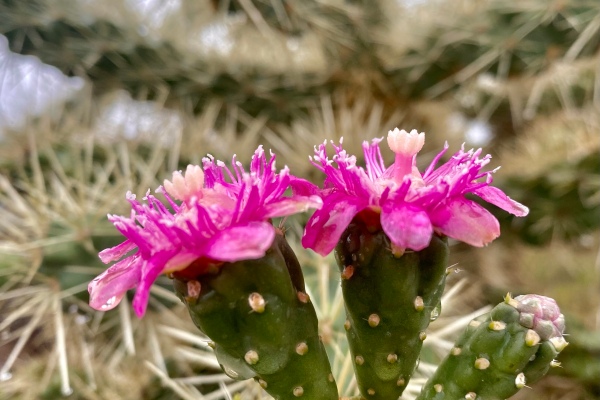
Cylindropuntia ramosissima (branched pencil colla—family Cactaceae).

I had originally planned to camp lower down in the canyon at Kyle Canyon Campground, but by the time I got there it was already nearly filled to capacity. There were a couple of campsites still available, but the campground as a whole had a noisy, crowded vibe that wasn’t my cup of tea. I decided to take a chance and head further up the mountain to Hilltop Campground to see if I could find something more to my liking. It was a short drive up the mountain, and this campground also was nearly filled to capacity. However, it was a much quieter vibe, and among the three campsites still available was one that was isolated from all the others on the side of the mountain with spectacular views across the canyon and down into the desert below. Also, the 8300 ft of elevation offered much cooler conditions—a welcome change from the searing temperatures I had endured earlier in the day. It was perfect!
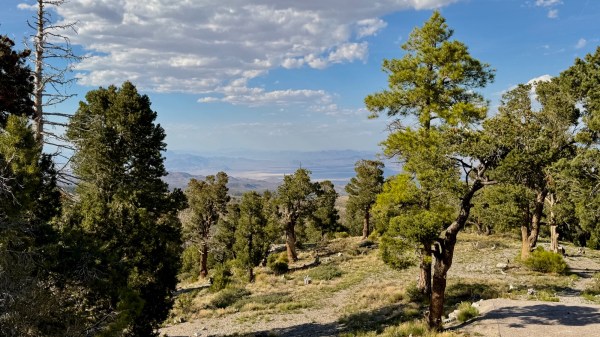
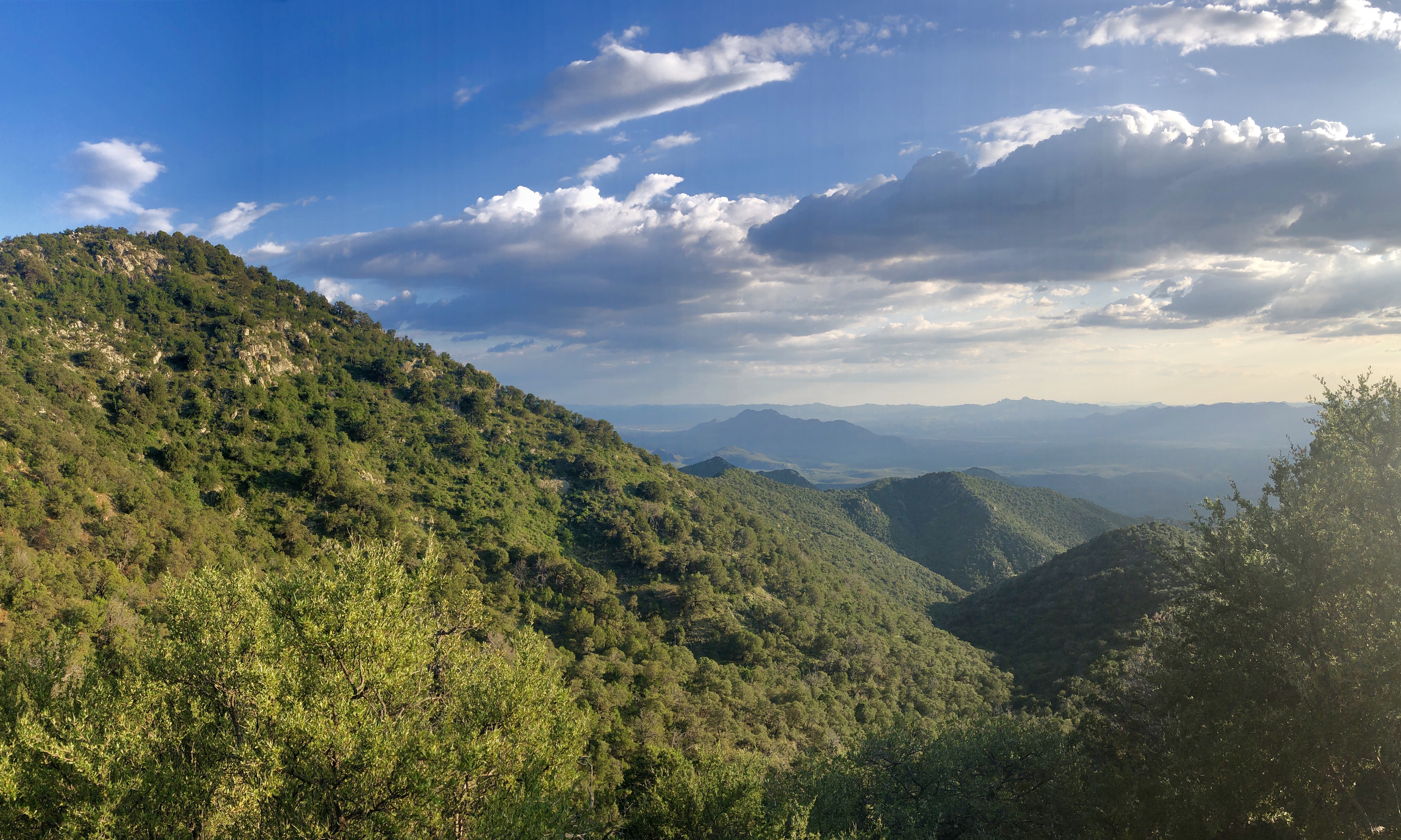
View from Hilltop Campground, Spring Mountains, Nevada.

I quickly set up camp and began looking around. Not far from the campsite I found a wind-thrown branch Utah juniper, and slicing into the bark I found a dead adult Semanotus sp. prob. caseyi amplus (not as exciting as S. juniperi, but still a nice find) and a small scolytid bark beetle boring an oviposition gallery. I did a bit of chopping into the bark and found small new cerambycid galleries (probably either Callidium or Semanotus) and some very large frass-filled galleries at the larger end that may be Semanotus juniperi. I found the frass-plugged entrance hole to the sapwood —a sign that the beetle had not yet emerged—and chipped away on either side of the gallery into the sapwood until I saw the large cerambycid larvae sitting it it. This confirms that the wood is actively infested, and I’ll cut it up and bring it home for rearing. At the empty campsite next to mine, I found a small, recently dead Abies concolor (white fir—family Pinaceae), and closer inspection of the trunk revealed an adult Dicerca tenebrosa tenebrosa, and on a return trip to the tree I saw another one (but too high up to capture ☹️). I also hung a red wine-baited jug trap just south of the campsite. There wasn’t much else going on in the area and it was getting late, so I got dinner started.
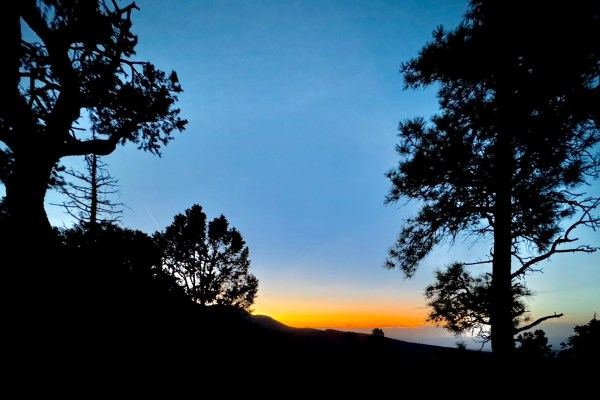
Sunset at Hilltop Campground.

I didn’t even consider setting up lights—the combination of a full moon and the cool, windy conditions that typify sites at this high of an elevation made the chance of success highly unlikely (in fact, it got so cool that I needed to pull on a fleece pullover). That did not, however, mean I could not do any night collecting—examining tree trunks has become a favorite strategy of mine that can be done on almost any night regardless of temperatures or wind. Trees under stress or recently dead (as well as recent wind throws or woodpiles) are especially good to look at, and I had noticed several during my earlier foray that I made a point to check. At the same time, I have also learned not to ignore living, seemingly healthy trees, as these can also harbor interesting beetles. Of course, the very first tree I headed for was the recently dead white fir on which I had collected Dicerca tenebrosa a few hours earlier, and I was rewarded right off the bat with an unusually small Zopherus uteanus. I wondered if this might be an interesting locality for the species, but I saw the species was recorded from Kyle Canyon in a review of the genus by Triplehorn (1972) (at which time it was still placed in the family Tenebrionidae). I quickly found another individual, this time on the trunk of a large Utah juniper—interestingly, the first non-pinaceous host on which I’ve found the species (although still a gymnosperm).

Zopherus uteanus on trunk of large Juniperus osteosperma (Utah juniper) at night.

What I was most anxious to check, however, was a large Pinus monophylla (single-leaf pinyon pine) that I had seen nearby with a long, twisting scar from a lightning strike gashing down the trunk—surely there would be something on that (there wasn’t despite checking it repeatedly for the next couple of hours). What did produce beetles, though, was a large, recently wind-thrown branch from that very tree laying on the ground nearby—two species and multiple specimens of each, one (Oeme? sp.) searching frenetically back and forth along the branch, and the other (Haplidus? sp.) in the form of a mating pair. I found it interesting that my inspection of the branch earlier during the day produced nothing.

Oeme? sp. on fallen branch of Pinus monophylla (single-leaf pinyon pine) at night.
Haplidus? sp. mating pair on fallen branch of Pinus monophylla (single-leaf pinyon pine) at night.

At this point, the night was already a reasonable success, but the greatest success lay just ahead. I had noticed a few large Utah junipers that showed evidence of infestation by Semanotus juniperi—or at least that what I presumed based on what I had learned about that species in the Kaibab Plateau a few days earlier. Not that I thought I would see adults of that species, but I figured the trees would have to be under some stress and might attract other beetles (I had already collected Z. uteanus off of one a few minutes prior). The first one I checked had nothing on it, but when I checked the second one I noticed a large black longhorned beetle on the trunk underneath some shredded bark. I carefully removed the overlying bark to get a better look at it and quickly realized that it was, indeed, S. juniperi! As I prepared to take a photograph, I noticed movement a bit higher on the trunk, and there sat a second individual! In the fraction of a second that followed, the memory of all the chainsaw work I had done a few days earlier in an effort to rear proper specimens flashed through my mind, yet here before me now were two live adults on their host in the wild. I presume the tree is attracting the adults and that there are already numerous individuals inside of it, as I found large swaths of larval galleries under the bark but no obvious adult emergence holes. The tree itself looks healthy and shows no outward sign of stress, and were it not for the evidence of larval galleries I wouldn’t have even suspected it was infested. As with Z. uteanus, this species also has been recorded from Kyle Canyon (Hammond & Williams 2013).

Semanotus juniperi on trunk of large Juniperus osteosperma (Utah juniper) at night.

Over the next hour, I continued inspecting trees in the area, but especially those on which I’d found beetles, and eventually that effort was rewarded with a third S. juniperi on the same tree I collected the previous two. The final collection of the night occurred just after that, when I found not one but two more Z. uteanus, this time on the trunk of P. monophylla. I made one more quick round of the trees, but as it was now midnight I accepted the bounty of the night and turned in.


Days 10 & 11

Unfortunately, I had to end the trip rather abruptly due to a confluence of circumstances at home. The final straw was the rapid decline of Berlioz—our 20-year-old cat (only lifelong cat lovers will understand the bond between a man and his cat). It was not a surprise, and in the morning as soon as I was able to break camp, I left Kyle Canyon and spent the next two days blasting north on I-15 and west on I-70. Sadly, I wasn’t able to make it home before he passed. I’ve had many cats over the course of my life, but King Berlioz was the best!


R.I.P. Berlioz – 10/31/2004 to 6/11/25.
65 hours driving almost 4,000 miles.

©️ Ted C. MacRae 2025

Sometimes the best collecting…

…is in other people’s collections!

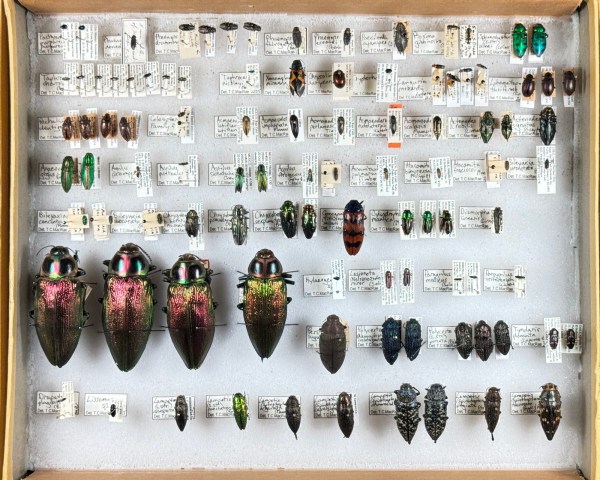
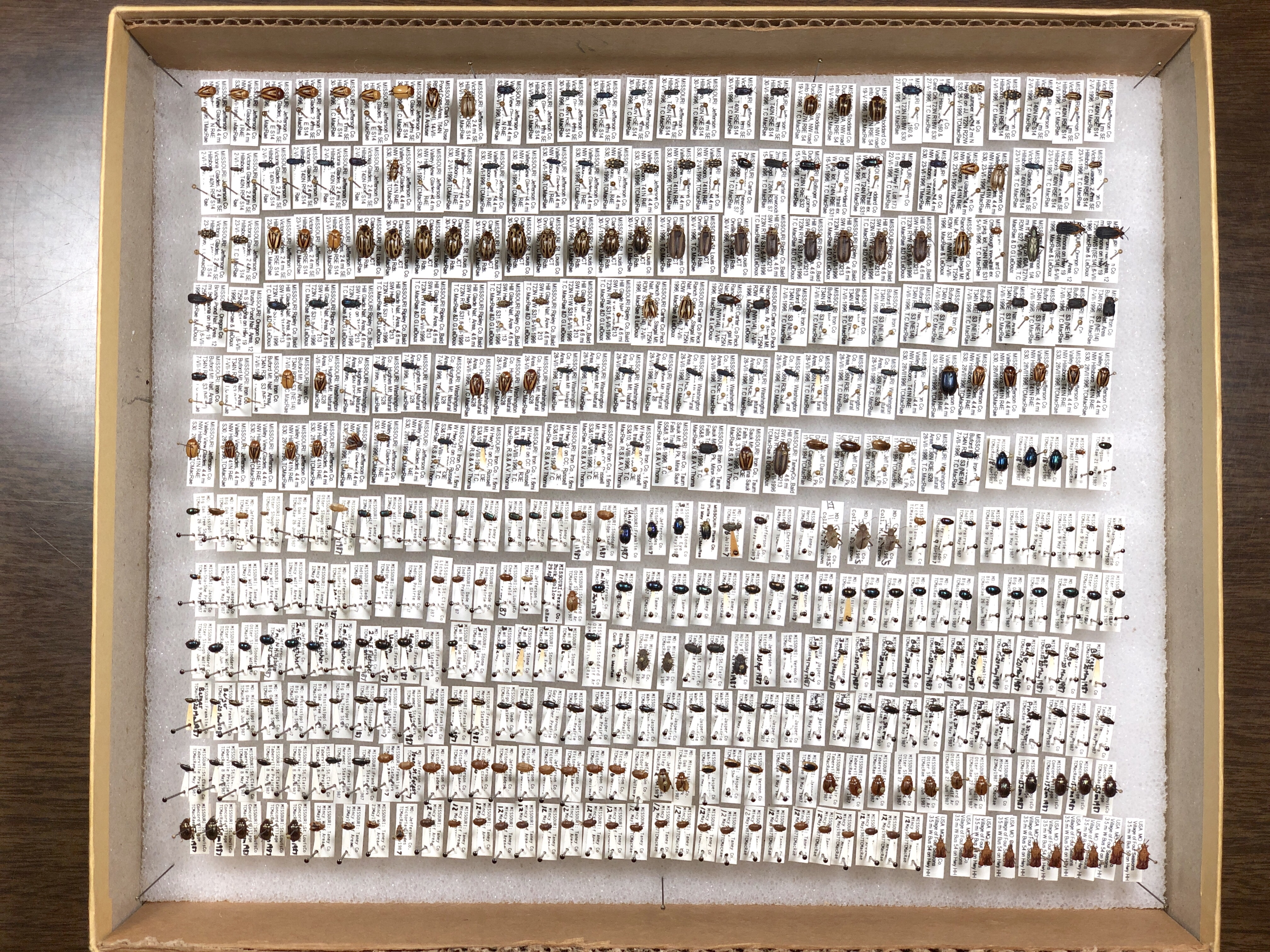
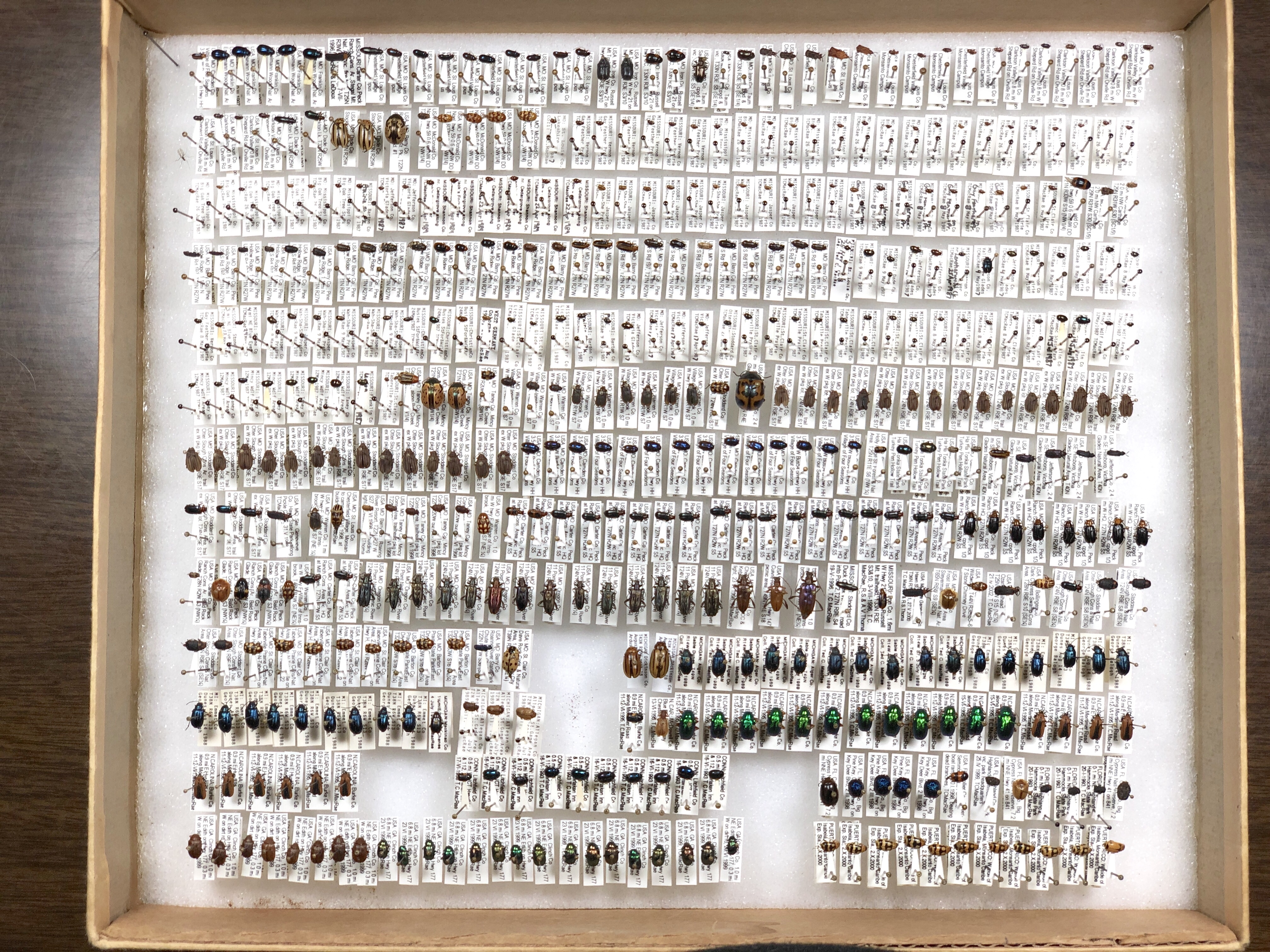
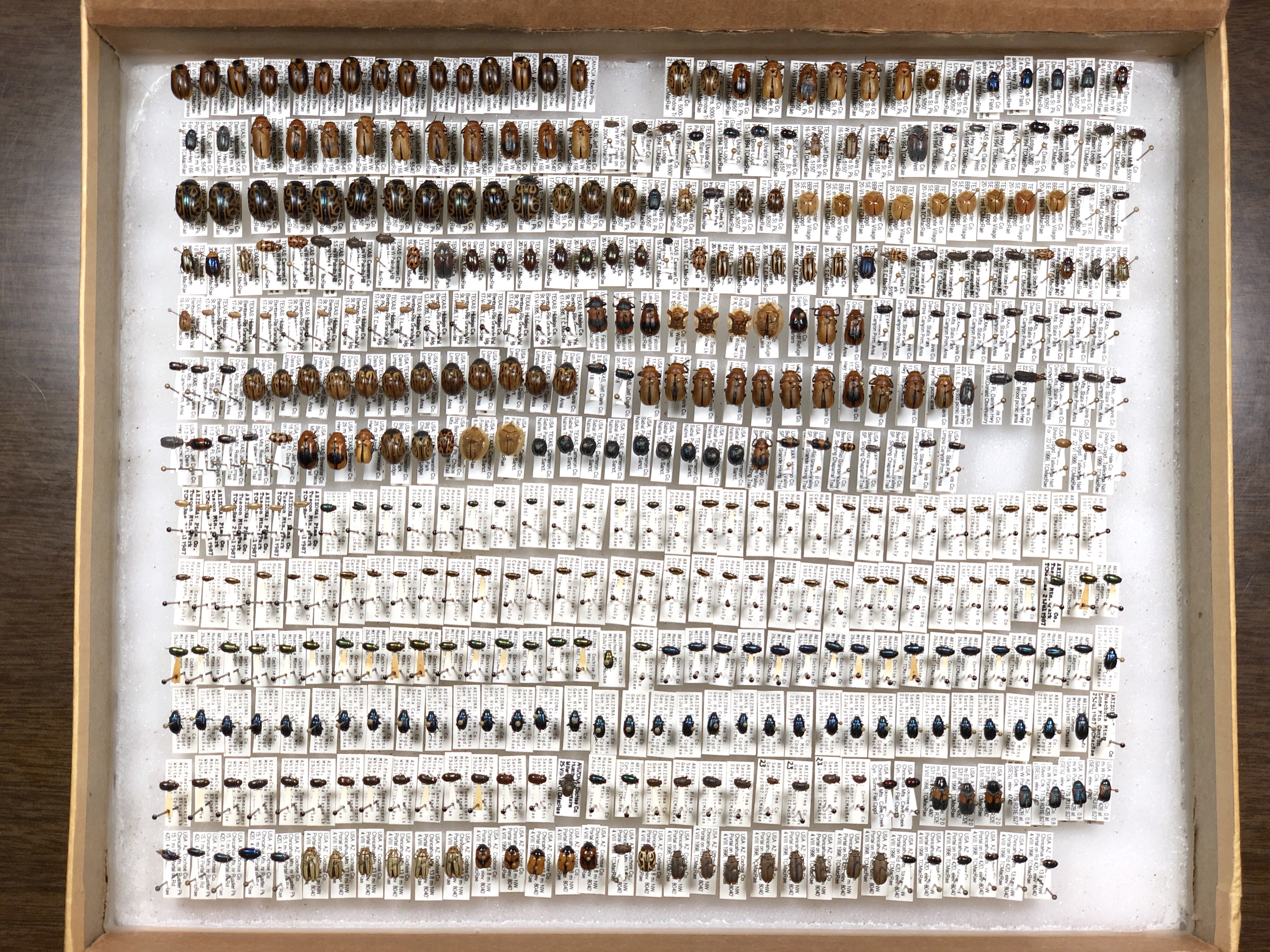
Buprestidae (plus one Elateridae) selected from specimens in the insect collection at the Illinois Natural History Survey sent for identification.

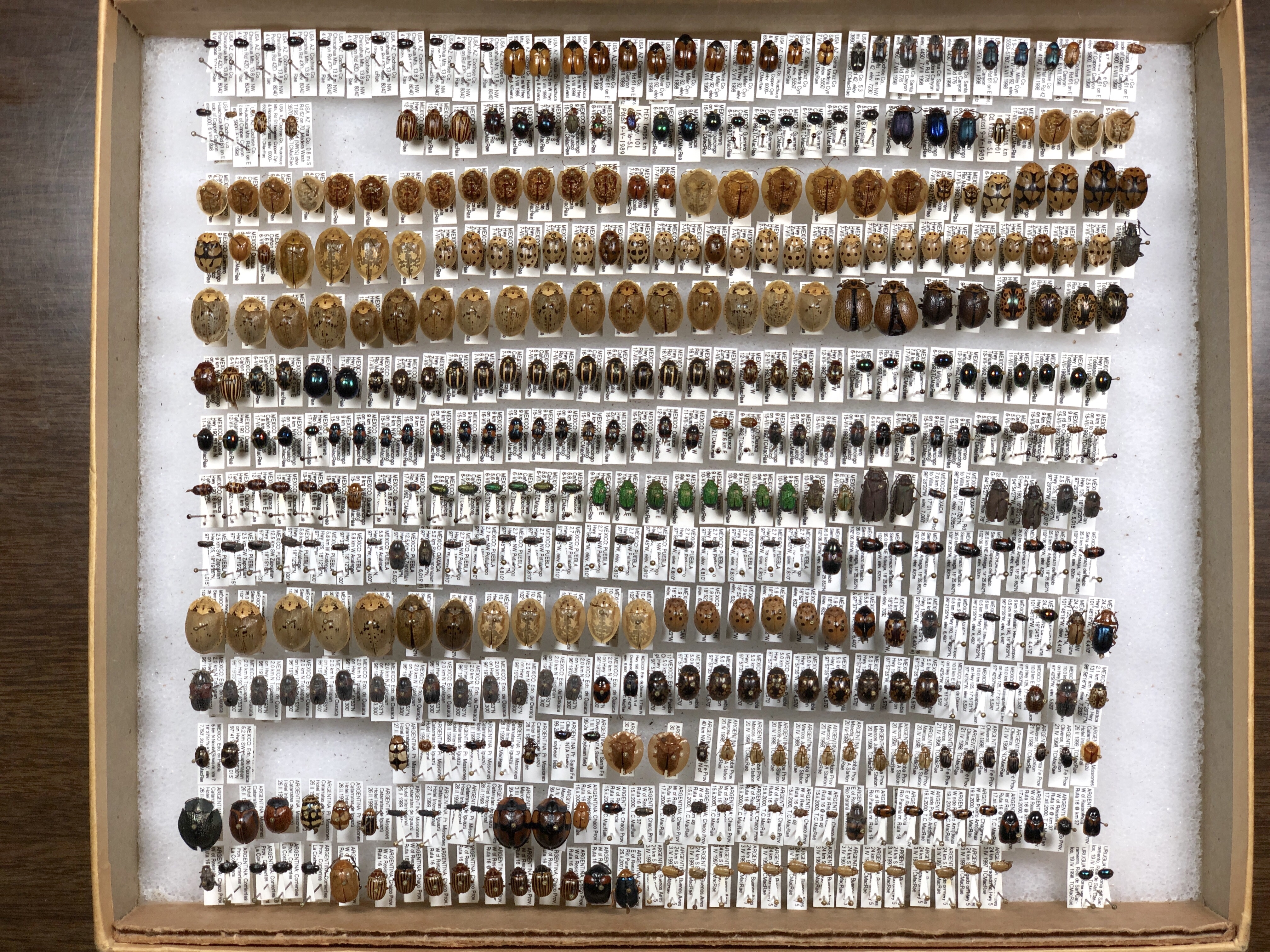
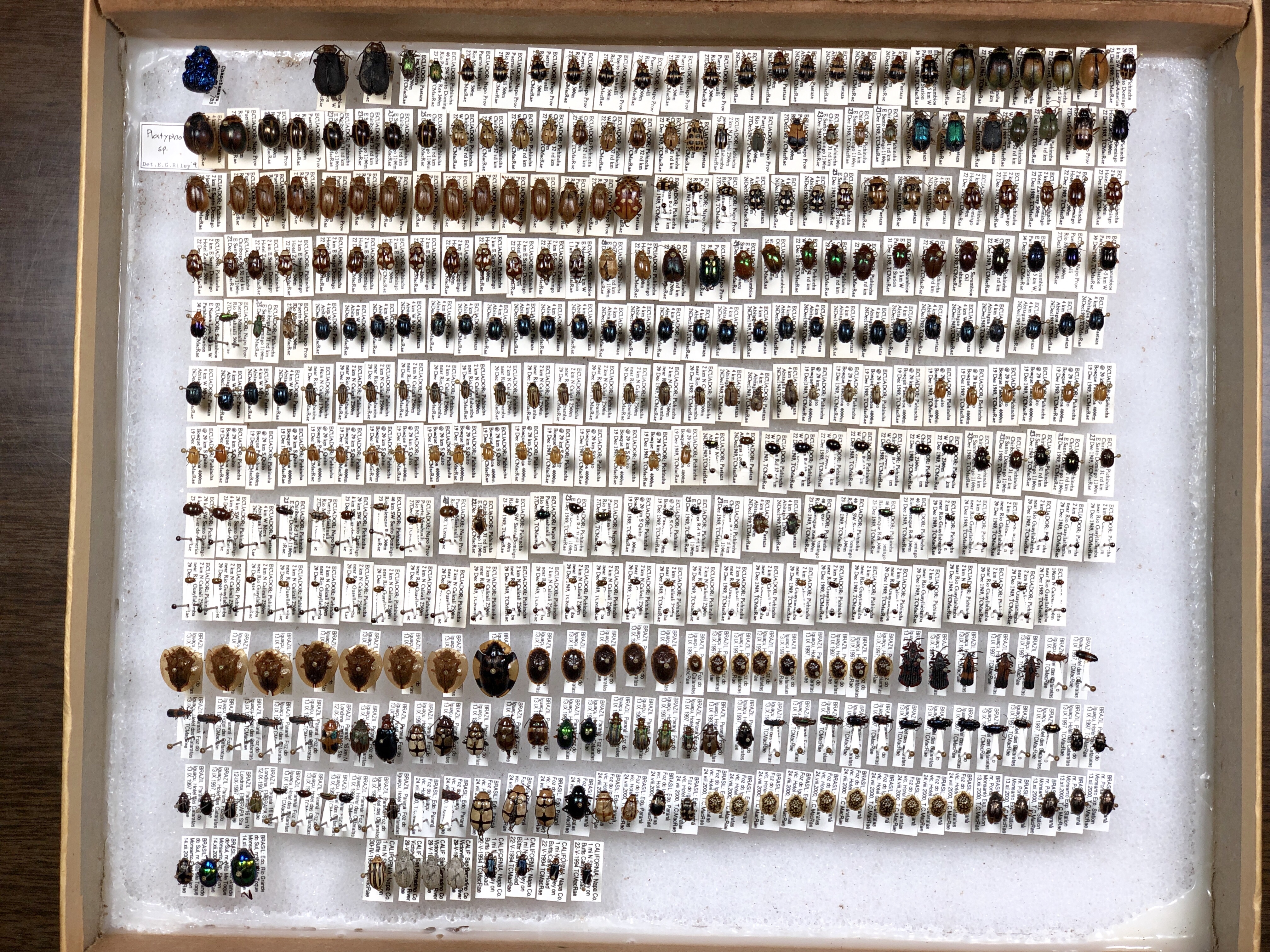
I’ve been working hard the past couple of weeks on one of three batches of Buprestidae in the insect collection at the Illinois Natural History Survey sent to me for identification. I’ve already completed one of these batches, which included all specimens strictly from Illinois. This second batch includes specimens from the not only the rest of North America (sensu lato), but South America and the West Indies as well. Out of ~450 total specimens, in this batch, I identified 167 species, with eight new state and two new country records.

Why do I do it? While I’d like to say it’s because I’m just a nice guy, and I do genuinely enjoy helping to improve the level to which public insect collections are curated, my motives aren’t completely unselfish. First, it is a chance for me to glean the specimens for new data in the form of unknown distributional and host plant records. This is a main area of interest for me, and the data provide fuel for my publications on the subject. Second, and perhaps, it is a chance to encounter species that are absent or poorly represented in my cabinets. Most public collections allow specialists to retain a certain number of duplicates of the species they identify. This allows me to increase the representation of species in my collection, which in turn increases its usefulness as a resource for even further identifications. (In this particular case, the INHS collection manager graciously allowed me even to retain a handful of singletons in exchange for some other species that helped to improved the representation in their collection.) Finally (and perhaps most importantly), regularly examining new material helps to continually refine my understanding of species concepts. Sometimes this causes me to reassess a previous identification in light of an improved understanding (a reference collection is only useful if its representatives are correctly identified).

For those wondering, here is what 165 species of Buprestidae looks like:

INHS Buprestidae .
INHS Buprestidae .
INHS Buprestidae .

©️ Ted C. MacRae 2025

Beetle Collecting 101: “Jug traps”

As long-time readers will know, I have used “bucket traps” with fermenting liquid bait for many years to collect Cerambycidae. In fact, I discovered my first new species (Purpuricenus paraxillaris) soon after I began using these traps back in the mid-1980s. The traps are simple—a bucket (2-L in my case) filled to about 1/3 with diluted molasses/beer (MB) or sweet red wine (SRW). When placed in the field, the bait ferments, releasing ethanol and other volatiles that attract a variety of longhorned beetles (as well as some other groups of beetles and insects). Beetles attracted to the trap drown in the bait and are retrieved by pouring the bait through a kitchen strainer. The bait, thus, acts as both an attractant and a killing agent. Other collectors of Cerambycidae have used these traps as well for many years, and in fact Marlin Rice and I have just completed a manuscript on a 4-year study comparing the efficacy and relative attractiveness of bucket traps baited with MB vs. SRW in Missouri, Iowa, and Florida—look for that paper to appear (hopefully) later this year in The Coleopterists Bulletin.

More recently, however, I have switched from bucket traps to “jug traps.” These differ obviously in that they are jugs with “windows” cut into them rather than open-top buckets. More importantly, however, instead of fermenting bait, the bottom of the jug (i.e., “reservoir”) is filled with dilute propylene glycol. Like fermenting liquid bait, propylene glycol forms a trap from which the beetles cannot escape, but it plays no role in attracting the beetles to the trap. Instead, it acts as a preservative to prevent deterioration of the trapped beetles after even prolonged submersion. Attraction to the trap is still accomplished with bait, but in this case it is isolated inside a bottle that is suspended inside the jug above the reservoir. A wick inserted into the bait and extending above the top of the bottle enables the release of ethanol and other volatiles from the bait to serve to attract beetles to the trap. A variety of baits can be used—I have been comparing the relative efficacy of three: pure ethanol, sweet red wine, and a 50:50 mixture of the two (look for a manuscript on the results after this season).

The advantages of jug traps are several-fold. First, beetles trapped in propylene glycol do not deteriorate (beetles trapped in fermenting bucket traps will deteriorate if not removed within about a week). Second, wicked bottles of ethanol-based baits last much longer (several weeks) than fermenting liquid baits in open buckets (10–12 days). These features drastically reduce the frequency with which traps must be serviced, allowing placement of traps at much more distant locations and enabling sampling of more distinct faunas. In all the years that I used bucket traps (1984–2021), the vast majority were restricted to east-central Missouri (within about an hour’s drive from my home). On the other hand, in the past three years of using jug traps, I have been able to place them across southern Missouri (2022), the Oklahoma panhandle (last year), and throughout eastern New Mexico (this year)!

I mentioned above my plans to publish the results of my first three seasons using these traps and comparing relative efficacy of the different baits (in fact Marlin Rice and I will be combining again to publish data collected not only in Missouri, Oklahoma, and New Mexico, but also Iowa and south Texas). Each time I’ve mentioned using these traps, however, I’ve received questions about how to make and deploy them. This will, of course, be fully detailed in the eventual publication, but since “a picture is with a thousand words,” I’m posting some of the details with photographs here to allow folks to begin using them without waiting for my published paper.


Trap construction

Almost any plastic jug will do, but a minimum size of 1-G is suggested. The finished jug shown below is from the cheapest drinking water I could find (99¢ per gallon). I will note that these jugs are made of low density polyethylene (LDPE), and after a couple of seasons of use in the field, those that were exposed to full sun eventually became brittle and cracked. For this reason, I’ve been replacing them with jugs made of high density polyethylene (HDPE) (of which you will have plenty after purchasing ethanol and propylene glycol!). Either way, I used a utility knife to cut a “window” into each side of the jug. The windows should be large enough to allow free access to the jug interior, but take care to keep the bottom edges of the windows high enough above the bottom of the jug to accommodate at least one liter of propylene glycol in the reservoir. You may also notice two additional modifications that I made: 1) the presence of a nylon cord loop at the top of the jug (allows the trap to be hung in the field), and 2) a metal S-hook inserted into the cap (allows hanging of the bait bottle inside the trap). The cord loop is simple—a 6-inch length of nylon cord threaded through two holes drilled below the mouth of the jug and tied to form a loop. The S-hook hanger installation is described further below.

Modified 1-G jug ready for use as a trap.

I used 250-ml water bottles for the bait bottles, which, in the conditions I’ve experienced, is enough bait to last 4–5 weeks. I will be trying larger (500-ml) bottles this season to see if they will last longer (hoping for two months). I drilled a hole into the center of the bottle cap that was large enough to accommodate a 5.9-inch long by 0.3-inch wide cotton humidifier stick. The stick acts as a wick that provides a continuous releases of ethanol and other volatiles from the bait. I also fashioned a hanger for the bottle using an ~10-inch length of plastic-coated copper wire (it’s what I had sitting around) to suspend the bottle inside the trap.

Modified 8-oz water bottle. A stiff cotton stick is inserted through a hole in the cap, and a wire hanger is added.

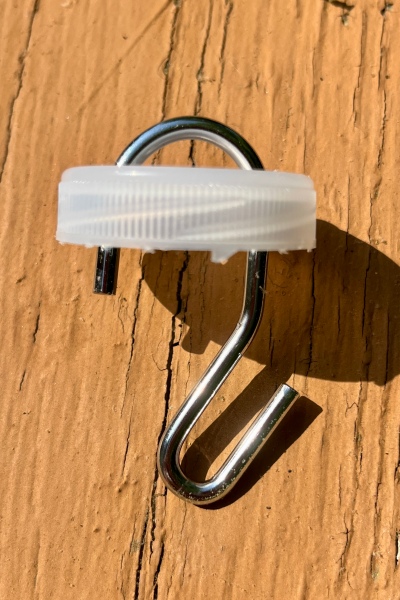
To suspend the bait bottle inside the trap, I installed an S-hook in the cap of the jug by drilling two small holes in the cap and threading the S-hook through them. If you make the holes slightly closer together and squeeze the S-hook with pliers while threading, the S-hook will end up being held more securely in the cap with little likelihood of popping out.

Cap of milk jug with S-hook installed.

Deploying the trap

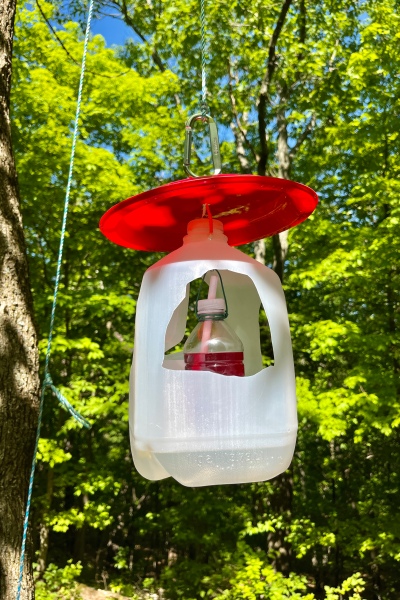
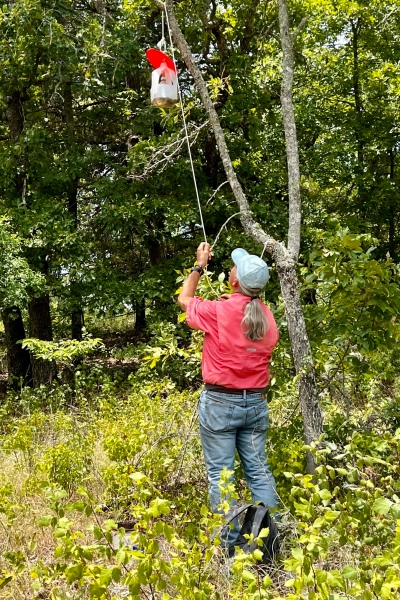
In the field, find a suitable spot to deploy the trap. The “perfect” spot will depend upon the habitat, but I always look for a tree in relatively open (i.e., accessible) habitat with an unobstructed branch around 8–12 feet above the ground. Tie a rock or heavy stick to one end of a long nylon rope and throw it over the branch. Tie the other end of the rope to a carabiner, which is then clipped to the cord loop at the top of the trap. Hoist the trap to eye-level and keep it in place by tying the cord to a nearby trunk or branch. Fill a bait bottle with your choice of bait (right now, the 50:50 mixture of ethanol and wine seems to be the most effective) and hang it from the S-hook inside the trap (see photo below). I also like to give the bottle a twist or two so the wire wraps around the S-hook, securing the bait bottle and reducing the likelihood it will be dislodged by high winds. The photo shows a red plastic plate above the trap to act as a rain shield; however, I have found this unnecessary and no longer use them.

Bait bottle hanging inside trap.

Once the bait bottle is in place, fill the jug reservoir with 50:50 diluted propylene glycol. I have been using about 750–1000 ml per trap, which usually is enough to last for about a month. Areas with low humidity, high temperatures, or heavy beetle populations may require a higher volume to last that long, so adjust accordingly.

A carabiner is used to hang the assemble trap from a nylon chord strung over a tree branch.

Once the bait bottle is in place and the reservoir filled, hoist the trap up until there is about a foot of rope between the branch and the trap (closer makes the trap more vulnerable to spillage from high winds and also provides easier access for “raiding” by raccoons). Secure the rope again to keep the trap in its fully hoisted position, then stand back and admire your handiwork!

Traps are serviced about every four weeks. Photo by Art Evans.

Servicing the trap

You can check the traps at any time, but as mentioned the advantage of this trap is its ability to not only attract beetles, but preserve them over an extended period of time so that remote or difficult to access habitats can be sampled. Servicing the trap is similar to servicing bucket traps in that the reservoir contents are poured over a kitchen strainer placed on top of another bucket to catch the liquid. The liquid can be reused and the volume topped off, but I like to replace it completely if it has become diluted due to rain or discolored due to large numbers of insects attracted to the trap.

Trap contents ready for cleaning and sorting. Photo by Art Evans.

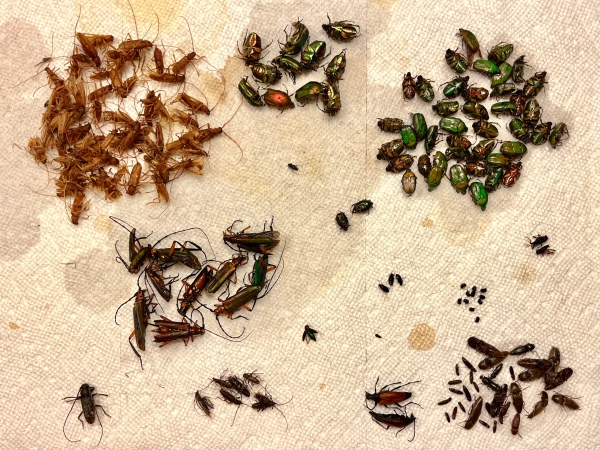
If the catch is not overwhelming, it can be sorted in the field, but in many cases the number of insects—not just the target beetles (in my case, Cerambycidae), but other beetles (especially Elateridae and cetoniine scarabs) and even other insects (e.g., noctuid moths, flies, wasps, etc.) can be so high that it is easier to simply transfer the entire catch to a ziplock bag (1-qt bags are usually sufficiently large, but if the trap catch is overwhelming a 1-G bag may be necessary) and sort the catch at a more convenient time and place. Either way, I start out by overdrenching with water to rinse the specimens and then pick out the target specimens. If the catch is large, it is easier to spread it out on a white fiberglass or plastic tray and add water to help separate the specimens. In this case, I drop the specimens that I pick out into paper toweling to blot off the excess.

Cleaned, sorted beetles ready for processing.

Once the target specimens are segregated from the bycatch, I place them in glass vials and add a few drops of ethyl acetate to tissue in the vial (for larger quantities, I use plastic specimen cups and a few ml of ethyl acetate) to prevent spoilage until the specimens can be further processed at a later date. Further processing involves washing the specimens to remove remaining traces of propylene glycol and other contaminants. This is done by soaking the specimens overnight in soapy water, rinsing thoroughly, and then blotting the specimens dry on paper towels before returning them to storage as above or pinning them directly. Unlike specimens trapped in fermenting MB or SRW baits, specimens trapped in propylene glycol tend to be stiff, which makes arranging the legs and antennae during pinning more of a challenge. I have found that prolonging the wash soak before pinning helps to soften the specimens—the longer the better (even specimens soaked for two months did not deteriorate). Apparently the initial period of submersion in propylene glycol provides some preservative benefit.

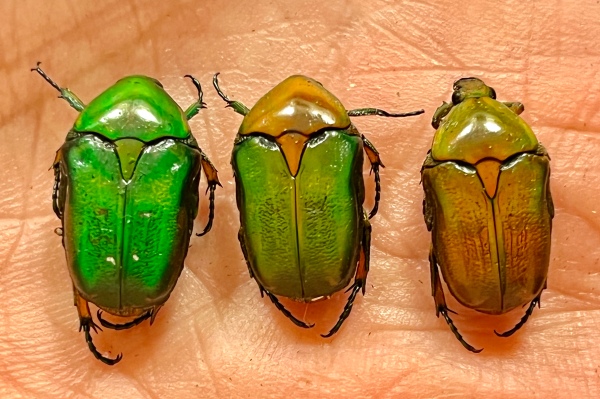
Euphoria fulgida showing range of color variation.

As with any new trap, the potential for optimization is great. I’ve mentioned some of the optimizations that I have tried or am currently trying such as the bait itself. Other potential improvements include the size of the bait bottle and the amount of propylene glycol used in the reservoir to allow trap placement for even longer periods of time before it needs to be serviced; the type of wine used—perhaps one with the highest possible sugar content to prolong or increase the intensity of fermentation; and a more secure method of hanging/attaching the bait bottle inside the trap (zip ties?). I’m sure a readership as erudite as mine will be able to come up with any number of other possible improvements, both to the trap itself and to the methods I’ve outlined for deploying the traps and processing the catch.

Trap hanging in a gum bumelia (Sideroxylon lanuginosum) tree.

©️ Ted C. MacRae 2024

2021 Texas/New Mexico/Arizona Insect Collecting Trip iReport

This is the 10th “Collecting Trip iReport”; this one covering 13 days of collecting in western Texas, southern New Mexico, and southeastern Arizona July 19–31, 2021. This trip was a “two-parter”—the first week with frequent field mate Jeff Huether (our seventh joint collecting trip) as we made our way from western Texas through southern New Mexico and into southeastern Arizona on our way to a memorial celebration for Jim Wappes at the home of Steve Lingafelter and Norm Woodley (for which I took the day off from collecting), and the second week visiting various locations in the “Sky Islands” of southeastern Arizona with several other entomologists.

As with all previous “iReports” in this series, this report is illustrated exclusively with iPhone photographs (thus the term “iReport”). Previous iReports in this series include:
2013 Oklahoma
2013 Great Basin
2014 Great Plains
2015 Texas
2018 New Mexico/Texas
2018 Arizona
2019 Arkansas/Oklahoma
2019 Arizona/California
2021 West Texas


Day 1 – Monahans State Park, Texas
This was my first stop on the previous trip back in late April and early May, and what a difference a couple of months with good rains makes—dry as a bone then but bursting with a great variety of wildflowers now. Like last time we stopped at the Shin Oak Picnic Area first, and almost immediately Jeff got an Acmaeodera gibbula on living Prosopis glandulosa (mesquite). I started beating the trees and got a good series of that species along with a good series of an Actenodes sp. (prob. A. mendax). There were also some mesquites that had been killed (apparently by herbicide), and when I started beating them I got several more A. gibbula and one Paratyndaris sp. It went from blazing hot when we arrived to raining about an hour later, and for a while after the rain moved through it stayed cloudy and quite comfortable. Eventually we decided to look for another spot with more mesquite to beat.

Monahans Sandhills State Park with rain moving in!
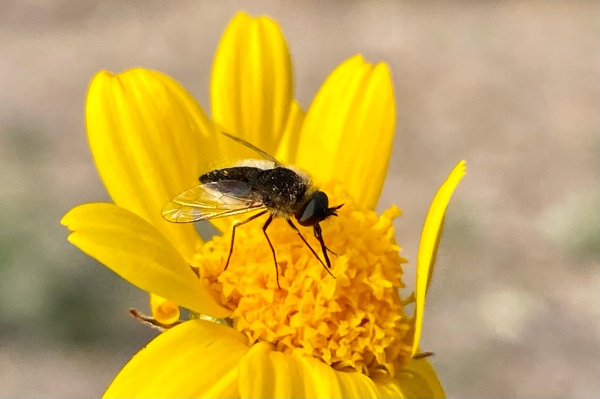
Poecilanthrax effrenus (family Bombyliidae) on flower of Thelosperma megapotamicum (rayless greenthread).
Acanthochalcis nigricans (family Chalicididae) female looking to oviposit on dead Prosopis glandulosa (mesquite).
Palafoxia sphacelata (othake).
Asclepias arenaria (sand milkweed).
Penstemon ambiguus (gilia beardtongue).

We found an area closer to the entrance (Equestrian Area) with lots of mesquite and also sunflowers, which Jeff was interested in looking at to search for meloids (blister beetles). Before I even reached the first mesquite I saw an Acmaeodera sp. (maybe A. obtusa) sitting on the flower of Thelosperma megapotamicum (rayless greenthread) and later found another plus one A. immaculata. Off the mesquite I beat just one Actenodes sp. prob. mendax and a few treehoppers, while another and a Chrysobothris sp. got away (it was by now quite hot and they bolted!). I continued beating mesquite but just wasn’t seeing anything, so we decided to take a look at the area around the main dunes and another picnic area.

Helianthus petiolaris (prairie sunflower).

At the Pump Jack Picnic Area, we saw a lot of Thelosperma megapotamicum (rayless greenthread) in bloom and decided to check the flowers for Acmaeodera. We each got a nice series of what appear to be A. obtusa and A. immaculata. Also, I finally found a single Acmaeodera immaculata on the flower of Hymenoppapus flavescens (collegeflower), which I’d been looking at all day thinking it must be a good Acmaeodera flower host. On the way back to the vehicle, I scared up a cicada that had been singing on a nearby plant—I’d been hearing them all day but assumed they were grasshoppers or katydids. I listened for another and saw it perched on the stem of Mentzelia nuda (bractless blazingstar), and netted it—a fine male, smallish and with a very white venter. I wanted to find one more—catching another A. gibbula in flight, and saw one singing in a mesquite tree. This time I took some photos of it (working carefully not to alarm it) and then hand-caught it (later identified as Diceroprocta texana). A nice end to the visit.

Male Diceroprocta texana singing on Prosopis glandulosa (mesquite).
Mentzelia nuda (bractless blazingstar).

After dinner, we returned to Shin Oak Picnic Area for night collecting. I setup my new Mercury-vapor (MV) station (first time using the gas-powered generator and tripod—slick setup) and my two ultraviolet (UV) stations. Jeff set out three prionic acid lures. Large numbers of Polyphylla monahanensis (which came mostly to the UV stations) and P. pottsorum (which came mostly to the MV station), but otherwise few beetles showed up and not a single longhorn. Other insects were also limited mostly to large numbers of ground-nesting bees and several big grasshoppers. No Prionus came to the lures—not surprising since we are in the tail end of the season for P. arenarius (April to July) and too early for P. spinipennis (mostly August). I’ve only gotten a few P. monahanensis and P. pottsorum before now, so it’s nice to have good series of each, but I would have preferred to collect some longhorns.

Blacklights humming as dusk settles over the dunes.
Polyphylla pottsorum at the MV sheet.

Day 2 – Toyahvale, Texas
We’re on our way to the Davis Mountains, and along the way I decided to stop at the “Agrilus cochisei” spot we found (on a tip from Jason) back during the April trip. I swept the roadsides—not just the host plant (Artemisia occidentalis, western ragweed) but a variety of other plants in bloom but did not find any A. cochisei. I did collect a few meloids (which were on Solanum eleagnifolium) and Zygogramma leaf beetles but nothing else.

Proboscidea parviflora (family Martyniaceae)—doubleclaw or red devil’s-claw.

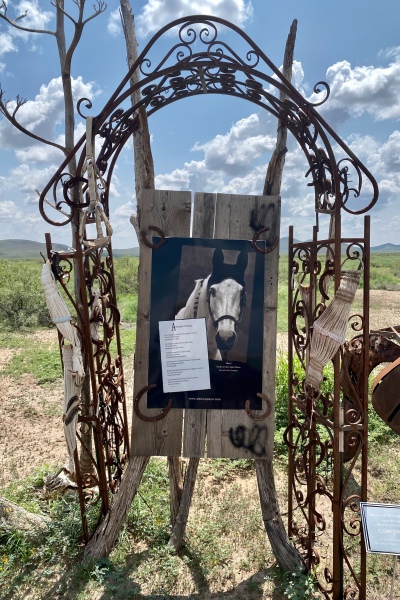
A bit further down the road from the last stop, we noticed this memorial to the many horses that have been transported along this highway on their way to slaughter.

Davis Mountains, Ft. Davis, Texas
Another roadside stop for one of the places where I collected during last April’s trip. I was hoping we would not be too late for Acmaeodera—there were plenty of plants in bloom but we did not see any. Senegalia greggii (formerly Acacia greggii, commonly called cat-claw acacia) and Vachellia constricta (formerly Acacia constricta, commonly called whitethorn acacia) were both in bloom, and off the former I got the obligatory Stenaspis solitaria male/female pair as well as a Lampetis drummondii, but I collected nothing off the latter. Tried for a couple of cicadas and missed ‘em both!

Stenaspis solitaria male on flowering Senegalia greggii (cat-claw acacia).
Lampetis drummundii captured on flowering Senegalia greggii (cat-claw acacia).
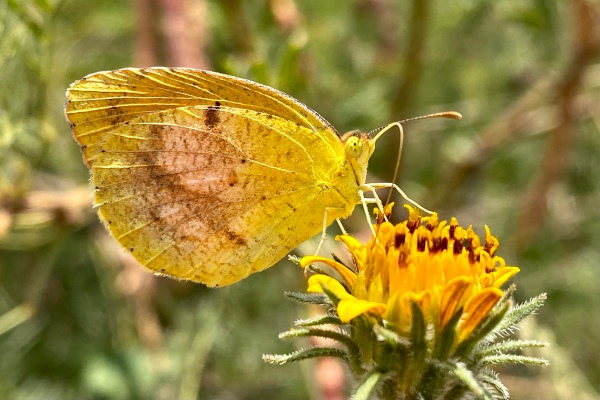
Eurema nicippe (sleepy oranges) on yellow asteraceous flower.

Davis Mountains, Boy Scout Rd, Texas
This looked like a good spot, with water in the creek and lots of butterflies flying around. Beating, however, yielded nothing but lots of lep larvae. It seems we are in the mid-summer lull—too late for spring things, but too early for late summer-fall species. I think we’ll try some higher elevations and see what it is like.

Argemone aenea (golden prickly poppy).
Argemone albiflora (white prickly poppy).

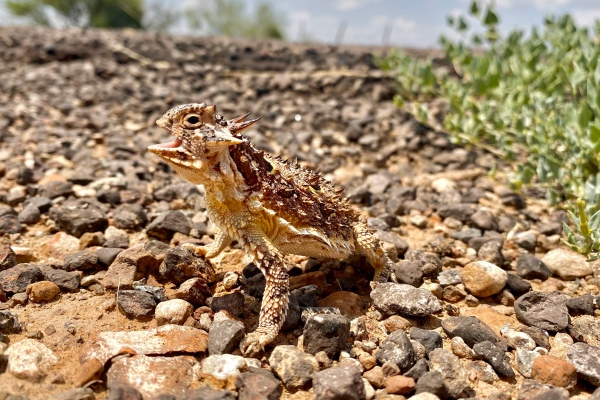
We were headed back towards the highway when I spotted a stand of Thelosperma megapotamicum along the road. We got out so I could take a look at them and immediately encountered this Texas horned lizard who seems to be saying “WTF?!” I swept through the Thelosperma and picked up two Batyle sp., one Enocleris sp., and a couple of species of meloids. There were lots of other plants in bloom, too, including several that are typically attractive to beetles such as Sphaeralcea and Ratibida. However, nothing was seen on them, further reinforcing our desire to go to higher elevations to see if that would improve the collecting.

Phrynosoma cornutum (Texas horned lizard).

Davis Mountains, Madera Canyon, Texas
We wanted to get up to higher elevation to see if that might improve the insect collecting. It is strange—the Davis Mountains are greener than I’ve ever seen them, yet there are almost no insects, no flowers. Jeff and I were wondering if the deep freeze Texas experienced this past winter might have knocked out insect populations. We beat along the way but just we’re not seeing anything on the beating sheets. We hiked our way up to the overlook, and up there I ran into a few species of tenebrionids running along the trail and doing their famous “headstands” when we disturbed them. On the way back down I saw a few large, red and black clytrine chrysomelids on what I take to be a fall-flowering helianthoid aster (old flowering stalks were 5–6 feet tall), so I picked up a few for Shawn (my scope of insects that I’ll collect expands greatly when I’m not finding anything in the groups that I study). I think we’ve had it with the Davis Mountains, and tomorrow we’ll travel further west and try our luck around Fabens.

Lower part of the Madera Canyon Trail.
The trail at upper elevations.
A small Eleodes sp. doing the headstand.
A larger species (Eleodes wenzeli sulcicollis) doing the headstand.
Same individual as in the previous photo.

Day 3 – Van Horn, Texas
Just a quick stop along the highway when we saw a variety of plants in bloom. Things are different at these lowers elevations compared to the Davis Mountains. Sweeping yielded a number of Agrilus sp. (vittate) and two Agaeocera gentilis—I suspect they were on the Sphaeralcea angustifolia (narrow-leaved globemallow), along with an Acmaeodera sp. and assorted other beetles. On a much taller globemallow I found two Tylosis jiminezi (male/female) perched on the foliage—a first for me! I did a little more sweeping further to the south but came up with only a few melyrids and a blister beetle (Epicauta segmenta). Nice stop!

Tylosis jiminezi on Sphaeralcea angustifolia (narrowleaf globemallow).
Sphaeralcea angustifolia (narrowleaf globemallow).

San Felipe Park, El Paso Co., Texas
When we first arrived, we were not at all optimistic—it looked like it hadn’t rained in years. However, the Larrea tridentata (creosote) and Prosopis glandulosa (mesquite) were both in full bloom, so we began looking about. Almost immediately I saw Stenaspis solitaria in the mesquites, which in itself is not exciting, but two of the first three I saw were the form that has the distinctly reddish-brown pronotum, which I’ve never seen before. I saw a couple more and tried to get photographs, but they were too skittish. As I searched for them, I caught one Aethecerinus latecinctus (a second got away), one Plionoma sp. (not sure if it’s suturalis or rubens), one Chrysobothris sp. (prob. C. octocola) and one Acmaeodera gibbula. The real fun began, though, when I walked by a creosote and saw a Gyascutus planicosta (should be subsp. obliteratus in this area) take flight. I tracked it to see where it landed, caught it, and then put most of my effort into getting a decent series of individuals. I succeeded, but it took more than four hours with the heat maxing out at 96°F! In addition to the Gyascutus, Jeff was quite excited to see the bright green and orange blister beetle Eupompha fissiceps abundant on the creosote in mating pairs and feeding on the petals of the flowers. I finished off the blister beetle fun by finding Cysteodemus wislizeni (black bladder-bodied meloid) crawling in the sand, which, despite the common name, was decidedly bluish.

The author looks out over the vast creosote/mesquite scrub.
Eupompha fissiceps on Larrea tridentata (creosote).
Eupompha fissiceps feeds on Larrea tridentata (creosote) as “Mr. Meloid” (Jeff Huether) looks on.

After going into town to restock on supplies and catch some dinner, we returned to the park to do some lighting and night collecting. The moon is almost full, which generally puts the kibosh on longhorns coming to the lights, but we decided to try anyway because of the high amount of activity during the day in a rarely-visited location. I set up the Mercury-vapor (MV) light only and skipped going through the trouble to put up the ultraviolet lights also. I also wanted to beat the mesquite since I didn’t have much chance during the day, spending most of my time hunting Gyascutus with an aerial net, and once I got the MV setup going I started whacking the mesquite. Almost immediately, I got three Aethecerinus latecinctus, which came off the first two plants I beat. This motivated me further and caused me to commit to beating for the next hour or so—never even getting a single beetle of any kind! By then the lights had been going for awhile, and I was pleased to see several Derobrachus hovorei (palo verde root borer) crawling on the sand near the light. Even though it is a common species, I’ve not seen many myself, so I was happy to have a nice series to take up beaucoup room in one of my prionid drawers. Otherwise, very few beetles came to the lights, or most other insects as well—the sheet being covered primarily by dozens of white-lined Sphinx moths and lots of wasp/bee-type things. We did enjoy the evening, however, as we sat in our chairs and drank a cold brew between checkings of the light.

Mercury-vapor light setup at dusk.
Mercury-vapor light just turned on at sunset.
Mercury-vapor light going strong as darkened settles.
Derobrachus hovorei (palo verde root borer).

Day 4 – Chaparral, New Mexico
We had planned to take NM-213 north to White Sands, but public access was blocked at Ft. Bliss. While backtracking, I spotted Sphaeralcea angustifolia (narrow-leaved globemallow) growing along the roadside and stopped to check it out. There was nothing on any of the plants, despite good growth and appearing to be coming into flowering. I did a little beating on Prosopis glandulosa (mesquite) as well—again very little going on, just a few treehoppers, tiny blister beetles, and one weevil. Larrea tridentata (creosote) was in full bloom, just like at Fabens, and here too there were many Eupompha fissiceps on the flowers and in mating pairs. I couldn’t resist collecting just a few and even made a short video of a mating pair engaged in some interesting behavior. I did see one Gyascutus planicosta as it flew by, but I could not track it to see where it landed. Otherwise all I picked up was another Cysteodemus wislizeni (black bladder-bodied meloid)—along with a photo, and a male cicada (maybe Diceroprocta texana) singing on a dry yucca stalk (hand-collected!).

Cysteodemus wislizeni (black bladder-bodied meloid).
Eupompha fissiceps mating pair engaged in some interesting behavior.

Point of Sands, New Mexico
Jeff wanted to stop here to look for Pleurospasta mirabilis, a really cool-looking blister beetle that looks unlike anything else. He found just one by disturbing the host plant (small purple blooms), and I found none—seems we are right at the tail end of their activity period. I looked around for other things also, but there was not much out. I did catch a couple more cicadas (males singing), and near an Ephedra sp. bush I found a mostly-intact carcass of Sphaerobothris ulkei. The most interesting find, however, was a couple of apparently lost pitfall traps—the barriers had fallen over, and the cops were filled with sand and the carcasses of numerous tenebrionids that had fallen into the traps and never been retrieved. I pulled up the cups and filled in the holes to prevent further loss, finding a few live tenebrionids and trogids and one Pasimachus sp. ground beetle that had not yet succumbed in the process.

Point of Sands, New Mexico.
“Lost” pitfall trap.

Hatch, New Mexico
While passing through the town of Hatch, I couldn’t resist taking the opportunity to stop and photograph some interesting town characters.

An interesting take on the Sinclair dinosaur.
Chili Pepper Man!
Cast of characters.

Deming, New Mexico
Another roadside stop in an area that was green with flowers and also had Yucca (to look for Tragidion) and Ephedra (to look for Sphaerobothris). Neither of those insects were found, and no buprestids or cerambycids were seen on or swept from any of the many composite flowers about including Thelosperma megapotamicum. I did find a couple of the meloid Lytta biguttata, one on flowers of Cirsium sp. and another on an unidentified yellow composite flower, and Jeff found a huge aggregation of another meloid, Epicauta costata, on herbicide-treated Kali tragus (prickly Russian thistle). I finished off the stop by finding a spectacular ridged tenebrionid beetle walking about after the sinking sun went behind some clouds.

Lytta biguttata on yellow composite flower.
Epicauta costata on herbicide-treated Kali tragus (prickly Russian thistle).

Day 5 – Sunshine, New Mexico
We saw a nice stand of what proved to be Picradeniopsis absinthifolia (formerly Bahia absinthifolia, hairyseed bahia) and stopped to check them for buprestids/meloids. None were seen, just a few bees and lots of bee flies (genus Geron?). We did find a fair number of Cysteodemus wislizeni (black bladder-bodied meloid) crawling on the roadsides in a patch of Solanum elaeagnifolium (silverleaf nightshade).

Geron? sp. (family Bombyliidae) on flower of Picradeniopsis absinthifolia (hairyseed bahia).

Columbus, New Mexico
We found a moist drainage along the roadside with plants blooming in abundance, including Isocoma tenuisecta (burroweed) and Sphaeralcea angustifolia (narrow-leaved globemallow); however, insects were very scarce. I didn’t see any buprestids or cerambycids at all on any of the plants, only picking up one Lytta biguttata and one Cotinis mutabilis on the Isocoma and sweeping single examples of a small black/red Cleridae from the latter and a yellow-flowered composite.

Pepsis thisbe (Thisbe’s tarantula-hawk wasp) on flowers of Isocoma tenuisecta (burroweed).

Animas, New Mexico
We drove a fair distance west hoping to get into a different rainfall system in hope that insects would be present and saw a roadside in good bloom with the surrounding creosote scrub also green and blooming. As soon as we got out of the car we saw big beetles flying overhead and tracked them back to several creosote bushes very near the car with an aggregation of yet another blister beetle, Pyrota postica, which were mating and feeding on the flowers and leaves. After taking a few photos (and collecting my small series), I started sweeping through the variety of plants in bloom along the roadsides. I did not see anything on the flowers themselves (including Baileya multiradiata, pretty good buprestid flower) but collected a series of clytrine chrysomelids and one Dectes sp. While sweeping through Sphaeralcea hastulata (spear globemallow), I got one Agaeocera gentilis, and sweeping though a mix of S. hastulata and S. angustifolia (narrow-leaved globemallow) I got three Agrilus sp. (perhaps the same as I collected south of Van Horn, Texas). Finally, on the latter, I found one more A. gentilis perched on the leaf.

Pyrota postica female on flowering Larrea tridentata (creosote).
Pyrota postica female feeding on the flowers of Larrea tridentata (creosote).
Sphaeralcea hastulata (spear globemallow).

Portal, Arizona
Finally made it to Arizona, and for the first stop I wanted to try a spot below Portal where I’ve had limited success finding Sphaerobothris ulkei on Ephedra. Last time I was I here I found a few, but not until after being distracted by Gyascutus caelatus and Hippomelas sphenicus in the acacias and mesquites. I vowed not to let that happen this time and weaved a zigzag pattern looking at every Ephedra I could find. While I was doing that. I did see one G. caelatus take flight and then caught another that I saw sitting on Vachellia constricta (white-thorn acacia) but remained focused on looking at the Ephedra. Eventually, after not seeing any S. ulkei, I started looking for other buprestids. The acacias were just beginning to flower—only a few plants had open flowers, and Jeff noticed the tiny silhouette of an insect in flight approaching the flowers. He netted it and showed it to me, and to my surprise it was one of the species in the A. stigmata group (black with two red apical spots)—none of which I have ever collected before but which I believe could be A. davidsoni. We spent the next hour watching for and netting the silhouettes on the few trees we could find with flowers, and then I got the beating sheet out and beat more off of the trees (whether in flower or not) to end up with a nice little series. I’ll be anxious to confirm whether these are A. davidsoni.

Mozena arizonensis on Vachellia constricta (white-thorn acacia).
Vachellia constricta (white-thorn acacia).

South of Willcox, Arizona
We got to Willcox around dusk, and the cool, breezy conditions told my gut that it would be pointless to set up the lights. Still, I couldn’t let myself not try, and without much opportunity to look for a good place to set up I just went down Blu Sky Rd to E Moonlight Rd and hoped for the best. My optimism waned rapidly, as conditions continued getting colder and breezier, and not a single insect came to the light—I should’ve listened to my gut!

Moonrise. A twilight zone moment occurred when I realized that I had taken this photo on Moonlight Rd!😮

Day 6 – Jim Wappes Celebration, Hereford, Arizona
Fun day with lots of fellow coleopterists at the home of Steven Lingafelter and Norm Woodley in memory of Jim Wappes. We got there in the early afternoon and enjoyed eats, conversation, and war stories from the field.

Min, Sangmi Lee, Lisa Lee, Candy Kuckartz, the author, Margarethe Brummermann, Jason Botz, & Andrew Johnston (photo by Steven Lingafelter).
The author, Andrew Johnston, Norm Woodley, & Ed Riley (photo by Margarethe Brummermann).

It was a good day for a party, as rain made insect collecting a no-go. As dusk settled, I admired the incredible view from Steve’s and Norm’s back patio!

Low clouds hang over the Huachuca Mountains.

The fun extended well into the evening hours. My thanks to Steve and Norm for hosting the celebration—what fun to see and talk to so many entomologists in one place.

Steve Lingafelter, Gino Nearns, “Kira Brummermann,” & the author (photo by Margarethe Brummermann).
Bill Warner, Norm Woodley, Paul Skelley, Jeff Huether, Steve Lingafelter, Andrew Johnston, & the author (photo by Margarethe Brummermann)

Day 7 – Superstition Mountains, Weaver’s Needle Vista Viewpoint, Arizona
We awoke to rain yesterday morning in Willcox, and it has stayed with us since—first on our way to Hereford for the Wappes Celebration, then up to Phoenix this morning—our efforts to escape the rain by coming north thus proving futile. I came to this spot on a tip that I might find Agrilus cavifrons on Celtis pallida (spiny hackberry) (although maybe a bit early), and I’d hoped despite the light rain I would still be able to find it. I did not—though I found the plants, but I did get a Chrysobothris sp. that I don’t recognize while beating Senegalia greggii (formerly Acacia greggii, cat-claw acacia). Of course, it was on the first plant that I beat, so I ended up beating for another hour with nothing to show for it! While walking the short paved trail, I found Cercidium sp. (palo verde) tree that had been cut up and showed evidence of buprestid infestation in one of the larger branches, so I retrieved and cut it up for rearing.

Water… water… everywhere!
Cylindropuntia fulgida (chain-fruit cholla, jumping cholla, hanging chain cholla).

Lost Dutchman State Park, Arizona
We made a quick stop here to admire its incredible scenery before heading back south.

Superstition Mountains as seen from Lost Dutchman State Park.
Stands of Cylindropuntia fulgida (chain-fruit cholla) frame this view of the Superstition Mountains from Lost Dutchman State Park.
Carnegiea gigantea (saguaro) in front of the Superstition Mountains.
Carnegiea gigantea (saguaro).

Upper Tanque Verde Falls Trailhead, Tucson, Arizona
The rain finally moved out and it was sunny for the drive back to Tucson, but with still-cool temps we weren’t sure if lighting would be worthwhile. We decided to try this spot—not too high (based on a tip by Bill Warner), and I setup the lights using a technique recommended by Roy Morris that involved placing one ultraviolet (UV) light on each side of the sheet, extending the Mercury-vapor lamp above to the top of the sheet, and periodically shutting off the latter to allow the UV lights the pull in the “shyer” insects before turning it back on. While I waited for the lights to started pulling things in, I did some beating around the area. I only collected one specimen, but it was a Cleridae that I don’t recognize, which was beaten off of Prosopis glandulosa (mesquite). Temps ended up in the lower 70s to upper 60s, but at the lights we still got a few longhorned beetles (Aneflomorpha sp.), a few melolonthine scarabs, and a nice series of two species of Pachybrachis (that I will send to Bob Barney).

Jeff looks for beetles at the light sheet.
Lethocerus medius at ultraviolet/mercury-vapor light in mesquite/acacia scrub.

Day 8 – Atascosa Mountains, Ruby Rd near Atascosa Lookout Trailhead, Arizona
The primary quarry here was Acmaeodera chuckbellamyi, a species I described in 2014 from a single specimen collected by my friend and hymenopterist, Mike Arduser, at this location on flowers of Aloysia sp. Several people have tried to find it since—without success, and in June 2011 the area was severely burned by the 27,550-hectare Murphy Fire. I was hoping enough time has passed to allow the area (and beetle population) to recover in this, my first attempt, at finding the species myself. I knew it was a long-shot, and long sorry short I did not find either the beetle or it’s Aloysia host flowers. I did collect a number of other beetles, however, including Lycus lorises, a few longhorned beetles and pachybrachine leaf beetles, and one Acmaeodera quadrivittatoides on flowers of Eysenhardtia orthocarpa (desert kidneywood), several Aneflomorpha sp. and a few pachybrachines on Quercus oblongifolia (Mexican blue oak), and more pachybrachines on Senegalia greggii (catclaw acacia), Mimosa dysocarpa (velvetpod mimosa)—the latter also yielding a few tiny Chrysobothris spp. (one looking like C. lucanus), and Propopis glandulosa (mesquite). Jeff also collected and gave to me a couple of Acmaeodera parkeri on flowers of Talinum aurantiacum (orange flameflower). I hiked 0.7 mi E on Ruby Rd to a spot where I swept a few beetles from low vegetation, and on the underside of a large, fallen branch of Q. oblingifolium I found a large female Polycesta arizonica. Finally, about halfway back to the trailhead I encountered a few tiger beetles on the road near standing puddles of water from the recent rains.

View from Ruby Rd looking south toward Mexico.
View from Ruby Rd looking southwest toward Mexico.
Lycus loripes on flowers of Eysenhardtia orthocarpa (desert kidneywood).
Talinum aurantiacum (orange flameflower).

Atascosa Mountains, Peña Blanca Lake, Arizona
We came here to look for Deltaspis tumacacorii, which like many rare beetles the odds are against finding it despite it having been taken in the area on several occasions. Again, this would not be one of those occasions, but I was happy to find a tiny tiger beetle (Cylindera viridisticta arizonensis) along the creek and even happier to beat a series of two species of Paratyndaris, one large Lampetis webbii (only my fifth specimen). and one Aneflomorpha sp. from mostly dead Senegalia greggii (catclaw acacia).

Leptinotarsa lineata on Ambrosia monogyra (cheeseweed burrobrush)—adult.
Leptinotarsa lineata on Ambrosia monogyra (cheeseweed burrobrush)—larvae.

Huachuca Mountains, lower Carr Canyon, Arizona
After dropping Jeff off at his hotel in Tucson (he flies home in the morning), I high-tailed it down to Carr Canyon to do some light collecting. It has been a long time since I’ve seen my sheet covered so quickly and thoroughly with insects! My quarry was longhorned beetles—of which I got a nice variety, but who can resist also the variety of scarabs, ground beetles, tenebrionids, blister beetles, and even planthoppers that flock to the lights in the mountains of southeastern Arizona? I’ll have to control myself a little better in the coming nights! Walking about along the roadsides (hoping to see Amblycheila giant tiger beetles), I encountered a gorgeous male Aphonopelma chalcodes (Arizona blonde tarantula).

Mercury-vapor/ultraviolet light setup.
Enaphalodes cortiphagus at Mercury-vapor/ultraviolet light in oak/juniper woodland.
Parabyrsopolis chihuahuae at Mercury-vapor/ultraviolet light in oak/juniper woodland.
Phileurus truncatus (triceratops beetle) at Mercury-vapor/ultraviolet light in oak/juniper woodland.
Chrysina beyeri (Beyer’s jewel scarab) at Mercury-vapor/ultraviolet light in oak/juniper woodland.
Chrysina gloriosa (glorious jewel scarab) at Mercury-vapor/ultraviolet light in oak/juniper woodland.
Pachysphinx occidentalis (western poplar sphinx) at Mercury-vapor/ultraviolet light in oak/juniper woodland.
Manduca florestan (Florestan sphinx) at Mercury-vapor/ultraviolet light in oak/juniper woodland.
Aphonopelma chalcodes (Arizona blonde tarantula) on ground in in oak/juniper woodland.

Day 9 – Huachuca Mountains, Copper Canyon, Arizona
I met Steve Lingafelter and Norm Woodley at their house, and together we drove to the famed Copper Canyon on the south side of the Huachucas. On the way I got a nice primer about the species that have been collected there and the plants they have been collected on. Steve and I started out walking the trail up the canyon while Norm swept the area down below. I pretty much beat every oak along the way, for a while only getting a smattering of beetles—Agrilaxia sp. on Quercus emoryi (Emory oak) and also on Q. arizonica (Arizona white oak) along with Sternidius decorus?. About a half-mile up the trail I beat dead branches of Q. hypoleucoides (silverleaf oak) and, not seeing anything at first, said “I’m going back; I’m literally not getting anything.” Right then, a small black beetle on the sheet caught my eye. I looked at it closely and realized it was a Mastogenius (prob. M. robustus)! I popped it in the bottle and beat more dead branches from the same tree and got not only another Mastogenius but also Tigrinestola tigrina. Freshly motivated, I spent the next half-hour working all the oaks in the area—and, as often happens, did not see another beetle! Nevertheless, it was hard not to be happy with the beetles that I’d gotten.

An unidentified treehopper nymph, likely something in the subfamily Smiliinae, tribe Telamonini, on twig of Quercus arizonicus (Arizona white oak).

I walked back down the trail and met Norm, who was just starting up. He filled me in on the results from below, which included sweeping a few Agrilaxia hespenheidei—one of my target species—and an Agrilus sp. on Bouvardia ternifolia (firecrackerbush). I decided to work the slope under the road, reasoning that Norm had likely already worked the flat ground below. On the first B. ternifolia I approached, I saw an A. hespenheidei on the flower, gave the plant a sweep, and caught not only the A. hespenheidei but also an Agrilus sp. (maybe A. latifrons). Over the next hour I would sweep a nice series of A. hespenheidei from B. ternifolia (but not another Agrilus sp.). While I was doing that, I also swept the numerous stands of Acaciella angustissima (formerly Acacia angustissima, prairie acacia) looking for the large, spectacular Agrilus cavatus. I would find two, and considering that I swept perhaps 50 or more stands they were well earned. Also, in the meantime, I noticed Acmaeodera parkeri on small blue flowers that I eventually identified as Evolvulus arizonicus (Arizona blue-eyes). The flowers were few in number and the beetles difficult to catch, so I only ended up with two specimens. Further down the slope the flowers much more abundant, but there was not a beetle to be found on them. In the waning moments of my visit, I encountered two Trichodes peninsularis horni on flowers of Lasianthaea podocephala (San Pedro daisy).

Bouvardia ternifolia (firecrackerbush), flower host for Agrilaxia hespenheidei.
Acaciella angustissima (prairie acacia), host for Agrilus cavatus.
Evolvulus arizonicus (Arizona blue-eyes), flower host for Acmaeodera parkeri.
Lasianthaea podocephala, flower host for Trichodes peninsularis horni.

Eventually we all met up at the car, compared our catches (not surprisingly, Norm did very well with buprestids and Steve did very well with cerambycids), and I did okay in both counts. We headed back over Montezuma Pass and were greeted with stunning views looking down into the Coronado National Monument!

Coronado National Monument from near Montezuma Pass.

Huachuca Mountains, Miller Canyon, Arizona
After dropping Steve off, Norm and I went to nearby Miller Canyon to look at a spot where he has collected three species of Taphrocerus (I’ve only collected two, but only once way back in 1987 at a spot in the lower canyon). We thought it might be too late in the season, but it was at least worth a shot. The sedges were lush and green, but the “sedgy wedgies” were absent. Looks like I’ll have to just come back out in April or May!

After striking out with Taphrocerus, I went back down to the lower elevations of the canyon to look for Tragidion on the stand of Baccharis sarothroides (desert broom) that occurs there. Once again, I was likely too late to find them, but as with Taphrocerus it was certainly worth a shot, and again I would not find any despite looking and most of the large plants in the area. I did find a few Euphoria leucographa feeding on the sap flows and a very large red/black clytrine, so it wasn’t all for naught. Just another reason to come out earlier in the season.

Euphoria leucographa feeding on a sap flow on stem of Baccharis sarothroides (desert broom).

Day 10 – Santa Rita Mountains, upper Box Canyon, Arizona
After getting reports of buprestid activity near Madera Canyon, I decided to head to the Santa Rita Mountains today instead of continuing in the Huachucas. The shortest route to this most famous of canyons in the Santa Ritas goes down Box Canyon, a less-well-known but still-fantastic canyon in its own right and where I’ve had good luck collecting the two previous times I’ve been there (August 2018 w/ Art Evans, Steve Lingafelter, and Norm Woodley; and September 2019 w/ Jeff Huether). I stopped at the “dry falls” and worked my way back up the road to a point where I’ve collected the majority of my insects there. Along the way, I beat the flowering Eysenhardtia orthocarpa (desert kidneywood)—insects were not numerous on the plants, but over the course of the trips up and back I got Acmaeodera gibbula, A. cazieri, two Aneflomorpha sp., and a few Lycus sp. I also swept the just-beginning-to-flower Mimosa dysocarpa (velvetpod mimosa) but got just a single Sphaenothecus bivittatus. When I reached the top of the canyon, I looked for a small patch of Allionia incarnata (creeping four-o’clock) in the steep road bank, off the flowers of which I have previously collected Acmaeodera cazieri, A. parkeri, and A. yuccavora. I found the patch, but the plants were not yet in flower. What was in flower on the flats above the bank, however, was Talinum aurantiacum (orange flameflower), off which I collected all three species (A. cazieri being the most abundant and only a single A. cazieri). As at previous stops this week, it seems that insect activity is beginning but is still a bit shy of coming into full peak.

Larva of Euscirrhopterus gloveri (purslane moth), which was present in outbreak numbers on a portulacaceous plant growing amongst Talinum aurantiacum.

While I was collecting, a caravan of cars came by. They turned out to be filled with entomologists attending the Invertebrates in Education Conference, one of whom I knew—Tad Yankoski of the Sophia M. Sachs Butterfly House in my hometown of St. Louis. He handed me a vial containing a large, live individual of Polycesta aruensis. I was excited to see this, especially when he told me he found it and saw many more in the flats below Madera Canyon, where I had planned to go next!

Santa Rita Mountains, flats below Madera Canyon, Arizona
It was a frustrating afternoon on several fronts. Starting off, I had trouble finding the Polycesta aruensis locality, and when I finally did find it there was nary a Polycesta to be seen. Perhaps they sleep during the heat of the day.🤷 After that, there was little time to go anywhere but Madera Canyon, where I spent a half-hour beating Quercus oblongifolia (Mexican blue oak) hoping to see Chrysobothris chalcophoroides (I didn’t) and another two hours checking out Baccharis sarothroides (desert broom) in the area where I collected Stenaspis verticalis and Tragidion deceptus two years ago (also fruitless). Of course, the dreadfully common Stenaspis solitaria was everywhere, but all I ended up collecting was a tenebrionid on the 2-track, a clytrine beaten from Cercidium aculeata (retama), and one Euphoria leucographa along with a nondescript cerambycid (Heaperophanini maybe) on B. sarothroides. On the way back to the vehicle, I encountered a dead, mostly skeletonized deer, and while I rarely collect from carcasses, I noticed a little green beetle crawling on the jaw bone. I figured it must be the cosmopolitan clerid, Necrobia rufipes—something I’d not seen before, so I collected it and tried to collect but missed another one.

Rain clouds gather over Madera Canyon.
Another view of the mouth of Madera Canyon.
Magusa sp. (one of the narrow-wings) caterpillar feeding on Sarcomphalus obtusifolius (lotebush).

Santa Rita Mountains, lower Florida Canyon, Arizona
I suppose I can credit my frustrating afternoon for one of my best nights of lighting ever. I stumbled upon this spot at the bottom of Florida Canyon during this afternoon’s Polycesta wild-goose chase and immediately thought, “Wow, what a perfect spot to set up a light!” A nice place to pull off the road with a small, level clearing embedded within low-elevation oak woodland. There was even a babbling creek in the background! It was close to dark by the time I returned and set up the lights (would’ve been even later if I’d gone into town for a “real” dinner). Ironically, there were neither the diversity nor quantity of beetles as two nights ago in lower Carr Canyon. But the cerambycids brought it… and kept bringing it! It seemed like every time I got up to check the sheet there were another 4–5 individuals. I ended up leaving the sheet up for four full hours and collected perhaps 40–50 specimens representing a dozen or more species. A few I don’t recognize, and most of those that I do recognize have resided in my cabinet in precious few numbers until now. It’s been years literally since I’ve had a night like this, and it’s a nice shot of motivation leading into the last few days of what is starting to feel like a long trip.

Sometimes circumstances dictate an unusual dinner.
Enaphalodes niveitectus at Mercury-vapor/ultraviolet light in oak/juniper woodland.
Tigrinestola tigrinus at Mercury-vapor/ultraviolet light in oak/juniper woodland.
Coenopoeus palmeri at Mercury-vapor/ultraviolet light in oak/juniper woodland.
Syssphinx hubbardi (Hubbard’s silk moth) at Mercury-vapor/ultraviolet light in oak/juniper woodland.
Eacles oslari (Oslar’s imperial moth) at Mercury-vapor/ultraviolet light in oak/juniper woodland.

Day 11 – Madera Canyon Rd, Continental, Arizona
I came back to the spot where Tad Yankoski had seen Polycesta aruensis so abundantly yesterday morning but which was completely absent by the time I got there in the afternoon. I did not see any adults on the trees this morning either and was about to give up when I spotted a few partially dead trees with very large, apparently fresh emergence holes in the main trunks that were the perfect size for P. aruensis—good thing I brought my chainsaw! I cut a trunk with its branches and segregated the cut up wood into age (fresh dead versus older) and size (twigs, medium branches, and main trunk) classes. While I was doing this, a Polycesta adult dropped off one of the fresh-dead, medium-sized branches! I beat the remaining branches on the tree and on nearby trees but did not see any more, so whatever Tad witnessed yesterday morning must have been an ephemeral event, perhaps related to synchronized emergence from the very trees among which I collected the wood. NOTE: don’t let anyone tell you that cutting up wood for rearing beetles is anything but a sweaty, exhausting endeavor, even with temps still in the mid-80s and decent cloud cover!

This camouflaged tanker marks the spot—trees on the W side of the tanker.
Job half-done—wood cut up.
Job complete—wood segregated and bundled.

Santa Rita Mountains, lower Florida Canyon, Arizona
I had such good night collecting here last night that I thought I’d come back and see what I could find during the day in this ribbon of riparian oak/hackberry woodland. Almost immediately I beat a Paratyndaris sp. off of dead Celtis reticulata (netleaf hackberry). The tree was very dead, but I knew Paratyndaris spp. like old, dead wood, so I split open some of the branches and found larvae inside and also a dead and unemerged but perfectly intact adult of a very tiny Chrysobothris sp. inside one of the smaller branches. Beating on other plants in the area was, in general, fruitless, but occasionally (and just often enough) I encountered something of interest that motivated me to continue working: Paratyndaris sp. and Agrilus sp. on Quercus oblongifolia (Arizona white oak), a small red/brown elaterid on Prosopis glandulosa (mesquite), and Acmaeoderopsis sp., Paratyndaris sp., and a few clytrines on Senegalia greggii (cat-claw acacia).

Lower Florida Canyon.
Celtis reticulata (netleaf hackberry).

Santa Rita Mountains, Gardner Canyon, Arizona
Last night, I got a message from fellow buprestophile Robert Velten, who told me that he would be in Gardner Canyon the next day, so after finishing at Florida Canyon I drove over to Gardner Canyon to meet up with him. Despite being longtime correspondents, Rob and I had never actually met face-to-face, so I was thrilled to have the chance to do so and spend some time with him in the field. Joining him were his mothing buddies Steve McElfresh and Paul Tuskes, and a little later our mutual friend and Arizona coleopterist-extraordinaire, Margarethe Brummermann, also joined us for a night of lighting. It was great to spend time at the lights with so many like-minded folks! There were three light stations between us, but the weather was less than cooperative—a persistent cool breeze accompanied constant lighting and thunder in the mountains above. Eventually, the threat was realized when the skies opened up, prompting a hasty dismantling and storage of all my lighting equipment safely inside the vehicle. Nevertheless, in the time that I was able to collect, I got a small number of longhorned beetles (half of which came to my light in the moments I was taking it down—longhorns typically become very active right before a storm) along with a variety of showy scarabs and clerids. The rain ended as quickly as it began, so the socializing continued. The entire evening I was continuously taunted, however, by a large prionid sitting inside its emergence hole on the trunk of a large Quercus emoryi (Emory oak). It only showed its jaws and antennae, and if I even touched the tree to boost myself up for a closer look it withdrew deep into the hole. I’m convinced it was Nothopleura madericus—a species I’ve never collected. I can still hear it laughing at me! My attempt to find one out and about by scanning the trunks and branches of of the other oaks in the area with my headlight was not successful, although I did collect another elaphidiine longhorn in such manner.

Polyphylla decemlineata (or perhaps a new species) at Mercury-vapor/ultraviolet light in oak/juniper woodland.
Lucanus mazama (cottonwood stag beetle) at Mercury-vapor/ultraviolet light in oak/juniper woodland.
Xyloryctes thestalus (western rhinoceros beetle) at Mercury-vapor/ultraviolet light in oak/juniper woodland.
Hemiphileurus illatus at Mercury-vapor/ultraviolet light in oak/juniper woodland.
Cymatodera horni at Mercury-vapor/ultraviolet light in oak/juniper woodland.
Manduca rustica (rustic sphinx) at Mercury-vapor/ultraviolet light in oak/juniper woodland.

Day 12 – Santa Rita Mountains, Gardner Canyon, Arizona
Rob had noticed a stand of Anisacanthus thurberi (desert honeysuckle)—a host for Spectralia cuprescens—along the road into Gardner Canyon, so together (after morning coffee!) we checked the spot on the way out. The plants were in the early stages of leafing out, and after visually inspecting them for a while and not seeing anything I decided to get out the beating sheet to sample the stand more thoroughly. My eyes did not deceive me—neither one of us found any. Too early? Low population? Who knows! I did beat one clytrine off the plants and collected a few weevils by beating Prosopis glandulosa (mesquite) before finding Acmaeodera parkeri and A. cazieri on the flowers of Allionia incarnata (creeping four o’clock). The flowers were common in the area around the road, but no Acmaeodera were seen until I started scaling the steep hillside nearby—a similar situation in which I’ve found these species on this flower in Box Canyon.

Rob Velten and the author enjoying morning coffee (photo by Margarethe Brummermann).
Dense stand of Anisacanthus thurberi (desert honeysuckle) in Gardner Canyon.
Gardner Creek running full after last night’s rain.
Yours truly with buprestophile extraordinaire Rob Velten.

Huachuca Mountains, upper Carr Canyon, Reef Township Campground, Arizona
I’ve been wanting to explore the higher reaches of Carr Canyon ever since I arrived in Arizona a full week ago. It is the only high canyon in the Huachucas that has a road leading all the way into its upper reaches. At these high elevations the forest is Pinus ponderosa (ponderosa pine) and Quercus hypoleucoides (silverleaf oak). There are many species of woodboring beetles at these high elevations that simply aren’t found down below. Another reason is the recent discovery up here of one of the rarest and most enigmatic of North American longhorned beetles, Placoschema dimorpha. Not even know to science until it was described from Mexico in 2007, it has since popped up here and a few other places in southeast Arizona—some of which have been heavily studied by coleopterists or many decades. Now, I didn’t actually <u>expect</u> to find such a rare thing, but maybe I could get lucky or at least find some other unusual species. The specimen at this location was photographed on a burned pine tree; however, I do not think that is the host (as far as I am aware, no species in the tribe utilizes gymnosperms as larval hosts). I think the host must be oak, as is the case for many trachderines. So, while I kept an eye out for burned pine trees, I also looked for oak, and especially recently dead oaks showing signs of woodboring beetle infestation. I did some of beating on Q. hypoleucoides and had collected just a clerid (Enoclerus bimaculatus) when I came upon a recently fallen Q. hypoleucoides that showed a few buprestid(ish) emergence holes and looked to be “the right age.” Cutting away the bark of the trunk revealed galleries, and chopping into sapwood revealed buprestid larvae in their galleries. I tagged it for retrieval, eventually cutting it up and segregating the trunk sections from the branches. Very nearby, I found another dead Q. hypoleucoides, this one much smaller and apparently cut rather than fallen. Unlike the previous one, however, this one showed the round holes with ejecting frass that indicated infestation by cerambycid rather than buprestid larvae. Cutting into the wood confirmed the presence of such, and so this one also was later cut up and bundled for bringing back. I saw no beetles on the trunks of any of the many fire-scarred pines lofting overhead, but at one point I spotted in the distance the telltale brown flagging of a recently died pine up the slope. Hiking up to it took some effort, but when I reached it the first thing I saw was a giant click beetle—Chalcolepidius apacheanus (Apache click beetle)—nestled against the ground at the base of the trunk (apparently ovipositing?). Inspecting the trunk of the tree itself, I noted just a few buprestid emergence holes that seemed fresh. Once again, chopping away the bark revealed the frass-packed galleries, and chopping into the heartwood revealed a large pre-pupal buprestid larvae. This was put into a vial, and I noted the location so I could return with the chainsaw and “bring ‘er down.” As I was cutting up the oaks, I found some small, recently cut pine branches near where I had parked the car. I found (and accidentally killed) a woodboring beetle larva of some type (I mangled it pretty good, but I think it was a buprestid) in one of them, so that was good enough to earn a spot in the rearing tubs. Unfortunately, I was not able to retrieve the dead pine tree—cutting up the oaks took a fair bit of time, during which darkening clouds gathered over the nearby peaks. Eventually cracks of thunder began piercing the air. It was all I could do to get the oaks into the car and all of the equipment put away before heavy rain drops began pelting the car. I had no idea what the storm would bring, but the last thing I wanted to be was stranded on the top of a mountain on my last full day of field collecting. As it turned out, the storm was more bark than bite (although the sharp drop in temperatures would kill lighting later in the evening). Perhaps I’ll be able to get back up the mountain in the morning and retrieve the pine tree.

Chalcolepidius apacheanus (Apache click beetle) on trunk base of dead Pinus ponderosa (ponderosa pine).

Huachuca Mountains, lower Carr Canyon, Arizona
It seems like forever ago that I began this trip, and now the last night of collecting has arrived. I decided to come back to this spot where I’d had such good luck earlier this week, but I wasn’t optimistic given how rain chased me out of the canyon earlier. My pessimism was warranted, and while I did picked up a variety of things, it included only two longhorns—both rather pedestrian species. No, the real charm of the night came not from collecting insects, but after the lights were down and my mind was free to wander as I leaned back in my chair and gazed into the crisp, dark, starry Arizona sky—its perimeter along the horizon bound by a craggy silhouette of nearby oak trees and distant peaks; from listening to the sounds of the night, alternately focusing on the individual cricket or distant coyote versus the chorus as a whole. Only to the north could I see the faint glow of city lights—the only sign that anything beyond me and this moment exist. These moments happen only once on a trip (maybe twice), and they are to be savored; indelibly stamped into the memory banks for future enjoyment; one of those experiences that, when recalled, is guaranteed to trigger euphoric recall.

Campground set for a final night of lighting.
Manduca sexta (Carolina sphinx) at Mercury-vapor/ultraviolet light in oak/juniper woodland.
Sphinx dollii (Doll’s sphinx) at Mercury-vapor/ultraviolet light in oak/juniper woodland.

Day 13 – Huachuca Mountains, upper Carr Canyon, Reef Township Campground, Arizona
I went back up to the top of Carr Canyon to retrieve the dead Pinus ponderosa that I found yesterday. Good thing I did, as I also found my favorite hatchet (which I’d inadvertently left behind yesterday). The 9” diameter trunk was almost too big a job for my Stihl MiniBoss chainsaw, but I kept at it and finally felled the the 25’ tall tree. It took three trips up and down the steep slope—each round trip almost a half-mile—to haul out the upper 10 ft of trunk and associated branches, which I segregated into three batches for rearing: trunk, 1–2” día. branches, and <1” dia. twigs. Now let’s hope the effort was worth it and I get some good species out of the wood.

Pinus ponderosa (ponderosa pine) dominates the high elevations in the Huachuca Mountains.

Huachuca Mountains, near Carr Canyon, Waterfall, Arizona
One last stop to take in the terrifyingly magnificent views from atop Carr Canyon! You can see the road that I traveled up this morning snaking back down the right side of the mountain. The massif to the left is the highest point that you can see from the valley below, but there are much higher peaks behind me.

Terrifyingly steep, magnificently endless drop!
Carr Canyon Rd snakes up the right side of the mountain.
This massif is the highest point visible from the mouth of the canyon.

Epilogue
Sadly, I could squeeze no more stops into the trip—I’d allowed myself two days to make the 24-hour drive back to St. Louis, and it was already almost noon on the first of the two days. I left, however, with a rack full of vials filled with insects and a renewed love for Arizona and the desert southwest that first captured my heart some 37 years ago!

©️ Ted C. MacRae 2021

What does 30 years-worth of leaf beetles look like?

I’ve been collecting insects for a long time. A really long time… like, almost my whole life! In the beginning, as a child and adolescent, I collected everything—a so-called “general collector.” Sadly, none of the collections I made during those formative years survived—lost to curious cats and benign neglect. I loved hunting for insects but hadn’t yet learned the importance of collection maintenance and preservation. This changed once I began taking entomology courses in college, and in fact the oldest personally-collected insects in my present collection are from my Entomology 201 “Introduction to Entomology” course taken during my junior year in 1978.

Entering graduate school in 1980 began my next phase as a collector—learning to specialize. With more than three-quarters of known life on earth being represented by insects (and perhaps, conservatively, 95% when considering all the not yet discovered species of insects), attempting to build a collection focused on all groups of insects is barely less ambitious—or feasible—than attempting to build a collection representing all life on earth!* If one wishes—as I did—to make meaningful contributions to insect taxonomy, they must specialize in a particular group—typically a family but sometimes even more restricted to certain subfamilies, tribes, or even genera. Although I was still not quite ready to narrow my focus to that degree, I was already leaning towards beetles, especially longhorned beetles (family Cerambycidae) (this despite the fact that leafhoppers were my thesis subject).

* I am reminded at this point of the quote by Oliver Wendell Holmes, who, when asked if he was an entomologist, replied “No man can be truly called an entomologist, sir; the subject is too vast for any single human intelligence to grasp.” In ‘The Poet at the Breakfast Table: II’, The Atlantic Monthly (Feb 1872), 29, 231.

My interest in longhorned beetles grew even stronger after I finished my degree and began working as a field entomologist for the Missouri Department of Agriculture. Part of my responsibilities included detecting, identifying, and providing recommendations for control of insect infestations in commercial nurseries. Woodboring beetles—primarily longhorned beetles but also jewel beetles (family Buprestidae)—were among the most difficult to control and, to me, interesting of the nursery pests that I encountered. These quickly gelled as my focus groups, and nearly 40 years later I still study them seriously, although for various reasons I eventually began focusing my primary efforts on jewel beetles while working on longhorned beetles as a secondary interest.

If, by now, you have the impression that I stopped collecting insects in other groups, you would be mistaken. While I may have been (somewhat) successful in focusing my studies on woodboring beetles (let’s forget for now my later diversions into tiger beetles—family Cicindelidae), I have been spectacularly unsuccessful in restricting my collecting activities just to those groups of insects. For years after I ‘supposedly’ specialized in woodboring beetles, I continued collecting insects in other groups—primarily but not exclusively beetles, and the farther afield I go from my home state of Missouri, the less discriminating I become when it comes to deciding what insects to place in the bottle. Of course, while I pin and label all the specimens I collect in these other groups, I cannot effectively work with them; with rare exceptions, I lack the knowledge, literature, and reference materials necessary to identify the specimens or, more importantly, synthesize and disseminate the findings to the broader scientific community. Thus, the specimens accumulate in my cabinet—waiting to be seen by somebody with the knowledge to determine their significance. Until that happens, the knowledge they represent is locked away; hidden.

In recent years, I have begun making an effort to change that. Four+ decades of being a serious insect collector has given me the opportunity to establish relationships with entomologists whose specializations run the gamut. Each of them could make far greater use of the specimens I have collected in these other groups than I ever will, and I have begun reaching out to them offering access. The photos shown here represent one such group—the leaf beetles (family Chrysomelidae). It has been more than 30 years since anybody specializing in this group has looked at the specimens I’ve collected, and in that time I’ve not only collected numerous specimens from my home state of Missouri but also from extensive collecting trips across the U.S., Mexico, South America, and even Africa—enough to fill six Schmidt-sized boxes! Surely, within this amount of material, there are specimens representing significant records or possibly even new species and just waiting for a discerning eye to spot them. Shawn Clark at Brigham Young University graciously identified the specimens in these boxes, and in return for his efforts he was allowed to retain anything of interest to his research.

A similar situation exists for other groups of insects that I have accumulated a wealth of specimens over the past several decades: click beetles (family Elateridae), currently being examined by Paul Johnson at South Dakota State University; darkling beetles (family Tenebrionidae), currently being examined by Aaron Smith at Purdue University; and weevils (family Curculionidae), currently being examined by Robert Anderson at the Canadian National Collection.

It should be noted that, eventually, my entire collection will end up in a public research collection, where it will be accessible at any time to any researcher. Nevertheless, I still take satisfaction in knowing that I don’t have to die before significant specimens in my collection belonging to groups that I don’t study can come to light.

Chrysomelidae Box 1—Missouri 1.

Chrysomelidae Box #2—Missouri 2, Michigan, Connecticut, North Carolina, Georgia.

Chrysomelidae Box #3—Canada, Texas, Arizona 1.

Chrysomelidae Box #4—Arizona 2, Mexico, Argentina, Uruguay.

Chrysomelidae Box #5—Ecuador, Brazil, California.

Chrysomelidae Box #6—South Africa, South Korea, Denmark, Netherlands, West Germany.

©️ Ted C. MacRae 2021

2018 Arizona Insect Collecting Trip “iReport”

Hot on the heels of the previous installment in this series, I present the sixth “Collecting Trip iReport”; this one covering a trip to Arizona during July/August 2018 with Art Evans and—like the previous installments in this series—illustrated exclusively with iPhone photographs (see previous installments for 2013 Oklahoma2013 Great Basin2014 Great Plains, 2015 Texas, and 2018 New Mexico/Texas).

This trip was a reunion of sorts—not only had it been 20 years since I’d collected in Arizona, it had also been 20 years since I’d spent time in the field with Art Evans—which just happened to be in southeast Arizona! For years I looked forward to our next opportunity, and when he told me of his plans for an extended trip to take photographs of his forthcoming Beetles of the Western United States, I couldn’t pass up the chance. Art had already been out west for five weeks by the time I landed in Phoenix on July 28th, and together we drove to Cave Creek Canyon in the Chiricahua Mountains and spent the night before beginning a 7-day adventure in and around the “Sky Islands” of southeastern Arizona.

As with the recent New Mexico/Texas post, the material collected still has not been completely processed and curated, so I don’t have final numbers of taxa collected, but there were a number of species—some highly desirable—that I managed to find and collect for the first time, e.g., the buprestids Acmaeodera yuccavoraAgrilus restrictus, Agr. arizonicusChrysobothris chiricauhuaMastogenius puncticollis, and Lampetis webbii and the cerambycids Tetraopes discoideus and Stenaspis verticalis. Who knows what as-yet-unrecognized goodies await my discovery in the still unprocessed material?!


Day 1 – Chiricahua Mountains, Cave Creek Canyon
After arriving at Cave Creek Ranch late last night, we awoke to some stunning views right outside our room!

View of Cave Creek Canyon at Cave Creek Ranch, Chiricahua Mountains.

Cave Creek Ranch, Cave Creek Canyon, Chiricahua Mountains.

Cave Creek Ranch, Cave Creek Canyon, Chiricahua Mountains.

The first buprestid of the trip was a series of Pachyschelus secedens on Desmodium near Stewart Campground. We beat the oaks and acacia along the way to Sunny Flat Campground but didn’t find much. Once we got near Sunny Flat I did some sweeping in an area with new growth of Helianthus sp. and got a series of Agrilus huachucae, a few lycids, and one Leptinotarsa rubiginosa. I beat one Acmaeodera cazieri from Acacia greggii and found another on flower of prickly poppy (Argemone sp.). On the roadside at Sunny Flat I found several Acmaeodera spp. on a yellow-flowered composite – one A. rubronotata, one A. solitaria(?), and three A. cazieri. Also collected one A. cazieri on a rain gauge, Mecas rotundicollis and one as yet undetermined acanthocinine cerambycid on miscellaneous foliage, one tiger beetle (Cicindela sedecimpunctata?) on the roadside, and two orange lycids in flight.

Majestic peaks loom over the canyon.

Blue pleasing fungus beetle (Gibbifer californicus) – family Erotylidae.

Me with Margarethe Brummermann.

Reddish potato beetle (Leptinotarsa rubiginosa) is an uncommon relative of the much more well known (and despised) Colorado potato beetle (L. decemlineata).

Margarethe Brummermann searches for beetles in Sunny Flat Campground.

Bordered patch (Chlosyne lacinia) – family Nymphalidae.

Desert flats east of Portal, Arizona
We came to this spot to look for Sphaerobothris ulkei on joint-fir (Ephedra trifurca), but after not finding any for awhile I got distracted by some big buprestids flying around. Caught several Hippomelas sphenicus, one Gyascutus caelatus, and two Acmaeodera gibbula on Acacia rigida, and the first and third were also on Prosopis glandulosa along with Plionoma suturalis. We finally found S. ulkei – searched the area for almost three hours, and Art and I each caught two and Margarethe caught one – also one each of P. suturalis and A. gibbula. I also got a mating pair of A. gibbula on Acacia greggii. After dinner, we went back and placed an ultraviolet light – checked it a couple hours later and got a nice series of Cylindera lemniscata and a few meloids (for Jeff).

Desert flats below Portal, Arizona – dominant woody vegetation is mesquite (Prosopis glandulosa), sweet acacia (Acacia constricta), and three-pronged joint-fir (Ephedra trifurca).

Art Evans photographing Hippomelas planicauda in the ‘studio’ afterwards.

Sphaerobothris ulkei, collected on Ephedra trifurca.

Day 1 of the trip ended in typical monsoon fashion – heavy, thunderous rainstorms moved into the area during late afternoon, dimming prospects for blacklighting. Still, we set them up anyway at several spots and checked them later in the evening (flood waters preventing us from going to all the spots we wanted to). Not surprisingly, the one trap that yielded interesting specimens was in the lowest (warmest) area and received the least amount of rain. For me it was a nice series of Cylindera lemniscata.


Day 2 – Southwestern Research Station, Chiricahua Mountains, Arizona
There is a large stand of a narrow-leaved milkweed (Asclepias sp.) at the station, so we stopped by in our way up the mountain to check it for beetles. Got a nice little series of Tetraopes discoideus (tiny little guys!) on the stems as well as a few Rhopalophora meeskei, two Lycus spp., and one Pelonides humeralis on the flowers.

Tetraopes discoideus (family Cerambycidae).

Rhopalophora meeskei and Lycus sp. on Asclepias sp.

IMG_3151 (Edited)

At the Southwestern Research Station with Barbara Roth, Art Evans, and Margarethe Brummermann.

Road from Southwestern Research Station to Ruster Park
After leaving the SWRS on our way up to Rustler Park, we stopped to check a couple of bushes of New Mexico raspberry (Rubus neomexicanus). Margarethe thought there might be lepturines on the flowers, but instead we found a few Acmaeodera spp. and some Rhopalophora meeskei.

New Mexico raspberry (Rubus neomexicanus).

Further up the road we made another quick stop to check roadside flowers – just a single A. rubronotata on a yellow-flowered composite, but spectacular views of the valley below.

Looking west from the Chiricahua Mountains, Arizona.

Gayle Nelson once told me about finding Chrysobothris chiricahuae on pine slash at Rustler Park, so I was pleased to see several fresh slash piles when we arrived. I saw a Chrysobothris (presumably this species) on the very first branch in the very first pile that I looked at, but I missed it (damn!) and didn’t see any more in that pile. However, in the next pile I visited I saw two and got them both. I looked at a third pile and didn’t see any, nor did I see any more on the two previous piles that I looked at. Still, two is better than none (assuming this is, indeed, what they are!).

Rustler Park, Chiricahua Mountains, Arizona.

Chiricahua National Monument
Not a bug collecting stop, but we wanted to drive into the monument and see the incredible rock formations which are best appreciated by driving through Bonita Canyon and then up to Massai Point. The unusual spires, columns, and balancing rocks are a result of erosion through vertical cracks in the compressed volcanic ash which was laid down in layers 25 million years ago and then uplifted. Tilting during uplift caused vertical fractures and slippage, into which water then worked its way to create today’s formations. One of the columns I saw is 143 feet tall and only 3 feet in diameter at one point near the base! Mexican jays were our constant, close companions as we hiked through the pinyon pine/oak/juniper woodland.

Vicinity Gleeson, Arizona
There is a wash across N Ghosttown Trail with stands of Baccharis sarothroides growing along the sides. Art previously collected a single Cotinis impia on one of the plants, so we came back to check them. We didn’t find any, but we did find two fine males and one female Trachyderes mandibularis on a couple of the plants. I also found a dead Polycesta aruensis.

Vicinity Tombstone, Arizona
Art saw Gyascutus caelatus here previously, so we came back and found them abundantly in sweet acacia (Acacia rigidula), which was in full bloom. They were extremely flighty and hard to catch, so we each got only four. I also collected one Stenaspis solitaria on the same and a Trachyderes mandibularis female in flight.

Trachyderes mandibularis female

At another spot nearby, we stopped to look for Lampetus webbii, which Art had seen but not been able to collect when he was here a couple of weeks ago. We did not see any (but read on…), and I saw but did not collect a Trachyderes mandibularis and two Stenaspis solitaria. I also saw and photographed some giant mesquite bugs (Thasus neocalifornicus).

Giant mesquite bugs (Thasus neocalifornicus).

Note the heavily armed and thickened hind legs of the male (L) versus the more slender and red/black banded hind legs of the female (R).

Not sure of the ID (other than ‘DYC’ – damned yellow composite).

The day ended enjoying steaks, Malbec, and Jameson with two of the best hosts ever!


Day 3 – Box Canyon, Santa Rita Mountains, Arizona
Our first stop of the day was Box Canyon, a gorgeous, rugged canyon on the east side of the range. Mimosa dysocarpa was in bloom, off which I beat two Agrilus aeneocephalus, several Hippomelas planicauda, and one Stenaspis solitaria. Norm gave me an Acmaeodera cazieri that he’d collected on an unidentified yellow-flowered composite, and right afterwards I found some small, low-growing plants with purple flowers and sticky leaves (eventually ID’d as Allionia incarnata, or trailing four o’clock) to which Acmaeodera yuccavora and A. cazieri were flying in numbers. After that I crawled up top and beat the mesquites, getting one Chrysobothris sp., a mating pair of S. solitaria, and a couple of large clytrine leaf beetles.

Box Canyon from just above the dry falls.
Prickly poppy (Argemone mexicana) blooming along the roadside.

Hippomelas planicauda mating pair on Mimosa dysocarpa.

Allionia incarnata, flower host for Acmaeodera cazieri and Acm. yuccavora.

Acmaeodera cazieri (left-center).

Acmaeodera yuccavora.

Lubber grasshopper (Taenipoda eques). The striking coloration warns potential predators that it is chemically protected.

Datana sp. caterpillars.

Vicinity Duquesne, Arizona
We came here to look for Tetraopes skillmani (this is the type locality). We found the host plant (Sarcostemma sp.), but there were no beetles to be seen anywhere. Maybe another location nearby…

Sarcostemma sp. (family Asclepiadaceae).

Patagonia Pass, Patagonia Mountains, Arizona
We went up higher into the mountains to get into the oak woodland, where I hoped to find some of the harder-to-collect oak-associated Agrilus spp. Right away I beat one Agrilus restrictus off of Emory oak (Quercus emoryi), but no amount of beating produced anything more than a single Enoclerus sp.. I also beat the Arizona oak (Q. arizonica) and got only a single Macrosaigon sp. On Desmodium sp. I collected not only Pachyschelus secedens but a nice series of Agrilus arizonicus. For me it is the first time I’ve collected either A. restrictus and A. arizonicus, the former being quite uncommon as well, so all-in-all not a bad stop.

Agrilus arizonicus mating pair – the males are brighter green than the females, which are more coppery.

Unidentified plant.

Me, Art Evans, and Norm Woodley.

Sycamore Canyon, Santa Cruz Mountains, Arizona
We came here for night lighting, but while we still had light I did some sweeping in the low vegetation and collected a mixed series of Agrilus arizonicus (on Desmodium sp.) and Agrilus pulchellus – the latter a first for me, along with two small cerambyids that could be Anopliomorpha rinconia. Conditions were perfect (warm, humid, and no moon), and we had lots of lights (Art’s five LED units, Steve’s MV/UV combo setup, and my UV setup), but longhorned beetles were scarce – just one Prionus heroicus and one Lepturges sp. for me, and Steve got a few others including a nice Aegomorphus sp. I did also collect a few scarabs – Chrysina gloriosa and Strategus alous – because they’re just so irresistible!

A beacon in the night!

Art, Steve, and Norm checking the lights.

Chrysina gloriosa.

A male oz beetle (Strategus aloeus).

Eacles oslari is a western U.S. relative of the imperial moth (E. imperialis).

Insects whirring around my head!

Day 4 – Prologue
One of the downsides (if you can call it that) of having great collecting is the need to take periodic “breaks” to process all the specimens and make my field containers available for even more specimens. Thanks to Steve and Norm for making their place available to Art and I so we can do this before heading out to our next set of localities.

Copper Canyon, Huachuca Mountains, Arizona
Copper Canyon is the classic spot for finding the charismatic Agrilus cavatus (see photo), but first we did some sweeping in the low vegetation near the parking area, where Norm got one Agrilus arizonicus and two Agrilus latifrons – and gave them to me! (Thanks, Norm!) I did some beating of the oaks, and after much work I ended up with a single Agrilaxia sp. and pogonocherine cerambycid on Emory oak (Quercus emoryi) and a couple of giant clytrines on the Arizona oak (Q. arizonicus). I then started sweeping the low-growing Acaciella angustissima – right away I got two A. cavatus. They were in the area past the cattle guard on the right where lots of dead stems were sticking up, and although I continued to sweep the plants more broadly in the area I never saw another one. Finally, Norm called me up to a small Mimosa dysocarpa near the car off which he collected three Agrilus elenorae – and gave them to me! (Thanks, Norm!) I gave the tree a tap and got one more, and in my last round of sweeping I came up with a Taphrocerus sp. (must be some sedges growing amongst the grasses).

Copper Canyon to the northwest.

Copper Canyon to the north.

Agrilus cavatus on its host plant, prairie acacia (Acaciella angustissima).

Robber fly (family Asilidae) with prey (a ladybird beetle).

Bear Canyon Crossing, Huachuca Mountains, Arizona
There was quite a bit of Mimosa dysocarpa in bloom along the roadsides on the west side of the Bear Canyon crossing, which I beat hoping to find some more Agrilus elenorae. I didn’t find any, but I did get several more Hippomelas planicauda, which is a nice consolation prize – and a great photo of the last one! Other than that I did a lot of sweeping and found only a single Acmaeodera cazieri.

Bear Canyon to the south.

Bear Canyon to the north.

Hippomelas planicauda on one of its hosts, velvetpod mimosa (Mimosa dysocarpa).

Appleton-Whittell Research Ranch of the National Audubon Society, Elgin, Arizona
Cool temperatures and a blustery wind discouraged most insects from finding our blacklights. However, our blacklight did find some other interesting local residents. These two individuals could be the stripe-tailed scorpion, Paravaejovis (Hoffmannius) spinigerus, a common species in Arizona and southwestern New Mexico.


Day 5 – Miller Canyon Recreation Area, Huachuca Mountains, Arizona
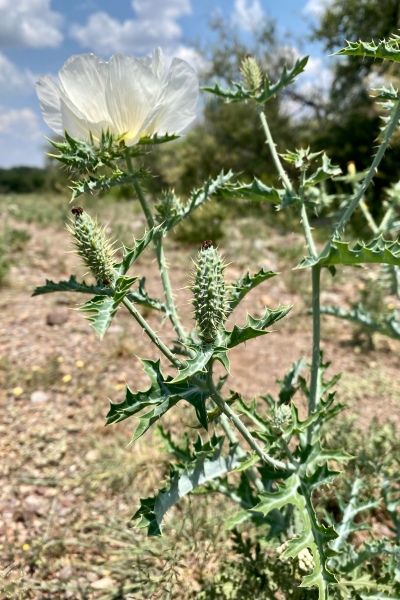
There was a lot of Baccharis sarothroides growing in the lower canyon near the parking area, so I checked it all out hoping to find Tragidion annulatum. None were seen, and in fact there was very little insect life in general. I did pick up a couple of Acmaeodera solitaria by sweeping – not anything significant but the 15th species buprestid of the trip and found a dead Cotinis mutabilis, and Art got a nice series of Chalcolepidius click beetles on B. sarothroides and Prosopis glandulosa. Puzzling the lack of insect activity, given how green all the plants were and how fresh the growth looked. I guess we’ll have to look elsewhere.

Acanthocephala thomasi, a leaf-footed bug (family Coridae).

I was all lined up for a side shot of the bug when suddenly he took flight.

Turkey vultures hanging out waiting for me to die!

Actually they were all hanging out around a dead cat, some of which I scared up as they were feeding on it.

Vicinity Naco, Arizona
We decided to try some desert thorn-scrub habitat so headed east towards Bisbee. Just north of Naco we saw some habitat where it had rained recently – everything was green with the sweet acacia (Acacia rigidula) and creosote (Larrea tridentata) in full bloom. Immediately out of the car I found a Dendrobias mandibularis on Baccharis sarothroides (and when I came back to it later I found a big, major male on it – see photos). On the sweet acacia we found a handful of Gyascutus caelatus (one of which I got a nice photo of), a mating pair of Sphaenothecus bivittatus, and a Cymatodera sp. Finally, out along the roadsides a riot of different yellow composites were in full bloom, including Heliomeris longifolia off which Art got a couple of Acmaeodera solitaria and I got two specimens of a large Acmaeodera sp. (blue-black with numerous small irregular yellow spots).

Dendrobias mandibularis – major male.

Them’s some mandibles!

Gyascutus caelatus on Acacia rigidula.

A blister beetle (family Meloidae) in the genus Zonitis – either sayi or dunnianus – on Heliomeris longifolia.

Heliomeris longifolia – host flower for both the Zonitis blister beetle and Acmaeodera sp. jewel beetle.

Vicinity Tombstone, Arizona
We decided to go back to the spot north of Tombstone where Art had earlier seen Lampetis webbii and give that species another shot. We looked at the Rhus sp. tree that he’d seen them on, and then we each followed the wash in opposite directions looking at the Rhus trees along them, which growing above the banks but never further away than about 25 feet. Along the way I collected several more Gyascutus caelatus on sweet acacia (Acacia rigida), which were more abundant this time than last and also easier to catch. After walking about 1/4-mile down the wash I saw something fly from a Rhus tree and land low on the bushes nearby. I quickly netted it, pulled it out, and was elated to see that it was, indeed, Lampetis webbii! I searched the Rhus in the area more carefully but didn’t find any more, then found some Rhus growing up along the road. At one point, I saw a large buprestid fly and land high in the top of another Rhus tree. I couldn’t tell for sure if it was L. webbii, but I extended my net as far as I could, positioned it beneath the beetle, and tapped the branch hoping it would fall in. Unfortunately, it flew away instead of dropping, so I can’t say for sure whether it was L. webbii or just a wayward G. caelatus. At any rate, L. webbii is yet another species that I have not collected before now and the 17th buprestid species of the trip.

Lampetis webbii, collected on Rhus sp.

Stenaspis solitaria on Acacia rigidula.

Ramsey Canyon, Huachuca Mountains, Arizona
After returning from Tombstone, we visited Pat & Lisa Sullivan at their home at the end of Ramsey Canyon. Pat is a scarab collector who runs lights at his home nightly, and after a delicious dinner we spent the rest of the evening checking the lights. I was hoping to collect Prionus heroicus, and I got my wish. Also got Prionus californicus and several other non-cerambycid beetles such as Chrysina beyeri, C. gloriosa, Lucanus mazama, and Parabyrsopolis chihuahuae (the latter a first for me). I also placed a prionic acid lure (thanks Steve!) and got three more male P. heroicus. We also hunted around the rocks and roadsides hoping to find Amblycheila baroni but didn’t find any. Art did, however, find a female P. californicus and gave it to me (thanks!).

Meeting Pat Sullivan!

Darkling beetles (family Tenebrionidae) such as this one come out at night to feed on decaying vegetation.

Chrysina beyeri (family Scarabaeidae) is one of three species in the genus occurring in Ramsey Canyon.

Black-tailed rattlesnake (Crotalus molossus), collected by Pat in Ramsey Canyon.

Sidewinder (Crotalus cerastes lateropens), collected by Pat in Yuma County.

“Sometimes the best collecting is inside!”

Day 6 – Vicinity Sonoita, Arizona
Unsuccessful attempt to collect Hippomelas martini, only recently described (Bellamy & Nelson, 1998) and part of the type series taken somewhere near this spot (“20 mi NE Patagonia, Hwy 82”) by “sweeping roadside vegetation”. At other locations it had been recorded on Calliandra sp., and I found patches of the plant here along and on top of the road cuts. This gives me confidence that I found the right spot, but I didn’t encounter this or any other beetles by sweeping the patches or visually inspecting them.

Box Canyon, Santa Rita Mountains, Arizona
We decided to come back to Box Canyon since we’d had such good luck last time. I started at the spot above the dry falls where I collected so many Acmaeodera cazieri and A. yuccavora on flowers of Allionia incarnata. This time it was hotter, drier, and windier, and the flowers were semi-closed. Still I found a few of each. I then started walking down the road towards the lower canyon crossing where I would meet up with Art. Things were really hopping on the Mimosa dysocarpa, with Hippomelas planicauda abundant (finally collected my fill) and several other Buprestidae also beaten from the plants: Agrilus aeneocepahlus, Acmaeodera scalaris, Acmaeodera cazieri, Chrysobothris sp., and a species of Spectralia! (seven species of Buprestidae at one location I think is the high for the trip.) I checked other plants and flowers along the way down but didn’t find much.

Halfway down from the “dry falls”.

The “dry falls” about halfway up the canyon.

Pseudovates arizonae – the aptly named Arizona unicorn mantis.

Lower Madera Canyon, Santa Rita Mountains, Arizona
Madera Canyon is perhaps the most famous insect collecting locality in Arizona – maybe in the country, and it is hard to make a visit to Arizona without stopping by here. We elected to work the lower canyon first in an area where Chrysobothris chalcophoroides has been taken on Arizona oaks (Quercus arizonicus). Hiking towards the oaks I found some Stenaspis solitaria in a Baccharis sarothroides and marveled at the variety of other insects active on the plants (see photos) – later I would also collect an elaphidiine cerambycid on the plant. Next I started working the oaks, beating every branch I could reach with my net handle. With one whack of the stick a single Paratyndaris sp. and a single Brachys sp. landed on my sheet – those would be the only buprestids I would collect off the oaks! Other than that I collected one Hippomelas planicauda on Mimosa dysocarpa for the record. While I was working the oaks up in the knoll, the weather started turning with blustery winds, and I could see the rain coming in the distance. By the time I got down from the knoll the rain had arrived, and I walked back to the car in a sunny downpour using my beating sheet as an umbrella!

Madera Canyon in the Santa Rita Mountains.

Acanthocephala thomasi on Baccharis sarothroides.

What appears to be a so-called “cricket killer” wasp (Chlorion aerarium) also feeds on sap on Baccharis sarothroides.

A longhorned beetle, probably in the genus Aneflus, rests on the foliage of Baccharis sarothroides.

Rain headed my way!

Rain passing into neighboring Florida Canyon.

Montosa Canyon, Santa Rita Mountains, Arizona
Just to try something different, we went to Montosa Canyon – the next canyon south of Madera Canyon – for tonight’s blacklighting. We set my sheet up just E of the crossing and Arts ground units back to the west along a gravel road on the south side of the crossing. Moths came in numbers, but the beetles were light – I collected only blister beetles (Epicauta sp.) and a Cymatodera sp. checkered beetle at the sheet, a series of tiger beetles and a female Strategus cessus at the second ground unit, and a male Strategus aloeus and two Stenelaphus alienus at the third ground unit.

A gorgeous sunset to start the evening.

A deepening dusk brings the promise of insects at the lights. 

A bee assassin bug, Apiomerus flaviventris.

An ocotillo, or calleta, silkmoth – Eupackardia calleta.

One of the western riparian tiger beetles.

Day 7 (last day) – Vicinity Continental, Arizona
There was a photo posted on BugGuide of Stenaspis verticalis taken last week, so we decided to give it a shot and see if we could get lucky and find it ourselves. We checked all the Baccharis sarothroides within ½-mile if the spot but didn’t find it. I did, however, collect four Euphoria leucographa, two Chalcolepidius smaragdula, two Aneflus spp., and singletons of Stenaspis solitaria and Dendrobias mandibularis. I also took a couple of Hippomelas planicauda on Mimosa dysocarpa – just for the record!

Euphoria leucographa on Baccharis sarothroides.

Chalcolepidius smaragdinus on Baccharis sarothroides.

Lower Madera Canyon, Santa Rita Mountains, Arizona
We returned to work the lower canyon area. I’d heard that the tiger beetle Cicindelidia obsoleta santaclarae has been taken in the area last week so was hoping to run into it. While Art worked the east side of the road I worked the west, initially following FR-781 into what looked like grassland areas where the tiger beetle might occur. I didn’t see any but took Acmaeodera scalaris on Heterotheca sp. flowers and Acmaeodera solitaria on Argemone mexicana flowers. There was also a fresh wind-thrown mesquite (Prosopis glandulosa) with a bunch of Chrysobothris octocola and one Chrysobothris rossi on it. Still the area looked abused from grazing and was uninteresting, so I looked for another area to explore.

Northwest of the parking lot I spotted another grassy area that was dotted with Baccharis sarothroides, so I decided to give that area a look. After clambering several times through barbed wire fence, I reached the area and began to give it a look. Still no tiger beetles, but every time I passed a B. sarothroides I inspected it closely. I’d looked at several plants when I came upon one with a Stenaspis solitaria sitting in the foliage, and when I looked down on one of the stems and saw a big male Tragidion sp. on the underside of the stem. After securing it, I looked closer at the plant and saw a pair of annulated antennae crawling up another stem – I knew right away it was a mating pair of Stenaspis verticalis! After carefully moving to the other side to confirm, I dared to take a few photos in situ (see below) and then secured the couple. Of course, this gave me newfound motivation to work the entire area to look for more. It was very hot by then, and I was already quite thirsty, but I summoned up all the stamina that I could and worked as many plants as I could, ending up with six Tragidion spp. and three Stenaspis verticalis. The latter was one of my top priority targets for this trips, and the only thing more satisfying than getting it is doing so on my last day on the field.

View to south edge of Madera Canyon – Elephant Head is at the right.

Chrysobothris octocola female ovipositing on freshly killed mesquite (Prosopis glandulosa).

Tragidion sp. mating pair on Baccharis sarothroides.

Mating pair of Stenaspis verticalis arizonensis on Baccharis sarothroides.

Chalcolepidius lenzi at a sap flow on Baccharis sarothroides.

Lateral view of Chalcolepidius lenzi.

Barrel cactus in bloom.

Montosa Canyon, Santa Rita Mountains, Arizona
We  returned to Montosa Canyon and stopped at the Astronomy Vista partway up. It was hotter than bejeebuz! There was not an insect to be seen except giant cactus bugs and a single Euphoria leucographa that Art found on a sapping Baccharis sarothroides. Temp was 103°F even at this elevation!

Stunning vista during the day! 

We needed to escape the heat, and I wanted to see oaks for one more crack at Mastogenius, so we drove up to the 13-km marker and I collected on the way back down to below the 12-km marker. Conditions were much more agreeable (temps in the 80s), and near the top there was a Ceanothus sp. bush in bloom, off which I collected Rhopalophora meeskei and Stenosphenus sp. – both genera represented by individuals with black versus red pronotum. Then I started beating the (Mexican blue, I believe) oaks, and right away I got a Mastogenius sp.! Kinda small, so I’m thinking not M. robusta and, thus, probably M. puncticollis (another species new to my collection). I also beat a largish Agrilus sp. that I don’t recognize, a few clerids, two R. meeskei, one Stenosphenus sp., and a couple of leaf beetles. There was also another type of oak there – Arizona white, I believe, which I beat as well but only got one clerid.

Spectacular views from 7000 ft!

A lichen moth on flowers of Ceanothus sp.

The biggest, fattest, bristliest tachinid fly I have ever seen!

The spectacular vistas just keep on coming!

An ancient alligator juniper stares down yet another sunset (perhaps its 50 thousandth!).

We stopped by the Astronomy Vista again on our way back down the canyon, and I found a pair of Moneilema gigas on cholla (Opuntia imbricata).

Obligatory dusk shot of Moneilema gigas on Opuntia imbricata.

Another individual on the same plant.

Sunset over “Las Cuatro Hermanas”.

It was a fantastic seven days in the field with Arthur, and it was a great pleasure to (in some cases, finally) meet Margarethe, Barbara, Steven, Norm, and Pat. I appreciate the warmth, generosity, and hospitality that all of them displayed to me and look forward to our next encounter, hopefully in the near future. Now, for some light reading during the plane ride home!

© Ted C. MacRae 2019

Pop! goes the beetle

Alaus oculatus (eyed elater) | Beaver Dunes State Park, Oklahoma

Alaus oculatus (eyed elater) | Beaver Dunes State Park, Oklahoma

Last June while collecting beetles from cottonwood trees at Beaver Dunes State Park, Oklahoma, I came across one of my favorite beetles—Alaus oculatus, or eyed elater (family Elateridae, or click beetles). Large by click beetle standards, the most striking feature of eyed elaters is, of course, their false eye spots, which are not eyes at all but patches of pubescence—black surrounded by a narrow ring of white—intended to look like eyes and located prominently on the prothorax rather than the head. A handful of related species are also found in various parts of the U.S., all of which exhibit variations on this same eye spot theme. Undoubtedly these spots serve to frighten would-be predators, much like the false eye spots on the thorax of many lepidopteran caterpillars. The true eyes, of course, are much smaller and are located on the head in front of the “false eyes.” In contrast to the prominently visible eye spots, pubescence on the rest of the body seems to function in cryptic coloration. The mottled patterning blends in with the bark of trees where these beetles usually hang out for effective concealment.

Look into my eye(spot)s!

Look into my eye(spot)s!

If either of those first two lines of defense don’t work, the beetles exhibit “thanatosis” by lying still with legs and antennae appressed to the body to fool the would-be predator into thinking that they are already dead.

A ventral look at the clicking mechanism between the pro- and mesosterna.

Adults exhibit “thanatosis” (play dead)  when disturbed.

Their most remarkable defensive behavior, however, is their ability to snap or “click” their bodies with enough force to free themselves from the grasp of a novice predator (or careless entomologist). The click is produced by a large prosternal spine and mesosternal notch on the beetle’s underside. To click, the beetle arches back its head and pronotum to retract the spine from the notch cavity, the tip of which is then pressed against the edge of the notch. Muscles within the thorax contract, storing elastic energy, and as the flexible hinge between the pro- and mesothoraces moves, the spine slides until its tip passes over the edge of the notch, releasing the elastic energy stored in the thoracic musculature and snapping the spine back into the notch cavity with enough force to produce an audible click.

A large spine on the prosternum fits into a groove on the mesosternum.

A large spine on the prosternum fits into a groove on the mesosternum.

This clicking ability also comes in handy if the beetle frees itself from the grasp of a predator and lands on its back. While the beetle’s legs are too short to right itself, its click is capable of launching the beetle high into the air. By tumbling while in the air, the beetle has a 50% chance of landing on its feet (thus, several attempts may be required). When jumping from a hard surface, the beetle is actually capable of launching itself to a height that is several times its body length and can tumble several times while in the air. This raises an interesting question, since theoretically an elevation of only one body length and half of a body revolution are all that is needed for an upside-down beetle to right itself. The power of the click, thus, grossly exceeds the minimal requirement for righting, yet the beetles seem incapable of moderating the force of the click. Furthermore, the 50% probability of landing suggests that they are also incapable of controlling the orientation of their body during the jump and landing. Did the clicking mechanism initially evolve to combat the grasp of predators and was then co-opted for use in jumping, or was the ability to jump the selective pressure that drove its evolution?

Locked and loaded—the mechanism is primed for the click.

Locked and loaded—the mechanism is primed for the click.

Ribak & Weihs (2011) used biomechanical analyses with Lanelater judaicus to support the idea that the click evolved primarily as a mechanism for vertical jumping. They reason that the excessive vertical distance of the jumps ensures sufficient height when jumping from soft substrates such as foliage or loose soil. A followup study evaluating the effect of natural substrates (Ribak et al. 2012) found that jump height was dramatically reduced (by ~75%) when the beetles jumped from leaves that covered approximately half of the study site and that the reduction in jump height was directly correlated with the amount of work absorbed by the substrate. This provides further evidence that the beetles do not moderate their jumping force and instead simply aim to jump “as high as possible” and rely on random chance for landing back on their feet.

After clicking, the spine returns to its resting position out of the groove.

After clicking, the spine returns to its resting position within the groove.

REFERENCE:

Ribak, G., S. Reingold & D. Weihs. 2012. The effect of natural substrates on jump height in click-beetles. Functional Ecology 26(2):493–499 [abstract].

Ribak, G. & D. Weihs. 2011. Jumping without using legs: The jump of the click-beetles (Elateridae) is morphologically constrained. PLoS ONE 6(6):e20871. doi:10.1371/journal.pone.0020871 [full text].

Copyright © Ted C. MacRae 2014

Baffling beetles

Even though I pride myself as a fairly competent coleopterist, I occasionally run into beetles that—despite my best efforts—I just cannot identify them beyond the family level. I don’t feel too bad about that, as the group’s 350,000 to 400,000 described species represent more than a third of all described life forms! Still, with the amount of information now available online combined with traditional print literature, it’s frustrating when I photograph species that seem quite distinctive but fail to show up in any search result. Here are a couple of South American beetles that I’ve pondered over for a year or more now. If you have any thoughts on their identity I would appreciate hearing from you.

Tenebrionidae? | Campinas, São Paulo, Brazil.

Tenebrionidae? | Campinas, São Paulo, Brazil.

This first beetle was encountered January 2011 on the trunk of a tree in the city of Campinas, southeastern Brazil (São Paulo State). I only got this one shot of it before it dropped and disappeared, and except for the bright green color of the head and pronotum it reminds me of some of the long-jointed beetles—formerly the family Lagriidae but now a subfamily of Tenebrionidae (darkling beetles).

Elateridae | Rt 16 nr. Rio Nego, Chaco Province, Argentina

Elateridae | Rt 16 nr. Rio Negro, Chaco Province, Argentina

This is without question a species of click beetle (family Elateridae), but despite its rather distinctive coloration I’ve not found any images that resemble it. I found these beetles fairly commonly on flowers of Solidago chilensis in April 2012 at several localities along Rt 16 in northern Argentina (Chaco Province).

Copyright © Ted C. MacRae 2013