Just how widespread is Prionus heroicus?

On our insect collecting trip to the western Great Plains last June, Jeff Huether and I encountered several species of beetles in the genus Prionus—longhorned beetles (family Cerambycidae) known commonly as “prionid root borers”. I’ve already recounted our experiences with two of them—P. integer in southeastern Colorado and P. fissicornis in northeastern New Mexico, both of which we encountered unexpectedly and by the “bucketload” using prionic acid baited traps in shortgrass prairie habitats. The third species we encountered was also rather unexpected, so much so that we were not even sure about its identity until we examined the collected specimens more closely. Unlike the two previously mentioned species, however, the behavior of this third species—P. heroicus, especially regarding its attraction to prionic acid, was quite different, and one of the localities where we found it raises some interesting questions regarding its recorded distribution.

Prionus heroicus male

Prionus heroicus male | Mills Canyon, Harding Co., New Mexico.

Prionus heroicus is among the largest species in the genus, and we first encountered it in northeastern New Mexico while searching for suitable habitat around the small town of Mills (Harding Co.) where several grassland-associated species in the genus had been found by other collectors. While we were searching we were intrigued by the USDA Forest Service road sign pointing to “Mills Canyon” and decided to head down the gravel road to see what it looked like. A few miles down the road the endless shortgrass prairie quickly changed to sandstone canyonland with oak/pine/juniper woodland. By now it was late afternoon, and the rich, pulsing buzz of cicadas filling the air as we drove slowly through the area suggested the potential for good insect activity. We stopped to take a closer look at things, and within minutes an enormous prionid beetle came flying up to the car—apparently attracted to the prionic acid lures inside!  We netted the beetle, and shortly afterwards another beetle flew into the vicinity… and another! We hurriedly set out some lure-baited traps, and over the next hour or so we collected close to a dozen beetles. Our first thought, based on their large size and the presence of 12 antennal segments, was that they might be P. californicus. This was a bit of a letdown, as our goal was to find little known and uncommonly encountered Great Plains species, not common and widespread western species like P. californicus. However, the blackish rather than reddish color and relatively broad pronotum eventually convinced us that we had actually found P. heroicus—not a rare species, but also not something we expected to see at this relatively northeastern location compared to its usual haunts in southeastern Arizona.

Prionus heroicus male

Males generally landed in the vicinity of the prionic acid lures but seemed unable to locate its precise whereabouts.

Interestingly, none of the beetles came directly to the lure-baited traps but, rather, flew to the vicinity and then either circled broadly in the air or landed some distance from the trap and ran rapidly on the ground as if searching. We missed a few that we tried to net in mid-air, which responded by immediate straight line flight far away into the distance. Those that we watched while on the ground searched for up to several minutes but seemed unable to locate the lure, eventually taking flight and flying away. This suggests that prionic acid is more important as a component of the female’s calling pheromones for long distance detection, but that other components might be necessary to allow the males to locate females in the immediate vicinity. We returned to the site the following day around noon and were surprised to see males flying to our lures immediately after our arrival, since we had observed P. integer and P. fissicornis activity to occur almost exclusively during the morning and evening hours. Linsley et al. (1961), however, also note that adults of this species fly during the day, as well as at night. Again, none of the beetles seemed capable of finding the precise location of the lure.

Prionus heroicus male

Males rapidly searched the ground after landing but seemed unable to locate the lures and eventually flew off.

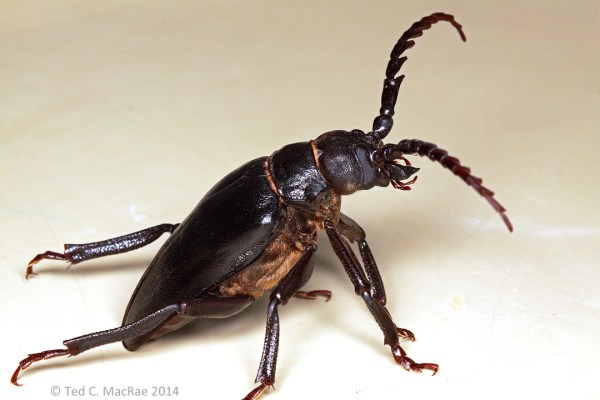
The larval habits of P. heroicus are not known, but the closely related P. californicus feeds on roots of living oaks or occasionally in dead oak logs or stumps (Linsley 1962). Prionus heroicus may have similar habits, since adult females have been found in leaf litter at the bases of living oak trees and stumps (Hovore & Giesbert 1976, Skiles 1978). Presumably the Mills Canyon population is associated with Gambel oak (Quercus gambelii), which was the only oak species noted at this location. An interesting defensive behavior was observed for an adult beetle that I kept alive and photographed later in the hotel room. I had put the beetle on a light-colored tray, and while I was getting the camera ready to take some shots the beetle began crawling away. I picked it up and put it back into position, and for a brief period it assumed the rather comical-looking “standing-on-its-butt” pose shown in the accompanying photograph. It maintained this pose for some seconds and then gradually lowered itself in the front before beginning to crawl again. If I poked it before it finished lowering itself it immediately pushed its front all the way back up again and held the pose briefly before beginning to lower itself again. I did not encounter this behavior in the field—beetles on the ground immediately tried to flee when I handled them and took flight if allowed to.
Prionus heroicus male

Defensive posturing as a result of being disturbed.

The story does not end here, however, as this would not be our last encounter with the species. While we were traveling back towards the east, we decided to visit the area around Black Mesa in the extreme northwestern corner of the Oklahoma panhandle. I had been to this site the previous summer, and although conditions were very dry at the time the presence of Gambel oak in the area—perhaps the easternmost outpost of this western species—had me thinking about the possibility of the area serving as an unknown eastern outpost for western species of jewel beetles (family Buprestidae). Conditions were once again dry, and no jewel beetles were found, but this quickly became a moot point as not long after our arrival a large prionid beetle came flying up to me—again in the same manner as P. heroicus at Mills Canyon and in the middle of the afternoon. We decided these, too, represented P. heroicus and remained in the area for the rest of the day, counting at least a dozen males attracted to the vicinity of the lures that we’d set out. As with the males we observed in New Mexico, none seemed able to find the precise location of the lure, and some circling only briefly and then flew off without even landing. Unlike New Mexico, however, we did succeed in trapping a few males in lure-bated traps that we set out overnight and checked the next morning.

Prionus heroicus male

This Prionus heroicus male  near Black Mesa, Oklahoma confirms the presence of this species in the state.

Our capture of P. heroicus at Mills Canyon in northeastern New Mexico and near Black Mesa in northwestern Oklahoma not only seems to suggest an association of this species with Gambel oak, but also confirms the previously questionable occurrence of the species in Oklahoma. Alexander (1958) reported the species (under one of its synonyms, P. tetricus) from Payne Co. in north-central Oklahoma. This record is dubious, since Payne Co. is well east of the 100th meridian and has a decidedly eastern flora, including its oaks. That record has not been mentioned by any subsequent authors addressing the overall distribution of P. heroicus (Linsley 1962, Chemsak 1996). The presence of P. heroicus in the Black Mesa area, with its decidedly western flora, does not necessarily give credence to the Payne Co. record, but it does bring up the question of just how broadly distributed P. heroicus really is. Most records of this species are from mountainous areas of southern Arizona and New Mexico, but more recently it has been recorded from Texas (Big Bend National Park) by Van Pelt (1999, 2007) and extreme northwestern Colorado (Moffat Co.) by Heffern (1998). The latter record is particularly interesting, as this represents a considerable range extension from any previously recorded locality and begs the question regarding its occurrence in other parts of Colorado.

REFERENCES:

Alexander, D. R. 1958. A preliminary survey of the cerambycids (Insecta: Coleoptera) of Oklahoma. Proceedings of the Oklahoma Academy of Science 38:43–52 [pdf].

Chemsak, J. A. 1996. Illustrated Revision of the Cerambycidae of North America. Volume I. Subfamilies Parandrinae, Spondylidinae, Aseminae, Prioninae. Wolfsgarden  Books, Burbank, California, x + 149 pp., plates I–X [description].

Heffern, D. J. 1998. Insects of Western North America 1A Survey of the Cerambycidae (Coleoptera) or Longhorn Beetles of Colorado. Gillette Museum of Arthropod Diversity, Department of Bioagricultural Sciences and Pest Management, Colorado State University, Fort Collins, i + 32 pp., 1 color plate [summary].

Hovore, F. T. & E. F. Giesbert. 1976. Notes on the ecology and distribution of western Cerambycidae (Coleoptera). The Coleopterists Bulletin 30:350 [JSTOR].

Linsley, E. G. 1962. The Cerambycidae of North America. Part II. Taxonomy and classification of the Parandrinae, Prioninae, Spndylinae, and Aseminae. University of California Publications in Entomology 19:1–102, 1 plate [OCLC WorldCat].

Linsely, E. G., J. N. Knull & M. Statham. 1961. A List of Cerambycidae from the Chiricahua Mountain area, Cochise County, Arizona (Coleoptera). American Museum Novitates 2050:1–34 [pdf].

Skiles, D. D. 1976. Taxonomy and description of two prionine Cerambycidae from southern Arizona: a new species of Stenodontes and new status for Neomallodon arizonicus (Coleoptera). Proceedings of the Entomological Society of Washington 80:407–423 [Biodiversity Heritage Library].

Van Pelt, A. F. (ed.). 1999. Inventory of insects of Big Bend National Park, Texas. Big Bend Natural History Association, Big Bend National Park, and Texas.

Van Pelt, A. F. (ed.). 2007. Inventory of insects of Big Bend National Park, Texas. Report to Big Bend National Park, 204 pp.

© Ted C. MacRae 2015

Mexican Siesta

Summertime is go time for most entomologists, especially those who conduct field work both as a profession and as a hobby. Far flung field sites and the need to travel between them eats up most of each week, while on weekends clipboard and spreadsheets are exchanged for beating sheet and hatchet before traveling to other sites with the promise of some cool species of beetles. Even the most peripatetic entomologist, however, needs a break, and in late July I packed up my swim trunks, rounded up the girls, and headed off for a week of rest and relaxation on the beaches of Cabo San Lucas, Mexico.

Of course, you’re not a real entomologist if you don’t sneak off once or twice for a peak at the local flora and fauna with a vial that just happens to be in your pocket. Despite the rampant development in the area, reasonably extensive parcels of the original San Lucan xeric scrub habitat are accessible to those willing to hike a few miles up the beach. This unique, dry shrubland occurs only at the southern tip of the peninsula, extending from the coast up to about 250 meters in elevation. About ten percent of San Lucan scrub biota is endemic as a result of separation from more northern parts of the peninsula until the Miocene (23–5 mya). Xeric scrub is normally dry, brown, and dusty, but rains prior to my visit had created a verdant landscape with (relatively) lush foliage and an abundance of flowers. Insects were strangely scarce, however, save for a nice diversity of heavily sculptured darkling beetles (family Tenebrionidae), which I encountered along 2-tracks running through the habitat, and a few wood-boring beetles that were found on recently wind-thrown branches of palo verde (Cercidium floridum).

Chrysobothris octocola | Cabo San Lucas, Baja California Sur, Mexico

Chrysobothris octocola on Cercidium floridum ssp. peninsulare | Cabo San Lucas, Baja California Sur, Mexico

Adults were numerous on fresh wind-thrown branches of Cercidium floridum ssp. peninuslare

Adults ran rapidly on the fresh wind-thrown branches

Given the level of endemism in the area, I was hoping the beetles would prove to be examples of such, or at least species restricted to Baja California that I had not encountered before. Alas, both proved to be not only more widespread in Mexico but species occurring commonly in the southwestern U.S. as well. I suppose finding endemic species right off the bat after a quick jaunt up the beach while on a family vacation is a bit much to expect, although I suspect the palo verde trees on which I found the beetles represents the endemic subspecies Cercidium floridum ssp. peninsulare. And I got some nice photos.

Stenosphenus sobrius | Cabo San Lucas, Baja California Sur, Mexico

Stenosphenus sobrius on Cercidium floridum ssp. peninsulare | Cabo San Lucas, Baja California Sur, Mexico

This species was not as abundant on Cercidium branches as Chrysobothris octocola

Adults were found resting on the undersides of fresh wind-thrown branches

© Ted C. MacRae 2015

Best of BitB 2014

Welcome to the 7th Annual “Best of BitB”, where I pick my favorite photographs from the past year. Before I do this, however, let me briefly recap the year 2014. The trend of increasing travel each year continued, with more days spent on the road than in any prior year. Travel for work over the past few years has settled into a familiar routine—touring soybean fields in Argentina in late February and early March, working in my own field trials at (previously three, now four) sites in Illinois and Tennessee from late May through late September, touring more soybean fields at sites across the southeastern U.S. during mid-September, returning to Argentina in October to finalize plans for field trials in the upcoming season, and—finally—attending/presenting at the Entomological Society of America (ESA) Meetings (this year in Portland, Oregon). This heavy travel load makes scheduling my own insect collecting trips a bit tricky, but I’m a persistent sort! In late May I traveled to Tennessee and Georgia with fellow buprestophile Joshua Basham and lab mate Nadeer Youseff to collect several rare jewel beetles, then in late June I collected prionids and jewel beetles in Colorado, New Mexico, and Oklahoma with Jeff Huether. In addition to these longer trips, I also managed to take advantage of my work travel to check out interesting natural habitats along the way to and from my field sites. I continue to give the occasional entomology seminar as well, speaking in March at “Day of Insects” in Ames, Iowa and here in St. Louis to the Entomology Natural History Group of the Webster Groves Nature Study Society in April and the Missouri Master Naturalists Confluence Chapter in December. On top of all this, I still managed to vacation with my family in Lake Tahoe during March and in Cabo San Lucas, Mexico during late July.

I say all this to highlight the fact that after all these years I still consider myself an entomologist with a camera rather than a bona fide insect photographer. The reason for this is that the science of entomology itself remains my primary focus—photography is simply one of the tools that I have come to use in my pursuit of the discipline. I don’t mean to imply that I don’t continue to work on my photography style and technique—because I do. But my style and technique are not goals in of themselves; rather, they are means to an end—that end being my entomological studies. With that said, I present my favorite BitB photographs from 2014. As in previous years, my photos are largely hand-held, in situ field shots that are intended to tell a natural history story in a (hopefully) aesthetic manner. Links to original posts are provided for each photo selection, and I welcome any comments you may have regarding which (if any) is your favorite and why—such feedback will be helpful for me as I continue to hone my craft. If you’re interested, here are my previous years’ picks for 2008, 2009, 2010, 2011, 2012 and 2013. Once again, thank you for your readership, and I hope to see you in 2015!


Paraselenis tersa? female guarding her eggs | Cordoba Prov., Argentina

Paraselenis tersa (Boheman, 1854) | Cordoba Prov., Argentina

From Tortoise beetles on the job (posted April 20). This photograph of a tortoise beetle female over her egg mass illustrates maternal guarding behavior—rare in insects. The perfect lateral profile shot and clean, blue sky background also give the photo a pleasing aesthetic quality.


Who likes mole crickets?

Scapteriscus borellii Giglio-Tos, 1894 | Emanuel Co., Georgia

From Who likes mole crickets? (posted June 6). This has to be the most comical expression ever on the face of an insect!


Chrysobothris orono Frost, 1920 | South Cumberland State Park, Tennessee

Chrysobothris orono Frost, 1920 | South Cumberland State Park, Grundy Co., Tennessee

From Chrysobothris orono in Tennessee (posted July 29). I found this rare jewel beetle for the first time this year with the help of Josh Basham and Nadeer Youseff. The beetle itself is beautiful enough, but photographing it on a pine root with a presumed adult emergence hole adds considerable natural history interest to the photo. Rock substrate behind the root adds a pleasingly blurred background.


Buprestis (Stereosa) salisburyensis Herbst, 1801 | South Cumberland State Park, Tennessee.

Buprestis (Stereosa) salisburyensis Herbst, 1801 | South Cumberland State Park, Tennessee.

From The Buprestis tree (posted August 10). This was another of several jewel beetles that I found for the first time after more than three decades of collecting this group. I like the value contrast in this photo from the striking, metallic colors of the beetle against the nicely blurred cinnamon-colored pine bark of the tree on which it is sitting.


A "super moon" watches over a parasitized hornworm caterpillar.

A “super moon” watches over a parasitized hornworm caterpillar.

From A time of reckoning (posted August 13). I fully admit this is a composite photograph. Nevertheless, it is a faithful recreation of a true sight, and I don’t consider the use of composite techniques to overcome equipment shortcomings to be unethical. There is a haunting symmetry between the blood red moon—considered by some as a sign of the second coming—and the sad, parasitized caterpillar waiting for its inevitable demise.


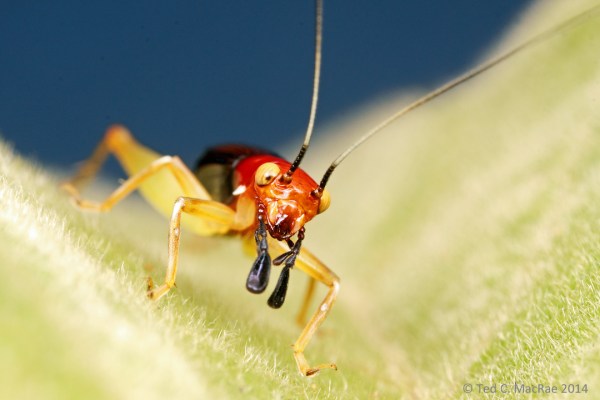
The greatly expanded palps are thought to mimic beetle mandibles or spider pedipalps.

Phyllopalpus pulchellus Uhler, 1864 | Hickman Co., Kentucky

From My, what busy palps you have! (posted September 2). I’ve become quite fond of insect photos with the subject “peering” at me, the photographer”, from some unusual vantage point. The “pupils” in the eyes of this red-headed bush cricket give the insect an almost quizzical look.


Acmaeodera immaculata Horn, 1881 | vic. Vogel Canyon, Otero Co., Colorado.

Acmaeodera immaculata Horn, 1878 | vic. Vogel Canyon, Otero Co., Colorado.

From Sunset beetles (posted September 30). Taking photos of insects at sunset is a challenging and ephemeral experience—one has only a few minutes to take advantage of the unusual and serene colors it offers, while at the same time trying to determine the best camera and flash settings to use in the rapidly fading light. Of the several that I’ve tried, this one is my favorite because of the softly complimentary colors of the beetle, the flower upon which it is sitting, and the dying orange sky behind it. If I had to choose, I would probably pick this one as my favorite of the year because of the unusual and serene colors.


Megacyllene decora (Olivier, 1795) | Stoddard Co., Missouri

Megacyllene decora (Olivier, 1795) | Stoddard Co., Missouri

From Amorpha borer on goldenrod (posted October 5). I featured this very same species in Best of BitB 2012 but can’t resist choosing this second attempt at photographing the spectacularly beautiful adult—this time on goldenrod. As with the previous version this is a true in situ field photograph, hand held and using the left-hand technique to achieve precise composition against a clear blue sky—difficult to do with an insect of this size and using a 100-mm lens, but well worth the effort.


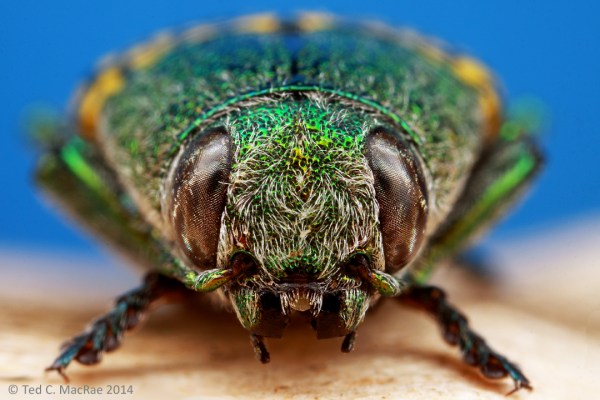
Buprestis (Knulliobuprestis) confluenta Say, 1823 | Woods Co., Oklahoma

Buprestis (Knulliobuprestis) confluenta Say, 1823 | Woods Co., Oklahoma

From A Buprestis hat-trick! (posted October 14). I didn’t take near as many of the classic “frontal portraits” this year, but this one of a jewel beetle that had eluded me for more than 30 years until this past June is perhaps my favorite of them all.


Agrilus concinnus  Horn, 1891 | Stoddard Co., Missouri

Agrilus concinnus Horn, 1891 | Stoddard Co., Missouri

From North America’s Most Beautiful Agrilus Jewel Beetle (posted October 19). There was a time when this beetle was considered one of North America’s rarest species of jewel beetle. Several years worth of hunting by me and others revealed this beetle’s association with mallow and its unusually late adult activity period—the two combining to make this beetle “seem” rare. This year I succeeded in photographing the spectacular adult beetle.


Cacama valvata female ovipositing

Cacama valvata (Uhler, 1888) | Vogel Canyon, Otero Co., Colorado

From Scorching plains, screaming cactus (posted December 5). Insect photos are always better when they also show some aspect of the subject’s natural history. I was lucky to find this female cactus dodger cicada in the act of ovipositing into the dry stem of cholla cactus—in a position where I could get a perfect lateral profile with a clean, blue sky background.


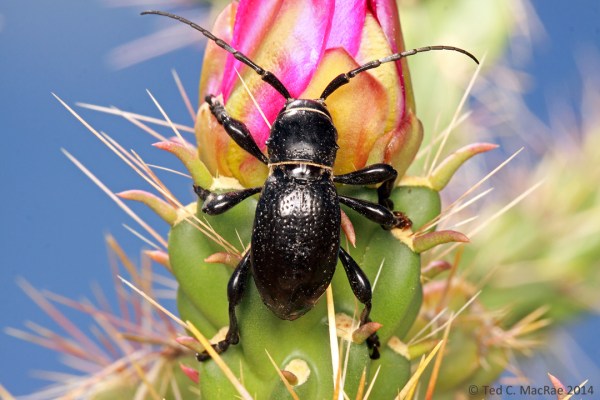
Moneilema armatum LeConte, 1853 | Vogel Canyon, Otero Co., Colorado

Moneilema armatum LeConte, 1853 | Vogel Canyon, Otero Co., Colorado

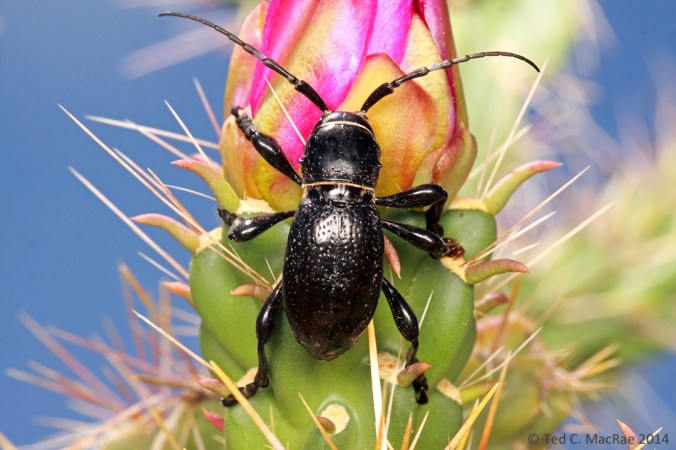
From Cactus beetle redux (posted December 20). Cactus beetles can be difficult to photograph, but sometimes they cooperate by nicely posing on a pleasing pink flower bud with a blue sky in the background and the cactus spines forming a nice, fuzzy “halo” around the jet black beetle. There were surprisingly few cactus spines impaled in the control unit of my flash after this photo session.


I hope you’ve enjoyed this 2014 version of “Best of BitB” and look forward to seeing everyone in 2015.

Copyright © Ted C. MacRae 2015

Cactus beetle redux!

Moneilema armatum LeConte, 1853 | Vogel Canyon, Otero Co., Colorado

Moneilema armatum LeConte, 1853 | Vogel Canyon, Otero Co., Colorado

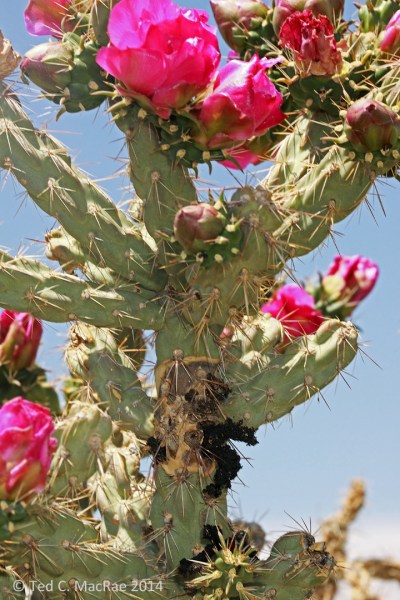
On my most recent Great Plains collecting tripcactus dodger cicadas weren’t the only residents of the cholla cactus (Cylindropuntia imbricata) that studded the open grasslands in southeastern Colorado—cactus beetles (Moneilema spp.) also were found, though in lesser numbers than their frenetic, screeching neighbors (perhaps the reason for their scarcity?!). I’ve covered cactus beetles before, posing the question, “How do you photograph cactus beetles?” The answer was, of course, “Very carefully!” That is certainly true in most cases, but not all.

Moneilema armatum LeConte, 1853 | Vogel Canyon, Otero Co., Colorado

The clumsy, flightless adults rely on their host’s vicious spines for protection.

Cactus beetles are found almost exclusively on opuntioids (chollas and prickly pear cacti), and while most opuntioids are rather viciously spined the plants themselves vary tremendously in structure. Prickly pears (Opuntia spp.), on which I previously photographed these beetles, generally grow in low, dense clumps, their flattened pads often forming a tangle of well-armed hiding places for the beetles. Such is not the case with chollas, which are generally taller, more erect, and have a much more open structure of well spaced, cylindrical stems. The beetles on these plants still enjoy a great amount of protection by the long, barbed spines that cover the stems, but to entomologists/photographers like me they are still much more easily collected and photographed. In this particular case, no special techniques were needed to get nice close-up photos against a clear blue sky other than crouching down a bit and being careful not to lean too close to the plant. That is not to say, of course, that photographing insects on cholla is completely without risk, as this photo showing the spines impaled in my flash unit afterwards will attest (but better the flash unit than poking the lens!).

The hazards of photographing cactus beetles.

The hazards of photographing cactus beetles.

The cactus beetle in these photographs appears to be an armed cactus beetle, Moneilema armatum, by virtue of the small but distinct lateral spines on its pronotum, lack of pubescence on the elytra, and relatively smooth pronotum lacking large punctures except along the apical and basal margins. These shiny black beetles occur in the western Great Plains from Colorado and Kansas south through New Mexico, Oklahoma, and Texas into northern Mexico. Adults and larvae seem to prefer chollas over prickly pears—adults feeding on the surface and larvae tunneling within the stems. I suspect the adult feeding helps provide nutrition for egg maturation in addition to creating an oviposition site, and plants infested with larvae often appear unthrifty and exhibit black masses of hardened exudate along their stems (Woodruff 1966).

Hardened black masses of plant exudate indicate larval feeding within the stems.

Hardened black masses of plant exudate indicate larval feeding within the stems.

REFERENCES:

Linsley, E. G. and J. A. Chemsak. 1984. The Cerambycidae of North America, Part VII, No. 1: Taxonomy and classification of the subfamily Lamiinae, tribes Parmenini through Acanthoderini. University of California Publications in Entomology 102:1–258 [preview].

Woodruff, R. E. 1966. A cactus beetle new to the eastern United States (Coleoptera: Cerambycidae). Florida Department of Agriculture, Division of Plant Industry, Entomology Circular No. 53, 2 pp. [pdf].

© Ted C. MacRae 2014

Two endemic Jamaican jewel beetles: one known, one not?

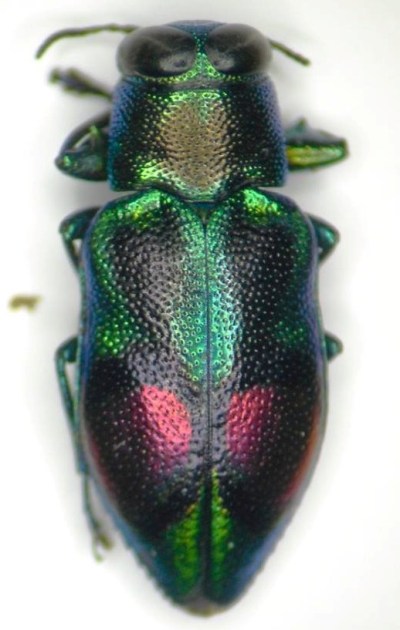
I recently received a batch of jewel beetles from Enrico Ruzzier of Italy. It was an impressive sending (as is any sending of jewel beetles!) collected from diverse parts of the world, but what really caught my eye were two specimens he had collected earlier this year in Jamaica—both representing species in the genus Chrysobothris. Most members of this genus are moderate-sized in relation to other species in the family, but at only 5 and 6 mm in length the two specimens I received are downright tiny. They also are extraordinarily pretty compared to most species in the genus by virtue of their striking patterns of metallic green, red, and blue to violaceous colors! Even more interesting, however, was their West Indian provenance. This “biodiversity hotspot” enjoys not only high species diversity but also high species endemism as a result of the 7,000+ islands that comprise it. This is especially true for Jamaica, where my records indicate that 64% of the known jewel beetle fauna (16 of 25 species) occurs nowhere else.

One of the specimens was easily identifiable as Chrysobothris quadrimaculata (Fabricius, 1776) because of the transverse green, violaceous, and reddish-cupreous bands on the pronotum and metallic green “cross” on the elytra separating four large violaceous spots, each with a reddish-cupreous central area (Fisher 1925). This species has so far been found only in Jamaica and appears to be uncommon in collections. As far as I can tell, the only illustration of the species is a 224-year old drawing appearing in Olivier (1790)¹. Considering this and the extraordinary beauty of this little beetle, it seems appropriate to post a photo here (sent to me by Enrico in his initial query regarding its identity).

¹ This early landmark taxonomic publication is occasionally offered for sale by rare book dealers at asking prices that run in the thousands of dollars! Fortunately, the National Library of France has made a pdf of the book available for free download.

Chrysobothris quadrimaculata (Fabricius, 1776)

Chrysobothris quadrimaculata (Fabricius, 1776). Photo by Enrico Ruzzier.

The second specimen, even smaller but no less pretty than the first, has defied all attempts at identification. It does not key out in Fisher (1925) and clearly differs from the four species and one subspecies known to occur in Jamaica (all of which are endemic). Further comparison with descriptions of all known West Indian species also fails to turn up a match. Considering this and the fact that many West Indian Chrysobothris seem to be quite rare in general (Maier & Ivie 2012), I would not be surprised if this specimen turns out to represent yet another (and as yet undescribed) endemic species for Jamaica. I am hopeful (although not optimistic) that posting a photo here (also provided by Enrico Ruzzier) will prompt those with West Indian material in their collections to examine their holdings and see if any additional specimens can be located.

Chrysobothris n. sp. ex Jamaica

Chrysobothris n. sp.? Photo by Enrico Ruzzier.

REFERENCES:

Fisher, W. S. 1925. A revision of the West Indian Coleoptera of the family Buprestidae. Proceedings of The United States National Museum 65:1–207 [BioDiversity Heritage Library, BioStor].

Maier, C. A. & M. A. Ivie. 2013. New species and records of Chrysobothris Eschscholtz (Coleoptera: Buprestidae) from Montserrat, Saba, and Anguilla, with a key to the Chrysobothris thoracica species-group in the West Indies. The Coleopterists Bulletin 67(2):81–88 [BioOne].

Olivier, A. G. 1790. Entomologie, ou histoire naturelle des insectes, avec leurs caractères génériques et spécifiques, leur description, leur synonymie, et leur figure enluminée. Coléoptères. Tome 2, genera 9–34 (32. Bupreste), pp. 1–485, 63 plates, Baudouin, Paris [Bibliothèque nationale de France].

© Ted C. MacRae 2014

First internet image of Phaenops piniedulis

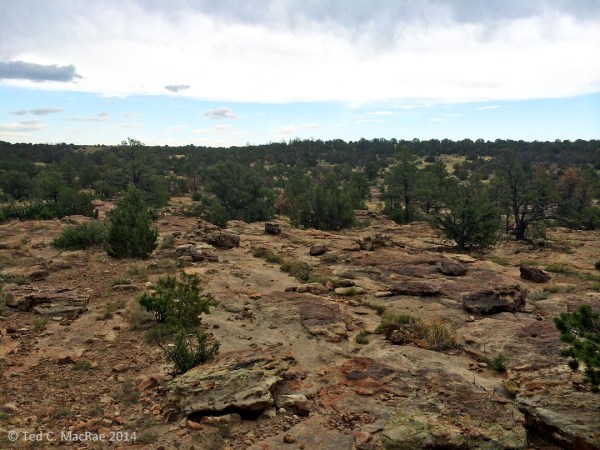
During last June’s collecting trip through the western Great Plains, we stopped at an interesting spot in northeastern New Mexico near the small town of Mills (Harding Co.). Mills itself sits smack dab in the middle of expansive shortgrass prairie; however, a few miles to the west the flat terrain gives way to a rugged, boulder-strewn sandstone canyon harboring oak-pine-juniper woodland. Welcome to Mills Canyon, which descends almost 1,000 feet to the Canadian River below.

Oak/juniper woodland at Mills Canyon, habitat for Prionus heroicus.

Oak-pine-juniper woodland near Mills Rim Campground, Harding Co., New Mexico.

Our quarry for the trip was longhorned beetles in the genus Prionus, especially those associated with grasslands in the central U.S., and while searching the area for suitable grassland-Prionus habitat we chanced upon this spot. Though not the grasslands we were searching for, the area looked interesting enough that we decided to stop and do a little beating. We were immediately rewarded with several interesting finds and decided to come back the next day when we had more time to spend. That was a good decision, as apparently the timing was perfect and we collected perhaps a dozen or more species of jewel and longhorned beetles.

Phaenops piniedulis on Pinus sp. | Mills Rim Campground, Harding Co., New Mexico.

Phaenops piniedulis on Pinus edulis  | Mills Rim Campground, Harding Co., New Mexico.

Perhaps the most interesting of the day’s catch was a single individual representing the jewel beetle Phaenops piniedulis. Though widespread across the southwestern U.S. (records exist from Arizona, California, Colorado, Nevada, New Mexico, Oregon, Utah, and Texas), it is nevertheless only rarely encountered, often no more than a few individuals at a time. As the name suggests, the species was originally associated with pinyon pine (Pinus edulis) (Burke 1908), although it has also been reared from California foothills pine (P. sabiniana), Jeffrey pine (P. jeffreyi), and single-leaf pinyon (P. monophylla) (MacRae & Nelson 2003). The species is distinguished from other several other North American species in the genus by the large yellow maculations that cover more than 50% of the elytral surface (Sloop 1937). These beetles are closely related to the so-called “fire beetles” of the genus Melanophila, the latter famous for their attraction to the smoldering and even still-burning wood of forest fires. However, Phaenops lack the large heat-sensing pores found on the metathorax of Melanophila and, thus, do not exhibit such behavior.

The photo above is not a true field photo, as I encountered the beetle on my beating sheet after whacking a dead pinyon pine branch. Rather than risking escape, I popped it into a vial for safekeeping and later that evening (when it was cooler) placed it on a pinyon twig for photographs. Even then it was still rather active, and the photo shown here is really the only decent photograph I obtained of the beetle. This turns out to be a rather significant photo, for as far as I can tell it is the only photograph of the species—live or dead—to be found on the internet!

REFERENCES:

Burke, H. 1908. A new buprestid enemy of Pinus edulisProceedings of the Entomological Society of Washington 9(1–4):117–118 [Google Books].

MacRae, T. C. & G. H. Nelson. 2003. Distributional and biological notes on Buprestidae (Coleoptera) in North and Central America and the West Indies, with validation of one species. The Coleopterists Bulletin 57(1):57–70 [pdf].

Sloop, K. D. 1937. A revision of the North American buprestid beetles belonging to the genus Melanophila (Coleoptera, Buprestidae). University of California Publications in Entomology 7(1):1–19.

© Ted C. MacRae 2014

I got Thomas Shahan to image my Chrysochroa corbetti!

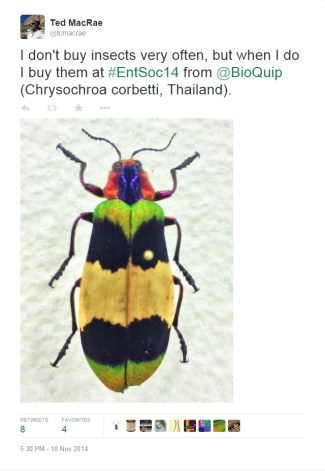
Chrysochroa-corbetti-TwitterThose who follow me on Twitter know that I attended Entomology 2014 last month in Portland, Oregon. As with other scientific conferences, live tweeting of the talks and associated events was all the rage. I may not have been the most prolific “tweeter”, but I did do my share, and one of my tweets involved a rather spectacular preserved specimen of the jewel beetle, Chrysochroa corbetti. The quick iPhone snapshot attached to the tweet was sufficient to prove that the beetle is pure eye candy, but still it did not do full justice to its stunning beauty:

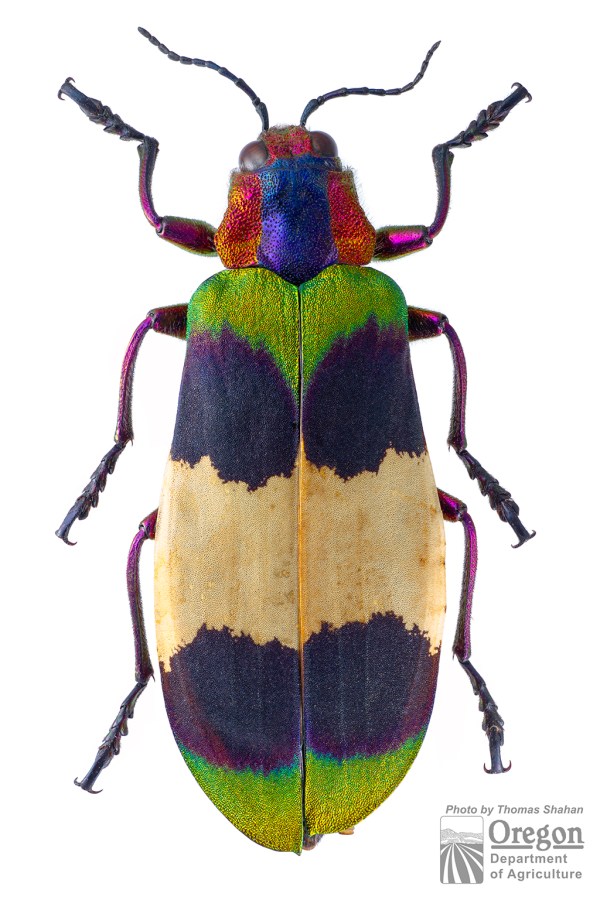
Fortunately, while I was at the meetings I ran into Thomas Shahan—already an icon among insect macrophotographers for his seemingly impossible portraits of jumping spiders, tiger beetles, and other insects. I had planned to spend a couple of days in Salem after the meetings to visit my friend and longtime buprestophile Rick Westcott. As it happens, Thomas is currently a Digital Imaging Specialist at the Oregon Department of Agriculture where Rick spent his entire career as an entomologist. When I showed my specimen to Thomas, he kindly agreed to make some focus-stacked images of the specimen using his lab’s photographic setup. I think you can now agree that this is one of the most spectacular jewel beetles around, and I think you’ll also agree that these images by Thomas are perhaps the most stunning of this oft-photographed species. Be sure to check out the last photo—a 10× close-up of the dorsal elytral detail at the interface between the green and blue areas. Simply stunning!

Chrysochroa (Chroodema) corbetti (Kerremans, 1893) | Thailand

Chrysochroa (Chroodema) corbetti (Kerremans, 1893) | Thailand

Chrysochroa corbetti lateral view

Chrysochroa corbetti lateral view

Chrysochroa corbetti ventral view

Chrysochroa corbetti ventral v

Chrysochroa corbetti dorsal elytral detail (10X)

Chrysochroa corbetti dorsal elytral detail (10X)

© Ted C. MacRae 2014