Mexico 1992—Gang of Ten

As a young collector attracted to woodboring beetles, my interests were split evenly between the families Buprestidae and Cerambycidae. In those early days, I actively sought the counsel of experts in both families, looking for help with identifications. Most were more than gracious with their help, and receiving their letters and return shipments of beetles I had sent for their examination was a highlight of each winter season. There was one man, however, whose letters and parcels I looked forward to receiving more than any other—the late, great Gayle Nelson. More than just a report of identifications, Gayle’s letters were also rich with advice, suggestions and encouragement—he became my first mentor. I coauthored my first published paper on Buprestidae with Gayle (Nelson & MacRae 1990), and when I moved to California in 1990 I had the chance to meet him in person and accompany him on a collecting trip to the great southern Californian deserts. Talk about learning from the master! In the meantime I had also struck up correspondence with long-time buprestophiles Rick Westcott and Chuck Bellamy. I guess between the three of them they saw some potential in me, as shortly after my move to California they invited me to join the upcoming World Buprestid Workers Gathering—a 2-week collecting trip in southern Mexico scheduled for July 1992. While not all of the world’s buprestid workers were able to make this trip, a majority of the heaviest hitters from the U.S. and Europe were there. The photo below is the only one I’m aware of in which all ten participants are present, and while I felt like a midget amongst giants at the time, I’ve enjoyed more or less regular correspondence with most of the participants of that trip over the many years that have since passed.
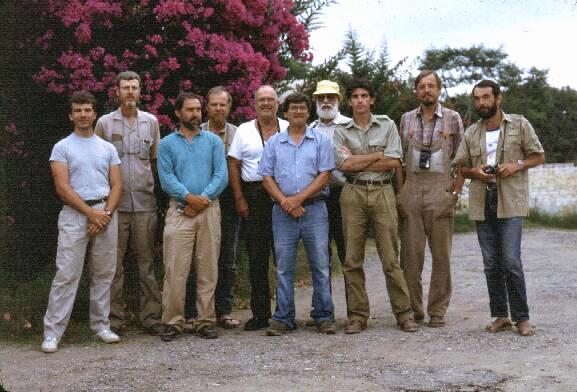
Huahuapan de Leon, Oaxaca, Mexico - July 1992 (L to R): Ted MacRae, Rick Westcott, Hans Mühle, Chuck Bellamy, Gayle Nelson, Byrd Dozier, Dave Verity, Kim Pullen, Svata Bílý, Mark Volkovitsh (photographer unknown).

Huahuapan de Leon, Oaxaca, Mexico—July 1992 (left to right): Ted MacRae, Rick Westcott, Hans Mühle, Chuck Bellamy, Gayle Nelson, Byrd Dozier, Dave Verity, Kim Pullen, Svata Bílý, Mark Volkovitsh.

That trip remains one of the best insect collecting trips I’ve ever experienced (although there are many others now that also bear that distinction). Gayle, Dave Verity and I started in the state of Guerrero and worked our way down into Oaxaca, where we met up with the others and collected together as one large group before Chuck, Rick and I split off and returned for more collecting in Guerrero. I don’t remember how many species I collected—somewhere in the neighborhood of 60 or so, but I’ll never forget finding the first specimens of what would eventually be described as Oaxacanthaxia nigroaenea Nelson & MacRae 1994. We found it at the type locality (near Tehuantepec) of what was then the only known species in the genus, O. viridis Bellamy 1990, that represented an apparently relictual line of buprestids with affinities to certain Old World genera. While that was the only new species that I described from the trip, several described by others are based at least in part on material that I collected. Another highlight of the trip was the “big, dead tree” in Cañón del Zopilote, Guerrero (literally, a big, dead tree), the high branches of which yielded several specimens of Polycesta cortezii Thomson 1878 and one Jelinekia barri (Nelson 1975). Sadly, I wasn’t much of a journal-keeper in those days, so most of the memories that remain from that trip are just snippets in time. Nevertheless, whenever I look at specimens collected on that trip I am usually able to recall the circumstances of its collection, and I recently had the chance to go through much of this material in detail again, as many of the specimens collected represented newly documented state occurrences and adult host plants. These records can now be found in a newly published paper by me and Chuck in which two new species of Actenodes collected during subsequent trips are described (MacRae & Bellamy 2013).

REFERENCES:

MacRae, T. C. & C. L. Bellamy. 2013. Two new species of Actenodes Dejean (Coleoptera: Buprestidae) from southern Mexico, with distributional and biological notes on Buprestidae from Mexico and Central America. The Pan-Pacific Entomologist 89(2):102–119.

Nelson, G. H. & T. C. MacRae. 1990. Additional notes on the biology and distribution of Buprestidae (Coleoptera) in North America, III. The Coleopterists Bulletin 44(3):349–354.

Nelson, G. H. & T. C. MacRae. 1994. Oaxacanthaxia nigroaenea Nelson and MacRae, a new species from Mexico (Coleoptera: Buprestidae). The Coleopterists Bulletin 48(2):149–152.

Copyright © Ted C. MacRae 2013
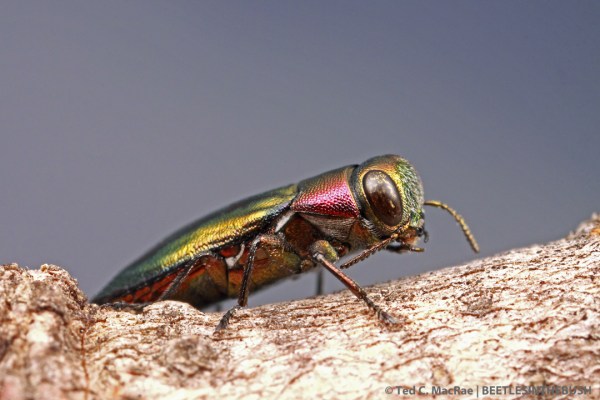
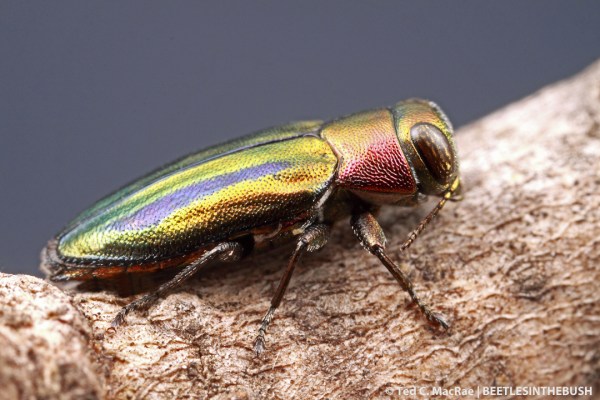
The perfectly polyphagous Chrysobothris purpureovittata

Chrysobothris purpureovittata on Celtis sp. | Gloss Mountains State Park, Woodward Co., Oklahoma

Chrysobothris purpureovittata Horn 1886 | Gloss Mountains State Park, Woodward Co., Oklahoma

Many species of jewels beetles in North America are known for having some degree of host specificity. This is especially true of species in the genus Chrysobothris, whose members are often restricted to a particular family, genus, or even species of host plant. There are some, however, that are not so fastidious in their choice of host plant, and perhaps the best example of such is the species Chrysobothris purpureovittata. This pretty and not uncommonly collected species has been associated with well over two dozen species of deciduous trees representing 21 genera in eleven plant families.

Chrysobothris purpureovittata

Interestingly, the extent of this species’ polyphagy has not been fully appreciated until recently. At the time of Fisher’s (1942) revision of North American species, the only recorded larval hosts were elm (Ulmus sp.) and plum (Prunus sp.). Numerous adult hosts—i.e., plants on which adults had been collected only—were recorded in subsequent years, first by Vogt (1949) in south Texas and later by Nelson et al. (1982) from other locations. However, it was not until my Missouri jewel beetle survey (MacRae 1991) and subsequent “notes papers” by me and colleagues (MacRae & Nelson 2003, MacRae 2006, Wellso & Jackman 2006) that the true diversity of larval hosts became known. A majority of the larval host records are from the Ulmaceae, including several species of hackberry (Celtis tenuifoliaC. laevigataC. ehrenbergia, C. reticulata) and cedar elm (Ulmus crassifolia), suggesting that despite its polyphagous nature there is some preference for members of this plant family. On my recent early June trip to northwestern Oklahoma, I encountered this species at several localities as abundantly as I can ever recall, with nearly all of them beaten from hackberry.

Chrysobothris purpureovittata

Chrysobothris purpureovittata is distributed primarily in the central and south-central U.S., with records from Indiana west to Kansas and south to Mississippi and northern Mexico. A population at the western edge of its distribution (Cloudcroft, Otero Co., New Mexico) associated with mountain mahogany (Cercocarpus montanus) was recently described as a separate subspecies (C. purpureovittata cercocarpi) by Westcott & Nelson (2000)—it is distinguished from nominotypical populations by the entirely red pronotum and uniformly dark elytra.

Chrysobothris purpureovittata

REFERENCES:

Fisher, W. S. 1942. A revision of North American species of buprestid beetles belonging to the tribe Chrysobothrini. U. S. Department of Agriculture, Miscellaneous Publication 470, 1–275.

MacRae, T. C. 1991. The Buprestidae (Coleoptera) of Missouri.  Insecta Mundi 5(2):101–126.

MacRae, T. C. 2006. Distributional and biological notes on North American Buprestidae (Coleoptera), with comments on variation in Anthaxia (Haplanthaxiaviridicornis (Say) and A. (H.) viridfrons Gory. The Pan-Pacific Entomologist 82(2):166–199.

MacRae, T. C. and G. H. Nelson. 2003. Distributional and biological notes on Buprestidae (Coleoptera) in North and Central America and the West Indies, with validation of one species. The Coleopterists Bulletin 57(1):57–70.

Nelson, G. H., D. S. Verity & R. L. Westcott. 1982. Additional notes on the biology and distribution of Buprestidae (Coleoptera) of North America. The Coleopterists Bulletin 35(2) [1981]:129–152.

Vogt, G. H. 1949. A biologically annotated list of the Buprestidae of the Lower Rio Grande Valley, Texas. Annals of the Entomological Society of America 42(2):192–202.

Wellso, S. G. & J. A. Jackman. 2006. A new species of Anthaxia (Haplanthaxia) Reitter (Coleoptera: Buprestidae) and new North American buprestid distributional and host records. The Pan-Pacific Entomologist 82(2):262–268.

Westcott, R. L. & G. H. Nelson. 2000. Descriptions of two new species of Acmaeodera Eschscholtz, and two new subspecies of Agrilus Curtis and Chrysobothris Eschscholtz (Coleoptera: Buprestidae) in North America, with detailed notes on others. The Coleopterists Bulletin 54(3):300–312.

Copyright © Ted C. MacRae 2013

The ever-increasing diversity of Oklahoma beetles

My idea to return to Oklahoma’s Gloss Mountains this spring actually began taking shape during last year’s fall visit to the area, when I found a single Chrysobothris octocola adult on a dead mesquite (Prosopis glandulosa) branch. While common across the southwestern U.S. in association with this plant, its occurrence in the Gloss Mountains represented a northeastern range extension and new state record for Oklahoma! On that same trip I also collected an interesting beetle in the family Rhipiphoridae representing the species Toposcopus wrightii—also not previously recorded in the literature from Oklahoma. Combined with finding Acmaeodera macra here the previous year, it was becoming clear to me that area held good potential for other more typically southwestern species of wood boring beetles. Although I had by then visited the area several times, most of these visits were more focused on tiger beetles rather than wood boring beetles. If I could find such interesting species of wood boring beetles when I wasn’t focused on them, imagine what I might find if I timed a visit in late spring when such species should be at their peak of adult activity.

Chrysobothris quadrilineata | Gloss Mountains State Park, Major Co., Oklahoma

Chrysobothris quadrilineata | Gloss Mountains State Park, Major Co., Oklahoma (new state record).

Of course, success came quickly during this early June visit. I immediately found C. octocola common on the mesquite and would collect a nice series of voucher specimens before the day was over, and the second species I encountered, also on mesquite, was the longhorned beetle Plionoma suturalis—another new state record! I spent a bit of time working the mesquite, and when I had collected a sufficient series of both species, I turned my attention to the eastern red-cedars (Juniperus virginiana) in the area. Actually, I had had my eye on the red-cedars since last fall, when I noticed that nearly every tree had dead branches mixed in amongst the living branches. Closer examination revealed the workings of jewel beetle larvae in all of these dead branches, and a few larvae typical of the genus Chrysobothris were cut from one of the branches. A common species in the Great Plains associated with Juniperus is C. ignicollis, but these larvae looked rather big to represent that species, so I bundled up some dead branches and brought them back home for rearing but forgot to check on them before I left on this trip. At any rate, I walked up to one of the red-cedars, placed my beating sheet under a dead branch, gave the branch a whack with the handle of my net, and onto the sheet fell a rather robust Chrysobothris that I didn’t immediately recognize. I knew it wasn’t C. ignicollis, a much smaller species that I have collected on numerous occasions, so I thought maybe it could be C. texana, another western Juniperus-associate that I’ve collected less commonly. Still, the robust body and broad, distinct elytral and pronotal ridges had me second guessing that identification (especially after I found some individuals that looked more like what I remembered C. texana looking like). Over the next two days I beat hundreds (literally!) of dead juniper branches, finding many C. ignicollis but every now and then getting also one of these big, robust individuals.

Chrysobothris quadrilineata

Adults were beaten from dead branches on live Juniperus virginiana (new adult host).

After returning home, I checked my heavily annotated copy of Fisher (1942) and quickly determined the robust specimens as representing C. quadrilineata—a rather uncommon species and one that I’d never collected before. Described by LeConte in 1860 from New Mexico and recorded early in the 20th century from Arizona, Nevada and California, it has in more recent years been found to occupy a rather wide distribution across the western U.S., including Texas (Barr & Westcott 1976), Colorado, Oregon, South Dakota (Nelson et al. 1982), and Utah (Nelson 1987). Notice one state that is not in that list—Oklahoma! That’s right, another new state record! I later found photographs of this species on BugGuide taken in the very same area a year earlier (7 June 2012).

Chrysobothris quadrilineata

Adults also emerged from dead J. virginiana branches collected Sept. 2012 (first reported larval host).

When I returned home, I also checked the rearing cans and found several adults had emerged from the branches I collected last September. The only host associations that have been recorded for this species are adults collected on Juniperus californica (Linsley & Ross 1940) and J. pachyphloea [= J. deppeana] (Barr & Westcott 1976). Thus, J. virginiana not only represents a new host record for the species but is also the first known larval host. Considering how broadly distributed across the western U.S. this species is, it seems likely that it utilizes a number of Juniperus spp. throughout its range.

REFERENCES:

Barr, W. F. & R. L. Westcott. 1976. Taxonomic, biological and distributional notes of North American Chrysobothris, with description of a new species from California (Coleoptera: Buprestidae).  The Pan-Pacific Entomologist 52(2):138–153.

Fisher, W. S. 1942. A revision of North American species of buprestid beetles belonging to the tribe Chrysobothrini. U. S. Department of Agriculture, Miscellaneous Publication 470, 1–275.

Linsley, E. G. & E. S. Ross. 1940. Records of some Coleoptera from the San Jacinto Mountains, California.  The Pan-Pacific Entomologist 16(2):75–76.

Nelson, G. H. 1987. Additional notes on the biology and distribution of Buprestidae (Coleoptera) in North America, II.   The Coleopterists Bulletin 41(1):57–65.

Nelson, G. H., D. S. Verity & R. L. Westcott. 1982. Additional notes on the biology and distribution of Buprestidae (Coleoptera) of North America.  The Coleopterists Bulletin 35(2) [1981]:129–152.

Copyright © Ted C. MacRae 2013

“Rare jewel beetles discovered in Mexico by team of scientists!”

I hope you’ll excuse the hyperbolic title, but such has been my impression with some of the headlines I’ve seen recently in the popular media regarding newly described insect taxa in various parts of the world. The “discovery” of new species in far away, tropical lands sounds exciting and ground-breaking to many people, who envision teams of scientists wearing pith helmets and cargo shorts machete-slashing their way through miles of virgin forest before stumbling into a secret biodiversity hot-spot, their weeks of toil and sweat finally paying off by becoming the first white men to lay eyes upon a bounty of strange, exotic, never-before-seen creatures. In reality, new species of insects are not at all hard to find—in fact, depending on where you go it can be downright easy. Admittedly the chances are greater in the tropics, where many areas remain little explored, but even in well-studied North America new species turn up regularly. This includes popularly collected beetles in the very well-studied eastern U.S., where I’ve already described one new jewel beetle (family Buprestidae) and one new longhorned beetle (family Cerambycidae) from right here in my home state of Missouri (MacRae 2000, 2003) and am in the process of describing another new jewel beetle. No, finding new species is easy—recognizing them as such is the hard part. That’s not to say that new species cannot be recognized when first encountered, but I suspect that a majority of new insect species aren’t actually “discovered” until they’ve been brought back from the field, curated, and sat in a cabinet for years or decades—unrecognized for what they really are due to resemblance to known species until somebody comes along and examines them more critically.

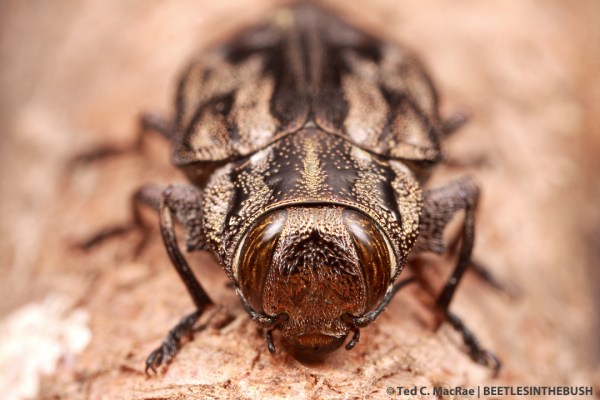
Such is the case with two jewel beetle species that Chuck Bellamy and I describe in a paper just published in The Pan-Pacific Entomologist (MacRae & Bellamy 2013). I joined Chuck on several trips to Mexico in 1992 and again from 2004–2006 to explore the tropical thorn woodlands in the southern states of Oaxaca, Puebla, Guerrero and Michoacán. Jewel beetle diversity is high in these still relatively intact woodlands, with a number of new species already having been described from the area in recent years, and all-told we collected well over 100 species. At least a dozen or more of these look to be new, and considering that the Mexican jewel beetle fauna as a whole includes more than 800 known species the actual number could greatly exceed 1,000. The two described in this most recent paper resemble the common, widespread species Actenodes calcaratus. This big, beautiful jewel occurs from the southwestern U.S. through Mexico and Central America to northern South America, developing as larvae in dead wood of a variety of fabaceous hosts. We collected several of what we thought was this species during our trips, but a number of subtle but consistent differences in punctation and surface sculpturing emerged as we began comparing them more critically against A. calcaratus from other locations. The coup de grâce, however, was the coloration of the male face—normal bronze in A. calcaratus (Fig. 5) and similar to the female (Fig. 6), but flash-green in male A. scabrosus (Fig. 2) and green-violaceous in male A. michoacanus (Fig. 8). It’s quite remarkable that both of these species differ from their more widespread relative by subtle morphological characters but such striking sexually dimorphic facial coloration, and we subsequently found a similar situation with another species in the genus (A. undulatus) that otherwise bears little resemblance to A. calcaratus.

Figs. 1–9. Actenodes spp. 1–3. Actenodes scabrosus. 1–2. Male holotype. 1. Dorsal habitus. 2. Frontal view. 3. Female paratype (Guerrero). 4–6. A. calcaratus. 4–5. Male (MEXICO, Guerrero, Hwy 95, 5 km S Milpillas, 7.vii.1992, "big dead tree", G. H. Nelson [FSCA]). 4. Dorsal habitus. 5. Frontal view. 6. Female (MEXICO, Hwy 95, 2 km S Milpillas, 6.vii.1992, on Acacia farnesiana, G. H. Nelson [FSCA]), frontal view. 7–9. A. michoacanus. 7–8. Male holotype. 7. Dorsal view. 8. Frontal view. 9. Female paratype, frontal view. All scale bars = 5 mm.

Figs. 1–9. Actenodes spp. 1–3. Actenodes scabrosus. 1–2. Male holotype. 1. Dorsal habitus. 2. Frontal view. 3. Female paratype (Guerrero). 4–6. A. calcaratus. 4–5. Male (MEXICO, Guerrero, Hwy 95, 5 km S Milpillas, 7.vii.1992, “big dead tree”, G. H. Nelson [FSCA]). 4. Dorsal habitus. 5. Frontal view. 6. Female (MEXICO, Hwy 95, 2 km S Milpillas, 6.vii.1992, on Acacia farnesiana, G. H. Nelson [FSCA]), frontal view. 7–9. A. michoacanus. 7–8. Male holotype. 7. Dorsal view. 8. Frontal view. 9. Female paratype, frontal view. All scale bars = 5 mm.

In the case of both of these new species, the first specimens were actually collected more than 40 years ago but remained “hidden” among specimens of A. calcaratus until we examined the collections containing them more closely. While it might seem that the striking male facial coloration both of these species exhibit should have resulted in their quick recognition as undescribed species, even seemingly obvious characters such as this can be overlooked when an otherwise great resemblance to a common, widespread species prevents their critical examination.

REFERENCES:

MacRae, T. C. 2000. Review of the genus Purpuricenus Dejean (Coleoptera: Cerambycidae) in North America. The Pan-Pacific Entomologist 76(3):137–169.

MacRae, T. C. 2003. Agrilus (s. str.) betulanigrae MacRae (Coleoptera: Buprestidae: Agrilini), a new species from North America, with comments on subgeneric placement and a key to the otiosus species-group in North America. Zootaxa 380:1–9.

MacRae, T. C. & C. L. Bellamy. 2013. Two new species of Actenodes Dejean (Coleoptera: Buprestidae) from southern Mexico, with distributional and biological notes on Buprestidae from Mexico and Central America. The Pan-Pacific Entomologist 89(2):102–119.

Copyright © Ted C. MacRae 2013

Observation and Bias in Biology

The following is a guest post by my friend Kent Fothergill. Read more of Kent’s musings at his blog, biologistsoup.


Observation is a key activity in scientific inquiry. People who work with insects can make many interesting observations from collected insects: distribution, phenology, etc. Observations can be documented and analyzed later from photographs. A collection of photographs can also yield information about: associations with other species, behavior, while providing the same information as collected specimens – as such photography is a new tool changing entomology. Of course, most observations are made using only human senses without photographic or specimen documentation, but all observations can be subject to biases.

Observer biases are our evolutionary legacy. Our brains evolved to process and interpret data based on patterns observed in previously processed data. Because of the vast amount of data flowing in from our five senses and our limited ability to focus on data, our brains let most data be background. Even the subset of data that we focus our attention on is filtered, who hasn’t taken a photograph and found something much more interesting in the photograph than the original subject (e.g., these mites on harvestmen)? All data, even the data subset we are focused on can be misinterpreted. When teaching scientific methods, my students always enjoyed the optical illusion exercises to demonstrate why objective analyses and accurate measurement are important.

Remember, that the brain also compares incoming data to previous data. This allows pattern recognition. Recently, Ted and I were blacklighting along the Mississippi River in Southeast Missouri. We found a pair of Elaphidion mucronatum (spiny oak borer) a very common insect in Southeast Missouri. So common that many would move on to other more interesting subjects at that point. The insects were in a mate guarding situation.  Because I had a name for the behavior, my brain put my observation in the mate guarding category. At this point I would have moved on, except Ted wished to document the subject with his camera rig, which meant I would do what any friend should: watch the insects while Ted ran to vehicle to get his camera so he would be able to photograph them. While Ted was gone things got interesting. The male was positioned above the female, who was more or less caged between his legs. The pair was moving in unison on the tree trunk with very little actual contact between the pair. This was interesting, but when the female E. mucronatum suddenly shot out from under the male ending up 10’ vertical below him on the side of the tree trunk I was stunned. The male covered this distance with amazing speed and recaptured the female. After a couple minutes the female again shot out from under went down a few feet and doubled back ending out of sight above the male. At this point the male remained motionless for a brief period. When Ted came back with his camera, I took my eyes off of the male to tell him about what I had seen, and the male had vacated the area. Later, on the very same tree, we saw a mate guarding pair (presumably the same individuals) coming down towards us.

I have viewed many mate guarding insects. Mate guarding is a male insect using its body to prevent other males from mating with this female. Evolutionary biologists will explain mate guarding behavior in terms of enhanced male reproductive success, and that is why mate guarding persists. I never questioned this explanation, but should have. The E. mucronatum observation caused me to see mate guarding in a new way and realize that mate guarding involves a male and female component – I know this seems obvious, but I had my own cultural bias to overcome in this regard. I had never considered that mate guarding could involve non-willing females.

Based on a 10 minute observation of a very common insect my new understanding of mate guarding now recognizes that mate guarding influences female fitness also. Mate guarding persists when it creates a change in fitness in the male and female such that there is a positive net change in fitness for reproductive output for all individuals involved. In the case I witnessed, there may actually be a reproductive cost for the female and that is why she tried to avoid/escape the mate guarding. I have much more to learn about mate guarding.

Science is a way of objectively seeing the world and testing what you have seen to approach truth. This observation of E. mucronatum was also a mirror that showed my cultural bias and how that bias influenced my interpretation of my observations. For me, this observation could be a watershed event.

The moral(s) of this story:

  1. Life is short: enjoy time in the field with friends.
  2. Pay attention. There are new and wonderful things to observe even in the common and mundane.
  3. Be aware of the biases that can keep you from the truth.
  4. Have fun out there!

Copyright © Kent Fothergill 2013

Cover photo for the June 2013 issue of The Coleopterists Bulletin

Eurhinus cf. adonis on Solidago chilensis | Chaco Province, Argentina

Did anybody think that weevil photograph on the cover of the June 2013 issue of The Coleopterists Bulletin (vol. 67, no. 2) looked familiar? If so, it’s  because you saw it first in my April 28, 2013 post,  This is Eurhinus cf. adonis (ID courtesy of Charles O’Brien), which I photographed near La Escondida in Chaco Province, Argentina on flowers of Solidago chilensis. This photo reminds me that I need to pay more attention to portrait-style photographs, as landscape oriented photos don’t often fit very well on magazine and journal covers.

Beyond being my first cover for The Coleopterists Bulletin (and I hope not the last), the issue contains a number of papers that I will be studying with interest. These include a paper describing new species of Chrysobothris (Buprestidae) from the West Indies with notes on others, a checklist of longhorned beetles (Cerambycidae) from Montana, and the synonymization of Megacyllene comanchei under M. angulifera—all by Mike Ivie and colleagues (I did have the privilege of reviewing the Chrysobothris paper, and my Megacyllene comanchei“—now M. angulifera—specimens were among those examined). Also of interest to me is a paper about wood-boring beetle emergence (including Buprestidae and Cerambycidae) from ponderosa pines killed by mountain pine beetle and fire in the Black Hills of South Dakota. Finally, Brett Ratcliffe has included a primer on best writing and curatorial practices for describing a new species of beetle—as a somewhat but not highly practiced alpha taxonomist, this should be an interesting read for me that will hopefully give me a chance to correct any nascent bad habits that I may be developing. Scarabaeologists and weevil specialists should be equally pleased with this issue, with a half-dozen or more papers in each group filling most of the remaining pages.

Copyright © Ted C. MacRae

Plionoma suturalis in Oklahoma—a new state record!

When I returned from my vacation/insect collecting trip to western Oklahoma two weeks ago, most people upon learning where I went responded with a funny look that said, “Why would you want to go to Oklahoma?” Even entomologists familiar with my inclination for beetles merely assumed I went there to collect tiger beetles and were surprised to learn that, for this trip, I was actually targeting jewel beetles (family Buprestidae) and longhorned beetles (family Cerambycidae). Jewel beetles and longhorned beetles, of course, are largely associated with dead wood, and western Oklahoma is smack dab in the middle of the Great Plains. However, this does not mean that there are no trees in the area, or that whatever trees do exist are merely western examples of pedestrian eastern species with a depauperate beetle fauna. In fact, I came to this area precisely because previous visits had seemed to indicate high potential for interesting species of woodboring beetles. On my September 2011 visit, passing through on my way back from Colorado, I found several individuals of the unusual fall-active Acmaeodera macra (representing a northern range extension), and during last year’s fall visit I found a single Chrysobothris octocola adult on a dead mesquite (Prosopis glandulosa) branch—a northeastern range extension and new state record for Oklahoma! Interesting records for other species of beetles over the past few years also supported the idea that western Oklahoma was understudied and held the promise of more interesting new records for anyone willing to spend time in the area.

Plionoma suturalis (male) | Gloss Mountains, Major Co., Oklahoma

Plionoma suturalis (male) on mesquite (Prosopis glandulosa) | Gloss Mountains, Major Co., Oklahoma

Nearly all of these interesting records have been found in the Gloss Mountains, a fascinating system of gypsum capped, red clay mesas in Major Co. I now regard the Gloss Mountains State Park as my “portal” to northwestern Oklahoma and can’t imagine traveling to or through the area without stopping and spending time knocking around this fascinating, brick-red landscape. Such was the case during this year’s trip, and while I had decided to spend at least the first field day in and around the State Park, the collecting was so good that I stayed for a second day and returned for a third later in the week. The beetle shown in these photos is part (and only part) of the reason why. Arriving in the morning of the first day in the field, I headed straight for the mesquite tree on which I had found the C. octocola adult last fall. It’s a common species in the southwestern U.S. that normally wouldn’t warrant any special attention, but since the Oklahoma record was based on a single specimen I wanted to see if I could find additional individuals to confirm that the species was actually established in the area and that last year’s record wasn’t just a one-off. I whacked a dead branch, and onto my beating sheet fell a C. octocola adult! I whacked another dead branch, and off fell another adult! As it was, I would find the species as abundantly here, in strict association with mesquite, as I have seen it at other locations further to the southwest. Soon after collecting the first few C. octocola adults, however, I whacked a live branch on the same mesquite tree, and off fell two large, colorful longhorned beetles that I recognized instantly as representing the species Plionoma suturalis.

Plionoma suturalis (female) | Gloss Mountains, Major Co., Oklahoma

Plionoma suturalis (female) on mesquite flowers | Gloss Mountains, Major Co., Oklahoma

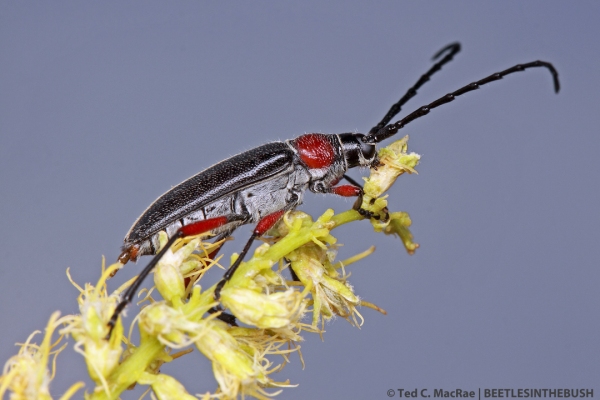
Plionoma suturalis belongs to the great tribe Trachyderini. Beetles in this tribe are known for the bright colors, attraction to flowers, and diurnal (day-active) tendencies, and while we have a few species in the eastern U.S. they are far more diverse in the southwestern states. Plionoma suturalis and another U.S. species (P. rubens) are known to occur from Texas west to California and south into northern Mexico, but I immediately had the feeling that finding this species in Oklahoma was a significant record. The beetles were abundant on the mesquite trees that lined the parking lot and dotted to landscape below the main mesa, with many observed feeding on the flowers (the trees were in full bloom) and numerous mating pairs also observed. Considering its abundance at the site and possible significance of the record, I collected several dozen specimens to serve as vouchers (not to mention I had only collected a handful of specimens in all of my previous years of collecting). Checking my database later that evening (I never leave home without my computer!) confirmed my suspicions—Oklahoma was not only a new state record, but a significant northeastern range extension. In fact, the closest previous record was by Lingafelter & Horner (1993), who recorded eight specimens from Wichita Co., Texas—just over 200 miles to the south! Further, the Wichita Co. specimens were all collected in 1956, and subsequent collecting had yielded no additional specimens, leading the authors to consider the status of this species in north-central Texas as doubtful.

The female feeds on flowers of mesquite (Prosopis glandulosa)

Large number of individuals were seen feeding on mesquite flowers.

Plionoma suturalis is one of only a handful of North American longhorned beetle species in which the adults exhibit bimodal seasonal activity, with adults appearing during the spring months, disappearing during the summer, and reappearing in the fall (see  for a previous example from Missouri) (Linsley 1962). In the Lower Rio Grande Valley of south Texas (where the activity of many species of longhorned beetles and other insects is distinctly bimodal to coincide with moderate temperatures and increased precipitation during spring and fall), this species has been found on fresh-cut mesquite and huisache (Acacia farnesiana) in the fall months and on the blossoms of fabaceous trees during spring and early summer (Hovore et al. 1987).

REFERENCES:

Hovore, F. T., R. L. Penrose & R. W. Neck. 1987. The Cerambycidae or longhorned beetles of Southern Texas: a faunal survey. Proceedings of the California Academy of Science 44(13):283–334, 20 figs.

Lingafelter, S. W. & N. V. Horner. 1993. The Cerambycidae of north-central Texas. The Coleopterists Bulletin 47(2):159–191, 7 figs.

Linsley, E. G. 1962. The Cerambycidae of North America. Part III. Taxonomy and classification of the subfamily Cerambycinae, tribes Opsimini through Megaderini. University of California Publicatons in Entomology 20:1–188, 56 figs.

Copyright © Ted C. MacRae 2013

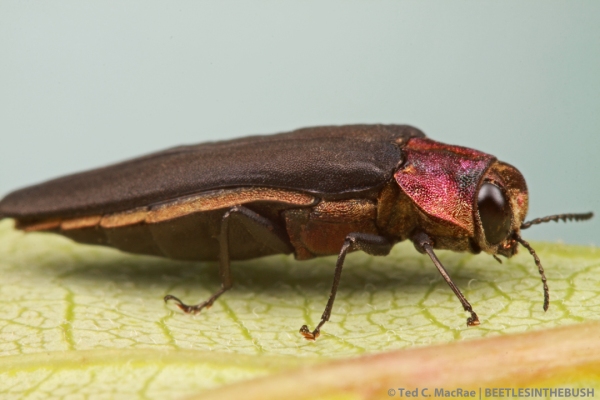
Agrilus fuscipennis on Persimmon

Agrilus fuscipennis

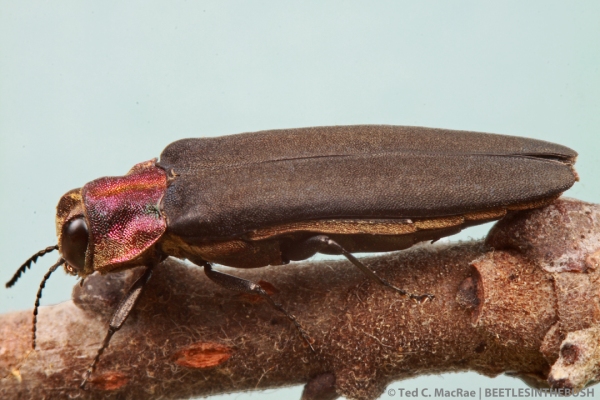
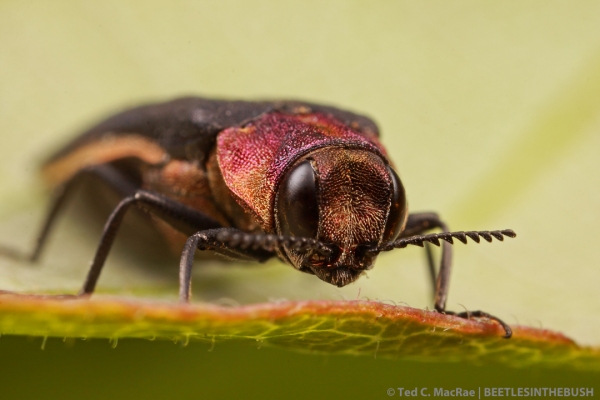
Agrilus fuscipennis may not be the largest or the prettiest member of the genus occurring in Missouri (that honor is reserved for Agrilus concinnus, or “hibiscus jewel beetle”—MacRae 2004). Nevertheless,  it comes pretty darned close! Add to that the fact that it is among our most seldom encountered jewel beetles, and you can understand how excited I was to see this species on my sheet after beating a small persimmon (Diospyros virginiana) tree last weekend at Hercules Glades Wilderness in the White River Hills of extreme southwestern Missouri. In fact, I have only collected this species three times previously—all single specimens beaten from persimmon, and all back in the 1980s!

Agrilus fuscipennis

Jewel beetles are unquestionably popular among insect collectors, due no doubt in large part to their vivid, metallic colors. I think the family, however, would be even more popular were it not for the genus Agrilus. Fully one in five species of jewel beetles belongs to this genus, which at nearly 3,000 described species and counting (Bellamy 2008) is perhaps the largest genus in the entire animal kingdom. As might be expected, such hyperdiversity has resulted in taxonomic quagmire, with species limits difficult to define and many hardly distinguishable except by examination of male genitalia (MacRae 2003). Additionally, in contrast to the rest of the family which is generally recognized as containing some of the most spectacularly beautiful beetles in the world, the most species of Agrilus are small, usually less than 8 mm in length and often as small as only 4–5 mm, and also lack the vivid colors (at least, to the naked eye) for which the rest of the family is so noted.

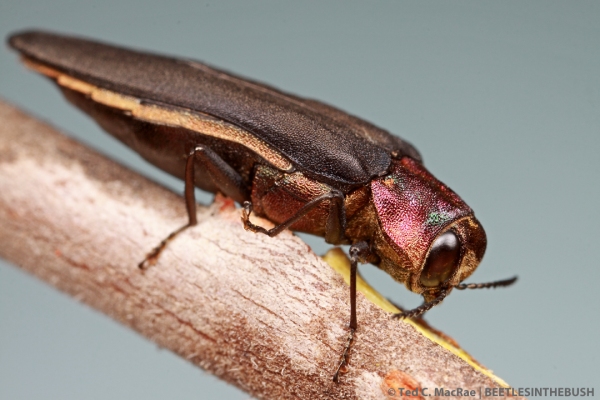
Agrilus fuscipennis

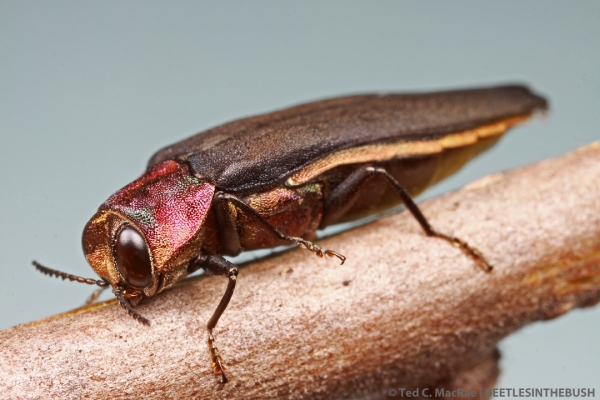
Agrilus fuscipennis is one of several species that buck this general Agrilus theme. While not forming a discrete taxonomic group within the genus, they are all unified by the following characteristics: 1) relatively large for the genus (A. fuscipennis measures 12–14 mm length), 2) vivid red pronotum and black elytra, and 3) mine the lower trunks, crown and main roots of living rather than dead host plants. For A. fuscipennis the larval host is persimmon, and other similar species include A. vittaticollis on serviceberry (Amelanchier) and A. concinnus on wild hibiscus (Hibiscus). These other species also are not very commonly encountered, at least in my experience, perhaps partly because they are not as easily reared from their hosts as species that develop as larvae in dead wood (the latter can be easily reared by retrieving infested wood from the field and placing in containers to trap emerging adults).

Agrilus fuscipennis

In the interest of full disclosure, these photos were taken in the studio after returning home. Although the persimmon branch is real, the “blue sky” is actually just a colored index card. I prefer to photograph insects in the field, especially with insects such as tiger beetles where it is desirable to include elements of the insect’s natural habitat in the photograph. However, I don’t have a problem with studio photography if field photographs prove too difficult or time-consuming or present too high a risk of escape by a prize specimen. My normal protocol for the latter is to place the first individual in a vial and continue to search for another that I will then try to photograph in the field. If that doesn’t work then I still have the first individual as a backup for studio photographs. In the case of this beetle, I found it on the very first clump of persimmon that I beat but never saw another despite beating persimmon for the rest of the afternoon (just like the three I found separately back in the 80s)! I have plans to photograph A. concinnus later this summer on its Hibiscus host plant in southeastern Missouri—hopefully I will succeed in getting true field photographs of that species.

Agrilus fuscipennis

REFERENCES:

Bellamy, C. L. 2008. World catalogue and bibliography of the jewel beetles (Coleoptera: Buprestoidea), Volume 4: Agrilinae: Agrilina through Trachyini. Pensoft Series Faunistica 79:1–722.

MacRae, T. C. 1991. The Buprestidae (Coleoptera) of Missouri.  Insecta Mundi 5(2):101–126.

MacRae, T. C. 2004. Beetle bits: Hunting the elusive “hibiscus jewel beetle”. Nature Notes, Journal of the Webster Groves Nature Study Society 76(5):4–5.

Copyright © Ted C. MacRae 2013