Best of BitB 2012

Welcome to the 5th Annual “Best of BitB”, where I pick my favorite photographs from the past year. 2012 was one of the most intensive travel years I’ve ever had—I spent 8 weeks in Argentina from February through April, made separate trips to Puerto Rico and Arkansas in May (bracketing a personal week in California), traveled almost weekly to Illinois and Tennessee from June to September (interrupted by a personal week in Florida in July), toured the southeastern U.S. (Arkansas, Louisiana, Mississippi and Georgia—great food!) in early September, chased tiger beetles in Oklahoma, Texas and Arkansas in late September, went back to Argentina for a week in October, and capped off the travel year by attending the Entomological Society of America Annual Meetings in Knoxville, Tennessee (for the first time in more than 10 years!)—whew! While many would cringe at such a travel load, I am among the lucky few who actually get paid for doing something that is also my hobby—entomology! This gives me ample opportunity to further hone my photography skills (nine of the 13 photos I’ve selected below were actually taken while I was on business travel), resulting in two key accomplishments this year—my first ever photography talk at the ESA’s insect photography symposium and my first commercial sales (look for the BitB commercial site to go online in 2013).

Enough blather! Here are my favorite BitB photographs from 2012. Click the link in the text below the photo to see the original post. I would greatly appreciate knowing if you have a favorite (and why)—your feedback will be enormously helpful to me as I continue to learn and develop as a photographer.  For those interested, here are my previous year picks for 2008, 2009, 2010 and 2011. And, as always, thank you for your readership!
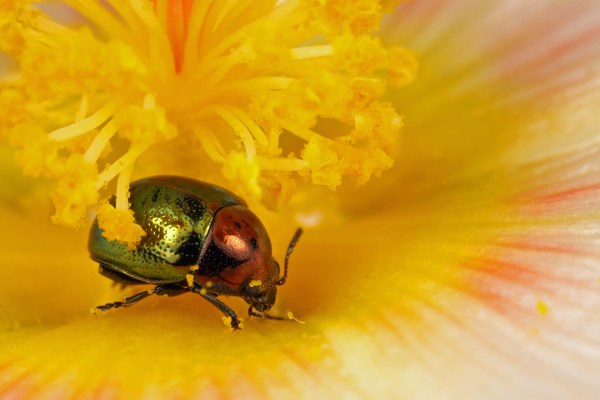

Spintherophyta (?) sp. in flower of Abutilon pauciflorum | Buenos Aires, Argentina

From  (posted 2 Feb). One of my 2012 learnings was that sometimes a photograph that is not so close is more effective than one that is as close as possible. In one of my earlier attempts at “not-so-close” macrophotgraphy, the soft colors of the flower compliment the brash shininess of the tiny leaf beetle that has been feeding on its pollen. Pink lines lead the eye directly to the subject and create a pleasing composition, and pollen grains stuck to the beetle—a distraction in some situations—add to the miniature natural history story of the photo.


Apiomerus flavipennis with stink bug prey and kleptoparasitic flies | Chaco Province, Argentina

From  (posted 11 Mar). I selected this photo solely for the complex natural history story drama it shows—stink bug (Piezodorus guildenii) feeding on soybean becomes prey of an assassin bug (Apiomerus flavipennis), with volatiles from the chemicals it emitted in a vain attempt to defend itself serving as cues to kleptoparasitic flies (families Milichiidae and Chloropidae) that benefit from the assassin bug’s labors.


Planthopper nymph | Buenos Aires Province, Argentina

From  (posted 26 Mar). Another learning that I began putting into practice in 2012 was the use of low perspective for compositional impact. The cryptic coloration of this planthopper nymph (family Fulgoridae) made it almost invisible on the branch on which it was sitting when viewed from a normal “top-down” human perspective. Getting “down under” it, however, brought the nymph to life and emphasized its unusual form.
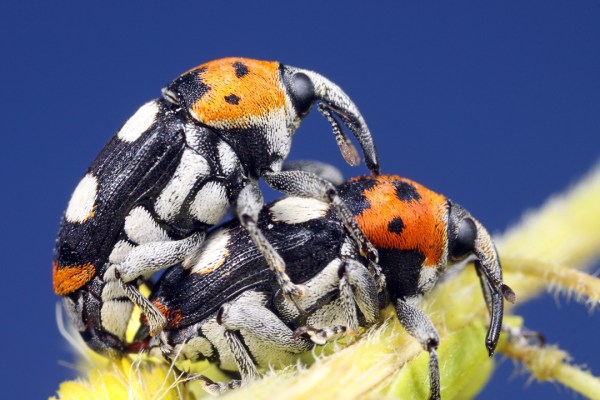

Megabaris quadriguttatus | Corrientes Province, Argentina

From  (posted 12 Apr). I spent much of 2012 working on the “blue sky background” technique, with these weevils from northern Argentina representing one of my better attempts. Macrophotography of insects with a blue sky background involves setting exposure, ISO, and aperture to achieve two separate exposures—full flash illumination of the subject for maximum depth-of-field, and ambient light from the sky to create a clean, uncluttered, natural-looking background. In this shot I managed to achieve an almost ideal shade of blue to compliment the wild black, white and red colors of the beetles. (My one criticism of the photo is having clipped one of the beetle’s feet.)


Bombylius sp. cf. mexicanus | Scott Co., Missouri

From  (posted 16 May). This photo is unusual if nothing else. Focus, lighting, depth-of-field, and composition are all better than can be hoped for in a single shot, but the subject—perfectly alive—is in a most unusual position. Read the original post to find out how this happened.


Perisphaerus sp. (a pill roach) | Vietnam (captive individual)

From  (posted 27 May). White-box photography is an excellent technique for clean, uncluttered photographs of insects, but it also isolates them from their natural surroundings and limits their natural history appeal. The best white-box photos are those that highlight a key feature or behavior of the subject—in this case a pill roach’s comically conglobulating defensive posture.


Micronaspis floridana (Florida intertidal firefly) larva | Pinellas Co., Florida

From  (posted 31 July). Here is another photo whose back story played a big part in its selection. This firefly larva not only represents a rare Florida-endemic species but was also first seen by my then 12-year old nephew, who willingly accompanied me through a dark, spooky salt marsh in the middle of a humid Florida night to see what he could learn. The lesson here for budding natural historians (and old-timers like me) cannot be overstated!


Arctosa littoralis (beach wolf spider) | Lewis Co., Missouri

From  (posted 23 Aug—prelude to  posted 28 Aug). Those who follow this blog know of my obsession with close-up portraits, and while tiger beetles are the subjects I most commonly photograph in this manner, I am always on the lookout for good subjects in other taxa. This wolf spider “face” almost looks human, with “two” eyes, two “nostrils” and a shiny upper lip above huge (albeit hairy) buck teeth! It’s enough fill-the-frame spidery goodness to melt (or explode) the heart of even the most ardent arachnophobe!
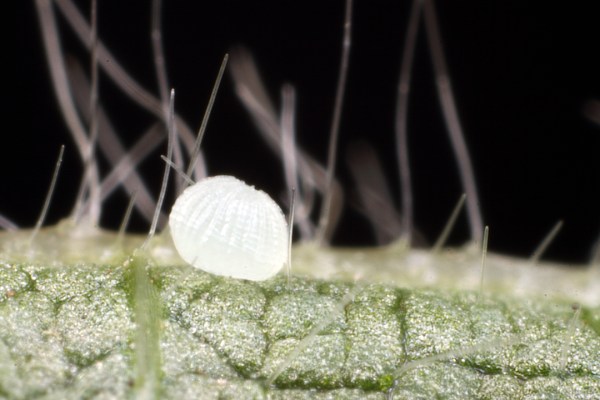

Anticarsia gemmatalis (velvetbean caterpillar) egg on soybean leaf

From Life at 8X—Guide to lepidopteran eggs on soybean (posted 3 Sep). “Life at 8X” was a new series I introduced this year, featuring insects photographed at magnifications testing the upper limit of my equipment and photographic skills. Diffraction is the chief difficulty with magnifications as high as this and is the primary flaw in the above photograph. Nevertheless, such view of a moth egg on the underside of a soybean leaf provides a spectacular view of the otherwise unseen micro-world that lives right beneath our noses.


Megacyllene decora (amorpha borer) on snakeroot flowers | Mississippi Co., Missouri

From  (posted 12 Sep). This second example of “blue sky background” was taken later in the year and was considerably more difficult to capture than the first because of the larger size of the subject and resulting need for a longer focal length macro lens. Getting a well-lit, focused, and composed image with a desirable shade of blue in the background depended not only on finding the proper camera settings, but also secure body and camera bracing techniques for this completely hand-held shot.


Cicindelidia politula politula (Limestone Tiger Beetle) | Montague Co., Texas

From  (posted 28 Sep). I will go ahead and say it—this is my favorite photograph of 2012. As discussed under the first entry, panning back from the subject can allow for some very interesting compositions. This photo combines charismatic pose by a wary subject with panning back and low perspective to create an image that scores high in both natural history and aesthetic appeal.


Calosoma sayi (black caterpillar hunter) | New Madrid Co., Missouri

From Black is beautiful! (posted 7 Nov). Of course, close-as-possible can also be used to create striking photos, especially if the subject exhibits features that are best seen up close. Anything with jaws fits the bill in my book, and highlighting the mandibular sculpturing of this caterpillar hunter (a type of ground beetle) required precise angling of the flash heads for maximum effect.


Cicindela repanda (Bronze Tiger Beetle) | St. Louis Co., Missouri

From  (12 Nov). This final selection is not a rare species, but it is as close as I have come to what I consider the “perfect” tiger beetle macrophotograph—a close, low angle, lateral profile of an adult in full-stilt posture (a thermoregulatory behavior), well lit, perfectly focused, and with a dynamic but pleasingly blurred background. It’s a perfect storm of a photo that took the better part of two hours to achieve—rarely do all of these elements come together in a hand-held photograph of an unconfined tiger beetle in its native habitat.


Well, there you have it. I hope you’ve enjoyed my selections, and again please do let me know if you have a personal favorite. See you in 2013!

Copyright © Ted C. MacRae 2012

One-Shot Wednesday: Upside down bee fly

Bombylius sp. cf. mexicanus | Scott Co., Missouri

This has got to be one of the strangest photos I’ve ever taken. Three weeks ago after visiting Sam A. Baker State Park (and photographing the scorpionfly featured in last week’s One-Shot Wednesday post), my dad and I visited a couple of sand prairie remnants in the Mississippi lowlands of extreme southeastern Missouri. I was hoping to see (and photograph) some individuals of the unique population of Cicindela scutellaris that occurs in that part of the state—apparently disjunct, this populations shows an intergrade of characters typical of subspecies C. s. lecontei to the north and C. s. unicolor to the south. I’ve photographed this population before, but those photographs were taken with a small (though quite good) point-and-shoot camera before I acquired my current dSLR camera setup.

Unfortunately, temperatures were quite cool that day, and no beetles were seen at either of the two locations we visited where I’ve seen good populations in past years. When I don’t find what I’m looking for, I start noticing other things, one of which was this very fresh-looking bee fly (order Diptera, family Bombyliidae) resting on the sandy ground. I’ve not really attempted to photograph many bee flies—they are as skittish and difficult to approach as the tiger beetles I adore but, unlike the latter, not a subject of my research and, thus, harder to justify spending inordinate amounts of time attempting photographs. This one, however, was sitting so nicely on the ground, and with no tiger beetles around to demand my attention I thought I would give it a shot (pun intended!). I carefully assembled my rig and slowly crouched down to attempt a photograph, but before I could get in position the fly spooked and tried to fly away. As it took off, however, it hit a plant and fell to the ground on it’s back. As it laid there,seemingly stunned, I got myself into position and took a quick shot to make sure I had the settings and exposure that I wanted. In that regard, I couldn’t ask for better, but of course what I really wanted was a photograph of the fly right-side up, resting on its feet rather than its back. Just as I was considering what to do next, the fly abruptly righted itself and flew away, leaving me with this single, rather unconventional photograph.

After perusing the bee fly pages at BugGuide, I was fairly certain this was something in the tribe Bombyliini, with the genera Bombylius and Systoechus being the likeliest candidates. Apparently the location of the r-m vein on the wing is an important distinguishing character between these genera, but I wasn’t quite sure about its location on the wing in this photograph. Nevertheless, some of the comments under the different species in these two genera suggested that members of Bombylius tend to be active as adults in the spring, while those of Systoechus tend more towards fall. I sent the photo to dipterist Joel Kitts at University of Guelph for his opinion—he confirmed that it belonged to the genus Bombylius and suggested its appearance was consistent with that of B. mexicanus—many thanks Joel!

Copyright © Ted C. MacRae 2012

Bee Fly Parasitism of Tetracha virginica

I expected to gain a better understanding of insect photography principles and techniques at last weekend’s BugShot insect photography workshop at Shaw Nature Reserve in Gray Summit, Missouri.  I even expected that I would walk away from the event with some new friends.  The one thing I did not expect was the discovery of an apparently unreported host/parasitoid relationship amongst my beloved tiger beetles.  Nevertheless, that’s exactly what happened in a patch of barren soil just outside of the Dana Brown Education Center where the event was being held.

Tetracha virginica 3rd instar larva | Shaw Nature Reserve, Franklin Co., Missouri

I had spied the small cluster of tiger beetle burrows the previous day as we left on our first group hike.  The burrows were unmistakably those of Tetracha virginica (Virginia metallic tiger beetle) due to their size (no other tiger beetle in east-central Missouri approaches the size of this species), and in fact some of the larvae were seen sitting at the tops of their burrows.  Tetracha larvae are easily distinguished from other genera of North American tiger beetles (in addition to their size) by their distinctive white-margined pronotum.  I had to catch back up with the group but came back later in the day and took a few photographs of one of the larvae sitting in its burrow.  Some of the other BugShot attendees were there and wanted to take photographs, but the larvae dropped on their less-practiced approach.  No problem, I just “fished” a larva out of its burrow and let them take their photographs.  When they finished, I began taking my own photographs, but I only got off one shot before the larva suddenly made a bee-line for its burrow and dropped in before I could block its escape.  Oh well, I do already have photographs of the larva of this species from other locations.

Tetracha virginica 3rd instar larva | Shaw Nature Reserve, Franklin Co., Missouri

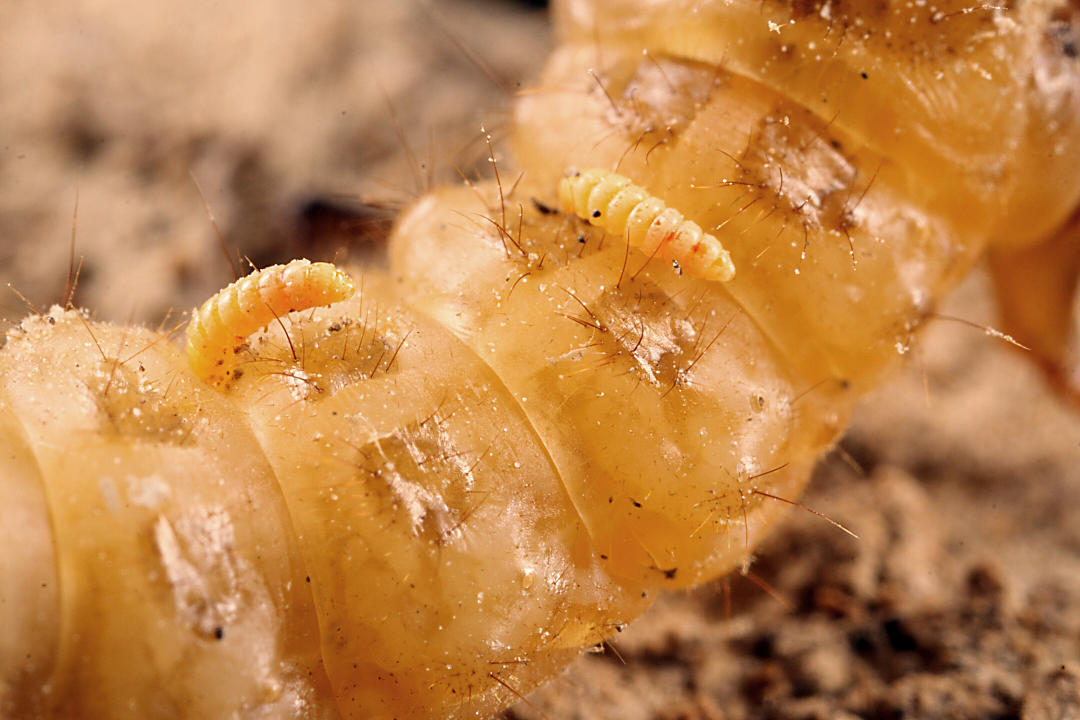
The next day I passed by the burrows again with Crystal and Lee.  I really wanted them to see the larvae, but they were not active.  No problem, I grabbed a long grass stem, chewed on one end, and inserted it to a depth of about 35 cm before it hit bottom.  A little jiggling to get the larva to bite, then a quick jerk back and out came the larva.  I never tire of seeing someone witness this for the first time—the way they jump back half-startled when they see the otherworldly larva flying through the air and landing on the grass.  I grabbed the larva and placed it on the barren clay to let them take photographs.  Crystal went first, and as she looked at the larva through her viewfinder she exclaimed, “there are wormy-things [the technical term, of course] on him.”  Lee and I looked, and sure enough there were two small “wormy-things” attached to the back of the tiger beetle.  I immediately recognized them as bee fly larvae (family Bombyliidae)—specifically Anthrax analis, the only bee fly known to parasitize tiger beetle larvae in the United States.  I was quite excited by this discovery, as I have never seen these before despite fishing untold numbers of tiger beetle larvae from their burrows over the past decade or so.  We all went camera crazy and took our turns photographing larvae and host, after which I popped it into a vial to keep for an attempt at rearing out the bee flies.

Anthrax analis larvae attached to abdomen of Tetracha virginica larva

It now seems that our find represents more than just a personal discovery, as bee flies—to my knowledge—have not yet been reported parasitizing any species of the genus Tetracha.  Of the 70 Anthrax spp. for which hosts have been recorded (Yeates and Greathead 1997), only three are known to parasitize tiger beetles.  Shelford (1913) gave the first account of A. analis (as Spogostylum anale) parasitzing Cicindela scutellaris lecontei, noting that the adult females lay their eggs by flying backward and downward while thrusting the abdomen forward until it touches the sand near the host burrow entrance.  Hamilton (1925) found Cicindelidia obsoleta parasitized by this species, and Bram and Knisley (1982) expanded its known host spectrum to include C. hirticollis, C. tranquebarica, Cicindelidia punctulata, and Ellipsoptera marginata.  Photographs of larvae (presumably of this species) parasitizing undetermined tiger beetle larvae can be seen in Pearson and Vogler (2001) and in this photo by Chris Wirth.  Anthrax gideon has been recorded parasitizing Pseudoxycheila tarsalis in Costa Rica (Palmer 1982) and Oxycheila trisis in Brazil (Arndt and Costa 2001), while a third undetermined Anthrax sp. has been reared from larvae of Pentacomia ventralis, also in Brazil (Arndt and Costa 2001).  Oxycheila and Pseudoxycheila are related to Tetracha at the tribal/subtribal level (depending on which classification you follow), so the finding of A. analis utilizing Tetracha is not unexpected.

Closer view of anteriormost Anthrax analis larva

The beetle larva and its unwelcome tagalongs is now in a container of native soil and has accepted the starter burrow that I made for it. Hopefully at least one of the bee fly larvae will complete its development and emerge as an adult to allow confirmation of its identity.  If this host association does turn out to be unreported, we will follow up with at least a short journal communication.  To that end, any literature citations you are aware of regarding bee fly parasitism of tiger beetles that is not listed below would be most welcome.

Congratulations to Ben Coulter, who wins yet another BitB Challenge with 14 points (this guy is a machine!), and Mr. Phidippus came close with 13 points.  Ben and Phiddy were the only participants that figured out the parasites were bee flies of the genus Anthrax, and Phiddy was the only participant to guess the correct genus for the host.  Ben’s win gives him a now commanding lead with 49 points in the current BitB Challenge Session #4 as we enter the home stretch.  Mr. Phidippus and Roy are still in striking distance with 39 and 28 points, respectively.  Is anybody capable of keeping him from his third title?  We shall see.

REFERENCES:

Arndt, E. and C. Costa.  2001.  Parasitism of Neotropical tiger beetles (Coleoptera: Carabidae: Cicindelinae) by Anthrax (Diptera: Bombyliidae).  Studies on Neotropical Fauna and Environment 36(1):63–66.

Bram, A. L. and C. B. Knisley.  1982.  Studies on the bee fly Anthrax analis (Bombyliidae), parasitic on tiger beetle larvae (Cicindelidae).  Virginia Journal of Science 33:90.

Hamilton, C. C. 1925. Studies on the morphology, taxonomy, and ecology of the larvae of Holarctic tiger beetles (family Cicindelidae).  Proceedings of the U.S. National Museum 65 (Art. 17):1–87.

Palmer, M. K.  1982.  Biology and behavior of two species of Anthrax (Diptera: Bombyliidae), parasitoids of the larvae of tiger beetles (Coleoptera: Cicindelidae).  Annals of the Entomological Society of America 75(1):61–70.

Pearson, D. L. and A. P. Vogler.  2001. Tiger Beetles: The Evolution, Ecology, and Diversity of the Cicindelids.  Cornell University Press, Ithaca, New York, 333 pp.

Shelford, V. E.  1913.  The life history of a bee-fly (Spogostylum anale Say) parasite of the larva of a tiger beetle (Cicindela scutellaris Say var. lecontei Hald.).  Annals of the Entomological Society of America 6(2):213–225.

Yeates, D. K. and D. J. Greathead.  1997. The evolutionary pattern of host use in the Bombyliidae (Diptera): a diverse family of parasitoid flies.  Biological Journal of the  Linnaean Society 60:149—185.

Copyright © Ted C. MacRae 2011

Magnificently Monstrous Muscomorphs

I suppose tiger beetles have gotten more than their fair share of attention here lately, so for this post I thought I’d highlight insects of a completely different group – flies! Admittedly, as a coleopterist, I tend to view flies with much the same disdain as your average insect non-enthusiast – as pesky, pestiferous vermin worthy of little more attention than a decisive swat. I don’t begrudge them their amazing diversity – at ~100,000 described species worldwide, they are strong contenders with the Lepidoptera and Hymenoptera as the second largest order of insects (of course, you need all three of these orders combined to match the diversity of the Coleoptera). I am also prepared to accept that they may well represent, at least morphologically, the pinnacle of insect evolution (a position that a few hymenopterists I know might argue with) due to their amazing flight capabilities and the morphological adaptations they have developed for such. These include the development of aristate antennae for detecting wind speed, the conversion of the second pair of wings into stabilizing organs (halteres), and the ability to beat the remaining pair of wings at incomprehensible rates – up to 1,000 times per second in some very small midges (even more baffling when one considers that the wing “beat” is actually just a passive result of rhythmic distortions of the thoracic box). I even acknowledge that the vast majority of fly species are not even pests, living their lives innocuously as herbivores, scavenging organic matter that nothing else wants, and preying upon or parasitizing other insects, including important agricultural pests. Still, flies bug me – mosquitoes prevent me from sleeping under the stars without a tent, deer flies drone around my head incessantly while I’m trying to stalk an elusive tiger beetle, stable flies trick me into assuming they are just another house fly (until they bite me!), house flies (the real ones) rudely land on my sandwich with their filthy feet, and eye gnats insist on committing hary kary in my eyes as I walk the trails (I won’t mention their other common name, derived from their habit of clustering around exposed canid genitalia).

There is, however, one group of flies that possess “cool factor” rivaling that of even the most popular insect groups – robber flies and their kin. I’ve always picked them up as an aside, even sending them off for authoritative ID and constructing an inventory of the species in my collection. The brute of a fly pictured here is not a true robber fly, but in the related family Mydidae. Mydus clavatus can be recognized easily in the field by its large size and distinctive black coloration with red/orange on top of the 2nd abdominal segment. Presumably this is an example of Batesian mimicry modeled upon spider wasps (family Pompilidae) in the genus Anoplius. This mimicry allows them to fly rather boldly in the open and is so persuasive that it can not only fool the casual observer, but even the most knowledgable of entomologists might be loathe to handle it despite knowing better. Although common across the eastern U.S., aspects of its life history are poorly understood. Adults have been reported to be predators of other insects, but apparently there are some doubts about the veracity of such reports. Patrick Coin of BugGuide has observed adults (males?) taking nectar from flowers and has suggested that reports of predation by adults might have been an erroneous assumption due to their relation and resemblance to robber flies. Larvae are reported to be predaceous on woodboring beetle larvae, and I have reared adults of this species from a dead sycamore (Platanus occidentalis) stump in southern Missouri that was infested with mature larvae of the large buprestid species, Texania campestris. This habit is similar to robber flies of the genus Laphria, which mimic bumble bees and carpenter bees.

In Greek mythology, Promachos (Προμαχοε) was “the champion” or one “who leads in battle” – an appropriate generic name for the so-called “giant robber flies” of the genus Promachus. These large flies are dominant and fearless predators that will capture just about any flying insect – even adult dragonflies. There are three species of Promachus in the eastern U.S. that exhibit the yellow and black tiger striping of the abdomen seen in this individual, identified as a female Promachus hinei by Herschel Raney at BugGuide due to its reddish femora and occurrence in the central U.S. Promachus rufipes is similar but has black femora with distinctly orangish tibiae and is more common in the southeastern U.S., whereas P. vertebratus has more muted two-toned legs with smaller dark areas dorsally on the abdominal segments and is more common in the northern states. Additional species occur in the region but lack the tiger striping of the abdomen, and even more species occur in the western U.S. Members of this genus generally lay their eggs on the ground near grass roots, and the larvae burrow into soil after hatching and feed on soil insects, roots, and decaying matter before pupating within the soil in an unlined cell.

During my recent trip to Nebraska I encountered this related robber fly genus Proctacanthus, also determined by Herschel provisionally as P. milbertii. These large robber flies with a prominent beard are similar in habit to Promachus species, laying their eggs in crevices in soil and the larvae feeding on soil insects, roots, and decaying plant matter. Proctacanthus milbertii is a late season species that occurs across much of the U.S. and reportedly loves butterflies. However, Joern & Rudd (1982), in studying predation by this species in western Nebraska (where the individual pictured here was photographed) found that grasshoppers made up 94% of the prey captured by this species. Interestingly, nearly all of the remaining prey captures were other P. milbertii, which was carefully verified as such since mating postures can be easily mistaken for prey handling positions. Grasshopper prey species taken by this species were most strongly influenced by availability rather than size, suggesting that even the largest grasshopper species could be captured as easily as smaller species – a testament to the ferocity of this robber fly.

Another family of flies modestly related to robber flies and also ranking high in “cool factor” are the bee flies (family Bombyliidae). The scaly bee fly, Lepidophora lepidocera (ID confirmed by Joel Kits at BugGuide), is a particularly attractive member of the family. The distinctive, hunch-backed shape of this southern U.S. species is shared with the more northern L. lutea, from which it is distinguished by having pale scales only on the 5th abdominal segment and not on the 4th also. Most bee flies are presumbably mimics of – yes – bees; however, the species in this genus might actually be mimics of robber flies instead. Adults are most often seen taking nectar from flowers – this individual was taken on flowers of tall boneset (Eupatorium altissimum). Larvae are characterized by Sivinski et al. (1999) as kleptoparasites on the provisions of solitary wasps in the families Vespidae and Sphecidae – meaning that the larva does not parasitize wasp larvae directly, but instead usurpes the nest provisions on which the wasp larvae were supposed to feed. The little thieves!