T.G.I.Flyday—fuzzy wuzzy wuz a…

Megaphora? sp. | Lyon Co., Nevada

Megaphora? sp. | Lyon Co., Nevada

I’m back after an uncharacteristically lengthy absence, due not to loss of desire or inspiration but rather a malfunctioning computer. Repeated attempts to restore connectivity were unsuccessful, and heavy travel during the past week only exacerbated the situation. However, all is well now (for the time being—hopefully a new machine will arrive before my current one bites the dust), and as a peace offering until I can post something more substantial I offer this photo of a robber fly (family Asilidae) that I photographed near Wellington Springs in Lyon Co., Nevada during my late August Great Basin collecting trip. The fly was found very much alive but torpidly clinging to the stem of Chrysothamnus viscidiflorus (yellow rabbitbrush). My best guess is something in the genus Megaphorus (correction or confirmation by any passing fly guys would be much appreciated).

Speaking of my Great Basin collecting trip, I’m putting together an “iReport” of the trip featuring a general synopsis and photographs taken exclusively with my iPhone. Don’t snicker—when used within its capabilities an iPhone can take quite good photographs. I carry mine with me at all times despite also carrying a “real” camera and use it in situations that play to its strengths and don’t require the big camera. At any rate, look for something in the next day or so.

Copyright © Ted C. MacRae 2013

Flown the coop

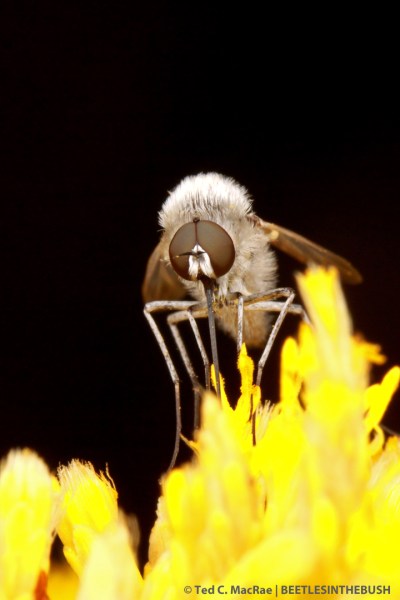
Ted has flown the coop and will be roaming the vastness of the Great Basin for the next week or so to collect and photograph beetles and other insects. Ted has asked me to watch over BitB while he is away, so allow me to introduce myself—I’m “fly guy” (although Ted calls me Geron sp. and insists that my family is called Bombyliidae or something weird like that). I live in the semi-arid hills near Washoe Lake, Nevada and spend my days flitting amongst antelope bitterbrush and desert peach and sipping nectar from rabbitbrush flowers with Mt. Rose in the backdrop. Anyway, I don’t think Ted has thought his plan through very well—since I’m not very smart (I am just a fly, afterall), a quick photo here and there is about the best I can do. Anyway, for my first post, I hope you’ll enjoy this portrait of ME!

Geron sp.

Copyright © Fly Guy 2013

T.G.I.Flyday: Argentine robber

I’m back in South America for the next 2+ weeks, and though it will be another week before I actually make it into Argentina, I am celebrating my return to that lovely country with photos of Argentinian insects taken during last year’s extended visit but that I haven’t had a chance to share before now. Earlier this week I featured Camponotus sericeiventris (though I prefer the literal translation, “silky-bellied humpbacked ant“)—easily among the most handsome ants that I’ve ever seen and which I encountered in the remnant quebracho forests at Chaco National Park in northern Argentina. Today’s feature is an equally handsome robber fly (order Diptera, family Asilidae), also seen at the park and which landed on a dead log just long enough to allow one good lateral profile shot of the beast in all its hairy splendidness! (Probably it zipped off to impale an Odontocheila tiger beetle in the back of the neck!)

Triorla sp. | Chaco National Park, Argentina

Triorla sp. | Chaco National Park, Argentina

I sent this photo to a few fly guys looking for a more authoritative opinion about its identity, mentioning its resemblance to some of our North American species of Efferia. Herschel Raney agreed that it belonged to at least that group, while Eric Fisher suggested a species in the genus Triorla (an early segregate of Efferia that is now widely regarded as a valid genus). The most recent checklist of robber flies from Argentina (Artigas & Hengst 1999) lists three species in the Efferia group (all in the genus Nerax); however, both Herschel and Eric confirmed my suspicion that Argentina, and especially the north, is not well studied for Asilidae. Eric further suggested that there could be as many as several times the number listed, mainly undescribed but also described from adjacent countries and occurring in Argentina but not yet recorded from there. Also, I had presumed this individual to represent a female since it lacked the distinctly swollen genital capsule (e.g. see this post, presumably another Efferia-group species), but Herschel thought the terminal structure was odd and did not look female.

REFERENCE:

Artigas, J. N. & M. B. Hengst. 1999. Clave ilustrada para los géneros de asílidos argentinos (Diptera: Asilidae). Revista Chilena de Historia Natural 72:107—150.

Copyright © Ted C. MacRae 2013

Best of BitB 2012

Welcome to the 5th Annual “Best of BitB”, where I pick my favorite photographs from the past year. 2012 was one of the most intensive travel years I’ve ever had—I spent 8 weeks in Argentina from February through April, made separate trips to Puerto Rico and Arkansas in May (bracketing a personal week in California), traveled almost weekly to Illinois and Tennessee from June to September (interrupted by a personal week in Florida in July), toured the southeastern U.S. (Arkansas, Louisiana, Mississippi and Georgia—great food!) in early September, chased tiger beetles in Oklahoma, Texas and Arkansas in late September, went back to Argentina for a week in October, and capped off the travel year by attending the Entomological Society of America Annual Meetings in Knoxville, Tennessee (for the first time in more than 10 years!)—whew! While many would cringe at such a travel load, I am among the lucky few who actually get paid for doing something that is also my hobby—entomology! This gives me ample opportunity to further hone my photography skills (nine of the 13 photos I’ve selected below were actually taken while I was on business travel), resulting in two key accomplishments this year—my first ever photography talk at the ESA’s insect photography symposium and my first commercial sales (look for the BitB commercial site to go online in 2013).

Enough blather! Here are my favorite BitB photographs from 2012. Click the link in the text below the photo to see the original post. I would greatly appreciate knowing if you have a favorite (and why)—your feedback will be enormously helpful to me as I continue to learn and develop as a photographer.  For those interested, here are my previous year picks for 2008, 2009, 2010 and 2011. And, as always, thank you for your readership!
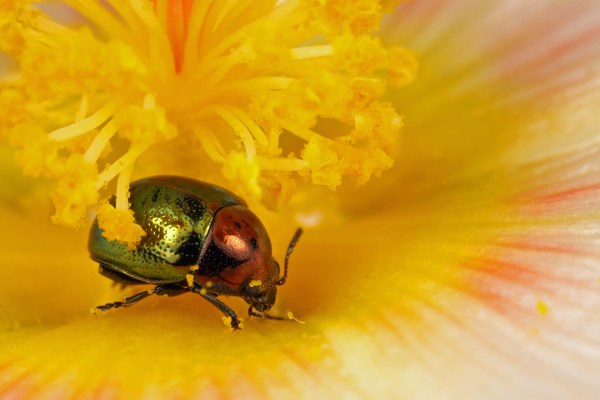

Spintherophyta (?) sp. in flower of Abutilon pauciflorum | Buenos Aires, Argentina

From  (posted 2 Feb). One of my 2012 learnings was that sometimes a photograph that is not so close is more effective than one that is as close as possible. In one of my earlier attempts at “not-so-close” macrophotgraphy, the soft colors of the flower compliment the brash shininess of the tiny leaf beetle that has been feeding on its pollen. Pink lines lead the eye directly to the subject and create a pleasing composition, and pollen grains stuck to the beetle—a distraction in some situations—add to the miniature natural history story of the photo.


Apiomerus flavipennis with stink bug prey and kleptoparasitic flies | Chaco Province, Argentina

From  (posted 11 Mar). I selected this photo solely for the complex natural history story drama it shows—stink bug (Piezodorus guildenii) feeding on soybean becomes prey of an assassin bug (Apiomerus flavipennis), with volatiles from the chemicals it emitted in a vain attempt to defend itself serving as cues to kleptoparasitic flies (families Milichiidae and Chloropidae) that benefit from the assassin bug’s labors.


Planthopper nymph | Buenos Aires Province, Argentina

From  (posted 26 Mar). Another learning that I began putting into practice in 2012 was the use of low perspective for compositional impact. The cryptic coloration of this planthopper nymph (family Fulgoridae) made it almost invisible on the branch on which it was sitting when viewed from a normal “top-down” human perspective. Getting “down under” it, however, brought the nymph to life and emphasized its unusual form.
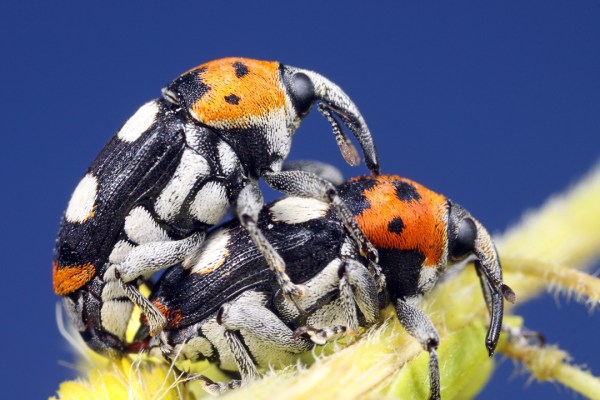

Megabaris quadriguttatus | Corrientes Province, Argentina

From  (posted 12 Apr). I spent much of 2012 working on the “blue sky background” technique, with these weevils from northern Argentina representing one of my better attempts. Macrophotography of insects with a blue sky background involves setting exposure, ISO, and aperture to achieve two separate exposures—full flash illumination of the subject for maximum depth-of-field, and ambient light from the sky to create a clean, uncluttered, natural-looking background. In this shot I managed to achieve an almost ideal shade of blue to compliment the wild black, white and red colors of the beetles. (My one criticism of the photo is having clipped one of the beetle’s feet.)


Bombylius sp. cf. mexicanus | Scott Co., Missouri

From  (posted 16 May). This photo is unusual if nothing else. Focus, lighting, depth-of-field, and composition are all better than can be hoped for in a single shot, but the subject—perfectly alive—is in a most unusual position. Read the original post to find out how this happened.


Perisphaerus sp. (a pill roach) | Vietnam (captive individual)

From  (posted 27 May). White-box photography is an excellent technique for clean, uncluttered photographs of insects, but it also isolates them from their natural surroundings and limits their natural history appeal. The best white-box photos are those that highlight a key feature or behavior of the subject—in this case a pill roach’s comically conglobulating defensive posture.


Micronaspis floridana (Florida intertidal firefly) larva | Pinellas Co., Florida

From  (posted 31 July). Here is another photo whose back story played a big part in its selection. This firefly larva not only represents a rare Florida-endemic species but was also first seen by my then 12-year old nephew, who willingly accompanied me through a dark, spooky salt marsh in the middle of a humid Florida night to see what he could learn. The lesson here for budding natural historians (and old-timers like me) cannot be overstated!


Arctosa littoralis (beach wolf spider) | Lewis Co., Missouri

From  (posted 23 Aug—prelude to  posted 28 Aug). Those who follow this blog know of my obsession with close-up portraits, and while tiger beetles are the subjects I most commonly photograph in this manner, I am always on the lookout for good subjects in other taxa. This wolf spider “face” almost looks human, with “two” eyes, two “nostrils” and a shiny upper lip above huge (albeit hairy) buck teeth! It’s enough fill-the-frame spidery goodness to melt (or explode) the heart of even the most ardent arachnophobe!
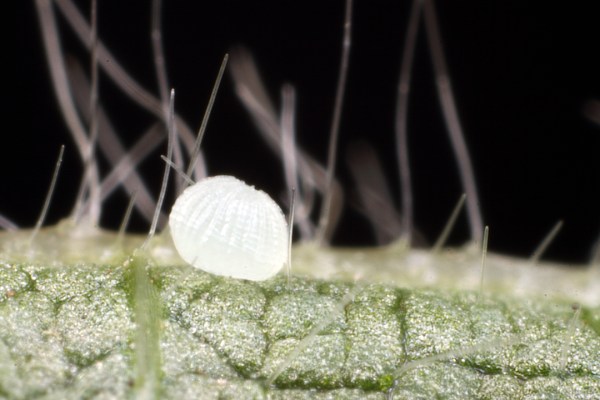

Anticarsia gemmatalis (velvetbean caterpillar) egg on soybean leaf

From Life at 8X—Guide to lepidopteran eggs on soybean (posted 3 Sep). “Life at 8X” was a new series I introduced this year, featuring insects photographed at magnifications testing the upper limit of my equipment and photographic skills. Diffraction is the chief difficulty with magnifications as high as this and is the primary flaw in the above photograph. Nevertheless, such view of a moth egg on the underside of a soybean leaf provides a spectacular view of the otherwise unseen micro-world that lives right beneath our noses.


Megacyllene decora (amorpha borer) on snakeroot flowers | Mississippi Co., Missouri

From  (posted 12 Sep). This second example of “blue sky background” was taken later in the year and was considerably more difficult to capture than the first because of the larger size of the subject and resulting need for a longer focal length macro lens. Getting a well-lit, focused, and composed image with a desirable shade of blue in the background depended not only on finding the proper camera settings, but also secure body and camera bracing techniques for this completely hand-held shot.


Cicindelidia politula politula (Limestone Tiger Beetle) | Montague Co., Texas

From  (posted 28 Sep). I will go ahead and say it—this is my favorite photograph of 2012. As discussed under the first entry, panning back from the subject can allow for some very interesting compositions. This photo combines charismatic pose by a wary subject with panning back and low perspective to create an image that scores high in both natural history and aesthetic appeal.


Calosoma sayi (black caterpillar hunter) | New Madrid Co., Missouri

From Black is beautiful! (posted 7 Nov). Of course, close-as-possible can also be used to create striking photos, especially if the subject exhibits features that are best seen up close. Anything with jaws fits the bill in my book, and highlighting the mandibular sculpturing of this caterpillar hunter (a type of ground beetle) required precise angling of the flash heads for maximum effect.


Cicindela repanda (Bronze Tiger Beetle) | St. Louis Co., Missouri

From  (12 Nov). This final selection is not a rare species, but it is as close as I have come to what I consider the “perfect” tiger beetle macrophotograph—a close, low angle, lateral profile of an adult in full-stilt posture (a thermoregulatory behavior), well lit, perfectly focused, and with a dynamic but pleasingly blurred background. It’s a perfect storm of a photo that took the better part of two hours to achieve—rarely do all of these elements come together in a hand-held photograph of an unconfined tiger beetle in its native habitat.


Well, there you have it. I hope you’ve enjoyed my selections, and again please do let me know if you have a personal favorite. See you in 2013!

Copyright © Ted C. MacRae 2012

T.G.I.Flyday: Tachinomyia sp.

You would think that somebody with enough patience to photograph tiger beetles would be equally patient with “calyptrate” flies, but for me such is not the case. It’s not that I don’t find them interesting (although, really, what insect group can match the diversity, polytopism, ecological extremism and behavioral charisma of tiger beetles?), but their flighty, frenetic behavior and difficult taxonomy are just a bit too much for me. After all, why invest the time it would take to get a good photograph of something that, in the end will probably be unidentifiable.

IMG_9659_enh_1080x720

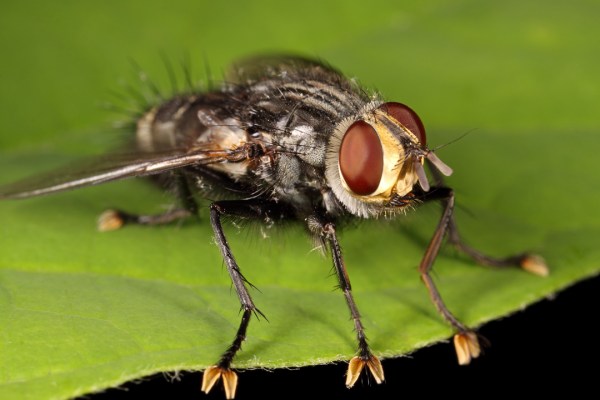
Tachinid fly (prob. Tachinomyia sp.) | Wayne Co., Missouri

Last April as I was hiking a woodland trail in Sam A. Baker State Park in southeastern Missouri’s Ozark Highlands, I saw this decent-sized fly bumbling across the trail. I knelt to look at it more closely, and though it tried to flee, it seemed too weak and uncoordinated to take flight. It was in beautiful condition—a perfect specimen, and I surmised that it represented a newly emerged adult that had not yet hardened sufficiently to withstand the rigors of flight. I was fascinated by its distinctive, orange tarsal pads and the white “beard” around its head, and the ability to coax the fly onto a leaf and hold the leave in whatever position I desired was all the enticement I needed to spend a little time with it. Out of the several shots that I took, these two are my favorites.

IMG_9683_enh_1080x720

You got it—the BitB face shot!

Of course, just being able to photograph the fly was only half the battle—there still remained the matter of its identification. It seemed “tachinidish” to me at the time, but a little digging revealed that there are species of Sarcophagidae look very similar to tachinids, the difference being the presence or absence of a visible postscutellum. My photos don’t show this character, and I quickly became overwhelmed when I tried scanning through BugGuide photos for these two families. Nevertheless, I’m a persistent sort, and after winnowing out the numerous unlikely choices I finally settled on not only family Tachinidae, but possibly Tachinomyia sp. (tribe Exoristini). I was tempted to go out on a limb and post the ID here unvetted, but I chickened out and and sent the photos to fly guy Norman Woodley at the Systematic Entomology Lab in Washington, DC. Norm supported my identification and wrote back:

I think it is probably Tachinomyia.  It would be better to have a wing view as well as the hind end to be absolutely positive, but I’m reasonably sure that’s what it is.  It’s a male.  Some species are active in the spring, so that fits with your data as well.

Copyright © Ted C. MacRae 2012

A 50-million-year-old midge

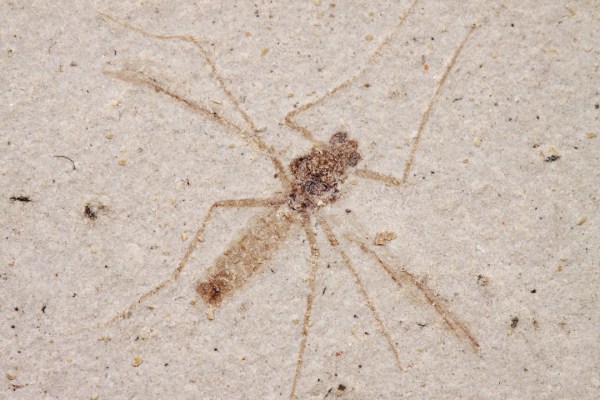
Several of the insect fossils collected from the Green River Formation (45–50 mya) that I am photographing appear to be flies, and specifically members of the “primitive” suborder Nematocera. This is not surprising, as the G.R. Formation of Colorado, Utah, and Wyoming, is composed of shales derived from volcanic ash sediments that were laid down in a system of large, shallow lakes. Most (all?) nematoceran flies are aquatic to some degree in the larval stage, thus the adults are also closely associated with such habitats for mating and egg laying.

Diptera: Chironomidae | USA: Colorado, Garfield, Hwy 139, Douglas Pass

Diptera: Chironomidae | USA: Colorado, Garfield, Hwy 139, Douglas Pass

This particular fossil looked to me a lot like the more elegantly preserved fossil of another fly that I posted a few days ago, which at the time I thought represented a member of the family Mycetophilidae (fungus gnats) or Sciaridae (black-winged fungus gnats). Several knowledgable specialists offered their opinions in comments at this site and at Facebook’s Diptera forum (my thanks to all who offered their opinion), with most settling on Mycetophilidae and Vlad Blagoderov further suggesting subfamily Mycetophilinae. The fossil posted here seemed to me to represent a dorsal view of the same species, but, of course, I’m a coleopterist—so what do I know? Indeed, dipterist Dr. Chris Borkent believes this is actually a species of Chironomidae (common name simply “midges”)—also a nematoceran but differing from Mycetophilidae by their longer front tarsi and longer, relatively narrower wings. Males of the family have thickly plumose (“feathery”) antennae, which are not visible in this specimen and thus suggesting it might be a female. I wouldn’t doubt Chris’ identification  for a second, as he comes from good stock—his father is Art Borkent, a world expert on several families of nematoceran dipterans. Art also agreed after seeing the photo that it looked like a female chironomid midge, so that is what I am going with. Thank you, Chris and Art, for your help in identifying this fossil!

Complete fossil specimen (63 mm x 52 mm maximum each axis).

Copyright © Ted C. MacRae 2012

An elegant Eocene fly

IMG_1864_enh_720x1080

USA: Colorado, Garfield, Hwy 139, Douglas Pass.

Here is one of the more elegantly preserved specimens among the collection of Green River Formation fossil insects that I am photographing. It is obviously a fly (order Diptera), but I don’t agree with the preliminary identification of “Mosquito?” as indicated on its label. Rather, I think it is one of the fungus gnats—also members of the suborder Nematocera and, thus, closely related to mosquitos (family Culicidae), but with distinctly elongate coxae (bases of the legs) and lacking the elongated proboscis that mosquitos use for sucking blood. It’s hard to decide between Mycetophilidae (fungus gnats sensu stricto) or Sciaridae (dark-winged fungus gnats), which differ in whether the eyes meet above the antennae (Sciaridae) or not (Mycetophilidae). However, Borrer & White (1970) mention that species of the former are generally less than 5 mm in length, while the latter range from 5–10 mm. This specimen measures 4.15 mm from the front of the head to the tip of the abdomen, so  maybe that is evidence supporting Sciaridae (although perhaps there were smaller mycetophilids 50 mya than today).

Here is a view of the whole fossil, measuring approximately 50 mm on each side:

IMG_1937_enh_1080x720

REFERENCE:

Borrer, D. J. & R. W. White. 1970. A Field Guide to the Insects of America North of Mexico. Houghton Miffton Company, Boston, 404 pp.

Copyright © Ted C. MacRae 2012
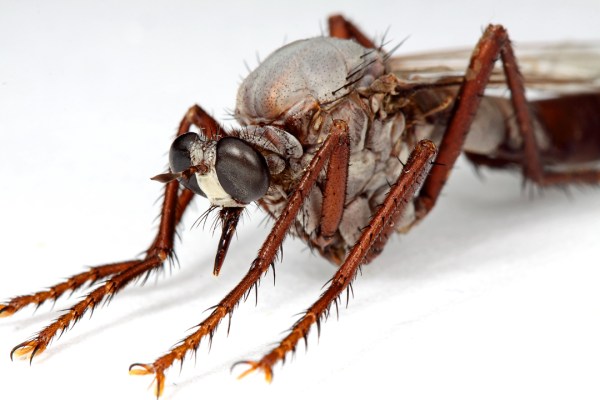
The “Other” Marvelously Monstrous Microstylum

Microstylum galactodes | Brewster Co., Texas

A couple of years ago during the initial testing of my DIY diffuser, I pulled a selection of rather impressive insects from my collection and photographed them on a white background to see how effectively the diffuser worked with different types and sizes of insects. I posted some of those photos for the larger insects in the following weeks, including the tank-like eastern Hercules beetle, the frightful-looking stag beetle, and the downright evil-looking red-eyed devil. There were, however, a number of smaller insects that I had also photographed but whose photos never made it onto these pages as a flush of new photography began the following spring. This is one of them: the robber fly, Microstylum galactodes (order Diptera, family Asilidae). I collected this specimen nearly 20 years ago in western Texas, and until the last few years it was the largest robber fly I had ever seen. That honor now goes to the closely related M. morosum (North America’s largest robber fly), which I have seen in northwest Oklahoma and as a previously unreported occurrence in southwestern Missouri. Still, M. galactodes is an impressive beast, and these photographs of the preserved specimen do little justice to its appearance in life.

The ”beard” (mystax) of Microstylum is confined to the oral margin and composed of stout bristles.

Both species of Microstylum are distinguished by the mystax (dense moustache of bristles on the face) confined to the oral margin and composed chiefly of stout bristles, but M. galactodes may be separated from its larger cousin by the light-colored wings and even, whitish bloom (powdery covering) covering the head and thoracic dorsum (Back 1909). Despite being the relatively commoner species, M. galactodes seems to be a little more specific in habitat preference, most often found in short grass prairies and scrub lands (Beckemeyer & Carlton 2000). Also, even though both species occur broadly in the southcentral to southwestern U.S., M. galactodes seems to have a slight western shift in its distribution compared to M. morosum, extending north only into the western parts of Oklahoma and Kansas (Beckemeyer & Carlton 2000); while M. morosum occurs across these states and eastward into northwestern Arkansas (Warriner 2004) and southwestern Missouri (MacRae unpublished—gotta get that note submitted!

REFERENCES:

Back, E. A. 1909. The robberflies of America, north of Mexico, belonging to the subfamilies Leptograstrinae and Dasypogoninae. Transactions of the American Entomological Society 35:137–400.

Beckemeyer, R. J. & R. E. Carlton.  2000.  Distribution of Microstylum morosum and M. galactodes (Diptera: Asilidae): significant extensions to previously reported ranges.  Entomological News 111(2):84–96.

Warriner, M. D.  2004.  First Arkansas record of the robber fly Microstylum morosum (Diptera: Asilidae).  The Southwestern Naturalist 49(1):83–84.

Copyright © Ted C. MacRae 2012