1986 Florida Field Trip Report

Ted C. MacRae & Rev. James M. Sullivan1

Fr. James Sullivan (left) and Ted MacRae (right) stand under a banyan tree in Key Largo, Florida, 9 May 1986 (photographer unknown).

In Spring 1986, the Rev. James Sullivan (Fr. Sullivan to those who knew him) and I made a two-week trip to Florida with the objective to explore as much of the state as we could—from the Panhandle to the Keys! My goal, of course, was to collect beetles2, especially woodboring beetles in the families Buprestidae and Cerambycidae (it was only my third trip outside of Missouri for such purpose), while Fr. Sullivan’s was to identify and document as many plant species as possible. This apparent dichotomy in interests was not as clean as it may seem—as an entomologist interested in host plant relationships, the chance to spend time in the field with as accomplished a botanist as Fr. Sullivan was too good to pass up, and Fr. Sullivan’s passion for studying insect associates of the plants he studied greatly aligned our interests. My memories of that trip have faced in the nearly 40 years since, jogged only by the specimens I collected now residing in my cabinet and two trays of 35 mm slides taken with an Olympus OM10 SLR film camera. Fortunately, Fr. Sullivan was more diligent than I in journaling his observations during that trip, a copy of which he gave to me. This report is an attempt to summarize our observations using these materials. In his journal, Fr. Sullivan made the following disclaimer: “Plant determinations in these notes must be regarded as tentative: We have not had the use of a complete flora for any portion of the State of Florida. We have been as precise as possible with the use of several less complete sources. ★This star symbol indicates plant determinations that were later confirmed by the use of the Flora of Tropical Florida or by other adequate keys.”

[Note: names for most of the plants included in this report were confirmed by Fr. Sullivan, the primary exceptions being those indicated with question marks (?). As a result, I have omitted use of the star symbol in this report. Also note that plant taxonomy has likely changed immensely during the past 39 years. Scientific names, common names, and plant families given are those we used at the time, and only in a few cases have they been harmonized with current nomenclature (my notes in [square brackets]). An asterisk (*) denotes plants and insects that were also photographed.]

We left St. Louis on the morning of April 28 with the goal of spending the night in Montgomery, Alabama. The next morning, true to form, Fr. Sullivan got up early to explore the area around the hotel before continuing the drive south. He noted two plants: Cirsium horridulum and Sapium sebiferum (Euphorbiaceae), the latter a fast-growing deciduous tree known as Chinese tallow and native to eastern Asia. All parts of the tree emit a milky white sap when damaged, which is toxic and can cause gastrointestinal upset if ingested. As we continued south, we noted the first Spanish moss (Tilandsia usneoides) draping the trees along Hwy 281. The growth was very well-developed, leading Fr. Sullivan to speculate that it also probably occurred north of Montgomery along I-65 but that we missed it due to our nighttime arrival.

Later in the day we arrived at our first destination, Torreya State Park in the Florida Panhandle, home of the extremely rare Florida nutmeg (Torreya taxifolia*) tree that grows only on the bluffs along the Apalachicola River. We explored the heavily forested hills and ravines of the area and found examples of this plant alongside the road near the entrance to the campground. However, we documented a diverse list of other plants including Acer barbatum [= A. saccharum ssp. floridanum] (Florida maple), Actaea pachypoda, Amorpha fruticosa, Aralia spinosa, Ascyrum sp., Callicarpa americana, Calycanthus floridus, Calycarpon lyoni, Cnidoscolus stimulosus*, Conopholis americana, Conradina canescens*(Lamiaceae), Croomia pauciflora* (Stemonaceae), Decumaria barbara, Dirca palustris, Erigeron strigosus, Erythrina herbacea*, Euonymus americanus*, Lonicera sempervirens*, Halesia sp., Hydrangea quercifolia*, Ilex opaca, Itea virginica*, Lygodium japonicum, Mitchella repens, Myrica serifera, Onoclea sensibilis*, Opuntia humifusa*, Rhaphidophyllum hystrix (needle palm), Ruellia carolinensis*, Sebastiana fruticosa* (Sebastianbush, Euphorbiaceae), Spiranthes praecox*, Viburnum sp., and Wahlenbergia marginata. Insect collecting consisted primarily of an assortment of longhorned beetles attracted to ultraviolet (UV) lights at night.

After two nights at Torreya State Park, we traveled further down the peninsula along the central spine to Highlands Hammock State Park, one of the oldest state parks in Florida protecting 9,000 acres of old-growth cypress swamp and oak hammock. We first explored the Wild Orange Grove Trail (noting wild orange trees as well as our first alligator!) but moved to other areas of the park over the next two days. We noted the occurrence of three species of palms here: Rhaphidophyllum hystrix (needle palm), which lacks the leaf midrib of and has fewer leaf divisions than Sabal palmetto (cabbage palm), the most common palm and distinguished by a strong leaf midrib, and Serenoa repens (saw palmetto) with its saw-toothed petiole edges. We repeatedly saw the tortoise beetle Hemisphaerota cyanea on the leaves of S. palmetto. A nice variety of longhorned beetles was also collected here, including the Florida endemic Typocerus flavocinctus and several lamiines at UV lights at night. A blister beetle (family Meloidae) similar to our Nemognatha nemorensis was common on the flowers of Aster reticulatus* and Pterocaulon pycnostachyum* (both Asteraceae), and on flowers of Cirsium horridulum we saw the leaf-footed bug Acanthocephala terminalis* (Coreidae). Other plants that Fr. Sullivan noted include Abrus precatorius*, Ardisia crenulata* (crenate berry bush, Myrsinaceae), Asimina pygmaea* (?), Bacopa sp.*, Bidens pilosa*, Callicarpa americana*, Cuthbertia graminea (?), Emilia sonchilfolius, Eriocaulon sp.*, Erythrina herbacea, Hypericum sp.*, Ilex cassine, Ilex glabra, Lachnocaulon anceps, Lygodesmia aphylla*, Lyonia lucida*, Mikania scandens, Oxalis violacea* (?), Persea borbonia, Polygala lutea*, Schrankia microphylla*, Tephrosia chrysophylla, Urena lobata, Utricularia sp.*, and Xyris sp.* Fr. Sullivan also noted in his journal a list of a dozen “rare” birds such (e.g., cardinal, catbird, crow, etc.!).

Our next destination was outside the northwestern limits of Everglades National Park at Collier-Seminole State Park, which lies partly within the great mangrove swamp of South Florida (one of the largest mangrove swamps in the world) and covering one of three original stands of royal palm (Roystonea elata [= Roystonea regia]) in Florida (the park was previously called Royal Palm Hammock). We primarily explored the Royal Palm Hammock Nature Trail and along the water’s edge around the boat basin, where Rhizophora mangle* (red mangrove) lined the edges of the salt marsh. Two species of Solanum were observed, primarily S. erianthum (potato tree) but also S. donianum*, and we noted the pleasant fragrance of a Eugenia sp. that escaped identification. Bursera simaruba (“tourist tree”), with its distinctive peeling bark, was also common here. We noted Baccharis halimifolia heavily infested with the leaf beetle Trirhabda bacharidus*, saw Heliconius charitonius butterflies on the wing, and observed a cluster of young seed bug nymphs* (Lygaeidae), likely one of the milkweed-associated species, on a vining species of milkweed. Deer flies (family Tabanidae) were a real problem for both of us, and we had to use head nets (Fr. Sullivan even resorted to wearing his London Fog jacket!). Other plants documented included Acrostichum sp., Alternanthera sp. poss. philoxeroides (Amaranthaceae), Batis maritima, Bidens pilosa var. radiata, Blechum brownei, Borrichia frutescens*(sea daisy), Commelina diffusa, Dicliptera assurgens*, Dicromena sp.* (white-bracted sedge, Cyperaceae), Eugenia sp.*, Ipomoea alba (moon flower), Ipomoea sagittata*, Passiflora pallens, Pithecellobium unguis-cati (cat claw), Pluchia odorata (camphor weed), Polygala grandiflora var. angustifolia, Psychotria undata*, Solidago sp.*, Triodanus sp., Urena lobata*, and Zanthoxylum fagara (lime prickly ash). Similar to previous localities, a diversity of longhorned beetles were attracted to UV lights at night.

After two days at Collier-Seminole, we drove east along the Tamiami Trail, noting the magnificent stands of bald cypress (Taxodium distichum) in the Big Cypress Swamp Preserve and seeing the first water hyacinths (Eichhornia crassipes) in bloom. We also saw Australian pines (several species in the genus Casuarina)—angiosperms rather than gymnosperms. Its needles are much longer than true pine (genus Pinus), and the trees appeared very dark green as seen from a distance. Eventually we landed at John Pennekamp Coral Reef State Park on Key Largo. Most people visit this park to dive and explore the spectacular living reefs of the Florida Keys; however, we had more terrestrial objectives. We began by exploring the coral limestone woodland along the Wild Tamarind Trail, where Metopium toxiferum *was common along the woodland border (and we took care not to touch!). A large ichneumonid wasp* (Ichneumonidae) was seen perched in the understory, and we noted the impressively oversized female of the spider Nephilia clavipes* being courted by an equally strikingly diminutive male. Lysiloma latisiliqua* was abundant in the woodland, as was Bursera simaruba* its bark red and peeling like a sunburned tourist! Coccoloba uvifera was also abundantly fruiting, and other plants seen include Alternanthera sp., Conocarpus erecta var. sericea, Schinus terebinthifolius*, and an unidentified composite (either Eupatorium villosum or Garberia sp.). Along the Mangrove Trail we saw (of course) not only red mangrove Rhizophora mangle*) but also black mangrove (Avicennia germinans*, Avicenniaceae) and white mangrove (Languncularia racemosa, Combretaceae). These three plants are placed in three unrelated families, yet all show a high degree of fidelity to mangrove ecosystems. At a Persea americana* orchard in the adjunct Shaw Property, we saw Hamelia patens* in bloom and Lysiloma latisiliqua growing around the orchard’s edge. Other plants seen in the area include Abutilon sp., Batis sp.*, Eupatorium villosum* (?), Gaillardia pulchella*, Heliotropium angiospermum, Heliotropium curassavicum, Hibiscus tiliaceus, Melanthera sp., and Rivina humilis*.

Our plan the following day was to continue down the length of the Keys, making stops at a few selected places along the way before spending the night in Key West. At our first stop on Lower Matecumbe Key, we noted Avicennia germinans, Eustoma exaltatum*, and Polygala baldwini (as well as a Great Blue Heron) and then continued southwestward to Long Key State Recreation Area [now Long Key State Park]. Most people visit Long Key for its beaches and fishing, but we came to the preserve to explore the endangered coastal dune ecosystem that it protects. Few insects were seen, but a number of interesting, mostly highly salt-tolerant, plant species were seen. These include Abutilon sp., Argemone mexicana*, Cassasia clusiifolia*, Chrysobalanus icaco, Ipomoea pes-caprae, Lantana involucrate, Manilkara bahamensis* (wild dilly, Sapotaceae), Scaevola plumieri* (inkberry, Goodeniaceae), Solanum diphyllum, and Suriana maritima* (bay cedar). We finished the day at Key Deer Preserve on Big Pine Key, a sanctuary for the smallest subspecies of white-tailed deer in North America. We did not see any deer, but we did see some interesting plants. Byrsonima cuneata* (Malphigiaceae) was common here, as was Croton linearis. Along the Nature Trail we saw the orchid Bletia purpurea* (pale pink) and also recorded Aletris sp., Chrysophyllum oliviforme (Sapotaceae), Dichromena sp., Ernodia littoralis*, Metopium toxiferum, Pithecellobium sp., Polygala verticillate (?), and “thatch palms” (plus a hissing alligator!).

The next two days were spent at Everglades National Park, where we began our visit by exploring the Long Pine Key Nature Trail, where Cladium jamaicensis* (sawgrass) and Taxodium distichum* dominated the landscape. We noted that it was easy to pass one’s fingers over the sawgrass blade edge in one direction, but not so easy in the other! It was here that I found what I considered a real prize—my first ever bumelia borer (Plinthocoelium suavelons)! I also collected the very colorful Trichodes apivorus on the flowers of Sabal palmetto. Fr. Sullivan had even more success with the plants—so much, in fact, that we were only able to explore the east end of the trail. Several plants belonging to largely tropical plant familys were seen, including Dodonaea viscosa (varnish leaf, Sapindaceae), Tatrazygia bicolor* (Melastomataceae), and Dipholis salicifolia (willow bustic, Sapotaceae). Polygala balduinii (or a similar species) and an unidentified Buchnera sp. were common. The recorded list of other plant species seen was diverse: Asclepias lanceolata*, Baccharis sp., Byrsonima cuneata, Calopogon sp.* [likely C. tuberosus var. simpsonii], Croton linearis, Dichromena sp., Heliotropium polyphyllum var, polyphyllum (H. leavenworthii ) (Boraginaceae), Jacquemontia jamaicensis, Lobelia glandulosa*, Melanthera angustifolia (Asteraceae), Myrica cerifera, Myrsine guianensis, Passiflora sp.*, Persea bordonia, Piriqueta caroliniana, Psychotria nervosa, Rhus sp., Sabatia sp. poss. brevifolia*, and Stillingia sylvatica ssp. tenuis (Euphorbiaceae). We returned again to Long Pine Key Nature Trail the following day to explore the west end near Pine Glades Lake, finding many of the same plants recorded the previous day but also Ageratum littorale (?), Bletia purpurea, Justicia ovata var. lanceolata*, Lippia stoechadifolia, and Morinda royoc. From there we moved on to the P.K. Nature Trail, where Cynanchum blodgettii was seen twining over much of the vegetation—including other plants of its own species!. Fr. Sullivan spent a good deal of time studying a plant found growing at the edge of Pine Glades Lake, which he presumed to be a species of Lippia that exhibited pleated leaves with matching teeth (leading him to call it “corduroy lippia” or “pleated lippia”). Eventually he settled (and later confirmed) the species as Lippia stoechadifolia, a Neotropical species limited in the U.S. to south Florida and the Keys. Other plants observed included Angadenia berterii, Urechites lutea, and (my favorite) Zamia floridana* [likely Z. integrifolia var. silvicola].

Back at Key Largo near Tarpon Bay (below our motel), Fr. Sullivan continued exploring the plants, especially the mangroves. He noted that Avicennia has “dewdrops” but that the other mangroves do not. This relates to the processes used by the plant to eliminate excess salt, which in Avicennia involves salt water “perspiration” that dries in the heat of the day (indeed, the residue of salt flecks is useful in distinguishing Avicennia from the other mangroves) but in Rhizophora is done by accumulating salt in the oldest leaves before they turn yellow and drop. He also noted that Avicennia and Rhizophora can be distinguished by color; Avicennia, which normally grow a little farther from the water, are closer to gray-green, while Rhizophora are closer to yellow-green. Tridax procumbens was a common roadside weed around the motel—its flowers and fluffy seedheads rise on long scapes, as if leafless, but are actually attached to the sprawling, hairy stems, which bear many deeply cleft leaves with opposite arrangement. He also noted Morinda royoc growing not only in the woods but also hedgerows. It is like Psychotria [both species are in the Rubiaceae], but without the large, nervy leaves. The fruits aggregate to look like large, yellowish mulberries. Hamelia patens grows right along the highway here, and several large Solanum shrubs with stellate trichomes on the leaves and white flowers were seen that may be a complex of species including S. donianum, S. verbascifolium, S. erianthum, or yet another species.

On May 10, the field visits were over, and it would take two days of driving to return to St. Louis. Even beginning the drive home, however, did not stop Fr. Sullivan from botanizing. During a stop at the drawbridge on Hwy 1 between Key Largo and the mainland, Fr. Sullivan collected Stachytarpheta jamaicensis, its flower tubes emerging from upward pointing, elongate triangular bracts, and its leaves being coarsely dentate. Also, from the highway in northern Florida, we saw what appeared to be the frequent occurrence of blooming Asimina. These were low plants with white flowers and leaves present. Spending several days in south Florida also gave Fr. Sullivan a chance to contemplate the different hammock habitats that we had visited, and he noted the following: “A hammock is basically a hardwood forest. A hammock in Florida has a significance parallel to that of a glade in Missouri: it is a relief from the ordinary situation. In the Everglades hammocks take the form of “hillocks”: The forest seems to build itself above the level of the sawgrass wetlands. In Highlands County, on the other hand, the hammocks occupy depressions in the topography. It is natural for the pinelands to burn with some degree of regularity, but the wet depressions are protected from most fires. Fire actually helps Pinus to have a competitive edge (since the needles make good tinder and the resin burns so hot, the pines contribute to their own survival situation), but in the wet depressions the broadleaf hardwoods are able to take over. The State Parks often feature the hammocks. As we go farther south, the hardwood species become more tropical. We have seen a lot of Bursera simaruba, a hammock feature, but have yet to see Ceratiola ericoides, which is more a representative of the norm for this state. Visiting Mahogany Hammock in the Everglades we learn that it is protected from sawgrass fires by a natural moat surrounding it. The moat results as limestone strata are eaten away by the hardwood-produced acids.”


1 Deceased April 15, 2025.

2 Permits for collecting beetles were obtained from the Florida Department of Agriculture and the National Park Service.

© Ted C. MacRae 2025

2019 Arkansas/Oklahoma Insect Collecting Trip iReport

Alternative title: Rich and Ted’s Excellent Adventure

This is the seventh “Collecting Trip iReport”; this one covering a 5-day trip to Arkansas and Oklahoma from June 7–11, 2019 with my friend and local collecting buddy Richard Thoma. As with all previous “iReports” in this series, this one too is illustrated exclusively with iPhone photographs.

Previous iReports include the following
2013 Oklahoma
2013 Great Basin
2014 Great Plains
2015 Texas
2018 New Mexico/Texas
2018 Arizona

Image may contain: 2 people, including Ted MacRae, people smiling, people standing, beard, tree and outdoor
…and so it begins!

Day 1 – Ozark National Forest, vic. Calico Rock, Arkansas
It’s been many years since I’ve visited these sandstone glades overlooking the White River near Calico Rock. Conditions were partly sunny when we arrived, but water on the ground suggested rain earlier in the day. We had only a short time to start exploring before the wind started blowing up and the smell of rain filled the air. I did manage to beat one Amniscus sexguttata from a branch of living Pinus echinata and collect a couple of Strigoderma sp. from Coreopsis lanceolata flowers before steady rain forced us to retreat.

Image may contain: cloud, sky, mountain, outdoor, nature and water
White River near Calico Rock, Arkansas—before the rain.
Image may contain: mountain, sky, outdoor and nature
White River near Calico Rock, Arkansas—rain’s a comin’!

Day 2 – Ouachita National Forest, Winding Stair Campground & Ouachita Trail, Oklahoma
We walked the trail from the campground S about 2½ miles and back. I started off with Acmaeodera tubulus on Krigia sp. flowers, eventually finding a lot of them on this plant at higher elevations along with a single Acmaeodera ornata, and I beat a few Agrilus cepahlicus off of Cornus drummondii. This had me thinking it would be a good buprestid day, but it wasn’t, the only other species collected being some Chrysobothris cribraria off of small dead Pinus echinata saplings and Pachyschelus laevigatus on Desmodium sp. Also beat a few miscellaneous insects off of Cercis canadensis and Vaccineum arborea and swept some from grasses and other herbaceous plants. Back at the campground I collected Chrysobothris dentipes on the sunny trunks of large, live Pinus echinata trees.

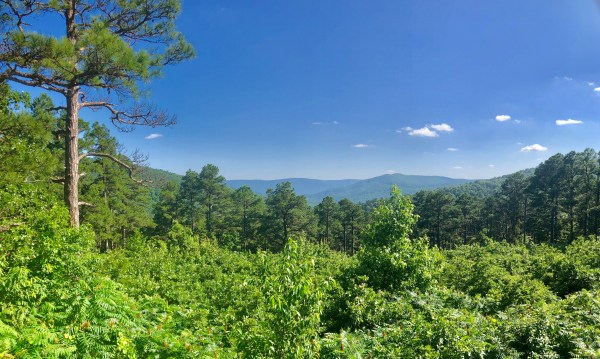
Emerald Vista, along the Talihema Scenic Drive.
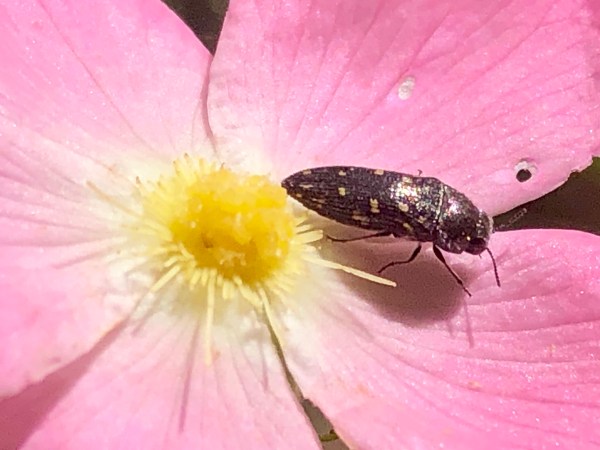
Acmaeodera tubulus on flower of Rosa carolina.
Canthon sp.
Apheloria virginiensis reducta (ID by Derek Hennen).
The biggest cairn I’ve ever seen.

Ouachita National Forest, Talimena Scenic Dr at Big Cedar Vista, Oklahoma
There were lots of native wildflowers like Coreopsis tinctoria and Ratibida columnifera in bloom, so we stopped to check them out. There were lots of butterflies, however, I found only a single Typocerus zebra on Coreopsis lanceolata.

View south from Talimena Scenic Drive at Big Cedar Vista.
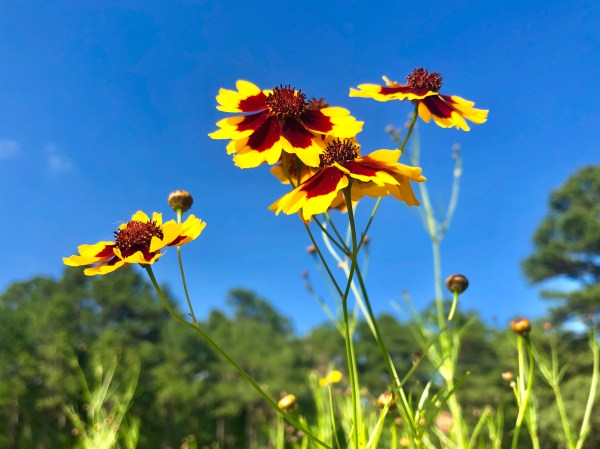
Coreopsis tinctoria (plains coreopsis).
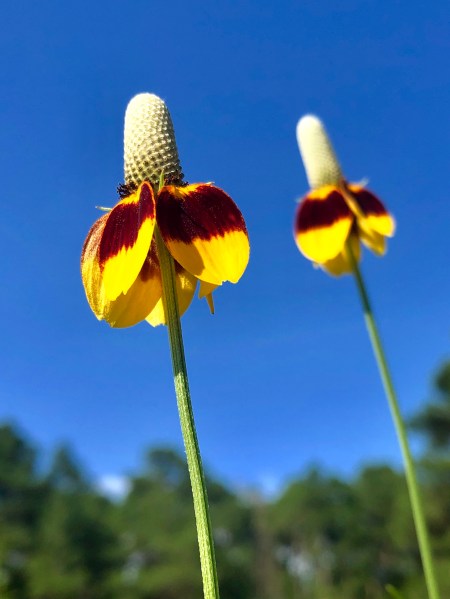
Ratibida columnifera (upright prairie coneflower).

Ouachita National Forest, Winding Stair Campground, Oklahoma
We returned to the campground in the evening to do some blacklighting. I had high hopes, but only five cerambycids came to the lights, all represented by a single individual: Monochamus carolinensis, Acanthocinus obsoletus, Amniscus sexguttatus, Eutrichillus biguttatus, and Leptostylus tranversus (the first four are pine-associates). I also picked up a few other miscellaneous insects.

Rich processes the day’s catch as the blacklight hums in the background.

Day 3 – Medicine Park Primitive Campground, Oklahoma
There wasn’t much insect activity going on in eastern Oklahoma, so we drove out west to the Wichita Mountains for hopefully better luck. We found a small park with a primitive campground in the city of Medicine Park—my first thought was to beat the post oaks dotting the campground, but when I went into the native prairie between the campground and the creek I never came out! Right away I found what must be Acmaeodera ornatoides on flowers of Opuntia sp., then I found more on flowers of Gallardia pulchella along with Acmaeodera mixta. The latter were also on flowers of Thelesperma filifolium along with Acmaeodera neglecta—took a nice series of each, and I also got a few of the latter on flowers of Coreopsis grandiflora. Strangalia sexnotata were on flowers of C. tinctoria and Torilis arvensis, and then on the latter plant I saw a male Strangalia virilis—a Texas/Oklahoma specialty that I’ve never collected before! I spent the next hour looking for these guys and ended up with 3 males and 2 females along with a few Trichiotinus texanus—another Texas/Oklahoma specialty—and a single Agrilaxia sp. nr. flavimana (could be A. texana). One single Typocerus octonotatus was on flowers of Achillea millefolium. I think we may come back here tomorrow—I’d like to look for more S. virilis and beat the post oaks (the reason we stopped here to begin with).

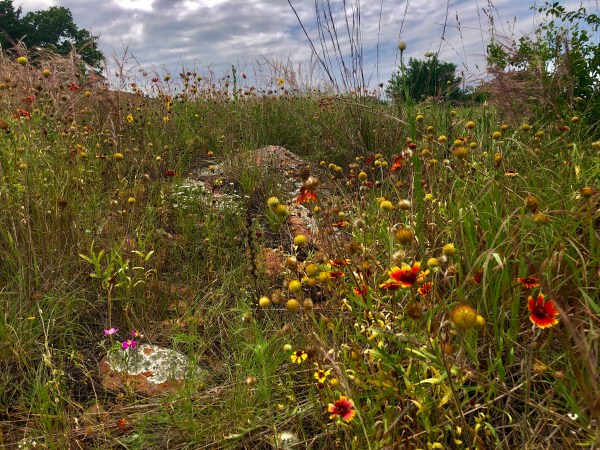
A cacophony of native wildflowers!
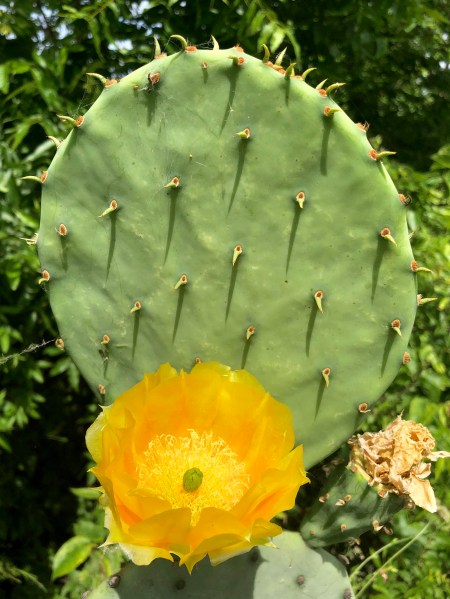
An orgy of Euphoria kernii (Kern’s flower scarab) in Opuntia sp. flower. Multiple color forms exist for this species.
At first I thought this was a type of hover fly (family Syrphidae), but eventually I determined it to be Esenbeckia incisuralis, a horse fly (family Tabanidae)—incredible emerald green eyes!
Papilio polyxenes asterius (black swallowtail) caterpillar.
Echinocereus reichenbachii baileyi (lace hedgehog cactus).

Lake Lawtonka nr. Ma Ballou Point, Oklahoma
We stumbled into this area while looking for stands of Sapindus drummondii (soapberry)—found a small stand along the road, but it was too inaccessible. The same diversity of blooms were present as at the previous spot, so I picked a few longhorns off flowers of Coreopsis grandiflora and Gaillardia pulchella. Super windy, so we didn’t stay long.

View across Lake Lawtonka from Ma Ballou Point.
Neochlamisus sp. (case-bearing leaf beetle) larvae inside their “casas de caca” on Monarda fistulosa (bee balm).
I believe this is Harrisina coracina, a leaf skeletonizer in the family Zygaenidae. Both BugGuide and the Moth Photographers Group show records only from Texas.

Day 4 – Wichita Mountains National Wildlife Refuge, Oklahoma
Before starting the day’s collecting, we wanted to go into the Wichita Mountains National Wildlife Refuge to have a look around. On the way into the refuge we some American bison near the road and had to stop, take photos, and simply admire these massive, majestic beasts. We then went to the Cedar Plantation, where I had visited before back in 2012 and photographed black individuals of Cicindelidia obsoleta vulturina (prairie tiger beetle). No tiger beetles were out now (they come out in the fall), but I’d hoped to maybe see Cylindera celeripes (swift tiger beetle) along the 2-tracks in the area. No such luck—nevertheless, we saw a myriad of interesting insects, including several more Esenbeckia incisuralis (green-eyed horse flies) and a beautiful Trichodes bibalteatus (checkered beetle), the latter of which I photographed on flowers of Ratibida columnifera and Achillea millefolium with the big camera. Afterwards we visited the “prairie dog town” and got marvelous views and photographs of black-tailed prairie dogs.

Native American wildlife on a native American landscape.
American bison (Bison bison bison).
Wichita Mountains from Cedar Plantation.
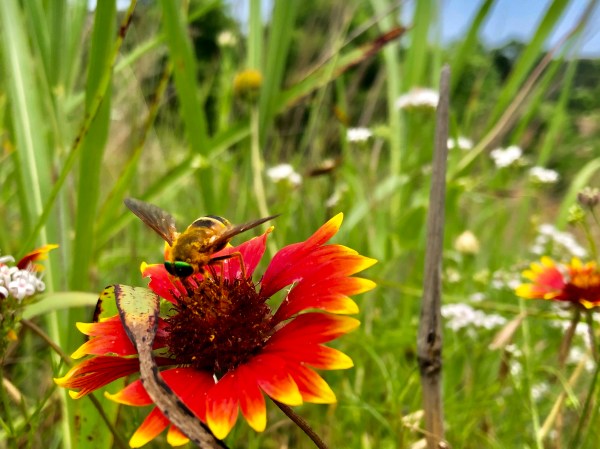
Acmaeodera mixta on flower of Rudbeckia hirta (black-eyed Susan).
Typocerus octonotatus on inflorescence of Achillea millefolium (yarrow).
Strangalia sexnotatus on flower of Ratibida pinnata (gray coneflower)
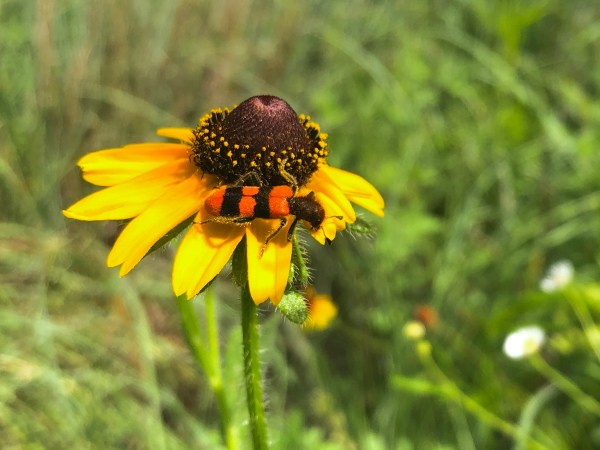
Trichodes bibalteatus on flower of Rudbeckia hirta (black-eyed Susan).
Trichodes bibalteatus on flower of Ratibida pinnata (gray coneflower)
The author walks a bison trail through the Cedar Plantation.
Black-tailed prairie dog at its burrow entrance.
“Watch you lookin’ at, Willis?!”
Black-tailed prairie dog (Cynomys ludovicianus).

Medicine Park, Jack Laughter Park, Oklahoma
We’d noticed this spot yesterday because of the old post oaks and wealth of wildflowers blooming up the mountainside. There wasn’t much going on today, however—just a few Acmaeodera mixta on flowers of Gaillardia pulchella. I did find an Anthaxia (Haplanthaxia) sp. on my arm! Otherwise I spent some time photographing the landscape and some geometrid larvae on flowers of Gaillardia pulchella.

Opuntia sp. (prickly-pear cactus) amidst rocky exposures.
Small Oncoptus fasciatus (large milkweed bugs) nymphs colonize seed pods of Asclepias asperula (antelope-horns).

Medicine Park Primitive Campground, Oklahoma
We returned to this spot since we had so much luck yesterday. I was hoping to collect more Acmaeodera ornatoides and Strangalia virilis, but there was much less going on today than yesterday—basically didn’t see anything for the first hour and a half. I didn’t give up, however, and kept checking the area where we saw most of the S. virilis yesterday, and eventually I saw another male in the same area as yesterday on the same stand of Torilis arvensis. I found two more males in the same area over the next hour, so three males on the day was a good reward for the time spent looking for them. I also collected Trichodes apivorus and Trichiotinus texanus on flowers of Allium sp. Interestingly, beating the post oaks—the reason why I originally wanted to stop here—produced nothing. So, not very many specimens on the day, but happy with those I did get.

Thelesperma filifolium (stiff greenthread).
Coreopsis grandiflora (large-flowered tickseed).
Gaillardia pulchella (firewheel).
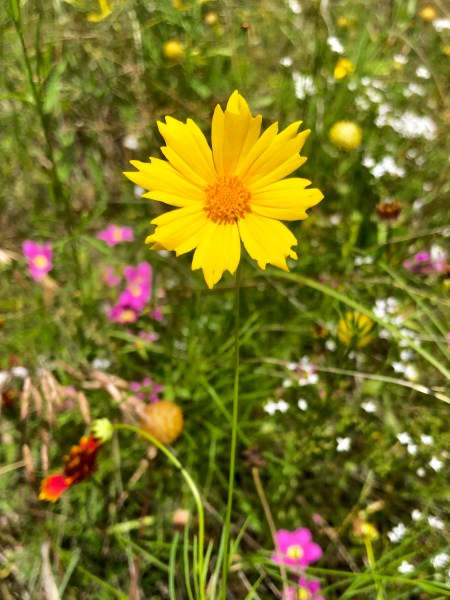
Coreopsis tinctoria (plains coreopsis).
Torilis arvensis (erect hedge parsley), introduced.
Opuntia sp. (prickly-pear cactus).
Allium sp. (wild onion).

Medicine Park, Jack Laughter Park, Oklahoma
I was pretty much done for the day after spending all morning at the refuge and most of the afternoon at the previous spot, but Rich wanted to take another look at Jack Laughter Park because he’d found some interesting grasshoppers there. As with earlier in the day there were few beetles of interest to me, but I did collect a couple of Trichiotinus texanus on flowers of Cirsium undulatum. I checked out some large post oaks with large dead branches thinking that might be what Strangalia virilis was breeding in but never saw any, and eventually I turned my attention to photographing a few interesting native plants that I found along the way.

Krameria lanceolata (trailing krameria).
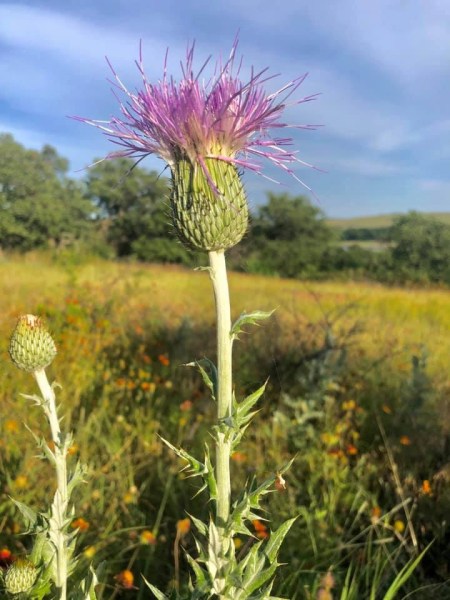
Cirsium undulatum (wavyleaf thistle or gray thistle) inflorescence.

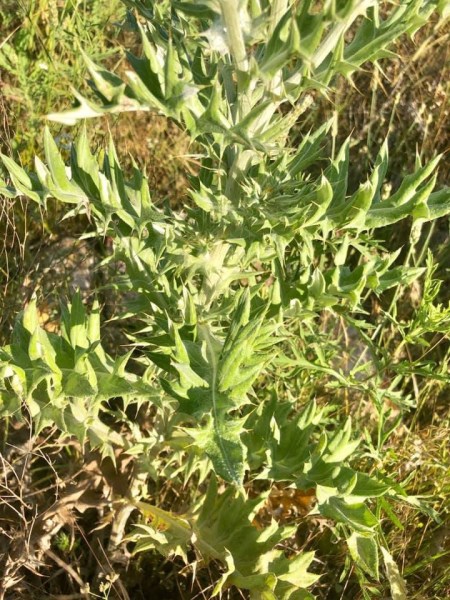
Cirsium undulatum (wavyleaf thistle or gray thistle) can be distinguished by its wavy leaves that are gray-green on both upper and lower surfaces.

Day 5 – Epilogue
We were tempted to do one last little bit of collecting on the way back to St. Louis, but since had pretty good luck during the last couple of days and the drive alone would take more than nine hours we decided to leave well enough alone and get home at a reasonable hour. A walk with Beauregard when I got home to stretch the post-drive legs was the perfect way to end the mini-vacation.


©️ Ted C. MacRae 2019

T.G.I.Flyday—Black horse fly (Tabanus atratus)

In my previous post, I talked about a day trip to a sand scrub remnant in the Lake Wales Ridge of central Florida to find and photograph the endemic Highlands tiger beetle (Cicindelidia highlandensis). Ironically, the dry sand scrub/pine woodland habitats along this ridge are dotted with small lakes and ponds, allowing a rich aquatic flora and fauna to co-exist alongside the xeric specialists. Field mate Chris Brown and I had found and just finished photographing the tiger beetles when we encountered this rather largish lake—bright, white sand surrounding crisp, clear water reflecting white, puffy clouds in a deep, blue sky. ‘Twas a spectacular sight, indeed!

Sand scrub lake

Sand scrub remnant, Lake Wales Ridge, central Florida

As we stood looking at the scenery, I noticed something black on the stem of one of the sedges growing along the water’s edge. Something big and black! As I moved closer I could tell quickly that it was a large horse fly, but it was not simply perched and resting on the sedge—there was something else going on. Moving closer, ever so cautiously so as not to disturb the fly, I eventually realized that it was a female in the act of oviposition. How cool—I’d never witnessed this before with any species of horse fly, so to see it with such a large species was a real treat. I recognized it instantly as Tabanus atratus—commonly called the black horse fly and recognizable as such by its large size, all-black coloration, and distinctively hooked antennae (see 3rd photo below).

Tabanus atratus ovipositing

A Tabanus atratus female oviposits on a stem overhanging the water.

Before we get to the eggs, let’s dispel some misinformation that seems to persist regarding the size of this species (as it does with almost any large insect). Black horse flies are undeniably large, and in fact they are one of the largest horse flies in North America. The more credible sources (e.g., Pechuman et al. 1983, Long 2001) cite body length as ranging from 20–25 mm (up to a full inch in length). Incredibly, the species does not take the honors as North America’s largest horse fly, which goes instead to Tabanus americanus and it’s upper limit of 30 mm (in fact, T. americanus may be the world’s largest horse fly)! There are, however, on-line sources and a few popular field guides (as cited in BugGuide) that state a maximum length of 28 mm for T. atratus. How credible this figure is I cannot say, but I guarantee that the size indications of 30, 40, and even a whopping 50 mm in length found routinely among photos of this species on BugGuide were not derived from careful measurement and almost certainly instead reflect the astonished reactions that such an abnormally large insect can generate! In fact, there are precious few insects in North America that reach lengths as grand as 50 mm (i.e., two full inches)!

Tabanus atratus ovipositing

Lateral view of oviposition.

We approached carefully, again so as not to disturb the female in the middle of her act, and we watched and photographed as she laid the individual eggs one by one, using the tip of her abdomen to carefully arrange them neatly against each other in stacked layers. From a photographic perspective, balancing flash exposure of the all-black adult with the bright-white egg mass presented a real challenge. Added to that was an additional exposure challenge (my desire for a blue-sky background), making it a truly difficult-to-photograph subject. Long (2001) states that T. atratus egg masses can contain anywhere from one hundred to a thousand eggs each, always near water’s edge or somewhere quite close to water. Females are capable of laying three or four of these egg masses, which apparently gradually turn dark as the eggs develop and approach hatch.

Tabanus atratus egg mass

Freshly laid Tabanus atratus egg mass.

Despite this being the first time I’ve ever witnessed oviposition by this species, it seems to be encountered regularly. There are several photos of ovipositing females among the many photos of this species that have been posted to BugGuide. Moreover, descriptions of the egg mass of T. atatus appeared very early in the literature, first by Hart (1895) and then in photographs by Schwardt (1936). The latter author also states “T. atatus deposits its eggs in masses which are so constant in structural plan as to make specific determination of the egg mass readily possible” (as quoted in Bailey 1948). Thus, even if this female had already finished and left her egg mass, it still could have been identified to species.

REFERENCES:

Bailey, N. S. 1948. Notes on Tabanus atratus subsp. nantuckensis Hine (Diptera). Psyche 55(3):131–138 [pdf].

Hart, C. A. 1895. On the entomology of the Illinois River and adjacent water. Illinois State Laboratory of Natural History Bulletin 4:149–273 [eBook].

Jones, C. M. & D. W. Anthony. 1964. The Tabanidae (Diptera) of Florida. U.S. Department of Agriculture, Agricultural Research Service, Technical Bulletin No. 1295, 85 pp. [pdf].

Long, W. 2001. Tabanus atratus (on-line), Animal Diversity Web. Accessed 20 March 2019 at https://animaldiversity.org/accounts/Tabanus_atratus/

Pechuman, L. L., D. W. Webb & H. J. Teskey. 1983. The Diptera, or true flies, of Illinois 1. Tabanidae. Illinois Natural History Survey Bulletin 33(1):1–121 [pdf].

Schwardt, H. I. 1936. Horseflies of Arkansas. Arkansas Agricultural Experiment Station Bulletin 332:14–15, 27–32.

© Ted C. MacRae 2019


Crazy Eyes 2

Buenos Aires Province, Argentina | March 2012

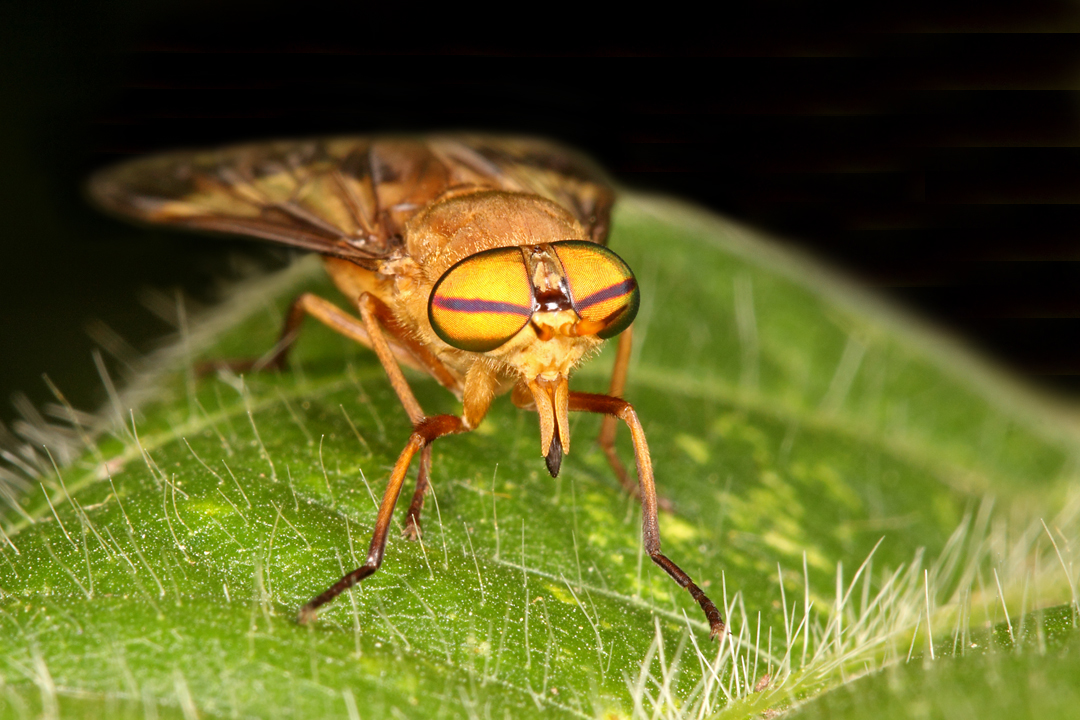
While the eyes of this female horse fly (family Tabanidae) aren’t quite as striking as those of Tabanus lineolus (the wonderfully dimorphic males and females of which were made famous by Thomas Shahan and Ralph Holzehthal), they still managed to catch my eye as I was scouting for more pedestrian types of insect in a soybean field in central Argentina this past week. We know this is a female due to the separated eyes (males have larger eyes that meet at the middle of the head—supposedly the better to see females with); and by the obvious, blade-like mouthparts, which the females use to slice mammal skin so they can lap the blood that their eggs need for development prior to being laid while males forego specialized mouthparts and concentrate on using their huge eyes to look for females.

Female horse flies have well-separated eyes and distinct, blade-like mouthparts.


I suspect this individual had recently emerged from the soil (where many horse flies pupate) and was still hardening off, as she was very calm sitting on the leaf and allowed me to steady the leaf with one hand as I snapped a few photos with the other. I would have loved to have switched out the 100mm lens I was using and put on my 65mm 1-5X lens to really zoom in on those striking eyes. Unfortunately, I don’t think my field companions shared or understood my fascination with this little insect. If anybody has a clue about the identity of this species please let me know.

Copyright © Ted C. MacRae 2012

Frenatae 2011 Calendar

Ralph Holzenthal - Tabanidae. Adobe Illustrator, gradient mesh/Adobe Photoshop.

Even though we’re now in the latter part of February, I wanted to spread the word about a cool insect-themed calendar shown to me by a colleague during my recent trip to Brazil. Produced by Frenatae, the Graduate Student Entomology Club at the University of Minnesota, the calendar features original work by students using computer illustration techniques taught in a UMN course titled, ENT 5051, Scientific Illustration of Insects. The mastermind behind this course is Dr. Ralph W. Holzenthal, who – as can be seen by the stunning image above of a female (L) and male (R) Tabanus lineola – knows a thing or two about insect illustration! While the course covers traditional techniques such as pen & ink, pencil, watercolor, etc., its major emphasis is on computer-assisted techniques using Adobe Illustrator® and Photoshop®. This includes instruction on preparing full habitus color illustrations of insects on the computer. How I wish a course such as this had been available when I was in graduate school (of course, how I wish computers had been available when I was in graduate school!).

While Dr. Holzenthal’s illustrative skills are obvious, it’s also clear that he excels at teaching these skills to his students, as evidenced by this selection of my favorite images (not surprisingly, all beetles!) from the course website galleries:

Caitlin Krueger - Scarabaeidae

Martha Megarry - Scarabaeidae

Heather Cummins - Zopheridae

.
It should be pointed out that all of these Photoshop illustrations represent original artwork and not modified photographs!

I ordered my copy of the calendar as soon as I returned home from my trip. You can order one too by sending a check for $12 to the following address:

Frenatae
1980 Folwell Ave Rm 219
St Paul, MN 55108

My thanks to Dr. Holzenthal for allowing me to post this small selection of images from his website.

Copyright © Ted C. MacRae 2011