2018 New Mexico/Texas Insect Collecting Trip “iReport”

This is the fifth in a series of Collecting Trip “iReports”—so named because I’ve illustrated them exclusively with iPhone photographs (see previous articles for 2013 Oklahoma2013 Great Basin, 2014 Great Plains, and 2015 Texas). Note that I continue to use my “big” camera for specific insect targets—and these will be featured from time to time on this site. However, I use my iPhone camera much more during these trips for general photography to document habitats, landscapes, and miscellaneous subjects because it is so small and handy and because it is also capable of capturing reasonably good photographs (see this post for tips on making the most of the iPhone camera’s capabilities). This allows me to spend more time looking for and collecting insects—usually my primary objective on these trips! Collectively, these iPhone photos and the short narratives accompanying them form a nice trip synopsis when assembled into a single post.

This report covers a collecting trip I made with Jeff Huether from June 2–9, 2018 to southeastern New Mexico and west Texas. I’ve dabbled in this area before, primarily just a quick stop at Mescalero Sand Dunes many years ago, but not specifically targeted this area for any systematic collecting. Thus, most of the locations that we visited were new to me, which automatically means that I would find at least a few things of interest—and more probably a lot (as long as the insects are active). We had great success at many localities, having found areas where sufficient rain had occurred to trigger insect emergence despite the drought that was plaguing much of the area. Highlights were the areas along Hwy 380 between San Antonio and Bingham, the Mescalero Sand Dunes, and the dunes near Kermit, Texas. I haven’t yet tallied the number of species collected, as much of the material is still waiting to be mounted and identified. However, I estimate that it is in the neighborhood of about three dozen buprestids and maybe half that many cerambycids, including some quite charismatic species that I’d not collected previously (e.g., Prionus arenarius and Tragidion armatum).

Stay tuned, because I made a second insect collecting trip during 2018, this one with Art Evans to southeast Arizona during late July and early August.


Day 1 – Sandia Mountains, New Mexico
We flew into Albuquerque this afternoon and, after getting the car, supplies, and something to eat we came up to Sandia Crest Recreation Area looking for Cicindela longilabris (long-lipped tiger beetle). This was the first place I stopped on the first day of the trip for the first species I wanted to look for, and I found it in the first five minutes I was here!

View from near the summit of Sandia Mountain.

We stopped at the Capulin Picnic Ground on the way down the mountain. There were some oaks with fresh-looking foliage that I beat – no Buprestidae but a nice series of a treehopper (Telamonthe?) and a few odds and ends. There was also Robinia off which I beat a series of what is surely Agrilus egenus.

Penstemon sp. ID by George Yatskievych.

Day 2 – Walking Sands Rest Area, New Mexico
Quick stop to check the lights – later in the season Jeff has collected Prionus palparis here, but this time we saw nothing. Also checked the nearby vegetation, there was Dalea in bloom but no beetles on the flowers.

Hwy 380 between San Antonio & Bingham, New Mexico
We saw a few things in bloom at the Rio Grande bridge crossing so decided to stop. I took a fair series of what must be Acmaeodera mixta off of the Thelesperma flowers (along with a few mordellids for Enrico and one meloid for Jeff). Otherwise not much activity at the spot.

Bone dry Rio Grande!

There were some cool looking red sand dunes on Hwy 380 east of San Antonio, so we stopped to see if there might be any tiger beetles. There weren’t any, but I found yucca stems infested with cerambycid larvae, likely Tragidion. I collected 6–8 stems to bring back and try to rear out the adults. Jeff also found a single Chrysobothris sp. on sage, otherwise we saw few beetles.

Going east on Hwy 380 we went into an area of higher elevation with junipers. We stopped to check the Thelosperma flowers, but there were no bups on them. I collected a few noisy cicadas and some Acmaeodera quadrivittatoides on Opuntia flowers. I then started beating the junipers, however, and got a fair series of a small green Gyascutus plus two tiny Chrysobothris. They were extremely difficult to collect – winds were very stiff and the beetles were very active. I probably lost as many as I collected. To finish off I found a mating pair of Moneilema sp. on cholla.

Acmaeodera quadrivittatoides in a flower of Opuntia sp.

Yours truly standing next to a cholla (Opuntia imbricata).

In addition the the Tragidion larvae that I collected two stops back, Jeff saw one adult at the previous stop. So, when we saw thick stands of yucca along the roadsides just a few miles down the road we stopped to take a look. They were out and not uncommon on the flower stalks and down in the basal rosettes. I collected about a dozen of them and also another Gyascutus.

A Tragidion female on a yucca flower stalk.
Tragidion sp. mating pair on yucca flower stalk.

Tarantula hawk (family Pompilidae) on yucca flower stalk. This must be a mimicry model for Tragidion.

I believe this is a cactus dodger cicada (Cacama sp.).

At the last stop we noticed a lot of emergency vehicles rushing to the east. Just a couple of miles down the road we ran into an accident blockade. Since we were stopped I was tempted to look at the rock shop, but then I started looking at the cholla and found several Moneilema sp. adults on the plants.

Walking Sands Rest Area, New Mexico
We came back up to the rest stop because of the dunes – there are Prionus spp. that live in the dunes, so we put out some pheromone to see if we could attract the males which fly at dusk and early nighttime. In the meantime we walked around looking for nocturnally active beetles – found a few skin beetles (Omorgus sp.) feeding in dried dog poop and a huge tenebrionid (Eleodes sp.) strangely perched up in a bush. Also photographed a cool little sun spider (Solifugida). When we went back to check the pheromone there was one male Prionus arenarius running around under the lure!

Skin beetle (Omorgus nodosus) feeding on dried dog poop at night. ID by Bill Warner.

A sun spider (Solifugida) pauses briefly from its frantic search for prey.

Day 3 – Valley of Fire National Recreation Area, New Mexico
We came over the hill and saw a huge black area in the valley below. I thought it was just an area of thick woody vegetation, but it was actually a lava field! Very cool. There were tons of cicadas, I think also cactus dodgers (Cacama spp.) but look different from the one we saw yesterday. I beat a lot of Celtis and only got one Chrysobothris sp. (looks like analis), and there was nothing on the junipers. We also didn’t see any Moneilema on the abundant cholla. I did catch two Acmaeodera mixta on an unidentified white flower. I think yesterday’s rains must have missed this area!

Malpais Lava Beds.

A tarantula hawk (family Pompilidae) on flowers of milkweed (Asclepias sp.).

I believe this is another species of cactus dodger cicada (Cacama sp.).

Malpais Lava Beds.

Lead-footed bugs (family Coreidae) on cholla cactus (Opuntia imbricata).

Malpais Lava Beds.
Cactus dodger cicada (Cacama sp.)?
Male cactus dodger (Cacama sp.) on cholla cactus in mid-song.

We drove a couple miles down the road and made just a quick stop to check flowers along the roadsides. No beetles seen – seems to be super dry, but I did photograph one of the tiniest butterflies (something in the family Lycaenidae) I’ve ever seen.

Western pygmy blue (Brephidium exilis). ID by Doug Taron.

Sierra Blanca Mountains, New Mexico
Jeff wanted to look for an Epicauta up here, but the whole drive up the mountain we could only comment on how dry it was and how extensively the area had burned. I only found two wood borers – an Anthaxia (Melanthaxia) and a lepturine cerambycid, both on iris flowers. We did find the Epicauta though, also on iris flowers.

Atop the Sierra Blanca.

Perhaps Erysimum capitatum (Brassicaceae). ID suggested by Erik Emanuelsson.

Flower longhorn (subfamily Lepturinae) on flower of iris.

Vicinity Sunset, New Mexico
There were some mallow in bloom along the roadsides, so we stopped to see if there were any Acmaeodera on them. There weren’t, just a few meloids that Jeff was interested in. I found a a single Euphoria kerni on a flower of Acacia greggii and, of course, large numbers of them on thistle flowers. The area seems to have gotten some rain, but not much activity to speak of yet.

Euphoria kernii in their typical “buried-butt-upwards” post on a thistle flowerhead.

Mescalero Sand Dunes, New Mexico
This area got rain last night, so we suspected there would be a lot of insect activity, and we were right! The place was alive when we got here at ~6 pm. I walked the area while we waited for dusk to set out pheromone. I collected a series of Enoclerus zonatus off of yucca blooms, beat an Actenodes sp. (something new for me), a Chrysobothris octocola, and a nice series of treehoppers off of mesquite, and found three Batyle suturalis ssp. on an unidentified yellow comp.

Mescalero Sands Recreation Area.

A skin beetle (Omorgus nodosus) makes tracks in the sand.

Enoclerus spinolae on yucca.

Another Enoclerus spinolae individual on yucca. Note the larger spots on this one compared to the other, an example of intraspecific variation.

As the sun began to sink lower in the sky, I hiked around to the backside of the dunes and then bushwhacked across them to get the perfect perspective for photographs when the sun hit the horizon – spectacular sunset!

Sunset on the dune.

What a sunset!

I’m happier than I look! 

By the time I got back to the car, Jeff had already placed three lures out, so we started making the rounds and found at least one or two Prionus arenarius males running frantically in circles under each one. At the second lure, I started searching the area nearby and found a female walking on the ground! (Females are very rarely encountered, and it seems a little more than coincidental to me that for each species of Prionus, whenever we have collected good numbers of males with lures we have also found at least one or a few females in the same area – maybe cheaters [in the ecological sense]?).

As we made the rounds we picked up an amazing diversity of tenebrionids and a few carabids walking in the sand, and we finished off by picking up Jeff’s light trap, which had attracted one more Prionus male and a very light-colored Polyphylla sp. male.

Incredible huge blue spider on the dune at night.

Day 4—Mescalero Sand Dunes, New Mexico

We noticed a stand of soapberry (Sapindus drumondii) along the sides of the road just west of the entrance to Mescalero Sands Recreation Area last night, and I immediately thought of Agrilus sapindi, so this morning on our our way to the dunes we stopped by. I started beating the flowering branches of the larger soapberry trees but wasn’t really getting anything. Then I noticed an A. sapindi flying to a low non-flowering plant, so I caught it and resumed beating – now with more gusto knowing they were here. I still wasn’t getting anything and, again, saw another adult fly and land on a low non-flowering plant. Lesson learned – I started sweeping the low plants and started getting them. I worked all five stands in the area and got about 3 dozen adults, plus a few A. ornatulus, one A. limpiae, and spectacular Neoclytus.

After finishing with the soapberry, Jeff had noticed some tiny Acmaeodera on an unidentified white-flowered composite. We started searching in earnest and collected several dozen adults. I’m not sure what they are, but they are tiny and vittate (maybe A. quadrivittatoides). We also did a lot of sweeping of the short shrubby oak also and came up with a couple of Brachys. Overall a great morning/early afternoon in the field!

The only thing cooler than this abandoned homestead was the squawking ravens hanging out on it!

Soapberry (Sapindus drummondii) stands along Hwy 380 – host for Agrilus sapindi.

Host for unidentified Acmaeodera sp.

We next went into the Recreation Area proper to each lunch, after which we explored the rest of the area accessible by vehicle and saw a stand of cottonwood back in the dunes. We got out to see if there might be any Buprestidae on them (e.g., Poecilonota), but they were devoid of insects. The midday heat on the dunes was extreme! I did find, however, a single Prionus elytron lying on the sand beneath the cottonwoods, so we know they are further back in the dunes as well.

Mescalero Sands Recreation Area.

Mescalero Sands Recreation Area.

We worked the variety of blooming plants in the vicinity of the entrance. I collected ~22 of the small Acmaeodera that were on the white-flowered plant at the soapberry spot on two blossoms of a single yellow-flowered pad Opuntia sp., a couple of Acmaeodera spp. on Gaillardia sp. flowers, a few more Acmaeodera spp. on Prosopis, and several Acmaeodera mixta on another as-yet-unidentified white flower. It was hotter than bejesus we later learned 103°F!) – I had wanted to check out one more stand of soapberry at the entrance, but we were exhausted and dehydrated and had to quit!

Some kind of wasp on some kind of flower.

There are four separate bird nests in the cholla plant – a veritable avian apartment!

Cholla (Opuntia imbricata) blossom.

Vicinity Hobbs, New Mexico
We got a hotel in Hobbs and grabbed a sandwich for dinner, then went out west of town to see if we could find some good habitat for evening collecting. We found a spot of open rangeland about 8–9 miles west of town, set out the pheromone lures, and began beating the mesquite (Prosopis glandulosa). We had high hopes because there was still standing water, meaning that the area had gotten good rains on Sunday night. Boy were we correct! Beating the mesquite was amazing. For buprestids I got 10 individuals of an Actenodes sp., 4 individuals of a Paratyndaris sp., 4 Chrysobothris spp., 4 Acmaeodera spp., and 1 Agrilus sp. I also got several tiny cicadas, a couple treehopper species, and a few clerids and other odds and ends. We setup a blacklight and the scarabs were quite diverse, but the only thing I took was a tiger beetle (Cylindera lemniscata). I also picked up a Phyllophaga cribrosa and a tenebrionid walking on the ground at night. No Prionus came to the lures, any my searches of the ground at night turned up no Amblycheila.

Tiny scarab beetles in the genus Diplotaxis congregate on low plants to “catch” pheromone trails in search of mates.

Giant millipedes (genus Orthoporus) were common at night, a sure sign of recent rains. ID by Derek Hennen.

Ted of Arabia and Jeff.

Day 5—Sand Dunes near Kermit, Texas
We stopped just outside the Kermit Sand Dunes to beat the mesquite (Prosopis glandulosa) to see what might be out. I collected 8 species of Buprestidae: nice series of an Acmaeoderopsis (hoping A. prosopis), 1 sp. Actenodes, 2 spp. Chrysobothris, 1 sp. Paratyndaris, 1 sp. Agrilus, and 2 Acmaeodera spp. We eventually gave up – the heat had not only wilted us, but the Acmaeoderopsis were flying away immediately upon hitting the sheet.

Updated field pic (the last one was taken in 1999!).

We drove a little further towards the heart of the dunes and found a spot where there were some blowouts and classic sand flora. Immediately upon starting out we noticed Acmaeodera mixta adults flying around commonly, so I swept through the vegetation a bit and collected a representative series. On Oenethera sp. flowers I found a single A. immaculata and later several A. mixta and a very small Acmaeodera (looked like the one we collected yesterday at Mescalero). In one spot I found a few plants of an unidentified yellow composite with a few more A. mixta, and on Baccharis I found one A. obtusa(?) along with A. mixta. Coming back to the car Jeff and I noticed huge numbers of A. immaculata flying to an unidentified shrub, from which we each swept a nice series. Eventually the heat (103°F) again overwhelmed us, and we had to get in the car, eat, and cool down for a bit on the way to another spot.

The dunes are part of an extensive series of dunes stretching from West Texas through southeastern New Mexico.

Acmaeodera mixta on flower of an unidentified yellow composite.

We returned to an area with stands of soapberry (Sapindus drummondii) that we had seen when we first arrived in the area. I swept all of the small plants on the east side of the highway and got a single Agrilus sapindi – not nearly as abundant as we had seen at Mescalero Sands.

On the west side of the highway there were some larger mesquite (Prosopis glandulosa). I found one Chrysobothris octocola on the trunk, then Jeff and I noticed Acmaeoderopsis flying to the tips of the high branches. I got my aerial net and just started betting them as they flew in while we stood and watched. I caught them from several trees, but a majority from a single tree. That worked much better than beating this morning – I probably lost as many as I collected because they flew so quickly upon hitting the sheet.

Underneath one large mesquite I found several prionid elytra – couldn’t tell if they were Prionus or Derobrachus, but then I noticed burrows in the ground very similar to those we saw for Prionus integer in Colorado (see photo). We dug a few out but found nothing. Something to keep in mind.

The high plains of west Texas.

Burrows like this one look suspiciously like those of Prionus integer in Colorado – did another Prionus make this one?

We returned to the dunes for some evening collecting. I beat the two large mesquite (Prosopis glandulosa) trees by the parking area and got an Actenodes and a few Chrysobothris octocola – no Acmaeoderopsis, I guess they hide elsewhere for the night. Once dusk fell we began checking the pheromones and light – only a single male Prionus arenarius came to the pheromone, but we got several individuals of two Polyphylla spp. (P. monahansensis – larger, and P. pottsorum – smaller) at the light. Walking around the dunes at night there were significantly fewer tenebrionids and other insects walking around, but I did pick up two cool “concave” tenebs and a Pasimachus ground beetle.

I’ve never seen a mourning dove make a nest in the ground before.
I always thought these oil pumps looked like dinosaurs bobbing up and down.

Bull nettle (Cnidoscolus texanus)—something tells me I should not touch this plant!

A very small (<1.5” in length) scorpion visits the light looking for a meal.

Face-to-face with a scorpion!

Day 6—I-10 Rest Area at mile marker 162, Texas
Just a quick stop to use the facilities, but I couldn’t resist the temptation to photograph these three Reakirts blues all on one flower (a fourth flew away before I could snap).

Reakirts blue (Echinargus isola). ID by Doug Taron.

San Felipe Park, near Fabens, Texas
We took a chance on going further west to the dunes near Fabens, since we’ve had such good luck with rains in the area. However, when we got here and started looking around it was apparent that nothing was happening here – dry, dry, dry with temps just over 100°F. I saw a few insects but only a single buprestid – Acmaeodera quadrivittatoides, and I missed it! We decided to cut bait and head back east and north towards Carlsbad – we should be able to get to the area in time for some late afternoon and evening collecting. You can’t win ‘em all!

This roadrunner was rather annoyed with us for intruding in his spot of shade under a Siberian elm.

A broad-nosed weevil.

A mating pair of walkingsticks. Note the great size difference between the male (smaller) and female (larger).

I think I found our retirement home!

Vicinity Carlsbad, New Mexico
After getting lost in the Fabens Sand Dunes and then a whole lot of driving back east into New Mexico, we arrived in Carlsbad with just enough time to grab a sandwich and head out to some promising habitat we’d noticed on the way in for some evening/night collecting.

The area contained a ribbon of woodland with mesquite (Prosopis glandulosa), black acacia (Acacia rigida), and catclaw acacia (A. greggii). I beat only one tiny Chrysobothris sp. off the mesquite, but off the black acacia I beat three individuals (four actually, one got away) of a large, chunky Chrysobothris sp. that I do not recognize, plus an undetermined cerambycid and a few clytrines. Actually, before I collected the Chrysobothris I had given up on the lack acacia until I was walking by one plant and saw the first one sitting on a branch. I popped it in the vial and started beating the other plants in the area with renewed enthusiasm the find the other two (three!).

We setup the lights and the pheromones, but not much came to the former and nothing to the latter (expected, since there was no sand habitat nearby). The sunset beforehand, however, was magnificent, and I did find a couple of miscellaneous beetles walking around at night.


Day 7—vicinity Loco Hills, New Mexico
We saw an area with stands of soapberry (Sapindus drummondii) alongside the road so stopped to sample it for Buprestidae. I got 3 Agrilus limpiae on trees right around the car but nothing on all the rest of the three stands nearest the car on either side of the road. I hope the south area of Mescalero Sands is not as dry as it still appears around here.

Soapberry (Sapindus drummondii).

Mescalero Sand Dunes, New Mexico
We found the central dunes of the southern area and immediately found several Acmaeodera mixta adults on mesquite (Prosopis glandulosa) flowers. I started beating the mesquite and picked up a nice series of Acmaeoderopsis, one Actenodes, and a few other miscellaneous Acmaeodera off the larger trees. There was some soapberry (Sapindus drummondii) in bloom around the dunes, but beating it produced no Buprestidae.

A lone windswept soapberry tree hangs on precariously to life in the dunes.

Acmaeodera mixta on flowers of mesquite (Prosopis glandulosa).

We stopped at a spot outside the dunes because it looked pretty green with a number of plants in bloom suggesting recent rain. I saw but did not take Acmaeodera mixta on white flowers of undetermined composite. I did collect a small series of bright red and black clerids on a small blue-green euphorbiaceous plant. Also saw a little horned lizard, who cooperated just enough to get a few snaps!

A young Texas horned lizard (Phrynosoma cornutum) tries to make himself look big!

White-flowered composite blooming in the desert.

Vicinity Carrizozo, New Mexico
We stopped at a thick stand of yucca that we’d noted on the way past here earlier in the week, the hope being that we would find Tragidion armatum on the stems. Sadly we did not see any, nor did we see more than just a couple of the pompilid wasps that the beetles mimic. Surely this is a result of the lack of rain in the area, which the hotel clerk confirmed during our earlier check in. Cicadas, on the other hand, were everywhere!

The low sun illuminates the yuccas, while the higher clouds shade the mountains behind.

The low sun illuminates the yuccas, while the higher clouds shade the mountains behind.

How many cicadas do you see on this single yucca stem?

Promising clouds tease a thirsty landscape.

For the final stop for the day we returned to Valley of Fire Recreation Area – not really to collect insects, but to look about this fascinating landscape. The Lava Beds are thought to be 5,000 years old, having formed over a 30-year period when lava poured from Black Peak to the north (not a volcano, but a volcanic vent) at a rate that would fill 15 bathtubs every second! It was a serene and otherworldly walk in the falling darkness – nice way to cap off an evening.

Towering clouds try to squeeze out some moisture.

Lots of virga, little rain.

A 400-year old juniper watches another sunset.

Day 8—vicinity Bingham, New Mexico and west on Hwy 380
We stopped at another yucca stand very near where we’d found the Tragidion armatum last weekend – no problem finding them here either. I got plenty of photographs of the beetles (despite having to go ‘au natural’ with the lighting – my flash unit had died!), as well as of cicadas, wasps, and other insects on the yucca stems and pods. Otherwise I only collected two Acmaeodera (looks like A. immaculata) on flowers of Sphaeralcea sp., what looks to be A. disjuncta/paradisjuncta on Ephedra sp., and a single Moneilema sp. on Opuntia imbricata. Nice stop!

Variety of wasps on yucca.

We then stopped by “the juniper spot” again to see if I could get a better series of the Gyascutus (G. carolinensis?) that we found on the junipers (Juniperus monosperma). Boy, did I ever! I collected about 30 specimens this time, made easier by the fact that it was cooler and not nearly as windy! I also again collected two small Chrysobothris sp. on the juniper, a single Moneilema sp. on cholla (Opuntia imbricata), and a single Acmaeoderopsis sp. beating mesquite (Prosopis glandulosa).

One of the more exciting finds of the trip – a jewel beetle in the genus Gyascutus on Juniperus monosperma (I believe this is G. carolinensis).
The greenish waxy bloom that covers the body must help the beetle blend into the foliage on which they perch.

A cactus beetle in the genus Moneilema on its host, cholla (Opuntia imbricata).

A multi-tool comes in very handy for collecting cactus beetles!

We stopped at another spot further west on Hwy 380, where last weekend when we were here we saw few beetles but I did collect yucca stems infested with Tragidion armatum larvae. It rained here later that day, so we stopped by again on our way back to see if the rains had prompted more insect activity. It didn’t seem to, but I did find a Tragidion armatum adult feeding on a yucca flower and photographed a big-as-heck katydid.

Tragidion armatum adult female feeding on a yucca flower.

Big katydid. You can tell this is a brachypterous adult because the anterior wings are on top and their costal margins oriented outside (in nymphs the posterior wings are on top and their costal margins oriented inside).

Perfect camouflage!

“The Box”, vicinity Socorro, New Mexico
Last stop of the trip – we just wanted to find some habitat to beat around in before finding a hotel in Socorro for the night. I beat a couple of small Chrysobothris sp. from the Juniperus monosperma – no Gyascutus – and a couple of treehoppers from Prosopis glandulosa – no Acmaeoderopsis, then turned my attention to the cholla (Opuntia imbricata), in what must have been the thickest stand of this plant I’ve ever seen. There were two species of cactus beetles on them – Moneilema sp. and Coenopoeus palmeri, the latter a first for the trip. After hiking up to the canyon overlook, I realized that the collecting and fun were finally over (until Arizona in August!).

“The Box.”

Cactus beetle (Moneilema sp,) on a cholla (Opuntia imbricata) skeleton.

The “other” cactus beetle (Coenopoeus palmeri).

How many cactus beetles can you count?

Last selfie of the trip. That wry smile is the satisfaction of knowing that the trip was success, I collected lots of great beetles, and I learned a ton!

© Ted C. MacRae 2019

Inaugural “One-Shot Wednesday”

On many occasions I have considered making my own contributions to the “Wordless Wednesday” meme. Unfortunately, I find it impossible to post photos of insects and not be allowed to say anything about them. I suppose I could follow Dragonfly Woman‘s “Well-Nigh Wordless Wednesday” example, but that seems like horning in on somebody’s trademark. At last it finally occurred to me a meme that I could use for Wednesday’s that gets around these issues—”One-Shot Wednesday”! Ever photograph an insect and only get off a single shot? Not just one keeper from a series of photos, but only one single photo of the insect, like it or lump it! That’s what I’m talking about here. The subtext, of course, is that there was only that one chance to get everything right—exposure, focus, composition, lighting, etc. Obviously, it’s not my plan to show crappy photos as part of this meme, but rather that occasional instance where I only got off a single shot, and for the most part everything worked pretty well to produce a decent photograph. I would, of course, be more than happy to see this meme take off and spread throughout the insect blogging community, but if it doesn’t and it remains a BitB exclusive then that’s fine also.

Leptoglossus sp. | nr. Corrientes, Argentina

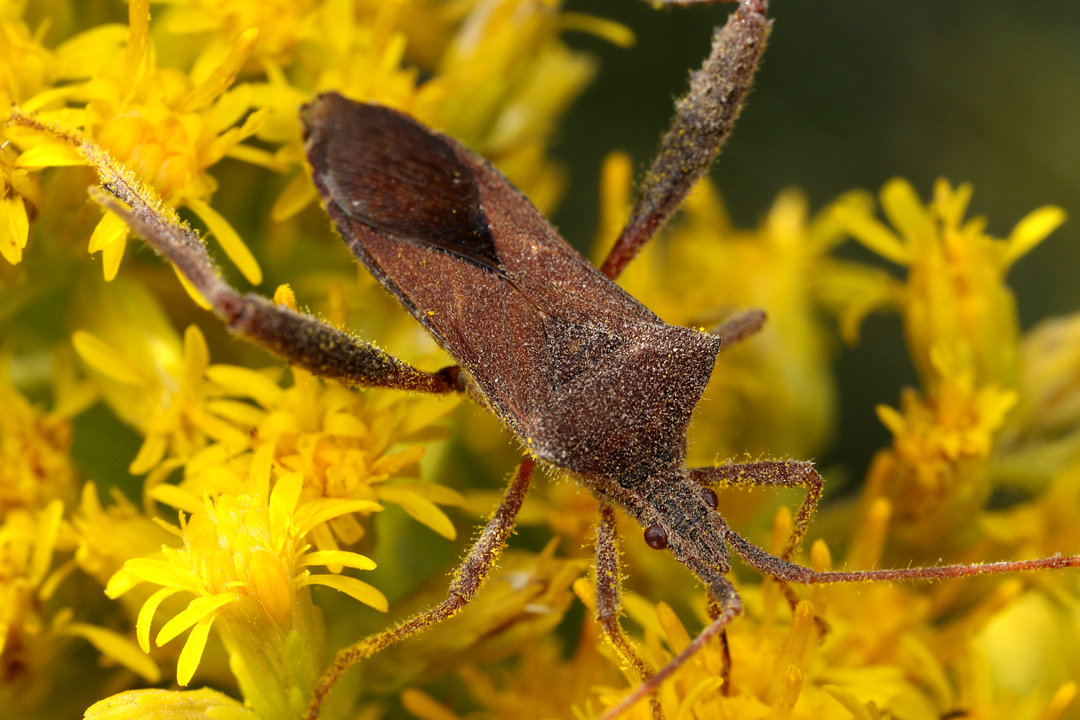
Here is contribution in the meme: a leaf-footed bug (family Coreidae) feeding on flowers of Solidago chilensis  that I photographed a couple of weeks ago near Corrientes, Argentina. According to coreid-specialist Harry Brailovsky (Universidad Nacional Autónoma de México), the expanded hind tibiae place it in the large, mostly New World genus Leptoglossus. Which one, however, is a good question—according to Coreoidea Species File Online, ten species in the genus have been recorded in Argentina, but browsing through available images didn’t immediately turn up a good match for the individual shown in this photo.

I’ve often wondered about the purpose of the leaf-like expansions of the hind tibiae of coreids—which reach truly gargantuan proportions in some tropical species—and their adaptive significance. One can imagine they might serve as a “false target” for potential avian predators, and supporting this idea is the fact that the hind legs seem to break off rather easily when handled. It’s not rare to find individuals in the field missing one or even both hind legs.

Copyright © Ted C. MacRae 2012

To the land of Gauchos

Today I leave for an extended stay in Argentina. Many have asked me if my trip is for work or fun, and my standard response has been, “It’s for work, and it will be fun!” For the next eight weeks, I’ll be helping out with field trials and speaking to farmers (while sampling a few Malbecs as well). Of course I would rather it be an 8-week collecting trip, but I consider myself fortunate even to have an opportunity such as this. I’ll pick up a few insects along the way, but what I really hope to bring back in large quantity is photographs.

It’s a little difficult to predict how reliable and consistent I’ll have internet access or the time to take advantage of it, so postings over the next few weeks may be a little less regular than what has become my usual custom. The trip is also heavily front-loaded with work activities as I get my bearings and spend time getting to know my new colleagues, so I’m not sure when I might have new photos to show here. Not to worry, I have plenty of material that I haven’t yet shown. Until then, I leave you with this photograph I took last November at  in Buenos Aires. These tiny bugs seem to be early-instar leaf-footed bug (family Coreidae) nymphs, their bright red and black coloration and aggregating behavior indicating ample chemical protection against predation.

Early-instar coreid nymphs | Buenos Aires, Argentina

Copyright © Ted C. MacRae 2012

Brazil Bugs #4 – Mais dos percevejos

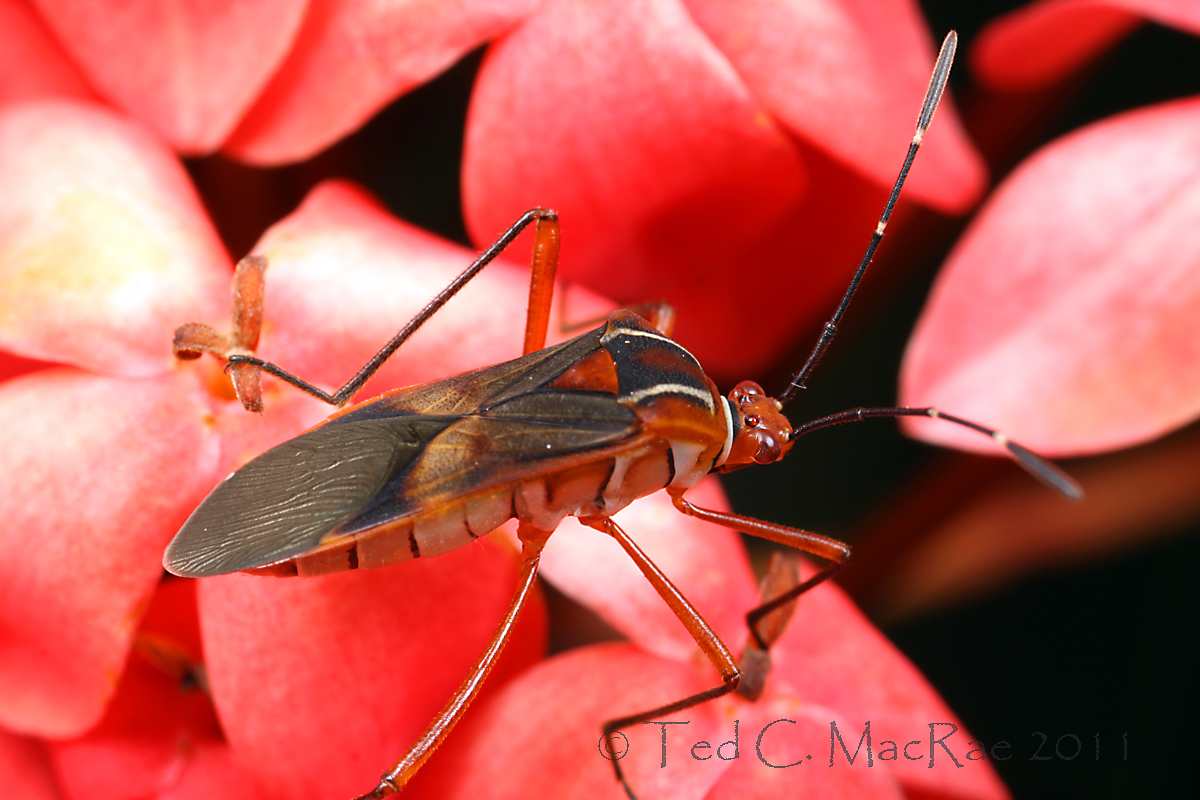
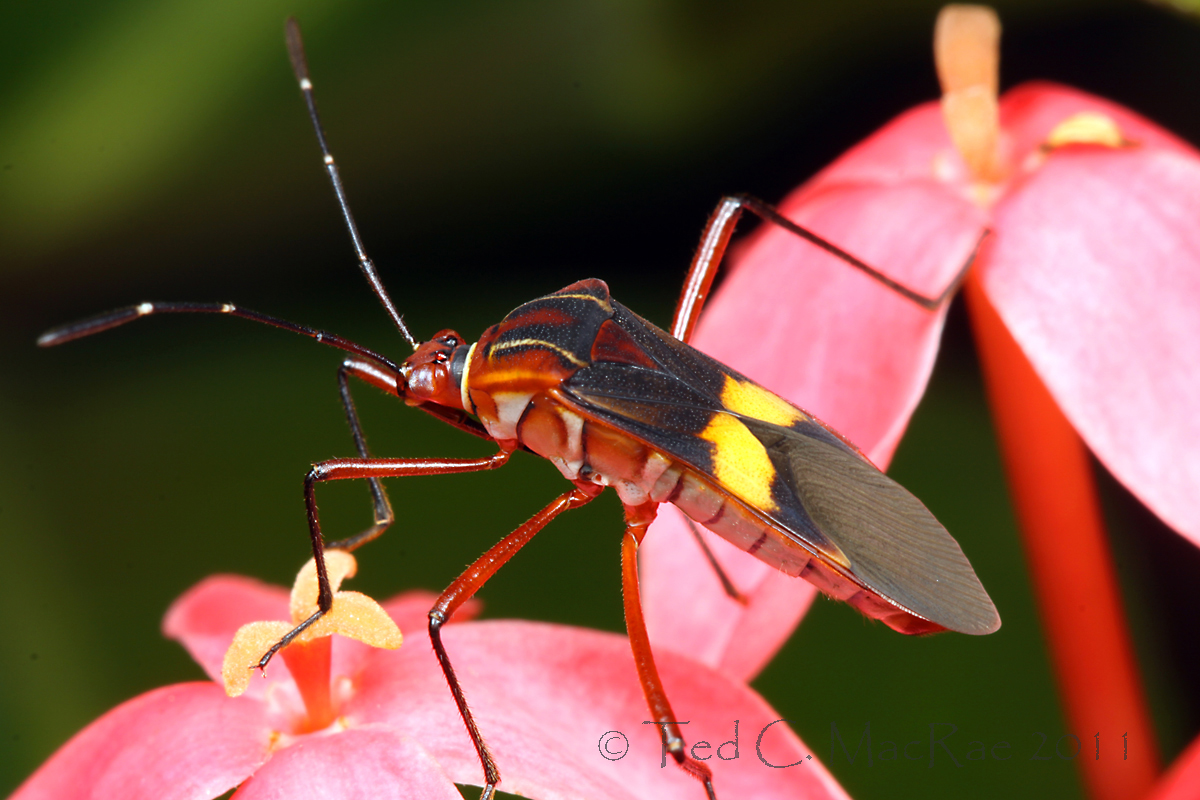
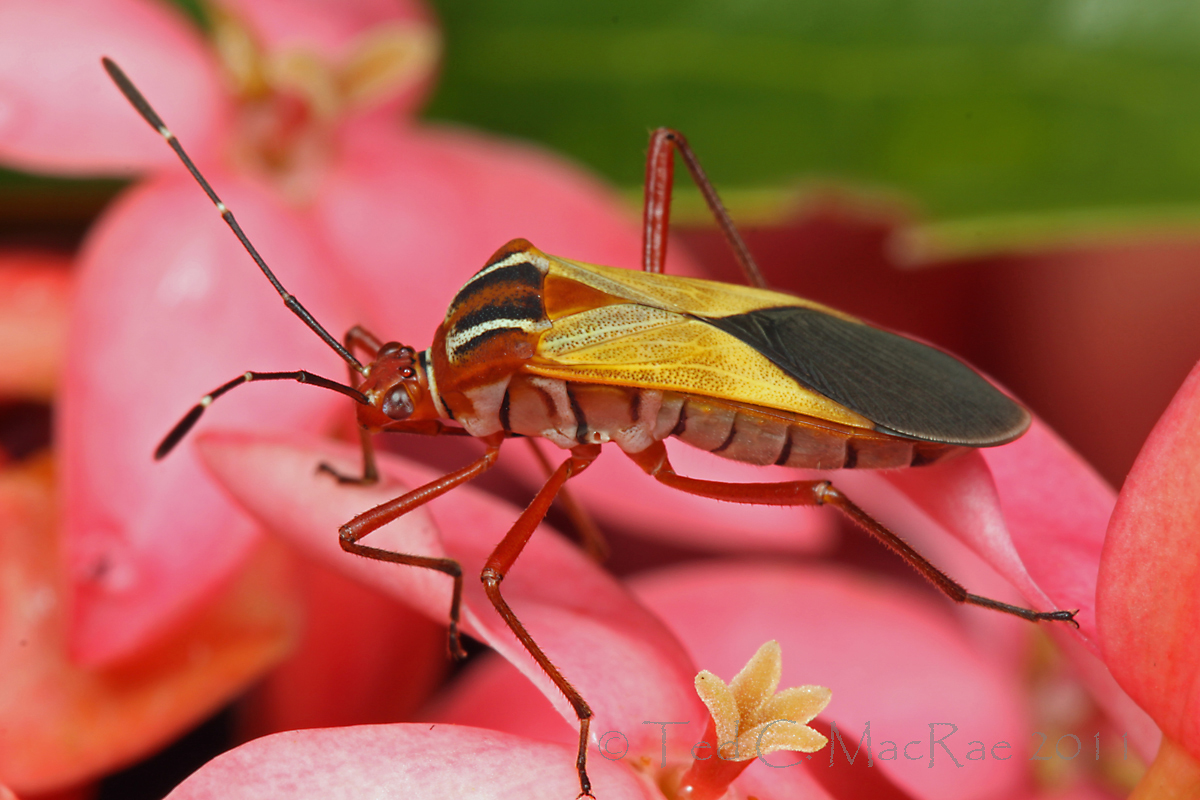
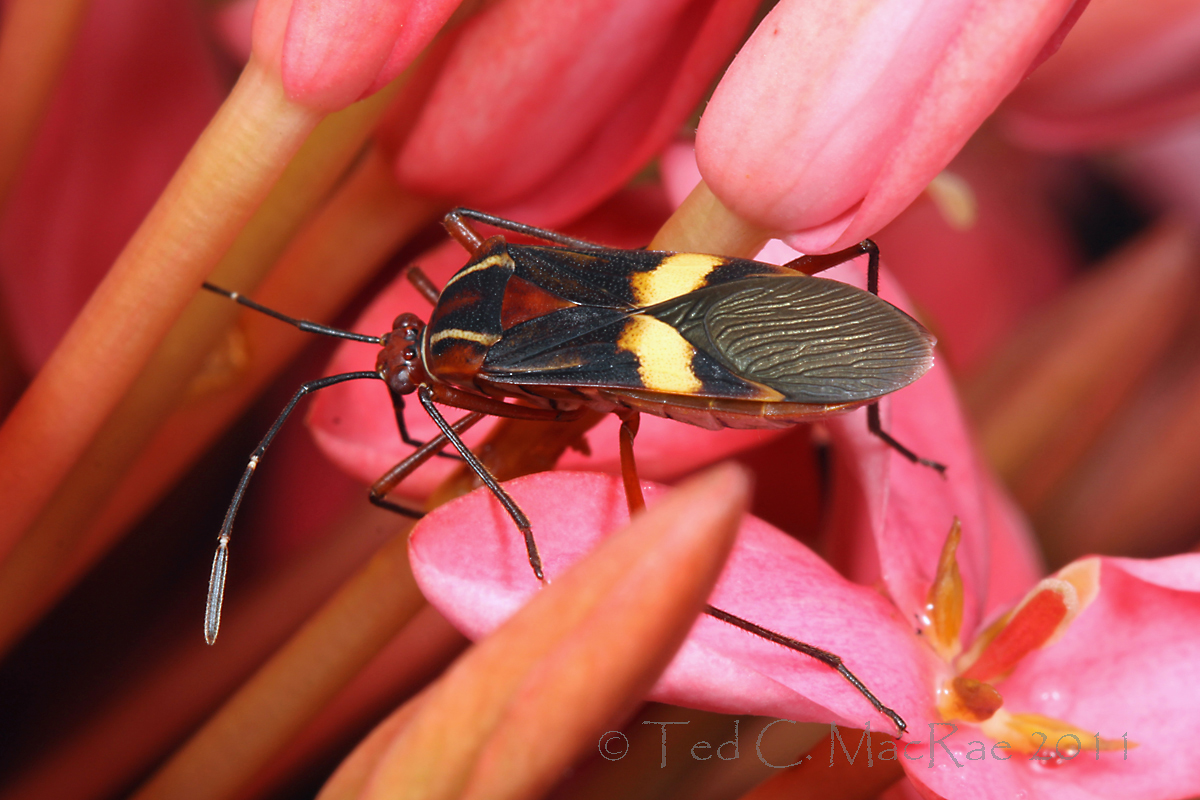
I found mais dos percevejos (more of the leaf-footed bugs) on the still-unnamed pink flowering shrub in back of the hotel in Campinas, Brazil.  Not only am I convinced that they truly do belong to the family Coreidae (for the reasons mentioned in the earlier post and below), but also that despite the different color patterns shown by the two individuals in that post that they are indeed a single species.  I also found the above individual, representing an even more heavily melanized version than the two shown previously.  In looking at a large number of individuals on the shrubs (and subsequently encountering them in a different part of Campinas over the weekend), it became clear that there were not just two distinct color forms but a broad range of variability.  I could believe maybe two species occurring together on a common resource, but it seems unlikely that each color variation represents a different species.  Thus, it now seems that there is one highly variable species visiting these flowers.

I had an idea on how to find the name of this species that almost worked.  Rather than Googling “leaf-footed bug” or “Coreidae,” I tried “percevejo” instead, along with Brazil or Brasil.  There were 3 or 4 photographs that showed up in the images search that I recognized instantly as belonging to the same species.  Unfortunately, none of the links where the photos were found gave any information more specific than family (all, however, agreeing with family Coreidae).  I think it’s time to send an email to Harry Brailovsky, a coreid specialist at the Instituto de Biologia (UNAM) in Mexico City.

Photo 1: Canon MP-E 65mm 1-5X macro lens (ISO 100, 1/200 sec, f/13).
Photo 2: Canon 100mm macro lens (ISO 100, 1/200 sec, f/16).
Both photos: Canon 50D, Canon MT-24EX flash w/ oversized DIY concave diffuser. Typical post-processing (levels, color, unsharp mask).

Last minute edit: I just heard back from Harry Brailovsky as I was ready to post (thank you Harry!).  The insect is, indeed, a species of Coreidae, which he identified as a member of the genus Hypselonotus.  I did some searching online to see if I could find any additional clues as the species identity – I found no images that looked right but did find this key to the Hypselonotus of Costa Rica.  The key relies on some ventral characters, and I’m a little uneasy about using it for something from southern Brazil, so I think I’ll just wait until Harry has a chance to look it up when he returns to the museum.

Second update 1/26/11:  Harry has confirmed the species as Hypselonotus interruptus, which was mentioned but not included in the key that I linked to above.  The only online images I have found of this species are at this link. Either Harry is wrong (unlikely), the photos in the link are misidentified (maybe), or the species is enormously variable (perhaps quite likely).

Copyright © Ted C. MacRae 2011

Brazil Bugs #1

ID Challenge #3 update: I knew this would be a hard one, and so far nobody has figured this one out (only one commenter got the right order!).  I’ve released the comments gotten so far so you can see where things stand, and maybe with the additional information (and my pointing out an important clue) it will be enough for one of you to arrive at a full ID.  Further comments are still being moderated until I decide to close the challenge.  Right now the points are there for the taking!


This past Monday I embarked on an extended business trip to Brazil.  “Wow, Brazil!” – you say, and while getting to travel to an exotic tropical locality on my company’s dime definitely rocks, I do have to justify the trip by actually working.  Add that to the time involved with planes, automobiles, and hotel transfers, and there is precious little time for more esoteric activities such as photographing insects.  It is Brazil, however, and summer at that, so whatever time does become available over the next ten days, I’ll be on it!  I’m stationed in Campinas, about 2 hours north of São Paulo, and this evening I had my first opportunity to break out the camera and do a little exploring around the hotel grounds during the waning hours of daylight. I’m not normally one to take short walks just looking for any random insect to photograph, but hey – it’s Brazil!  I also don’t normally like to post photographs of insects without knowing much about them – especially their identity. But hey, it’s Brazil!  I think I’ll be lucky to figure out most things to family, although I might be able to drill down a little further on occasion.  With that prelude, I hope you’ll indulge me these random postings over the next 10 days or so, primarily photographs but perhaps accompanied by a little bit of text.

Coreidae?

At first I thought this was a member of the hemipteran family Pyrrhocoridae (red bugs), as some North American species have similar coloration; however, members of that family apparently lack ocelli, which this insect clearly possesses. This would seem to indicate instead some species of Lygaeidae (seed bugs), but the forewing membrane with numerous veins arising from a transverse basal vein and presence of what appears to be a distinct metathoracic scent gland opening suggest instead some “unleaf-footed” species of leaf-footed bug (Coreidae). Whatever its identity, I would imagine it is quite distasteful, based on what clearly seems to be aposematic coloration and the fact that there were numbers of these bugs hanging out quite conspicuously on these flowers.

Same species?

This individual was differently colored than the others, but otherwise it seemed structurally and behaviorally identical.  Is it merely a highly melanized individual?  Maybe a case of sexual dimorphism, and I only saw this one individual of one of the sexes?  Maybe it truly is a different species – it is Brazil, afterall!

Pseudoplusia includens?

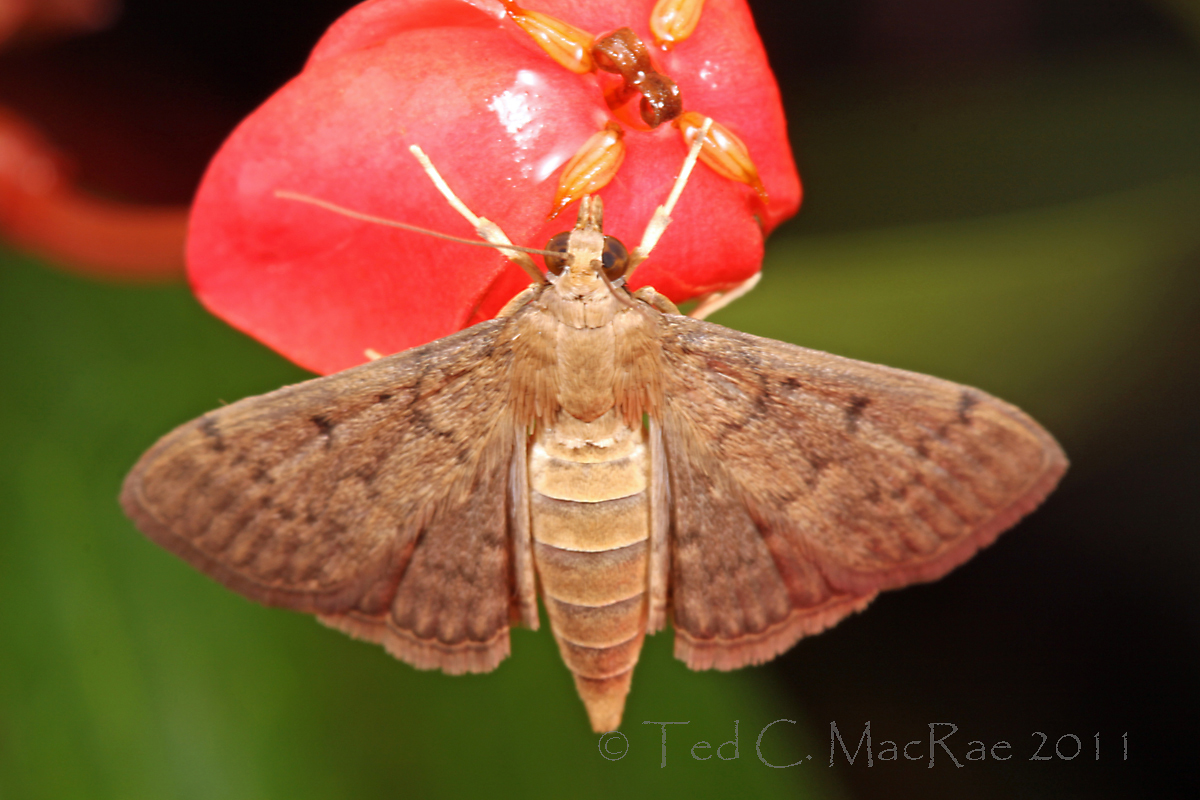
Daylight began to slip away much too soon, and I was about to pack it up when  I noticed some blurs at the flowers.  I realized that moths had begun to visit the flowers in the obscurity of dusk and became determined to photograph one, despite the fact that they never actually landed on the flowers but hovered in front of them instead.  It was quite difficult to even get them framed in the viewfinder, and on those few occasions when I managed to do this it was all but impossible to spend any time trying to focus – I used the lamp on the flash unit to help me see the moth, then just framed and quickly took the shot.  This one actually turned out not too bad – a little bit of blur in the wings but otherwise acceptable enough to let me tentatively identify it as Pseudoplusia includens (soybean looper).  Brazil is well on its way to becoming the world’s largest producer of soybean, and the caterpillars of these moths are enjoying the bounty!

Family Crambidae, possibly Herpetogramma phaeopteralis (ID by Chris Grinter)

I saw one last moth before the final traces of daylight disappeared – I don’t have any idea about its identity, but it’s a pretty picture nonetheless.  It has the generic look of the large family Noctuidae, so that’s what I’m gonna go with until somebody tells me differently.  Edit 1/20/11 – Somebody just told me differently!  According to Chris Grinter, this is a species of Crambidae, possibly Herpetogramma phaeopteralis (tropical sod webworm).  Thanks, Chris!

I don’t know the name of the plant whose flowers these insects were visiting, but the hotel staff has promised to ask their gardener in the morning and let me know – now that’s service!

Copyright © Ted C. MacRae 2011

A “leafless” leaf-footed bug

Merocoris distinctus feeding on flower stem of Coreopsis lanceolata.

This is Merocoris distinctus, a true bug in the family Coreidae whose members are usually recognized by their distinctive flattened hind tibiae (and hence the common name, leaf-footed bugs). This diminutive species, however, lacks that character, instead sporting strangely curved hind tibiae along with club-shaped (incrassate) hind femora. It’s a chunky little species – much smaller than the typical leaf-footed bugs seen across North America, and is most often encountered in grassland habitats where it feeds on herbaceous plants such as goldenrod, Solidago spp. (Slater and Baranowski 1978). This individual was seen probing the upper flower stem of lanceleaf tickseed, Coreopsis lanceolata, during May of last year at Shaw Nature Reserve in east-central Missouri. I’m not sure how well the life history of this species is understood, but I did find one interesting record of twelve individuals feeding gregariously on a dead chicken (Engelhardt 1912)! Apparently, feeding on carrion and other extra-phytophagous foods such as bird droppings and dung is a not uncommon practice among the Coreidae and closely related Alydidae (Adler and Wheeler 1984).

I kind of lucked out with this shot – I’d just gotten my new camera two weeks earlier and can’t say I really knew what I was doing at this point. I had first noticed and photographed the bug sitting on top of the flower but totally blew the exposure due to the flower’s bright yellow color.  My clumsy approach also caused the insect to move under the flower, where I watched it settle down and begin feeding before trying another shot. The dorsal surface of this species is mottled gray and brown, allowing the bug to blend in with most backgrounds. The underside of the body, however, is thickly matted with white hair, providing a very nice contrast with the black background that I stumbled upon achieved in this photo to emphasize the distinctive appearance of this often-overlooked insect.

Photo Details: Canon 50D w/ 100mm macro lens (ISO 100, 1/250 sec, f/14), Canon MT-24EX flash (1/4 ratio), undiffused. Typical post-processing (levels, minor cropping, unsharp mask).

REFERENCES:

Adler, P. H. and A. G. Wheeler.  1984. Extra-phytophagous food sources of Hemiptera Heteroptera: Bird droppings, dung, and carrion.  Journal of the Kansas Entomological Society 57(1):21-27.

Engelhardt, G. P. 1912. A hemipteron on carrion.  Journalof the New York Entomological Society 20:294.

Slater, J. A. and R. M. Baranowski. 1978. How to Know the True Bugs. W. C. Brown Company Publishers, 256 pp.

Copyright © Ted C. MacRae 2010

Magodo – giant twig wilter

petascelis-remipes

In previous posts, I have highlighted some of the insects I observed on a trip to South Africa in November-December 1999.  All of the photos I have shown to this point were taken at Borakalalo National Park in North West Province or at the Geelhoutbos farm of Susan Strauss below the Waterberg Range in the formerly Northern, now Limpopo Province.  Both of these locations are deep inside the bushveld, providing ample opportunity to observe an incredible diversity of insect life.  This is not to say that insects, even spectacular ones, cannot be found in more urban areas.  During the weekend between those two mini-expeditions, I stayed with my friend and colleague, Chuck Bellamy, at his home in Pretoria, a beautiful city with lovely architecture, elegant gardens… and some very impressive bugs!  The bug in this photo was found on a tree in a shrubby enclave, and at well over 35 mm in length it is easily the largest leaf-footed bug (order Hemiptera, family Coreidae) that I have ever seen.  Its chunky build, velvety black coloration with thin yellow lines along the sides and down the center of the thorax, and greatly enlarged hind femora quickly led me to a provisional identification of a male Petascelis remipes, or giant twig wilter.  This ID was confirmed by my friend and colleague Harry Brailovsky, an entomologist at UNAM (Universidad Nacional Autónoma de México) and world expert on Coreidae (and who, incidentally, just recently published a review of this Afrotropical genus – Brailovsky 2008).

According to Picker et al. (2002), these insects are found on plants in the genus Combretum.  Like most species in the family, they have scent (“stink”) glands that provide defensive capabilities. Adults are gregarious and bold, walking towards intruders with antennae vibrating when disturbed, and they are apparently capable of squirting their defensive secretions for some distance.  The nymphs are black as well but futher advertise their noxiousness with warning coloration of red spots on a whitish background. Interestingly, and despite their powerful chemical defenses, this species is considered a delicacy in parts of Mozambique where it is known as Magodo.  In a post called Insects for Dinner (in a blog with the eerily similar title, Beating about the Bush), Bart Wursten of Gorongosa National Park in Mozambique describes how local folk burn small patches of the grassland in which these insects are found to smoke them out and catch them.  The Magodo hunters kill the bugs by breaking off the head and removing the scent glands, which releases a very strong almond-like smell.  In doing this, the locals are able to catch considerable quantities of the bugs, which they eat with supper.

Lest you believe such practices are an anomaly, van Huis (2003) has compiled a list of about 250 insect species used as food in sub-Saharan Africa.  Lepidoptera, Orthoptera and Coleoptera represented the bulk (78%) of species eaten, with Isoptera, Hemiptera, Hymenoptera, Diptera and Odonota making up the rest.  Several examples of toxic insects and the traditional methods used to remove the poisons were given.  It was noted that whether or not insects are eaten depends not only on taste and nutritional value, but also on customs and ethnic preferences or prohibitions.  I’m not one to shy away from the thought of eating insects – after all, shrimp are just bugs that live in water, and insects rank far lower in ‘slime factor’ than many other invertebrates (e.g., oysters) that enjoy great popularity in our culture.  I’ve eaten roasted beet armyworm (Spodoptera exigua) pupae and munched on chocolate covered ants, but that’s kid stuff – the armyworms tasted like the soy sauce in which they were roasted, and the ants tasted like, well… chocolate.  I did once eat a softshelled crab (alive!), and I actually hope to one day taste the enormous grub of the giant metallic ceiba borer, Euchroma gigantea, eaten by indigenous cultures in Central and South America.   Still, I think I’d need a lot of faith in my chef’s scent gland removal prowess before I started scarfing Magodo down like popcorn.

What insects have you eaten?

REFERENCES:

Brailovsky, H.  2008. Notes on the genus Petascelis Signoret and description of one new species (Hemiptera: Heteroptera: Coreidae: Coreinae: Petascelini).  Zootaxa 1749:18–26.

Picker, M., C. Griffiths and A. Weaving. 2002. Field Guide to Insects of South Africa. Struik Publishers, Cape Town, 444 pp.

van Huis, A. 2003. Insects as food in sub-Saharan Africa. Insect Science and Its Application 23(3):163-185.

Copyright © Ted C. MacRae 2009

Add to FacebookAdd to NewsvineAdd to DiggAdd to Del.icio.usAdd to StumbleuponAdd to RedditAdd to BlinklistAdd to Ma.gnoliaAdd to TechnoratiAdd to Furl

A sand prairie autumn

Splitbeard bluestem seed headsAsk any astronomer when autumn begins, and they will likely tell you it begins at the autumnal equinox – when shortening days and lengthening nights become equal as the sun crosses over the celestial equator. According to them, fall began this year on September 22 – at 11:44:18 A.M. EDT, to be precise. I agree that autumn begins at a precise moment, but it is not at the equinox. Rather, it is that unpredictable moment when a sudden crispness in the air is felt, when the sky somehow seems bluer and shadows seem sharper, and hints of yellow – ever so subtle – start to appear in the landscape. Butterfly pea blossomIn Missouri, with its middle latitudes, this usually happens a few weeks before the equinox, as August is waning into September. It is a moment that goes unnoticed by many, especially those whose lives and livelihoods have lost all connection with the natural world. To plants and animals, however, it is a clear signal – a signal to begin making preparations for the long cold months of winter that lie ahead. Plants that have not yet flowered begin to do so in earnest, while those that have shift energy reserves into developing seeds. Animals take advantage of their final opportunities to feed before enduring the scarcities of winter, digging in to sleep through them, or abandoning altogether and migrating to warmer climes. Insects begin hastily provisioning nests for their broods or laying eggs – tiny capsules of life that survive the harsh winter before hatching in spring and beginning the cycle anew.

Sand prairie in early September.Sand prairie in early October.  Note abundance of splitbeard bluestem seed heads.Across much of Missouri, in the Ozark Highlands and in riparian ribbons dissecting the northern Plains, autumn brings an increasingly intense display of reds, purples, oranges, and yellows, as the leaves of deciduous hardwoods begin breaking down their chlorophyll to unmask underlying anthocyanins and other pigments. Small southern jointweedIn Missouri’s remnant prairies, seas of verdant green morph to muted shades of amber, tawny, and beige. This subtle transformation is even more spectacular in the critically imperiled sand prairies of the Southeast Lowlands, where stands of splitbeard bluestem (Andropogon ternaries – above) turn a rich russet color while fluffy, white seed heads (1st paragraph, 1st photo) appear along the length of each stem, evoking images of shooting fireworks. Small southern jointweed (Polygonella americana – right) finds a home at the northern extent of its distribution in these prairie remnants and in similar habitats in nearby Crowley’s Ridge, blooming in profusion once the cooler nights arrive. Butterfly pea (Clitoria mariana – 1st paragraph, 2nd photo) blooms add a gorgeous splash of soft purple in contrast to the muted colors of the plants around them.

Kent Fothergill, Ted MacRae, and Rich ThomaAfter first becoming acquainted with Missouri’s sand prairies this past summer, I knew a fall trip (or two) would be in order. The extensive deep, dry sand barrens were ideal habitat for sand-loving insects, including certain spring/fall species of tiger beetles that would not be active during the summer months. The cooler nights and crisp air of early fall make insect collecting extraordinarily pleasurable, so it took little effort to convince friends and colleagues Kent and Rich to join me on another excursion to these extraordinary remnant habitats, along with my (then 8 yr-old) daughter Madison (who would likely characterize this as “tallgrass” prairie). Madison MacRae, age 9 (almost)I was, as ever, on the lookout for tiger beetles; however, temperatures were cool, skies were overcast, and the fall season was just beginning, greatly limiting tiger beetle activity during this first fall visit. We did see one Cicindela formosa (big sand tiger beetle), which cooperated fully for a nice series of photographs. We also found single specimens of the annoyingly ubiquitous C. punctulata (punctured tiger beetle) and a curiously out-of-place C. duodecimguttata (12-spotted tiger beetle), which must have flown some distance from the nearest dark, muddy streambank that it surely prefers. Of greatest interest, we found two specimens of C. scutellaris (festive tiger beetle), which in this part of Missouri is represented by a population presenting a curious mix of influences from two different subspecies (more on this in a later post…). Despite the scarcity of tiger beetles, other insects were present in great diversity, some of which I share with you here.

Ululodes macleayanusThis bizarre creature, sitting on the stem of plains snakecotton (Froelichia floridana), is actually a neuropteran insect called an owlfly (family Ascalaphidae). Looking like a cross between a dragonfly and a butterfly due to its overly large eyes and many-veined wings but with long, clubbed antennae, this individual is demonstrating the cryptic resting posture they often assume with the abdomen projecting from the perch and resembling a twig. The divided eyes identify this individual as belonging to the genus Ululodes, and Dr. John D. Oswald (Texas A&M University) has kindly identified the species as U. macleayanus. As is true of many groups of insects, their taxonomy is far from completely understood. Larvae of these basal holometabolans are predaceous, lying on the ground with their large trap-jaws held wide open and often camouflaging themselves with sand and debris while waiting for prey. The slightest contact with the jaws springs them shut, and within a few minutes the prey is paralyzed and can be sucked dry at the larva’s leisure.

Ant lion, possibly in the genus Myrmeleon.Another family of neuropteran insects closely related to owlflies are antlions (family Myrmeleontidae, sometimes misspelled “Myrmeleonidae”). This individual (resting lower down on the very same F. floridana stem) may be in the genus Myrmeleon, but my wanting expertise doesn’t allow a more conclusive identification [edit 4/12/09 – John D. Oswald has identified the species as Myrmeleon immaculatus]. Strictly speaking, the term “antlion” applies to the larval form of the members of this family, all of whom create pits in sandy soils to trap ants and other small insects, thus, it’s occurrence in the sand prairie is not surprising. Larvae lie in wait beneath the sand at the bottom of the pit, flipping sand on the hapless prey to prevent it from escaping until they can impale it with their large, sickle-shaped jaws, inject digestive enzymes that ‘pre-digest’ the prey’s tissues, and suck out the liquifying contents. Finding larvae is not easy – even when pits are located and dug up, the larvae lie motionless and are often covered with a layer of sand that makes them almost impossible to detect. I’ve tried digging up pits several times and have failed as yet to find one. Larvae are also sometimes referred to as “doodlebugs” in reference to the winding, spiralling trails that the larvae leave in the sand while searching for a good trap location – these trails look like someone has doodled in the sand.

Bembix americanaThis digger wasp, Bembix americana (ID confirmed by Matthias Buck), was common on the barren sand exposures, where they dig burrows into the loose sand. Formerly included in the family Sphecidae (containing the better-known “cicada killer”), members of this group are now placed in their own family (Crabronidae). Adult females provision their nest with flies, which they catch and sting to paralyze before dragging it down into the burrow. As is common with the social hymenoptera such as bees and paper wasps, these solitary wasps engage in active parental care by providing greater number of prey as the larva grows. As many as twenty flies might be needed for a single larva. I found the burrows of these wasps at first difficult to distinguish from those created by adults of the tiger beetles I so desired, but eventually learned to distinguish them by their rounder shape and coarser, “pile” rather than “fanned” diggings (see this post for more on this subject).

Stichopogon trifasciatusRobber flies (family Asilidae) are a favorite group of mine (or, at least, as favorite as a non-coleopteran group can be). This small species, Stichopogon trifasciatus (ID confirmed by Herschel Raney), was also common on the barren sandy surface. The specific epithet refers to the three bands of alternating light and dark bands on the abdomen. Many species in this family are broadly distributed but have fairly restrictive ecological requirements, resulting in rather localized occurrences within their distribution. Stichopogon trifasciatus occurs throughout North America and south into the Neotropics wherever barren, sandy or gravely areas near water can be found. Adults are deadly predators, swooping down on spiders, flies and other small insects and “stabbing” them with their stout beak.

Chelinidea vittigerPrickly pear cactus (Opuntia humifusa) grows abundantly in the sandy soil amongst the clumps of bluestem, and on the pads were these nymphs of Chelinidea vittiger (cactus bug, family Coreidae). This wide-ranging species occurs across the U.S. and southward to northern Mexico wherever prickly pear hosts can be found. This species can either be considered a beneficial or a pest, depending upon perspective. On the one hand, it serves as a minor component in a pest complex that prevents prickly pear from aggressively overtaking rangelands in North America; however, prickly pear is used by ranchers as emergency forage, and fruits and spineless pads are also sometimes harvested for produce. In Missouri, O. humifusa is a non-aggressive component of glades, prairies, and sand and gravel washes, making C. vittiger an interesting member of the states natural diversity.

Ammophila sp., possibly A. proceraThis wasp in the genus Ammophila (perhaps A. procera as suggested by Herschel Raney) was found clinging by its jaws to a bluestem stem in the cool morning, where it presumably spent the night. One of the true sphecid (or “thread-waist”) wasps, A. procera is a widespread and common species in eastern North America. One of the largest members of the genus, its distinctive, bold silver dashes on the thorax distinguish it from most other sympatric congeners. Similar to the habits of most other aculeate wasp groups, this species captures and paralyzes sawfly or lepidopteran caterpillars to serve as food for its developing brood. Females dig burrows and lay eggs on the paralyzed hosts with which the nests have been provisioned. Adults are also found commonly on flowers, presumably to feed on nectar and/or pollen.

Dusty hog-nosed snakeRich is a bit of herpatologist, so when he brought this hog-nosed snake to our attention we all had a good time pestering it to try to get it to turn upside down and play dead. I had never seen a hog-nosed snake before but knew of its habit of rolling over and opening its mouth with its tongue hanging out when disturbed, even flopping right back over when turned rightside up or staying limp when picked up. We succeeded in getting it to emit its foul musky smell, but much to our disappointment it never did play dead, instead using its shovel-shaped snout to dig into the sand. Dusty hog-nosed snake - head closeupWe had assumed this was the common and widespread eastern hog-nosed snake (Heterodon platirhinos); however, in our attempts to turn it over I noticed its black and orange checker patterned belly. I later learned this to be characteristic of the dusky hog-nosed snake (H. nasicus gloydi), only recently discovered in the sand prairies of southeast Missouri and regarded as critically imperiled in the state due to the near complete destruction of such habitats. Disjunct from the main population further west, its continued survival in Missouri depends upon the survival of these small sand prairie remnants in the Southeast Lowlands.