Brazil Bugs #15 – Formiga-membracídeos mutualismo

Of the several insect groups that I most wanted to see and photograph during my trip to Brazil a few weeks ago, treehoppers were near the top of the list.  To say that treehoppers are diverse in the Neotropics is certainly an understatement – South America boasts an extraordinary number of bizarre and beautiful forms that still, to this day, leave evolutionary biologists scratching their heads.  The development of this amazing diversity is a relatively recent phenomenon (thinking geological scale here), as there are no known membracid fossils prior to Oligo-Miocene Dominican and Mexican amber – well after the early Cretaceous breakup of Gondwanaland split the globe into the “Old” and “New” Worlds.  With its origins apparently in South America, numerous groups continued to spring forth – each with more ridiculous pronotal modifications than the last and giving rise to the dazzling diversity of forms we see today.  Even North America got in the evolutionary act, benefiting from northern dispersal from South America’s richly developing fauna via temporary land bridges or island stepping stones that have existed at various times during the current era and giving rise to the almost exclusively Nearctic tribe Smiliini (whose species are largely associated with the continent’s eastern hardwood forests).  Only the subfamily Centrotinae, with its relatively unadorned pronotum, managed to successfully disperse to the Old World, where it remains the sole representative taxon in that hemisphere.  With a few notable exceptions, treehoppers have virtually no economic importance whatsoever, yet they enjoy relatively active study by taxonomists, evolutionists, and ecologists alike – due almost completely to the bizarreness of their forms and unique mutualistic/subsocial behaviors.

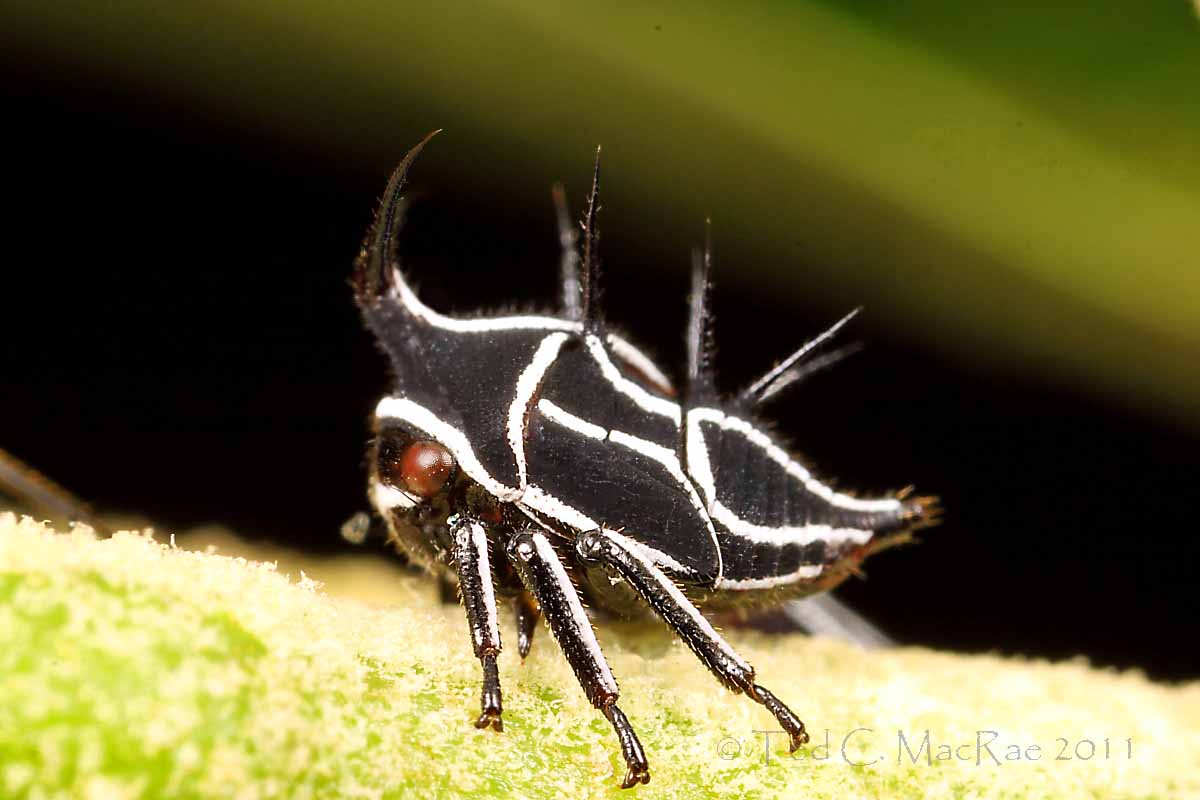
I did manage to find a few species of treehoppers during the trip (a very primitive species being featured in Answer to ID Challenge #4 – Aetalion reticulatum), and of those that I did find the nymphs in this ant-tended aggregation on a small tree in the rural outskirts of Campinas (São Paulo State) were perhaps the most striking in coloration and form.  Most were jet black, although a few exhibited fair amounts of reddish coloration, and all exhibited sharply defined white bands of wax and long erect processes on the pronotum, mesonotum, and abdomen.  I’ve seen a fair number of treehopper nymphs, but I did not recognize these as something I had seen before, and given the incomplete state of immature taxomony I feared an identification might not be possible.  Still (and I know this is probably beginning to sound like a broken record), I gave it the old college try.

I usually like to start simple and get more creative if the results aren’t satisfactory, so I went to my old friend Flickr and simply typed “Membracidae” as my search term.  Predictably, pages and pages of results appeared, and I began scanning through them to see if any contained nymphs at all resembling what I had.  After just a few pages, I encountered this photo with very similar-looking nymphs, and although no identification beyond family was indicated for the photo, I recognized the lone adult sitting with the nymphs as a member of the tribe Aconophorini – a diverse group distinguished from other treehoppers by their long, forward-projecting pronotal horn.  Luck was with me, because I happen to have a copy of the relatively recent revision of this tribe by Dietrich and Deitz (1991).  Scanning through the work, I learned that the tribe is comprised of 51 species assigned to three genera: Guayaquila (22 spp.), Calloconophora (16 spp.), and Aconophora (13 spp.).  The latter two genera can immediately be dismissed, as ant-interactions have not been recorded for any of the species in those two genera – clearly the individuals that I photographed were being tended by ants.  Further, the long, laterally directed apical processes of the pronotal horn, two pairs of abdominal spines, and other features also agree with the characters given for nymphs of the genus Guayaquila.  In looking at the species included in the genus, a drawing of a nymph that looked strikingly similar to mine was found in the species treatment for G. gracilicornis.  While that species is recorded only from Central America and northern South America, it was noted that nymphs of this species closely resemble those of the much more widely distributed G. xiphias, differing by their generally paler coloration.  My individuals are anything but pale, and reading through the description of the late-instar nymph of the latter species found every character in agreement.  A quick search of the species in Google Images was all that was needed to confirm the ID (at least to my satisfaction). 

In a study of aggregations of G. xiphias on the shrub Didymopanax vinosum (Araliaceae) in southeastern Brazil, Del-Claro and Oliveira (1999) found an astounding 21 species of associated ant species – a far greater diversity than that reported for any other ant-treehopper system.  The most frequently encountered ant species were Ectatomma edentatum, Camponotus rufipes, C. crassus, and C. renggeri, and after perusing the images of these four species at AntWeb I’m inclined to believe that the ants in these photos represent Camponotus crassus (although I am less confident of this ID than the treehoppers – corrections welcome!).  The authors noted turnover of ant species throughout the day in a significant portion of the treehopper aggregations that they observed, which they suggest probably reflects distinct humidity and temperature tolerances among the different ant species and that might serve to reduce interspecific competition among ants at treehopper aggregations.  Since treehopper predation and parasitism in the absence of ant mutualists can be severe, the development of multispecies associations by G. xiphias results in nearly “round-the-clock” protection that can greatly enhance their survival.
Update 3/3/11, 9:45 a.m.:  My thanks to Chris Dietrich at the Illinois Natural History Survey, who provided me in an email exchange some clarifying comments on the origins and subsequent dispersal of the family.  The first paragraph has been slightly modified to reflect those comments.

REFERENCES:

Del-Claro, K. and P. S. Oliveira. 1999. Ant-Homoptera interactions in a Neotropicai savanna: The honeydew-producing treehopper, Guayaquila xiphias (Membracidae), and its associated ant fauna on Didymopanax vinosum (Araliaceae). Biotropica 31(1):135–144.

Dietrich, C. H. and L. L. Deitz.  1991.  Revision of the Neotropical treehopper tribe Aconophorini (Homoptera: Membracidae).  North Carolina Agricultural Research Service Technical Bulletin 293, 134 pp.

Copyright © Ted C. MacRae 2011

Answer to ID Challenge #4 – Aetalion reticulatum

Aetalion reticulatum female guarding her egg mass - São Paulo state, Brazil.

ID Challenge #4 seems to have been a little more difficult than I anticipated – only a few people mustered the courage to even hazard a guess, of whom TGIQ emerged with maximum points to take the win.  Looking sort of like a cross between a leafhopper (family Cicadellidae) and a treehopper (family Membracidae), Aetalion reticulatum is one of a few species and the only genus comprising the family Aetalionidae.  While lacking the pronotal processes that characterize species in the much more diverse and better known Membracidae, aetalionids are nevertheless considered treehoppers as well, along with another little-known family Melizoderidae.  As a whole, the Aetalionidae + Melizoderidae + Membracidae form a sister group to the Cicadellidae (Deitz and Dietrich 1993), which combine to form the most diverse and successful lineage of sap-sucking phytophagous insects. 

Like many treehoppers, A. reticulatum exhibits ant-mutualistic and presocial behaviors; however, it remains unclear whether these behaviors were acquired separately by each treehopper lineage or if they represent retention of a more primitive condition (sorry, Alex – it’s just easier to say it that way than deal with terms such as ‘retained plesiomorphy’ and ‘phylogenetic conservatism’).  Aetalion reticulatum occurs broadly in the New World tropics, where females can often be found perched on top of their egg masses.  Some (but not all) guarding females make periodic sweeps of the hing legs down the sides of the egg mass, apparently to dislodge egg parasitoids and discourage further attack (Preston-Mafham & Preston-Mafham 1993).  Ant-mutualistic relationships and the tendency to form colonies provide additional protection from predators.

Now is a good opportunity to summarize the ‘1st BitB Challenge Series’ overall standings – Ben Coulter maintains his overall lead by gaining points in every challenge.  TGIQ climbs into 2nd place with this week’s win, and tceisele leap frogs over several contestants to tie Janet Creamer for the 3rd podium spot (and gets the nod for more frequent participation).  It’s no real surprise that the most frequent players took the top spots.  At this point, I’m going to call a close to the 1st series and declare Ben Coulter the overall series winner – contact me for your loot!  To the rest, thanks for playing, and now that you know how this game works maybe you’ll think about making a move for the 2nd series win!

Place Commenter IDC #1 SSC #3 IDC #2 IDC #3 IDC #4 Total
1 Ben Coulter 9 14 9 4 4 40
2 TGIQ 8 5 10 23
3 tceisele 3 8 3 14
4 Janet Creamer 14 14
5 James Trager  6 5 11
6 Dave 11 11
7 Christopher Taylor 7 3 10
8 Dave Hubble 6 2 8
  JasonC 5 3 8
10 Charley Eiseman 7 7
  Delbert La Rue 7 7
  jason 7 7
  Techuser 7 7
14 Richard Waldrep  6 6
15 Alex/Watcher 2 2
  dragonflywoman 2 2
  nellie 2 2
16 Brady Richards  1 1
  Francis 1 1
  macroinstantes 1 1
  Margarethe 1 1
  Mark Deering  1 1
  Andrew 1 1

REFERENCES:

Deitz, L. L. and C. H. Dietrich.  1993.  Superfamily Membracoidea (Homoptera: Auchenorrhyncha). I. Introduction and revised classification with new family-group taxa.  Systematic Entomology 18(4):287–296.

Preston-Mafham, R. and K. Preston-Mafham.  1993.  The Encyclopedia of Land Invertebrate Behaviour.  The MIT Press, 320 pp.

Copyright © Ted C. MacRae 2011
Brazil Bugs #7 – Cigarrinhas

It seems that North American entomologists have returned en masse from their various tropical winter travels – Alex and Brigette have returned from their respective trips to Ecuador, Troy has come back from Costa Rica, and I am now back home after my recent business trip to São Paulo, Brazil.  I’m anxious to see the photos and read the tales that the others will no doubt be posting in the coming weeks regarding their visits to cloud forests, research stations, and nature preserves.  My insect hunting activities were limited to municipal parks and hotel grounds, but I still have a decent variety of insect encounters to share (along with many pleasant memories of churrasco, cerveja, e novos amigos).

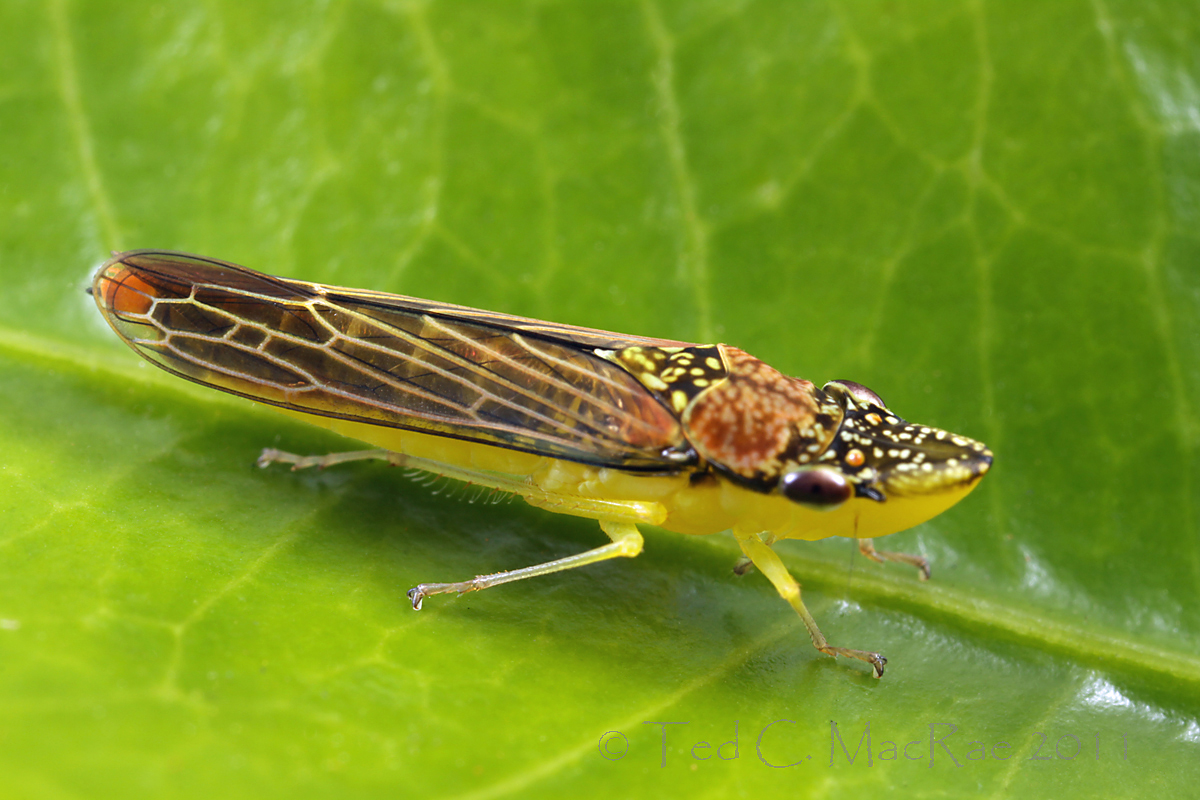
Acrogonia citrina

Thanks to Ani, I think we now agree that the pink-flowered shrub on the grounds of my hotel in Campinas that attracted such a nice diversity of insects belongs to the genus Ixora (family Rubiaceae).  Included in this post are a few leafhoppers (order Hemiptera, family Cicadellidae) in a group known as ‘sharpshooters’ (subfamily Cicadellinae) that I found also attracted to this shrub.  Leafhoppers are, of course, a hugely diverse family, but because of the generally small size and cryptic coloration of most North American species, it is a group that often goes unnoticed.  In the tropics, however, it’s a different story, with not only a number of larger forms but also a multitude of brightly colored species.

Acrogonia citrina at 5X life size

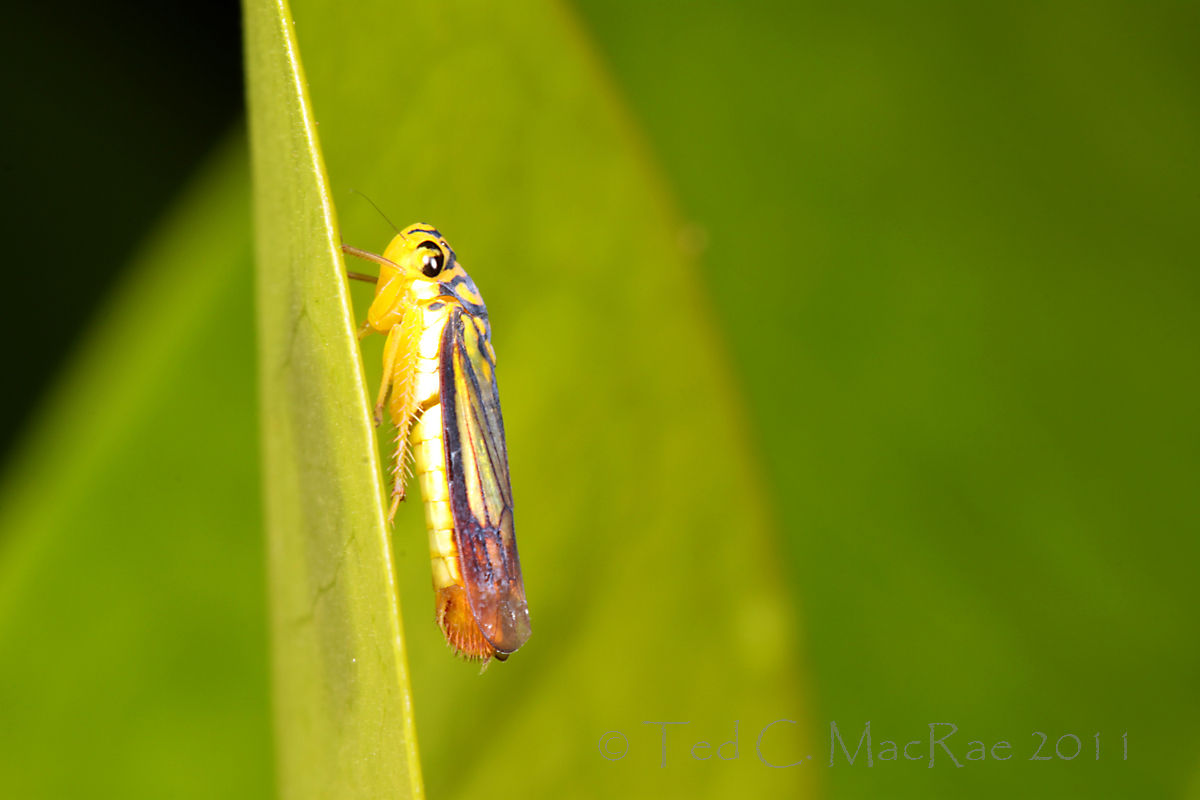
The diversity of species present in a place like southern Brazil might seem to preclude any possibility of identification without consulting a specialist, but the individual in these first two photos looks very much like Acrogonia citrina.  This species has become a major pest of citrus in São Paulo state during the past two decades, its importance driven not so much by direct damage, but rather by vectoring a bacterial disease of citrus called Citrus Variegated Chlorosis (Xylella fastidiosa) – or CVC (Lopes 2007).  Of the 12 sharpshooter species identified as vectors of CVC, A. citrina is among the most important due to its abundance in citrus groves (an important agricultural crop in São Paulo state) and high degree of polyphagy.  The disease affects mainly fruit quality, reducing their size and making them unsuitable to be sold fresh, and by decreasing yield when processed for juice.

Dilobopterus costalimai

Dilobopterus costalimai is another important vector of CVC, again primarily as a result of its abundance on citrus in São Paulo state and polyphagous nature.¹  At this point, CVC has not been found outside of South America; however, California and Florida citrus growers are understandably nervous about the potential for its eventual occurrence in the U.S. due to the presence here of leafhopper species that are confirmed vectors of the disease and the ease with which the disease can be transported in infected nursery stock.  There is no cure for CVC, and chemical control of vectors is both costly and difficult, leaving nursery certification, protection of nursery stock from infection, pruning of symptomatic parts of trees to remove inoculum sources, and other such labor intensive methods as the only options for managing CVC (Chung and Brlansky 2009).

¹ I originally attempted to photograph this individual because it appeared to have been parasitized by what I suspect is a dryinid (order Hymenoptera, family Dryinidae).  Unfortunately the parasitoid is on the right side of the abdomen of this individual and can’t really be seen in this view, and I didn’t get any other shots besides this one.

REFERENCE:

Chung, K.-R. and R. H. Brlansky.  2009.  Citrus Diseases Exotic to Florida: Citrus Variegated Chlorosis (CVC).  University of Florida, Institute of Food and Agricultural Sciences Fact Sheet PP-223, 4 pp.

Lopes, J. S.  2007.  Vector ecology and implications on epidemiology of citrus variegated chlorosis.  Proceedings of the 2007 Pierce’s Disease Research Symposium, California Department of Food and Agriculture.

Copyright © Ted C. MacRae 2011
Brazil Bugs #4 – Mais dos percevejos

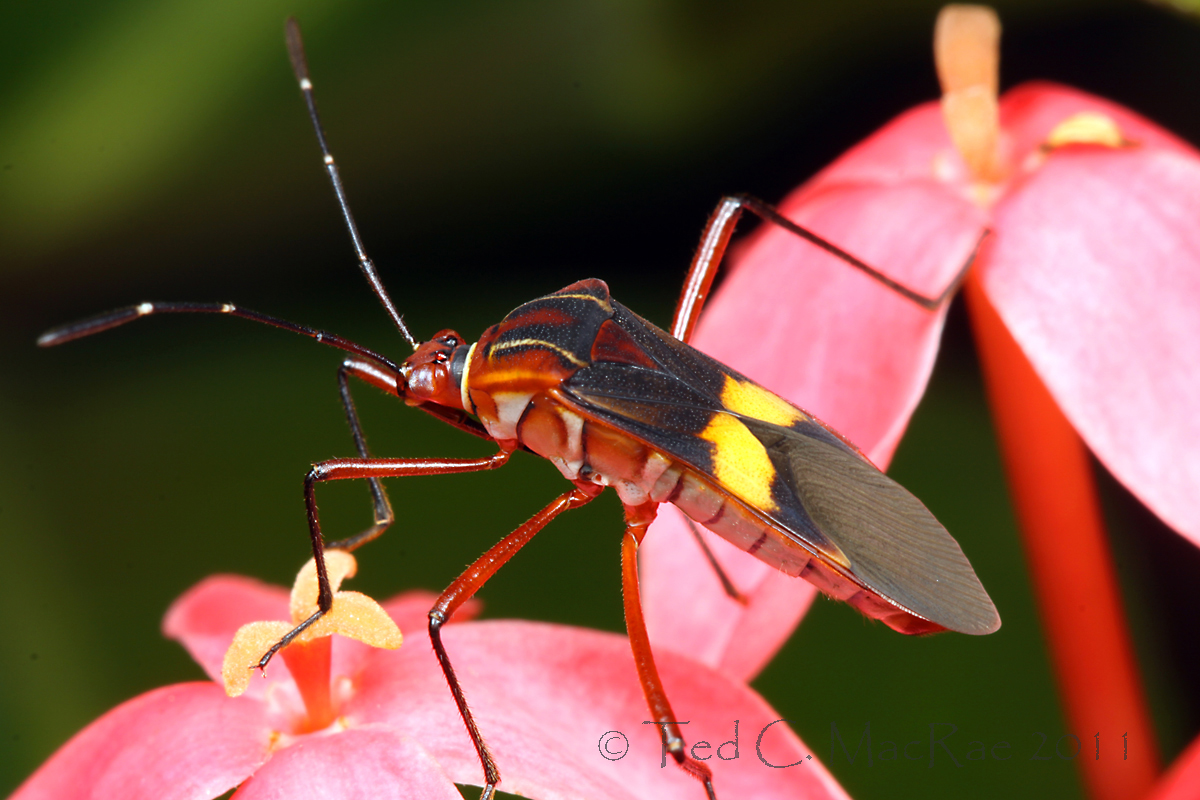
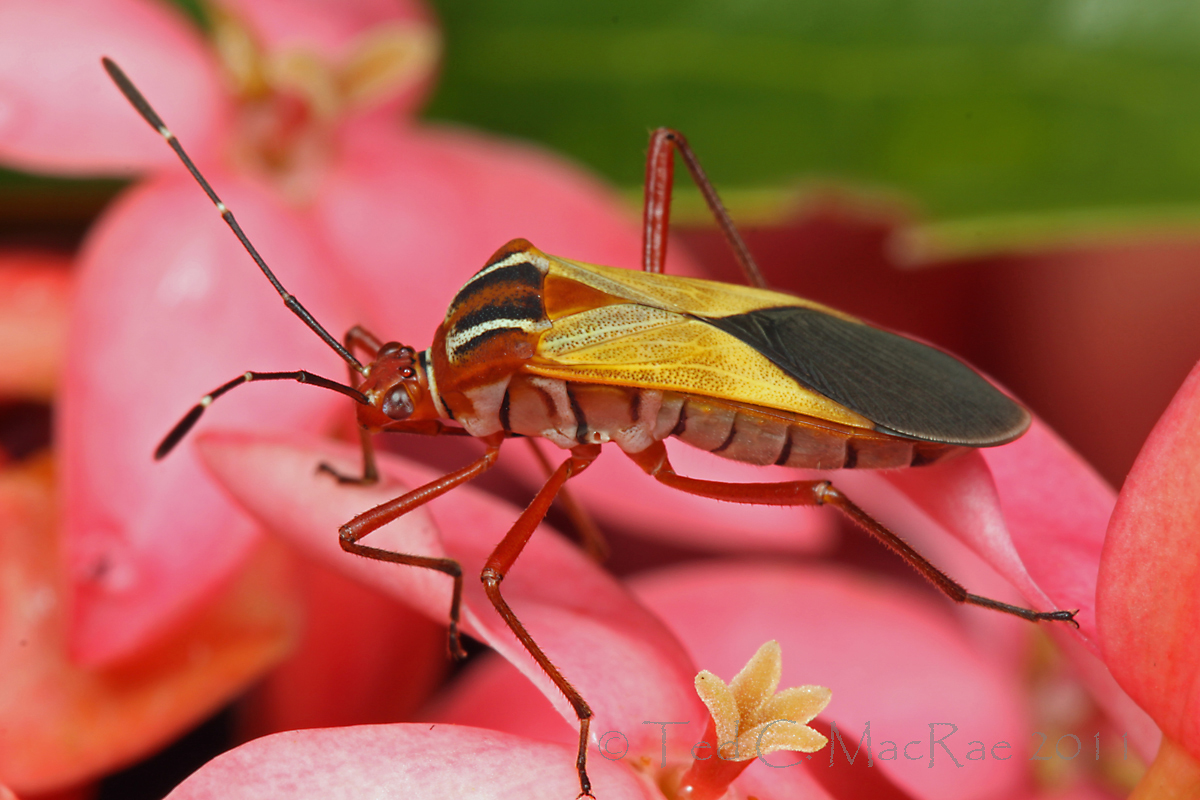
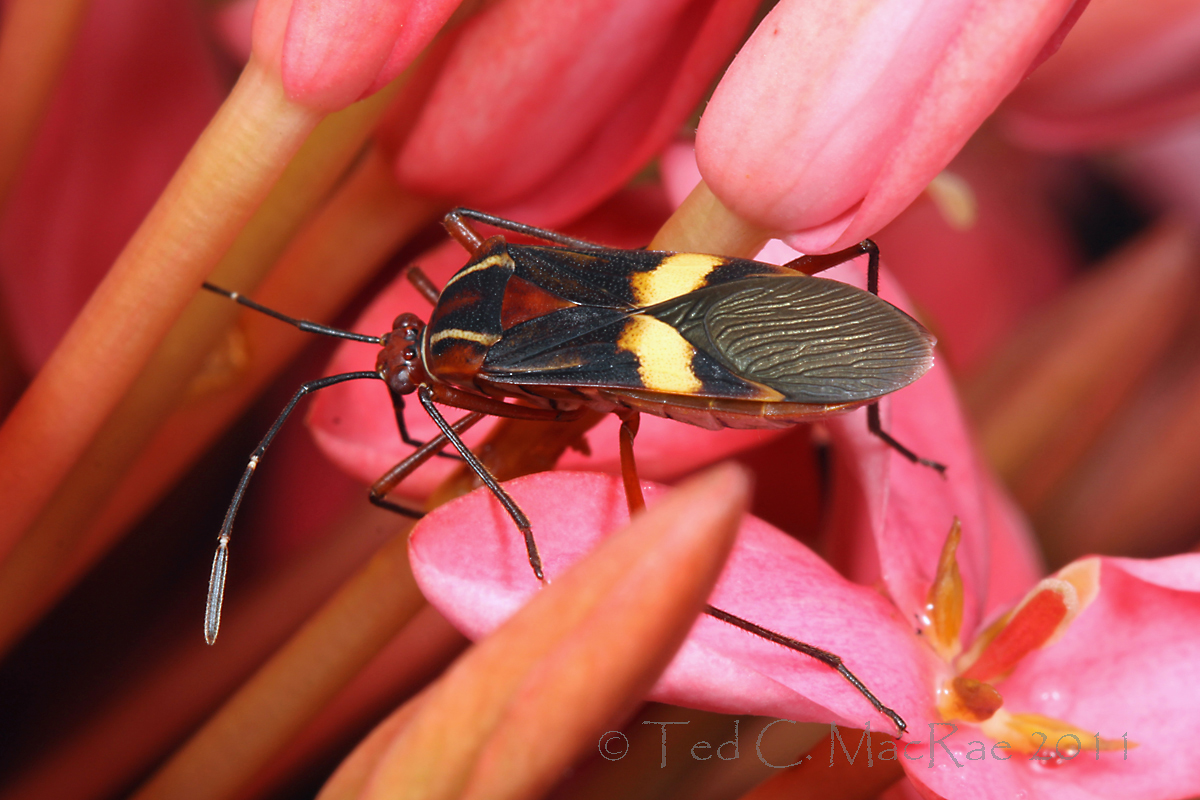
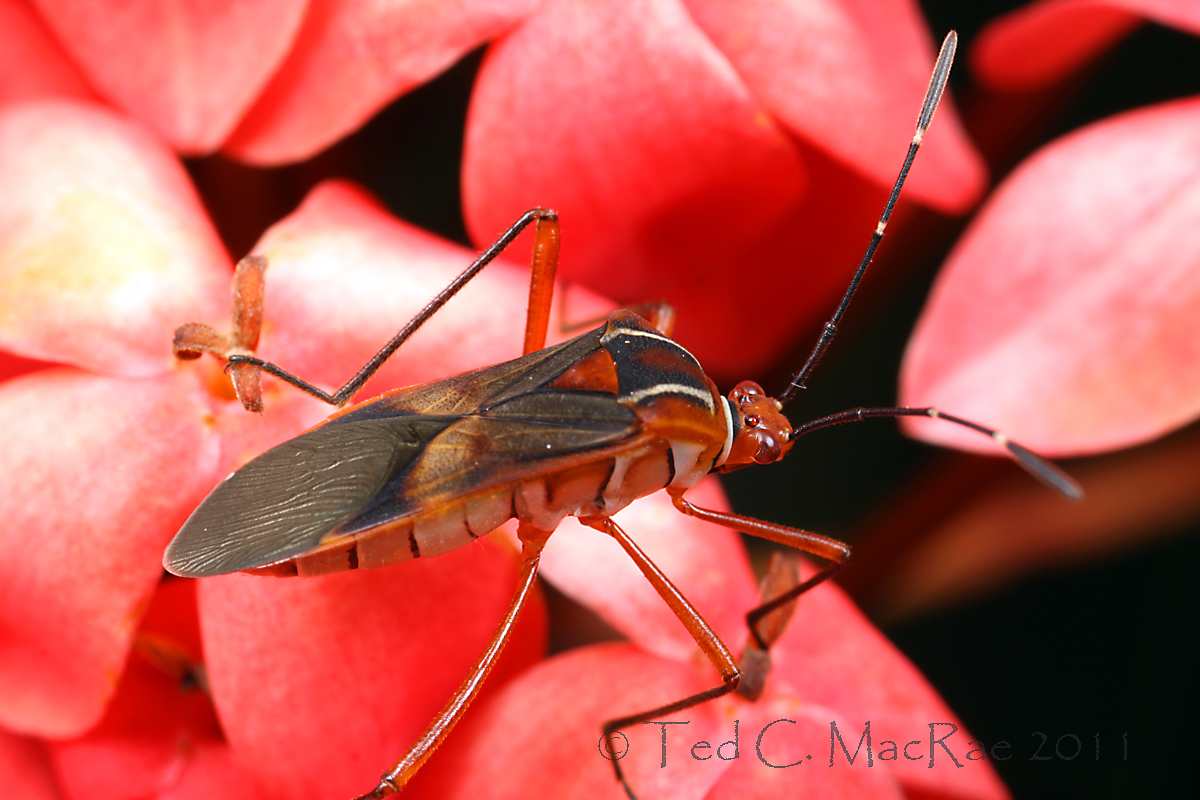
I found mais dos percevejos (more of the leaf-footed bugs) on the still-unnamed pink flowering shrub in back of the hotel in Campinas, Brazil.  Not only am I convinced that they truly do belong to the family Coreidae (for the reasons mentioned in the earlier post and below), but also that despite the different color patterns shown by the two individuals in that post that they are indeed a single species.  I also found the above individual, representing an even more heavily melanized version than the two shown previously.  In looking at a large number of individuals on the shrubs (and subsequently encountering them in a different part of Campinas over the weekend), it became clear that there were not just two distinct color forms but a broad range of variability.  I could believe maybe two species occurring together on a common resource, but it seems unlikely that each color variation represents a different species.  Thus, it now seems that there is one highly variable species visiting these flowers.

I had an idea on how to find the name of this species that almost worked.  Rather than Googling “leaf-footed bug” or “Coreidae,” I tried “percevejo” instead, along with Brazil or Brasil.  There were 3 or 4 photographs that showed up in the images search that I recognized instantly as belonging to the same species.  Unfortunately, none of the links where the photos were found gave any information more specific than family (all, however, agreeing with family Coreidae).  I think it’s time to send an email to Harry Brailovsky, a coreid specialist at the Instituto de Biologia (UNAM) in Mexico City.

Photo 1: Canon MP-E 65mm 1-5X macro lens (ISO 100, 1/200 sec, f/13).
Photo 2: Canon 100mm macro lens (ISO 100, 1/200 sec, f/16).
Both photos: Canon 50D, Canon MT-24EX flash w/ oversized DIY concave diffuser. Typical post-processing (levels, color, unsharp mask).

Last minute edit: I just heard back from Harry Brailovsky as I was ready to post (thank you Harry!).  The insect is, indeed, a species of Coreidae, which he identified as a member of the genus Hypselonotus.  I did some searching online to see if I could find any additional clues as the species identity – I found no images that looked right but did find this key to the Hypselonotus of Costa Rica.  The key relies on some ventral characters, and I’m a little uneasy about using it for something from southern Brazil, so I think I’ll just wait until Harry has a chance to look it up when he returns to the museum.

Second update 1/26/11:  Harry has confirmed the species as Hypselonotus interruptus, which was mentioned but not included in the key that I linked to above.  The only online images I have found of this species are at this link. Either Harry is wrong (unlikely), the photos in the link are misidentified (maybe), or the species is enormously variable (perhaps quite likely).

Copyright © Ted C. MacRae 2011
Brazil Bugs #2

A few more photographs from this past week in Campinas, Brazil.  It rained during the afternoon but stopped by the time I arrived back at the hotel, allowing me to stroll the lavishly landscaped grounds during the mild evening hours.  There is a pink-flowered shrub forming a hedge row in back of the hotel that is highly attractive to many types of insects.  The identity of the shrub remains a mystery to me, and most of the insects I’m finding on it I can recognize only to family – I’m hoping the hotel staff will be able to name the former and that the readers of this blog might be able to provide IDs for the latter.

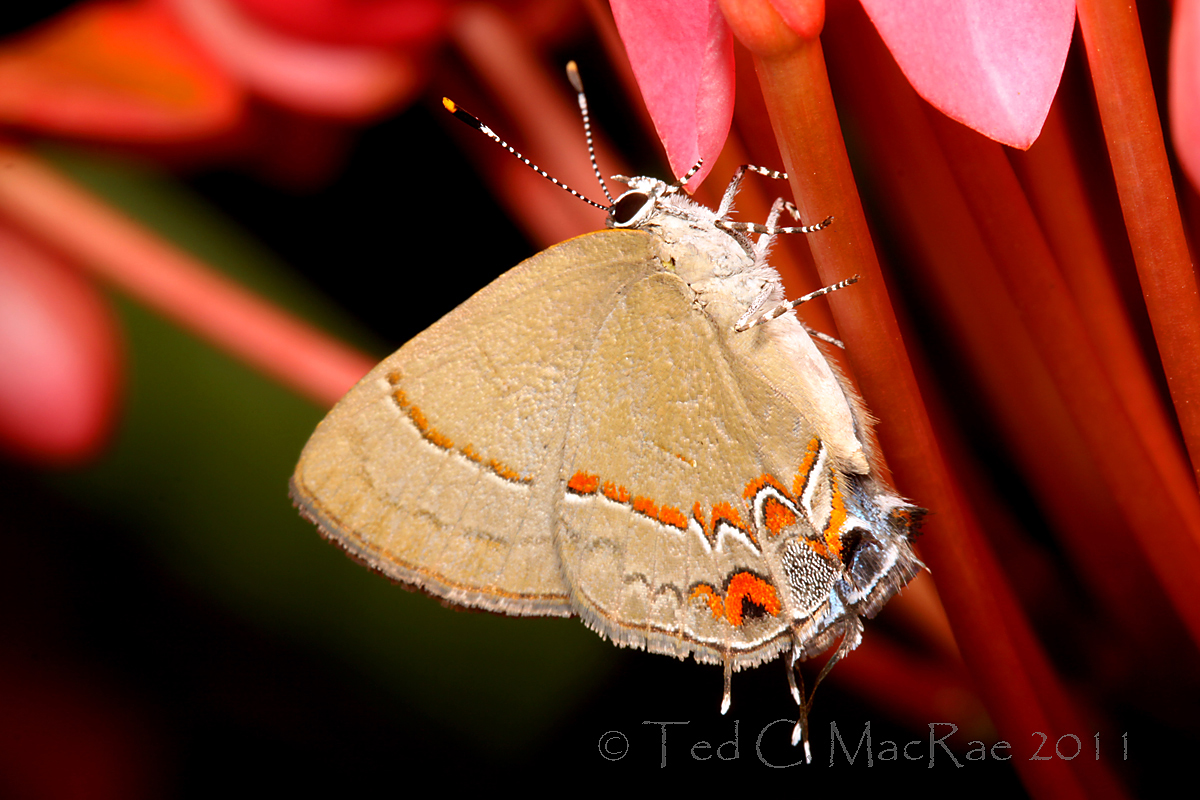
Calycopis sp. poss. origo (Lepidoptera: Lycaenidae). ID by Dave Hubble and Chris Grinter.

It took a bit of effort to find an unobstructed view of this hairstreak butterfly (family Lycaenidae) as it visited the flowers within the shrub.  Every time I tried to move foliage out of the way to get a good view, the butterfly became alarmed and flew to another part of the hedge row.  My antics drew the attention of a hotel worker, who was apparently interested enough in what I was doing to act as a spotter whenever the butterfly flew to help me relocate it.  Eventually I got a few shots that I was happy with, including the above.

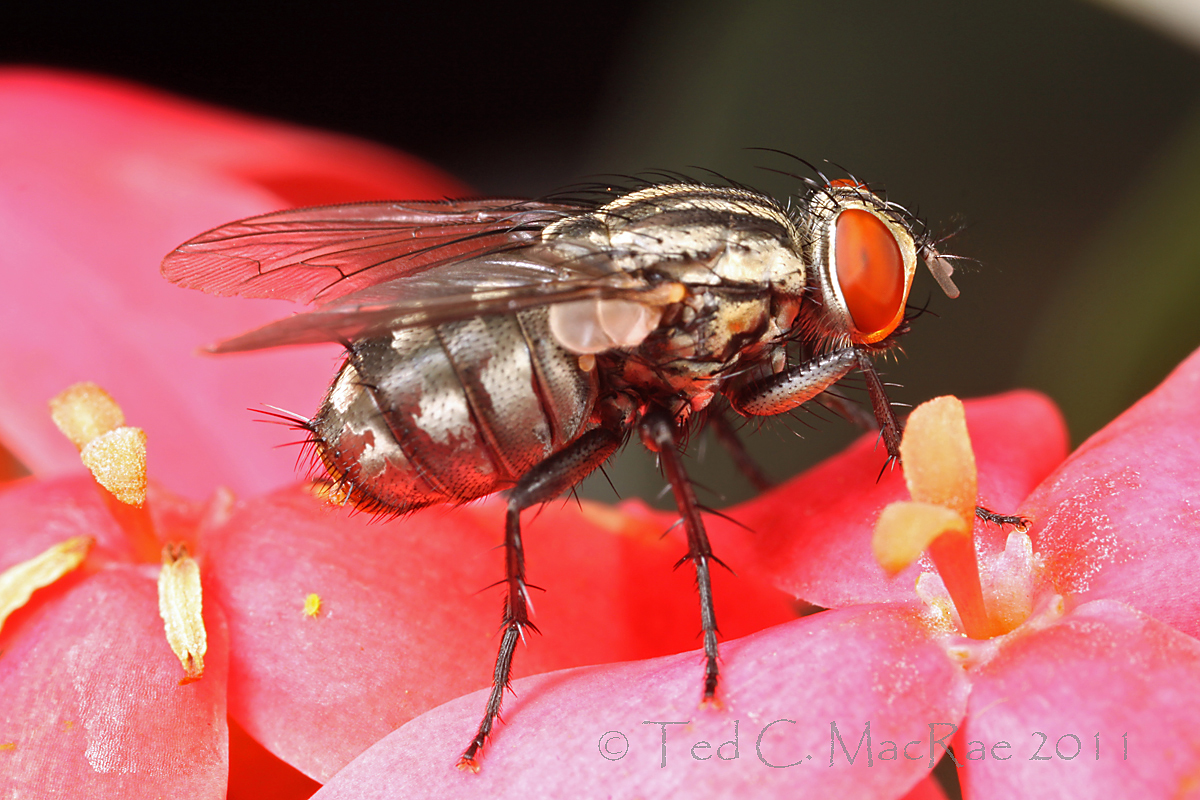
A flesh fly (Diptera: Sarcophagidae).

I presume this to be a type of flesh fly (family Sarcophagidae) based on the stout bristles and color pattern that seems typical for the family.  I like the striking contrast in coloration between the fly and the flower.  There are a few fly bloggers who I’m hoping might be able to give a better identification.

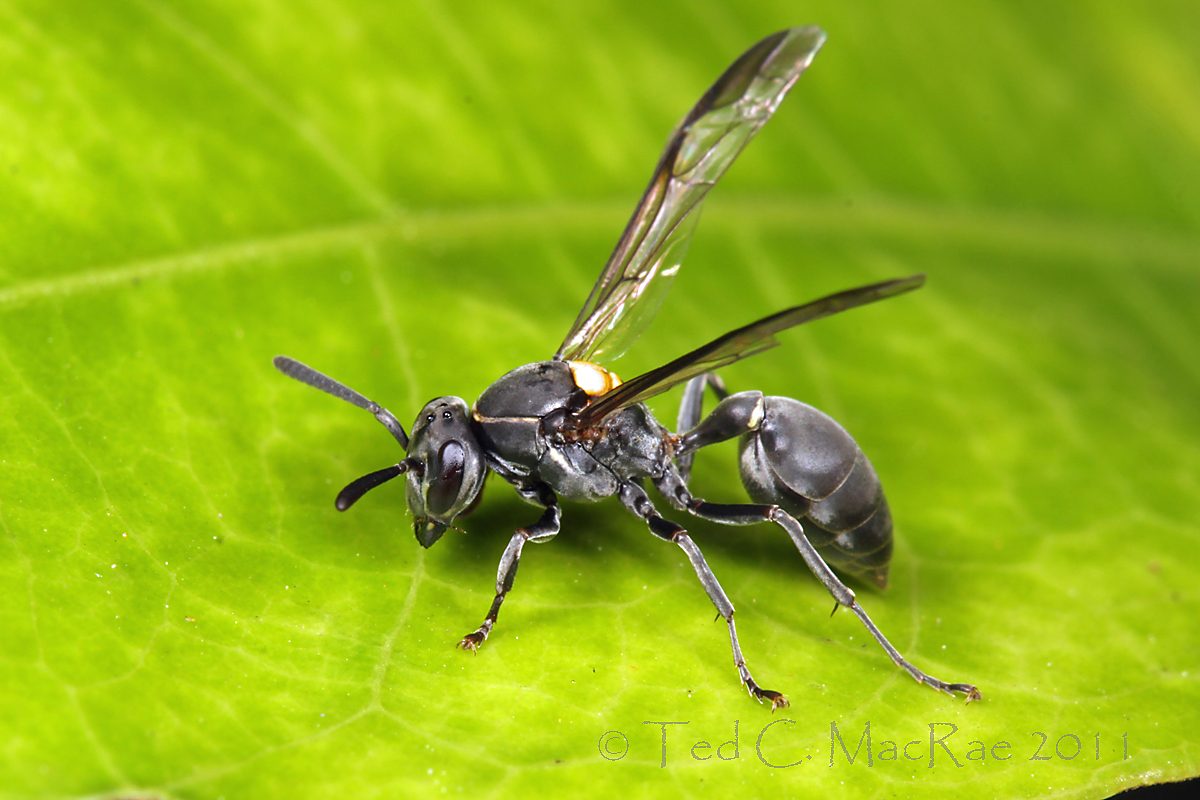
A potter/mason wasp? (Hymenoptera: Vespidae).

This appears to me to be some kind of potter or mason wasp (family Vespidae, subfamily Eumeninae) – it was a bit smallish at only about 12mm in length.  I hope one of the knowledgeable wasp bloggers out there (ahem… Eric?) can at least confirm this level of identification and perhaps the tribe or genus as well. 

Azya orbigera (Coleoptera: Coccinellidae). ID by Tucker Lancaster.

Every ladybird beetle (family Coccinellidae) I’ve ever seen is some variation of black and red/orange/yellow and has a smooth, glabrous appearance.  This beetle is cobalt blue with a dense pubescence over the dorsal surface, but it still seems to me to be some type of ladybird beetle.  It was a tiny little thing, so I suppose it could be one of the multitude of small beetle families with which I am unfamiliar.

Quedas sp.? (Hemiptera: Cicadidae).

This cast cicada exuvium was not on the shrub, but on a nearby tree at about eye level.  I really wish I could have seen the cicada that emerged from it, because this is certainly the biggest cicada exuvium I have ever seen.  I was about to simply label it “family Cicadidae” but seem to recall that cicada higher classification is in a bit of flux these days.  At any rate, given its great size I wonder if it might represent one of the giant cicadas in the genus Quesada.

I still have many more insect photographs from the past week and will certainly increase that number over the next week as well.  Stay tuned!

Copyright © Ted C. MacRae 2011

Brazil Bugs #1

ID Challenge #3 update: I knew this would be a hard one, and so far nobody has figured this one out (only one commenter got the right order!).  I’ve released the comments gotten so far so you can see where things stand, and maybe with the additional information (and my pointing out an important clue) it will be enough for one of you to arrive at a full ID.  Further comments are still being moderated until I decide to close the challenge.  Right now the points are there for the taking!


This past Monday I embarked on an extended business trip to Brazil.  “Wow, Brazil!” – you say, and while getting to travel to an exotic tropical locality on my company’s dime definitely rocks, I do have to justify the trip by actually working.  Add that to the time involved with planes, automobiles, and hotel transfers, and there is precious little time for more esoteric activities such as photographing insects.  It is Brazil, however, and summer at that, so whatever time does become available over the next ten days, I’ll be on it!  I’m stationed in Campinas, about 2 hours north of São Paulo, and this evening I had my first opportunity to break out the camera and do a little exploring around the hotel grounds during the waning hours of daylight. I’m not normally one to take short walks just looking for any random insect to photograph, but hey – it’s Brazil!  I also don’t normally like to post photographs of insects without knowing much about them – especially their identity. But hey, it’s Brazil!  I think I’ll be lucky to figure out most things to family, although I might be able to drill down a little further on occasion.  With that prelude, I hope you’ll indulge me these random postings over the next 10 days or so, primarily photographs but perhaps accompanied by a little bit of text.

Coreidae?

At first I thought this was a member of the hemipteran family Pyrrhocoridae (red bugs), as some North American species have similar coloration; however, members of that family apparently lack ocelli, which this insect clearly possesses. This would seem to indicate instead some species of Lygaeidae (seed bugs), but the forewing membrane with numerous veins arising from a transverse basal vein and presence of what appears to be a distinct metathoracic scent gland opening suggest instead some “unleaf-footed” species of leaf-footed bug (Coreidae). Whatever its identity, I would imagine it is quite distasteful, based on what clearly seems to be aposematic coloration and the fact that there were numbers of these bugs hanging out quite conspicuously on these flowers.

Same species?

This individual was differently colored than the others, but otherwise it seemed structurally and behaviorally identical.  Is it merely a highly melanized individual?  Maybe a case of sexual dimorphism, and I only saw this one individual of one of the sexes?  Maybe it truly is a different species – it is Brazil, afterall!

Pseudoplusia includens?

Daylight began to slip away much too soon, and I was about to pack it up when  I noticed some blurs at the flowers.  I realized that moths had begun to visit the flowers in the obscurity of dusk and became determined to photograph one, despite the fact that they never actually landed on the flowers but hovered in front of them instead.  It was quite difficult to even get them framed in the viewfinder, and on those few occasions when I managed to do this it was all but impossible to spend any time trying to focus – I used the lamp on the flash unit to help me see the moth, then just framed and quickly took the shot.  This one actually turned out not too bad – a little bit of blur in the wings but otherwise acceptable enough to let me tentatively identify it as Pseudoplusia includens (soybean looper).  Brazil is well on its way to becoming the world’s largest producer of soybean, and the caterpillars of these moths are enjoying the bounty!

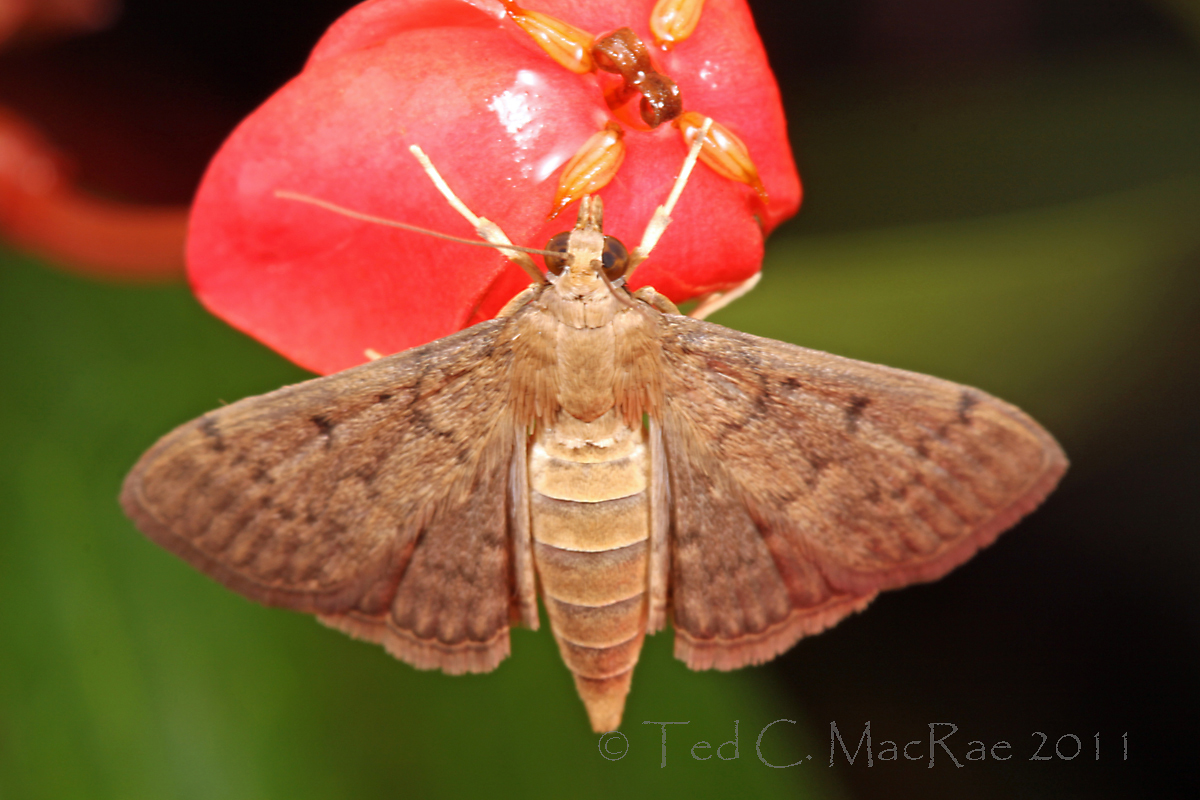
Family Crambidae, possibly Herpetogramma phaeopteralis (ID by Chris Grinter)

I saw one last moth before the final traces of daylight disappeared – I don’t have any idea about its identity, but it’s a pretty picture nonetheless.  It has the generic look of the large family Noctuidae, so that’s what I’m gonna go with until somebody tells me differently.  Edit 1/20/11 – Somebody just told me differently!  According to Chris Grinter, this is a species of Crambidae, possibly Herpetogramma phaeopteralis (tropical sod webworm).  Thanks, Chris!

I don’t know the name of the plant whose flowers these insects were visiting, but the hotel staff has promised to ask their gardener in the morning and let me know – now that’s service!

Copyright © Ted C. MacRae 2011

A “leafless” leaf-footed bug

Merocoris distinctus feeding on flower stem of Coreopsis lanceolata.

This is Merocoris distinctus, a true bug in the family Coreidae whose members are usually recognized by their distinctive flattened hind tibiae (and hence the common name, leaf-footed bugs). This diminutive species, however, lacks that character, instead sporting strangely curved hind tibiae along with club-shaped (incrassate) hind femora. It’s a chunky little species – much smaller than the typical leaf-footed bugs seen across North America, and is most often encountered in grassland habitats where it feeds on herbaceous plants such as goldenrod, Solidago spp. (Slater and Baranowski 1978). This individual was seen probing the upper flower stem of lanceleaf tickseed, Coreopsis lanceolata, during May of last year at Shaw Nature Reserve in east-central Missouri. I’m not sure how well the life history of this species is understood, but I did find one interesting record of twelve individuals feeding gregariously on a dead chicken (Engelhardt 1912)! Apparently, feeding on carrion and other extra-phytophagous foods such as bird droppings and dung is a not uncommon practice among the Coreidae and closely related Alydidae (Adler and Wheeler 1984).

I kind of lucked out with this shot – I’d just gotten my new camera two weeks earlier and can’t say I really knew what I was doing at this point. I had first noticed and photographed the bug sitting on top of the flower but totally blew the exposure due to the flower’s bright yellow color.  My clumsy approach also caused the insect to move under the flower, where I watched it settle down and begin feeding before trying another shot. The dorsal surface of this species is mottled gray and brown, allowing the bug to blend in with most backgrounds. The underside of the body, however, is thickly matted with white hair, providing a very nice contrast with the black background that I stumbled upon achieved in this photo to emphasize the distinctive appearance of this often-overlooked insect.

Photo Details: Canon 50D w/ 100mm macro lens (ISO 100, 1/250 sec, f/14), Canon MT-24EX flash (1/4 ratio), undiffused. Typical post-processing (levels, minor cropping, unsharp mask).

REFERENCES:

Adler, P. H. and A. G. Wheeler.  1984. Extra-phytophagous food sources of Hemiptera Heteroptera: Bird droppings, dung, and carrion.  Journal of the Kansas Entomological Society 57(1):21-27.

Engelhardt, G. P. 1912. A hemipteron on carrion.  Journalof the New York Entomological Society 20:294.

Slater, J. A. and R. M. Baranowski. 1978. How to Know the True Bugs. W. C. Brown Company Publishers, 256 pp.

Copyright © Ted C. MacRae 2010

BitB Best of 2009

In my first post of 2009, I looked back at the photographs I had posted during 2008 and picked some of my personal favorites. I hesitated then to call myself a photographer (and still do), but I at least now have suitable equipment to aid in my progress toward that eventual goal. I have learned much over the past six months in my first attempt at serious insect macrophotography (prioritizing in situ field photographs of unmanipulated subjects as a matter of personal choice).  Through this, I’ve come to realize the following skills to be the most important for success:  

  1. Composition
  2. Understanding lighting
  3. Knowing how to use a flash
  4. Knowledge of the subject

I’ll give myself a “A” in the last of these, but in the other areas I still have much to learn. With this caveat, and for the last post of 2009, I offer the following twelve photographs as my final choices for the 2nd Annual “Best of BitB”:  

Best beetle

Cylindera celeripes (swift tiger beetle), Woodward Co., Oklahoma

From Revisiting the Swift Tiger Beetle – Part 1 (June 30).  A decent enough photograph, especially considering that I’d had my camera for about a month when I took it.  However, the discovery of robust populations of this formerly rare and enigmatic species throughout northwestern Oklahoma (and later also in northwestern Missouri) was the most significant find of the 2009 field season, and this photograph is the best capture of that moment.

Best fly

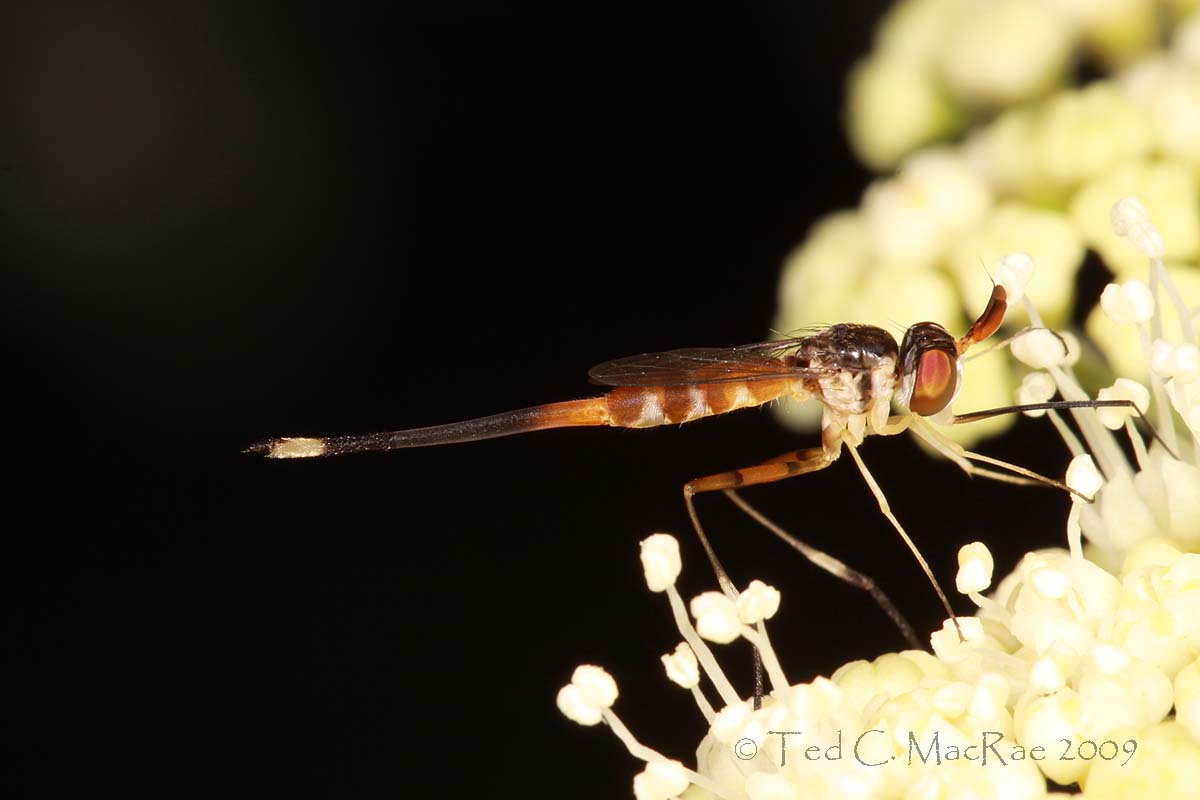
Stylogaster neglecta, a species of thickheaded fly

From Overlooked, needle-bellied, thick-headed fly (Aug 14).  One of my first good “black background” shots.  The white tip of the abdomen compliments the white flower stamens against the background.

Best “true” bug

Beameria venosa, a prairie obligate cicada

From North America’s smallest cicada (Aug 4).  So many different shades of green with white frosting on the bug’s body.  I tried taking this shot in portrait and it just didn’t work—I liked this landscape shot much better.

Best predator

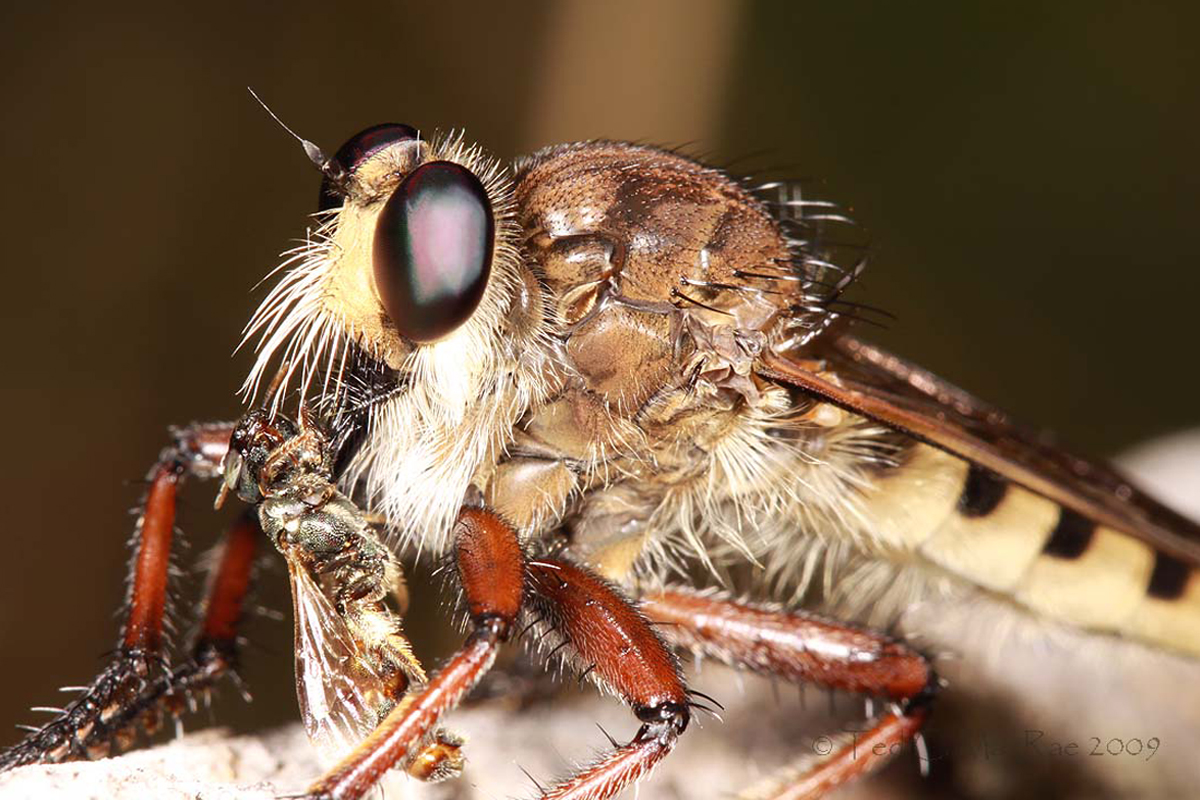
Promachus hinei (Hines giant robber fly) & Ceratina sp. (small carpenter bee) prey

From Prey bee mine (Sept 14).  Robber flies are immensely photogenic, especially those in the genus Promachus due to their prominent “beards.”

Best camoflauge

Dicerca obscura on bark of dead persimmon

From The “obscure” Dicerca (June 19).  Sparkling and gaudy as specimens in a cabinet, the coloration of many jewel beetles actually helps them blend almost perfectly with the bark of their preferred tree hosts.

Best immature insect

Tetracha floridana (Florida metallic tiger beetle) 3rd-instar larva

From Anatomy of a Tiger Beetle Larva (Oct 22).  “Otherwordly” is invariably the first word that comes to mind when someone sees a tiger beetle larva for the first time.  I was lucky enough to get this one in profile with a nice view of its abdominal hump and its curious hooks.

Best arachnid

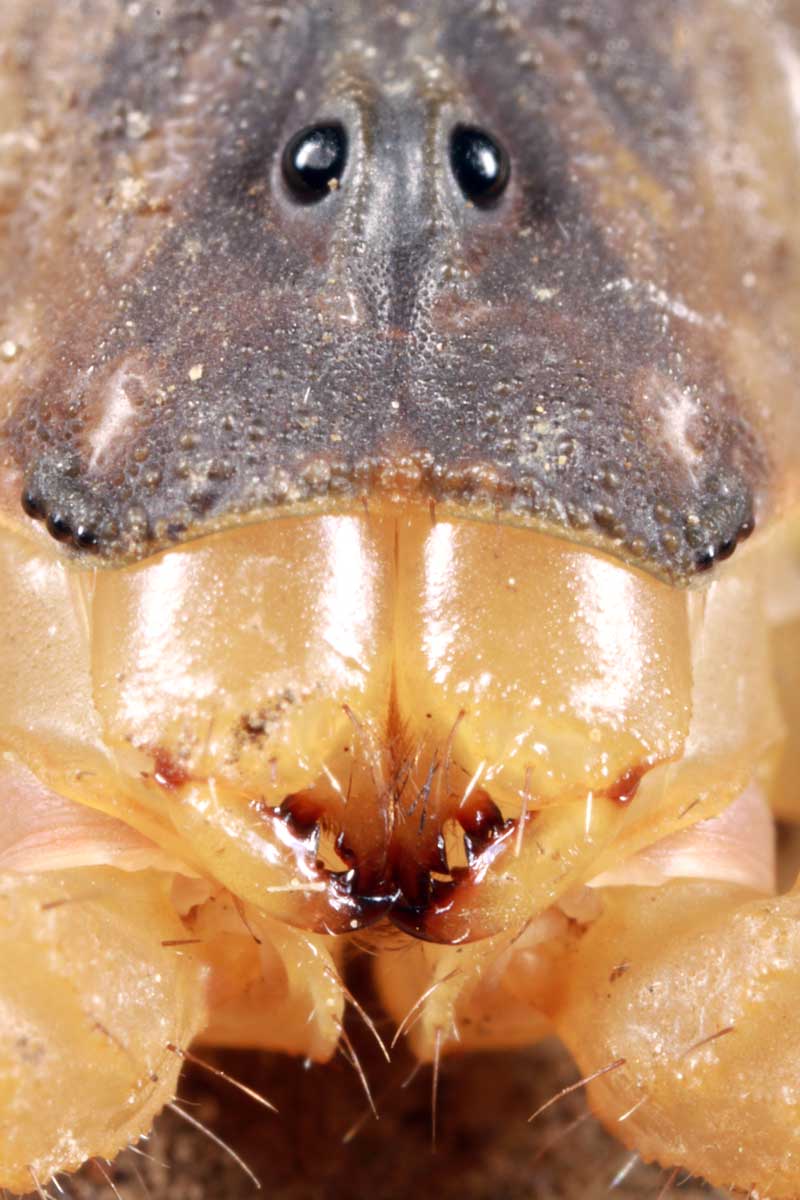
Centruroides vittatus (striped bark scorpion)

From A face only a mother could love (Oct 6).  Despite some minor depth-of-field problems with this photograph, I’m fascinated by its “smile.”

Best reptile

Eastern collared lizard (Crotaphytus collaris collaris) adult male

From North America’s most beautiful lizard (July 10).  A simply spectacular lizard—all I had to do was frame it well and get the flash right.

Best wildflower

Spiranthes magnicamporum (Great Plains ladies

From Great Plains Ladies’-tresses (Dec 7).  Few flowers are as photogenic as orchids, even native terrestrials with minute flowers such as this one.  I like the frosty texture of the lip and the starkness of the white flower on the black background.

Best natural history moment

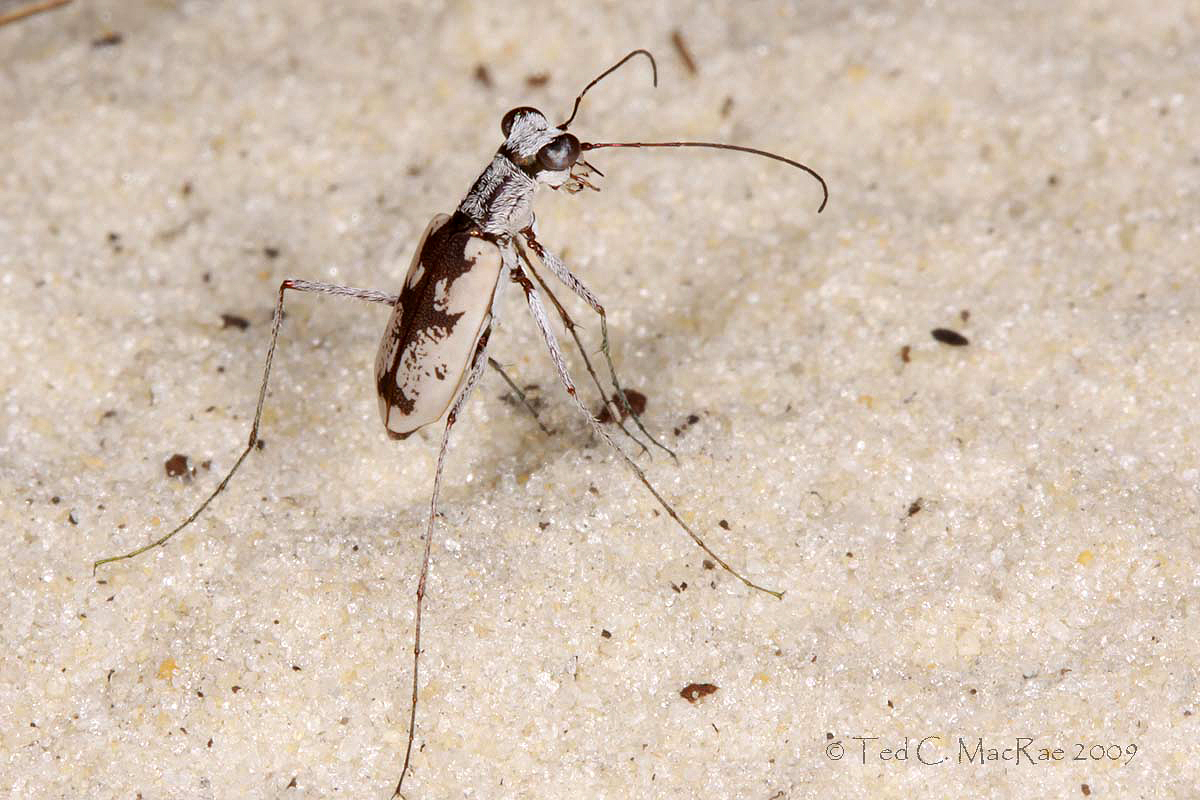
Thermoregulatory behavior by Ellipsoptera hirtilabris (moustached tiger beetle)

From Tiger Beetles Agree—It’s Hot in Florida! (Dec 18). I chose this photo for the classic “stilting” and “sun-facing” thermoregulatory behaviors exhibited by this tiger beetle on a blistering hot day in Florida.

Best closeup

Megaphasma denticrus (giant walkingstick)

From North America’s longest insect (Aug 21).  I haven’t tried a whole lot of super close-up photographs yet.  I liked the combination of blue and brown colors on the black background.

Best Landscape

Sand Harbor Overlook, Lake Tahoe, Nevada

From Sand Harbor Overlook, Nevada (March 23).   My choice for “best landscape” again comes from Lake Tahoe.  This is not a great photo technically—I was still using a point-and-shoot and had to deal with foreground sun.  However, none of the other photos I took during my March visit to the area captivate me like this one.  I like the mix of colors with the silhouetted appearance of the trees on the point.

Copyright © Ted C. MacRae 2009

Add to FacebookAdd to DiggAdd to Del.icio.usAdd to StumbleuponAdd to RedditAdd to BlinklistAdd to TwitterAdd to TechnoratiAdd to Yahoo BuzzAdd to Newsvine

Email to a friend