Brazil Bugs #2

A few more photographs from this past week in Campinas, Brazil.  It rained during the afternoon but stopped by the time I arrived back at the hotel, allowing me to stroll the lavishly landscaped grounds during the mild evening hours.  There is a pink-flowered shrub forming a hedge row in back of the hotel that is highly attractive to many types of insects.  The identity of the shrub remains a mystery to me, and most of the insects I’m finding on it I can recognize only to family – I’m hoping the hotel staff will be able to name the former and that the readers of this blog might be able to provide IDs for the latter.
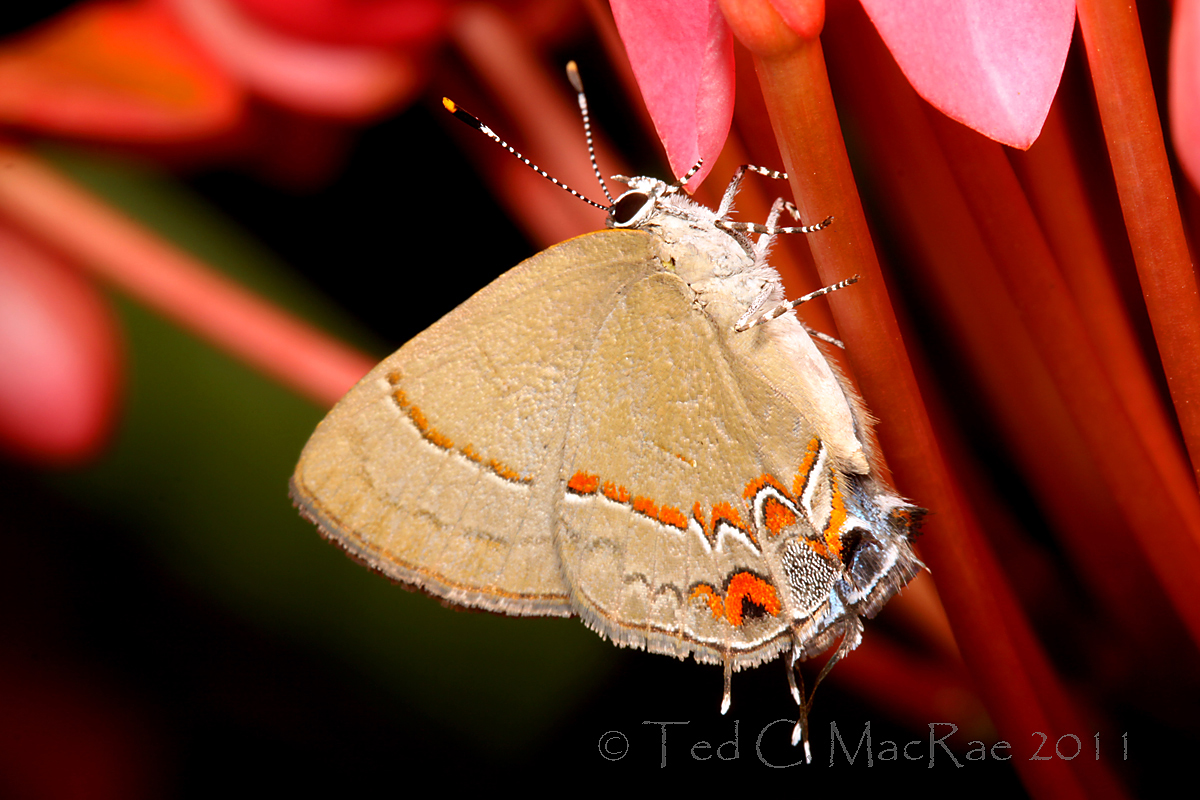
Calycopis sp. poss. origo (Lepidoptera: Lycaenidae). ID by Dave Hubble and Chris Grinter.

It took a bit of effort to find an unobstructed view of this hairstreak butterfly (family Lycaenidae) as it visited the flowers within the shrub.  Every time I tried to move foliage out of the way to get a good view, the butterfly became alarmed and flew to another part of the hedge row.  My antics drew the attention of a hotel worker, who was apparently interested enough in what I was doing to act as a spotter whenever the butterfly flew to help me relocate it.  Eventually I got a few shots that I was happy with, including the above.
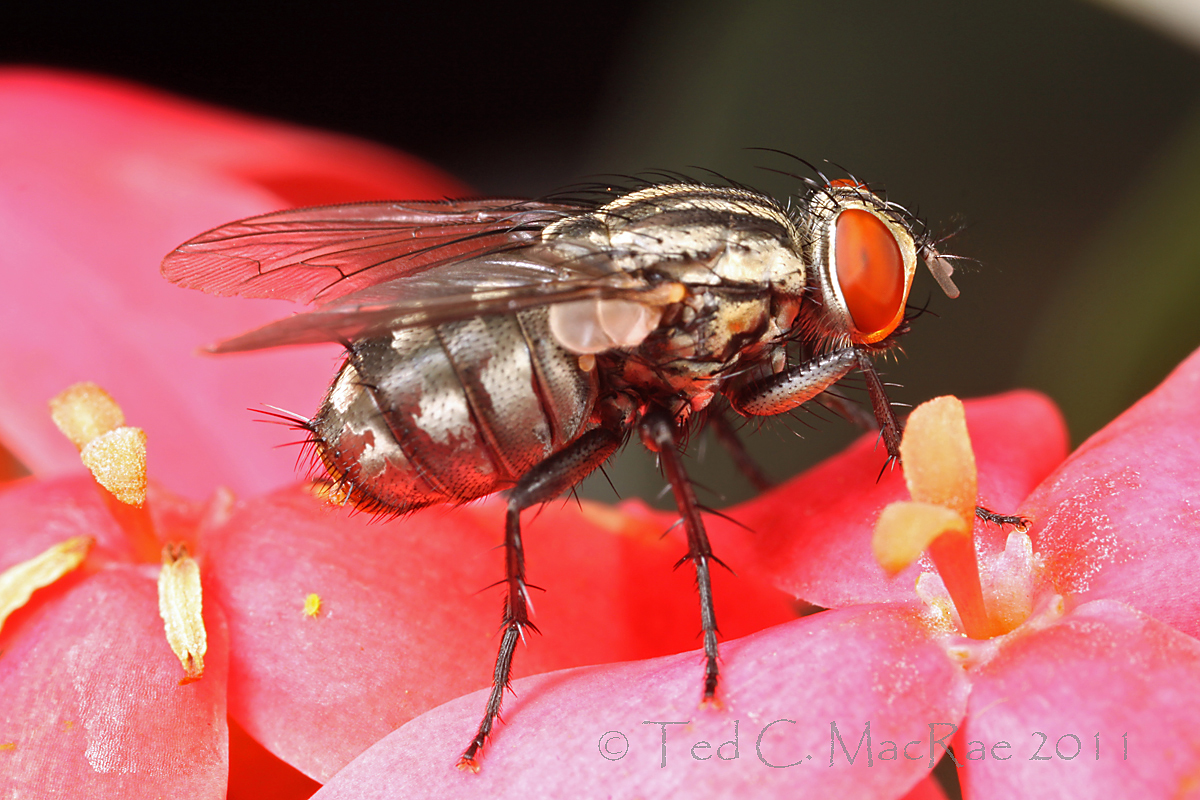
A flesh fly (Diptera: Sarcophagidae).

I presume this to be a type of flesh fly (family Sarcophagidae) based on the stout bristles and color pattern that seems typical for the family.  I like the striking contrast in coloration between the fly and the flower.  There are a few fly bloggers who I’m hoping might be able to give a better identification.
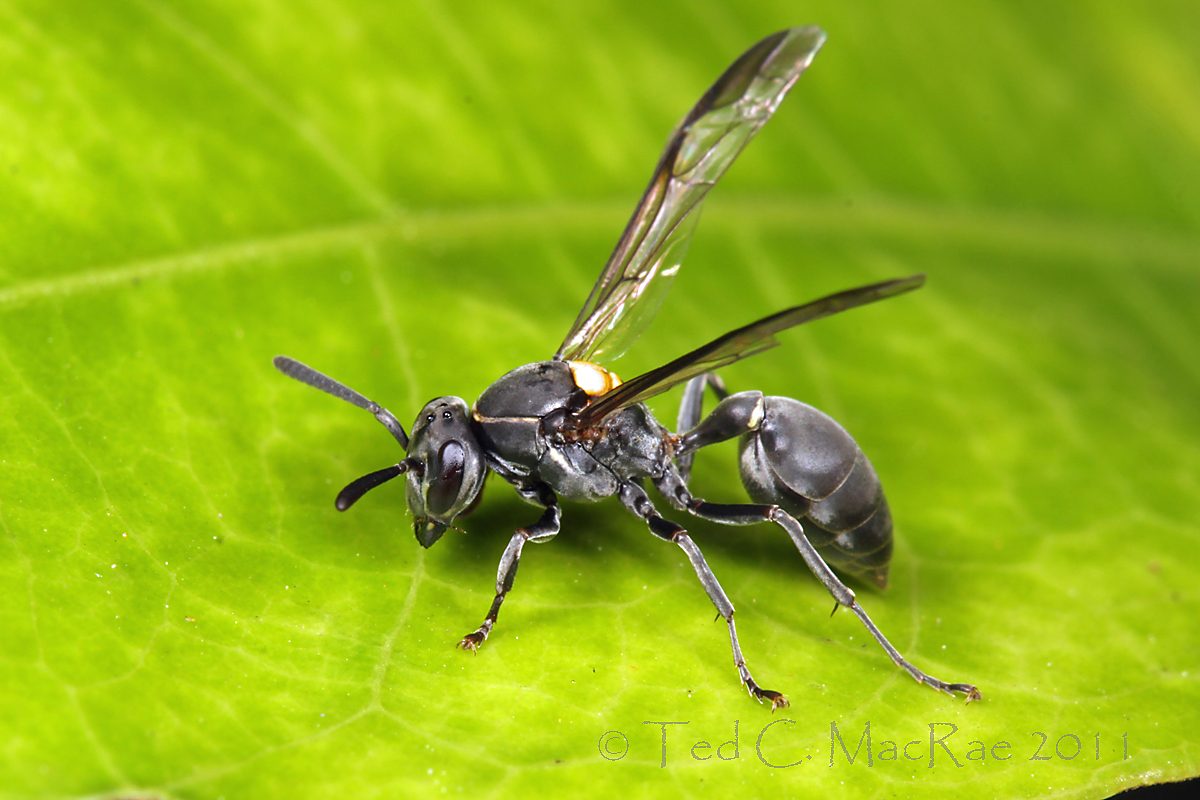
A potter/mason wasp? (Hymenoptera: Vespidae).

This appears to me to be some kind of potter or mason wasp (family Vespidae, subfamily Eumeninae) – it was a bit smallish at only about 12mm in length.  I hope one of the knowledgeable wasp bloggers out there (ahem… Eric?) can at least confirm this level of identification and perhaps the tribe or genus as well. 

Azya orbigera (Coleoptera: Coccinellidae). ID by Tucker Lancaster.

Every ladybird beetle (family Coccinellidae) I’ve ever seen is some variation of black and red/orange/yellow and has a smooth, glabrous appearance.  This beetle is cobalt blue with a dense pubescence over the dorsal surface, but it still seems to me to be some type of ladybird beetle.  It was a tiny little thing, so I suppose it could be one of the multitude of small beetle families with which I am unfamiliar.

Quedas sp.? (Hemiptera: Cicadidae).

This cast cicada exuvium was not on the shrub, but on a nearby tree at about eye level.  I really wish I could have seen the cicada that emerged from it, because this is certainly the biggest cicada exuvium I have ever seen.  I was about to simply label it “family Cicadidae” but seem to recall that cicada higher classification is in a bit of flux these days.  At any rate, given its great size I wonder if it might represent one of the giant cicadas in the genus Quesada.

I still have many more insect photographs from the past week and will certainly increase that number over the next week as well.  Stay tuned!

Copyright © Ted C. MacRae 2011
Brazil Bugs #1

ID Challenge #3 update: I knew this would be a hard one, and so far nobody has figured this one out (only one commenter got the right order!).  I’ve released the comments gotten so far so you can see where things stand, and maybe with the additional information (and my pointing out an important clue) it will be enough for one of you to arrive at a full ID.  Further comments are still being moderated until I decide to close the challenge.  Right now the points are there for the taking!


This past Monday I embarked on an extended business trip to Brazil.  “Wow, Brazil!” – you say, and while getting to travel to an exotic tropical locality on my company’s dime definitely rocks, I do have to justify the trip by actually working.  Add that to the time involved with planes, automobiles, and hotel transfers, and there is precious little time for more esoteric activities such as photographing insects.  It is Brazil, however, and summer at that, so whatever time does become available over the next ten days, I’ll be on it!  I’m stationed in Campinas, about 2 hours north of São Paulo, and this evening I had my first opportunity to break out the camera and do a little exploring around the hotel grounds during the waning hours of daylight. I’m not normally one to take short walks just looking for any random insect to photograph, but hey – it’s Brazil!  I also don’t normally like to post photographs of insects without knowing much about them – especially their identity. But hey, it’s Brazil!  I think I’ll be lucky to figure out most things to family, although I might be able to drill down a little further on occasion.  With that prelude, I hope you’ll indulge me these random postings over the next 10 days or so, primarily photographs but perhaps accompanied by a little bit of text.

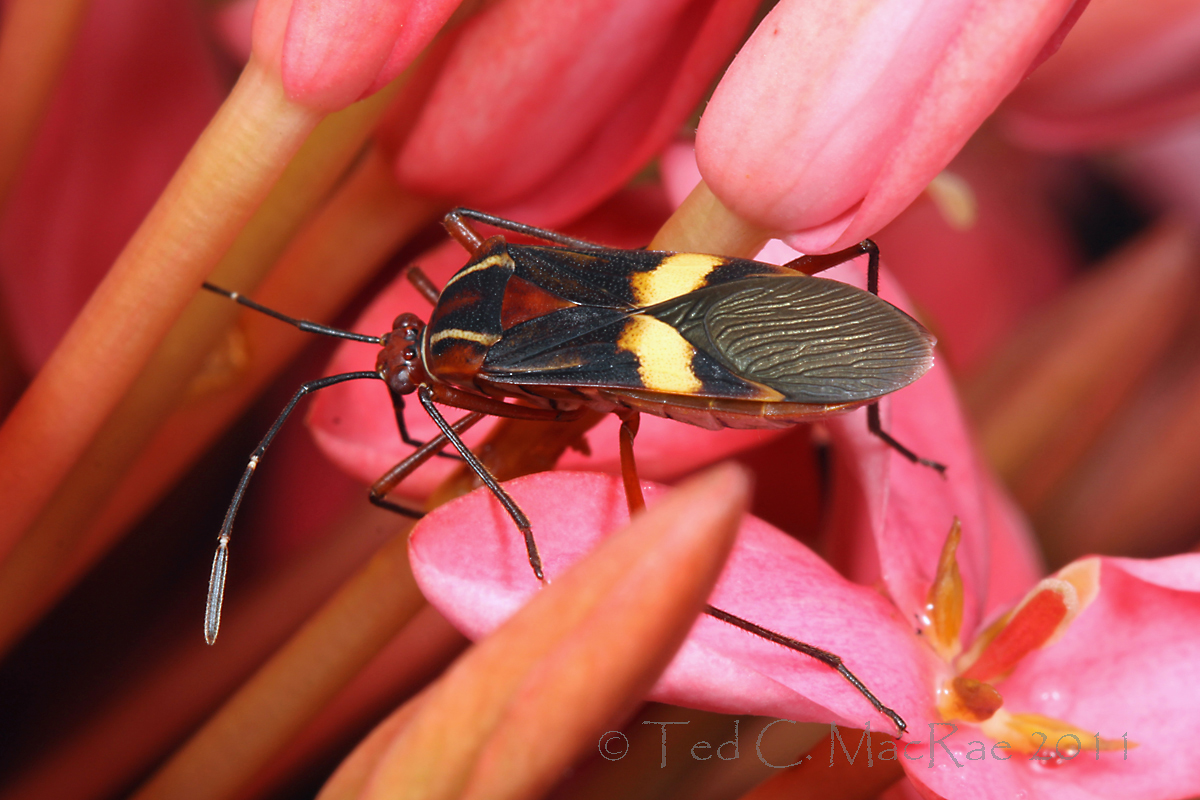
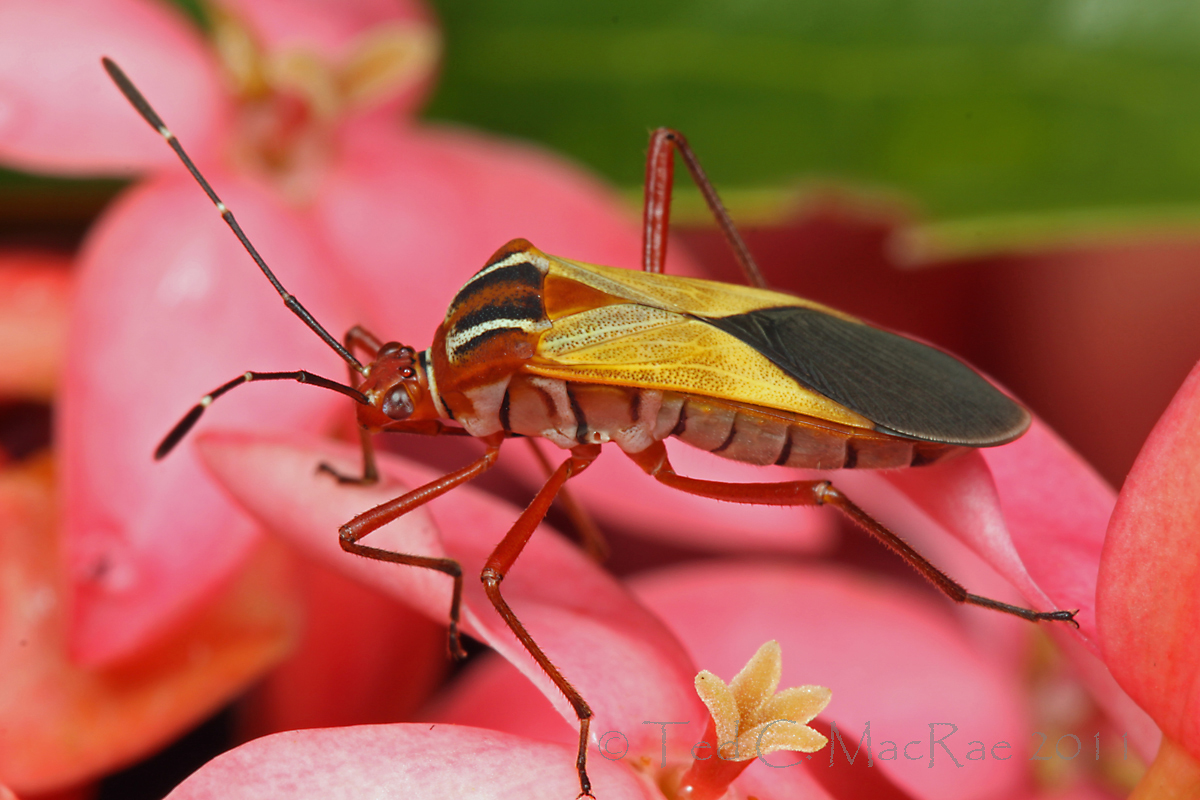
Coreidae?

At first I thought this was a member of the hemipteran family Pyrrhocoridae (red bugs), as some North American species have similar coloration; however, members of that family apparently lack ocelli, which this insect clearly possesses. This would seem to indicate instead some species of Lygaeidae (seed bugs), but the forewing membrane with numerous veins arising from a transverse basal vein and presence of what appears to be a distinct metathoracic scent gland opening suggest instead some “unleaf-footed” species of leaf-footed bug (Coreidae). Whatever its identity, I would imagine it is quite distasteful, based on what clearly seems to be aposematic coloration and the fact that there were numbers of these bugs hanging out quite conspicuously on these flowers.

Same species?

This individual was differently colored than the others, but otherwise it seemed structurally and behaviorally identical.  Is it merely a highly melanized individual?  Maybe a case of sexual dimorphism, and I only saw this one individual of one of the sexes?  Maybe it truly is a different species – it is Brazil, afterall!

Pseudoplusia includens?

Daylight began to slip away much too soon, and I was about to pack it up when  I noticed some blurs at the flowers.  I realized that moths had begun to visit the flowers in the obscurity of dusk and became determined to photograph one, despite the fact that they never actually landed on the flowers but hovered in front of them instead.  It was quite difficult to even get them framed in the viewfinder, and on those few occasions when I managed to do this it was all but impossible to spend any time trying to focus – I used the lamp on the flash unit to help me see the moth, then just framed and quickly took the shot.  This one actually turned out not too bad – a little bit of blur in the wings but otherwise acceptable enough to let me tentatively identify it as Pseudoplusia includens (soybean looper).  Brazil is well on its way to becoming the world’s largest producer of soybean, and the caterpillars of these moths are enjoying the bounty!

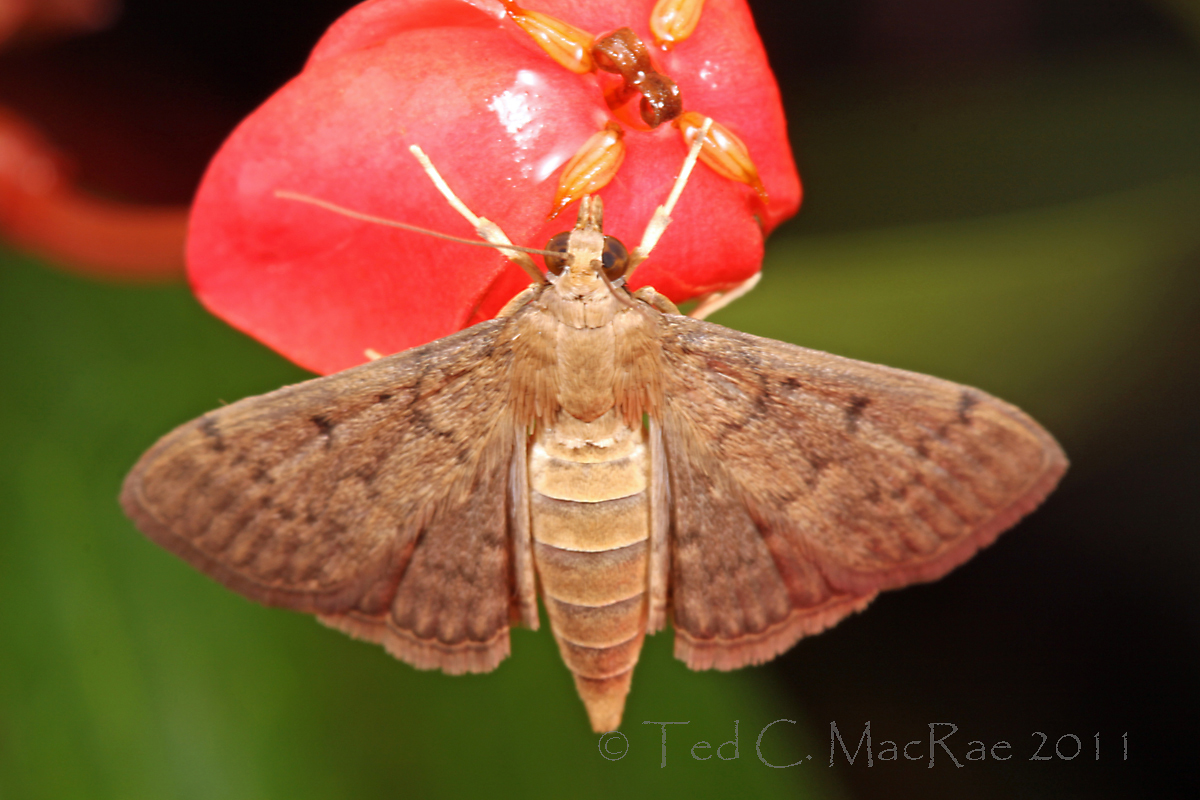
Family Crambidae, possibly Herpetogramma phaeopteralis (ID by Chris Grinter)

I saw one last moth before the final traces of daylight disappeared – I don’t have any idea about its identity, but it’s a pretty picture nonetheless.  It has the generic look of the large family Noctuidae, so that’s what I’m gonna go with until somebody tells me differently.  Edit 1/20/11 – Somebody just told me differently!  According to Chris Grinter, this is a species of Crambidae, possibly Herpetogramma phaeopteralis (tropical sod webworm).  Thanks, Chris!

I don’t know the name of the plant whose flowers these insects were visiting, but the hotel staff has promised to ask their gardener in the morning and let me know – now that’s service!

Copyright © Ted C. MacRae 2011

A “leafless” leaf-footed bug

Merocoris distinctus feeding on flower stem of Coreopsis lanceolata.

This is Merocoris distinctus, a true bug in the family Coreidae whose members are usually recognized by their distinctive flattened hind tibiae (and hence the common name, leaf-footed bugs). This diminutive species, however, lacks that character, instead sporting strangely curved hind tibiae along with club-shaped (incrassate) hind femora. It’s a chunky little species – much smaller than the typical leaf-footed bugs seen across North America, and is most often encountered in grassland habitats where it feeds on herbaceous plants such as goldenrod, Solidago spp. (Slater and Baranowski 1978). This individual was seen probing the upper flower stem of lanceleaf tickseed, Coreopsis lanceolata, during May of last year at Shaw Nature Reserve in east-central Missouri. I’m not sure how well the life history of this species is understood, but I did find one interesting record of twelve individuals feeding gregariously on a dead chicken (Engelhardt 1912)! Apparently, feeding on carrion and other extra-phytophagous foods such as bird droppings and dung is a not uncommon practice among the Coreidae and closely related Alydidae (Adler and Wheeler 1984).

I kind of lucked out with this shot – I’d just gotten my new camera two weeks earlier and can’t say I really knew what I was doing at this point. I had first noticed and photographed the bug sitting on top of the flower but totally blew the exposure due to the flower’s bright yellow color.  My clumsy approach also caused the insect to move under the flower, where I watched it settle down and begin feeding before trying another shot. The dorsal surface of this species is mottled gray and brown, allowing the bug to blend in with most backgrounds. The underside of the body, however, is thickly matted with white hair, providing a very nice contrast with the black background that I stumbled upon achieved in this photo to emphasize the distinctive appearance of this often-overlooked insect.

Photo Details: Canon 50D w/ 100mm macro lens (ISO 100, 1/250 sec, f/14), Canon MT-24EX flash (1/4 ratio), undiffused. Typical post-processing (levels, minor cropping, unsharp mask).

REFERENCES:

Adler, P. H. and A. G. Wheeler.  1984. Extra-phytophagous food sources of Hemiptera Heteroptera: Bird droppings, dung, and carrion.  Journal of the Kansas Entomological Society 57(1):21-27.

Engelhardt, G. P. 1912. A hemipteron on carrion.  Journalof the New York Entomological Society 20:294.

Slater, J. A. and R. M. Baranowski. 1978. How to Know the True Bugs. W. C. Brown Company Publishers, 256 pp.

Copyright © Ted C. MacRae 2010

BitB Best of 2009

In my first post of 2009, I looked back at the photographs I had posted during 2008 and picked some of my personal favorites. I hesitated then to call myself a photographer (and still do), but I at least now have suitable equipment to aid in my progress toward that eventual goal. I have learned much over the past six months in my first attempt at serious insect macrophotography (prioritizing in situ field photographs of unmanipulated subjects as a matter of personal choice).  Through this, I’ve come to realize the following skills to be the most important for success:  

  1. Composition
  2. Understanding lighting
  3. Knowing how to use a flash
  4. Knowledge of the subject

I’ll give myself a “A” in the last of these, but in the other areas I still have much to learn. With this caveat, and for the last post of 2009, I offer the following twelve photographs as my final choices for the 2nd Annual “Best of BitB”:  

Best beetle

Cylindera celeripes (swift tiger beetle), Woodward Co., Oklahoma

From Revisiting the Swift Tiger Beetle – Part 1 (June 30).  A decent enough photograph, especially considering that I’d had my camera for about a month when I took it.  However, the discovery of robust populations of this formerly rare and enigmatic species throughout northwestern Oklahoma (and later also in northwestern Missouri) was the most significant find of the 2009 field season, and this photograph is the best capture of that moment.

Best fly

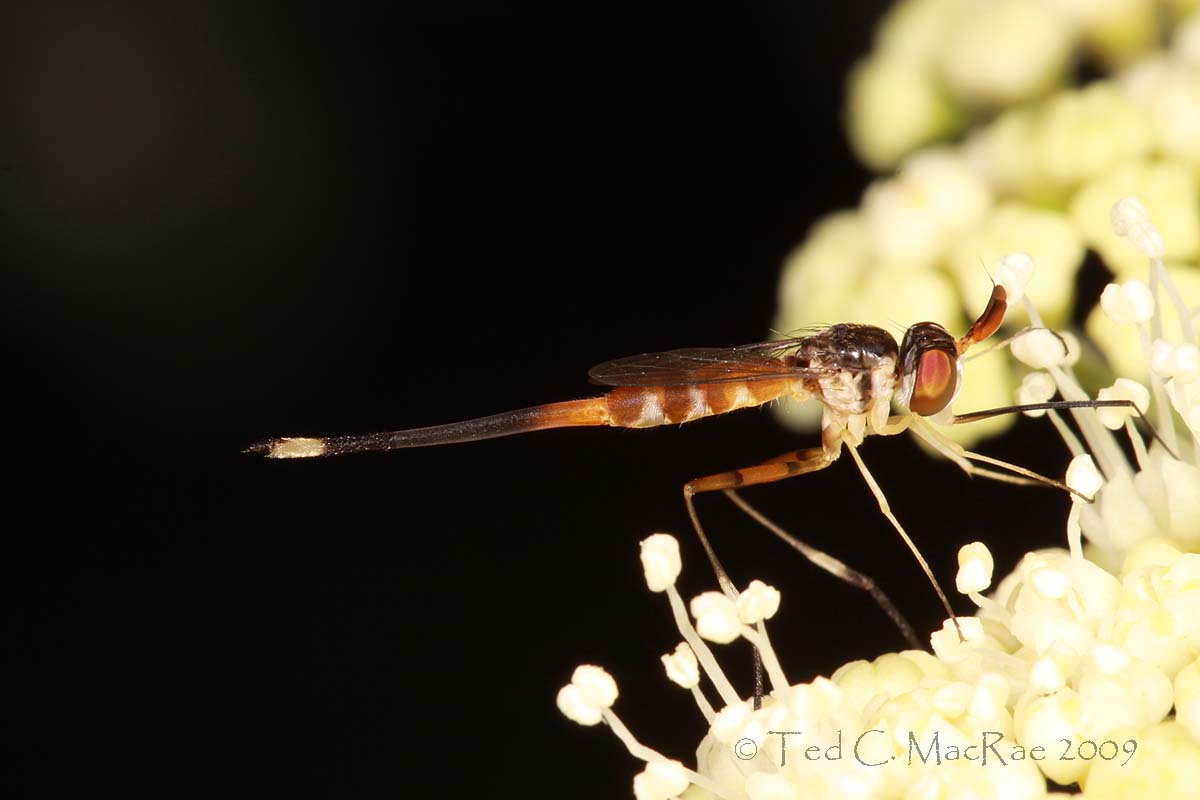
Stylogaster neglecta, a species of thickheaded fly

From Overlooked, needle-bellied, thick-headed fly (Aug 14).  One of my first good “black background” shots.  The white tip of the abdomen compliments the white flower stamens against the background.

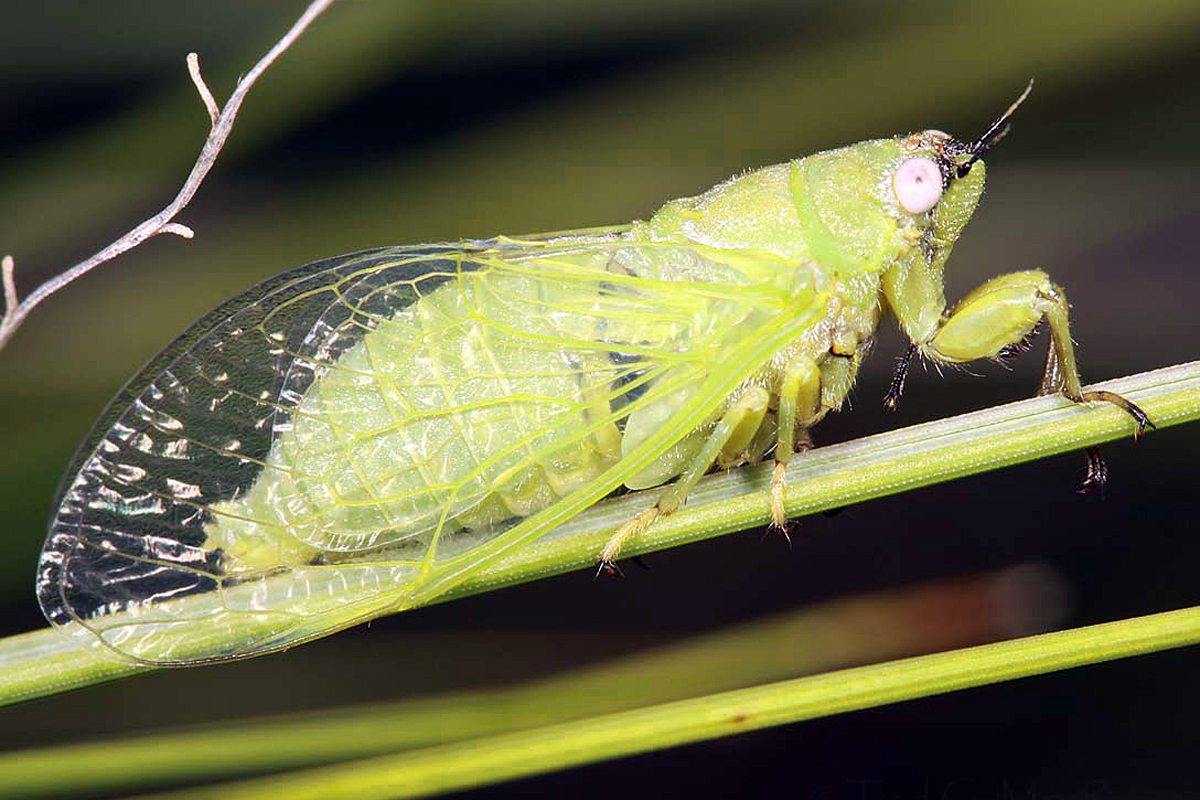
Best “true” bug

Beameria venosa, a prairie obligate cicada

From North America’s smallest cicada (Aug 4).  So many different shades of green with white frosting on the bug’s body.  I tried taking this shot in portrait and it just didn’t work—I liked this landscape shot much better.

Best predator

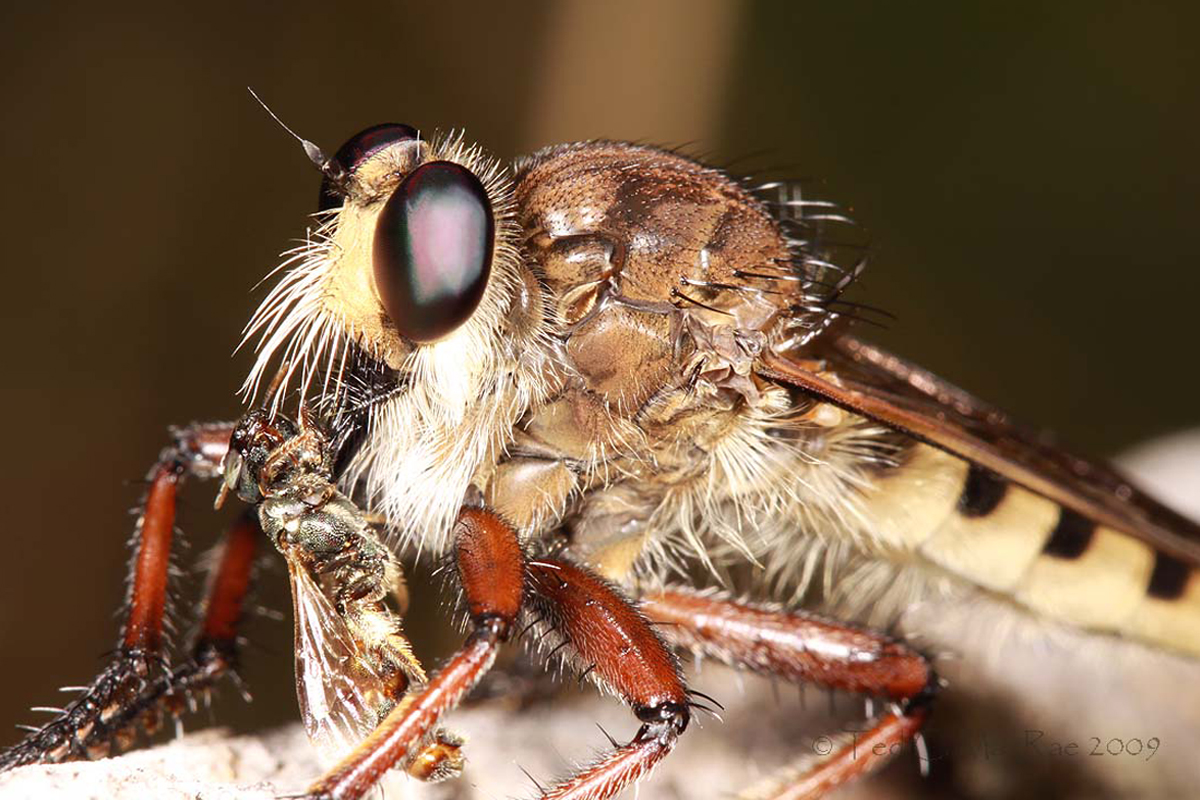
Promachus hinei (Hines giant robber fly) & Ceratina sp. (small carpenter bee) prey

From Prey bee mine (Sept 14).  Robber flies are immensely photogenic, especially those in the genus Promachus due to their prominent “beards.”

Best camoflauge

Dicerca obscura on bark of dead persimmon

From The “obscure” Dicerca (June 19).  Sparkling and gaudy as specimens in a cabinet, the coloration of many jewel beetles actually helps them blend almost perfectly with the bark of their preferred tree hosts.

Best immature insect

Tetracha floridana (Florida metallic tiger beetle) 3rd-instar larva

From Anatomy of a Tiger Beetle Larva (Oct 22).  “Otherwordly” is invariably the first word that comes to mind when someone sees a tiger beetle larva for the first time.  I was lucky enough to get this one in profile with a nice view of its abdominal hump and its curious hooks.

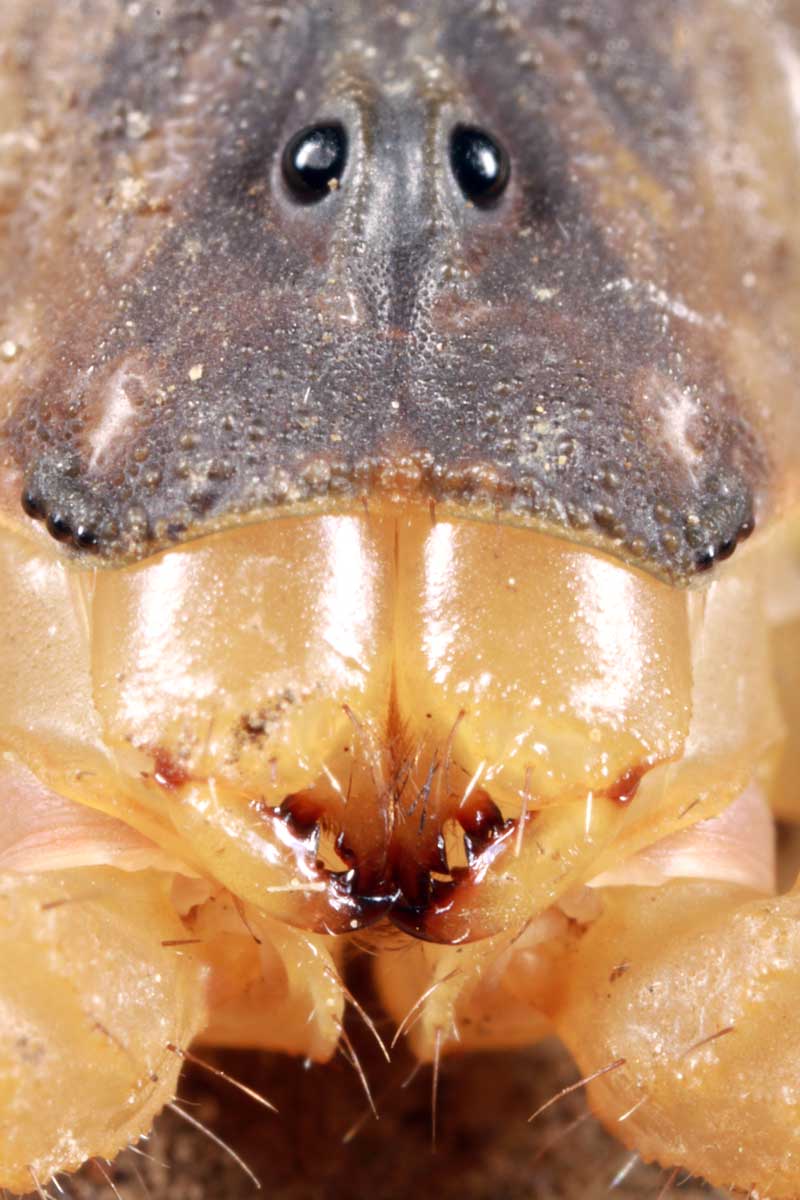
Best arachnid

Centruroides vittatus (striped bark scorpion)

From A face only a mother could love (Oct 6).  Despite some minor depth-of-field problems with this photograph, I’m fascinated by its “smile.”

Best reptile

Eastern collared lizard (Crotaphytus collaris collaris) adult male

From North America’s most beautiful lizard (July 10).  A simply spectacular lizard—all I had to do was frame it well and get the flash right.

Best wildflower

Spiranthes magnicamporum (Great Plains ladies

From Great Plains Ladies’-tresses (Dec 7).  Few flowers are as photogenic as orchids, even native terrestrials with minute flowers such as this one.  I like the frosty texture of the lip and the starkness of the white flower on the black background.

Best natural history moment

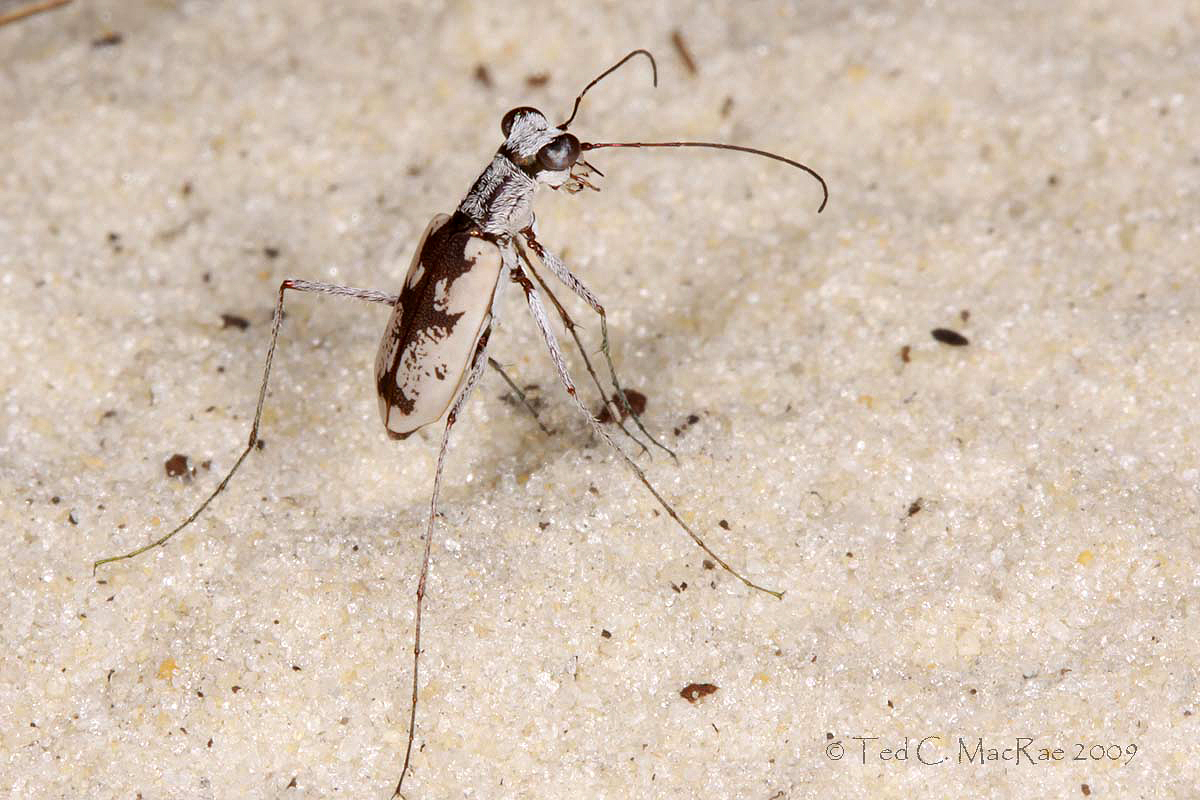
Thermoregulatory behavior by Ellipsoptera hirtilabris (moustached tiger beetle)

From Tiger Beetles Agree—It’s Hot in Florida! (Dec 18). I chose this photo for the classic “stilting” and “sun-facing” thermoregulatory behaviors exhibited by this tiger beetle on a blistering hot day in Florida.

Best closeup

Megaphasma denticrus (giant walkingstick)

From North America’s longest insect (Aug 21).  I haven’t tried a whole lot of super close-up photographs yet.  I liked the combination of blue and brown colors on the black background.

Best Landscape

Sand Harbor Overlook, Lake Tahoe, Nevada

From Sand Harbor Overlook, Nevada (March 23).   My choice for “best landscape” again comes from Lake Tahoe.  This is not a great photo technically—I was still using a point-and-shoot and had to deal with foreground sun.  However, none of the other photos I took during my March visit to the area captivate me like this one.  I like the mix of colors with the silhouetted appearance of the trees on the point.

Copyright © Ted C. MacRae 2009

Add to FacebookAdd to DiggAdd to Del.icio.usAdd to StumbleuponAdd to RedditAdd to BlinklistAdd to TwitterAdd to TechnoratiAdd to Yahoo BuzzAdd to Newsvine

Email to a friend

Cicadetta kansa in Oklahoma

Photo details: Canon 100mm macro lens on Canon EOS 50D, ISO 100, 1/250 sec, f/14, MT-24EX flash 1/4 power w/ Sto-Fen diffusers.

Another of the insects that I saw this past June at Four Canyon Preserve in northwestern Oklahoma was this small cicada, Cicadetta kansa. Though not as small as the diminutive Beameria venosa (see North America’s smallest cicada), their barely audible call – a soft buzz – makes them even more difficult to notice.  I only realized what they were after noticing something odd about the small, green “grasshoppers” that flitted in front of me as I walked through the mixed shortgrass prairie.  They didn’t quite fly “right” and landed delicately within the grass rather than crashing into it clumsily.  Even after realizing that they weren’t grasshoppers, it was difficult to say what they were at first due to their wariness and lime green coloration that helped them blend marvelously into their grassy surroundings.  A few sweeps of the net solved that problem, and I discovered what was at the time the smallest and most beautiful cicada I had seen to that point (Beameria venosa took both honors later that month in the Loess Hills of northwestern Missouri).

Despite being the only world-wide genus of cicadas, Cicadetta is represented in the U.S. by only two species—C. kansa and C. calliope.  In addition to its pale green coloration, C. kansa is distinguished from C. calliope by having only 4 or 5 apical cells in the hind wing (6 in C. calliope).  Cicadetta kansa occurs from Texas north to South Dakota, while C. calliope is found from Texas to Florida and northwards to Iowa, Ohio and New Jersey.  Little is known about the biology of Cicadetta kansa; however, presumably it is similar to that of C. calliope, which emerges and lays eggs in late spring.  Eggs hatch by late summer, at which time the nymphs burrow into the ground again begin feeding on the roots of grasses.  This feature of their biology protects them from the negative impacts of managed spring and fall burns, and indeed C. calliope is known to increase in prairies that are managed by such burns.  This is in contrast to other prairie cicadas (genus Tibicen), which overwinter as eggs in the above-ground portion of grasses and, thus, are negatively impacted by fall and spring burns.

A number of websites are dedicated to these charismatic insects; however, Cicada by Andy Hamilton at the Canadian National Collection of Insects, Arachnids and Nematodes is the most informative and comprehensive that I’ve found.

Copyright © Ted C. MacRae

Add to FacebookAdd to NewsvineAdd to DiggAdd to Del.icio.usAdd to StumbleuponAdd to RedditAdd to BlinklistAdd to TwitterAdd to TechnoratiAdd to Furl

Assassin ate

IMG_1146_1200x800

I came upon this interesting scene last month while hiking through Allen David Broussard Catfish Creek Preserve State Park, which preserves some of the highest quality remnants of sand scrub habitat on the Lake Wales Ridge of central Florida. The spider seems to be Peucetia viridans (green lynx spider), widespread across the southern U.S. and distinguished by its bright transparent green color with red spots and black spines (Emerton 1961). These largest of North American lynx spiders hunt diurnally on low shrubs with an agility excelled only by the jumping spiders (Salticidae) and aggressively attack their insect prey. In this case, the prey is one of the so-called “bee assassins” of the genus Apiomerus (Hemiptera: Reduviidae). The common and generic names of these insects both derive from their habit of preying upon bees, not only on flowers but also by ambushing them at nest entrances, although other insects are preyed upon as well. Ironically, this particular assassin himself got ate.

An interesting situation was uncovered while I tried to determine which species of Apiomerus was represented by the prey. By virtue of its pale ventrals with the front and hind margins black, it keys to A. spissipes in a literature-based key to Florida Reduviidae (Bierle et al. 2002) – one of two species considered widely distributed across the eastern U.S. In reality, however, it appears that this individual represents another species named almost 30 years ago but which remains officially undescribed. As explained in this BugGuide post by Daniel Swanson, the genus was revised by Berkeley grad student Sigurd Leopold Szerlip in partial fulfillment of the requirements for a Ph.D., who proposed a number of taxonomic acts including the description of 19 new species. Among these were eastern U.S. populations to which the name A. spissipes had been applied, with those in Florida being described as the new species “A. floridensis“. However, dissertations do not meet the criteria of publication according to Article 8 of the International Code of Zoological Nomenclature (ICZN 1999), and none of the dissertation was formally published. Thus, “A. floridensis” remains an invalid, unpublished name.  This is a most unfortunate situation, as Swanson considers the dissertation to be well done.  It is not only names, but important information about life histories and detailed genitalic studies that remain unavailable to the scientific community as well.  What are the nomenclatural impacts of this work remaining unpublished?  Is this as much a failure by the advising professor as by Szerlip himself?  What ethical considerations would need to be addressed in order for it to be published in absentia, or is this even possible?

Photo details: Canon 100mm macro lens on Canon EOS 50D (manual mode), ISO-100, 1/250 sec, f/13, MT-24EX flash 1/2 power through diffuser caps.

REFERENCES:

Bierle, S., E. Dunn, S. Frederick, S. Garrett, J. Harbison, D. Hoel, B. Ley and S. Weihman. 2002. A literature-based key to Reduviidae (Heteroptera) of Florida (assassin bugs, and thread-legged bugs). Unpublished manuscript, University of Florida, Department of Entomology and Nematolgy, Insect Classification ENY 4161/6166, 18 pp.

Emerton, J. H. 1961. The Common Spiders of the United States. Dover Publications, Inc., N.Y., xx + 227 pp.

International Commission on Zoological Nomenclature [ICZN]. 1999. International Code of Zoological Nomenclature, 4th Edition. The International Trust for Zoological Nomenclature, c/o Natural History Museum, London. xxix + 306 pp.

Szerlip, S. L. 1980. Biosystematic revision of the genus Apiomerus (Hemiptera: Reduviidae) in North and Central America. Unpublished Ph.D. thesis, University of California, Berkley, CA.

Copyright © Ted C. MacRae 2009

Add to FacebookAdd to NewsvineAdd to DiggAdd to Del.icio.usAdd to StumbleuponAdd to RedditAdd to BlinklistAdd to TwitterAdd to TechnoratiAdd to Furl

North America’s smallest cicada

Photo details: Canon 100mm macro lens on Canon EOS 50D, ISO 100, 1/250 sec, f/18, MT-24EX flash 1/2 power w/ diffuser caps.

Photo details: Canon 100mm macro lens on Canon EOS 50D, ISO 100, 1/250 sec, f/18, MT-24EX flash 1/2 power w/ diffuser caps.

While searching the hilltop prairies for Cylindera celeripes (swift tiger beetle) at McCormack Loess Mounds Natural Area in northwestern Missouri, I ran across a species of cicada that I’d not yet encountered in the state – Beameria venosa.  Cicadas as a rule are quite large insects, but with a body measuring only 16 mm (well under an inch) in length, B. venosa is one of – if not the – smallest species of this group in all of North America.  Had it not been for its distinctly cicada-esque call I might have thought it was some sort of fulgoroid planthopper (albeit a rather large one).  But a cicada it is, and a beautiful one at that despite its small size.

Beameria venosa is a prairie obligate species occurring from Nebraska and Colorado south to Texas and New Mexico.  To my knowledge, it has not been formally recorded from Missouri, although it is certainly already known from the state (it is listed in the 2009 issue of Missouri Species and Communities of Conservation Concern Checklist as “vulnerable” due to the restricted occurrence in Missouri of the prairie habitats in which it lives).  Froeschner (1952) listed 14 species of cicadas from Missouri but did not include this species even among those of possible occurrence in the state.  In my younger days, I managed not only to find all 14 of those species, but also a fifteenth species – the magnificent Tibicen superbus – in the southwestern corner of the state (formally recorded from the state some years later by Sanborn and Phillips 2004).  The occurrence of B. venosa in Missouri now brings to 16 the number of cicada species known from Missouri.

Despite its small size, the calling song of B. venosa is quite audible.  In fact, it was only due to its call that I noticed and began looking for this individual.  This brings up an interesting point regarding conspicuous insect songs and their role in enhancing predation risk.  Many predators are known to orient to the calls of cicadas (Soper et al. 1976), which in turn exhibit a variety of predator avoidance behaviors such as high perching, hiding, fleeing, and perhaps even mass emergence in the periodical cicadas.  Beameria venosa appears to avoid predators by producing its continuous train of sound pulses at a very high frequency.  Although audible to humans, the high frequency call apparently is not audible to birds and lizards – their chief predators (Sanborn et al. 2009).  In the open, treeless prairies where B. venosa lives, high frequency calling appears to provide the selective advantage for predator avoidance that fleeing, hiding, and high perching cannot.

REFERENCES:

Froeschner, R. C.  1952. A synopsis of the Cicadidae of Missouri. Journal of the New York Entomological Society 60:1–14.

Sanborn, A. F., J. E. Heath and M. S. Heath.  2009.  Long-range sound distribution and the calling song of the cicada Beameria venosa (Uhler) (Hemiptera: Cicadidae).  The Southwestern Naturalist 54(1):24-30.

Sanborn, A. F. and P. K. Phillips.  2004.  Neotype and allotype description of Tibicen superbus (Hemiptera: Cicadomorpha: Cicadidae) with description of its biogeography and calling song.  Annals of the Entomological Society of America 97(4):647-652.

Soper, R. S., G. E. Shewell and D. Tyrrell. 1976. Colcondamyia auditrix nov. sp. (Diptera; Sarcophagidae), a parasite which is attracted by the mating song of its host, Okanagana rimosa (Homoptera: Cicadidae).  The Canadian Entomologist 108:61-68.

Copyright © Ted C. MacRae 2009

Add to FacebookAdd to NewsvineAdd to DiggAdd to Del.icio.usAdd to StumbleuponAdd to RedditAdd to BlinklistAdd to Ma.gnoliaAdd to TechnoratiAdd to Furl

Magodo – giant twig wilter

petascelis-remipes

In previous posts, I have highlighted some of the insects I observed on a trip to South Africa in November-December 1999.  All of the photos I have shown to this point were taken at Borakalalo National Park in North West Province or at the Geelhoutbos farm of Susan Strauss below the Waterberg Range in the formerly Northern, now Limpopo Province.  Both of these locations are deep inside the bushveld, providing ample opportunity to observe an incredible diversity of insect life.  This is not to say that insects, even spectacular ones, cannot be found in more urban areas.  During the weekend between those two mini-expeditions, I stayed with my friend and colleague, Chuck Bellamy, at his home in Pretoria, a beautiful city with lovely architecture, elegant gardens… and some very impressive bugs!  The bug in this photo was found on a tree in a shrubby enclave, and at well over 35 mm in length it is easily the largest leaf-footed bug (order Hemiptera, family Coreidae) that I have ever seen.  Its chunky build, velvety black coloration with thin yellow lines along the sides and down the center of the thorax, and greatly enlarged hind femora quickly led me to a provisional identification of a male Petascelis remipes, or giant twig wilter.  This ID was confirmed by my friend and colleague Harry Brailovsky, an entomologist at UNAM (Universidad Nacional Autónoma de México) and world expert on Coreidae (and who, incidentally, just recently published a review of this Afrotropical genus – Brailovsky 2008).

According to Picker et al. (2002), these insects are found on plants in the genus Combretum.  Like most species in the family, they have scent (“stink”) glands that provide defensive capabilities. Adults are gregarious and bold, walking towards intruders with antennae vibrating when disturbed, and they are apparently capable of squirting their defensive secretions for some distance.  The nymphs are black as well but futher advertise their noxiousness with warning coloration of red spots on a whitish background. Interestingly, and despite their powerful chemical defenses, this species is considered a delicacy in parts of Mozambique where it is known as Magodo.  In a post called Insects for Dinner (in a blog with the eerily similar title, Beating about the Bush), Bart Wursten of Gorongosa National Park in Mozambique describes how local folk burn small patches of the grassland in which these insects are found to smoke them out and catch them.  The Magodo hunters kill the bugs by breaking off the head and removing the scent glands, which releases a very strong almond-like smell.  In doing this, the locals are able to catch considerable quantities of the bugs, which they eat with supper.

Lest you believe such practices are an anomaly, van Huis (2003) has compiled a list of about 250 insect species used as food in sub-Saharan Africa.  Lepidoptera, Orthoptera and Coleoptera represented the bulk (78%) of species eaten, with Isoptera, Hemiptera, Hymenoptera, Diptera and Odonota making up the rest.  Several examples of toxic insects and the traditional methods used to remove the poisons were given.  It was noted that whether or not insects are eaten depends not only on taste and nutritional value, but also on customs and ethnic preferences or prohibitions.  I’m not one to shy away from the thought of eating insects – after all, shrimp are just bugs that live in water, and insects rank far lower in ‘slime factor’ than many other invertebrates (e.g., oysters) that enjoy great popularity in our culture.  I’ve eaten roasted beet armyworm (Spodoptera exigua) pupae and munched on chocolate covered ants, but that’s kid stuff – the armyworms tasted like the soy sauce in which they were roasted, and the ants tasted like, well… chocolate.  I did once eat a softshelled crab (alive!), and I actually hope to one day taste the enormous grub of the giant metallic ceiba borer, Euchroma gigantea, eaten by indigenous cultures in Central and South America.   Still, I think I’d need a lot of faith in my chef’s scent gland removal prowess before I started scarfing Magodo down like popcorn.

What insects have you eaten?

REFERENCES:

Brailovsky, H.  2008. Notes on the genus Petascelis Signoret and description of one new species (Hemiptera: Heteroptera: Coreidae: Coreinae: Petascelini).  Zootaxa 1749:18–26.

Picker, M., C. Griffiths and A. Weaving. 2002. Field Guide to Insects of South Africa. Struik Publishers, Cape Town, 444 pp.

van Huis, A. 2003. Insects as food in sub-Saharan Africa. Insect Science and Its Application 23(3):163-185.

Copyright © Ted C. MacRae 2009

Add to FacebookAdd to NewsvineAdd to DiggAdd to Del.icio.usAdd to StumbleuponAdd to RedditAdd to BlinklistAdd to Ma.gnoliaAdd to TechnoratiAdd to Furl