What’s black and white and red all over?

Last September, labmate and fellow insect collecting enthusiast Stephen Penn and I visited the dolomite glades of the White River Hills in extreme southwestern Missouri. Our main quarry was tiger beetles, specifically a disjunct population of the large and impressive Prairie Tiger Beetle (Cicindelidia obsoleta vulturina) that lives only on the glades in this area and adjacent Arkansas. I was hoping to find additional localities for the beetles in the more western parts of the region where it’s precise distribution in Missouri is less well known. First, however, I wanted to make sure the beetle was out, so we started at the westernmost of its known locations—Chute Ridge Glade at Roaring River State Park. As we picked our way through dry-mesic woodland bordering the more open glades, a large, dead chinquapin oak (Quercus muehlenbergii) with sloughing bark caught my eye. One never knows what might be encountered under bark, regardless of the season, and as I pulled away the very first slab of bark I was rewarded with the sight of what must be North America’s most beautiful assassin bug, Microtomus purcis.

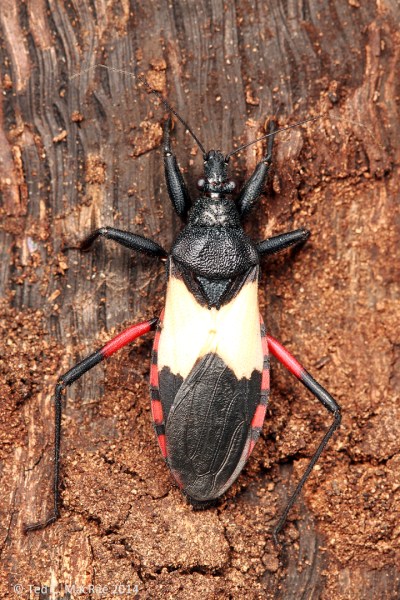
Microtomus purcis

Microtomus purcis (Drury, 1782) | Barry Co., Missouri

Sometimes called the “bark assassin bug”, this species is not quite as large as the better known “wheel bug” (Arilus cristatus) but makes up this by its spectacular coloration—black with the base of the wings prominently marked creamy-white and parts of the abdomen and hind legs bright red. One would think such a conspicuously  marked assassin bug with a bite powerfully painful enough to back up its apparent warning coloration could brazenly venture out during the day with little to fear. To the contrary, this species seems best known for its habit of hiding under bark during the day and venturing out only at night, during which time it is sometimes attracted to lights (Slater & Baranowski 1978, Eaton & Kaufman 2007). A majority of BugGuide photos of the species also mention finding them under bark or apparently attracted to lights.¹

¹ I was especially amused by this particular photo for which the contributor states, “While holding it, the bug pierced my finger nail with its proboscis. The pain was searing and I have a small blood stain under the nail.” I’ll admit it—I, too, learned firsthand how painful the bite of an assassin bug can be when I picked one up, in my case Melanolestes picipes, with plans to include it in my Entomology 101 collection.

Sunset on the glade

Sunset on the glade | Pilot Knob Conservation Area, Stone Co., Missouri

I, in fact, have only seen this species once before—also in Missouri and again under bark, although that time was during the winter, thus causing me to think this was its overwintering habit. I placed the individual in a glass vial and brought it indoors to “revive” it, but to my disappointment when I checked on it a few days later it was dead. Froeschner (1944) reported this species (under its older name, Hammacerus purcis) was “not uncommon” in Missouri, though apparently confined to the Ozark Highlands south of the Missouri River. Adult records in Missouri extended from September to March, with small nymphs being found during November and December, but BugGuide records include summer months as well. If I want to see this species more than twice in 30 years, I supposed I am going to have to spend more time peeling bark, or checking lights.

REFERENCES:

Eaton, E. R. & K. Kaufman. 2007. Kaufman Field Guide to Insects of North America. Houghton Mifflin Harcourt, New York, 391 pp. [Amazon preview].

Froeschner, R. C. 1944. Contribution to a synopsis of the Hemiptera of Missouri, Pt. III. Lygaeidae, Pyrrhocoridae, Piesmidae, Tingidae, Enicocephalidae, Phymatidae, Ploiariidae, Reduviidae, Nabidae. The American Midland Naturalist 31(3):638–683 [JSTOR preview].

Slater, J. A. & R. M. Baranowski. 1978. How to Know the True Bugs. The Pictured Key Nature Series, William C. Brown Company Publishers, Dubuque, Iowa, x + 256 pp. [Amazon description].

© Ted C. MacRae 2015

Best of BitB 2014

Welcome to the 7th Annual “Best of BitB”, where I pick my favorite photographs from the past year. Before I do this, however, let me briefly recap the year 2014. The trend of increasing travel each year continued, with more days spent on the road than in any prior year. Travel for work over the past few years has settled into a familiar routine—touring soybean fields in Argentina in late February and early March, working in my own field trials at (previously three, now four) sites in Illinois and Tennessee from late May through late September, touring more soybean fields at sites across the southeastern U.S. during mid-September, returning to Argentina in October to finalize plans for field trials in the upcoming season, and—finally—attending/presenting at the Entomological Society of America (ESA) Meetings (this year in Portland, Oregon). This heavy travel load makes scheduling my own insect collecting trips a bit tricky, but I’m a persistent sort! In late May I traveled to Tennessee and Georgia with fellow buprestophile Joshua Basham and lab mate Nadeer Youseff to collect several rare jewel beetles, then in late June I collected prionids and jewel beetles in Colorado, New Mexico, and Oklahoma with Jeff Huether. In addition to these longer trips, I also managed to take advantage of my work travel to check out interesting natural habitats along the way to and from my field sites. I continue to give the occasional entomology seminar as well, speaking in March at “Day of Insects” in Ames, Iowa and here in St. Louis to the Entomology Natural History Group of the Webster Groves Nature Study Society in April and the Missouri Master Naturalists Confluence Chapter in December. On top of all this, I still managed to vacation with my family in Lake Tahoe during March and in Cabo San Lucas, Mexico during late July.

I say all this to highlight the fact that after all these years I still consider myself an entomologist with a camera rather than a bona fide insect photographer. The reason for this is that the science of entomology itself remains my primary focus—photography is simply one of the tools that I have come to use in my pursuit of the discipline. I don’t mean to imply that I don’t continue to work on my photography style and technique—because I do. But my style and technique are not goals in of themselves; rather, they are means to an end—that end being my entomological studies. With that said, I present my favorite BitB photographs from 2014. As in previous years, my photos are largely hand-held, in situ field shots that are intended to tell a natural history story in a (hopefully) aesthetic manner. Links to original posts are provided for each photo selection, and I welcome any comments you may have regarding which (if any) is your favorite and why—such feedback will be helpful for me as I continue to hone my craft. If you’re interested, here are my previous years’ picks for 2008, 2009, 2010, 2011, 2012 and 2013. Once again, thank you for your readership, and I hope to see you in 2015!


Paraselenis tersa? female guarding her eggs | Cordoba Prov., Argentina

Paraselenis tersa (Boheman, 1854) | Cordoba Prov., Argentina

From Tortoise beetles on the job (posted April 20). This photograph of a tortoise beetle female over her egg mass illustrates maternal guarding behavior—rare in insects. The perfect lateral profile shot and clean, blue sky background also give the photo a pleasing aesthetic quality.


Who likes mole crickets?

Scapteriscus borellii Giglio-Tos, 1894 | Emanuel Co., Georgia

From Who likes mole crickets? (posted June 6). This has to be the most comical expression ever on the face of an insect!


Chrysobothris orono Frost, 1920 | South Cumberland State Park, Tennessee

Chrysobothris orono Frost, 1920 | South Cumberland State Park, Grundy Co., Tennessee

From Chrysobothris orono in Tennessee (posted July 29). I found this rare jewel beetle for the first time this year with the help of Josh Basham and Nadeer Youseff. The beetle itself is beautiful enough, but photographing it on a pine root with a presumed adult emergence hole adds considerable natural history interest to the photo. Rock substrate behind the root adds a pleasingly blurred background.


Buprestis (Stereosa) salisburyensis Herbst, 1801 | South Cumberland State Park, Tennessee.

Buprestis (Stereosa) salisburyensis Herbst, 1801 | South Cumberland State Park, Tennessee.

From The Buprestis tree (posted August 10). This was another of several jewel beetles that I found for the first time after more than three decades of collecting this group. I like the value contrast in this photo from the striking, metallic colors of the beetle against the nicely blurred cinnamon-colored pine bark of the tree on which it is sitting.


A "super moon" watches over a parasitized hornworm caterpillar.

A “super moon” watches over a parasitized hornworm caterpillar.

From A time of reckoning (posted August 13). I fully admit this is a composite photograph. Nevertheless, it is a faithful recreation of a true sight, and I don’t consider the use of composite techniques to overcome equipment shortcomings to be unethical. There is a haunting symmetry between the blood red moon—considered by some as a sign of the second coming—and the sad, parasitized caterpillar waiting for its inevitable demise.
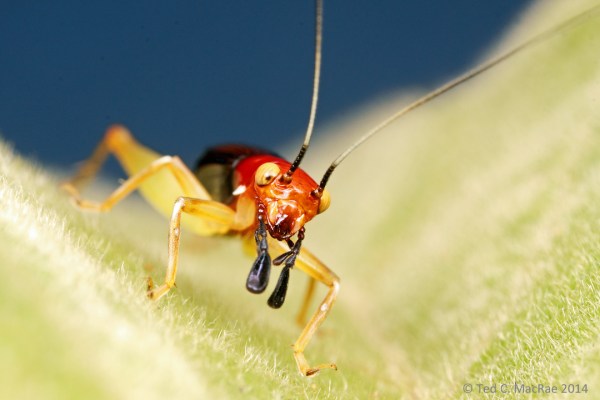

The greatly expanded palps are thought to mimic beetle mandibles or spider pedipalps.

Phyllopalpus pulchellus Uhler, 1864 | Hickman Co., Kentucky

From My, what busy palps you have! (posted September 2). I’ve become quite fond of insect photos with the subject “peering” at me, the photographer”, from some unusual vantage point. The “pupils” in the eyes of this red-headed bush cricket give the insect an almost quizzical look.


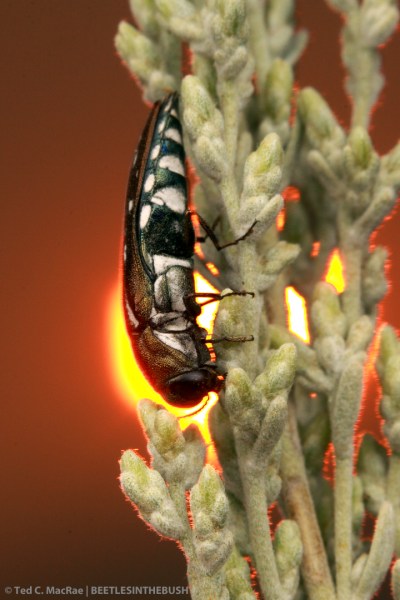
Acmaeodera immaculata Horn, 1881 | vic. Vogel Canyon, Otero Co., Colorado.

Acmaeodera immaculata Horn, 1878 | vic. Vogel Canyon, Otero Co., Colorado.

From Sunset beetles (posted September 30). Taking photos of insects at sunset is a challenging and ephemeral experience—one has only a few minutes to take advantage of the unusual and serene colors it offers, while at the same time trying to determine the best camera and flash settings to use in the rapidly fading light. Of the several that I’ve tried, this one is my favorite because of the softly complimentary colors of the beetle, the flower upon which it is sitting, and the dying orange sky behind it. If I had to choose, I would probably pick this one as my favorite of the year because of the unusual and serene colors.


Megacyllene decora (Olivier, 1795) | Stoddard Co., Missouri

Megacyllene decora (Olivier, 1795) | Stoddard Co., Missouri

From Amorpha borer on goldenrod (posted October 5). I featured this very same species in Best of BitB 2012 but can’t resist choosing this second attempt at photographing the spectacularly beautiful adult—this time on goldenrod. As with the previous version this is a true in situ field photograph, hand held and using the left-hand technique to achieve precise composition against a clear blue sky—difficult to do with an insect of this size and using a 100-mm lens, but well worth the effort.
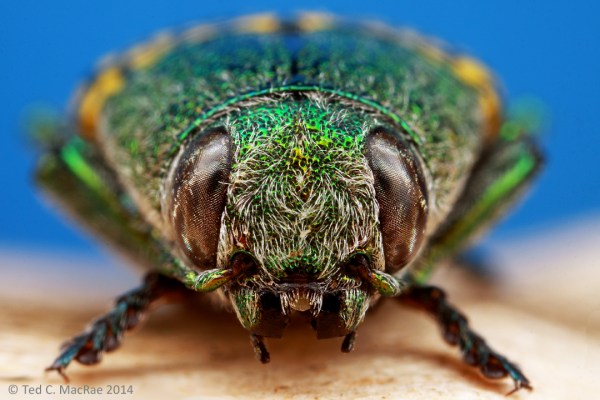

Buprestis (Knulliobuprestis) confluenta Say, 1823 | Woods Co., Oklahoma

Buprestis (Knulliobuprestis) confluenta Say, 1823 | Woods Co., Oklahoma

From A Buprestis hat-trick! (posted October 14). I didn’t take near as many of the classic “frontal portraits” this year, but this one of a jewel beetle that had eluded me for more than 30 years until this past June is perhaps my favorite of them all.
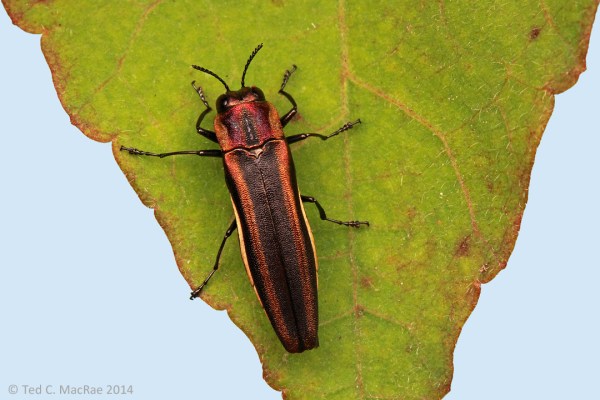

Agrilus concinnus  Horn, 1891 | Stoddard Co., Missouri

Agrilus concinnus Horn, 1891 | Stoddard Co., Missouri

From North America’s Most Beautiful Agrilus Jewel Beetle (posted October 19). There was a time when this beetle was considered one of North America’s rarest species of jewel beetle. Several years worth of hunting by me and others revealed this beetle’s association with mallow and its unusually late adult activity period—the two combining to make this beetle “seem” rare. This year I succeeded in photographing the spectacular adult beetle.


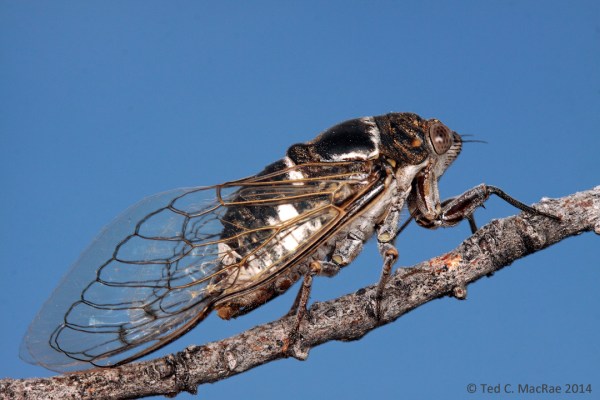
Cacama valvata female ovipositing

Cacama valvata (Uhler, 1888) | Vogel Canyon, Otero Co., Colorado

From Scorching plains, screaming cactus (posted December 5). Insect photos are always better when they also show some aspect of the subject’s natural history. I was lucky to find this female cactus dodger cicada in the act of ovipositing into the dry stem of cholla cactus—in a position where I could get a perfect lateral profile with a clean, blue sky background.
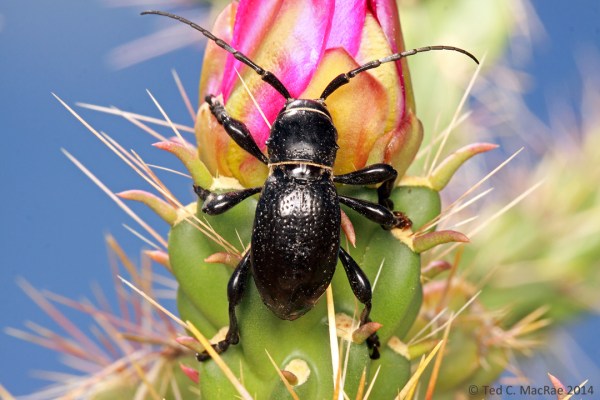

Moneilema armatum LeConte, 1853 | Vogel Canyon, Otero Co., Colorado

Moneilema armatum LeConte, 1853 | Vogel Canyon, Otero Co., Colorado

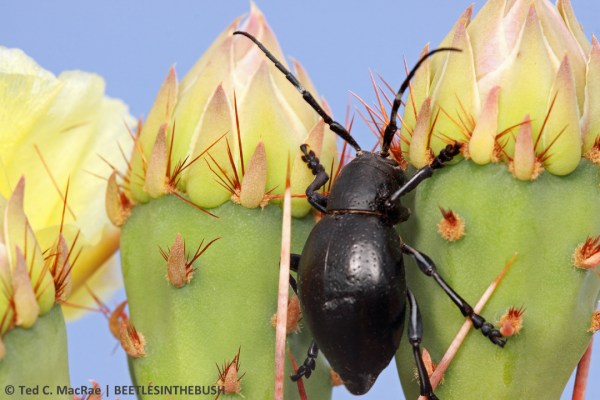
From Cactus beetle redux (posted December 20). Cactus beetles can be difficult to photograph, but sometimes they cooperate by nicely posing on a pleasing pink flower bud with a blue sky in the background and the cactus spines forming a nice, fuzzy “halo” around the jet black beetle. There were surprisingly few cactus spines impaled in the control unit of my flash after this photo session.


I hope you’ve enjoyed this 2014 version of “Best of BitB” and look forward to seeing everyone in 2015.

Copyright © Ted C. MacRae 2015
Scorching plains, screaming cactus

One of my greatest pleasures with collecting insects is not only the sights of the habitats that I visit, but the sounds. How many a night I’ve spent camped out in the Ozarks and watched royal moths fluttering at the blacklight sheet while dueling katydids traded their raspy “ch ch ch“s in the tree branches above and a whip-poor-will sang it’s haunting, eponymous song off in the distance. What joy to be hiking the canyon-lands out west and hear the musical, descending “t-te-tee-teee-teew-teeew-teeeew-teeeeew” of the canyon wren echoing off the tall, sheer rock faces. Even large-treed urban parks offer the hypnotizing “wee-er, wee-er, wee-er, weeeeeeeee” of scissor grinder cicadas (Tibicen pruinosa) on a hot summer night. Ah—cicadas! Few other animals can match their ability to fill a landscape with song, and with more than 100 species in North America it’s a safe bet that no matter where you go you can hear cicadas.

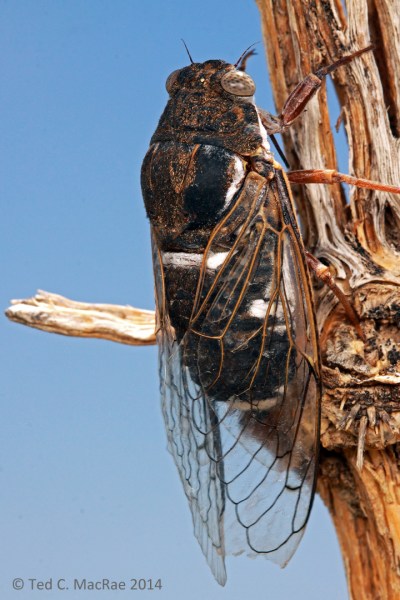
Cacama valvata

Cacama valvata (Uhler, 1888) | New Mexico, Harding Co., 5 mi W of Mills

Scissor grinders were the cicadas of my urban youth in Kansas City; I was a teenager the first time I heard the rich, pulsing buzz of bush cicadas (Tibicen dorsata) in the prairies around my house farther east in Blue Springs; and I experienced my first periodical cicada (Magicicada spp.) event as a young adult in St. Louis with Brood XIX and their whirring, “flying saucer” chorus. More recently, I’ve made several trips to the western Great Plains, where particularly large cicadas known as “cactus dodgers” (Cacama valvata) perch on prickly pear (Opuntia spp.) and cholla (Cylindropuntia imbricata) cacti and sing their loud, distinctive songs in the scorching, mid-summer heat. The male song has been described as a high pitched “metallic zing” (Beamer & Beamer 1930) or as an intense shrill, often in short bursts (Kondratieff et al. 2002); however, to me it sounds like a dull-bladed table saw cutting through a piece of ironwood and hitting a nail!

Cylindropuntia imbricata | Otero Co., Colorado.

Cholla (Cylindropuntia imbricata, Otero Co., Colorado) is a preferred host for Cacama valvata.

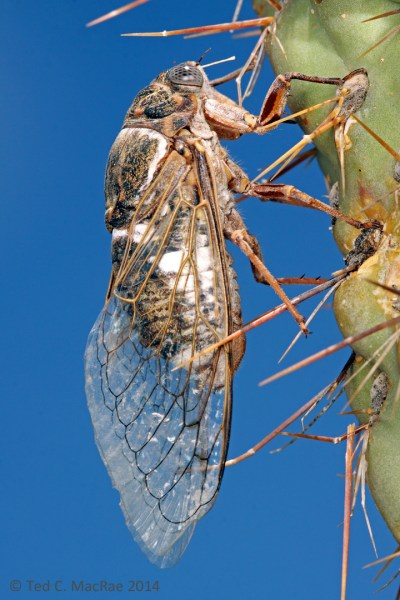
Fast flying and alert, cactus dodgers often defy the attempts of collectors (Kondratieff et al. 2002) and have the amazing ability to usually land safely on their spined hosts without becoming impaled (although occasionally this does happen—see photo below). The perils of dodging cactus spines, however, seem to pale compared with the benefits of utilizing these widespread hosts, as the association appears to have facilitated the spread of the species into a wide variety of environments across the southern Great Plains and westward to California (Sanborn & Phillips 2013).

Cacama valvata female

This female has a cactus spine impaled on her head.

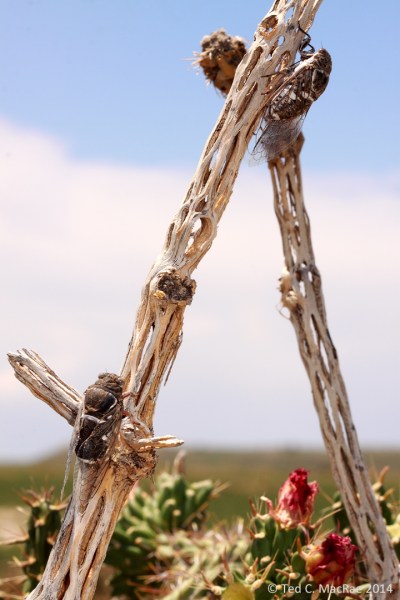
The photos in this post were taken during late June 2014 in the scorching, cholla-studded, shortgrass prairies of southeastern Colorado and northeastern New Mexico. Given their alertness and fast flying capabilities, they were a challenge to photograph before eventually finding the somewhat more cooperative subjects shown in the above photographs. Eventually, I was lucky enough to encounter two individuals sitting on a dead cholla stem in the mid-afternoon heat near Vogel Canyon, Colorado, one of which (the lower) was singing (and thus a male) and the other I surmised to be a female (this I confirmed once I got a better look through my camera viewfinder).

Cacama valvata male (bottom) & female (top)

A male Cacama valvata (bottom) sings to a female (top).

The male was creeping slowly towards the female as it sang, pausing occasionally and interrupting his song before resuming both. I presumed I was witnessing courtship singing, a behavior Kondratieff et al. (2002) have described in detail. They observed males perched on the ends of branches producing long, wavering, repeated shrills as they moved closer to the female. The song changed to a long shrill followed by shorter sequence of shrills as they made their final approach, which was followed by touching with the legs, mounting, and copulation.

Cacama valvata male singing

Cacama valvata male singing.

Unfortunately for this male, the female was already in the act of oviposition (poor male—wasting his time flirting with a married woman!). In cactus, females oviposit almost exclusively in dry, dead, skeletonized stems and rarely utilize green material (Beamer & Beamer 1930). The eggs laid by this female might remain in the dry stem for another three months or more, where they will await a fall rainstorm to wet the stem and ground and bring cooler temperatures to improve their chances of survival before hatching, dropping to the ground, burrowing into the soil, and searching for roots upon which they can feed.

Cacama valvata female ovipositing on dead cholla stem.

REFERENCES:

Beamer, L. D. & R. H. Beamer. 1930. Biological notes on some western cicadas. Journal of the New York Entomological Society 38(3):291—305 [pdf].

Kondratieff, B. C., A. R. Ellingson & D. A. Leatherman. 2002. Insects of Western North America 2. The Cicadas of Colorado (Homoptera: Cicadidae, Tibicinidae). Contributions of the C. P. Gillette Museum of Arthropod Diversity, Department of Bioagricultural Sciences & Pest Management, Colorado State University, Fort Collins, 63 pp. [pdf].

Sanborn, A. F. & P. K. Phillips. 2013. Biogeography of the Cicadas (Hemiptera: Cicadidae) of North America, North of Mexico. Diversity 5:166–239 (doi:10.3390/d5020166) [abstract].

© Ted C. MacRae 2014

Missouri’s largest planthopper

Although I have long dedicated myself to beetles, I must confess that my first love was the so-called “Homoptera”—that now defunct order containing some really cool bugs (cicadas and hoppers—i.e., leafhoppers, treehoppers, planthoppers, froghoppers, armadillohoppers, etc.) and some not-so-cool bugs (aphids, whiteflies, mealybugs, and their kin)¹. Perhaps you already sense that it was only the cicadas and hoppers that I really liked, the other mentioned groups being… well… boring from my perspective as a collector (overwhelming numbers of tiny, soft-bodied, sessile insects that required preservation in alcohol or on slides²). Even within the “cool” homopterans, however, some groups interested me more than others. Leafhoppers were okay, but my interest in them derived mostly from the fact that they were the subject of my thesis work. Treehoppers, on the other hand, were my favorite because they were just so adorably bizarre, and cicadas also fascinated me due to their size and behavioral charisma.

¹The homopterans have since been subsumed within the larger order Hemiptera (true bugs)—an irritating but necessary consequence of molecular studies that have shown rather conclusively that hoppers and cicadas are more closely related to the other true bugs than they are to the group containing aphids, whiteflies and mealybugs.

²So, not only are they boring to curate, but they directly caused the first order of insects in which I became interested to be completely dismantled!

Poblicia fuliginosa on Silphium terebinthinaceum (prairie dock)| Barry Co., Missouri.

Poblicia fuliginosa on Silphium terebinthinaceum | Barry Co., Missouri.

The planthoppers also interested me, although many of the various families contained within the group seemed not much different to me than leafhoppers. One family, however, stood out—the Fulgoridae. Much larger than the other planthoppers, they seemed like a cross between a planthopper and a small cicada (okay, a very small cicada)—combining the hopping capabilities of the former with the size (almost) of the latter. I only rarely encountered these bugs in Missouri; actually it was only a single species that I ever found—Poblicia fuliginosa, one of only two species in the family known to occur as far north as Missouri (Bartlett 2014). Moreover, when I did find them, they were extraordinarily wary and difficult to approach and collect. Vernon Brou, in a comment at this species’ BugGuide page, describes their capture-avoidance capabilities perfectly:

These are nearly impossible to capture by hand netting, they are rocket propelled. A most [frustratingexercise in futility.—Vernon Antoine Brou, Jr., pers. comm. to Mike Quinn, 2012.

The abdomen is brightly colored red (barely visible in this photo).

The abdomen is brightly colored red (barely visible in this photo).

This past fall, while on a collecting trip in the White River Hills of extreme southwestern Missouri, I chanced upon a few individuals perching on the stems of prairie dock (Silphium terebinthinaceum) in a dolomite glade. Remembering how wary they were in my previous encounters, I figured I had little chance of successfully photographing any of them. I love a challenge, however, and with the help of field mate Stephen Penn I managed to get the shots shown here. Getting within the range of focus generally caused the insects to dart around to the backside of the stem. I took advantage of this behavior by getting myself set and focusing the camera on the bug (even though it was behind the stem) and then having Stephen move his insect net slowly toward the bug from the side to get it to dart back around the stem away from the net… right into my field of view! The first individual we tried to photograph took off rather quickly (rocket-propelled!), but fortunately we found another individual in the same clump of stems and succeeded in getting some shots.

In the second photo the bright red abdomen is barely visible on the underside of the insect. The entire abdomen is, in fact, bright red in obvious contrast to the otherwise dark and somber coloration of the insect. I’ve searched the literature but can find no mention of the function of the red abdomen, but I presume it serves a flash coloration function similar to the bright green abdomen of some jewel beetles to confuse potential predators by its visibility in flight and then sudden disappearance when the insect lands and folds its wings over the abdomen. I suppose an aposematic function is also possible given the red coloration, but I’m not aware that any hoppers are known to be chemically protected, and the fact that the red abdomen is seen only during flight also suggests a non-chemically based function.

REFERENCES:

Bartlett, C. R. 2014 (and updates). Planthoppers of North America. Available at: http://canr.udel.edu/planthoppers (accessed 12 November 2014).

© Ted C. MacRae 2014

One-shot Wednesday: pale green assassin bug

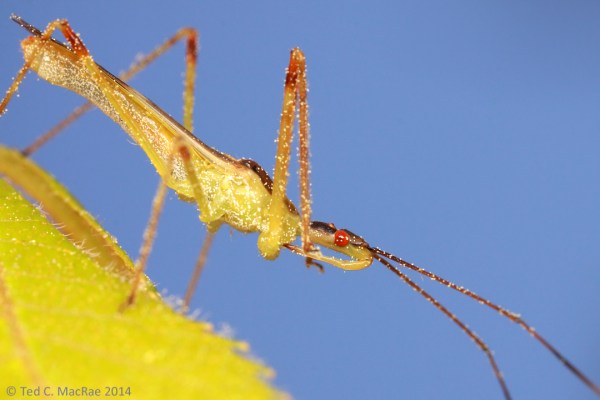
Zelus luridus (pale green assassin bug) | Howell Co., Missouri.

Zelus luridus (pale green assassin bug) | Howell Co., Missouri.

As my friend Rich and I set out a week ago Sunday on the final stretch in our quest to hike the 350-mile Ozark Trail in its entirety, I saw this slender, green assassin bug (family Reduviidae) sitting on a tender young leaf of an oak sapling. I already had my camera out but had outfitted with the 65-mm, 1–5× macro lens in anticipation of small beetles that I wanted to photograph on dogwood flowers. Nevertheless, it was still a bit on the cool side, making me think I might yet succeed in getting off some super-closeup shots of this delicate predator. I managed to carefully snip the leaf from the sapling and move the bug up close to the camera for a nice, blue-sky background shot, but one shot is all I got—as soon as the shutter clicked the bug took flight and left me with this single photo. As I have observed to usually be the case, the body of this individual is thickly covered with debris, which I take to be pollen from the abundant oaks at the height of their flowering period.

I’ve seen this species regularly over the years during my springtime forays in upland, oak-hickory Ozark forests. I presume the species is Zelus luridus, based on an online synopsis of the genus Zelus in eastern North America. As true bugs go, assassin bugs are undeniably cool—sometimes large, often colorful, and pure predators! Interestingly, these bugs have adopted a rather diverse array of strategies to assist their predaceous habits, mostly involving modifications of the front legs. Some involve a more typical raptorial design (similar to mantids) with chelate surfaces or even spines on the femora and tibiae, while others have developed flexible, cushion-like structures on the tips of the tibiae to aid in prey handling (Weirauch 2006). Gross morphological modifications, however, are not the only strategy employed by assassin bugs—some groups use secretions either to paralyze or immobilize their prey. Species in the genus Zelus employ the latter strategy—essentially using their front legs as “sticky traps”. The sticky substance is derived from glands on the front legs and is used to coat numerous, microscopically branched setae on the legs called “sundew setae” in reference to the similarity of appearance and function with insectivorous sundew plants. Interestingly, sundew setae have also been found on other parts of the body, at least in first-instar Z. luridus nymphs, leading to speculation that they may also serve some other function besides prey capture. Perhaps these setae explain why most individuals I see are so debris-covered, as with the pollen-laden individual above.

REFERENCE:

Weirauch, C. 2006. Observations on the sticky trap predator Zelus luridus Stål (Heteroptera, Reduviidae, Harpactorinae), with the description of a novel gland associated with the female genitalia. Denisia 19, zugleich Kataloge der OÖ. Landesmuseen
Neue Serie 50:1169–1180 [pdf].

© Ted C. MacRae 2014

Best of BitB 2013

Welcome to the 6th Annual “Best of BitB”, where I pick my favorite photographs from the past year. Like last year, 2013 was another year of heavy travel. For work I did my annual tour of soybean field sites throughout Argentina during late February and early March, then cranked it up for my own field season with frequent travel to sites in Illinois and Tennessee from May to October. In the meantime I spent a week at company meetings in Las Vegas in August, toured field sites across the southeastern U.S. for two weeks in September, visited Argentina again in October to finalize research plans for their upcoming season, and finished off the travel year by attending the Entomological Society of America (ESA) Meetings in Austin, Texas during November. On top of all this, I managed to slip in two of the best insect collecting trips I’ve had in years, with 10 days in northwestern Oklahoma in early June and another 10 days in California, Nevada, Utah, and Colorado during late August, and I got to play “visiting scientist” during short trips to Montana State University in late July and the Illinois Natural History Survey in late October! Of course, during my brief interludes at home I wasn’t sitting still, giving entomology seminars to several local nature societies and hosting two ESA webinars on insect photography. Needless to say, come December I was more than ready to spend some quite time at home (well, except for hiking most weekends) and am happy to report that I’ve successfully become reacquainted with my family and office mates. It’s a peripatetic life—and I wouldn’t have it any other way!

Okay, let’s get down to business. Here are my favorite BitB photographs from 2013. This year was less about learning new techniques as it was about refining the techniques I’ve found most useful for the style I’ve chosen as a photographer, i.e., hand-held, in situ field shots that (hopefully) excel at both natural history and aesthetic beauty. Links to original posts are provided for each photo selection, and I welcome any comments you may have regarding which (if any) is your favorite and why—such feedback will be helpful for me as I continue to hone my craft. If you’re interested, here are my previous years’ picks for 2008, 2009, 2010, 2011, and 2012. Once again, thank you for your readership, and I hope to see you in 2014!


Tremex columba, female ovipositing | Sam A. Baker State Park, Missouri

Tremex columba female drilling for oviposition into hardwood trunk | Sam A. Baker State Park, Missouri

From Ovipositing Pigeon Horntail (posted 6 Jan). I like this photo for the combination of vibrant, contrasting colors between the wasp and moss-covered wood and the visualization it provides of the remarkable depth to which this wasp will insert its ovipositor into solid wood!


Eurhinus cf. adonis on Solidago chilensis | Chaco Province, Argentina

Eurhinus cf. adonis on Solidago chilensis flowers | Chaco Province, Argentina

From Giving me the weevil eye! (posted 28 Apr). While a little soft, the color combination is pleasing and the pose taken by the beetle almost comically inquisitive.


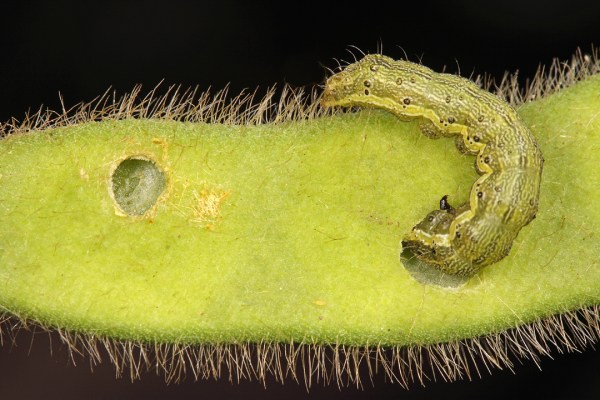
Helicoverpa gelotopeon feeding on soybean pod | Buenos Aires Prov., Argentina

Helicoverpa gelotopeon feeding on soybean pod | Buenos Aires Prov., Argentina

From Bollworms rising! (posted 30 Mar). This is the first photo of an economic pest that has made one of my “Best of BitB” lists. The two holes in the soybean pod, one with the caterpillar and its head still completely inserted, visualizes how the feeding habits of these insects can so dramatically affect yield of the crop.


cf. Eremochrysa punctinervis | Gloss Mountains, Major Co., Oklahoma

cf. Eremochrysa punctinervis | Gloss Mountains, Major Co., Oklahoma

From “Blue-sky” tips and tricks (posted 1 July). Insects with a lot of delicate detail and long, thin appendages are especially difficult to photograph against the sky due to wind movement. See how I dealt with the antennae of this delicate lacewing without resorting to the standard black background typical of full-flash macrophotography.


Cicindela scutellaris lecontei x s. unicolor

Cicindela scutellaris lecontei x s. unicolor intergrade | Holly Ridge Natural Area, Stoddard Co., Missouri

From The Festive Tiger Beetle in Southeast Missouri (posted 25 Oct). I like this photo a lot more now than I did when I first took it. Its shadowy feel and the beetle “peering” from behind a leaf edge give a sense of this beetle’s attempts to hide and then checking to see if the “coast is clear”


Batyle suturalis on paperflower (Psilostrophe villosa) | Alabaster Caverns State Park, Woodward Co., Oklahoma

Batyle suturalis on Psilostrophe villosa flowers | Alabaster Caverns State Park, Woodward Co., Oklahoma

From Tips for photographing shiny beetles on yellow flowers (posted 10 Aug). “Bug on a flower” photos are a dime a dozen, but shiny beetles on yellow flowers with natural sky background can be quite difficult to take. All of the techniques for dealing with the problems posed by such a photo came together nicely in this photo.


Agrilus walsinghami | Davis Creek Regional Park, Washoe Co., Nevada

Agrilus walsinghami | Davis Creek Regional Park, Washoe Co., Nevada

From Sunset for another great collecting trip (posted 1 Sep). This photo is not without its problems, with a little blurring of the backlit fuzz on the plant, but the placement of the sun behind the subject’s head and resulting color combination make it my favorite in my first attempts at achieving a “sun-in-the-sky” background with a true insect macrophotograph.


A tiny male mates with the ginormous female.

Pyrota bilineata on Chrysothamnus viscidflorus | San Juan Co., Utah

From Midget male meloid mates with mega mama (posted 8 Nov). Another blue-sky-background photograph with good color contrast, its real selling point is the natural history depicted. with some of the most extreme size dimorphism among mating insects that I’ve ever seen.


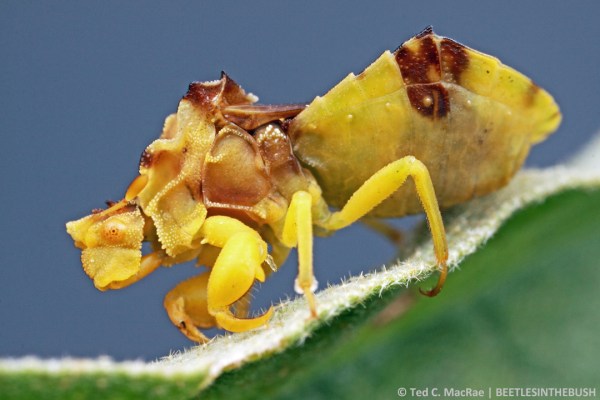
Phymata sp.

Phymata sp. on Croton eleagnifolium foliage | Austin, Texas

From ESA Insect Macrophotography Workshop (posted 13 Nov). The oddly sculpted and chiseled body parts of ambush bugs makes them look like they were assembled from robots. Contrasting the body against a blue sky gives a more unconventional view of these odd beasts than the typical top-down-while-sitting-on-a-flower view.


Fourth attempt - holding detached pad up against sky for cleaner background.

Moneilema armata on Opuntia macrorhiza | Alabaster Caverns State Park, Woodward Co., Oklahoma

From Q: How do you photograph cactus beetles? (posted 24 Nov). Photographing cactus beetles requires patience, persistence, long forceps, and strong forearms. Natural sky provides a much more pleasing background than a clutter of cactus pads and jutting spines.


I hope you’ve enjoyed this 2013 version of “Best of BitB” and look forward to seeing everyone in 2014.

Copyright © Ted C. MacRae 2013

Red-eyed poop!

I was looking at some of my older files and ran across these photographs taken in early 2011 in Campinas (São Paulo state), Brazil. They’re not my best photos from a compositional and technical perspective, as I was still on the steep part of the learning curve with the Canon MP-E 65mm macro lens. This lens is no doubt powerful and allows amazingly close-up photographs, but it is rather a beast to learn in the field, especially hand-held. I could quibble endlessly about missed focus and suboptimal composition with these shots, and that is probably why they never made it to the front of the line for being posted. Nevertheless, they still depict some interesting natural history by one of nature’s most famous natural history poster children—the treehoppers (order Hemiptera; family Membracidae).

An adult next to a cast nymphal exuvia.

Bolbonota sp. (Hemiptera: Membracidae), upper right | Campinas, São Paulo, Brazil. Note cast exuvia.

The treehoppers shown in these photos were found on a low shrub in a municipal park and are all that I could manage before my clumsy, unpracticed molestations caused the few adults and nymphs present in the aggregation to disperse. The dark coloration of the adult and its globular form, corrugated pronotal surface, and lack of any horns identify the species as a member of the genus Bolbonota in the New World tribe Membracini (another similar genus, Bolbonotoides, occurs as a single species in Mexico). Species identification, however, is much more difficult, as there are at least a dozen species recorded from Brazil and perhaps many more awaiting description. We have a similar though slightly more elongate species here in eastern North America, Tylopelta americana. I don’t know if this is a specific character or not, but I don’t recall seeing any members of this genus with smoldering red eyes—it gives them an almost devilish appearance, especially the blackish adults (see last photo)!

Bolbonota sp. late-instar nymphs clustered together.

Bolbonota and similar genera are often cited by evolutionists as examples of insects that mimic seeds. I can see such a resemblance if I force myself, but honestly I don’t really buy it. To me they seem to bear an uncanny resemblance to the chlamisine leaf beetles which are thought to mimic caterpillar frass. As with the beetles they resemble, frass-mimicry seems to make much more sense than seed-mimicry, especially given their preference for positioning themselves along the stems of the plants on which they feed (when was the last time you saw seeds of a plant randomly distributed along its stems?). Another thought I’ve had is that this is not an example of mimicry at all, but merely an accidental consequence of the heavy, corrugated body form they have adopted, which likely also affords them a reasonable amount of protection from predation. Confounding both of these theories, however, are the radically different appearance and form of the adults versus the nymphs, and indeed even between the different nymphal instars (see early- and late-instar nymphs in photo below). The later instars seem perfectly colored for mimicking unopened leaf buds, but why they would start out dark in early instars before turning mottled/streaked-white as they mature, only to revert back to dark when reaching adulthood, is a mystery to me. If my thoughts are anywhere close to the truth, it would be a remarkable case of different life stages mimicking the products of two different taxonomic kingdoms (plant parts as nymphs, animal poop as adults)!

Bolbonota sp. nymphs tended by Camponotus sp. | Campinas, São Paulo, Brazil.

An ant (presumably Camponotus sp.) tends a first-instar nymph alongside a later instar.

Of course, if either/both of these lines of defense fail then there are the ant associates that often protect treehoppers and other sap-sucking, aggregating insect species in exchange for the sweet, sugary honeydew that such insects exude as a result of their sap-feeding habits. I presume this ant belongs to the genus Camponotus, perhaps C. rufipes or C. crassus which are both commonly encountered treehopper associates in southern Brazil. I have written previously about ant-treehopper mutualism in the stunningly-marked nymphs of another treehopper, Guayaquila xiphias, and its ant-associate C. crassus in Brazil Bugs #15 – Formiga-membracídeos mutualismo (a post that has become one of this blog’s most popular all-time). Maybe this post will never match that one in popularity, but I do find the third photo shown here remarkable in that is shows no less than five elements of this treehopper’s natural history (early-instar nymph, late-instar nymph, cast nymphal exuvia, partial adult, and an ant-associate) within a single frame (shot by a person still on the steep portion of the MP-E 65mm learning curve!).

Copyright © Ted C. MacRae 2013

Hooray for iStock—I finally have an ID for my photo

I was all set to make a “One-Shot Wednesday” post today, but sometimes big news strikes and plans must change. The news today was in the form of a random tweet by Alex Wild:

iStock-caption_Wild-20131120

The link in the tweet led me to the following photo on iStock by Getty:

bedbug has captured worm

I was stunned—the photo depicted a scene almost identical to one that I had photographed back in September while visiting soybean fields in Louisiana. For two months I sat on the photo with no idea what I was looking at, but now thanks to Alex I have my answer! Compare the above photo with mine below, and you’ll see that everything matches perfectly—I had photographed a “bedbug” that had captured a “worm”!

Podisus maculiventris preying on Chrysodeixis includens larva

bedbug captures a worm

I considered myself to be fortunate, because there was not just one but two different subjects in the photo, and both of them matched perfectly with the subjects shown in the iStock photo. Gotta love the internet—nowadays names for even the most hard-to-identify bugs are just a click away if you know where to look!

</snark>

Of course, the aggressor in both photos is not a “bedbug” [sic for “bed bug”] (order Hemiptera, family Cimicidae) but a stink bug (family Pentatomidae), specifically Podisus maculiventris, or “spined soldier bug”—perhaps the most common predatory stink bug in North Amerca and ranging from Mexico and parts of the West Indies north through the U.S. into Canada. It is a well-known predator of crop pests and, as such, has been imported to several other countries as part of classical biological control efforts. As for the “worm,” in my photo it is a late-instar larva of Chrysodeixis includens, or “soybean looper, and while I haven’t been able to identify the exact species in the iStock photo it is definitely a lepidopteran caterpillar that appears to related to if not in the same family as the soybean looper (Noctuidae). Now, I concede that “worm” is sometimes used for lepidopteran larvae, but one must also concede that in it’s broadest sense “worm” can refer to members of several disparate phyla such as Nematoda (roundworms), Platyhelminthes (flatworms), or Annelida (segmented worms).

This case, of course, just screams for application of the Taxonomy Fail Index (TFI), which scales the amount of error in a taxonomic identification in absolute time against the error of misidentifying a human with a chimpanzee—our closest taxonomic relative. For example, when TFI = 1 the error is of the same magnitude as mistaking a human for a chimp, while  TFI > 1 is a more egregious error and TFI < 1 a more forgivable one. In the case shown here, one must go back to the common ancestor that eventually gave rise to all of the worm phyla and noctuid moths (~937.5 mya). In addition, since there are two subjects in the photo, one must also go back to the divergence of the main hemipteran groups that contain bed bugs and stink bugs (mid-Triassic, ~227.5 mya). This results a whopping 1.165 billion total years of divergence between the identifications assigned to the subjects in the iStock photo and their actual identity. Assuming that chimps and humans diverged approximately 7.5 mya, this gives a TFI for the iStock photo of 155! I haven’t searched thoroughly to determine whether this is a record for the highest TFI in a single photo, but surely it is a strong contender!

Copyright © Ted C. MacRae 2013