2015 Texas Collecting Trip iReport—Fall Tiger Beetles

This is the fourth in a series of “Collecting Trip iReports”—so named because I’ve illustrated them exclusively with iPhone photographs. As I’ve mentioned in previous articles in this series (2013 Oklahoma2013 Great Basin, and 2014 Great Plains), I tend to favor my iPhone camera for general photography—i.e., habitats, landscapes, miscellaneous subjects, etc.—during collecting trips and save my full-sized dSLR camera only for those subjects that I want high-quality macro photographs of. iPhones are not only small, handy, and quick but also capable (within reason) of quite good photographs (see this post for tips on making the most of the iPhone camera’s capabilities). This keeps the amount of time that I need to spend taking photos at a minimum, thus allowing more time for the trip’s intended purpose—collecting! Those photos form the basis of this overall trip synopsis, while photos taken with the ‘real’ camera will be featured in future posts on individual subjects.

Last year during late September and early October I travelled to eastern and central Texas. This trip was all about fall tiger beetles, in particular certain subspecies of the Festive Tiger Beetle (Cicindela scutellaris) and Big Sand Tiger Beetle (Cicindela formosa) found in that area that I had not yet seen. I enjoy all collecting trips, but fall tiger beetle trips are among the most enjoyable of all—cooler temperature, a changing landscape, and charismatic subjects that are both fun and challenging to find and photograph. This trip was no different, with spectacular weather during the entire week and, for the most part, great success in finding the species/subspecies that I was after. At this point I’d like to acknowledge the help of several people—David Hermann (Ft. Worth, Texas), David Brzoska (Naples, Florida), and Steve Spomer (Lincoln, Nebraska), who generously provided information on species and localities. My success at finding these beetles was due in large part to the information they provided.


Day 1 – Cobb Hollow

My car

Little question about what I am doing out here.

After driving 700 miles from my home near St. Louis, I arrived at the first stop of trip—Cobb Hollow in north-central Texas. This small creek lined with deep, dry sand is close to Forestburg (Montegue County)—the type locality of Cicindela scutellaris flavoviridis, a beautiful, all-green subspecies with the elytra suffused golden-yellow.  The habitat looked very promising from the start, and it wasn’t long before I found the first tiger beetle of the trip—a gorgeous, red nominate Big Sand Tiger Beetle (Cicindela formosa formosa). Not long after that I found the first Cicindela scutellaris flavoviridis, and over the next few hours I would find a total of nine individuals. Despite the extensive habitat along the creek the beetles were quite localized, occurring primarily in two dry sand areas within a mile west of the bridge. This spot is actually near the northern limit of the subspecies’ distribution, and several of the individuals showed varying influence from nominate scutellaris with the elytra tending to be more red than yellow-green. There was a diversity of other tiger beetles here as well—C. formosa formosa was the only one that was common, but I did find also a few individuals each of Tetracha carolina, Cicindelidia punctulata, Cicindela splendida, and C. repanda. A very cool place.

Cobb Hollow from bridge

View of Cobb Hollow east from the bridge

Sand bar along creek

Dry sand deposits line the creek.

Robber fly with bumble bee prey

I watched this robber fly snag a bumble bee in mid-flight.

Ted MacRae at Cobb Hollow

Looking down onto the creek from the bridge.


Day 2 – Stalking the Limestone Tiger Beetle

Today was all about looking for the Limestone Tiger Beetle, Cicindelidia politula. I have collected this species previously at several sites in Erath and Somervell Counties, Texas (west of Ft. Worth) and featured photographs from that trip. However, since I would be passing through the area on my way south I decided to spend a day looking for it again and, hopefully, collecting a few more specimens. Cicindelidia politula is related to the much more common and widespread Punctured Tiger Beetle, C. punctulata, but is shiny blue-black with the elytral markings absent or limited to the apices and the abdomen red. I visited several localities—two new ones for me in Erath County and another I had visited previously in Somervell County, with habitats that ranged from rocky clay to white limestone exposures along roadsides and even limestone gravel.

I found a fair number of individuals at the first site (1.7 mi SW Bluff Dale, Jct US-377 & FM-1188), which had a finely ground limestone substrate. Most of the individuals were flushed from the base of clumps of bunch grass and captured when they landed in more exposed situations.

Limestone habitat for Cicindelidia politula

Cicindelidia politula habitat—1.7 mi SW of Bluff Dale.

The beetle had also been reported along the roadsides at the second location (0.4 mi E Jct FM-2481 on CR-539), but the only individual I saw here was on a very coarse crushed limestone 2-track leading off of the main road.

Limestone habitat for Cicindelidia politula

Cicindelidia politula habitat—0.4 mi E Jct FM-2481 on CR-539.

The species was most numerous at the third site in Somervell County (3.4 mi SE Jct US-67 on CR-2013). I collected ten individuals and saw probably that many more on white limestone exposures along the roadside and along a dirt road cut along the base of the hill to the NE side of the highway. Most of the beetles in the latter area were seen along the scraped dirt road (at left in 2nd photo below), although presumably the beetles also utilized the undisturbed, surrounding habitat.

Limestone habitat for Cicindelidia politula

Cicindelidia politula habitat on white, limestone exposures along the roadside.

Limestone habitat for Cicindelidia politula

Cicindelidia politula habitat on white limestone hillside and scraped dirt road.

Catching the beetles at this last locality was challenging—the adults are fast and flighty, and the rough, rocky habitat made it difficult to clamp the net over the beetle and pounce on top of the rim before they were able to find a gap and escape. With practice I found my catch efficiency increased a little bit if I slowly approached the beetle and then made an assertive swing with the net right when the beetle began to fly—the trick is learning how to tell when they are ready to fly (and “assertive” is the key word!). Tiger Beetle Stalker; however, does not quit!

Tiger beetle stalker!

Tiger Beetle Stalker!


Day 3 (Part 1) – Pedernales Fall State Park

This was another locality where Cicindela scutellaris flavoviridis had been recorded. I came here to find this subspecies even though I had seen it two days previously at Cobb Hollow, because that latter population showed some slight intergradation of characters from nominate C. scutellaris and I wanted to get field photographs of a “pure” population. I was pretty excited when I saw extensive dry sand habitat lining the upper bank area along the Perdenales River; however, I found no tiger beetles of any kind after extensive searching through that habitat. I did note the area seemed dry and reasoned that perhaps timely rains had not yet triggered emergence of C. scutellaris, C. formosa, and other sand-loving fall tiger beetles. I did find a small area of wet sand right along the water’s edge where three species of Cicindelidia could be seen: C. ocellata rectilatera, C. trifasciata ascendens, and C. punctulata. I’ve photographed all of these species before, so I didn’t try to spend any time doing so here. However, combined with the species seen the previous two days, this made a total of ten species seen on the trip so far. Although I didn’t find the beetle I was looking for, I marveled at the beauty of the area, especially the Pedernales River with its hard, conglomerate bedrock and mini shut-ins and spent quite a bit of time here taking photographs.

Perdenales River

The Perdenales River is the centerpiece of the state park.

Schistocerca americana or nitens

Schistocerca americana or S. nitens (ID courtesy of Matt Brust).

Perdenales River

Shut-ins are extensive along the Perdenales River.

Poecilognathus sp.

Bee flies (family Bombyliidae), prob. Poecilognathus sp. (ID courtesy Rob Velten).


Day 3 (Part 2) – Lick Creek Park

Another of the Festive Tiger Beetle subspecies that I wanted to look for was Cicindela scutellaris rugata. I had several localities from which this solid blue-green subspecies has been recorded, and this site was the nearest of those that I planned to visit. The drive from Pedernales State Park was longer than I anticipated, so I didn’t get to this spot until close to 6 p.m. At first I worried that I wouldn’t have enough time to even find suitable habitat, but that was no problem as I quickly found the Post Oak Trail and its perfect open, post oak woodland with deep sand substrate. By all accounts the beetles should have been all over the trail but they weren’t. As with the previous site, the area was quite dry as evidenced by the wilted plants along the trail side, and I also note that the previous record from here was on Oct. 23rd—more than three weeks later. Despite the fact that I didn’t find any tiger beetles, I did see a young timber rattle snake (Crotalus horridus) crossing the trail late in the hike—I took a quick shot with the iPhone (see below) and then broke out the big camera and was able fire off a few shots before it left the trail and headed for cover. (Several people walking the trail came upon us, and they were all—happily—more than willing to oblige my requests to stay away until I was finished.)

Sand woodlant habitat for Cicindela scutellaris rugosa

Post oak woodland with dry sand substrate seems to be perfect for Cicindela scutellaris rugata.

Wilted American beautyberry (Callicarpa americana)

Wilted American beautyberry (Callicarpa americana).

Timber rattlesnake (Crotolus horridus)

A youngish (prob. ~32″ in length) timber rattlesnake (Crotolus horridus) was a treat to see.


Day 4 – East Texas cemeteries

Cemeteries are often great places to look for tiger beetles because they tend to be located on parcels of land with low agricultural value that were donated by landowners to local churches. Older cemeteries especially tend not to be highly maintained and, thus, offer excellent habitat for tiger beetles. My goals for this day were Cicindela scutellaris rugata and the gorgeous Cicindela formosa pigmentosignata. I had records of both from a couple of cemeteries in eastern Texas (Sand Flat Pioneer Cemetery in Henderson and Morris Chapel Cemetery in Van Zandt Counties) and found good numbers of both along sandy 2-tracks and sparsely to moderately vegetated sand exposures in and around the cemetery grounds. I don’t have any iPhone photographs to share of either of these species, but I did spent a lot of time with the big camera and got a number of photos of each that I am quite pleased with—I’ll share those in future posts. The cemeteries themselves were haunting and poignant, with some headstones dating back to the late 1800s.

Sandy 2-track habitat for Cicindela scutellaris rugata & C. formosa pigmentosignata

Sandy 2-track habitat for Cicindela scutellaris rugata & C. formosa pigmentosignata at Sand Flat Pioneer Cemetery, Henderson County, Texas.


Ant mound

Pogonomyrmex sp. poss. barbatus tend their nest entrance (ID courtesy of Ben Coulter).

Sand Flat Pioneer Cemetery

Oldest section of Sand Flat Pioneer Cemetery.

Died Nov 10, 1874

Fallen, but not forgotten—yet (died Nov 10, 1874).

Oldest headstones (late 1800s)

Oldest headstones (late 1800s) at rest under the shade of huge, red-cedar trees.

Oldest person (106 yrs old)

The oldest person died at 106 years of age (born in 1804).

At Morris Chapel Cemetery I found C. formosa pigmentosignata and C. scutellaris rugata on sparsely vegetated deep dry sand 2-track north of the cemetery. I did also manage to get field photos of the former before it got too hot and they became too active. There were also a few of the latter in the open sandy ground just outside the northwestern edge of the cemetery. As with Sand Flat Pioneer Cemetery, I spent a bit of time in the cemetery proper to look at the headstones—the oldest headstone also being the most poignant; a one and a half-year old boy who died in 1881.

Sandy 2-track habitat for Cicindela scutellaris rugata & C. formosa pigmentosignata

Sandy 2-track habitat near Morris Chapel Cemetery.

Morris Chapel Cemetery

A large, spreading post oak shades pioneers at rest.

Died 1881 (age 1½ yrs)

A poignant headstone (died 1881 at 1½ years of age).

After finishing up at Morris Chapel Cemetery I returned to Sand Flat Cemetery to see if I could get more field photographs before the beetles bedded down for the night. The sun was still up when I arrived a little before 6 p.m., but the shadows were long and no beetles were seen. Not one to waste an opportunity, I broke out the big camera anyway and started photographing a large species of bee fly (family Bombyliidae) that was perching on the ground and on the tips of plains snakecotton (Froelichia floridana).

Undet. bee fly

Bee fly (family Bombyliidae), poss. Poecilanthrax lucifer? (ID courtesy Alex Harman).


Day 5 (Part 1) – Cowtown Bowman Archery Club

With both specimens and good field photos of Cicindela scutellaris rugata and C. formosa pigmentosignata in hand, I returned my attention to C. scutellaris flavoviridis. Again, I did already have specimens in hand from Cobb Hollow, but most of them showed some degree of intergradation with nominate C. scutellaris and I was hoping to see some “pure” individuals. Failing to find it at the more southerly locations (Pedernales State Park and Lick Creek Park), I had one more location in Tarrant County where the subspecies had been recorded—a sand borrow pit near the entrance of Cowtown Bowman Archery Club. Once again I searched the area thoroughly for a couple of hours during mid-morning but did not see the subspecies or any other tiger beetles. Conditions were overcast and cool (72°F), but I do not think this explains the absence of adults. Rather, I think I was on the early side of the season and they just hadn’t started emerging at this site.

While I was at the site I found several tiger beetle larval burrows in a moderately vegetated area near the deeper sand deposits that were occupied by Tetracha carolina, so I used the “stab” or “ambush” method to collect several 3rd instars for an attempt at rearing. For those of you who are not familiar with this technique, a knife is set at a 45° angle with the tip in the soil about 1″ from the edge of the burrow. Then you wait, sometimes for quite a while, until the larva reappears at the top of the burrow and STAB the knife assertively into the soil to block the larva from retreating. The larvae are extremely wary with excellent vision and will usually drop back down immediately when they see you, so you have to be ready and act quickly. Once the retreat is blocked, a simple twist of the knife to expose the larva is all that is needed. I prepared larval habitats by placing native soil with as intact a top layer as possible in plastic critter carriers, made a starter hole for each larva with a pencil, dropped each larva into one of the holes, and then pushed the soil to seal the burrow entrance. This prevents the larvae from crawling right back out of the starter burrow, which can result in them encountering and fighting each other. The larvae will eventually reopen the burrow entrance, but after being sealed inside for a while they usually accept the burrow and further modify it to suit their needs.


Sandy grassland habitat for Tetracha prob. carolina

Sandy grassland habitat for Tetracha carolina.

Larval burrows (lower left) can be recognized by their clean, almost perfectly round, beveled edge. The presence of fresh soil diggings cast to one side (upper right) indicates the burrow is occupied by an active larva.

Tetracha prob. carolina larval burrow

Tetracha carolina larval burrow with cast soil diggings.

Using the “stab” or “ambush” method to collect larvae. One must have patience to successfully use this method.

"Stab 'n; grab" method to collect tiger beetle larvae (Tetracha prob. carolina)

Using the “stab” or “ambush” method to collect tiger beetle larvae.


Day 5 (Part 2) – Cobb Hollow (epilogue)

Although I had found Cicindela scutellaris flavoviridis at this site on the first day of the trip, I had not taken any field photographs in hopes of finding a more “pure” population at one of the more southerly locations. That did not happen, so I returned to Cobb Hollow on this last day in the field to get field photographs from the population there. Temperatures were a bit cooler (mid-70s) and cloud cover was variable, actually sprinkling when I arrived mid-afternoon but eventually clearing. This seemed to have no detrimental effect on adult presence, and it may have actually helped as I was able to photograph the very first individual that I found to my heart’s content. I collected that individual and the next three that I saw by hand and found two more over the next hour—all on the same deep, dry sand bars west of the bridge where I had seen them previously. Curiously, Cicindela formosa was strangely absent from these same areas where they had been so numerous a few days earlier.

Habitat for Cicindela formosa formosa and C. scutellaris flavoviridis

Deep, dry sand deposit where most of C. scutellaris flavoviridis were seen.

On the east side of the bridge I collected two more Tetracha carolina in the same moderately vegetated sandy clay spot as last time, then went on to the furthest dry sand bar where I found and photographed (but did not collect) a single C. formosa (only one shot before it took off). I also found a female green lynx spider (Peucetia viridans) sitting on her egg mass and got some nice macro photos as well as this iPhone shot (talk about a face only a mother could love!).

???????????????????????????????????????????????????????????????????

Female green lynx spider (Peucetia viridans) atop her egg mass.


I hope you’ve enjoyed this collecting trip iReport. Stay tuned for true macro photographs of the tiger beetles and other insects/arthropods that I photographed on this trip in more subject-specific posts. You are also welcome to leave feedback in the comments below.

Ted MacRae w/ field collecting equipment & camera

© Ted C. MacRae 2016
Multiple Megarhyssa males

Today while hiking at Hilda Young Conservation Area (north-central Jefferson County, Missouri), I encountered a declining sugar maple (Acer saccharum) with lots of woodboring insect holes in the trunk. As I approached I noticed numerous giant ichneumon wasps in the genus Megarhyssa flying about the trunk and resting on its surface. Giant ichneumons belong to the family Ichneumonidae and are, as the name suggests, the largest members of the family in North America. Interestingly, all of the wasps that I initially saw were males. I have never seen male giant ichneumon wasps before, and certainly not in such numbers, so this was quite exciting. We have two species of giant ichneumons here in Missouri—M. atrata and M. macrurus, the females of which I have seen only rarely, but I couldn’t immediately decide which of these two species the males represented. I looked up higher on the trunk, and there I saw a female M. macrurus in the act of oviposition, so I decided that the males must also represent this species. However, one of the males was smaller and differently colored than the others, having more brown than black on the body and the wings clear with a well developed spot on the costal margin. The other males were noticeably larger and had more black than brown on the body and the wings smoky with only a narrow spot on the costal margin. After a little bit of digging, I know believe that the smaller male is also M. macrurus—the same species as the ovipositing female, while the larger males all represent the larger species M. atrata.

Megarhyssa macrurus (male) | Hilda Young Conservation Area, Jefferson Co., Missouri

Megarhyssa macrurus (male) | Hilda Young Conservation Area, Jefferson Co., Missouri

Megarhyssa atrata (male) | Hilda Young Conservation Area, Jefferson Co., Missouri

Megarhyssa atrata (male) | Hilda Young Conservation Area, Jefferson Co., Missouri

As I watched the males that had landed on the trunk of the tree, I observed both the M. macrurus male and one of the M. atrata males to bend their abdomen forward beneath their body rub the tip of the abdomen against the bark, a behavior called “tergal stroking”, and at times inserted the tip of the abdomen into cracks in the bark in an almost prehensile-looking manner. These behaviors belong to a suite of behaviors exhibited by male Megarhyssa aggregations. Previously thought to be function in early insemination of as-yet-unemerged females, the precise function of these behaviors remains unknown but seems somehow related to enabling sex discrimination of emerging wasps and/or increasing the rate at which virgin females are encountered (Matthews et al. 1979).

All species of Megarhyssa parasitize the woodboring larvae of Pigeon horntails (Tremex columba) (order Hymenoptera, family Siricidae), which the females reach by inserting their long, thin ovipositor deep into the wood where the horntail larvae live. Multiple species of giant ichneumons occurring in the same area at the same time and utilizing the same resource seems to violate a basic ecological concept; the competitive exclusion principle, which states that two species competing for the same resource cannot coexist at constant population values because one species will always eventually outcompete the other. In the case of Megarhyssa, it seems that size differences between the species allow them to share a common resource (horntail larvae), as females of the larger M. atrata have longer ovipositors than the smaller M. macrurus, thus allowing them to penetrate deeper into the wood to parasitize horntail larvae that M. macrurus females cannot reach. By the same token, M. macrurus females tend to parasitize horntail larvae tunnel at shallower depths and that tend not to be utilized by M. atrata females.

REFERENCE:

Matthews, R. W., J. R. Matthews & O. Crankshaw. 1979. Aggregation in male parasitic wasps of the genus Megarhyssa: I. Sexual discrimination, tergal stroking behavior, and description of associated anal structures behavior. The Florida Entomologist 62(1):3–8 [pdf].

© Ted C. MacRae 2015

Digger wasps in action

Bicyrtes quadrifasciatus

Bicyrtes quadrifasciatus digging a burrow | Stoddard Co., Missouri

Here is an animated gif that I made from a series of photographs of the digger wasp, Bicyrtes quadrifasciatus (ID courtesy of Doug Yanega), digging a burrow in a sand bank in extreme southeastern Missouri (it’s amazing what you can do with an iPhone and a free internet app!). A large number of these wasps had colonized the sand bank, and as I photographed this one individual busily digging its burrow, others repeatedly flew up and investigated. The digging individual would disappear briefly down into the burrow, and each time it returned to the surface with a fresh load of sand another wasp would fly up to it and investigate. The digging individual never seemed to pay much attention to the investigating wasp, so I’m not sure if these other wasps were looking for a potential mate or perhaps even trying to usurp the burrow.

The cumulative noise from all of the flying wasps was really quite remarkable—indeed, the noise is what drew my attention to the sand bank in the first place. A video of the colony with my commentary can be seen here. I did see one wasp that had returned to its burrow carrying prey (apparently a stink bug in the family Pentatomidae). I touched the wasp thinking that it would drop the prey and fly away, as another digger wasp, Cerceris fumipennis, does with its buprestid prey when disturbed. This would have given me a chance to confirm the prey identity. Unfortunately, the wasp kept hold of the prey and flew off with it.

© Ted C. MacRae 2014

A time of reckoning

The sun shall be turned to darkness and the moon to blood, before the day of the Lord comes, the great and magnificent day.

A "super moon" watches over a parasitized hornworm caterpillar.

A “super moon” watches over a parasitized hornworm caterpillar.

I’m not normally one to quote Bible passages, but this line from Acts 2:20 seems appropriately ominous for the predicament of this poor hornworm caterpillar. The white objects on its back are the cocoons of tiny parasitic wasps in the family Braconidae who spent their entire lives inside the body of the growing caterpillar slowly eating away the inner tissues of the caterpillar, eventually consuming all but the most essential of its internal organs before exiting the skin and spinning their tiny, silken cocoons. Inside the cocoons the tiny grubs transformed into adult wasps, chewed their way out through the tip of the cocoon, and flew off to mate and find more hornworm caterpillars to parasitize. Its unwelcome guests now gone, this poor caterpillar has nothing to do but to sit and await its inevitable demise (which I suspect the caterpillar will not regard as such a “great and magnificent day”).

I found this caterpillar resting on a vine climbing a tree along the Mississippi River in southeast Missouri after setting up an ultraviolet light nearby and noticing the softly glowing cocoons. I was going to photograph it in situ, but I’ve learned that choice of background can have a dramatic effect on insect photographs, and the jumble of weeds and tree bark that would have comprised the background had I photographed the caterpillar where it sat seemed decidedly boring. I looked up and saw the blood red moon (a so called “super moon”) rising above the river in the eastern sky and decided to give it a try. The above photograph is actually a composite of two photographs—one of the caterpillar taken with flash and fairly normal camera settings, and another of the moon itself with aperture, shutter speed, and ISO all adjusted for very low light conditions (at least to the extent possible without a tripod). While this may not qualify in some people’s minds as a “real” photograph, it is nevertheless a true representation of what I actually saw, as I also made a number of attempts to capture both the insect and the moon in a single exposure. Since it is impossible to have both the insect (very close) and the moon (very far) in focus at the same time, the resulting photograph has a different, though still striking, effect, as shown in the photograph below:

IMG_6919_enh_1080x720

A more surrealistic version of the above photograph, with both caterpillar and moon captured in a single exposure.

This second photograph is actually much harder to take, as the moon does not appear in the viewfinder as the small, discrete, fuzzy-edged object resulting in the image, but rather as a large, blinding light that is difficult to place within the composition and know exactly where it will end up (at least, without a lot of trial and error). Add to that the fact that my camera image and histogram display panel is, at the moment, not functional, forcing me to “guess” if I had the right settings (in a situation where I’m well outside of my ‘normal’ settings for flash macrophotography). I’m a little surprised that I ended up with any usable photographs at all!

I’ve tried this type of photography with the sun as well—those interested to see how those photographs turned can find them at Sunset for another great collecting trip and Under Blood Red Skies.

© Ted C. MacRae 2014

Best of BitB 2013

Welcome to the 6th Annual “Best of BitB”, where I pick my favorite photographs from the past year. Like last year, 2013 was another year of heavy travel. For work I did my annual tour of soybean field sites throughout Argentina during late February and early March, then cranked it up for my own field season with frequent travel to sites in Illinois and Tennessee from May to October. In the meantime I spent a week at company meetings in Las Vegas in August, toured field sites across the southeastern U.S. for two weeks in September, visited Argentina again in October to finalize research plans for their upcoming season, and finished off the travel year by attending the Entomological Society of America (ESA) Meetings in Austin, Texas during November. On top of all this, I managed to slip in two of the best insect collecting trips I’ve had in years, with 10 days in northwestern Oklahoma in early June and another 10 days in California, Nevada, Utah, and Colorado during late August, and I got to play “visiting scientist” during short trips to Montana State University in late July and the Illinois Natural History Survey in late October! Of course, during my brief interludes at home I wasn’t sitting still, giving entomology seminars to several local nature societies and hosting two ESA webinars on insect photography. Needless to say, come December I was more than ready to spend some quite time at home (well, except for hiking most weekends) and am happy to report that I’ve successfully become reacquainted with my family and office mates. It’s a peripatetic life—and I wouldn’t have it any other way!

Okay, let’s get down to business. Here are my favorite BitB photographs from 2013. This year was less about learning new techniques as it was about refining the techniques I’ve found most useful for the style I’ve chosen as a photographer, i.e., hand-held, in situ field shots that (hopefully) excel at both natural history and aesthetic beauty. Links to original posts are provided for each photo selection, and I welcome any comments you may have regarding which (if any) is your favorite and why—such feedback will be helpful for me as I continue to hone my craft. If you’re interested, here are my previous years’ picks for 2008, 2009, 2010, 2011, and 2012. Once again, thank you for your readership, and I hope to see you in 2014!


Tremex columba, female ovipositing | Sam A. Baker State Park, Missouri

Tremex columba female drilling for oviposition into hardwood trunk | Sam A. Baker State Park, Missouri

From Ovipositing Pigeon Horntail (posted 6 Jan). I like this photo for the combination of vibrant, contrasting colors between the wasp and moss-covered wood and the visualization it provides of the remarkable depth to which this wasp will insert its ovipositor into solid wood!


Eurhinus cf. adonis on Solidago chilensis | Chaco Province, Argentina

Eurhinus cf. adonis on Solidago chilensis flowers | Chaco Province, Argentina

From Giving me the weevil eye! (posted 28 Apr). While a little soft, the color combination is pleasing and the pose taken by the beetle almost comically inquisitive.


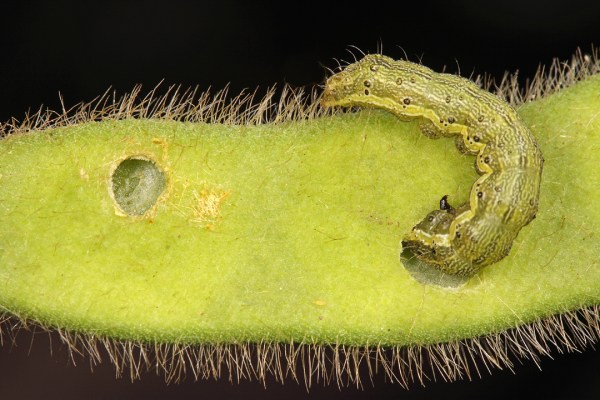
Helicoverpa gelotopeon feeding on soybean pod | Buenos Aires Prov., Argentina

Helicoverpa gelotopeon feeding on soybean pod | Buenos Aires Prov., Argentina

From Bollworms rising! (posted 30 Mar). This is the first photo of an economic pest that has made one of my “Best of BitB” lists. The two holes in the soybean pod, one with the caterpillar and its head still completely inserted, visualizes how the feeding habits of these insects can so dramatically affect yield of the crop.


cf. Eremochrysa punctinervis | Gloss Mountains, Major Co., Oklahoma

cf. Eremochrysa punctinervis | Gloss Mountains, Major Co., Oklahoma

From “Blue-sky” tips and tricks (posted 1 July). Insects with a lot of delicate detail and long, thin appendages are especially difficult to photograph against the sky due to wind movement. See how I dealt with the antennae of this delicate lacewing without resorting to the standard black background typical of full-flash macrophotography.


Cicindela scutellaris lecontei x s. unicolor

Cicindela scutellaris lecontei x s. unicolor intergrade | Holly Ridge Natural Area, Stoddard Co., Missouri

From The Festive Tiger Beetle in Southeast Missouri (posted 25 Oct). I like this photo a lot more now than I did when I first took it. Its shadowy feel and the beetle “peering” from behind a leaf edge give a sense of this beetle’s attempts to hide and then checking to see if the “coast is clear”


Batyle suturalis on paperflower (Psilostrophe villosa) | Alabaster Caverns State Park, Woodward Co., Oklahoma

Batyle suturalis on Psilostrophe villosa flowers | Alabaster Caverns State Park, Woodward Co., Oklahoma

From Tips for photographing shiny beetles on yellow flowers (posted 10 Aug). “Bug on a flower” photos are a dime a dozen, but shiny beetles on yellow flowers with natural sky background can be quite difficult to take. All of the techniques for dealing with the problems posed by such a photo came together nicely in this photo.


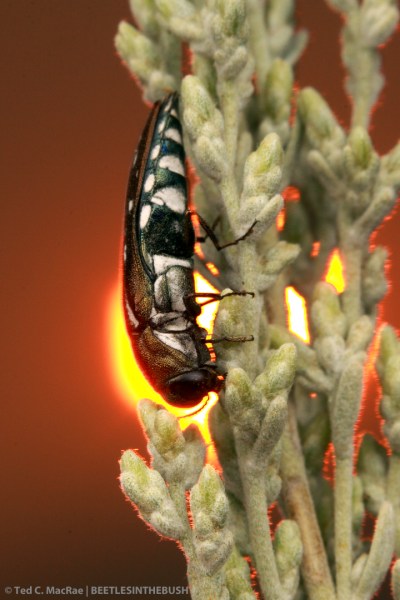
Agrilus walsinghami | Davis Creek Regional Park, Washoe Co., Nevada

Agrilus walsinghami | Davis Creek Regional Park, Washoe Co., Nevada

From Sunset for another great collecting trip (posted 1 Sep). This photo is not without its problems, with a little blurring of the backlit fuzz on the plant, but the placement of the sun behind the subject’s head and resulting color combination make it my favorite in my first attempts at achieving a “sun-in-the-sky” background with a true insect macrophotograph.


A tiny male mates with the ginormous female.

Pyrota bilineata on Chrysothamnus viscidflorus | San Juan Co., Utah

From Midget male meloid mates with mega mama (posted 8 Nov). Another blue-sky-background photograph with good color contrast, its real selling point is the natural history depicted. with some of the most extreme size dimorphism among mating insects that I’ve ever seen.


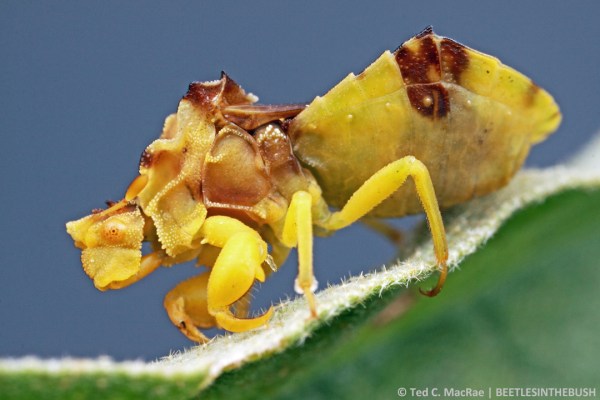
Phymata sp.

Phymata sp. on Croton eleagnifolium foliage | Austin, Texas

From ESA Insect Macrophotography Workshop (posted 13 Nov). The oddly sculpted and chiseled body parts of ambush bugs makes them look like they were assembled from robots. Contrasting the body against a blue sky gives a more unconventional view of these odd beasts than the typical top-down-while-sitting-on-a-flower view.


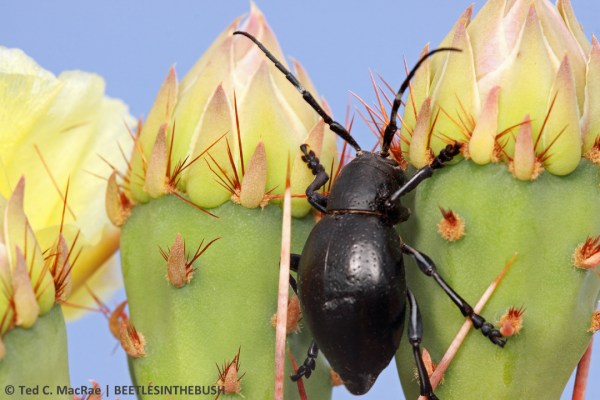
Fourth attempt - holding detached pad up against sky for cleaner background.

Moneilema armata on Opuntia macrorhiza | Alabaster Caverns State Park, Woodward Co., Oklahoma

From Q: How do you photograph cactus beetles? (posted 24 Nov). Photographing cactus beetles requires patience, persistence, long forceps, and strong forearms. Natural sky provides a much more pleasing background than a clutter of cactus pads and jutting spines.


I hope you’ve enjoyed this 2013 version of “Best of BitB” and look forward to seeing everyone in 2014.

Copyright © Ted C. MacRae 2013

Party on a pin oak

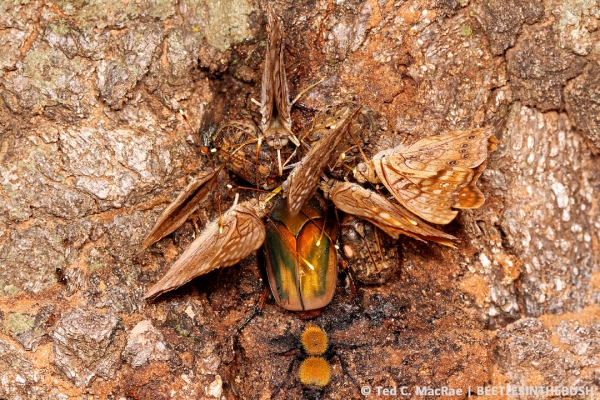
In September 2012 while collecting in western Oklahoma (Weatherford) I came across this interesting scene. It had been exceedingly dry in the area, and because of this few insects were out and about in the small city park that I stopped by to check for the presence of tiger beetles. I had nearly completed my circuit of the park when I came upon a moderate-sized pin oak (Quercus palustris) tree and noticed something on the lower trunk:

Six insect species representing five families in four orders share a sap flow.

Six insect species representing five families in four orders share a sap flow on the trunk of a pin oak.

No less than six insect species representing four orders were seen all huddled together at a darkly stained sap flow. This could be the result of slime flux, a bacterial disease that usually affects deciduous hardwoods that are under stress and results in darkly stained weeps on the trunk that are known to be attractive to a variety of insects. At the center sat a green June beetle (Cotinis nitida) and three bumble flower beetles (Euphoria inda)—all in the family Scarabaeidae (subfamily Cetoniinae). Covering the scarab beetles were half a dozen Texas Tawny Emperor (Asterocampa clyton texana) butterflies (family Nymphalidae, or Brushfooted Butterflies), and milling around the perimeter was a velvet ant (Dasymutilla creusa, I believe) in the family Mutillidae, an apparent flesh fly (family Sarcophagidae), and a true ant (family Formicidae). I guess this would be the equivalent to a watering hole in Africa with a lion, a hyena, a baboon, three vervet monkeys and six zebras all crouched shoulder-to-shoulder at its edge.

Euphoria sepulchralis feeds on a sap flow higher up on the trunk.

Euphoria sepulchralis feeds on a sap flow higher up on the trunk.

Further up on the trunk, yet another species of scarab beetle, a dark flower scarab (Euphoria sepulchralis) was found feeding on a smaller sap ooze. Unlike the diverse aggregation of insects on the lower ooze, this guy had managed to keep the ooze all to himself.

Cotinus nitidus | Weatherford, Oklahoma

Cotinis nitida | Weatherford, Oklahoma

Green June beetles, especially, are known for their feeding on sap oozes. The beetles are actually attracted to the odors caused by fermentation of the sap rather than the sap itself. It has been reported that the presence of alcohol in fermenting sap can affect the behaviour of insects that feed upon it, causing them to act “stupid and lethargic.” I did not see any such behavior, but I did notice that the insects were not at all skittish and loath to leave the sap.

Copyright © Ted C. MacRae 2013

Red-eyed poop!

I was looking at some of my older files and ran across these photographs taken in early 2011 in Campinas (São Paulo state), Brazil. They’re not my best photos from a compositional and technical perspective, as I was still on the steep part of the learning curve with the Canon MP-E 65mm macro lens. This lens is no doubt powerful and allows amazingly close-up photographs, but it is rather a beast to learn in the field, especially hand-held. I could quibble endlessly about missed focus and suboptimal composition with these shots, and that is probably why they never made it to the front of the line for being posted. Nevertheless, they still depict some interesting natural history by one of nature’s most famous natural history poster children—the treehoppers (order Hemiptera; family Membracidae).

An adult next to a cast nymphal exuvia.

Bolbonota sp. (Hemiptera: Membracidae), upper right | Campinas, São Paulo, Brazil. Note cast exuvia.

The treehoppers shown in these photos were found on a low shrub in a municipal park and are all that I could manage before my clumsy, unpracticed molestations caused the few adults and nymphs present in the aggregation to disperse. The dark coloration of the adult and its globular form, corrugated pronotal surface, and lack of any horns identify the species as a member of the genus Bolbonota in the New World tribe Membracini (another similar genus, Bolbonotoides, occurs as a single species in Mexico). Species identification, however, is much more difficult, as there are at least a dozen species recorded from Brazil and perhaps many more awaiting description. We have a similar though slightly more elongate species here in eastern North America, Tylopelta americana. I don’t know if this is a specific character or not, but I don’t recall seeing any members of this genus with smoldering red eyes—it gives them an almost devilish appearance, especially the blackish adults (see last photo)!

Bolbonota sp. late-instar nymphs clustered together.

Bolbonota and similar genera are often cited by evolutionists as examples of insects that mimic seeds. I can see such a resemblance if I force myself, but honestly I don’t really buy it. To me they seem to bear an uncanny resemblance to the chlamisine leaf beetles which are thought to mimic caterpillar frass. As with the beetles they resemble, frass-mimicry seems to make much more sense than seed-mimicry, especially given their preference for positioning themselves along the stems of the plants on which they feed (when was the last time you saw seeds of a plant randomly distributed along its stems?). Another thought I’ve had is that this is not an example of mimicry at all, but merely an accidental consequence of the heavy, corrugated body form they have adopted, which likely also affords them a reasonable amount of protection from predation. Confounding both of these theories, however, are the radically different appearance and form of the adults versus the nymphs, and indeed even between the different nymphal instars (see early- and late-instar nymphs in photo below). The later instars seem perfectly colored for mimicking unopened leaf buds, but why they would start out dark in early instars before turning mottled/streaked-white as they mature, only to revert back to dark when reaching adulthood, is a mystery to me. If my thoughts are anywhere close to the truth, it would be a remarkable case of different life stages mimicking the products of two different taxonomic kingdoms (plant parts as nymphs, animal poop as adults)!

Bolbonota sp. nymphs tended by Camponotus sp. | Campinas, São Paulo, Brazil.

An ant (presumably Camponotus sp.) tends a first-instar nymph alongside a later instar.

Of course, if either/both of these lines of defense fail then there are the ant associates that often protect treehoppers and other sap-sucking, aggregating insect species in exchange for the sweet, sugary honeydew that such insects exude as a result of their sap-feeding habits. I presume this ant belongs to the genus Camponotus, perhaps C. rufipes or C. crassus which are both commonly encountered treehopper associates in southern Brazil. I have written previously about ant-treehopper mutualism in the stunningly-marked nymphs of another treehopper, Guayaquila xiphias, and its ant-associate C. crassus in Brazil Bugs #15 – Formiga-membracídeos mutualismo (a post that has become one of this blog’s most popular all-time). Maybe this post will never match that one in popularity, but I do find the third photo shown here remarkable in that is shows no less than five elements of this treehopper’s natural history (early-instar nymph, late-instar nymph, cast nymphal exuvia, partial adult, and an ant-associate) within a single frame (shot by a person still on the steep portion of the MP-E 65mm learning curve!).

Copyright © Ted C. MacRae 2013

Fire ant winged reproductives: male and female

While in Austin at the Entomological Society of America meetings, I had the chance to tour The University of Texas at Austin’s Brackenridge Field Laboratory.  Located on 82 acres of land bordering the Colorado River, the station supports studies in biodiversity, ecosystem change and natural history. A major focus of research at the station involves efforts to establish biological control agents for control of imported fire ant (Solenopsis invicta) using entomopathogens and parasitoids (e.g. phorid flies in the genus Pseudacteon). This research relies on maintaining cultures of fire ants to support rearing of the phorid fly. While time was limited and I did not have much opportunity to photograph either the ant or the fly, I did manage to quickly sneak in a shot or two of some winged reproductives that were removed from the teaming formicid mass in a rearing tray and placed on a table top for all to see (and when I say “a shot or two” I mean it. I had the chance only for one shot of the female and two of the male as they crawled crazily about and the tour leader quickly tried to move us on). I’m sure Alex Wild has all stages/forms of this species covered in spades, but the sexually dimorphic winged reproductives were new for me, and perhaps some readers of this blog as well.

Solenopsis invicta winged reproductives: male (top), female (bottom).

Solenopsis invicta winged reproductives: male (top), female (bottom).

Copyright © Ted C. MacRae 2013