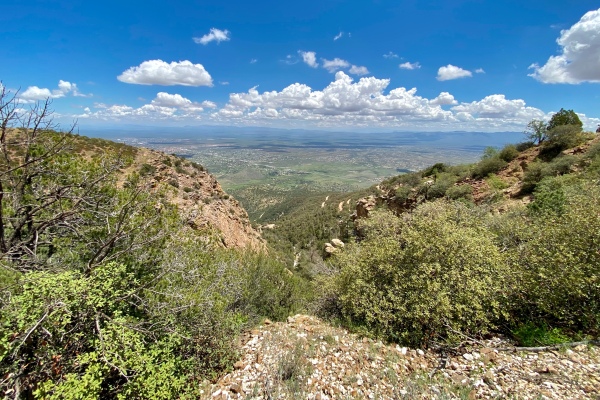
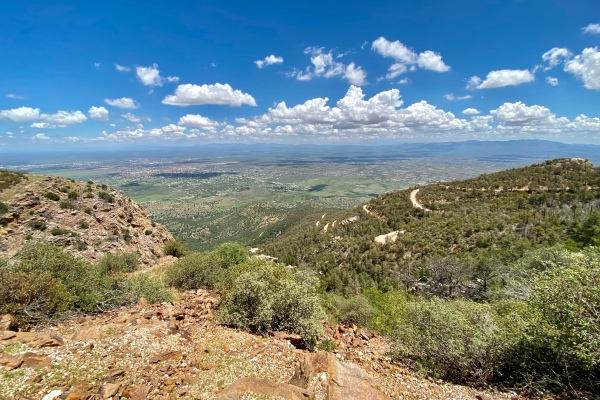
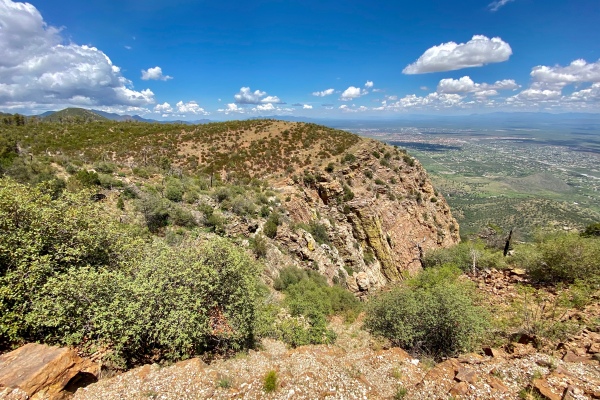
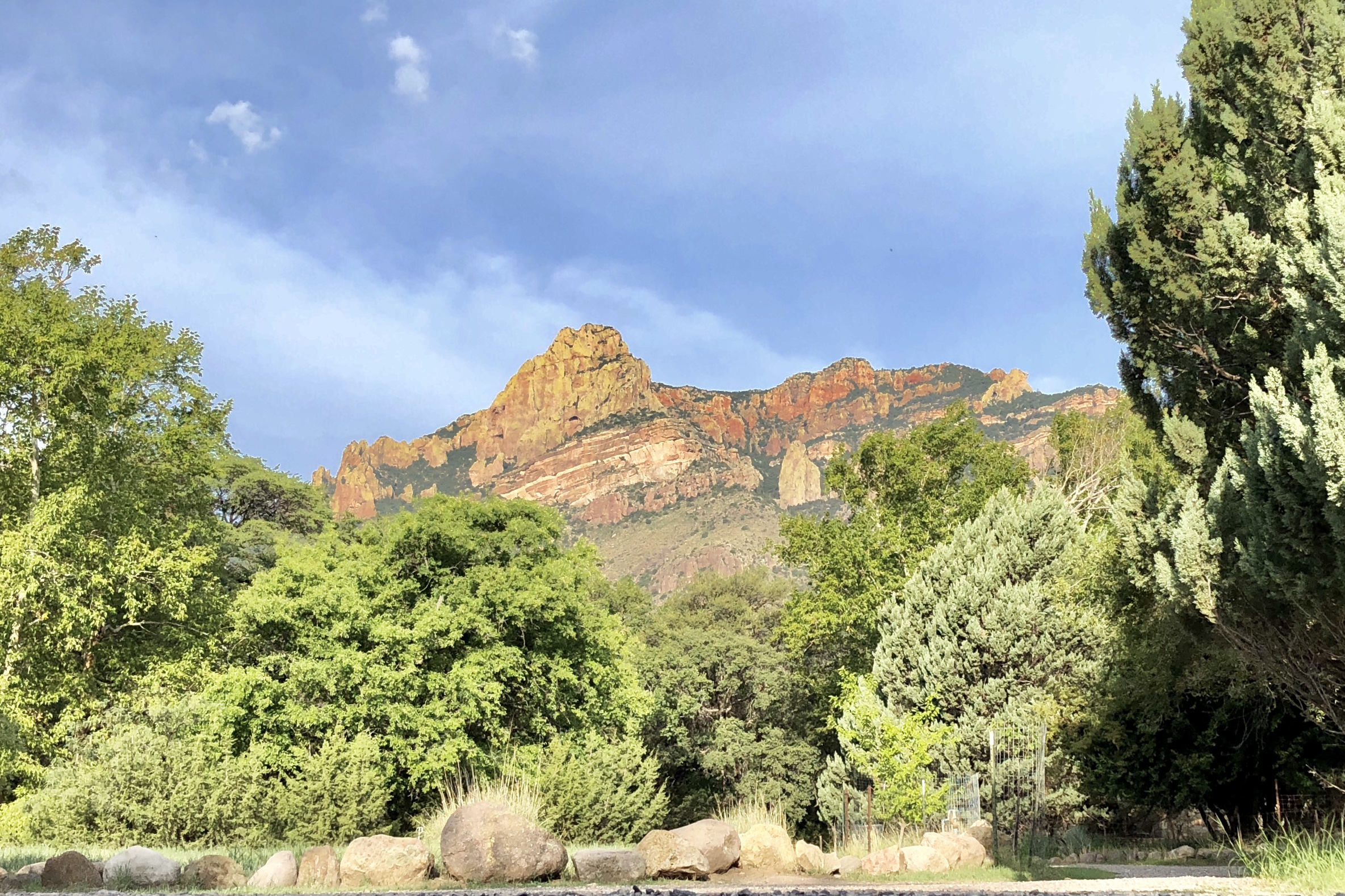
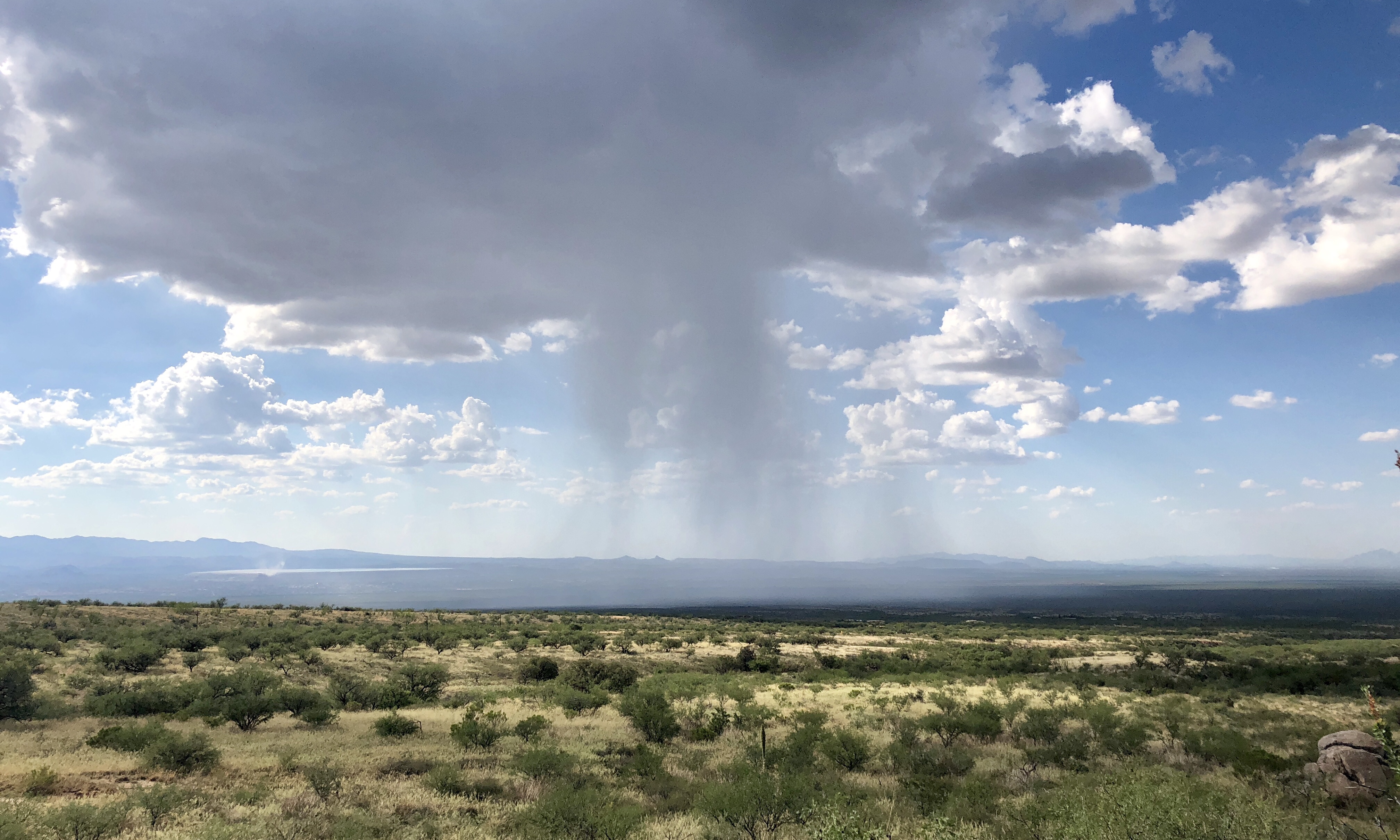
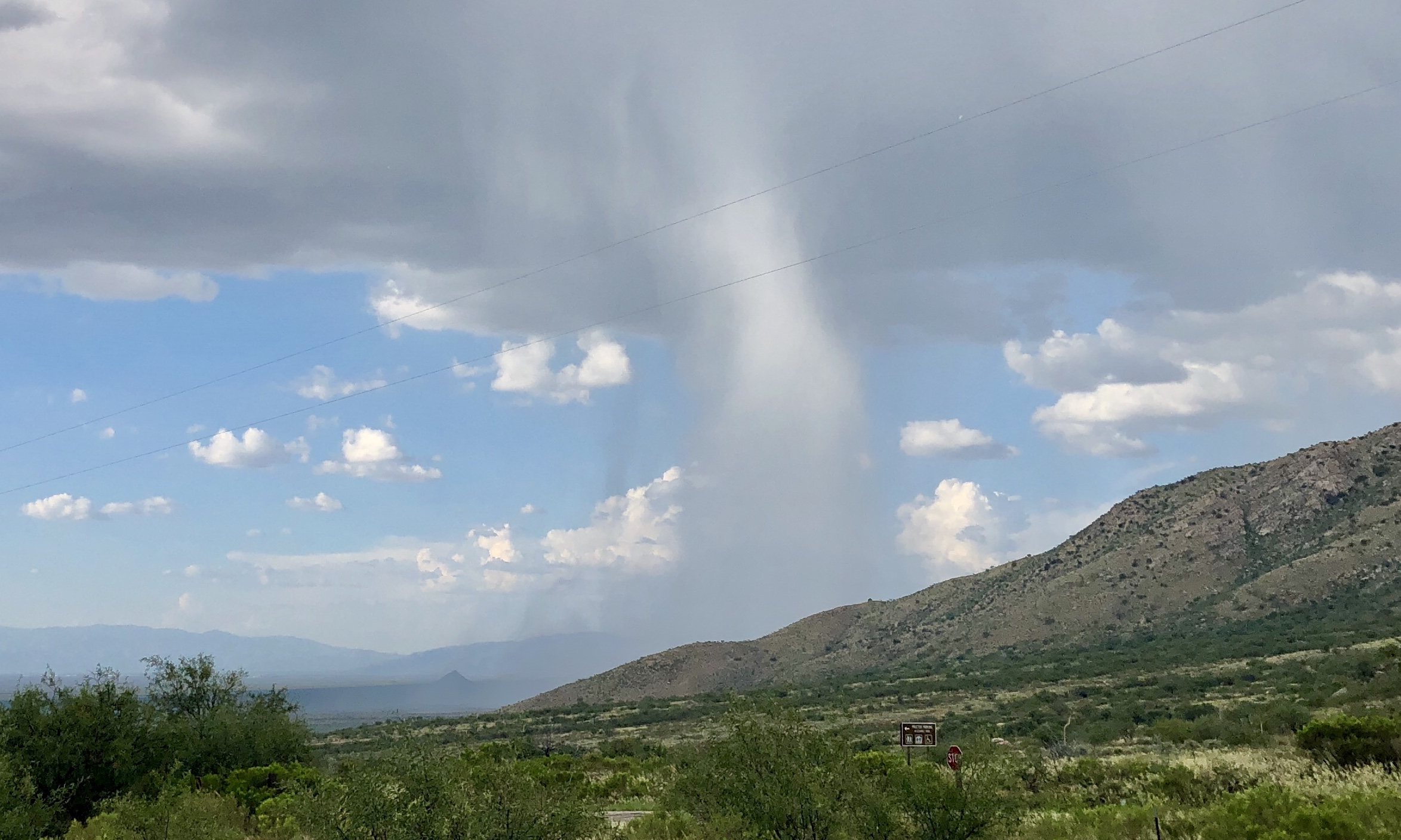
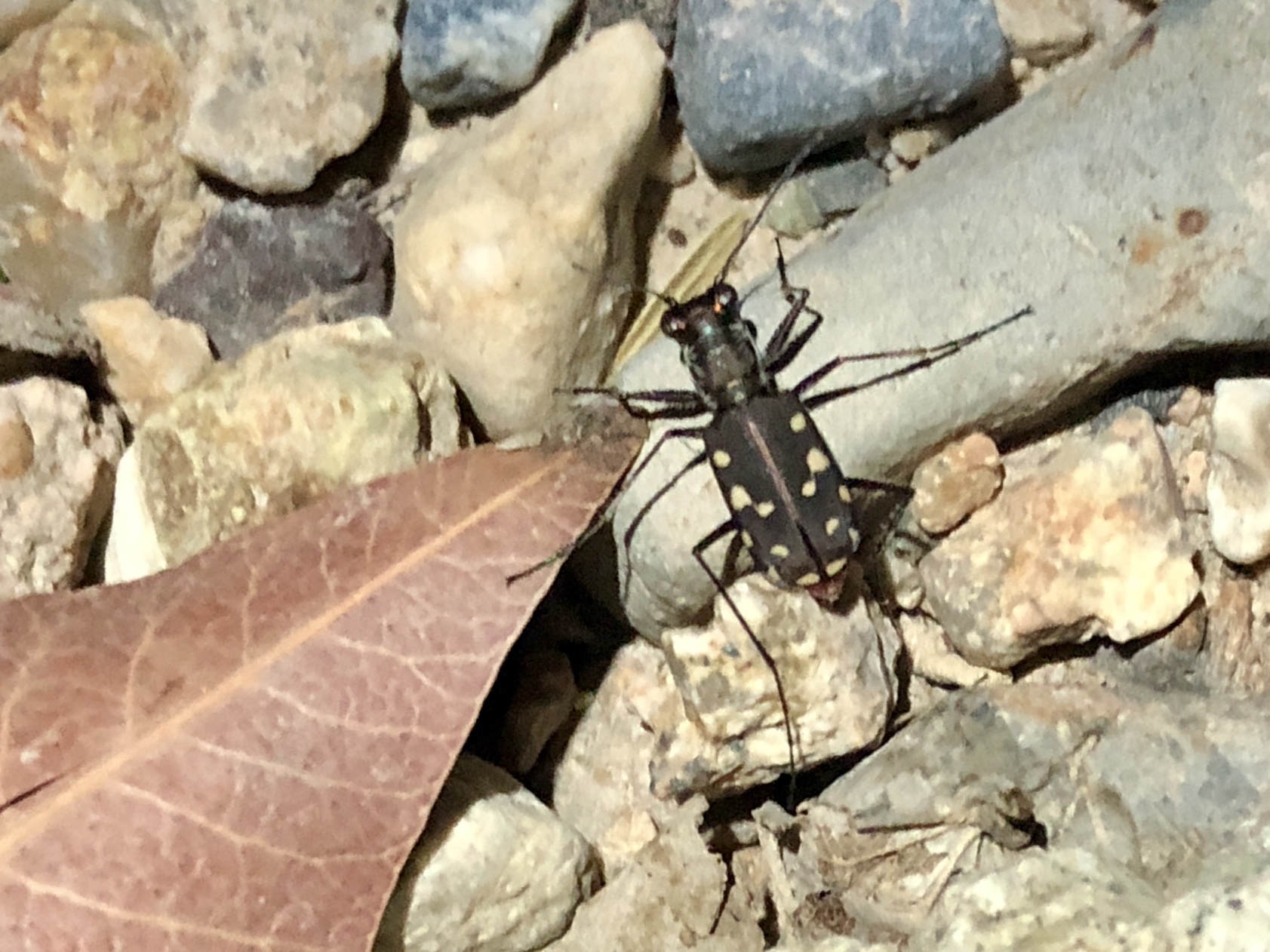
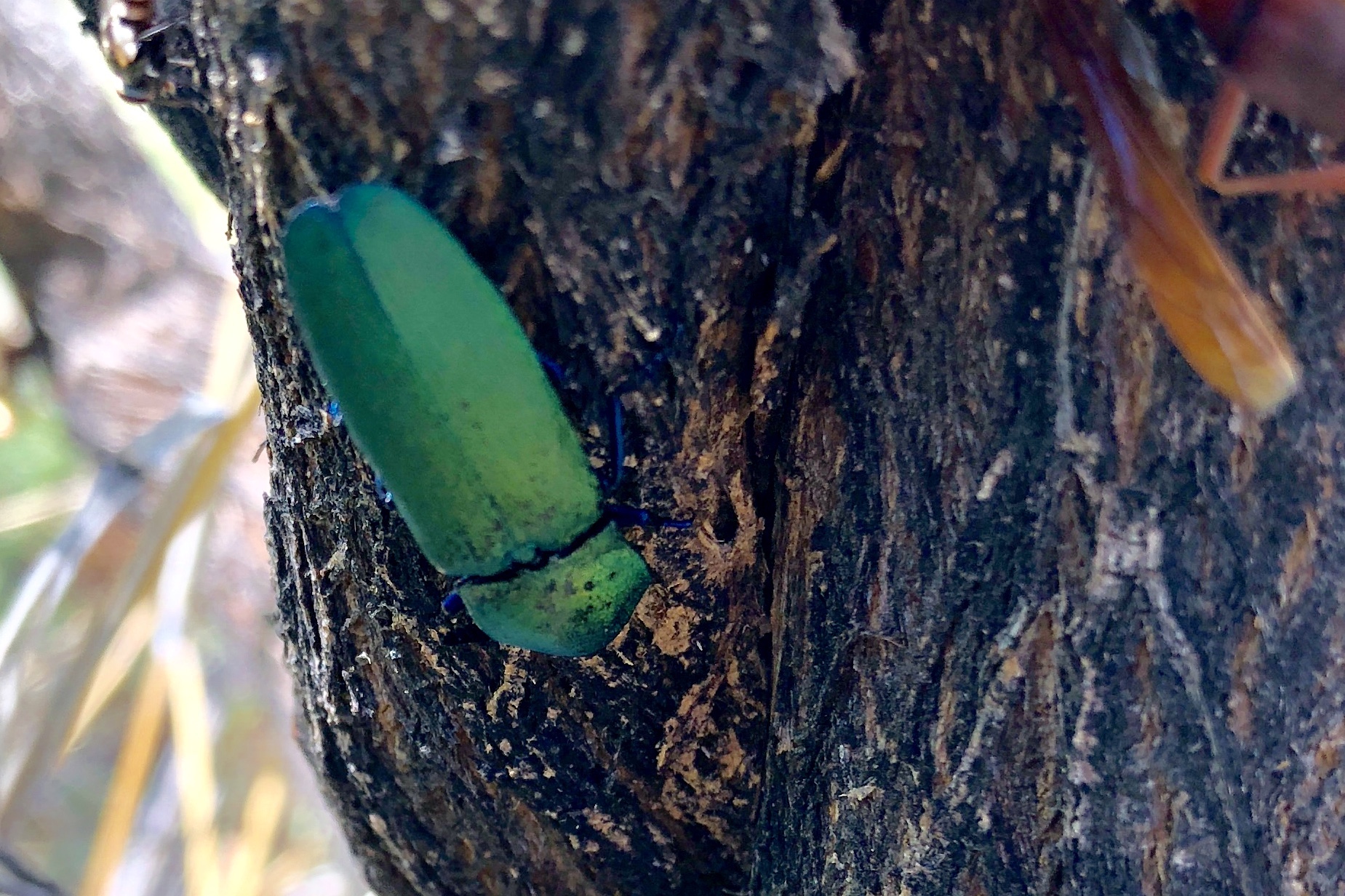
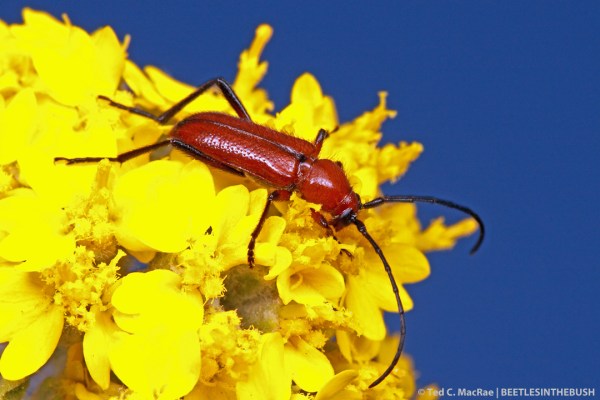
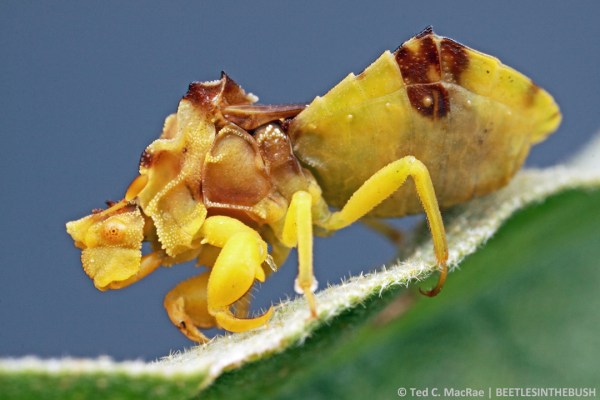
2025 Southwestern U.S. Insect Collecting Trip iReport: Act 2 (Finale)

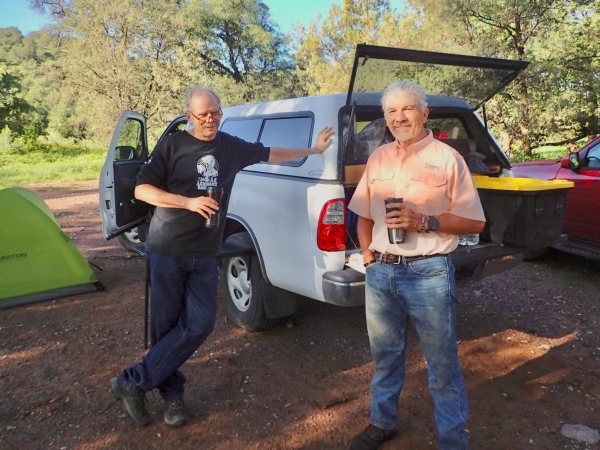
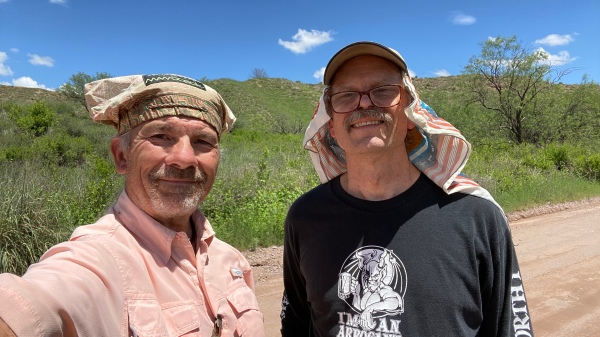
This—the 18th “Collecting Trip iReport”—covers the second of two insect collecting trips to the southwestern U.S. this season—this first one occurring from June 4–13, during which I placed “bottle traps” and “jug traps” at several locations, and this one from September 3–14 to retrieve the traps and take advantage of any late-season collecting opportunities. I was fortunate on this trip to have longtime collecting buddy and melittologist Mike Arduser joining me, during which we visited the same 15 localities that I visited on my precious trip back in June (one in northwestern Oklahoma, six in northern Arizona, six in southern Utah, and two in southern Nevada) plus two additional localities (one each in northwestern Oklahoma and northeastern New Mexico).

Like previous trip reports, this one assembles field notes largely as they were generated during the trip. They have been lightly “polished” but not substantially rewritten or changed based on subsequent examination of collected specimens (unless expressly indicated by “[Edit…]” in square brackets). While I did photograph a few insects in the field with my “macro” rig to feature individually in future posts, this post contains only iPhone photographs (thus the title “iReport”). Previous collecting trip iReports are:
2013 Oklahoma
2013 Great Basin
2014 Great Plains
2015 Texas
2018 New Mexico/Texas
2018 Arizona
2019 Arkansas/Oklahoma
2019 Arizona/California
2021 West Texas
2021 Southwestern U.S.
2022 Oklahoma
2022 Southwestern U.S.
2023 Southwestern U.S.
2024 New Mexico: Act 1
2024 New Mexico: Act 2
– 2024 New Mexico: Finale
– 2025 Southwestern U.S.: Act 1


Day 1

I’m on my way out west with fellow collector Mike—today being only a travel day but with a quick stop in Texas Co., Oklahoma to retrieve bottle traps set back in June and then a night of camping at Black Mesa State Park before continuing the drive west tomorrow. After 7 hours, we needed to stretch our legs and stopped at Salt Plain National Wildlife Refuge’s Sandpiper Trail—a spot we both have visited several times and know well. Recent rains had the alkaline flats filled with more water than I’ve seen during any previous visit, …

Salt Plain National Wildlife Refuge, Alfalfa Co., Oklahoma.

… and only a few Ellipsoptera nevadica knausi (Knaus’ tiger beetle) and Eunota circumpicta johnsoni (Johnson’s tiger beetle) were seen on the drier margins of the alkaline flats. Several Epicauta conferta (red-cornered blister beetle) were seen lumbering across the path, and a Diogmites angustipennis (prairie robber fly) posed nicely on the trail for pictures as well.

Diogmites angustipennis (prairie robber fly—family Asilidae).

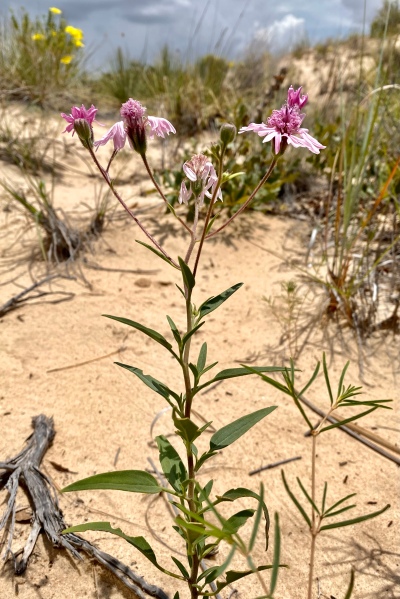
Showy Eustoma russellianum (prairie gentian)—a plant I’ve never seen before—were blooming spectacularly and prolifically in the vegetated areas bordering the alkaline flats.
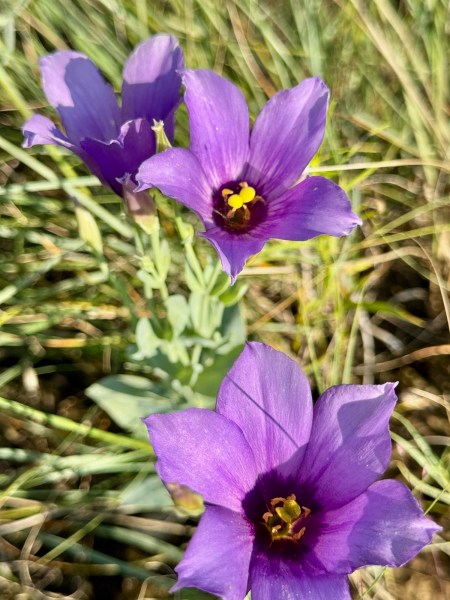
Eustoma russellianum (prairie gentian—family Gentianaceae).

It was a quick but interesting stop that rejuvenated the legs before we continued our journey westward.

The first “real” stop of the trip was ~5 miles north of Goodwell in Texas Co., Oklahoma where I placed three white bottle traps in early June hoping to capture the very rare Acmaeodera robigo, which had been photographed here on flowers of Melampodium leucanthemum (blackfoot daisy) and the photos posted on BugGuide. I was never able to contact the photographer, but since bottle traps are so effective at sampling species of Acmaeodera I reasoned placing three traps here (one at the precise spot and two more several hundred yards to the north and to the south) would give me the best chance of collecting it. It had already been dark for an hour before we reached the spot, but despite the darkness and late hour I had no trouble finding each of three traps. I was happy to see all three traps still in place, undisturbed, and filled to the brim with insects. I tried to pick out the larger insects (mostly crickets and grasshoppers) and stir through the remaining contents of each trap a bit to see if I could detect any Acmaeodera, but the majority of insects appeared to be small blister beetles, followed by bees. The darkness made further sorting impossible, so I bagged the contents of each trap and saved for later sorting. [Edit: later sorting found only a couple of Acmaeodera mixta? in just one of the traps and no A. robigo.]

We arrived at our first overnight spot—Black Mesa State Park—quite late (~11:30 pm) and quickly setup camp before retiring for the evening. In the middle of the night I got up, came out of the tent, and was greeted by an incredible amazing starscape that is normally only seen during winter. Taurus was already high in the sky, and Orion was well above the horizon with a brightly shining Jupiter not too far to its left.

Night sky at Black Mesa State Park. Orion has risen, with Taurus above and Jupiter just rising in the lower left.

Day 2

In the morning, a canyon towhee (Melozone fusca) kept us company as we prepared breakfast and then broke camp for another mostly travel day
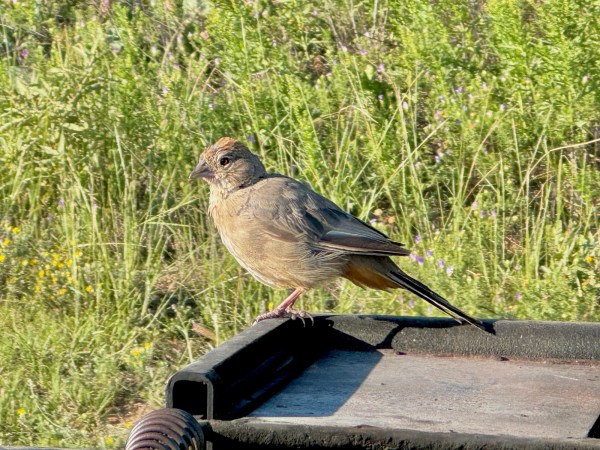
Canyon towhee (Melozone fusca).

Our destination this evening is Devils Canyon Campground near Monticello, Utah, to which we will travel by way of northeastern New Mexico and then southwestern Colorado.
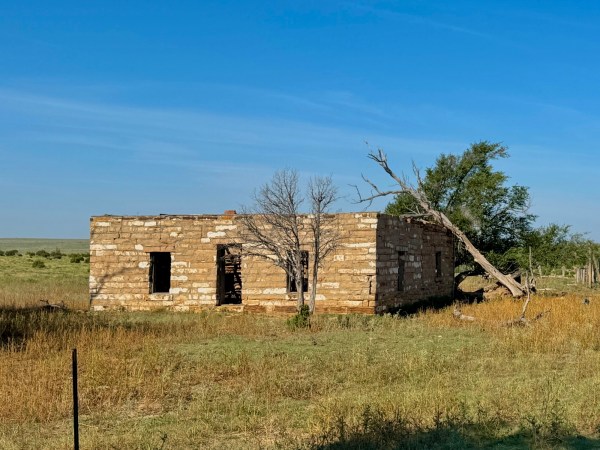
Abandoned homestead outside of Clayton, New Mexico.

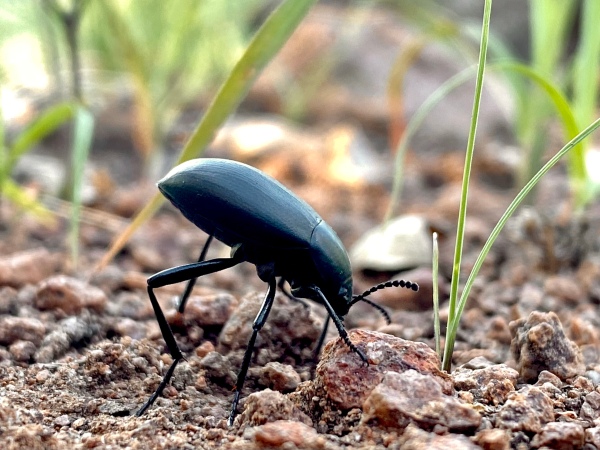
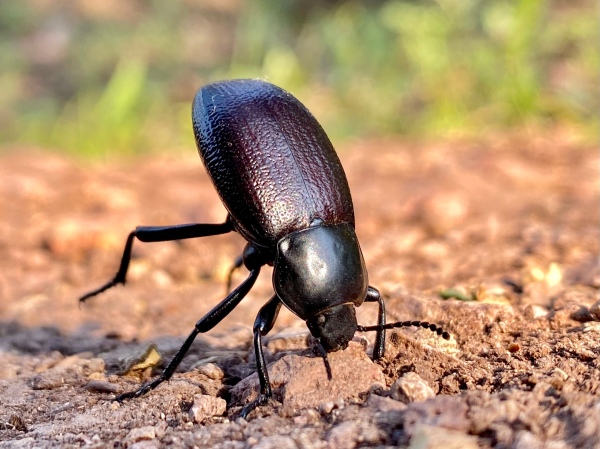
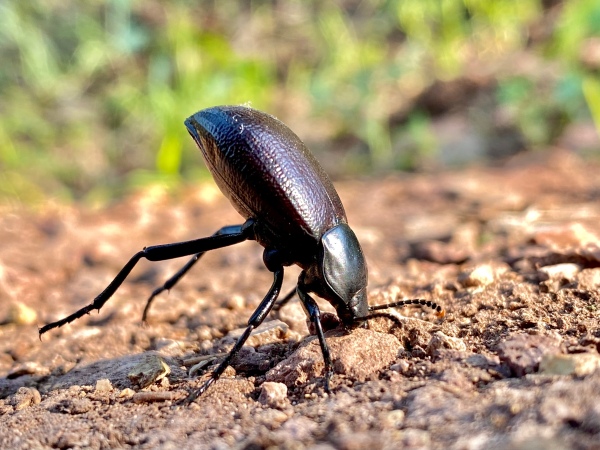
Shortly after crossing into Colorado we made a pit stop for ice and I began searching the pavement around the gas station looking for beetles that may have come into the previous night’s lights. I didn’t find any cerambycids but I did find a small tenebrionid beetle that didn’t look like familiar to me.

Crossing the Sangre de Cristo and then the San Juan ranges were as spectacular a mountain crossings as any that Colorado has to offer, and a coffee stop in Pagosa Springs (at Faire Society Cafe and Patisserie) provided not only good coffee and pastries to fuel me for the rest of the drive to Devils Canyon Campground near Monticello, Utah, but interesting and creatively framed art work to treat the eyes while waiting for our orders.


“Art wall” in Faire Society Cafe and Patisserie, Pagosa Springs, Colorado.
“Butterflies”—Faire Society Cafe and Patisserie, Pagosa Springs, Colorado.
“Gentleman Frog”—Faire Society Cafe and Patisserie, Pagosa Springs, Colorado.
“Cow”—Faire Society Cafe and Patisserie, Pagosa Springs, Colorado.

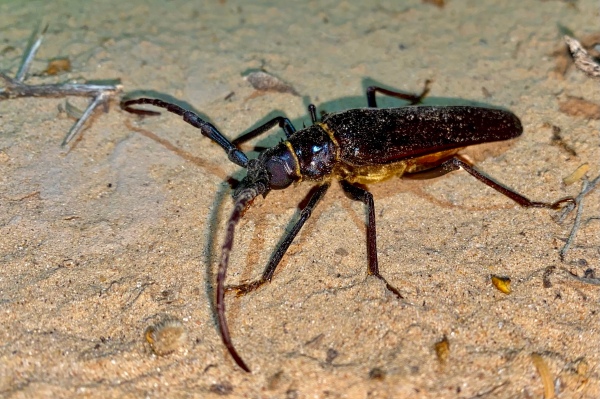
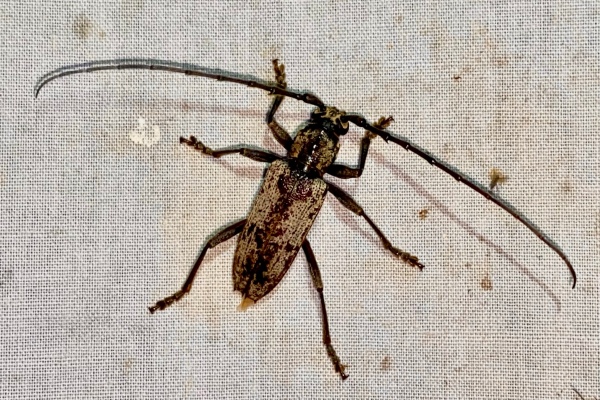
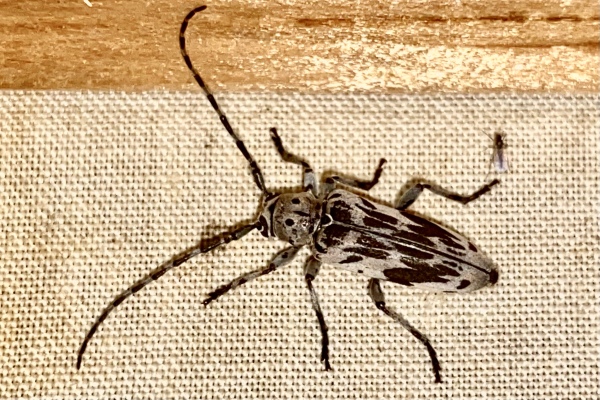
Weather during the drive had been good all day, but on the final approach to Devils Canyon Campground the skies began looking worryingly threatening. The last time I came here (early June) I had intended to camp here but got rained out and took a motel in town. I did not want a repeat of that, so we kept our fingers crossed and made the final drive to the campground. Although still threatening, it was not actually raining when we arrived (unlike last time), so we took our chances and set up camp. No sooner than that did the rain start! Fortunately, the tent was already up, so it just meant that instead of cooking dinner at the site, we would instead go to town and have dinner (Dave’s BBQ). When we got back to camp, the rain had stopped (although we could tell that it had rained hard), so I decided to walk the roads looking for night-active beetles. I knew this was probably a fruitless exercise—by then the post-rain temps at this 7000’ site were already down to the mid-50s, but it would give me a chance to stretch my legs after two straight days of driving, and I could also take that opportunity to retrieve the bottle and jug traps that I had set back in June. The bottle trap was disappointing, especially after seeing the ones I’d set near Goodwell, Oklahoma filled to the brim with insects—just a handful of bees (for Mike) and no beetles of any kind. This was surprising given the many Acmaeodera I have collected in alpine habitats just like this (Ponderosa pine and Gambel oak). The SRW-baited jug trap, on the other hand, was nicely (if not overwhelmingly) productive (Tragosoma sp., Enaphalodes sp., small elaphidiines, small acanthocine with very long antennae, Xestoleptura?)—enough to make it worth the effort. I was also pleased to see that the jug trap was in still place and intact with the catch in good shape despite three months in the field. The bait bottle was still about half full of red wine, but since the propylene glycol had dried the trap was no longer trapping insects. As I’d expected, no night-active insects were seen in the way to the traps or on the way back.


Day 3

It was a chilly morning, and though it had not rained since our arrival last night the skies remained overcast. The day’s plan was to continue west to the Ponderosa Grove Campground in southwestern Utah (north of Kanab), but with only five hours of driving required to get there we would have time to make a few stops along the way. Before leaving I started checking the Ericameria nauseosa (rubber rabbitbrush), several of which had begun blooming in the campground, and found a few Crossidius coralinus and Acmaeodera amabilis on the flowers. I was tempted to suggest staying put—at least for a short time—and exploring the area a little more fully, but my real objectives were further west and I elected to stick with the plan.

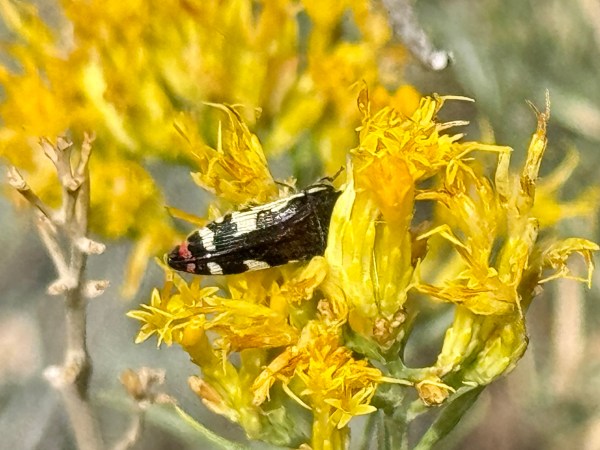
Crossidius coralinus (family Cerambycidae) on flowers of Ericameria nauseosa (rubber rabbitbrush).
Acmaeodera amabilis (family Buprestidae) on flowers of Ericameria nauseosa (rubber rabbitbrush).

One of the stops I’d made along this way last June was 4 miles east of Bluff in San Juan Co., Utah, where the famous Mont Cazier had collected what would later be described as Agrilus utahensis. I did not find it in June (nor did I fully expect to, since the record was from late July), and I was equally skeptical about my chances this time given how much later it was in the season. On the way here, we got caught behind an oversized load on the highway that was so big it required three highway patrol chaperone vehicles to clear the road ahead. Going at about half the speed limit, I worried we might have to follow it the entire way to our turnoff, which would nearly double our travel time to the first spot. Fortunately, the caravan pulled over at one point to let the long train of trsffic that had accumulated behind it pass, and we were on our way (the convoy would later pass us at the very spot where we had stopped to collect).

Oversized convoy!

The location was disappointing dry and crispy, although Gutierrezia sarothroides (broom snakeweed) was coming into bloom. Sweeping it eventually produced about a dozen Crossidius pulchellus and two other beetles (a clytrine leaf beetle and a weevil), and Mike collected a handsome series and diversity of bees off of flowering Eriogonum sp. (buckwheat).

Crossidius pulchellus (family Cerambycidae) on flowers of Gutierrezia sarothrae (broom snakeweed).

Our drive afterwards through southeastern Utah and northeastern Arizona took us through some of the most amazing scenery that the American West has to offer—red sand/siltstones sculpted through the eons by wind and rain have created a landscape that can only be described as “planetary.”

Monument Valley, southeastern Utah.

Eventually, the dramatic landscape gave way to a more monotonous series of desert plateaus periodically interrupted  by dramatic descents and canyons as we got deeper into north-central Arizona. Though pleasing to the eye, there were few signs of greenery of flowers to tempt the passing entomologist except occasional stands of Ericameria nauseosa (rubber rabbitbrush) beginning to bloom in higher elevation spots. We kept our nose to the grindstone, hoping to see better things once we passed through Page and crossed back into south-central Utah, but the landscape became even crispier, with a stop about 20 miles northwest of Page to look for Nanularia brunnea on Eriogonum inflatum (which I had found two years ago in late June) being a total bust. We expected/hoped that the higher elevations around Ponderosa Grove Campground (~6000’) would provide better collecting and continued there without haste. Our expectations/hopes proved well-founded, as blooming rabbitbrush was seen with greater frequency as we traveled north of Kanab and even more so along Hancock Rd approaching the campground. We took a few moments to scout out a good campsite and setup camp before spending the rest of the available daylight hours exploring. For me the rabbitbrush was most tempting, and scouting plants in the campground and the vicinity east produced small but nice series of Crossidius coralinus and Typocerus balteatus. As I was doing so, a sinking sun and virga to the east produced an impressive rainbow that became irresistible for photography—not only as a subject itself but as a backdrop for the beetles I was finding.

Rainbow at Ponderosa Grove Campground.
Crossidius coralinus (family Cerambycidae) on flowers of Ericameria nauseosa (rubber rabbitbrush).
Typocerus balteatus (family Cerambycidae) on flowers of Ericameria nauseosa (rubber rabbitbrush).

After some downtime back at camp (and grilled sirloin steaks for dinner), I did my customary nighttime patrol to check for night-active insects. This campground was especially productive when I did this back in June and found several Zopherus utahensis and other tenebrionids on the trunks of the massive Ponderosa pines that are the namesake of this campground.
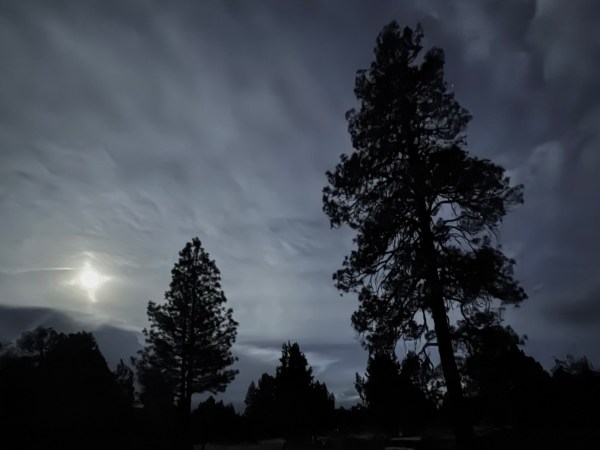
A near-full moon rises over our campsite at Ponderosa Grove Campground.

This time was no different—while I found only a single Z. utahensis, I did also find a few specimens of Coelocnemis sulcata, including a mating pair, on the trunks of the trees …
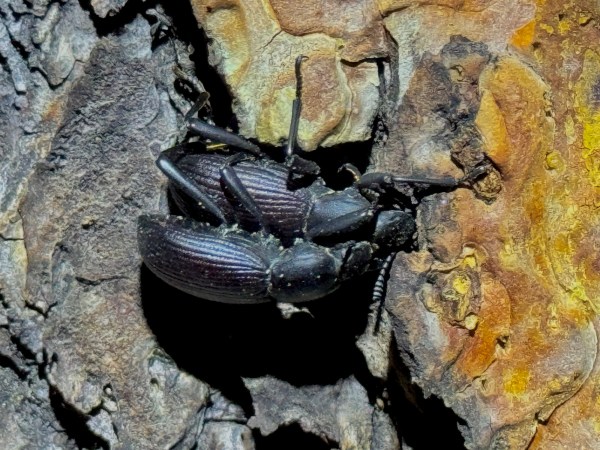
Coelocnemis sulcata (family Tenebrionidae) mating pair on trunk of Pinus ponderosa (Ponderosa pine) at night.

… and a single Embaphion sp. on the ground at the base of another. There are several massively-trunked Juniperus osteosperma (Utah juniper) in the campground as well, on which another C. sulcata was found. Despite this success and the relatively early hour, I was exhausted and called it quits for the night and retire. We will spend the entirety of the day here tomorrow, so I’ll have another chance to check the tree trunks again tomorrow night.


Day 4

After a relaxing morning at the campsite (during which time I caught up on my field notes while enjoying double-pour-through coffee), I walked over to the sand dune-adjacent woodlands to retrieve the traps that I’d set there back in June and brought them back to the campsite for sorting. I was happy to see Ericameria nauseosa (rubber rabbitbrush) and many other plants in bloom and looked forward to checking them more closely after servicing the trap catches.
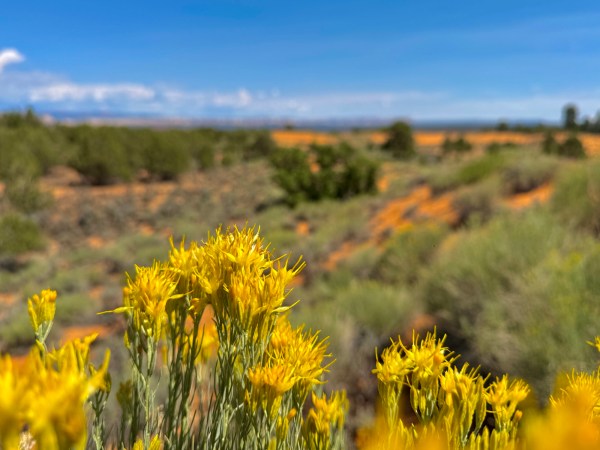
Ericameria nauseosa (rubber rabbitbrush) blooming in sand dune habitat at Moquith Mountain Wilderness Study Area.

The yellow bottle trap had ~15-20 beetles, including several Acmaeodera spp., a lepturine cerambycid, and a tiny Dichelonyx-like scarab (a relief after getting skunked with the bottle trap I’d set in Devils Canyon). There were also a fair number of bees in the trap, which I gave to Mike. The SRW-baited jug trap also did well, containing Tragosoma sp., Enaphalodes sp., several Psyrassa sp., and another colorful little lepturine along with several Euphoria inda, several small clerids, a mantispid, and numerous small beetles I take to be oedemerids. After processing the trap catch, I went back over to the woodlands and dunes, spending more than three hours collecting off the flowers of E. nauseosa and other flowers.

Typocerus balteatus was found not uncommonly on the flowers in most of the areas that I covered, while Crossidius coralinus and C. suturalis were found a bit more sparingly.
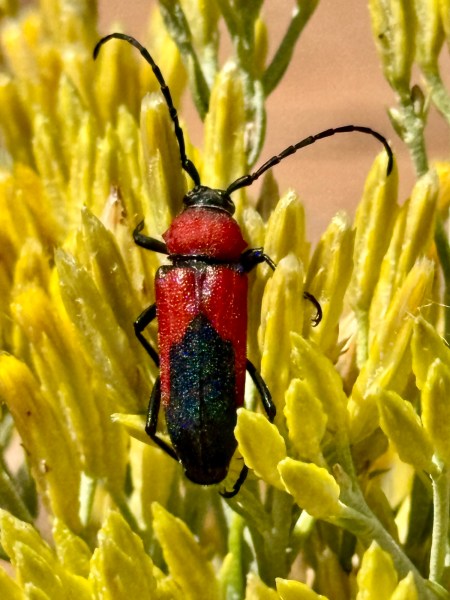
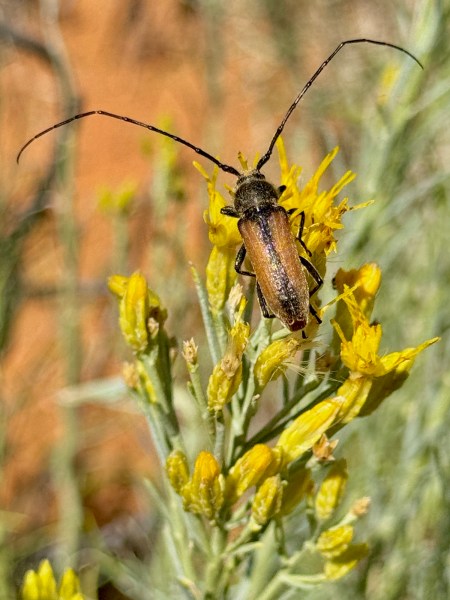
Crossidius coralinus (family Cerambycidae) on flowers of Ericameria nauseosa (rubber rabbitbrush).
Crossidius suturalis (family Cerambycidae) on flowers of Ericameria nauseosa (rubber rabbitbrush).

I also found Acmaeodera rubronotata on the flowers of Grindelia squarrosa (curlycup gumweed), Dieteria canescens (hoary tansyaster), and E. nauseosa, but they were limited to the woodlands and not seen in the dunes.

Acmaeodera rubronotata (family Buprestidae) on flowers of Dieteria canescens (hoary tansyaster).

I also found several individuals of an interesting little weevil on the rabbitbrush flowers, its gray/black longitudinally striped body making a good subject for photography (for which I also brought back a live A. rubronotata and a mating pair of ambush bugs), and spent a bit of time photographing some of the other blooming plants in the area.

Castilleja linariifolia (Wyoming paintbrush—family Orobanchaceae).

By the time I feel like I’d gotten a good enough look at the area, nearly four hours had gone by and I was famished. Sardines and Triscuits did the trick, after which we did a quick ice run into town and back—the highlights being an authentic Sinclair dinosaur (he’s smiling!) and an real (though non-functioning) pay phone.
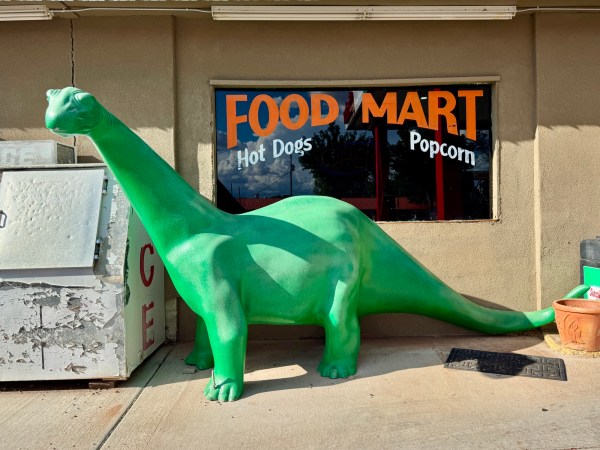
The famous “Sinclair dinosaur.”
He’s smiling!
An authentic (though non-functional) pay phone.

Returning to the campground, I walked with Mike back into the dunes to retrieve his bowl traps. I had hoped that some of them would pick up Acmaeodera (as is often the case with bowl traps and why I have started utilizing them on my own collecting trips), but the only species that would be out in this area at this time of season would be A. rubronotata, which I had already collected earlier in the day (there were none).

Mike services a “bowl trap.”

After a period relaxing (with a cold beer and burgers hot off the grill), I began my customary night walk. I have yet to find a cerambycid on tree trunks at night here, but still I enjoy night walks here as much as anywhere due to the consistent presence of ironclad beetles and other tenebrionoids on the trunks of the massive Ponderosa pine trees that give the campground its name.

Another near-full moon rises over the campsite.

Tonight would be no different—I found Zopherus uteanus on just the second tree that I examined (right in our campsite), and I would also find two species of tenebrionids in the vicinity on the trunks of ponderosas (Coelocnemis sulcata and Eleodes obscura sulcipennis) and a third species (ID unknown) on the ground at the base of one of them.
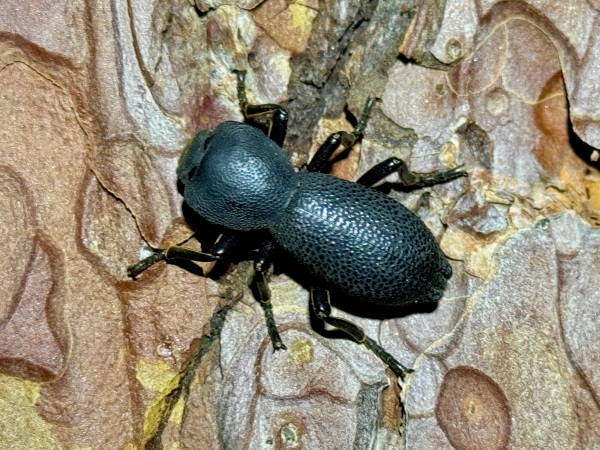
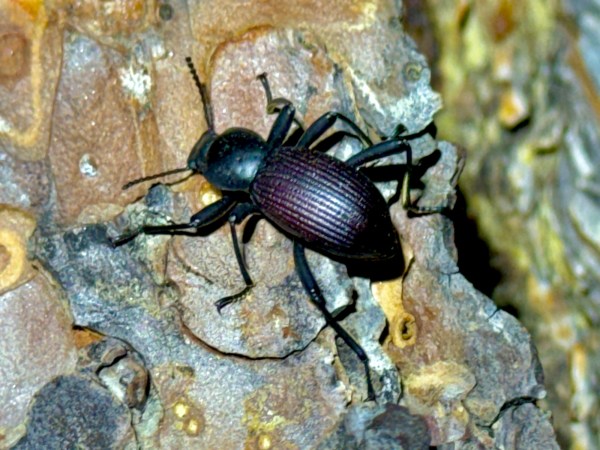
Zopherus uteanus (family Zopheridae) on trunk of Pinus ponderosa (Ponderosa pine) at night.
Coelocnemus sulcata (family Tenebrionidae) on trunk of Pinus ponderosa (Ponderosa pine) at night.
Eleodes obscura sulcipennis (family Tenebrionidae) on trunk of Pinus ponderosa (Ponderosa pine) at night.

At that point, I decided to go outside of the loop towards a couple of large P. ponderosa at the entrance, and on the way I found another E. obscura sulcipennis on the trunk of a massively old Juniperus osteosperma (Utah juniper). There was nothing on the P. ponderosa trees that I had targeted, but nearby was another large one, and high up on the trunk (as far as my fully extended net could reach) was another Z. uteanus, and several C. sulcata—including a mating pair—were found on the ground at its base.

At that point I decided to limit my tenebrionoid collecting to only Zopherus unless I saw species that I hadn’t seen before, so I passed by some additional tenebrionids of the same species as the previous on a large P. ponderosa in the RV loop, then saw a large, multi-branched Pinus edulis (Colorado pinyon pine) that I thought might be interesting to check. I did not find any beetles on it, but I did locate at eye level—with considerable difficulty!—a male Oecanthus californicus (western tree cricket). I was not only able to take a photograph of it with its wings fanned but also record an audio track up close (posted on iNaturalist).

Oecanthus californicus (western tree cricket—family Oecanthidae) male singing on trunk of Pinus edulis (Colorado pinyon pine) at night (song).

Returning to the tent loop, I checked all of the large P. ponderosa trees and junipers that had—during the past visit and last night—been so productive, but the only beetles I found was a very small tenebrionid that, fortunately, was yet another species I had not previously seen here (ID unknown). After two hours of searching tree trunks, I called an end to the night, which also meant a close to the collecting at this spot—tomorrow we will drive to Kyle Canyon in southern Nevada!


Day 5

Our exit from Ponderosa Grove took us through more of the spectacular canyonland that southern Utah is famous for and past the incredible Coral Pink Sand Dunes State Park (so spectacular it is that I think it could—despite its small size—be a national park). A dramatic descent down into the Virgin River valley and the town of Hurricane was only the first such descent—the second one being even more dramatic as I-15 dropped off the edge of the Colorado Plateau along the Virgin River Gorge. The remainder of the drive to Kyle Canyon northwest of Las Vegas was mindnumbing in its contrast—an endless stretch of interstate highway through a vast expanse of low, hot, featureless desert punctuated at regular intervals by palm tree dotted oases, each with a gaudy, glittering casino at its center. Driving up Kyle Canyon Rd put an end to this, however, as each thousand foot gain in elevation brought with it an increasingly interesting landscape. At about 4500’ elevation, I had set a couple of bottle traps—one yellow, one blue—hoping to catch the recently described Acmaeodera raschkoi (whose namesake—Mike Raschko—I had happened to meet at Ponderosa Grove Campground last June a few days before I set the traps!). Mike R. had also placed a bottle trap (white) at the site and was kind enough to reset it for me so I would have three colors sampling the area. Both of my traps were still in place, intact, and filled with numerous Acmaeodera that I take to be A. quadrivittata (along with many bees for Mike A.) and the yellow also containing a larger species that I didn’t immediately recognize (not unusual since I have never collected this area). Unfortunately, I did not see any specimens that appeared to be A. raschkoi, and even more unfortunately the white bottle trap had been pulled from the ground (although I was able to recover a few A. quadrivittata that were still inside the trap). Not much else was going on at the site—only a few things in sparse bloom but no beetles visiting the flowers, nor was there any rabbitbrush around on which to look for Crossidius.

We got a scare when we arrived at the campground and saw a sign at the entrance saying “Campground Full.” This was bad—if this campground was full, then surely the much more heavily used one down below was also full, and I didn’t look forward to spending the rest of the afternoon scrambling for a campsite somewhere in the Spring Mountains. We drove through the campground anyway, and, in fact, there were many campsites available! Looks like somebody forgot to do their job!

“Campground Full” sign at a not-full Hilltop Campground above Kyle Canyon, Nevada.

Crisis averted, we selected a nice spot overlooking the desert below and set up camp. Cool evening temps come early at this high elevation (~8300’), so with the remaining afternoon hours I retrieved and sorted my SRW-baited jug trap, finding several Tragosoma sp. but, curiously, not a single other longhorned beetle (or any beetle for that matter). Searching around the area afterwards, I extracted a dead Dicerca tenebrosa partial carcass in its emergence hole in a stump of Pinus monophylla (single-leaf pinyon pine), then went back down to the area I had collected last time, focusing especially on the two large half-dead Juniperus osteosperma (Utah juniper) trees on which I had seen damage from the rarely collected Semanotus juniperi (on one of which I collected three adults later that night). There was nothing on the first (the one on which I found the beetles), but at the second one I saw a large wind-thrown branch that I had not noticed last time. It exhibited S. juniperi damage and emergence holes on the lower part, and chopping into it I quickly recovered a dead but intact carcass of yet another S. juniperi adult. Further chopping turned up nothing, and I was about to walk away when I thought maybe I should cut into the upper part of the branch as well to look for evidence smaller woodboring species. Doing so, I quickly encountered a Chrysobothris sp. larva, and with that I decided to bring the entire upper part of the branch back for rearing. There wasn’t much else going on—few plants were in flower and nothing was seen on the trunks of trees or various pieces of downed wood that were laying about, so I went back to camp.

Alpine pinyon/juniper woodland at Hilltop Campground above Kyle Canyon, Nevada.
An elevation of 8300’ affords spectacular views into the desert below.

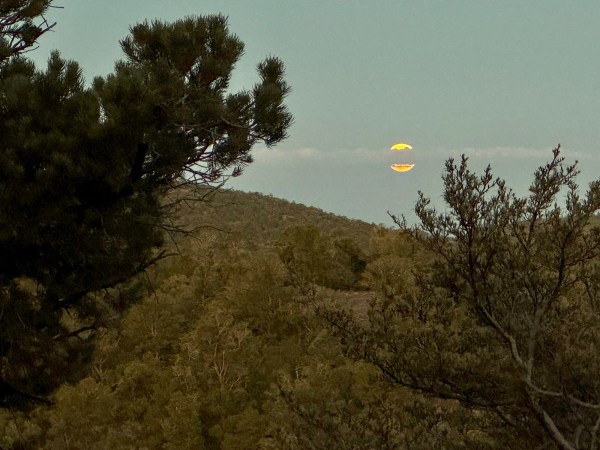
Later in the evening, we watched a spectacular moonrise, then enjoyed “surf ‘n’ turf” (grilled sirloin steak and salmon) before I started up my customary night walk to check tree trunks for night-active beetles.
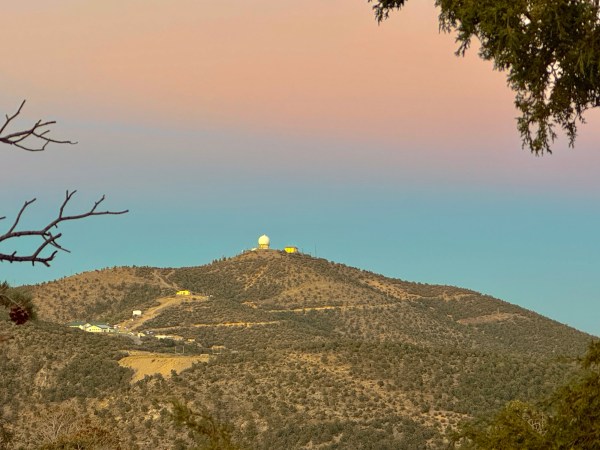
Angel Peak Radar Station at sunset.
“Corn Moon” rising.
Peeking through the trees.

Last time here when I did this, I found not only S. juniperi but also a few Zopherus uteanus, so I was hopeful for my chance tonight despite the lateness of the season. It started out well—on the first P. monophylla tree that I checked (right at our campsite), I found Oeme costata and a weevil.

Oeme costata (family Cerambycidae) on trunk of P. monophylla (single-leaf pinyon pine) at night.

Those would be the last live beetles I would see (other than an occasional tenebrionid beetle, none of which I collected). However, I would still find success—back at the J. osteosperma on which I had found three S. juniperi back in June, I found three more. They were not alive, however, but dead carcasses at the base of the tree—two nearly completely intact and the other partially so.
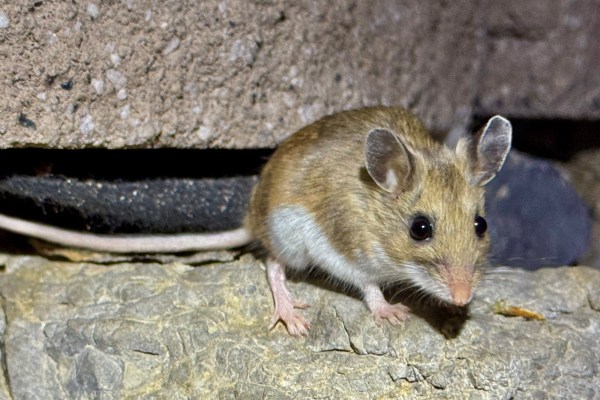
Western deer mouse (Peromyscus sonoriensis) at night.

Day 6

We had planned to visit few localities at middle and lower elevations but stopped to check out the profusely-blooming Ericameria nauseosa (rubber rabbitbrush) right outside the campground entrance for bees and beetles. Curiously, hardly anything was seen on the flowers despite the by then late-morning hour, sunny skies, and temps above 70°F. It seemed odd to me that there were no Crossidius beetles on the blooms, and the thought occurred to me that maybe the occurrence of E. nauseosa in the area itself could be a relatively recent phenomenon since it is only seen—albeit profusely—along the roads and highways in the area but nowhere further within the native habitats. With nothing going on, we pushed down to the lowest elevation point that caught our eye on the way in yesterday—the Step Ladder Trailhead at ~6700’.

Again, E. nauseosa was blooming profusely around the parking lot, but a quick perusal made it clear the situation would be similar here as well. Mike, on the other hand, was having good success collecting bees off of E. nauseosa and especially Gutierrezia sarothrae (broom snakeweed), so I was content to stay and refocus by searching for infested wood. I noticed a lot of Quercus gambelii (Gambel oak) and quickly found one with a dead but still attached, fully-barked branch. I broke the branch off the tree, and there in the broken butt of the branch was a large chrysobothroid larvae! This quickly prompted a decision to collect the infested branch and put it up for rearing. A second larvae was found in a small dead (but still fully-barked) tree nearby, which was added to the bundle. While this was going on, Mike found what seemed to be Agrilus blandus? in his net while sweeping bees from the flowers of G. sarothrae. I recall collecting this species in southern California in flowers of Eriogonum (wild buckwheat), so finding it on other flowers—particularly if Eriogonum is in the area (but not seen because it was not blooming) did not seem out of the question. My much more thorough sweeping of the plants around the area where he found it, however, produced no additional specimens. I was also interrupted in my sweeping attempts by a couple of curious bystanders—one a woman from Ukraine who wondered what the plant was that I was sweeping (I told her “broom snakeweed”) and what it was good for (“brooms” I wryly replied and then quickly clarified its role in the ecosystem), and then offered me a beetle collecting tip by telling me about large beetles they call “bombers” and that bite people sitting in spas in Southern California (I presume these are diving beetles in the family Dytiscidae); and the other a young man who was pleased to hear I was from St. Louis because he used to live there when he was married to his ex-wife. This all happened while I was in the middle of my sweeps, so I held the net bag firmly to keep insects from escaping my net until I could resume my sweeping. Eventually, I gave up the ghost and resumed my search for dead, infested wood, eventually finding a Cercocarpus ledifolius (curl-leaf mountain mahogany) tree with one recently-dead and one older dead branch, the former buprestid-infested (verified by cutting into the wood and finding young buprestid larvae) and which I collected for rearing.

View of Fletcher Peak from Step Ladder Trailhead.

After lunch back at the campground and some time spent processing specimens (as well as enjoying the antics of our resident golden-mantled ground squirrel [Callospermophilus lateralis certus]), …
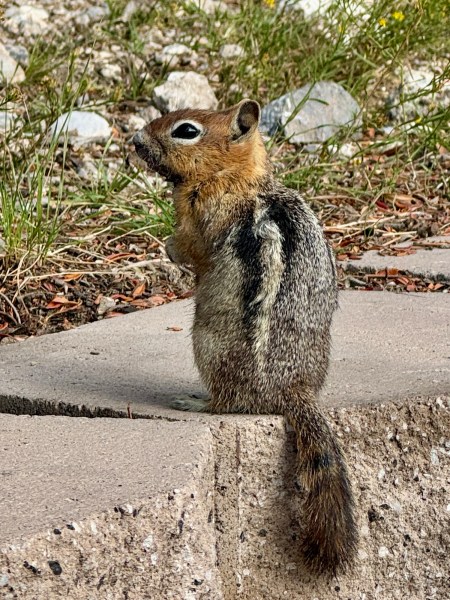
Mount Charleston golden-mantled ground squirrel (Callospermophilus lateralis certus).

… I wanted to check out the nearby Deer Creek Picnic Area where I’d seen a lot of iNaturalist observations (suggesting it might be an interesting place). At first all I saw was the massive parking lot below an equally massive road-cut slope—the only thing that looked like a trail was a steep drop down to the creek below. I checked it out, only to find it dead-ending at the creek and clambered back up.
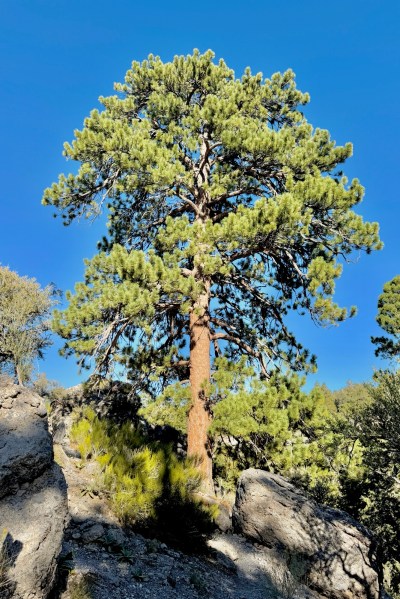
A massive Ponderosa pine looms above.

Then I saw a gravel trail behind the guardrail on the opposite side of the highway and found it leading to a paved path up the creek. Much of the trail was covered with a deep layer of gravel from flooding (and indeed some of the picnic tables were also nearly completely buried). I hiked the trail as it ascended alongside the creek under massive ponderosa pines until it dead-ended at a gravel road and turned around. The only plants in flower was Ericameria nauseosa (rubber rabbitbrush), and it was only near the highway, and while I saw no insects that I wished to collect, I did see a large Adejeania vexatrix (orange bristle fly) that frustrated my attempts to photograph it until I finally “pre-set” the focus, exposure, and zoom and quickly fired off a few shots at the distance I’d set it for as soon as the fly landed. The virtual lack of insect activity here confirmed what we’ve been seeing in the area as a whole, so I’ll be anxious to leave tomorrow and head for (hopefully) greener pastures at Leeds Canyon back in southwest Utah.

Adejeania vexatrix (orange bristle fly—family Tachinidae) on flowers of Ericameria nauseosa (rubber rabbitbrush).

Day 7

The drive from Kyle Canyon to Leeds Canyon was essentially a straight shot on I-15—normally a recipe for extreme boredom; however, coming back up through the Virgin River Gorge was a different, even more awe inspiring experience than the descent two days earlier. Ascending such a steep narrow canyon has the breathtakingly tall canyon bluffs looming high overhead, dwarfing the traffic, even the largest semi tractor trailers, snaking up below, whereas descending into a seemingly bottomless chasm feels a little more “dangerous.” We arrived at Leeds Canyon relatively early thanks to the “only” 3-hours drive. The area looked very dry, but a variety of blooming plants kept us optimistic as we made our way up the canyon road towards Oak Grove Campground at the top.

Leeds Canyon in southwestern Utah.

Sadly, optimism turned to dismay in an instant when we encountered a “Road Closed” sign about halfway up—a result of the ongoing fire risk that has bplagued the area this season. We checked to see if the campground on the other side of the mountain range was available, only to learn that it was closed due to fire damage. At that point, our decision was made for us—we would need to continue another two hours to the Kaibab Plateau where I had my last sets of traps to retrieve and where we could camp at Jacob Lake. While we were here, however, we took the opportunity to stop at a spot along Leeds Creek and see what we could find.
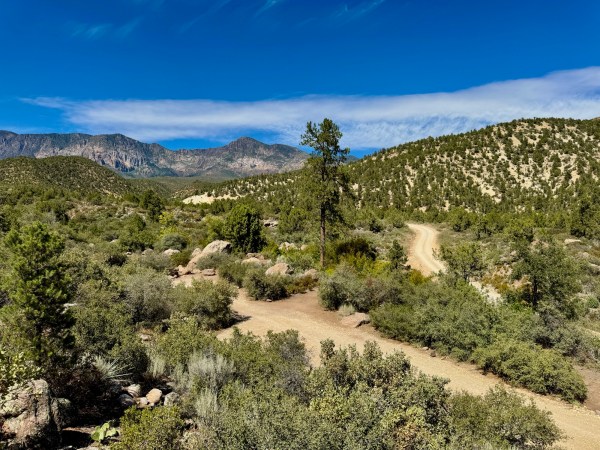
Oak Grove Rd crosses Leeds Creek in the lower part of Leeds Canyon.

Several different plants were in bloom, on which I’d hoped to find either Acmaeodera or longhorned beetles, the first that I looked at being Dieteria canescens (hoary tansyaster), but I only saw small dasytines (a few of which I collected). Nothing was seen on Solidago velutinus (velvety goldenrod) or Sphaeralcea grossulariifolia (gooseberry leaf globemallow) flowers, but then Mike came up with a Crossidius discoideus on flowers of Gutierrezia sarothrae (broom snakeweed).
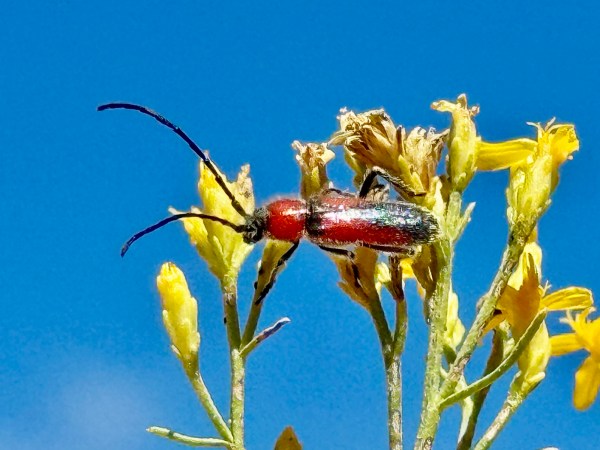
Crossidius discoideus (family Cerambycidae) on flowers of Gutierrezia sarothrae (broom snakeweed).

Careful searching of the plants in the surrounding area atop a small hill turned up an additional half-dozen individuals, but none were seen on any of the plants further up or down along the road. By this time, we’d spent about an hour and decided to finish the additional 2-hours drive needed to get to Jacob Lake.
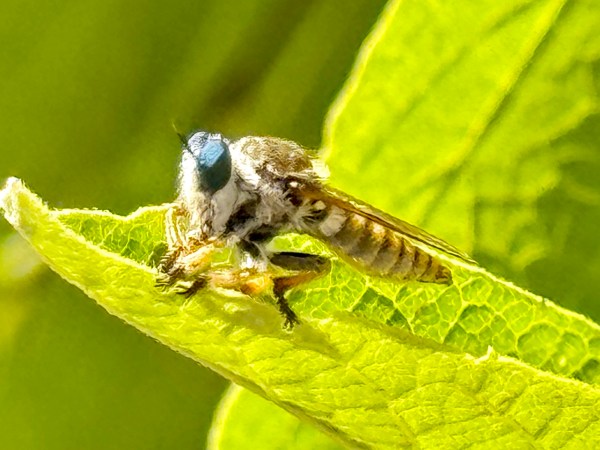
Megaphorus sp. (family Asilidae).
Historic home in nearby Harrisburg, Utah.

Some of the western U.S.’s worst fires this season occurred on Arizona’s Kaibab Plateau. The Dragon Bravo Fire destroyed over 100 structures on the Grand Canyon’s North Rim—including the historic Grand Canyon Lodge and the North Rim Visitor Center, while the White Sage Fire simultaneously burned significant areas of Kaibab National Forest north and east of Jacob Lake. It was the latter that, unfortunately, swept across both of the sites where I had placed traps a month earlier in June, so I was not optimistic about the likelihood that they had survived. Fortunately, the fires did not reach the immediate vicinity of Jacob Lake, so the campground was unaffected and—unusual in my experience—nearly devoid of people. After setting up camp, I went back north into the burn zone to see if my traps 1) had survived and 2) could be retrieved. The area around the site was almost completely destroyed, with charred black skeletons of trees dotting blackened soils devoid of any vegetation.
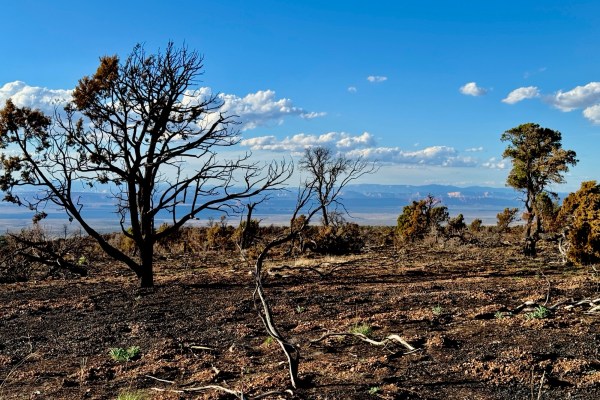
Aftermath of the White Sage Fire in the Kaibab National Forest.

I had low expectations for the traps at this site even before the fires, as the area had already burned several years early and was in the early stages of recovery (I had decided to place traps here anyway because I wanted to see what the woodboring beetle fauna in a recovering area might look like).

Blackened trunks punctuate a stark landscape.

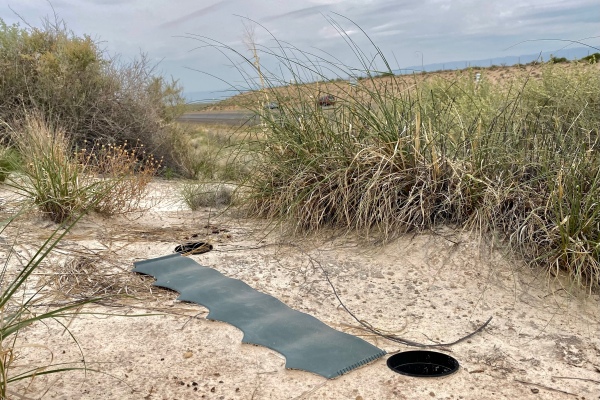
I continued walking the 2-track toward the trap location surveying the damage, came around a bend, and saw it—a lone, still-green pinyon pine with my jug trap hanging from a branch and a bottle trap, its yellow funnel only slightly heat deformed, still planted in the soil beneath the tree!

A lone green tree amongst the destruction—with my traps in the tree and below it both intact!

At first I was elated, but then I saw the jug trap reservoir was dry and almost completely empty save for a few dried beetle carcasses—the trap had survived the fires, but the associated winds had blown the trap and dumped the contents (none of which could be detected on the ground beneath). The bottle trap, on the other had, looked to be full of insects with plenty of liquid still in the reservoir, so I was hopeful that I would retrieve some good specimens from it. This proved to be the case (sort of!) as I pulled a few Anthaxia sp., a meloid, and lots of bees (for Mike) from the trap. The dried carcasses in the SRW-baited jug trap turned out to be an elaphidiine & several silphids.

After leaving the first trap site and driving towards the second (a few miles east of Jacob Lake), I saw little to no fire impacts as I continued east of Jacob Lake. However, as I got closer to the site I began to see impacts—first along the ridge above, then down the slope and engulfing the area where I had placed my traps. Fortunately, the fire did not seem to have been as severe in the immediate area, so I remained hopeful.

Intact jug trap in burned woodland east of Jacob Lake, Arizona.

The bottle trap was found first and was in much the same condition as the bottle trap at the previous location—it’s blue funnel slightly heat-deformed, but the reservoir was filled with liquid and insects. Later sorting yielded an Acmaeodera diffusa?, a Melanophila sp., a couple of Anthaxia sp., a clerid, and lots of bees (for Mike). The Melanophila sp. was especially welcome—known collectively as “fire beetles” for their attraction to active fires, its presence in the trap may have been been a direct result of the fire. The SRW-baited jug trap was quickly found next, and much to my relief the trap was not only intact and undamaged but also filled with insects (in fact, the propylene glycol had not even completely dried). Later sorting would yield only a single longhorned beetle (plus a silphid and a Euphoria inda), but that longhorned beetle would prove to be the catch of the trip—Calloides nobilis mormonus! I have reared a single individual of the nominate subspecies from fire-damaged oak collected in Missouri, so I suspect the presence of this beetle is also a direct result of the fires that swept through the area—a satisfying irony.

Calloides nobilis mormonus (family Cerambycidae) attracted to sweet red wine-baited jug trap.

Back at camp and after another “surf & turf” dinner of sirloin steak and salmon, I did my customary nighttime walk to look for night-active beetles on the ground and in tree trunks. I had good luck with this here back in June, finding a Zopherus uteanus and several other beetles, but tonight’s catch consisted of just a single Temnochila sp. (family Trogosittidae) and a single weevil (superfamily Curculionoidea) crawling on the large trunks of Pinus ponderosa.

Unidentified weevil (superfamily Curculionoidea) on trunk of Pinus ponderosa (Ponderosa pine) at night.

Day 8

I’d seen a fair amount of Ericameria nauseosa (rubber rabbitbrush) in bloom at the second site the previous day when I retrieved my traps but didn’t see any insects (or, at least, beetles or bees) on them. I figured this was due to the early evening hour, so we decided to come back during the day to try again. The E. nauseosa flowers were still, puzzlingly, devoid of insects (save for honey bees and enormous numbers of a large, black, bristly tachinine fly—possibly Archytas metallicus or Juriniopsis adusta).

Tachinine fly (possibly Archytas metallicus or Juriniopsis adusta—family Tachindae) on flowers of Ericameria nauseosa (rubber rabbitbrush).

Like at Kyle Canyon, the absence of Crossidius spp. on E. nauseosa flowers was surprising, as I have seen them on this plant at almost every other location I have ever checked. You can’t make things appear no matter how hard you look, however, so we continued into some openings farther up the slop and encountered a few other plants in bloom. One was Dieteria canescens (hoary tansyaster), on the flowers of which I found a few small beetles of an unknown family. Nearby I saw several dead main branches in a clump of Quercus gambelli (Gambel oak)—cutting into them revealed a very small woodboring beetle larvae, so I collected several of the stems for rearing. Coming back down the slope I found a single cryptocephaline on the flower of Eriogonum racemosa (redroot buckwheat) and a single Acmaeidera rubronotata on flowers of Gutierrezia sarothrae (broom snakeweed)—the latter on which Mike had also found a single Crossidius discoideus. (This seems to be the first record of any species of Crossidius from the Kaibab Plateau! Maybe the other species are here as well but are not quite out yet at this relatively early date in fall.)
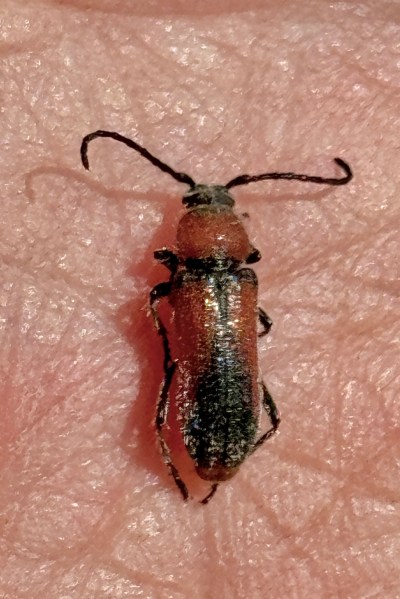
Crossidius discoideus (family Cerambycidae) collected on flowers of Gutierrezia sarothrae (broom snakeweed).

We were getting ready to leave when I spotted a large, fallen Pinus ponderosa (Ponderosa pine) with the twigs brown but still attached (indicating it might be the right “amount” of dead to host woodboring beetles. Damage by such could be seen on the smaller branches, and cutting into them confirmed the presence of larvae and led to a second wood-cutting/bundling session to bring the beetle-infested twigs and branches back for rearing.

Chasing more floriferous pastures, we went back up to higher elevations and stopped at a spot close to the campground where we 1) saw a great diversity of plants in bloom and 2) could safely pull off the highway. A huge diversity of blooming plants were seen (from which Mike collected ~20 species of bees), but the only beetles of interest that I saw and collected were numerous small black/red cryptocephalines on the flowers of Eriogonum racemosum (redroot buckwheat). After Mike was satisfied he’d sufficiently sampled the diversity of bees at the site, we looked for another place to collect.
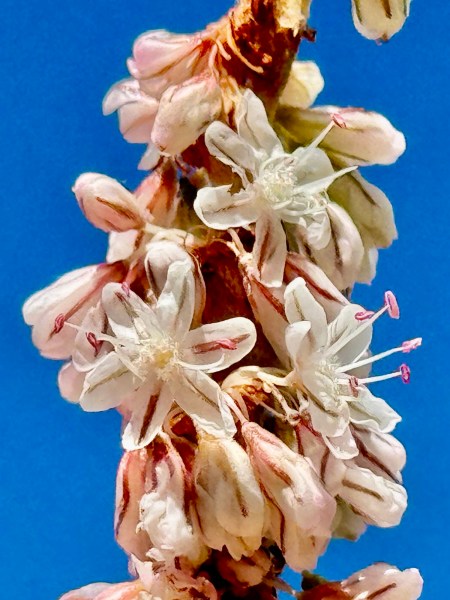
Eriogonum racemosa (redroot buckwheat—family Polygonaceae).

We drove south towards DeMotte Campground on Hwy 67, but much of the landscape was complete devastation due to the fires and no access was allowed beyond Kaibab Lodge. It was depressing to see the immense scale of destruction and loss of natural resources, but as one forest worker that Mike talked to put it, “It’s just trees, and he didn’t have to call anybody’s family [i.e., there was no loss of life].” We then drove back down past my second trap location where we had collected earlier in the day to see if we could find better stands of Gutierrezia sarothrae (broom snakeweed) on which to look for more Crossidius discoideus (still represented in the area by the single individual Mike had collected earlier). We drove through even more complete and utter destruction but eventually found undamaged areas at about 6600’ elevation. Not only was there G. sarothrae in bloom, but also Chrysothamnus visicidiorus (green rabbitbrush) and Ericameria nauseosa (rubber rabbitbrush)—all three species serving as hosts for various Crossidius and providing a perfect scenario for comparing and contrasting the sometimes-tricky-to-identify plants! The promise of Crossidius, however, would not be realized, and after an hour of searching—finding only a lone weevil on the flowers of E. nauseosa—did I finally admit defeat and concede that Crossidius from this after would have to come some other time.

Inflorescences of Gutierrezia sarothrae (left), Chrysothamnus viscidiflorus (middle), and Ericameria nauseosa (right). Note the distinct ray florets of G. sarothrae and blue-green leaves of E. nauseosa.

I hadn’t planned to do my customary nighttime walk this evening—my motivation waning after the less than meager success of the previous night, continuing relative absence of beetle life I’d seen during the day, and temps now dropping towards the 50s. A cute but shy Uinta chipmunk in our campsite captured my photographic interest as we relaxed, and the setting sun turned the clouds a stunning pink!

An Uinta chipmunk (Neotamias umbrinus) climbs a Ponderosa pine to stay as far from my camera as possible!

However, as night fell the siren song of the nighttime walk began singing its tune and I was unable to resist.

The setting sun turns the clouds an exceptional pink.

It turned out to be a more successful night than I’d expected—I found a small species of tenebrionid [Edit 10/1/25: Eleodes pimelioides] on the rocks surrounding the campsite, and there turned out to be dozens of the little buggers crawling though the pine duff in the campground.


Eleodes pimelioides (family Tenebrionidae) in alpine coniferous forest at night.

Nothing else was seen, however, and since tomorrow would be a long travel day I called it an early night.


Day 9

On a mostly travel day, we tried to take a big bite out of the many miles that still separate us from St. Louis, where we planned to be in three days time. We got another look at the devastation east of Jacob Lake before reaching the dramatic drop off the Kaibab Plateau and down into the Vermilion Cliffs National Monument—their massive red bluffs accompanying us all the way to Mojave Canyon. Just south of there as the highway climbed up and out of the valley, we made a quick stop to remove excess clothing (having gone from high elevation to low), and alongside the road I spotted a Crossidius pulchellus on the flowers of Gutierrezia sarothrae (broom snakeweed). This is the furthest southwest I have collected this species, and I was tempted to continue looking to see if I could find the other G. sarothrae associate—C. discoideus—as well. We still had a long drive ahead of us, however (destination Mills Rim Campground in northeastern New Mexico), so I resisted temptation and we continued the drive.

The Vermilion Cliffs, stunning as they were, still weren’t the highlight of the drive. That honor would come from the moonscape formations along Hwy 89 as it followed the Echo Cliffs and then turned east onto Hwy 160 towards Tuba City. We then passed through a series of stunning plateaus and drops on Hwy 264 as it passed through the Navajo and Hopi Reservations. One abandoned house as we dropped down off the Ganado Mesa was especially picture-worthy.

Abandoned home on the Ganado Plateau near Kykotsmovi Village, Arizona.

Eventually we crossed the state line at Picture Rocks into New Mexico, and, suddenly, the landscape seemed more “tame” and less hostile. I don’t normally like interstates, and the stretch of I-40 to Albuquerque did nothing to change my opinion of them, but I must admit that I-25 north towards Santa Fe was among the most picturesque I have ever seen. Eventually, we left the mountains and found ourselves once again on the western edge of the Great Plains—its vast featureless expanse a true contrast to the landscape we had witnessed throughout most of the day. This apparent homogeneity, however, is misleading—tucked away in places unknown to most are some remarkable natural areas, and Mills Rim is one such place. We arrived after dark, so the explorations of its hidden charms would have to wait until the next day, but after getting camp set up I did a short nighttime walk to see what was out and about.
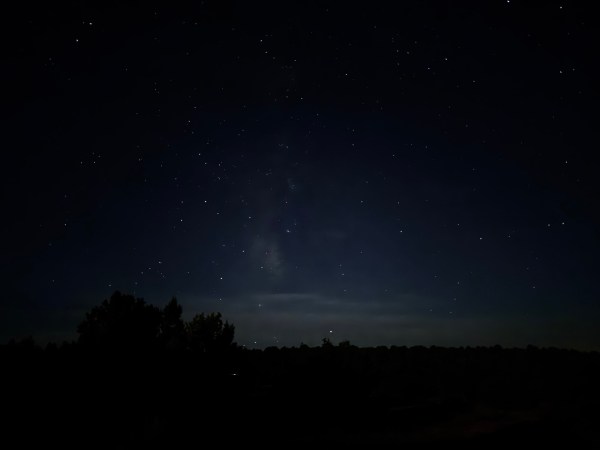
Night sky at Mills Rim Campground, Harding Co., northeastern New Mexico.

Only one beetle, Stenomorpha sp. (family Tenebrionidae) ambling across the ground, was seen.
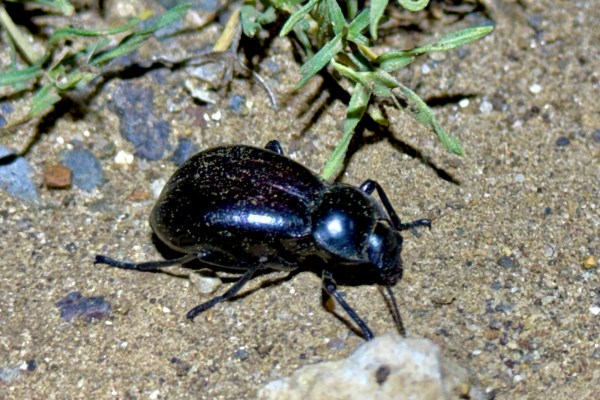
Many plants in bloom were also seen however, so I went to bed optimistic about my prospects for finding beetles the next day.


Day 10

Mosquitoes were bad during the previous night, and they were bad again the following morning, prompting liberal use of repellent to a much greater degree than I am used to. At the same time, the presence of mosquitoes indicates abundant moisture in an area, and it was with that optimism that I set about searching for jewel beetles, longhorned beetles, tiger beetles, and whatever other insects could catch my eye in this hidden jewel of a place. Surrounded by treeless grasslands (and preserved as the Kiowa National Grasslands), Mills Rim Campground sits at the edge of Mills Canyon—a chasm in the landscape at the edge of a plateau bordering the foothills of the Rocky Mountains. Firmly embedded in the Great Plains, the juniper/pine/oak woodland at the edge of and down in the canyon features plants and animals at their easternmost extent—residents of the Rocky Mountains that have found an isolated home in the middle of the grasslands. Pinus edulis (Colorado pinyon pine), Pinus ponderosa (Ponderosa pine), Juniperus monosperma (one-seed juniper), Juniperus scopulorum (Rocky Mountain juniper), Quercus grisea (gray oak), and Quercus × undulata (wavy leaf oak) all make their homes here, hosting innumerable insect species that are normally more at home in the Rocky Mountains.

View into Mills Canyon from Mills Rim Campground.

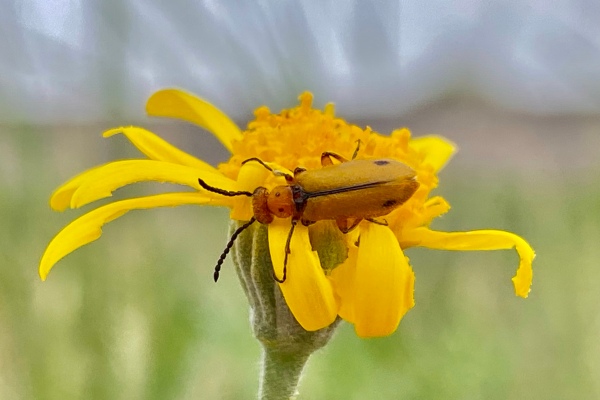
I’ve collected here several times and recorded many different western species of beetles, but the height of the season seems to be in June and July. Mid-September, in contrast, seems to be near the tail end of the season, the numbers and diversity of beetles and other insects dropping from their highs earlier in the season. The flowers of Gutierrezia sarothrae, however, were hosting lots of insects. In addition to Crossidius pulchellus, Chauliognathus basalis, Bothrotes canalicularis, and Collops sp., Mike found numerous bee species, mostly females, collecting pollen from the flowers.
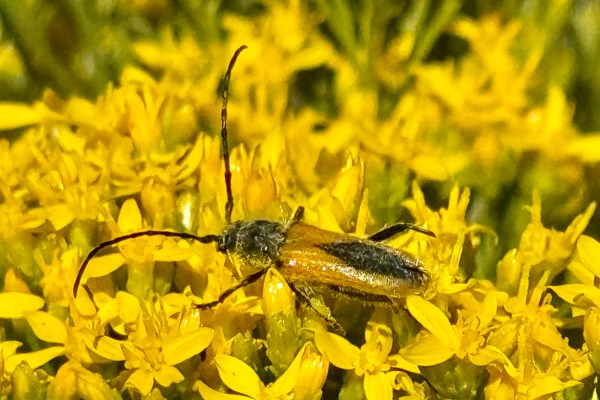
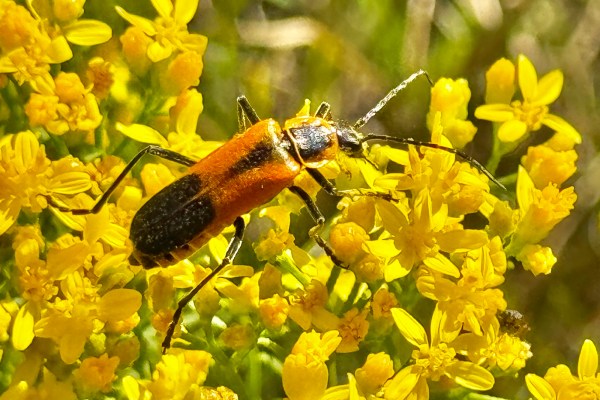
Crossidius pulchellus (family Cerambycidae) on flowers of Gutierrezia sarothrae (broom snakeweed).
Chauliognathus basalis (family Cantharidae) on flowers of Gutierrezia sarothrae (broom snakeweed).
Bothrotes canalicularis (family Tenebrionidae) on flowers of Gutierrezia sarothrae (broom snakeweed).

A couple of species of robber flies—Ospricerus sp. and Efferia sp.—were also taken in flight, presumably patrolling the flowers of G. sarothrae for bee prey.

Ospricerus sp. (family Asilidae) patrolling flowers of Gutierrezia sarothrae (broom snakeweed) for bee prey.
Nysius sp. (false chinch bugs—family Lygaeidae) on flower of Erigeron divergens (spreading fleabane).
Mirabilis linearis (narrowleaf four o’clock—family Nyctaginaceae).

After a rest and rehydration break, I followed the road down Mills Canyon as it approaches the Canadian River to see if I could find Ericameria nauseosa—should I be able to, it would surely be at or near the easternmost limit of occurrence for the species in this part of New Mexico.

Mills Canyon above the Canadian River.
A bit further down Mills Canyon Road.

About half  a mile down the road I began seeing Acmaeodera rubronotata on the flowers of G. sarothrae, and I eventually secured a series of about a half dozen specimens. This is a nice record, as I found a single specimen a couple of years ago at Black Mesa in northwestern Oklahoma—a new state record and northeastern range extension, and this record helps bridge the gap between that record and the species’ more normal range of distribution across New Mexico and Arizona. Finally, nearly a mile into the canyon, I found one large blooming E. nauseosa and a smaller pre-bloom plant, but there were no Crossidius beetles on them, nor were any additional plants were seen a hundred yards or so further down the road, so I turned around.

Ericameria nauseosa (rubber rabbitbrush—family Asteraceae) along Mills Canyon Road.

On the way back out of the canyon, I collected a Calopteron sp. (family Lycidae) on senescing Melilotus alba (white clover) and photographed a female Stagmomantis limbata (Arizona mantis—family Mantidae).

Stagmomantis limbata (Arizona mantis—family Mantidae) on flowers of Gutierrezia sarothrae (broom snakeweed).

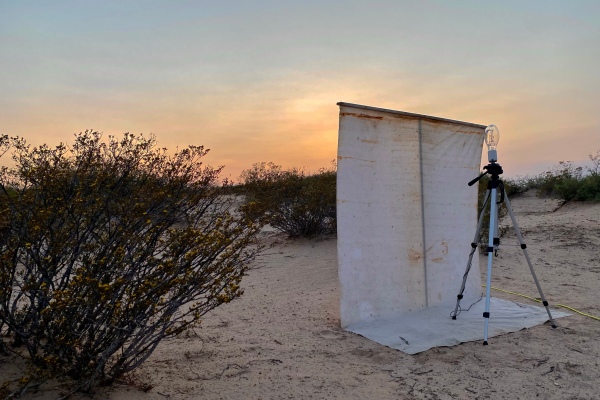
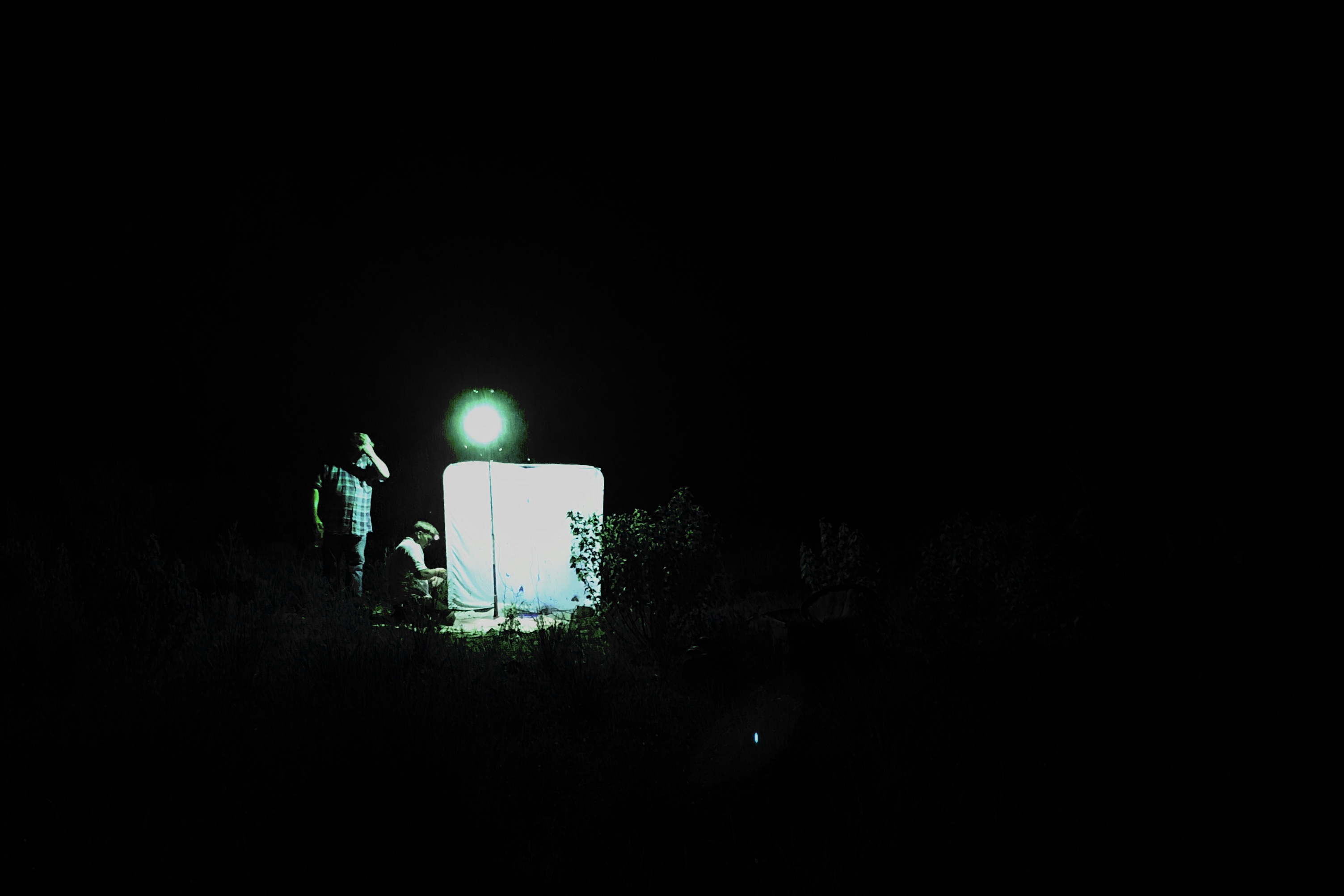
Back at camp, a couple of scarabaeoid beetles flew to the light of the lamp while we were relaxing with refreshments in hand and waiting for the coals to be ready. This suggested that maybe conditions were favorable for setting up the ultraviolet lights to attract other insects.

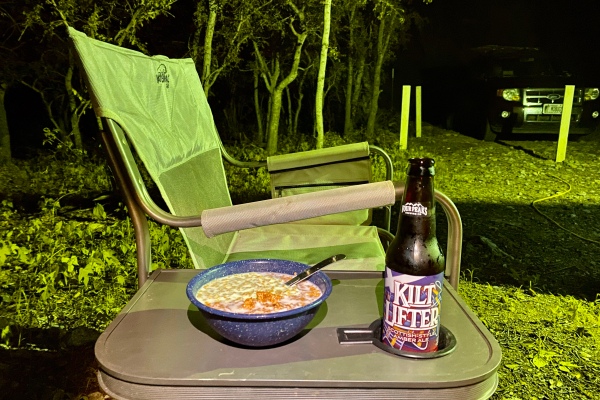
A final night of relaxing at camp with refreshments in hand.

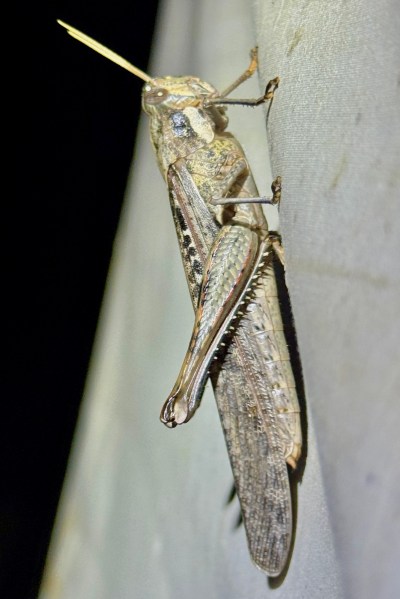
After finishing dinner, we did exactly that and saw a few interesting insects show up, but shortly after setting up the lights the wind began to kick up, the temps began to drop, and increasingly frequent gusts making further lighting impossible!
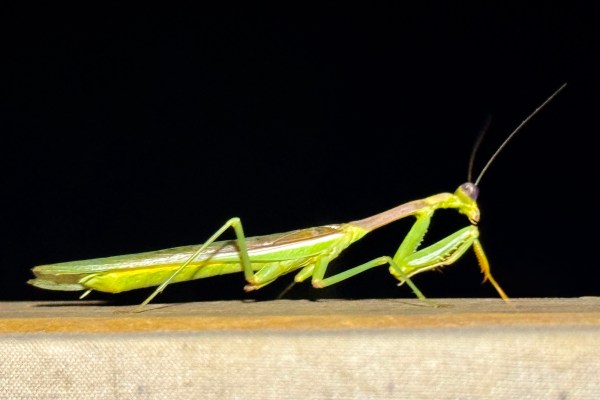
Stagmomantis limbata (Arizona mantis—family Mantidae) male attracted to ultraviolet lights.
Schistocerca nitens (gray bird grasshopper—family Acrididae) attracted to ultraviolet lights.
Ophion sp. (short-tailed ichneumon wasp—family Ichneumoidae) attracted to ultraviolet lights.

Day 11

It was a rather sleepless final night in the tent—winds whipped as we turned in for the night, and shortly afterwards we awoke to rain splattering our faces through the fly-less tent roof. We quick got up and put on the rain fly, then listened to light but steady rain for most of the rest of the night. By the time we got up it had mostly stopped, but cool conditions with low-hanging, fast-moving clouds caused us to quickly break camp and save coffee and breakfast for Mocks Coffee Shop in Clayton, New Mexico near the Oklahoma state line (let me tell you how difficult it was for me to drive two hours first thing in the morning without coffee!). We had wanted to make our final collecting stop at a a lot near Kenton in the Black Mesa area of extreme northwestern Oklahoma, but the forecast for the area showed only slightly warmer temperatures and very gusty winds. This would make collecting there pointless, so we instead traveled four more hours east to get in front of the cold front at another of our favorite collecting spots, Gloss Mountain State Park in Major Co.

Gloss Mountain State Park features gypsum-capped mesas atop Permian red siltstones.

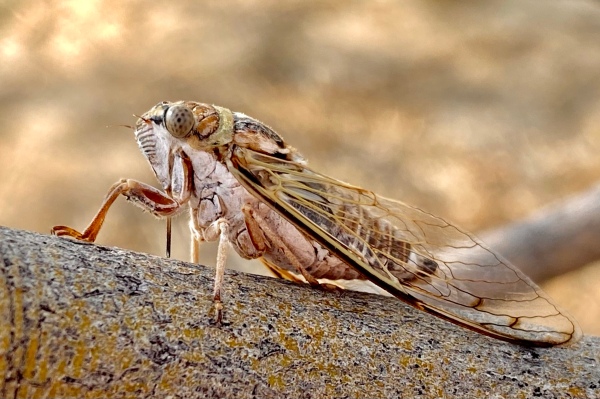
I was hoping to see an attractive late-season jewel beetle—Acmaeodera macra, which I had collected here and at nearby Alabaster Caverns State Park in previous years during late September. Temps were good (well over 80°F) when we arrived but the hour was already late (near 4:00 p.m.), so we had limited time for collecting before insects would start bedding down for the evening (usually around 5:00 to 6:00 p.m. at this point in the season). Megatibicen dorsata (bush cicada) and Neotibicen aurífera (prairie cicada) males were still singing abundantly, filling the air with their distinctive songs (video of M. dorsata male singing here).
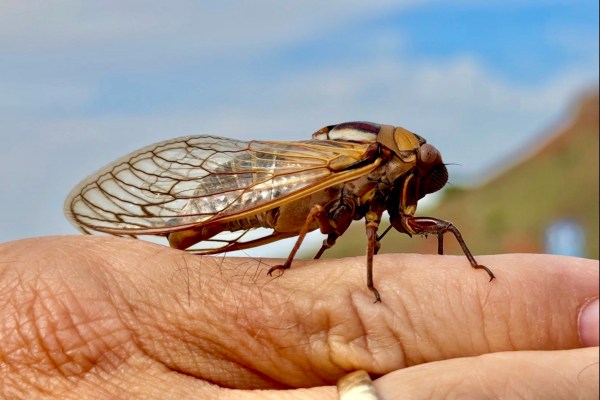
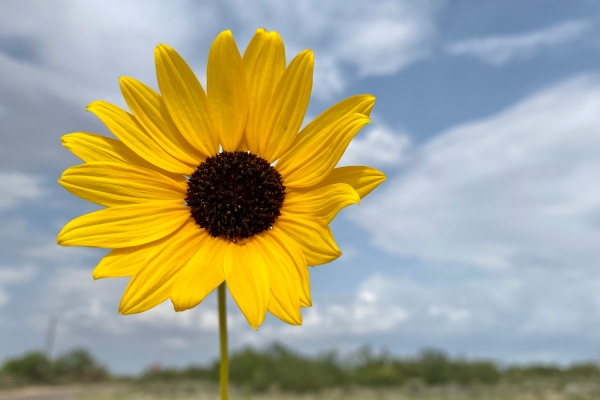
Megatibicen dorsata (bush cicada—family Cicadidae) male singing on my hand after being taken from the stem of Helianthus annuus (annual sunflower).

Helianthus annuus (annual sunflower) and Grindelia ciliata (wax goldenweed) were blooming prolifically, off the flowers of which Mike collected a fair diversity of bees. I’d hoped to find beetles on the flowers as well, but they were limited almost exclusively to Chauliognathus limbicollis.

Chauliognathus limbicollis (family Cantharidae) on flower of Grindelia ciliata (wax goldenweed).

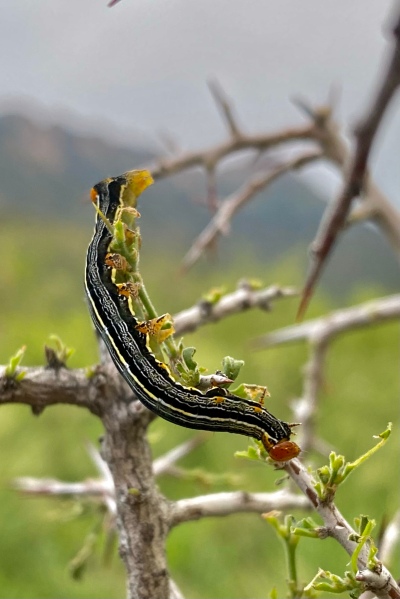
I did collect a male/female pair of Tetraopes femoratus (red-femured milkweed borer) on the seed pod of Asclepias engelmanniana (Engelmann’s milkweed) and photographed the striking and beautiful caterpillar of Schinia gaurae (clouded crimson moth) on the stem of Oenethera glaucifolia (false gaura).

Tetraopes femoratus (red-femured milkweed borer—family Cerambycidae) on seed pod of Asclepias engelmanniana (Engelmann’s milkweed).
Schinia gaurae (clouded crimson moth—family Noctuidae) on the stem of Oenethera glaucifolia (false gaura).

After that, I went up on top of the main mesa where I expected A. macra to occur. Heterotheca stenophylla (stiffleaf false goldenaster), on the flowers of which I collected A. macra in previous years, was blooming abundantly, but intense searching their flowers produced no beetles. I also noticed that Gutierrezia sarothrae (broom snakeweed), abundant in the area as well, was in only the earliest stages of bloom, suggesting to me that it might still be a bit too early for the jewel beetles to be out. By the time the 6:00 hour arrived, insect activity was noticeably diminished, and we wrapped up this, our final, collecting stop of the trip.

No camping is available at Gloss Mountain State Park, so we knocked out another hour and a half of travel by driving to Ponca City in north-central Oklahoma and taking a hotel there. For the first time since we left, we enjoyed dinner at a restaurant (fried catfish for me!), a hot shower, and a real bed!


Day 12

The following morning, we were surprised to learn that the only coffee shops in town were Starbuck’s and drive-throughs. This just wasn’t going to cut it for us on our final travel day, so we drove 15 minutes north to the small town of Newkirk and enjoyed great coffee, breakfast sandwiches, and scones at “Savvy Cactus” (Newkirk Mercantile Boutique & Espresso Bar). (The coffee was good enough that I bought a bag of their coffee!)

“Savvy Cactus” Newkirk Mercantile Boutique & Espresso Bar in Newkirk, Oklahoma.

The rest of the drive back to St. Louis was spent reflecting on the many experiences we’d just had and synthesizing the new knowledge while enjoying the landscape as it skirted the southern edge of the Flint Hills of Kansas and traversed the familiar hills and dales of our beloved Missouri Ozarks—the end of a 3,931-mile trip!

62.3 mph average for the trip.

©️ Ted C. MacRae 2025

“BioBlitzing” Schoolcraft Prairie

It’s been a few months since I’ve been on a WGNSS field trip, so I was anxious to attend this past weekend’s joint trip between the Entomology and Nature Photography Groups to visit a private restored tallgrass prairie remnant located in extreme southwestern Washington County and named after Henry Schoocraft, who famously chronicled his journey through the Missouri Ozarks in the early 1800s and passed within a few miles of this spot (if you’ve not yet read Schoolcraft’s journal, I highly recommend this natural history classic!). The landowner, a restoration ecologist for Shaw Nature Reserve, has been using prescribed burns and selective thinning over the past several years to restore the 70-acre tract of upland forest, former cropland, and grassland remnants to their presettlement character. Stupidly, I did not bring my main camera, preferring to focus instead on collecting rather than photography. In hindsight, I would have been much better served had I had my camera, as the beetle groups that I study (Buprestidae and Cerambycidae) tend to be scarce at this time of season in Missouri, while interesting subjects for photography in other insect groups abound. As far as photos go, my iPhone would have to suffice.

A lone Pinus echinata (shortleaf pine) in restored tallgrass prairie remnant.

We arrived a bit after mid-afternoon and spent the bulk of the remaining daylight hours in the prairie remnant. Florally, it was one of the most diverse prairies I’ve ever seen, especially in this part of the Missouri Ozarks. One plant in bloom that was new to me was Liatris scariosa (devil’s bite blazingstar), distinguished from the similar L. aspera (also in bloom) by its flower heads on long stalks and with mostly flat phyllaries.

Liatris scariosa (devil’s bite blazingstar—family Asteraceae) in restored tallgrass prairie remnant.

The first insect of interest that I found was the white fluffy early-instar caterpillar of Megalopyge crispata (black-waved flannel moth). The hairs of all species in this genus are venomous in the larval stage, and interestingly the later instars of a related species (M. opercula) resemble a tiny Trump toupee (look it up!).

Megalopyge crispata (black-waved flannel moth—family Megalopygidae) early-instar caterpillar on foliage of Carya tormentosa (mockernut hickory) in restored tallgrass prairie remnant.

Also present were Neotibicen auriferus (prairie dog-day cicada), whose whining, metallic songs filled the air. Normally very skittish and difficult to approach, I managed to snag one on the trunk of a small persimmon tree in the middle of the prairie.

Neotibicen auriferus (plains dog-day cicada—family Cicadidae) captured while singing on trunk of Diospyros virginiana (persimmon) in restored tallgrass prairie remnant.
Atalopedes huron (Huron skipper—family Hesperiidae) perched on foliage of Rhus copallina (shiny sumac) in restored tallgrass prairie remnant.

As afternoon progressed to evening, I went back down from atop the ridge and visited a small calcarous fen—a unique wetland habitat created by seepage of calcareous groundwater that results in saturated, low-oxygen soil. Fens often support unique plants, and in this one I found Solidago patula (swamp goldenrod). I’ve never seen this plant before, so I was a bit disappointed it was not yet in bloom, but I marveled at an enormous, darkly colored banded fishing spider (Dolomedes vittatus) sitting on one of the plants.

Solidago patula (swamp goldenrod—family Asteraceae) in small calcareous fen.
Dolomedes vittatus (banded fishing spider—family Pisauridae) on Solidago patula (swamp goldenrod) in small calcareous fen.

After dinner we set up several light stations, including one up in the restored prairie remnant. Despite the warm, humid conditions, I had little optimism that we would see much of interest at the lights due to the near-full moon shining brightly in the cloudless sky. This was mostly true, although I did collect a few ceresine treehoppers and weevils from the lights. Additionally, a few small but pretty moths warranted a photograph or two.

Pyrausta tyralis (coffee-loving pyrausta moth—family Crambidae) at ultraviolet light in restored tallgrass prairie remnant.
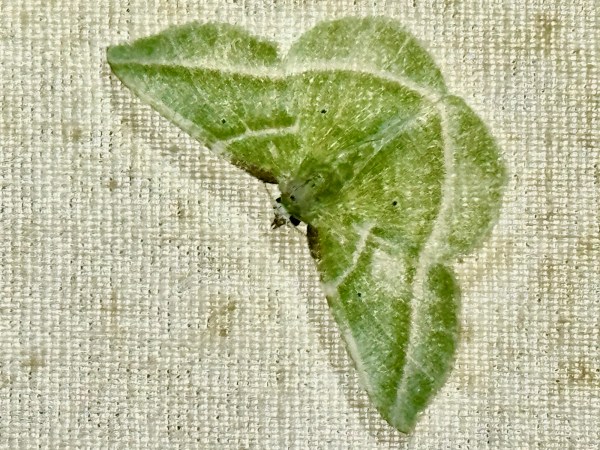
Dichorda iridaria (showy emerald moth—family Geometridae) at ultraviolet light in restored tallgrass prairie remnant.

The truly interesting finds, however, would come in the form of caterpillars on the foliage of nearby trees. Three species of slug moths (family Limacodidae)—among the most bizarre-looking of caterpillars, and all of which can sting—would be found. Two of them were new to me—a beautifully lichen-colored Euclea delphinii (spiny oak slug moth), and the nearly amorphous Apoda y-inversa (yellow-colored slug moth). The third species was the striking Parasa indetermina (stinging rose slug moth)—always a treat to see!

Euclea delphinii (spiny oak slug—family Limacodidae) caterpillar on foliage of Quercus stellata (post oak) in restored tallgrass prairie remnant.
Apoda y-inversa (yellow-collared slug moth—family Limacodidae) caterpillar on foliage of Quercus stellata (post oak) in restored tallgrass prairie remnant.
Parasa indetermina (stinging rose moth—family Limacodidae) caterpillar on foliage of Quercus marilandica (blackjack oak) in restored tallgrass prairie remnant.

Other striking caterpillars were found as well: Amorpha juglandis (walnut sphinx) and Ceratomia catalpae (catalpa sphinx)—adults of each also visiting the lights, Anisota virginiensis (pink-striped oakworm), Automeris io (io moth), Acronicta radcliffei (Radcliffe’s dagger moth), and Halysidota tessellaris (banded tussock moth). Some of these were photographed in situ, but most were brought back to camp for photographs under more controlled conditions.

Amorpha juglandis (walnut sphinx—family Sphingidae) caterpillar on foliage of Juglans nigra (black walnut) in dry-mesic upland oak/hickory forest.
Acronicta radcliffei (Radcliffe’s dagger moth—family Noctuidae) on foliage of Prunus serotina (black cherry) in dry-mesic oak/hickory forest.
Halysidota tessellaris (banded tussock moth—family Erebidae) on foliage of Carya tomentosa (mockernut hickory) in restored tallgrass prairie remnant.

Another interesting observation near the light in the prairie was a Neoconocephalus ensiger (sword-bearing conehead katydid—family Tettigoniidae) final-instar nymph molting to adulthood. At the time that I photographed it, the antennae were pulled taught—almost but not completely pulled free from the exuviae.

Neoconocephalus ensiger (sword-bearing conehead katydid—family Tettigoniidae) final-instar nymph molting to adulthood at night in restored tallgrass prairie remnant.

A final observation of a small treehopper (Platycotis vittata) on a Quercus stellata (post oak) twig—after which I called it a night (it was around 2 am!).

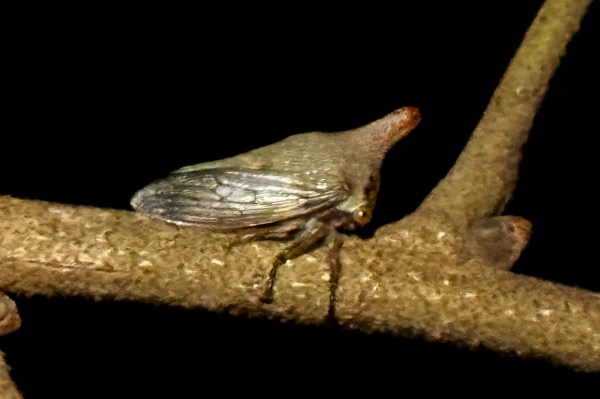
Platycotis vittata (family Membracidae) on twig of Quercus stellata (post oak) in dry-mesic oak/hickory forest.

©️ Ted C. MacRae 2024

2021 Texas/New Mexico/Arizona Insect Collecting Trip iReport

This is the 10th “Collecting Trip iReport”; this one covering 13 days of collecting in western Texas, southern New Mexico, and southeastern Arizona July 19–31, 2021. This trip was a “two-parter”—the first week with frequent field mate Jeff Huether (our seventh joint collecting trip) as we made our way from western Texas through southern New Mexico and into southeastern Arizona on our way to a memorial celebration for Jim Wappes at the home of Steve Lingafelter and Norm Woodley (for which I took the day off from collecting), and the second week visiting various locations in the “Sky Islands” of southeastern Arizona with several other entomologists.

As with all previous “iReports” in this series, this report is illustrated exclusively with iPhone photographs (thus the term “iReport”). Previous iReports in this series include:
2013 Oklahoma
2013 Great Basin
2014 Great Plains
2015 Texas
2018 New Mexico/Texas
2018 Arizona
2019 Arkansas/Oklahoma
2019 Arizona/California
2021 West Texas


Day 1 – Monahans State Park, Texas
This was my first stop on the previous trip back in late April and early May, and what a difference a couple of months with good rains makes—dry as a bone then but bursting with a great variety of wildflowers now. Like last time we stopped at the Shin Oak Picnic Area first, and almost immediately Jeff got an Acmaeodera gibbula on living Prosopis glandulosa (mesquite). I started beating the trees and got a good series of that species along with a good series of an Actenodes sp. (prob. A. mendax). There were also some mesquites that had been killed (apparently by herbicide), and when I started beating them I got several more A. gibbula and one Paratyndaris sp. It went from blazing hot when we arrived to raining about an hour later, and for a while after the rain moved through it stayed cloudy and quite comfortable. Eventually we decided to look for another spot with more mesquite to beat.

Monahans Sandhills State Park with rain moving in!
Poecilanthrax effrenus (family Bombyliidae) on flower of Thelosperma megapotamicum (rayless greenthread).
Acanthochalcis nigricans (family Chalicididae) female looking to oviposit on dead Prosopis glandulosa (mesquite).
Palafoxia sphacelata (othake).
Asclepias arenaria (sand milkweed).
Penstemon ambiguus (gilia beardtongue).

We found an area closer to the entrance (Equestrian Area) with lots of mesquite and also sunflowers, which Jeff was interested in looking at to search for meloids (blister beetles). Before I even reached the first mesquite I saw an Acmaeodera sp. (maybe A. obtusa) sitting on the flower of Thelosperma megapotamicum (rayless greenthread) and later found another plus one A. immaculata. Off the mesquite I beat just one Actenodes sp. prob. mendax and a few treehoppers, while another and a Chrysobothris sp. got away (it was by now quite hot and they bolted!). I continued beating mesquite but just wasn’t seeing anything, so we decided to take a look at the area around the main dunes and another picnic area.

Helianthus petiolaris (prairie sunflower).

At the Pump Jack Picnic Area, we saw a lot of Thelosperma megapotamicum (rayless greenthread) in bloom and decided to check the flowers for Acmaeodera. We each got a nice series of what appear to be A. obtusa and A. immaculata. Also, I finally found a single Acmaeodera immaculata on the flower of Hymenoppapus flavescens (collegeflower), which I’d been looking at all day thinking it must be a good Acmaeodera flower host. On the way back to the vehicle, I scared up a cicada that had been singing on a nearby plant—I’d been hearing them all day but assumed they were grasshoppers or katydids. I listened for another and saw it perched on the stem of Mentzelia nuda (bractless blazingstar), and netted it—a fine male, smallish and with a very white venter. I wanted to find one more—catching another A. gibbula in flight, and saw one singing in a mesquite tree. This time I took some photos of it (working carefully not to alarm it) and then hand-caught it (later identified as Diceroprocta texana). A nice end to the visit.

Male Diceroprocta texana singing on Prosopis glandulosa (mesquite).
Mentzelia nuda (bractless blazingstar).

After dinner, we returned to Shin Oak Picnic Area for night collecting. I setup my new Mercury-vapor (MV) station (first time using the gas-powered generator and tripod—slick setup) and my two ultraviolet (UV) stations. Jeff set out three prionic acid lures. Large numbers of Polyphylla monahanensis (which came mostly to the UV stations) and P. pottsorum (which came mostly to the MV station), but otherwise few beetles showed up and not a single longhorn. Other insects were also limited mostly to large numbers of ground-nesting bees and several big grasshoppers. No Prionus came to the lures—not surprising since we are in the tail end of the season for P. arenarius (April to July) and too early for P. spinipennis (mostly August). I’ve only gotten a few P. monahanensis and P. pottsorum before now, so it’s nice to have good series of each, but I would have preferred to collect some longhorns.

Blacklights humming as dusk settles over the dunes.
Polyphylla pottsorum at the MV sheet.

Day 2 – Toyahvale, Texas
We’re on our way to the Davis Mountains, and along the way I decided to stop at the “Agrilus cochisei” spot we found (on a tip from Jason) back during the April trip. I swept the roadsides—not just the host plant (Artemisia occidentalis, western ragweed) but a variety of other plants in bloom but did not find any A. cochisei. I did collect a few meloids (which were on Solanum eleagnifolium) and Zygogramma leaf beetles but nothing else.

Proboscidea parviflora (family Martyniaceae)—doubleclaw or red devil’s-claw.

A bit further down the road from the last stop, we noticed this memorial to the many horses that have been transported along this highway on their way to slaughter.

Davis Mountains, Ft. Davis, Texas
Another roadside stop for one of the places where I collected during last April’s trip. I was hoping we would not be too late for Acmaeodera—there were plenty of plants in bloom but we did not see any. Senegalia greggii (formerly Acacia greggii, commonly called cat-claw acacia) and Vachellia constricta (formerly Acacia constricta, commonly called whitethorn acacia) were both in bloom, and off the former I got the obligatory Stenaspis solitaria male/female pair as well as a Lampetis drummondii, but I collected nothing off the latter. Tried for a couple of cicadas and missed ‘em both!

Stenaspis solitaria male on flowering Senegalia greggii (cat-claw acacia).
Lampetis drummundii captured on flowering Senegalia greggii (cat-claw acacia).
Eurema nicippe (sleepy oranges) on yellow asteraceous flower.

Davis Mountains, Boy Scout Rd, Texas
This looked like a good spot, with water in the creek and lots of butterflies flying around. Beating, however, yielded nothing but lots of lep larvae. It seems we are in the mid-summer lull—too late for spring things, but too early for late summer-fall species. I think we’ll try some higher elevations and see what it is like.

Argemone aenea (golden prickly poppy).
Argemone albiflora (white prickly poppy).

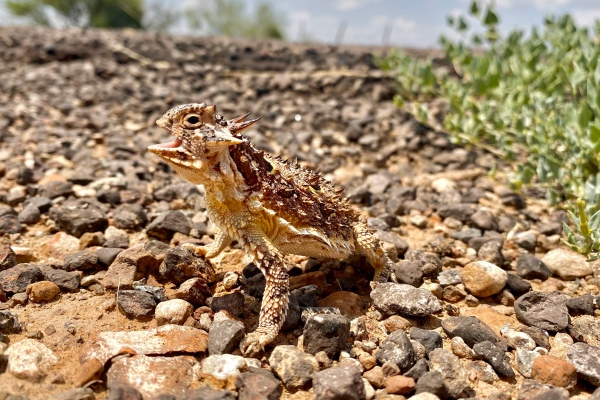
We were headed back towards the highway when I spotted a stand of Thelosperma megapotamicum along the road. We got out so I could take a look at them and immediately encountered this Texas horned lizard who seems to be saying “WTF?!” I swept through the Thelosperma and picked up two Batyle sp., one Enocleris sp., and a couple of species of meloids. There were lots of other plants in bloom, too, including several that are typically attractive to beetles such as Sphaeralcea and Ratibida. However, nothing was seen on them, further reinforcing our desire to go to higher elevations to see if that would improve the collecting.

Phrynosoma cornutum (Texas horned lizard).

Davis Mountains, Madera Canyon, Texas
We wanted to get up to higher elevation to see if that might improve the insect collecting. It is strange—the Davis Mountains are greener than I’ve ever seen them, yet there are almost no insects, no flowers. Jeff and I were wondering if the deep freeze Texas experienced this past winter might have knocked out insect populations. We beat along the way but just we’re not seeing anything on the beating sheets. We hiked our way up to the overlook, and up there I ran into a few species of tenebrionids running along the trail and doing their famous “headstands” when we disturbed them. On the way back down I saw a few large, red and black clytrine chrysomelids on what I take to be a fall-flowering helianthoid aster (old flowering stalks were 5–6 feet tall), so I picked up a few for Shawn (my scope of insects that I’ll collect expands greatly when I’m not finding anything in the groups that I study). I think we’ve had it with the Davis Mountains, and tomorrow we’ll travel further west and try our luck around Fabens.

Lower part of the Madera Canyon Trail.
The trail at upper elevations.
A small Eleodes sp. doing the headstand.
A larger species (Eleodes wenzeli sulcicollis) doing the headstand.
Same individual as in the previous photo.

Day 3 – Van Horn, Texas
Just a quick stop along the highway when we saw a variety of plants in bloom. Things are different at these lowers elevations compared to the Davis Mountains. Sweeping yielded a number of Agrilus sp. (vittate) and two Agaeocera gentilis—I suspect they were on the Sphaeralcea angustifolia (narrow-leaved globemallow), along with an Acmaeodera sp. and assorted other beetles. On a much taller globemallow I found two Tylosis jiminezi (male/female) perched on the foliage—a first for me! I did a little more sweeping further to the south but came up with only a few melyrids and a blister beetle (Epicauta segmenta). Nice stop!

Tylosis jiminezi on Sphaeralcea angustifolia (narrowleaf globemallow).
Sphaeralcea angustifolia (narrowleaf globemallow).

San Felipe Park, El Paso Co., Texas
When we first arrived, we were not at all optimistic—it looked like it hadn’t rained in years. However, the Larrea tridentata (creosote) and Prosopis glandulosa (mesquite) were both in full bloom, so we began looking about. Almost immediately I saw Stenaspis solitaria in the mesquites, which in itself is not exciting, but two of the first three I saw were the form that has the distinctly reddish-brown pronotum, which I’ve never seen before. I saw a couple more and tried to get photographs, but they were too skittish. As I searched for them, I caught one Aethecerinus latecinctus (a second got away), one Plionoma sp. (not sure if it’s suturalis or rubens), one Chrysobothris sp. (prob. C. octocola) and one Acmaeodera gibbula. The real fun began, though, when I walked by a creosote and saw a Gyascutus planicosta (should be subsp. obliteratus in this area) take flight. I tracked it to see where it landed, caught it, and then put most of my effort into getting a decent series of individuals. I succeeded, but it took more than four hours with the heat maxing out at 96°F! In addition to the Gyascutus, Jeff was quite excited to see the bright green and orange blister beetle Eupompha fissiceps abundant on the creosote in mating pairs and feeding on the petals of the flowers. I finished off the blister beetle fun by finding Cysteodemus wislizeni (black bladder-bodied meloid) crawling in the sand, which, despite the common name, was decidedly bluish.

The author looks out over the vast creosote/mesquite scrub.
Eupompha fissiceps on Larrea tridentata (creosote).
Eupompha fissiceps feeds on Larrea tridentata (creosote) as “Mr. Meloid” (Jeff Huether) looks on.

After going into town to restock on supplies and catch some dinner, we returned to the park to do some lighting and night collecting. The moon is almost full, which generally puts the kibosh on longhorns coming to the lights, but we decided to try anyway because of the high amount of activity during the day in a rarely-visited location. I set up the Mercury-vapor (MV) light only and skipped going through the trouble to put up the ultraviolet lights also. I also wanted to beat the mesquite since I didn’t have much chance during the day, spending most of my time hunting Gyascutus with an aerial net, and once I got the MV setup going I started whacking the mesquite. Almost immediately, I got three Aethecerinus latecinctus, which came off the first two plants I beat. This motivated me further and caused me to commit to beating for the next hour or so—never even getting a single beetle of any kind! By then the lights had been going for awhile, and I was pleased to see several Derobrachus hovorei (palo verde root borer) crawling on the sand near the light. Even though it is a common species, I’ve not seen many myself, so I was happy to have a nice series to take up beaucoup room in one of my prionid drawers. Otherwise, very few beetles came to the lights, or most other insects as well—the sheet being covered primarily by dozens of white-lined Sphinx moths and lots of wasp/bee-type things. We did enjoy the evening, however, as we sat in our chairs and drank a cold brew between checkings of the light.

Mercury-vapor light setup at dusk.
Mercury-vapor light just turned on at sunset.
Mercury-vapor light going strong as darkened settles.
Derobrachus hovorei (palo verde root borer).

Day 4 – Chaparral, New Mexico
We had planned to take NM-213 north to White Sands, but public access was blocked at Ft. Bliss. While backtracking, I spotted Sphaeralcea angustifolia (narrow-leaved globemallow) growing along the roadside and stopped to check it out. There was nothing on any of the plants, despite good growth and appearing to be coming into flowering. I did a little beating on Prosopis glandulosa (mesquite) as well—again very little going on, just a few treehoppers, tiny blister beetles, and one weevil. Larrea tridentata (creosote) was in full bloom, just like at Fabens, and here too there were many Eupompha fissiceps on the flowers and in mating pairs. I couldn’t resist collecting just a few and even made a short video of a mating pair engaged in some interesting behavior. I did see one Gyascutus planicosta as it flew by, but I could not track it to see where it landed. Otherwise all I picked up was another Cysteodemus wislizeni (black bladder-bodied meloid)—along with a photo, and a male cicada (maybe Diceroprocta texana) singing on a dry yucca stalk (hand-collected!).

Cysteodemus wislizeni (black bladder-bodied meloid).
Eupompha fissiceps mating pair engaged in some interesting behavior.

Point of Sands, New Mexico
Jeff wanted to stop here to look for Pleurospasta mirabilis, a really cool-looking blister beetle that looks unlike anything else. He found just one by disturbing the host plant (small purple blooms), and I found none—seems we are right at the tail end of their activity period. I looked around for other things also, but there was not much out. I did catch a couple more cicadas (males singing), and near an Ephedra sp. bush I found a mostly-intact carcass of Sphaerobothris ulkei. The most interesting find, however, was a couple of apparently lost pitfall traps—the barriers had fallen over, and the cops were filled with sand and the carcasses of numerous tenebrionids that had fallen into the traps and never been retrieved. I pulled up the cups and filled in the holes to prevent further loss, finding a few live tenebrionids and trogids and one Pasimachus sp. ground beetle that had not yet succumbed in the process.

Point of Sands, New Mexico.
“Lost” pitfall trap.

Hatch, New Mexico
While passing through the town of Hatch, I couldn’t resist taking the opportunity to stop and photograph some interesting town characters.

An interesting take on the Sinclair dinosaur.
Chili Pepper Man!
Cast of characters.

Deming, New Mexico
Another roadside stop in an area that was green with flowers and also had Yucca (to look for Tragidion) and Ephedra (to look for Sphaerobothris). Neither of those insects were found, and no buprestids or cerambycids were seen on or swept from any of the many composite flowers about including Thelosperma megapotamicum. I did find a couple of the meloid Lytta biguttata, one on flowers of Cirsium sp. and another on an unidentified yellow composite flower, and Jeff found a huge aggregation of another meloid, Epicauta costata, on herbicide-treated Kali tragus (prickly Russian thistle). I finished off the stop by finding a spectacular ridged tenebrionid beetle walking about after the sinking sun went behind some clouds.

Lytta biguttata on yellow composite flower.
Epicauta costata on herbicide-treated Kali tragus (prickly Russian thistle).

Day 5 – Sunshine, New Mexico
We saw a nice stand of what proved to be Picradeniopsis absinthifolia (formerly Bahia absinthifolia, hairyseed bahia) and stopped to check them for buprestids/meloids. None were seen, just a few bees and lots of bee flies (genus Geron?). We did find a fair number of Cysteodemus wislizeni (black bladder-bodied meloid) crawling on the roadsides in a patch of Solanum elaeagnifolium (silverleaf nightshade).

Geron? sp. (family Bombyliidae) on flower of Picradeniopsis absinthifolia (hairyseed bahia).

Columbus, New Mexico
We found a moist drainage along the roadside with plants blooming in abundance, including Isocoma tenuisecta (burroweed) and Sphaeralcea angustifolia (narrow-leaved globemallow); however, insects were very scarce. I didn’t see any buprestids or cerambycids at all on any of the plants, only picking up one Lytta biguttata and one Cotinis mutabilis on the Isocoma and sweeping single examples of a small black/red Cleridae from the latter and a yellow-flowered composite.

Pepsis thisbe (Thisbe’s tarantula-hawk wasp) on flowers of Isocoma tenuisecta (burroweed).

Animas, New Mexico
We drove a fair distance west hoping to get into a different rainfall system in hope that insects would be present and saw a roadside in good bloom with the surrounding creosote scrub also green and blooming. As soon as we got out of the car we saw big beetles flying overhead and tracked them back to several creosote bushes very near the car with an aggregation of yet another blister beetle, Pyrota postica, which were mating and feeding on the flowers and leaves. After taking a few photos (and collecting my small series), I started sweeping through the variety of plants in bloom along the roadsides. I did not see anything on the flowers themselves (including Baileya multiradiata, pretty good buprestid flower) but collected a series of clytrine chrysomelids and one Dectes sp. While sweeping through Sphaeralcea hastulata (spear globemallow), I got one Agaeocera gentilis, and sweeping though a mix of S. hastulata and S. angustifolia (narrow-leaved globemallow) I got three Agrilus sp. (perhaps the same as I collected south of Van Horn, Texas). Finally, on the latter, I found one more A. gentilis perched on the leaf.

Pyrota postica female on flowering Larrea tridentata (creosote).
Pyrota postica female feeding on the flowers of Larrea tridentata (creosote).
Sphaeralcea hastulata (spear globemallow).

Portal, Arizona
Finally made it to Arizona, and for the first stop I wanted to try a spot below Portal where I’ve had limited success finding Sphaerobothris ulkei on Ephedra. Last time I was I here I found a few, but not until after being distracted by Gyascutus caelatus and Hippomelas sphenicus in the acacias and mesquites. I vowed not to let that happen this time and weaved a zigzag pattern looking at every Ephedra I could find. While I was doing that. I did see one G. caelatus take flight and then caught another that I saw sitting on Vachellia constricta (white-thorn acacia) but remained focused on looking at the Ephedra. Eventually, after not seeing any S. ulkei, I started looking for other buprestids. The acacias were just beginning to flower—only a few plants had open flowers, and Jeff noticed the tiny silhouette of an insect in flight approaching the flowers. He netted it and showed it to me, and to my surprise it was one of the species in the A. stigmata group (black with two red apical spots)—none of which I have ever collected before but which I believe could be A. davidsoni. We spent the next hour watching for and netting the silhouettes on the few trees we could find with flowers, and then I got the beating sheet out and beat more off of the trees (whether in flower or not) to end up with a nice little series. I’ll be anxious to confirm whether these are A. davidsoni.

Mozena arizonensis on Vachellia constricta (white-thorn acacia).
Vachellia constricta (white-thorn acacia).

South of Willcox, Arizona
We got to Willcox around dusk, and the cool, breezy conditions told my gut that it would be pointless to set up the lights. Still, I couldn’t let myself not try, and without much opportunity to look for a good place to set up I just went down Blu Sky Rd to E Moonlight Rd and hoped for the best. My optimism waned rapidly, as conditions continued getting colder and breezier, and not a single insect came to the light—I should’ve listened to my gut!

Moonrise. A twilight zone moment occurred when I realized that I had taken this photo on Moonlight Rd!😮

Day 6 – Jim Wappes Celebration, Hereford, Arizona
Fun day with lots of fellow coleopterists at the home of Steven Lingafelter and Norm Woodley in memory of Jim Wappes. We got there in the early afternoon and enjoyed eats, conversation, and war stories from the field.

Min, Sangmi Lee, Lisa Lee, Candy Kuckartz, the author, Margarethe Brummermann, Jason Botz, & Andrew Johnston (photo by Steven Lingafelter).
The author, Andrew Johnston, Norm Woodley, & Ed Riley (photo by Margarethe Brummermann).

It was a good day for a party, as rain made insect collecting a no-go. As dusk settled, I admired the incredible view from Steve’s and Norm’s back patio!

Low clouds hang over the Huachuca Mountains.

The fun extended well into the evening hours. My thanks to Steve and Norm for hosting the celebration—what fun to see and talk to so many entomologists in one place.

Steve Lingafelter, Gino Nearns, “Kira Brummermann,” & the author (photo by Margarethe Brummermann).
Bill Warner, Norm Woodley, Paul Skelley, Jeff Huether, Steve Lingafelter, Andrew Johnston, & the author (photo by Margarethe Brummermann)

Day 7 – Superstition Mountains, Weaver’s Needle Vista Viewpoint, Arizona
We awoke to rain yesterday morning in Willcox, and it has stayed with us since—first on our way to Hereford for the Wappes Celebration, then up to Phoenix this morning—our efforts to escape the rain by coming north thus proving futile. I came to this spot on a tip that I might find Agrilus cavifrons on Celtis pallida (spiny hackberry) (although maybe a bit early), and I’d hoped despite the light rain I would still be able to find it. I did not—though I found the plants, but I did get a Chrysobothris sp. that I don’t recognize while beating Senegalia greggii (formerly Acacia greggii, cat-claw acacia). Of course, it was on the first plant that I beat, so I ended up beating for another hour with nothing to show for it! While walking the short paved trail, I found Cercidium sp. (palo verde) tree that had been cut up and showed evidence of buprestid infestation in one of the larger branches, so I retrieved and cut it up for rearing.

Water… water… everywhere!
Cylindropuntia fulgida (chain-fruit cholla, jumping cholla, hanging chain cholla).

Lost Dutchman State Park, Arizona
We made a quick stop here to admire its incredible scenery before heading back south.

Superstition Mountains as seen from Lost Dutchman State Park.
Stands of Cylindropuntia fulgida (chain-fruit cholla) frame this view of the Superstition Mountains from Lost Dutchman State Park.
Carnegiea gigantea (saguaro) in front of the Superstition Mountains.
Carnegiea gigantea (saguaro).

Upper Tanque Verde Falls Trailhead, Tucson, Arizona
The rain finally moved out and it was sunny for the drive back to Tucson, but with still-cool temps we weren’t sure if lighting would be worthwhile. We decided to try this spot—not too high (based on a tip by Bill Warner), and I setup the lights using a technique recommended by Roy Morris that involved placing one ultraviolet (UV) light on each side of the sheet, extending the Mercury-vapor lamp above to the top of the sheet, and periodically shutting off the latter to allow the UV lights the pull in the “shyer” insects before turning it back on. While I waited for the lights to started pulling things in, I did some beating around the area. I only collected one specimen, but it was a Cleridae that I don’t recognize, which was beaten off of Prosopis glandulosa (mesquite). Temps ended up in the lower 70s to upper 60s, but at the lights we still got a few longhorned beetles (Aneflomorpha sp.), a few melolonthine scarabs, and a nice series of two species of Pachybrachis (that I will send to Bob Barney).

Jeff looks for beetles at the light sheet.
Lethocerus medius at ultraviolet/mercury-vapor light in mesquite/acacia scrub.

Day 8 – Atascosa Mountains, Ruby Rd near Atascosa Lookout Trailhead, Arizona
The primary quarry here was Acmaeodera chuckbellamyi, a species I described in 2014 from a single specimen collected by my friend and hymenopterist, Mike Arduser, at this location on flowers of Aloysia sp. Several people have tried to find it since—without success, and in June 2011 the area was severely burned by the 27,550-hectare Murphy Fire. I was hoping enough time has passed to allow the area (and beetle population) to recover in this, my first attempt, at finding the species myself. I knew it was a long-shot, and long sorry short I did not find either the beetle or it’s Aloysia host flowers. I did collect a number of other beetles, however, including Lycus lorises, a few longhorned beetles and pachybrachine leaf beetles, and one Acmaeodera quadrivittatoides on flowers of Eysenhardtia orthocarpa (desert kidneywood), several Aneflomorpha sp. and a few pachybrachines on Quercus oblongifolia (Mexican blue oak), and more pachybrachines on Senegalia greggii (catclaw acacia), Mimosa dysocarpa (velvetpod mimosa)—the latter also yielding a few tiny Chrysobothris spp. (one looking like C. lucanus), and Propopis glandulosa (mesquite). Jeff also collected and gave to me a couple of Acmaeodera parkeri on flowers of Talinum aurantiacum (orange flameflower). I hiked 0.7 mi E on Ruby Rd to a spot where I swept a few beetles from low vegetation, and on the underside of a large, fallen branch of Q. oblingifolium I found a large female Polycesta arizonica. Finally, about halfway back to the trailhead I encountered a few tiger beetles on the road near standing puddles of water from the recent rains.

View from Ruby Rd looking south toward Mexico.
View from Ruby Rd looking southwest toward Mexico.
Lycus loripes on flowers of Eysenhardtia orthocarpa (desert kidneywood).
Talinum aurantiacum (orange flameflower).

Atascosa Mountains, Peña Blanca Lake, Arizona
We came here to look for Deltaspis tumacacorii, which like many rare beetles the odds are against finding it despite it having been taken in the area on several occasions. Again, this would not be one of those occasions, but I was happy to find a tiny tiger beetle (Cylindera viridisticta arizonensis) along the creek and even happier to beat a series of two species of Paratyndaris, one large Lampetis webbii (only my fifth specimen). and one Aneflomorpha sp. from mostly dead Senegalia greggii (catclaw acacia).

Leptinotarsa lineata on Ambrosia monogyra (cheeseweed burrobrush)—adult.
Leptinotarsa lineata on Ambrosia monogyra (cheeseweed burrobrush)—larvae.

Huachuca Mountains, lower Carr Canyon, Arizona
After dropping Jeff off at his hotel in Tucson (he flies home in the morning), I high-tailed it down to Carr Canyon to do some light collecting. It has been a long time since I’ve seen my sheet covered so quickly and thoroughly with insects! My quarry was longhorned beetles—of which I got a nice variety, but who can resist also the variety of scarabs, ground beetles, tenebrionids, blister beetles, and even planthoppers that flock to the lights in the mountains of southeastern Arizona? I’ll have to control myself a little better in the coming nights! Walking about along the roadsides (hoping to see Amblycheila giant tiger beetles), I encountered a gorgeous male Aphonopelma chalcodes (Arizona blonde tarantula).

Mercury-vapor/ultraviolet light setup.
Enaphalodes cortiphagus at Mercury-vapor/ultraviolet light in oak/juniper woodland.
Parabyrsopolis chihuahuae at Mercury-vapor/ultraviolet light in oak/juniper woodland.
Phileurus truncatus (triceratops beetle) at Mercury-vapor/ultraviolet light in oak/juniper woodland.
Chrysina beyeri (Beyer’s jewel scarab) at Mercury-vapor/ultraviolet light in oak/juniper woodland.
Chrysina gloriosa (glorious jewel scarab) at Mercury-vapor/ultraviolet light in oak/juniper woodland.
Pachysphinx occidentalis (western poplar sphinx) at Mercury-vapor/ultraviolet light in oak/juniper woodland.
Manduca florestan (Florestan sphinx) at Mercury-vapor/ultraviolet light in oak/juniper woodland.
Aphonopelma chalcodes (Arizona blonde tarantula) on ground in in oak/juniper woodland.

Day 9 – Huachuca Mountains, Copper Canyon, Arizona
I met Steve Lingafelter and Norm Woodley at their house, and together we drove to the famed Copper Canyon on the south side of the Huachucas. On the way I got a nice primer about the species that have been collected there and the plants they have been collected on. Steve and I started out walking the trail up the canyon while Norm swept the area down below. I pretty much beat every oak along the way, for a while only getting a smattering of beetles—Agrilaxia sp. on Quercus emoryi (Emory oak) and also on Q. arizonica (Arizona white oak) along with Sternidius decorus?. About a half-mile up the trail I beat dead branches of Q. hypoleucoides (silverleaf oak) and, not seeing anything at first, said “I’m going back; I’m literally not getting anything.” Right then, a small black beetle on the sheet caught my eye. I looked at it closely and realized it was a Mastogenius (prob. M. robustus)! I popped it in the bottle and beat more dead branches from the same tree and got not only another Mastogenius but also Tigrinestola tigrina. Freshly motivated, I spent the next half-hour working all the oaks in the area—and, as often happens, did not see another beetle! Nevertheless, it was hard not to be happy with the beetles that I’d gotten.

An unidentified treehopper nymph, likely something in the subfamily Smiliinae, tribe Telamonini, on twig of Quercus arizonicus (Arizona white oak).

I walked back down the trail and met Norm, who was just starting up. He filled me in on the results from below, which included sweeping a few Agrilaxia hespenheidei—one of my target species—and an Agrilus sp. on Bouvardia ternifolia (firecrackerbush). I decided to work the slope under the road, reasoning that Norm had likely already worked the flat ground below. On the first B. ternifolia I approached, I saw an A. hespenheidei on the flower, gave the plant a sweep, and caught not only the A. hespenheidei but also an Agrilus sp. (maybe A. latifrons). Over the next hour I would sweep a nice series of A. hespenheidei from B. ternifolia (but not another Agrilus sp.). While I was doing that, I also swept the numerous stands of Acaciella angustissima (formerly Acacia angustissima, prairie acacia) looking for the large, spectacular Agrilus cavatus. I would find two, and considering that I swept perhaps 50 or more stands they were well earned. Also, in the meantime, I noticed Acmaeodera parkeri on small blue flowers that I eventually identified as Evolvulus arizonicus (Arizona blue-eyes). The flowers were few in number and the beetles difficult to catch, so I only ended up with two specimens. Further down the slope the flowers much more abundant, but there was not a beetle to be found on them. In the waning moments of my visit, I encountered two Trichodes peninsularis horni on flowers of Lasianthaea podocephala (San Pedro daisy).

Bouvardia ternifolia (firecrackerbush), flower host for Agrilaxia hespenheidei.
Acaciella angustissima (prairie acacia), host for Agrilus cavatus.
Evolvulus arizonicus (Arizona blue-eyes), flower host for Acmaeodera parkeri.
Lasianthaea podocephala, flower host for Trichodes peninsularis horni.

Eventually we all met up at the car, compared our catches (not surprisingly, Norm did very well with buprestids and Steve did very well with cerambycids), and I did okay in both counts. We headed back over Montezuma Pass and were greeted with stunning views looking down into the Coronado National Monument!

Coronado National Monument from near Montezuma Pass.

Huachuca Mountains, Miller Canyon, Arizona
After dropping Steve off, Norm and I went to nearby Miller Canyon to look at a spot where he has collected three species of Taphrocerus (I’ve only collected two, but only once way back in 1987 at a spot in the lower canyon). We thought it might be too late in the season, but it was at least worth a shot. The sedges were lush and green, but the “sedgy wedgies” were absent. Looks like I’ll have to just come back out in April or May!

After striking out with Taphrocerus, I went back down to the lower elevations of the canyon to look for Tragidion on the stand of Baccharis sarothroides (desert broom) that occurs there. Once again, I was likely too late to find them, but as with Taphrocerus it was certainly worth a shot, and again I would not find any despite looking and most of the large plants in the area. I did find a few Euphoria leucographa feeding on the sap flows and a very large red/black clytrine, so it wasn’t all for naught. Just another reason to come out earlier in the season.

Euphoria leucographa feeding on a sap flow on stem of Baccharis sarothroides (desert broom).

Day 10 – Santa Rita Mountains, upper Box Canyon, Arizona
After getting reports of buprestid activity near Madera Canyon, I decided to head to the Santa Rita Mountains today instead of continuing in the Huachucas. The shortest route to this most famous of canyons in the Santa Ritas goes down Box Canyon, a less-well-known but still-fantastic canyon in its own right and where I’ve had good luck collecting the two previous times I’ve been there (August 2018 w/ Art Evans, Steve Lingafelter, and Norm Woodley; and September 2019 w/ Jeff Huether). I stopped at the “dry falls” and worked my way back up the road to a point where I’ve collected the majority of my insects there. Along the way, I beat the flowering Eysenhardtia orthocarpa (desert kidneywood)—insects were not numerous on the plants, but over the course of the trips up and back I got Acmaeodera gibbula, A. cazieri, two Aneflomorpha sp., and a few Lycus sp. I also swept the just-beginning-to-flower Mimosa dysocarpa (velvetpod mimosa) but got just a single Sphaenothecus bivittatus. When I reached the top of the canyon, I looked for a small patch of Allionia incarnata (creeping four-o’clock) in the steep road bank, off the flowers of which I have previously collected Acmaeodera cazieri, A. parkeri, and A. yuccavora. I found the patch, but the plants were not yet in flower. What was in flower on the flats above the bank, however, was Talinum aurantiacum (orange flameflower), off which I collected all three species (A. cazieri being the most abundant and only a single A. cazieri). As at previous stops this week, it seems that insect activity is beginning but is still a bit shy of coming into full peak.

Larva of Euscirrhopterus gloveri (purslane moth), which was present in outbreak numbers on a portulacaceous plant growing amongst Talinum aurantiacum.

While I was collecting, a caravan of cars came by. They turned out to be filled with entomologists attending the Invertebrates in Education Conference, one of whom I knew—Tad Yankoski of the Sophia M. Sachs Butterfly House in my hometown of St. Louis. He handed me a vial containing a large, live individual of Polycesta aruensis. I was excited to see this, especially when he told me he found it and saw many more in the flats below Madera Canyon, where I had planned to go next!

Santa Rita Mountains, flats below Madera Canyon, Arizona
It was a frustrating afternoon on several fronts. Starting off, I had trouble finding the Polycesta aruensis locality, and when I finally did find it there was nary a Polycesta to be seen. Perhaps they sleep during the heat of the day.🤷 After that, there was little time to go anywhere but Madera Canyon, where I spent a half-hour beating Quercus oblongifolia (Mexican blue oak) hoping to see Chrysobothris chalcophoroides (I didn’t) and another two hours checking out Baccharis sarothroides (desert broom) in the area where I collected Stenaspis verticalis and Tragidion deceptus two years ago (also fruitless). Of course, the dreadfully common Stenaspis solitaria was everywhere, but all I ended up collecting was a tenebrionid on the 2-track, a clytrine beaten from Cercidium aculeata (retama), and one Euphoria leucographa along with a nondescript cerambycid (Heaperophanini maybe) on B. sarothroides. On the way back to the vehicle, I encountered a dead, mostly skeletonized deer, and while I rarely collect from carcasses, I noticed a little green beetle crawling on the jaw bone. I figured it must be the cosmopolitan clerid, Necrobia rufipes—something I’d not seen before, so I collected it and tried to collect but missed another one.

Rain clouds gather over Madera Canyon.
Another view of the mouth of Madera Canyon.
Magusa sp. (one of the narrow-wings) caterpillar feeding on Sarcomphalus obtusifolius (lotebush).

Santa Rita Mountains, lower Florida Canyon, Arizona
I suppose I can credit my frustrating afternoon for one of my best nights of lighting ever. I stumbled upon this spot at the bottom of Florida Canyon during this afternoon’s Polycesta wild-goose chase and immediately thought, “Wow, what a perfect spot to set up a light!” A nice place to pull off the road with a small, level clearing embedded within low-elevation oak woodland. There was even a babbling creek in the background! It was close to dark by the time I returned and set up the lights (would’ve been even later if I’d gone into town for a “real” dinner). Ironically, there were neither the diversity nor quantity of beetles as two nights ago in lower Carr Canyon. But the cerambycids brought it… and kept bringing it! It seemed like every time I got up to check the sheet there were another 4–5 individuals. I ended up leaving the sheet up for four full hours and collected perhaps 40–50 specimens representing a dozen or more species. A few I don’t recognize, and most of those that I do recognize have resided in my cabinet in precious few numbers until now. It’s been years literally since I’ve had a night like this, and it’s a nice shot of motivation leading into the last few days of what is starting to feel like a long trip.

Sometimes circumstances dictate an unusual dinner.
Enaphalodes niveitectus at Mercury-vapor/ultraviolet light in oak/juniper woodland.
Tigrinestola tigrinus at Mercury-vapor/ultraviolet light in oak/juniper woodland.
Coenopoeus palmeri at Mercury-vapor/ultraviolet light in oak/juniper woodland.
Syssphinx hubbardi (Hubbard’s silk moth) at Mercury-vapor/ultraviolet light in oak/juniper woodland.
Eacles oslari (Oslar’s imperial moth) at Mercury-vapor/ultraviolet light in oak/juniper woodland.

Day 11 – Madera Canyon Rd, Continental, Arizona
I came back to the spot where Tad Yankoski had seen Polycesta aruensis so abundantly yesterday morning but which was completely absent by the time I got there in the afternoon. I did not see any adults on the trees this morning either and was about to give up when I spotted a few partially dead trees with very large, apparently fresh emergence holes in the main trunks that were the perfect size for P. aruensis—good thing I brought my chainsaw! I cut a trunk with its branches and segregated the cut up wood into age (fresh dead versus older) and size (twigs, medium branches, and main trunk) classes. While I was doing this, a Polycesta adult dropped off one of the fresh-dead, medium-sized branches! I beat the remaining branches on the tree and on nearby trees but did not see any more, so whatever Tad witnessed yesterday morning must have been an ephemeral event, perhaps related to synchronized emergence from the very trees among which I collected the wood. NOTE: don’t let anyone tell you that cutting up wood for rearing beetles is anything but a sweaty, exhausting endeavor, even with temps still in the mid-80s and decent cloud cover!

This camouflaged tanker marks the spot—trees on the W side of the tanker.
Job half-done—wood cut up.
Job complete—wood segregated and bundled.

Santa Rita Mountains, lower Florida Canyon, Arizona
I had such good night collecting here last night that I thought I’d come back and see what I could find during the day in this ribbon of riparian oak/hackberry woodland. Almost immediately I beat a Paratyndaris sp. off of dead Celtis reticulata (netleaf hackberry). The tree was very dead, but I knew Paratyndaris spp. like old, dead wood, so I split open some of the branches and found larvae inside and also a dead and unemerged but perfectly intact adult of a very tiny Chrysobothris sp. inside one of the smaller branches. Beating on other plants in the area was, in general, fruitless, but occasionally (and just often enough) I encountered something of interest that motivated me to continue working: Paratyndaris sp. and Agrilus sp. on Quercus oblongifolia (Arizona white oak), a small red/brown elaterid on Prosopis glandulosa (mesquite), and Acmaeoderopsis sp., Paratyndaris sp., and a few clytrines on Senegalia greggii (cat-claw acacia).

Lower Florida Canyon.
Celtis reticulata (netleaf hackberry).

Santa Rita Mountains, Gardner Canyon, Arizona
Last night, I got a message from fellow buprestophile Robert Velten, who told me that he would be in Gardner Canyon the next day, so after finishing at Florida Canyon I drove over to Gardner Canyon to meet up with him. Despite being longtime correspondents, Rob and I had never actually met face-to-face, so I was thrilled to have the chance to do so and spend some time with him in the field. Joining him were his mothing buddies Steve McElfresh and Paul Tuskes, and a little later our mutual friend and Arizona coleopterist-extraordinaire, Margarethe Brummermann, also joined us for a night of lighting. It was great to spend time at the lights with so many like-minded folks! There were three light stations between us, but the weather was less than cooperative—a persistent cool breeze accompanied constant lighting and thunder in the mountains above. Eventually, the threat was realized when the skies opened up, prompting a hasty dismantling and storage of all my lighting equipment safely inside the vehicle. Nevertheless, in the time that I was able to collect, I got a small number of longhorned beetles (half of which came to my light in the moments I was taking it down—longhorns typically become very active right before a storm) along with a variety of showy scarabs and clerids. The rain ended as quickly as it began, so the socializing continued. The entire evening I was continuously taunted, however, by a large prionid sitting inside its emergence hole on the trunk of a large Quercus emoryi (Emory oak). It only showed its jaws and antennae, and if I even touched the tree to boost myself up for a closer look it withdrew deep into the hole. I’m convinced it was Nothopleura madericus—a species I’ve never collected. I can still hear it laughing at me! My attempt to find one out and about by scanning the trunks and branches of of the other oaks in the area with my headlight was not successful, although I did collect another elaphidiine longhorn in such manner.

Polyphylla decemlineata (or perhaps a new species) at Mercury-vapor/ultraviolet light in oak/juniper woodland.
Lucanus mazama (cottonwood stag beetle) at Mercury-vapor/ultraviolet light in oak/juniper woodland.
Xyloryctes thestalus (western rhinoceros beetle) at Mercury-vapor/ultraviolet light in oak/juniper woodland.
Hemiphileurus illatus at Mercury-vapor/ultraviolet light in oak/juniper woodland.
Cymatodera horni at Mercury-vapor/ultraviolet light in oak/juniper woodland.
Manduca rustica (rustic sphinx) at Mercury-vapor/ultraviolet light in oak/juniper woodland.

Day 12 – Santa Rita Mountains, Gardner Canyon, Arizona
Rob had noticed a stand of Anisacanthus thurberi (desert honeysuckle)—a host for Spectralia cuprescens—along the road into Gardner Canyon, so together (after morning coffee!) we checked the spot on the way out. The plants were in the early stages of leafing out, and after visually inspecting them for a while and not seeing anything I decided to get out the beating sheet to sample the stand more thoroughly. My eyes did not deceive me—neither one of us found any. Too early? Low population? Who knows! I did beat one clytrine off the plants and collected a few weevils by beating Prosopis glandulosa (mesquite) before finding Acmaeodera parkeri and A. cazieri on the flowers of Allionia incarnata (creeping four o’clock). The flowers were common in the area around the road, but no Acmaeodera were seen until I started scaling the steep hillside nearby—a similar situation in which I’ve found these species on this flower in Box Canyon.

Rob Velten and the author enjoying morning coffee (photo by Margarethe Brummermann).
Dense stand of Anisacanthus thurberi (desert honeysuckle) in Gardner Canyon.
Gardner Creek running full after last night’s rain.
Yours truly with buprestophile extraordinaire Rob Velten.

Huachuca Mountains, upper Carr Canyon, Reef Township Campground, Arizona
I’ve been wanting to explore the higher reaches of Carr Canyon ever since I arrived in Arizona a full week ago. It is the only high canyon in the Huachucas that has a road leading all the way into its upper reaches. At these high elevations the forest is Pinus ponderosa (ponderosa pine) and Quercus hypoleucoides (silverleaf oak). There are many species of woodboring beetles at these high elevations that simply aren’t found down below. Another reason is the recent discovery up here of one of the rarest and most enigmatic of North American longhorned beetles, Placoschema dimorpha. Not even know to science until it was described from Mexico in 2007, it has since popped up here and a few other places in southeast Arizona—some of which have been heavily studied by coleopterists or many decades. Now, I didn’t actually <u>expect</u> to find such a rare thing, but maybe I could get lucky or at least find some other unusual species. The specimen at this location was photographed on a burned pine tree; however, I do not think that is the host (as far as I am aware, no species in the tribe utilizes gymnosperms as larval hosts). I think the host must be oak, as is the case for many trachderines. So, while I kept an eye out for burned pine trees, I also looked for oak, and especially recently dead oaks showing signs of woodboring beetle infestation. I did some of beating on Q. hypoleucoides and had collected just a clerid (Enoclerus bimaculatus) when I came upon a recently fallen Q. hypoleucoides that showed a few buprestid(ish) emergence holes and looked to be “the right age.” Cutting away the bark of the trunk revealed galleries, and chopping into sapwood revealed buprestid larvae in their galleries. I tagged it for retrieval, eventually cutting it up and segregating the trunk sections from the branches. Very nearby, I found another dead Q. hypoleucoides, this one much smaller and apparently cut rather than fallen. Unlike the previous one, however, this one showed the round holes with ejecting frass that indicated infestation by cerambycid rather than buprestid larvae. Cutting into the wood confirmed the presence of such, and so this one also was later cut up and bundled for bringing back. I saw no beetles on the trunks of any of the many fire-scarred pines lofting overhead, but at one point I spotted in the distance the telltale brown flagging of a recently died pine up the slope. Hiking up to it took some effort, but when I reached it the first thing I saw was a giant click beetle—Chalcolepidius apacheanus (Apache click beetle)—nestled against the ground at the base of the trunk (apparently ovipositing?). Inspecting the trunk of the tree itself, I noted just a few buprestid emergence holes that seemed fresh. Once again, chopping away the bark revealed the frass-packed galleries, and chopping into the heartwood revealed a large pre-pupal buprestid larvae. This was put into a vial, and I noted the location so I could return with the chainsaw and “bring ‘er down.” As I was cutting up the oaks, I found some small, recently cut pine branches near where I had parked the car. I found (and accidentally killed) a woodboring beetle larva of some type (I mangled it pretty good, but I think it was a buprestid) in one of them, so that was good enough to earn a spot in the rearing tubs. Unfortunately, I was not able to retrieve the dead pine tree—cutting up the oaks took a fair bit of time, during which darkening clouds gathered over the nearby peaks. Eventually cracks of thunder began piercing the air. It was all I could do to get the oaks into the car and all of the equipment put away before heavy rain drops began pelting the car. I had no idea what the storm would bring, but the last thing I wanted to be was stranded on the top of a mountain on my last full day of field collecting. As it turned out, the storm was more bark than bite (although the sharp drop in temperatures would kill lighting later in the evening). Perhaps I’ll be able to get back up the mountain in the morning and retrieve the pine tree.

Chalcolepidius apacheanus (Apache click beetle) on trunk base of dead Pinus ponderosa (ponderosa pine).

Huachuca Mountains, lower Carr Canyon, Arizona
It seems like forever ago that I began this trip, and now the last night of collecting has arrived. I decided to come back to this spot where I’d had such good luck earlier this week, but I wasn’t optimistic given how rain chased me out of the canyon earlier. My pessimism was warranted, and while I did picked up a variety of things, it included only two longhorns—both rather pedestrian species. No, the real charm of the night came not from collecting insects, but after the lights were down and my mind was free to wander as I leaned back in my chair and gazed into the crisp, dark, starry Arizona sky—its perimeter along the horizon bound by a craggy silhouette of nearby oak trees and distant peaks; from listening to the sounds of the night, alternately focusing on the individual cricket or distant coyote versus the chorus as a whole. Only to the north could I see the faint glow of city lights—the only sign that anything beyond me and this moment exist. These moments happen only once on a trip (maybe twice), and they are to be savored; indelibly stamped into the memory banks for future enjoyment; one of those experiences that, when recalled, is guaranteed to trigger euphoric recall.

Campground set for a final night of lighting.
Manduca sexta (Carolina sphinx) at Mercury-vapor/ultraviolet light in oak/juniper woodland.
Sphinx dollii (Doll’s sphinx) at Mercury-vapor/ultraviolet light in oak/juniper woodland.

Day 13 – Huachuca Mountains, upper Carr Canyon, Reef Township Campground, Arizona
I went back up to the top of Carr Canyon to retrieve the dead Pinus ponderosa that I found yesterday. Good thing I did, as I also found my favorite hatchet (which I’d inadvertently left behind yesterday). The 9” diameter trunk was almost too big a job for my Stihl MiniBoss chainsaw, but I kept at it and finally felled the the 25’ tall tree. It took three trips up and down the steep slope—each round trip almost a half-mile—to haul out the upper 10 ft of trunk and associated branches, which I segregated into three batches for rearing: trunk, 1–2” día. branches, and <1” dia. twigs. Now let’s hope the effort was worth it and I get some good species out of the wood.

Pinus ponderosa (ponderosa pine) dominates the high elevations in the Huachuca Mountains.

Huachuca Mountains, near Carr Canyon, Waterfall, Arizona
One last stop to take in the terrifyingly magnificent views from atop Carr Canyon! You can see the road that I traveled up this morning snaking back down the right side of the mountain. The massif to the left is the highest point that you can see from the valley below, but there are much higher peaks behind me.

Terrifyingly steep, magnificently endless drop!
Carr Canyon Rd snakes up the right side of the mountain.
This massif is the highest point visible from the mouth of the canyon.

Epilogue
Sadly, I could squeeze no more stops into the trip—I’d allowed myself two days to make the 24-hour drive back to St. Louis, and it was already almost noon on the first of the two days. I left, however, with a rack full of vials filled with insects and a renewed love for Arizona and the desert southwest that first captured my heart some 37 years ago!

©️ Ted C. MacRae 2021

2018 Arizona Insect Collecting Trip “iReport”

Hot on the heels of the previous installment in this series, I present the sixth “Collecting Trip iReport”; this one covering a trip to Arizona during July/August 2018 with Art Evans and—like the previous installments in this series—illustrated exclusively with iPhone photographs (see previous installments for 2013 Oklahoma2013 Great Basin2014 Great Plains, 2015 Texas, and 2018 New Mexico/Texas).

This trip was a reunion of sorts—not only had it been 20 years since I’d collected in Arizona, it had also been 20 years since I’d spent time in the field with Art Evans—which just happened to be in southeast Arizona! For years I looked forward to our next opportunity, and when he told me of his plans for an extended trip to take photographs of his forthcoming Beetles of the Western United States, I couldn’t pass up the chance. Art had already been out west for five weeks by the time I landed in Phoenix on July 28th, and together we drove to Cave Creek Canyon in the Chiricahua Mountains and spent the night before beginning a 7-day adventure in and around the “Sky Islands” of southeastern Arizona.

As with the recent New Mexico/Texas post, the material collected still has not been completely processed and curated, so I don’t have final numbers of taxa collected, but there were a number of species—some highly desirable—that I managed to find and collect for the first time, e.g., the buprestids Acmaeodera yuccavoraAgrilus restrictus, Agr. arizonicusChrysobothris chiricauhuaMastogenius puncticollis, and Lampetis webbii and the cerambycids Tetraopes discoideus and Stenaspis verticalis. Who knows what as-yet-unrecognized goodies await my discovery in the still unprocessed material?!


Day 1 – Chiricahua Mountains, Cave Creek Canyon
After arriving at Cave Creek Ranch late last night, we awoke to some stunning views right outside our room!

View of Cave Creek Canyon at Cave Creek Ranch, Chiricahua Mountains.

Cave Creek Ranch, Cave Creek Canyon, Chiricahua Mountains.

Cave Creek Ranch, Cave Creek Canyon, Chiricahua Mountains.

The first buprestid of the trip was a series of Pachyschelus secedens on Desmodium near Stewart Campground. We beat the oaks and acacia along the way to Sunny Flat Campground but didn’t find much. Once we got near Sunny Flat I did some sweeping in an area with new growth of Helianthus sp. and got a series of Agrilus huachucae, a few lycids, and one Leptinotarsa rubiginosa. I beat one Acmaeodera cazieri from Acacia greggii and found another on flower of prickly poppy (Argemone sp.). On the roadside at Sunny Flat I found several Acmaeodera spp. on a yellow-flowered composite – one A. rubronotata, one A. solitaria(?), and three A. cazieri. Also collected one A. cazieri on a rain gauge, Mecas rotundicollis and one as yet undetermined acanthocinine cerambycid on miscellaneous foliage, one tiger beetle (Cicindela sedecimpunctata?) on the roadside, and two orange lycids in flight.

Majestic peaks loom over the canyon.

Blue pleasing fungus beetle (Gibbifer californicus) – family Erotylidae.

Me with Margarethe Brummermann.

Reddish potato beetle (Leptinotarsa rubiginosa) is an uncommon relative of the much more well known (and despised) Colorado potato beetle (L. decemlineata).

Margarethe Brummermann searches for beetles in Sunny Flat Campground.

Bordered patch (Chlosyne lacinia) – family Nymphalidae.

Desert flats east of Portal, Arizona
We came to this spot to look for Sphaerobothris ulkei on joint-fir (Ephedra trifurca), but after not finding any for awhile I got distracted by some big buprestids flying around. Caught several Hippomelas sphenicus, one Gyascutus caelatus, and two Acmaeodera gibbula on Acacia rigida, and the first and third were also on Prosopis glandulosa along with Plionoma suturalis. We finally found S. ulkei – searched the area for almost three hours, and Art and I each caught two and Margarethe caught one – also one each of P. suturalis and A. gibbula. I also got a mating pair of A. gibbula on Acacia greggii. After dinner, we went back and placed an ultraviolet light – checked it a couple hours later and got a nice series of Cylindera lemniscata and a few meloids (for Jeff).

Desert flats below Portal, Arizona – dominant woody vegetation is mesquite (Prosopis glandulosa), sweet acacia (Acacia constricta), and three-pronged joint-fir (Ephedra trifurca).

Art Evans photographing Hippomelas planicauda in the ‘studio’ afterwards.

Sphaerobothris ulkei, collected on Ephedra trifurca.

Day 1 of the trip ended in typical monsoon fashion – heavy, thunderous rainstorms moved into the area during late afternoon, dimming prospects for blacklighting. Still, we set them up anyway at several spots and checked them later in the evening (flood waters preventing us from going to all the spots we wanted to). Not surprisingly, the one trap that yielded interesting specimens was in the lowest (warmest) area and received the least amount of rain. For me it was a nice series of Cylindera lemniscata.


Day 2 – Southwestern Research Station, Chiricahua Mountains, Arizona
There is a large stand of a narrow-leaved milkweed (Asclepias sp.) at the station, so we stopped by in our way up the mountain to check it for beetles. Got a nice little series of Tetraopes discoideus (tiny little guys!) on the stems as well as a few Rhopalophora meeskei, two Lycus spp., and one Pelonides humeralis on the flowers.

Tetraopes discoideus (family Cerambycidae).

Rhopalophora meeskei and Lycus sp. on Asclepias sp.

IMG_3151 (Edited)

At the Southwestern Research Station with Barbara Roth, Art Evans, and Margarethe Brummermann.

Road from Southwestern Research Station to Ruster Park
After leaving the SWRS on our way up to Rustler Park, we stopped to check a couple of bushes of New Mexico raspberry (Rubus neomexicanus). Margarethe thought there might be lepturines on the flowers, but instead we found a few Acmaeodera spp. and some Rhopalophora meeskei.

New Mexico raspberry (Rubus neomexicanus).

Further up the road we made another quick stop to check roadside flowers – just a single A. rubronotata on a yellow-flowered composite, but spectacular views of the valley below.

Looking west from the Chiricahua Mountains, Arizona.

Gayle Nelson once told me about finding Chrysobothris chiricahuae on pine slash at Rustler Park, so I was pleased to see several fresh slash piles when we arrived. I saw a Chrysobothris (presumably this species) on the very first branch in the very first pile that I looked at, but I missed it (damn!) and didn’t see any more in that pile. However, in the next pile I visited I saw two and got them both. I looked at a third pile and didn’t see any, nor did I see any more on the two previous piles that I looked at. Still, two is better than none (assuming this is, indeed, what they are!).

Rustler Park, Chiricahua Mountains, Arizona.

Chiricahua National Monument
Not a bug collecting stop, but we wanted to drive into the monument and see the incredible rock formations which are best appreciated by driving through Bonita Canyon and then up to Massai Point. The unusual spires, columns, and balancing rocks are a result of erosion through vertical cracks in the compressed volcanic ash which was laid down in layers 25 million years ago and then uplifted. Tilting during uplift caused vertical fractures and slippage, into which water then worked its way to create today’s formations. One of the columns I saw is 143 feet tall and only 3 feet in diameter at one point near the base! Mexican jays were our constant, close companions as we hiked through the pinyon pine/oak/juniper woodland.

Vicinity Gleeson, Arizona
There is a wash across N Ghosttown Trail with stands of Baccharis sarothroides growing along the sides. Art previously collected a single Cotinis impia on one of the plants, so we came back to check them. We didn’t find any, but we did find two fine males and one female Trachyderes mandibularis on a couple of the plants. I also found a dead Polycesta aruensis.

Vicinity Tombstone, Arizona
Art saw Gyascutus caelatus here previously, so we came back and found them abundantly in sweet acacia (Acacia rigidula), which was in full bloom. They were extremely flighty and hard to catch, so we each got only four. I also collected one Stenaspis solitaria on the same and a Trachyderes mandibularis female in flight.

Trachyderes mandibularis female

At another spot nearby, we stopped to look for Lampetus webbii, which Art had seen but not been able to collect when he was here a couple of weeks ago. We did not see any (but read on…), and I saw but did not collect a Trachyderes mandibularis and two Stenaspis solitaria. I also saw and photographed some giant mesquite bugs (Thasus neocalifornicus).

Giant mesquite bugs (Thasus neocalifornicus).

Note the heavily armed and thickened hind legs of the male (L) versus the more slender and red/black banded hind legs of the female (R).

Not sure of the ID (other than ‘DYC’ – damned yellow composite).

The day ended enjoying steaks, Malbec, and Jameson with two of the best hosts ever!


Day 3 – Box Canyon, Santa Rita Mountains, Arizona
Our first stop of the day was Box Canyon, a gorgeous, rugged canyon on the east side of the range. Mimosa dysocarpa was in bloom, off which I beat two Agrilus aeneocephalus, several Hippomelas planicauda, and one Stenaspis solitaria. Norm gave me an Acmaeodera cazieri that he’d collected on an unidentified yellow-flowered composite, and right afterwards I found some small, low-growing plants with purple flowers and sticky leaves (eventually ID’d as Allionia incarnata, or trailing four o’clock) to which Acmaeodera yuccavora and A. cazieri were flying in numbers. After that I crawled up top and beat the mesquites, getting one Chrysobothris sp., a mating pair of S. solitaria, and a couple of large clytrine leaf beetles.

Box Canyon from just above the dry falls.
Prickly poppy (Argemone mexicana) blooming along the roadside.

Hippomelas planicauda mating pair on Mimosa dysocarpa.

Allionia incarnata, flower host for Acmaeodera cazieri and Acm. yuccavora.

Acmaeodera cazieri (left-center).

Acmaeodera yuccavora.

Lubber grasshopper (Taenipoda eques). The striking coloration warns potential predators that it is chemically protected.

Datana sp. caterpillars.

Vicinity Duquesne, Arizona
We came here to look for Tetraopes skillmani (this is the type locality). We found the host plant (Sarcostemma sp.), but there were no beetles to be seen anywhere. Maybe another location nearby…

Sarcostemma sp. (family Asclepiadaceae).

Patagonia Pass, Patagonia Mountains, Arizona
We went up higher into the mountains to get into the oak woodland, where I hoped to find some of the harder-to-collect oak-associated Agrilus spp. Right away I beat one Agrilus restrictus off of Emory oak (Quercus emoryi), but no amount of beating produced anything more than a single Enoclerus sp.. I also beat the Arizona oak (Q. arizonica) and got only a single Macrosaigon sp. On Desmodium sp. I collected not only Pachyschelus secedens but a nice series of Agrilus arizonicus. For me it is the first time I’ve collected either A. restrictus and A. arizonicus, the former being quite uncommon as well, so all-in-all not a bad stop.

Agrilus arizonicus mating pair – the males are brighter green than the females, which are more coppery.

Unidentified plant.

Me, Art Evans, and Norm Woodley.

Sycamore Canyon, Santa Cruz Mountains, Arizona
We came here for night lighting, but while we still had light I did some sweeping in the low vegetation and collected a mixed series of Agrilus arizonicus (on Desmodium sp.) and Agrilus pulchellus – the latter a first for me, along with two small cerambyids that could be Anopliomorpha rinconia. Conditions were perfect (warm, humid, and no moon), and we had lots of lights (Art’s five LED units, Steve’s MV/UV combo setup, and my UV setup), but longhorned beetles were scarce – just one Prionus heroicus and one Lepturges sp. for me, and Steve got a few others including a nice Aegomorphus sp. I did also collect a few scarabs – Chrysina gloriosa and Strategus alous – because they’re just so irresistible!

A beacon in the night!

Art, Steve, and Norm checking the lights.

Chrysina gloriosa.

A male oz beetle (Strategus aloeus).

Eacles oslari is a western U.S. relative of the imperial moth (E. imperialis).

Insects whirring around my head!

Day 4 – Prologue
One of the downsides (if you can call it that) of having great collecting is the need to take periodic “breaks” to process all the specimens and make my field containers available for even more specimens. Thanks to Steve and Norm for making their place available to Art and I so we can do this before heading out to our next set of localities.

Copper Canyon, Huachuca Mountains, Arizona
Copper Canyon is the classic spot for finding the charismatic Agrilus cavatus (see photo), but first we did some sweeping in the low vegetation near the parking area, where Norm got one Agrilus arizonicus and two Agrilus latifrons – and gave them to me! (Thanks, Norm!) I did some beating of the oaks, and after much work I ended up with a single Agrilaxia sp. and pogonocherine cerambycid on Emory oak (Quercus emoryi) and a couple of giant clytrines on the Arizona oak (Q. arizonicus). I then started sweeping the low-growing Acaciella angustissima – right away I got two A. cavatus. They were in the area past the cattle guard on the right where lots of dead stems were sticking up, and although I continued to sweep the plants more broadly in the area I never saw another one. Finally, Norm called me up to a small Mimosa dysocarpa near the car off which he collected three Agrilus elenorae – and gave them to me! (Thanks, Norm!) I gave the tree a tap and got one more, and in my last round of sweeping I came up with a Taphrocerus sp. (must be some sedges growing amongst the grasses).

Copper Canyon to the northwest.

Copper Canyon to the north.

Agrilus cavatus on its host plant, prairie acacia (Acaciella angustissima).

Robber fly (family Asilidae) with prey (a ladybird beetle).

Bear Canyon Crossing, Huachuca Mountains, Arizona
There was quite a bit of Mimosa dysocarpa in bloom along the roadsides on the west side of the Bear Canyon crossing, which I beat hoping to find some more Agrilus elenorae. I didn’t find any, but I did get several more Hippomelas planicauda, which is a nice consolation prize – and a great photo of the last one! Other than that I did a lot of sweeping and found only a single Acmaeodera cazieri.

Bear Canyon to the south.

Bear Canyon to the north.

Hippomelas planicauda on one of its hosts, velvetpod mimosa (Mimosa dysocarpa).

Appleton-Whittell Research Ranch of the National Audubon Society, Elgin, Arizona
Cool temperatures and a blustery wind discouraged most insects from finding our blacklights. However, our blacklight did find some other interesting local residents. These two individuals could be the stripe-tailed scorpion, Paravaejovis (Hoffmannius) spinigerus, a common species in Arizona and southwestern New Mexico.


Day 5 – Miller Canyon Recreation Area, Huachuca Mountains, Arizona
There was a lot of Baccharis sarothroides growing in the lower canyon near the parking area, so I checked it all out hoping to find Tragidion annulatum. None were seen, and in fact there was very little insect life in general. I did pick up a couple of Acmaeodera solitaria by sweeping – not anything significant but the 15th species buprestid of the trip and found a dead Cotinis mutabilis, and Art got a nice series of Chalcolepidius click beetles on B. sarothroides and Prosopis glandulosa. Puzzling the lack of insect activity, given how green all the plants were and how fresh the growth looked. I guess we’ll have to look elsewhere.

Acanthocephala thomasi, a leaf-footed bug (family Coridae).

I was all lined up for a side shot of the bug when suddenly he took flight.

Turkey vultures hanging out waiting for me to die!

Actually they were all hanging out around a dead cat, some of which I scared up as they were feeding on it.

Vicinity Naco, Arizona
We decided to try some desert thorn-scrub habitat so headed east towards Bisbee. Just north of Naco we saw some habitat where it had rained recently – everything was green with the sweet acacia (Acacia rigidula) and creosote (Larrea tridentata) in full bloom. Immediately out of the car I found a Dendrobias mandibularis on Baccharis sarothroides (and when I came back to it later I found a big, major male on it – see photos). On the sweet acacia we found a handful of Gyascutus caelatus (one of which I got a nice photo of), a mating pair of Sphaenothecus bivittatus, and a Cymatodera sp. Finally, out along the roadsides a riot of different yellow composites were in full bloom, including Heliomeris longifolia off which Art got a couple of Acmaeodera solitaria and I got two specimens of a large Acmaeodera sp. (blue-black with numerous small irregular yellow spots).

Dendrobias mandibularis – major male.

Them’s some mandibles!

Gyascutus caelatus on Acacia rigidula.

A blister beetle (family Meloidae) in the genus Zonitis – either sayi or dunnianus – on Heliomeris longifolia.

Heliomeris longifolia – host flower for both the Zonitis blister beetle and Acmaeodera sp. jewel beetle.

Vicinity Tombstone, Arizona
We decided to go back to the spot north of Tombstone where Art had earlier seen Lampetis webbii and give that species another shot. We looked at the Rhus sp. tree that he’d seen them on, and then we each followed the wash in opposite directions looking at the Rhus trees along them, which growing above the banks but never further away than about 25 feet. Along the way I collected several more Gyascutus caelatus on sweet acacia (Acacia rigida), which were more abundant this time than last and also easier to catch. After walking about 1/4-mile down the wash I saw something fly from a Rhus tree and land low on the bushes nearby. I quickly netted it, pulled it out, and was elated to see that it was, indeed, Lampetis webbii! I searched the Rhus in the area more carefully but didn’t find any more, then found some Rhus growing up along the road. At one point, I saw a large buprestid fly and land high in the top of another Rhus tree. I couldn’t tell for sure if it was L. webbii, but I extended my net as far as I could, positioned it beneath the beetle, and tapped the branch hoping it would fall in. Unfortunately, it flew away instead of dropping, so I can’t say for sure whether it was L. webbii or just a wayward G. caelatus. At any rate, L. webbii is yet another species that I have not collected before now and the 17th buprestid species of the trip.
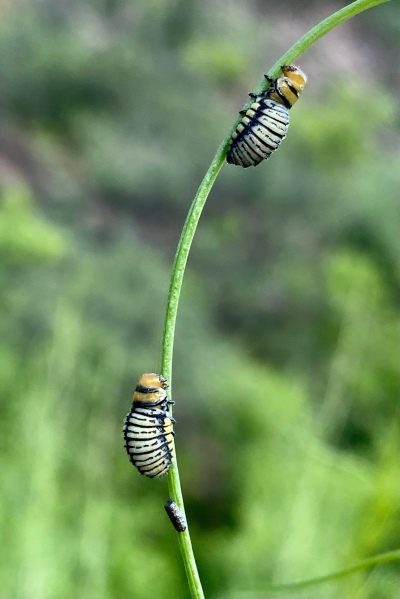
Lampetis webbii, collected on Rhus sp.

Stenaspis solitaria on Acacia rigidula.

Ramsey Canyon, Huachuca Mountains, Arizona
After returning from Tombstone, we visited Pat & Lisa Sullivan at their home at the end of Ramsey Canyon. Pat is a scarab collector who runs lights at his home nightly, and after a delicious dinner we spent the rest of the evening checking the lights. I was hoping to collect Prionus heroicus, and I got my wish. Also got Prionus californicus and several other non-cerambycid beetles such as Chrysina beyeri, C. gloriosa, Lucanus mazama, and Parabyrsopolis chihuahuae (the latter a first for me). I also placed a prionic acid lure (thanks Steve!) and got three more male P. heroicus. We also hunted around the rocks and roadsides hoping to find Amblycheila baroni but didn’t find any. Art did, however, find a female P. californicus and gave it to me (thanks!).

Meeting Pat Sullivan!

Darkling beetles (family Tenebrionidae) such as this one come out at night to feed on decaying vegetation.

Chrysina beyeri (family Scarabaeidae) is one of three species in the genus occurring in Ramsey Canyon.

Black-tailed rattlesnake (Crotalus molossus), collected by Pat in Ramsey Canyon.

Sidewinder (Crotalus cerastes lateropens), collected by Pat in Yuma County.

“Sometimes the best collecting is inside!”

Day 6 – Vicinity Sonoita, Arizona
Unsuccessful attempt to collect Hippomelas martini, only recently described (Bellamy & Nelson, 1998) and part of the type series taken somewhere near this spot (“20 mi NE Patagonia, Hwy 82”) by “sweeping roadside vegetation”. At other locations it had been recorded on Calliandra sp., and I found patches of the plant here along and on top of the road cuts. This gives me confidence that I found the right spot, but I didn’t encounter this or any other beetles by sweeping the patches or visually inspecting them.

Box Canyon, Santa Rita Mountains, Arizona
We decided to come back to Box Canyon since we’d had such good luck last time. I started at the spot above the dry falls where I collected so many Acmaeodera cazieri and A. yuccavora on flowers of Allionia incarnata. This time it was hotter, drier, and windier, and the flowers were semi-closed. Still I found a few of each. I then started walking down the road towards the lower canyon crossing where I would meet up with Art. Things were really hopping on the Mimosa dysocarpa, with Hippomelas planicauda abundant (finally collected my fill) and several other Buprestidae also beaten from the plants: Agrilus aeneocepahlus, Acmaeodera scalaris, Acmaeodera cazieri, Chrysobothris sp., and a species of Spectralia! (seven species of Buprestidae at one location I think is the high for the trip.) I checked other plants and flowers along the way down but didn’t find much.

Halfway down from the “dry falls”.

The “dry falls” about halfway up the canyon.

Pseudovates arizonae – the aptly named Arizona unicorn mantis.

Lower Madera Canyon, Santa Rita Mountains, Arizona
Madera Canyon is perhaps the most famous insect collecting locality in Arizona – maybe in the country, and it is hard to make a visit to Arizona without stopping by here. We elected to work the lower canyon first in an area where Chrysobothris chalcophoroides has been taken on Arizona oaks (Quercus arizonicus). Hiking towards the oaks I found some Stenaspis solitaria in a Baccharis sarothroides and marveled at the variety of other insects active on the plants (see photos) – later I would also collect an elaphidiine cerambycid on the plant. Next I started working the oaks, beating every branch I could reach with my net handle. With one whack of the stick a single Paratyndaris sp. and a single Brachys sp. landed on my sheet – those would be the only buprestids I would collect off the oaks! Other than that I collected one Hippomelas planicauda on Mimosa dysocarpa for the record. While I was working the oaks up in the knoll, the weather started turning with blustery winds, and I could see the rain coming in the distance. By the time I got down from the knoll the rain had arrived, and I walked back to the car in a sunny downpour using my beating sheet as an umbrella!

Madera Canyon in the Santa Rita Mountains.

Acanthocephala thomasi on Baccharis sarothroides.

What appears to be a so-called “cricket killer” wasp (Chlorion aerarium) also feeds on sap on Baccharis sarothroides.

A longhorned beetle, probably in the genus Aneflus, rests on the foliage of Baccharis sarothroides.

Rain headed my way!

Rain passing into neighboring Florida Canyon.

Montosa Canyon, Santa Rita Mountains, Arizona
Just to try something different, we went to Montosa Canyon – the next canyon south of Madera Canyon – for tonight’s blacklighting. We set my sheet up just E of the crossing and Arts ground units back to the west along a gravel road on the south side of the crossing. Moths came in numbers, but the beetles were light – I collected only blister beetles (Epicauta sp.) and a Cymatodera sp. checkered beetle at the sheet, a series of tiger beetles and a female Strategus cessus at the second ground unit, and a male Strategus aloeus and two Stenelaphus alienus at the third ground unit.

A gorgeous sunset to start the evening.

A deepening dusk brings the promise of insects at the lights. 

A bee assassin bug, Apiomerus flaviventris.

An ocotillo, or calleta, silkmoth – Eupackardia calleta.

One of the western riparian tiger beetles.

Day 7 (last day) – Vicinity Continental, Arizona
There was a photo posted on BugGuide of Stenaspis verticalis taken last week, so we decided to give it a shot and see if we could get lucky and find it ourselves. We checked all the Baccharis sarothroides within ½-mile if the spot but didn’t find it. I did, however, collect four Euphoria leucographa, two Chalcolepidius smaragdula, two Aneflus spp., and singletons of Stenaspis solitaria and Dendrobias mandibularis. I also took a couple of Hippomelas planicauda on Mimosa dysocarpa – just for the record!

Euphoria leucographa on Baccharis sarothroides.

Chalcolepidius smaragdinus on Baccharis sarothroides.

Lower Madera Canyon, Santa Rita Mountains, Arizona
We returned to work the lower canyon area. I’d heard that the tiger beetle Cicindelidia obsoleta santaclarae has been taken in the area last week so was hoping to run into it. While Art worked the east side of the road I worked the west, initially following FR-781 into what looked like grassland areas where the tiger beetle might occur. I didn’t see any but took Acmaeodera scalaris on Heterotheca sp. flowers and Acmaeodera solitaria on Argemone mexicana flowers. There was also a fresh wind-thrown mesquite (Prosopis glandulosa) with a bunch of Chrysobothris octocola and one Chrysobothris rossi on it. Still the area looked abused from grazing and was uninteresting, so I looked for another area to explore.

Northwest of the parking lot I spotted another grassy area that was dotted with Baccharis sarothroides, so I decided to give that area a look. After clambering several times through barbed wire fence, I reached the area and began to give it a look. Still no tiger beetles, but every time I passed a B. sarothroides I inspected it closely. I’d looked at several plants when I came upon one with a Stenaspis solitaria sitting in the foliage, and when I looked down on one of the stems and saw a big male Tragidion sp. on the underside of the stem. After securing it, I looked closer at the plant and saw a pair of annulated antennae crawling up another stem – I knew right away it was a mating pair of Stenaspis verticalis! After carefully moving to the other side to confirm, I dared to take a few photos in situ (see below) and then secured the couple. Of course, this gave me newfound motivation to work the entire area to look for more. It was very hot by then, and I was already quite thirsty, but I summoned up all the stamina that I could and worked as many plants as I could, ending up with six Tragidion spp. and three Stenaspis verticalis. The latter was one of my top priority targets for this trips, and the only thing more satisfying than getting it is doing so on my last day on the field.

View to south edge of Madera Canyon – Elephant Head is at the right.

Chrysobothris octocola female ovipositing on freshly killed mesquite (Prosopis glandulosa).

Tragidion sp. mating pair on Baccharis sarothroides.

Mating pair of Stenaspis verticalis arizonensis on Baccharis sarothroides.

Chalcolepidius lenzi at a sap flow on Baccharis sarothroides.

Lateral view of Chalcolepidius lenzi.

Barrel cactus in bloom.

Montosa Canyon, Santa Rita Mountains, Arizona
We  returned to Montosa Canyon and stopped at the Astronomy Vista partway up. It was hotter than bejeebuz! There was not an insect to be seen except giant cactus bugs and a single Euphoria leucographa that Art found on a sapping Baccharis sarothroides. Temp was 103°F even at this elevation!

Stunning vista during the day! 

We needed to escape the heat, and I wanted to see oaks for one more crack at Mastogenius, so we drove up to the 13-km marker and I collected on the way back down to below the 12-km marker. Conditions were much more agreeable (temps in the 80s), and near the top there was a Ceanothus sp. bush in bloom, off which I collected Rhopalophora meeskei and Stenosphenus sp. – both genera represented by individuals with black versus red pronotum. Then I started beating the (Mexican blue, I believe) oaks, and right away I got a Mastogenius sp.! Kinda small, so I’m thinking not M. robusta and, thus, probably M. puncticollis (another species new to my collection). I also beat a largish Agrilus sp. that I don’t recognize, a few clerids, two R. meeskei, one Stenosphenus sp., and a couple of leaf beetles. There was also another type of oak there – Arizona white, I believe, which I beat as well but only got one clerid.

Spectacular views from 7000 ft!

A lichen moth on flowers of Ceanothus sp.

The biggest, fattest, bristliest tachinid fly I have ever seen!

The spectacular vistas just keep on coming!

An ancient alligator juniper stares down yet another sunset (perhaps its 50 thousandth!).

We stopped by the Astronomy Vista again on our way back down the canyon, and I found a pair of Moneilema gigas on cholla (Opuntia imbricata).

Obligatory dusk shot of Moneilema gigas on Opuntia imbricata.

Another individual on the same plant.

Sunset over “Las Cuatro Hermanas”.

It was a fantastic seven days in the field with Arthur, and it was a great pleasure to (in some cases, finally) meet Margarethe, Barbara, Steven, Norm, and Pat. I appreciate the warmth, generosity, and hospitality that all of them displayed to me and look forward to our next encounter, hopefully in the near future. Now, for some light reading during the plane ride home!

© Ted C. MacRae 2019

Summer Insect Collecting iRecap

At the beginning of the season I was planning to spend the first week of June collecting insects in southeastern New Mexico. Family issues intervened, however, and left me with a week of vacation time and no plans on how to use it. I’ve never been one to not use vacation time, so I quickly came up with a backup plan—a Friday here and a Monday there to create several 3–4 day weekends. Long weekends may not allow travel to far off and exotic places, but they do allow me to travel a bit further than I would for a regular weekend. I also took advantage of my frequent travel for work to stop off at favorite collecting sites for an evening of blacklighting (much more fun than sitting in a hotel room) or a half-day in the field before getting back home. I always have my big camera with me for serious insect photography when the opportunity arises, but I also take frequent iPhone snapshots to document the “flavor” of my time in the field. In previous years, I’ve collected snapshots from my extended trips into “iReports”, which were later followed by posts featuring subjects that I spent “quality camera time” with (see 2013 western Oklahoma, 2013 Great Basin, and 2014 Great Plains). I’ve decided to do the same thing now, only instead of a single trip this report covers an entire summer. I realize few people have the patience for long-reads; nevertheless, enough readers have told me that they like my trip reports and all of their gory details to make this a worthwhile exercise. If you’re not among them, scan the photos—all of which were taken with a stock iPhone 5S and processed using Photoshop Elements version 11—and you’re done!


Searching for the Ghost Tiger Beetle
Central/Northwest Missouri (12–14 June 2015)

In mid-June my good friend, colleague, and fellow cicindelophile Chris Brown and I followed the Missouri River Valley across the state and and up along its northwestern border to visit previously known and potentially new sites for Ellipsoptera lepida—the Ghost Tiger Beetle. We first saw this lovely white species back in 2000 while visiting some of the large sand deposits laid down in central and east-central Missouri by the 1993 flood. In the years since these sites have become increasingly encroached by forests of eastern cottonwood (Populus deltoides), making them less and less suitable for the beetle (it also remains one of only two tiger beetles known to occur in Missouri that I have not yet photographed). In the meantime several new sand deposits have been laid down in northwestern Missouri by flooding in 2011, so the question has come up whether the beetle has yet occupied these new sites. We started out at a couple of potentially new sites in east-central Missouri (and did not find the beetle), then went to one of two known sites in central Missouri. We did not find the beetle there either, but we did find this eastern hognose snake  (Heterodon platirhinos).

Eastern hognose snake (Heterodon platirhinos)

Eastern hognose snake (Heterodon platirhinos) | vic. Eagle Rock Conservation Area, Boone Co.

Hognose snakes are well known for their vaired repertoire of defensive behaviors—from flattening of the head and hissing to rolling over and playing dead (a behavior called thanatosis)—the latter behavior often accompanied by bleeding from the mouth and even defecating onto itself. This one, however, was content to simply flatten its head and hiss, its tongue constantly flickering.

Eastern hognose snake (Heterodon platirhinos)

The flattened head is an attempt by the snake to make itself appear larger and more imposing.

Standing its ground as tenaciously as it did, I took advantage of the opportunity to close in tight and take a burst series of photos, which I used to create this animated gif of the snake’s constantly flickering tongue.

Eastern Hognose Snake (Heterodon platirhinos)

After an evening of driving to northwest Missouri and a stay in one of our favorite local hotels (eh hem…), we awoke to find the scene below at our first destination.

Ted MacRae & Chris Brown look out over a flooded wildlife refuge

Ted MacRae & Chris Brown look out over a flooded Thurnau Conservation Area, Holt Co.

No tiger beetles there! What to do now. One thing I love about modern times is the ability to pull out the smart phone and scan satellite images of the nearby landscape. Doing this we were able to locate a large sand deposit just to the south and navigate local, often unmarked roads to eventually wind up at a spot where we could access the area on foot. But before we did this we needed gas, and the only gas station for miles was a Sinclair station with a bona fide, original green dinosaur—one of the most potent and iconic corporate symbols ever! I remember these from my childhood, but this is the first one I’ve seen in years.

Authentic Sinclair dinosaur

An authentic Sinclair dinosaur guards the only gas station for miles.

Rain the night before had made the roads muddy, and it was only with some difficulty that we finally located a way to access the sand deposits we had seen on the satellite images. Even then we needed to hike a half-mile to access the sand plain, but once we got there this is what we saw:

Sand plain deposited 2009

Sand plain deposited 2011 along Missouri River, Thurnau Conservation Area, Holt Co.

At first we were optimistic—the habitat looked perfect for not only E. lepida but also the more commonly seen Cicindela formosa generosa (Eastern Big Sand Tiger Beetle) and, at least in this area, C. scutellaris lecontei (LeConte’s Tiger Beetle). We saw no adults however, as we searched the plain, and we wondered if the cool, cloudy conditions that lingered from the previous evening’s storms were suppressing adult activity. After awhile, however, we noted that we hadn’t even found evidence of larval burrows, and that is when we began to think that maybe four years wasn’t long enough for populations to establish in such a vast expanse of new habitat. Eventually Chris did find a single E. lepida adult—a nice record but certainly not evidence of a healthy population.

Sand plain deposited 2009

Seemingly perfect habitat, but void of active adults or evidence of larval burrows.

The next sand plain we visited was a little further north at Corning Conservation Area, also in Holt Co. and also laid down by the 2011 flood. Once again we saw no active tiger beetles in the area, and by this point we were convinced that the species were not just inactive but had not yet even colonized the plains. It should be noted that large sand expanses such as these actually are not exactly a natural process, but rather the result of river channeling and the use of levees to protect adjacent farmland. Before such existed, the river existed as an intricate system of braided channels that rarely experienced catastrophic flooding. Nowadays, with the river confined to a single, narrow channel, the river valley doesn’t experience a normal ebb and flow of water. Only when water levels reach such extreme levels in the narrow channel that they breach a levee does the adjacent valley flood, with the area immediately downstream from the levee breach receiving huge amounts of sand and mud scoured from the breach zone. Tiger beetle species adapted to ephemeral sand plain habitats along big rivers probably

Sand plain deposited 2009

Another sand plain deposited in 2011 at Corning Conservation Area, Holt. Co.

Cottonwoods and willows were already colonizing the edge of the plain, and the latter were heavily infested by large blue leaf beetles. As far as I know the only species of Altica in Missouri associated with willow is A. subplicata, although admittedly it is a large, diverse genus and there could be other willow-associates within the state that I am unaware of. The beetles seemed especially fond of the smaller plants (1–3′ in height), while taller plants were relatively untouched.

Altica bimarginata (willow flea beetle)

Altica subplicata? (willow flea beetle) | Holt Co., Missouri

Altica bimarginata (willow flea beetle)

Beetles congregated heavily on smaller willow plants.

Altica bimarginata (willow flea beetle)

Despite the heavy adult feeding we could find no larvae on the foliage.

Few other insects were seen. I did see a large, standing, dead cottonwood (Populus deltoides) and checked it out hoping hoping to find a Buprestis confluenta adult or two on its naked trunk (a species I found for the first time last year and still have yet to find in Missouri, although it is known from the state). No such luck, but I did collect a couple of large mordellids off of the tree. Let me say also that there were some interesting other plants in the area…

Wild hemp (Cannabis sativa)

Wild hemp (Cannabis sativa)

After satisfying ourselves that Corning also was not yet colonized by the tiger beetles, we drove further north into Atchison Co., the northwesternmost county in the state, to check out one more sand plain deposited by the 2011 flood at Nishnabotna Conservation Area. The sand plain at this area was much smaller than the two previous plains we had visited, and it was also far less accessible, requiring a bushwhacking hike through thick vegetation that was quite rank in some areas. Nevertheless, we soldiered on, motivated by the hope that maybe the third time would be a charm and we would find the beetles that we were searching for. The hike was not all bad—eagles were abundant in the area, and in one distant tree we could see a female perched near her nest with two large nestlings sitting in it. The passing storm system and sinking sun combined to create a rainbow that arched gracefully over the tree with the nest, resulting in one of the more memorable visions from the trip.

Rainbow over eagle's nest

Rainbow over eagle’s nest (tree is located at left one-third of photo).

By the time we got close enough to get a better photograph of the nest the female had departed, but the two nestlings could still be seen sitting in the nest. Sadly, the rather great effort we made to hike to the sand plain was not rewarded with any tiger beetles, and in fact the sand plain was little more than a narrow, already highly vegetated ridge that will probably be completely encroached before the tiger beetles ever find it.

Eagles in nest

Eagles in nest

Ellipsoptera lepida was not the only tiger beetle we were hoping to see on the trip. The Sandy Stream Tiger Beetle, E. macra, has also been recorded from this part of the state, and being members of the genus Ellipsoptera both species can be attracted to lights at night. In one last effort to see either of these species, we went to Watson Access on the Nishnabotna River, near its confluence with the Missouri River. Thunder clouds retreating to the east were illuminated by the low hanging sun to the west, creating spectacular views in both directions. Unfortunately, the insect collecting at the blacklights after sunset was not near as interesting as the sky views that preceded it.

Sunset lit thunderclouds

Sunset lit thunderclouds to the east…

Sunset on the Nishnabotna River

… and a bright colored sunset to the west on the Nishnabotna River, Atchison Co.

The next day we had to start making our way back to St. Louis. But while we were in the area we decided to check on the status of one of Missouri’s rarest tiger beetlesParvindela celeripes (formerly Cylindera celeripes)—the Swift Tiger Beetle. Not known to occur in Missouri until 2010, this tiny, flightless species is apparently restricted in the state to just three small remnants of loess hilltop prairie in Atchison and Holt Counties. We were close to one of these—Brickyard Hill Conservation Area (where Chris and I first discovered the beetles) so stopped by to see if adults were active and how abundant they were. To our great surprise, we found adults active almost immediately upon entering the site, and even more pleasantly surprising the adults were found not just in the two small areas of the remnant where we had seen them before but also in the altered pasture (planted with brome for forage) on the hillside below the remnant (foreground in photo below). This was significant in our minds, as it was the very first time we have observed this beetle in substantially altered habitat. The beetle was observed in relatively good numbers as well, bolstering our hopes that the beetles were capabale of persisting in these small areas and possibly utilized altered pastureland adjacent to the remnants.

Loess hilltop prairie

Brickyard Hill Conservation Area, loess hilltop prairie habitat for Parvindela celeripes

As we made our way back towards St. Louis, there was one more site created by the 1993 flood where we observed E. lepida in the early 2000s that we wanted to check out and see how the beetle was doing. In the years since we first came to Overton Bottoms, much of its perimeter has converted to cottonwood forest; however, a large central plain with open sand exposures and bunch grasses persists—presumably providing acceptable habitat for the species. Chris had seen a few beetles here in a brief visit last summer, but this time we saw no beetles despite a rather thorough search of the central plain. It seemed untenable to think that the beetles were no longer present, and we eventually decided (hoped) that the season was still too young (E. lepida is a summer species, and the season, to this point, had been rather cool and wet). The photos below show what the central plain looks like—both from the human (first photo) and the beetle (second photo) perspective. I resolved to return later in the month to see if our hunch was correct.

Sand plain (people view)

Big Muddy NFWR, Overton Bottoms, south unit, sand plain habitat for Ellipsoptera lepida

Sand plain (tiger beetle view)

A tiger beetle’s eye view of its sand plain habitat

It doesn’t happen often, but every now and then I get caught by rain while out in the field, and this time we got caught by a rather ominous thunderstorm. The rain didn’t really become too heavy until shortly before we reached the car, but the lightning was a constant concern that made bushwhacking back more than a mile through thick brush one of the more unnerving experiences that I’ve had to date.


Trying for Prionus—part 1
South-central Kansas (26–29 June 2015)

Last summer Jeff Huether and I traveled to several locations in eastern Colorado and New Mexico and western Oklahoma to find several Great Plains species of longhorned beetles in the genus Prionus using recently developed lures impregnated with prionic acid—a principal sex pheromone component for the genus. These lures are extraordinarily attractive to males of all species in the genus, and on that trip we managed to attract P. integerP. fissicornis, and P. heroicus and progress further in our eventual goal to collect all of the species in the genus for an eventual molecular phylogenetic analysis. One species that remains uncollected by pheromones (or any other method) is P. simplex, known only from the type specimen labeled simply “Ks.” A number of Prionus species in the Great Plains are associated with sand dune habitats, so we had the idea that maybe P. simplex could be found at the dunes near Medora—a popular historical collecting site, especially with the help of prionic acid lures. Perhaps a long shot, but there’s only one way to find out, so we contacted scarab specialist Mary Liz Jameson at Wichita State University, who graciously hosted Jeff, his son Mark Huether, and I for a day in the field at Sand Hills State Park. We didn’t expect Prionus to be active until dusk, during which time we planned to place lure-baited pitfall traps and also setup blacklights as another method for attracting the adult males (females don’t fly). Until then, we occupied ourselves with some day collecting—always interesting in dune habitats because of the unique sand-adapted flora and the often unusual insects associated with them.

"Medora" Dunes

Sand Hills State Park (“Medora Dunes”), Kansas

Milkweeds (genus Asclepias) are a favorite of mine, and I was stunned to see a yellow-flowered form of butterfly milkweed (A. tuberosus). Eventually I would see plants with flowers ranging from yellow to light orange to the more familiar dark orange that I know from southern Missouri. I checked the plants whenever I saw them for the presence of milkweed beetles, longhorned beetles in the genus Tetraopes (in Missouri the diminutive T. quinquemaculatus is most often associated with this plant), but saw none.

Asclepias tuberosus "yellow form"

Asclepias tuberosus “yellow form”

In the drier areas of the dunes, however, we began to see another milkweed that I recognized as sand milkweed (A. arenicola). I mentioned to Jeff and Mary Liz that a much rarer species of milkweed beetle, T. pilosus, was associated with this plant and to be on the lookout for it (I had found a single adult on this plant at a dune in western Oklahoma a few years back). Both the beetle and the plant are restricted to the Quaternary sandhills of the midwestern U.S., and within minutes of me telling them to be on the alert we found the first adult! During the course of the afternoon we found the species to be quite common in the area, always in association with A. arenicola, and I was happy to finally have a nice series of these beetles for my collection.

Tetraopes pilosus

Two Sandhills specialties—Tetraopes pilosus on Asclepias arenaria

Milkweed beetles weren’t the only insects associated with sand milkweed in the area—on several plants we saw Monarch butterfly larvae, some nearing completion of the larval stage as the one shown in the photo below. Monarchs have been in the news quite a bit lately as their overwintering populations show declines in recent years for reasons that are not fully understood but may be related to recent droughts diminishing availability of nectaring plants for migrating adults and reduction of available food plants as agricultural lands in the U.S. become increasingly efficient.

Danaus plexippus larva

Monarch butterfly (Danaus plexippus) larva on Asclepias arenaria

We found some other interesting insects such as the spectacular Plectrodera scalator, cottonwood borer, and the southern Great Plains specialty scarab, Strigoderma knausi, both of which I took the time to photograph with the big camera—separate posts on those species will appear in the future. Sadly, no Prionus came to either our lures or our lights that evening, but some interesting other insects were seen during the day and even at the lights despite unseasonably cool temperatures and a bright moon. I’ll post photographs of these insects, taken with the “big” camera, in the coming weeks. In the meantime, my thanks to Mary Liz for hosting us—I look forward to our next chance to spend some time in the field together.

Ted MacRae, Mark Huether, Jeff Huether, Mary Liz Jameson

Ted MacRae shows Mark Huether, Jeff Huether, and Mary Liz Jameson how to take a panoramic selfie.

The following day, Adam James Hefel—at the time a graduate student at Wichita State University—and I traveled northwest of Wichita to Quivira National Wildlife Refuge. Adam has recently become interested in tiger beetles and had observed several interesting species on the margins of the salt marshes at Quivira. Several of these species were on my “still to photograph” list (and one even on my “still to see” list), so I was happy to have access to some local knowledge to help me

Salt marsh

Quivira NWR – salt marsh habitat for halophilic tiger beetles

The saline flats of the central U.S. are hyperdiverse for tiger beetles. Adam has seen six species in the saling flats of Quivira, including the saline specialists Cicindela fulgida, C. wllistoni, Ellipsoptera nevadica knausi, Eunota togata, and E. circumpicta johnsonii (formerly Habroscelimorpha) (both red and green forms) and the ubiquitous Cicindelidia punctulata. We managed to find all of these except C. willistoni, which is a spring/fall species—unusual for a saline specialist, but the extreme heat of the day made them exceedingly difficult to approach (and virtually impossible to photograph).

Salt marsh

Tiger beetles are found most often in alkaline flats with sparse vegetation

Salt marsh

The wide open central flats are devoid of not only vegetation but tiger beetles (and life in general!).

Ever fascinated by the diversity of milkweeds to be found in the central U.S., an unfamiliar Asclepias growing in the higher, drier areas around a salt marsh caught my attention. Of course, I checked them for milkweed beetles and quickly found a number of Tetraopes tetraophthalmus individuals. John Oliver kindly identified the milkweed from my photos as Asclepias speciosa (showy milkweed), which does not occur in Missouri (hence the reason I was not familiar with it) but that gets common in the Great Plains and foothills of the Rocky Mountain.

Asclepias speciosa

Asclepias speciosa, or showy milkweed.

Asclepias speciosa

The specific epithet “specioosa” refers to the large, showy flowers.

Tiger beetles were not the only wildlife encountered on the saline flats. Killdeer and western snowy plover adults were abundant in the area, and we found this next with eggs along the lightly vegetated edge of a saline flat around Big Salt Marsh. Cheryl Miller suggested they are probably plover eggs, since killdeer don’t usually scrape out a cup or put debris around the eggs, while snowy plovers are known to nest on or near salt flats and frequently surround their eggs with twigs, small bones or other debris.

Western snowy plover (Charadrius nivosus) eggs

Western snowy plover (Charadrius nivosus) nest with eggs at the edge of an open flat

During the drive into the refuge, I noted several stands of large cottonwood (Populus deltoides), many of which were half- or completely dead. To some, these trees may be just ugly, half-dead trees. For me, however, they offer an opportunity to look for the gorgeous and rarely encountered Buprestis confluens, a species which I found for the first time just last year (not too far from hear in north-central Oklahoma). After getting our fill of tiger beetles, we drove to a parking lot surrounded by some of these trees, and even before I got out of the car I could see an adult B. confluens sitting on the trunk of a large, dead tree at the edge of the parking lot! I quickly secured the specimen, then spotted the half-dead tree in the photo below and walked towards it to look for more. I did not see any adults sitting on the trunk, but what I did see was truly incredible—two adults just beginning to emerge from the trunk! Waiting for one of the adults to emerge naturally (we “helped” the other one along) and photographing the sequence would occupy the next hour, but what an experience (and, of course, photos to come in a separate post).

Populus deltoides surrounded by hemp

This large, half-dead Populus deltoides “screams” Buprestis confluenta!

Wild hemp (Cannabis sativa)

Wild hemp (Cannabis sativa) fills the are with a pungent aroma.

After a break from the heat and something to eat in the nearest town (20 miles away), I returned to the cottonwoods, broke out the hatchet, and began chopping. Cottonwood is an amazingly soft wood compared to hardwoods such as oak and hickory, but dead cottonwood is still tough, and only after much effort did I manage to chop out two pupae (one of which later successfully emerged as an adult) and two unemerged adults, resulting in a nice, if still rather small, series of a species that until last year was not represented in my collection and until this time by only a single specimen.

Chopping Buprestis confluenta unemerged adults/pupae

Chopping Buprestis confluenta unemerged adults/pupae

Buprestis confluenta pupa

Exposed Buprestis confluenta pupa in its pupal chamber.

With the setting sun illuminating distant thunderclouds, I returned to the salt marshes to setup blacklights for the evening in hopes of attracting some of the tiger beetles that we had seen earlier in the day—not in attempt to collect more specimens, but rather to take advantage of their attraction to the lights and reduced skittishness in the cool, night air in an attempt to photograph them (I already had live specimens for studio photographs if necessary, but I prefer actual field photographs whenever possible). Eunota togata was not attracted to the lights, but both E. nevadica knausi and E. circumpicta johnsonii came to the lights in numbers (both red and green forms of the latter), and I succeeded in getting some real nice photographs as a result.

Thundercloud illuminated by setting sun

Thundercloud illuminated by setting sun

On the way back home, and again with the sun dropping close to the horizon, I stopped by Overton Bottoms again to look for Ellipsoptera lepida. Chris and I hadn’t see it here two weeks ago, and I was thinking (hoping) that it might have still a bit early in the season. This time I found them, and although they were not numerous and were apparently confined to the southernmost exposures of the central sand plain, they were still plentiful enough to allow me to get the field shots that I’ve wanted of this species for so long (and providing fodder for yet another future post). This species never seems to be encountered in great numbers, and although I have seen them on a number of occasions it always amazes me just how difficult they are to see!

Sand plain

Another pass through Overton Bottoms looking for Ellipsoptera lepida, this time with success!


Tryin’ for Prionus—part 2
South-central Kansas (11–12 July 2015)

Although our long-shot effort for Prionus simplex at the dunes near Medora, Kansas didn’t pan out, another species we hoped to see was P. debilis—a rather uncommonly collected species that occurs in the tallgrass prairies of the eastern Great Plains and, to our knowledge, had not yet been demonstrated to be attracted to prionic acid. I’d only seen this species once myself, some 30 years ago when I collected four males at lights near the southwestern edge of Missouri. As it happens, longtime cerambycid collector Dan Heffern grew up in P. debilis-land near Yates Center—not too far from where we were just a few weeks ago. When I mentioned my search for the species, he told me how commonly he used to see it around his home—especially around the 4th of July—and put me in contact with a friend who still lives in the area and has several tallgrass prairie remnants on his land. I made arrangements to visit the following weekend, and with prionic acid impregnated lures in the cooler and blacklights and sheets in the cargo area I set off. As I passed south through eastern Kansas I began to see nice tallgrass prairie remnants about 20 miles from my destination, so I took a chance and set a trap as a backup in case things didn’t pan out near Yates Center.

Trap baited with prionic acid lure

Trap baited with prionic acid lure

Things did pan out, however, although for a long time it did not appear they would. Dan’s friend kept me company while I placed a couple of traps and setup the blacklights, and for a couple of hours after sunset no beetles were seen (although we did enjoy good beer and better conversation). Just when I was ready to throw in the towel I saw a male crawling on the ground near one of the lights, and over the course of the next hour I found nearly a dozen males crawling on the ground in the general area around the lights but never actually at the lights. Interestingly, no males were actually seen in flight, nor were any attracted to the trap placed near one of the lights; however, after I took down the lights and checked the other trap there were five males in it. This likely represents the first demonstration of attraction to prionic acid by males P. debilis. I brought a couple of live males home for photography, taking this iPhone shot of a sleeping beetle in the meantime.

Prionus debilis "sleeping"

Prionus debilis “sleeping”in its cage after being taken near an ultraviolet light

One the way back home the next morning, success already “in the bag”, I stopped to check the trap I had placed the previous day. Filled with anticipation as I approached the trap, I was elated to find 21 males in the trap!

Prionus debilis

Prionus debilis in prionic acid lure-baited trap

The male antennae of this and other Prionus species show numerous adaptations that are all designed to maximize the ability to detect sex pheromones emitted into the air by females. They are both hyper-segmented and flabellate, providing maximum surface area for poriferous areas filled with chemical receptors. Larval habits for this species remain unknown, but Lingafelter (2007) states “Larvae may feed in living roots of primarily Quercus and Castanea, but also Vitis, Pyrus, and Zea mays.” I am not sure of the source of this information and don’t really believe it, either, as I think it much more likely that they feed on roots of bunch grasses such as bluestems (Andropogon spp.) and other grass species common in the tallgrass prairies.

Prionus debilis

Prionus debilis “looking” out over its tallgrass prairie habitat

Before reaching St. Louis, I decided to stop off at the last two known sites for Missouri’s endangered (possibly extirpated), disjunct, all-blue population of Eunota circumpicta johnsonii (Johnson’s Tiger Beetle). This didn’t go well—I first tried Blue Lick Conservation Area in Cooper County, where Chris Brown and I made the last known sighting of this beetle in the state 12 years ago at a salt spring about 500 yards further down the road in the photo below. I’m unsure what adaptations adults and larvae may have for surviving prolonged flooding, but it certainly cannot be helpful for the beetle. I then visited nearby Boone’s Lick State Historic Site in Howard County, and while the site was not flooded the two small areas where salt springs were located during our survey were even more heavily encroached by vegetation than before. Not only were no beetles seen, there did not even seem to be the slightest possibility that beetles could occur there. I keep hoping that the beetle will, someday, be seen again, but in reality I think I am just having trouble accepting the fact that I may have actually witnessed the extirpation of this incredibly beautiful and unusual population of beetles.

Flooded road leading to saline lick tiger beetle habitat

Flooded road leading to last known Missouri site for Eunota circumpicta johnsonii


Chillin’ after work
Sand Prairie – Scrub Oak Preserve, central Illinois (15 July 2015)

By the time mid-July rolls along, temperatures are not the only thing heating up. My travel for work also reaches a fever pitch as I begin traveling to research plots in Illinois and Tennessee every  two weeks. It takes three days to make the +1,000-mile round trip, which means that I have two nights and an occasional afternoon stop to collect insects—much more fun than checking into hotel right after work, eating dinner at Applebee’s, and spending the evening switching back and forth between FOX and MSNBC to see who can make the most outrageous statement because IFC just isn’t offered. One of my favorite spots along this route to set up a blacklight is Sand Prairie – Scrub Oak Preserve in Mason County, Illinois. Nothing too spectacular showed up at the lights there this season, but as they say a bad day (or night) of bug collecting is better than a good day of just about anything else.

Ted MacRae at the blacklight

Calling all insects—the blacklight awaits you!

On this particular night a number of hawk moths (family Sphingidae) came to the lights, among the prettier of which included this Paonias excaecata (blinded sphinx) (kindly identified by Robert Velten).

Blinded Sphinx, Paonias excaecata

Paonias excaecata (blinded sphinx) | Sand Prairie – Scrub Oak Preserve, Mason Co., Illinois


More chillin’ after work
Pinewoods Lake, southeast Missouri (28 July 2015)

Another species of Prionus that I hadn’t seen for many years was P. pocularis, a species found in the pineywoods across the southeastern U.S. and, thus, reaching its northwestern distributional limits in the shortleaf pine (Pinus echinata) forests of the Ozark Highlands in southern Missouri. Like P. debilis, I had only seen this species once before—two males at a blacklight at Pinewoods Lake National Forest Recreation Area in Carter County many years ago. Unlike P. debilis, however, these were seen later in summer, as were a few other specimens known from the state. That being the case, I decided to try the prionic acid lures at Pinewoods Lake while traveling back up from Tennessee. I arrived at the lake shortly before sunset and, after getting the traps put out and the lights setup, had the chance to look out over the lake and its surrounding forests where I had collected so many insects back in the 1980s as a young, eager, budding coleopterist.

Pinewoods Lake at dusk

Pinewoods Lake at dusk

Quite some time passed and no Prionus beetles were seen at the light or in the trap (but several other longhorned beetles did occur). Recalling my experience with P. debilis in Kansas a few weeks earlier, I remained hopeful, and eventually my optimism was rewarded when I found this single male floating in the trap’s ethanol preservative. Curiously, it would be the only male seen that night, although several individuals of the related and much more common P. imbricornis were attracted to the prionic acid lures.

Prionus pocularis

Prionus pocularis in prionic acid lure-baited trap | Pinewoods Lake, Carter Co., Missouri

Several other insects did come to the blacklights, among the more photogenic being this underwing moth (genus Catacola, family Noctuidae) identified by Mathew L. Brust as Catocala neogama.

Catocala neogama

Catocala neogama at ultraviolet light | Pinewoods Lake, Carter Co., Missouri

Even more photogenic than underwings are royal moths (family Saturniidae), including this imperial moth, Eacles imperialis.

Eacles imperialis (imperial moth)

Eacles imperialis (imperial moth) at ultraviolet light | Pinewoods Lake, Carter Co., Missouri

Among the longhorned beetles I mentioned that did come to the lights was this Orthosoma brunneum (brown prionid). This species is closely related to prionid beetles (both are in the subfamily Prioninae). However, it is not a member of the genus Prionus, and, thus, is not attracted to prionic acid. It is perhaps no coincidence that males of this species do not exhibit the hypersegmentation and flabellate modifications of their antennae possessed by males in the genus Prionus, though they may still rely on sex pheromones for locating females.

Orthosoma brunneum

Orthosoma brunneum at ultraviolet light | Pinewoods Lake, Carter Co., Missouri

Even spiders were coming to the blacklights, perhaps attracted not by the light itself but by the ready availability of potential prey.

Black widow spider (Latrodectus mactans) female

Latrodectus mactans (black widow) at ultraviolet light | Pinewoods Lake, Carter Co., Missouri


Cicadamania!
White River Hills region, southwest Missouri (1–2 August 2015)

Although I had succeeded in finding Prionus pocularis earlier in the week at Pinewoods Lake, I wasn’t satisfied with having found just a single individual. I had nothing on the calendar the following weekend, so I decided to make a run down to one of my favorite areas in all of Missouri—the White River Hills of extreme southwest Missouri. The only other record of the species in Missouri is from that area, with its abundance of shortleaf pine forests (the species breeds in decadent pines), and I though how nice it would be to find more individuals in a part of the state that I love so much. The plan was to drive down, set a prionic acid trap or two once I got into the pine forests of the area, and then find a good spot to setup some blacklights with one more prionic acid trap that I could monitor. The plan was executed perfectly, and I ended up setting up the lights on a ridge just south of Roaring River State Park; however, the beetles never came. Nevertheless, like I said earlier a bad day/night of bug collecting is still better than just about anything else, and there was plenty at and near the lights to keep the night interesting. Once was this tiny walkingstick nymph that I found hanging out at the tip of a blade of grass. I was intrigued by the rather peculiar position adopted by the resting animal, with its forelegs and antennae extended straight out in front of the body with their tips resting on the grass blade.

Undet. juvenile walkingstick

Undetermined walkingstick nymph | Mark Twain N.F., Barry Co., Missouri

One thing I love about blacklighting for insects is the sounds of the night—katydids fill the black night with raspy calls while Whip-Poor-Wills and their country cousins the Poor-Will’s-Widows hoot and cluck in the distance.

Undet. adult katydid?

Undetermined katydid | Mark Twain N.F., Barry Co., Missouri

As I was photographing the walkingstick, I felt something crawling on my neck. After many years of doing this, I’ve learned not to freak out and slap wildly at something crawling on my neck, because 1) more often than not it is something interesting and 2) even if it isn’t particularly interesting it’s almost never capable of biting or stinging. Still, I don’t want to just grab it unseen or pin it against my neck—instead I kind of “scoop” it away with my fingers and toss it onto the ground beside me in one swift, assertive movement. This night’s mystery neck crawler was about as interesting as they get—Dynastes tityus (eastern Hercules beetle), the largest beetle in eastern North America. This one is a female by virtue of its lack of any horns on the head and pronotum.

Dynastes tityus female

Female Dynastes tityus (eastern Hercules beetle) | Mark Twain N.F., Barry Co., Missouri

After pulling the lights down for the night, I drove to Mincy Conservation Area, one of the many dolomite glades in the area in the next county over and one that I had not visited for some time. There are no hotels in the area, and my bones are a little too old to be sleeping on the ground, so I just pulled into the campground, took off my shoes, changed into PJs, and laid the driver’s seat all the way back for a surprisingly comfortable night’s sleep. My frugalness would have its reward, although I did not know it until I awoke early the next morning to a hauntingly beautiful fog. I’d never seen the glades in such manner—so serene. I knew the rising sun would quickly burn off the fog and and the moment would be lost if I didn’t act quickly, so I grabbed both big camera and iPhone and, put on some shoes (didn’t bother with changing out of my PJs), and walked the glade taking as many photos as I could. While the quality of the iPhone snaps doesn’t compare with those taken with the big camera, they nevertheless convey the quiet beauty of the glade.

Morning fog over the dolomite glade

Morning fog over the dolomite glade | Mincy Conservation Area, Taney Co., Missouri

Missouri coneflower (Rudbeckia missouriensis) is a characteristic plant of limestone and dolomite glades in the Ozark Highlands of southern Missouri.

Morning fog over the dolomite glade

Missouri coneflower (Rudbeckia missouriensis) | Mincy Conservation Area, Taney Co., Missouri

Morning dew makes spider webs abundantly conspicuous.

Morning fog on a spider web

Morning fog on a spider web | Mincy Conservation Area, Taney Co., Missouri

Eventually the rising sun began to burn through the cool, damp fog, portending another day of searing heat in the xeric glade landscape.

Morning fog over the dolomite glade

The rising sun begins to burn off the fog | Mincy Conservation Area, Taney Co., Missouri

Heading back to my car as temperatures began to rise quickly, I was struck by the cacophony of cicadas that were already getting into high gear with their droning buzz calls. As I passed underneath one particular tree I noticed the song was coming from a branch very near my head. I like cicadas, but I was there to look for the spectacular Plinthocoelium suaveolens (bumelia borer), a glade species associated with gum bumelia (Sideroxylon lanuginosum). Had it been the song of a “normal” cicada like Neotibicen lyricen (lyric cicada) or N. pruinosus (scissor grinder cicada) I would have paid it no mind. It was, instead, unfamiliar and distinctive, and when I searched the branches above me I recognized the beautiful insect responsible for the call as Neotibicen superbus (superb cicada), a southwest Missouri specialty—sumptuous lime-green above and bright white pruinose beneath. I had not seen this spectacular species since the mid 1980s (most of my visits to the area have been in the spring or the fall rather than high summer), so I spent the next couple of hours attempting to photograph an individual in situ with the big camera. This is much, much easier said than done—the bulging eyes of cicadas give them exceptional vision, and they are very skittish and quick to take flight. I knew I had the iPhone photo shown below if all else failed, and for some time every individual I tried to approach ended up fluttering off with a screech before I could even compose a shot, much less press the shutter. Persistence paid off, however, and I eventually succeeded in locating, approaching, and photographing an unusually calm female resting at chest height on the trunk of a persimmon tree. Along the way I checked the gum bumelia trees hoping to spot one of the beautiful longhorned beetles associated with that tree, but none were seen.

Neotibicen superbus

Neotibicen superbus

It was already high noon by the time I finished up at the Mincy glades, so I began to retrace my steps to check the prionic acid traps that I had set out the day before. Along the way I stopped by Chute Ridge Glade Natural Area in Roaring River State Park, another place where I have seen bumelia borers, so I stopped to try my luck there before continuing on to pick up the traps. Again, none were seen, but in addition to numerous individuals of N. superbus I found another species of cicada, still undetermined by more robust and nearly blackish and with a throatier call that sounding a bit like a machine gun (or table saw hitting a nail!). Despite the lack of bumelia borers, I enjoyed my time on the glade immensely and eventually had to call it quits if I was to get to all of my traps before nightfall.

IMG_6373_enh_1230x720


Still more chillin’ after work
Pinewoods Lake, southeast Missouri (11 August 2015)

Two attempts at Prionus pocularis in the past two weeks had netted me but a single specimen—this species was becoming my summer nemesis. So when I found myself back in Tennessee for field trial work and the timing still right I decided to spend the evening at Pinewoods Lake once again before heading back to St. Louis and see if the third time would be a charm. I found a new restaurant in the tiny nearby town of Ellsinore, and the dinner special that evening was fried catfish—hoo boy! My belly was in a good place after that, filling me with optimism that I would have success tonight. I got to the lake at dusk, quick setup the blacklights and put the prionic acid traps in place, and waited for the bugs to come in.

Pinewoods Lake at dusk

Pinewoods Lake at dusk, again!

The evening’s first visitor to the lights was a parandrine cerambycid—Neandra brunnea. Believe it or not, this was the first time I have ever seen the species alive (once before finding a dead specimen in a Japanese beetle trap waaaay back in the mid-1980s!)—a pretty nice find. In fact, Pinewoods Lake produced a number of good finds during those days back in the 1980s when I was collecting here regularly—longhorned beetles such as Acanthocinus nodosus, Enaphalodes hispicornis, and the aforementioned Prionus pocularis, male Lucanus elaphus stage beetles, the jewel beetle Dicerca pugionata on ninebark in the draws, and the seldom seen tiger beetle Apterodela unipunctata (formerly Cylindera unipunctata), just to name a few.

Neandra brunnea

Neandra brunnea | Mark Twain N.F., Pinewods Lake, Carter Co., Missouri

Seeing N. brunnea and the prospects of collecting P. pocularis weren’t the only things putting me in a good mood…

Blacklighting w/ beer

Blacklighting is better with beer!

My optimism, unfortunately, would eventually prove to be unfounded, as not only did P. pocularis never show up—either at the blacklights or the prionic acid traps, no other beetles showed up as well, longhorned or otherwise. When that happens, I have no choice but to start paying attention to other insects that show up at the lights. It was slim pickings on this night for some reason, making this already striking moth identified by Alex Harman as Panthea furcilla  (tufted white pine caterpillar or eastern panthea) in the family Noctuidae stand out even more so. 

Panthea furcilla

Panthea furcilla | Mark Twain N.F., Pinewoods Lake, Carter Co., Missouri

While walking between the blacklights and the prionic acid traps, something suspended between two trees caught my eye. I recognized it quickly as some type of orb weaver spider (family Araneidae), but I couldn’t exactly figure out exactly what was going on until I took a closer look and saw that there were actually two spiders! I’d never seen orb weaver courtship before, so I excitedly took a few quick shots with the iPhone and then hurried back to the car to get the big camera.

Neoscona sp. courtship

Be very, very careful boy!

Sadly, the male had already departed by the time I got back, so the quick iPhone photos I took are the only record I have of that encounter. Still, I got some good photos of just the female with the big camera, along with the quicker, dirtier iPhone shots—one of which is shown below. According to Eric Eaton these are likely a species in the genus Neoscona.

Neoscona sp.

Neoscona sp. | Mark Twain N.F., Pinewoods Lake, Carter Co., Missouri


Checking out a fen
Coonville Creek Natural Area, southeast Missouri (3 September 2015)

On yet another trip back to St. Louis from Tennessee, I made a spur-of-the-moment decision to visit Coonville Creek Natural Area in St. Francois State Park, an area I hadn’t seen in nearly 30 years and the outstanding feature being the calcareous wet meadow, or “fen”, that dominates the upper reaches of the creek drainage. Fen soils are constantly saturated, a result of groundwater from surrounding hills percolating through porous dolomite bedrock before hitting a resistant layer (in this case, sandstone) and seeping out onto the lower slopes. Constantly saturated soils and occasional fires (at least historically) have kept the fen open and treeless, with the cool groundwater allowing “glacial relicts” (i.e., plants common when glaciers covered the area) to persist. 

Calcareous wet meadow

Calcareous wet meadow | Coonville Creek, St. Francois State Park, St. Francois Co., Missouri

I saw a few Cicindela splendida (Splendid Tiger Beetles) on the rocky, clay 2-track leading to the area—a sure sign that fall was just around the corner, a female cicada on herbaceous vegetation in the fen (small, I think it’s not a species of Neotibicen), and a huge, fecund black and yellow garden spider (Argiope aurantia)—I love seeing the latter at this time of year when they have grown to their largest and the females are full of eggs. In reality, however, this visit turned into more of a botanical than an insect collecting experience. Insect activity in general was low, and my attention drifted instead to the diversity of wildflowers that were present on the fen—most new to me. False dragonhead (Physostegia virginiana), great blue lobelia (Lobelia siphilitica), and Spiranthes lacera (slender ladies’-tresses orchid)—its tiny white blossoms spiraling up the leafless spike were the most interesting, resulting in lots of time spent looking at them through the big camera.

Argiope aurantia

Argiope aurantia | Coonville Creek, St. Francois Co., Missouri


The always exciting amorpha borer
Otter Slough Conservation Area, southeast Missouri (23 September 2015)

As the dog-days of summer gave way to bright, blue skies and crisp, fall air, a distinctive insect fauna takes advantage of the explosion of goldenrod that blooms across a landscape morphing from shades of green to orange, yellow, and tawny. Many of these insects are widespread and super-abundant—soldier beetles, tachinid flies, bumble and honey bees, and scoliid, tiphiid, and vespid wasps are among the most conspicuous. Megacyllene robiniae, longhorned beetles commonly called locust borers  are also common on goldenrod during fall, but much less common is a closely related species that breeds in false indigo bush (Amorpha fruticosa)—Megacyllene decora, or the amorpha borer. I’ve seen this species several times, yet uncommonly enough that I still target it when I get the chance. One such place is Otter Slough Conservation Area—yet another interesting place along the way between Tennessee and St. Louis. On one of my final trips back this way I stopped by to see if these spectacular beetles would be out. My attention was first caught by egrets congregating in a mud flat exposed by recent dry weather. However, they were not what I was looking for.

Egrets congregating on mud flats

Egrets congregating on mud flats | Otter Slough, Stoddard Co., Missouri

There is no shortage of interesting insects to look at as I begin scanning the goldenrod flowers growing along the roadsides and around the edges of the shallow pools managed for fishing and shore birds. A fat, female Stagmomantis carolina (Carolina mantis) sat on one of the first inflorescences that I checked, but she also was not what I was looking for.

Undet. mantid

Stagmomantis carolina | Otter Slough, Stoddard Co., Missouri

After a bit of searching, I found what I was looking for! Over the course of the next two hours (all the time I had left before sundown) I would a total of three adults on goldenrod flowers at three disparate locations within the area—again not very many, making those that I did see a real treat.

Megacyllene decora

Megacyllene decora on goldenrod | Otter Slough, Stoddard Co., Missouri

As dusk fell over the area, insects began bedding down for the night. I was lucky to find the last amorpha borer in the dwindling light as it bedded down next to a bumblebee—perhaps the likely model for the beetle apparent mimetic coloration.

Megacyllene decora

Megacyllene decora and a bumble bee bed down together | Otter Slough, Stoddard Co., Missouri

The sun sinking over the horizon behind the wetlands put an end to the collecting, not only for the day but for the season, at least here in Missouri and surrounding states. It would not be the final day of collecting for me, however, as I managed to scrape together some free time amidst my hectic travel schedule and spend a week in eastern Texas for the Annual Fall Tiger Beetle Hunt. I’ll save that trip for another report and close this one out here, but be on the lookout for higher quality photos over the coming months of the really interesting insects that I encountered over this past season. Let me also say that if you’re still reading at this point, you have my deepest admiration for having the persistence to wade through all 8,376 of the words contained within this post!

Dusk over Plover Pond

Sunset over Plover Pond | Otter Slough, Stoddard Co., Missouri

© Ted C. MacRae 2015

A striking mallow caterpillar

Tarache delecta ("mallow caterpillar") on Hibiscus lasiocarpus | Hickman Co., Kentucky

Tarache delecta (“mallow caterpillar”) on Hibiscus lasiocarpus | Hickman Co., Kentucky

Last month while searching stands of Hibiscus lasiocarpus (hairy rose mallow) in western Kentucky, I encountered this rather large caterpillar feeding on the foliage. I presumed that something as large and striking in appearance as this should be a cinch to identify by scanning through photos on BugGuide, and not surprisingly I found photographs (here, here and here) of two very similar looking caterpillars from Oklahoma posted by Charles Schurch Lewallen. None of the photos, however, had an identification associated with them other than subfamily Acontiinae (family Noctuidae). The contributor mentioned in one of the photos that he had found nothing similar in the Wagner (2005) “bible” (a book that I do not yet own but hope to soon). Armed with this scant information (but definitive knowledge of its host plant), I searched Noctuidae of North America and settled on Tarache delecta as a good possibility. According to that site, T. delecta is the only member of the Acontiinae that feeds on plants in the genus Hibiscus. The site references Crumb (1956) for a larval description, but more useful was a plate of black & white photos that I found in Weiss (1919) and that seemed to be a good match for the species I had photographed. Weiss (1919) refers to the larva as the “mallow caterpillar” and notes that full grown larvae are 34–36 mm in length and dark purple with black spots edged with orange—consistent with the caterpillar shown here.

Apparently this species has been considered a pest of ornamental mallows. Weiss (1919) notes that the larvae feed on the upper and lower leaf surfaces usually near the margins, making large holes in the leaves and sometime devouring parts of the bracts around the buds. I will also note that, in recommending control of the caterpillars, he states that “there does not seem to be any reason why spraying with arsenate of lead should not be successful.” My, how times have changed!

REFERENCE:

Crumb, S. E. 1956. The larvae of the Phalaenidae. U. S. Department of Agriculture, Technical Bulletin 1135, 356 pp. + 10 plates [Google Books].

Wagner, D. L. 2005. Caterpillars of Eastern North America: A Guide to Identification and Natural History. Princeton University Press, Princeton, New Jersey, 512 pp. [Amazon].

Weiss, H. B. 1919. The more important insect enemies of the rose-mallow in New Jersey. New Jersey Department of Agriculture, Bureau of Statistics and Inspection Circular 25, 9 pp. + 4 plates [Google Books].

© Ted C. MacRae 2014

Southern armyworm feeding on soybean

Southern armyworm (Spodoptera eridania) late-instar larva feeding on soybean.

Southern armyworm (Spodoptera eridania) late-instar larva feeding on soybean.

Here is another animated gif that I made recently, this one showing a late-instar larva of southern armyworm (Spodoptera eridania) feeding on soybean (Glycine max). This polyphagous species is widely distributed from the southern U.S. through the northern half of South America and feeds on a variety of weeds, especially pigweed (Amaranthus spp.) and pokeweed (Phytolacca americana). It also occasionally attacks vegetable, fruit, and ornamental crops; however, in recent years it has become increasingly important on cultivated soybean in Brazil and Argentina, especially in regions where cotton is also cultivated. As a result, they have become one of the insects that I deal with regularly in my own research. More information on this and other armyworm species that affect soybean can be found in my earlier post, Quick Guide to Armyworms on Soybean.

Like many other lepidopteran caterpillars that feed on foliage, late-instar larvae become “feeding machines” that remain active both day and night as they try to cram as much nutrition into their expanding bag of a body as possible in preparation for an adult life focused solely on finding mates and laying eggs. Large larvae actively feeding during the day can be rather conspicuous, and as a result they often secrete themselves on the undersides of the leaves while feeding to make themselves less visible to predators. As they feed, however, a “window” opens up that gradually eliminates their cover. Rather than remaining in the same spot and feeding until they are completely exposed, however, larvae will move when the feeding hole reaches a certain size and find another place to conceal themselves before resuming feeding. Different caterpillar species have different exposure tolerances, and as a result, this combines with slight differences also in preferred tissue types to create recognizable differences in the damage patterns resulting from feeding by different species.

For those interested, making these animated gifs is really simple and allows those of us without expensive macro-video gear to simulate short videos of insect behavior. I make my animated gifs at GIFMaker.me—all you do is take a series of photos, touch them up in photo editing software (I use Photoshop Elements to adjust levels, color and sharpness), upload them to the site in the sequence desired, and click “Create Now”. It couldn’t be easier! You don’t even need a “real” camera—I took the photos for this gif with my iPhone using the “burst” function to take a rapid sequence of photos (all you do is hold your finger down on the shutter button for the desired length of time).

© Ted C. MacRae

Best of BitB 2013

Welcome to the 6th Annual “Best of BitB”, where I pick my favorite photographs from the past year. Like last year, 2013 was another year of heavy travel. For work I did my annual tour of soybean field sites throughout Argentina during late February and early March, then cranked it up for my own field season with frequent travel to sites in Illinois and Tennessee from May to October. In the meantime I spent a week at company meetings in Las Vegas in August, toured field sites across the southeastern U.S. for two weeks in September, visited Argentina again in October to finalize research plans for their upcoming season, and finished off the travel year by attending the Entomological Society of America (ESA) Meetings in Austin, Texas during November. On top of all this, I managed to slip in two of the best insect collecting trips I’ve had in years, with 10 days in northwestern Oklahoma in early June and another 10 days in California, Nevada, Utah, and Colorado during late August, and I got to play “visiting scientist” during short trips to Montana State University in late July and the Illinois Natural History Survey in late October! Of course, during my brief interludes at home I wasn’t sitting still, giving entomology seminars to several local nature societies and hosting two ESA webinars on insect photography. Needless to say, come December I was more than ready to spend some quite time at home (well, except for hiking most weekends) and am happy to report that I’ve successfully become reacquainted with my family and office mates. It’s a peripatetic life—and I wouldn’t have it any other way!

Okay, let’s get down to business. Here are my favorite BitB photographs from 2013. This year was less about learning new techniques as it was about refining the techniques I’ve found most useful for the style I’ve chosen as a photographer, i.e., hand-held, in situ field shots that (hopefully) excel at both natural history and aesthetic beauty. Links to original posts are provided for each photo selection, and I welcome any comments you may have regarding which (if any) is your favorite and why—such feedback will be helpful for me as I continue to hone my craft. If you’re interested, here are my previous years’ picks for 2008, 2009, 2010, 2011, and 2012. Once again, thank you for your readership, and I hope to see you in 2014!


Tremex columba, female ovipositing | Sam A. Baker State Park, Missouri

Tremex columba female drilling for oviposition into hardwood trunk | Sam A. Baker State Park, Missouri

From Ovipositing Pigeon Horntail (posted 6 Jan). I like this photo for the combination of vibrant, contrasting colors between the wasp and moss-covered wood and the visualization it provides of the remarkable depth to which this wasp will insert its ovipositor into solid wood!


Eurhinus cf. adonis on Solidago chilensis | Chaco Province, Argentina

Eurhinus cf. adonis on Solidago chilensis flowers | Chaco Province, Argentina

From Giving me the weevil eye! (posted 28 Apr). While a little soft, the color combination is pleasing and the pose taken by the beetle almost comically inquisitive.


Helicoverpa gelotopeon feeding on soybean pod | Buenos Aires Prov., Argentina

Helicoverpa gelotopeon feeding on soybean pod | Buenos Aires Prov., Argentina

From Bollworms rising! (posted 30 Mar). This is the first photo of an economic pest that has made one of my “Best of BitB” lists. The two holes in the soybean pod, one with the caterpillar and its head still completely inserted, visualizes how the feeding habits of these insects can so dramatically affect yield of the crop.


cf. Eremochrysa punctinervis | Gloss Mountains, Major Co., Oklahoma

cf. Eremochrysa punctinervis | Gloss Mountains, Major Co., Oklahoma

From “Blue-sky” tips and tricks (posted 1 July). Insects with a lot of delicate detail and long, thin appendages are especially difficult to photograph against the sky due to wind movement. See how I dealt with the antennae of this delicate lacewing without resorting to the standard black background typical of full-flash macrophotography.


Cicindela scutellaris lecontei x s. unicolor

Cicindela scutellaris lecontei x s. unicolor intergrade | Holly Ridge Natural Area, Stoddard Co., Missouri

From The Festive Tiger Beetle in Southeast Missouri (posted 25 Oct). I like this photo a lot more now than I did when I first took it. Its shadowy feel and the beetle “peering” from behind a leaf edge give a sense of this beetle’s attempts to hide and then checking to see if the “coast is clear”


Batyle suturalis on paperflower (Psilostrophe villosa) | Alabaster Caverns State Park, Woodward Co., Oklahoma

Batyle suturalis on Psilostrophe villosa flowers | Alabaster Caverns State Park, Woodward Co., Oklahoma

From Tips for photographing shiny beetles on yellow flowers (posted 10 Aug). “Bug on a flower” photos are a dime a dozen, but shiny beetles on yellow flowers with natural sky background can be quite difficult to take. All of the techniques for dealing with the problems posed by such a photo came together nicely in this photo.


Agrilus walsinghami | Davis Creek Regional Park, Washoe Co., Nevada

Agrilus walsinghami | Davis Creek Regional Park, Washoe Co., Nevada

From Sunset for another great collecting trip (posted 1 Sep). This photo is not without its problems, with a little blurring of the backlit fuzz on the plant, but the placement of the sun behind the subject’s head and resulting color combination make it my favorite in my first attempts at achieving a “sun-in-the-sky” background with a true insect macrophotograph.


A tiny male mates with the ginormous female.

Pyrota bilineata on Chrysothamnus viscidflorus | San Juan Co., Utah

From Midget male meloid mates with mega mama (posted 8 Nov). Another blue-sky-background photograph with good color contrast, its real selling point is the natural history depicted. with some of the most extreme size dimorphism among mating insects that I’ve ever seen.


Phymata sp.

Phymata sp. on Croton eleagnifolium foliage | Austin, Texas

From ESA Insect Macrophotography Workshop (posted 13 Nov). The oddly sculpted and chiseled body parts of ambush bugs makes them look like they were assembled from robots. Contrasting the body against a blue sky gives a more unconventional view of these odd beasts than the typical top-down-while-sitting-on-a-flower view.


Fourth attempt - holding detached pad up against sky for cleaner background.

Moneilema armata on Opuntia macrorhiza | Alabaster Caverns State Park, Woodward Co., Oklahoma

From Q: How do you photograph cactus beetles? (posted 24 Nov). Photographing cactus beetles requires patience, persistence, long forceps, and strong forearms. Natural sky provides a much more pleasing background than a clutter of cactus pads and jutting spines.


I hope you’ve enjoyed this 2013 version of “Best of BitB” and look forward to seeing everyone in 2014.

Copyright © Ted C. MacRae 2013