August “jug trap” run

In late August, I made another trip out to northwestern Oklahoma to service “jug traps” and other insect traps placed at several locations throughout the area. The traps were set in mid-May (see “First insect collecting trip of the season”), checked for the first time in mid-June at the beginning of a 3-week long collecting trip to the southwestern U.S. (see “2023 Southwestern U.S. Collecting Trip iReport”), and checked again in late July (see “July “jug trap” run”). This post describes the third trip to service the traps—less about what the traps themselves had caught and more about other insects seen and collected at the locations where the traps have been set. The final trap run will be made in early October, and you can expect a post about that trip as well shortly afterwards.


Day 1 — 28 Aug 2023
Alabaster Caverns State Park
Woodward County, Oklahoma

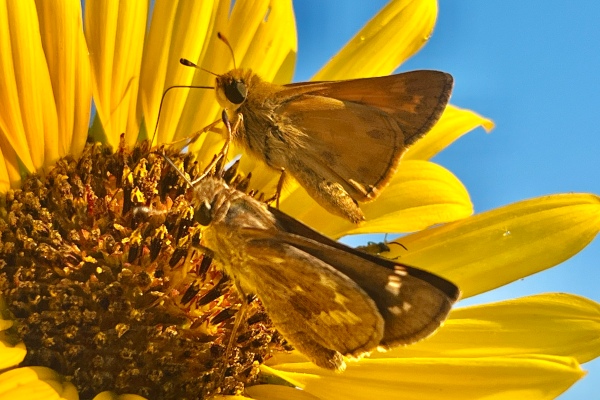
Finally a nice break in the weather. Rain moved through a few days ago and temperatures are decidedly lower than the mid-90 to low-100 temps that have dominated for the past few weeks. I started out in the shortgrass prairie along Raptors Roost Trail above the canyon. Last time I was here (5 weeks ago), the only cicadas I heard were Neotibicen superbus (superb dog-day cicada). This time I heard three different species: Neotibicen auriferus (plains dog-day cicada), Neotibicen pruinosus (scissors grinder dog-day cicada), and Megatibicen dorsatus (prairie cicada). I was able to snag one of the former but couldn’t get M. dorsatus—the one I really wanted. There were no Acmaeodera in the white bottle trap—just one Elateridae (and some bees for Mike). Robust patches of Helianthus annuus (annual sunflower) were in flower in the prairie—I checked the flowers hoping maybe some of the fall beetles I was interested in (Acmaeodera macra and Crossidius pulchellus) would be out by now, but all I saw on them were Epicauta sp. (blister beetles), Chauliognathus limbicollis (soldier beetles), and Atalopedes campestris (sachem skippers).
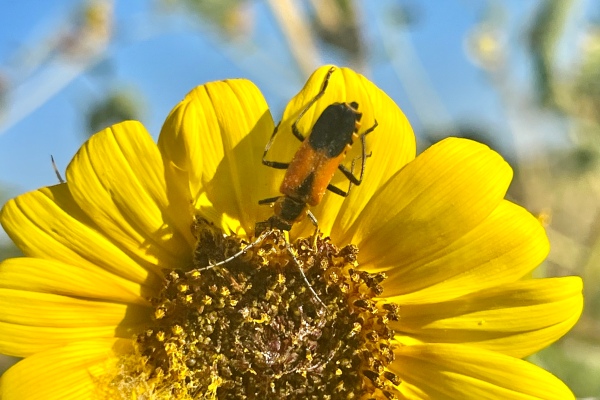
Chauliognathus limbicollis (family Cantharidae) on flower of Helianthus annuus (annual sunflower) in shortgrass prairie.
Male (top) and female (bottom) Atalopedes campestris (sachem skipper—family Hesperiidae) on flower of Helianthus annuus (annual sunflower) in shortgrass prairie.

After that I went down into the canyon to check the traps. All of them were completely overloaded—primarily Elateridae and Cotinis nitida. Field counting was impossible, so I bagged for counting later (I did see a few specimens of Plinthocoelium suaveolens and Eburia quadrigeminata/haldemani in the morass) and went down to the campground to set up camp and cook some dinner.

Euphorbia marginata (snow-on-the-mountain, smoke-on-the-prairie, variegated spurge, or whitemargined spurge—family Euphorbiaceae) in shortgrass prairie.

I debated whether to setup the lights (ultraviolet/mercury-vapor)—the moon is waxing towards full (which, by the way, will be the 3rd brightest full moon of the year), and though warm today (not hot) there was a tad of a cool crispness in the air down in the canyon as the evening progressed—good my my comfort but not so good for beetles! I set them up anyway (because that’s what I do), and for the first hour it was a steady accumulation of moths and a few crummy scarabs.
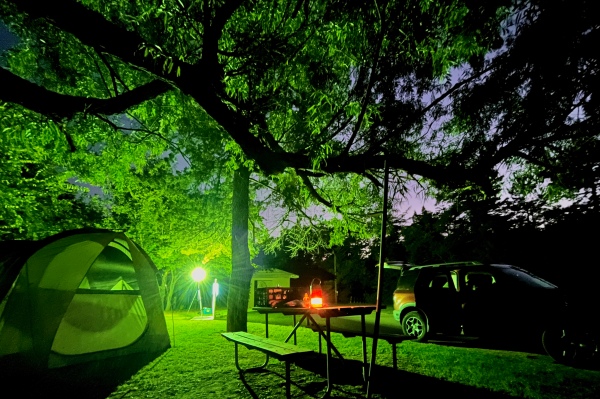
Tent, table, lights, and a large overhanging branch—the perfect campsite!

Eventually I ended up with a single alkali tiger beetle (Eunota togata globicollis—absent where I’m from but quite common in the Great Plains, but nothing else came after that and we’ll into full darkness. I did get a bonus—a dead male Neotibicen pruinosus lying on the picnic table on the campground.

Eunota togata globicollis (alkali tiger beetle—family Cicindelidae) at ultraviolet/mercury vapor light in hackberry/bumelia/juniper canyon woodland.
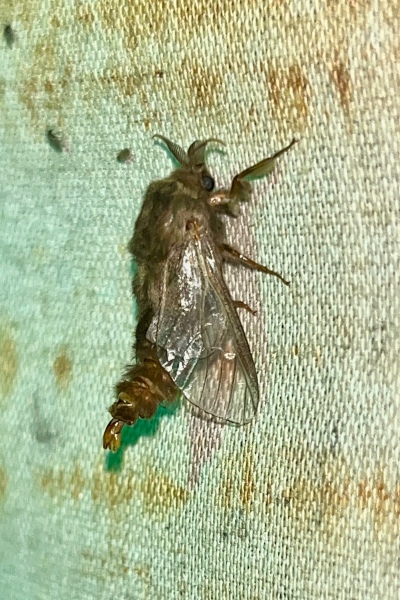
Adult male Thyridopteryx ephemeraeformis (evergreen bagworm—family Psychidae) at ultraviolet/mercury vapor light in hackberry/bumelia/juniper canyon woodland.
SkyView version of tonight’s night sky.

Day 2 — 29 Aug 2023

Sleeping temps were really nice, but I was awoken at 3:40 am by light rain and had to get up and put on the rain fly. It dumped soon afterwards, but I slept nicely anyway. In the morning first thing I found a Epicauta conferta blister beetle—beautifully marked with red on black, and after breakfast and breaking camp I checked the Lindgren funnel trap. On the way to the trap, I came across about a dozen more E. conferta on the road—all feeding on the fallen fruits of Sideroxylon lanuginosum (gum bumelia).

Epicauta conferta (family Meloidae)—one of about a dozen individuals feeding on the fallen fruits of Sideroxylon lanuginosum (gum bumelia) in hackberry/bumelia/juniper canyon woodland.

Like the jug traps yesterday, the Lindgren funnel trap was overwhelmed by mostly click beetles but did also contain Eburia haldemani/quadrigeminata and Plinthocoelium suaveolens in the mix. The trap contents were bagged unsorted for counting later.

Gloss Mountain State Park
Major County, Oklahoma

There was even more Helianthus annuus (annual sunflower) in bloom here than at Alabaster Caverns (I’ve not seen this here since I haven’t been here much during this time of season), it they were simply loaded with Megatibicen dorsatus (bush cicada). I collected a half dozen from a single clump (and there were four more that flew away while I was doing so) and recorded one male singing. As it sang, a female flew to the plant, and the male then slowly backed down the stem and positioned itself directly opposite from the female, allowing me to photograph the pair together (before the female then flew off abruptly—I guess she didn’t get the right “vibe” from the male).
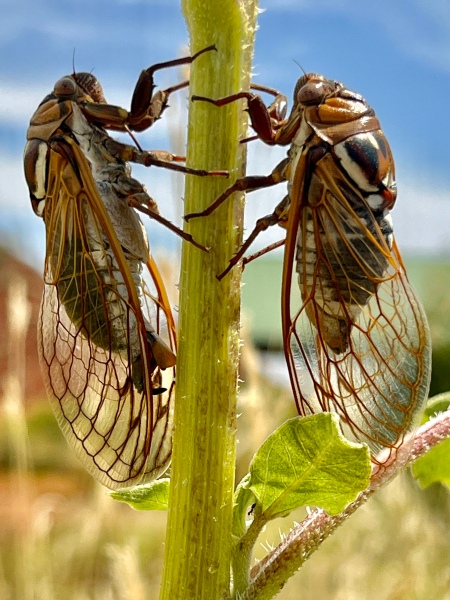
Megatibicen dorsatus (bush cicada—family Cicadidae) male (left) and female on Helianthus annuus (annual sunflower) in mesquite chaparral.

Right next to the patch of sunflowers i was working, I saw (and caught) a male Neotibicen auriferus singing in Prosopis glandulosa (honey mesquite. I would end up with about a half dozen and record one male singing over the next few hours.
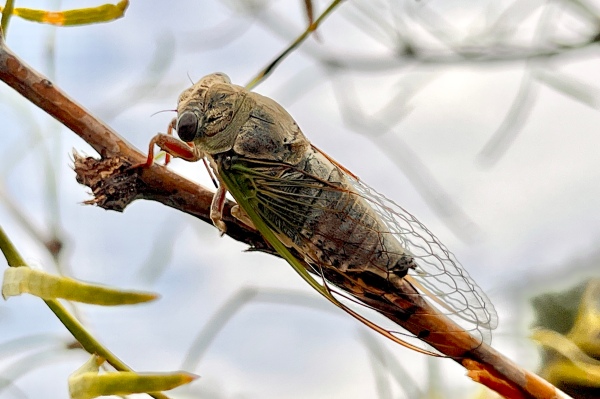
Neotibicen auriferus (plains dog-day cicada—family Cicadidae) on Prosopis glandulosa (honey mesquite) in mesquite chaparral.

Walking the road into the park to check the lower traps, I encountered a few colonies of Vanduzeea segmentata on H. annuus being tended by ants.

Vanduzeea segmentata (family Membracidae) on Helianthus annuus (annual sunflower) in mesquite chaparral.

The white bottle trap had a single Acmaeodera sp. and a few other miscellaneous beetles (and 5 bees for Mike), and, as at Alabaster Caverns yesterday, both the SRW and SRW/EtOH traps (the EtOH trap was removed last time) were overwhelmed with Elateridae and Cotinus nitidus beetles and were thus bagged for counting later. However, once again I did see a fair number of Plinthocoelium suaveolens, Eburia haldemani/quadrigeminata, and elaphidiines in the mix. Up on top of the mesa, the jug traps were again overwhelmed and the catch bagged for later counting, and the white bottle trap had no Acmaeodera but several miscellaneous other beetles and bees.
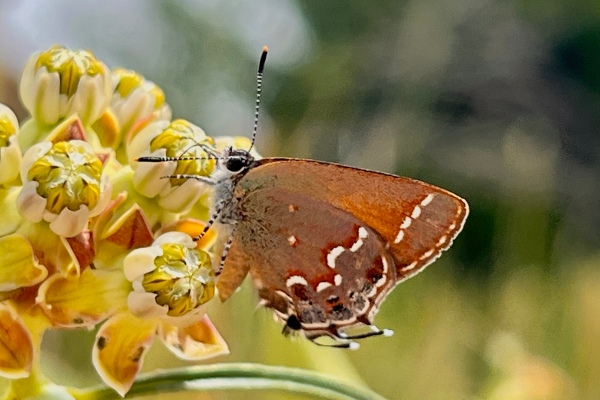
Callophrys gryneus (juniper hairstreak or olive hairstreak—family Lycaenidae) on flower Asclepias engelmannii (Engelmann’s milkweed) in mesquite chaparral.

Woodward, Oklahoma

After leaving Gloss Mountain State Park and passing through Woodward, Oklahoma a short distance to the west, I couldn’t resist stopping at my favorite “Christian coffee shop”—sadly closed during my first trip to the area in May but open again under new ownership as a bakery during my July visit.

The coffee is undeniably good, but what I really love about this place is the life-sized dinosaurs in front of the shop, complete with signs giving the true “facts” about dinosaurs from a creationist viewpoint (see “2022 Oklahoma Insect Collecting Trip iReport”). As laughable as the “facts” are, the dinosaurs really are very nicely done (save the angel riding the Stegosaurus!).
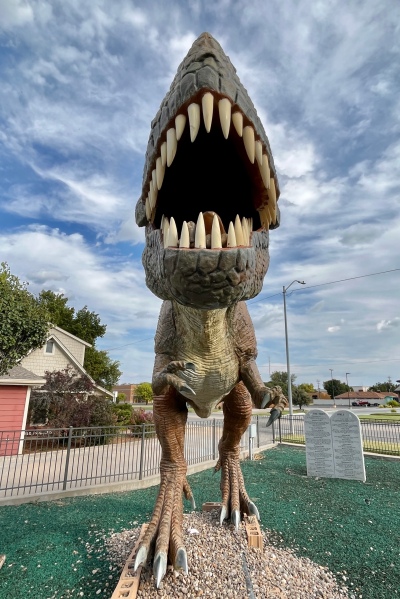
Slapout, Oklahoma

Another “must stop” on the way to Beaver Dunes Park is the Slapout Service Station in—you guessed it—Slapout, Oklahoma. The town is (literally!) little more than an intersection, but inside the store is a standup freezer filled with some of the tastiest cuts of packaged meats I’ve ever had. I stopped to pick up a nice filet for tomorrow night’s dinner in the campground at Black Mesa State Park tad a way to celebrate a (hopefully) successful end of the trip.

Slapout Service Station.
Beef filet steak.

Beaver Dunes Park
Beaver County, Oklahoma

I got here with just enough daylight left to check the traps if I could be quick about it. At the previous spots the traps have been so full that field counting wasn’t feasible, and here was no exception. Although I will eventually have to count them at some point, it does make things go more quickly in the field. I first checked the white bottle trap, which contained a few Acmaeodera sp. and bees, and was able to service all the jug traps and bag their catches quickly with a little bit of time to spare searching the dunes as the sun set in the western sky.

Sunset over Beaver Dunes.

I was looking chiefly for Megatibicen tremulus (Cole’s bush cicada), which was unknown until relatively recently due to the great similarity of its appearance and song to the more common and widespread M. dorsatus (bush cicada) and one that I have not yet seen. This cicada is generally found in more sandy habitats, and there are some iNaturalist records from this area. It didn’t take long, as soon as I hit the 2-track leading into the dunes I saw a male on Helianthus petiolaris (prairie sunflower), and although it looked nearly identical to the M. dorsatus I was catching earlier in the day (at Gloss Mountain State Park) the black rather than brown tymbal covers strongly suggest it is M. tremulus. I saw two more males as I searched the dunes, but both were far too wary and bolted before I could get within net range.

Helianthus petiolaris (prairie sunflower—family Asteraceae) in sand dune habitat with and a rising “super moon.”

Eventually the settling darkness became too much of an obstacle and I had to return to the car, but as a consolation prize I found a Plectrodera scalator (cottonwood borer) sitting on the upper stem of a sapling Populus deltoides (eastern cottonwood). Right next to the sapling was a much larger cottonwood in which several male Megatibicen dealbatus (plains cicadada) were singing—unfortunately none of which were within net reach (I can’t be too disappointed, as I did collect a couple of them at lights the last time I was here, and I’ve also collected the species in northern Texas).

Plectrodera scalator (cottonwood borer—family Cerambycidae) on Populus deltoides (eastern cottonwood) sapling in sand dune habitat.

Day 3 — 30 Aug 2023

No lighting last night—it was too cool and the moon at its brightest. It did make for comfortable sleeping, however (in the middle of the night I had to get into the heavy sleeping bag)! I decided to check out the dunes before heading on to Black Mesa since I had caught only a single Megatibicen tremulus (Cole’s bush cicada) yesterday and wanted to see if I could get a few more. The dunes were bright (and already hot!) in the morning sun.

Beaver Dunes in the morning light.

The cicadas proved to be common enough on the dunes (though not abundant as with M. dorsatus yesterday at Gloss Mountain), but unlike the latter, which were quite clumsy and easy to catch, these were incredibly wary and quick to fly. Less than half the individuals I approached I got within a net swing’s reach (and I have a telescoping long-handled net!), and most of those I could take a swipe at I missed. After more than an hour of trying, I had only two individuals to to show for it—both males singing from the branch tips of Rhus aromatica (fragrant sumac). I did manage to get photos of the one I caught yesterday, which I placed in sumac foliage for the photos, but in cruel turnabout, it got away from me before I could re-secure it! Life is just that unfair sometimes.😊
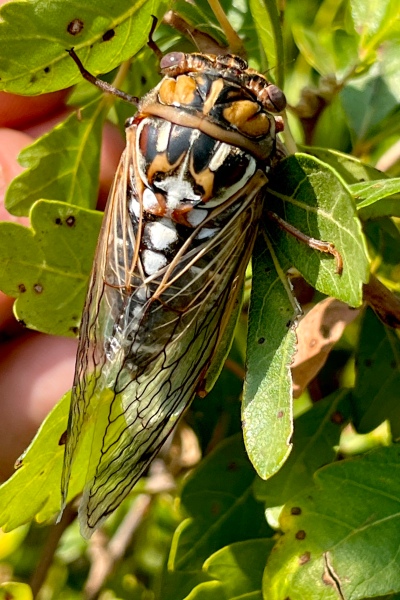
Megatibicen tremulus (Cole’s bush cicada—family Cicadidae) male singing from Rhus aromatica (fragrant sumac) in sand dune habitat.

Even more frustratingly, right as I was swinging the net at one of the two that I caught, I saw right next to the cicada what must have been the large and charismatic buprestid, Lampetis drummondii—a species I have not seen since 1995 when I encountered them rather commonly in western Texas. The buprestid did not end up in the net, nor did I see another individual, so my memory (and this note) will have to remain the only record of the species from this place, at least for now.

1.4 mi E of Kenton
Cimarron County, Oklahoma

The jugs traps were not quite as overwhelmed as at the previous locations, and instead of Cotinus nitidus being the abundant scarab it was Euphoria inda. Elateridae were still numerous, but a cursory glance through the catch did not reveal the presence of any Cerambycidae. Nevertheless, the catch from each jug trap was bagged for sorting later. Walking back to the vehicle I encountered two Crossidius discoideus—one hanging out on a grass clump and another flying slowly above the ground nearby. I caught the latter and then tried to photograph the former, but it became quickly alarmed and I had to grab it. After I put it in the vial and went to get the other one out of the net, I discovered it had found its way out and escaped—good thing I had secured the first one! I scanned the plants on the way back to the car but never saw another one.

Crossidius discoideus (family Cerambycidae) in shortgrass prairie.

When I reached the car, I decided to keep searching the area—I had seen a Cicindelidia obsoleta (large grassland tiger beetle)—apparently all black in this area—when I first got here but missed it and wanted to see if I could find it again. It took a while, but eventually I did see another one and got it, and right afterwards I saw yet another one but it got away.

Cicindelidia obsoleta obsoleta (large grassland tiger beetle—family Cicindelidae) in sparsely-vegetated exposures in shortgrass prairie.

In the same general area as I was looking, I saw something red flying and ran to catch it. It was a Tetraopes femoratus, apparently having just flown from a nearby Asclepias latifolia (broadleaf milkweed).
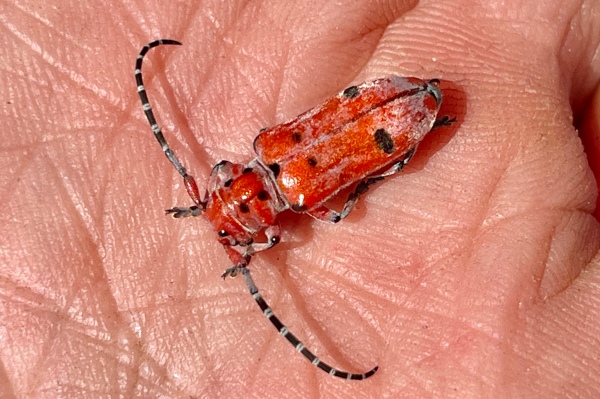
Tetraopes femoratus (red-femured milkweed borer—family Cerambycidae) on Asclepias latifolia (broadleaf milkweed) in shortgrass prairie.

These new captures induced to me to spend another 45 minutes or so at the site, but I didn’t see a single individual of any of the species I had already collected or any other species of interest. By then it was late enough that I had to leave in order to have enough time to check the final set of traps in nearby Black Mesa State Park.
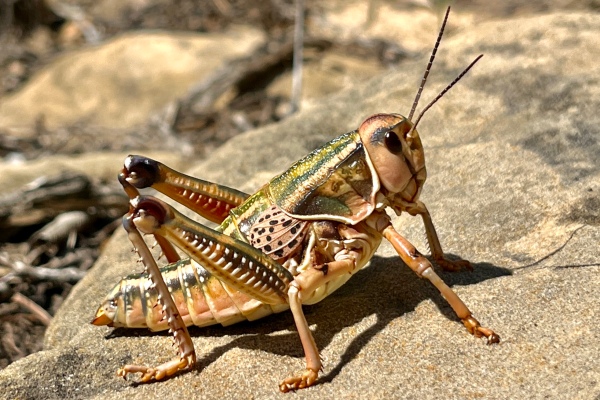
Brachystola magna (Plains lubber grasshopper—family Romaleidae) on sandstone outcrops in shortgrass prairie.

Black Mesa State Park
Cimarron County, Oklahoma

I checked the canyon jug traps first—results were similar to the previous nearby site, with all traps loaded with Euphoria inda and Elateridae. I bagged them for processing later but did see a few Cerambycidae in the catch. The Lindgren funnel trap was also overwhelmed by the same, but since I’m not taking data from the trap I sorted through the catch and picked out 1 Enaphalodes sp., 1 Neoclytus acuminatus, and more than a dozen elaphidiine cerambycids comprising at least two species. While I was servicing the Lindgren funnel trap I found a Stenomorpha opaca crawling in the rocks, and nearby I found another one a short ways down the Overlook road.

Stenomorpha opaca (family Tenebrionidae) on rocks in shortgrass prairie.

The white bottle trap again had lots and lots of bees in it, but unlike last time it also had 8 Acmaeodera sp. plus 20 Meloidae and one Trichodes orestus along with tons of bees for Mike. I saw a few Megatibicen sp. males singing (presumably M. dorsatus rather than M. tremulus due to the non-sandy nature of the habitat) but couldn’t get close to them, and I heard several Megacicada dealbatus males singing in the tall cottonwoods down below by the creek. I think I’ve had my fill of chasing cicadas for now!

After finishing the last of the traps (26 in all at five locations!), I had about an hour of good daylight left and played a hunch that Lampetis drummoni (family Buprestidae) might be out now. I had seen one earlier in the day on Rhus aromatica (fragrant sumac) at Beaver Dunes but missed it, and I reasoned that I might find it in the same here. I took the Overlook Hiking Trail and had walked about half the loop—looking closely at R. aromatica patches along the way (and picking up another Stenomorpha opaca)—and was starting to think it might still be too early in the season (iNaturalist records from the area are all from September and October) when suddenly I saw one perched near the tip of a R. aromatica branch. It was not at all wary (likely due to the lateness of the hour, although my experience with this species in Texas is that they are not particularly zippy), and after taking a photo I was able to pick it easily with my fingers.
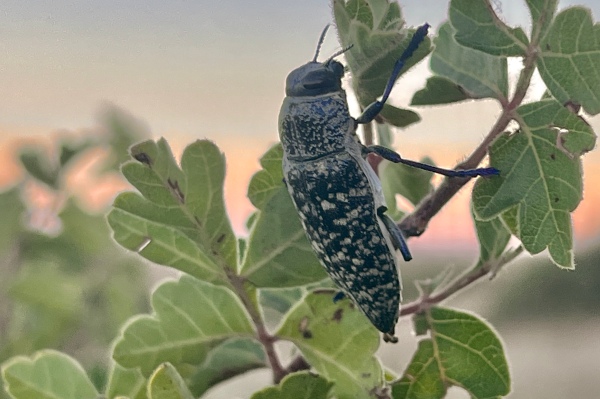
Lampetis (Spinthoptera) drummondi (family Buprestidae) perched on Rhus aromatica (fragrant sumac) at dusk in shortgrass prairie.

I checked the patch carefully and found another four—all perched in the same fashion and not at all inclined to fly off in alarm. I took another photo of the last one I found with a beautiful evening sky in the background, and those would be the only ones I would see for the rest of the hike.
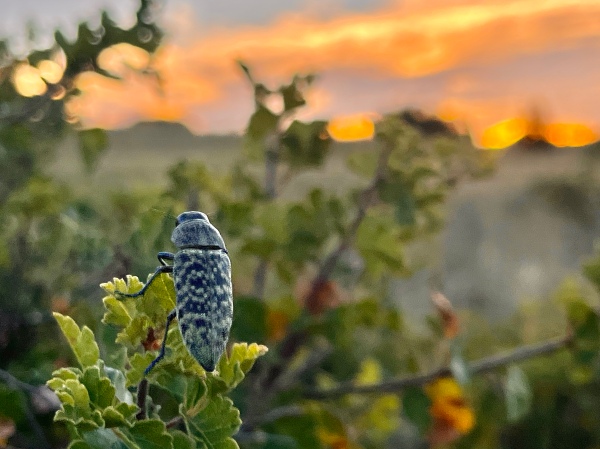
Lampetis (Spinthoptera) drummondi (family Buprestidae) admiring the sunset!

©️ Ted C. MacRae 2023

It’s a Mayfly…It’s a Moth…It’s Thyridopteryx

Mississippi River @ Hwy 62 bridge

One of the nice things about the study of insects is the endless opportunity for discovery. It could be a new species, or it might just be something already known but not yet seen personally. I’ve been collecting insects most of my life, and although much of it has been done in far away places the bulk has occurred in my home state of Missouri. Despite my long experience in this state, this past summer I had the opportunity to experience collecting within the state in a way that I’ve not yet done before—blacklighting up and down the length of the Mississippi River regularly during the months of July through September. Each time, I would arrive at the selected spot in the early evening while there was still daylight and search the (hopefully sandy) beaches for evidence of several tiger beetle species that might occur in such habitat. Then, as the sky turned aglow from the setting sun, I would setup the blacklights and wait for the appearance of those particular tiger beetles that are attracted to such.

Thyridopteryx ephemeraeformis | Mississippi Co., Missouri

Expectedly, beetles were seen at only some sites, and numbers and diversity generally decreased as summer approached its end. By early September beetles were no longer showing up even though the habitat seemed good (I guess that’s why they call them “summer” species). Still, on this particular night, the lights setup at the Hwy 62 bridge in far southeastern Missouri were attracting a variety of other insects, so I kept them on to see what might come in. I had nothing else to do. At some point, I noticed a strange insect that seemed like a cross between a mayfly and a moth, and then another…and another. Although I had never seen one of these in person before, I knew exactly what they were—male bagworms! Bagworms (order Lepidoptera, family Psychidae), of course, are extraordinarily common in Missouri, and the sight of dozens or even hundreds of their silken/twig bags attached to ornamental evergreen shrubs in the neighborhood where I lived as a kid remains vivid. I can remember “popping” the larvae inside to see their innards ooze out from the tip of the bag (I know—I’m not proud of it) and even cut open a few of the bags to see the larvae inside (that is, once the less sadistic and more scientifically curious side of me took over). Despite all of this, I had never seen an adult bagworm—male or female—until this night.

Dorsal view

Obviously, these are males because they have wings—females remain wingless into adulthood and, in fact, never even leave the bag in which they’ve spent their entire lives. Bagworm males are distinctive in that their wings are virtually devoid of any scales, and I surmise that the generic name of the most common species in eastern North America—Thyridopteryx ephemeraeformis—is derived from the Greek thyris (window) and the Latin ptera (wing) in reference to this. I was fascinated by the strange appearance of these moths and even more fascinated by the curious manner in which the males held out the tip of their abdomen when at rest; reminiscent of a female releasing sex pheromone. This can’t be true, because it is the females that call from their bags to attract the males, and since the females remain within their bag, the male must insert his abdomen through the tip of the bag and all the way to the top where he can reach the female genital opening. Thus, the male abdomen is highly extensible and prehensile—I guess the males can’t keep an abdomen with that much stretching capacity still for very long.

Two males

Based on gestalt, I presumed these represented T. ephemeraeformis since it is such a common and widespread species, but it’s not always wise to presume, especially in a relatively more southern location. The Moth Photographers Group lists five species in this genus in North America, two of which (T. alcora and T. meadii) seem to be southwestern in distribution. Of the remaining three, T. ephaemeraeformis is the only one I could find any photos or information beyond simple listings (the Moth Photographers Group lists no distribution records for T. rileyi or T. davidsoni), so I asked my lepidopterist friend Phil Koenig for his opinion. Phil informed me that T. ephemeraeformis has been recorded in Missouri 285 times in 49 counties, while T. rileyi is known from the state based only very old literature records and T. davidsoni not at all. Thus, the odds are definitely favor these males representing T. ephemeraeformis. Late summer is apparently the prime period of adult bagworm activity. I’ve not done much blacklighting late in the season because most of the beetles on which I’ve focused over the years and that are attracted to blacklights are active more during spring and early summer. This could explain why I’ve not until now seen male bagworms despite their commonness in Missouri.

Copyright © Ted C. MacRae 2012

The Moth and Me #11

The Moth and MeWelcome to issue #11 of The Moth and Me, the monthly carnival devoted to the “forgotten” lepidopterans. Most people – even entomologists – regard these as the lesser leps, denizens of the night, as if to hide their somber-colored drabness from the flashy brilliance of their rhopaloceran relatives. Of course, this simply isn’t true, as the contributions to this month’s issue well demonstrate. Butterflies may be among the largest insects on earth, but the largest lepidopteran in the world is a moth. They may also be as gaudily colored as the rainbow itself, but what butterfly is more colorful than the Urania day-flying moths (the genus name literally means, “The heavenly one”).   And, they may be almost universally accepted by a largely insect-indifferent public, but who among us does not think back to that first sight of a luna moth as the most stunning insect we had ever seen to that point.  Yes, moths are all that butterflies are, and for this month’s issue of TMaM, 15 contributions by nine writer’s show us why.

Family Saturniidae – Giant Silkworm & Royal Moths

Tales from the Butterfly Garden: LepcuriousLuna moths belong to the royal moths of the family Saturniidae, and as the name implies they are not the only stunningly beautiful member of the group. Kristen at Tales from the Butterfly Garden: Lepcurious writes about an encounter with the Sweetbay Silkmoth (Callosamia securifera).  Like other members of the family, larvae of this species are rather particular about the type of tree that they utilize for food, which in the case of this moth is sweetbay (Magnolia virginiana).  I’m a little too far north here in Missouri for this tree, so I have never seen this moth.  However, I have seen (and reared) some of its close relatives, the Promethia Silkmoth (Callosamia promethea) which hosts on several plant species and the Tulip-tree Silkmoth (Callosamia angulifera) which hosts on Tulip Tree (Liliodendron tulipifera).

Family Zygaenidae – Leaf Skeletonizer Moths

xenogereJason Hogle at xenogere is fond of the unusual and has a gift for finding it. In his post The Unmoth, Jason shows us a male grapeleaf skeletonizer (Harrisina americana) – not your typical moth!, The uniformly black color and bright red neck collar just screams “Don’t eat me – I’m poisonous”, and indeed species in this family are among the few insects capable of producing hydrogen cyanide!  As the name suggests, larvae skeletonize the leaves of both wild and cultivated grapes (Vitis spp.), as well as the related Virginia creeper (Parthenocissus quinquefolia).

Family Noctuidae – Noctuid Moths & Tiger Moths

Tales from the Butterfly Garden: LepcuriousRoyal moths are not the only stunningly colored moths that Kristen at Tales from the Butterfly Garden: Lepcurious has found in Florida, as she shows in this post on Oleander Moths (Syntomeida epilais) and a companion piece on its Oleander host plant.  This striking day-active moth, also called Uncle Sam Moth (for its red, white, and blue colors) and Polka-Dot Wasp Moth (for obvious reasons), may seem like an easy-to-spot target for would be predators, but its gaudiness is actually warning of the toxic chemicals it has sequestered in its body from the Oleander on which it fed as a larva.  Oleander contains the toxins oleandrin, a cardiac glycoside, and neandrin and is toxic if ingested.  Although oleander is an Old World exotic, oleander moths may also be found feeding on devil’s potato vine (Echites umbellata), which may have been their native Florida host before the introduction of oleander to the United States.

See TrailAside from the underwings (genus Catacola) and the recently incorporated tiger moths, Noctuids are typically thought of as the “basic brown moths” – relying on just the aforementioned groups to add a splash of color to the family’s otherwise drearyness.  Nothing could be further from the truth – check out the stunning Eight-spotted Forester (Alypia octomaculata) in this post by Matthew York at See Trail. Larvae of this beautiful little moth feed on ampelopsis, Virginia creeper, and other plants in the grape family (similar to the grape leaf skeletonizer above). “A great moth; brilliant color, diurnal…… and yes… Noctuid. Some moths, like people, don’t go with the trends.”

See TrailFor the most part, tiger moths shun the daytime in preference for the safety of the night. That does not mean, however, that they are any less colorful, as Matthew York at See Trail shows in his post Poor Grammia. Notarctia proxima, the Mexican Tiger Moth, and its relatives have had a bit of name shuffling over the years at the hands of taxonomists – formerly placed in the genera Grammia and Apantesis. Whatever name you call it, the striking white and black striped forewings give a clue about their common name of tiger moths, and the red, black-tipped abdomen not only add to its beauty, but belies the defensive compounds it surely contains.

Speaking of tiger moths and defensive compounds, watch the video that Chris Grinter at The Skeptical Moth included in his post Moth Perfume. In it, Chetone angulosa gives a striking display of a common defensive mechanism for the group – excreting hemolymph (sweating blood, so to speak!). So spectacularly does the moth do this that you can actually hear the hissing sound of the fluid being pumped from the body. Moreover, there seem to be at least a couple of active ingredients in the froth – one that smells like peppermint, and another that causes numbing of the tongue (as Chris can testify firsthand – he is a truly dedicated experimental naturalist!).

Karthik's JournalIn similar fashion to our North American species of underwing moths (Catocola spp.), the related Eudocima materna, one of the fruit-sucking moths of south India, uses its drab-colored forewings to hide its brilliantly colored hindwings, as Karthik at Karthik’s Journal shows us in his post Startling Displays.  This forms a double line of defense against would-be predators – the forewings blend marvelously into the color of the tree trunks upon which it rests during the day, camouflaging the insect and making it nearly invisible.  If this doesn’t work, a sudden flash of the hindwings may startle the predator just enough to allow the moth to take flight to another tree – where it instantly “disappears” as soon as it closes its wings.

Snails Eye ViewAustralia also has some very colorful fruit-piercing moths, and Bronwen Scott at Snails Eye View presents some beautiful photos of the particularly strikingly-colored Othreis iridescens. Like other members of the group, this Far North Queensland endemic feeds on fruit (Pycnarrhena novoguineensis and Hypserpa laurina, both Menispermaceae, in the case of this species), but as it is apparently the rarest of the primary fruitpiercing moth species in Australia it is not considered to be a pest (and Bronwen would cut it some slack even if it was!).

EntophileAdults are but only one of four life stages that all moths go through. If moths are the “forgotten” leps, then caterpillars are the “forgotten” moths. In many cases, the caterpillar stage cannot be recognized until it becomes a moth (and in some cases the caterpillars are completely unknown). Fortunately, Navy entomologist corycampora at Entophile recognized the caterpillar he found on his croton bush, which he features in the post Croton caterpillar, Achaea janata (Linnaeus), (Lepidoptera: Noctuidae). These “eating machines” can be just as fascinating to observe as their scaled adult counterparts, and while croton seems to be a preferred host in Hawaii, it apparently also feeds on castor beans (judging by its other common name, Castor Oil Semi-looper).

Family Notodontidae – Prominent Moths

the Marvelous in NatureOften dismissed as noctuids, the prominent moths tend to be fuzzier, more thickly-bodied moths that rest with their wings curled around their abdomen or tented over their back (rather than flat like noctuids and most other moths). TMaM organizer Seabrooke Leckie at the Marvelous in Nature has a love affair with prominents, and in her post Georgian Prominent, she features the nicely thick-bodied and fuzzy Georgian Prominent, Hyperaeschra georgica. The caterpillars of this widespread species feed on oak (Quercus spp.), thus, unless you live in the Pacific Northwest you stand a good chance of encountering this species – if you’re you’re willing to make the effort.

Family Psychidae – Bagworm Moths

xenogereMany of us are probably familiar with the evergreen bagworm moth (Thyridopteryx ephemeraeformis), whose large, cone-shaped bags almost look like fruit hanging from the evergreen bushes on which the caterpillars feed. But did you know there are other species of bagworms as well? Jason Hogle at xenogere does, and he compares and contrasts two of them in this duo of posts, Rainy day on the patio and The Other Bagworm. One huge and prominent, the other (Dahlica triquetrella) very small and oft unseen. One with all manner of plant matter stuck to its bag, the other usually mistaken for small bits of dirt or wood. Jason is so good, he can even determine the sex of the caterpillar inside the bag!

Family Sphingidae – Hawk Moths

Roundtop RumingsCarolyn at Roundtop Rumings is hoping that somebody can Name this moth, which she found on the door of her cabin in the forests of Pennsylvania. Don’t let her inability to name this moth fool you, however, for her post contains loads of information on exactly the kinds of characters one should take note of when trying to identify hawk moths. Large size and membership in a popularly studied group aren’t enough – what do the hindwings look like? Are there any spots on the abdomen? As a coleopterist, I hesitate to offer my relatively uninformed opinion on the exact genus and species for this moth, but I’m going to go out on a limb here and suggest maybe something in the genus Ceratomia, perhaps the waved sphinx (C. undulosa)?


I hope you have enjoyed this issue of The Moth and Me, and my sincere thanks go out to all of those who contributed!  The hosting slot for next month’s issue of TMaM is still open, but you can submit your contributions anyway to Seabrooke Leckie at the home site for inclusion in the June 2010 issue once a host is selected.  The submission deadline is June 13, with the issue appearing a few days later.  Perhaps you might like to host the June issue – hosting is not only fun, but also a great way to introduce readers to your site and generate a little traffic.  Contact Seabrooke at the home site if you’re interested – I’m sure she would love to hear from you.

Copyright © Ted C. MacRae 2010

Add to FacebookAdd to DiggAdd to Del.icio.usAdd to StumbleuponAdd to RedditAdd to BlinklistAdd to TwitterAdd to TechnoratiAdd to Yahoo BuzzAdd to Newsvine

Email to a friend