Group mimicry in Cerambycidae… and more

During last year’s extended visit to Argentina, I had the chance to spend the early part of April in the northern province of Chaco. Though much of this hot, arid plain has been converted to agriculture, remnants of thorn forest remain along fence rows and in small patches of Chaco Forest. Despite the decidedly tropical latitude of the region, however, the profuse bloom of Chilean goldenrod, Solidago chilensis, along these fence rows during the Argentine autumn is reminiscent of crisp fall days here in the eastern U.S., and like the goldenrod here the ubiquitous stands of yellow blossoms stretching across the Chaco Plain are equally attractive to a multitude of insects. Among those insects are the Cerambycidae, or longhorned beetles, and while the eastern U.S. cerambycid fauna of goldenrod boasts only a few (albeit spectacular) species in the genus Megacyllene, the Argentine cerambycid fauna that I found on these flowers included at least three species in various genera belonging to two different tribes.
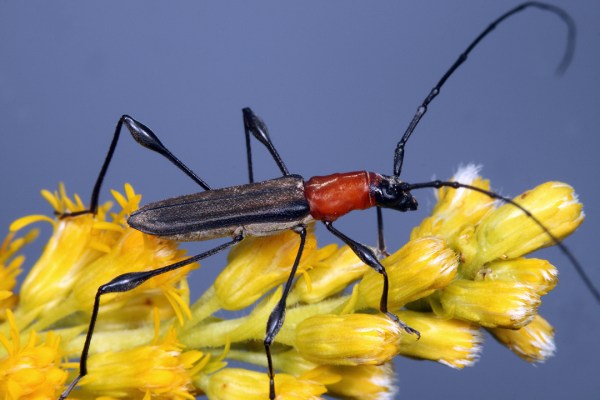
Rhopalophora collaris (Germar 1824) | Chaco Province, Argentina

Rhopalophora collaris (Germar 1824) | Chaco Province, Argentina

Two of the species I saw are shown here, and their similarity of appearance is no coincidence, as both belong to the tribe Rhopalophorini (coming from the Greek words rhopalon = club and phero = to bear, in reference to the distinctly clavate, or club-shaped, legs exhibited by nearly all members of the tribe). In fact, a great many species in this tribe exhibit the same general facies—slender in form and black in coloration with the head and/or pronotum red to some degree. Since all of these species are diurnal (active during the day) and frequently found on flowers, one can assume that the members of this tribe represent an example of what Linsley (1959) called ‘group mimicry.’ In this simple form of Batesian mimicry (harmless mimic with protected model), a group of related species within a genus or even a tribe have a general but nonspecific resemblance to those of some other group of insects—in this case presumably small, flower-visiting wasps. Although the tribe is largely Neotropical, the nominate genus Rhopalophora does extend northward with one eastern U.S. representative, R. longipes. Among the numerous species occurring in South America, the individuals I saw in Argentina can be placed as R. collaris due to the relative lengths of their antennal segments and uniquely shaped pronotum (Napp 2009).
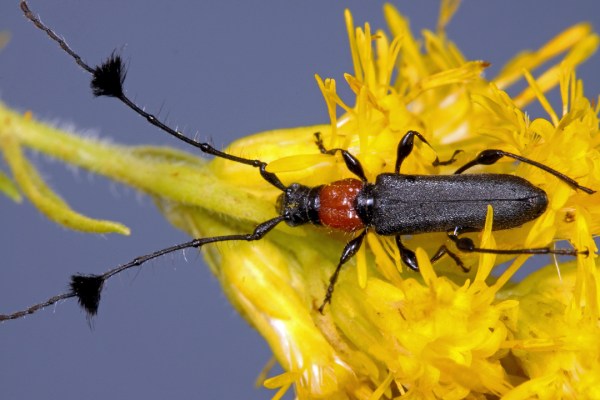
Cosmisoma brullei (Mulsant 1863) | Chaco Province, Argentina

Cosmisoma brullei (Mulsant 1863) | Chaco Province, Argentina

The second species could easily be mistaken for another species of Rhopalophora were it not for the distinct tufts of hair surrounding the middle of the antennae. These tufts immediately identify the beetle as a member of the large, strictly Neotropical genus Cosmisoma (derived from the Greek words kosmos = ornament and soma = body, a direct reference to the tufts adorning the antennae of all members of this genus). Three species of the largely Brazilian genus are known from Argentina, with the black and red coloration of this individual easily identifying it as C. brullei (Bezark 2o13). In the years since this genus was described, additional related genera have been described that bear remarkably similar tufts of hair not on the antennae, but on the elongated hind legs. The great, 19th century naturalist Henry Walter Bates “tried in vain to discover the use of these curious brush-like decorations” (Bates 1863), and nearly a century later Linsley (1959) conceded that their function still remained unknown. Antennal tufts are actually quite common in Cerambycidae, especially in Australia, and while experimental evidence continues (to my knowledge) to be completely lacking, Belt (2004) records observing “Coremia hirtipes” (a synonym of C. plumipes) flourishing its leg tufts in the air (presumably in a manner similar to waving of antennae) and, thus, giving the impression of two black flies hovering above the branch on which the beetle was sitting. This seems also to suggest a function in defense, with the tufts perhaps serving as a distraction to potential predators in much the same way that many butterflies have bright spots near the tail to draw the predator’s attention away from the head.

REFERENCES:

Bates, H. W. 1863. The Naturalist on the River Amazons. Murray, London, 2 vols.

Belt, T. 2004. The Naturalist in Nicaragua. Project Guttenberg eBook.

Bezark, L. G. 2009. A Photographic Catalogue of the Cerambycidae of the World. Available at http://plant.cdfa.ca.gov/byciddb/

Linsley, E. G. 1959. Ecology of Cerambycidae. Annual Review of Entomology 4:99–138.

Napp, D. S. 2009. Revisão das espécies sul-americanas de Rhopalophora (Coleoptera: Cerambycidae). Zoologia (Curitiba) 26(2):343–356.

Copyright © Ted C. MacRae 2013

And the results are in…

I recently entered my first photo contest, a local competition sponsored by the Webster Groves Nature Study Society (of which I have been a member for ~30 years), and although the competition was limited to its few hundred members there were some serious cash prizes on offer. Being a noob at photo contests and a still relative newcomer to photography in general, I wasn’t sure what to expect. I thought my photos might be good enough to compete, but I also knew I would be going up against some long-time and very skilled nature photographers. The basic rules were a maximum of two submissions in no more than three of the following categories:

  • Botany
  • Entomology
  • Ornithology
  • Landscapes/habitats

Since I’ve only photographed two birds ever, I decided to submit entries to each of the other three categories. It was an interesting competition—the judges (each category had a panel of three consisting of a WNGSS board member, a natural history expert, and a photography expert) had a chance to see all of the photographs prior to the event (held last night) and select the top ten from each category, but the rest of the judging was done live at the event. Eventually, from each category a 1st place, 2nd place, and 3rd place photo was selected. The 12 winning photographs were then displayed in a continuous loop, and everybody attending the event was allowed to vote for one grand prize winner. The grand prize winner had to receive more than 50% of the vote, so a few runoff rounds were required to decide the final winner.

How did it go for me? I had a pretty good night, with three winning photographs:

Entomology—3rd place

Cicindela repanda (Bronze Tiger Beetle) | St. Louis Co., Missouri

Cicindela repanda (Bronze Tiger Beetle) | St. Louis Co., Missouri

Botany—2nd place

Hamammelis vernalis (Ozark witch hazel) | Iron Co., Missouri

Hamammelis vernalis (Ozark witch hazel) | Iron Co., Missouri

Entomology—1st place

Arctosa littoralis (beach wolf spider) | Lewis Co., Missouri

It was a thrill for me to learn that, out of the six photographs I submitted (and I really didn’t think my two landscape submissions were competitive to begin with), three were among the 12 final prize winners. That also made them eligible for the grand prize, but in this case I didn’t really expect the larger membership (which has a lot of birders) would really take to my closeup insect photographs. To my surprise, the first round of voting produced four finalists—two of which were my insect photos! The first runoff vote eliminated one photo—but not either of mine, and the second runoff eliminated one more photo—but again neither of mine. I had won the grand prize without yet knowing which photo would be the winner! In the end, the tiger beetle took the top prize. Personally, I was happy about that, because even though the photo took only 3rd place in the entomology competition, I thought it was the stronger of the two photos based on composition, the time and effort it took to work the beetle to finally “get the shot” (not that the wolf spider photo didn’t also take a lot of effort to get that close), and the natural history behavior that it captured (stilting and sun-facing for thermoregulation). I know blog commenting is becoming passé, but if you have any particular thoughts about these photos, good or bad, I would love to hear from you.

Overall I would have to say that, winner or not, participating in a photo competition was an extraordinary learning opportunity for me as I try to hone my craft. Listening to the comments of the judges in all of the categories, both on the natural history and the technical aspects of the photographs, gave me a lot of insight into how I might further improve my technique and take photographs that can be appreciated on both technical and artistic grounds. More importantly, the cash was nice, but the motivation to keep trying that I got out of the experience was priceless!

Copyright © Ted C. MacRae 2013

Ceti Eel offspring?

Nicrophila americana

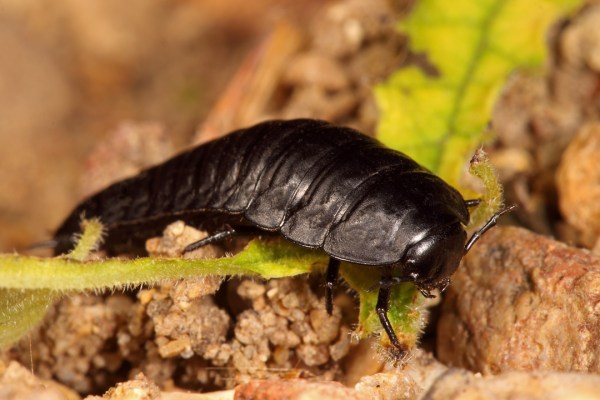
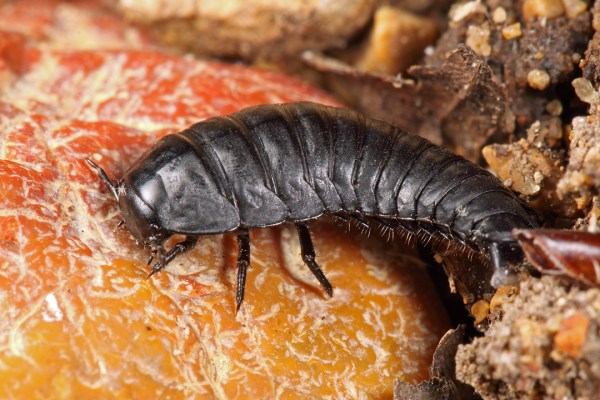
Nicrophila americana (American carrion beetle) larva | Sam A. Baker State Park, Wayne Co., Missouri.

If this creature was a tad bit slimier, you might think it had just been plucked from underneath the armor of an adult Ceti Eel and was looking to slip inside the ear of Chekov or some other human to wrap itself around the unsuspecting victim’s cerebral cortex. In reality, this creature lives not on Ceti Alpha V., but right here on earth, and while it’s natural history may not include making human hosts “extremely susceptible to suggestion“, it does include an appetite for dead flesh and the maggots that try to compete for it. Say hello to the larva of Nicrophila americana (American carrion beetle), a member of the family Silphidae (carrion and burying beetles) (not to be confused with the endangered Nicrophorus americanus, or American burying beetle). Like most beetles, the larvae can be difficult to recognize as such due to its very different form compared to the adult. However, the one-segmented tarsi, distinct head, presence of chewing mouthparts, and presence of spiracles along the sides of the body give the clues to its identity.

Necrophila americana

While not the offspring of a Ceti Eel, its habits are almost as… er, disgusting!

The genus name (literally meaning “attracted to corpses“) is a perfect descriptor of this beetle’s natural history. Adults are attracted to animal carcasses, where they lay their eggs and prey on maggots (fly larvae) as they hatch to give a competitive advantage to their own larvae once they hatch. The larvae also will eat maggots and other larvae within the carcass, along with the carcass itself. This larva had completed its development and was searching the ground for a suitable spot to dig a burrow for pupation and eventual emergence as an adult.

Copyright © Ted C. MacRae

Bollworms rising!

One of the most pernicious pests that U.S. farmers have battled is the larval stage of Helicoverpa zea (Lepidoptera: Noctuidae). This insect is destructive enough to have earned not just one official common name, but four (corn earworm, cotton bollworm, soybean podworm, and tomato fruitworm)—one for each of the crops in which it has attained major pest status. It isn’t only North American farmers, however, that must deal with this pest, but South American farmers as well. For many decades, corn and cotton have been its most important hosts in North America, but in recent years its importance has increased steadily in soybean as well, particularly across the mid-south. In South America, however, it seems satisfied—curiously—to confine its attacks to corn. Lest you think that South American farmers are getting off easy, there are other species of Helicoverpa in South America that are causing problems of their own. Perhaps the most troubling one is H. armigera, the Old World bollworm¹—a sister species to H. zea (Goldsmith & Marec 2010) native to Africa, Asia, and Australia and just as polyphagous as H. zea that was recently found infesting corn, cotton, soybean, and other crops in several areas of Brazil.

¹ Interestingly, in the Old World this species is called the “American bollworm,” despite the fact that it did not come from the Americas at all. I guess neither hemisphere wants to take the blame for this species.

Helicoverpa gelotopeon (South American bollworm) | Buenos Aires Province, Argentina

Helicoverpa gelotopeon (South American bollworm) | Buenos Aires Province, Argentina

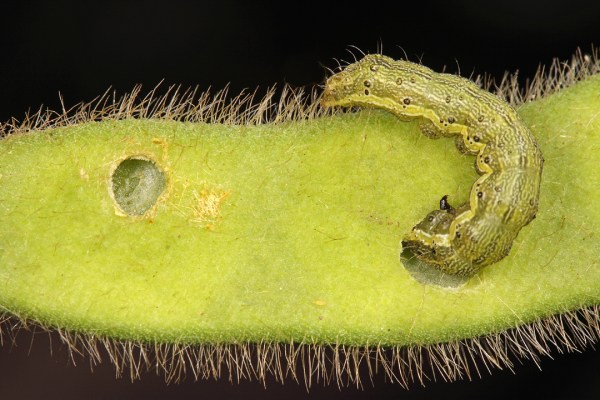
While we wait to see what impact H. armigera ends up having in South America, another species of the genus is quietly rising from the ranks of secondary to primary pest further south on the continent. For many years, Helicoverpa gelotopeon (or South American bollworm) has been a sometimes pest of cotton and other crops in Argentina, Chile and Uruguay (Evangelina et al. 2012), but in a situation that mirrors the rise of H. zea on soybean in North America, the incidence of H. gelotopeon has grown during the past few years in the more southern soybean growing areas of South America as well. Like its North American counterpart, this insect causes not only indirect damage by feeding on the foliage of the plant during vegetative stages of growth (reducing photosynthetic capacity of the plant), but also direct damage by feeding on the developing pods during reproductive stages of growth. Predictably (and regrettably), farmers have responded by increasing applications of organophosphate insecticides, but the efficacy of these products—despite their relatively high toxicity—has often been inadequate to prevent yield losses. As a result, other management techniques and technologies will be required to keep this insect from having a major impact on soybean production in the temperate regions of Argentina.

Young larvae feed on foliage (note the very small caterpillar in the lower center area of the leaf).

Young larvae feed on foliage (note the very small caterpillar in lower left area of the leaf).

A mid-instar larvae feeding on soybean foliage.

A mid-instar larvae feeds on soybean foliage and exhibits the black pinacula characteristic of the subfamily.

Larger larvae feed on developing pods, breaching the wall of the pod to consume the seeds within.

Larger larvae feed on developing pods, breaching the wall of the pod to consume the seeds within.

Adults are slightly smaller than H. zea and a little darker with somewhat bolder markings.

The photographs in this post may well be the best—and perhaps even the only ones—available of this species. A Google image search turned up nothing, and have I been unable to find any literature with photographs of either the adults or the larvae and their damage. If you are aware of any please leave a comment with the citation.

REFERENCES:

Goldsmith, M. R. & Marec, F. 2010. Molecular Biology and Genetics of the Lepidoptera. CRC Press, Boca Raton, Florida, 368 pp.

Evangelina, P., F. Crepo & J. C. Gamundi. 2012. Evaluación del daño simulado de “oruga bolillera” Helicoverpa gelotopoeon (Dyar) en estados vegetativos del cultivo de soja. Unpublished report, Instituto Nacional de Tecnología Agropecuaria (INTA), 6 pp.

Copyright © Ted C. MacRae 2013

The “little soybean weevil”

Lepidopteran caterpillars are without question the most important pests affecting soybean in South America, while stink bugs run a close second in terms of economic impact and as the targets of insecticide applications. There are, however, a number of weevil species (order Coleoptera, family Curculionidae) whose incidence has increased during the past decade or so as the area planted to soybean continues its decade’s long expansion on the continent. The most important of these is Sternechus subsignatus, a  relatively large (and rather attractive black-and-yellow) species that was first detected in southern Brazil in the 1970s. It has since spread to northern Brazil and in recent years has also begun affecting soybean in Salta and Tucumán Provinces of northern Argentina (sometimes considered a distinct species, S. pinguis). Known locally as “picudo grande” (big weevil), adults clip the petiole of leaves and girdle the stems, leading to stand loss. One adult is capable of killing multiple plants, so that even light infestations can result in severe damage.

IMG_2439_enh_1080x720

Promecops carinicollis | Tucumán Province, Argentina

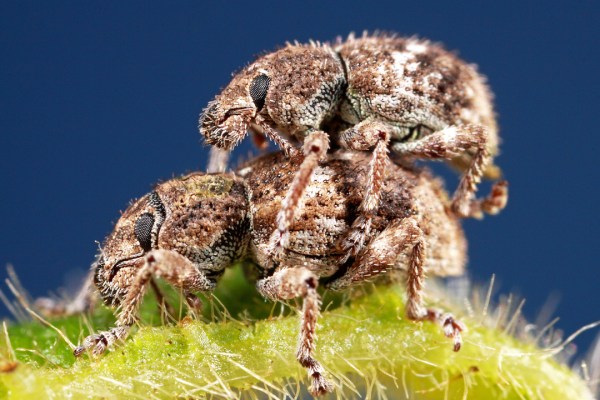
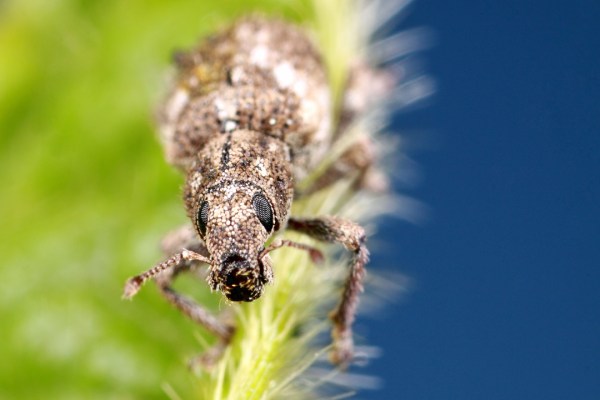
I’ve not yet seen “big weevils” for myself, but there are at least two other species that are showing up in soybean fields, particularly in Salta and Tucumán Provinces. During my recent visit to Argentina I happened upon a soybean field in northern Tucumán infested with one of them, Promecops carinicollis, a few photos of which I show here. This species is much smaller than S. subsignatus and is, thus, called “picudo chico” (little weevil)—certainly an appropriate name for the 3- to 4-mm long adults. While the integument is black, the body is densely covered with flat scales that form irregular white blotches on the elytra and otherwise give the beetle a mottled-brown appearance.

IMG_2436_enh_1080x720

Damage consists of adult feeding around the leaflet margins, giving them a scalloped appearance.

Like S. subsignatus, it is the adults that cause damage to the plants, although instead of the stems and petioles their feeding seems to be confined to the margins of the leaflets. This gives the leaflets a “scalloped edge” appearance that is quite distinctive and unlike the leaf damage caused by other leaf-feeding insects of soybean. The feeding causes a general reduction of the leaf surface area of the plant, which reduces the plant’s capacity to photosynthesize. However, as soybean has a rather high capacity to compensate for foliage loss by growing new foliage, especially during the earlier vegetative stages of growth, it would take rather high pressure by these weevils to cause enough damage to result in yield loss. It may be one of those soybean pests for which insecticide applications are made much more often than is warranted. The most important impact of this insect probably occurs just after seedling emergence, during which time feeding on the cotyledons and first leaves can weaken seedlings enough to cause stand loss.

Promecops carinicollis | Tucumán Province, Argentina

Beginning the process of making more Promecops carinicollis.

Copyright © Ted C. MacRae 2013
Baffling beetles

Even though I pride myself as a fairly competent coleopterist, I occasionally run into beetles that—despite my best efforts—I just cannot identify them beyond the family level. I don’t feel too bad about that, as the group’s 350,000 to 400,000 described species represent more than a third of all described life forms! Still, with the amount of information now available online combined with traditional print literature, it’s frustrating when I photograph species that seem quite distinctive but fail to show up in any search result. Here are a couple of South American beetles that I’ve pondered over for a year or more now. If you have any thoughts on their identity I would appreciate hearing from you.

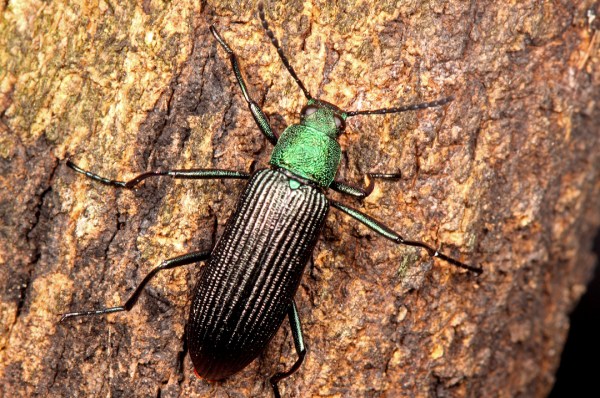
Tenebrionidae? | Campinas, São Paulo, Brazil.

Tenebrionidae? | Campinas, São Paulo, Brazil.

This first beetle was encountered January 2011 on the trunk of a tree in the city of Campinas, southeastern Brazil (São Paulo State). I only got this one shot of it before it dropped and disappeared, and except for the bright green color of the head and pronotum it reminds me of some of the long-jointed beetles—formerly the family Lagriidae but now a subfamily of Tenebrionidae (darkling beetles).

Elateridae | Rt 16 nr. Rio Nego, Chaco Province, Argentina

Elateridae | Rt 16 nr. Rio Negro, Chaco Province, Argentina

This is without question a species of click beetle (family Elateridae), but despite its rather distinctive coloration I’ve not found any images that resemble it. I found these beetles fairly commonly on flowers of Solidago chilensis in April 2012 at several localities along Rt 16 in northern Argentina (Chaco Province).

Copyright © Ted C. MacRae 2013

Brazilian Bike Adventure

Atlantic Forest

Atlantic Forest in Serra do Mar.

Yesterday I joined my Brazilian colleagues on a bicycling tour from the outskirts of São Paulo to the beaches of the Atlantic Coast. To say that the tour was an ‘adventure’ is an understatement—it was epic! For those not familiar with São Paulo, its 20 million inhabitants make it not only the largest city in Brazil, but also one of the five largest cities in the world. Yet, despite the explosive growth it has seen during the past century, it remains isolated from the Atlantic Coast of southeastern Brazil by the Serra do Mar, a 40-kilometer wide swath of rugged, mountainous terrain and part of the Great Escarpment that runs along much of the eastern coast of Brazil. It is here where some of the last tracts of Atlantic Forest, the second largest forest ecotype in South America after the Amazon, remain. Atlantic Forest once stretched along much of Brazil’s Atlantic coast, turning inland in its southern reaches to Paraguay and the northern tip of Argentina. However, much of the forest, especially in populous southeastern Brazil, has fallen victim to the axe. Only the ruggedness of the Serra do Mar has allowed the Atlantic Forest to survive in such close proximity to one of the world’s most populous cities. Understandably, travel between São Paulo and the coast has been difficult. In former years, vehicles had to snake their way through the mountains along a treacherous 2-lane highway with steep grades and hairpin turns. That highway has since been circumvented by an elevated, double, 4-lane highway of alternating spans and tunnels, and the old highway, now closed to vehicles, is instead used by maintenance crews for the new highway and cyclists who yearn to experience the Atlantic Forest up close and personal.

Our van dropped us off in the outskirts of São Paulo, from where we rode along the main highway a short bit before accessing the old highway. Dropping into the Atlantic Forest was like being magically transported into virgin wilderness. The pavement was so encroached by the forest, steep and slippery in places, that it was hard to imagine it ever served as a link between Brazil’s largest city and its largest port. Heavy rains the previous night made the forest moist and gave it an earthy aroma, and moisture-laden air hung heavy with fog and intermittent drizzle. For a time it seemed we would have an uninterrupted, 40-km downhill freeride; however, just a few kilometers into the ride we encountered the first of what would be many landslides blocking the route. I can honestly say that I’ve never portaged a bike through as rough and tumble a pile of trees, rocks, and mud as I did on this day. Still, perhaps encouraged by the fresh bike tracks that lay before us, we soldiered on. After picking our way through a half-dozen such landslides we came upon a work crew who said there were another 30–40 landslides further down along the route. We were at a tunnel that connected with the main highway, so we decided to play it safe and take the main highway the rest of the way down. That, too, was an adventure, made feasible only by the fact that traffic was crawling at a snail’s pace due to the popularity of the Atlantic beaches with the citizenry of São Paulo. It was enjoyable to swish past the cars as they idled their engines, but we had to navigate about seven kilometers worth of shoulderless tunnels. That would have been impossible in normal traffic, but the congestion made finding room to squeeze by large trucks and buses the biggest problem (and I guess breathing exhaust!). Eventually we made it down into Santos, the largest port city in Brazil, and after picking our way through the center of the city, took a ferry to the beach city of Guarujá. Rain, landslides and traffic had thrown everything they had at us, but we persevered the 53-km trek and watched the sun break through while enjoying our just rewards in a beachside restaurant.

Following are a few more of my favorite photos from the day, and you can see all of them in my Facebook album Brazilian Bike Adventure.

Descending into the forest.

Descending into the forest.

Magical vistas such as this were around every turn of the road.

Magical vistas such as this awaited us around every turn of the road.

Manacá da Serra (Tibouchina mutabilis) was abundant in the forest.

Manacá da Serra (Tibouchina mutabilis) flowered in abundance in the forest.

Elevated roadways bypass the beauty of the forest below them.

Why did the ‘hellgramite’ (order Megaloptera, family Corydalidae) cross the road? (Thanks to dragonflywoman for the ID.)

The first of many landslides that blocked our path.

The first of many landslides that blocked our path.

The new elevated highway snakes through the Serra do Mar. This portion was closed due to landslides.

The new elevated highway snakes through the Serra do Mar. This portion was closed due to landslides.

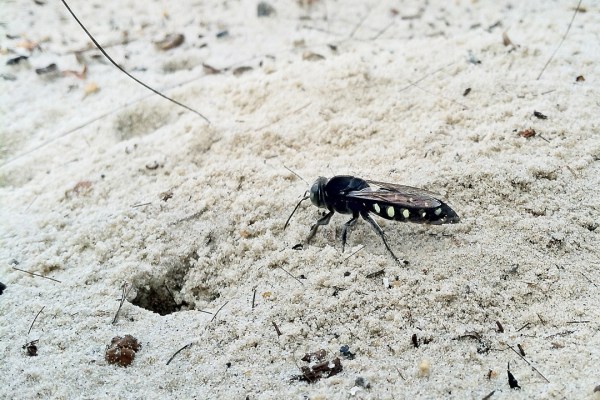
Outside of the cicada killer, this digger wasp (family Crabronidae) on the  beach at Guarujá is the largest that I have ever seen.

A large digger wasp (family Crabronidae) greets us on the beach at Guarujá.

My Brazilian colleagues and I enjoy some well-deserved refreshments after our 53-km trek!

My Brazilian colleagues and I enjoy some well-deserved refreshments after our 53-km trek!

I may have looked like a nerd still in my cycling clothes, but the wave experience was unforgettable.

I may have looked like a nerd still in my cycling clothes, but the wave experience was unforgettable.

Copyright © Ted C. MacRae 2013
T.G.I.Flyday: Argentine robber

I’m back in South America for the next 2+ weeks, and though it will be another week before I actually make it into Argentina, I am celebrating my return to that lovely country with photos of Argentinian insects taken during last year’s extended visit but that I haven’t had a chance to share before now. Earlier this week I featured Camponotus sericeiventris (though I prefer the literal translation, “silky-bellied humpbacked ant“)—easily among the most handsome ants that I’ve ever seen and which I encountered in the remnant quebracho forests at Chaco National Park in northern Argentina. Today’s feature is an equally handsome robber fly (order Diptera, family Asilidae), also seen at the park and which landed on a dead log just long enough to allow one good lateral profile shot of the beast in all its hairy splendidness! (Probably it zipped off to impale an Odontocheila tiger beetle in the back of the neck!)

Triorla sp. | Chaco National Park, Argentina

Triorla sp. | Chaco National Park, Argentina

I sent this photo to a few fly guys looking for a more authoritative opinion about its identity, mentioning its resemblance to some of our North American species of Efferia. Herschel Raney agreed that it belonged to at least that group, while Eric Fisher suggested a species in the genus Triorla (an early segregate of Efferia that is now widely regarded as a valid genus). The most recent checklist of robber flies from Argentina (Artigas & Hengst 1999) lists three species in the Efferia group (all in the genus Nerax); however, both Herschel and Eric confirmed my suspicion that Argentina, and especially the north, is not well studied for Asilidae. Eric further suggested that there could be as many as several times the number listed, mainly undescribed but also described from adjacent countries and occurring in Argentina but not yet recorded from there. Also, I had presumed this individual to represent a female since it lacked the distinctly swollen genital capsule (e.g. see this post, presumably another Efferia-group species), but Herschel thought the terminal structure was odd and did not look female.

REFERENCE:

Artigas, J. N. & M. B. Hengst. 1999. Clave ilustrada para los géneros de asílidos argentinos (Diptera: Asilidae). Revista Chilena de Historia Natural 72:107—150.

Copyright © Ted C. MacRae 2013