
Phrynus marginenotata (Florida tailless whip scorpion)
Back in May I visited the California Department of Food and Agriculture’s Plant Pest Diagnostics Laboratory in Sacramento. While I was there to visit my friend and colleague Chuck Bellamy and see him receive Honorary Membership in The Coleopterists Society, I was also anxious for the opportunity to spend time with the lab’s other entomologists—most of whom I interact with as members of the Editorial Board of The Pan-Pacific Entomologist. Among the more ‘colorful’ of these is Martin Hauser, a dipterist (although I don’t hold that against him!) who also has a passion for maintaining live, captive arthropods. For me, there is nothing finer than visiting the lab/office of a taxonomic entomologist—one wall lined with steel cabinets full of insect specimens, another wall crammed-full of books and literature (the older the better), a workbench with microscope at the center of a jumble of specimen containers and open reprints, and shipping boxes piled everywhere. I take that back—there is nothing finer than visiting the lab/office of a taxonomic entomologist that also keeps livestock! Martin’s collection of live arthropods, however, goes well beyond the requisite 10-gallon aquarium with Madagascan hissing cockroaches. I already featured one of his more unusual tenants, Damon diadema (Tanzanian giant tailless whip scorpion), and here I feature its North American relative, Phrynus marginenotata (Florida tailless whip scorpion).

The genus is characterized by five spines on the pedipalp tibia—the 3rd shorter than the 2nd and 4th.
According to Weygoldt (2000), this is the northernmost and only U.S. representative of a mostly northern Neotropical genus of eleven species, recognized by the pedipalp tibia (the thickened segment of their “claws”) with five spines—the middle one shorter than the 2nd and 4th (refer to Photo 2). This species occurs in southern Florida and some Antillean islands, where it lives under coral stones and rocks close to the beach—a habitat that presumably subjects them to periodic flooding. While most tailless whip scorpions prefer humid/moist environments, they nevertheless studiously avoid standing water itself. This species, however, has been observed to voluntarily enter the water when placed on a stone surrounded by water and remain submerged for as many as eight hours. Remarkably, submerged individuals remain active and do not drown, apparently the result of a “plastron”—an area of the cuticle surrounding the lung openings that is packed with stiff, branched structures and, thus, capable of holding a volume of air against the body while the animal is submerged. The plastron seems to function much like a gill—oxygen continuously diffuses into the plastron from the surrounding water as it is used for respiration.
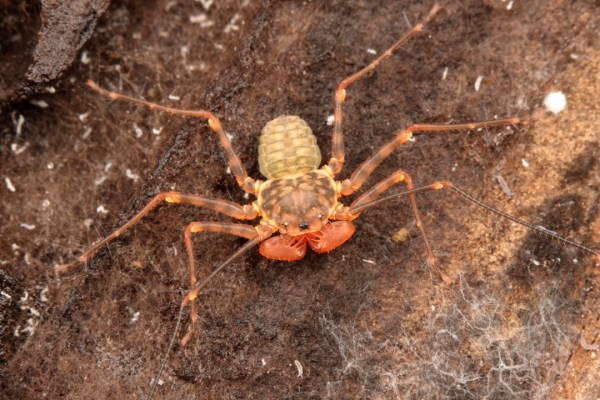
The bright orange pedipalps of 2nd-instar nymphs contrast with the somber coloration of the adults.
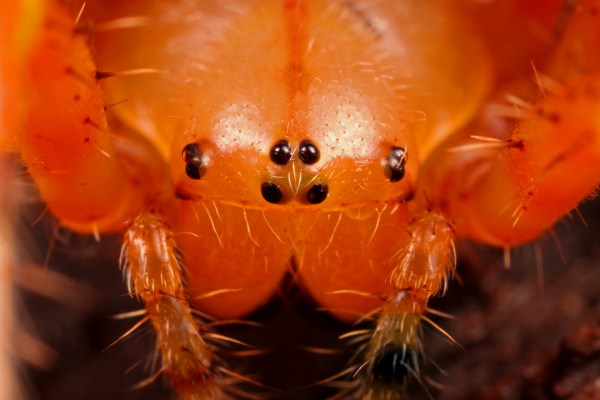
Like the D. diadema individuals that I also photographed, these P. marginenotata individuals had also produced viable eggs which had hatched a few weeks before my visit. Two nymphs can be seen with the adult in the top photo (although I can’t say for sure whether the adult is actually the mother), and Photos 3 and 4 show one of these nymphs up close and personal. I would have liked to have seen these nymphs when they first hatched, as the 1st-instars are a soft sea-green color and remain clustered on their mother’s abdomen until they are able to start fending for themselves (for a beautiful photo showing this, see Piotr Naskrecki’s The scariest animal that will never hurt you). The 2nd-instars that I photographed had already left their mother, and while they had lost their sea-green coloration, their pale yellow/gray bodies and bright orange pedipalps were no less striking compared to the more somber coloration of the full-sized adults.
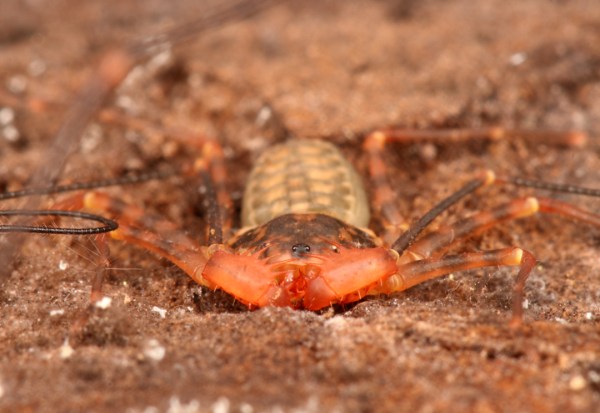
…and, of course, the signature BitB face shot!
REFERENCE:
Weygoldt, P. 2000. Whip Spiders (Chelicerata: Amblypygi): Their Biology, Morphology and Systematics. Apollo Books, Stenstrup, Denmark, 163 pp.
Copyright © Ted C. MacRae 2012









 Beetles In The Bush