More on Chalcosyrphus

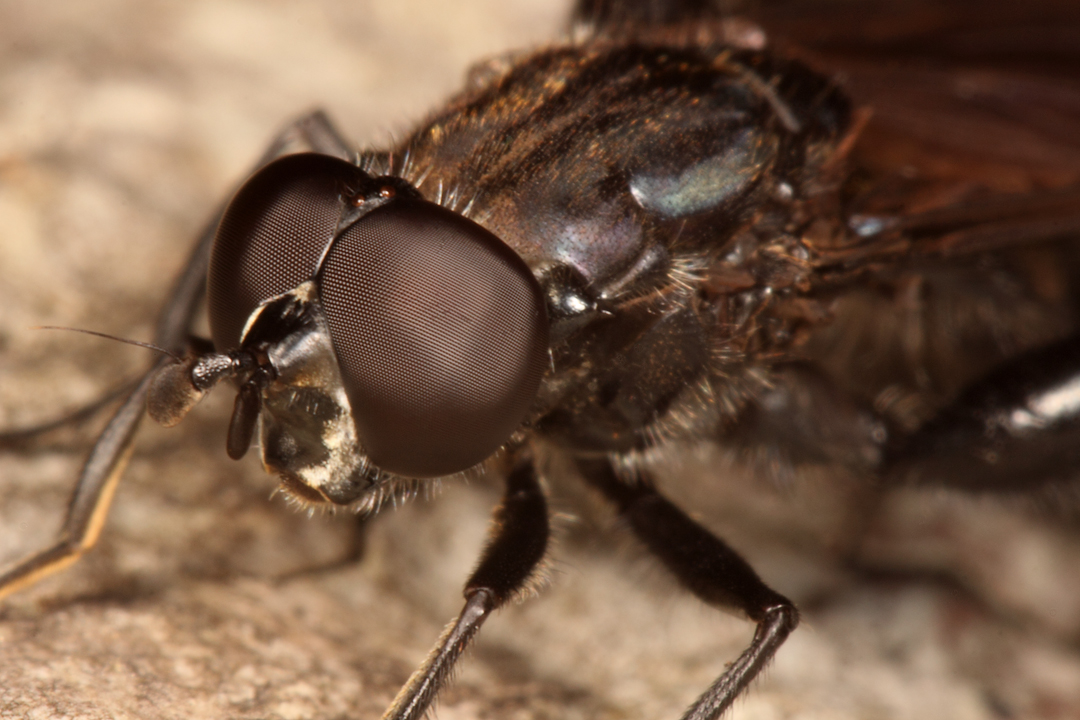
Here are two more photos of the fly I tentatively identified as Chalcosyrphus sp. The first photo shows the all-black coloration with no trace of either steel blue highlights (seen in C. chalybea) or red abdominal markings (seen in C. piger). It also gives a better view of the enlarged and ventrally spinose metafemora. The second photo shows the holoptic (contiguous) eyes that make me think this is a male individual (if, indeed, this is true for syrphids as with tabanids).

I’m hoping that posting these will provide any passing dipterists with the information needed for a firmer ID (and possibly an explanation of the purpose of those intriguingly modified hind legs).

Lateral view showing black abdomen with no trace of red (except what appears to be a parasitic mite).

Do the holoptic eyes identify this as a male?

Copyright © Ted C. MacRae 2012

T.G.I.Flyday – Chalcosyrphus?

When I was an entomology student, I learned that flies in the family Syrphidae are called “hover flies,” due to their habit of hovering in front of flowers, and that the larvae are predators of aphids. As is the case for nearly every other group of insects, I now know that there are exceptions–often many—to the typical rule, and the fly shown in the above photograph is a perfect example of such. Being a beetle-man (and a wood-boring beetle-man, at that), I don’t generally notice flies unless there is something unusual about them. This fly was seen last summer at Sam A. Baker State Park in southeastern Missouri on the trunk of a very large, recently wind-thrown mockernut hickory (Carya alba) tree. I had never seen a fly quite like this before, but everything about it suggested an intimate association with dead wood, including its relatively large, hulking, black form and the way it repeated returned to and landed on the trunk of the dead tree each time I disturbed it. It instantly made me think of robber flies in the subfamily Laphriinae, which includes Andrenosoma fulvicaudum and many species of Laphria that, as larvae, tunnel through dead and decaying wood where they prey upon the larvae of wood-boring beetles. While it was quite obvious that the fly in the photo was not a robber fly, imagine my surprise when I eventually determined it to be a member of the family Syrphidae. For now I’ve provisionally settled on the genus Chalcosyrphus, although it lacks the steely blue cast exhibited by the only all-black species of the genus—C. chalybeus—shown on BugGuide. Another species, C. piger, looks very similar but seems always to have some red on the abdomen, which this individual definitely lacks. Perhaps the related genus Xylota is also a possibility, although the “gestalt” does not seem to quite match that of any shown on BugGuide. Most interesting for me are the distinctly enlarged and toothed metafemora, which along with the correspondingly curved tibiae suggest some predatory function, but the literature that I have seen makes no mention of such, but rather that the adults feed on pollen. My hunch about its association with dead wood does seem to be true, although it now seems the larvae are saprophages rather than predators within the wood, as I first imagined.

Copyright © Ted C. MacRae 2012

Beetle botanists

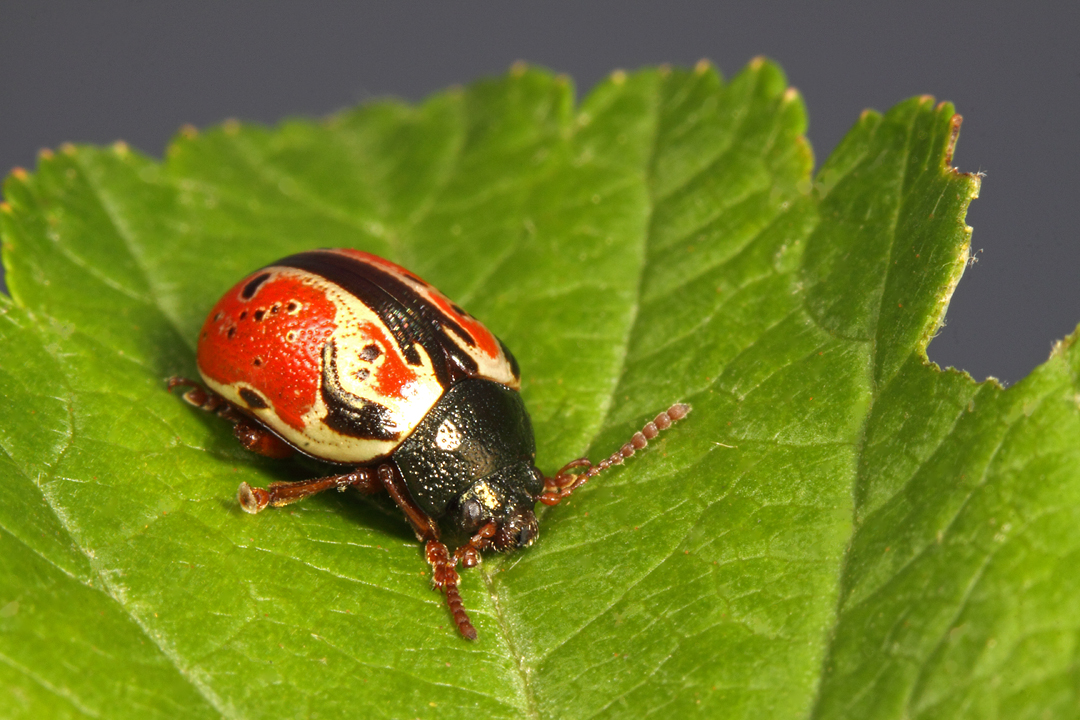
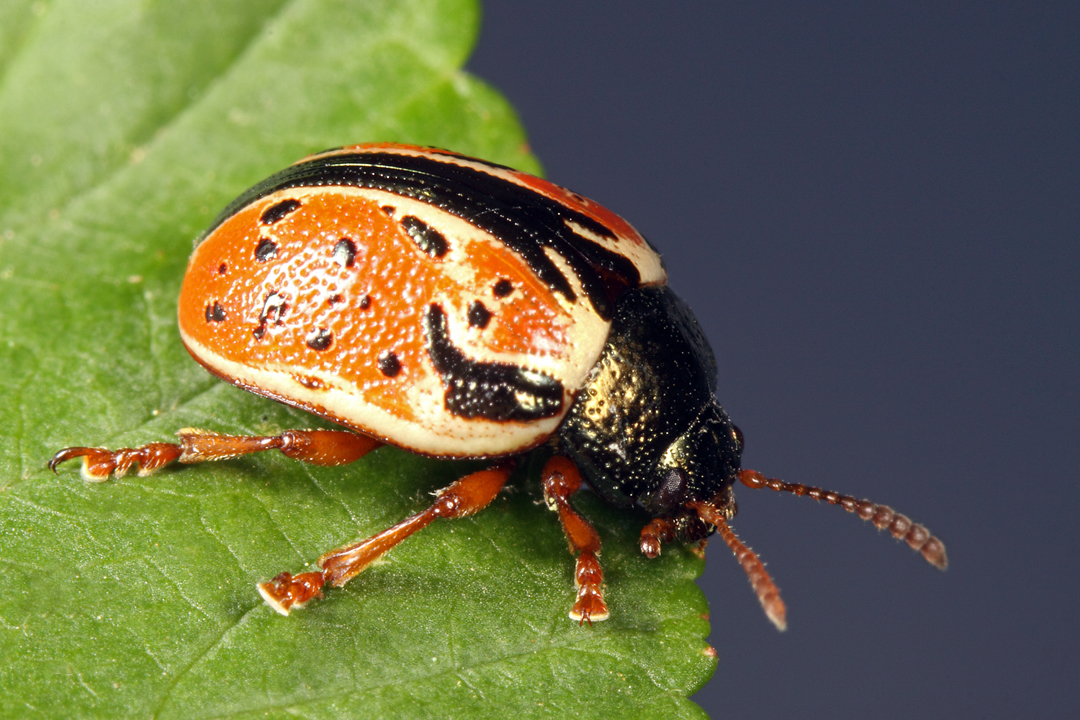
Calligrapha spiraeae on Physocarpus opulifolius | Jefferson Co., Missouri

While Dicerca pugionata (family Buprestidae) is, for me, the most exciting beetle species that I’ve found in Missouri associated with ninebark (Physocarpus opulifolius). it is not the only one. The beetles in these photographs represent Calligrapha spiraeae, the ninebark leaf beetle (family Chrysomelidae). Unlike D. pugionata, however, I almost never fail to find C. spiraeae on ninebark, no matter when or where I look, and whereas D. pugionata has been recorded in the literature associated with a few other host plants like alder (Alnus spp.) and witch-hazel (Hamamelis virginiana), C. spiraeae is not known to utilize any other plant besides ninebark as its host.

Beetles in the genus Calligrapha are among the most host-specific of all phytophagous beetles, with most of the 38 species in this largely northeastern North American genus relying upon a single plant genus as hosts (Gómez-Zurita 2005). The genus as a whole is fairly recognizable by its dome-like shape and black and white or red coloration, with the black markings on the elytra varying from coalesced to completely broken into small spots. The species, however, are another matter, with several groups of species that are quite difficult to distinguish morphologically. Fortunately most of them can be easily distinguished by their host plant (although such information is rarely recorded on labels attached to museum specimens). Calligrapha spiraeae, for example, with its reddish coloration and small black spots, looks very much like two other species in the genus—C. rhoda and C. rowena. Those latter species, however, are restricted to hazel (Corylus spp.) and dogwood (Cornus spp.); as long as the host is known, the species can be readily identified in the field.

At this point you may be wondering why the species name refers to the plant genus Spiraea rather than Physocarpus. In fact, ninebark was already known as the host plant when Say (1826) described the species, but the name spiraeae was given because at the time ninebark was included in the genus Spiraea (Wheeler & Hoebeke 1979).

REFERENCE:

Gómez-Zurita, J. 2005. New distribution records and biogeography of Calligrapha species (leaf beetles), in North America (Coleoptera: Chrysomelidae, Chrysomelinae). Canadian Field-Naturalist 119(1): 88–100.

Say, T. 1826. Descriptions of new species of coleopterous insects of North America. Journal of the Academy of Natural Sciences of Philadelphia 5:293–304.

Wheeler, A. G., & E. R. Hoebeke. 1979. Biology and seasonal history of Calligrapha spiraeae (Say) (Coleoptera: Chrysomelidae), with descriptions of the immature stages. The Coleopterists Bulletin 33:257–267. 

Copyright © Ted C. MacRae 2012

Damon diadema—Tanzanian giant tailless whip scorpion

Damon diadema, Tanzanian giant tailless whip scorpion (adult female)

I’ve reared more than my share of arthropods over the years—from easy ones like Madagascan hissing cockroaches to hard ones like certain tiger beetles (in fact, I’m the only person to have ever seen the larva of Cylindera celeripes, much less reared them from egg to adult) to the innumerable tarantulas, scorpions, millipedes, hickory horned devils, darkling beetles, etc. that fall somewhere in between. And that’s just as a hobby entomologist—nevermind that it has often been my job over the years to rear dozens of species of insects and other “critters” as part of my professional duties. One group of arthropods, however, that I have not yet tried to rear are tailless whip scorpions or whip spiders. Members of the arachnid order Amblypygi, they are not scorpions, not whip scorpions, not even spiders, but rather something else. Like other arachnids they have eight legs and the combined head and thorax (cephalothorax); however, more than any other arachnid, tailless whip scorpions have stumbled upon a most insect-like body plan—the first pair of true legs are modified to long, thin, sensory appendages that mimic in form and function insect antennae, leaving—again, like insects—only three pairs of walking legs, and as predators they have the anteriormost pair of appendages (pedipalps) modified into grasping,  jaw-like structures analogous to the toothy mandibles of predaceous insects.

Adult males have the pedipalps extending past the ”knee” of the first pair of walking legs…

Of course, any resemblance to insects ends right there—tailless whip scorpions look like they belong not only to another class, but another world! Flattened, scuttling sideways at blinding speeds, and with legs all asplay at odd angles, they are as frightful and menacing in appearance as the hairiest, jaws-dripping-with-venom spider imaginable. However, nothing could be further from the truth. Lacking the sting of a scorpion, the venom of a spider, the powerful bite of other “jawed” creatures, or even defensive chemicals of any kind, tailless whip scorpions have only their speed and ability to hide in the slimmest of crevices to prevent them from becoming easy meals for the vertebrate predators with which they share their world.

…while in females the pedipalps are distinctly shorter.

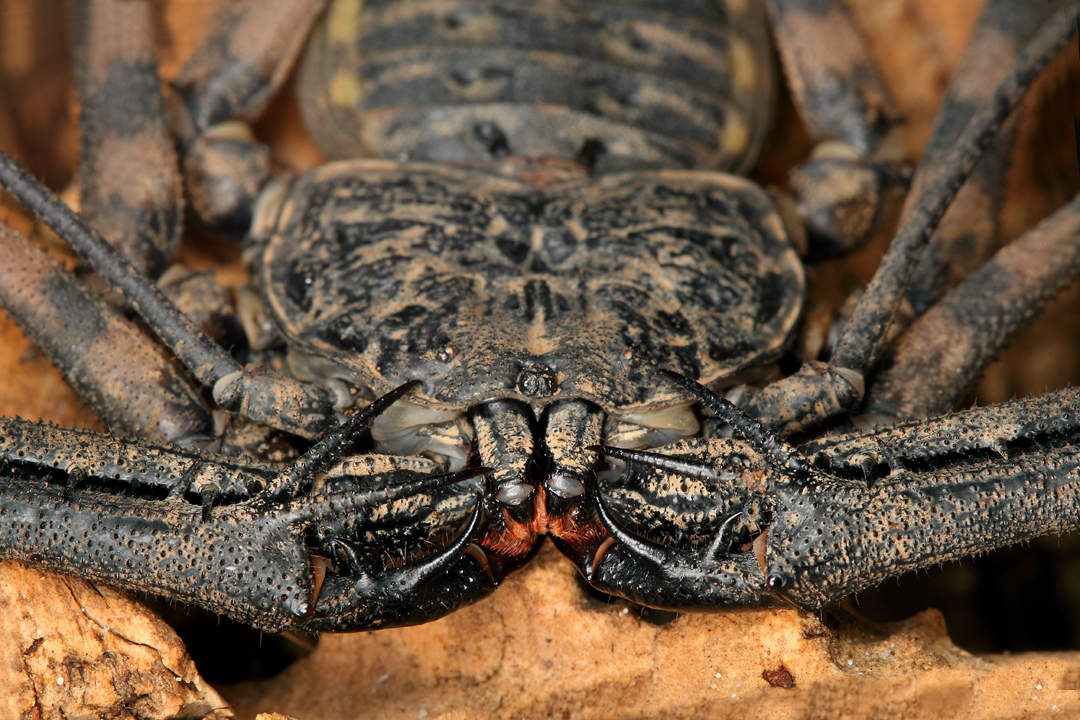
The male and female Damon diadema, or Tanzanian giant tailless whip scorpion, featured in these photos belong to Martin Hauser, a dipterist with the California Department of Food and Agriculture in Sacramento who I had the pleasure to spend some time with last month. Like me, Martin is a fan of invertebrates as pets, but unlike me he has strayed into unusual taxa that I haven’t yet tried—these tailless whip scorpions being perhaps the most impressive of these odd groups. Hailing from east Africa (eastern Tanzania and Kenya north to Ethiopia and Somalia), this species has gained some popularity in recent years among hobbyists due to their adaptability to culture, relatively docile nature, and—of course—their terrifyingly impressive size (body length up to 30 mm according to Prendini et al. 2005, although some hobbyist forums state as much as 2 inches, and with “whip” spans many times that). In this species males and females are immediately distinguishable by the relative length of the pedipalps—highly elongate in males and with the “elbow” extending past the “knee” of the first pair of walking legs, while shorter in females and not reaching the knee. Damon diadema is the largest of the East African Damon variegatus species-group, and while there are other amblypygids in the world that are larger (e.g., Acanthophrynus from Central and South America, with up to 10″ leg-span and nearly 20″ whip-span), none are so tolerant of captive rearing as this species. There seems to be some confusion about identification of Damon spp. among hobbyists, and even Martin wasn’t sure which species his represented; however, according to Prendini et al. (2005) all of the species are easily distinguished morphologically. Damon diadema is one of only two species in the genus with two spines rather than one on the ventral surface of the pedipalp trochanter, the other being D. brachialis from southern African and unknown in captivity. In the closeup face shot of the adult male below, two spines can be seen on the right pedipalp trochanter, just visible between two of the pedipalp apical spines.

Pedipalps modified as raptorial ”claws” make these arachnids formidable predators.

I visited Martin at a good time, for not only did he have these marvelous monsters available for me to photograph, but one of the females had just recently produced a brood of young. All of them had reached 2nd instar by the time of my visit, with one or two already at 3rd instar. It was interesting to note the tendency of the juveniles to aggregate under the adult female, as if they needed/wanted her for protection. While seemingly obvious, this is actually quite interesting because most amblypygids are considered to be solitary and intolerant of conspecifics (Walsh & Rayor 2008). Damon diadema, however, is known to live in prolonged subsocial groups, apparently aided by kin discrimination abilities. I find this fascinating, considering the extraordinarily limited neural capacity of these creatures—there are only so many brain cells available for conducting the business of life without diverting any of them to the ability to recognize unrelated conspecifics, much less their own kin. It is the reason so many spiders and other predaceous invertebrates tend to live solitary lives and have evolved elaborate courtship dances to convince a potential partner that they are, in fact, a mate and not a meal.
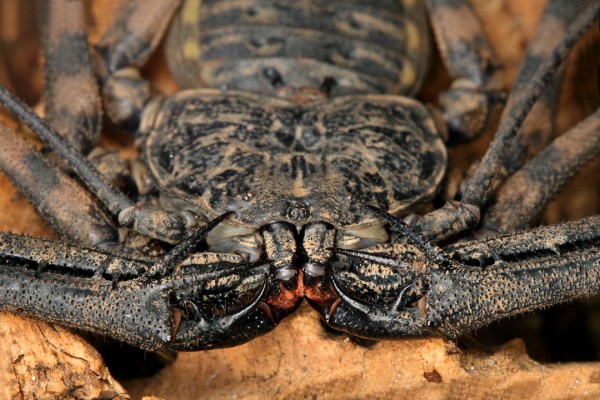
Two ventral spines on the pedipalp trochanter distinguish Damon diadema in east Africa.

I was so impressed by these creatures that after returning home from California I set about finding a source from which I could purchase one of them—or better yet a male/female pair. Sadly, I could not find any sources—my dream of seeing these fantastically fearsome-looking fellows in an aquarium in my office would have to wait. I happened to mention this in passing during correspondence with Martin about other matters, and although it was not intended as a suggestion (or even anticipated that it could be interpreted as such), Martin immediately offered to send me a couple of his juveniles. How could I refuse?! We corresponded a little more about preparations for and timing of the shipment, and on Friday last week the package arrived. Neither of us were completely sure how well the little guys would handle a 3-day transcontinental journey, so it was with a blend of anticipation and trepidation that I opened the package. Imagine my surprise when I found them not only alive and well, but all six of them were alive and well! Well, for now they are all going under the name “Baby Damon,” but I suppose as they grow and (hopefully) develop some distinctiveness I can start giving each of them their own, unique name. It may take awhile—individuals of this species don’t mature sexually until around 12-15 months. Martin was also kind enough to include some small, temporary containers that will provide better confines until they are large enough to move into the large terrarium that I readied for them, and just as Dave has been  doing with his tarantulas, it will be fun to monitor the progress of each individual through their molts. This will continue to provide entertainment even after they reach adulthood, as amblypygids continue to molt and increase in size all of their life. Their lives could also be long ones—I’ve read of people maintaining this species for 10 years or more as adults, so it looks like I am in this for the long haul. A formidable challenge it might seem, but in addition to the invertebrates I mentioned above, I’ve also spent the past several decades being responsible for cats, dogs, rats, salamanders, and—most recently—two hominine juveniles (and females at that). Now that’s a challenge!

This 2nd instar youngster can already handle crickets its own size.

REFERENCES:

Prendini, L., P. Weygoldt & W. C. Wheeler. 2005. Systematics of the Damon variegatus group of African whip spiders (Chelicerata: Amblypygi): Evidence from behaviour, morphology and DNA. Organisms, Diversity & Evolution 5:203–236.

Walsh, R. E. & L. S. Rayor. 2008. Kin discrimination in the amblypygid, Damon diademaThe Journal of Arachnology 36:336–343.

Copyright © Ted C. MacRae 2012

Welcome “Baby Damon”!

”Baby Damon”—one of six 2nd instar Tanzanian giant tailless whip scorpions that now call me Papa!

Just a quick post to formally introduce “Baby Damon,” who arrived last Friday with several siblings courtesy of my friend Martin Hauser in California. Damon represents the species Damon diadema, or the Tanzanian giant tailless whip scorpion. It will take at least a year for Damon to reach maturity, and he may live as long as ten years or more, so it looks like I’m in this for the long haul! When I visited Martin in California a couple of weeks ago I had a chance to photograph Damon’s terrifyingly impressive mother and father as well—look for those pics soon!

Copyright © Ted C. MacRae 2012

Poised for the bounty

Misumenops pallidus on soybean | Santa Fe Province, Argentina

By mid-April I was near the end of my 8-week stay in Argentina. One of the more enjoyable tasks during this time was to go back out and visit some of the soybean fields that I had seen earlier in the season. I enjoy watching the progression of soybeans over time—both in plant phenology and in the guilds of insects present. Defoliating caterpillars like Rachiplusia nu (oruga medidora) and Anticarsia gemmatalis (oruga de las leguminosas) abound during the late vegetative and early to mid-reproductive stages of growth, feeding day and night on the lush, green foliage. As the days grow shorter and cooler, the soybean fields slowly morph from dark green to tawny-yellow, and leaf-feeding guilds give way to seed-feeding stink bugs like Piezodorus guildinii (chinche de las leguminosas) and Nezara viridula (chinche verde).

Ever present amongst the plant-feeding insects are their natural enemies, with spiders being among the more numerous predators. This small (~10 mm length) crab spider (family Thomisidae) was seen in a soybean field in Santa Fe Province with the plants at R6 stage of growth (pods completely filled). I’m fairly certain it represents Misumenops pallidus based on its close resemblance to the spider in this photo. Piezodorus guildinii stink bugs were especially abundant, and just as the crop of newly hatched nymphs was poised to take advantage of the fat, juicy seed pods, this spider seemed poised and ready to take advantage of the fat, juicy nymphs. In fact, M. pallidus is the most abundant crab spider in soybean agroecosystems in the Humid Pampas of Argentina (Liljesthröm et al. 2002), which as a group comprise nearly half of all spiders in those systems (González et al. 2009). Perhaps one reason for this is their generalist prey selection tendencies, feeding on prey species such as R. nu and P. guildenii when they are abundant and switching to non-pest prey species (except the heavily sclerotized weevils and the large and noxious adults of N. viridula) when they are absent (González et al. 2009).

REFERENCES:

González, A., G. Liljesthröm, E. Minervino, D. Castro, S. González & A. Armendano. 2009. Predation by Misumenops pallidus (Araneae: Thomisidae) on insect pests of soybean cultures in Buenos Aires Province, Argentina. The Journal of Arachnology 37:282–286.

Liljesthröm, G., E. Minervino, D. Castro & A. González. 2002. La comunidad de arañas del cultivo de soja en la provincia de Buenos Aires, Argentina. Neotropical Entomology 31:197–209.

Copyright © Ted C. MacRae 2012

Just published: Cicindela 44(1) March 2012

Issue 44(1) of the journal Cicindela is now hitting mailboxes. This one-paper issue features an article by Chandima D. Dangalle and Nirmalie Pallewatta (University of Colombo, Sri Lanka) and Alfred P. Vogler (The Natural History Museum, London) reporting the results of a survey of tiger beetles of Sri Lanka and analysis of their habitat specificity. The authors sampled 94 locations on the island representing six habitat types: coastal and beach habitat, river and stream banks, reservoir systems, urban man-made sites, agri-ecosystems and marshy areas, finding ten species in the genera Cylindera, Calomera, Hypaetha, Lophyra and Myriochile at 37 locations representing all habitat types except the last two. The study further revealed that the species of tiger beetles were restricted to different habitat types, with most displaying a high degree of habitat specificity. Statistical analysis revealed significant differences between two or more species in four factors: solar radiation (i.e., sun or shade), soil salinity, soil moisture and wind speed. This suggests that these are the key factors involved in habitat selectivity in Sri Lankan tiger beetle species. Other factors such as temperature, relative humidity, soil type and soil color did not differ significantly between habitats for the different species, suggesting that these criteria are essential for tiger beetle survival in any habitat type.

You may also notice that my photo of Cicindela arenicola, taken last fall in Idaho Falls, graces the cover of this latest issue. Contact Managing Editor Ron Huber to begin your subscription—membership is a very nominal $10 per year in the U.S., a little more elsewhere to cover additional postage.

REFERENCE:

Dangalle, C. D., N. Pallewatta & A. P. Vogler. 2012.  Habitat specificity of tiger beetle species (Coleoptera, Cicindelidae) of Sri Lanka. Cicindela 44(1):1–32.

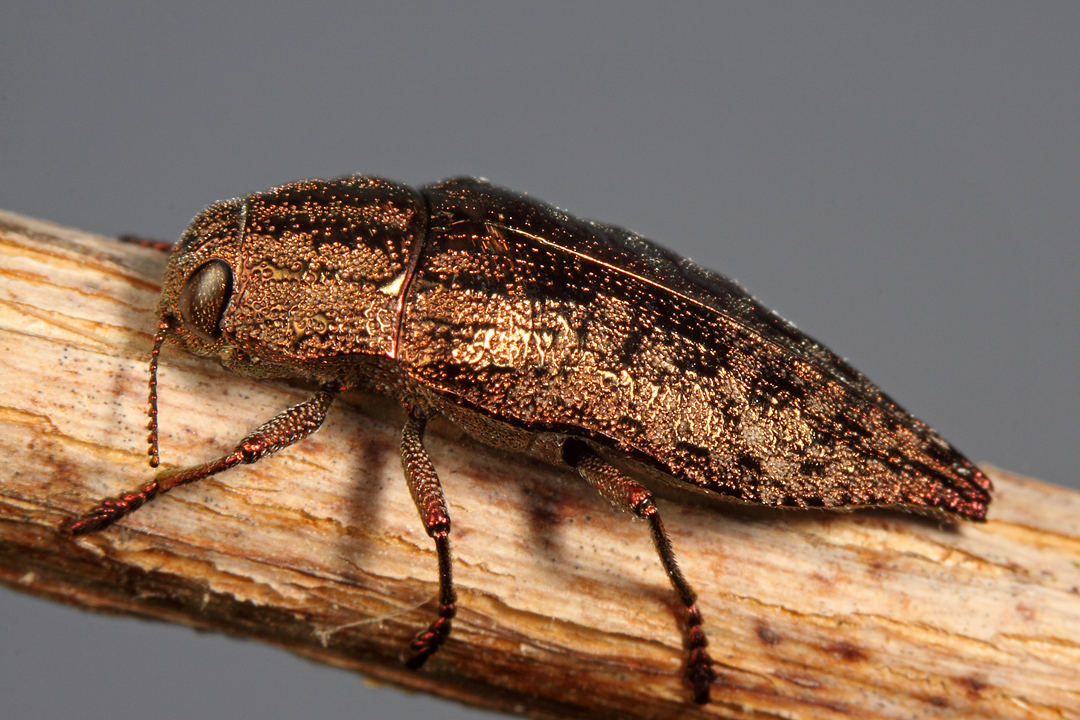
Dicerca pugionata – safe and sound!

Dicerca pugionata on Physocarpus opulifolius (ninebark) | Jefferson Co., Missouri

One of my favorite beetle species in Missouri is Dicerca pugionata—a strikingly beautiful jewel beetle (family Buprestidae) found sporadically across the eastern U.S. Unlike most species in the genus, which breed in dead wood of various species of trees, D. pugionata larvae mine living stems of certain woody shrubs—namely alder (Alnus spp.), witch-hazel (Hamamelis virginiana) and ninebark (Physocarpus opulifolius) (Nelson 1975). When I first began studying Missouri Buprestidae (way back in 1982), the species had just been reported from the state based on a single specimen (Nelson et al. 1982). I happened to stumble upon these beetles at what became my favorite collecting spot during the 1980s—Victoria Glades Natural Area, just south of St. Louis in Jefferson Co. For several years while I was visiting Victoria Glades, I found these beetles regularly during spring and fall on stems and branches of living ninebark plants growing within the ravines and along the toeslopes at the lower edges of the glades.

After finding the beetles at Victoria Glades (and nearby Valley View Glades Natural Area), I made it a habit to examine ninebark wherever I found it growing in Missouri. Ninebark is actually rather common in the state along the rocky streams and rivers that dissect the Ozark Highlands. Interestingly, I almost never encountered this beetle on ninebark elsewhere in the state. I’m sure it occurs in other areas, but probably at too low a level to be easily detected. I surmised that the populations at Victoria and Valley View Glades were unusually high due to the non-optimal conditions for its host plant. The ravines and toeslopes where the plants grow are drier than typical for ninebark, and unlike the lush, robust plants found in moister streamside habitats, the plants at these glades are small, scraggly and often exhibit a certain amount of dieback. It seemed likely to me that the plants growing in the glades were less capable of fending off attacks by these insects, thus resulting in relatively higher numbers of beetles at these glades.

After the publication of my “Buprestidae of Missouri” (MacRae 1991), it would be many years before I actually returned to Victoria Glades. When I did return, I was pleased to see that management practices (e.g. prescribed burning, cedar removal, etc.) intended to halt the encroachment of woody vegetation and preserve the glade’s pre-settlement character had been implemented in the area. I was a little bothered, however, by the seeming paucity of insects compared to the years prior to management. I visited the glades again several times afterwards, and not only did insect populations in general seem to be depressed, but I never succeeded in finding D. pugionata adults on the ninebark plants. I began to worry that the prescribed burns, while clearly beneficial to the glade flora, might have had a negative impact on the glade’s insect populations.

I’m happy to report that, at last, I have found the beetles again. I returned to the glades in early May this year and, for the first time since 1987 I found the adults of this species—five in all (a typical number for the many dozens of plants checked) and right in the same areas where I had so consistently found them 25–30 years earlier. This does much to allay my concerns about the ability of these beetles to persist in the face of prescribed burning (though I remain convinced that this management technique should be used more judiciously in our state’s natural areas than it has in recent years), and I’m happy to have these new photographs of the species, which are a decided improvement over the old scanned slides taken nearly 30 years ago!

REFERENCES:

MacRae, T. C. 1991. The Buprestidae (Coleoptera) of Missouri. Insecta Mundi 5(2):101–126.

Nelson, G. H. 1975. A revision of the genus Dicerca in North America (Coleoptera: Buprestidae). Entomologische Arbeiten aus dem Museum G. Frey 26:87–180.

Nelson, G. H., D. S. Verity & R. L. Westcott. 1982. Additional notes on the biology and distribution of Buprestidae (Coleoptera) of North America. The Coleopterists Bulletin 35(2) [1981]:129–151.

Copyright © Ted C. MacRae 2012