Au Bon Marché


Earlier this week a colleague in my lab presented me with this delightful print featuring beetle imagery.  A mutual acquaintance had encountered it while going through some items that had been in storage for many years, thought of me, and asked her to give it to me.  She couldn’t tell me anything more about its origins, but its whimsical, turn-of-the-century look and apparent age immediately captivated me.

I had originally intended to simply post this scan, say “Isn’t this cute?”, and leave it at that.  However, my compulsive side took over and before long I found myself in full bore Google search mode.  My initial desire was simply to translate the French text – the beetles were easy enough (1 _ Giant Borer.  2 _ Blister Beetle.  3 _ Rhinocerus Griffin¹) – but the title “Au Bon Marché” gave me a bit of trouble.  The translators I was using continually turned up results related to “cheap” and “inexpensive”, which just didn’t make sense. Eventually I figured out that it was a store name – specifically the oldest department store in Paris (dating from 1852). A bit more searching revealed it to be one of many trade cards lithographed for the store during the late 19th and early 20th centuries, presumably for promotional purposes.  Nowadays these cards seem to be popular collector’s items, especially in France.  Alas, I was not able to find an image of this specific card among the several hundred other Au Bon Marché trade card images I perused across the web – if anyone knows anything more about the history and use of these cards or about this card in particular, please do let me know.

¹ Apparently the scarab beetle version of a griffin, the mythological creature with the body of a lion and the head and wings of an eagle – wise and powerful characters who spent a good deal of time seeking out and guarding gold and treasures.

Considering its century or more of age, the print is in remarkably good condition. There is just a small amount of staining and glue residue on the backside of the mounting board – perhaps it was part of a treasured scrap book in days long gone. A glass frame should do a nice job of preserving it for another several decades or so.

Copyright © Ted C. MacRae 2011

Super Crop Challenge #4

It’s been a long time since the last Super Crop Challenge – can you identify the structures and the organism they belong to?  As always, each correct taxonomic and descriptive answer is worth 2 points, and bonus points are awarded at my discretion for extra effort.  Standard challenge rules apply.

Enormous Unknown Bug!

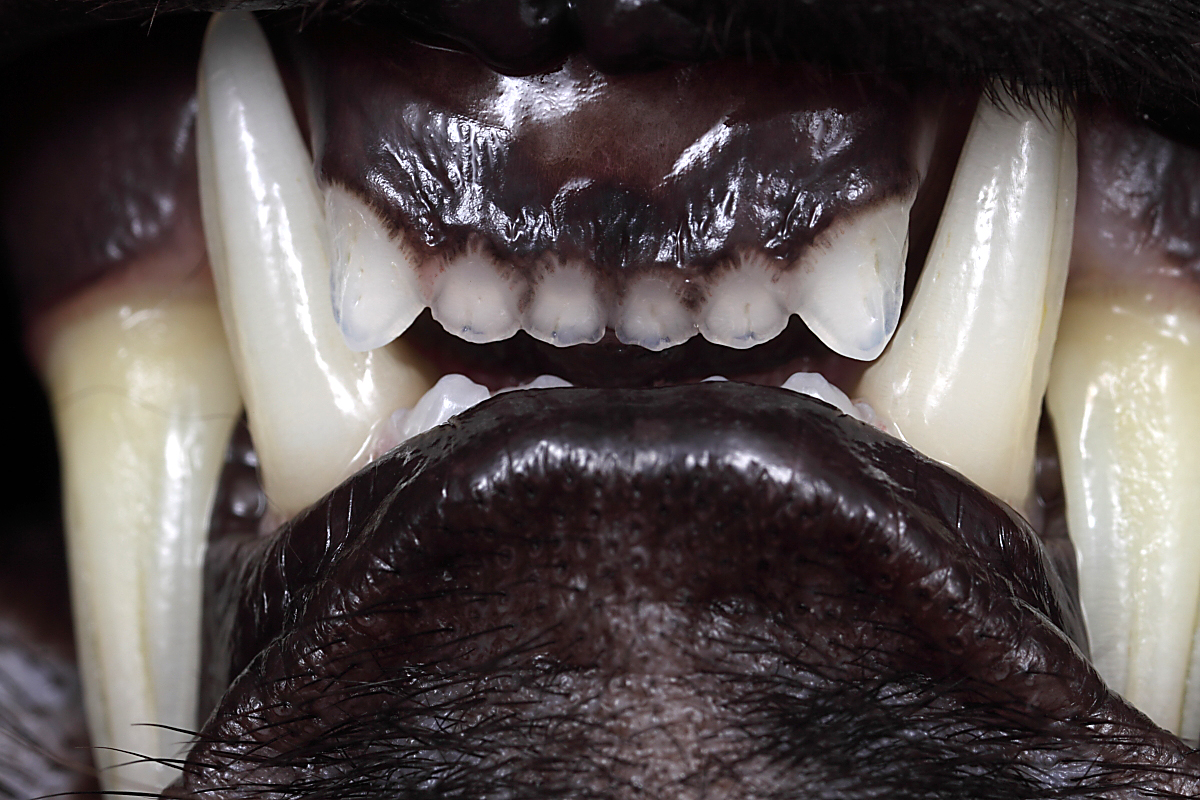
The other day I found an enormous bug in my house.  I had no idea what it was when I saw it, so I grabbed my camera and put on the 65mm macro lens to make sure I got some detailed shots of what I figured might be the important characters.  I wouldn’t have even recognized it as an insect, since at first it seemed to have four rather than six legs.  However, I noted that the third pair of legs was actually present, but that one was atrophied to a long, flexible, backward-directed appendage incapable of locomotory or weight bearing function, and that the other leg was missing completely – perhaps aborted during embryogenesis due to some injury or genetic malfunction.

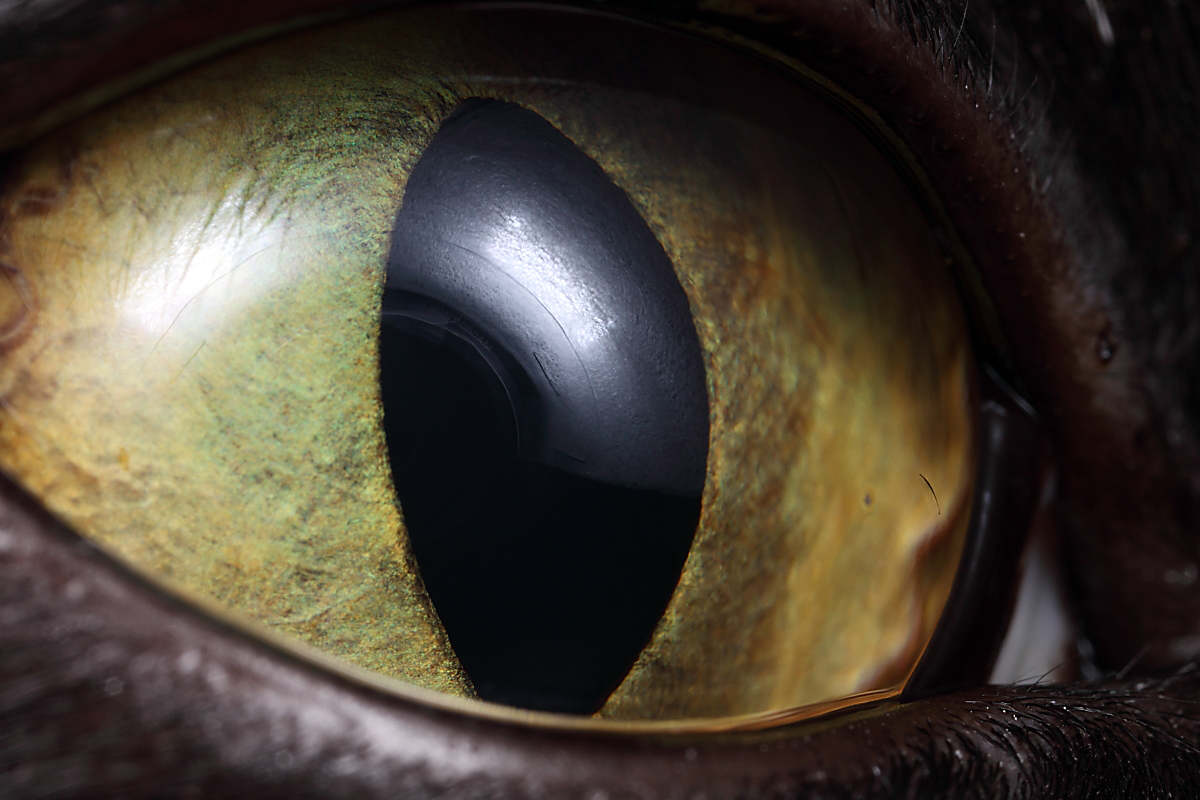
As I said, the bug was enormous and jet-black, although I can’t be sure that is its real color because it was covered so thickly with long, thin, semi-recumbant setae that the surface was completely obscured.  I know a lot of acalyptrate flies are thickly covered with setae, but I’ve never seen a fly with setae so densely packed as this.  The large eyes also pointed towards something in the Diptera, but since it was wingless that narrows the choices down to just a few flightless, ectoparasitic families.  However, most ectoparasitic dipterans have well developed compound eyes, while this one had only two (albeit very large) ocelli.  The above shot gives a decent view of one of them.

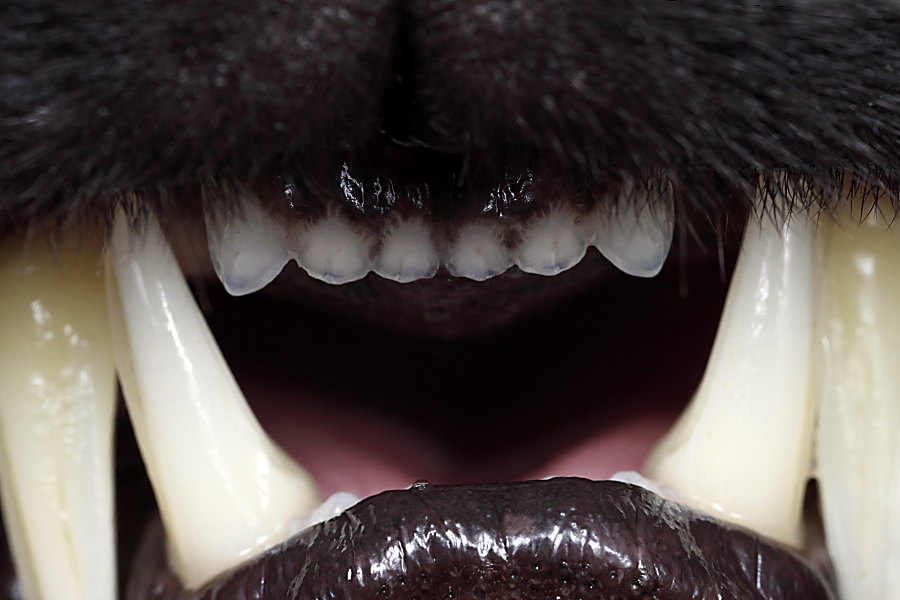
The bug was active and alert and quite difficult to photograph, but I managed to get this shot of its mandibles.  The numerous points remind me of the mandibles of certain predaceous coleopterans, which combined with the somber coloration made me think it might be some kind of ground beetle.  If so, it would be the largest ground beetle I had ever seen.  However, I noticed that the mandibles opposed each other in a vertical rather than horizontal plane – something I’ve never seen with ground beetles (or any kind of beetle), nor have I seen a black beetle with the teeth on the mandibles tipped with such a contrasting white coloration.

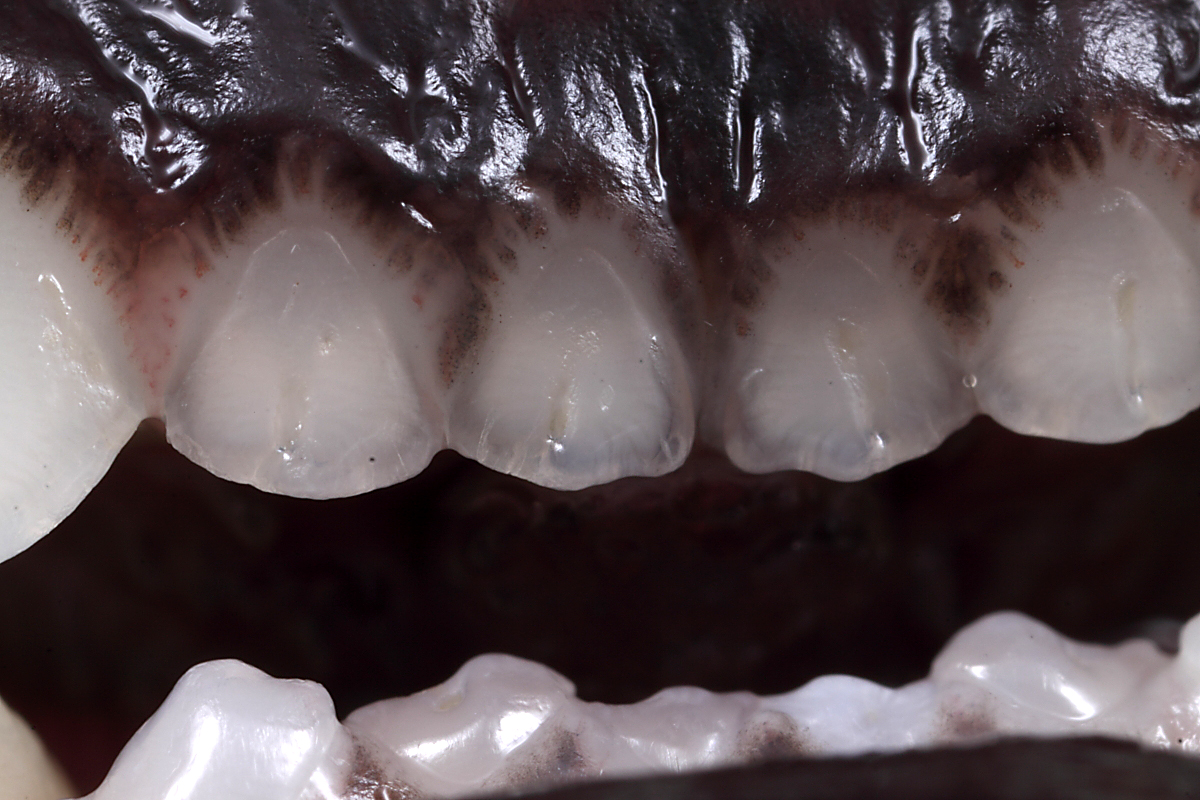
An even closer view of the white-tipped mandibular teeth shows that each point bears a median groove.  Whether these are wear patterns from mandibular occlusion or serve some feeding function is unknown.  If it is predaceous, as I suspect, they could form channels for directing liquids imbibed from their prey towards they hypostoma.

The frons was the only glabrous part on the entire body (besides the two ocelli and the undersides of the tarsal pads), and its bulbous form with a median groove reminded me of certain auchenorrhynchous hemipterans that have a similar frons containing a cybarial pump to provide suction for obtaining sap from plants.  However, again, the distinctly toothed mandibles suggest this is a predaceous insect, and as far as I have been able to tell all auchenorrhynchans are exclusively plant feeders.

Eventually the insect became quite agitated and began struggling to escape.  I tried to confine it so I could complete my examination and make sure I had enough photos to get an ID, but it began displaying its mandibles in a suggestively threatening manner.  I decided to let it go at that point and hoped that what I had photographed to that point would be sufficient.  Although I still haven’t figure out what insect this is, I don’t think it is a new species since I’ve found quite a few photos on Flickr that seem to show the ocellus of this or related species.  Puzzlingly, there is no indication on any of these photos which insect group they belong to, so I’ll have to keep searching in an effort to come up with an ID.  I’ll post an update here if/when I can find this out.  Until then, this site has some information that might prove useful.

Copyright © Ted C. MacRae 2011

BitB Does CoO

STS 5 ('Mrs. Ples') | Australopithecus africanus - Sterkfontein, South Africa

Although my fondness for beetles is well known, I also have an inordinate fondness for systematics.  For this reason, Catalogue of Organisms by Christopher Taylor has long been high on my ‘must read’ list.  While there are no limits to the taxa – extant or extinct – that he writes about, one can be sure that whatever subject he picks, it will be comprehensively covered and richly referenced.  One of his more popular features is ‘Name the Bug’ (“bug” being any group of organisms, not just insects), where readers are invited to identify a featured organism and provide evidence to support their answer.  Points may be earned (and even usurped) in this free-for-all competition, with series winners eligible to request a post on the taxon of their choosing or write a guest post of their own.  As the most recent winner of this competition, I have chosen the latter and written a post called Origins – A Day in the Broom Room.  It’s about paleoanthropology, human evolution, and a personal experience with some of the field’s most iconic fossils.  I know these are subjects far outside my normal fare, but I hope you’ll take a look anyway and I thank Chris for letting me elbow my way onto his site for a while.  While you’re there, be sure check out the rest of the fine content on CoO – it might end up on your ‘must read’ list as well.


Copyright © Ted C. MacRae 2011
ID Challenge #7

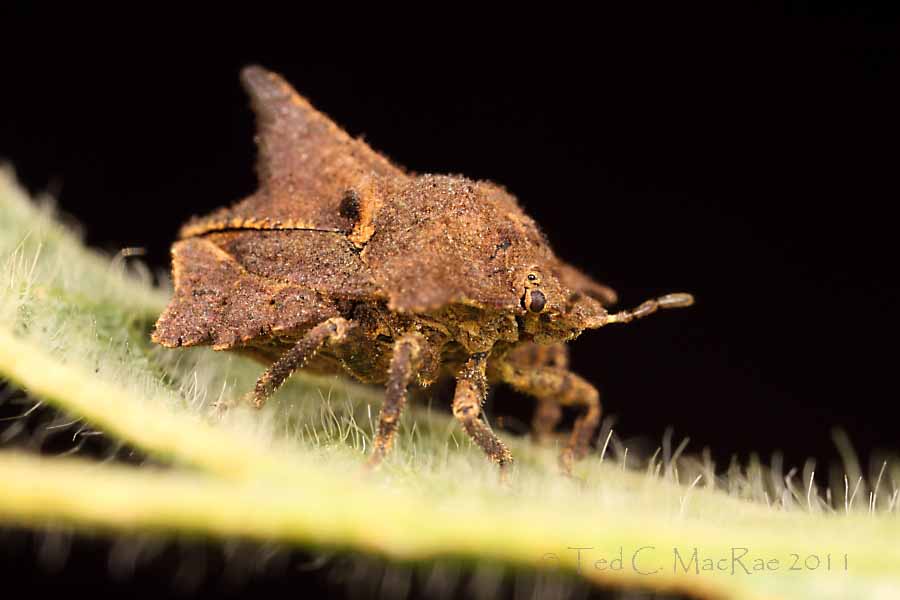
I hadn’t planned on doing another ID Challenge so quickly after the previous one¹; however, this critter is just too cool to keep in my pocket any longer.  Order-level identification shouldn’t be too much of a challenge, but I’ll be impressed with anyone who drills down much deeper than that – 2 pts each for correct order-, family-, genus-, and species-level identifications.  What the heck – I’ll go ahead and throw in superfamily as a points-earner as well.  Supporting information for your IDs will help your cause, and we all know my predilection for handing out bonus points on the most subjective of bases.  As always, standard ID Challenge rules apply.

¹ For those of you wondering about the recent flurry of posts, I’m on a well-earned vacation right now and have pledged to fritter away as much time on idle pursuits as possible rather than fret about accomplishing anything constructive.

Copyright © Ted C. MacRae 2011

ID Challenge #6

It’s been awhile since our last ID Challenge.  I’ll give 2 pts each for correctly naming the order, family, genus, and species and whatever supporting information you can provide.  Bonus points if you can surmise host plant, location, etc.  Standard ID Challenge rules apply.  No trick questions this time – it’s just about the bug!

Copyright © Ted C. MacRae 2011

Saludos de Argentina

I was hoping somebody might try to guess in which city the photos in the previous post were taken, but nobody took the bait.  My allusion to a population of 13.1 million people makes for a rather short list, and in fact they were taken in Buenos Aires, Argentina.  I’m on another business trip, and though I’ve traveled to Argentina numerous times, all of my previous trips were prior to my owning a camera of any kind.  This trip is turning out to be much more frenetic than my Brazil trip of this past January, with not near as much time or opportunity to wander the gardens looking for insects to photograph; however, I did have a full day to myself in Buenos Aires yesterday, which was spent in its entirety at the nearby Reserva Ecológica Costanera Sur.  It’s summer here, although there is definitely a late-season, temperate feel to it.  Nevertheless, I found a number of interesting insects to photograph, and I promise to share some of those photos in the coming weeks.  For now, I hope you’ll indulge me a few more traditional sightseeing photos of what I consider to be one of the world’s most beautiful mega-cities.  I’m not sure when I’ll get to update again – I’m traveling to a number of locations in the country’s interior, and internet service in the places I’ve been and will be over the next week is usually either expensive or non-existent.

''Palo boraccho'' (Chorisia speciosa) trees (background) in full bloom in Plaza de San Martin

The elegant ''Calle Florida" in Buenos Aires centro.

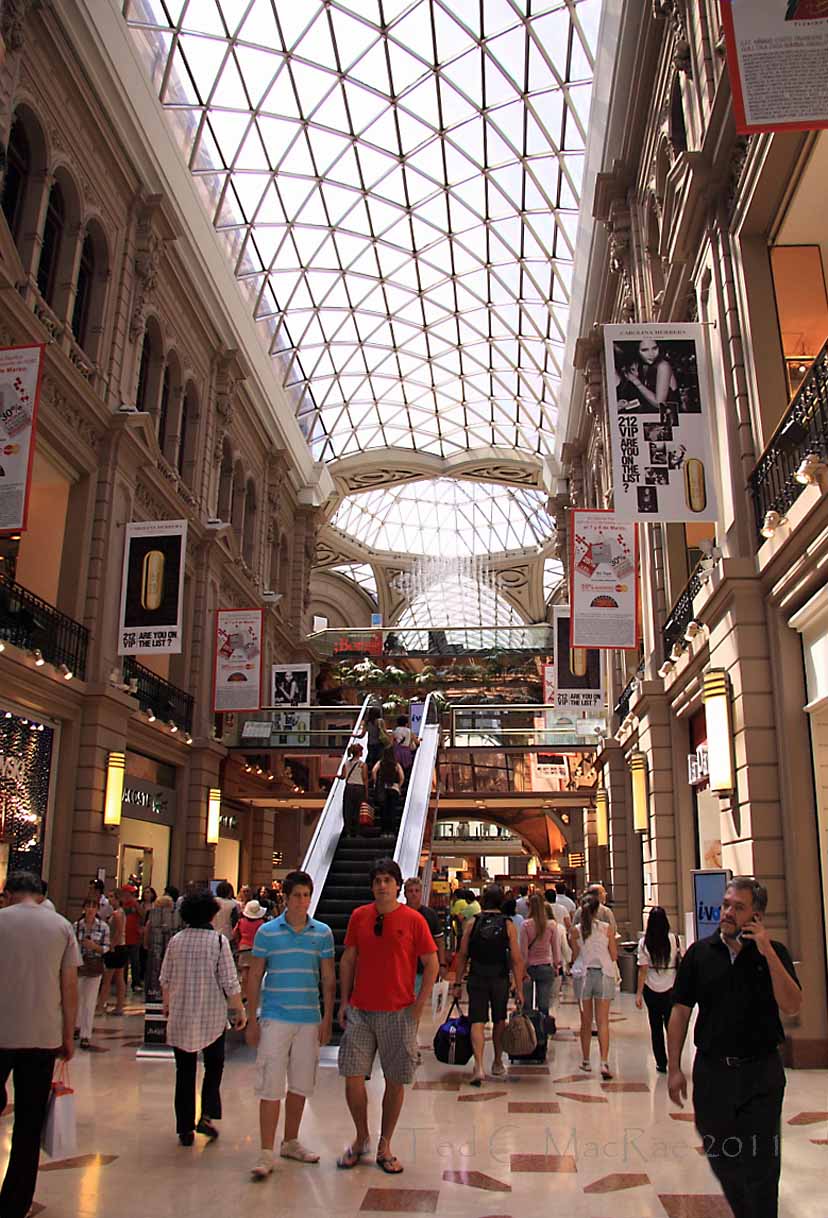
''Galeria Pacifico'' on calle Florida - a national historic monument.

Puerto Madero Waterfront on the Rio de la Plata boasts trendy architecture and upscale restaurants.

''Puente de la Mujer'' (Woman's Bridge) on the Puerto Madero Waterfront. Commissioned in 2001, this unique asymmetrical cantilever pedestrian bridge is also a swing bridge that rotates 90 degrees to allow water traffic to pass.

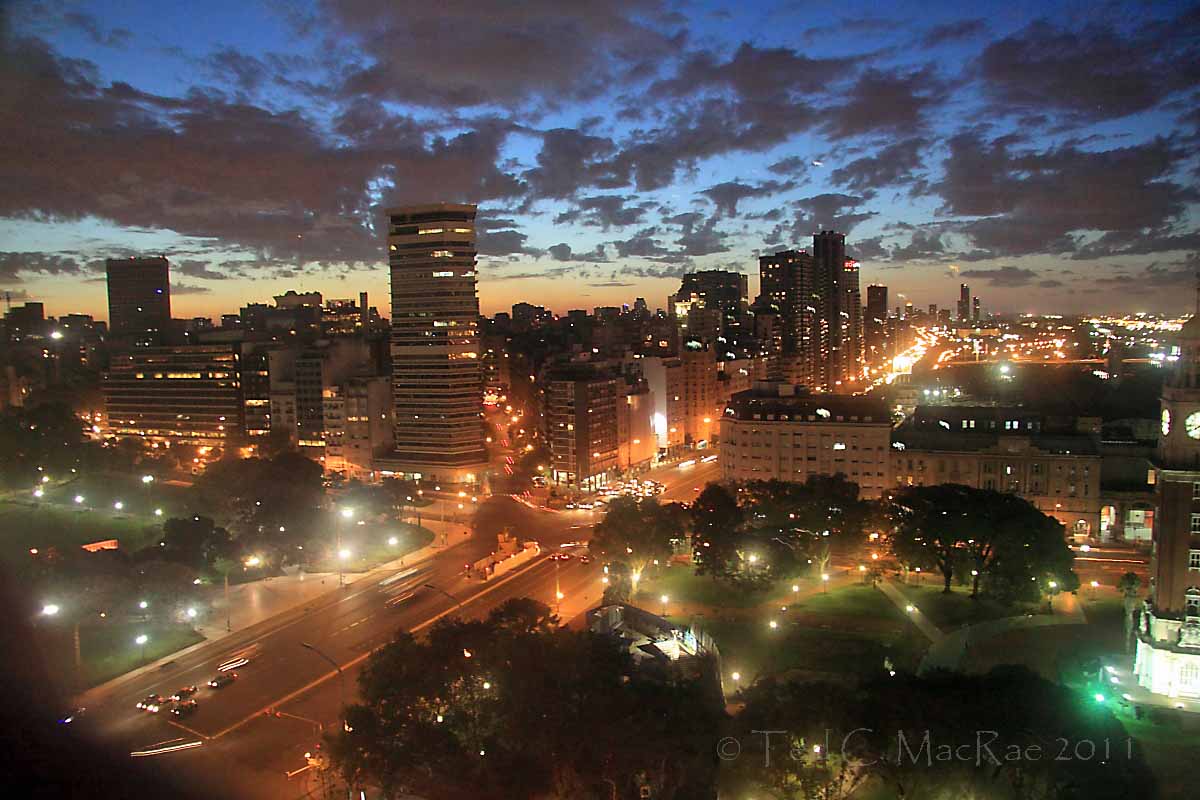
Early morning view from my hotel room in the heart of Buenos Aires.

Las Nazarenas - my favorite restaurant in all of Argentina - serves traditional Argentine meats and wine.

Can you guess what is the botanical representation of this sculpture in the Puerto Madero district?

Copyright © Ted C. MacRae 2011