BitB Gets a Facelift

How do you like the new look? This is the just-released Enterprise theme from StudioPress.  Truth be told, I’ve been looking for a new theme for a while now to replace the MistyLook theme that I adopted when I first migrated my blog from Blogger to WordPress.  MistyLook is a good theme, but there are two things I’ve never liked about it: 1) its relatively narrow width (500 pixels for the posts); and 2) the search box at top right that overlaps the page headings, limiting the number of pages that can be added.  I’ve never understood why so many fixed-width blog themes are as narrow as they are, resulting in long, skinny posts with lots of wasted space on each side.  Perhaps this is to accommodate even the oldest and smallest of computer monitors, but 750 pixels total width seems to be rather extreme.  Flexible-width themes eliminate this problem, but the variable post width plays havoc with paragraph formatting in my (usually) image-heavy posts.  There’s also one more reason I’ve become dissatisfied with MistyLook – it has, over the past year, become a very popular theme (even with the recent exodus of Myrmecos to Science Blogs).  I know, I know… I’m blogging for free, and beggars can’t be choosy – if I want my own look, I can either pony up for a customized theme, or I can look for greener pastures.

Enterprise appears to be those greener pastures.  It has all the features I want – two columns, fixed width, and customizable header.  It’s wider though – 630 pixels for the posts, and the sidebar is slightly wider as well (limits annoying text-wrapping).  It also has a clean, professional look with smaller font and a pleasing blue color for highlighting linked text.  WordPress suggests that Enterprise is “perfect for … a more corporate look,”  but it seems to me to work well as a backdrop for a science-oriented nature blog as well.  The greater width will allow me to add at least one more main page along the top (I’m thinking along the lines of a photo gallery, or maybe a page of techniques articles), and the customizable header allows me to keep the distant image of me in the field to maintain some visual continuity.  I wasn’t sure I would like the blog title and subtitle on top of that image, but matching the color to the background makes it at once visible and unobtrusive.

There are two new features with Enterprise that I really like: 1) the prominent two-level navigation at top, with pages (featuring drop-down menus) in the first level and most-used categories in the second; and 2) a footer with three widget areas – perfect for small, miscellaneous widgets that would clutter up the more list-oriented sidebar.  I’ve gotten things arranged in a way that seems to work for me, although you might see further adjustments over the next few days or so.  I hope you like the new look – please do let me know if you have any ideas on how I can best use its features.

Copyright © Ted C. MacRae 2010

Add to FacebookAdd to DiggAdd to Del.icio.usAdd to StumbleuponAdd to RedditAdd to BlinklistAdd to TwitterAdd to TechnoratiAdd to Yahoo BuzzAdd to Newsvine

Email to a friend

Beetle Collecting 101: Dress for Success

For most of the nearly 3 decades that I’ve been collecting insects, beetles have been my primary interest – first longhorned beetles, then jewel beetles, and now more recently tiger beetles (each taxon an addition, not a replacement!). During that time, I’ve learned a thing or two about the art of collecting – some of which I’ve figured out for myself, much more a result of my good fortune to have spent time in the field with the likes of Gayle NelsonChuck Bellamy, and a number of other learned entomologists.  In view of this, I thought there might be interest in an occasional post on some aspect of my approach to collecting beetles. With that, I introduce my new series, “Beetle Collecting 101,” and since it all starts in the field, this first installment will consider my basic outfit for field collecting. Although my focus is beetles (and specific groups of beetles at that), this basic outfit is widely applicable across most insect groups. There are a number of additional items that I can and do bring into the field with me at various times depending on location and season or for specific collecting techniques (e.g., beating, blacklighting, pitfall/bait trapping, etc.) that won’t be covered here – these additional items could be covered in future posts if this post indicates sufficient interest. Other future post ideas I had include rearing, specimen processing (everything from pinning and labeling to batch processing and storage methods), and collection organization/curation. Comments and suggestions welcome.

Beetle Collecting 101: Dress for Success

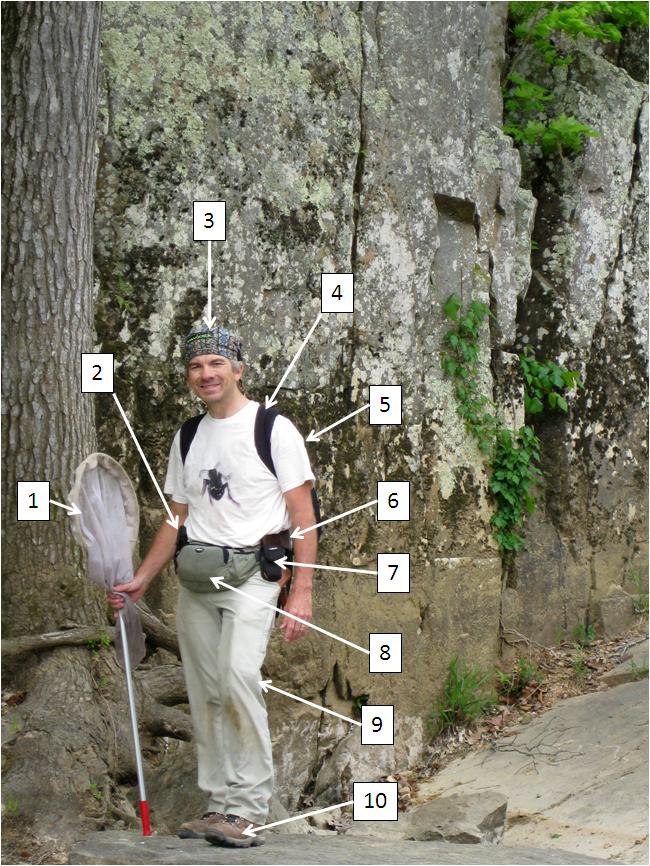
A well-dressed entomologist. Photo by Rich Thoma.

Beyond the needed equipment, the primary considerations for my field outfit are lightweight, comfortable, and protective.  I can spend hours away from the truck in extreme conditions or rugged terrain (or both!), so I want clothing that stays comfortable no matter how much I exert myself.  It is also tempting to carry more equipment than is necessary – this only adds weight and limits the ground that can be covered.

  1. Insect net – duh!  This is an absolute necessity for nearly all but the purely flightless species.  I highly recommend an extendable net handle – I keep mine collapsed (3′ length) for normal use and extend it out to 6′ when stalking tiger beetles or other wary, flighty species.  The collapsed net handle is also a good length and weight to serve as a beating stick when I am carrying a beating sheet (not shown).  I use an aerial net bag, since I don’t do much sweeping anymore – match the bag to your interests.  Of the three common ring diameters for aerial nets, I find the 15″ to be more effective than the 12″, while the 18″ is a little unwieldy.  Green fabric is said to be not as visible to insects as white, thereby allowing closer approach before they attempt to flee, but I do not have any experience with this.  I have collected quite a lot of beetles with my white net bag and appreciate the ability to see the contrast of the insect inside the bag when attempting to remove it.
  2. Hunting knife.  If you’re interested in wood-boring beetles, you’ll want to be able to slice into dead branches suspected of harboring insects.  I like the classic folding Buck Knives Ranger and attach it to the strap of my waist pack (#8) rather than my belt so that it will move with the pack when I swing the pack around backside.
  3. Hat.  If the sun doesn’t bother you, the flies will.  Wear something light and comfortable that will absorb sweat – I like my 2-decades old Mombosok for this (and because I be stylin’!), but those with greater sun sensitivity (or who live in tropical environments) might do better with a brimmed hat.
  4. Backpack.  Before my camera carrying days, this was a Camelbak hydration pack with a good-sized but not overly large water reservoir and zippered pouches with newspaper for placing host plant samples for pressing.  A backpack isn’t really necessary for short forays or mild conditions but is essential for hiking longer distances in hot/dry climates where there is real risk of dehydration.  Many regard backpacks as uncomfortable; however, I find slinging water containers attached to the waist equally annoying and also cumbersome to deal with when crouching or laying.  These days, however, I carry full camera gear in my backpack (camera body, multiple lenses, extension tubes, flash unit).  This adds weight, but it only took a day or two during my first field trip to get used to it.  I still use the camera pack for carrying water, as the front compartment has room for two water bottles or a Camelbak bladder, and my pack also contains a separate zippered compartment where I can still place plant samples for pressing.
  5. Lightweight t-shirt.  I used to wear buttoned fishing shirts over an undershirt, thinking the undershirt would keep perspiration off my skin, while the pockets on the outer shirt would come in handy for holding small items.  In reality, things fall out of the front pockets, and both under- and outer layers would become soaked with sweat.  Now I wear simple 100% cotton t-shirts – artfully emblazoned with an image of Cicindela ancosisconensis by Kirk Betts at The Wild Edge (and leaving no doubt to curious onlookers as to what I am up to).  I find these simple  shirts to be the most comfortable in the most extreme conditions.
  6. Hand axe.  Again, if you’re interested in beetles that live in wood, an axe will be handy for chopping into wood too large or hard to sample with a hunting knife.  Smaller is better (to limit weight), and rather than using a leather holster (which will become soaked with sweat and stretched out), I simply slip the handle under the strap of my waist pack and let the head of the axe rest on the strap to hold it in place.
  7. GPS Unit.  You do record GPS coordinates for your specimens, don’t you?!  I just got a new one for my birthday (Garmin Oregon 450t) with computer download capabilities – no more manual transcribing of data!  Again, I attach it to my waist pack strap rather than my belt.
  8. Waist pack.  I use the very compact Eagle Creek Wayside, with two zippered pouches and an unzippered side pouch to hold all my vials and small tools.  I’ve tried a number of different methods for holding these items – they fall out of shirt pockets whenever you bend over, are not readily accessible when in a backpack, and do not stay organized in a non-compartmented pack.  I have developed a system of vials that serve as both killing bottles and storage containers (this alone could be the subject of another post) – 4-dram vials for most specimens and 8-dram for larger ones.  This waist pack holds 8 small and 6 large vials in the front pouch – with the two sizes kept separate by a divider.  Being able to carry numerous vials allows me to segregate insects by host plant or ecological association, and most importantly, vials in this pouch stay organized so I can easily find the proper vial when I need it.  The larger rear pouch is roomy enough to hold two small olive bottles (for the occasional behemoths or blacklighting), forceps, aspirator, and miscellaneous other items – or, if I’m in the mood to collect wood for rearing (also could be the subject of another post), pruning shears, small folding saw, twine, flagging tape, and permanent marker.  A small side pouch is perfect for keeping a hand lens and an eye dropper bottle of ethyl acetate killing agent at the ready.  Also, the pack easily swings around to my backside when I need to crouch or lay prostrate (e.g., when photographing tiger beetles).
  9. Lightweight polyester/cotton outdoor pants.  I’m fond of the Columbia line of products, but whatever brand you choose, make sure they are lightweight, have a relaxed fit (to allow crouching) and dry quickly (no denim jeans for me!).  The last thing I want is chafing from sweat-soaked pants – yikes!  (Let’s just say lesson learned the hard way).
  10. Hiking boots.  Again, lightweight and comfortable are key, and because of the sometimes rugged terrain I traverse I like mid-ankle support so I can watch for bugs instead of constantly watching my feet.  The lighter the boot, the longer you’ll be able to hike with comfort, and leather uppers will provide greater protection from thorns.

I hope you’ve found some useful tips here.  If you have your own techniques or experiences with field outfits, I’d love to hear them.  Also, if you have subjects that you would like covered in future issues of “Beetle Collecting 101,” please do let me know.

Copyright © Ted C. MacRae 2010

Add to FacebookAdd to DiggAdd to Del.icio.usAdd to StumbleuponAdd to RedditAdd to BlinklistAdd to TwitterAdd to TechnoratiAdd to Yahoo BuzzAdd to Newsvine

Email to a friend

CotS #50 – the Mantis Shrimp Edition

Circus of the Spineless turns 50 (issues) this month, and this special edition is hosted by Mike Bok at Arthropoda.  This is Mike’s first blog carnival hosting gig, but there is nothing rookie about his presentation – the 19 submissions are skillfully organized with visual appeal and just  enough hook to invite clicking.  Stop on by and see a sampling of the latest in invertebrate blogging (and don’t forget to tip the waiter).

As a caveat, I feel I’ve been a bit remiss in not featuring Mike’s blog when I first found it a few months ago, as it has quickly became one of the regular stops on my rounds.  Mike is a graduate student at University of Maryland, and while his primary  interest is in the mantis shrimp visual system, his posts span the breath of the Arthropoda (my phavorite phylum!).  I enjoy his generally casual tone while covering fairly academic subject matter.  One thing I’ve learned after reading Arthropoda for awhile – mantis shrimp are hecka cool!  If you don’t believe me, check out this video of the pseudopupil of a mantis shrimp eye in action (look for it at 0:14-0:18).

Copyright © Ted C. MacRae 2010

Add to FacebookAdd to DiggAdd to Del.icio.usAdd to StumbleuponAdd to RedditAdd to BlinklistAdd to TwitterAdd to TechnoratiAdd to Yahoo BuzzAdd to Newsvine

Email to a friend

Taum Sauk Mountain – Missouri’s High Point

Although spring is now well underway in the middlin’ latitudes of Missouri, it was only a few short weeks ago that winter was still with us.  For my last winter hike of the season, I returned to perhaps my favorite stretch of my favorite trail in all of Missouri – the Mina Sauk portion of the Taum Sauk Trail on Taum Sauk Mountain.  Located in the rugged St. Francois Mountains (the “epicenter” of the Ozark Highlands), Taum Sauk Mountain is Missouri’s highest peak.  I say “peak” with a bit of reservation – at 1,772 feet it hardly compares with the high peaks of the Rocky Mountains or even the much mellower Appalachians (and certainly not with those of my beloved Sierra Nevada).  Nevertheless, unlike the remainder of the Ozark Highlands, the St. Francois Mountains are true mountains initially formed through a series of volcanic events occurring well over a billion years ago.  They, and the rest of the Ozark Highlands, have been shaped to their current form by repeated cycles of uplift and subsequent erosion.  

During their Precambrian prime, the St. Francois Mountains reached heights of 15,000 feet (the “ancient” Appalachians, in the meantime, were still just a twinkle in Mother Earth’s eye).  Rain and wind and the vastness of time have reduced them to nubs, leaving only the most ancient of volcanic rocks as testament to their former glory.  Although most of what is now the Ozark Highlands was inundated repeatedly later in the Palaeozoic (laying down the sediments that were then uplifted and “carved” to their current shape), the highest peaks of the St. Francois Mountains may be among the few areas in the United States never to have been completely submerged under those ancient seas.  Standing atop Taum Sauk Mountain, it is tempting to visualize today’s craggy terrain as a fossil of that ancient landscape – the peaks representing the former islands of rhyolite, their slopes barren and lifeless in stark contrast with the exploding diversity of bizarre life forms appearing in the tropical waters that surrounded them.

The sterile, volcanic rocks of the St. Francois Mountains support an abundance of open, rocky glades – especially on their peaks and southern and western slopes – that are home to a number of plants and animals more typically found in the tallgrass prairies further west.  Indian grass (Sorghastrum nutans) and little bluestem (Schizachyrium scoparium) thrive in clumps between the large, pink boulders that are strewn across the landscape and which provide shelter and sunning spots for animals ranging from the charismatic eastern collared lizard (Crotaphytus collaris) to the smaller but no less beautiful splendid tiger beetle (Cicindela splendida).  The surrounding forest is historically an open woodland with a rich, herbaceous understory and widely-spaced, drought-tolerant trees such as shagbark hickory (Carya ovata), post oak (Quercus stellata), and blackjack oak (Quercus marilandica).  These woodlands and glades are a fire-mediated landscape dependent upon periodic burns to maintain their vegetative character.

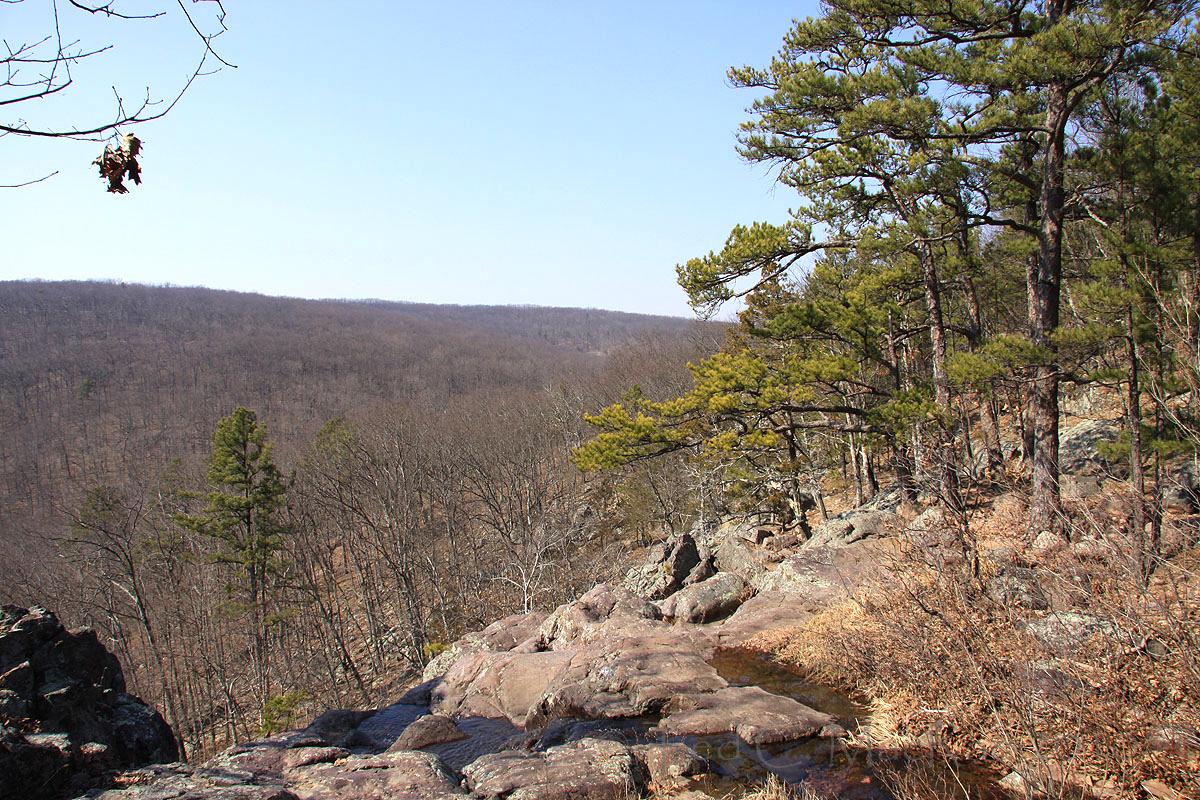
A trail begins at “High Point”, marking the summit of Taum Sauk Mountain and the highest point in Missouri.  A granite slab next to the summit rock documents the elevation at 1,772.68 feet MSL (Mean Sea Level).  The Mina Sauk Falls Trail, a rugged three-mile loop that joins the Taum Sauk Section of the Ozark Trail, leads to the tallest wet-weather waterfall in Missouri, Mina Sauk Falls.  During periods of high water flow, water gushes over the edge and drops 132 feet over a series of rocky ledges.  Water was flowing lightly during my late winter visit; nevertheless, looking out from above the falls (see photo above) offers one of the most spectacular vistas available in Missouri.  A rather difficult hike down the side of the mountain to the bottom of the falls is also well worth the effort, although clear views of the entire falls are difficult to find in the dense, moist forest below (it was here that I photographed the spectacular Ozark Witch Hazel).

A second unique geological feature lies about a mile farther down the Ozark Trail – Devil’s Toll Gate.  The rocks stand 30 feet high on either side of this eight-foot-wide, 50-foot-long fissure.  The gap probably began as a vertical fracture in the rock that has been enlarged by subsequent weathering. Over time the fissure will continue to widen, as the rocks on either side lose height.

Returning to High Point at the end of the hike, I noticed that the summit was a little higher than when I started my hike – whether this was through additional uplift of the underlying mountain or a depositional event I cannot say.  Nevertheless, I estimated Missouri’s new highest elevation to be approximately 1,773.01 feet MSL!

Copyright © Ted C. MacRae 2010

Add to FacebookAdd to DiggAdd to Del.icio.usAdd to StumbleuponAdd to RedditAdd to BlinklistAdd to TwitterAdd to TechnoratiAdd to Yahoo BuzzAdd to Newsvine

Email to a friend

New Bug Blogs of note

I try to keep my blogroll useful and relevant – by that I mean that each blog I list has, in a sense, “earned its spot” by offering engaging writing and/or quality photographs on subjects that interest me, and if they go silent or become, well… boring then I remove them. In the past two years, I’ve pretty well explored most of the established blogs dealing with insects and natural history and know what I like, so additions these days tend to be primarily startup blogs. Recommending startups is risky – blogs come and go all the time, and it’s difficult to know if the energy and passion apparent in the first few posts of a blog indicates sustainable creativity or just an ephemeral burst. With that caveat, I’d like to highlight three new blogs that have not only captured my interest, but also seem to have what it takes to sustain that interest for a long time to come.

Chris Grinter is an entomologist at the California Academy of Sciences in San Francisco. He has an interest in microlepidopterans, and his 6-week old blog, called The Skeptical Moth, has featured some rather stunning photographs of these tiny, yet extraordinarly beautiful insects. Moreover, he actually knows something about them – how refreshing it is to see scientific names attached to each photograph and associated discussion that doesn’t sound like a Wikipedia excerpt. As his blog title suggests, he also has a passion for encouraging science education and critical thinking, adding to the general feeling of erudition. There are lots of bug blogs out there, but only a few really good ones – this has the makings of a really good bug blog!

Peter Yeeles has only been blogging since the middle of March, but he is well-known among entomology-blog-circles by his frequent and articulate participation in the comments sections.  Happily, Peter has finally taken the bait and started his own blog, called ptygmatics.  His contributions thus far have been more than engaging and have featured some wonderful photographs of Australian insects (the stalk-eyed flies being far and away my favorite).  Peter has described himself as a “work in progress” entomologist, but I think we are about to witness the emergence of a more substantial entomologist than he is willing to admit. If nothing else, you must see his stalk eyed flies video link.

Heath Blackmon is the newest blogger featured here, and his blog, Coleopterists Corner, in fact has only three posts so far.  Nevertheless, I was impressed by his willingness to jump right into Coleoptera deep phylogeny in his inaugural post, in which he reviewed a recent paper on the subject by Friedrich et al. (2009).  Yea, another beetle lover!  An amateur naturalist for many years, Heath has decided he wants to become a professional coleopterist and is beginning graduate studies this fall (sounds like another back-to-schooler that has won our hearts in recent months).  His first post was followed by a post on how to make a $69 malaise trap.  So he’s also a collector – that’s even better.  The clincher, however, was the photograph he posted in his sidebar of him collecting tiger beetles in Florida – well, this one just has to be a winner!

Copyright © Ted C. MacRae

Add to FacebookAdd to DiggAdd to Del.icio.usAdd to StumbleuponAdd to RedditAdd to BlinklistAdd to TwitterAdd to TechnoratiAdd to Yahoo BuzzAdd to Newsvine

Email to a friend

Carnival of Evolution #22

In my fifth blog carnival hosting gig, I am honored and priviledged to present Carnival of Evolution #22.  I’ve always considered this to be the most cerebral of the blog carnivals that I follow, and this month’s submissions have once again lived up to the high standards that I have come to expect – 26 submissions by 19 of the best evolution bloggers out there.  I suggest we all pour ourselves a glass of brandy, settle into our armchairs, and enjoy an evening of thought-provoking erudition.

Human & Primates

Andrew Bernardin at 360 Degree Skeptic presents an evolutionary psychology piece in his post, Less Visible Forms of Social Power | 360 Degree Skeptic. Are humans an exuberantly affiliative species, like the bonobo, or is our nature essentially hierarchical? Or both? (Not to mention the impressively variety of forms that hierarchies can take.)

There’s a new kid on the blog, and Chadrick Lane jumps right into fray with his inaugural post at The Ancestral Mind.  In Ancestral Mind in the Twitterverse: Discovering the information age through evolution, he recounts the magical feeling of visiting the Smithsonian Natural History Museum’s David H. Koch Hall of Human Origins, prompting him to ask “How is it that we have gone from a common ancestor with chimpanzees to a blogging, social networking, moon walking, singing and dancing species in just around 6 million years?” An impressive first post!

I was sure I’d receive multiple submissions dealing with the news of a potential new extinct human species, deduced from mitochondrial DNA sequence generated from a 40,000 year old finger bone found in a cave in a region of Siberia from which the remains of modern humans and Neanderthals have also been found.  David Winter, however, enjoys a monopoly on this topic with his post, Does a forty thousand year old finger point to another human species? at The Atavism.  David reminds us that inferring species boundaries is a tricky business, and the mtDNA sequences are not, in and of themselves, proof that the finger belonged to a member of a third human species.  In fact, it might be a Neanderthal after all – how?  David explains why.

At The Primate Diaries, Eric Michael Johnson discusses Cultural Transmission in Chimpanzees.  The origin, maintenance, and transmission of cultural traits in human populations is both a fascinating and difficult subject for anthropologists.  Though lacking obvious cultural traditions such as clothing or cuisine, nonhuman primates also have culture.  An example is the Kibale Forest chimpanzees, which use sticks to get at honey in fallen logs, while Budongo Forest chimpanzees use chewed leaves as sponges to collect the same thing.  Findings of a study to understand why some societies have more unique cultural traits than others, recently published in PLoS ONE, suggest this may have something to do with the number of females (with impressionable youngsters) present within a given society.

From Madeleine Begun Kane at Mad Kane’s Humor Blog comes this gem in her post, South African Pinot’s Too Pricey? Blame The Baboons:

Though South African wine can be fine,
There’s a threat to each grape growing vine.
Cuz baboons enjoy feeding
On grapes. Their fave eating
Is prized pinot noir — that’s the whine.

Adaptations

Jason Goldman at The Thoughtful Animal presents a post on a FIFTY YEAR LONG study of captive silver foxes in Russia in his post, The Russian Fox Study.  It is his favorite study of animals EVER, perhaps because the experimental foxes were more eager to hang out with humans, whimpered to attract attention, and sniffed and licked their caretakers. They wagged their tails when they were happy or excited.  Does that sound like Fido?

At Mauka to Makai, Kelsey Abbott discusses a male beetle (yeah, beetles!) with a penis so long and flexible that he has to sling it over his shoulder to keep it safe in her post Shouldering: Penis Extraction in Rove Beetles.  As titillating as it sounds, the post is really about the behavioral adaptations that this male rove beetle has employed to deal with such extreme genitalia.  The male is highly motivated (in the evolutionary sense) to follow a specific “penis extraction protocol” carefully, otherwise it will end up in a tangled mess (shudders!) and his chances with other ladies will be shot.

Zen Faulkes at NeuroDojo discusses a paper in PloS ONE by Sol et al. (2010) in his post Are big brains better for long trips? He notes that the authors found, as expected, that migratory birds tended to have smaller (and, thus, more energetically efficient) brains than non-migratory birds.  However, what is the direction of causality?  Read it and find out.

At Out walking the dog, Melissa Cooper discusses Mastodons in Manhattan: How the Honey locust Tree Got Its Spikes, noting that the formidible thorns of the honey locust tree are remnants of its co-evolution with giant herbivores – namely the browsing mastodons and woolly mammoths that roamed North America (including Manhattan) until somewhere between 6,000 and 11,000 years ago. The mastodons are gone, but the tree has not yet lost the adaptation, which now seemingly function only to puncture truck tires rather than deter proboscidean tongues.

Evolution of Sex

Genetic tests have revealed the secret sex life of a tiny poison dart frog species that lives in the Peruvian rain forests, GrrlScientist discusses at Living the Scientific Life in the post, Made for Each Other: Evolution of Monogamy in Poison Frogs.  Remarkably, it turns out that these frogs are monogamous, but the reason is surprising: it’s all about the size of the pools that their tadpoles mature in. This is the best evidence yet that just a single cause can affect evolution of a major life history trait, e.g. a species’ mating system.  GrrlScientist also discusses new research that shows evidence for cryptic mate choice in Gulf pipefish in her post, Size Matters — Bigger is Better, Even for Male Pipefish at Maniraptora: Tastes Like Chicken. This is supported by two observations. First, males that mate with larger (“more desirable”) females raise broods that have a higher survivorship. Second, embryo success in consecutive broods is negatively correlated. These observations show that males preferentially invest their limited resources into raising broods produced by “more desirable” females.

Microorganisms

At Skeptic Wonder, Psi Wavefunction recounts the excitement of getting to ramble on about protists for a whole twenty minutes in her post, Excavates and Rhizarians: A talk for phylogeny course.  Presentations on each taxon included!  She then admits a certain weakness for ciliates – not just for their insane cell and genomic organisation, or their bizzarely complicated morphology, or even their epi- and endosymbionts.  No, what really tickles her about this group is that many of them WALK!  See how in her post, Sunday Protist — Aspidisca: Walking ciliates with scrambled genomes

Shuna Gould at Lab Rat looks at the evolution of two-component sensor (TCS) systems in her post, How The Animal Lost Its Sensor, and discusses a few reasons why they may no longer be present in animals.  Widely used by bacteria to detect and respond to changes in both their outside and internal environments, but only nominally used by archaea and hardly at all by eukaryotes, it may be that TCSs originated in bacteria and spread by horizontal gene transfer to both archaea and eukaryotes.  Once eukaryotes developed a nuclear membrane, no further transfers took place, while in bacteria TCSs continued to diversify.

Biology

“There’s more to eggshells than meets the eye,” says GrrlScientist at Living the Scientific Life in her post, presents Ancient DNA Isolated from Fossil Eggshells May Provide Clues to Eggstinction of Giant Birds.  An international team of scientists just published a paper demonstrating for the first time that fossil eggshells are a rich source of ancient DNA.  Using a newly developed method, the team isolated ancient DNA from a 19,000-year-old emu eggshell, an extinct species of giant moa, the enigmatic elephant bird from Madagascar, and two other extinct species. However, attempts to isolate DNA from a 50,000-year-old flightless Australian Thunderbird failed because the DNA was too fragmented.  No – cloning these long-extinct birds is not likely.

Origins

At Evolving Thoughts, John Wilkins wonders how replicators  can evolve (replicators being genes, or if not then any part or section of a process that meets Dawkin’s criteria of longevity, fecundity and copying-fidelity) in his post, Thermodynamics, and the origin of replicators « Evolving Thoughts.  However, John takes exceptions with Dawkin’s view on the origin of replicators: “to posit that some molecule just acquired the capacity to replicate is to posit a scientific miracle. It’s a bit like suggesting that a molecule might just acquire the ability to act as a transistor. I do not like scientific miracles – they strike me as an admission of failure.”

Lucas at Thoughtomics admits he is an animal.  In his post, On the Origin of Animals, he discusses a Nature paper published last month by a team of researchers that used the conserved expression of mircoRNAs to piece together information about the most recent common ancestor of all Bilateria – the great-great grandmother of almost all animals, expected to have lived somewhere between 600 and 550 million years ago.  Since the evolution of Bilateria coincides with the evolution of many complex tissue types, microRNAs have the potential to be a great source of evidence for their evolution, and the team found microRNAs that were more or less specific for almost any tissue type present across the range of taxa studied.   Move over HOX genes!

Evolutionary Theory

With a book titled, What Darwin Got Wrong, it might surprise you to learn that lead author Jerry Foder is a teacher of philosophy and not evolution.  The premise of the book is that the “theory of natural selection” – as Foder calls it – cannot be true, but Bjørn Østman at Pleiotropy, in his post, The damned field of biology and the cursed theory of evolution, considers it to be nothing but “non peer-reviewed tripe”.  Listen to the hour-long interview with Foder if you don’t have time to read his book and decide for yourself.

In addition to her unicellular musings above, Psi Wavefunction at Skeptic Wonder also argues In defense of constructive neutral evolution – Part I.  This is the first of a 3-part post that addresses neutral evolution and its (mis)understanding compared to the flashier but probably overused explanations of adaptive evolution.  “In short, selection acts probabilistically, not absolutely”.

Population dynamics of cheaters are interesting, since cheaters generally benefit when their numbers are low but don’t when they become too numerous.  Lucas Brouwers at Thoughtomics discusses a paper that studied cheaters among bacteria in his post, Wolves, Bacteria and Cheaters.  Population dynamics between cheaters and cooperators are much easier to study in prokaryotes than in animals, since genes and molecules involved in the cooperative behaviour are more easily identified and manipulated.  Read what the authors of the study found…

At Culturing Science – biology as relevant to us earthly beings, Hannah Waters discusses two organisms that don’t fit into the 5-Kingdom classification that we all (at least the older among us) grew up with in her post, Photosynthetic Evolution: how 2 organisms gained or lost the ability to eat sunshine. The first is about microorganisms that were once photosynthetic — and thus evolved with the cyanobacteria and plants — but no longer go through photosynthesis.  The second is about a sea slug that has developed the ability to photosynthesize, or harvest energy from the sun.  Imagine the stories that all the other uncategorized protists out there have to tell!

At Deep Thoughts and Silliness, Bob O’Hara reviews a paper by Venditti et al. (2009, Nature) in his post, Branch Lengths and Species, that looks at the time between speciation events (i.e. the time a species spends as a single species, before it splits) as a way to infer something about the processes that lead to speciation.  The authors conclude that speciation is a random event: there is nothing intrinsic to the species (such as its age) that makes it more or less likely to speciate.  However, Bob has some methodological concerns about the paper – I’ll let him explain!

Alexander Bisignano at The Chromosome Chronicles discusses the potential that in silico models of evolution have over in vivo models in his post, Modeling Evolution in vitro and in silico.  In the computer, DNA can be substituted for by self replicating computer code that undergoes changes/rearrangement. Resources can be simulated by computer memory or RAM. The actions of competing and reproducing are executed by self-replicating code as they compete to take up more of the computer’s memory.  These in silico models of evolution allow for many generations to occur within a short period of time, thereby bypassing the main impediment to the study of in vivo models; however, whether these digital organisms are real beings will require more thought and ethical debate.

Eric Michael Johnson at The Primate Diaries discusses a paper by Harvard Medical School physician and researcher J. Wes Ulm that investigates the legacy of ideas that formed the basis of laissez-faire social Darwinism in his post, Social Darwinism and the “Cachet of the Cutthroat”. Despite their misuse by conservatives and economists for the past century and a half, Darwin’s ideas may be exactly what are needed to address some of our dire political and economic problems. 

Politics & Science

“Embargoes do not serve the best interests of science or scientists because they deny access to embargoed literature to those people — science blog writers — who are most likely to invest the greatest amount of time and energy into writing the story accurately and in an engaging way for the public,” says GrrlScientist at Living the Scientific Life in her post Goddam, But I Hate Embargoes.  “Since a fair number of science blog writers are scientists themselves, they have the knowledge to present these stories to the public and they also have a vested interest in making sure the science is being reported clearly and accurately. Even if embargoes are a necessary evil — and I remain unconvinced that they are — how they’re applied and dealt with is certainly not uniform, and pretending otherwise is just plain disingenuous.”

Announcements

GrrlScientist reminds us about her new twitter feed that announces science, environment, nature and medical blog carnivals to the public by providing links to the twitter feed and email for carnival hosts/managers to send URLs to.  She is seeking community comments for how to make this feed work most effectively for this community.

I hope you’ve enjoyed this edition of Carnival of Evolution. The May edition of will be hosted at Evolution: Education and Outreach – posts can be submitted using this handy blog carnival submission form.  You can find past issues at the home site and blog carnival index pageNOTE: hosts are needed for June and beyond – if you’ve never hosted a blog carnival, here’s your chance.  If you have, you know how to do it, so why not share your expertise.  Send an email to Bjørn if you’re interested.

Copyright © Ted C. MacRae 2010

Technorati tags: , .

Add to FacebookAdd to DiggAdd to Del.icio.usAdd to StumbleuponAdd to RedditAdd to BlinklistAdd to TwitterAdd to TechnoratiAdd to Yahoo BuzzAdd to Newsvine

Email to a friend

Up the Glacial Staircase

During last year’s visit to Lake Tahoe, we attempted to hike Eagle Falls Trail, one of Lake Tahoe’s most scenic and popular trails.  Beginning at the Hwy 89 trailhead above Emerald Bay, this trail climbs a dramatic ‘glacial staircase’ with steep, narrow gorges connecting a series of deep lakes and meadows.  Each of these lakes, and indeed Emerald Bay itself, was formed as a result of glaciers that carved Lake Tahoe’s granite shores until as recently as 10,000 years ago – leaving behind scars of incomparable beauty.  Eagle Lake perches atop one of these steps – only a short, one-mile hike up the trail but rising nearly 2,000 feet above the trailhead.  Summer hikers have trouble enough dealing with this elevation gain, but winter hikers – as we learned last year –  find it impossible without the assistance of snowshoes.  The first steep section just short of Upper Eagle Falls would prevent any further progress, leaving me with only a teasing view up the gorge and a commitment to try again on our next visit.

There was even more snow this year than last – a good 4-6′ it appeared, but our rented snowshoes made this irrelevant (even desirable), and the four of us began the arduous task of climbing the snow-laden slopes all the way up to Eagle Lake.  It was a family affair, so the pace was dictated by 10-yr old Madison, who got us to Eagle Lake – serenely beautiful and frozen solid – in a leisurely 1 hour 45 minutes.  The hike back down the gorge passed more quickly (almost too quickly) but provided spectacular views of Emerald Bay and Lake Tahoe below. Those of you with an interest in the geological history of Lake Tahoe may refer to my earlier posts, Lake Tahoe, California (Mar 2008) and Born of Glaciers (Mar 2009).  The rest of you may just enjoy these pretty pictures.

View of Upper Eagle Falls - it was here where our hike last year would end.

View back down the gorge from bridge over Upper Eagle Falls.

Looking back down at Emerald Bay from Eagle Falls Trail.

Further up the trail, one looks back upon this spectacular view of Jake's Peak.

Eagle lake lies at 8,500' elevation (frozen lake surface visible through trees left).

Copyright © Ted C. MacRae 2010

Add to FacebookAdd to DiggAdd to Del.icio.usAdd to StumbleuponAdd to RedditAdd to BlinklistAdd to TwitterAdd to TechnoratiAdd to Yahoo BuzzAdd to Newsvine

Email to a friend

Lake Tahoe – 2010 Preview

How does an entomologist/wannabe botanist-ecologist-geologist-cyclist-nature photographer spend his time on a family vacation?

  • Thursday evening to Saturday late afternoon:
    – Drive from St. Louis to Lake Tahoe.  In between driving shifts:
    – Complete manuscript on Cylindera cursitans surveys
    – Complete manuscript on Dromochorus pruinina surveys.
    – Arrive late afternoon, quick 1-hr bike ride before dark.
  • Sunday:
    – Cross-country skiing with the family: Spooner Lake (~6 miles).
    – Sight-seeing: Sand Harbor Overlook on the east shore.
    – Hang out at the hot tub with the family and a glass of wine.
  • Monday:
    – Drive to Sacramento with the family.
    – Visit buprestid-colleagues Chuck Bellamy (CDFA) and Mark Volkovitsh (Russian Academy of Science).
    – Private lesson from Mark on how to dissect buprestid larvae for taxonomic description.
    – Dinner with my favorite brothers-in-law.
    – Drive back to Lake Tahoe.
  • Tuesday:
    – Snowshoe hike with the family: Emerald Bay to Eagle Lake and back (2 miles, 1,900′ of climbing).
    – Bike ride: South Lake Tahoe to Bliss State Park and back (33 miles, 1,100′ of climbing).
  • Wednesday:
    – Bike ride: all the way around Lake Tahoe (72 miles, 3,500′ of climbing).
    – Hang out at the hot tub with the family and a glass of wine.
  • Thursday:
    – Botanizing and hiking with daughter Madison at Mt. Rose (4 miles, 1,300′ feet of climbing).
    – Hang out at the hot tub with the family and a glass of wine.
  • Friday:
    – Alpine skiing with the family at Heavenly Ski Resort.
    – Join a 2-hour ski tour with US Forest Service rangers discussing natural and cultural history of Lake Tahoe.
    – Hang out at the hot tub with the family and a glass of wine.
  • Saturday morning to Sunday night:
    – Drive from Lake Tahoe back to St. Louis.  In between driving shifts:
    – Process/file photographs from trip (~250).
    – Complete reports for 2009 collecting permits.
    – Complete new applications for 2010 permits.
    – Begin manuscript on Cylindera celeripes conservation status.
  • Monday:
    – Return to work mentally refreshed!

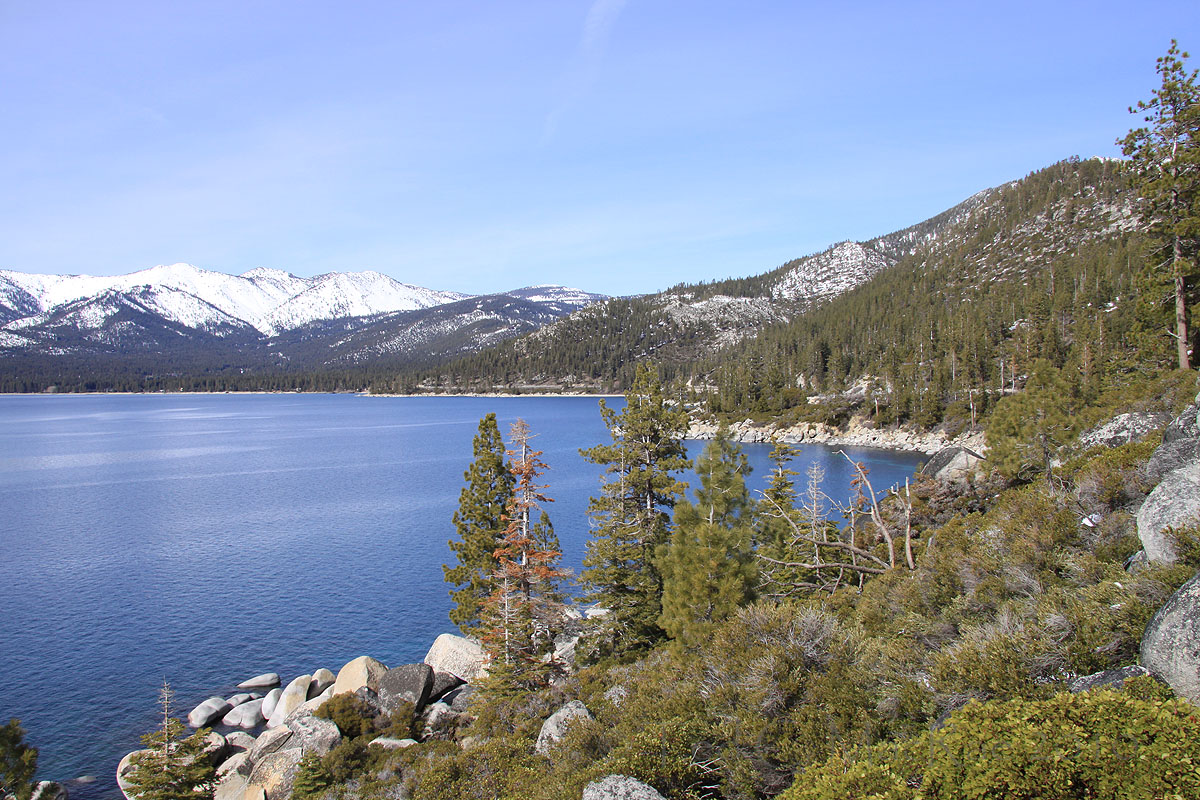
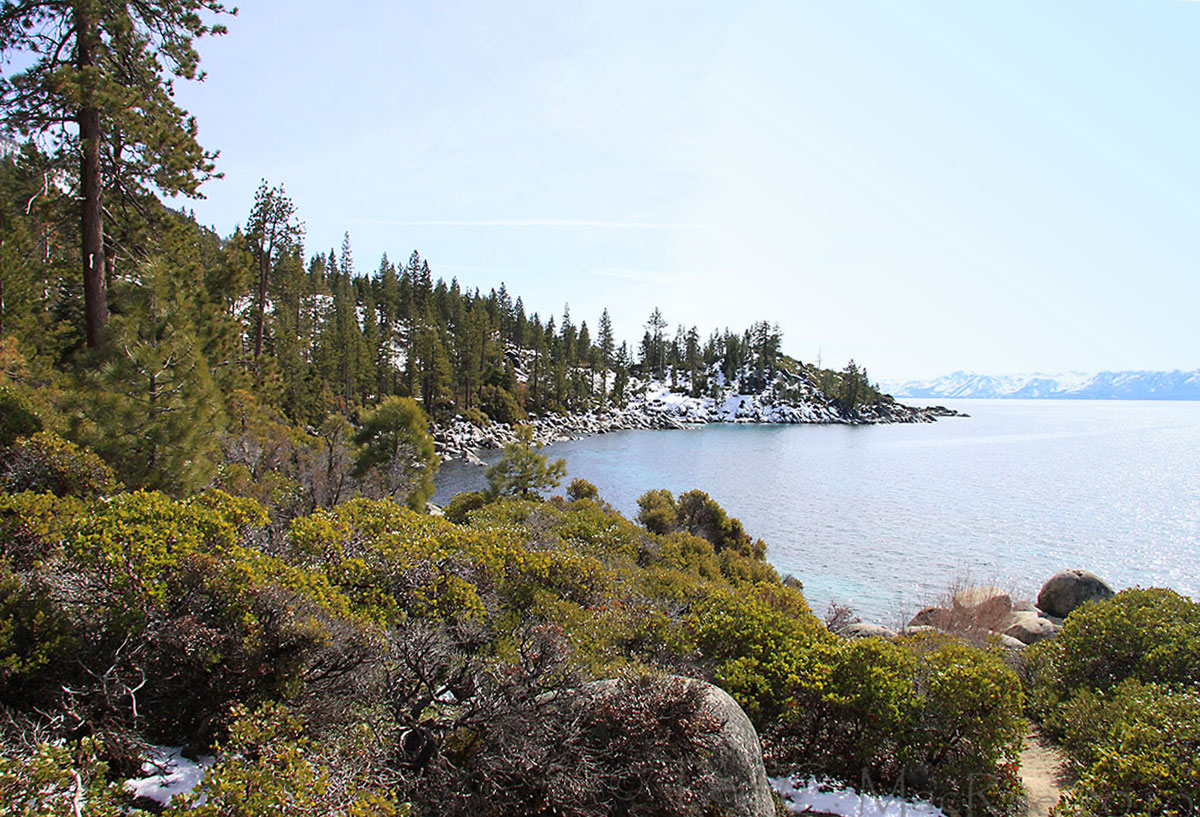
I’ve already shared a bit of the trip with a view of Mt. Rose from 7,000′ and ensuing pismire quagmire.  Today I share some views of one of the most scenic of lakeside spots on the east shore – Sand Harbor Overlook.  I featured this spot in this post from last year’s trip due to its stunning beauty, and this year I was no less impressed.  I still had that same, annoying, afternoon sun to deal with (next year I’ve resolved to get here during the morning) but managed to get some passable photographs.  The one above is my favorite, and I hope you enjoy the following as well. (p.s. if someone knows how to fix a sun-blown sky in Photoshop Elements, please let me know).

Copyright © Ted C. MacRae 2010

Add to FacebookAdd to DiggAdd to Del.icio.usAdd to StumbleuponAdd to RedditAdd to BlinklistAdd to TwitterAdd to TechnoratiAdd to Yahoo BuzzAdd to Newsvine

Email to a friend