Proof that I am out standing in my field

CIMG5858_TCM_1200x900

Okay, I know this was lame, but for those of you who were expecting to see the newest issue of Berry Go Round today, all I can say is sometimes life/work gets in the way. BGR #21 should be up in the next day or so – in the meantime I’ll let you puzzle and speculate as to what I am actually doing in this photograph.

Copyright © Ted C. MacRae 2009

Add to FacebookAdd to NewsvineAdd to DiggAdd to Del.icio.usAdd to StumbleuponAdd to RedditAdd to BlinklistAdd to TwitterAdd to TechnoratiAdd to Furl

Do you know what time it is?

I’ll give you a few hints:

  • It’s fall.
  • I haven’t collected bugs for a few weeks.
  • A new crop of tiger beetles has emerged from their burrows.

What time is it?

IT’S TIME FOR THE ANNUAL FALL TIGER BEETLE TRIP!

 I don’t think there is any trip during the year that I look forward to more than this one. Hunting for insects is fun no matter what, but it is particularly enjoyable when the sweltering days of summer give way to the cool days of fall – crisp air, pungent, earthy aromas, shadows long and sharp, and skies so blue above a golden, tawny, morphing landscape. How I adore fall, and how I thrill at any chance to travel across the fall landscape chasing after gorgeous tiger beetles that have spent the spring and summer as larvae, hidden in their unseen burrows, growing fat on the few hapless insects that chanced too close to their burrow, until the rains of late summer and early fall trigger their transformation to adulthood – glittering jewels that emerge out into the autumn world for a brief session of dining and play before winter forces them back into their burrows for the long wait to spring.

This year’s edition is somewhat abbreviated – little more than a long weekend due to a combination of job and family responsibilities. Still, five days is a little better than four (and a lot better than none) and is long enough for me to play a hunch that I’ve had ever since I returned from the Red Hills of northwestern Oklahoma this past June. You’ll recall that I had some rather amazing luck on that trip, discovering a robust population of the very rare Cylindera celeripes (Swift Tiger Beetle) and a slight western range extension of the seldom seen Dromochorus pruinina (Frosted Dromo Tiger Beetle). While I was exploring that landscape, the habitat reminded me of another tiger beetle – Cicindela pulchra (Beautiful Tiger Beetle), a glorious species – brilliant purple with glassy wine-red elytra – that I had seen in 2005 in the nearby Gypsum Hills of south-central Kansas. I don’t know if that species occurs in the Red Hills of northwestern Oklahoma or not, but my impression is that the area has not been very well explored. If a species as rare as C. celeripes can be found there, perhaps C. pulchra will occur there as well. The enormous tiger beetle larvae that I saw in their burrows in the Gloss Mountains during June gives me further reason to believe there may now be some impressive adult activity in the area.

Should I not succeed in finding C. pulchra, it will nevertheless be a glorious, though frenetic trip. On Friday I’ll drive 525 miles from St. Louis to the Gloss Mountains, where I’ll explore during the early part of Saturday and then finish the day at Alabaster Caverns State Park. Sunday’s itinerary depends upon whether I succeed at finding C. pulchra in the Gloss Mountains – if I do, I’ll head on over to Salt Plains National Wildlife Refuge to photograph some of the fall tiger beetles that were not out during my June trip (hopefully including Eunota togata globicollis, or Alkali Tiger Beetle). If I don’t find C. pulchra in the Gloss Mountains, I’ll explore the Red Hills of Barber Co. Kansas, where I’ve seen this insect in the past and attempt to find and photograph it there, then move on to Salt Plains on Monday. I’m really hoping my C. pulchra hunch plays out, because if it does that gives me an extra day to shoot back east to my beloved White River Hills in southwestern Missouri and photograph its small, disjunct population of Cicindela obsoleta vulturina (Prairie Tiger Beetle) – the largest member of the genus in North America. Regardless of how events play out, I’ll need to blast back to St. Louis on Tuesday, work a couple of days, then leave town again for my niece’s wedding in New York (congratulations Shannon and Tamer).

While I’m gone, you can click on the interactive map to see where I’m going, or you can catch up on several newly issued Blog Carnivals (I’ve been a busy submitter this past month):

  • Circus of the Spineless. With discussion that is restricted to the 95% of life forms that do NOT have vertebrae, CotS #42 is up at Quiche Moraine.  For my part, I have proposed a replacement name for a rather ‘ubiquitous’ species of tiger beetle.
  • Berry Go Round.  After a brief summer vacation, botanical discussions resume with BGR #20 at Further Thoughts.  My contributions cover zygomorphic flowers with oily rewards, a very ungentianlike gentian, and plant-insect relationships.
  • Carnival of Evolution.  From Darwin to Drift to Deleterious Mutation, find it all at CoE #16 hosted by Pleiotropy.  I’ve added a little ‘perspective’ to the discovery of new species.

No longer just a contributor, at the end of this month I will host my first Blog Carnival in the form of Berry Go Round #21.  I know,  it’s strange that a bug dude is jumping into the Carnival hosting pool with a botanical carnival, but duty calls!  Submissions are due to me by Oct. 27, with a scheduled issue date of Oct. 30.  If you’ve never contributed to a Blog Carnival before, it’s a great way to get exposure for your blog and possibly find other blogs of interest.

Copyright © Ted C. MacRae 2009

Add to FacebookAdd to NewsvineAdd to DiggAdd to Del.icio.usAdd to StumbleuponAdd to RedditAdd to BlinklistAdd to TwitterAdd to TechnoratiAdd to Furl

On the road again!


IMG_3397_0006_006_enh

By the time you read this, I’ll be on the road again for yet another extended bug collecting trip.  I don’t think I am ever happier than when I am on one of these trips – whether it be a once-in-a-lifetime visit to Africa or a one-week jaunt to the nearby plains.  With so many places to see – each with their own unique story – I don’t understand how anyone ever ends up getting bored.  The main destination for this trip is the Nature Conservancy’s recently established Four Canyon Preserve in northwestern Oklahoma.  This nearly 4,000-acre preserve contains a stunning assemblage of rugged, mixedgrass prairie ridges dissected by deep, chinquapin oak-lined canyons that drain into the Canadian River in southern Ellis County.  Although past grazing and fire suppression have reduced shrub cover, lowered vegetation complexity and promoted expansion of eastern redcedar (Juniperus virginiana) throughout the area, the preserve nevertheless supports a number of species of conservation concern such as Cassin’s sparrow, Swainson’s hawk, least tern, and Arkansas River shiner.

IMG_3285_0024_024_enh

As is typical with many protected areas, studies of the biotic diversity of this preserve have dealt primarily with its flora (Hoagland and Buthod 2007) and avifauna (Patten et al. 2006). Arthropods and other microfauna, on the other hand, remain essentially unknown.  I’ll be joining a group of entomologists – primarily hymenopterists – who began conducting surveys of the preserve’s insect fauna last fall.  While my colleagues gaze at the hyperdiversity of asteraceous flowers looking for things with stings, I’ll be staring at the red Permian sandstone and shale exposures – watching for any darting movement between clumps of grama and little bluestem that might indicate the presence of the enigmatic Cicindela celeripes (swift tiger beetle).  I’ve written previously about the occurrence of this rare, flightless tiger beetle in the Loess Hills of Iowa and our ongoing search for this species in northwestern Missouri in my post The Hunt for Cicindela celeripes.  Although this beetle has not yet been recorded at the preserve, it was seen very recently in nearby Alabaster Caverns – some 60 miles to the north, and a historical record is known from just south of the preserve.  My optimism is bolstered by the fact that the Alabaster Caverns individual was observed in late May – much earlier than the typical late June and early July records for this species further north in its stronghold in the Flint Hills of Kansas.  Of course, I will be looking for other things as well – other species of tiger beetles are likely to occur on the reddish loamy upland soils and quaternary alluvial deposits along the Canadian River, and any number of woodboring beetle species are likely to be found on herbaceous flowers and dead branches of the 51 species of woody plants recorded in the preserve.

After getting our fill of Four Canyon Preserve, we’ll visit the world’s largest remaining tract of tallgrass prairie, Tallgrass Prairie Preserve in northeastern Oklahoma.  Encompassing nearly 40,000 acres, we can do nothing more than only scratch its surface.  However, the tallgrass prairie habitat should provide a nice contrast to the mixedgrass prairie of Four Canyon Preserve, and it will be interesting to compare and contrast these two distinctive plant communities and their associated insect faunas.  After a week on the road¹, I’ll return to St. Louis for a brief respite before beginning a hectic four-week survey in northwestern Missouri for – you guessed it – Cicindela celeripes!

¹ I’ll be without internet access, so please forgive my nonresponsiveness to comments. I do have a couple of posts scheduled to appear during my absence.

My thanks to Mike Arduser, an expert hymenopterist and also a good friend, for bringing Four Canyon Preserve to my attention.  His spectacular photographs that I share here were all I needed to convince me to join him on his return trip this season.

REFERENCES:

Hoagland, B. W., and A. K. Buthod.  2007.  Vascular flora of the Four Canyons Preserve, Ellis County, Oklahoma.  Journal of the Botanical Research Institute of Texas 1(1):655–664.

Patten, M. A., D. L. Reinking, and D. H. Wolfe.  2006.  Avifauna of the Four Canyon Preserve, Ellis County, Oklahoma.  Publications of the Oklahoma Biological Survey (2nd Series) 7:11-20.

Copyright © Ted C. MacRae 2009

Add to FacebookAdd to NewsvineAdd to DiggAdd to Del.icio.usAdd to StumbleuponAdd to RedditAdd to BlinklistAdd to Ma.gnoliaAdd to TechnoratiAdd to Furl

Library expansion

p1020873_3

If there is anything that I love as much as beetles, it’s books! Pulling a handsome, leatherbound volume from its location on the shelf and smelling the aging paper while leafing through its pages quickens my pulse the way no electonic reprint ever can. That is not to say I don’t appreciate the convenience and increasing accessability of digital literature – especially with regards to searchability and the growing body of older, previously unobtainable works that can be downloaded and printed at will. Still, whenever I have a choice between pulling a real entomology journal from my shelf or accessing its electronic version on CD or online, I will opt for the real thing.

p1020884_3Over the years, I’ve had the opportunity to obtain complete series of several journals key to my studies. The first, and most important of these, was The Coleopterists Bulletin. About 15 years ago I was able to purchase a nearly complete set of this journal previously owned by cicindelid icon Norman Rumpp. His set contained a few recent volumes overlapping with my own set, started in the early 1980’s, and dating back to all but the earliest of years. When I acquired the Rumpp set, I set about purchasing the missing volumes from the available stores of back issues still offered by The Coleopterists Society. However, a few of the earliest numbers were simply not available, so I borrowed copies of these from my good friend Gayle Nelson, carefully made 2-sided copies of each, and trimmed the papers to match the size of the originals. I then took the entire combined set of issues – Rumpp originals and Nelson photocopies – to the bindery and had them bound in antique burgundy, just as one would expect to see them in a university library. In the years since then, I have begun binding my other journal series as time and funds permit. Not only do these bound volumes look attractive, but they are eminently more functional – standing upright on their own and remaining nicely organized through heavy use.

p1020870_3This week I placed my newest complete journal series on the bookshelf – the exclusively tiger beetle-focused journal, Cicindela. I’ve actually had the complete set for awhile now, purchased last year when editor Ron Huber had a limited number of complete sets reprinted. Being a more recent convert to tiger beetles, I hadn’t started my series of Cicindela until around 2000, although I did obtain some older volumes from the library of the late Prof. Wilbur R. Enns, kindly given to me upon his passing in 2003 by his close friend Prof. Ben Putler. Ron made all of the remaining volumes of this fine journal available to me to complete my set, and I’ve finally gotten the set bound – all 40 volumes dating back to 1969.

While I was taking journal volumes to the bindery, I took advantage of the opportunity to bind a complete set of the SCARABS Newsletter. In keeping with the times, SCARABS is a completely virtual publication – all issues are created, distributed, and archived electronically, with the end user free to print a copy for themselves or not. p1020880_3I chose to print, again carefully generating 2-sided printed of each issue on a color laser printer, and had them bound in “volumes” of appropriate thickness. The example shown here is the “Frank T. Hovore” issue, produced as a memorial to one of our time’s most enthusiastic collector of beetles. Frank, known among scarab circles as “Mr. Pleocoma” for his dedication to rain beetles, died of a heart attack in 2006 while on a collecting trip to a remote part of Ecuador. There is something ironically satisfying about having a complete, bound set of a modern, electronic periodical.

Other complete sets that I have bound in my library include Insecta Mundi (vols. 1-18, subsequent volumes electronic only), Jewel Beetles (vols. 1-11), Consortium Coleopterorum (vols. 1-4), and Michigan/Great Lakes Entomologist (vols. 1-40). Also, while not complete, I have the last 21 volumes of The Pan-Pacific Entomologist, nicely bound in forest green.  Oh, and look at the first photograph again – the book on the right side of the photo is an original copy of Catalogue of the described Coleoptera of the United States, published by Frederick Ernst Melsheimer in 1853. It is the oldest book in my library – received as a gift from the family of the late Marshall Magner, a long-time member of our local Webster Groves Nature Study Society, upon his passing in 2005.

Copyright © Ted C. MacRae 2009

Add to FacebookAdd to NewsvineAdd to DiggAdd to Del.icio.usAdd to StumbleuponAdd to RedditAdd to BlinklistAdd to TwitterAdd to TechnoratiAdd to Furl

An extendable handle for insect nets

For many years, my standard insect collecting gear has been a beating sheet and a short-handled aerial net (see small photo at right in “The Author” or the full-sized version under About). From the deciduous forests of the Ozark Highlands to the tropical bushveld of South Africa, these two pieces of equipment have been all that I’ve needed to collect the woodboring beetles that have dominated my interests. The beating sheet is, of course, an absolute necessity for anyone interested in jewel beetles (family Buprestidae), longhorned beetles (family Cerambycidae), and the many other insects that tend to be found on tree branches. Woodboring beetles are most frequently, but not exclusively, found on dead branches of their host trees, but regardless of whether the branches are alive or dead, the concept for collecting beetles off of them is the same – a beating sheet is held underneath the branch, and the branch is given a decisive whack with a stick of some kind. This dislodges any beetles that may be foraging or resting on the branch and causes them to drop onto the sheet, where they can be spotted easily and picked off before (hopefully) they escape. For my “stick” I like to use the handle of an aerial net, as the net itself is quite handy to have in case I stumble upon some of the many flower-feeding species or for more general collecting (my inability to focus exclusively on any one taxon is by now well documented). Using a net handle as a beating stick, unfortunately, forces one to compromise on the length of the handle – the handle must be relatively short (no more than 3′ long) to be effective as a beating stick, but such a short handle severely limits reach when the net is being used.  This problem has become even more apparent during the past few years as I have become increasingly interested in tiger beetles (family Cicindelidae).  There is no way around it – you need a long-handled net to have any hope of collecting tiger beetles, and the longer the better (ideally about 6′).  Thus my quandary – I needed a short-handled net to best collect woodboring beetles, but a long-handled net to best collect tiger beetles.

Enter the extendable handle for insect nets, available from BioQuip Products.  This ingenious net handle consists of two telescoping aluminum tubes with a clutch-lock device.  When fully collapsed the handle measures only 36″ in length – perfect for use as a beating stick and when extra length is not needed.  When a longer net handle is needed, however, a quick turn of the clutch-lock frees the inner section, allowing the handle to be extended to nearly 6′ in length – perfect for those fast-moving tiger beetles. Once extended, another quick twist of the clutch-lock secures the handle in place, and that Cicindela is mine!  To cap it all off, the handle is fully compatible with standard insect net rings and bags, including the red “T” knob for ring attachment. It was almost as if the handle had been designed specifically for my purposes.

I purchased mine at the beginning of the last field season. While the design seemed a perfect solution for my short handle-long handle quandary, I wasn’t convinced it would be able to withstand the rigors of field use. Specifically, I questioned whether the inner section would remain firmly seated within the outer section after a few slams of the net against the ground with the handle fully extended (for example, when using the ‘slap’ method for those tiger beetles I hadn’t yet figured out). I expected that repeated flexing of the handle would eventually cause the joint to fail and the handle to lose its rigidity. I also wondered how quickly and easily the handle would extend – especially after seeing some wear and tear. Any difficulty in this regard would quickly negate the convenience offered by an extendable handle.

I was immediately impressed with this handle upon its very first use, and after one full season of heavy use, it appears my concerns about its durability were unfounded. Weighing only 12 oz, it is extremely lightweight and easy to carry, and I am also pleased at how easily the handle extends and collapses – the clutch-lock disengages completely with a single twist, and the inner section slides into and out of the outer section smoothly and quickly. The true test of its durability, however, came during last year’s annual fall tiger beetle trip – a test that it passed with flying colors. I really put the net handle to hard use, and despite repeatedly slapping the net ring against the ground with the handle fully extended, the joint remained solid and rigid. I was able to swing the net with just as much assertion at the end of the trip as at the beginning.

Even during those times when I wasn’t carrying a beating sheet, I found myself routinely preferring to carry the extendable handled-net rather than the long-handled net. It was easier to carry and use when a short handle was sufficient, yet it could be extended quickly and easily when the extra length was needed. At $22.95, I consider its cost to be rather modest compared to the convenience and versatility it offers. For those of you who need a long-handled net but don’t want to wield a long handle all the time (and for the one or two other people in the world who use their net handle as a beating stick), this is the handle for you.

Copyright © Ted C. MacRae 2009

Add to FacebookAdd to NewsvineAdd to DiggAdd to Del.icio.usAdd to StumbleuponAdd to RedditAdd to BlinklistAdd to Ma.gnoliaAdd to TechnoratiAdd to Furl

Myths about why Lake Tahoe does not freeze

p1020598_2In my recent post, Born of glaciers, I touched on the formation of Lake Tahoe and discussed the glacial origins of Emerald Bay and nearby Fallen Leaf and Donner Lakes.  At the end of that post, I listed some interesting facts about Lake Tahoe, including the fact that Lake Tahoe does not freeze over.  That last fact was linked to one of the many internet sources explaining that Lake Tahoe’s massive size and the fact that its waters are always in motion prevent it from freezing. Sounded good to me.

Fortunately, my post drew the attention of David C. Antonucci, an environmental and civil engineer and author of the website TahoeFacts.com. David pointed out that this widely circulated explanation for why Lake Tahoe doesn’t freeze (repeated even by the U.S.D.A. Forest Service, Lake Tahoe Basin Management Unit FAQ website) is, in fact, wrong. David is currently updating his TahoeFacts.com website to include a more detailed explanation about this, but he sent me a draft of his update and has graciously given me permission to quote from it in order to help clear up some of the confusion.

As David points out, size is not the reason – Lake Baikal has more than three times the depth of Lake Tahoe and 160 times the volume, yet is freezes over to a thickness sufficient to support a railway. Nor is it the motion of the water – the Bering Sea is rocked all winter long by violent storms but still forms thick ice cover. The real reason results from a combination of three basic scientific principles:

  1. Freshwater has the unique property of reaching its maximum density at about 39°F – that is, water is densest at a temperature 7°F above the temperature at which it freezes.    For any lake to freeze, its surface waters must cool to 39°F, at which time they become denser than the underlying waters and sink beneath them.  This process continues until the water at all depths is a uniform 39°F, after which the surface waters can continue cooling down to 32°F and begin freezing.
  2. Freshwater bodies gain heat during summer when air temperatures exceed the temperature of the water at the surface and lose it during winter when air temperatures are below the water surface temperature.  The rate at which stored heat is lost during winter depends upon the surface area/volume ratio – lakes with a higher ratio (i.e., they have a large surface area compared to their volume) lose heat quickly, while those with a smaller ratio (small surface area compared to their volume) lose it more slowly.
  3. The rate at which heat is lost is also affected by climate.  Freshwater bodies in colder climates will lose heat more quickly than those with the same surface area and volume in a milder climate.

These three principles combine to explain why Lake Tahoe does not freeze over.  Lake Tahoe has a very small surface area/volume ratio due to its great depth but relatively small circumference.  This limits the rate at which stored heat is lost from the lake during the colder winter months.  The relatively mild climate that occurs in the Tahoe Basin, due to its proximity to the warm Pacific Ocean, further limits the rate at which stored heat is transferred to the air above it.  The result of all this is that the surface temperature of Lake Tahoe never reaches 39°F.  The lake is coldest in late March with a temperature of 41°F at the surface and gradually decreasing to 39°F at a depth of 500-600 ft and below.  Before the surface of the lake has a chance to cool further, increasing sunlight and air temperatures start raising the temperature at the surface.  By early May, surface temperatures reach 50°F, and they peak at 65°F to a depth of 15 ft by mid-August.  However, the summer warming penetrates only to a depth of about 375 ft – where the temperature has remained at 41°F.  Since the upper layers of water never cool below this temperature, they never sink below this depth and allow further cooling to take place.  It is, ironically, a lack of movement that prevents Lake Tahoe from freezing. In order for Lake Tahoe to freeze over, climatic conditions would have to become much colder, or the lake would have to fill in and decrease its depth enough to achieve a sufficiently high surface area/volume ratio.

David also points out that Emerald Bay has formed complete ice cover at least three times during the 20th Century and partial cover in more years. The reason for this is that Emerald Bay lacks the same depth of the main lake – its surface area/volume ratio is high enough to lose its accumulated heat and reach the required 39°F top to bottom during particularly cold winters.

Copyright © Ted C. MacRae 2009

Add to FacebookAdd to NewsvineAdd to DiggAdd to Del.icio.usAdd to StumbleuponAdd to RedditAdd to BlinklistAdd to Ma.gnoliaAdd to TechnoratiAdd to Furl

Born of glaciers

Three months of camp life on Lake Tahoe would restore an Egyptian mummy to his pristine vigor, and give him an appetite like an alligator.–Mark Twain, Roughing It (1872)

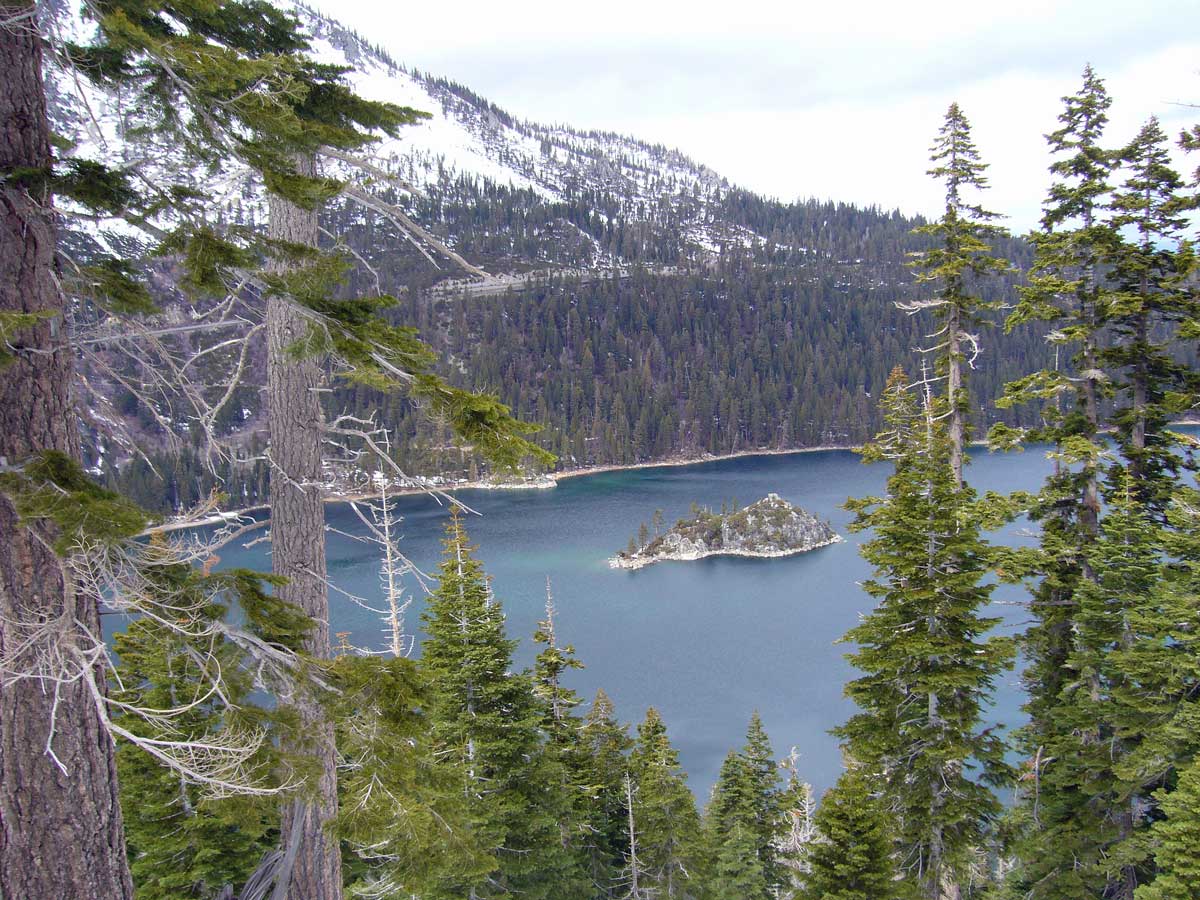
p1020578_2 When Mark Twain first laid eyes upon Lake Tahoe in 1861, he thought it “must surely be the fairest picture the whole earth affords.” More than a century and a half later, that opinion is still shared by another Missouri boy, and though I would gladly welcome three months of camp life over one week at a ski resort, I nevertheless remain confident that my vigor will be fully restored by the time I return to work next Monday. The journey that began some days ago in the foothills of my beloved, ancient Ozark Highlands has today taken me to one of the youngest of landscapes to grace Lake Tahoe – Emerald Bay. I have written previously about Lake Tahoe (one year ago almost to the day) in a post that also featured photos of Emerald Bay and its only island, the iconic Fannette Island. p1020596_2 The Tahoe Basin itself is a relatively young landscape, forming within the last 5-10 million years as the basin floor dropped between two uplifted blocks. Volcanic flows in the valley on the north side of the present lake dammed the valley to form the lake, whose level has fluctuated drastically over time during the past 2 million years as Pleistocene glaciations have repeatedly damned the Truckee River that drains the lake into the lowlands of Nevada. At maximum, the level of the lake approached 7,000 feet in elevation – nearly 800 feet higher than today. p1020577_2 It was the last of these glacial events – near the end of the Pleistocene just 10,000 years ago – that gave birth to Emerald Bay. Unlike the “ice sheets” that spread out across much of the continent, the ice age here manifested itself as individual glaciers that formed at the highest elevations and carved out individual valleys as their crushing weight ground them inexorably downward. The elongated shape characteristic of such glacial valleys is seen not only in Emerald Bay, but in the adjacent Fallen Leaf Lake and Donner Lake in the north as well. John Muir alludes to this glacial birth in a description of Emerald Bay that he wrote in his private journal in 1888:

Emerald Bay is about two miles long. Its mouth is nearly closed by a terminal moraine; the sides are formed by lateral moraines. The left lateral is very striking, well formed, three or four hundred feet high where it joins the shoulder of the mountain, timbered with pine and spruce¹ sparsely on the grayish slopes.

¹ Actually firs, of the genus Abies.

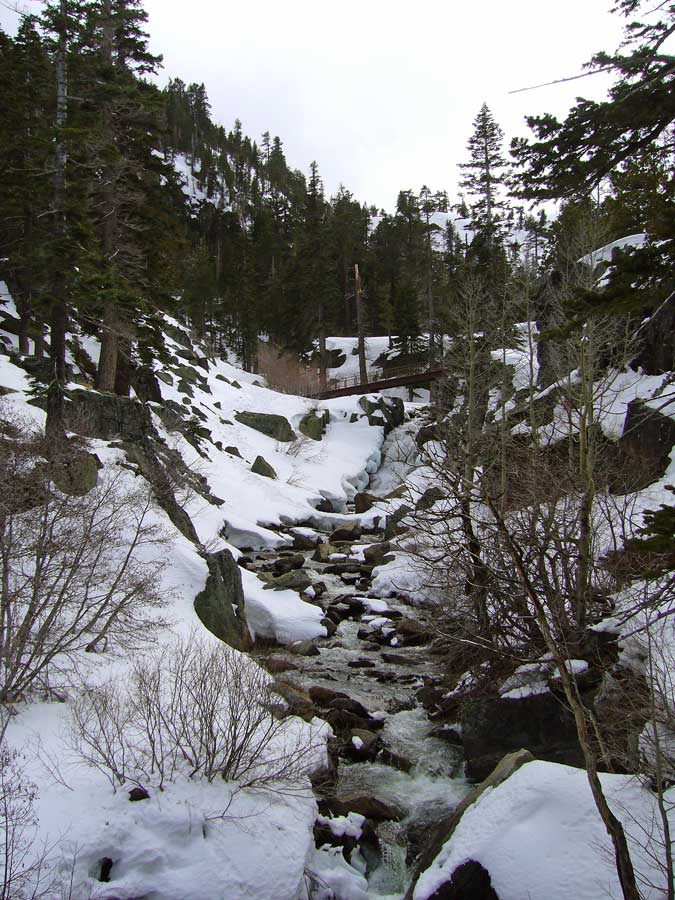
Upper Eagle Falls from Eagle Lake - part of a ''glacial staircase'' above Emerald Bay

Upper Eagle Falls from Eagle Lake - part of a

Unfortunately, the very existence of Lake Tahoe is under threat. While the mountain building processes that created the Sierra Nevada have ceased for now, the erosive forces caused by weathering continue unabated. The Sierra Nevada range is being gradually worn down, and Lake Tahoe is filling with sediment at an average rate of about 1/10th of a millimeter per year. At this rate, Lake Tahoe will become a meadow in just over 3 million years.[/humor]

Lake Tahoe facts:

  • It is 22 miles long, 12 miles wide, and holds about 40 trillion gallons of water – enough to cover the entire state of California to a depth of 14.5 inches!
  • Maximum elevation of the lake surface is about 6,229 feet above sea level.
  • The lake is drained by the Truckee River, one of a few rivers that run inland to the desert rather than towards the ocean.
  • It is the third deepest lake in North America, with an average depth of 989 feet. However, the deepest point is about 1,645 feet.  It is the largest lake in North America above 600 feet elevation.
  • Surface temperatures can reach as high as 75°F in summer, but at depths below 600 feet the water remains a constant 40°F.
  • Lake Tahoe does not freeze over, although Emerald Bay has formed complete ice cover at least three times during the 20th Century and partial cover in more years.

More Lake Tahoe facts can be found at the U.S.D.A. Forest Service, Lake Tahoe Basin Management Unit FAQ site and at Tahoe Topics and FAQ’s, by David C. Antonucci (2004).

Copyright © Ted C. MacRae

Add to FacebookAdd to NewsvineAdd to DiggAdd to Del.icio.usAdd to StumbleuponAdd to RedditAdd to BlinklistAdd to Ma.gnoliaAdd to TechnoratiAdd to Furl

A journey through time

hole_in_the_mountain

East Humbolt Range, northeastern Nevada

During the past two days, my family and I made the long drive from St. Louis, Missouri to Lake Tahoe, California to enjoy a week of skiing (both alpine and cross-country), snow-shoeing, hiking (at lower elevations), and decompression.  At 1,990 miles, it’s not a drive for the pampered or easily bored (and for those with children, thank goodness for in-car DVD players). Yet, for those willing to explore the little seen wonders of a landscape that most people see only from 30,000 feet, driving cross-country can be a richly rewarding experience.  I have traveled through many parts of the U.S., but this was my first time experiencing the “northern route” between Missouri and California along I-80.  Along the way, I saw:

  • Massive flocks of snow geese roosting in wetlands along the Platte River Valley, rising up at morning’s light in swirling clouds and stringing across the sky in vast, intersecting “V”s as they begin another day on their journey northward.
  • Sandhill cranes in the Nebraska Sand Hills, dropping down from the sky like miniature parachutes as they congregated in fallow corn fields to feed amongst the stubble.
  • The vast, high, arid, lonely expanses of the Wyoming Basin, transitioning from mixed-grass prairie in the east to sagebrush steppe in the west.
  • The stunningly spectacular descent down the western escarpment of the Wasatch Range, where the eastern edge of the Great Basin laps against the western edge of the Rocky Mountains.  (Nightfall unfortunately deprived me of my chance to see the vast Great Salt Lake and the even more expansive stretches of its associated salt flats.)
  • The magnificent Great Basin landscape and its alternating basin and range theme – its broad basins of salt lakes, marshes and mud flats interrupted at regular intervals by craggy, north to south mountain ranges formed as a result of strike-slip faulting during the past 30-50 million years as the thin Basin crust continues to crack and stretch even thinner.
  • The dramatic eastern face of the Sierra Nevada Range, its snow-capped peaks rising massively as a single granite block at the western edge of the Great Basin, and the equally dramatic, tortuous climb up to Spooner Pass at 7,200′ elevation before the 1,000′ drop down into the majestic Lake Tahoe Basin.

Driving across such a vast expanse of North America, especially in the west with its endless vistas and majestic landscapes, invites contemplation about earth and time.  Starting out in the foothills of my beloved Ozark Highlands – born before life itself and weathered for a billion and a half years, driving through the upstart Rocky Mountains – mere babies at only 50-100 million years of age, and finally arriving at the truly young Lake Tahoe – whose mere few million years of age make it a mere infant in geological time, I realized that the vastness of these landscapes, and of the countless tectonic, erosional and sedimentary episodes that shaped them, is surpassed only by the vastness of the time it took to create them.  For those willing to make the investment, driving through these landscapes is more than a trip across the country – it is a journey through time.

Copyright © Ted C. MacRae 2009

Add to FacebookAdd to NewsvineAdd to DiggAdd to Del.icio.usAdd to StumbleuponAdd to RedditAdd to BlinklistAdd to Ma.gnoliaAdd to TechnoratiAdd to Furl