Super Crop Challenge #15

Can you identify the structure in the photo below (2 pts), what it is doing (2 pts), and the organism to which it belongs (order, family, genus, and species—2 pts each)? Comments will be held in moderation so everybody has a chance to participate, although there are early-bird bonus points on offer. Read the full rules for details on how (and how not) to earn points. Good luck!

IMG_8054_ssc_enh_1080x720

Copyright © Ted C. MacRae 2013

Virtual Mantle 2012

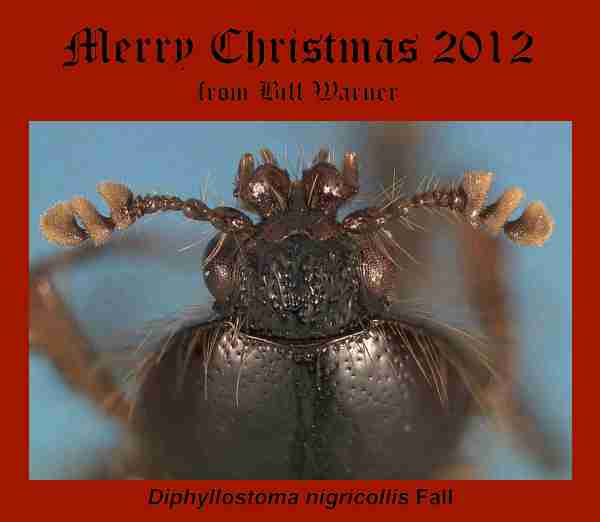
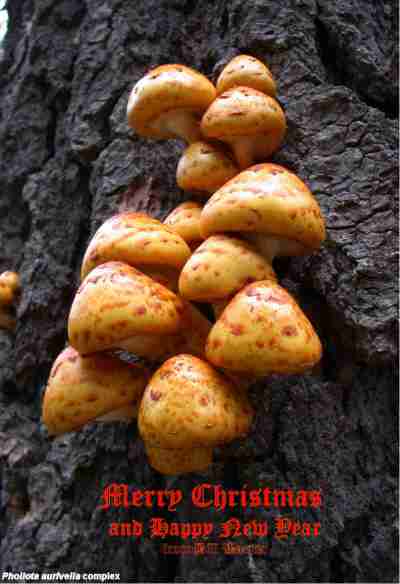
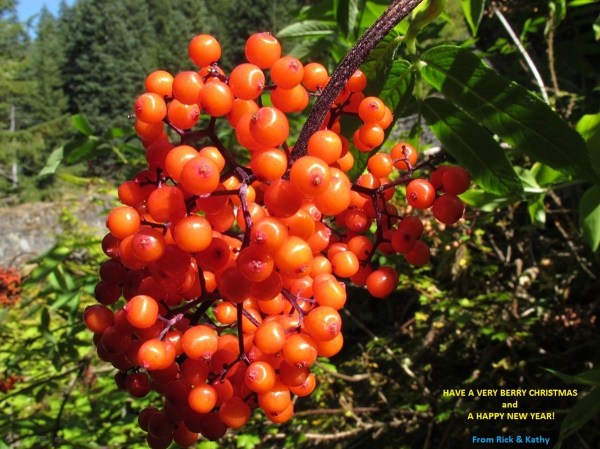
In recent years a truly delightful custom has developed among taxonomic entomologists—Photoshopped e-Christmas cards featuring their favorite insects! This should not be a surprising development—connectivity among scientists from around the world is at an all-time high, as is their access to digital cameras and imaging software. And, of course, what better subject for such cards could one ask for than insects (especially beetles, I might add)? It’s hard to resist anthropomorphizing them, with their buggy eyes and comical expressions, but their outright beauty makes them perfect also as pure ornaments. I did my first one last year (Santa Jaws), and for this year’s version I created Buprestis saintnicholasii. Following are the e-Christmas cards on my virtual mantle this year, received from beetle taxonomists as far and wide as Arizona, California, Oregon, Bulgaria, Germany and Romania!

I really enjoy getting these—if I’m not already on your e-Christmas card mailing list please consider adding me in 2013!

Xmas-2012_Bellamy

Chuck & Rose Bellamy – Sacramento, California

Xmas-2012_Kalashian

Mark Kalashian – Yerevan, Armenia

Xmas-2012_Mühle

Hans Mühle – Munich, Germany

Xmas-2012_Ruicanescu

Adrian Ruicanescu – Cluj-Napoca, Romania

Xmas-2012_Warner

Bill Warner – Phoenix, Arizona

Xmas-2012_Warner2

Bill Warner – Phoenix, Arizona

Xmas-2012_Westcott

Rick & Kathy Westcott – Salem, Oregon

Xmas-2012_Gashtarov

Victor Gashtarov – Sofia, Bulgaria

Copyright © Ted C. MacRae 2012

Beetle, orthop or something else?

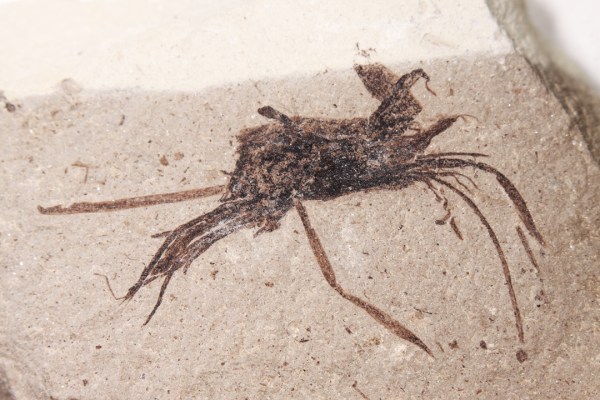
I had such helpful participation with my first fossil ID request that I thought I would go to the well again. This one is not so enigmatic as the first—it is clearly an insect, but it’s the only insect fossil among the batch that I haven’t settled on at least an order-level identification. Again, this is one of a set of 20 fossils loaned to me by a local collector for photographs and possible identifications, all coming from the Green River Formation in Colorado and dating back to the early to mid-Eocene (45–50 mya).

USA: Colorado, Rio Blanco Co., Parachute Creek Member. Body length = 11.05 mm.

USA: Colorado, Rio Blanco Co., Parachute Creek Member. Body length = 11.05 mm.

The label for this fossil indicates “Planthopper; Homoptera; Fulgoridae”; however, the short, robust legs and overall gestalt do not look right for either a planthopper or really any of the other hemipteran groups. What I see is an indistinct (mandibulate?) head, a distinct and well-developed pronotum, mes0- and metathoracic segments that are not nearly as heavily sclerotized as the pronotum but also lacking any sign of wings, a distinctly segmented abdomen with 9 or 10 segments, and short robust legs. I’m thinking an apterous/brachypterous coleopteran (Staphylinidae?) or a wingless member of one of the orthopteroid orders (although size alone excludes many of the latter—at more than 11 mm in length it is too large for something like Zoraptera). At first I thought the extension near the apex of the abdomen was a cercus, but I now think this is part of the piece of debris over the abdomen as there is no evidence of a cercus on the left side—another knock against something orthopteroid. Still, the lack of any trace of elytra—however shortened—keeps me from fully endorsing Coleoptera. Okay, so what do you guys think?

Copyright © Ted C. MacRae 2012

Spider, insect or something else?

I recently received a batch of fossil insects from a local fossil collector, who is hoping that I and other local entomologists will be able to provide some level of identification beyond just “insect.” All are from the Green River Formation, a lake bed shale deposit dating back to the early to mid-Eocene epoch (45–50 mya). Most major insect orders and families were established and undergoing rapid diversification by this time, and as a result most of the fossils are clearly identifiable at least to order or even family. There is one fossil, however, that has got me stumped. The label that came with the fossil indicates “Spider (?)”, and while at first glance this is the first thing that comes to mind, the more I look at it the more I become convinced that it represents something else. What, however, I do not know.

The fossil is a cast and mold from a split rock, so two views of the fossil are available. I’ve photographed them to try to get a better look at the details and still can’t come to a decision (I’ve even considered a small crustacean or even a plant part). Perhaps somebody who reads this might have an idea?

Colorado: Garfield, Hwy 139, Douglas Pass. Maximum diameter = 22.5 mm.

Colorado: Garfield, Hwy 139, Douglas Pass. Maximum diameter = 22.5 mm.

IMG_1840_enh_1080x720

Mirror half of same fossil.

Copyright © Ted C. MacRae 2012

Friday Editor’s Tip: Lose the formatting!

As Managing Editor of The Pan-Pacific Entomologist, I have the privilege of guiding manuscripts through the entire publication process—from submission and review through acceptance and preparation for final printing. It’s gratifying to see the results of a researcher’s efforts come to fruition, and it is also a good time to be an editor—due in no small part to the plethora of digital tools we have at our disposal. Knowing the amount of effort required to be an editor in today’s environment, I can’t imagine fulfilling the role in pre-computer days when manuscripts were prepared on a typewriter, submitted as hard copy, mailed to reviewers, collated upon their return (after interpreting hand-scribbled reviewer notations), and mailed back to authors for retyping. My heartiest congratulations to and respect for anyone who served as an editor in those days!

One of the holdovers from those days is the use of double-spaced text and numbered lines in draft manuscripts. This was necessary back then to provide space for reviewer comments and facilitate quick reference to specific portions of the manuscript. Of course, most journals today utilize fully electronic processes for submitting and reviewing manuscripts, and in some cases (including The Pan-Pacific Entomologist) a hard copy version of the manuscript may never be produced until the journal itself is issued. While the ability of reviewers to directly insert comments and suggested edits into an electronic version of the manuscript obviates the need to include line spacing and numbers, some authors still find themselves in the habit of preparing their manuscripts with such format. A bigger issue, however, brought on by the change from manual to electronic manuscript preparation is the temptation by some authors to overly “format” their manuscripts. Modern word processing programs (e.g., Microsoft Word) make it easier than ever to give documents visual appeal when printed, and most authors thus find themselves wanting to apply at least some formatting to their manuscripts. Indeed, some even go so far as to format their manuscript so that it closely resembles the printed journal! The problem is that most printers utilize file conversion software that automatically applies formatting according to a journal’s style sheet. Formatting commands used by word processing programs often interfere with those used by file conversion software, thus, to avoid conflicts any formatting applied to a draft manuscript must be stripped out prior to file conversion. The more of this that is done by the author prior to submission, the less potential for errors during printing. Unfortunately, just as secretaries don’t often make very good scientists, many scientists wouldn’t make good secretaries and find the prospect of “cleaning” an overly formatted manuscript more intimidating than it really is. Accordingly, I offer here this little “cheat sheet” for those who would like help in making sure their manuscript is clean prior to submission. These tips assume the use of Microsoft Word (since its file formats are acceptable for submission to The Pan-Pacific Entomologist), but a similar process should be possible with most other word processing programs.

Step 1. Select the entire document by pressing “Ctrl+A”.

Step 2. Click on “Home” in the menu ribbon and open the “Paragraph” dialogue box.

Step 3. Click on the “Indents and Spacing” tab. Set all of the commands as shown in the figure below.
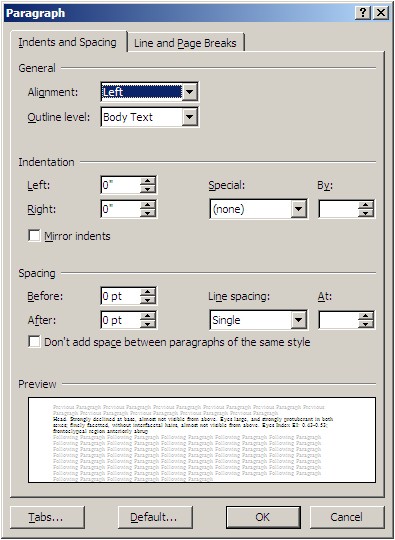
Step 4. Click on the “Line and Page Breaks” tab. Set all of the commands as shown in the figure below and click “OK”.

Step 5. Open the “Font” dialogue box (also under “Home” in the menu ribbon). Set all of the commands as shown in the figure below and click “OK”.
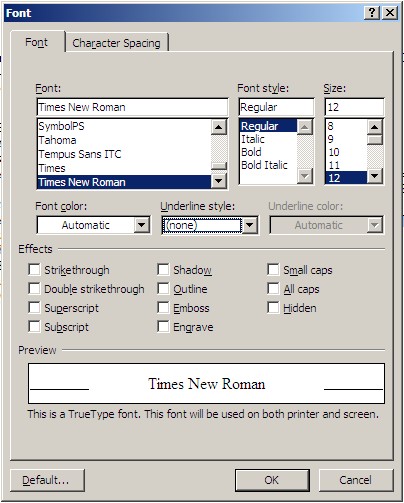
Step 6. Click on “Page Layout” in the menu ribbon and open the “Page Setup” dialogue box.

Step 7. Click on the “Margins” tab. Set all of the commands as shown in the figure below and click “OK”.
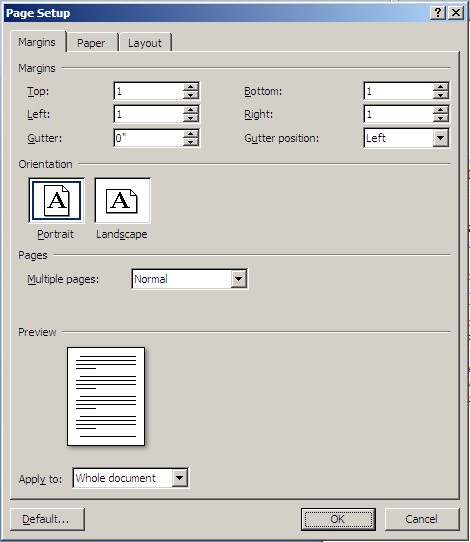
Voila! Your manuscript is free of all extraneous formatting commands and is ready for submission (assuming its contents are complete and well written). If there are portions of text that simply must be formatted (e.g., italics for scientific names) those can be reapplied. Of course, my best advice is to ensure the manuscript contains the above settings before it is even started. This not only ensures that formatting is limited to text that must be formatted, but also that the author will not need to spend additional time stripping out unneeded formatting during the preparation of final files for printing.

Copyright © Ted C. MacRae 2012

Super Crop Challenge #14

Wow, has it really been five months since the last Super Crop Challenge?! Well, it’s time to start a new BitB Challenge Session (this will be #7), so what better way to start? Can you name the structure shown in the photo below (2 pts), the organism to which it belongs (order, family, genus, and species—2 pts each), and its significance (2 pts)?

Note: If you are not completely familiar with them, please read the full rules for details on how and how not to earn points. Good luck!

Copyright © Ted C. MacRae 2012

Approaching the unapproachable

Yesterday I gave a talk at the Entomological Society of America’s Insect Macrophotography Symposium, focusing on techniques that I use for photographing wary insects in the field. Turnout for the symposium was awesome (I estimate ~125 people in attendance), and as the first talk I’ve given where I presented myself as a photographer I was pleased at the warm reception I got. A big thanks to my friends and colleagues who showed up to see the talk—it was great seeing your friendly faces in the crowd.

For those of you who couldn’t attend the ESA meetings this year or were unable to see my talk, I’ve attached a PDF version of the talk to this post—click on the image of the title slide below to see it. I expect I might give some version of this talk again in the future, so I would love to hear about any techniques you have found useful for approaching and photographing wary, skittish insects in their native habitats.

Copyright © Ted C. MacRae 2012