The true Ombú

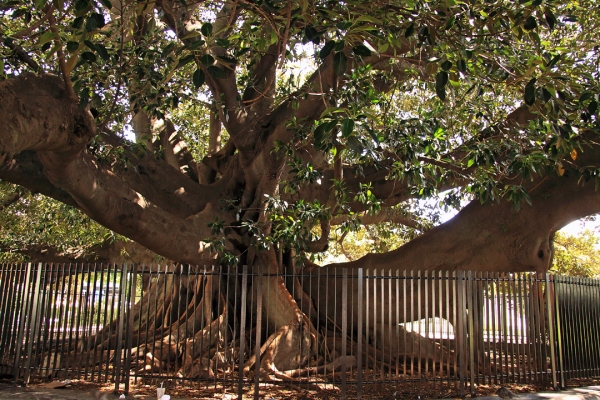
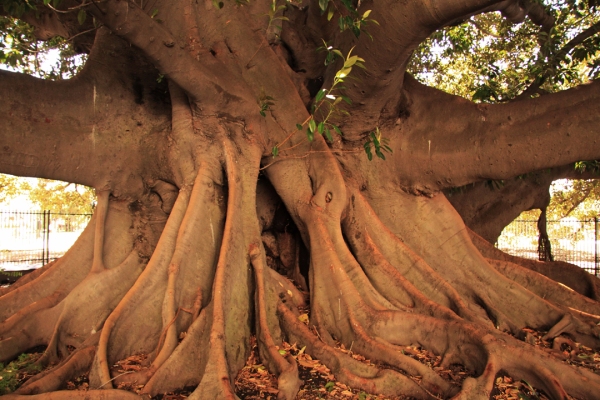
Recall ID Challenge #21, which featured a photograph of the massively buttressed trunk of a rubber tree (Ficus elastica) planted more than 200 years ago in Buenos Aires, Argentina and give the name Gran Gomero (meaning “big rubber”). There are many photographs of this tree on the internet, owing to its celebrity status, which allowed more than a few participants to properly guess its identity. Unfortunately, one participant still guessed the wrong answer despite having found an image of the exact same tree due to the tree being incorrectly identified as an Ombú tree (Phytolacca dioica). Unlike the rubber tree, which is native to south and southeast Asia, the Ombú is indigenous to South America and is, in fact, the only “tree” that occurs naturally in the South American Pampas. I place the word tree in parentheses, because this plant—also unlike the rubber tree—is not even really a tree, but rather multi-stemmed shrub (albeit a very large one) in the family Phytolaccaceae (relative of the common pokeweed). Like its North American cousin, the milky sap is laced with toxic compounds that protect it from vertebrate and invertebrate herbivores, and its massive, fire resistant trunks consist of soft water storage tissues arising from enlarged bases. These features are obvious adaptations to life on the Pampas, where rainfall is scarce (10–30 in per year) and fires are frequent.

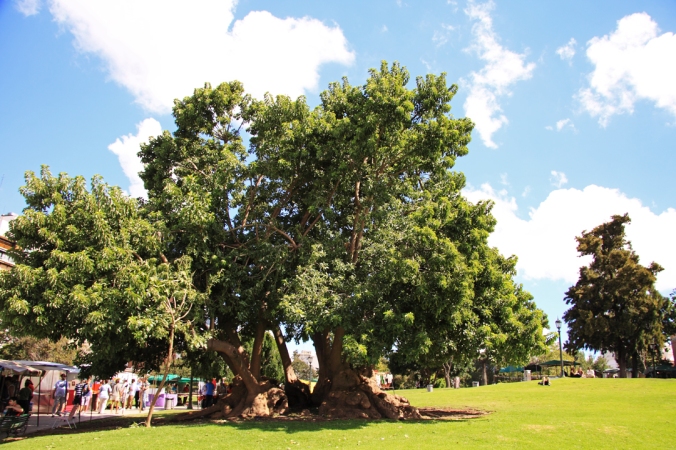
Ombú (Phytolacca dioica) | Buenos Aires, Argentina

Ombú (Phytolacca dioica) | Buenos Aires, Argentina

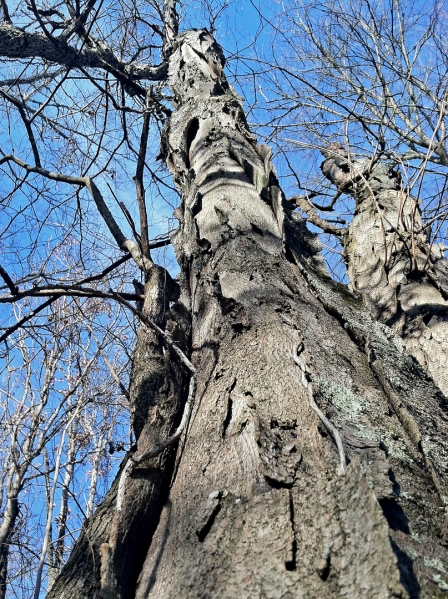
While not nearly as spectacular as El Gran Gomero, there is an Ombú growing nearby in the same very plaza adjacent to the Recoleta Cemetery (above photo) that typifies the multi-stemmed, swollen-base appearance that very large specimens assume. It is easy to see how, at least based on superficial appearance, one could mistake El Gran Gomero for an Ombú; however, it also goes to show that one should always be cautious about too quickly accepting what they find on the internet (watch somebody now point out an error in this post!).

Here is another (better) photo of the exact same tree.

Copyright © Ted C. MacRae 2013

The 213-year old “Gran Gomero”

Here are two more views of the tree featured in ID Challenge #21. This is El “Gran Gomero,” a planted rubber tree (Ficus elastica) located in the upscale Recoleta district of Buenos Aires, Argentina. Whenever locals give a name to an individual tree, you know it has to be something special, and this tree certainly does not disappoint. Huge, buttress roots and massive branches supporting a majestic, 50-meter wide crown make it an impressive sight indeed. Its branches are so large that wooden supports have been placed beneath them to help support their great weight and prevent them from breaking.

El "Gran Gomero" rubber tree (Ficus elasticus) | Buenos Aires, Argentina

El “Gran Gomero” rubber tree (Ficus elasticus) | Buenos Aires, Argentina

There seems to be some question about how old this tree actually is. A Wikipedia entry on the Recoleta district mentions that the tree was planted in 1791 by Martín José Altolaguirre, a landowner in the area at the time, making it a cool 222 years old! Wikimapia claims that the tree was planted in 1826 by Martín de Altolaguirre in the adjacent Recoleta Cemetary (itself worth a blog post) and transplanted to its current location eight years later. Still other sources, such as Buenos Aires Delivery and numerous individual blog posts state that the tree was planted in 1870 by the monks of the Recoleta. Finally, there is a sign at the base of the tree that says the tree was planted in 1800, again by the monks of the Recoleta, and that the fence was donated to the city by the nearby cafe La Biela. Unfortnately, I did not photograph the sign, but I did find a photo of it on Flickr. Perhaps the 9-year difference in planting date between the sign and Wikipedia has to do with the transplanting from its original location in the cemetary as mentioned by Wikimapia. Regardless of its true age, El Gran Gomero must certainly be among the oldest of any residing in a city as large as Buenos Aires.


Huge buttress roots support a massive, 50-meter wide crown.

Huge buttress roots support a massive, 50-meter wide crown.

Just when I was beginning to think nobody read this blog anymore, a record 30 people participated in this ID Challenge. Even more impressive is that more than a few got it right! Timing is everything, however, and 3-time BitB Challenge Champion Ben Coulter takes the win due to his speedy response and early-bird bonuses that netted him a total of 23 points. Also making the podium were Chelydra and Brady Richards with 18 each. The overall leader is now Ben Coulter with 33 points. Bill Rockenbeck and Chelydra both follow with 21 points, but in the event of a tie-breaker Bill would get the nod by virtue of having participated in more challenges. Look for another installment of BitB Challenge Session #7 in the near future.

Copyright © Ted C. MacRae 2013

Backyard gems

I’ve been fortunate to have the chance to travel far and wide in my searches for insects—from the Gypsum Hills of the Great Plains and Sky Islands of the desert southwest to the subtropical riparian woodlands of the Lower Rio Grande Valley, tropical thorn forests of southern Mexico and veld of southern Africa. No matter how far I travel, however, I’m always happy to return to the Missouri Ozarks. It is here where I cut my entomological teeth so many years ago, and though I’ve now scrabbled around these ancient hills for more than three decades it continues to satisfy my thirst for natural history. Though not nearly as expansive as the Great Plains, there are nevertheless innumerable nooks and crannies nestled in the Ozarks, and I find myself constantly torn between looking for new spots (it would take several lifetimes to find them all) and going back to old favorites. Living in the northeastern “foothills” in the outskirts of St. Louis provides an ideal vantage for exploration; however, sometimes I am truly amazed at the natural history gems that can be found within a stone’s throw from my house. Some examples I’ve featured previously include Shaw Nature Reserve, home to a hotspot of the one-spotted tiger beetle, Castlewood State Park, where I found a gorgeously reddish population of the eastern big sand tiger beetle, and Victoria Glades Natural Area, site of the very first new species (and perhaps also the most beautiful) that I ever collected.

Englemann Woods Natural Area | Franklin Co., Missouri

Today I found another such area—Englemann Woods Natural Area, and at only 5 miles from my doorstep it is the closest natural gem that I have yet encountered. One of the last old-growth forests in the state, its deep loess deposits on dolomite bedrock overlooking the Missouri River valley support rich, mesic forests on the moister north and east facing slopes and dry-mesic forests on the drier west-facing slopes dissected by rich, wet-mesic forests with their hundreds-of-years-old trees. A remarkable forest of white oak, ash, basswood and maple in an area dominated by monotonous second-growth oak/hickory forests.
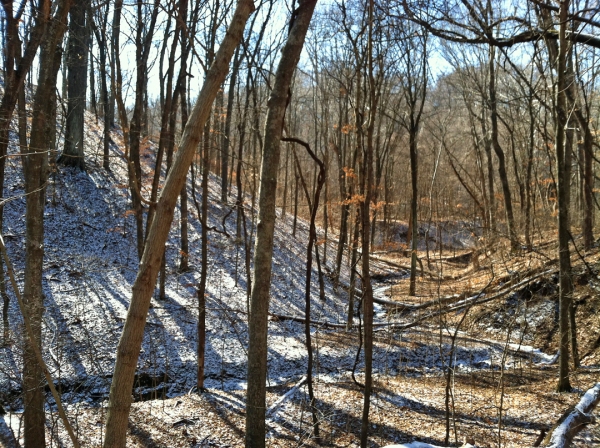
Englemann Woods Natural Area

Steep north-facing slopes border the Missouri River valley.

It is not, however, the 200-year-old trees that will bring me back to this spot, but rather the understory on the north and east-facing slopes. Here occur some of the richest stands of eastern hornbean (Ostrya virginiana) that I have ever seen. This diminutive forest understory inhabitant is not particularly rare in Missouri, but as it prefers rather moist upland situations it is not commonly encountered in the dry-mesic forests that dominate much of the Ozarks. Stands of this tree, a member of the birch family (Betulaceae) are easy to spot in winter due to their habit of holding onto their dried canopy of tawny-brown leaves (see photo below).
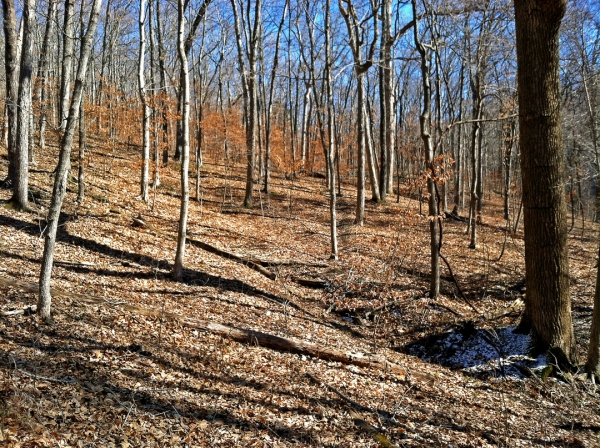
Englemann Woods Natural Area

Rich stands of eastern hornbeam (Ostrya virginiana) dominate the north- and east-slope understory.

Why am I so interested in this plant? It is the primary host of the jewel beetle species Agrilus champlaini. Unlike most other members of the genus, this species breeds in living trees rather than dead wood, their larvae creating characteristic swellings (galls, if you will) on the twigs and stems as they spiral around under the bark feeding on the cambium tissues before entering the wood to pupate and emerge as adults in spring. This species is known in Missouri from just two specimens, both collected by me way back in the 1980s as they emerged from galls that I had collected during the winter at two locations much further away from St. Louis. The presence of this rich stand of hornbeam just 5 miles from my home gives me the opportunity to not only search the area more thoroughly to look for the presence of galls from which I might rear additional specimens, but also to look for adults on their hosts during spring and (possibly, hopefully) succeed in photographing them alive.
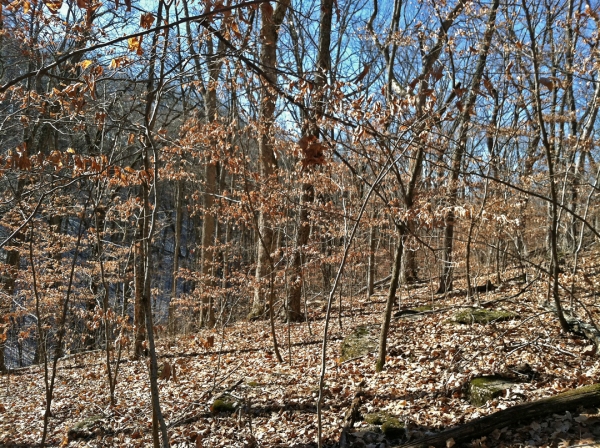
Englemann Woods Natural Area

Inside the “hornbeam forest.”

Another “draw” for me is the restoration work that has begun on some of the west-facing slopes in the areas. Pre-settlement Missouri was a far less wooded place than it is today, as evidenced by the richly descriptive writings penned by Henry Schoolcraft during his horseback journey through the Ozarks in the early 1800’s. At the interface between the great deciduous forests to the east and the expansive grasslands to the west, the forests of Missouri were historically a shifting mosaic of savanna and woodland mediated by fire. Relatively drier west-facing slopes were more prone to the occurrence of these fires, resulting in open woodlands with more diverse herbaceous and shrub layers. At the far extreme these habitats are most properly called “xeric dolomite/limestone prairie” but nearly universally referred to by Missourians as “glades”—islands of prairie in a sea of forest! I have sampled glades extensively in Missouri over the years, and they are perhaps my favorite of all Missouri habitats. However, it is not future glades or savannas that have me excited about Englemann Woods but rather the availability of freshly dead wood for jewel beetles and longhorned beetles resulting from the selective logging that has taken place as a first step towards restoration of such habitats on these west-slopes. The downed trees on these slopes and subsequent mortality of some still standing trees that is likely to result from the sudden exposure of their shade adapted trunks to full sun are likely to serve as a sink for these beetles for several years to come. I will want to use all the tools at my disposal for sampling them while I have this opportunity—beating, attraction to ultraviolet lights, and fermenting bait traps being the primary ones. It looks like I’d better stock up on molasses and cheap beer!
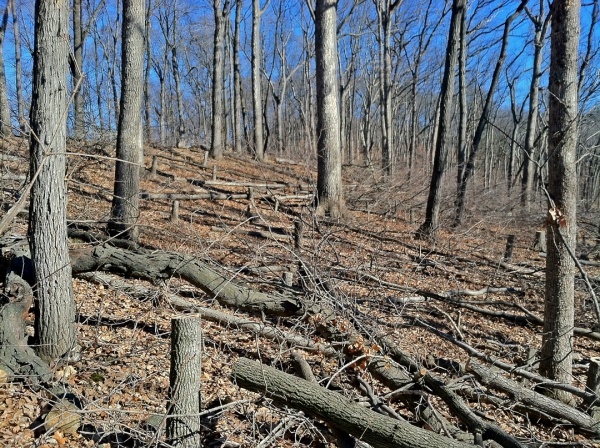
Englemann Woods Natural Area

Restoration efforts on the west-facing slopes begins with selective logging.

Eastern red-cedar (Juniperus virginiana) is native to Missouri, but in our time it has become a major, invasive pest tree. The suppression of fire that came with settlement also freed this tree from a major constraining influence on its establishment in various habitats around the state, primarily dolomite/limestone glades. Nowadays most former glade habitats, unless actively managed to prevent it, have become choked with stands of this tree, resulting in shading out of the sun-loving plants that historically occurred much more commonly in the state. Untold dollars are spent each year by landscape managers on mechanical removal and controlled burns to remove red-cedar and prevent its reestablishment in these habitats. There is one habitat in Missouri, however, in which eastern red-cedar has reigned supreme for centuries or possibly millenia—dolomite/limestone bluff faces.
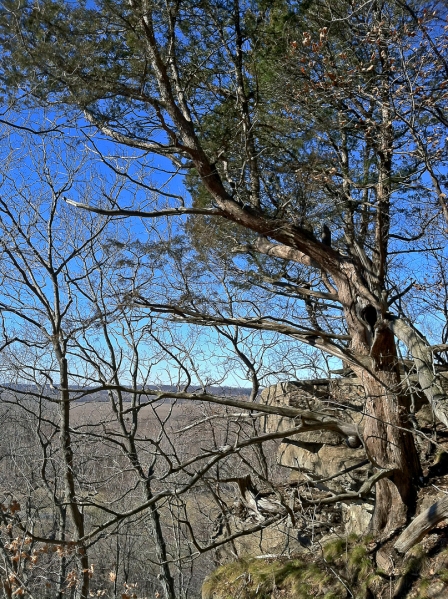
Juniperus virginiana

Craggly, old Eastern red-cedars (Juniperus virginiana) cling tenaciously to the towering dolomite bluffs.

With little more than a crack in the rock to serve as a toehold, red-cedars thrive where no other tree can, growing slowly, their gnarled trunks contorted and branches twisted by exposure to sun and wind and chronic lack of moisture. Some of the oldest trees in Missouri are red-cedars living on bluffs, with the oldest example reported coming from Missouri at an incredible 750–800 years old. There is something awe-inspiring about seeing a living organism that existed in my home state before there were roads and cars and guns. These ancient trees are now an easy drive from my house (though a rather strenuous 300-ft bushwhacking ascent to reach the bluff tops)—they seem ironically vulnerable now after having endured for so long against the forces of nature. For me, they will serve as a spiritual draw—a reason to return to this place again regardless of what success I might have at finding insects in the coming months.
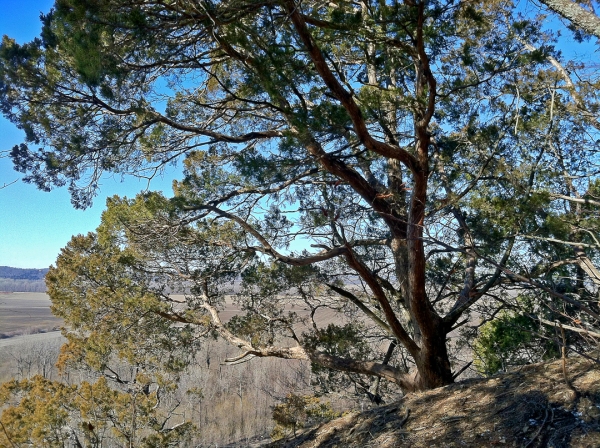
Juniperus virginiana

This tree may pre-date Eurpoean settlement.

Aplectrum hyemale

Adam-and-Eve orchid (Aplectrum hyemale).

Copyright © Ted C. MacRae 2013
These are a few of my favorite trees

Adrian Thysse recently posted a video of a talk by Wayne Maddison titled “Jumping Spider Melodies,” given November 2012 at the Joint Annual Meeting of the Entomological Society of Canada and the Entomological Society of Alberta. It was a fascinating talk that revealed some interesting correlations between the phylogeny and geographical patterns of distribution of jumping spiders—those bright-eyed, bouncy, almost kitten-like darlings of the spider world. One quote from the talk, however, that stood out for me above all others went something like “Scientists have a rational motivation to seek truth and an emotional motivation to seek beauty.” I think this is true especially for biologists and natural historians—who among us that studies that natural world in adulthood didn’t start out with a love of the outdoors as a child? For me it was the woods that ignited my passion, and still today nothing rejuvenates my spirit like the overwhelming beauty and solitude of the forest.

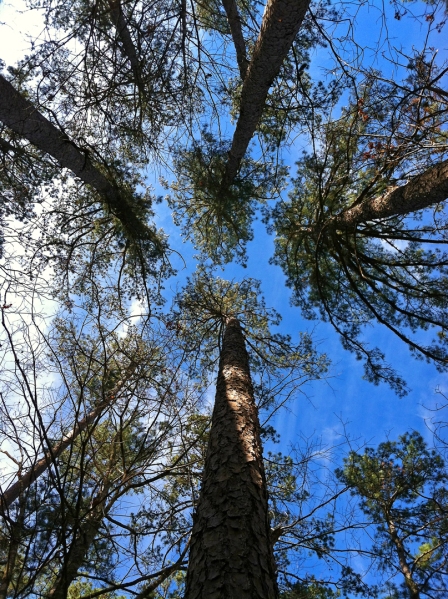
Shortleaf pine (Pinus echinata) | Wayne Co., Missouri

Shortleaf pine (Pinus echinata) | Wayne Co., Missouri

Wintertime especially is when I enjoy my visits to the forest. Far from the cacophony of summer, my mind is free to explore the open canopy, to examine the fabric of the landscape and ponder its history—unhurried, without objective. During the summer, trees are host plants—I see them not for what they are, but for the beetles that might be on them. I identify them, sample them, assess them for where their guests might be. In winter though, without beating sheet in hand, without collecting vials in the pocket, I see trees as works of art—freed from their summer cloaks, living skeletons on a living landscape.

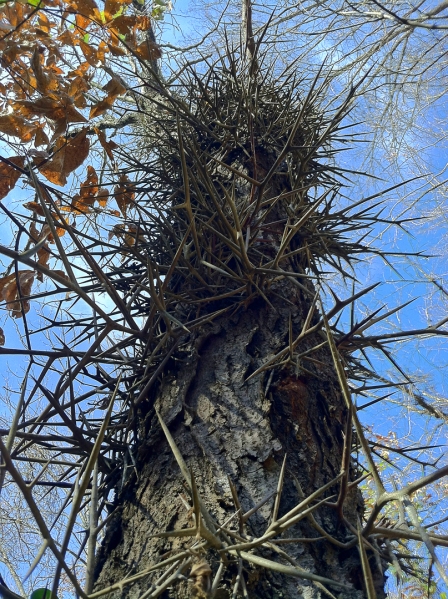
Honey locust (Gleditsia triacanthos) | Wayne Co., Missouri

Honey locust (Gleditsia triacanthos)

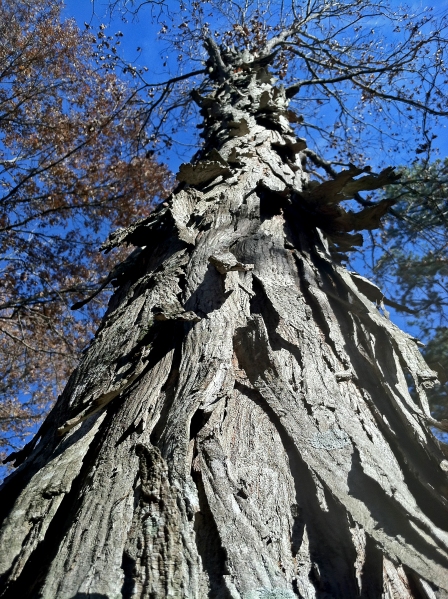
Different trees are my favorite at different times for different reasons. Blazing hot orange sugar maples (Acer saccharum) at peak fall color, stately white oaks (Quercus alba) with their ash-gray branches, broad-crowned post oaks (Quercus stellata) dotting a remnant savanna, or even gnarled, ancient red-cedars (Juniperus virginiana) clinging tenuously to life on the edge of a dolomite bluff. Most often for me, however, the beauty is in the bark. The deeply fissured, reddish plates of shortleaf pine (Pinus echninata), the terrifyingly thorned trunks of honey locust (Gleditsia triacanthos), the shaggy, peeling strips of shagbark hickory (Carya ovata). Even in their winter nakedness, the bark of these trees gives them year-round personality that is lacking in lesser-barked trees.

Shagbark hickory (Carya ovata) | Wayne Co., Missouri

Shagbark hickory (Carya ovata)

Honey locust (Gleditsia triacanthos) - thornless individual | Wayne Co., Missouri

Honey locust (Gleditsia triacanthos) – thornless individual

The tree in this post were photographed during November 2012 while hiking the Wappapello Section of the Ozark Trail in the Ozark Highlands of southeastern Missouri (Wayne Co.). 

Copyright © Ted C. MacRae 2013
Great Smoky Mountains National Park

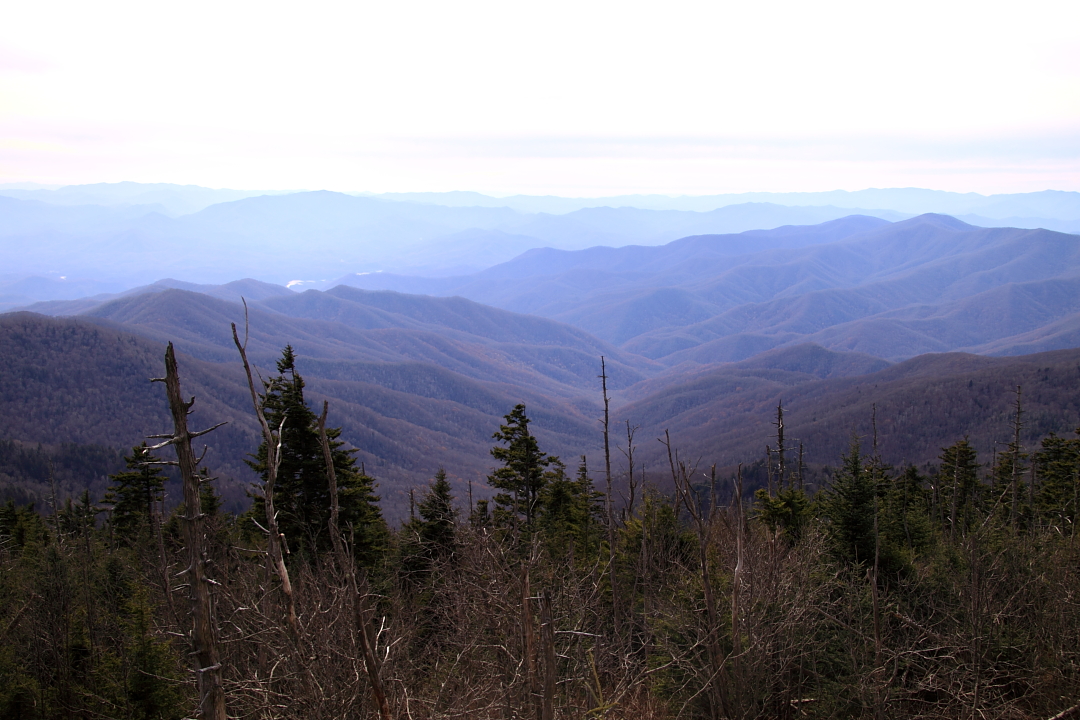
Is there any question why these are called the Smoky Mountains?

Last week I attended the Entomological Society of America (ESA) meetings in Knoxville, Tennessee. It was my first ESA attendance in more than ten years, so I took full advantage of the opportunity by speaking at the insect macrophotography symposium, presenting a poster on my soybean insect research, and enjoying face-to-face conversations with an extraordinary number of colleagues—some of whom I had not seen since my last ESA meeting and many more for which this was my first opportunity to meet them in person. I admit to having grown a little complacent in recent years about the importance of regular personal contact in cultivating these relationships—my attendance at this year’s ESA reminded me of that fact, and I’ve renewed my commitment to make ESA attendance a priority in the coming years.

Of course, no meeting should be all work and no play, and for me the chance to sample the local natural or cultural history is an added benefit of meeting attendance. This year’s destination for such was a no-brainer—located less than an hour’s drive from Knoxville, Great Smoky Mountains National Park is the largest federally protected area east of the Mississippi River. Straddling some of the highest peaks of one of the world’s oldest mountain ranges, the park has been designated an International Biosphere Reserve by the United Nations due to its rich biota.

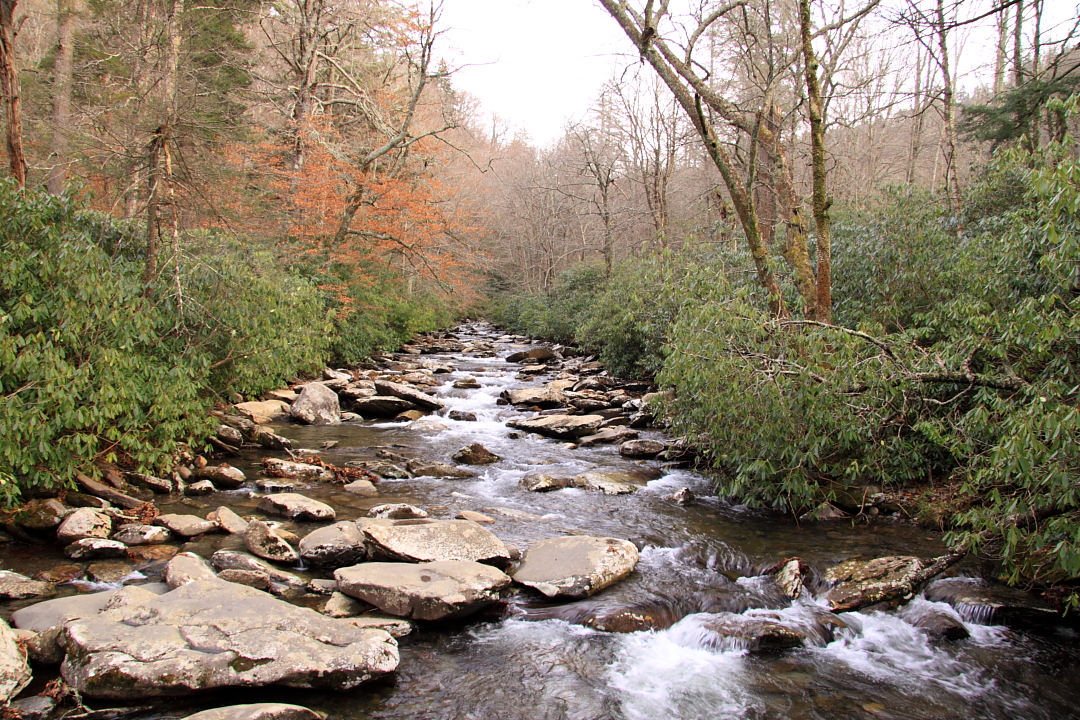
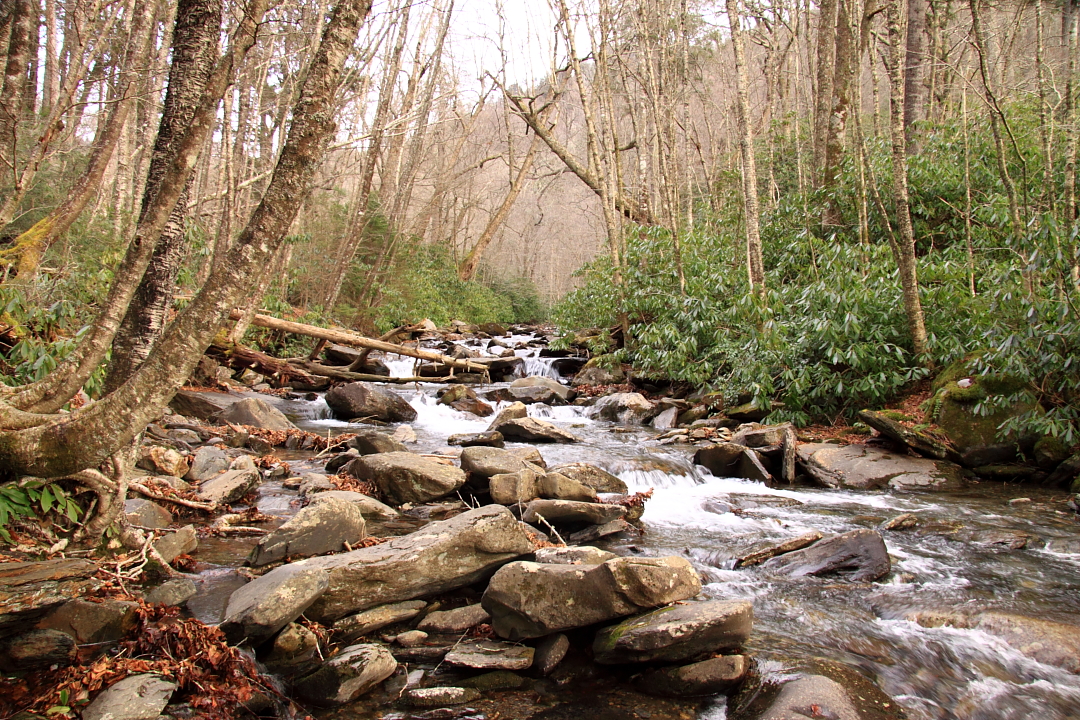
One afternoon is not nearly enough time to even scratch the surface of the park’s 800 square miles, but it’s enough to get a taste of the diverse habitats they encompass and whet the appetite for further exploration. Highly recommended for those short on time is Clingman’s Dome—the park’s highest point at 6,643 ft. An observation tower allows spectacular vistas (provided the day has good visibility) of the surrounding mountains and the evergreen forests that cloak them. Unfortunately, the view has been marred in recent years by the accidental introduction of an exotic woolly adelgid (a relative of aphids) from Europe and its subsequent establishment on the forest’s Frazier firs. Dead trunks rise from the forest like tombstones—ghostly reminders of what has been lost. The starkness of the high elevation forest contrasts with the lush mixed hemlock forest that dominates the park’s lower elevations, and the 2.4-mile Alum Creek Trail provides an intimate experience with this rich forest and its thick understory of native rhododendron. I hope the following slide show imparts some essence of the experience, and larger versions of each photo can be seen by clicking on the thumbnails in the gallery that follows.

This slideshow requires JavaScript.

Copyright © Ted C. MacRae 2012

9th Annual Fall Tiger Beetle Trip: Day 1

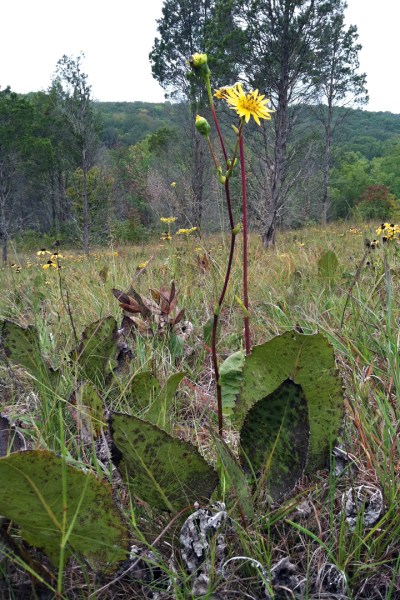
Once again, I have embarked upon my Annual Fall Tiger Beetle Trip, this being the ninth consecutive year that I have done such a trip. Unlike previous editions, however, the quarry on Day 1 (Sept. 15) was not a tiger beetle but a longhorned beetle. Ataxia hubbardi is not uncommon in the eastern and central U.S. and breeds in the living tissues of a variety of herbaceous plants, but especially certain species of Helianthus, Ambrosia, and Silphium in the family Asteraceae. I was hoping to see a distinctive population of this beetle that is associated with prairie dock (Silphium terebinthinaceum) in the dolomite glades just south of St. Louis. This population is interesting because individuals are smaller, darker, and narrower in form than is typical for the species, and I would like very much to get some photographs of the adults, which seem most abundant in the fall, on the tall flower stalks of their host plant.

Victoria Glades Natural Area | Jefferson Co., Missouri

I first discovered the population many years ago—back in the 1980s when I visited one particular glade, Victoria Glades Natural Area, almost weekly over a period of several years. I left Missouri for a few years in the early 1990s but returned in 1995, and during my absence fire was implemented in Victoria Glades and other glades in the area as a management practice for controlling invasion by woody plants (primarily eastern red-cedar, Juniperus virginiana). While the use of fire has certainly done much to restore the glades and improve its floral diversity, it seems more than coincidental that insect abundance and diversity on the glades is only a fraction of what I observed during my pre-burn collecting in the 1980s. There are a number of beetle species that I found at the glade historically that I have not seen now for more than 20 years; one of which is this distinctive population of A. hubbardi.

Prairie dock (Silphium terebinthinaceum) – host for Ataxia hubbardi

The prairie dock plants were at the height of bloom, but the flower stems seemed shorter and the normally large, spatulate basal leaves of the plants generally smaller than typical—perhaps a result of this summer’s severe drought. How such conditions affect the beetles is unknown. The day was also rather cool due to unbroken cloud cover and light drizzle, with temperatures in the low 70s during my visit. I spent the better part of two hours inspecting the stems of every prairie dock plant that I encountered and did not see a single beetle, so it has now been 23 years—almost a quarter century—since I’ve seen this once fairly common species at the glade. Can I prove that fire management has extirpated the beetle? No—populations might have been knocked down by the drought, or maybe the adults hide on cool, cloudy, drizzly days. Still, the pattern is too consistent to ignore, and I become increasingly worried that a special feature of these glades has now been lost.

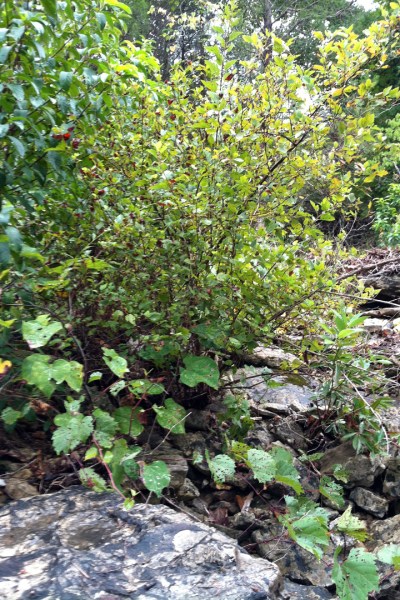
Ninebark (Physocarpus opulifolius intermedius) – host for Dicerca pugionata

On the other hand, another quite rare beetle that I encountered abundantly at Victoria Glades in the past seems to have rebounded from its long absence—the jewel beetle Dicerca pugionata. This beautiful beetle is associated with the scraggly clumps of ninebark (Physocarpus opulifolius intermedius) that hang on in the moist toe slopes of the glades. I wrote about this species earlier this year after re-discovering it in the glades; however, I couldn’t resist taking a few more photographs of this stunningly gorgeous species. This species also makes its appearance in the fall as well as spring, and in the two hours I spent searching I counted 13 beetles—more than I’ve ever seen on any one day. Interestingly, most of these were associated with a stand of plants in an area at the south end of the glade that I had never searched before and that appears not to have been subjected to fire management (cedar removal has been effected instead with a chain saw). Only a few of the beetles were found in the much more abundant plants growing in the area of the glade I am more familiar with and that has obviously been subjected to repeated burning. It’s not proof, but I’m just saying…

Dicerca pugionata on ninebark branch.

Adult beetles are colored almost precisely the same as the bark of their host plant.

More even lighting in this face shot compared to my previous attempts.

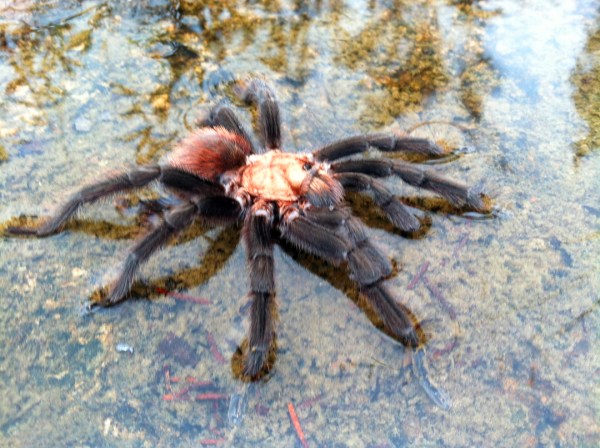
The cool temperatures and light drizzle were not conducive to much other insect activity, but while crossing the small, shallow creek that separates the south end of the glade from the main glade, the biggest male tarantula (Aphonopelma hentzi) that I have ever seen caught my attention as it crossed the creek. Situated only 30 miles south of St. Louis, Victoria Glades must represent the northeastern limit of distribution for the species, and although I once saw a tarantula crossing the road very near to this location, this is the first tarantula that I have actually seen in the glades that lie so close to St. Louis. Males are famous for their fall wanderings, presumably in search of the females that tend to stay within their burrows. This male was missing part of one of its hind legs but otherwise appeared quite healthy and robust. I hope he succeeds in finding a mate and sires many offspring and is not discovered by any of the poachers who regularly scour the glades and steal its more unusual inhabitants—the glades have already lost enough of their unique residents…

Can you find the tarantula crossing the creek? (Hint: 0.60X, 0.37Y)

Male Aphonopelma hentzi | Jefferson Co., Missouri

Copyright © Ted C. MacRae 2012

Fathers Day at the Missouri Botanical Garden

Yesterday my girls (wife Lynne and daughters Mollie and Madison) took me and my father to the Missouri Botanical Garden for Fathers Day. Although I’m an entomologist, I also have a strong botanical bent, and although my wife and father are not scientists like me, they nevertheless find a day at the Missouri Botanical Garden as enjoyable as I do. The girls, on the other hand, will never admit that they like it the way the rest of us do, but I think deep inside they enjoy it very much and, in later years, will look upon these visits as some of their fondest Mothers and Fathers Day memories.

Me and daughters Mollie and Madison.

My father and I have been back together for 20 years now. With my wife and daughters, he has become one of the most important persons in my life. I wrote an essay about my father four years ago that explains how he made me whole—it still rings true today.

Me and Pop.

I have been to the Missouri Botanical Garden many, many times over the years, but one sight have have still never seen is a corpse flower (Amorphophallus titanum). I learned earlier this week that one of their plants is about ready to bloom, so I eagerly looked for this plant as we wound our way through the Climatron. As we came near the end and I still hadn’t seen it, I wondered if somehow I had missed it along the path. Suddenly I caught a glimpse of the giant 3′ tall flower bud near the end of the footpath, and I knew instantly that I had found what I was looking for.

Corpse flower (Amorphophallus titanum) getting ready to bloom.

I will be keeping track of the progress of this flower over the next couple of weeks on the Missouri Botanical Garden Facebook page in hopes that I can see it again when the flower opens fully—a rare botanical treat that few people ever get the chance to experience!

Corpse flower explained.

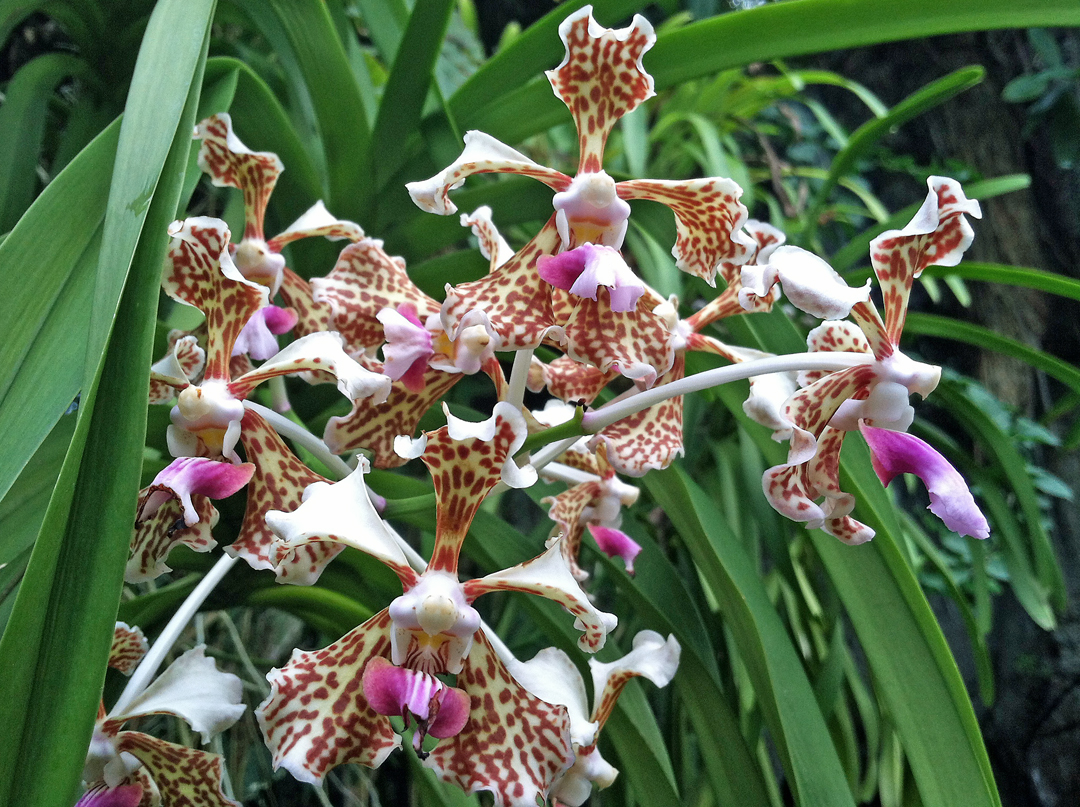
In my younger years when I had a bit more free time on my hands I was a hobbyist orchid grower. I didn’t have a greenhouse but nevertheless managed to keep a steady supply of plants in bloom by growing them outdoors under shade cloth with heavy watering and fertilizing during the summer and moving them indoors under fluorescent lights and in bright windows during the winter. I don’t have nearly the time for such pursuits these days, but I still enjoy looking at their exquisite and infinitely diverse blooms whenever I have the chance, and the Climatron never fails to disappoint.

One of many epiphytic orchids blooming in the Climatron.

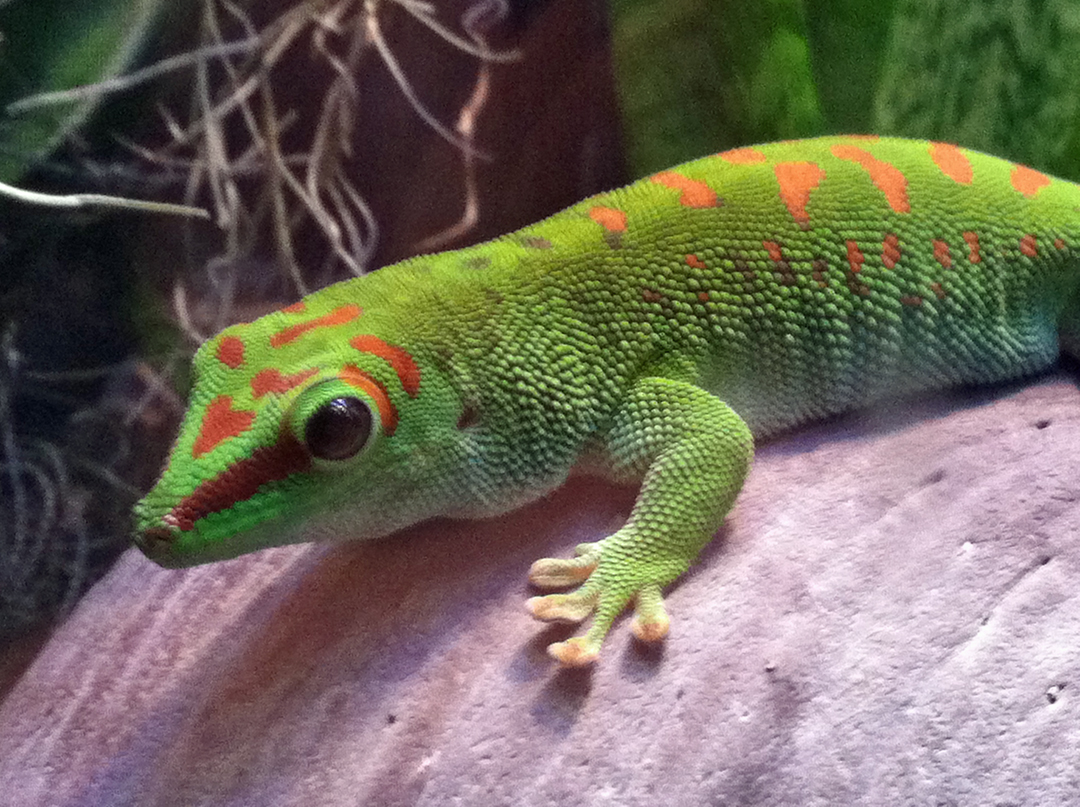
While walking through the Climatron, I noticed a very exotic looking lizard on the trunk of one of the trees. I watched it licking exudate from the trunk and thought such behavior seemed rather odd. I later learned that this was the Standing’s day gecko (Phelsuma standingi), and that it might have an important role in pollinating the double coconut palm (Loidiocea maldivica). Both are endemic to the Seychelles Islands north of Madagascar, with the latter bearing the largest seed of any plant in the world (up to 45 lbs. in weight). The photo below was taken of another individual through the glass of its terrarium and, thus, lacks some clarity, but it shows the vivid colors and markings that distinguish these diurnal geckos from the other more typically nocturnal members of the gecko infraorder.

Standing’s day gecko (Phelsuma standingi).

While not gracing this post in a photo, many thanks to my loving wife, Lynne, who is the best mother my daughters could ask for and who helped make yesterday the special day for me and my father that it was!

Copyright © Ted C. MacRae 2012

Friday Flower: Phacelia purshii

Phacelia purshii (Miami mist) | Sam A. Baker State Park, Wayne Co., Missouri

It’s been rather a long time since I’ve featured a botanical subject here, so it seems a good time to resurrect my “Friday Flower” meme with this delightful little wildflower seen on my birthday field trip a few weeks ago. Phacelia purshii (family Hydrophyllaceae), also known as Miami mist, is one of only four species in this rather large genus (159 species in North America according to the USDA Plants Database) found in Missouri. Though the flowers are small, their deeply fringed petals are quite striking. The late Dan Tenaglia¹ notes at his Missouriplants.com website that the species is limited in Missouri to the extreme eastern portions of the state—the plant shown here was one of several I saw in rich, bottomland forest along Big Creek at Sam A. Baker State Park in Missouri’s southeastern Ozark Highlands.

¹ Dan Tenaglia was not only an expert botanist but a enthusiastic cyclist. He died in February 2007 after being struck by a car while riding his bicycle. Dan’s wife has kept Missouriplants.com up and running since then in honor of his passion for plants. You can help support its maintenance by making a donation to the “Dan Tenaglia Foundation”: 1416 Victoria Avenue, Opelika, Alabama 36801.

This particular woods is one of the richest I’ve seen in the state, and in the past two years I’ve featured a number of interesting plants (Phlox bifida and Tradescantia longipes), invertebrates (Drosphila sp., Magicicada sp.Calosoma scrutator, Pleuroloma flavipes, Graphisurus trianguliferG. fasciatus, Arrhenodes minutus, Neoclytus scutellaris, Corydalus cornutus and Panorpus helena) and even snakes (Crotalus horridus and Agkistrodon contortrix phaeogaster) from there. This year marks the third consecutive birthday that I’ve visited these woods, and since I’ve found something I’ve never seen before each time (hint: just wait till you see what I still have coming from there!), I have a feeling the trend will continue next year as well.

Copyright © Ted C. MacRae 2012