Welcome to the 15th “Collecting Trip iReport” covering the second 11-day insect collecting trip to eastern New Mexico this year. This trip, which took place on June 17–28, was a follow-up to “Act 1” on May 14–25 with the purpose of servicing “jug traps” placed on the first trip. Joining me this time was Rich Thoma, who has accompanied me on more field trips than anyone else over the past four decades! Initially I had planned to pick up the traps that I’d placed on the first trip; however, I found the idea of sampling just the early part of the longhorned beetle season to be unsatisfying and decided shortly before the trip to service the traps but leave them in place for another sampling period and make a third trip later in the season to retrieve them. It will be a coupe of months, however, before I can make that third trip, meaning the traps will be out for much longer than normal and making desirable any modifications that I can make to extend their effectiveness. To that end, I prepared larger bait bottles (500-ml capacity versus 250-ml) and purchased enough propylene glycol to fill the jug reservoirs to the limit of their capacity (1250 ml versus the 900 ml used previously). The prototype trap that I made prior to the trip seemed to work, so it was only a matter of deploying them in the field and keeping my fingers crossed. Similar to the last trip, we ended up making 16 visits to 16 different localities—15 in New Mexico, one in Oklahoma (versus 13 localities previously), but unlike last trip we also spent time at two localities (one in Oklahoma, one in Texas) strictly for hiking and observation.
As always, this report assembles field notes generated during the trip in “semi-rough” form—i.e., lightly condensed and “polished” but not further modified based on subsequent examination of collected specimens unless expressly indicated by “[Edit…]” in square brackets. As with all “iReports” in this series, this report is illustrated exclusively with iPhone photographs. Previous iReports in this series are:
– 2013 Oklahoma
– 2013 Great Basin
– 2014 Great Plains
– 2015 Texas
– 2018 New Mexico/Texas
– 2018 Arizona
– 2019 Arkansas/Oklahoma
– 2019 Arizona/California
– 2021 West Texas
– 2021 Southwestern U.S.
– 2022 Oklahoma
– 2022 Southwestern U.S.
– 2023 Southwestern U.S.
– 2024 New Mexico: Act 1
Day 1
Salt Plain National Wildlife Refuge
Alfalfa County, Oklahoma
Rich and I are repeating the 12-hour drive from St. Louis to Black Mesa State Park in the northwestern corner of the Oklahoma panhandle that I did last month with Mike Arduser. I decided not to do the dreadful I-44 through Tulsa route, even though it is quicker, because I really just dread the boredom of the interstates and especially dislike the traffic and highways around Tulsa. Instead, we cut into southern Kansas at the last mile in Missouri and skimmed the bottom edge of that state—a very scenic route—until dropping down into Oklahoma once we’d gotten past I-35. Since we were passing by Salt Plain National Wildlife Refuge and it had been probably ten or more years since we’d stopped there, we decided to take a look around the alkaline flats to see what tiger beetles we might see.

Ellipsoptera nevadica knausii (Knaus’ tiger beetle) was out in abundance, allowing easy cell phone photography.

There was also the occasional individual of the dreadfully pedestrian Cicindelidia punctulata punctulata (punctured tiger beetle), but none of the other alkaline flat specialties like Eunota circumpicta johnsoni (Johnson’s tiger beetle) or Eunota togata globicollis (white-cloaked tiger beetle) were seen.

We were fooled, however, by a tiny species of “tiger beetle” that, upon closer inspection, proved to be a shore bug (Pentacora signoreti—family Saldidae).

It was dreadfully windy (as it often is in the wide open reaches of the vast Great Plains), so nothing was found on the few flowers that were found along the trail. Not wanting to delay our arrival at Black Mesa this evening too much, we cut the visit short and continued on the way.

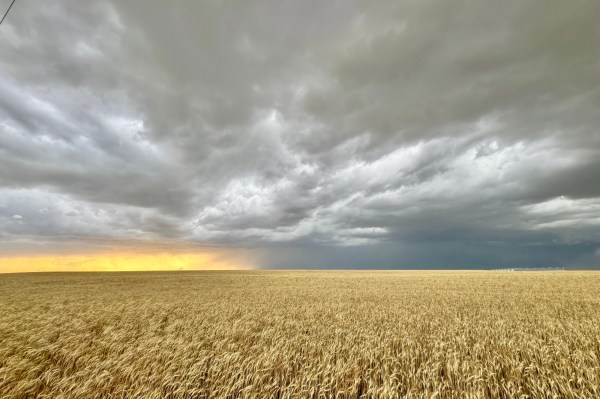
The rest of the drive along the northern edge of Oklahoma was stunningly beautiful. Not only did we get to enjoy the non-interstate landscape and the more intimate experience it provided, but we also watched a spectacular storm system as it bloomed across the skies to the north and west. Radar and forecasts calmed our fears that we would experience it more directly—it was slated to sweep across Kansas but not touch Oklahoma, letting us admire stunning vistas of golden fields of sunlit wheat against a backdrop of blackened clouds …

…and, as sunset approached, fiery skies peaking out between them.
Black Mesa State Park
Cimarron County, Oklahoma
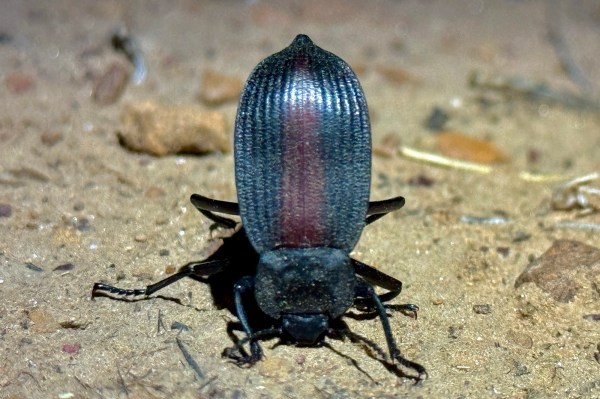
By the time we reached Black Mesa State Park, it was well dark, but we got camp set up with enough time left to enjoy a beer and relax a bit before walking the roads to see what beetles might be out and about. I was hoping to see Amblycheila cylindriformis (Plains giant tiger beetle), but our finds were limited to darkling beetles (Eleodes suturalis and E. longicollis)…
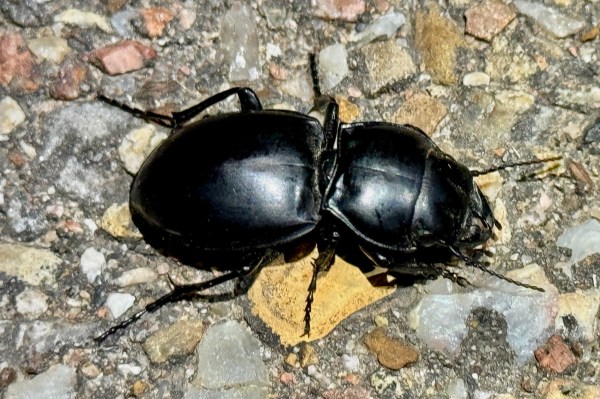
…a couple of Pasimachus californicus (California warrior beetle—family Carabidae)…
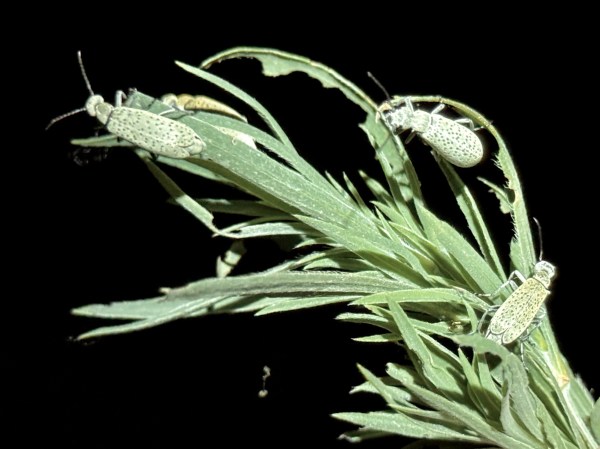
…and an interesting aggregation of Epicauta sp. prob. maculata species-group blister beetles (family Meloidae).
Satisfied we’d given the area a good enough look, we settled into the fly-less tent to admire the stars while falling to sleep in the cool night air.

After resting up a bit, we decided to head back out of the park (and, thus, into New Mexico) to nearby Queen to replenish our ice and liquids and then visit the Lincoln National Forest’s Sitting Bull Falls Recreation Area. Both of those decisions did not work out as planned. The (only) convenience store in Queen was closed, despite the posted hours of business stating they were open until 5 pm, so the little ice that we had left would have to last until the morning. Then, when we arrived at the turn off to Sitting Bull Falls, we saw that the area closed at 4 pm—less than an hour away. We drove to the entrance anyway, where we found a parking area for a trailhead and looked around a bit. The area was very lush, obviously having enjoyed the recent rains, but there was almost no insect activity to speak of. Our already tired legs didn’t help with our motivation, and we decided to call it a day and head back to the park.
Day 2
Conditions turned quickly and unexpectedly on us! There was no hint of rain in the local forecast, but we awoke at 2 am to drizzle coming through the roof of the tent and quickly installed the rain fly. It rained the rest of the night—sometimes heavily, and while we were able to eat breakfast and then break camp in the morning before heavy rains returned it was still a cold, windy, drizzly experience. (I’ve now camped here seven times in the last two years, and this is the fourth time I’ve experience blustery cold and/or rainy weather here!) We had planned to collect during the morning at our favorite nearby spot—a sandstone outcropping just east of Kenton where I have collected five new state records—two cerambycids and three buprestids—in the last few years. Steady rain and cold temperatures, however, cancelled those plans, and radar and forecasts made it appear we might spend the next two or three days dealing with such unless we made significant progress towards the south. We decided to go to our next stop—Mills Rim Campground—where I had the first set of my traps to service, and then see how conditions developed before deciding whether to stay or move on.
Mills Rim Campground
Kiowa National Grassland
Harding County, New Mexico
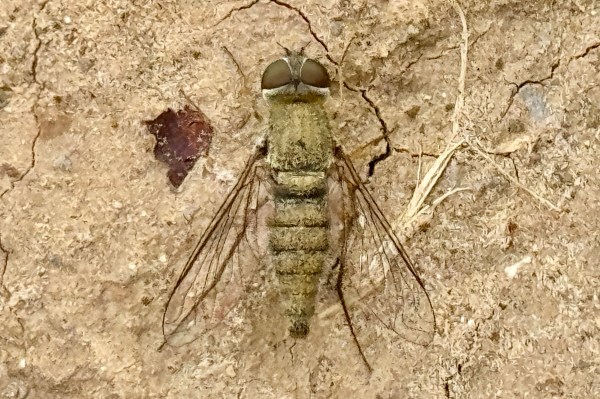
Rains did let up as we approached Mill Rim Campground and while we were there, but only temporarily while cool (almost cold!) conditions persisted. We stopped on the road into the campground to check out a pile of recently-cut juniper wood hoping to see woodboring beetles, but all I saw was a solitary bee fly (though one I’d never noticed before—Aphoebantus sp. (bee fly—family Bombyliidae).
In the campground, I was pleased to see that all three traps were still in place, though the bait and reservoir liquid were both completely gone in them. I was also pleased to find that the traps redeployed nicely with my changes (larger 500-ml bait bottle and a larger volume—1250 ml—of diluted propylene glycol in the reservoir).
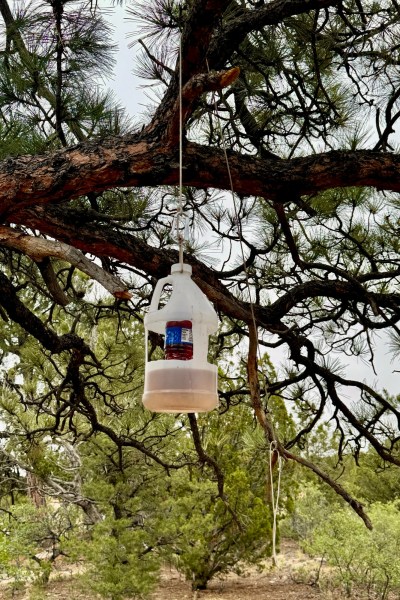
Catch results, however, were a bit disappointing. The SRW and SRW/EtOH traps had lots of moths and Euphoria fulgida but no cerambycids, while the EtOH trap had nothing but a single E. fulgida (I suspect the trap reservoir may have been “dumped” during high winds). The white bottle trap had a few Acmaeodera spp. and about 12–15 bees, which I collected for my mellitologist friend Mike Arduser.
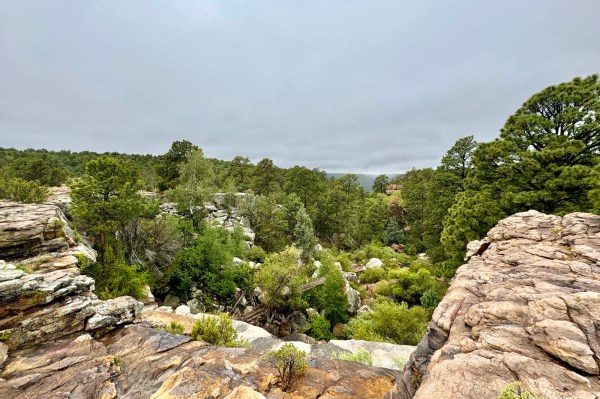
Once all the traps had been serviced, the continuing rain and cold conditions made it an easy decision to keep moving south and forget about trying to collect or camp here!
“San Jon Hill”
Quay County, New Mexico
The forecasts showed temperatures about 10°F higher once we got as far south as San Jon, near which I had a set of traps that needed to be serviced, and about an hour further south was Oasis State Park where we would have a place to camp and possibly collect if the conditions were right. Conditions did indeed improve as we neared San Jon, with solid overcast skies beginning to brighten in the south and intermittent sun beginning to reach the ground. By the time we reached the spot where my traps were located, temps were well above 80°F and skies were partly sunny—but what wind!
We set about servicing the traps, and here I had another concerned calmed—this was the last place I had set traps last month, so the traps were the older style body made from shorter water jugs—nevertheless, the larger bait bottles fit inside the traps (barely), and the reservoir was able to handle the higher liquid amount. Results for the SRW and SRW/EtOH traps were nearly identical to Mills Rim—both filled with lots of moths and Euphoria fulgida but no cerambycids (or at least very few—I did see at least one as I dumped the catch into the plastic bag). Again, I bagged the catch from both traps for later sorting. The EtOH trap, unfortunately, was down—the hanging rope was cut, apparently snapped due to rubbing against a branch in the wind. Just in case the culprit was hominid, however, I installed a new trap in a different nearby tree where it couldn’t be seen from the previous spot. The white bottle trap was absolutely overwhelmed with both Acmaeodera mixta and A. ligulata (and hopefully other species as well) and bees (for Mike), which I bagged for later sorting. We spent another hour or so collecting, but it was not terribly productive for me—beating Prosopis glandulosa produced lots of leaf-footed bugs and tiny beetles from the flowers, but I kept only a single Cleridae. I also beat a lot of oaks (Quercus mohriana and Q. x undulata) hoping to find more Brachys barberi (got one last time) but found nothing except a couple of elaterids. I also swept several stands of Quercus havardii but found nothing but grasshopper nymphs. All of the Opuntia camanchica (tulip pricklypear) from which I had collected Acmaeodera spp. last time were bloomed out, but I paid attention to them anyway hoping to see cactus beetles and finally found one Moneilema armatum on the pad of one.

I also encountered a single plant in flower, from which I collected one Trichiotinus texanus (Texas flower scarab) and a couple of Euphoria kernii (Kern’s flower scarab). There were a few A. mixta on various flowers (primarily Thelesperma megapotamicum and Xanthisma spinulosa), but I let Rich have them and didn’t see any other species. Having satisfied ourselves that we’d gotten a good enough look, we continued south towards Oasis State Park.

Oasis State Park
Roosevelt County, New Mexico
Nice conditions and brightly sunlit windmills followed us during the 90-minute drive further south to our campground near Portales, with a spectacular bonus sunset greeting us upon our arrival.
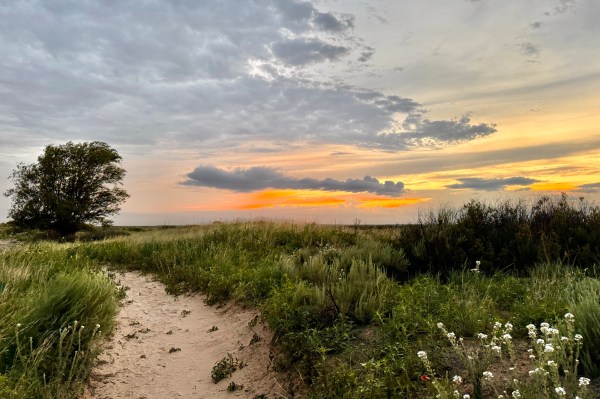
I quick ran over to the Sand Dune Trail to get a photo, knowing that colored sunsets of that sort are fleeting at best, and then we set about putting up camp and grilling some brats. Afterwards, we began our night walk to see what critters might be out and about, but first I wanted to go to a small, nicely-lit building near the restrooms to see what the lights may have pulled in (despite the presence of nearly full moon). At first I found only a few tenebrionids, though in nice variety and including one of the fantastically explanate tenebrionid Embaphion muricatum, and a crummy Cicindelidia punctulata chiricahuae (western subspecies of the punctured tiger beetle), but then I found several bolboceratine geotrupids—the large chunky Bradycinetulus fossatus, and several of the smaller Eucanthus sp. Then I saw a big something crawling frenetically nearby in the road, went over to look at it, and saw that it was a female Prionus arenarius—what a find!
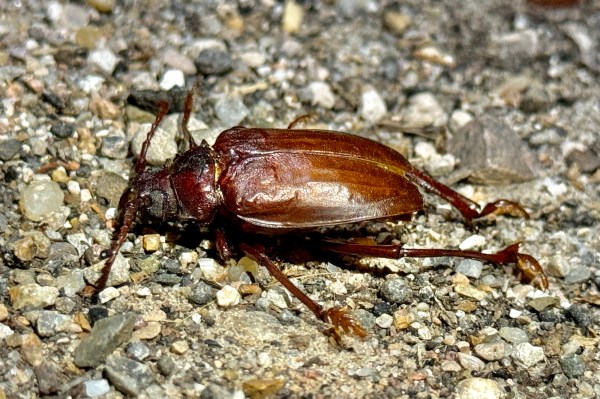
There wasn’t much on the Sand Dune Trail loop, but another Embaphion muricatum on the loop and dead but perfectly intact specimens on the road through the campground of yet another Bradycinetulus fossatus and female Prionus arenarius—the two best finds of the night—made the walk worth it. Afterwards, we returned to the building lights to see if more Prionus (male or female) had arrived, but by then it was close to midnight and the cool night air had a decided “things are over” feel to it.


Day 3
We stayed dry all night and awoke to sunny skies early, but clouds increased as the morning progressed and the forecast called for rain starting around 10 am. Rich wanted to look around while we had the chance, but I’d seen enough and instead worked on my notes while he was out and about. Eventually we broke camp and headed out—no sooner had we done that then the rain started! We eventually learned that all this rain we were dealing with had a name—Tropical Storm Alberto, which had made landfall the day before in Mexico and was throwing moisture everywhere in its wake. At least it now made sense to us why the entire eastern half of the state was so persistently rainy no matter where we went. As we drove towards our next stop (Mescalero Sands Recreation Area), we formulated Plan B to blast all the way south and west to near Las Cruces, which seemed to be escaping the rains, and hole up there for the next two days until things cleared up. However, we arrived at the dunes under partly sunny skies and nicely warm, though quite windy, conditions.
Mescalero Sands Recreation Area
Chaves County, New Mexico
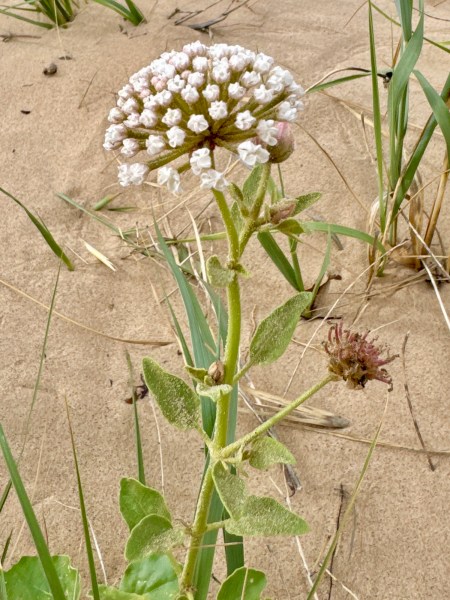
The first order of business was to service my jug traps, which I had hung in the Sapindus saponaria ssp. drummondii (western soapberry) stands that dot the highway rights-of-way along the edge of the sand dune area. This has been one of my best collecting spots over the years—being the only place where I have reliably found in numbers the beautiful lime-green Agrilus sapindi in association with the soapberry. Unfortunately, all three jug traps were empty—compromised in some way by the strong winds that seem to persist in this area. One trap was “spun around” the branch on which it was hanging, another dropped when the rope came undone, and the third simply swung wildly in the wind, throwing the bait bottle and emptying the reservoir. I elected not to rehang any of the traps here, having little confidence that I would be able hang them any more securely than I had already done. It’s a shame, because I was really interested in seeing what longhorned beetles the traps would pull, not only from the soapberrys in which they were hanging but also from the surrounding Quercus havardii (shinnery oak)-dominated sandhill shrubland. Right on queue, however, I found several A. sapindi and one Neoclytus mucronatus vogti on the soapberries as I was retrieving the last trap.

Also, though not an insect, I noticed a partial mammal cranium (missing the maxillae) half-buried in the sand. I picked it up and looked at it, thinking it might be a javelina because of the far rear-situated cranial crest. Then I noticed the other half of the cranium lying teeth-upwards nearby. The two pieces fit together nearly perfectly (some minor warping notwithstanding), and the large canine tusks convinced me even more so that it represented a javelina. I bagged it and will glue it together when I return home for display in my “bone shelf”!

As I started heading back to the car, I saw—and missed!—a Chrysobothris mescalero on the shinnery oak in that spot—damn! Happily, I did manage to sweep another individual from the plants back near where we parked. Continued sweeping failed to produce any more individuals, but what I really wanted to find was Agrilus hespenheidei—also beautiful green but completely unrelated to A. sapindi and which I have collected only sparingly in the past but failed completely to find on my most recent visit. I swept the grasses along the roadside and found none (for now!), then went into the recreation area entrance to retrieve the white bottle trap—it was overwhelmed with Acmaeodera spp. and bees, which I bagged and will sort later. Very little else was seen, and by the time I returned to the car Rich was satisfied with the myriad pollinating insects he’d collected off the soapberry flowers and specimens of A. sapindi and C. mescalero that he’d swept. It was still early enough in the day after refueling and rehydrating that we decided to visit the dunes proper and see what might be out.
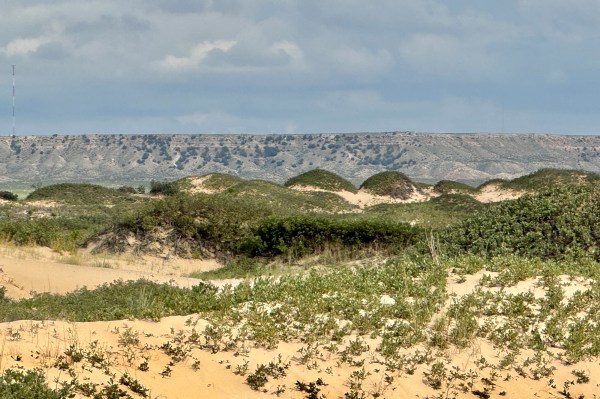
I wasn’t very optimistic about collecting in the dunes, given that paucity of insects seen in the shrubland along the highway and just inside the entrance, but there was still enough time left in the day to spend time here and not enough to move on to the campground near Roswell and collect there. For much of the time, my pessimism prevailed, as I did a bit of sweeping here and there and saw (but did not collect) only the occasional mutillid (velvet ant) and tenebrionid (darkling beetle). The scenery was nice, however, and the temperatures comfortable, and at the furthest point out we had a bit of fun “working” a common blotch-sided lizard (Uta standsburiana) female into a place where we were able to photograph her.

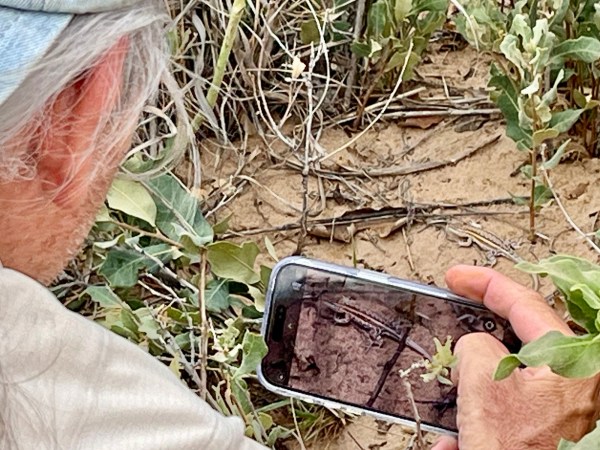
On the way back, I happened to notice a buprestid sitting on the dried stem of Sporobolus giganteus (giant dropseed) and realized it was the one buprestid I was hoping to collect here—Agrilus hespenheidei! This led to a renewed round of sweeping in all the neighboring plants and others along the way back, resulting in several interesting captures such as an ataxiine cerambycid, one Macrosaigon sp., two Selenodon sp., and a couple of small weevils—but no additional A. heapenheidei! I also found an interesting little Eusattus sp. tenebrionid on the sand, so it was nice leaving the place knowing that I would not be “skunked” for the first time on the trip!
We drove through rain on the drive going west towards Roswell, and shortly afterwards I saw a male Texas brown tarantula (Aphonopelma hentzi) crossing the highway. I did a U-turn and went back to it to 1) move it off the highway so it wouldn’t get run over and 2) take photos of it. Several cars passed over it as we were backtracking, but fortunately none ran over it, and we had a clear road to turn around once again and pull over. We took a few quick photos while it was still on the road—one amazingly capturing the newly formed rainbow in the background—before a semi bearing down from the distance forced us to quickly “guide” it off the road. It really wanted to continue to the other side, so we had to be quite insistent on forcing it off the road, and after traffic cleared we coaxed it into a jar and delivered it to the other side of the highway all the way to the fenceline.

Bottomless Lakes State Park
Chaves County, New Mexico
We arrived at the park with some good daylight to spare and snagged the choicest campsite in the entire campground (why the people at the two already occupied sites didn’t take it is beyond me!), explored our new home for a bit, and then set about putting everything in place.

As soon as we finished, we noticed a rain shower in the distance and debated the direction it was moving. I thought it would pass to our east, but within minutes it was raining—and a few minutes later it was pouring! But we watched in comfort under the large metal shelter covering our table and admired the incredible rainbow that formed over the canyon wall bordering the eastern side of our campsite.

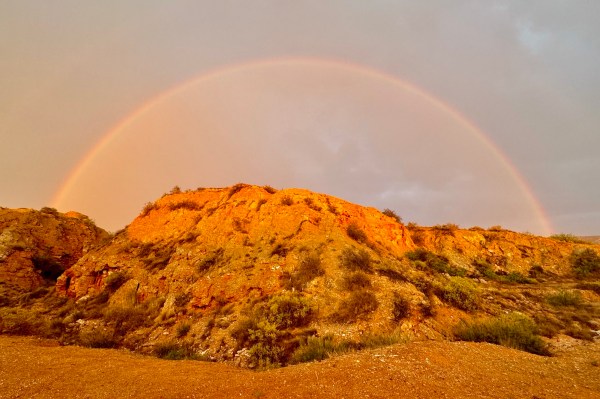
Eventually the rain stopped and we fired up some burgers on the grill. Wildlife competed for my interest while the burgers were cooking, apparently brought out by the fresh rain and coming darkness. These included a kangaroo rat (Dipodomys sp.) and a red-spotted toad (Anaxyrus punctatus).


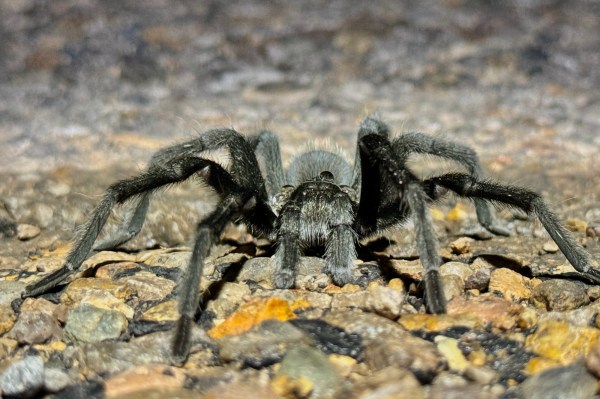
The fresh rain, coolish temps, and near-full moon made setting up the lights to attract insects out of the question, but after dinner when darkness had fully settled we walked the road through the campground to look for nocturnal beetles. I was hoping to find Amblycheila picolominii (Plateau giant tiger beetle), one of which had had found up on the rock slope the last time I was here, but I wasn’t thrilled with the idea of clambering over steep, wet rocks in the dark and settled for the pavement up to the beginning of the tent campground and back. Large tenebrionid darkling beetles were expected, thus the two we saw were no surprise, but what did surprise and delight us was another male tarantula—and not the common Texas brown tarantula (Aphonopelma hentzi) but the much less commonly encountered Chihuahuan gray (A. gabeli)! This was a delight and becomes the fourth species of tarantula I’ve found in the wild. We trailed it back and forth as it ambled along the road trying to get good photos, but it never stopped long enough to allow such. Eventually it did stop along the side of the road, where we took some “okay” photos before moving on.

As we began to walk away, I had second thoughts and decided to try for one more frontal portrait shot, but I had to move a little plant stem that was obscuring the view. I did this as carefully as I could, but the tarantula sensed something and suddenly took off like a shot. I followed as it bolted across the road, where suddenly it stopped and hunkered down right out in the open—as if it had fled the danger and was now willing to wait it out for a bit before resuming its wandering. At that point, I was able to easily take the frontal portrait photos that I desired—all that following and frustration, when all I really needed to do was scare it and wait for it to stop running.
By the time we returned to the campsite, I was exhausted and turned in early (rare for me!).
Day 4
It started raining again around 2 am and didn’t really let up until after noon. We took advantage of the chance to update our field notes and process specimens before going into town to pick up a few supplies. It was still raining when we returned later in the morning, but only lightly and allowing us to stop at the cenote next to the visitor center. I never took the opportunity to look at one of the cenotes last time, so this was my first actual look at one of them.


We headed back to our campsite and continued working on our field notes and adding captions to our photographs until the rain finally stopped around 1:30 pm, and by 2:30 conditions had dried out and temps warmed enough to warrant going out and collecting.
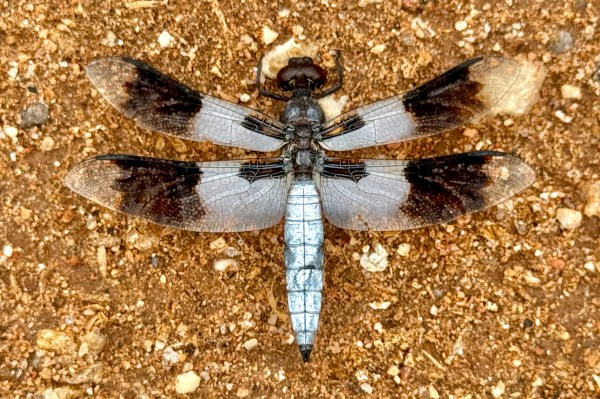
I started out by hiking the ravine from our campground down to where it drained into a cenote (Pasture Lake) near the adjacent campsite and found lots of Sphenophorus aequalis (clay-colored billbug) on the ground near and within a stand of Bolboschoenus maritimus ssp. paludosus (saltmarsh bulrush) along the lake margin where they were walking about, mating, and burrowing into the soil at base of the plants—especially dead remnants.

I also scoured the barren alkaline soil along the lake margin for tiger beetles and found a couple of Tetracha carolina (Carolina metallic tiger beetle) elytra and several adult Cicindelidia ocellata ocellata (ocellated tiger beetle). Before leaving the lake area I also snagged an Acmaeodera gibbula in flight and then wandered over to the area where I found Atriplex canescens (four-winged saltbush) infested with longhorned beetles (Amannus sp., which I still have not identified). I was hoping to see adults now emerged and in the plants, but none were seen. I also kept an eye out for buprestids on the Ephedra torreyana (Torrey’s jointfir) but never saw anything. I was starting to think buprestids were (puzzlingly) out-of-season as I wandered up into the picnic area where I found several things last time and quickly saw a beautiful Gyascutus planicosta obliterata adult sitting on the foliage of A. canescens. Over the next couple of hours I would collect a handful of these beautiful beetles. It’s been a long time since I’ve seen members of this genus in the field, and I’d forgotten whether they were skittish or sluggish—this one was the latter and let me take a nice close photo before obligingly dropping into the net. Probably it depends on temperature, as I remember collecting these in Texas in blazing hot conditions and seeing them zip off instantly and fly far into the distance upon sensing my approach. Today’s temps were much more modest (thankfully), so the adults were rather easy to collect.

As I looked for Gyascutus on the slopes and around the picnic area, I took the opportunity to beat the mesquites (Prosopis glandulosa)—especially those in flower. [Edit: the genus Prosopis was recently split up into several genera, with P. glandulosa being assigned to the new genus Neltuma. I don’t reject this new placement but will use the older, more familiar name on this blog until the new name receives greater acceptance.] Most of what I saw were leaffooted bugs, but I did pick up one more A. gibbula, one Acmaeoderopsis hulli, a few Epicauta sp., and a couple each of a darnine and a centrotine membracid. I also continued to inspect A. canescens plants for signs of infestation by Amannus but was unable to find any larvae or unemerged adults in the few living plants that I broke apart when they exhibited emergence holes. What I did find, however, was an Acmaeodera sp. partial cadaver of an adult that had failed to emerge. I was able to retrieve its elytral shield (Acmaeodera sp. have fused elytra, which they lift up during flight rather than spread apart like most other buprestids), and hopefully it will be enough to enable a species identification and a confirmed larval host plant association. By the time I looked at the last plant, it was going on 6 pm. I was hot, thirsty, and hungry, and I had a lot of specimens from previous days still to process, so I headed back to the campsite.

It took a couple of hours to write up my notes and complete processing of the specimens I’d collected from the bottle trap yesterday at Mescalero Sands (I’m guessing there were at least 100, if not 200, Acmaeodera specimens as well as a few dozen bees for Mike). As darkness descended, the full moon rising in the east dampened any enthusiasm I may have had for putting up the full UV/MV (ultraviolet/mercury vapor) light setup, but what we did do was much simpler: just lay a UV light on a white sheet on the ground. Despite the increasingly intense moonlight, tiger beetles began to show up on and near the sheet. Eunota circumpicta johnsonii (Johnson’s tiger beetle) was the first to arrive and turned out to be abundant.

Jundlandia lemniscata repaptisata (rouged tiger beetle) also was common, but it took longer for them to come in.
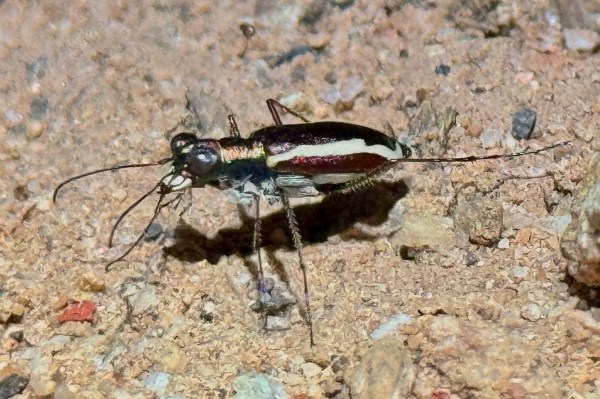
What I was most recited about, however, were the two individuals of Cicindelidia tenuisignata (thin-lined tiger beetle) that showed up.

Rich also found a Tetracha carolina (Carolina metallic tiger beetle running on the ground nearby. Eventually we decided to walk the road—Rich was hoping to see snakes, and I was hoping to see Amblycheila picolominii (Plains giant tiger beetle), a single individual of which I had seen during my previous visit up on the gypsum/red siltstone slope bordering the campground. Neither of us saw what we were hoping to see, or anything else for that matter, so we returned to the campground. I still had Amblycheila on my mind, however, so I decided to go back up onto the slopes where I had seen the species before to at least give myself a chance of seeing it again. I clambered semi-directly to the spot where I had seen it before, continued across the slope to the northern canyon limit, and then went downslope a bit to traverse the again in the opposite direction. Right as I started across again, I found one ambling across the rocks much as the previous one I’d seen. This charged my motivation, and though traversing the slope several more times proved fruitless, I was still a happy camper!

After returning to the campsite, I decided to explore the steep, narrow, canyon ravine behind our campsite, which I still had not yet done, and picked my way over the rocks to as far as I could go. I kind of expected/hoped to see Amblycheila, but not really—just wanted to explore the unique canyon feature. Near the furthest point I shine my headlamp on the steep clay slope at the bottom of the canyon wall and saw a Texas brown tarantula (Aphonopelma hentzi). It was not, however, just any ol’ Texas brown, but a female—recognizable as such by her relatively shorter legs and larger abdomen and also the fact that she was sitting right next to her burrow. I’m sure Madam will be rightly excited when she finds out we have a new pet named Bertha!
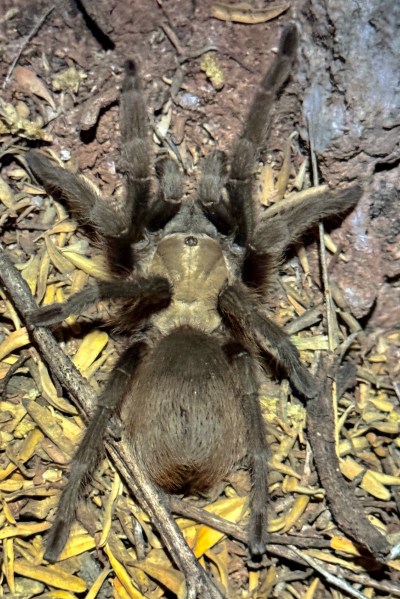
You’d think this would be the perfect swan song for the evening, but as I picked my way back down the canyon floor I spotted another A. picolominii, which made me want to keep exploring even more. This I did, going down to the spot along the Bluff Trail where I’d had so much success with Gyascutus earlier in the afternoon, but the only thing all this extra walking resulted in was an even later bedtime. Nevertheless, I couldn’t have been more pleased at finding six tiger beetle species during this visit (after finding only the single Amblycheila last time and thinking I was losing my tiger beetle mojo!).

Day 5
Despite the great success we’d had collecting insects in Bottomless Lakes State Park the previous day or so, there was one thing I was glad to be leaving—the house flies! They swarmed our campsite in numbers I’d never seen before, relentlessly landing on everything including our supplies, hands, faces, etc. it then took an hour or so getting all of the thousand or so that had infiltrated our vehicle out of the vehicle as we drove towards our next stop in the southernmost tract of the Lincoln National Forest in Eddy Co. Before leaving Roswell, however, we had to stop by the “Alien Welcome Monument” at the edge of town. I was disappointed to see that my version of “Kilroy was here” graffiti from last time’s visit was gone (apparently the monument gets painted over periodically), so I added it back.


X Bar Rd
Eddy County, New Mexico
The gradual ascent from the desert floor up into the pinyon/oak/juniper zone of the mountains is among the remotest-feeling that I have ever experienced, and just shy of the National Forest boundary we found our next spot. My biggest concern was whether the area was still experiencing drought conditions, but we were happy to see that the area has actually received rain—enough in the last day or so to thoroughly wet the soil. We could see it in the way the area looked, with most of the oaks and acacias having sprouted new leaves and the surrounding slopes exhibiting a greenish “cast.” The catches from all three traps were similar to each other and to what we had seen further north—i.e., mostly moths, but without the Euphoria fulgida. The SRW and SRW/EtOH traps seemed to have caught more than the EtOH trap, but the difference was not as large as further north. I did see a few elaphidiine cerambycids in the first two (as I bagged them for later sorting), but not many. I was hoping to see my primary target—Purpuricenus opacus, but I also knew that it may be a bit early for that species (and with the prevailing droughty conditions I may never see it). The white bottle trap, on the other hand, was loaded with Acmaeodera spp. and bees (the latter which I kept for Mike). Seeing the fresh foliage on the plants in the area, I set about beating some of them hoping things were starting to come out. Beating Senegalia greggii (catclaw acacia), however, produced only a few chrysomelids, as did beating the oaks (Quercus grisea—gray oak, I believe). There was very little in bloom, and sweeping the roadside vegetation produced nothing. Even the the few Opuntia camanchica (tulip pricklypear cactus) from which I’d collected a fair number of Acmaeodera spp. last time were devoid of flowers. Hopefully the recent rains will continue to trigger further beetle emergence, and my traps will collect some of these over the next two months.

Klondike Gap Rd, Hamm Vista
Lincoln National Forest
Eddy County, New Mexico
We were optimistic about what we might see at this, my highest priority location for the jug traps, as it was from here that the west Texas specialty Purpuricenus opacus was recently reared from oak. Since the previous spot had seen rain, it seemed likely that this one had as well. Sadly, the landscape turned bone dry as we approached—dust on the plants with no sign of fresh foliage proving that it hadn’t rained for some time. My spirits were further dampened when I found the SRW trap down due to a frayed and broken rope. I rehung the trap with replacement rope (I always bring a spare trap and parts just in case) and was pleased to find both the SRW/EtOH and EtOH-only traps still hanging and—remarkably—with even more numerous trap catches than at the previous spot despite the lack of rain. Again, I did see a few elaphidiine cerambycids in each, but not many, and not a single scarab. The real surprise, however, came with the white bottle trap—literally hundreds of Acmaeodera, perhaps three or four times as many as were in the bottle trap at the previous spot. There were even a couple of still-living beetles walking about on top of the mass of beetles that were testing the limits of the volume of propylene glycol in the trap, suggesting that the beetles are currently active even with the dry conditions—but where are they?! There are no flowers to speak of, and beating produced nothing, yet the beetles must be flying about. All I can do is hope that conditions will improve sometime over the next two months that the traps are out and that they will be able attract whatever emerges whenever that happens.
Dog Canyon Campground
Guadalupe Mountains National Park
Culberson County, Texas
Last month when I came here with Mike, our only reason for coming here was that it was a campground close to my trap localities where we could spend the night after setting the traps and then move on the next morning. When we arrived, however, we were immediately captivated by the stunning beauty of the canyon, and we decided that my next trap run should include an extra day to allow some hiking and exploring. That’s exactly what I planned for this visit, with two nights of camping bracketing a full day of hiking. The approach to the park is, in itself, spectacular, starting with a steep drop off the plateau and an expansive vista of the valley below—the highway leading to the park appearing as a thin, straight line between the massively tall canyon walls on either side.
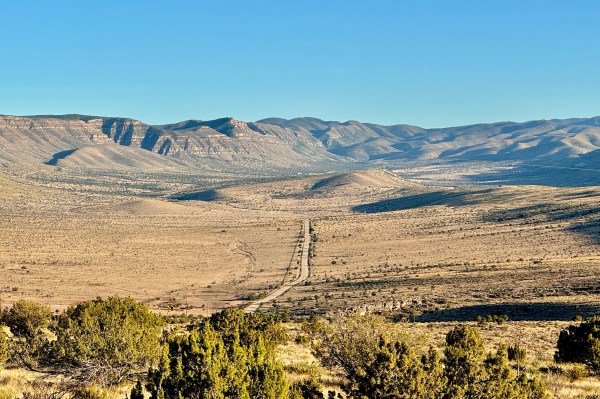
A small sign at the park border announces that you are also entering the great state of Texas!

To our surprise, the campground was deserted—a marked contrast from last time when we were lucky enough to snag the last available campsite as Saturday night walk-ins. I can’t say I was disappointed, as that was my only real complaint about my previous visit. We weren’t totally alone, however—Kitty quickly stopped by to see us, at once skittish yet desperately wanting affection (and probably food). Of course, insect collecting is not allowed in a national park without a permit, so this visit was strictly for observing and (hopefully) lots of photographs. Both of these began shortly after we finished dinner (including Kitty, who scored a couple of sardines) and dusk had settled over the canyon when several large male Prionus californicus flew by at our campsite.

Afterwards, we decided to walk the gravel road through the campground and back past the state line to the paved highway in hopes of seeing snakes and other critters. We saw no snakes, but we say plenty of other critters—Xyloryctes thestalus (western rhinoceros beetle—family Scarabaeidae), a couple of Omorgus sp. (carcass beetles—family Trogidae), Scolopendra polymorpha (common desert centipede—family Scolopendridae), a juvenile tarantula (likely Aphonopelma sp.—family Theraphosidae), and my favorite—a couple of Amblycheila picolominii (Plateau tiger beetle—family Cicindelidae).

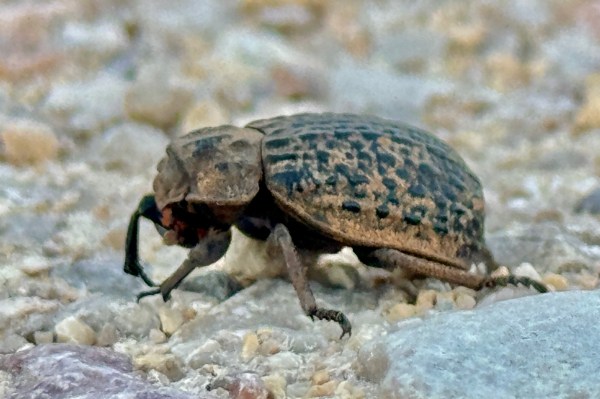


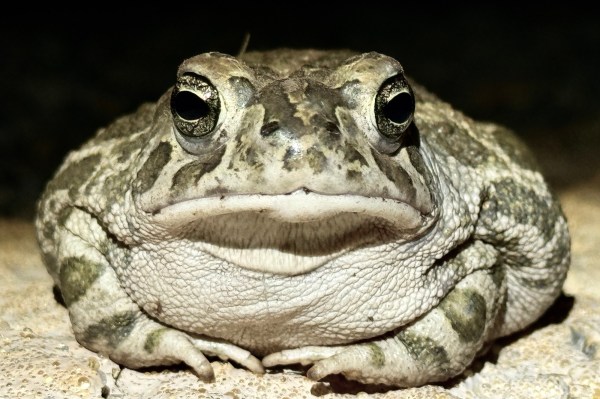
We also saw numerous tenebrionid beetles in diversity far too great to photograph as well as two species of toads.


The most puzzling observation of the evening was two large ants apparently locked in tug-of-war combat—each momentarily gaining momentum and then just as quickly losing it to the other in a back-and-forth seesaw battle. Perhaps our local formicid specialist James Trager can shed light on this observation. Edit: James writes:
This looks like a couple of major workers of Camponotus sp. tussling at a territorial boundary of two colonies. These look like and might be C. americanus, but I’m frankly not sure about the ID from that location, without looking at specimens.

Day 6
Bush Mountain Trail
Guadalupe Mountains National Park
Culberson County, Texas
Today’s plan was to spend the first part of the morning relaxing with coffee while catching up on the previous day’s field notes, then hike up Bush Mountain to Marcus Overlook. Gaining nearly 1000 feet in just under three miles, it would be enough of a challenge for either one of us, especially considering how slow Rich and I tend to be on our hikes due to constantly stopping to look at things.

As we passed through the grasslands beyond the horse corrals, we started seeing one of my favorite tiger beetles—Cicindelidia obsoleta (large grassland tiger beetle). The first two we saw were black, suggesting they were assignable to the nominate subspecies, but then we saw a green individual (that I got barely close enough for a crappy photo) which suggests subspecies C. o. santaclarae—a subspecies I’ve never seen in the field before and this spot surely on the eastern edge of its distribution (perhaps in an intergrade zone with nominate C. obsoletus). Perhaps in the morning before we leave I’ll go back and see if I can get a more acceptable photograph.

For a while the trail was not too steep as it followed a rocky wash, and most of the herbaceous plants were just beginning to produce new foliage (late June seems to me like an awful late start to the season!). As we ascended the mountain, the habitat turned from pinyon/juniper/oak woodland to alpine grassland with large ponderosa pines dotting the steep hillsides. The ascent was quite steep in places, causing us to stop frequently; however, our reward for doing so was the chance to take our eyes off our feet and instead admire the expansive vistas sprawling before us!

About halfway up I noticed what must have been a webbed-over (and thus occupied) tarantula burrow—my second tarantula burrow after having never seen one in my emite life.

Along a ridge near the top we found a very colorfully marked juvenile greater short-horned lizard (Phrynosoma hernandesi—the first horned lizard that I’ve seen in the field that was not a Texas horned lizard (P. cornutum).


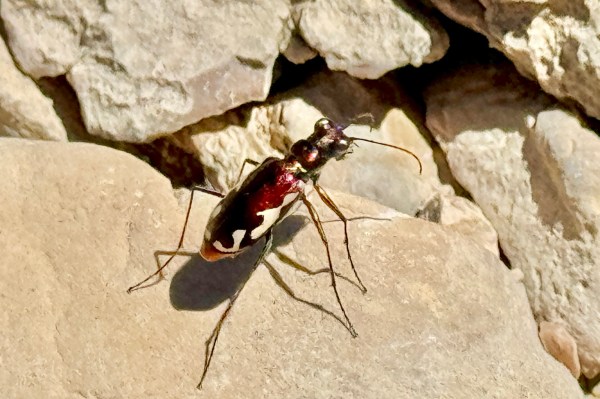
The best find of the day, however, was the least expected—several tiger beetles whose identity I did not recognize and which proved to be Cicindelidia laetipennis! This particular population was, until very recently, considered a subspecies of C. politula (limestone tiger beetle) that was endemic to the Guadeloupe Mountains (C. p. petrophila—rock loving tiger beetle) and characterized by extreme variability in coloration despite its very small geographic range. Indeed, the two individuals I managed to get close enough to photograph (thanks to my new cell phone’s zoom function!) showed part of this variability—one being bright coppery-red and the other almost greenish. Molecular analysis, however, has shown that the population is instead conspecific with C. laetipennis, which was until then considered restricted to Mexico. Whether an endemic subspecies of a more common species or a distinct phenotype of a Mexican species, it was a thrill for me to see in the field for the first time.



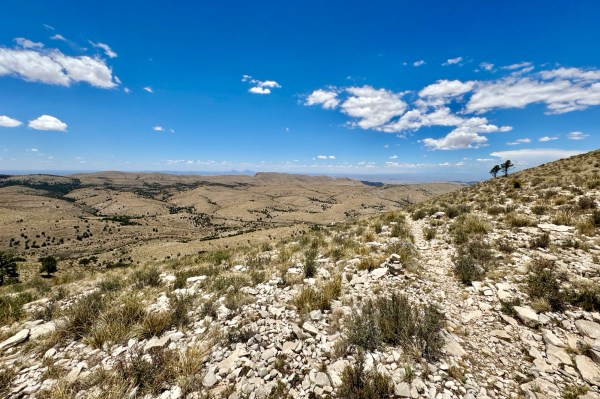
At Marcus Overlook, we enjoyed a bit of a food and rest while viewing the expanse of mountains further west and south in the park, thankful that such immensely wild, unspoiled places still exist. The hike back down was more about the destination than the experience—the careful footing required to navigate the at times steep grades keep our eyes mostly on our feet, and by the time we reached our campsite at mid-afternoon we were ready for some rest, food, and rehydration!
After resting up a bit, we decided to head back out of the park (and, thus, into New Mexico) to nearby Queen to replenish our ice and liquids and then visit Sitting Bull Falls Recreation Area. Neither decision worked out as planned. The (only) convenience store in Queen was closed (despite the posted hours of business stating they were open until 5 pm), so the little ice that we had left would have to last until the morning, and when we arrived at the turn off to Sitting Bull Falls, we saw that the area closed at 4 pm—less than an hour away. We drove the road anyway and found a trailhead parking area just before the entrance that looked interesting enough to explore. The area was very lush, obviously having enjoyed recent rains, but there was no insect activity to speak of. Our already tired legs further lowered our motivation, and we decided to call it a day and head back to the park.
Hamm Vista
Lincoln National Forest
Eddy County, New Mexico
On the way back, I had an idea—stop by the traps I’d serviced the previous day on Klondike Gap Rd (not too far off the main highway) and see if they were beginning to pull anything in. I checked only the bottle trap and the SRW/EtOH traps, and both had fresh catch—Acmaeodera in the former and Euphoria in the latter. Of course, I was hoping (but did not expect) to see Purpuricenus opacus, and though I did not see it after 24 short hours I remain optimistic that it will come to the traps in the next few weeks. While we were there, I noticed a particular oak tree (Quercus grisea—gray oak, I believe) alongside the road. Something about it said “Beat me!”, so I went back and got the beating sheet out of the car, beat another oak on the way back to the tree without seeing anything, and in the first whack of the tree I got Chrysobothris axillaris—an oak associate that I’ve only seen in west Texas. Of course, that motivated me to starting beating other oaks, but I never saw another beetle. Certainly not a productive stop, but at least getting C. axillaris made it worth the effort.
Dog Canyon Campground
Guadalupe Mountains National Park
Culberson County, Texas
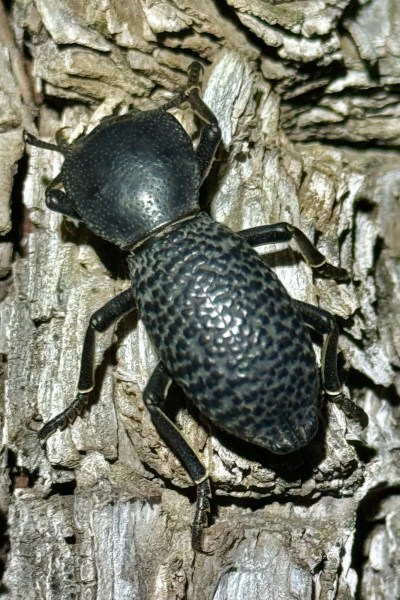
This being our last evening in the park, we brought out the bison steaks for a celebratory dinner, and they were quite good despite having to be cooked in a skillet over my tiny stove (no charcoal grills allowed!). Perhaps the “dirty skillet” imparted some flavor. Kitty joined the celebration, scoring four sardines for dinner instead of just two! Afterwards once darkness had settled, we walked the roads again hoping to see snakes and other crawlies, but there was far less on the roads this time compared to last night, with two notable exceptions—a Zopherus concolor (family Zopheridae), and a large male Prionus californicus (California prionid—family Cerambycidae), both on the trunks of the massive alligator junipers (Juniperus deppeana) that dot the campground. Perhaps the cooler and more blustery conditions had things hunkering down.

Before turning in for the night, I started to hike the short (0.6 mi) Meadow Nature Trail. I’d made it about halfway around when I decided that hiking the trail on a moonless night by myself was not such a bright idea and turned around. I really got spooked on the way back out when I saw two glowing eyes not far away but breathed a sigh of relief when their owner turned out to be a mule deer, who was equally spooked by my approach and bolted, crashing away through the darkness.
Day 7
I normally dislike mornings that we have to break camp and move on—I’d rather relax for an hour or so and enjoy a cup (or two) of French press coffee while catching up on the previous day’s field notes. Today was supposed to be such a day, but I negotiated with Rich to delay our departure until mid-morning to give the grassland tiger beetles (Cicindelidia obsoleta santaclarae) that we saw beginning yesterday’s hike a chance to become active again so I could try for better photographs. The coffee tasted good this morning, and three wild turkeys strutting nonchalantly through our campsite made my leisure hour just that much more enjoyable. Once it warmed up a bit, I went to the corrals where we’d seen them before—nothing! We decided to go ahead and break camp, then go back and check again after we were all packed up—nothing! This was puzzling, since we were there at the time we’d seen them the day before. All I can say is figuring out insects is hard—especially in the West, and if I live to be 100 I don’t think I’ll ever fully figure them out. With that, we said our goodbyes to Dog Canyon—I truly look forward to coming back!

It was a long drive between Eddy Co. and our first collecting spot of the day, and we stupidly made it even longer by going all the way back to Roswell to restock on groceries for the coming week. While we were there, we decided to each lunch at a restaurant instead of out of the car—further adding to our travel time (but the burritos from Burrito Express were so good!). The last leg from Roswell to near Mayhill was—like last time—the worst, with temperatures soaring up to 100°F and the landscape providing so very little of interest.
Carr Canyon Rd
Lincoln National Forest
Otero County, New Mexico
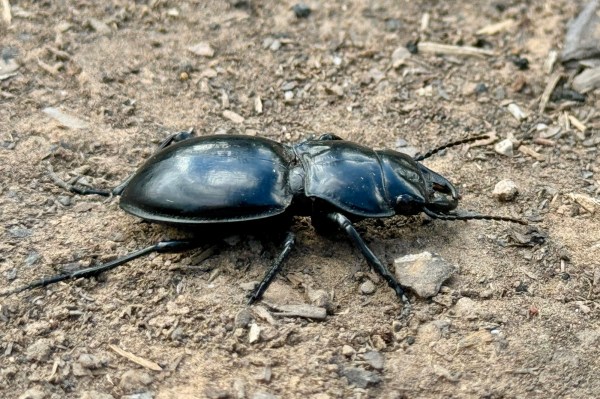
We arrived at about 4:30 pm—still plenty of time to collect and, if we didn’t like what we saw, move on, and we were happy that the higher elevation was providing some temperature relief. We had come to this spot last time based on a prior record of a rather fine buprestid species (Buprestis prospera) from the area, but it was bone dry at the time and we moved on without even getting out of the vehicle. Conditions seemed much better this time, but still I saw no pinyon pine (the larval host) to inspect—and certainly no dead ones to chop into. We were here, however, and decided to give it a shot. I did find a few small dead Juniperus deppeana (alligator juniper), but beating them produced only a single Anomoea sp. (likely an incidental association). The scrub oaks (not sure which Quercus species they represent) as well were leafing out nicely, but sweeping them produced only a smattering of Chrysomelidae (leaf beetles), Elateridae (click beetles), and Curculionidae (weevils)—no Buprestidae (jewel beetles) or Cerambycidae (longhorned beetles). A dry creekbed ran through the area, and I noticed rather lush growth of grassy vegetation in and alongside the creekbed. Recalling that I’d swept such growth along the roadside in nearby Mayhill a few years ago and got a series of Taphrocerus schaefferi, I began sweeping. This was much more productive—each sweeping pass produced one or two Taphrocerus (will need to examine closely to determine if they also represent T. schaefferi, also that is likely), and by the time I finished I had a nice little series of around eight individuals. Checking back with Rich, neither he nor I were seeing much else of interest, so we decided to continue on to the next locality near Cloudcroft.
Switchback Trailhead
Lincoln National Forest
Otero County, New Mexico
The threatening clouds that had just started appearing as we were leaving the previous spot developed into full-blown rain showers as we continued up the mountains to Cloudcroft. Just as quickly as they had come, however, they abated and we arrived to this spot under broken clouds and cool early evening temps. Of all the locations where I had placed traps, my expectations were lowest for this one due to its combination of high elevation (nearly 9000’) and dense, coniferous forests (wine-based baits typically do not attract beetles associated with conifers). I went ahead and placed traps here, however, because 1) I already had several sets at lower elevation woodlands, 2) the presence here of Quercus gambelii (Gambel oak)—a high elevation oak that could be hosting a variety of interesting beetle species, and 3) perhaps the ethanol component of the bait might still attract conifer associates. What I found was completely unexpected—all three traps contained several species of Cerambycidae, none of which I immediately recognized to species! The most abundant species appears to be a large, blonde lepturine, and there was also a smaller Stenocorus sp. as well as a few even smaller species that will require closer examination to identify. I was happy to see all three traps not only still hanging, but also with a little bit of bait still in the bottle and the propylene glycol in the reservoirs not completely dried out. This is in contrast to the traps at all the other lower-elevation localities, which exhibited bone-dry bait bottles and little to no propylene glycol remaining in the reservoir. The thought occurred to me that perhaps the reason these traps were so much more productive was because they remained attractive for the entire one-month period following their placement, while traps at other localities dried up after two or three weeks and failed to attract beetles during the latter part of the period—potentially after beetles had begun to appear in numbers. On the other hand, the very different habitats could also easily explain such a difference. As for the traps, expectedly the SRW/EtOH trap had the largest catch volume, the EtOH-only trap had the smallest (though still good numbers and variety of beetles), and the SRW-only trap volume was in between. Sadly, the white bottle trap was not only pulled out of the ground but completely missing—I can only guess that one of the many hikers that pass through the area saw it and couldn’t resist their inner vandal. The lateness of the hour precluded much further collecting, but I noticed a couple of Anthaxia (Haplanthaxia) caseyi on flowers of Rosa woodsii (Woods’ rose). Based on locality and their dark coloration, they should represent the subspecies A. c. pseudotsugae—unlike the bright green individuals of the nonimate subspecies found further west in California.

There were lots of other plants of various types in bloom, suggesting that a return to this spot with sunny conditions might be warranted. It also convinced me that I should replace the bottle trap here (using the one I retrieved from Mescalero Sands), given the uniqueness of this locality—I’ll just need to find a more secluded spot to place it.
Upper Karr Canyon Campground
Lincoln National Forest
Otero County, New Mexico
During my last visit with Mike, we camped at Lower Karr Canyon Recreation Area on the west side of the mountains below Cloudcroft. It was a nice place to camp but with no table or restroom. This time, Rich and I decided to try Upper Karr Canyon, and boy were we impressed—high elevation (9350’!) with a spacious campground and, most importantly, tables! There were other people in the campground, but everyone was spaced so far apart that it still felt private—at least, until the toddler in the next campsite had a meltdown and woke the infant, who himself then had a meltdown! It was dark by then, so I decided to take a walk to look for night-active critters and hoped that the frazzled parents would manage to get things under control by the time I returned. I saw lots of tenebrionids, of course, but also far more Carabidae (ground beetles) than I typically see out west—perhaps because of the high elevation. Nothing, however, warranted placement in my bottle, so I returned to a (thankfully) quiet campground and admired the amazing starscape in the sky above in the time before the waning gibbous moon began rising in the east.


Day 8
I was tempted to do a bit of collecting before we broke camp—Cicindela purpurea (pasture tiger beetles) were flitting amongst clay exposures in the campground, and Trimerotropis verruculata (crackling forest grasshopper) serenaded us with their snap-crackle-popping flights. We decided instead to break camp anyway and head back to Switchback Trailhead.


Switchback Trailhead
Lincoln National Forest
Otero County, New Mexico
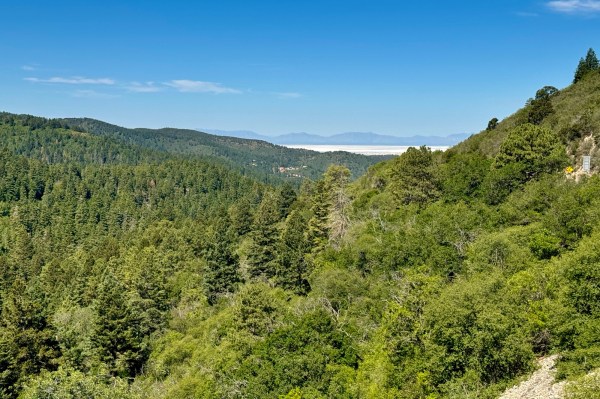
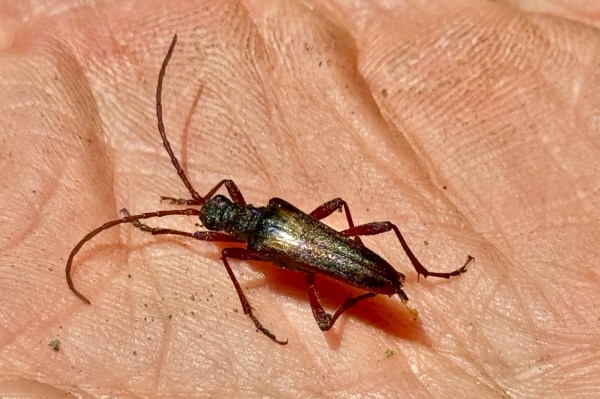
After a quick stop at Mexican Canyon Overlook (I actually made it to the far end of the cantilever lookout deck!), we went back to Switchback Trailhead so we could get a better look than allowed by our quick trap check stop the previous evening. This included examining the variety of flowers and sweeping the large patches of mature Gambel oaks in hopes of finding the recently described Brachys rileyi. I also wanted to reset a new bottle trap to replace the one that was stolen, except this time I hid the trap in an exposed area inside a large patch of Rosa woodsii (Woods’ rose). I barely got the trap set when I noticed more Anthaxia on the flowers and collected a nice series of what I now believe are two species—A. (Haplanthaxia) caseyi pseudotsugae (due to its dark coloration) and A. (Melanthaxia) expansa (due to the two pronotal impressions). I went back to the car to get my long-handled net for sweeping the Gambel oak and found nearby a stand of Ratibida columnifera (Mexican hat) with more Anthaxia plus Acmaeodera variegata on the flowers. Sweeping the Gamble oak was disappointing—no Buprestidae of any kind, much less B. rileyi, but I did collect a small variety of other beetles including a very tiny adult of what must be Neoclytus irroratus. I was about to go back and see if Rich was having any luck when I spotted a large flowering Sambucus cerulea neomexicana (western elderberry). My long-handled net came in very handy, as I was able to seep the flowers high up out of normal reach. The first tree yielded what I suspect is Agrilaxia arizonae, and after sweeping the four different tree in the area I collected two more adults. I’m not aware of the occurrence of this species east of western New Mexico, so we will have to see how it compares to the very similar species A. texana. The last plant was very close to one of my bait traps (SRW-only bait)—I couldn’t resist the temptation to take a peak and was happy to see a lepturine longhorn already in the trap. It was the smaller, darker species that I thought yesterday was a species of Stenocorus, and a little bit of internet sleuthing revealed it to be the very local and uncommonly collected S. copei—a very nice species that I have never collected before! Now I am even more excited about the trap results from this spot and am anxious to see what they trap in the next couple of months. (I also sleuthed the larger yellow species and believe it is Centrodera spurca [yellow Douglas-fir borer]—not an especially rare species, but one that I have never collected and this population representing one that is interestingly disjunct from the main population in the Pacific Coast states.)
In the meantime, Rich learned from a passing Forest Service worker that a small protected area for the Sacramento Mountains checkerspot butterfly (Euphydryas anicia cloudcrofti), currently proposed for listing on the endangered species list, could be found just up the road. Rich had to promise that we were not interested in collecting the butterflies before the worker agreed to tell him where the caged butterfly food plots were located, so we went up to take a look at them.
Bailey Canyon Rd
Lincoln National Forest
Otero County, New Mexico
While Rich examined the food plots (he did not see either larvae or adults), I examined the flowers alongside the road, collecting more Acmaeodera variegata and Anthaxia spp. of the flowers of Hymenoxys hoopsii (owlsclaws) and Achillea millefolium (common yarrow).

There were several additional flowering Sambucus cerulea neomexicana (western elderberry), but sweeping the flowers produced no additional Agrilaxia. Nothing else sparked our interest, so we then headed to Trestle Depot Recreation Area in nearby Cloudcroft.
Trestle Recreation Area
Lincoln National Forest
Otero County, New Mexico
This little picnic spot caught my eye when I was here last month, looking like it might be good for a quick stop and look around. Musk thistle (Carduus nutans) in flower along the roadside may be an exotic invasive plant, but the flowers attracting a variety of butterflies were of immediate interest to Rich. I looked as well to see if there were any beetles on the flowers, but there were not and so went back to the picnic area. Immediately I spotted a freshly dead Douglas-fir (Pseudotsuga menziesii) and walked toward it. As I approached, I saw two Buprestis lyrata adults on the trunk—one of which flew off as I spotted them and the other I caught. I checked the trunk carefully to see if there were others, and failing to find any I checked out a nearby cut Ponderosa pine (Pinus ponderosa) stump. I suspected, however, that the first one would eventually come back to the tree, and when I returned it was there. It was too high to reach, however, so I found a long dead stick, placed the loop of my net right beneath it, and used the tip of the stick to cause it to drop into the net. I would catch two more adults this way on successive returns to the tree, and while these would be my only specimens from the visit I was quite happy to have found them.

“Point of Sands”
Otero County, New Mexico
By the time we finished up at Trestle Depot, it was mid-afternoon and I wanted to show Rich “Point of Sands” where White Sands National Monument spills across the park border and down onto Hwy 70. I’ve collected some very nice Buprestidae associated with Ephedra torreyana (Torrey’s joint-fir) on previous visits (Acmaeodera recticollis and Sphaerobothris ulkei), but last month when I visited here with Mike it was bone dry with very little in flight. This time, it was not only bone dry, but also 108°F—seriously! We were here, and I didn’t want to assume that we would find nothing, but for the first 20 minutes it felt like we were walking in an oven. Somehow, I adapted and the heat stopped bothering me, and when I found a male cicada (Diceroprocta eugraphica) singing in an Atriplex canescens (four-wing saltbush) I was motivated to continue looking to see if something else might be out. This was the case, although it was limited to cicadas at the far south end of the stop—a female Hadoa townsendii on the old fruiting stalk of Yucca elata (soaptree yucca), and a female D. eugraphica on A. canescens, both of which cooperated for photos nicely.

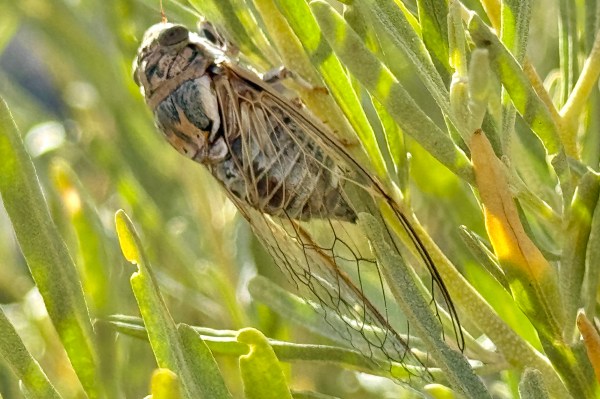
Rich had long ago returned to the car to cool off in the air conditioning but then became worried when I went out of view and didn’t return shortly—I’d just started heading back to the car as I saw him coming to look for me! We both decided that we’d had enough of 108°F temperatures and continued on to our next destination, the fantastically beautiful Organ Mountains-Desert Peaks National Monument!
Aguirre Springs Campground
Organ Mountains-Desert Peaks National Monument
Doña Ana County, New Mexico
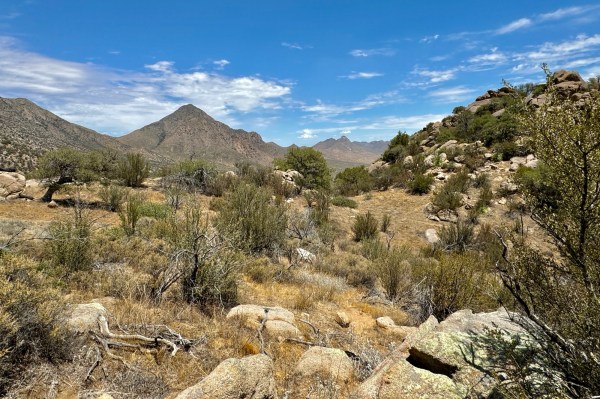
The ascent up into the Organ Mountains is among the most spectacular of any—tall dried stalks of sotol give the slopes a “brushy” appearance in front of sharp, jagged peaks.

The campground itself is also gorgeous; however, beauty is one thing—the presence of insect activity is another, and the parched-looking, still-quite-warm landscape (though nothing like the oven that we encountered at the previous stop) had us wondering if it would even be worth staying one night, much less the two that we had planned. I suggested spending a little bit of time beating the local vegetation—if I found beetles we would stay, but if not (as I fully expected), we would go back to Upper Karr Canyon to enjoy another night at its high, deliciously cool elevation and then head north in the morning to search for “greener pastures.”
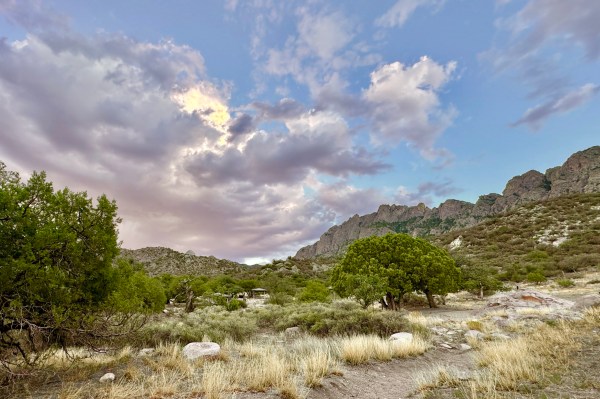
I got out the beating sheet and whacked the branch of a nearby hackberry, and to my surprise onto the sheet fell an Agrilus sp. (in fact, I was so surprised that I’d neglected to ready my aspirator and the damn thing got away!). More whacks of the hackberry produced nothing, so I regarded it as a fluke and turned my attention to the gray oaks (Quercus grisea). With one whack, onto the sheet dropped two Sternidius decorus—a species I know only from Arizona, and with continued beating I collected an additional individual or two at regular intervals.

Okay, so it looked like things might be happening here—despite the very dry-looking conditions, and we went about setting up camp. Dusk settled in as we finished our dinner, and I set up not only the ultraviolet lights but also the mercury vapor lamp. To make things interesting, I also set out a prionic acid lure near the lights in case there were any Prionus beetles in the area. It didn’t take long for the first male to show up—a remarkably small P. heroicus, and over the next hour several additional, more normal-sized males showed up.

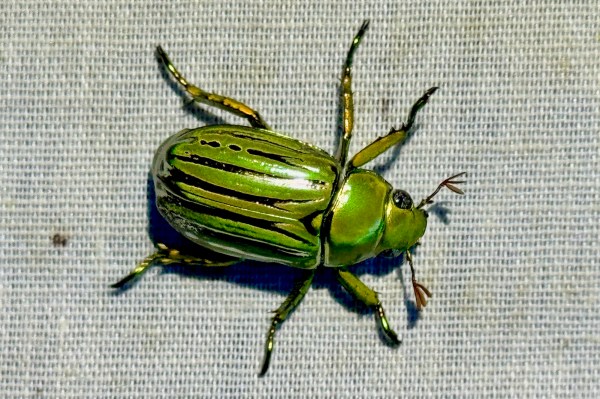
The lights alone also began attracting Cerambycidae as soon as full darkness arrived—many individuals of Methia mormona showed up, but so did other species such as Hypexilis sp. and what I take to be a species of Elaphidiini.

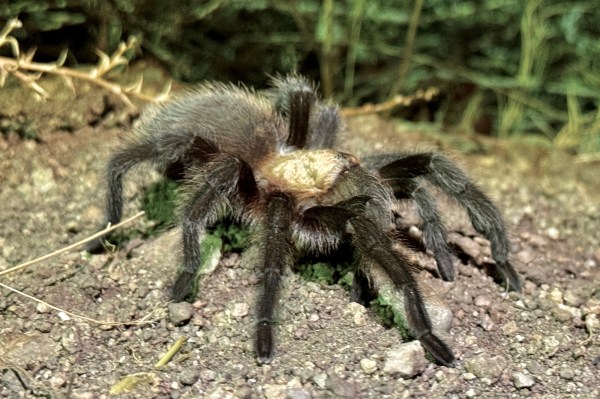
A female Aphonopelma hentzi (Texas brown tarantula—family Theraphosidae) also paid a visit to the lights looking for a free meal (I never saw a female tarantula ever and then see two in five days!).
Additional cerambycid individuals arrived regularly, and we would have left the lights up longer had occasional gusts and distant lightning not become blustering winds and certain rain. We got the lights taken down and put away with little time to spare, then spent the rest of the night not sleeping while high winds buffeted and heavy rain pelted the tent. (Its a good thing I got a new tent last year—my old one would not have survived!)
Day 9
La Cueva Recreation Area
Organ Mountains-Desert Peaks National Monument
Doña Ana County, New Mexico
Given the heat we experienced yesterday, we decided to do any lower elevation collecting first thing in the morning and then come back up into the mountains for the afternoon when (hopefully) the higher elevations would provide some relief. Some good species of Buprestidae have been taken by others in the vicinity of La Cueva picnic area on the other side of the mountain range, so we headed down there to take a look.

It was already hot by mid-morning as we headed out on the Arroyo Trail. Conditions were dry, but the mesquites (Prosopis glandulosa) had fresh foliage and the whitethorn acacias (Vachellia constricta) even had flowers. Hackberries (Celtis reticulata) were thick along the trail, and large oaks (Q. grisea and Q. turbinella) dotted the arroyo margins. Beating, however, produced nothing—no Buprestidae, no Cerambycidae, not even Chrysomelidae. I didn’t feel like continuing to “beat” a dead horse, especially when temperatures were skyrocketing and the mountains were beckoning, so we cut bait and headed back up the slopes.

Pine Tree Loop
Organ Mountains-Desert Peaks National Monument
Doña Ana County, New Mexico
The Pine Tree Loop is purported to be a 4-mile loop with 1000 ft of ascent (all within the first two miles!). My main objective was the small leafmining buprestid Brachys rileyi, which is known only from higher elevations in New Mexico and west Texas on Gambel oak (Quercus gambelii), and it was found a few years ago along this very trail. This was not my first attempt to find the species here—I stopped by two years ago guided by that record, which had been placed on the popular citizen scientist platform iNaturalist. Unfortunately, the record was inaccurately placed at a lower elevation (below the Gambel oak zone). I (incorrectly) assumed that the host must have been misidentified and that the species had been collected instead on gray oak (it is not unusual for buprestids thought to be associated with one host to eventually be found on another) and was rather frustrated to later learn that the inaccurate placement was intentional—the beetle had been photographed after it was collected, and because the true location had (amazingly!) not been recorded, the record was instead placed at a random point somewhere near the start of the hike. I must have beaten every oak within 100 feet of that (erroneous) location—obviously without success! I have since found other examples of such “malplacements” on iNaturalist, a practice which I can only describe as sloppy at best, and I implore all iNaturalist users (especially practicing entomologists) to record the most accurate placements for observations of insects photographed later as collected specimens rather than as live individuals out in the field. Obviously, this will involve more detailed note-taking; however, accuracy is, after all, a basic tenet of science! [Now climbing down from my soapbox.]

Okay, so now knowing that the record actually came from the Gambel oak zone on the upper part of the trail, we readied ourselves to hike the trail in its entirety. The scenery grew increasingly spectacular as we ascended, during which time I beat selected trees—mostly Quercus grisea (gray oak), from which I got a lone Acmaeodera quadrivittatoides on the lower slopes and a couple of Polycesta arizonica—represented in my collection until now by just a couple of specimens collected many years ago in west Texas—from a bit further up.

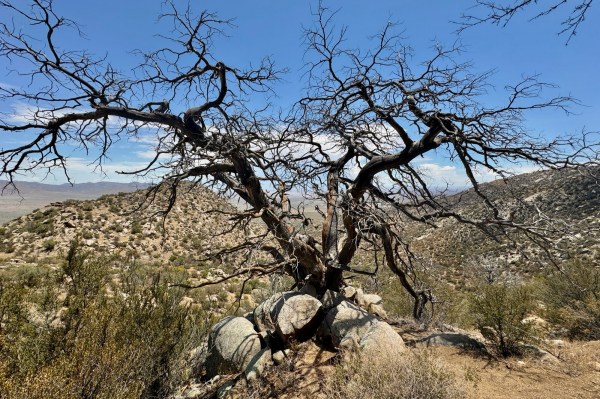
Massive alligator junipers (Juniperus deppeana), both alive and as cadavers, graced the landscape, providing both visual interest and opportunities for shade during our frequent breaks from the hot sun and the relentless ascent.


At long last, we reached the Gambel oak zone and I began beating stands near the trail in earnest. Almost immediately I add another Sternidius decorus to the series I’d gotten the previous evening, giving me hope that further beating would bring success. After only a few more minutes, a Brachys landed upside-down on my sheet! I quickly picked it up and popped it into the vial, then turned the vial until I could see the upper side. I was looking for the blue coloration with red apices to confirm its identity as B. rileyi, but instead its uniform coppery color indicated it was B. querci. Until a couple of years ago when I collected a good series of this species in the Davis Mountains of west Texas, I would have been very excited by this capture. Instead, my momentary elation turned to disappointment. Still having collected one species of Brachys gave me hope that I would still find the other, but that would not be the case—continued beating of Gambel oak was fruitless, and even my ability to do that was cut short when a popup thunderstorm moved in and drenched everything (including us!). I will admit that we welcomed the break in temperatures, as the heat and effort from the ascent had by then begun to take its toll on us, but eventually the rain moved out (creating some spectacular views as it moved across the slopes below us), and I resumed my beating.

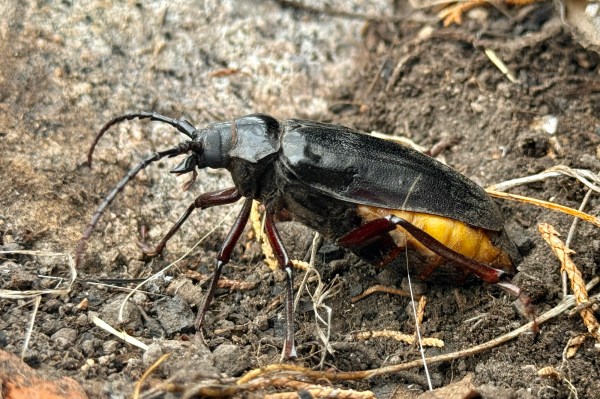
For a long time nothing hit my beating sheet (except a shower of water drops, which I had to continually shake off the sheet). Just before we passed back out of the Gambel oak zone after beginning our descent, I got a sort of consolation prize—a large(-ish) sp., and as I was putting the beetle in the vial a Prionus heroicus male flew by and circled slowly back towards me to within net’s reach. Not long after, as I was beating the last of the Gambel oaks that we would see, Rich called out to me from further down on the trail saying he saw another Prionus crawling on the ground and that it had crawled under a dead log. We lifted the log (gray oak), and there she sat—the most enormous gravid female P. heroicus I’d ever seen! I wanted a photo, but she started running so I blocked her with my finger to get her to stay still. This did not work despite repeated attempts, and at one point when I became rather careless with my finger placement she gave me the most painful beetle bite I’ve ever had—bringing blood right on the most sensitive part of my fingertip! I guess giving me a good nip brought her some satisfaction, because after that she stayed put long enough for me to snap the photos I wanted. By this point, we were really feeling the combination of miles, heat, thirst, and hunger and focused on completing the rest of the descent back to the parking area, where we enjoyed a (very) late lunch and cold liquids under a table with shade!
Aguirre Springs Campground
Organ Mountains-Desert Peaks National Monument
Doña Ana County, New Mexico
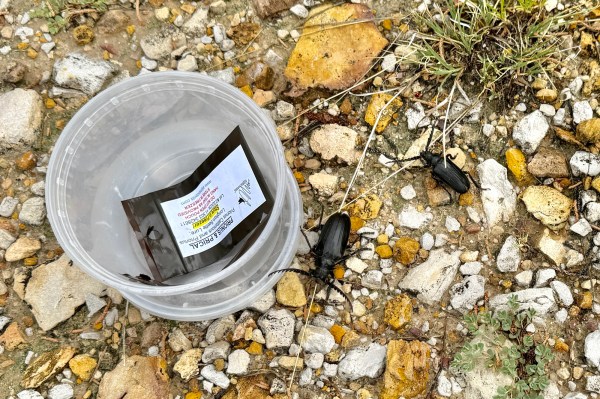
When we got back to the campground, I was so drained that all I wanted to do was rest (and continue rehydrating!). But, I still had the set of jug traps (that I’d taken down from Mescalero Sands) and had decided that the juniper/oak woodland around the campground with large gray oaks could be an interesting place to set them. We’d seen very few people in the area since our arrival (apparently camping in the heat of the summer is not popular here!), but I still wanted to eliminate any chance of the traps being molested so hoofed it past the barbed-wire fence on the west side and bushwhacked across the slope to a line of large gray oaks on the other side of the ravine. The SRW-only trap was placed furthest up the slope, the SRW/EtOH trap in the ravine, and the EtOH-only trap above the ravine nearest the road. On the way back to the campsite, another P. heroicus male flew within net’s reach, which I nabbed and gave to Rich. I also watched a large, orange/black female velvet ant (family Mutillidae) crawling on the ground and soon noticed a male that must have been the same species (smaller but identical coloration) fly in, circle around, and land on the ground not far from the female. I hoped he would encounter her, but when he was within a couple of feet he suddenly took flight and disappeared—perhaps she didn’t smell right or, in fact, was not a conspecific!

Spotty showers and gusty breezes prevented another night of lighting, but honestly we were both so exhausted from the day that we welcomed the opportunity to relax after dinner and catch up on our field notes.
Day 10
We enjoyed a much more restful night than previously thanks to cooler temperatures and awoke to spectacular views over the valley below. It was hard to think about turning around and heading back to the north and east, but both of us had committed to returning to St. Louis by late Friday—if we were going to keep that commitment we would have to make significant progress today. Our plan was to go back to Black Mesa in the extreme northwestern corner of Oklahoma (where we had been rained out at the beginning of the trip). At about a 7½-hour drive, we would have plenty of time to collect in the area before facing Friday’s 12-hour slog back to St. Louis. I did get a “goodbye gift” before we left—another Polycesta arizonica that was sitting on the tent as we broke camp!

Pajarito Rest Stop
Roosevelt County, New Mexico
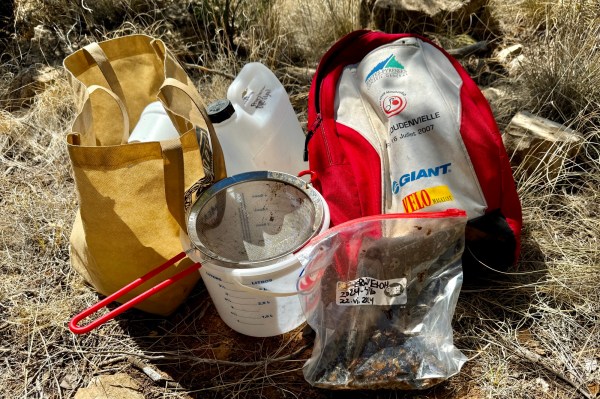
At the halfway point of the drive—approaching Tucumcari in east-central New Mexico, we decided to stop at an interstate rest stop for lunch and were pleased to find sheltered picnic tables to enjoy our meal. Afterwards, while exploring the grounds a bit (never pass up an opportunity to look for bugs!), I spotted a lidless white cooler sitting next to the fence along the back edge of the area. I don’t know what I expected to see inside of it, but when I looked I saw standing water in the bottom… and beetles! It was nothing more than a giant bowl trap! We brought the cooler back to the car, poured the contents through a sieve and rinsed before dumping out, and picked out a cerambycid (Strangalia sexnotata), two scarabs (Euphoria kernii), and a few other miscellaneous beetles (but, unfortunately, no Acmaeodera).

Kenton
Cimarron County, New Mexico
As we continued northward through northeastern New Mexico, we noticed what looked like rainclouds in the distance, and checking the radar forecast showed spot thundershowers moving through the area around Black Mesa. All we could say was “Here we go again!” and spent the remaining few hours of the drive watching the clouds and constantly checking the radar updates trying to predict if rain would actually occur at our planned collecting spot—a sandstone outcropping with juniper/oak/pinyon woodland just east of the tiny town of Kenton. Rain seemed certain as we passed through Clayton—about 30 minutes south and west of Kenton—when we got drenched while making a quick pit stop, but as we neared our destination the clouds started breaking up a bit, even allowing occasional peaks of sunlight. We arrived at the spot at either 5 pm or 6 pm, depending on whether we followed Central or Mountain Time (the time zone boundary passes right through the area), and though it had rained, it was neither cool nor overly wet. I had discovered Prionus heroicus in this area a number of years ago (with the help of prionic acid lures), and given our repeated sightings of this species the previous two days, I set out lures to see if they were active in this area. Almost immediately the males started flying in, easily recognized from afar by their enormous size, peculiar waving of their hind legs while flying, and diesel engine-like sound of their flight!
I collected a few to document the occurrence, but what I was most interested in doing here was beating the oaks. There are two species here, Quercus × undulata (wavylweaf oak) being the more abundant and Q. mohriana (Mohr oak) represented by sporadic individuals. I had beaten a nice series of Brachys barberi (and one B. aeruginosus) from the former last month and collected a few cerambycid-pruned branches from the latter, but beating on this day produced little. I did, however, note several additional cerambycid-pruned branches on the very same Q. mohriana from which I had collected them last month, which I bundled for rearing, and beating the living branches produced a single Chrysobothris purpureovittata purpureovittata.

Also from Q. mohriana, I beat a large, impress caterpillar that I soon decided must be one of the Hemileuca spp. (sheep and buck moths—family Saturniidae). The only species known from the area is H. oliviae (range sheep moth), but it clearly did not look match images of that species, so Rich decided to see if he could rear the caterpillar to adulthood and collected foliage from the tree to provide additional food until it pupated. [Edit: The host, location, and gestalt (especially the reddish dorsal coloration between the segments) suggest it is Hemileuca grotei diana (Grote’s buck moth). Apparently this species has not yet recorded from Oklahoma, but the location in far northwest corner is very close to several Colorado records, and the species also occurs in Texas, New Mexico, and Arizona. Rich also wrote the following update on his attempts to rear the caterpillar to adulthood:
The caterpillar made it home safely. I put the caterpillar in a large jar with cactus soil, and some of the oak leaves I collected off the bush where it was collected. For the next three days, it fed on the leaves at night and left lots of frass behind. During the day, it remained motionless on the dirt. Since last night, the caterpillar has not moved which could mean that it has died or is parasitized. It may also be taking its time to form a pupa. This is what I am hoping for.]

I continued beating the oaks but found only a few weevils on Q. × undulata before turning back to look around the flats around the parking area. Along the way, I noted a lone Celtis reticulata (net-veined hackberry) along the roadside, from which I beat a single Agrilus. Its chunky size and coppery color had me fooled until I realized it was a stray A. sapindi—normally associated with Sapindus saponaria ssp. drummondii (western soapberry). I’m not aware of the occurrence of soapberry at this particular spot, but it is common at nearby Black Mesa State Park and likely also occurs in other closer areas.

Checking the flats around the parking area, I found not only Moneilema armatum on Cylindropuntia imbricata (cholla), but also Cacama valvata (common cactus dodger).

After taking photos of the latter, I noticed a large beetle crawling on the ground and realized it was a female P. heroicus—only the second female of this species I’ve seen (the first being only one day earlier at Organ Mountains-Desert Peaks National Monument). This brings me to an idea I have about attraction to pheromones in Prionus beetles—released by females (none of which fly to my knowledge) to attract males (which are powerful fliers). The use of prionic acid pheromone lures has greatly facilitated the collection of male Prionus beetles (all species of Prionus appear to be attracted to prionic acid); however, I have also collected females of several species (P. arenarius, P. fissicornis, P. integer, and—now—P. heroicus) while using prionic acid lures to collect male Prionus. In each case, I found the females walking on the ground in the general direction of the lures, suggesting to me that they may be “cheaters”—i.e., rather than producing and releasing their own pheromone, they detect pheromone being released by another female and walk towards the source in hopes of “stealing” a male. If this is true, the energetic cost of producing/releasing pheromone must be sufficiently high to allow cheaters to persist in the population. In today’s case as well, the female was walking in the general direction of the lure from a distance of about 60 meters. It would be interesting to test this hypothesis experimentally (but it will be up to someone else to do this). On the way back to the car, I collected one more M. armatum—this one on Opuntia phaeacantha (brown-spined pricklypear cactus).
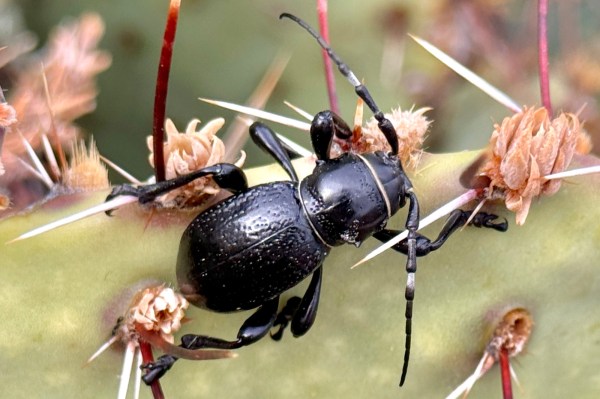
Rich came back to the car about the same time, so I checked in with him to see how he had done. He gave me an Acmaeodera (prob. A. mixta/immaculata) that he’d collected on the flower of Pediomelum tenuiflorum (slimflower scurfpea) and wanted to walk back down the gravel road to check for other flowers. I accompanied him, beating oaks along the way without success (but seeing a very impressive Climaciella brunnea—brown wasp mantidfly) until, finally, a B. barberi from Q. mohriana near the bottom of the hill landed on my sheet.

By then it was getting close to dusk, but I hadn’t yet checked the dead Pinus edulis (Colorado pinyon pine) from which I’d beaten two new state records (Oeme rigida deserta and Haplidus testaceus) on my visit here last month. I was keen to see what else might be on the tree a month later and, amazingly, got two more new state records this time as well: Buprestis laeviventris beaten from a branch, and a dead Monochamus clamator clamator (spotted pine sawyer) female stuck on the trunk.

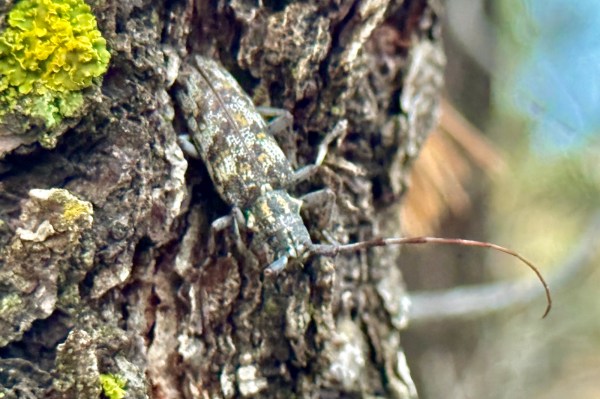
These would be the last insects that I would collect on the trip, and what a final duo they were! On the way back to the car, I picked up a couple of cerambycid-pruned branches of Q. × undulata that I had set aside earlier for rearing. It will be interesting to see if it is the same species that is pruning the two oak species (Q. × undulata and Q. mohriana). With dusk approaching and us still needing to get to the state park and setup camp, we decided that three hours of collecting at the final spot was a good way to close out 10 straight days of collecting!
Black Mesa State Park
Cimarron County, New Mexico
Our “favorite” campsite in the park was unavailable—in fact, the entire West Canyon campground was closed due to installation of a new dump station for the nearby RV campground. As an alternative, we secured a spot at the nearby Lake Etling Campground. I’ve never stayed there because there are no toilets, but the sites are much larger and come with shelters over the picnic tables—something that would have come in handy during my several previous visits with rain. Site #24, in particular—located at the far end of the campground, nestled up against a low cliff, and well out of sight from the rest of the campground, may well now be my new favorite campsite at the park.

After enjoying a celebratory rib-eye steak dinner, I walked the roads hoping to see night-active beetles. Unfortunately, the same rains that killed the possibility of setting up the lights also apparently kept the beetles holed up, and I saw nothing. It occurred to me then that this was my tenth visit to the park in the past three years, and it has rained on six of those visits! So much for western Oklahoma being a “dry” place!

Day 11
The drive from Black Mesa to St. Louis was predictably boring and unfulfilling. Normally I would eschew interstates and divided highways in favor of backroads, but at 12 hours even on the quickest route I had to bite the bullet. At least we did not have to get out of the car while the hottest temperatures of the trip (111°F!) settled over us, and the memories of the trip will feed my souls for a long time to come.

©️ Ted C. MacRae 2024
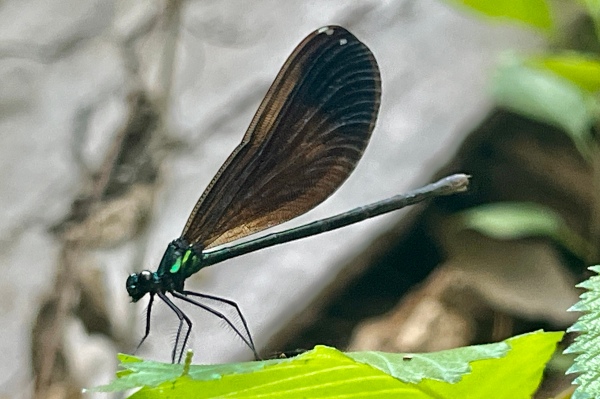
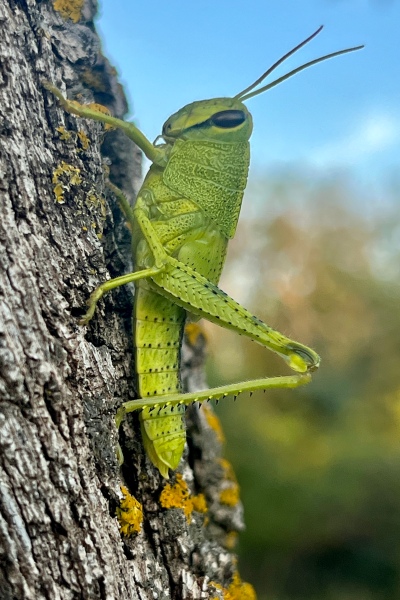
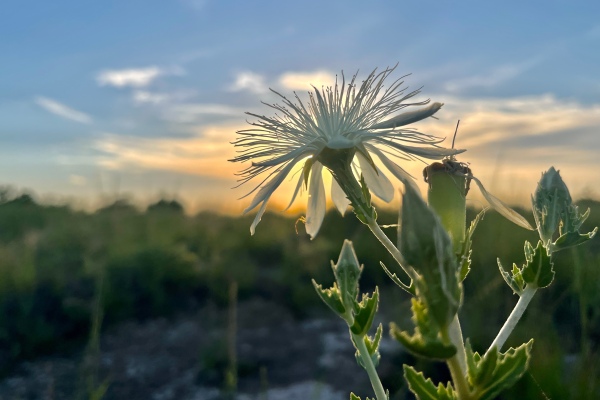
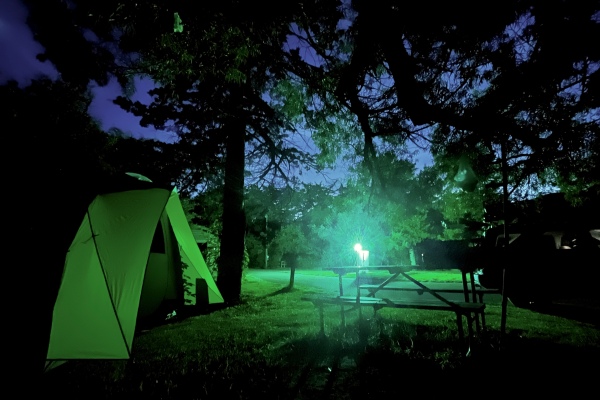
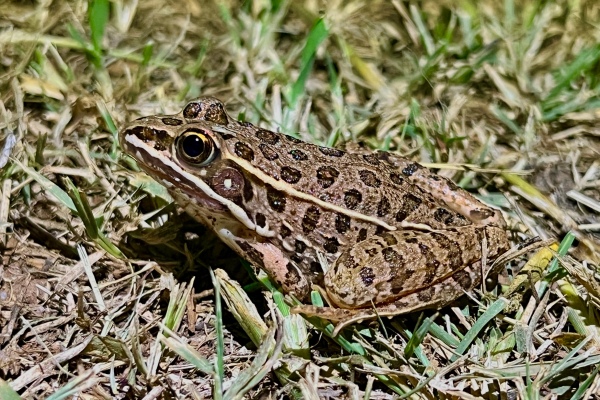


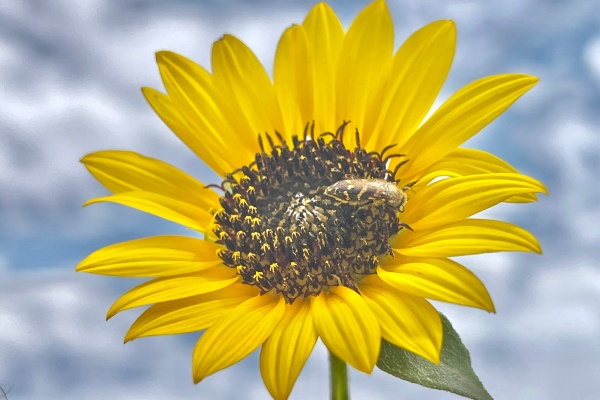

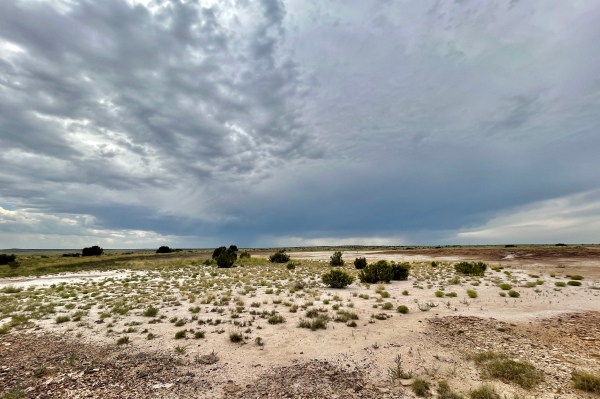
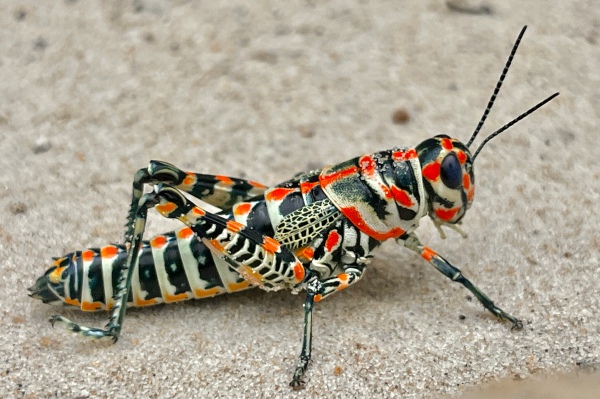


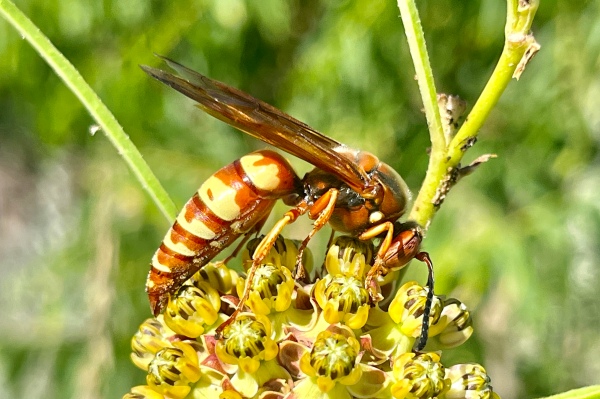



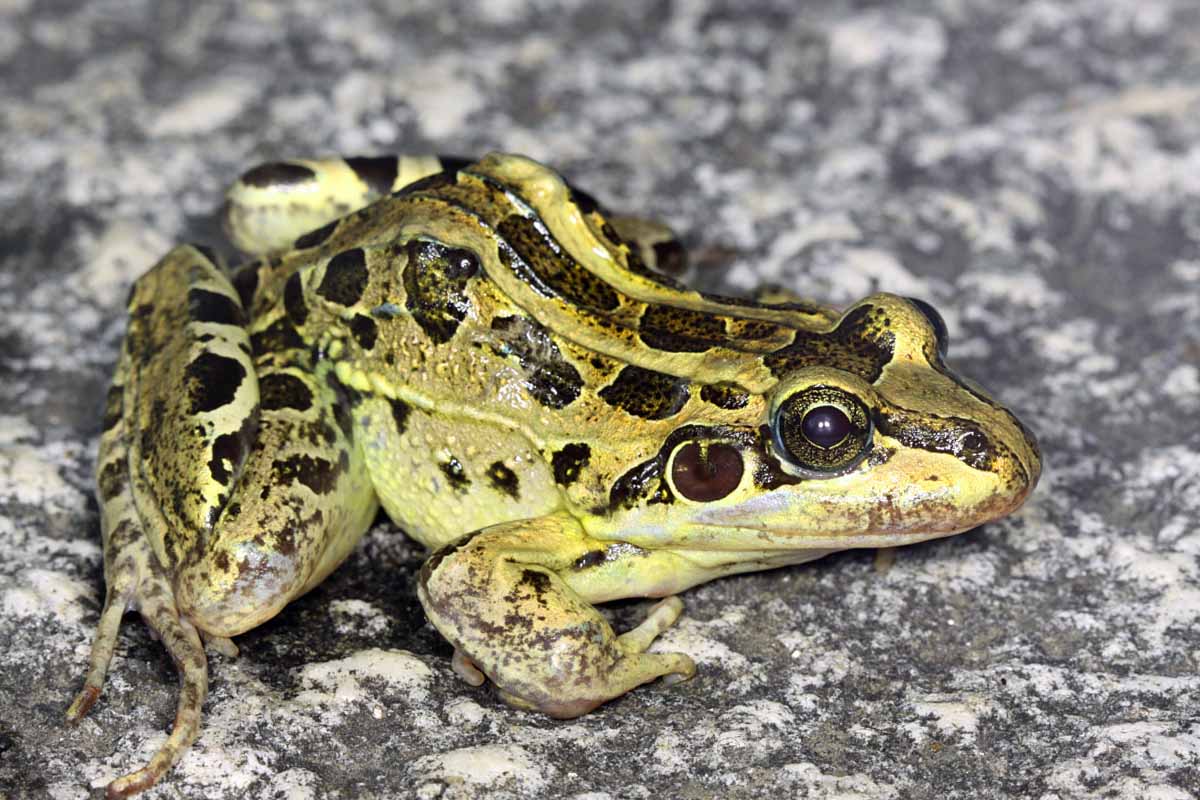


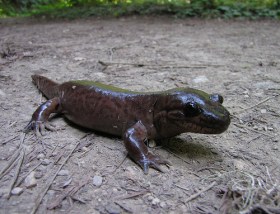


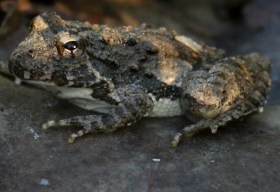










 Beetles In The Bush