The inviting openness of the Sierra woods is one of their most distinguishing characteristics. The trees of all the species stand more or less apart in groves, or in small, irregular groups, enabling one to find a way nearly everywhere, along sunny colonnades and through openings that have a smooth, parklike surface.–John Muir, The Mountains of California (1894)
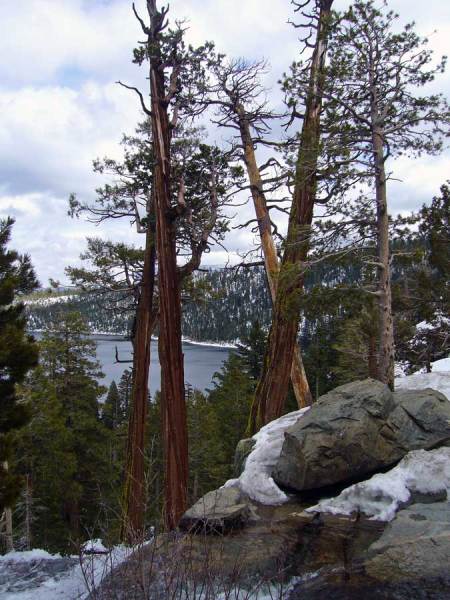
In a previous post (Trees of Lake Tahoe – The Pines), I discussed the six species of pine that can be found within the Tahoe Basin. These include Jeffrey pine (Pinus jeffreyi) – dominant around the lake at lower elevations, lodgepole pine (P. contorta ssp. murrayana) – common in meadows at lower elevations and replacing Jeffrey pine at higher elevations, ponderosa pine (P. ponderosa) – uncommon in the basin due to its preference for lower elevations, sugar pine (P. lambertiana) – the magnificent giant of high quality mesic sites along the western shore, western white pine (P. monticola) – co-occurring with lodgepole pine at higher elevations, and whitebark pine (P. albicaulis) – covering the highest peaks with its gnarled and twisted form. In this post, I will cover the five “other” coniferous trees that can be found growing in the Tahoe Basin. These other conifers belong to several different genera in two gymnospermous families – the Pinaceae and the Cuppressaceae. Together with the pines, these trees comprise what John Muir described as one of the most diverse and appealing coniferous forests in the world. I am most inclined to agree with him. The diversity of conifers found in the Tahoe Basin is reflective of the wide range of conditions occurring there as a result of differences in elevation (from 6,200 ft to more than 10,000 ft), exposure, and moisture.
Family-level identification of Tahoe Basin conifers is relatively straightforward – those with needle-shaped leaves belong to the Pinaceae (the pine family), while those with scale-like leaves belong to the Cuppressaceae (the cypress family). There are other characters that distinguish members of these two families, but leaf shape is the most useful for purposes of field identification. Nine of the eleven species of conifers found in the Tahoe Basin belong to the Pinaceae, while only two are members of the Cuppressaceae. Within the families, the genera can be distinguished most readily by the following characters:
Pinaceae
- Pines (Pinus) – needles linear, arranged in bundles or clusters of up to 5 needles held together at the base by sheath of papery bark (discussed in Trees of Lake Tahoe – The Pines).
- Firs (Abies) – needles more or less flattened, growing directly and singly from the branch and with a plump base that leaves a round depression on the branch. Cones upright, on upper branches.
- Hemlocks (Tsuga) – needles more or less flattened and growing directly and singly from the branch like firs, but narrowly stalk-like at the base where they are joined to tiny wooden pegs. Cones pendant, on outer branches.
Cuppressaceae
- Incense-cedars (Calocedrus) – scale-like leaves 4-ranked, twigs branching in one plane to form flat sprays, cones > ½” in length, consisting of two large scales separated from a closed center.
- Junipers (Juniperus) – scale-like leaves arranged in circles of 3, twigs not forming flat sprays, cones < ½” in length, berrylike.
There are three additional coniferous genera in the Sierra Nevada – each represented by a single species and found along the western slope – that do not occur in the Tahoe Basin. These include: Douglas-fir (Pseudotsuga menziesii) – widespread at elevations from 2,500 ft to 6,000 ft (higher at the southern end of its range); giant sequoia (Sequoiadendron giganteum) – primarily in Giant Sequoia National Monument, and California nutmeg (Torreya californica) – of scattered occurrence.
White fir (Abies concolor)
As old age creeps on, the bark becomes rougher and grayer, the branches lose their exact regularity, many are snow-bent or broken off,…but throughout all the vicissitudes of its life on the mountains, come what may, the noble grandeur of the species is patent to every eye.
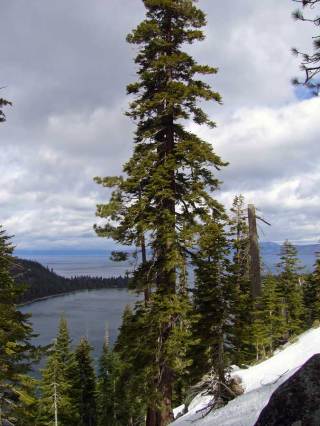

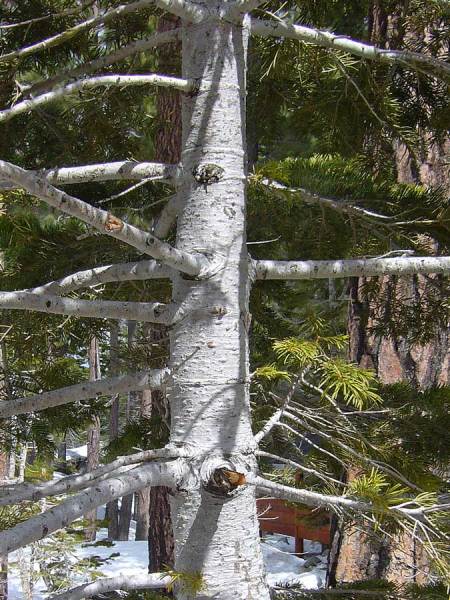
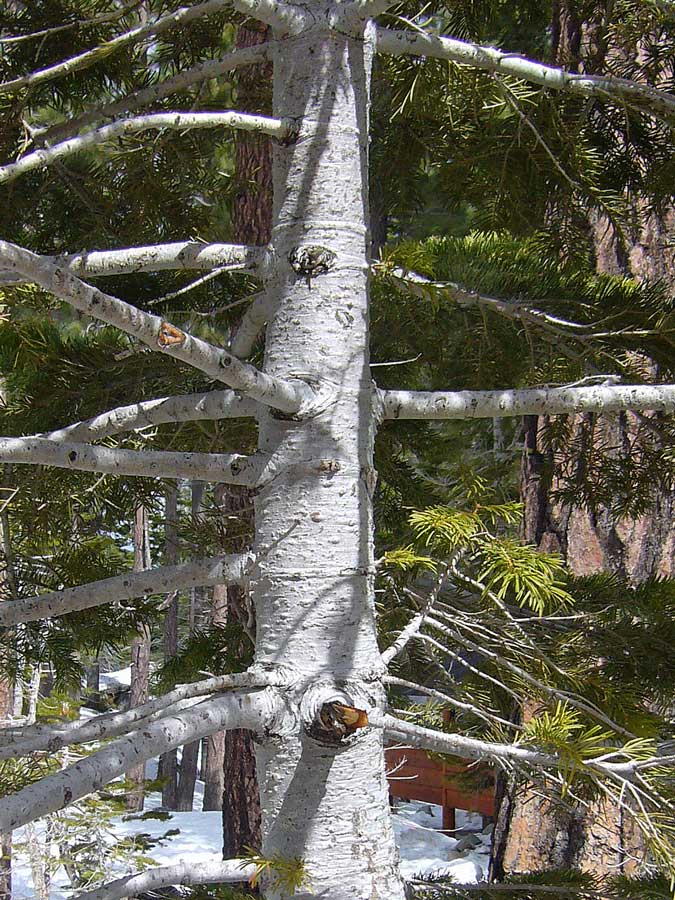
White fir is second only to Jeffrey pine as the dominant conifer at the lower elevations within the Tahoe Basin¹. It is immediately recognizable as the only non-pine member of the Pinaceae to occur at these elevations – red fir and mountain hemlock are found only at higher elevations in the basin. Young trees have a nearly perfect pyramidal shape, with silvery gray bark that is thin, smooth, and  covered with resin-filled blisters that can be “popped” to shoot out the resin. Older trees develop a more cylindrical and slightly irregular crown, and the bark becomes thick and roughly furrowed, changing to a dark gray or brown color. The foliage has a gray frosted appearance from below, and crushing the needles releases a delightful citrus smell that I found myself partaking in repeatedly. In the narrow elevational zone where white fir and red fir co-exist, white fir may be recognized by its more flattened needles (cannot be “rolled” in the fingers) which are distinctly twisted near the base, causing them to appear 2-ranked. White fir was seen throughout the Tahoe Basin at elevations below around 7,500 ft, and especially along the western shore and southern shores where the greater moisture and protection of north and east facing slopes are to this species liking.
¹ This post by Watching The World Wake Up provides an excellent introduction to the characteristics and distribution of white fir and its relatives. It also contains what must be the best tangent to ever appear in a botanical blog – the connection made between white fir and the alluring Salma Hayek (annoyingly mispelled “Selma” Hayek), softly singing Siente Mi Amor, is pure brilliance!
Despite its “noble grandeur,” white fir may be regarded as somewhat of a pest species. The suppression of fires that have been the hallmark of 20th century forest management have encouraged the replacement of pines throughout the Sierra Nevada by this species. White fir does not tolerate fire as well as the pines with which it occurs, but unlike those species it does well in shadier conditions. The suppression of fires has resulted in dense stands of white firs growing up in the spaces between the pines. Since it tends to retain its lower branches as it grows, when fires do occur the white firs can act as “fire ladders” that allow the fires to reach the upper canopies of the pines. Pines are not as shade tolerant as firs and are thus unlikely to become established beneath the dense canopy of firs. The result of these fire suppression policies are mixed-conifer forests that are denser and contain a much higher proportion of white fir than in the past, making the forests more vulnerable to stand-replacing fires as well as stress-induced insect and disease outbreaks. These counterproductive management policies are beginning to change – and I saw two controlled burns taking place during the week while I was in Lake Tahoe – but there is still much progress yet to be done if we are to once again see large expanses of the “inviting openness” that so captivated John Muir.
Red fir (Abies magnifica)
This is the most charmingly symmetrical of all the giants of the Sierra woods, far surpassing its companion species [white fir] in this respect… Happy the man with the freedom and the love to climb one of these superb trees in full flower and fruit.
 I suspected I had seen this magnificent relative of the white fir in the higher elevations at Heavenly Ski Resort on my first trip back to the area last year, but lacking any real knowledge or field guides at the time it remained only a suspicion. When I returned to Heavenly this year, I was ready for it, and I recognized it instantly when I reached elevations around 8,000 ft. The massive trees with deeply reddish bark were unmistakable, and my only disappointment in seeing this species was that I was unable to approach them closely enough to allow a more thorough examination of their needles and bark. Like the white firs I saw at lower elevations, these massive trees had developed a bit of irregularity in their long, cylindrical crowns.
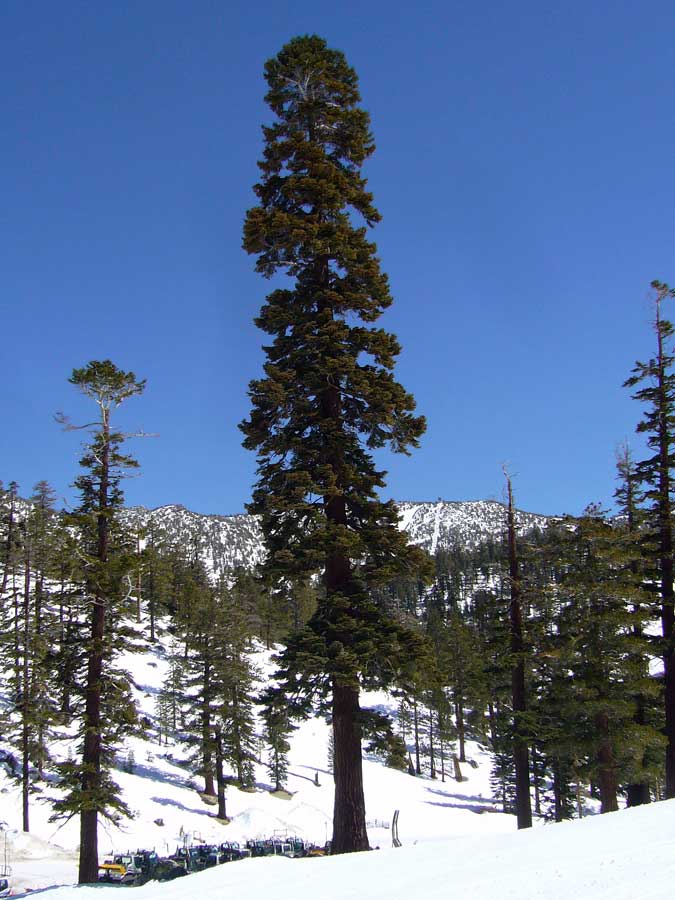
Younger trees can appear more similar to white fir because of their thin, smooth gray bark with elliptical resin blisters. However, in trees both young and old, the foliage is a more boldly colored blue-green than the paler foliage of white fir. 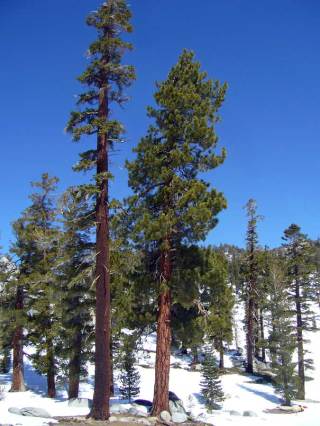 Both species develop thick, deeply furrowed bark as they age, but the bark of red fir is distinctly reddish-brown or reddish purple, compared to the dark gray or brown bark of white fir – almost ashen in appearance. In the hand, the needles are not so flattened as white fir – almost quadrangular in cross-section and able to be rolled in the fingers – nor are they distinctly twisted near the base. The photo at right shows a stately red fir on the left next to a Jeffrey pine on the right at Lakeview Lodge on the California side of Heavenly (elevation 8,250 ft – the highest at which I saw the latter species). I found this species growing in the company of western white pine (Pinus monticola), lodgepole pine (P. contorta ssp. murrayana), and mountain hemlock (Tsuga mertensiana), as well as in groves of its own kind (unfortunately, seen only from my perch upon a ski lift).
Mountain hemlock (Tsuga mertensiana)
The Hemlock Spruce is the most singularly beautiful of all the California coniferæ. So slender is its axis at the top, that it bends over and droops like the stalk of a nodding lily. The branches droop also, and divide into innumerable slender, waving sprays, which are arranged in a varied, eloquent harmony that is wholly indescribable.
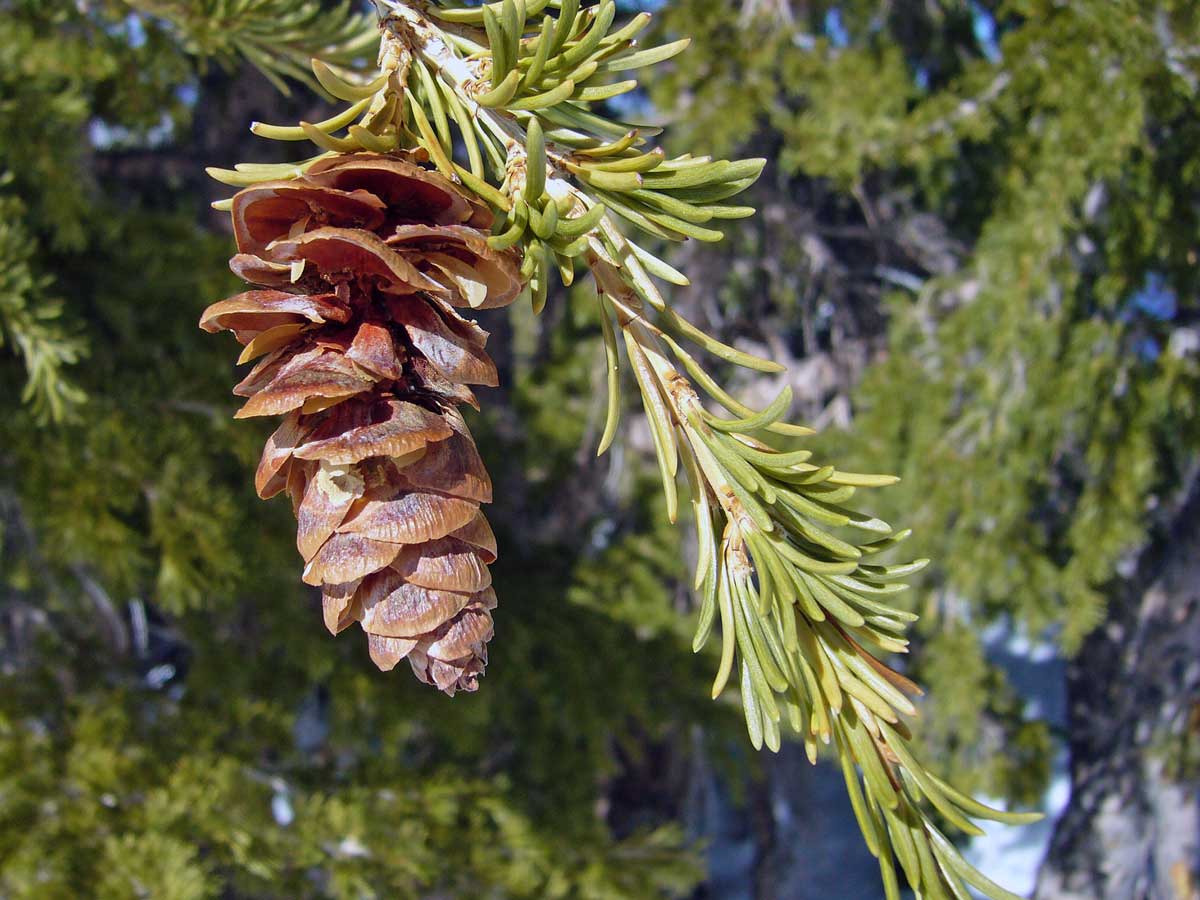
 I hadn’t a clue whether I would succeed in finding mountain hemlock – I knew it was a denizon of the snowy high mountains, though less common than some of the other high country conifers, and I didn’t recall noticing anything that might be this species during last year’s visit to the slopes of Heavenly. Of course, being a long-time resident of the Midwest I have little experience with hemlocks in general – eastern hemlock (T. canadensis) is on occasion planted in urban landscapes here, but mountain hemlock is markedly different from that species, as well as its Pacific counterpart western hemlock (T. heterophylla), due to its needles growing out of the twigs in all directions rather than in two flat planar sprays. Additionally, the needles are square in cross-section like spruce (Picea), a genus that does not now occur in the Sierra Nevada. These features caused 19th century botanists to suspect that mountain hemlock might have originated from an intergeneric hybridization event, as evidence by John Muir’s reference to it as “Hemlock Spruce.” However, no crosses between genera in the Pinaceae have ever been substantiated, and no compelling evidence of the presumed crossing events proposed for mountain hemlock has been brought forth (Lanner 1999).
 Perhaps being primed by the readings I had done beforehand, I knew instantly I had found this species while riding a ski lift and seeing what looked at first like small junipers, but with a Tolkienesque appearance due to the gracefully nodding leader and drooping branch tips. My hurried attempts to snap photographs of the trees from the moving ski lift produced nothing but skewed views marred by lift cables and passing cars, but once at the summit I was able to ski down to a little grove next to the ski run for closer inspection. I immediately noticed the many cones clustered at the branch tips and was struck by their pine cone-like appearance. They were quite large – nearly 2” long (massive by hemlock standards). Sadly, the only examples I would see of this species would be these small trees that only hinted at the charms of the massive specimens with trunks up to six feet in diameter that so enamoured John Muir. Like the rare Washoe pine (Pinus washoensis) that occurs just outside Tahoe Basin on the eastern slopes of Mt. Rose, attempts to find some of these graceful 100-footers will have to await my next year’s visit.
Incense-cedar (Calocedrus decurrens)
Casting your eye over the general forest from some ridge-top, the color alone of its spiry summits is sufficient to identify it in any company.


The incense-cedar is my favorite of all the Tahoe Basin conifers. The bright, cinnamon-red bark of mature trees, deeply-furrowed, fibrous and peeling, is reminiscent of California’s two most iconic conifers – redwood (Sequoia sempervirens) and giant sequoia (Sequoiadendron giganteum), respectively the world’s tallest and most massive trees. Incense-cedar is neither as tall as redwood nor as massive as giant sequoia –  indeed, it is not even very closely related (redwood and giant sequoia belong to yet another coniferous family, the Taxodiaceae, containing also the graceful but much smaller resident of southeastern U.S. swamps, baldcypress – Taxodium distichum). Nevertheless, old trees – veterans of centuries of fires and storm damage – are stunning specimens to behold, their massive, buttressed trunks often draped in yellow-green mosses and bearing deep basal fire scars, their spired crowns often broken and forked. Their flattened sprays of foliage give the tree a delicate, lacy appearance in beautiful contrast to its grizzled, gnarled bark. Indeed, even in death these trees stand out for their stark beauty.
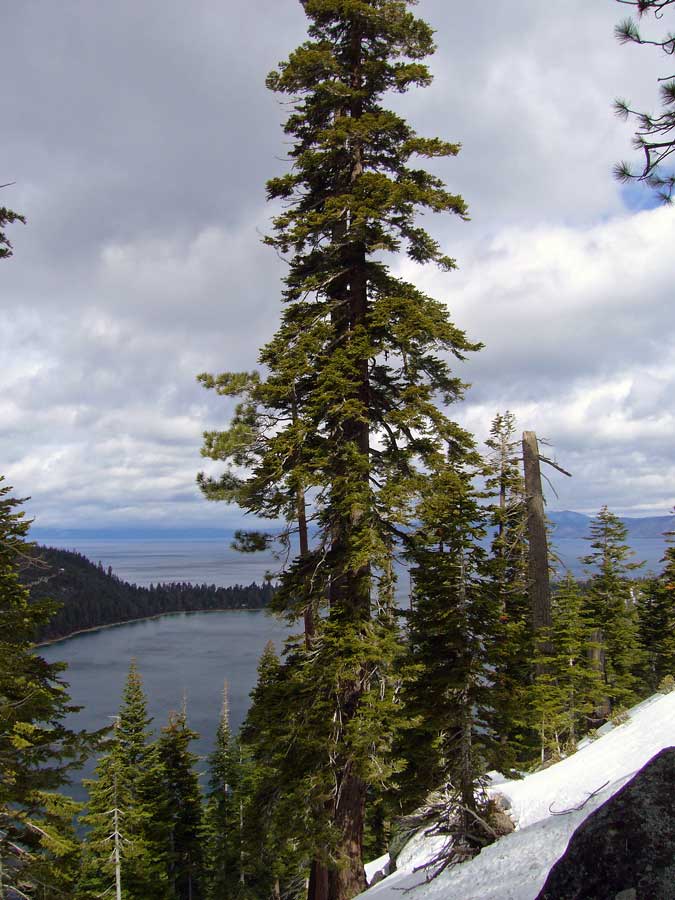
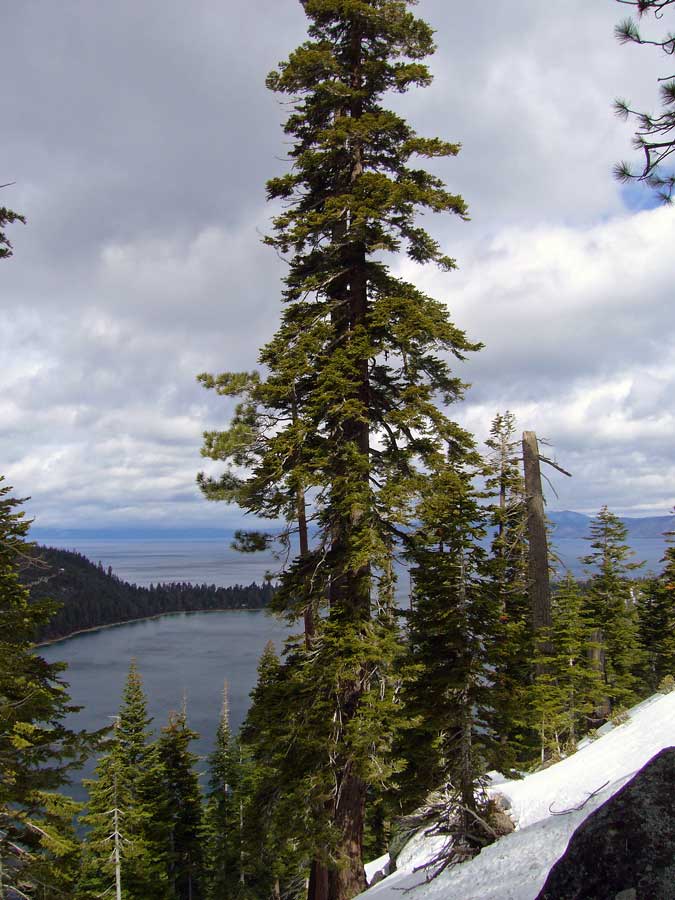
Incense-cedar is common at lower elevations in the Tahoe Basin, especially down close to the lake and in the communities ringing the shore. It rarely forms “stands” like white fir and the pines,  but rather most often occurs singly – as if to emphasize their distinctiveness. I found it most common along the western shore, where it grows scattered amongst white fir and Jeffrey, sugar, and ponderosa pines. Some of the most massive incense-cedars I have ever seen were found down near the lakeshore along the Rubicon Trail in Emerald Bay State Park. Common on these trees were what I take to be incense-cedar mistletoe (Phoradendron libocedri) (family Santalaceae), which is apparently rare in the Tahoe Basin but known to occur in the mesic forests of the west shore.
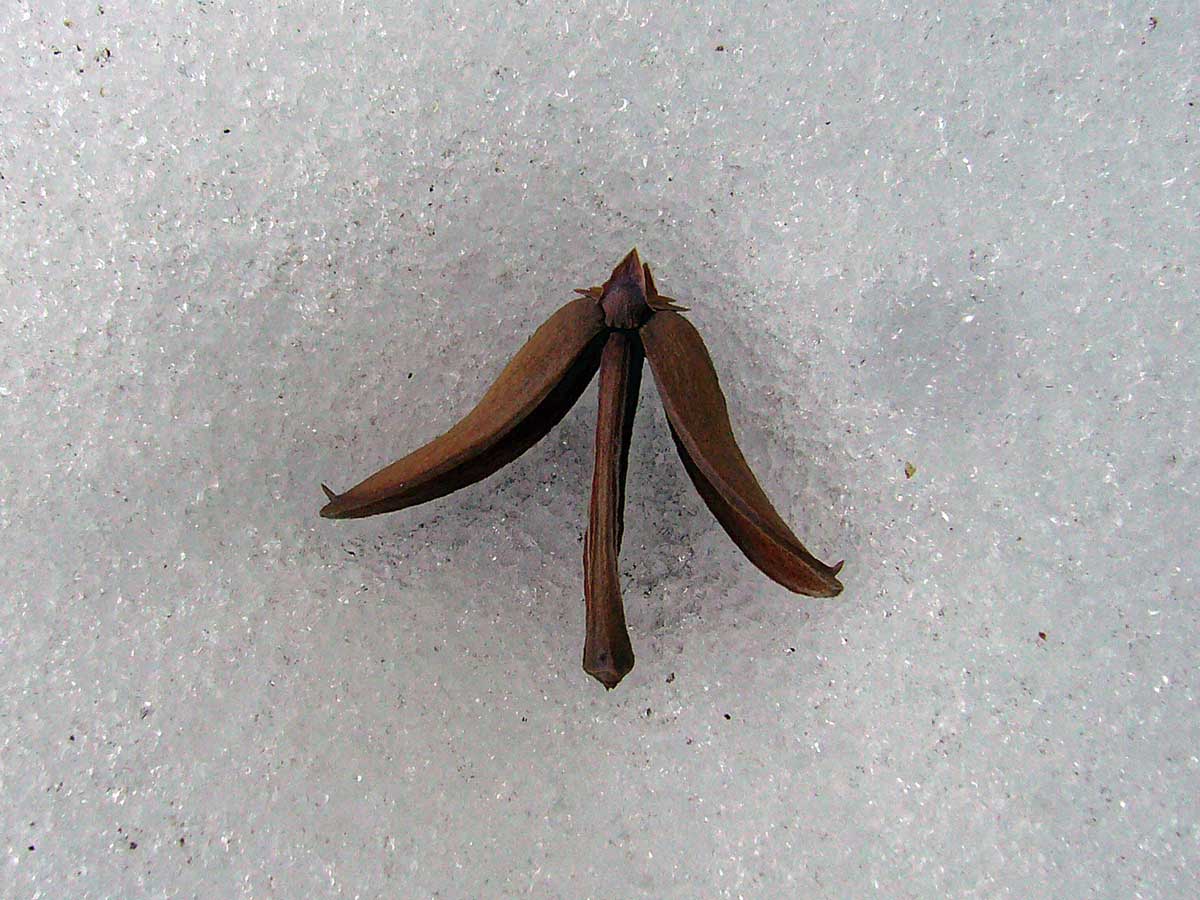
Incense-cedar is another of the so-called “wrongly named” conifers – it is not a true cedar (thus, the hyphen in the name), a group of conifers belonging to the genus Cedrus in the family Pinaceae that is found across Eurasia². While somewhat resembling the true cedars, incense-cedar’s closest relatives are restricted to China and Taiwan. 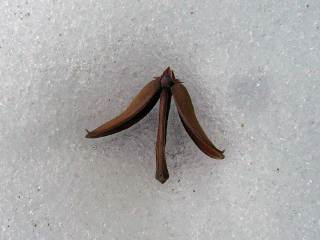 Early botanist-explorers, when they first encountered this tree, named it for what it most resembled to them – the old world cedars. This distinctiveness makes older trees the easiest Tahoe Basin conifer to identify. Even it’s cones that litter the ground under mature trees are unique – slender, spindle-shaped, and about an inch long, with the two longest scales bending back at maturity in a manner resembling a wide-open duck’s bill with the tongue sticking out. Young trees resemble Sierra juniper by their scale-like leaves and peeling bark, but the flattened, yellow-green sprays of incense-cedar and shiny reddish coloration of the bark of twigs and younger branches are immediately distinctive.
² There are actually numerous examples of such wrongly named conifers – Douglas-fir (Pseudotsuga menziesii) is not a true fir; eastern redcedar (Juniperus virginiana), western redcedar (Thuja plicata) and Alaska-cedar (Chamaecyparis nootkatensis) are not true cedars; and baldcypress (Taxodium distichum) is not a true cypress. Long live scientific names!
Like white fir, the Sierra Nevada has seen a bit of a population explosion of incense-cedar due to the fire-suppressive forest management practices of the past century. Despite the thick, fire-resistant bark of older trees, the thin-barked seedlings and saplings are intolerant of fire and grow more slowly than the fire-adapted pines. As a result, the frequent low-intensity fires of the past kept seedling establishment to a minimum, resulting in spot occurrences of mature, fire-resistant specimens. The suppression of these fires, combined with the ability of incense-cedar to germinate in shade and thick layers of duff, have allowed this species to increase in incidence throughout the Sierra Nevada. Along with white fir, it is gradually replacing the pines. This may seem like a good thing from the perspective of foresters and loggers, who value the wood of incense-cedar for its use in making pencils and cedar chests, but from an ecological perspective this has the same negative consequences discussed above for white fir.
Sierra juniper (Juniperus occidentalis ssp. australis)
Its fine color and odd picturesqueness always catch an artist’s eye, but to me the Juniper seems a singularly dull and taciturn tree, never speaking to one’s heart.
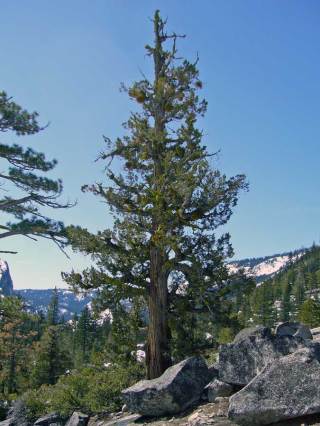


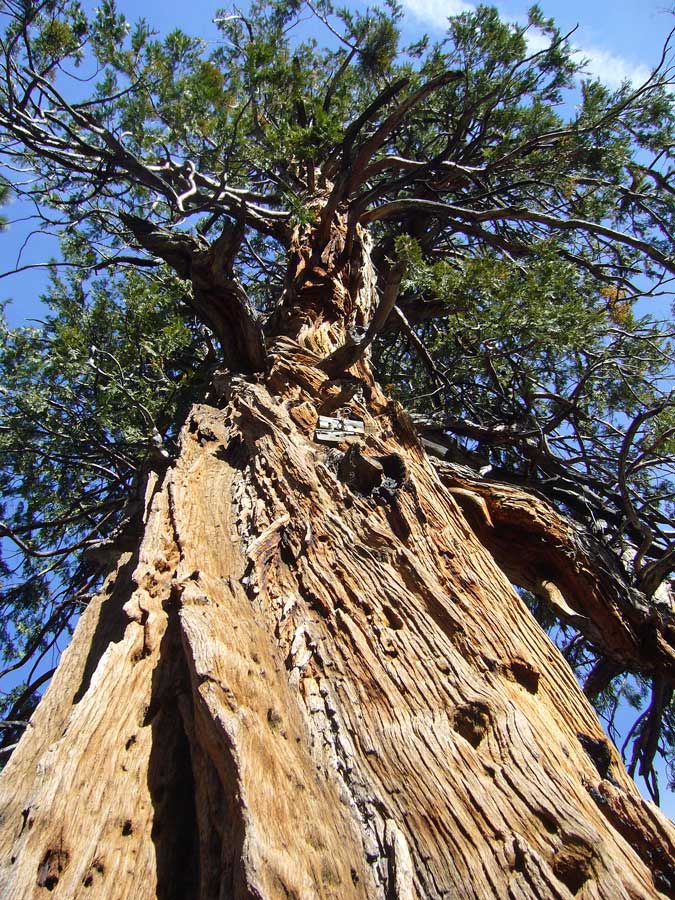
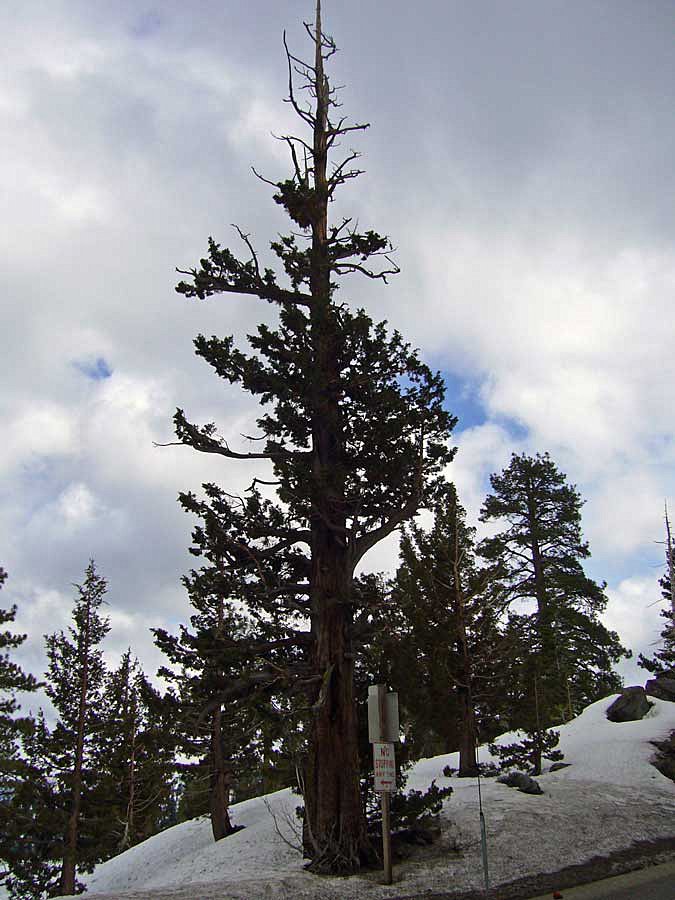
This was another conifer that I didn’t recall seeing on my previous visits, but from what I had read I really hoped I did. Gnarly and burly, mature specimens have a weather-beaten, picturesque quality that is unmatched by any other Tahoe Basin conifer save whitebark pine (P. albicaulis). While I did not find this tree to be common in the Tahoe Basin, I did find it in the most surprising of places – Emerald Bay overlook, where I had gazed in admiration at Lake Tahoe on so many previous occassions. This enduring dweller of exposed granite crags grows where no other trees can, anchored to crevices with only the tracest amounts of soil,  seemingly thriving on nothing more than rock, snow, and sunshine. Old trees, with their massively short trunks supporting wind-pruned crowns, cannot be mistaken for any other Tahoe Basin conifer. The wood, it seems, is almost as hard as the granite upon which the trees grow, accounting for John Muir’s impression of this tree as without expression – not even the strongest Sierra winds evoke the slightest of shudders or the quietest of whispers in its unyielding bows.
I did not find this species commonly in the areas of the Tahoe Basin that I visited (which were mostly lower elevation sites below 7,000 ft). In addition to the specimens seen at Emerald Bay State Park, I also found this species near Upper Truckee River before the climb to Echo Summit, and I found a number of fine mature specimens outside of the basin proper at Pyramid Creek Geological Area. Where I did find it, Jeffrey pine was the most common associate, but in most cases the trees stood alone in their own starkness. Among the Tahoe Basin conifers, the small scale-like leaves are recognizable to almost any easterner as those of juniper, immediately placing it in the family Cuppressaceae alongside incense-cedar. Even the young trees can be distinguished from that species by their non-glossy foliage borne on twigs that radiate out from the branches in all directions.  The bark of young trees is shreddy and peeling like that of incense-cedar, but it is dull brown to reddish-brown rather than the shiny purple-red color of incense-cedars.
Sierra Nevada populations of Juniperus occidentalis are considered a separate subspecies due to differences in reproduction and elevational preference. Trees in nominotypical populations, found in northeastern California and up through eastern Oregon and Washington, are found at somewhat lower elevations (4,000 ft to 5,000 ft) and have cones of both sexes on the same tree; while those of subspecies australis, limited to higher elevations (usually from 6,500 ft to over 10,000 ft) in the Sierra Nevada, have either all male cones or all female cones.
REFERENCES:
Arno, S. F. 1973. Discovering Sierra Trees. Yosemite Association, Yosemite National Park, California, 89 pp.
Graf, M. 1999. Plants of the Tahoe Basin. Flowering Plants, Trees, and Ferns. A Photographic Guide. California Native Plant Society Press, Berkeley, 308 pp.
Muir, J. 1894. The Mountains of California. The Century Co., New York, xiii+381 pp.
Lanner, R. M. 1999. Conifers of California. Cachuma Press, Los Olivos, California, 274 pp.
Peterson, P. V., and P. V. Peterson, Jr. 1975. Native Trees of the Sierra Nevada. University of California Press, Berkeley, 147 pp.
Copyright © Ted C. MacRae 2009









 Beetles In The Bush