Hot on the heels of the previous installment in this series, I present the sixth “Collecting Trip iReport”; this one covering a trip to Arizona during July/August 2018 with Art Evans and—like the previous installments in this series—illustrated exclusively with iPhone photographs (see previous installments for 2013 Oklahoma, 2013 Great Basin, 2014 Great Plains, 2015 Texas, and 2018 New Mexico/Texas).
This trip was a reunion of sorts—not only had it been 20 years since I’d collected in Arizona, it had also been 20 years since I’d spent time in the field with Art Evans—which just happened to be in southeast Arizona! For years I looked forward to our next opportunity, and when he told me of his plans for an extended trip to take photographs of his forthcoming Beetles of the Western United States, I couldn’t pass up the chance. Art had already been out west for five weeks by the time I landed in Phoenix on July 28th, and together we drove to Cave Creek Canyon in the Chiricahua Mountains and spent the night before beginning a 7-day adventure in and around the “Sky Islands” of southeastern Arizona.
As with the recent New Mexico/Texas post, the material collected still has not been completely processed and curated, so I don’t have final numbers of taxa collected, but there were a number of species—some highly desirable—that I managed to find and collect for the first time, e.g., the buprestids Acmaeodera yuccavora, Agrilus restrictus, Agr. arizonicus, Chrysobothris chiricauhua, Mastogenius puncticollis, and Lampetis webbii and the cerambycids Tetraopes discoideus and Stenaspis verticalis. Who knows what as-yet-unrecognized goodies await my discovery in the still unprocessed material?!
Day 1 – Chiricahua Mountains, Cave Creek Canyon
After arriving at Cave Creek Ranch late last night, we awoke to some stunning views right outside our room!


The first buprestid of the trip was a series of Pachyschelus secedens on Desmodium near Stewart Campground. We beat the oaks and acacia along the way to Sunny Flat Campground but didn’t find much. Once we got near Sunny Flat I did some sweeping in an area with new growth of Helianthus sp. and got a series of Agrilus huachucae, a few lycids, and one Leptinotarsa rubiginosa. I beat one Acmaeodera cazieri from Acacia greggii and found another on flower of prickly poppy (Argemone sp.). On the roadside at Sunny Flat I found several Acmaeodera spp. on a yellow-flowered composite – one A. rubronotata, one A. solitaria(?), and three A. cazieri. Also collected one A. cazieri on a rain gauge, Mecas rotundicollis and one as yet undetermined acanthocinine cerambycid on miscellaneous foliage, one tiger beetle (Cicindela sedecimpunctata?) on the roadside, and two orange lycids in flight.


Desert flats east of Portal, Arizona
We came to this spot to look for Sphaerobothris ulkei on joint-fir (Ephedra trifurca), but after not finding any for awhile I got distracted by some big buprestids flying around. Caught several Hippomelas sphenicus, one Gyascutus caelatus, and two Acmaeodera gibbula on Acacia rigida, and the first and third were also on Prosopis glandulosa along with Plionoma suturalis. We finally found S. ulkei – searched the area for almost three hours, and Art and I each caught two and Margarethe caught one – also one each of P. suturalis and A. gibbula. I also got a mating pair of A. gibbula on Acacia greggii. After dinner, we went back and placed an ultraviolet light – checked it a couple hours later and got a nice series of Cylindera lemniscata and a few meloids (for Jeff).


Day 1 of the trip ended in typical monsoon fashion – heavy, thunderous rainstorms moved into the area during late afternoon, dimming prospects for blacklighting. Still, we set them up anyway at several spots and checked them later in the evening (flood waters preventing us from going to all the spots we wanted to). Not surprisingly, the one trap that yielded interesting specimens was in the lowest (warmest) area and received the least amount of rain. For me it was a nice series of Cylindera lemniscata.


Day 2 – Southwestern Research Station, Chiricahua Mountains, Arizona
There is a large stand of a narrow-leaved milkweed (Asclepias sp.) at the station, so we stopped by in our way up the mountain to check it for beetles. Got a nice little series of Tetraopes discoideus (tiny little guys!) on the stems as well as a few Rhopalophora meeskei, two Lycus spp., and one Pelonides humeralis on the flowers.


At the Southwestern Research Station with Barbara Roth, Art Evans, and Margarethe Brummermann.
Road from Southwestern Research Station to Ruster Park
After leaving the SWRS on our way up to Rustler Park, we stopped to check a couple of bushes of New Mexico raspberry (Rubus neomexicanus). Margarethe thought there might be lepturines on the flowers, but instead we found a few Acmaeodera spp. and some Rhopalophora meeskei.

Further up the road we made another quick stop to check roadside flowers – just a single A. rubronotata on a yellow-flowered composite, but spectacular views of the valley below.

Gayle Nelson once told me about finding Chrysobothris chiricahuae on pine slash at Rustler Park, so I was pleased to see several fresh slash piles when we arrived. I saw a Chrysobothris (presumably this species) on the very first branch in the very first pile that I looked at, but I missed it (damn!) and didn’t see any more in that pile. However, in the next pile I visited I saw two and got them both. I looked at a third pile and didn’t see any, nor did I see any more on the two previous piles that I looked at. Still, two is better than none (assuming this is, indeed, what they are!).

Chiricahua National Monument
Not a bug collecting stop, but we wanted to drive into the monument and see the incredible rock formations which are best appreciated by driving through Bonita Canyon and then up to Massai Point. The unusual spires, columns, and balancing rocks are a result of erosion through vertical cracks in the compressed volcanic ash which was laid down in layers 25 million years ago and then uplifted. Tilting during uplift caused vertical fractures and slippage, into which water then worked its way to create today’s formations. One of the columns I saw is 143 feet tall and only 3 feet in diameter at one point near the base! Mexican jays were our constant, close companions as we hiked through the pinyon pine/oak/juniper woodland.


Vicinity Gleeson, Arizona
There is a wash across N Ghosttown Trail with stands of Baccharis sarothroides growing along the sides. Art previously collected a single Cotinis impia on one of the plants, so we came back to check them. We didn’t find any, but we did find two fine males and one female Trachyderes mandibularis on a couple of the plants. I also found a dead Polycesta aruensis.

Vicinity Tombstone, Arizona
Art saw Gyascutus caelatus here previously, so we came back and found them abundantly in sweet acacia (Acacia rigidula), which was in full bloom. They were extremely flighty and hard to catch, so we each got only four. I also collected one Stenaspis solitaria on the same and a Trachyderes mandibularis female in flight.

At another spot nearby, we stopped to look for Lampetus webbii, which Art had seen but not been able to collect when he was here a couple of weeks ago. We did not see any (but read on…), and I saw but did not collect a Trachyderes mandibularis and two Stenaspis solitaria. I also saw and photographed some giant mesquite bugs (Thasus neocalifornicus).


The day ended enjoying steaks, Malbec, and Jameson with two of the best hosts ever!

Day 3 – Box Canyon, Santa Rita Mountains, Arizona
Our first stop of the day was Box Canyon, a gorgeous, rugged canyon on the east side of the range. Mimosa dysocarpa was in bloom, off which I beat two Agrilus aeneocephalus, several Hippomelas planicauda, and one Stenaspis solitaria. Norm gave me an Acmaeodera cazieri that he’d collected on an unidentified yellow-flowered composite, and right afterwards I found some small, low-growing plants with purple flowers and sticky leaves (eventually ID’d as Allionia incarnata, or trailing four o’clock) to which Acmaeodera yuccavora and A. cazieri were flying in numbers. After that I crawled up top and beat the mesquites, getting one Chrysobothris sp., a mating pair of S. solitaria, and a couple of large clytrine leaf beetles.


Vicinity Duquesne, Arizona
We came here to look for Tetraopes skillmani (this is the type locality). We found the host plant (Sarcostemma sp.), but there were no beetles to be seen anywhere. Maybe another location nearby…


Patagonia Pass, Patagonia Mountains, Arizona
We went up higher into the mountains to get into the oak woodland, where I hoped to find some of the harder-to-collect oak-associated Agrilus spp. Right away I beat one Agrilus restrictus off of Emory oak (Quercus emoryi), but no amount of beating produced anything more than a single Enoclerus sp.. I also beat the Arizona oak (Q. arizonica) and got only a single Macrosaigon sp. On Desmodium sp. I collected not only Pachyschelus secedens but a nice series of Agrilus arizonicus. For me it is the first time I’ve collected either A. restrictus and A. arizonicus, the former being quite uncommon as well, so all-in-all not a bad stop.


Sycamore Canyon, Santa Cruz Mountains, Arizona
We came here for night lighting, but while we still had light I did some sweeping in the low vegetation and collected a mixed series of Agrilus arizonicus (on Desmodium sp.) and Agrilus pulchellus – the latter a first for me, along with two small cerambyids that could be Anopliomorpha rinconia. Conditions were perfect (warm, humid, and no moon), and we had lots of lights (Art’s five LED units, Steve’s MV/UV combo setup, and my UV setup), but longhorned beetles were scarce – just one Prionus heroicus and one Lepturges sp. for me, and Steve got a few others including a nice Aegomorphus sp. I did also collect a few scarabs – Chrysina gloriosa and Strategus alous – because they’re just so irresistible!


Day 4 – Prologue
One of the downsides (if you can call it that) of having great collecting is the need to take periodic “breaks” to process all the specimens and make my field containers available for even more specimens. Thanks to Steve and Norm for making their place available to Art and I so we can do this before heading out to our next set of localities.

Copper Canyon, Huachuca Mountains, Arizona
Copper Canyon is the classic spot for finding the charismatic Agrilus cavatus (see photo), but first we did some sweeping in the low vegetation near the parking area, where Norm got one Agrilus arizonicus and two Agrilus latifrons – and gave them to me! (Thanks, Norm!) I did some beating of the oaks, and after much work I ended up with a single Agrilaxia sp. and pogonocherine cerambycid on Emory oak (Quercus emoryi) and a couple of giant clytrines on the Arizona oak (Q. arizonicus). I then started sweeping the low-growing Acaciella angustissima – right away I got two A. cavatus. They were in the area past the cattle guard on the right where lots of dead stems were sticking up, and although I continued to sweep the plants more broadly in the area I never saw another one. Finally, Norm called me up to a small Mimosa dysocarpa near the car off which he collected three Agrilus elenorae – and gave them to me! (Thanks, Norm!) I gave the tree a tap and got one more, and in my last round of sweeping I came up with a Taphrocerus sp. (must be some sedges growing amongst the grasses).


Bear Canyon Crossing, Huachuca Mountains, Arizona
There was quite a bit of Mimosa dysocarpa in bloom along the roadsides on the west side of the Bear Canyon crossing, which I beat hoping to find some more Agrilus elenorae. I didn’t find any, but I did get several more Hippomelas planicauda, which is a nice consolation prize – and a great photo of the last one! Other than that I did a lot of sweeping and found only a single Acmaeodera cazieri.


Appleton-Whittell Research Ranch of the National Audubon Society, Elgin, Arizona
Cool temperatures and a blustery wind discouraged most insects from finding our blacklights. However, our blacklight did find some other interesting local residents. These two individuals could be the stripe-tailed scorpion, Paravaejovis (Hoffmannius) spinigerus, a common species in Arizona and southwestern New Mexico.


Day 5 – Miller Canyon Recreation Area, Huachuca Mountains, Arizona
There was a lot of Baccharis sarothroides growing in the lower canyon near the parking area, so I checked it all out hoping to find Tragidion annulatum. None were seen, and in fact there was very little insect life in general. I did pick up a couple of Acmaeodera solitaria by sweeping – not anything significant but the 15th species buprestid of the trip and found a dead Cotinis mutabilis, and Art got a nice series of Chalcolepidius click beetles on B. sarothroides and Prosopis glandulosa. Puzzling the lack of insect activity, given how green all the plants were and how fresh the growth looked. I guess we’ll have to look elsewhere.


Vicinity Naco, Arizona
We decided to try some desert thorn-scrub habitat so headed east towards Bisbee. Just north of Naco we saw some habitat where it had rained recently – everything was green with the sweet acacia (Acacia rigidula) and creosote (Larrea tridentata) in full bloom. Immediately out of the car I found a Dendrobias mandibularis on Baccharis sarothroides (and when I came back to it later I found a big, major male on it – see photos). On the sweet acacia we found a handful of Gyascutus caelatus (one of which I got a nice photo of), a mating pair of Sphaenothecus bivittatus, and a Cymatodera sp. Finally, out along the roadsides a riot of different yellow composites were in full bloom, including Heliomeris longifolia off which Art got a couple of Acmaeodera solitaria and I got two specimens of a large Acmaeodera sp. (blue-black with numerous small irregular yellow spots).


Vicinity Tombstone, Arizona
We decided to go back to the spot north of Tombstone where Art had earlier seen Lampetis webbii and give that species another shot. We looked at the Rhus sp. tree that he’d seen them on, and then we each followed the wash in opposite directions looking at the Rhus trees along them, which growing above the banks but never further away than about 25 feet. Along the way I collected several more Gyascutus caelatus on sweet acacia (Acacia rigida), which were more abundant this time than last and also easier to catch. After walking about 1/4-mile down the wash I saw something fly from a Rhus tree and land low on the bushes nearby. I quickly netted it, pulled it out, and was elated to see that it was, indeed, Lampetis webbii! I searched the Rhus in the area more carefully but didn’t find any more, then found some Rhus growing up along the road. At one point, I saw a large buprestid fly and land high in the top of another Rhus tree. I couldn’t tell for sure if it was L. webbii, but I extended my net as far as I could, positioned it beneath the beetle, and tapped the branch hoping it would fall in. Unfortunately, it flew away instead of dropping, so I can’t say for sure whether it was L. webbii or just a wayward G. caelatus. At any rate, L. webbii is yet another species that I have not collected before now and the 17th buprestid species of the trip.


Ramsey Canyon, Huachuca Mountains, Arizona
After returning from Tombstone, we visited Pat & Lisa Sullivan at their home at the end of Ramsey Canyon. Pat is a scarab collector who runs lights at his home nightly, and after a delicious dinner we spent the rest of the evening checking the lights. I was hoping to collect Prionus heroicus, and I got my wish. Also got Prionus californicus and several other non-cerambycid beetles such as Chrysina beyeri, C. gloriosa, Lucanus mazama, and Parabyrsopolis chihuahuae (the latter a first for me). I also placed a prionic acid lure (thanks Steve!) and got three more male P. heroicus. We also hunted around the rocks and roadsides hoping to find Amblycheila baroni but didn’t find any. Art did, however, find a female P. californicus and gave it to me (thanks!).


Day 6 – Vicinity Sonoita, Arizona
Unsuccessful attempt to collect Hippomelas martini, only recently described (Bellamy & Nelson, 1998) and part of the type series taken somewhere near this spot (“20 mi NE Patagonia, Hwy 82”) by “sweeping roadside vegetation”. At other locations it had been recorded on Calliandra sp., and I found patches of the plant here along and on top of the road cuts. This gives me confidence that I found the right spot, but I didn’t encounter this or any other beetles by sweeping the patches or visually inspecting them.

Box Canyon, Santa Rita Mountains, Arizona
We decided to come back to Box Canyon since we’d had such good luck last time. I started at the spot above the dry falls where I collected so many Acmaeodera cazieri and A. yuccavora on flowers of Allionia incarnata. This time it was hotter, drier, and windier, and the flowers were semi-closed. Still I found a few of each. I then started walking down the road towards the lower canyon crossing where I would meet up with Art. Things were really hopping on the Mimosa dysocarpa, with Hippomelas planicauda abundant (finally collected my fill) and several other Buprestidae also beaten from the plants: Agrilus aeneocepahlus, Acmaeodera scalaris, Acmaeodera cazieri, Chrysobothris sp., and a species of Spectralia! (seven species of Buprestidae at one location I think is the high for the trip.) I checked other plants and flowers along the way down but didn’t find much.


Lower Madera Canyon, Santa Rita Mountains, Arizona
Madera Canyon is perhaps the most famous insect collecting locality in Arizona – maybe in the country, and it is hard to make a visit to Arizona without stopping by here. We elected to work the lower canyon first in an area where Chrysobothris chalcophoroides has been taken on Arizona oaks (Quercus arizonicus). Hiking towards the oaks I found some Stenaspis solitaria in a Baccharis sarothroides and marveled at the variety of other insects active on the plants (see photos) – later I would also collect an elaphidiine cerambycid on the plant. Next I started working the oaks, beating every branch I could reach with my net handle. With one whack of the stick a single Paratyndaris sp. and a single Brachys sp. landed on my sheet – those would be the only buprestids I would collect off the oaks! Other than that I collected one Hippomelas planicauda on Mimosa dysocarpa for the record. While I was working the oaks up in the knoll, the weather started turning with blustery winds, and I could see the rain coming in the distance. By the time I got down from the knoll the rain had arrived, and I walked back to the car in a sunny downpour using my beating sheet as an umbrella!


Montosa Canyon, Santa Rita Mountains, Arizona
Just to try something different, we went to Montosa Canyon – the next canyon south of Madera Canyon – for tonight’s blacklighting. We set my sheet up just E of the crossing and Arts ground units back to the west along a gravel road on the south side of the crossing. Moths came in numbers, but the beetles were light – I collected only blister beetles (Epicauta sp.) and a Cymatodera sp. checkered beetle at the sheet, a series of tiger beetles and a female Strategus cessus at the second ground unit, and a male Strategus aloeus and two Stenelaphus alienus at the third ground unit.


Day 7 (last day) – Vicinity Continental, Arizona
There was a photo posted on BugGuide of Stenaspis verticalis taken last week, so we decided to give it a shot and see if we could get lucky and find it ourselves. We checked all the Baccharis sarothroides within ½-mile if the spot but didn’t find it. I did, however, collect four Euphoria leucographa, two Chalcolepidius smaragdula, two Aneflus spp., and singletons of Stenaspis solitaria and Dendrobias mandibularis. I also took a couple of Hippomelas planicauda on Mimosa dysocarpa – just for the record!


Lower Madera Canyon, Santa Rita Mountains, Arizona
We returned to work the lower canyon area. I’d heard that the tiger beetle Cicindelidia obsoleta santaclarae has been taken in the area last week so was hoping to run into it. While Art worked the east side of the road I worked the west, initially following FR-781 into what looked like grassland areas where the tiger beetle might occur. I didn’t see any but took Acmaeodera scalaris on Heterotheca sp. flowers and Acmaeodera solitaria on Argemone mexicana flowers. There was also a fresh wind-thrown mesquite (Prosopis glandulosa) with a bunch of Chrysobothris octocola and one Chrysobothris rossi on it. Still the area looked abused from grazing and was uninteresting, so I looked for another area to explore.
Northwest of the parking lot I spotted another grassy area that was dotted with Baccharis sarothroides, so I decided to give that area a look. After clambering several times through barbed wire fence, I reached the area and began to give it a look. Still no tiger beetles, but every time I passed a B. sarothroides I inspected it closely. I’d looked at several plants when I came upon one with a Stenaspis solitaria sitting in the foliage, and when I looked down on one of the stems and saw a big male Tragidion sp. on the underside of the stem. After securing it, I looked closer at the plant and saw a pair of annulated antennae crawling up another stem – I knew right away it was a mating pair of Stenaspis verticalis! After carefully moving to the other side to confirm, I dared to take a few photos in situ (see below) and then secured the couple. Of course, this gave me newfound motivation to work the entire area to look for more. It was very hot by then, and I was already quite thirsty, but I summoned up all the stamina that I could and worked as many plants as I could, ending up with six Tragidion spp. and three Stenaspis verticalis. The latter was one of my top priority targets for this trips, and the only thing more satisfying than getting it is doing so on my last day on the field.


Montosa Canyon, Santa Rita Mountains, Arizona
We returned to Montosa Canyon and stopped at the Astronomy Vista partway up. It was hotter than bejeebuz! There was not an insect to be seen except giant cactus bugs and a single Euphoria leucographa that Art found on a sapping Baccharis sarothroides. Temp was 103°F even at this elevation!

We needed to escape the heat, and I wanted to see oaks for one more crack at Mastogenius, so we drove up to the 13-km marker and I collected on the way back down to below the 12-km marker. Conditions were much more agreeable (temps in the 80s), and near the top there was a Ceanothus sp. bush in bloom, off which I collected Rhopalophora meeskei and Stenosphenus sp. – both genera represented by individuals with black versus red pronotum. Then I started beating the (Mexican blue, I believe) oaks, and right away I got a Mastogenius sp.! Kinda small, so I’m thinking not M. robusta and, thus, probably M. puncticollis (another species new to my collection). I also beat a largish Agrilus sp. that I don’t recognize, a few clerids, two R. meeskei, one Stenosphenus sp., and a couple of leaf beetles. There was also another type of oak there – Arizona white, I believe, which I beat as well but only got one clerid.


We stopped by the Astronomy Vista again on our way back down the canyon, and I found a pair of Moneilema gigas on cholla (Opuntia imbricata).


It was a fantastic seven days in the field with Arthur, and it was a great pleasure to (in some cases, finally) meet Margarethe, Barbara, Steven, Norm, and Pat. I appreciate the warmth, generosity, and hospitality that all of them displayed to me and look forward to our next encounter, hopefully in the near future. Now, for some light reading during the plane ride home!

© Ted C. MacRae 2019


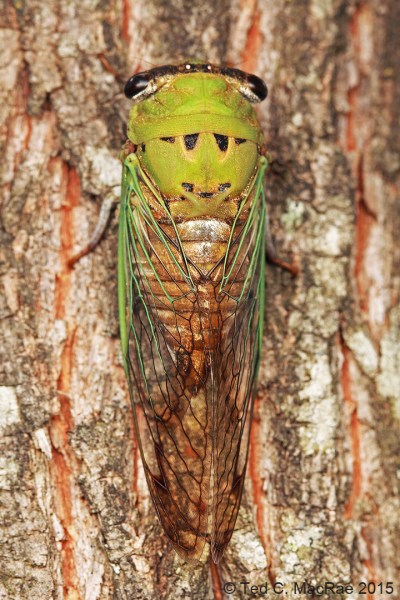
 I believe this is another cactus dodger cicada (Cacama valvata).



 Beetles In The Bush