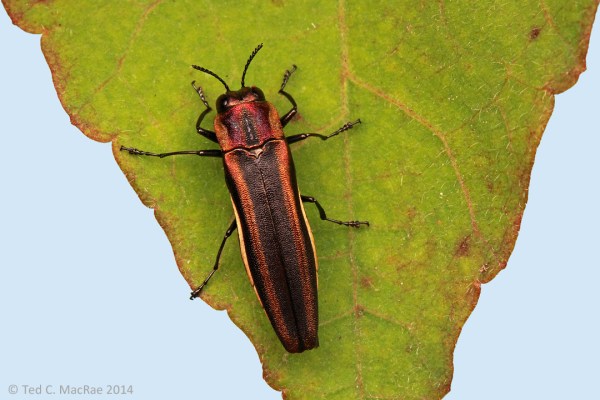
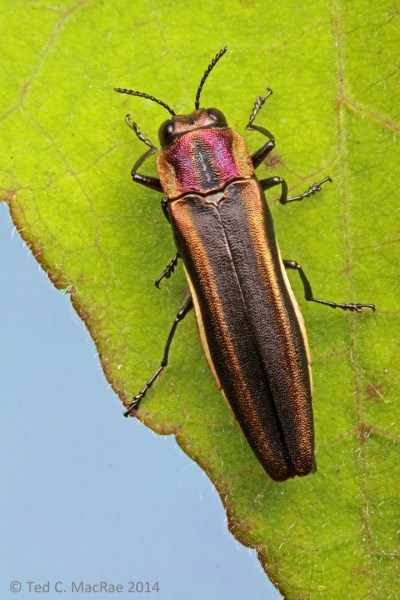
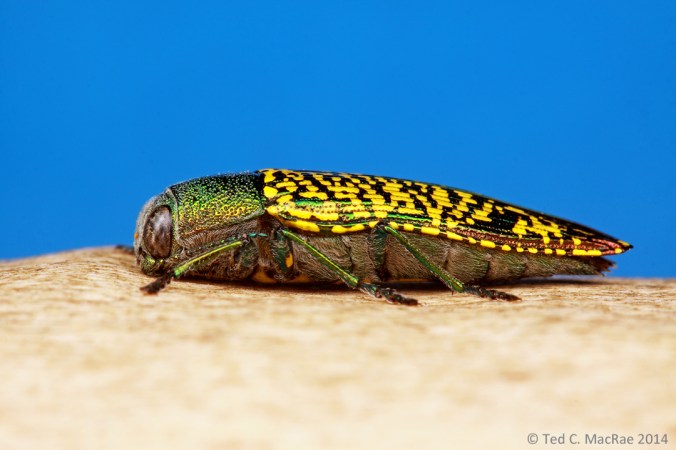
I got Thomas Shahan to image my Chrysochroa corbetti!

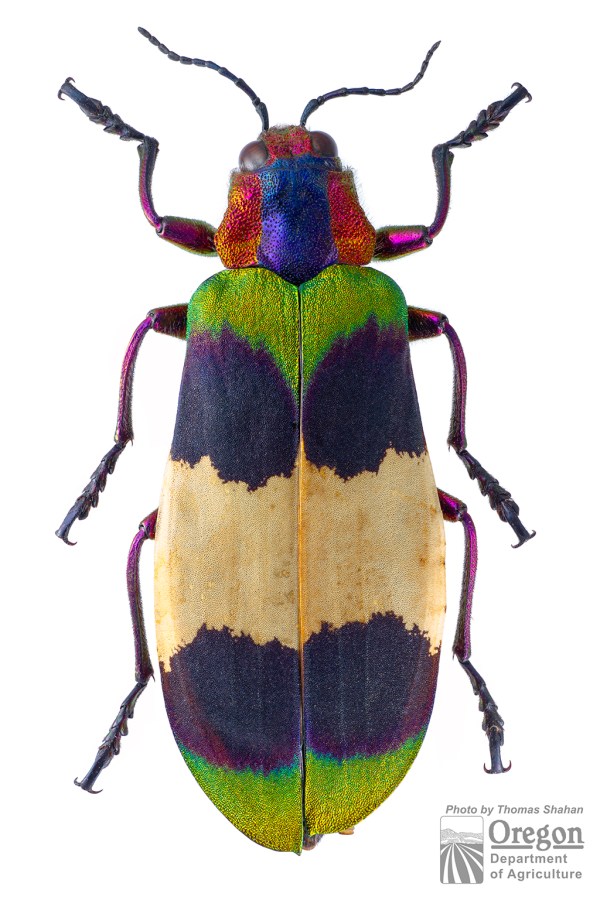
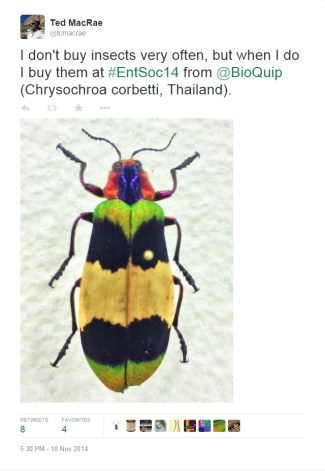
Chrysochroa-corbetti-TwitterThose who follow me on Twitter know that I attended Entomology 2014 last month in Portland, Oregon. As with other scientific conferences, live tweeting of the talks and associated events was all the rage. I may not have been the most prolific “tweeter”, but I did do my share, and one of my tweets involved a rather spectacular preserved specimen of the jewel beetle, Chrysochroa corbetti. The quick iPhone snapshot attached to the tweet was sufficient to prove that the beetle is pure eye candy, but still it did not do full justice to its stunning beauty:

Fortunately, while I was at the meetings I ran into Thomas Shahan—already an icon among insect macrophotographers for his seemingly impossible portraits of jumping spiders, tiger beetles, and other insects. I had planned to spend a couple of days in Salem after the meetings to visit my friend and longtime buprestophile Rick Westcott. As it happens, Thomas is currently a Digital Imaging Specialist at the Oregon Department of Agriculture where Rick spent his entire career as an entomologist. When I showed my specimen to Thomas, he kindly agreed to make some focus-stacked images of the specimen using his lab’s photographic setup. I think you can now agree that this is one of the most spectacular jewel beetles around, and I think you’ll also agree that these images by Thomas are perhaps the most stunning of this oft-photographed species. Be sure to check out the last photo—a 10× close-up of the dorsal elytral detail at the interface between the green and blue areas. Simply stunning!

Chrysochroa (Chroodema) corbetti (Kerremans, 1893) | Thailand

Chrysochroa (Chroodema) corbetti (Kerremans, 1893) | Thailand

Chrysochroa corbetti lateral view

Chrysochroa corbetti lateral view

Chrysochroa corbetti ventral view

Chrysochroa corbetti ventral v

Chrysochroa corbetti dorsal elytral detail (10X)

Chrysochroa corbetti dorsal elytral detail (10X)

© Ted C. MacRae 2014

Guess who just turned 7?

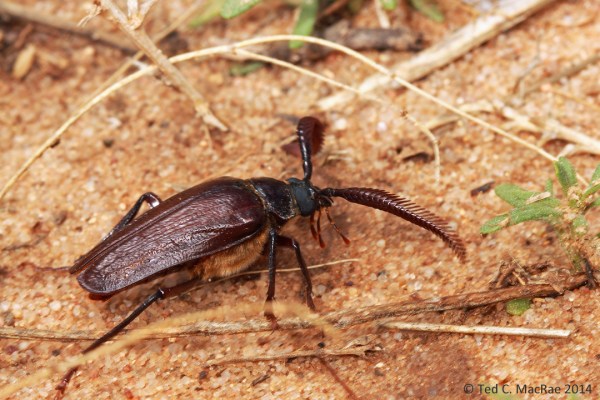
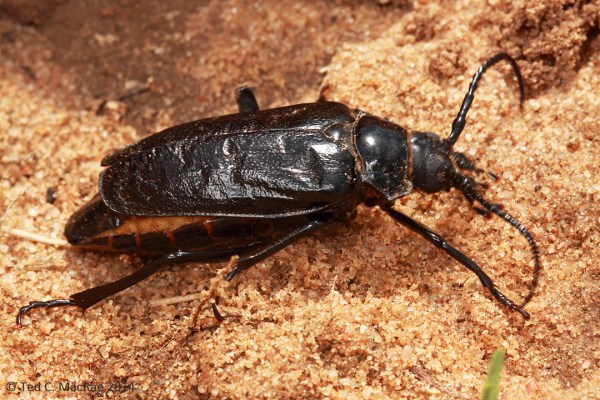
Prionus heroicus | Harding Co., New Mexico

Prionus heroicus | Harding Co., New Mexico

No, not this very alarmed male Prionus heroicus (among North America’s largest longhorned beetles) seen this past June at Mills Rim Campground in northeastern New Mexico—although he could very well have spent several years underground as a ever-fatter grub feeding on tree roots (probably oaks) before emerging as an adult.

No, today is the 7th birthday of this blog, and I’m a little embarrassed to admit that I’d almost completely forgotten about it. To a human, seven years of age is still immaturity, but in blog years that’s getting close to old age—perhaps like it’s author! I guess old age (on both counts) qualifies me to reminisce a little bit. I’ve seen the blogging thing come—there was a time when it seemed everybody was blogging, and I’ve seen it mature into something a little different. People still blog, but not as many and not for the same reasons. In the early days, blogs were how people with common interests connected and interacted. Nowadays other social media (e.g., Twitter and Facebook) have usurped that role. I don’t think that has made blogs irrelevant, but rather they now seem to serve more for outreach and as searchable repositories for information (at least among natural history blogs). In the past I’ve vacillated greatly in my feelings about this (and I still do sort of miss the “good ol’ days” of lively conversations in the comments). But actually I’m okay with it. When I want my social fix I jump onto Facebook (or Twitter in certain circumstances). When I want to write a little more substantively—to recount memorable field trips, document interesting things I’ve learned, reflect on my experiences as an entomologist, etc.—I blog. I used to watch hit counts; now I hardly ever give them a thought. I care less about who is reading and how many of them there are than I do about the content of the writing and quality of the images I share with those who do choose to read. I am enjoying the fruits of having blogged consistently for seven years—able to write well (and fast), vastly more versed in natural history, and connected broadly to the larger entomological community—and that alone makes it worth continuing. I’ve learned to blog for me and not for what I think others want to see. How liberating! After 7 years, I am more comfortable with and motivated to write than ever.

To all those people who have followed me, either now or in the past, thank you for your part in helping me in this journey. To those who are still to come, I look forward to meeting you!

© Ted C. MacRae 2014

How to catch “bucket loads” of Prionus fissicornis!

Fresh off our unexpected success at finding Prionus integer in the shortgrass prairie of southeastern Colorado, field mate Jeff Huether and I made our way down into northeastern New Mexico to see if the prionic acid lures we used to attract that species would bring us success with other species of Prionus. Several species in this genus are known to occur in the Great Plains, and we had records of three from the area around Gladstone (Union Co.). Based on our experience from the previous day, we stopped at several sites that had sandy/loam soil and searched exposures along the roadsides for burrows that bore any resemblance to those that we had found associated with P. integer. Frustratingly, we saw no such burrows or evidence of the presence of Prionus beetles in any of the spots that we searched.

Eventually, with day’s end drawing near, we decided to play a hunch and set traps at two sites with soil exposures that seemed most similar to those seen the day before. As Jeff set the last pair of traps in place, I occupied myself photographing a dusty hognose snake (Heterodon nasicus gloydi). While photographing the animal, I happened to look down to my side, and what did I see but a male Prionus crawling through the vegetation! I recognized the species immediately as P. fissicornis—represented in my cabinet by a single specimen. This species is distinguished by the highly segmented antennae (up to 30 segments or more) that place it in the monotypic subgenus Prionus (Antennalia). I called out to Jeff, and for the next half an hour or so we scoured the surrounding area; however, our searches were in vain as we failed to find another individual.

Prionus fissicornis male

Prionus (Antennalia) fissicornis male | 24 June 2014, Union Co., New Mexico

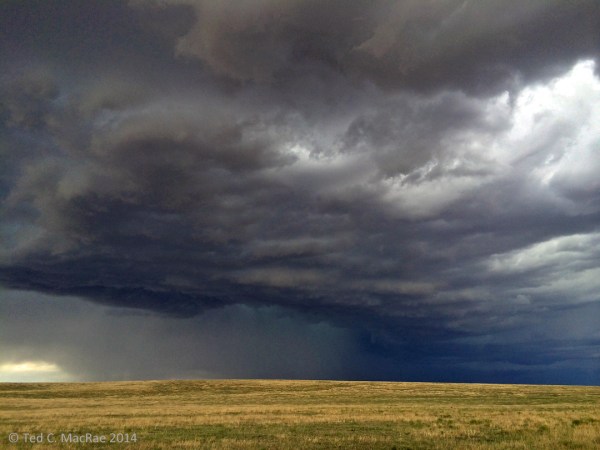
We cast an eye towards the north and watched late afternoon thunderstorms roll across the expansive landscape. Rain is normally a downer on an insect collecting trip. However, considering the numbers of P. integer that came to the traps after rain the previous day, we actually found ourselves hoping that the skies would open up. Whether they would and if this would lead to success with P. fissicornis (or other Prionus species), however, would have to wait until the next morning when we returned to check the traps.

Thunderstorms over shortgrass prairie.

Thunderstorms over shortgrass prairie.

Around 10 a.m. the next morning our reward was revealed—traps brimming with P. fissicornis males! Each trap contained more than a dozen individuals, and males were still actively crawling around in the vicinity of the traps as well.

Prionic acid-bated traps w/ Prionus fissicornis males

Prionic acid-bated traps filled w/ Prionus fissicornis males.

Prionic acid-bated traps w/ Prionus fissicornis males

Each trap contained more than a dozen males.

We spent about an hour at the site determining the extent of their occurrence, and like P. integer the previous day the males were found almost exclusively in a small area adjacent to (and upwind from) the traps. As we searched, we also found a few females, one of which seemed to be in the act of ovipositing into the soil at the base of a plant. I carefully excavated the hole into which the ovipositor had been inserted once the female withdrew it, but I was unsuccessful in finding an egg. Perhaps she was only probing to search for a suitable oviposition site and did not find this one to her liking.

Prionus fissicornis female

Prionus (Antennalia) fissicornis female | 24 June 2014, Union Co., New Mexico

There are some interesting similarities and differences with this species compared to our experience with P. integer the previous day. Males of both were highly attracted to the prionic acid lures that we used and were effectively trapped in cans over which the lures were suspended. It is also interesting that both species were found in rather large numbers directly after a rain event, and it seems logical to presume that rain might trigger adult emergence—as is the case with many insects that inhabit dry habitats with seasonal rains. However, we did not find P. fissicornis adults associated with burrows as with P. integer, making me even more intrigued with the burrowing behavior in the latter and its possible function. Also, it is interesting that we found P. fissicornis adults most active during the morning hours and P. integer most active during early evening, but since we did not visit both localities at both times of day it is not possible to say for sure that the two species differ in their adult daily activity.

© Ted C. MacRae 2014

Missouri’s largest planthopper

Although I have long dedicated myself to beetles, I must confess that my first love was the so-called “Homoptera”—that now defunct order containing some really cool bugs (cicadas and hoppers—i.e., leafhoppers, treehoppers, planthoppers, froghoppers, armadillohoppers, etc.) and some not-so-cool bugs (aphids, whiteflies, mealybugs, and their kin)¹. Perhaps you already sense that it was only the cicadas and hoppers that I really liked, the other mentioned groups being… well… boring from my perspective as a collector (overwhelming numbers of tiny, soft-bodied, sessile insects that required preservation in alcohol or on slides²). Even within the “cool” homopterans, however, some groups interested me more than others. Leafhoppers were okay, but my interest in them derived mostly from the fact that they were the subject of my thesis work. Treehoppers, on the other hand, were my favorite because they were just so adorably bizarre, and cicadas also fascinated me due to their size and behavioral charisma.

¹The homopterans have since been subsumed within the larger order Hemiptera (true bugs)—an irritating but necessary consequence of molecular studies that have shown rather conclusively that hoppers and cicadas are more closely related to the other true bugs than they are to the group containing aphids, whiteflies and mealybugs.

²So, not only are they boring to curate, but they directly caused the first order of insects in which I became interested to be completely dismantled!

Poblicia fuliginosa on Silphium terebinthinaceum (prairie dock)| Barry Co., Missouri.

Poblicia fuliginosa on Silphium terebinthinaceum | Barry Co., Missouri.

The planthoppers also interested me, although many of the various families contained within the group seemed not much different to me than leafhoppers. One family, however, stood out—the Fulgoridae. Much larger than the other planthoppers, they seemed like a cross between a planthopper and a small cicada (okay, a very small cicada)—combining the hopping capabilities of the former with the size (almost) of the latter. I only rarely encountered these bugs in Missouri; actually it was only a single species that I ever found—Poblicia fuliginosa, one of only two species in the family known to occur as far north as Missouri (Bartlett 2014). Moreover, when I did find them, they were extraordinarily wary and difficult to approach and collect. Vernon Brou, in a comment at this species’ BugGuide page, describes their capture-avoidance capabilities perfectly:

These are nearly impossible to capture by hand netting, they are rocket propelled. A most [frustratingexercise in futility.—Vernon Antoine Brou, Jr., pers. comm. to Mike Quinn, 2012.

The abdomen is brightly colored red (barely visible in this photo).

The abdomen is brightly colored red (barely visible in this photo).

This past fall, while on a collecting trip in the White River Hills of extreme southwestern Missouri, I chanced upon a few individuals perching on the stems of prairie dock (Silphium terebinthinaceum) in a dolomite glade. Remembering how wary they were in my previous encounters, I figured I had little chance of successfully photographing any of them. I love a challenge, however, and with the help of field mate Stephen Penn I managed to get the shots shown here. Getting within the range of focus generally caused the insects to dart around to the backside of the stem. I took advantage of this behavior by getting myself set and focusing the camera on the bug (even though it was behind the stem) and then having Stephen move his insect net slowly toward the bug from the side to get it to dart back around the stem away from the net… right into my field of view! The first individual we tried to photograph took off rather quickly (rocket-propelled!), but fortunately we found another individual in the same clump of stems and succeeded in getting some shots.

In the second photo the bright red abdomen is barely visible on the underside of the insect. The entire abdomen is, in fact, bright red in obvious contrast to the otherwise dark and somber coloration of the insect. I’ve searched the literature but can find no mention of the function of the red abdomen, but I presume it serves a flash coloration function similar to the bright green abdomen of some jewel beetles to confuse potential predators by its visibility in flight and then sudden disappearance when the insect lands and folds its wings over the abdomen. I suppose an aposematic function is also possible given the red coloration, but I’m not aware that any hoppers are known to be chemically protected, and the fact that the red abdomen is seen only during flight also suggests a non-chemically based function.

REFERENCES:

Bartlett, C. R. 2014 (and updates). Planthoppers of North America. Available at: http://canr.udel.edu/planthoppers (accessed 12 November 2014).

© Ted C. MacRae 2014

Guest Post: Burrow Hole Blues

For today’s post, I am pleased to introduce nature writer and guest blogger Sharman Apt Russell. Epitomizing the increasingly important role of citizen scientists in conservation and natural history study, Sharman recently engaged in a year-long study of the Western red-bellied tiger beetle. Her experiences studying this little-known insect form the basis of her latest book, Diary of a Citizen Scientist. Chasing Tiger Beetles and Other New Ways of Engaging the World. With writing that is both humorous and whimsical, Sharman highlights the extraordinary scientific contributions being made by ordinary people. Of course, tiger beetles and citizen science are two subjects right up my own alley, so I’m avidly reading my own copy right now. I hope you’ll pick up a copy too (see ordering information below). The following excerpt from the book was kindly provided by the author.

When you’re a hammer, everything looks like a nail, and when you’re looking for the larval burrow hole of a Western red-bellied tiger beetle or Cicindela sedecimpunctata,  you see a surprising number of holes you’ve never seen before. Usually they are not the right size or shape, but you think about them anyway because suddenly you are curious: who lives inside all these holes?

Western Red-bellied Tiger Beetle adult. Photo by Cary Kerst.

Western red-bellied tiger beetle adult. Photo by Cary Kerst.

In Arizona and New Mexico, the Western red-bellied tiger beetle is a common and abundant species that comes out in June, before the summer rains, to congregate around ponds and ditches and river banks. For the last few years, as a citizen scientist, I have been trying to fill in what we don’t know about this insect, which includes what kind of habitat the females lay their eggs. Once these tiger beetle eggs hatch, the tiny larvae start digging vertical burrows, the entrance almost perfect circles in the dirt that increase in size (1-3 millimeters) as the larva goes through three stages or instars and enlarges the burrow. But where are those blankety-blank burrows? Does this beetle oviposit close to water or as much as a half mile away, like Cicindela marutha, the aridland tiger beetle? What kind of soil do Western red-bellies prefer?

Western Red-bellied Tiger Beetle larva. Photo used with permission.

Western red-bellied tiger beetle larva. Photo used with permission.

My entomologist-mentors David Pearson and Barry Knisley, coauthors of A Field Guide to the Tiger Beetles of  the United States and Canada, want to know the answers to these questions, and I’ve promised them that I would find out. So far, for three years, I’ve broken that promise, looking up and down the Gila River in southwestern New Mexico without success. About this time, in late fall, I start to give up, thinking that the larvae have closed their tunnels in order to overwinter.

On one last walk along the Gila River, a few holes remain to tempt me.

A number of almost-perfect circles in the dirt, eighty feet from the riverbank where I have seen hundreds of adult Western red-bellied tiger beetles congregate in the summer, are too large but still irresistible. Hole after hole, nothing lives there now. Instead something probably emerged months ago.

Tiny perfect circles in the dry upland grass are promising. Tiny ants are passing by, and I can see how the fiercely predacious tiger beetle larvae might lunge from such a hole to catch one of these ants. Then I notice how often the ants are marching into these holes, which are obviously their nests.

Other holes near the trail I am walking have turrets or small mud chimneys. I don’t bother to look inside these, knowing they were not built by the Western red-bellied tiger beetle—whom I have reared up in terrariums. (Yes, I have seen their larval burrow holes, just not in the wild.) Possibly these are the old nests of digger bees whose turrets prevent parasitic flies from flipping their eggs into the burrow to hatch and devour the bee larvae. Similarly, Williston tiger beetles construct turrets like this on salt lake beds in eastern New Mexico.

Closer to the Gila River, in dry cliffs that once marked the river’s channel, I see lots of cicada emergence holes and what I think is the home of a tarantula. Tarantulas start their burrows as spiderlings and live there a lifetime, as long as ten years if male and twenty-five if female. This entrance is over an inch in diameter and covered with a light veil of silk that keeps in humidity and carries vibrations down into the foot-long tunnel with its J-shaped chamber. About three inches long, fully-grown tarantulas hunt beetles and grasshoppers and other small prey at night. Their defense against the foxes and coyotes and raccoons who like to eat them are irritating abdominal hairs that fall off easily and get into a predator’s eyes or nasal passages. (Coatis have learned to dislodge those hairs by vigorously rolling the spider back and forth along the ground.) Most people who walk around the Southwest become fond of tarantulas and think of them as lucky, much like having a roadrunner cross your path. I always give a glad mental shout—hey, neat! a tarantula!

Along the river now are signs of beaver chewing on tree trunks; perhaps a den is nearby. Southwestern beavers tend to make bank dens rather than lodges, a bank den having several entry tunnels with one above the high water mark. Its single inside chamber is about two by three by three feet. Other holes I’ll see on this walk might be made by gophers or ground squirrels, pocket mice or grasshopper mice. Collared lizards and whiptails use the holes made by other animals but occasionally dig their own burrows with a half-inch, half-moon shaped entrance. Wintering snakes also borrow someone else’s hole and sometimes den communally, rattlesnakes and bull snakes and whipsnakes all together. Burrowing owls modify the holes they find by lining the interior with feathers, food debris, and horse and cow dung. A Field Guide to Desert Holes says blandly, “This may be to disguise their scent to predators or as decoration.” Similarly, skunks borrow burrows or make their own, decorating them with a strong musky odor. Coyotes only use dens when birthing and raising pups, often on a hillside or bank, the hole taller than wide. There are a few large mysterious holes near my house that I like to think were made by a badger, a prodigious and powerful digger.

I guess we just see the top half of life. Somewhere, I know, the larvae of the Western red-bellied tiger beetle are bedding down now at the bottom of their tunnels (at least 15 centimeters deep), quiescent, waiting for winter to pass. In the spring, they’ll emerge again to catch prey. Eventually they will pupate into adults, congregating in June along the Gila River. Their life cycle is still a bit of a mystery. Maybe I’ll solve that mystery next year—or the next or the next.  In the meantime, I could be doing worse things with my life than looking for holes.

Western Red-bellied Tiger Beetles mating. Photo by Mike Lewinski.

Western red-bellied tiger beetles mating. Photo by Mike Lewinski.

About the author
Sharman Apt Russell lives in the Gila Valley of southwestern New Mexico and teaches at Western New Mexico University and Antioch University in Los Angeles. Her books related to entomology include Diary of a Citizen Scientist: Chasing Tiger Beetles and Other New Ways of Engaging the World (Oregon State University Press, 2014) and An Obsession with Butterflies: Our Long Love Affair with a Singular Insect (Basic Books, 2005). Her work has been widely anthologized and translated into over ten languages. For more information, please go to her website and consider signing up for her infrequent newsletters www.sharmanaptrussell.com.

Ordering Information
Title: Diary of a Citizen Scientist
Author: Sharman Apt Russell
Publication Date: October 2014
Price: $18.95 paperback
Description: 224 pp., 6×9 inches
ISBN: 978-0-87071-752-9
Ordering: Available in bookstores or by calling 1-800-426-3797. Order online at http://oregonstate.edu/dept/press

© Sharman Apt Russell 2014
My first experience with Prionus lure

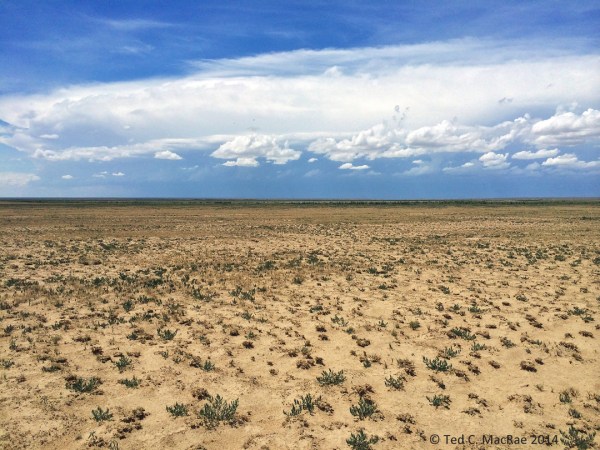
Our quick stop in Hardtner, Kansas to see “Beetle Bill” Smith at the beginning of our Great Plains Collecting Trip had already produced one unexpected success—the long-sought-after Buprestis confluenta. However, our trip didn’t really begin in earnest until noon the next day when field mate Jeff Huether and I stopped in the middle of a vast, dry grassland north of Las Animas in southeastern Colorado. Even at this point we hadn’t gotten to the first of our planned localities a little further south where we were hoping to find longhorned beetles in the genus Prionus, the main objective of the trip, using recently developed pheromone lures. Jeff had, however, collected an interesting blister beetle at this spot on an earlier trip and wanted to take another look since we were in the area. I looked out across the desolate landscape and wondered what on Earth I could find here that would be even remotely interesting to me.

Shortgrass prairie, 10.5 mi N of Las Animas, Colorado.

Shortgrass prairie, 10.5 mi N of Las Animas, Colorado.

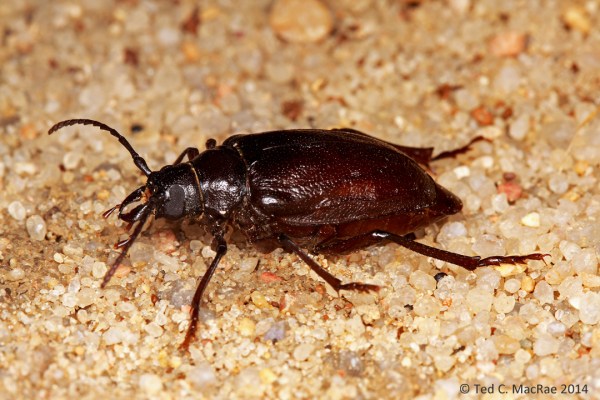
I was convinced there was no point for me to look around, but I wanted to let Jeff have some time to look for his blister beetle, so I milled around the vicinity of the car to look for any flowers that might be in bloom and hoped to maybe see a tiger beetle or two. As is often the case, plants were a little lusher and more diverse along the roadsides due to rain shedding by the road, so I decided to walk down the roadside and see what I might find. I hadn’t gone too far when I saw a big, brown beetle crawling along the edge of the road. My first thought while approaching it was ground beetle, but I quickly decided it was not that. Only when I crouched down and looked at the beetle, crawling with some urgency but making no attempt to fly, did I realize that it was a female Prionus (later identified as P. integer LeConte, 1851 in the subgenus Homaesthesis). I had, in fact, only once before ever seen a female Prionus, that being the ginormous species P. heroicus in southeastern Arizona almost 30 years ago. Incredible! We hadn’t even gotten to the first spot where we planned to look for Prionus, and I’d already found one. And a female, no less!

Prionus integer female

Prionus (Homaesthesis) integer LeConte, 1851 (female).

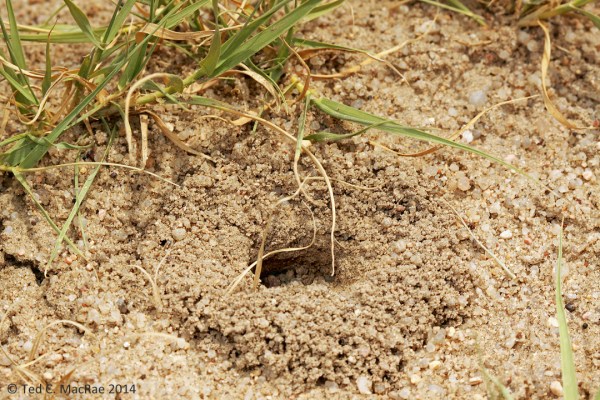
Jeff was out of ear-shot, so I resumed my walk along the roadside to look for more. Not long afterwards I found a male carcass laying on the ground, and then shortly afterwards I found another one. One of the carcasses was in pretty good condition still, giving me optimism that I would find a live one as well. Frustratingly, however, I saw nothing more during the next hour as I continued slowly down the road to a distance of nearly one mile from the car and then along the other side all the way back. During the time that I was searching, I noticed strange burrows in the ground. They were only along the roadsides and were especially numerous in the area where I had found the female and two male carcasses. The diggings looked fresh, so I tried excavating a few. They were no more than two inches deep, and I found nothing in any of the dozen or so burrows that I excavated. Nevertheless, I was convinced that the burrows were somehow associated with the Prionus beetles that I had found (even though I had never heard of burrows associated with adult Prionus beetles, nor have I been able to find anything in the literature since)—the size of the burrow matched that of the beetles perfectly, and the presence of fresh diggings meant something had made them recently. If the Prionus beetles didn’t make them, then what did?

Prionus integer burrow

Prionus integer adult burrow.

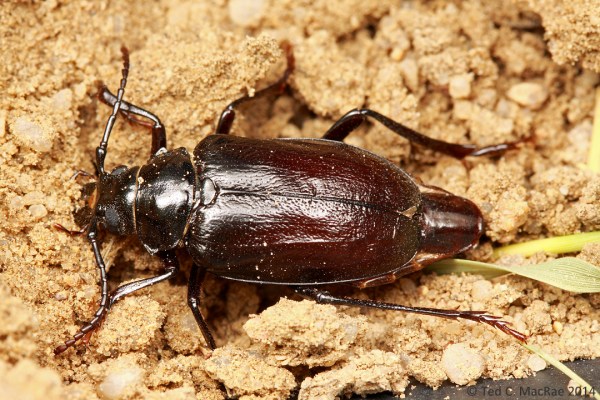
All the time as I was searching, I wondered if Jeff knew about the beetles occurring here. However, when we finally met up again near the car and I showed him what I had found, I could see by the surprised look on his face that this was not the case. I also showed him the burrows that I’d found, and we both agreed they had to be connected to the beetles. I decided to try using a shovel instead of my knife to excavate more burrows, thinking that maybe I wasn’t excavating deep enough, so we got the shovel out of the truck, walked to the area where I had seen the live female, sunk the shovel deep into the ground next to one of the burrows, and pried up a chuck of the soil containing the burrow in its entirety. As we broke apart the soil there it was—another female!

Prionus integer female

A female Prionus integer dug from her burrow (shovel in lower right).

We excavated more burrows in the vicinity, preferentially choosing those with the freshest-looking diggings, and while most were empty we did find several more females. We were beginning to think that only the females created the burrows, but eventually a male was dug from its burrow as well. By now it was clear that we needed to make the first schedule change of the trip (before even reaching the first planned locality!) and decided to set out lure-baited traps and check them later in the evening before resuming our plans the next day. We expected the beetles to become active during dusk, so we went into town to eat dinner and check out a nearby locality before returning to the site. While we were gone heavy rains moved through  the area, and we weren’t sure if or how this would affect beetle activity and their possible attraction to the traps. However, as we approached the site (slipping and sliding on the muddy 2-track), we could actually see beetles crawling on the road from afar. What we found when we got out of the car was nothing short of mind-blowing—beetles were everywhere, crawling on the road, crawling through the grass, and overflowing in the flooded traps! The vast majority, as expected, were males—distinguishable by their smaller size and distinctly flabellate antennae—but we also found a fair number of the much more rarely collected females—most of them either mating or digging burrows.

Prionus integer mating pair

A male Prionus integer attempts to mate with a female.

It was tempting to focus on just collecting individuals, as we had clearly encountered an ephemeral emergence event. However, it was soon apparent that the number of individuals milling around and flying into the area was far greater than what we could possibly put in our bottles. As I gradually realized this, my focus shifted from collecting to observing—especially the females involved in mating and digging burrows. Most of the females that I saw digging burrows had their abdomens protruding from the burrow as they used their front legs to dig soil from the burrow, but eventually I noticed a burrow that had a female sitting completely within the burrow with her head just below and facing towards the burrow opening.

Prionus integer female

A Prionus integer female sits in her burrow.

I crouched down and watched the female closely (through the camera lens) and noticed a regular, almost rhythmic movement by the beetle as she sat in the burrow. I imagined perhaps the female was in the act of oviposition, although I now think it unlikely that this is the case (it doesn’t make sense for a female to make the energetic expenditure to dig a burrow large enough to contain the adult body when a simple probe of the ovipositor into the soil surface would accomplish the same thing. It also occurred to me that the female was emitting pheromone to attract males, but this begs the same question: why call for mates while enclosed within a burrow when doing so from the surface would be just as (and possibly more) effective. At any rate, the chance to observe mating and other behaviors made the encounter far more informative than if our focused had remained strictly on collecting the abundance that we had encountered.

Prionus integer female

Prionus integer female moving rhythmically in her burrow, but why?

Barr & Penrose (1969) give the only biological notes I am aware of for this species, noting that the larvae have been associated with the roots of sagebrush (Artemisia tridentata) and yellow rabbitbrush (Chrysothamnus viscidiflorus) and on two occasions finding larvae damaging newly planted beans or cutting underground stems of potato plants in southern Idaho. In both cases the fields had been recently cleared for cultivation, suggesting opportunistic feeding by larvae that were already present in the soil and feeding on native hosts when the land was cleared. At any rate, the site where we found the species was completely devoid of any rangeland shrubs, suggesting that herbaceous plants also may serve as suitable hosts for the species. We did observe small bunch grasses that were abundant in the area where both the beetles and their burrows were most numerous—in fact (although perhaps coincidentally), the burrows seemed most often to have been dug at the base of these grasses (see 3rd and 6th photos).

The sinking sun in the west and receding storm clouds in the east created conditions ripe for rainbows—a fitting exclamation point to our first (and completely unexpected) Prionus success of the trip. As the cloak of dusk descended, we packed up our gear and headed into town full of optimism about what other Prionus experiences lay ahead in the coming days.

Rainbow over shortgrass prairie

A rainbow hangs over the shortgrass prairie.

REFERENCE:

Barr, W. F. & R. L. Penrose. 1969. Notes on the distribution and bionomics of some Idaho Cerambycidae (Coleoptera). Great Basin Naturalist 29:88–95 [Biodiversity Heritage Library].

© Ted C. MacRae 2014

North America’s Most Beautiful Agrilus Jewel Beetle

For the past few years I’ve spent the summers traveling once a month or so from my home near St. Louis to research plots in western Tennessee. I enjoy these trips immensely—not only are my research and the colleagues that I spend time with fun, but I also get to keep an eye on the progression of the season in one of Missouri’s most interesting (and threatened) natural communities: the southeastern lowlands. Spring sees the emergence of an unusual population of the Festive Tiger Beetle (Cicindela scutellaris) in the area’s critically imperiled sand prairies; summer harks the appearance of the diminutive and almost-impossible-to-see Ant-like Tiger Beetle (Cylindera cursitans) in the ribbons of wet bottomland forest that line the Mississippi River; autumn is graced by the sight of stunningly beautiful amorpha borers (Megacyllene decora) in wet areas hosting mixed stands of false indigo (Amorpha fruticosa) and goldenrod (Solidago spp.); and all season long a variety of seldom-seen insects (e.g., longhorned beetles that look like stag beetles) are attracted to ultraviolet lights set up in the area’s increasingly scarce natural habitats.

Hairy mallow (Hibiscus lasiocarpus), host for Agrilus concinnus

Hairy mallow (Hibiscus lasiocarpus), host for Agrilus concinnus

Another phenological event that I look forward to in the southeastern lowlands is the blooming period of hairy mallow (Hibiscus lasiocarpus). Starting in July and reaching its peak in early to mid-August, the enormous white (and sometimes pink) flowers explode across the landscape at a time when precious few other flowers can be found, conspicuously flagging any ground where water tends to stand. It is not the flowers themselves, however, that pique my interest, but rather a beautiful (and, until recently, rare) jewel beetle (family Buprestidae)—Agrilus concinnus—that becomes active on the plants while they are in flower. In fact, of the nearly 200 species belonging to the genus in North America, I consider A. concinnus to be perhaps the most beautiful!

Agrilus concinnus | Stoddard Co., Missouri

Agrilus concinnus | Stoddard Co., Missouri

I first saw this species in Missouri’s southeastern lowlands nearly 30 years ago. At that time, I didn’t know that the mating pair that I had found on low vegetation represented a species considered to be one of the rarest of the genus in North America (having been recorded only from Florida, Georgia, Illinois, and Texas and not yet known from Missouri) and whose host plant and biology were completely unknown. Over the course of several years following this first find, fellow buprestophile Gayle Nelson (now deceased) and I were able to document the occurrence of this species also in Kansas (MacRae & Nelson 2003) and confirm its association with plants in the genus Hibiscus (MacRae 2006). We also determined that adults of this species exhibited an unusually late seasonal occurrence, peaking in late July and early August, compared to the spring adult activity period of most other eastern North American species in the genus. As a result of these efforts, one of North America’s rarest and least known jewel beetles was no longer regarded as either. A more detailed summary of my experiences with this beetle can be found in a newsletter article that I wrote a while back (MacRae 2004).

Hibiscus lasiocarpus

Plants in peak bloom signals the adult activity period of the beetle.

Of course, those were the days before I began photographing insects, so despite the abundance with which I have seen this species in past years, I still lacked photographs of it. I first made an effort to photograph adults two years ago while on one of my research plot trips, but 2012 was characterized by a severe drought in the central U.S.—precious few potential host plants were found at the locality where I first collected these beetles, and those that were present were severely stunted and in poor shape due to the drought. Conditions were much more favorable last year (2013), but again no beetles were seen during an early August visit. This past season was again favorable for growth of the host plants, and though my visit during early August again looked like it was not going to pay off, I eventually scared up an adult and watched it as it flew to another plant. I would see four adults on the day—not a lot, but enough to make sure that I got photographs showing how spectacularly beautiful they are!

Agrilus concinnus

Adults perch, mate, and feed on the upper leaf surfaces.

REFERENCES:

MacRae, T. C. 2004. Beetle bits: Hunting the elusive “hibiscus jewel beetle”. Nature Notes, Journal of the Webster Groves Nature Study Society 76(5):4–5 [pdf].

MacRae, T. C. 2006. Distributional and biological notes on North American Buprestidae (Coleoptera), with comments on variation in Anthaxia (Haplanthaxia)viridicornis (Say) and A. (H.) viridfrons Gory. The Pan-Pacific Entomologist 82(2):166–199 [pdf].

MacRae, T. C. & G. H. Nelson. 2003. Distributional and biological notes on Buprestidae (Coleoptera) in North and Central America and the West Indies, with validation of one species. The Coleopterists Bulletin 57(1):57–70 [pdf].

© Ted C. MacRae 2014

A Buprestis hat-trick!

In North America, few beetles can rival jewel beetles in the family Buprestidae for sheer beauty, and within the family this beauty is perhaps best exemplified by species in the family’s namesake genus Buprestis. Often flashing yellow, green, coppery, or red, species in this genus combine brilliant colors, moderately large size, and relative rarity to make them desirable additions to the collections of casual and serious collectors alike.

Buprestis (Knulliobuprestis) confluenta | Woods Co., Oklahoma

Buprestis (Knulliobuprestis) confluenta | Woods Co., Oklahoma

Over the years I’ve had some success collecting certain species in this genus, but even after 30 years of collecting there still remain several species that have eluded my net. A few weeks ago I posted photos of and wrote about my experience collecting not one, but two of these species that had so far eluded me—B. striata and B. salisburyensis—both as single specimens from a single tree in the mountains of Tennessee. Three weeks after collecting these species, I began a collecting trip west into the heart of the Great Plains with the primary purpose of using recently developed lures to collect some uncommonly encountered prionid longhorned beetles. Before reaching the first locality, however, field mate Jeff Huether and I stopped off in Hardtner, Kansas to visit with fellow beetle enthusiast “Beetle Bill” Smith and do a little collecting with him before continuing on. Bill took us to a spot just south of the nearby state line into Oklahoma to a spot where he had collected, among other things, yet another of the Buprestis spp. that had so far eluded me—B. confluenta.

Buprestis (Knulliobuprestis) confluenta

If B. striata and B. salisburyensis are beautiful, then B. confluenta is downright stunning! Brilliant green, perhaps with a slight coppery brown to purplish blue hue and with more or less confluent (thus the species name) fine yellow flecks densely scattered over the elytra, it is one of the easiest to identify of any species in the genus. Moreover, unlike the previous two species, I had already made several attempts to collect B. confluenta during several previous trips to the Great Plains, stopping wherever I saw a nice stand of the large eastern cottonwood trees (Populus deltoides) in which larvae of the species are known to develop. Frustratingly, as if to taunt me, I have even seen specimens on more than one occasion in one of the many 4H and student collections that I have examined over the years in Missouri and Kansas.

Buprestis (Knulliobuprestis) confluenta
Today was different, however—I could just feel it. Pulling up to the spot, my attention was immediately drawn to a grove of large cottonwood trees, some dead with bark-less trunks still standing. I thought to myself, “Those look like Buprestis trees!” While Bill and Jeff swept nearby herbaceous plants looking for a blister beetle that Jeff was interested in, I picked my way through the cottonwood grove, carefully approaching each tree—especially the dead ones—and scanning the trunk for any sign of movement or flash of color. It took a long time—well over an hour, by which time I had almost given up hope and begun thinking that this would be yet another unsuccessful attempt to collect the species. Suddenly, there it was sitting on the trunk of a recently fallen tree in all of its unmistakable glory! I froze at first, afraid of spooking it by too excited an approach, then remembered that species of Buprestis in general are not very skittish or as quick to take flight as many other members of the family (e.g., species in the genus Chrysobothris). I resumed my approach, albeit still cautiously just in case, and easily secured the specimen in a vial. My season now included a Buprestis hat-trick! The beetle was not only calm but actually seemed disinclined to flee, prompting me to release it back onto the tree trunk for a few quick field photos before placing it back in the vial for better photos later in the security of my hotel room that evening.

Buprestis spp. love large, dead, barkless cottonwood trunks.

Buprestis spp. love large, dead, bark-less cottonwood trunks.

Among North American jewel beetles, B. confluenta has one of the stranger geographic distributions, having been recorded from most of the central and western states and provinces as far east as Quebec and Indiana (Nelson et al. 2008). This is no doubt a consequence of the distribution of its primary larval hosts—cottonwood and quaking aspen (Populus tremuloides) (Burke 1917, Nicolay & Weiss 1918). In my Missouri checklist (MacRae 1991) I saw only two specimens from the state, both in counties along its western edge near Iowa and Kansas. Considering how abundant cottonwood is in Missouri, it is a mystery to me why this species should be so rare in the state. But then, I’ve not found it easy to come by in Kansas or Oklahoma either, where more records seem to exist than in any other state. Even on this occasion, when I would finally find the species after 30 years of searching, only this one, single specimen was seen. Interestingly, I would also collect about a half dozen specimens of the closely related species, B. rufipes (more commonly associated with oaks), off of the same trees that I searched so intensively for B. confluenta.

The requisite frontal portrait!

The requisite frontal portrait!

REFERENCES:

Burke, H. E. 1917. Flat-headed borers affecting forest trees in the United States. U.S. Department of Agriculture Bulletin 437, 9 pp. [Biodiversity Heritage Library].

MacRae, T. C. 1991. The Buprestidae (Coleoptera) of Missouri. Insecta Mundi 5(2):101–126 [pdf].

Nelson, G. H., G. C. Walters, Jr., R. D. Haines & C. L. Bellamy.  2008.  A Catalogue and Bibliography of the Buprestoidea of American North of Mexico.  Coleopterists Society Special Publication No. 4, The Coleopterists Society, North Potomac, Maryland, 274 pp. [description].

Nicolay, A. S. & H. B. Weiss. 1918. A review of the genus Buprestis in North America. Journal of the New York Entomological Society 26(2):75–109 [pdf].

© Ted C. MacRae 2014