Tiger beetles in Argentina’s Chaco forest

The day after I photographed Brasiella argentata on the mud/san banks of the Rio Paraná in Corrientes, Argentina, I decided to drive westward into the heart of Chaco Province. The destination: Chaco National Park, where some of the best remaining examples of the original “Gran Chaco” remain. Once covering nearly a million square kilometers in northern Argentina, Paraguay and Bolivia, this distinctive ecoregion has been largely converted to a vast, hot sea of cotton fields and mesquite fence-rows. A unique plant community in the Gran Chaco is the quebracho forest that takes its name from quebracho colorado chaqueño (Schinopsis balansae)—a tall, massively-trunked tree (related to, of all things, poison ivy!) with beautiful red wood that has been logged relentlessly wherever it occurs. Chaco National Forest is unique for the largely intact example of this forest it preserves and the mature quebracho trees that it contains.

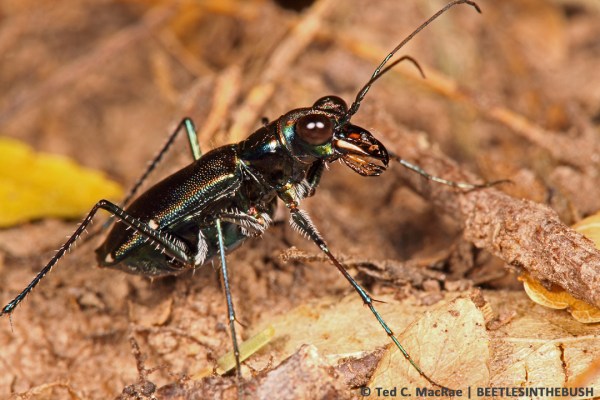
Odontocheila chrysis | Chaco National Park, Argentina

Odontocheila chrysis (Fabricius, 1801) | Chaco National Park, Argentina

Insect life was not abundant as I walked the dark forest path. The lateness of the season (early April) and long-enduring drought occurring in the region had taken their toll, and I was content to see just about anything. At one point, a flash of movement caught my eye, and as I scanned the forest floor in the area where I had seen it, the familiar silhouette of a Golden Forest Tiger Beetle—Odontocheila chrysis (Fabricius, 1801)—became visible. I was already familiar with this species, having seen fairly good numbers of them at another location further east during my first visit to the area 12 years earlier. Long-legged and fast-flying, this tiger beetle occurs throughout much of South America, where it lives in more shaded areas of forest clear-cuts, secondary forests, savannas, and open scrublands (Erwin & Pearson 2008). The ground-dwelling adults are known to congregate along paths and at large openings on the forest floor, and indeed I had seen them in their greatest numbers on a shaded dirt road around the margins of a temporary mud puddle. When disturbed, the wary adults fly up from the forest floor to land in adjacent bare area of substrate or on the leaves of understory plants.

Superposition eyes are adapted to the dark forest environment in which this species lives.

Superposition eyes are an adaptation to the dark forest environment where this species lives.

I faced a bit of a quandary when I saw this individual—do I collect it as a voucher and studio photograph backup, or do I go ahead and try to get the much more desirable in situ photograph of an unconfined adult in its native habitat. Considering that I had already collected a sufficient number during my earlier trip, I opted for the latter. I am fortunate that I got these two quite acceptable photographs before the adult flashed away in the blink of an eye right after I took the second shot, because I never saw another one the rest of the day or even the trip.  

An interesting feature of O. chrysis is its superposition eyes. In such eyes, each rhabdom (light sensitive unit) in the compound eye receives light through many ommatidial facets. This is in contrast to apposition compound eyes, where each rhabdom receives light from only a single facet. Superposition eyes are designed to increase photon capture, which is an advantage in the dark forest habitats where this beetle prefers to live (Brännström 1999).

Brasiella argentata | Chaco National Park, Argentina

Brasiella argentata (Fabricius, 1801) | Chaco National Park, Argentina

Shortly after photographing O. chrysis, I came upon a small opening where the path was a little wider and sunnier and the soil a little sandier and drier. Immediately I saw the small, zippy flits of the same tiger beetle species I had photographed the previous day on the banks of the Rio Paraná—Brasiella argentata. I could not find in the literature whether this species has superposition or apposition compound eyes, but considering that the species occur in great numbers on sunny river banks and that the few individuals I saw in the forest were in a sunny opening, I’m betting it’s the latter.

I couldn’t help but make another attempt to photograph this species, considering the difficulty I’d had the previous day (and that I wasn’t completely satisfied with any of the photos that I had obtained). More good fortune, despite there being only a few individuals to work with, as I managed to get the above photograph, which I consider far better than any that I already had. These beetles, too, quickly disappeared, and I never saw them again, but knowing I had the photos that I wanted made that okay.

Habitat for Odontocheila chrysis and Brasiella argentata

Quebracho forest habitat for Odontocheila chrysis and Brasiella argentata.

REFERENCES:

Brännström, P. A. 1999. Visual ecology of insect superposition eyes. Unpublished Ph.D. Dissertation, Lund University, 142 pp. [abstract].

Erwin, T. L. & D. L. Pearson. 2008. A Treatise on the Western Hemisphere Caraboidea (Coleoptera). Their classification, distributions, and ways of life. Volume II (Carabidae-Nebriiformes 2-Cicindelitae). Pensoft Series Faunistica 84. Pensoft Publishers, Sofia, 400 pp. [Amazon descriptionbook review].

© Ted C. MacRae 2014

ID Challenge #22

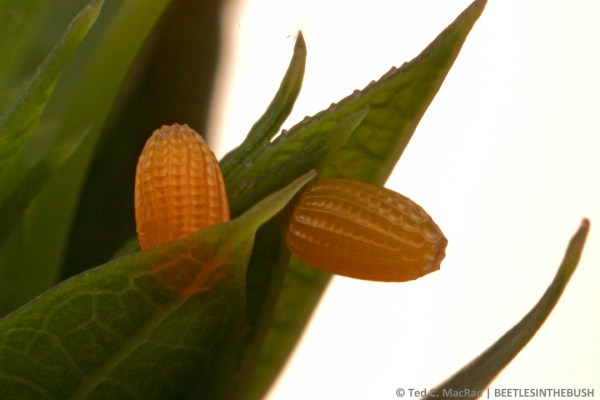
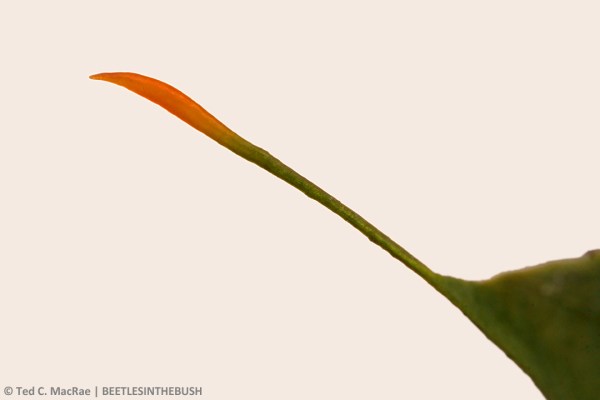
For this ID Challenge, please identify the objects/structure in the photos below and discuss how they are related to each other. I’ll give 5 pts to anybody who correctly identifies the object/structure in each photo and another 5 pts to anyone who correctly elucidates their connection. Go!

Edit: I am looking for a family-level ID for the objects in the first photo and a genus-level ID for the plant bearing the structure in the second photo to get full credit. Answers will be held in moderation until the answers are revealed to give all a chance to play.

What are these?

What are these objects?

What is this, and how does it relate to the structures in the other photo?

What is this structure, and how does it relate to the objects in the first photo?

© Ted C. MacRae 2014

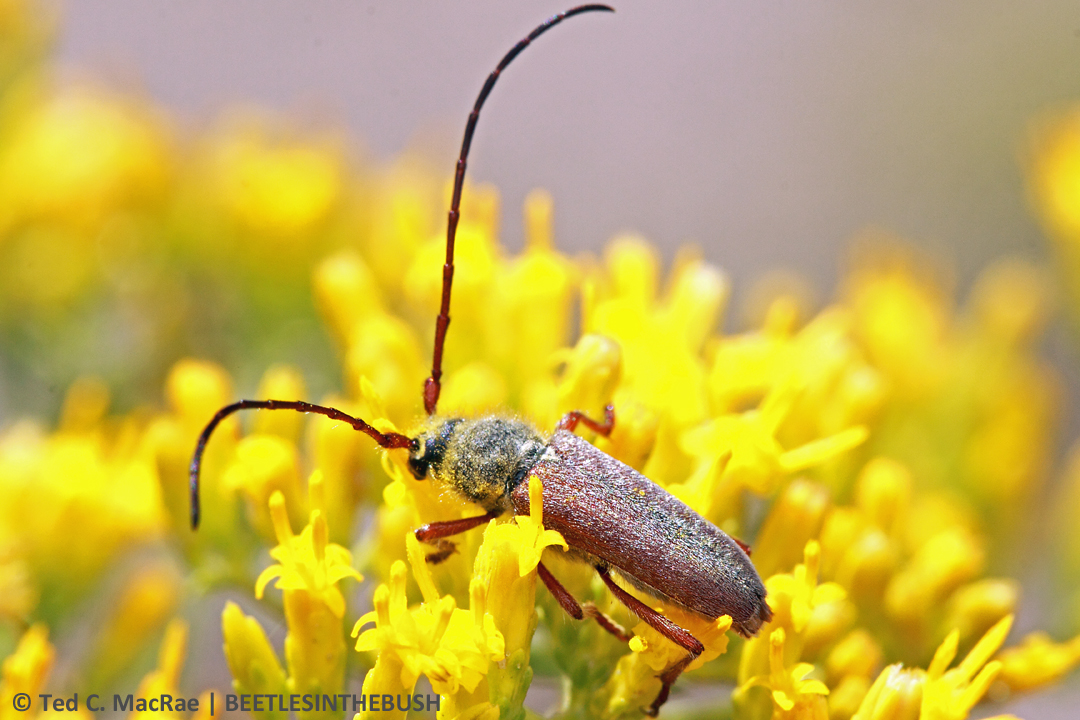
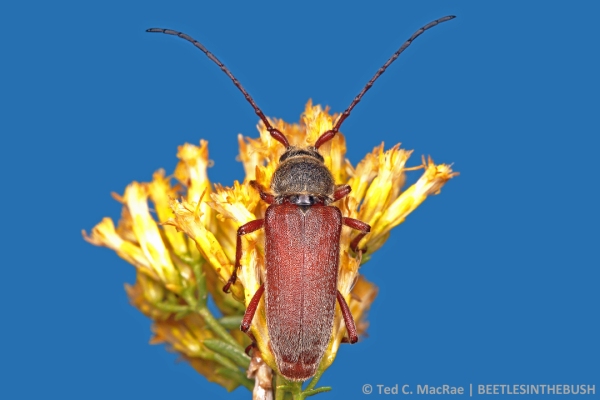
Crossidius hirtipes rhodopus in Adobe Valley, California

Crossidius hirtipes rhodopus | Adobe Valley, Mono Co., California

Crossidius hirtipes rhodopus Linsley, 1955 | Adobe Valley, Mono Co., California

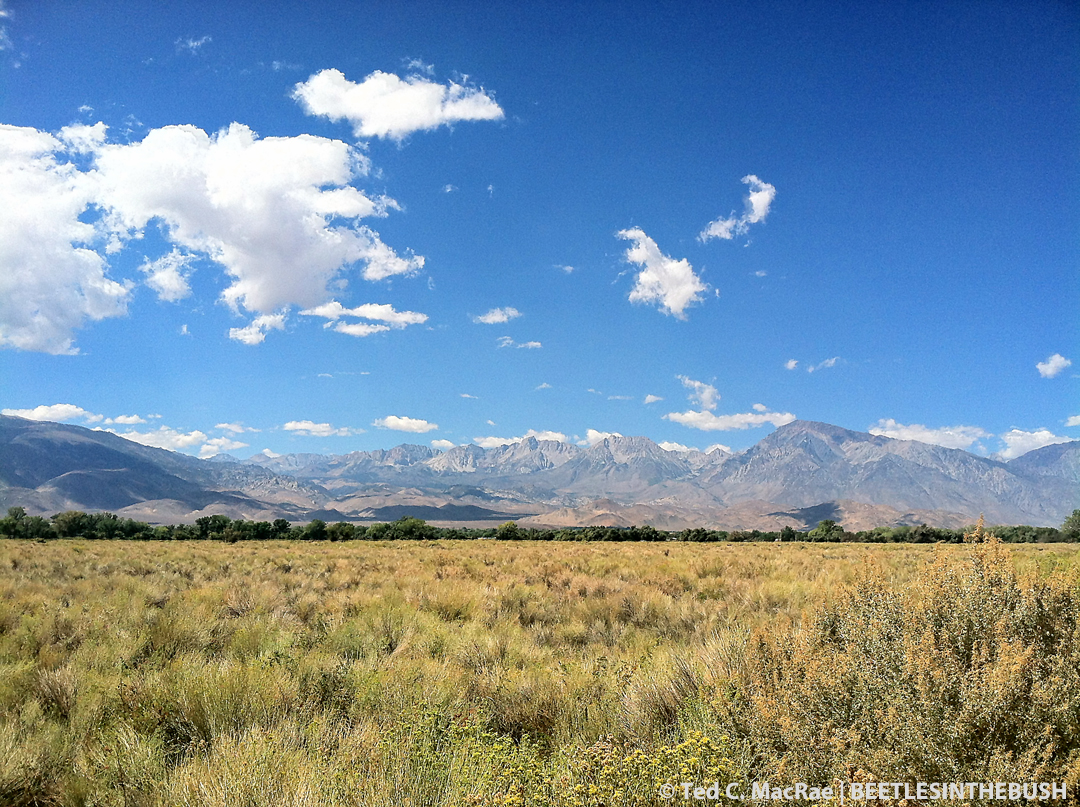
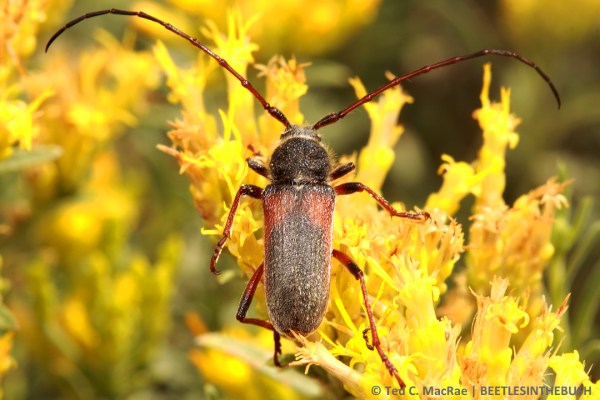
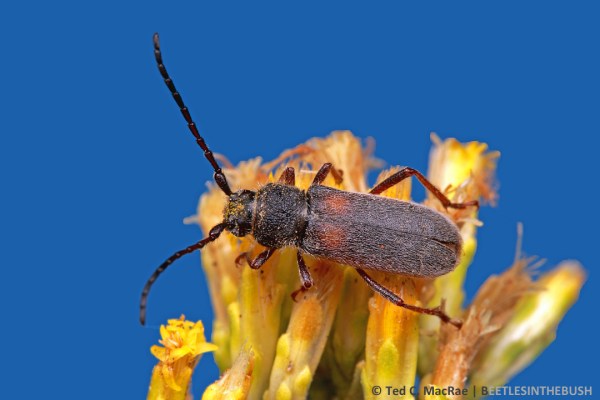
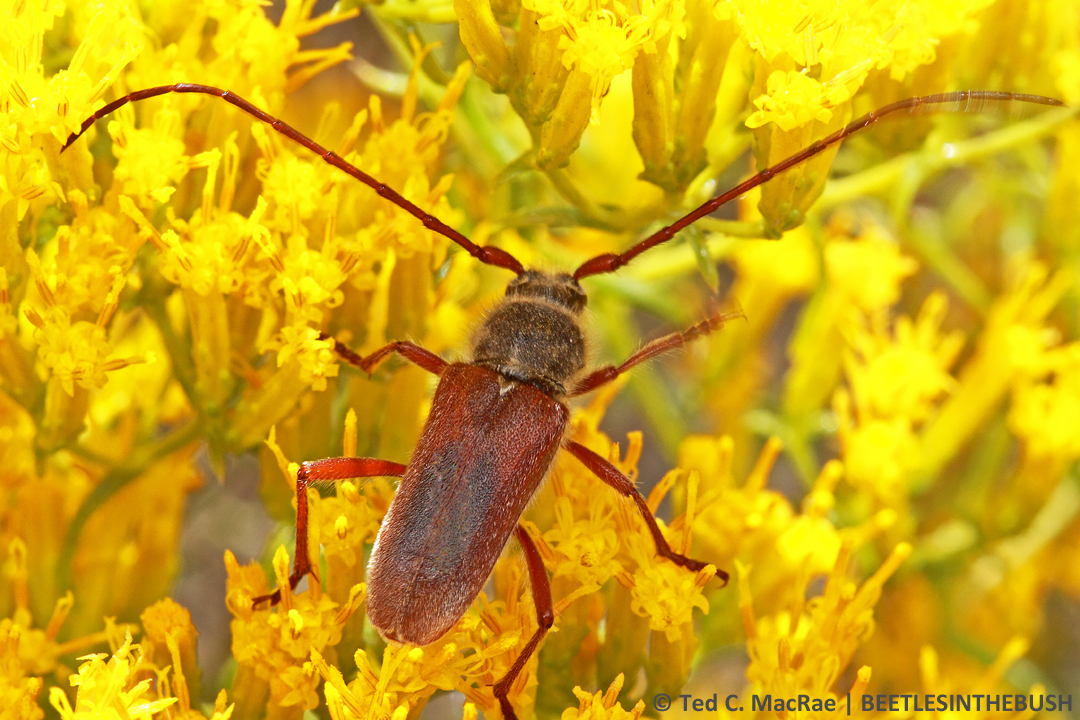
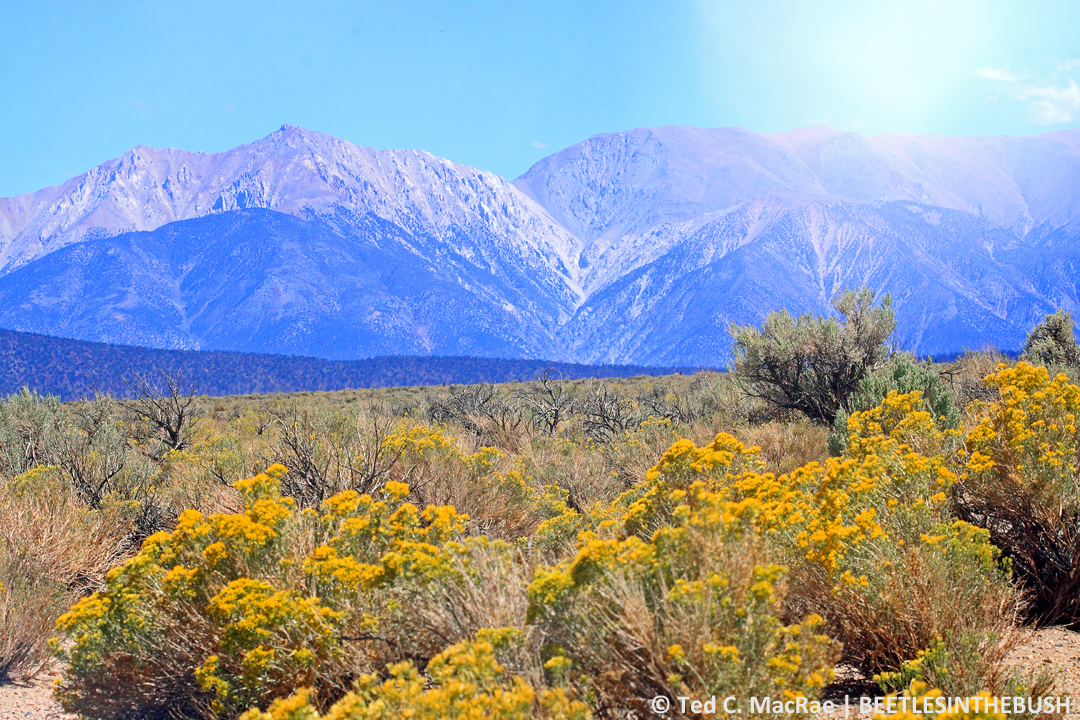
On Day 7 of last August’s Great Basin Collecting Trip, we left Bishop and headed back north to the Mono Basin to look for Crossidius hirtipes rhodopus, a distinctive reddish subspecies known only from the Mono Basin. I’d seen this beetle before—almost 20 years ago during one of several trips to the type locality of Nanularia monoensis (described by my late friend Chuck Bellamy in his 1987 revision of the genus), so we drove south of Mono Lake on Hwy 120 through Adobe Valley on our way to the Benton Range where I last saw them. Of course, C. h. rhodopus occurs more broadly in the Mono Basin than just the Benton Range, and as we drove through the valley we saw robust stands of the beetle’s host plant, yellow rabbitbrush (Chrysothamnus viscidiflorus), in full bloom stretching across the floor of the valley to the towering White Mountains in the distance. Impatience can sometimes be a virtue, and in this case our decision to stop and check the plants rather than waiting until we got to the Benton Range paid off—not only were the beetles out in force, allowing us to photograph and collect to our heart’s content, but we saw only a few beetles on but a single flowering plant during our subsequent visit to the Benton Range. Apparently the rains that had caused such a profusion of bloom in the Adobe Valley had not graced the Benton Range, resulting in the driest conditions I have seen during my several visits there.

This subspecies is one of the more darkly colored subspecies

This subspecies is one of the more darkly colored subspecies

Crossidius h. rhodopus is among the most distinctive of all the C. hirtipes subspecies due to its dark reddish-brown coloration. It closely resembles C. h. nubilus, which we had seen the day before at its only known locality further south at Westgaard Pass between the White and Inyo Mountains, but it is not as dark as that subspecies and lacks the extensive clouding of black on the apical portions of the elytra. The red-brown legs and brown antennae becoming darker at the tip further characterize C. h. rhodopus, originally described as a full species (Linsley 1955) but later regarded as a subspecies of the widely distributed and highly polytopic C. hirtipes LeConte, 1854 (Linsley & Chemsak 1961).

Yellow rabbitbrush (Chrysothamnus viscidiflorus) abounds in the valley, as the White Mountains loom in the background.

Yellow rabbitbrush (Chrysothamnus viscidiflorus) abounds below the magnificent White Mountains.

Those who are unfamiliar with the Mono Basin are missing one of California’s greatest natural treasures. A closed, internal-drainage basin bordered to the west by the massive Sierra Nevada Mountains (with Yosemite National Park lying just over the peaks), to the east by the Cowtrack Mountain, to the north by the Bodie Hills, and to the South by the north ridge of the Long Valley, the eerily beautiful Mono Lake is its most prominent feature. Do not, however, neglect other areas of the basin, which offer their own uniquely dramatic beauty. Adobe Valley, stretching south of the lake towards the White Mountains and famous for the wild mustang that live there, is one such area.

A handsome male rests on yellow rabbitbrush flowers (studio shot).

A robustly handsome female perches a terminal flower cluster of yellow rabbitbrush (studio shot).

REFERENCES:

Linsley, E. G. 1955. Notes and descriptions of some species of Crossidius. The Pan-Pacific Entomologist 31(2):63–66.

Linsley, E. G. & J. A. Chemsak. 1961. A distributional and taxonomic study of the genus Crossidius (Coleoptera, Cerambycidae). Miscellaneous Publications of the Entomological Society of America 3(2):25–64 + 3 color plates.

© Ted C. MacRae 2014

Beetle Collecting 101: How to rear wood-boring beetles

I’ve been collecting wood-boring beetles for more than three decades now, and if I had to make a list of “essential” methods for collecting them I would include “beating,” “blacklighting,” and “rearing.” Beating is relatively straightforward—take a beating sheet (a square piece of cloth measuring 3–5 ft across and suspended beneath wooden, metal, or plastic cross members), position it beneath a branch of a suspected host plant, and tap the branch with a stick or net handle. Many wood-boring beetles tend to hang out on branches of their host plants, especially recently dead ones, and will fall onto the sheet when the branch is tapped. Be quick—some species (especially jewel beetles in the genus Chrysobothris) can zip away in a flash before you have a chance to grab them (especially in the heat of the day). Others (e.g., some Cerambycidae) may remain motionless and are cryptically colored enough to avoid detection among the pieces of bark and debris that also fall onto the sheet with them. Nevertheless, persistence is the key, and with a little practice one can become quite expert at efficiently collecting wood-boring beetles using this method. Blacklighting is even easier—find the right habitat (preferably on a warm, humid, moonless night), set up a blacklight in front of a white sheet, crack open a brew, and wait for the beetles to come!

Rearing, on the other hand, takes true dedication. One must not only learn potential host plants, but also how to recognize wood with the greatest potential for harboring larvae, retrieve it from the field, cut it up, place it in rearing containers, and monitor the containers for up to several months or even years before hitting pay dirt (maybe!). Despite the considerable amount of effort this can take, the results are well worth it in terms of obtaining a diversity of species (usually in good series), some of which may be difficult to encounter in the field, and identifying unequivocal larval host associations. I have even discovered two new species through rearing (Bellamy 2002, MacRae 2003)! Moreover, checking rearing containers can be a lot of fun—in one afternoon you can collect dozens or even hundreds of specimens from places far and wide, depending on how far you are willing to travel to collect the wood. Because of the effort involved, however, the more you can do to ensure that effort isn’t wasted on uninfested wood and that suitable conditions are provided to encourage continued larval development and adult emergence from infested wood the better. It is with this in mind that I offer these tips for those who might be interested in using rearing as a technique for collecting these beetles.

I should first clarify what I mean by “wood-boring” beetles. In the broadest sense this can include beetles from any number of families in which the larvae are “xylophagous,” i.e., they feed within dead wood. However, I am most interested in jewel beetles (family Buprestidae) and longhorned beetles (family Cerambycidae), and as a result most of the advice that I offer below is tailored to species in these two families. That is not to say that I’ll turn down any checkered beetles (Cleridae), powderpost beetles (Bostrichidae), bark beetles (family Scolytidae), or even flat bark beetles sensu lato (Cucujoidea) that I also happen to encounter in my rearing containers, with the first two groups in particular having appeared in quite good numbers and diversity in my containers over the years. Nevertheless, I can’t claim that my methods have been optimized specifically for collecting species in these other families.

First, you have to find the wood. In my experience, the best time to collect wood for rearing is late winter through early spring. A majority of species across much of North America tend to emerge as adults during mid- to late spring, and collecting wood just before anticipated adult emergence allows the beetles to experience natural thermoperiods and moisture regimes for nearly the duration of their larval and pupal development periods. Evidence of larval infestation is also easier to spot once they’ve had time to develop. That said, there is no “bad” time to collect wood, and almost every time I go into the field I am on the lookout for infested wood regardless of the time of year. The tricky part is knowing where to put your efforts—not all species of trees are equally likely to host wood-boring beetles. In general, oaks (Quercus), hickories (Carya), and hackberries (Celtis) in the eastern U.S. host a good diversity of species, while trees such as maples (Acer), elms (Ulmus), locust (Gleditsia and Robinia), and others host a more limited but still interesting fauna. In the southwestern U.S. mesquite (Prosopis) and acacia (Acacia) are highly favored host plants, while in the mountains oaks are again favored. Everywhere, conifers (PinusAbies, JuniperusTsuga, etc.) harbor a tremendous diversity of wood-boring beetles. To become good at rearing wood-boring beetles, you have to become a good botanist and learn not only how to identify trees, but dead wood from them based on characters other than their leaves! Study one of the many good references available (e.g., Lingafelter 2007, Nelson et al. 2008) to see what the range of preferred host plants are and then start looking.

I wish it were as simple as finding the desired types of trees and picking up whatever dead wood you can findm but it’s not. You still need to determine whether the wood is actually infested. Any habitat supporting populations of wood-boring beetles is likely to have a lot of dead wood. However, most of the wood you find will not have any beetles in it because it is already “too old.” This is especially true in the desert southwest, where dead wood can persist for very long periods of time due to low moisture availability. Wood-boring beetles begin their lives as eggs laid on the bark of freshly killed or declining wood and spend much of their lives as small larvae that are difficult to detect and leave no obvious outward signs of their presence within or under the bark. By the time external signs of infestation (e.g., exit holes, sloughed bark exposing larval galleries, etc.) become obvious it is often too late—everything has already emerged. Instead, look for branches that are freshly dead that show few or no outward signs of infestation. You can slice into the bark with a knife to look for evidence of larval tunnels—in general those of longhorned beetles will be clean, while those of jewel beetles will be filled with fine sawdust-like frass that the larva packs behind it as it tunnels through the wood. Oftentimes the tunnels and larvae will be just under the bark, but in other cases they may be deeper in the wood. Broken branches hanging from live trees or old, declining trees exhibiting branch dieback seem to be especially attractive to wood-boring beetles, while dead branches laying on the ground underneath a tree are not always productive (unless they have been recently cut).

One way to target specific beetles species is to selectively cut targeted plant species during late winter, allow the cut branches to remain in situ for a full season, and then retrieve them the following winter or early spring. These almost always produce well. Doing this will also give you a chance to learn how to recognize young, infested wood at a time that is perfect for retrieval, which you can then use in searching for wood from other tree species in the area that you may not have had a chance to cut. I have cut and collected branches ranging from small twigs only ¼” diameter to tree trunks 16″ in diameter. Different species prefer different sizes and parts of the plant, but in general I’ve had the best luck with branches measuring 1–3″ diameter.

Once you retrieve the wood, you will need to cut it into lengths that fit into the container of your choice (a small chain saw makes this much easier and quicker). In the field I bundle the wood with twine and use pink flagging tape to record the locality/date identification code using a permanent marker. I then stack the bundles in my vehicle for transport back home. Choice of container is important, because moisture management is the biggest obstacle to rearing from dead wood—too much moisture results in mold, while too little can lead to desiccation. Both conditions can result in mortality of the larvae or unemerged adults. In my rearing setup, I use fiber drums ranging from 10-G to 50-G in size (I accumulated them from the dumpster where I work—mostly fiber drums used as shipping containers for bulk powders). Fiber drums are ideal because they not only breath moisture but are sturdy and may be conveniently stacked. Cardboard boxes also work as long as they are sturdy enough and care is taken to seal over cracks with duct tape. Avoid using plastic containers such as 5-G pickle buckets unless you are willing to cut ventilation holes and hot-glue fine mesh over them. While breathable containers usually mitigate problems with too much moisture, desiccation can still be a problem. To manage this, remove wood from containers sometime later in the summer (after most emergence has subsided), lay it out on a flat surface such as a driveway, and hose it down real good. Once the wood has dried sufficiently it can be placed back in the container; however, make sure the wood is completely dry or this will result in a flush of mold. I generally also wet down wood again in late winter or early spring, since I tend to hold wood batches through two full seasons.

I like to check containers every 7–15 days during spring and summer. Some people cut a hole in the side of the container that leads into a clear jar or vial—the idea being that daylight will attract newly emerged adults and facilitate their collection. I’ve tried this and was disappointed in the results—some of the beetles ended up in the vial, but many also never found their way to the vial and ended up dying in the container, only to be found later when I eventually opened it up. This is especially true for cerambycids, many of which are nocturnal and thus probably not attracted to daylight to begin with. My preference is to open up the container each time so that I can check the condition of the wood and look for evidence of larval activity (freshly ejected frass on the branches and floor of the container). I like to give the container a ‘rap’ on the floor to dislodge adults from the branches on which they are sitting, then dump the container contents onto an elevated surface where I can search over the branches and through the debris carefully so as not to miss any small or dead specimens. I use racks of 4-dram vials with tissue packed inside each and a paper label stuck on top of its polypropylene-lined cap as miniature killing jars. Specimens from a single container are placed in a vial with a few drops of ethyl acetate, and I write the container number and emergence date range on the cap label. Specimens will keep in this manner until they are ready to be mounted weeks or months (or even years) later. If the vial dries out, a few drops of ethyl acetate and a few drops of water followed by sitting overnight is usually enough to relax the specimens fully (the water relaxes the specimens, and the ethyl acetate prevents mold if they need to sit for a while longer).

I store my containers in an unheated garage that is exposed to average outdoor temperatures but probably does not experience the extreme high and low temperatures that are experienced outdoors. In the past I wondered if I needed more heat for wood collected in the desert southwest, but I never came up with a method of exposing the containers to the sun without also having to protect them from the rain. Metal or plastic containers might have eliminated this problem, but then breathability would again become an issue. I would also be concerned about having direct sun shining on the containers and causing excessive heat buildup inside the bucket that could kill the beetles within them. Now, however, considering the success that I’ve had in rearing beetles from wood collected across the desert southwest—from Brownsville, Texas to Jacumba, California, this seems not to be a big issue.

If anybody else has tips for rearing wood-boring beetles that they can offer, I would love to hear from you.

REFERENCES:

Bellamy, C. L. 2002. The Mastogenius Solier, 1849 of North America (Coleoptera: Buprestidae: Polycestinae: Haplostethini). Zootaxa 110:1–12 [abstract].

Lingafelter, S. W. 2007. Illustrated Key to the Longhorned Woodboring Beetles of the Eastern United States. Special Publication No. 3. The Coleopterists Society, North Potomac, Maryland, 206 pp. [description].

MacRae, T. C. 2003. Agrilus (s. str.) betulanigrae MacRae (Coleoptera: Buprestidae: Agrilini), a new species from North America, with comments on subgeneric placement and a key to the otiosus species-group in North America. Zootaxa 380:1–9 [pdf].

Nelson, G. H., G. C. Walters, Jr., R. D. Haines, & C. L. Bellamy.  2008.  A Catalogue and Bibliography of the Buprestoidea of American North of Mexico.  Special Publication No. 4. The Coleopterists Society, North Potomac, Maryland, 274 pp. [description].

Copyright © Ted C. MacRae 2014

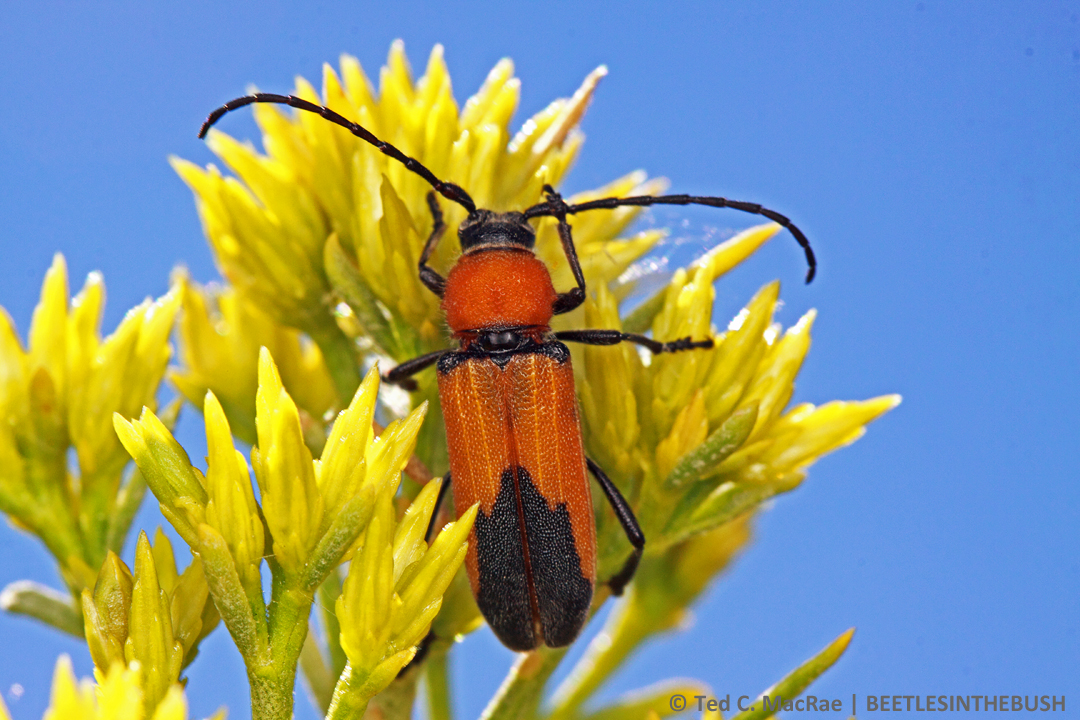
The sublimely beautiful Crossidius coralinus caeruleipennis

Crossidius coralinus caeruleipennis | Inyo Co. nr. Bishop, California

Crossidius coralinus caeruleipennis | Owens Valley nr. Bishop, California

Before driving up into the White Mountains to look for Crossidius hirtipes nubilus and see the grotesquely beautiful trees at Ancient Bristlecone Pine Forest, we made a short two-mile drive north of our hotel in Bishop, California to try our hand with a C. coralinus subspecies that I referred tangentially in my previous postC. c. caeruleipennis. This has to be among the most beautiful subspecies that I’ve seen yet of what must be considered one of North America’s most attractive species of longhorned beetle. In contrast to the other “orange” subspecies, C. c. monoensis, which we had collected the previous day but that I did not even recognize as C. coralinus because of its color and very small size, I knew exactly what I was looking for on this day as we began to scan the gray rabbitbrush (Ericameria nauseosa) plants that stretched out across the Owens Valley sage grassland as far as the eye could see. At first we were worried that we might be a little late, as most of the plants appeared to be somewhat past peak bloom, but it wasn’t long before we found the first individual sitting atop a flower cluster, and then another, and another...

Males are completely orange.

Males are solid, sublimely orange with strikingly contrasting black legs and antennae.

Crossidius c. caeruleipennis is immediately distinguishable from C. c. temprans (and most of the other C. coralinus ssp. that we collected on the trip further north in Nevada and east in Utah and Colorado) by its bright orange rather than dark red coloration. The subspecies is restricted to the Owens Valley of eastern California and greatly resembles another of the orange subspecies that we collected on the trip, C. c. monoensis. That subspecies is found just a short distance north in the Mono Basin, though at much higher elevations, and is easily distinguished from C. c. caeruleipennis by its smaller average size, by having the black markings of the elytra more expanded apically in females and at least present in males, and by the presence of black bands along the apical and basal margins of the pronotum (Linsley & Chemsak 1961).

Females have a distinct apical blue-black marking on the elytra

Females are distinguished by the apical blue-black marking on the elytra and their shorter antennae.

As it turned out, the beetle was as abundant as any we had seen on the trip to that point. Not that it didn’t require some effort to collect them—they were still rather sparsely distributed among the plants and definitely showed preference for plants that were not as far past peak bloom. However, the habitat was extensive—we could have wandered freely for hours on end without looking at the same plant twice (although that did not stop me from re-checking a few plants that were in peak bloom and seemed to be especially favored). The males were simply gorgeous—a bright, creamy orange that sadly takes on a dull quality in preserved specimens and with long black legs and antennae. The females are no dogs either, less strikingly orange due to the blue-black apical markings on the elytra, but certainly more robust than the males in a subspecies that is already one of the larger of the species. Temperatures climbed rapidly at this relatively southern and lower elevation locality compared to most of the others that we visited during the trip, so the beetles became quite active very quickly after we began to see them. I had only a short window of time in which to attempt field photographs, and while I’m not completely satisfied with the ones that I show here, they were the best that I could manage and still get the blue sky background that I desire for “beetles on flowers” photographs.

Sage grassland and gray rabbitbrush dominate the Owens Valley where C. coralinus caeruleipennis is found.

Gray rabbitbrush dominates the Owens Valley sage grassland where C. coralinus caeruleipennis occurs.

REFERENCE:

Linsley, E. G. & J. A. Chemsak. 1961. A distributional and taxonomic study of the genus Crossidius (Coleoptera, Cerambycidae). Miscellaneous Publications of the Entomological Society of America 3(2):25–64 + 3 color plates.

Copyright © Ted C. MacRae 2014
Clouded beetles amidst spectacular scenery

“Westerly from Westgard Pass is a view equaled in few parts of America. In the middle distance, a dozen miles away and nearly a mile below, lies the fertile Owens Valley, extending at right angles north and south over a hundred miles, and on the farther side, distant a score of miles, tower the snow-clad Sierras, with serrated crests and symmetric domes and peaks outlined against the sky at an approximate height of two and one-half miles vertical above the level of the ocean, and extending north and south far as the eye can see. The vision is rich reward for a journey of a thousand leagues.”—A. L. Westgard, March 1915

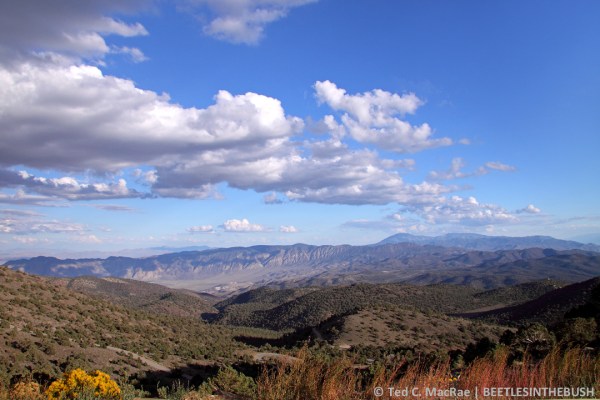
View of Westgard Pass from higher up in the White Mountains near Ancient Bristlecone Pine Forest.

View to Westgard Pass from higher up in the White Mountains near Ancient Bristlecone Pine Forest.

After a morning spent searching for Crossidius coralinus caeruleipennis (perhaps the most sublimely beautiful of the subspecies) in the high desert sage of the wide open Owens Valley floor near Bishop, California, we made the short drive south to Big Pine, turned sharply left, and began the slow, twisting ascent through a narrow gap between the White Mountains to the north and the Inyo Mountains to the south. Eventually reaching an elevation of 7,313 ft,  Westgard Pass serves as access to Earth’s oldest living things! and, in doing so, provides some of the most striking scenery in the entire Basin and Range Province of eastern California.

Westgard Pass, Inyo Co., California.

Chrysothamnus viscidiflorus (small plants with yellow flowers) host Crossidius hirtipes nubilus adults.

Field mate Jeff Huether and I no doubt wanted to see the grotesquely beautiful trees growing in Ancient Bristlecone Pine Forest and were happy to enjoy the magnificent scenery along the way, but our trek to Westgard Pass had also a strictly entomological purpose—to search for Crossidius hirtipes nubilus, among the most uniquely colored and geographically restricted of the C. hirtipes subspecies. Approaching the summit, the narrow, rocky gorge opened up to a broad expanse of pinyon/juniper woodland, and nestled among the ubiquitous sage we found the plant we were looking for—yellow rabbitbrush (Chrysothamnus viscidiflorus) in full bloom.

Crossidius hirtipes nubilus (male) on flowers of Chrysothamnus viscidiflorus.

Crossidius hirtipes nubilus (male) on flowers of Chrysothamnus viscidiflorus (field photo).

It took a while, however, before we found the beetles that we were looking for. Robust gray rabbitbrush (Ericameria nauseosa) plants in full bloom conspicuously dominated the roadsides and demanded our initial attentions, but our only reward was the widespread Crossidius ater. Not even a single Crossidius coralinus specimen could be claimed as consolation. Still, we knew the real quarry was further back from the roadsides, on the much smaller and less conspicuous yellow rabbitbrush that serves as an adult host for Crossidius hirtipes and most of its subspecies. Once we turned our attentions to these smaller plants we found the first adult fairly quickly, but precious few were seen considering the many plants that we examined until we finally zeroed in on one area just south of the summit where the beetles seemed to occur with slightly greater frequency. While not numerous, we eventually found enough beetles for us to declare, “Let’s go see the bristlecone pines!”

In addition to their longer antennae, males are distinguished by xxx.

In addition to longer antennae, males are distinguished by less extensive clouding (studio photo).

This subspecies is among the most distinctive of all the C. hirtipes subspecies due to the combination of dark reddish-brown coloration and extreme, dark clouded area of the elytra (Linsley & Chemsak 1961). It most closely resembles C. h. rhodopus, which occurs further north in the Mono Basin, but that subspecies is not as dark and lacks the extensive clouding of black on the apical portions of the elytra.

Females have the elytral markings xxx.

Females have the markings greatly expanded to almost completely cover the elytra (studio photo).

The dark clouding actually represents an expansion of the dark stripe found along the suture of the elytra of many C. hirtipes subspecies, most of which exhibit sexual dimorphism in the degree to which this stripe is developed. In some subspecies the stripe is present in the females but absent in the males, while in others the stripe is present in both but more fully developed in the female. In C. h. nubilus the sutural stripe reaches an extreme state of development, covering much of the apical two-thirds of the elytra in the male and being so greatly expanded in females that almost the entire elytra are covered except for two small subbasal patches revealing the ground color of the elytra.

REFERENCES:

Linsley, E. G. & J. A. Chemsak. 1961. A distributional and taxonomic study of the genus Crossidius (Coleoptera, Cerambycidae). Miscellaneous Publications of the Entomological Society of America 3(2):25–64 + 3 color plates.

Copyright © Ted C. MacRae 2014
What was that insect?

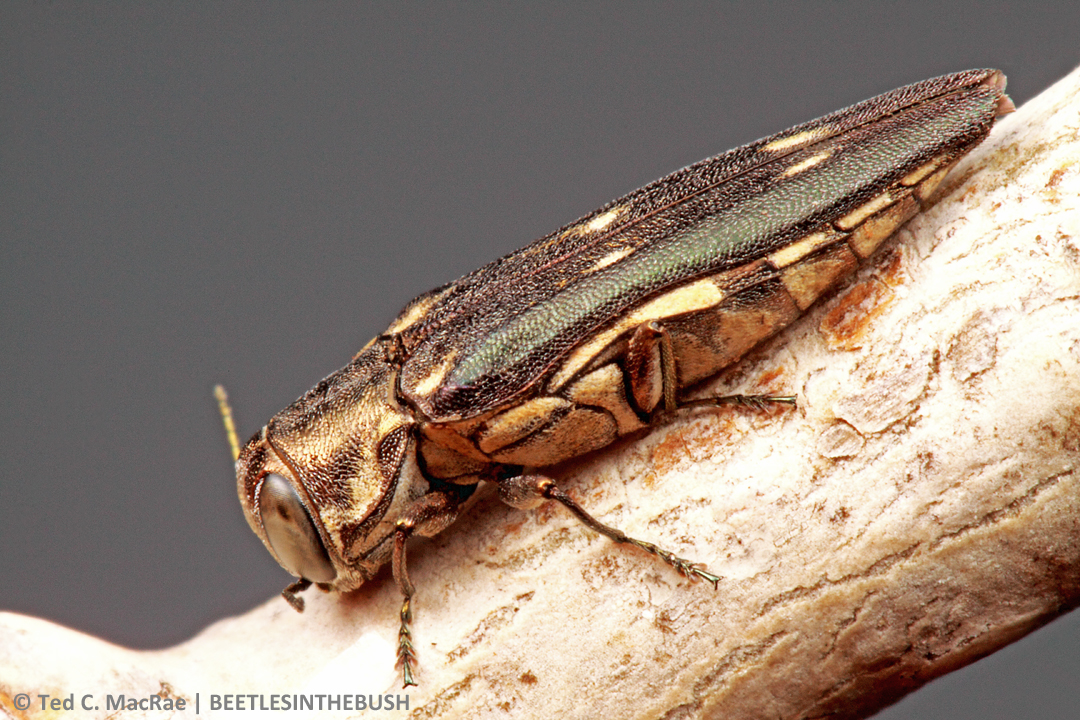
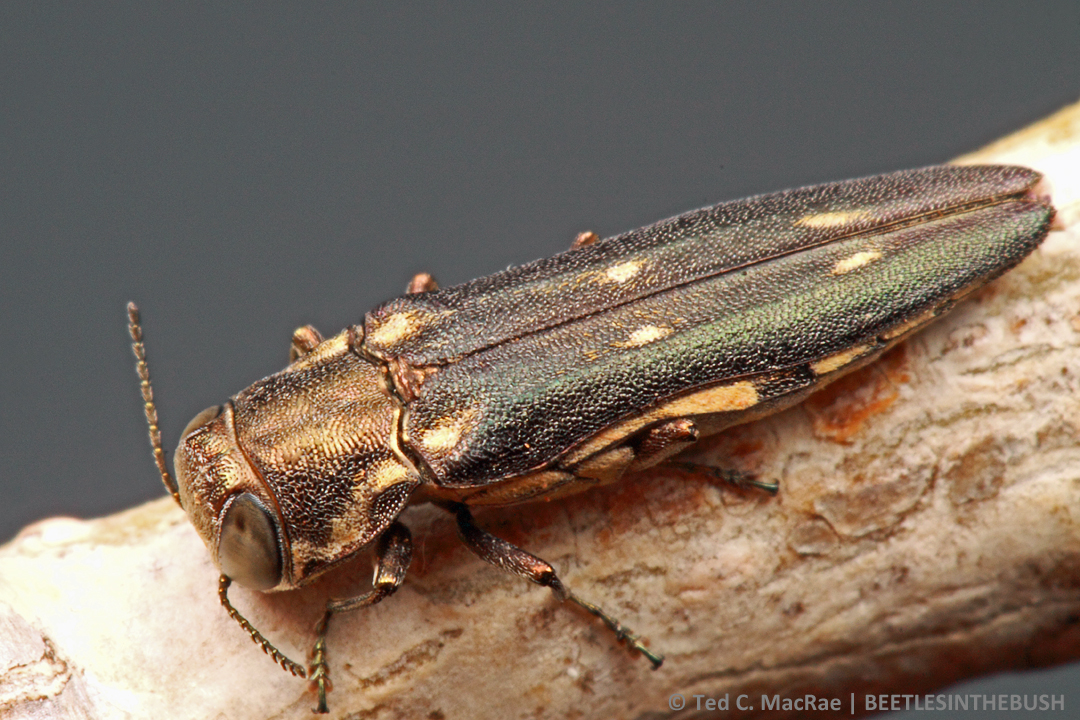
Yesterday I posted an identification challenge of a different sort. The main subject in the photo was a jewel beetle (family Buprestidae), but there was also another insect in the photo—a small parasitic wasp sitting on the branch below the beetle. Some of you saw it—Charley Eiseman was the first and correctly guessed it was a member of the family Encyrtidae, earning 5 pts, and Wikispecies editor gets 5 pts for further identifying it as a member of the genus Metaphycus. Honestly, I took several shots of the beetle and never saw the wasp until I examined the photograph during processing. I’m not certain, but I think the small object next to the wasp could be a scale insect (family Coccidae), which are known hosts of Metaphycus spp.

Of course, there is still the jewel beetle, and it wouldn’t be fair for me to award points for the wasp but not the beetle. Heath gets 5 pts for first identifying the beetle in the genus Agrilus; however, nobody was able to identify the species as A. granulatus—commonly associated with cottonwood and poplar (Populus spp.) across North America. Since Charley was the only person to mention both the beetle and the wasp, I’m going to give him a tie-breaking bonus point and declare him the challenge winner.

Populations of A. granulatus have been assigned to several subspecies—the beetle shown here (photographed June 2013 at Beaver Dunes, Oklahoma) represents the nominate form—restricted to the U.S. east of the Rocky Mountains, where it breeds in native eastern cottonwoods (P. deltoides) and introduced Lombardy poplars (P. nigra var. ‘Italica’). Agrilus granulatus is often confused in collections with A. quadriguttatus, but that species is associated with willow (Salix spp.) and can be further distinguished by the less dense pubescence of the lower face not obscuring the surface; the pronotum with the lateral margins evenly rounded and not strongly sinuate at the base, the median channel less distinct, and the lateral depressions scarcely pubescent; and the elytra more gradually narrowed posteriorly with the tips more acutely rounded and more coarsely serrulate and the pubescent spots less distinct (Fisher 1928).

Here are a few more photographs of the jewel beetle (without the wasp):

Agrilus granulatus granulatus on Populus deltoides | Beaver Dunes, Oklahoma

Agrilus granulatus granulatus on Populus deltoides | Beaver Dunes, Oklahoma

Agrilus granulatus granulatus on Populus deltoides | Beaver Dunes, Oklahoma

Agrilus granulatus granulatus on Populus deltoides | Beaver Dunes, Oklahoma

Agrilus granulatus granulatus on Populus deltoides | Beaver Dunes, Oklahoma

Agrilus granulatus granulatus on Populus deltoides | Beaver Dunes, Oklahoma

REFERENCE:

Fisher, W. S.  1928. A revision of the North American species of buprestid beetles belonging to the genus Agrilus.  U. S. National Museum 145, 347 pp.

Copyright © Ted C. MacRae 2014