Why did it take 30 years to collect these beetles?

Poecilonota cyanipes

Poecilonota cyanipes (eastern poplar jewel beetle) | Beaver Dunes State Park, Oklahoma

This is the best known of the American species of Poecilonota, and the one most commonly collected east of the Rocky Mountain.—Evans (1957)

I’ve been interested in insects since I was a kid, but I didn’t really become a dedicated coleopterist until after I’d finished graduate school and started working as a field entomologist with the Missouri Department of Agriculture. It was a perfect job for a young entomologist with a bent for collecting—being outside all day inspecting nursery stock and driving the back roads checking insect traps. It wasn’t long before I found myself focusing on wood-boring beetles, due initially to their horticultural importance but eventually to their astounding diversity and intrinsic beauty. So began my formal survey of the families Buprestidae and Cerambycidae in Missouri, and I spent the next eight years collecting them in all corners of the state and examining every insect collection, public and private, that I could find that might contain Missouri representatives of these families. In the end, I documented a cool 350 species and subspecies in the two families combined, more than a fifth of which represented new state records (MacRae 1991, 1994).
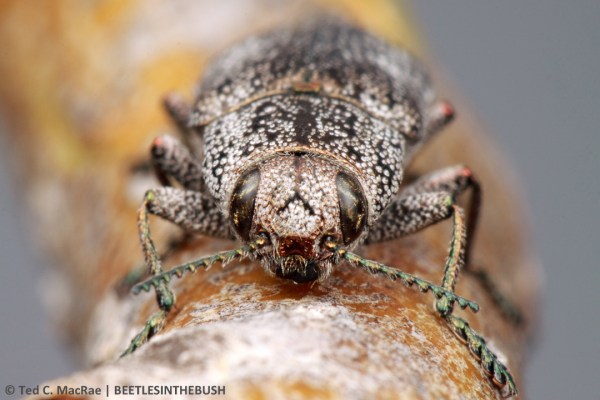
Poecilonota cyanipes

The specific epithet ‘cyanipes‘ refers to the blue feet

One species, however, that I had expected to find almost completely eluded me. This, despite the quote above by Evans (1957) in his revision of the genus Poecilonota in North America. Although it had been recorded from much of North America east of the Rocky Mountains in association with poplars (Populus spp.) and willows (Salix spp), I never actually encountered P. cyanipes in the field and found just two specimens labeled simply “Mo” in the insect collection at the University of Missouri in Columbia. This puzzled me, as I had beaten countless branches of cottonwood (Populus deltoides) and willow in search of this species and found many of the other known poplar/willow associates. I had even already collected two specimens of its much rarer congener, P. thureura, off of a redbud tree at the entrance to the Entomology Building on campus while still in graduate school!
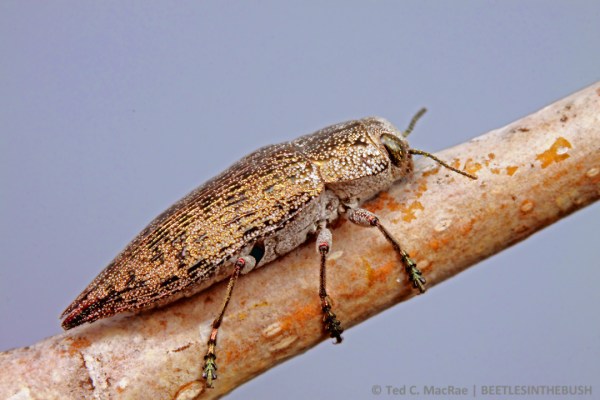
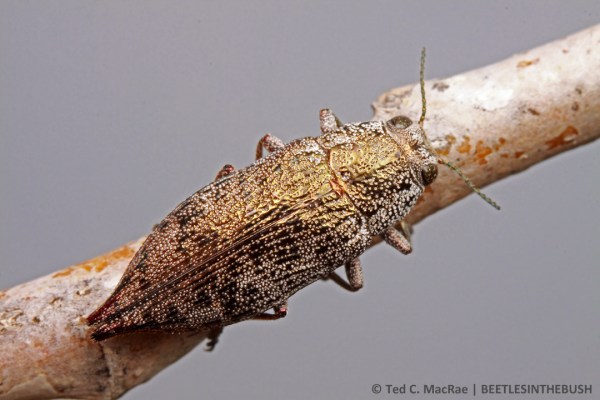
Poecilonota cyanipes

This species can be recognized by its coppery color and elongate, distinctly reddish elytral apices,

As is often the case, good comes to those who wait, and I’ve finally gotten my chance during the past two seasons to encounter this species in numbers—last year as prey taken from nest sites of the buprestid-specialist crabronid wasp, Cerceris fumipennis, and this past June on cottonwood trees in northwestern Oklahoma at Beaver Dunes State Park. The individual in these photos was the first one I found—beaten from the lower branch of a small, living cottonwood exhibiting significant branch dieback, and over the course of the next two days I managed to beat close to three dozen specimens from the small, stunted cottonwoods that dotted the park. I suspect that the combination of good timing—buprestids of many types were common on a number of woody plant species in the area—and susceptible hosts with abundant branch dieback due to protracted drought conditions over the past few years was the reason I was able to find so many of the beetles. A perfect storm for wood-boring beetles, so to speak!

Poecilonota cyanipes

The non-angulate pronotal sides distinguish this species from another eastern species, P. ferrea.

As suggested above, larvae of this species are associated exclusively with dead or dying branches of Populus and Salix (both in the family Salicaceae), often in association with galls made previously by other species of wood-boring beetles, e.g., Saperda concolor in poplar (Knull 1920) and Agrilus criddlei in willow (Wellso et al. 1976). In fact, with one exception (P. viridicyanea on Chilopsis linearis) all members of the genus seem to be associated exclusively with plants in these two genera. However, in addition to these plants, Nelson et al. (2008), in their catalogue of the Buprestidae of the U.S. and Canada, also included black locust (Robinia pseudoacacia) in the family Fabaceae as a larval host for P. cyanea. I am convinced that this record represents at best a mere incidental adult association, and there are other examples of such in the catalogue (the final preparation of which was completed after the untimely death of the senior author). This is unfortunate, since erroneous records in such ‘standard’ references tend to be propagated in subsequent literature, which already seems to have happened in the case of black locust as a larval host for P. cyanipes (Paiero et al. 2012).

REFERENCES:

Knull, J. N. 1920. Notes on Buprestidae with description of a new species (Coleop.). Entomological News 31(1):4–12 [BioStor].

MacRae, T. C. 1991. The Buprestidae (Coleoptera) of Missouri. Insecta Mundi5(2):101–126 [pdf].

MacRae, T. C. 1994. Annotated checklist of the longhorned beetles (Coleoptera: Cerambycidae and Disteniidae) known to occur in Missouri. Insecta Mundi 7(4) (1993):223–252 [pdf].

Nelson, G. H., G. C. Walters, Jr., R. D. Haines, & C. L. Bellamy.  2008.  A Catalogue and Bibliography of the Buprestoidea of American North of Mexico.  Coleopterists Society Special Publication No. 4, The Coleopterists Society, North Potomac, Maryland, 274 pp. [description].

Paiero, S. M., M. D. Jackson, A. Jewiss-Gaines, T. Kimoto, B. D. Gill & S. A. Marshall. 2012. Field Guide to the Jewel Beetles (Coleoptera: Buprestidae) of Northeastern North America. 1st Edition. Canadian Food Inspection Agency, 411 pp. [pdf].

Wellso, S. G., G. V. Manley & J. A. Jackman. 1976. Keys and notes on the Buprestidae (Coleoptera) of Michigan. The Great Lakes Entomologist 9(1):1–22.

Copyright © Ted C. MacRae 2013

The wondrously and eerily beautiful Mono Lake

During my recent Great Basin collecting trip, we stopped briefly at one of my favorite places in the world—Mono Lake in eastern California. My last visit was almost 20 years ago, so it was a thrill for me to see the strange tufa moonscape once again after so many years.

Mono Lake

Mono Lake has no eventual outlet to the ocean. As a result dissolved salts in runoff from the surrounding landscape have accumulated in the lake, resulting in water with high pH levels.

Mono Lake

The late day shadows created a black/white tufa landscape.

Mono Lake

Conservation actions have raised lake levels from their historical lows resulting from diversion of water to Los Angeles, but they have still not recovered to their former levels.

Mono Lake

I held the camera barely above the water’s surface to get this shot. It took several tries to get just a thin sliver of perfectly horizontal water. Yes, it would have been easier to hold the camera higher, look through the viewfinder and then crop, but I wanted the widest view possible (besides, doing that would seem like “cheating”).

Mono Lake

Tufa forms when calcium from underwater springs comes into contact with carbonates in the lake water, causing a chemical reaction that produces calcium carbonate (limestone). The calcium carbonate settles around the underwater spring and over time builds a tufa tower. This happens only underwater, and the tufa towers seen here are visible only because of the lowered lake level resulting from water diversion. Unless the lake level is restored completely, these towers are “dead” and will eventually erode away.

Mono Lake

Smoke and haze from the Rim Fire burning near Yosemite boils over the eastern slope of the Sierra Nevada.

Mono Lake

Mono Lake supports the second largest nesting population of California gulls after Utah’s Great Salt Lake.

Mono Lake

The water level at Mono Lake has dropped not only in recent years because of humans, but over several thousand years. At the end of the last ice age the water level was hundreds of feet higher than today and the lake 5 times its present size.

Mono Lake

Late day shadows, wildfire haze, and perfectly still waters create a surreal scene.

Copyright © Ted C. MacRae 2013

Stalking tigers in Argentina

Brasiella argentata

Brasiella argentata | banks of Rio Paraná, Corrrientes, Argentina

Most of you know that I have spent a lot of time in Argentina over the years, and while most of my time there has been for work I have had a fair bit of opportunity to collect insects as well. This includes tiger beetles, and in fact I recall one trip some years ago during which I spent the better part of a week chasing tigers in northeastern Argentina around Corrientes and west into Chaco Province. I think I collected maybe a dozen species or so—some in great numbers and others not, and with the help of tiger beetle expert David Brzoska I’ve managed to put names on most of the material. Despite this, however, I’ve never actually posted any photos of tiger beetles from Argentina here on BitB. I guess the main reason for this is that my efforts to photograph tiger beetles is still a relatively new pursuit (compared to the time that I’ve been going to Argentina), and most of my luck with tiger beetles in Argentina has preceded my time with a camera. The other reason for the delay is that, while I have managed to photograph a few tiger beetles in Argentina, I’ve only recently been able to determine their identity (and you all know how I dislike posting photos of unidentified insects). Well, time to change that, and for this post I am featuring the very first tiger beetle that I was able to photograph in Argentina—the aptly named Brasiella argentata.

Banks of Rio Paraná, habitat for Brasiella argentata.

Banks of Rio Paraná, habitat for Brasiella argentata.

The individuals in this post were photographed on 1 April 2011 during the early part of a week-long visit to Corrientes and neighboring Chaco Province in northern Argentina. Remember, this is the southern hemisphere, so early April is way late in the season and, in this part of Argentina, typically on the back end of a very long dry period. Still, it is far enough north to be borderline subtropical climate, and with the stifling heat it could, for all intents and purposes, have been the middle of summer. I knew tiger beetles could be found along the banks of the Rio Paraná, as I had collected them there during my trip some 10 years previous, so in late morning of my first day after arrival in the city I kitted up and walked down to the river. Sand and mud beaches are not plentiful along the mostly rocky shoreline, and I was perturbed to see the area where I had collected during my last visit had since been “developed.” Nevertheless, I found promising-looking habitat a short distance further north and walked to its moister edges (photo above). I saw nothing at first, but eventually I came to a small, moist drainage where the sand was mixed with more mud, and there they were! It took a little bit of looking, as this species is quite small—adults average only ~7 mm in length, and despite the impression you may get from these photos they are well camouflaged to match the color of the wet, muddy sand and, thus, difficult to see before they take flight and again after they land.

An individual sits long enough to allow a few close, lateral profile shots.

Brasiella argentata is one of the most widely distributed Neotropical species of tiger beetles, occurring from Panama and the West Indies south to Peru and Argentina (Cassola & Pearson 2001). Numerous subspecies have been described from throughout its range, but in truth it seems to actually be a “species swarm” comprised of multiple species, many of which can only be determined by examination of characters contained within the male aedeagus (Sumlin 1979). The genus Brasiella itself, like many others, was until recently considered to be a subgenus of Cicindela, but the distinctiveness of these mostly small (Pearson et al. 2007 refer to them as “Little Tiger Beetles”), cursorial (running) beetles has been recognized in most of the more recent comprehensive treatises (e.g., Cassola & Pearson 2001, Erwin & Pearson 2008). Unlike most of its related genera (subtribe Cicindelina), Brasiella is almost exclusively Neotropical in distribution—only one of its 45 species, B. wickhami, reaches the U.S. in southern Arizona (Pearson et al. 2007).

Brasiella argentata

The only photo I managed looking towards the front of an individual.

If their smallness must be recognized, so must their running abilities. This was one of the most difficult species I’ve ever attempted to photograph, and with those difficulties added to the heat of the day and its “perfect storm” habitat it’s a wonder I got any photographs at all. It was a good half hour before I even got the first photo (top), and another hour and a half of effort was required before I managed to get a selection of photos that included a good, close lateral profile shot (middle). As is often the case with very wary tiger beetles, frontal portraits were almost impossible due to their persistent efforts to flee, so I feel fortunate to have managed the last photo. It’s not as close as I typically like to get, but I am pleased with the composition and also the fact that it shows the species’ truncate labrum—a key character.

REFERENCES:

Cassola, F. & D. L. Pearson. 2001. Neotropical tiger beetles (Coleoptera: Cicindelidae): Checklist and biogeography. Biota Colombiana 2:3–24 [pdf].

Erwin, T. L. & D. L. Pearson. 2008. A Treatise on the Western Hemisphere Caraboidea (Coleoptera). Their classification, distributions, and ways of life. Volume II (Carabidae-Nebriiformes 2-Cicindelitae). Pensoft Series Faunistica 84. Pensoft Publishers, Sofia, 400 pp [Amazon description, book review].

Pearson, D. L., C. B. Knisley & C. J. Kazilek. 2006. A Field Guide to the Tiger Beetles of the United States and Canada. Oxford University Press, New York, 227 pp. [Oxford description].

Sumlin, W. D., III 1979. A brief review of the genus Cicindela of Argentina (Coleoptera: Cicindelidae). Journal of the New York Entomological Society 87(2):98–117 [JSTOR].

Copyright Ted C. MacRae 2013

Party on a pin oak

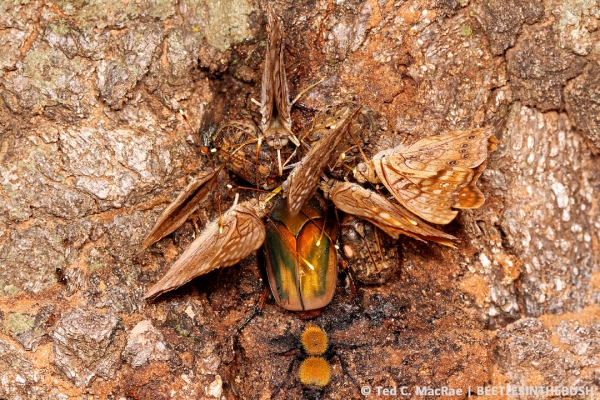
In September 2012 while collecting in western Oklahoma (Weatherford) I came across this interesting scene. It had been exceedingly dry in the area, and because of this few insects were out and about in the small city park that I stopped by to check for the presence of tiger beetles. I had nearly completed my circuit of the park when I came upon a moderate-sized pin oak (Quercus palustris) tree and noticed something on the lower trunk:

Six insect species representing five families in four orders share a sap flow.

Six insect species representing five families in four orders share a sap flow on the trunk of a pin oak.

No less than six insect species representing four orders were seen all huddled together at a darkly stained sap flow. This could be the result of slime flux, a bacterial disease that usually affects deciduous hardwoods that are under stress and results in darkly stained weeps on the trunk that are known to be attractive to a variety of insects. At the center sat a green June beetle (Cotinis nitida) and three bumble flower beetles (Euphoria inda)—all in the family Scarabaeidae (subfamily Cetoniinae). Covering the scarab beetles were half a dozen Texas Tawny Emperor (Asterocampa clyton texana) butterflies (family Nymphalidae, or Brushfooted Butterflies), and milling around the perimeter was a velvet ant (Dasymutilla creusa, I believe) in the family Mutillidae, an apparent flesh fly (family Sarcophagidae), and a true ant (family Formicidae). I guess this would be the equivalent to a watering hole in Africa with a lion, a hyena, a baboon, three vervet monkeys and six zebras all crouched shoulder-to-shoulder at its edge.

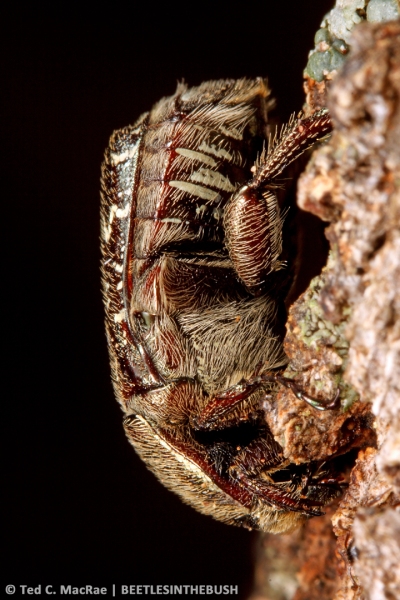
Euphoria sepulchralis feeds on a sap flow higher up on the trunk.

Euphoria sepulchralis feeds on a sap flow higher up on the trunk.

Further up on the trunk, yet another species of scarab beetle, a dark flower scarab (Euphoria sepulchralis) was found feeding on a smaller sap ooze. Unlike the diverse aggregation of insects on the lower ooze, this guy had managed to keep the ooze all to himself.

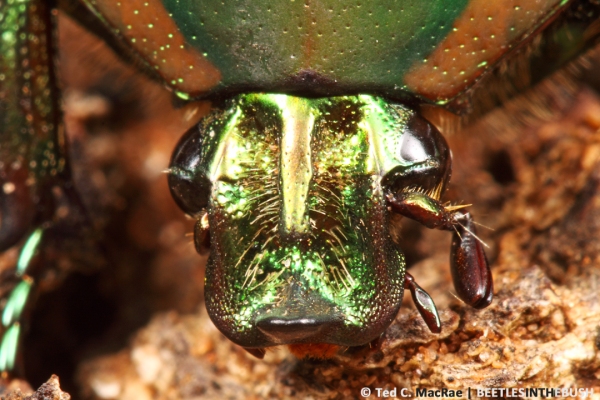
Cotinus nitidus | Weatherford, Oklahoma

Cotinis nitida | Weatherford, Oklahoma

Green June beetles, especially, are known for their feeding on sap oozes. The beetles are actually attracted to the odors caused by fermentation of the sap rather than the sap itself. It has been reported that the presence of alcohol in fermenting sap can affect the behaviour of insects that feed upon it, causing them to act “stupid and lethargic.” I did not see any such behavior, but I did notice that the insects were not at all skittish and loath to leave the sap.

Copyright © Ted C. MacRae 2013

A belated Happy Birthday

It seems that November 24th came and went without me even realizing that BitB turned six years old that day! Six years—wow, has it really been that long? I guess forgetting birthdays officially puts me in the old-timer camp (both as a person and as a blogger). No fanfare or celebration. Instead, I blithely wrote my 778th post (Q: How do you photograph cactus beetles?) and carried on as usual.

I guess it’s too late now to make a big deal of it, but I will make the observation that November 2013, with its 15 posts, was one of my heaviest blogging months ever (the most since 18 posts in December 2012 and the overall high of 21 in April 2010). This may come as a surprise to those who have heard me grouse periodically about the decline of blogging, both of my blog in particular and as a platform in general. It’s a different world than it was when I started BitB—Twitter and Facebook have taken over much of the social interaction that used to take place on blogs, relegating the latter primarily to satisfying a small but persistent niche demand for long-content. Throughout the course of these changes, however, motivation to blog still comes to me consistently and often. Mostly it seems to be an internal need to express myself, but the occasional and very much appreciated feedback in the form of comments and emails also helps. So, with that, thank you for the past six years, and here’s looking at the next six!

Enough blather—here are a few colorful net-winged beetles in the genus Calopteron (family Lycidae) to help with the celebration. They were photographed in northern Argentina (Chaco Province) in April 2012 while visiting flowers of Chilean goldenrod (Solidago chilensis). I’m not sure if they represent more than one species, as the taxonomy of the genus in the Neotropics appears to be very poorly known at this time—if so it would seem there exists in this area a mimicry complex that is ripe for study.

Calopteron sp. on flowers of Solidago chilensis| Chaco Province, Argentina

Calopteron sp. on flowers of Solidago chilensis | Chaco Province, Argentina

Calopteron sp. on flowers of Solidago chilensis| Chaco Province, Argentina

Calopteron sp. on flowers of Solidago chilensis | Chaco Province, Argentina

Calopteron sp. on flowers of Solidago chilensis| Chaco Province, Argentina

Calopteron sp. on flowers of Solidago chilensis | Chaco Province, Argentina

Copyright © Ted C. MacRae 2013

Pedantic Sunday: Blister beetles don’t suck

Nemognatha cribraria cribraria on flower head Chrysothamnus viscidiflorus | Millard Co., Utah

Nemognatha cribraria cribraria on flowers of Chrysothamnus viscidiflorus | Millard Co., Utah

The beetle featured in today’s photo is the blister beetle (family Meloidae), Nemognatha cribraria cribraria. The genus Nemognatha and its relatives in the subfamily Nemognathinae are distinctive due to the greatly elongated adult mouthparts that are modified for feeding on flowers. Specifically, parts of the maxillae, or second pair of mouthparts (behind the mandibles) are elongated to allow access to nectar in flowers with deep corollas, while the fairly standard-issue chewing mandibles are used for feeding on pollen. As pointed out by Enns (1956) in his revision of the North American members of the genus, the length of the maxillae seems to be related to the particular kind of flower preferred for feeding by the various nemognathine species, with species exhibiting longer maxillae adapted to feeding on flowers with deeper corollas. In the photo above, the elongated maxillae can be seen tucked underneath the adult and appear to be nearly half the length of the body—other species in the genus have the maxillae as long as the body, or in the case of a Mexican species (N. chrysomeloides) even longer than the body (Enns 1956).

The proboscis-like mouthparts of nemognathine blister beetles are often depicted in entomological texts as an amazing example of sucking mouthparts in Coleoptera, the vast majority of which possess strictly chewing mouthparts. Borrer et al. 1976, White 1983, Downie & Arnett 1996, and Pinto & Bologna 2002 all mention that the mouthparts are modified into an elongated proboscis for “sucking” nectar, and it has been suggested that nectar uptake occurs through a median food canal, formed by concavities on the inner surfaces when the two structures are locked together into a functional unit. However, Wilhemi & Krenn (2012) used scanning electron microscopy and micro computerized tomography to study the elongated mouthparts of three meloid genera: Nemognatha and Gnathium and Leptopalpus. They demonstrated that neither the elongated galeae of Nemognatha and Gnathium nor the elongated maxillary palpi of Leptopalpus formed a median food canal through which nectar is sucked. Furthermore, the filiform galeae of Nemognatha and Gnathium are densely covered with long bristles, suggesting that nectar uptake in these two genera is accomplished by capillary action along the bristles of the proboscis. In all three genera nectar transport is likely aided by musculature around the mouth.

REFERENCES:

Borrer, D. J., D. M. DeLong & C. A. Triplehorn. 1976. An Introduction to the Study of Insects, Fourth Edition. Holt, Rinehart and Winston, xii + 852 pp.

Downie, N. M. & R. H. Arnett, Jr. (Eds.). 1996. The Beetles of Northeastern North America. Volume II: Polyphaga: Series Bostrichiformia through Curculionoidea. The Sandhill Crane Press, Gainesville, Florida, x + 891–1721.

Enns, W. R. 1956. A revision of the genera Nemognatha, Zonitis, and Pseudozonitis (Coleoptera, Meloidae) in America north of Mexico, with a proposed new genus. The University of Kansas Science Bulletin 37, part 2(17):685–909 [Biodiversity Heritage Library].

Pinto, J. D. & M. A. Bologna. 2002. Chapter 111. Meloidae Gyllenhal 1810, pp. 522–529. In: R. H. Arnett, Jr., et al. (Eds.). American Beetles, Volume 2. CRC Press, Gainesville, xiv + 861 pp.

White, R. E. 1983. A Field Guide to the Beetles of North America. The Peterson Field Guide Series, Houghton Mifflin Co., Boston, xii + 368 pp.

Wilhelmi, A. P. & H. W. Krenn. 2012. Elongated mouthparts of nectar-feeding Meloidae (Coleoptera). Zoomorphology [abstract].

Copyright © Ted C. MacRae 2013

T.G.I.Flyday: Soybean nodule fly

I’ve been walking the rows of soybean fields for many years now, and while it might seem that I would have very quickly seen all there was to see in terms of insects associated with the crop, this is not the case. The major players are almost always present—lepidopteran caterpillars such as velvetbean caterpillar (Anticarsia gemmatalis) and soybean looper (Chrysodeixis includens), and stink bugs such as southern green stink bug (Nezara viridula), red-banded stink bug (Piezodorus guildinii) and brown stink bugs (Euschistus spp.). However, numerous other insects can be found at one time or another—some of great importance from the perspective of the farmer producer but others with very little impact on the crop. During a tour of soybean fields in Mississippi this past September, I saw a large number of “signal flies”¹ (family Platystomatidae) on the foliage of the soybean plants that I presumed to represent the soybean nodule fly, Rivellia quadrifasciata

¹ I originally learned these to be “picture-winged flies”—a name now more commonly used to refer to members of the family Ulidiidae—which I learned as “Otitidae”!

² This species can be separated with certainty from the closely related and largely sympatric species R. colei only by examination of male genitalia (Namba 1956). Rivellia quadrifasciata is more common and widespread than R. colei and is the species cited in literature in association with soybean.

Rivellia quadrifasciata (soybean nodule fly) | Stoneville, Mississipi

Rivellia quadrifasciata (soybean nodule fly) | Stoneville, Mississipi

Rivellia quadrifasciata is widely distributed in the eastern U.S. where it originally fed probably on tick trefoil, Desmodium spp. (Foote et al. 1987), but has since adapted to soybean, Glycines max (Eastman & Wuensche 1977), and black locust, Robinia pseudoacacia (McMichael et al. 1990). Despite its relatively recent adaptation to soybean as a favored host plant, the species does not appear to cause much economic damage to the crop. The small, white, maggot-like larvae live in the soil and feed on the Rhizobium nodules of the roots that are used by the plant for nitrogen-fixation. Soybean, of course, is famous for its compensatory abilities and can withstand considerable nodule injury without yield impact, and as a result losses from this insect are considered minor (Heatherly & Hodges 1998).

Signal flies wave their wings constantly.

The wings of signal flies are almost always in constant motion.

Of more interest from a natural history perspective, these flies—like other members of the Platystomatidae—are almost always seen with their wings in a constant “waving” motion as they walk about on the host leaves. This seems clearly an intraspecific “signaling” behavior (and the source of the family’s common name), with the pattern of markings on the wings and the particular sequence of movements of the wings combining to provide species-specific signals for mate recruitment. Some Asian members of the family are famous for the remarkably elongated eye stalks of the males, which aid in intraspecific male-to-male combat behaviors that provide selection pressure for even more elongate eye stalks. Sadly, our North American species exhibit no such modifications of the head, but their strangely tubular mouthparts do give them the appearance of wearing a “gas mask.”

gas mask

The strangely tubular mouthparts give adults the appearance of wearing a “gas mask.”

Information on the biology of adult platystomatids is limited, but a wide range of adult foods, e.g. nectar, honeydew, plant sap, bird droppings, and carrion, have been reported for this species, and R. quadrifasciata males have been observed to feed females globules of liquid during mating.

REFERENCES:

Eastman, C. E. & A. L. Wuensche. 1977. A new insect damaging nodule of soybeans: Rivellia quadrifasciata (Macquarl). Journal of the Georgia Entomological Society 12:190–199.

Foote, B. A., B. D. Bowker & B. A. McMichael. 1987. Host plants for North American species of Rivellia (Diptera, Platystomatidae). Entomological News 98:135–139 [Biodiversity Heritage].

Heatherly & Hodges. 1998. Soybean Production in the Midsouth. CRC Press LLC, Boca Raton, Florida, 416 pp. [Google Books].

McMichael,  B. A., B. A. Foote & B. D. Bowker, B. D. 1990. Biology of Rivellia melliginis (Diptera: Platystomatidae), a consumer of the nitrogen-fixing root nodules of black locust (Leguminosae). Annals of the Entomological Society of America 83(5):967–974 [abstract].

Namba, R. 1956. A revision of the flies of the genus Rivellia (Otitidae, Diptera) of America north of Mexico. Proceedings of the U.S. National Museum 106:21–84 [Biodiversity Heritage].

Copyright Ted C. MacRae 2013

One-shot Wednesday: Hawk moths suck!

Hyles lineata nectaring at flowers of Ericameria nauseosa | San Juan Co., Utah

Hyles lineata nectaring at flowers of Ericameria nauseosa | San Juan Co., Utah

I admit it—I give short shrift to Lepidoptera compared to other groups of insects. This is not because I don’t think they deserve attention; they are a stunning group with an amazing suite of adaptations to life on earth. It’s just that they already receive a lot of attention from others, while so many other equally amazing groups of insects remain almost completely unknown and under-appreciated due to the sole fact that they are smaller and less conspicuous. I’m not anti-Lepidoptera; I’m just pro-other Insecta. Every now and then, however, I must give Lepidoptera their due, and since today is Wednesday it’s a good day to feature a hawk moth that I got but a single photograph of on my late August Great Basin collecting trip.

Hyles lineata is not a particularly rare insect—in fact, it is one of the most common and widespread species of hawk moth (family Sphingidae) in North America. What is hard to come by, however, is a good shot of an adult nectaring at a flower. While such shots abound, most feature busy backgrounds and blurred wings. My photo is no different. However, I am a coleopterist, and when I took this shot there were also longhorned beetles present on the same flowers—it could be considered remarkable that I even diverted my attention long enough to attempt a shot. Of course, hawk moths are amazing creatures that have independently arrived at the same flight abilities and feeding habits as the equally amazing but taxonomically distant hummingbirds with their ability to hover motionless while sipping nectar and beating their wings at blinding frequencies. With little time to practice and even less to optimize settings, I’m amazed that I even got an adequate photograph before the moth zipped off to another bush. Yes, hawk moths suck, and that is amazing!

Copyright © Ted C. MacRae 2013