The Darwin Beetle

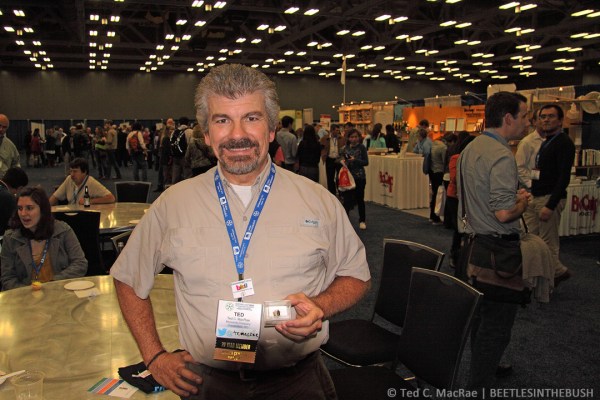
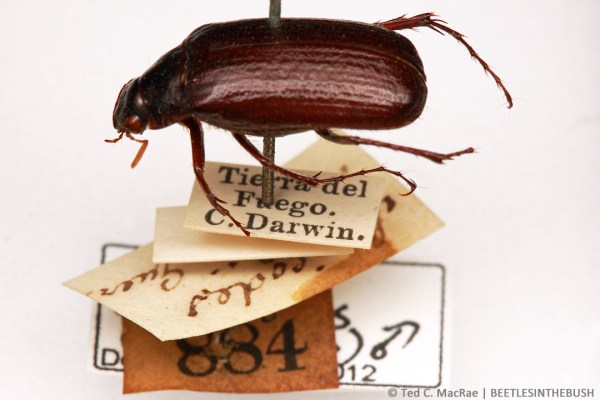
Like most modern biologists, Charles Darwin ranks high on my short list of intellectual/entomological heroes. Actually, with all due respect to others on the list—Carl Linnaeus, Alfred Russell Wallace, John Lawrence LeConte, and others, Darwin sits at . His theory of evolution, offered more than 150 years ago to a powerfully skeptical world, continues to provide the basic framework for modern biology (as Theodosius Dobzhansky said in his 1973 paper in American Biology Teacher, “Nothing in biology makes sense except in the light of evolution”). Thus, when Max Barclay recently posted on Facebook a photograph of a beetle collected by Charles Darwin himself, it reminded me that I have yet to visit Down House in Kent (the home of Charles Darwin) or to see anything personally touched by the man whose legacy I revere more than any other. Little did I know that Max did not post the photo from The Natural History Museum in London, but from Austin, Texas where he and I were each arriving for the annual meetings of the Entomological Society of America. When I commented on his post how I would love to see a beetle collected by Darwin someday, Max replied that he had the specimen with him and that he would bring it to the meetings for me to see (and I quote, “Most fun it has had since it flew to 22-year-old Charles Darwin’s gas lamp in Tierra Del Fuego in December 1832”). Can you imagine my anticipation?! True to his word, Max found me at the opening reception, came up from behind me, and placed  the plastic, see-through box housing the specimen on the table in front of me. I recognized it instantly, but still seeing “C. Darwin” on the label almost felt like I’d just met the man himself. I asked Max if it was okay to open the box, to which he agreed, and I even dared to grab the pin head and re-position the specimen for photographs. Call me crazy, but it was as spiritual an experience as I’ve had since, well… “Mrs. Ples” stood before me!

At any rate, here is the “Darwin Beetle,” followed by proof that I really got to hold it!

Sericoides glacialis (Fabricius), collected at Tierro del Fuego in 1832 by Charles Darwin.

Scarab beetle collected at Tierro del Fuego in 1832 by Charles Darwin. Identified as Sericoides glacialis (Fabricius) by Andrew B. T. Smith in 2012 after standing for many years as ‘Sericodes Reichii Guer.’

Holding the ''Darwin Beetle''

Holding the ”Darwin Beetle”

Copyright © Ted C. MacRae 2013

Midget male meloid mates with mega mama

Pyrota bilineata on flowers of Chrysothamnus viscidflorus | San Juan Co., Utah

Pyrota bilineata on flowers of Chrysothamnus viscidflorus | San Juan Co., Utah

While looking for longhorned beetles in the genus Crossidius on flowers of yellow rabbitbrush (Chrysothamnus viscidiflorus) in southern Utah, I encountered one particular plant with numerous blister beetles (family Meloidae) on its blossoms. The orange color, two black pronotal spots, and distinctive black and white longitudinal elytral stripes leave no doubt as to its identity—Pyrota bilineata, but for good measure I sent a photo to my field mate for the trip, Jeff Huether, who confirmed its identity. I had seen singletons of this species at a few previous localities during the trip, so I was intrigued by the large numbers of individuals congregated on this single plant. As I looked at them, I saw one individual that appeared to have something stuck to the tip of its abdomen. I peered closer to get a better look and, to my surprise, discovered that it was actually a male in the act of mating. The male was tiny, only one-third the size of the female, representing about as extreme a size difference in mating insects as I’ve ever seen.

Pyrota bilineata on flowers of Chrysothamnus viscidflorus | San Juan Co., Utah

A tiny male mates with the ginormous female.

Many species of blister beetles exhibit tremendous size variability, and a unique aspect of some species’ mating behavior is the cantharidin-packed spermatophore produced by males and transferred to females during mating. (Cantharidin is a toxic defensive compound that serves as a very effective deterrent to predation.) The spermatophores are energetically “expensive” to produce and are transferred to females during relatively short-lived mating aggregations. Mating in some species may take up to 24–48 hours, thus reducing the opportunities for multiple matings, and as a result males of long-mated species end up investing rather heavily in a limited number of females compared to males that mate more often. These features lead to size assortative mating (Alcock & Hanley 1987), with males showing a preference for larger females (that are presumably more fecund) and females preferring larger males to maximize the amount of cantharidin that they receive or to ensure receipt of a spermatophore large enough to fertilize their full complement of eggs. Medium-sized individuals, likewise, would choose the largest of the remaining individuals, leaving the smallest individuals to mate among themselves. Alcock & Hanley (1987) also note, however, that not all species of blister beetles exhibit size assortative mating, even though they form large mating aggregations and individuals vary greatly in size. I have not seen any reference to size assortative mating in Pyrota bilineata; however, this example seems to suggest that the behavior is not practiced by this species. This could be due to shorter mating times (leading to more opportunities for mating) or a range of variation in body size that is not sufficient to consistently favor the behavior.

REFERENCE:

Alcock, J. & N. F. Hadley. 1987. Assortative Mating by Size: A Comparison of Two Meloid Beetles (Coleoptera: Meloidae). Journal of the Kansas Entomological Society 60(1):41–50 [preview].

Copyright © Ted C. MacRae 2013

One-shot Wednesday: The “other” hibiscus jewel beetle

Paragrilus tenuis | Stoddard Co., Missouri

Paragrilus tenuis (LeConte) | Stoddard Co., Missouri

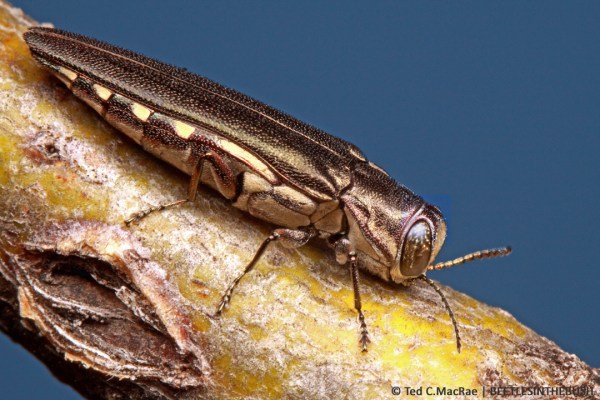
This past summer I visited Otter Slough Conservation Area in southeast Missouri in an effort to find and photograph the stunningly beautiful Agrilus concinnus Horn, or “hibiscus jewel beetle” (MacRae 2004). I was not successful in that quest, but I did manage to snap a single photo of another jewel beetle also associated exclusively with hibiscus, Paragrilus tenuis (LeConte). This species belongs to a much smaller genus of mostly Neotropical jewel beetles that resemble the related and much more speciose genus Agrilus but differ significantly by their antennae being received in grooves along the sides of the pronotum and, for the most part, their association as larvae with stems of living, herbaceous plants rather than dead branches and twigs of deciduous trees. Only four species of Paragrilus occur in the U.S. (Hespenheide 2002), and of these only Ptenuis is known to occur in the eastern U.S. where it has been reported breeding in Hibiscus moscheutos (including ssp. lasiocarpos). I have also collected adults on H. laevis (MacRae 2006), but to my knowledge it has not yet been reared from that plant.

These tiny little beetles (~ 5 mm in length) are normally seen resting on the terminal leaves of their host plants, but they are extremely wary and quick to take flight. As a result, photographing them in situ with a short macro lens in the heat of the day is rather challenging, especially when they are not numerous. I only saw perhaps half a dozen individuals during the visit, and the photo shown here represents the only shot that I even managed to fire off. While I would have liked to have gotten a dorsal view of the beetle, this single shot is nevertheless well-focused and a rather interesting composition.

REFERENCES:

Hespenheide, H. A. 2002. A review of North and Central American Paragrilus Saunders, 1871 (Coleoptera: Buprestidae: Agrilinae). Zootaxa 43:1–28 [pdf].

MacRae, T. C. 2004. Beetle bits: Hunting the elusive “hibiscus jewel beetle”. Nature Notes, Journal of the Webster Groves Nature Study Society 76(5):4–5 [pdf].

MacRae, T. C. 2006. Distributional and biological notes on North American Buprestidae (Coleoptera), with comments on variation in Anthaxia (Haplanthaxiaviridicornis (Say) and A. (H.) viridfrons Gory. The Pan-Pacific Entomologist 82(2):166–199 [pdf].

Copyright © Ted C. MacRae 2013

Honey Locust Borer

Agrilus difficilis | Beaver Dunes State Park, Beaver Co., Oklahoma

Agrilus difficilis | Beaver Dunes State Park, Beaver Co., Oklahoma

Conditions for collecting didn’t look very promising when I awoke on Day 4 of my early June trip to northwestern Oklahoma. After collecting at Alabaster Caverns State Park the previous day, I had traveled a few hours further west during the evening with plans to collect at Beaver Dunes State Park the following morning. However, heavy rain during the night and lingering sprinkles during the morning had me thinking it might be a lost day. By noon, however, the rain had completely abated, and though the sky still hung low and gray I decided I had nothing to lose by at least trying. I knew quickly that I’d made the right decision, as within minutes of arriving at the park I began seeing jewel beetles (family Buprestidae) landing on my beating sheet. Hackberry (Celtis sp.) was abundant along the roadways and supporting great numbers of individuals in the genera Chrysobothris and Agrilus.

This species is associated almost exclusively with honey locust (Gleditsia triacanthos).

This species is associated almost exclusively with honey locust (Gleditsia triacanthos).

By the time I reached the back end of the campground, I’d collected rather large series of the hackberry associates when I noticed a dying honey locust (Gleditsia triacanthos) tree in one of the campsites. Honey locust (and fabaceous trees, in general) is favored by several species of jewel beetles—at least a dozen species have been recorded in the literature reared from its branches, and another dozen species have been collected on it as adults. As a result, when jewel beetles are active it’s always a good bet that some will be found on honey locust when present, especially if the trees are stressed or dying. I walked up to the tree—a fairly large one—and scanned the lower branches overhead to see if I could notice any activity. I did not, but I nevertheless placed my beating sheet underneath one of the branches, gave the branch a quick “whack” with the handle of my net, and lowered the beating sheet to have a look. To my surprise, I saw at least 50 adults of the jewel beetle species, Agrilus difficilis, sitting on the beating sheet. Because of the cloudy conditions and cool, moist air, the beetles were not very active and did not immediately zip off the beating sheet as they would have had the day been sunnier and warmer, so I was able to rather easily collect a decent series of the beetles without any trouble. I had never seen the beetles so numerous, however, so I continued to beat a few more branches—each yielding just as many adults as the previous. I was astonished by the fact that the beetles were so abundant on the branch, yet I had not seen them even when I specifically looked for the presence of jewel beetles in the branches prior to beating them. Taking another look at the branches, I was able to visually detect just a few individuals, and those only with great difficulty, until I pulled the branch down and was able to look at it up close.

Relatively large size, coppery-purple color without spots on the elytra, and the presence of lateral white patches distinguish this species.

Large size, coppery color, no spots on elytra, and presence of lateral white patches distinguish this species.

Honey locust became a rather popular landscape ornamental tree in the eastern U.S. after the development of thornless cultivars, and while at first the tree seemed to be relatively free of insect pests, A, difficilis has proven to be one of several insects that have adapted to these landscape plants and occasionally cause economic damage. Trees in urban landscapes are often planted in suboptimal sites and suffer from stress to a much greater degree than their native counterparts, and the beetles take advantage of the lowered defensive capabilities of these stressed trees to gain entry. Larvae mine beneath the bark and damage the cambium layer, interfering with movement of water and nutrients. Trees in later stages of attack usually exhibit branch dieback and D-shaped holes in the trunk and main branches where adults have emerged from the tree. In severe cases infestation by this species can result in death of the tree. As mentioned above, there are twelve other species of jewel beetles that have been reared from the wood of honey locust. All of these have been reared only from dead wood rather than living trees, but adults of these species might, nevertheless, be encountered on living trees. They include three species (A. egeniformisA. fallax, and A. pseudofallax) that might be confused with A. difficilis; however, the latter is easily distinguished from these and other congeners by its relatively large size, coppery color with purple luster, absence of any spots or pubescent lines on the elytra, and distinctive patches of white pubescence along the sides. As with most wood boring beetles, chemical control of the adults or larvae is usually not feasible once an infestation has already begun—the best method to avoid infestations in landscape trees is proper site selection and optimal care to prevent stress that reduces the ability of the tree to fend off attack.

Copyright © Ted C. MacRae 2013
How to pack and ship pinned insect specimens

Even though I don’t work in a museum, sending and receiving pinned insects is a routine activity for me. As a collector of beetles with some expertise in their identification, I’ve had opportunity to exchange with or provide IDs to other collectors from around the world. Of course, the extreme fragility of dried, pinned insect specimens makes them vulnerable to damage during shipment, especially when shipped overseas. While properly labeled, pinned insect specimens have no monetary value, the scientific information they represent is priceless, and every attempt should be made to protect them from damage during shipment. Sadly, despite our best efforts damage is sometimes unavoidable, as even packages marked “Fragile” can be subject to rough or careless handling. More often than not, however, I have received shipments in which the contents suffered damage that could have been avoided had the sender paid more attention to packing the shipment in a manner that gave it the best possible chance of arriving safely. Here I offer some general tips on the best way to pack and ship pinned insect specimens for shipment. While these remarks are broadly applicable to pinned insects in general, they are given from the perspective of a someone who collects beetles—specimens of which are relatively small to moderate in size, hard-bodied, and compact in form. Insects from other groups, especially those with large, fragile species such as Lepidoptera and Orthoptera, may require additional precautions to minimize the risk of damage.

  1. Select a sturdy specimen box with a firm pinning bottom. The size of the box should be selected appropriate for the number of specimens—i.e., do not select a large box for only a few specimens or tightly pack too many specimens in too small a box,  Modern polyethylene foams used in pinning trays seem sufficiently firm to hold pinned specimens during shipment as long as they are at least ¼” thick—thicker foams, of course, will hold even more firmly but often “push” the labels on the pinned specimens up against each other, necessitating additional labor to reset them. The box should have a tight-fitting lid that can be set firmly in place. Pin the specimens into the box, making sure the pins are set completely through the foam and taking care not to overpack the specimens within the box too tightly (body parts, especially antennae and tarsi, should never overlap) that could result in damage to them or adjacent specimens during removal. Ideally the specimens should fill the box completely, but if they do not then fill the empty space with blank pins to avoid large, blank areas of foam bottom without pins. Here is an example of a filled specimen box:

    Pinned insects in specimen box ready for packing.

    Pinned insects in specimen box ready for packing.

  2. Use brace pins for large or heavy specimens. This is one of the most common mistakes I see! In the example above, several of the larger species are surrounded by brace pins to keep them from rotating on their pins and damaging neighboring specimens. At least two pins should be used—I place them against the elytra on each side behind the hind legs, and very long or heavy specimens should be further braced by additional pins on each side of the thorax to further ensure they are fully immobilized. Although not shown in this example, specimens with very heavy heads (large mandibles, etc.) should be even further immobilized with additional pins at the head. Here is a closeup view of some of the specimens in the above box that have been further secured with brace pins:

    Large specimens are further immobilized with brace pins.

    Large specimens are further immobilized with brace pins.

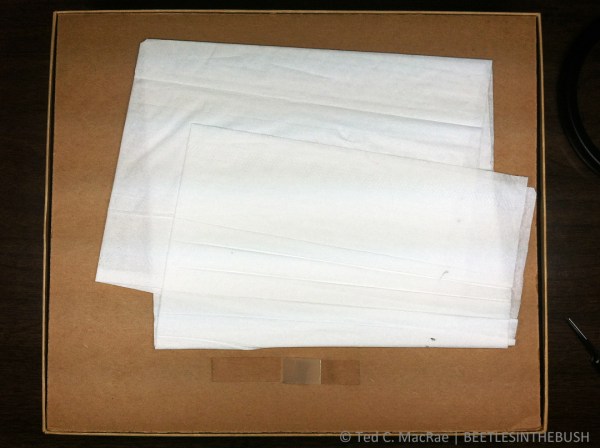
  3. Use an inner lid with padding to hold it firmly against the specimens. An inner lid lies on top of the specimens underneath the specimen box lid to keep the specimens securely seated in the foam and prevent them from “working” their way out. Some specimen boxes designed for shipping, such as the examples shown in these photos, come with an inner lid that is hinged on a long side. If the specimen box lacks an inner lid, one should be fashioned from cardboard or heavy card stock. The advantage of an attached inner lid is that it will not move inside the box, so if an inner lid must be fashioned it is essential to trim it so that it fits precisely within the box to minimize the potential for movement. I like to draw an outline on the cardboard with the specimen box and cut on the lines, then shave off extra material from each side to shape it to the inside perimeter of the box. Either way, make a “pull tab” out of adhesive tape and attach it to the inner lid to allow easy removal during unpacking. If the inner lid when set in place does not seat firmly against the outer lid, extra padding material such as paper towels should be placed on top of the inner lid to ensure that it sits firmly against the specimens when the outer lid is set in place. The specimen box with inner lid in place, pull tab attached, and extra padding placed on top is shown below:

    Cover the inner lid with padding to secure it firmly against the specimens.

    Cover the inner lid with padding to secure it firmly against the specimens.

  4. Seal closed specimen box with tape or rubber bands. The outer lid of the specimen box should be secured in place so that it does not “work” its way loose. Some people use tape, which is effective but must be cut if the box is opened for inspection, leaving the lid unsecured afterwards. I prefer to use sturdy rubber bands, which can be removed for inspection and then easily replaced afterwards. Some specimen boxes come equipped with metal tabs or hoops that fit through slots on the outer lid and that can be bent over to secure the lid in place. In my experience, these often break off after repeated use, so rubber bands or tape are a good insurance policy for such boxes. Another common practice is to wrap specimen boxes in packing paper or place them inside plastic, Zip-Lock bags. This was necessary in the days when excelsior shavings were often used as a packing material around the specimen box, which contained shavings that could work their way into the specimen box and cause damage. With the ready availability of modern packing materials such as foam peanuts there should no longer be any reason to use excelsior shavings. Still, wrapping or sealing inside a plastic bag can’t hurt if it is desired. A closed specimen box with rubber bands securely in place is shown in the photo below:

    Specimen box sealed with rubber bands

    Specimen box sealed with rubber bands

  5. Place an address label on the specimen box. This will ensure that the shipment does not get tossed into the “dead mail” pile if the outer address label is lost or destroyed (I’ve left the label off in these examples to ensure privacy of the recipient).
  6. Secure multiple specimen boxes tightly together. If multiple specimen boxes are shipped together, they should be secured tightly together so that they cannot “bump” into each other during shipment. As mentioned before, tape works but might end up being cut for inspection, so I prefer to use large rubber bands. String can also be used to tie the boxes together, but unless the inspection agent is handy with knots the boxes may not get tied back together. The two specimen boxes included in the shipment I used for this example, secured tightly together, are shown below:

    Multiple boxes should be bound tightly together.

    Multiple boxes should be bound tightly together.

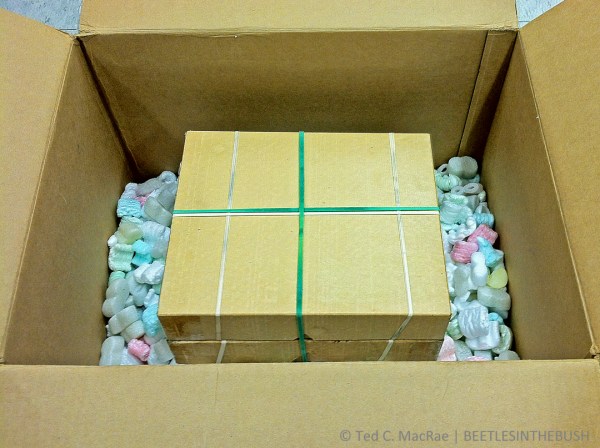
  7. Pack specimen box inside an oversized shipping boxShipping box size selection is critical! The shipping box should not only be sturdy but also big enough to accommodate specimen boxes with at least 3–4 inches below and 2–3 inches on top and each side of the specimen box. This space is necessary to allow the packing material to function not only as cushioning but also in “shock absorption.” My preferred packing material is foam peanuts, since it doesn’t settle during shipment and the amount used can be tailored precisely to the needs of an individual box. The photo below shows the pinning boxes resting on a 4-inch layer of foam peanuts with at least 2–3 inches of space on the sides and above:

    Place specimen boxes inside a sturdy shipping box with plenty of room on all sides.

    Place specimen boxes inside a sturdy shipping box with plenty of room on all sides.

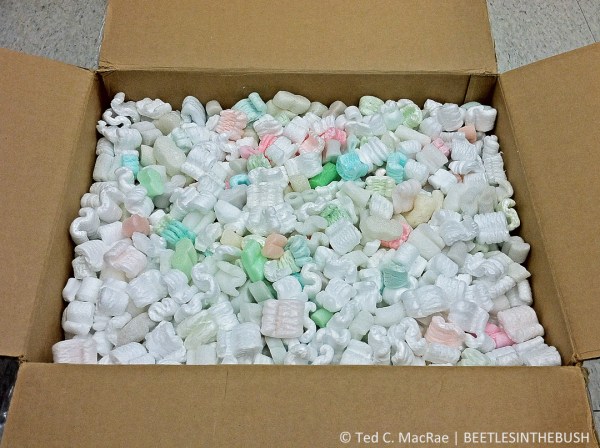
  8. DO NOT OVERPACK! This is the most common mistake people make! The packing material needs to serve two purposes: 1) provide a crush zone to protect from direct damage, and 2) provide shock absorption to protect from damage by impact jarring. The specimen box actually needs to be able to move slightly within the closed shipping box. If it cannot, energy from impacts is transmitted in full to the specimens inside, greatly increasing the risk that heavier body parts (especially the head/pronotum) will be jarred off the specimens. This not only results in damage to the broken specimen, but the dislodged body parts then act as “wrecking balls” that bounce and tumble inside the specimen box, destroying all of the specimens within their reach. After placing a 3–4-inch layer of packing in the bottom of the shipping box, I like to set the specimen box(es) on top of the foam in the center of the shipping box and fill the shipping box with additional foam peanuts to within about 1″ of the top. Avoid the temptation to fill the box to the brim, or to “settle” the foam peanuts and add a few more, as this will result in a tightly packed box that does not protect the specimens as well as a more loosely packed box. To test, close the flaps on top of the box and give the box a light up-and-down “shake”—you should feel the specimen box bounce slightly inside. If it does not, remove a small amount of packing peanuts and repeat the test. If you cannot remove enough packing peanuts without exposing the top of the specimen box inside, your shipping box is too small and you should select a larger size. The photo below shows the shipping box filled with packing peanuts to the proper level:

    Shipping box ''almost'' filled with packing material.

    Shipping box ”almost” filled with packing material.

  9. Label the package “FRAGILE”. Whether this is actually helpful or invites abuse by some passive aggressive handler is a matter of debate, but I am of the opinion that a majority of shipping personnel will actually treat the package with a little more respect if they see this label, especially with the disclosure that the contents are preserved insects with no commercial but extreme scientific value. Additionally, disclosure of such information may actually be required by some destination countries, so it’s a good idea to label packages as a matter of routine practice. I like to place one label on top of the shipping box and additional labels on all four sides. BioQuip Products sells moisture-activated adhesive labels as shown below, or similar labels can be designed in a word processing program and printed on blank adhesive labels; however, the latter should be covered with clear tape to prevent them from peeling off of the shipping box during transit.

    Place a fragile sticker on top and all four sides.

    Place a fragile sticker on top and all four sides.

Much of what I have written here I learned as a graduate student, based on a much more detailed article by Sabrosky (1971) that provides additional suggestions for extremely rare and valuable specimens, advice regarding the different postal classes available for international shipments, and a list of “Don’ts” under any circumstances.

Disclaimer: I am an amateur—albeit a highly practiced one, and there may be additional suggestions or advice from professional collection managers and museum curators that would be highly welcomed in the comments below  should it be offered.

REFERENCE:

Sabrosky, C. W. 1971. Packing and shipping pinned insects. Bulletin of the Entomological Society of America 17(1):6–8 [preview].

Copyright © Ted C. MacRae 2013
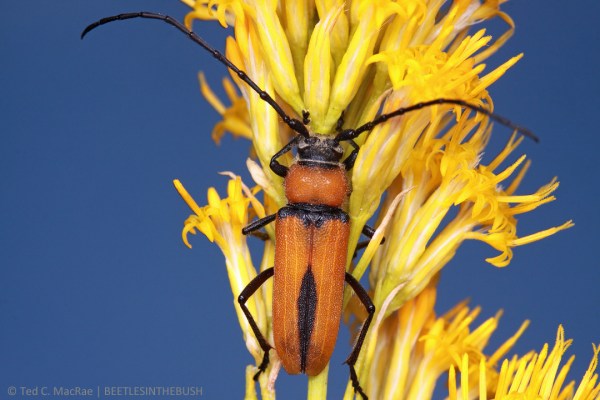
GBCT Beetle #5: Crossidius coralinus monoensis

Crossidius coralinus monoensis (male) | Mono Co., California

Crossidius coralinus monoensis (male) | Mono Co., California

After spending the first four days of our Great Basin Collecting Trip (GBCT) traveling around west-central Nevada, we dropped down into California and traveled south next to the eastern flank of the Sierra Nevada towards Mono Basin. We had two goals for the day: 1) a very localized population of Crossidius hirtipes known from “Kennedy Meadow” and described originally by Chemsak & Linsley (1959) as C. rhodopus flavescens but transferred to a subspecies of C. hirtipes in their revision of the genus (Linsley & Chemsak 1961), and 2) the stunningly beautiful C. coralinus monoensis! Before reaching the first destination, we were temporarily distracted by the inviting shores of Topaz Lake just after crossing the Nevada/California state line, where we found only a few extremely wary Cicindela oregona oregona darting across its muddy banks. We then spent a good portion of the day in a futile attempt to find C. h. flavescens—one of only two Crossidius subspecies we did not find out of the 16 species/subspecies that we had targeted for the trip. Our failure to find this subspecies was largely a consequence of going to “Kennedy Meadows” in Tuolumne Co. rather than “Kennedy Meadow” further to the south in Tulare Co.! (Note to self: pay attention not only to the name of the locality but also the county!)

Crossidius coralinus monoensis (female) | Mono Co., California

Crossidius coralinus monoensis (female) | Mono Co., California

As a consequence of the day’s distractions and diversions, we didn’t arrive at the C. coralinus monoensis locality until quite late in the day. Fortunately, we were looking for a C. coralinus subspecies rather than a C. hirtipes subspecies, as the latter seem to have the habit of retreating down from the flower heads of their host plants starting around 5 p.m. and not coming back up until mid-morning the following day. Crossidius coralinus subspecies, on the other hand, seem to stay put on the flower heads through the night, perhaps burying themselves inside the flower heads but not retreating down from the plant. As a result, they may still be found during the late afternoon and early evening hours. Because of this, we still had a chance of finding them (if they were there) despite our late arrival, and only a few minutes passed before I found a male (first photo) on flowers of gray rabbitbrush (Ericameria nauseosa). The appearance was so strikingly different that I wasn’t even sure what I had found at first—I knew it wasn’t a C. hirtipes subspecies, but the bright orange coloration and relatively smaller size were quite different from the larger, red/black C. coralinus subspecies that I had seen to that point. Once I found a female, however (second photo), I realized that we had found C. coralinus monoensis.

Mono Basin near Mammoth Lakes (7000 ft)—locality for Crossidius coralinus monoensis

Mono Basin near Mammoth Lakes (7000 ft)—locality for Crossidius coralinus monoensis

This subspecies is immediately distinguishable from the C. c. temprans we were collecting further north in Nevada (and, in fact, most other C. coralinus subspecies) by its bright orange rather than dark red coloration. We found only a handful of individuals (as we did two days later when we passed by the site again), and their average size was considerably smaller than the former as well. The subspecies does greatly resemble C. c. caeruleipennis, found still further south at much lower elevations in Owen’s Valley (and a target for the following day) but differs by its smaller average size and presence of distinctly expanded black elytral markings and apical and basal black pronotal bands.

REFERENCES:

Chemsak, J. A. & E. G. Linsley. 1959. Descriptions of some new Cerambycidae from Mexico and southwestern United States. Journal of the Kansas Entomological Society 32(3):111–114 [preview].

Linsley, E. G. & J. A. Chemsak. 1961. A distributional and taxonomic study of the genus Crossidius (Coleoptera, Cerambycidae). Miscellaneous Publications of the Entomological Society of America 3(2):25–64 + 3 color plates.

Copyright © Ted C. MacRae 2013

The Festive Tiger Beetle in Southeast Missouri

Cicindela scutellaris lecontei x s. unicolor

Cicindela scutellaris lecontei x scutellaris unicolor (male) | Holly Ridge Conservation Area, Missouri

This past spring I returned to the lowlands of southeastern Missouri in an effort to find and photograph a population of tiger beetles that seems to be unique to the area. The beetles represent Cicindela scutellaris (Festive Tiger Beetle), a widespread species that is common in dry sand habitats across the central and eastern U.S. It is also one of North America’s most polytopic species, with populations in the Great Plains, eastern U.S., Atlantic Coast, southeastern Coastal Plain, and several isolated populations on the western and southwestern peripheries of the species’ range of distribution recognized as distinct subspecies. In Missouri the species is known only from the extreme northwestern, northeastern, and southeastern corners of the state. In all of these areas the populations are found on alluvial sand deposits associated with the Missouri and Mississippi Rivers. Additional sand deposits are found in the areas between these three widely disjunct areas, but curiously the species has not yet been found in them, despite the presence of other species that occupy these same habitats such as Cicindela formosa (Big Sand Tiger Beetle).

Cicindela scutellaris lecontei x s. unicolor

Cicindela scutellaris lecontei x scutellaris unicolor (male) | Holly Ridge Conservation Area, Missouri

The populations in northern Missouri fall well within the distributional range of subspecies C. s. lecontei and are readily assignable to that taxon based on their wine-red coloration and well developed elytral markings. The population in southeastern Missouri, however, cannot be assigned either to that subspecies or to the more southern subspecies C. s. unicolor, which occurs along the southeastern U.S. Coastal Plain and is characterized by solid green coloration and no elytral markings. Individuals from southeastern Missouri are typically green, as in C. s. unicolor, but usually exhibit a distinct wine overtone from C. s. lecontei that varies greatly in its degree of development. Like C. s. lecontei, the elytra are usually marked, but never as strongly as in C. s. lecontei and sometimes not at all (as in C. s. unicolor). The two individuals shown in these photos represent the typical condition—wine blushing and elytral markings only moderately developed; however, more extreme examples can be seen in photos from fall 2008 and spring 2009 (taken during my “point-and-shoot” days, which explains my desire to photograph these beetles again). The intergradation of characters, their variable development, and the apparent presence of a wide disjunction zone between this population and C. s. lecontei to the north suggest to me that it originated from a relatively recent hybridization event between C. s. lecontei and C. s. unicolor—perhaps during the post-glacial hypsithermal that ended some 5,000 years ago.

Cicindela scutellaris lecontei x s. unicolor

Cicindela scutellaris lecontei x scutellaris unicolor (female) | Sand Prairie Conservation Area, Missouri

While I am happier with these photos than I am with those taken earlier, they don’t represent either the full range of variability seen in the population or the most aesthetically pleasing tiger beetle photographs I’ve ever taken. I made two trips to the southeast this past spring, and on each trip I was successful in finding and photographing only a single, very skittish individual—one on a sandy trail through upland forest (Holly Ridge Conservation Area) and the other along the margin of a sand blowout in a native sand prairie remnant (Sand Prairie Conservation Area). I’ll try again this coming spring and hopefully will be able to show some better photographs.

p.s. Can you tell the difference in the type of flash diffuser I used between these two trips? If so, which one do you like better?

Copyright © Ted C. MacRae 2013

INHS Seminar: Tiger Beetles of Missouri

If you are in the Champaign, Illinois area on Tuesday, 29 October 2013, I will be giving a seminar as part of the Illinois Natural History Survey Fall 2013 Seminar Series. I hope to see you there!

My thanks to Dr. Sam Heads for extending to me the invitation and to Jennifer Mui for preparing the very nice poster and attending to travel details.

INHS-Seminar-MacRae_2013-10-29
Copyright © Ted C. MacRae 2013