Friday Editor’s Tip: Lose the formatting!

As Managing Editor of The Pan-Pacific Entomologist, I have the privilege of guiding manuscripts through the entire publication process—from submission and review through acceptance and preparation for final printing. It’s gratifying to see the results of a researcher’s efforts come to fruition, and it is also a good time to be an editor—due in no small part to the plethora of digital tools we have at our disposal. Knowing the amount of effort required to be an editor in today’s environment, I can’t imagine fulfilling the role in pre-computer days when manuscripts were prepared on a typewriter, submitted as hard copy, mailed to reviewers, collated upon their return (after interpreting hand-scribbled reviewer notations), and mailed back to authors for retyping. My heartiest congratulations to and respect for anyone who served as an editor in those days!

One of the holdovers from those days is the use of double-spaced text and numbered lines in draft manuscripts. This was necessary back then to provide space for reviewer comments and facilitate quick reference to specific portions of the manuscript. Of course, most journals today utilize fully electronic processes for submitting and reviewing manuscripts, and in some cases (including The Pan-Pacific Entomologist) a hard copy version of the manuscript may never be produced until the journal itself is issued. While the ability of reviewers to directly insert comments and suggested edits into an electronic version of the manuscript obviates the need to include line spacing and numbers, some authors still find themselves in the habit of preparing their manuscripts with such format. A bigger issue, however, brought on by the change from manual to electronic manuscript preparation is the temptation by some authors to overly “format” their manuscripts. Modern word processing programs (e.g., Microsoft Word) make it easier than ever to give documents visual appeal when printed, and most authors thus find themselves wanting to apply at least some formatting to their manuscripts. Indeed, some even go so far as to format their manuscript so that it closely resembles the printed journal! The problem is that most printers utilize file conversion software that automatically applies formatting according to a journal’s style sheet. Formatting commands used by word processing programs often interfere with those used by file conversion software, thus, to avoid conflicts any formatting applied to a draft manuscript must be stripped out prior to file conversion. The more of this that is done by the author prior to submission, the less potential for errors during printing. Unfortunately, just as secretaries don’t often make very good scientists, many scientists wouldn’t make good secretaries and find the prospect of “cleaning” an overly formatted manuscript more intimidating than it really is. Accordingly, I offer here this little “cheat sheet” for those who would like help in making sure their manuscript is clean prior to submission. These tips assume the use of Microsoft Word (since its file formats are acceptable for submission to The Pan-Pacific Entomologist), but a similar process should be possible with most other word processing programs.

Step 1. Select the entire document by pressing “Ctrl+A”.

Step 2. Click on “Home” in the menu ribbon and open the “Paragraph” dialogue box.

Step 3. Click on the “Indents and Spacing” tab. Set all of the commands as shown in the figure below.

Step 4. Click on the “Line and Page Breaks” tab. Set all of the commands as shown in the figure below and click “OK”.

Step 5. Open the “Font” dialogue box (also under “Home” in the menu ribbon). Set all of the commands as shown in the figure below and click “OK”.

Step 6. Click on “Page Layout” in the menu ribbon and open the “Page Setup” dialogue box.

Step 7. Click on the “Margins” tab. Set all of the commands as shown in the figure below and click “OK”.

Voila! Your manuscript is free of all extraneous formatting commands and is ready for submission (assuming its contents are complete and well written). If there are portions of text that simply must be formatted (e.g., italics for scientific names) those can be reapplied. Of course, my best advice is to ensure the manuscript contains the above settings before it is even started. This not only ensures that formatting is limited to text that must be formatted, but also that the author will not need to spend additional time stripping out unneeded formatting during the preparation of final files for printing.

Copyright © Ted C. MacRae 2012

Book Announcement: Field Guide to the Jewel Beetles (Coleoptera: Buprestidae) of Northeastern North America

It’s not often that I anticipate the release of a book as much as I have with the soon-to-be-released Field Guide to the Jewel Beetles (Coleoptera: Buprestidae) of Northeastern North America. Fortunately, the wait is now almost over—Morgan Jackson, author of Biodiversity in Focus and co-author of the book, has just announced its planned released in early 2013. Even better, he has provided a sneak peak at its contents that is as smartly designed as the book itself.

Obviously, as a serious student of the family Buprestidae, this book would make it into my bookshelf no matter what, and I plan to do a more detailed review of the book once I have a copy permanently in my hands. However, I can tell you that I am already very impressed with the design of the book and the quality of the product. I was fortunate to meet up with Morgan at last month’s Entomological Society of America meetings in Knoxville, Tennessee, and Morgan kindly allowed me to leaf through the carefully guarded copy he had with him (it was difficult handing it back to him). The Prezi preview for the book covers some of the more important features that will set this book apart from other field guides, but worthy of special mention are: 1) the minimum/maximum size silhouette figure in the upper left-hand corner of each species treatment—a tremendously useful feature, 2) inclusion of the both the author and date of the original description of the species (to keep us more taxonomically inclined happy), 3) super high quality dorsal and lateral habitus photographs and of additional key features to aid in identification, 4) geographical range maps coded to show both presumed and recorded ranges, and 5) keys to all treated species, richly augmented with high quality photographs.

There is another reason I am so excited about this book, and that is the authors chose my photograph of Buprestis rufipes (red-legged buprestis), one of North America’s most striking jewel beetle species, to grace the cover of the book. I also provided specimens of a number of uncommonly encountered species which were used for the photographs in their respective species treatments.

Quite remarkably, this book will be available at NO COST—including free shipping anywhere! As a consequence, the book will not be available from commercial book and literature sources. You can request your copy by emailing your mailing address to Morgan at morgandjackson@gmail.com. I don’t know how many copies of the book are being printed, but I have a feeling that supplies will not last long, and in the coming years one will have to beg/borrow/steal from a kindly old colleague to get a copy (you can have my copy when you pry it from my cold, dead fingers!).

Copyright © Ted C. MacRae 2012
Life at 8X: MPMI Cover


The January 2013 issue of Molecular Plant-Microbe Interactions (volume 26, number 1) is now online. Why do I mention this? You may recall the cover photos of the soybean aphid, Aphis glycines, from my post —one of a series of posts I’ve done featuring insects photographed at 8X life-size.

MPMI is a publication of The American Phytopathological Society, and I have Dr. Gustavo MacIntosh at Iowa State University to thank for the appearance of these photos on the cover of this Special Focus Issue. Dr. MacIntosh is Associate Professor of Biochemistry, Biophysics and Molecular Biology and studies hormone-based defense mechanisms in soybeans. In a paper appearing in this special issue, Dr. MacIntosh and co-author Matthew Studham published the results of a study that suggests soybean aphids are able to “short-circuit” soybean defense mechanisms, making it easier for other pests (e.g., soybean cyst nematode) to colonize infested plants as well. Their study revealed large differences in transcription profiles of soybean varieties with and without an endogenous resistance gene (Rag1) in response to aphid infestation and suggested that the aphids are able to circumvent the defense response in susceptible plants by triggering activation of abscissic acid (normally associated with abiotic stress responses) as a “decoy” strategy (Studham & MacIntosh 2013). Plants infested with aphids have been shown to also become more susceptible to soybean cyst nematode—even varieties with genetic resistance to nematodes (McCarville et al. 2012). Dr. MacIntosh saw my photos when I posted them here and asked permission to submit them as candidates for the cover of the MPMI issue in which his paper was to appear.

Dr. Macintosh hopes that his research will enable the development of soybean varieties that will be more resistant to aphids and other pests.

REFERENCE:

McCarville, M. T., M. O’Neal, G. L. Tylka, C. Kanobe & G. C. MacIntosh. 2012. A nematode, fungus, and aphid interact via a shared host plant: implications for soybean management. Entomologia Experimentalis et Applicata 143(1):55–66 [DOI: 10.1111/j.1570-7458.2012.01227.x].

Studham, M. E. & G. C. MacIntosh. 2013. Multiple Phytohormone Signals Control the Transcriptional Response to Soybean Aphid Infestation in Susceptible and Resistant Soybean Plants. Molecular Plant-Microbe Interactions 26(1):116–129 [DOI: 10.1094/MPMI-05-12-0124-FI].

Copyright © Ted C. MacRae 2012

One Bad Beetle

Almost every tiger beetle trip that I take has a mix of gimmes and stretch goals. That’s alright—it’s impossible to find everything every time out, and if I eschewed the common and was happy only when I found something truly rare, then I would probably find myself rather unsatisfied most of the time. For the stretch goals, however, “success” can mean many things—obviously the best case scenario is to find it in good enough numbers to allow responsible collection of an adequate series and photograph enough individuals in situ to ensure that at least a few shots will have the focus, lighting, and composition that I want. Success can also be something less than that—maybe I find only a few and don’t get a very good series, or I have trouble getting field shots and am not happy with the shots I got…or worse I don’t even get field shots! The least successful version of “success” is when I end up with just one single beetle, and the only photographs I get are very ordinary-looking shots of that one beetle in confinement. Like what happened with Cicindela decemnotata (Badlands Tiger Beetle).

IMG_3717_1080x720

Soda Lake, Wyoming—we searched theses areas of alkaline exposures but never found beetles…

Chris Brown and I knew this species would be a stretch goal when we added “Soda Lake, Wyoming” to the itinerary of our 7th Annual Fall Tiger Beetle Trip™ (location “H” on this map). Cicindela decemnotata is the westernmost representative (Rocky Mountains from the northwestern Great Plains and northern Great Basin north to Yukon) of a group of species that seem to be closely related and resemble each other in their green coloration varying degrees of red on the head, pronotum and elytra and their variably developed white elytral markings (Pearson et al. 2006). Cicindela limbalis, C. splendida and C. denverensis occur as a partially allopatric species complex further east in the Great Plains, while C. sexguttata, C. patruela and C. denikei occupy more forested regions even further to the east. On this trip we were focusing on Great Plains tiger beetles and the dune specialists of the Yampa River Valley of northwestern Colorado. Our drive from northwestern Nebraska to the Yampa Valley would skirt the eastern edge of C. decemnotata‘s distribution, so we decided to stop by Soda Lake where Matt Brust had seen the species in previous years.

IMG_3721_1080x720

…until we started searching these small ridges of exposed sandy soil.

It took most of the morning to reach the spot, so by the time we arrived we were anxious to get out and start searching the sage brush habitat. For me it was an unfamiliar landscape—at that time my northwesternmost push for tiger beetles yet, and like many western habitats it seemed vast and unending. We were optimistic, however, because it just “looked” like good tiger beetle habitat, with ribbons of alkaline flats weaving through open brush. Of course, as time passes and one starts to recognize that they are again searching ground already covered with no sign of beetles, optimism begins to wane and searches become more deliberate. We were there for almost an hour before I heard Chris call out. He had abandoned the alkaline flats—obvious habitat it would seem—and started looking upon some slightly sandier low ridges a little further to the south. I hustled to where he was standing, and we both looked at the beetle, calmly sitting on the sand, as we deliberated our next move. Should we try to photograph it? It seemed not at all skittish—but what if we failed, it got away, and then we never saw another one? We played it safe, netted it (easily), and placed it in a vial for transfer to a container of native soil should further efforts at finding and photographing the species fail. It was perhaps another 45 minutes before we saw another beetle—I don’t know if it was just a less cooperative individual or the heat of the day had kicked in, but as soon as I started my approach it was gone. We saw another not long after, but same story. Finally we saw one last beetle that seemed to tolerate my approach to the point that I even began looking for it in the view finder—at which point it promptly zipped away. This small prospect of success only served to prolong our vain searching before we eventually we accepted defeat and tried to be happy with the single individual that we had caught and the photographs that we would take of it in its artificial home.

Cicindela decemnotata

Cicindela decemnotata (Badlands Tiger Beetle) | Soda Lake, Wyoming

Part of me really doesn’t like showing photographs of confined tiger beetles—not for any philosophical reasons, but because I just don’t like the way they look. Rarely do they exhibit the elegant stilting and other thermoregulatory behaviors that place them in much more pleasing postures when photographed in situ. Rather, they often have a “hunkered down” look that says “I’m not happy and I don’t want to be here, so I’m not going to smile for the camera!” Since these photos were taken, I have learned a few tricks to deal with confined beetles and achieve more aesthetically pleasing photographs—these include the use of much larger arenas, allowing the beetles more time to accommodate to their environs, and elevating the substrate relative to the camera (maybe a subject for a future post). In the end, however, they are still confined and can’t be passed off as anything but that.

The bold white markings, media band sharply angled and not reaching the edge of the elytra, and ''greasy'' appearance distinguish this species.

The bold white markings, media band sharply angled and not reaching the edge of the elytra, and ”greasy” appearance distinguish this species.

As an aside, tiger beetle pros Barry Knisley, Ryan Woodcock and Mike Kippenhan have recently published the results of an impressive study of this species in which a combination of morphological and molecular evidence support the recognition of four subspecific entities—three described as new (Knisley et al. 2012). The molecular analyses not only support the subspecific distinctions postulated from morphology but also suggest that populations have undergone rapid phylogenetic radiation in the recent geological past. Much of the area occupied by C. decemnotata was covered by an ice shield during the most recent glaciations and, thus, has opened up for colonization only during the past 10,000 years (Pearson and Vogler 2001). The molecular analyses showed a relatively low amount of genetic divergence within C. decemnotata populations, which combined with marked morphological differences suggests recent and rapid radiation—most likely in the wake of glacial recession. A similar situation has been observed with members of the Cicindela maritima species-group, which occupy much the same range as C. decemnotata and, presumably, have experienced similar selection pressures in the recent geological past.

REFERENCES:

Knisley, C. B., M. R. Woodcock & M. G. Kippenhan. 2012. A morphological and mtDNA analysis of the badlands tiger beetle, Cicindela (s. str.) decemnotata Say, 1817 (Coleoptera: Carabidae: Cicindelinae) with the description of three new subspecies. Insecta Mundi 0214:1–49.

Pearson, D. L., C. B. Knisley & C. J. Kazilek. 2006. A Field Guide to the Tiger Beetles of the United States and Canada. Oxford University Press, New York, 227 pp.

Pearson, D. L. and A. P. Vogler.  2001. Tiger Beetles: The Evolution, Ecology, and Diversity of the Cicindelids.  Cornell University Press, Ithaca, New York, 333 pp.

Copyright © Ted C. MacRae  2012

Another autumn oedipodine

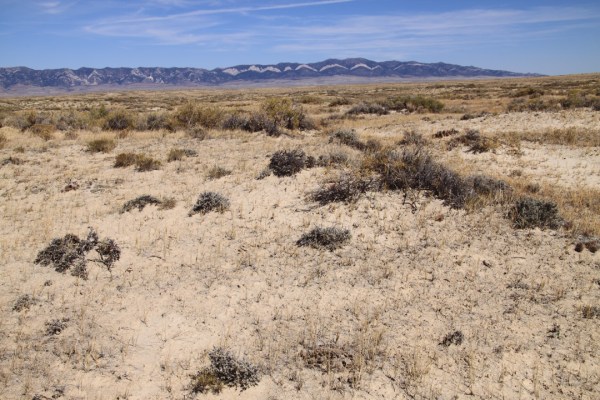
Shortgrass/sage brushland habitat in Medicine Bow Natl. Forest, Wyoming

In September 2010, Chris Brown and I explored shortgrass/sage brushland habitat atop the Laramie Mountains in southeastern Wyoming’s Medicine Bow National Forest (location “J” on this map). We were entering the final days of our 7th Annual Fall Tiger Beetle Trip™ and, to that point, had found every tiger beetle species we had set out to look for. This day, however, was the official “skunk” day of the trip, for although we did see one Cicindela limbalis (Common Claybank Tiger Beetle)—collected live to become the subject of one of the crappiest tiger beetle photos I’ve ever taken—we did not see the tiger beetle that we were there to see; Cicindela longilabris (Boreal Long-lipped Tiger Beetle). Of course, I rarely have trouble finding consolation on a skunk day, and during fall this is even easier—the deep blue sky, crisp fall air, and vivid colors of a morphing landscape are enough to make even a bad day of insect collecting better than a good day of just about anything else. And then there are the band-winged grasshoppers (family Acrididae, subfamily Oedipodinae)!  When there are no tiger beetles to be had, there are almost always members of this group around, and other than tiger beetles I don’t think there is another group of insects that I enjoy photographing more.

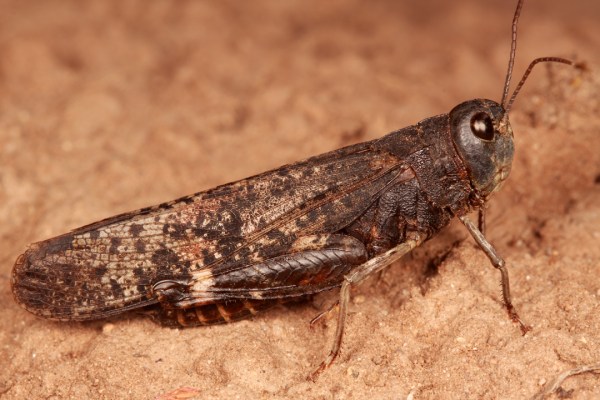
Arphia pseudonietana (red-winged grasshopper) | Medicine Bow Natl. Forest, Wyoming

As we walked the trails not finding tiger beetles, I noticed these very dark grasshoppers every once in a while. They flew with a particularly noisy crackling sound that exposed bright red hind wings before dropping to the ground and instantaneously becoming almost completely invisible. Once I accepted that tiger beetle photography just wasn’t gonna happen that day, I began paying attention to these grasshoppers and, after working a few individuals, finally found one who was willing to let me get close enough for some photos. I’m not terribly fond of this first photo—the perspective is still too high as I had not yet learned by that time to get down flat on my belly for photographing anything on the ground (remember, this was two years ago). Nevertheless, it is the only one that I have that shows the entire body of the grasshopper. Since this location isn’t too far west of the Nebraska border, I figured an identification should be possible using the Nebraska grasshopper guide (Brust et al. 2008)—based on that work and subsequent examination of photos at BugGuide, I surmise this individual represents Arphia pseudonietana (red-winged grasshopper). There are other species of Arphia in Nebraska, some of which are easily confused with A. pseudonietana; however, most of these are more common further east. The only other species in the genus that occurs west into Wyoming is A. conspersa (speckle-winged grasshopper), and although it is similar in appearance and may have red hind wings (though more commonly orange to yellowish), adults are most common during spring and early summer. Arphia pseudonietana adults, on the other hand, are most active during mid-summer through fall.

The pronotum bears a single notch just in front of the middle.

Grasshoppers, particularly in the western states, tend to be loathed by ranchers who see them as competitors with cattle for meager forage resources, especially in dry years. This species does feed preferentially on a variety of grasses such as western wheatgrass (Pascopyrum smithii), buffalograss (Buchloe dactyloides) and blue grama (Bouteloua gracilis); however, it doesn’t seem to occur at economically important levels except in association with other, more numerous grasshopper species. I’m glad to know this, because for some reason I just don’t want anybody regarding band-winged grasshoppers of any kind as a pest. Other grasshoppers, fine—just not my beloved bandwings!

I presume this 5th instar nymph also represents A. pseudonietana

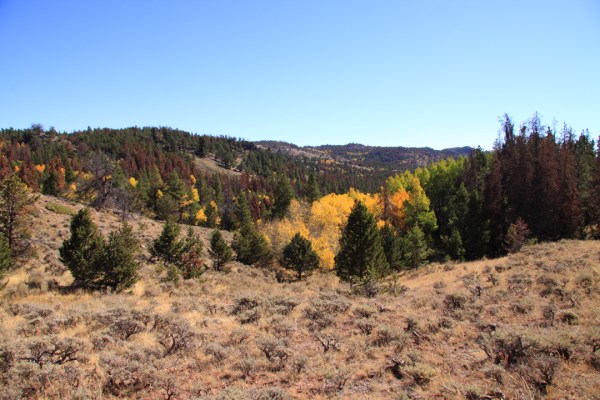
Later in the day I came across this presumed 5th-instar grasshopper nymph, and although it was quite skittish I eventually managed to get this single photograph before it resumed its frenetic hopping and I gave up in frustration. This is one of the better “one-shots” that I’ve managed to take—my only criticism being that the focus was just a tad too deep to catch the front metafemoral face. I really didn’t have much time to setup for this shot—once I got the critter reasonably in-frame I fired! Anyway, I’m inclined to think this also represents A. pseudonietana, although I’m less confident in that ID than I am for the adult as I wasn’t able to find a real good comparative photograph. Nymphs of A. pseudonietana are apparently most common from mid-spring to mid summer, so the seasonality is a bit off. I would be grateful to any acridophile who stumbles across this post and can provide an ID confirmation or correction (for either the nymph or the adult). Until then, I leave you with a shot that shows why I love fall regardless of whether I’m finding insects!

Quaking aspen glows under the late September sun.

REFERENCE:

Brust, M. L., W. W. Hoback and R. J. Wright.  2008. The Grasshoppers (Orthoptera: Acrididae and Romaleidae) of Nebraska.  University of Nebraksa-Lincoln Extension, 138 pp.

Copyright © Ted C. MacRae 2012

Mother and daughter (perhaps)

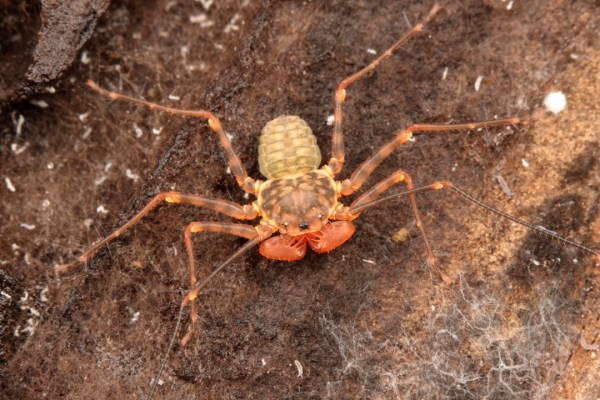
Phrynus marginenotata (Florida tailless whip scorpion)

Back in May I visited the California Department of Food and Agriculture’s Plant Pest Diagnostics Laboratory in Sacramento. While I was there to visit my friend and colleague Chuck Bellamy and see him receive Honorary Membership in The Coleopterists Society, I was also anxious for the opportunity to spend time with the lab’s other entomologists—most of whom I interact with as members of the Editorial Board of The Pan-Pacific Entomologist. Among the more ‘colorful’ of these is Martin Hauser, a dipterist (although I don’t hold that against him!) who also has a passion for maintaining live, captive arthropods. For me, there is nothing finer than visiting the lab/office of a taxonomic entomologist—one wall lined with steel cabinets full of insect specimens, another wall crammed-full of books and literature (the older the better), a workbench with microscope at the center of a jumble of specimen containers and open reprints, and shipping boxes piled everywhere. I take that back—there is nothing finer than visiting the lab/office of a taxonomic entomologist that also keeps livestock! Martin’s collection of live arthropods, however, goes well beyond the requisite 10-gallon aquarium with Madagascan hissing cockroaches. I already featured one of his more unusual tenants, Damon diadema (Tanzanian giant tailless whip scorpion), and here I feature its North American relative, Phrynus marginenotata (Florida tailless whip scorpion).

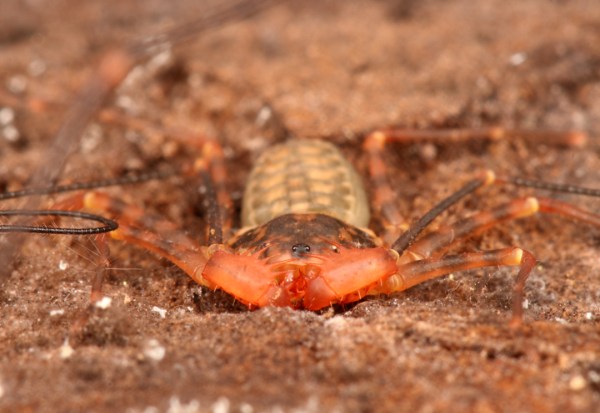
The genus is characterized by five spines on the pedipalp tibia—the 3rd shorter than the 2nd and 4th.

According to Weygoldt (2000), this is the northernmost and only U.S. representative of a mostly northern Neotropical genus of eleven species, recognized by the pedipalp tibia (the thickened segment of their “claws”) with five spines—the middle one shorter than the 2nd and 4th (refer to Photo 2). This species occurs in southern Florida and some Antillean islands, where it lives under coral stones and rocks close to the beach—a habitat that presumably subjects them to periodic flooding. While most tailless whip scorpions prefer humid/moist environments, they nevertheless studiously avoid standing water itself. This species, however, has been observed to voluntarily enter the water when placed on a stone surrounded by water and remain submerged for as many as eight hours. Remarkably, submerged individuals remain active and do not drown, apparently the result of a “plastron”—an area of the cuticle surrounding the lung openings that is packed with stiff, branched structures and, thus, capable of holding a volume of air against the body while the animal is submerged. The plastron seems to function much like a gill—oxygen continuously diffuses into the plastron from the surrounding water as it is used for respiration.

The bright orange pedipalps of 2nd-instar nymphs contrast with the somber coloration of the adults.

Like the D. diadema individuals that I also photographed, these P. marginenotata individuals had also produced viable eggs which had hatched a few weeks before my visit. Two nymphs can be seen with the adult in the top photo (although I can’t say for sure whether the adult is actually the mother), and Photos 3 and 4 show one of these nymphs up close and personal. I would have liked to have seen these nymphs when they first hatched, as the 1st-instars are a soft sea-green color and remain clustered on their mother’s abdomen until they are able to start fending for themselves (for a beautiful photo showing this, see Piotr Naskrecki’s The scariest animal that will never hurt you). The 2nd-instars that I photographed had already left their mother, and while they had lost their sea-green coloration, their pale yellow/gray bodies and bright orange pedipalps were no less striking compared to the more somber coloration of the full-sized adults.

…and, of course, the signature BitB face shot!

REFERENCE:

Weygoldt, P. 2000. Whip Spiders (Chelicerata: Amblypygi): Their Biology, Morphology and Systematics. Apollo Books, Stenstrup, Denmark, 163 pp.

Copyright © Ted C. MacRae 2012

Where siblings mingle: Ellipsoptera marginata vs. E. hamata

When Erwin & Pearson (2008) formally broke up the great genus Cicindela by elevating most of its former subgenera to full genus rank, it caused a bit of consternation amongst some North American cicindelophiles. The argument went something like, “Now we have all these new genus names to learn, and we’ll have to relabel and reorganize everything in our collections, and how do we know the names won’t change again, and we can’t even tell them apart in the field anyway, and blah blah…” Pardon me, but since when did taxonomy become more about slotting species into fixed, easy-to-learn categories and less about best reflecting dynamic knowledge of complex evolutionary relationships? In the case of Cicindela and its former subgenera, however, even these arguments don’t hold up to close scrutiny—tiger beetle enthusiasts in North America should have already been quite familiar with the former subgenera due to their inclusion in the widely accepted Pearson et al. (2006) field guide, many of which actually do present a unique suite of morphological/ecological characters that facilitate their recognition in the field, and I personally find that nomenclatural recognition of individual lineages helps my attempts to learn and understand them much more than dumping them into a large, all-encompassing genus based on superficial resemblance. As for insisting that names don’t change, well that has never been a tenet of taxonomy. Stable, yes, but fixed and immutable, no.

Ellipsoptera marginata male | Pinellas Co., Florida

Enough waxing philosophic. One of the more distinctive of the former subgenera is Ellipsoptera. Morphologically the genus is defined by details of male genitalia, but the 11 North American species are generally recognizable in the field by their relatively “bug-eyed” look and long legs (Pearson et al. 2006) and, as a group, seem ecologically tied to extreme habitats with sandy and/or saline substrates that are nearly or completely devoid of vegetation. Coastal marshes and mudflats, saline flats, sandy river banks, and deep sand ridges representing ancient coastlines are some of the habitats where species in this genus are most commonly encountered. Most of the species exhibit a fairly uniform facies but differ in the details of maculation and dorsal coloration, but two species that stand apart from the rest are E. marginata (Margined Tiger Beetle) and E. hamata (Coastal Tiger Beetle) due to the highly diffuse middle band of their elytra. These are both eastern coastal species and presumably represent sibling species that have diverged based on geographical range partitioning—E. marginata along the Atlantic Coast and E. hamata along the Gulf Coast. In the field, the two species are almost identical in appearance but nonetheless easily identifiable based on geographical occurrence. There is, however, a small stretch of coastline—the lower Gulf Coast of Florida—where the ranges of the two species overlap and geography alone isn’t sufficient for species determination.

Ellipsoptera hamata lacerata male | Dixie Co., Florida

Fortunately, despite their strong resemblance to each other, field identifications in areas where these species co-occur are still possible due to the presence of small but distinct sexual characters present in one species but absent in the other. Close examination is necessary to see the characters (or their absence), so it is best to net a few individuals and examine them in the hand or, as I have done here, look at them through the viewfinder of a camera. The photos in this post include the male and the female of both species, each showing the presence or absence of the distinguishing character.

Ellipsoptera marginata female | Dixie Co., Florida

In most tiger beetles, male individuals are distinguished by a number of secondary sex characters, but easiest to see in the field are the brush-like pads on the underside of the front tarsi (“feet”). Males of E. marginata and E. hamata are further distinguished from each other by the presence (E. marginata) or absence (E. hamata) of a distinct tooth on the underside of the right mandible. Photo 1 above shows a male E. marginata from Pinellas Co., Florida, and the tooth is easily seen in that relatively distant view. Photo 2 above shows a male E. hamata lacerata (Gulf Coast Tiger Beetle)—the Floridian subspecies, and while a small bump can be seen on the underside of the right mandible, it is not nearly as well developed into a distinct tooth as in E. marginata.

Ellipsoptera hamata lacerata female | Dixie Co., Florida

Female tiger beetles, on the other hand, lack the brush-like tarsal pads present in the males and are further distinguished by the “mesopleural coupling sulcus”—an area just behind the side of the pronotum that receives the male mandible during mating and is thus devoid of setae (compare the females in Photos 3 and 4 with the males in Photos 1 and 2). Neither E. marginata nor E. hamata females possess the mandibular tooth found in E. marginata males, but they can be distinguished from each other by their elytral apices. In E. marginata females (Photo 3), the elytra are curiously “bent” at the tips, forming a distinct indentation at the apex of the elytra where they meet, while female E. hamata (Photo 4) lack this indentation.

Are there other tiger beetle sibling species groups for which you would like to see comparative posts such as this one?

p.s. I completely neglected to mark yesterday’s 5th anniversary of Beetles in the Bush! I don’t know how I missed a milestone as big as five years—hopefully my ability to provide interesting content is faring better than my middle-aged memory!

REFERENCES:

Erwin, T. L. and D. L. Pearson. 2008. A Treatise on the Western Hemisphere Caraboidea (Coleoptera). Their classification, distributions, and ways of life. Volume II (Carabidae-Nebriiformes 2-Cicindelitae). Pensoft Series Faunistica 84. Pensoft Publishers, Sofia, 400 pp.

Pearson, D. L., C. B. Knisley and C. J. Kazilek. 2006. A Field Guide to the Tiger Beetles of the United States and Canada. Oxford University Press, New York, 227 pp.

Copyright © Ted C. MacRae 2012

Araneus marmoreus encore

Araneus marmoreus adult female—ventral view showing epigyne.

Here is the full-sized photo from which the crop shown in Super Crop Challenge #14 was taken. The small finger-like structure in the upper right of the photo—the object of the challenge—is the epigyne (or epigynum) of Araneus marmoreus (marbled orb weaver spider). Spiders have a rather unusual mating strategy—rather than possessing genitalia that couple for insemination, male spiders first form a packet of sperm (spermatophore) and transfer the packet to an enlarged segment (tarsus) at the end of their pedipalps. During mating, the male inserts the tarsus into the female genital opening, thereby effecting sperm transfer. The female genital opening and associated structures, located on the underside near the front of the abdomen, are called the epigyne and function to direct the male pedipalps during sperm transfer. The shape of the epigyne varies greatly and uniquely among species—probably serving as an isolating mechanism that prevents interspecific mating and also providing a good diagnostic character for species recognition among even very closely related species (similarly to the hardened male genitalia of many insect groups). An even closer view of the epigyne of A. marmoreus can be seen in this BugGuide photo.

Araneus marmoreus (marbled orb weaver) | Washington Co., Missouri

This is actually the second time I’ve featured A. marmoreus in a quiz—the intricate pattern of the dorsal abdomen being the subject of Super Crop Challenge #2. Folks had an easier time identifying the critter in that challenge than this one, which I guess is not surprising since people tend to know animals more by their color patterns than the structures of their genitalic openings. As in that first challenge, I encountered this adult female during a hike along the Ozark Trail, this time in Washington County in east-central Missouri. Unlike before, however, I found this spider crawling on a fallen log in the dark forest floor rather than resting in her web. The colors of this species are diverse and spectacular—a recipe that makes them almost irresistible to insect macrophotographers. That this is true is demonstrated by the 360! photos of this species posted to BugGuide.

Hot orange and yellows glow against the dark, moist wood of a fallen tree trunk.

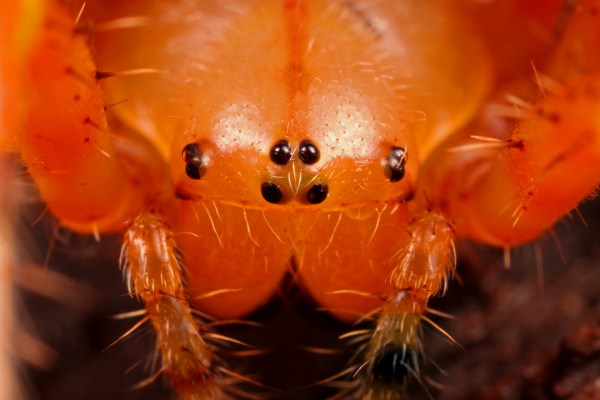
While my previous photos of this species were colorful, these simply glow due to the more orange coloration of this individual and its contrast with the darkened color of the moist wood. It’s a November color scheme if there ever was one—appropriate since I took them exactly one year ago today on November 23, 2011. She was a lot more cooperative than the first subject, and because of this and the stable substrate on which she was sitting I was able to get my favorite shot of all—the face portrait! Not quite as endearing as a jumping spider face (with its large, anthropomorphic median eyes), but striking nevertheless.

The obligatory BitB face shot!

A word about the challenges—I’m not sure if the lack of response to this one is an indication of difficulty or further evidence of declining relevance of blogs as an interactive social medium. I can’t help but notice that blog commenting in general has dropped with the rise of more functionally interactive media such as Twitter and Google+. What do you think—was this challenge too hard, or has the concept of challenge posts lost its appeal?

Copyright © Ted C. MacRae 2012