Super Crop Challenge #14

Wow, has it really been five months since the last Super Crop Challenge?! Well, it’s time to start a new BitB Challenge Session (this will be #7), so what better way to start? Can you name the structure shown in the photo below (2 pts), the organism to which it belongs (order, family, genus, and species—2 pts each), and its significance (2 pts)?

Note: If you are not completely familiar with them, please read the full rules for details on how and how not to earn points. Good luck!

Copyright © Ted C. MacRae 2012

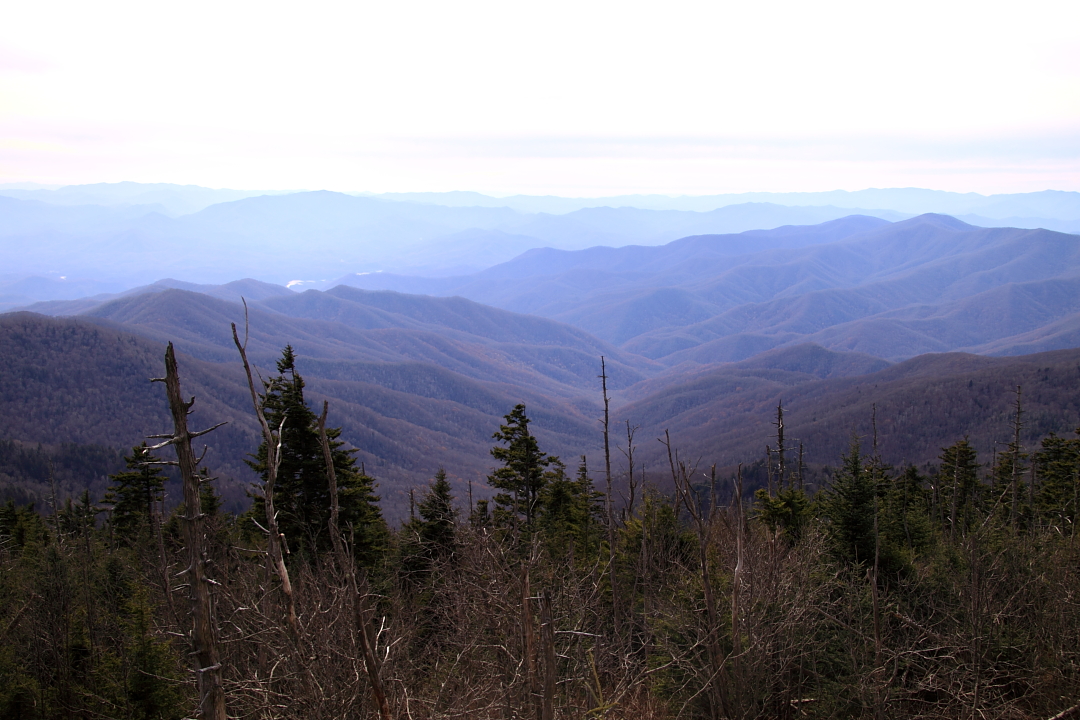
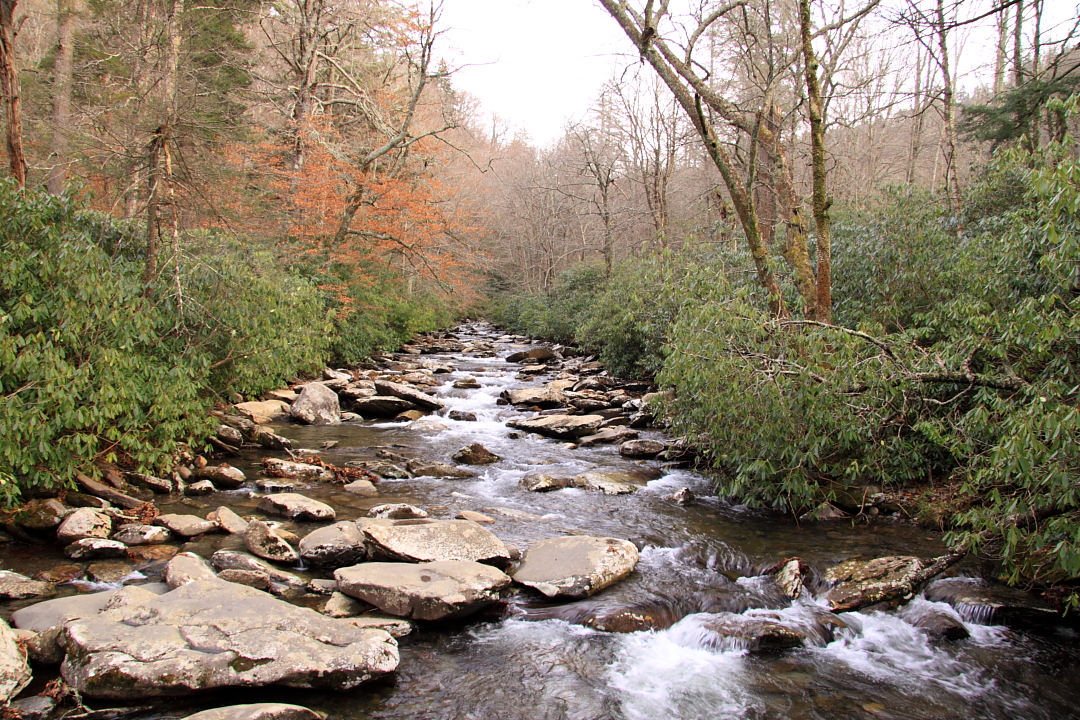
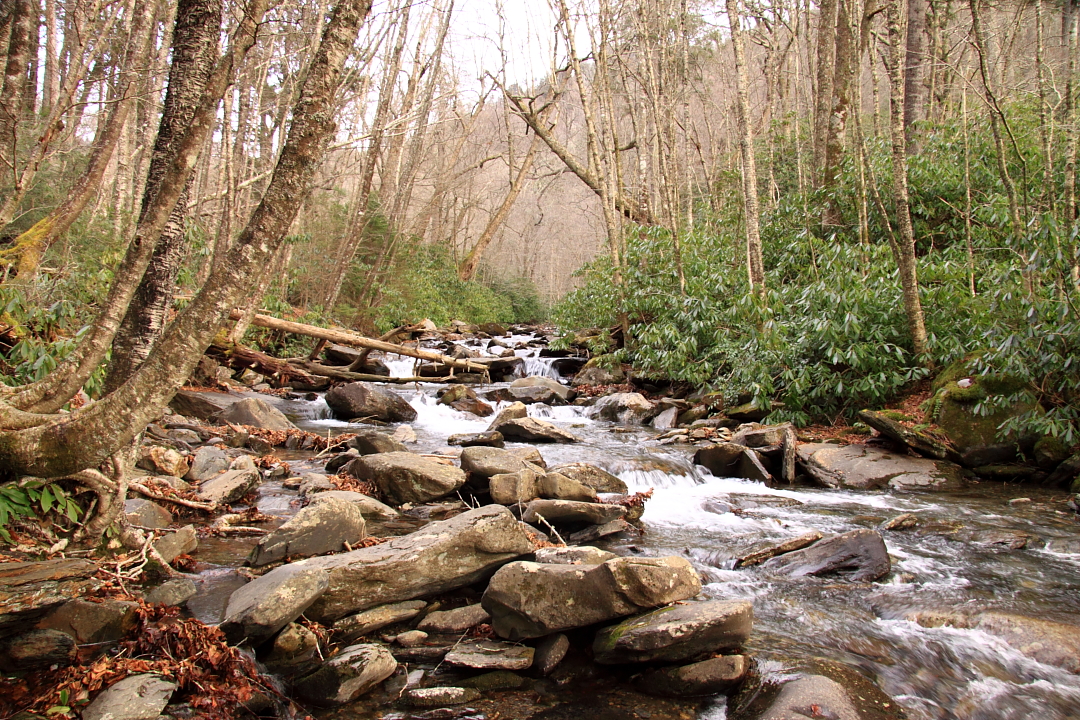
Great Smoky Mountains National Park

Is there any question why these are called the Smoky Mountains?

Last week I attended the Entomological Society of America (ESA) meetings in Knoxville, Tennessee. It was my first ESA attendance in more than ten years, so I took full advantage of the opportunity by speaking at the insect macrophotography symposium, presenting a poster on my soybean insect research, and enjoying face-to-face conversations with an extraordinary number of colleagues—some of whom I had not seen since my last ESA meeting and many more for which this was my first opportunity to meet them in person. I admit to having grown a little complacent in recent years about the importance of regular personal contact in cultivating these relationships—my attendance at this year’s ESA reminded me of that fact, and I’ve renewed my commitment to make ESA attendance a priority in the coming years.

Of course, no meeting should be all work and no play, and for me the chance to sample the local natural or cultural history is an added benefit of meeting attendance. This year’s destination for such was a no-brainer—located less than an hour’s drive from Knoxville, Great Smoky Mountains National Park is the largest federally protected area east of the Mississippi River. Straddling some of the highest peaks of one of the world’s oldest mountain ranges, the park has been designated an International Biosphere Reserve by the United Nations due to its rich biota.

One afternoon is not nearly enough time to even scratch the surface of the park’s 800 square miles, but it’s enough to get a taste of the diverse habitats they encompass and whet the appetite for further exploration. Highly recommended for those short on time is Clingman’s Dome—the park’s highest point at 6,643 ft. An observation tower allows spectacular vistas (provided the day has good visibility) of the surrounding mountains and the evergreen forests that cloak them. Unfortunately, the view has been marred in recent years by the accidental introduction of an exotic woolly adelgid (a relative of aphids) from Europe and its subsequent establishment on the forest’s Frazier firs. Dead trunks rise from the forest like tombstones—ghostly reminders of what has been lost. The starkness of the high elevation forest contrasts with the lush mixed hemlock forest that dominates the park’s lower elevations, and the 2.4-mile Alum Creek Trail provides an intimate experience with this rich forest and its thick understory of native rhododendron. I hope the following slide show imparts some essence of the experience, and larger versions of each photo can be seen by clicking on the thumbnails in the gallery that follows.

This slideshow requires JavaScript.

Copyright © Ted C. MacRae 2012

It’s a Mayfly…It’s a Moth…It’s Thyridopteryx

Mississippi River @ Hwy 62 bridge

One of the nice things about the study of insects is the endless opportunity for discovery. It could be a new species, or it might just be something already known but not yet seen personally. I’ve been collecting insects most of my life, and although much of it has been done in far away places the bulk has occurred in my home state of Missouri. Despite my long experience in this state, this past summer I had the opportunity to experience collecting within the state in a way that I’ve not yet done before—blacklighting up and down the length of the Mississippi River regularly during the months of July through September. Each time, I would arrive at the selected spot in the early evening while there was still daylight and search the (hopefully sandy) beaches for evidence of several tiger beetle species that might occur in such habitat. Then, as the sky turned aglow from the setting sun, I would setup the blacklights and wait for the appearance of those particular tiger beetles that are attracted to such.

Thyridopteryx ephemeraeformis | Mississippi Co., Missouri

Expectedly, beetles were seen at only some sites, and numbers and diversity generally decreased as summer approached its end. By early September beetles were no longer showing up even though the habitat seemed good (I guess that’s why they call them “summer” species). Still, on this particular night, the lights setup at the Hwy 62 bridge in far southeastern Missouri were attracting a variety of other insects, so I kept them on to see what might come in. I had nothing else to do. At some point, I noticed a strange insect that seemed like a cross between a mayfly and a moth, and then another…and another. Although I had never seen one of these in person before, I knew exactly what they were—male bagworms! Bagworms (order Lepidoptera, family Psychidae), of course, are extraordinarily common in Missouri, and the sight of dozens or even hundreds of their silken/twig bags attached to ornamental evergreen shrubs in the neighborhood where I lived as a kid remains vivid. I can remember “popping” the larvae inside to see their innards ooze out from the tip of the bag (I know—I’m not proud of it) and even cut open a few of the bags to see the larvae inside (that is, once the less sadistic and more scientifically curious side of me took over). Despite all of this, I had never seen an adult bagworm—male or female—until this night.
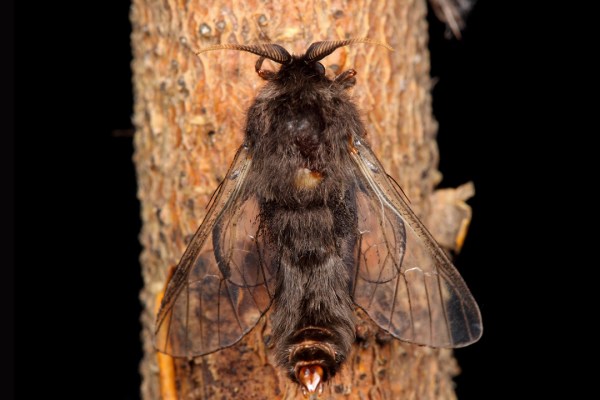
Dorsal view

Obviously, these are males because they have wings—females remain wingless into adulthood and, in fact, never even leave the bag in which they’ve spent their entire lives. Bagworm males are distinctive in that their wings are virtually devoid of any scales, and I surmise that the generic name of the most common species in eastern North America—Thyridopteryx ephemeraeformis—is derived from the Greek thyris (window) and the Latin ptera (wing) in reference to this. I was fascinated by the strange appearance of these moths and even more fascinated by the curious manner in which the males held out the tip of their abdomen when at rest; reminiscent of a female releasing sex pheromone. This can’t be true, because it is the females that call from their bags to attract the males, and since the females remain within their bag, the male must insert his abdomen through the tip of the bag and all the way to the top where he can reach the female genital opening. Thus, the male abdomen is highly extensible and prehensile—I guess the males can’t keep an abdomen with that much stretching capacity still for very long.

Two males

Based on gestalt, I presumed these represented T. ephemeraeformis since it is such a common and widespread species, but it’s not always wise to presume, especially in a relatively more southern location. The Moth Photographers Group lists five species in this genus in North America, two of which (T. alcora and T. meadii) seem to be southwestern in distribution. Of the remaining three, T. ephaemeraeformis is the only one I could find any photos or information beyond simple listings (the Moth Photographers Group lists no distribution records for T. rileyi or T. davidsoni), so I asked my lepidopterist friend Phil Koenig for his opinion. Phil informed me that T. ephemeraeformis has been recorded in Missouri 285 times in 49 counties, while T. rileyi is known from the state based only very old literature records and T. davidsoni not at all. Thus, the odds are definitely favor these males representing T. ephemeraeformis. Late summer is apparently the prime period of adult bagworm activity. I’ve not done much blacklighting late in the season because most of the beetles on which I’ve focused over the years and that are attracted to blacklights are active more during spring and early summer. This could explain why I’ve not until now seen male bagworms despite their commonness in Missouri.

Copyright © Ted C. MacRae 2012

Approaching the unapproachable

Yesterday I gave a talk at the Entomological Society of America’s Insect Macrophotography Symposium, focusing on techniques that I use for photographing wary insects in the field. Turnout for the symposium was awesome (I estimate ~125 people in attendance), and as the first talk I’ve given where I presented myself as a photographer I was pleased at the warm reception I got. A big thanks to my friends and colleagues who showed up to see the talk—it was great seeing your friendly faces in the crowd.

For those of you who couldn’t attend the ESA meetings this year or were unable to see my talk, I’ve attached a PDF version of the talk to this post—click on the image of the title slide below to see it. I expect I might give some version of this talk again in the future, so I would love to hear about any techniques you have found useful for approaching and photographing wary, skittish insects in their native habitats.

Copyright © Ted C. MacRae 2012

Persistence Pays

For the past three years I’ve crisscrossed the country in search of some of North America’s rarest tiger beetles, each time hoping to get that “perfect” photograph of an unconfined beetle exhibiting natural behavior in its native habitat. I’ve managed to get photos of most, though there are a few that I wish I could do over, but the only one that I think really comes close to the ideal I have in my mind is this one of Cicindela formosa generosa, featured in the ESA 2013 World of Insects Calendar (and, ironically, taken only about 5 miles from my home).

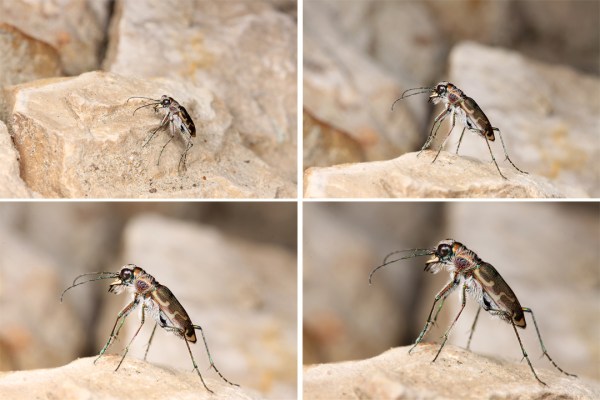
A consequence of all this attention to uncommon species is that I’ve somewhat neglected getting good photographs of some of our most common tiger beetles. One of these is Cicindela repanda (Bronze Tiger Beetle), which can be found near almost any body of water throughout the bulk of eastern North America. This summer I resolved to correct that situation, but I found this to be more difficult than anticipated. The first time I tried to photograph the species was when I encountered them in late July on a wide, open beach along the Mississippi River on a hot, summer day. I found the beetles almost completely unapproachable due to the extreme heat and lack of any cover that could be used to my advantage. I had better luck in mid-August when I attracted some individuals to an ultraviolet light that I had setup one night at a spot further north along the river. Those photos were acceptable technically but lacking otherwise, primarily because the beetles didn’t assume any of the charismatic poses associated with the thermoregulatory behaviors exhibited by active beetles in the middle of a hot summer day. Finally, at the end of August, I encountered the species yet again on a small patch of sandy/muddy river bank along the Mississippi River just south of St. Louis. It was another hot day—quite hot actually—but with the help of some features of terrain I was finally able to get that photo of the species that I’ve been wanting.

Cicindela repanda (Bronze Tiger Beetle) | St. Louis Co., Missouri

I like this photo for a number of reasons. The beetle is nicely profiled while paused “tall” on its front legs (a common posture on hot days as they try to lift themselves up off the hot soil surface), the angle is low, and the subject and foreground are well focused in front of a nicely blurred backdrop of rocks. It is these rocks that actually helped me get this photo. I had chased several individuals down on the open sand for some time, but since the day was as hot as my first attempt and I wasn’t having any better luck. Every now and then one of the beetles that I was “working” would fly up into this rockier area, and I noticed that I was able to get closer to these beetles because I was able to stay lower as I made my approach. I began preferentially working beetles towards the rocks and finally got one that settled down and started showing normal searching behaviors despite the fact that I was already in fairly close range. At that point, it became a matter of waiting for the beetle to “lower his guard” while I assumed a shooting position, and as soon as it began acting normal I slowly closed in and began taking shots.

Getting close is a process, as these successive shots demonstrate.

This collage shows the four shots immediately preceding the final photo and how each shot brought me a little closer to the beetle (and that final composition that I wanted). The beetle was still in search mode as it crawled up the side of one rock and I began taking photos, but upon reaching the top it paused and lifted itself up high on its front legs. I knew I would have 5, 10, maybe 15 seconds at the most to capture this pose before it began moving again, so I closed in slowly but assertively and fired a shot every couple of seconds until I got the one that I wanted. At that moment, the beetle flew away, and although I tried for another 20 minutes or so I was unable to get another beetle back up on the rocks for more shots. How fleeting success can be!

Copyright © Ted C. MacRae 2012
Black olives with legs

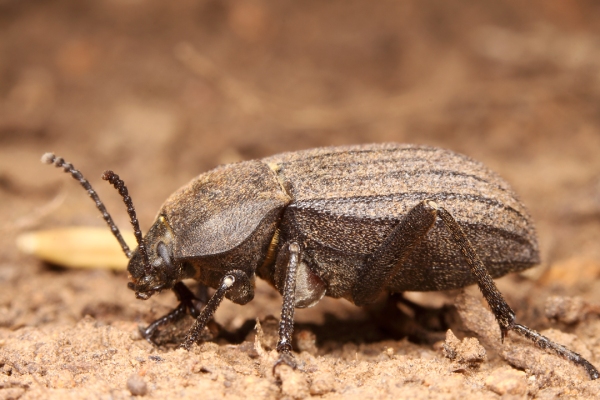
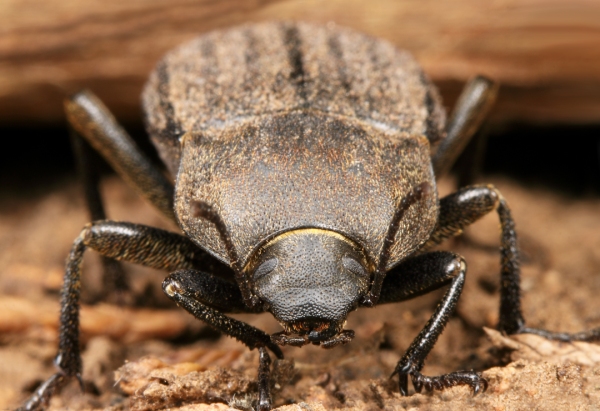
While searching the open red-cedar woodland at Oklahoma’s Wichita Mountains National Wildlife Refuge back in September, I rather regularly encountered these darkling beetles (family Tenebrionidae) that I recognized as the species Eleodes tricostata. I really wanted to photograph the first several that I found, but I soon abandoned this idea because they just… wouldn’t… stop… crawling! Not that I’m impatient and couldn’t wait one out if I put my mind to it, but what I was really after was more photos of the beautifully black Cicindelidia obsoleta vulturina (Prairie Tiger Beetle) population that I had just found there. It would take most of the afternoon before I finally got the nice, closeup photos of the tiger beetle that I wanted, and as I started to leave the site I found yet another of these darkling beetles… just sitting there! The beetle didn’t move at all as I took first a few lateral profiles, then moved around to the front for the face shots that I so love, and finally back to the side for even more profiles. I was even able to remove the stick that the beetle had siddled up against to improve the composition of the profile shot and then place it behind the beetle as a backdrop in the frontal shot. Another lesson in why it pays not to waste too much time with uncooperative subjects when others are available.

I already knew about this species because I have encountered it several times before in my travels across the western states, but most memorably during my first visit to the Great Plains back in 1986 when I saw large numbers of this species and the related E. suturalis crossing the highway in front of us during the early evening hours in south-central Kansas. I’d never seen such en masse movement by large beetles, and although I’ve seen both of these species numerous times since I’ve not seen another such migration. Eleodes is the largest genus in the family in North America but occurs exclusively in the western states. Famous for their skunk-like head-stand when disturbed, Triplehorn et al. (2009) note the genus name is derived from Greek and means “olive-like.” This is certainly the case for most of the other members of the genus—mostly black and shiny, the larger species resemble “black olives with legs”; however, this species has not quite such aspect. Rather, its dull color, depressed fusiform shape and elytra with distinct, tuberculate costae (Triplehorn et al. 2009, Bernett 2008) make it immediately recognizable amongst the dozens of congeners that are likely to be found co-occurring with it in the different parts of its wide range.

Not quite a head stand, but he wants to do it.

Although the normal range of this species covers the Great Plains from Canada to Mexico, its eastern limit of distribution is still incompletely known. There are some historical records from western and central Iowa, but it was only recently that Maxwell & Young (1998) reported the species for the first time from east of the Mississippi River in Wisconsin. Seeing this report made me wonder if I might be able to find the species in Missouri also; however, those authors noted that the Wisconsin population was encountered exclusively in open habitats with exposed soil surfaces and sandy soil in close proximity to shrub and tree cover. No such habitat exists in western Missouri, and although tiny remnants of sand prairie  habitat remain in the southeastern lowlands of the state they lack significant shrub and tree cover and are instead vegetated primarily by grasses and forbs.

REFERENCES:

Bernett, A. 2008. The genus Eleodes Eschscholtz (Coleoptera: Tenebrionidae) of eastern Colorado. Journal of the Kansas Entomological Society 81(4):377-391.

Maxwell, J. A. & D. K. Young. 1998. A significant eastern range extension for Eleodes tricostatus (Say) (Coleoptera: Tenebrionidae). The Coleopterists Bulletin 52(1):90–92.

Triplehorn, C. A., D. B. Thomas, and E. G. Riley. 2009. The genus Eleodes Eschscholtz (Coleoptera: Tenebrionidae) in Texas. The Coleopterists Bulletin 63(4):413-437.

Copyright © Ted C. MacRae 2012
Hand-held caddisflies

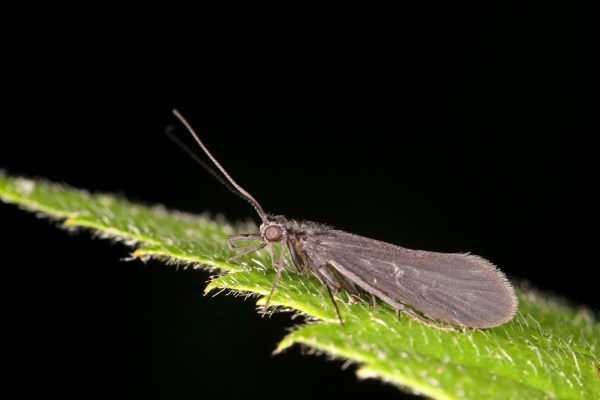
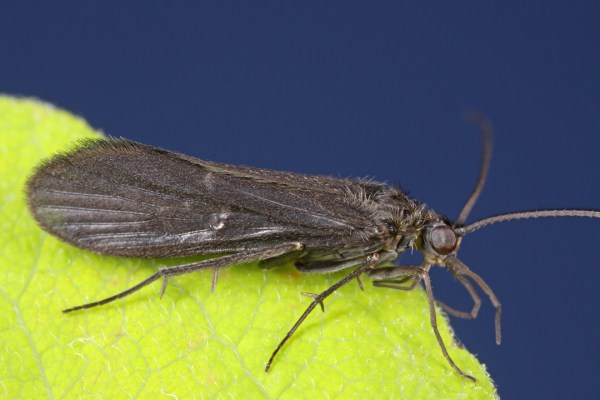
Chimarra sp. (Trichoptera: Philopotamidae) | Sam A. Baker State Park, Missouri

I recently found a folder in my files with a number of photos taken way back in April during a visit to Sam A. Baker State Park in the Ozark Highlands of southeastern Missouri. I never got around to posting them at the time, but there are some interesting photo series in the folder. One includes these photographs of an adult caddisfly (order Trichoptera). I remember seeing these insects in fair numbers resting on the foliage of shrubs alongside Big Creek and thinking they were some kind of archaic family of moths. Admittedly, it wasn’t until I got the photos up on the computer and saw the lack of any coiled proboscis for mouthparts, prominent maxillary and labial palps, and hairy rather than scaled wings that I realized what these were. My mistake is understandable—trichopterans are quite closely related to the order Lepidoptera, the two groups together forming an “ironclad” monophyletic clade (Wheeler et al. 2001).

The distinct palps, lack of proboscis and ”hairy” wings identify this insect as a caddisfly rather than a moth.

It was the beginning of this past season that I began practicing “hand-held” technique for insect macrophotography in earnest. I don’t use a tripod, so shooting insects resting on foliage requires that I brace my body to minimize movement. This is fairly easy if I can sit or crouch but very difficult if I have to stand. Moreover, even if I can manage to eliminate body movement, the plant on which the insect is resting often moves because of wind. What is really needed is a way to “lock” the relative positions of the camera and subject—movement is fine as long as both camera and subject are moving together. That’s where hand-holding the subject comes in… well, handy! I’ve learned to carry a small folding scissors in my waist pack when I am in the field, and by very gently grasping the petiole of the leaf on which the insect is perched with my left-hand thumb and forefinger and snipping the petiole with the scissors, I can detach the leaf without disturbing the insect and then hold it in any position and against any background that I desire. To take the photograph, I hold the camera in my right and and rest the lens on my left wrist or the base of my left thumb and then fine tune the position of the insect on the leaf while composing through the viewfinder. In this manner I not only lock the subject-lens distance but also precisely control the composition and background. This works best with the MP-E 65mm lens—its working distance of only 4″ at 1X and even less at higher magnifications is perfectly suited for this technique. I do also use this technique with my 100mm lens, but it is more difficult to do because of the longer working distance of the lens and resulting need to rest the camera further back on the left forearm. At any rate, these photos represent some of my earliest efforts using what I call the “left wrist” technique.

Among caddisflies, the blackish body and wings are characteristic for this genus.

I thank Dr. Robert Sites, University of Missouri-Columbia, for identifying the individual in these photos to the genus Chimarra in the family Philopotamidae (he also noted that male genitalic characters would be needed for species determination). Ferro and Sites (2007) listed three species of caddisflies in this genus from Sam A. Baker State Park (C. feria, C. obscura, and and unidentified Chimarra sp.).

REFERENCE:

Ferro, M. L. & R. W. Sites. 2007. The Ephemeroptera, Plecoptera, and Trichoptera of Missouri State Parks, with Notes on Biomonitoring, Mesohabitat Associations, and Distribution. Journal of the Kansas Entomological Society 80(2):105–129.

Wheeler, W.C, M. Whiting, Q.D. Wheeler & J.M. Carpenter. 2001. The phylogeny of extant hexapod orders. Cladistics 17: 113-169.

Copyright © Ted C. MacRae 2012

Black is beautiful!

As much love as I give to tiger beetles, I tend to be just as indifferent to the non-cicindeline ground beetles. Why this is I don’t know; ground beetles sensu lato are super diverse taxonomically, morphologically, and ecologically, and the colors of some rival even the gaudiest of beetles. Still, whenever I see a Harpalus pensylvanicus or Bembidion affine crawling on the ground, my brain just yawns and I look elsewhere. I suspect my tiger beetle inclinations have more to do with their extreme habitat specificity and attendant behavioral adaptations, in which areas the other ground beetles are clearly somewhat lacking. There are also those tiger beetles jaws!

Calosoma sayi (black caterpillar hunter) | New Madrid Co., Missouri

Well, there is one group of carabids that does excite me almost (almost!) as much as tiger beetles, and that is the nominate subfamily Carabinae with genera such as Calosoma, Callisthenes, Scaphinotus, and Cychrus—the so-called “caterpillar hunters” and “snail hunters.” These are the giants of the family, with most species measuring at least 15 mm in length and many measuring up to 25 mm in length or more. And then there are those jaws! Perhaps my feelings for this group are no coincidence, given the close relationship between these beetles and tiger beetles (in fact, most molecular data suggest that tiger beetles are firmly nested within the Carabinae).

Baby got jaw!

I came across several individuals representing Calosoma sayi (black caterpillar hunter), including the two individuals shown in the above photographs, back in late August under street lamps in the southeastern Missouri city of Portageville. Though it lacks the metallic colors possessed by many other species in the group, it does have those delightful, sculptured jaws. While I don’t normally like to photograph beetles on pavement, that’s where the beetles were and I’ve had poor luck in trying to move active beetles to an alternative substrate and then get them to settle down and resume natural-looking positions. In this case, it turned out not to be necessary to move the beetles, as the color and texture of the pavement provides a very nice background for these all black beetles. Also, did I mention those jaws?!

Copyright © Ted C. MacRae 2012