A classic fall ‘bycid

In eastern North America, autumn is the beginning of the end for most insect groups. Preparations for winter are either complete or well underway—eggs have been laid, nests have been provisioned, and larvae (hopefully) have eaten well enough to endure the long, cold months that lie ahead. But for a few insects, fall is just a beginning. Triggered by cooler temperatures, shortened daylength, and invigorating rains, adults of these insects burst forth under crisp, blue skies to feed amongst a plethora of fall flowers or prey upon other late season insects before the advancing cold, finally, forces a close to the season. As a beetle man, my favorite fall insects must be the “fall tigers” (i.e., tiger beetles) that come out in force and zip across barren sand dunes or bask on exposed rocks of dolomite glades. My fall insect collecting focuses almost exclusively on these insects, since my other favorite groups (jewel beetles and longhorned beetles) are, for the most part, restricted in their adult activity to the spring and summer months and long gone by the time fall rolls around. There are, however, a few longhorned beetles that buck the normal spring/summer rule for the family, namely species in the genus Megacyllene. The most commonly encountered of these is Megacyllene robiniae (locust borer), and anyone who has examined goldenrod (genus Solidago) and its profuse blooms during the fall has likely encountered this familiar beetle with its narrow, alternating, zig-zag bands of black and yellow.¹ I have seen this species many times and in many places; however, I still always enjoy seeing it anew in the field each fall—perhaps as some sort of confirmation that the fall season truly has arrived.

¹ If you see a “locust borer” in the spring, it is actually the closely related Megacyllene caryae (hickory borer), while further west in the Great Plains during fall you might find Megacyllene comanchei.

Megacyllene decora (amorpha borer) | Mississippi Co., Missouri

Another species in the genus that is far less commonly encountered, however, is Megacyllene decora (amorpha borer). I have encountered this stunningly beautiful species in only a handful of locations in Missouri (MacRae 1994)—all where stands of its larval host plant, Amorpha fruticosa (false indigo), grow in association with goldenrod and snakeroot (genus Eupatorium). These sites are primarily in the big river valleys of the state (Missouri and Mississippi Rivers), although I have found at least one site in the prairies of west central Missouri. Earlier this summer while traveling through the southeastern lowlands of Missouri, I noticed a stand of native Hibiscus growing within a wet ditch along the edge of a small city park and stopped by to look for the even rarer Hibiscus-associated jewel beetle, Agrilus concinnus (MacRae & Nelson 2003, MacRae 2006). While I did not find that species, I did notice fairly good numbers of A. fruticosa plants along the edge of the ditch as well and young goldenrod plants that had not yet reached flowering stage. At that moment I knew I had a good potential site to look for M. decora and made a mental note to stop at the site again later in the season when goldenrod began to bloom.
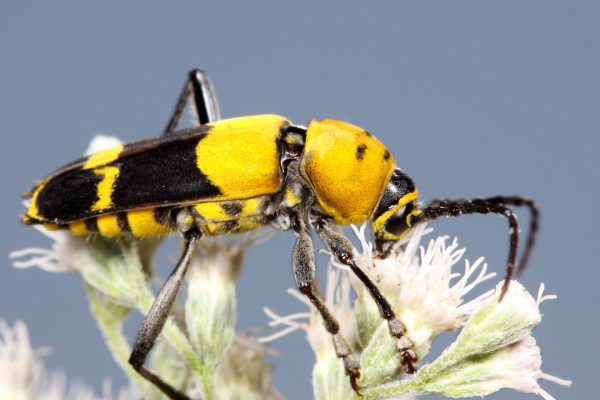
The species is distinguished from related species in the eastern U.S. by its wide black and yellow bands.

Last week I returned to the site to find not only goldenrod in its earliest stages of bloom, but an even greater number of Eupatorium serotinum plants already in bloom. I wanted to photograph the beetle, of course, but what I was really hoping for was to find and photograph the beetle on the stems of its Amorpha host plant (I have only seen this once before—all other sightings of the beetle have been on flowers of goldenrod and snakeroot). I approached each Amorpha clump cautiously and searched the stems carefully, also keeping an eye on the goldenrod and snakeroot blooms as I moved from one clump to the next. After searching a number of clumps, I finally found the adult shown in these photos. Fortunately, I knew from previous experience in collecting these beetles that they are not a particularly wary species (few aposematically- or mimetically-colored beetle are), so I was able to get a number of good photographs before I (stupidly) bumped the beetle with the diffuser over my flash heads and disturbed it.

”Blue sky” settings: ISO160–200, 1/200 sec, f/14–16, camera pointed near (not at) the sun.

It would be another half hour before I would find a second beetle, and in total on the day I saw only three (all on Eupatorium). This and the very early stage of the goldenrod blooms suggests to me that the beetles were just beginning to emerge—over the next few weeks I am sure they will become more numerous at the site, so I may yet have an opportunity to photograph one on its larval host plant when I pass by the area in a couple of weeks.

Normal ”normal” full-flash settings: ISO100, 1/250 sec, f/16.

REFERENCES:

MacRae, T. C. 1994. Annotated checklist of the longhorned beetles (Coleoptera: Cerambycidae and Disteniidae) known to occur in Missouri. Insecta Mundi 7(4) (1993):223–252.

MacRae, T. C. 2006. Distributional and biological notes on North American Buprestidae (Coleoptera), with comments on variation in Anthaxia (Haplanthaxia) viridicornis (Say) and A. (H.) viridfrons Gory. The Pan-Pacific Entomologist 82(2):166–199.

MacRae, T. C., and G. H. Nelson. 2003. Distributional and biological notes on Buprestidae (Coleoptera) in North and Central America and the West Indies, with validation of one species. The Coleopterists Bulletin 57(1):57–70.

Copyright © Ted C. MacRae 2012

Not quite a one-shot

This little jumping spider (~8 mm in length) was in one of my soybean fields in west-central Illinois last week. She(?) was quite fidgety and kept jumping from the leaf on which I found her as I tried to carry the leaf out of the field to a more open and convenient place  to take photographs. Once I got out to the grassy field border, I managed to get one photograph (not shown but similar to this one) right before she jumped off the leaf yet again. However, I was able to find her and coax her back onto the leaf for this last shot before she jumped off again—never to be found again! I presume this spider belongs to the genus Phidippus based on the cephalic tufts, and within that genus maybe a species in the P. clarus group (corrections welcome!).

When I look at insect macrophotographs, I like to do reverse engineering on the lighting to figure out what was the flash/diffuser setup. I have a few different diffusers that I use depending on which lens I’m using and how important the photographs are. In this case, I was taking photographs of soybean insects for work purposes and didn’t bother putting on the larger concave diffuser that I use when I’m really concerned about getting more even lighting. Instead, I was just using my snap-on Sto-Fens+Gary Fong Puffers. The difference between these two diffuser setups and their effect on lighting is minor in many cases, but when photographing very shiny surfaces (such as the eyes of this spider) the differences are much more apparent, and it is obvious from this photo that I was using a twin flash unit with separate diffusers on each flash head.

There is one more feature apparent about the lighting in this photograph—note that the “left” flash head appears much more diffuse than the “right” flash head. This is because the right diffuser had actually fallen off of the flash head without me noticing (also never to be found again!). As a result, the light from only one of the flash heads was diffused, while that from the other hit the subject in all its harsh glory. I don’t really like the twin highlights that are the hallmark of twin macro flash units, and if I had known I was going to be photographing jumping spiders when I was in the soybean field I would have gone ahead and used my concave diffuser. I’ve also learned, however, that great photographs are not something that I can expect to pop off while concentrating on other activities—I need to concentrate fully on the photographs and spend a good amount of time doing it until I feel like I’ve gotten the shots that I want. I never really liked the Sto-Fen+Puffer diffusers, as they were only marginally better than no diffuser (and this photograph shows it), so losing one of them might be a blessing in disguise as now I’ll be motivated to try out some of the many other diffuser ideas I’ve been toying around with but never really taken the time to sit down and try them out.

Copyright © Ted C. MacRae 2012

The very dirty tiger

Ellipsoptera cuprascens (Coppery Tiger Beetle) | Mississippi Co., Missouri

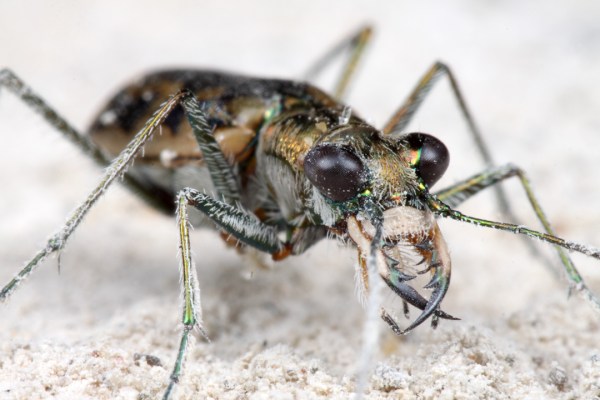
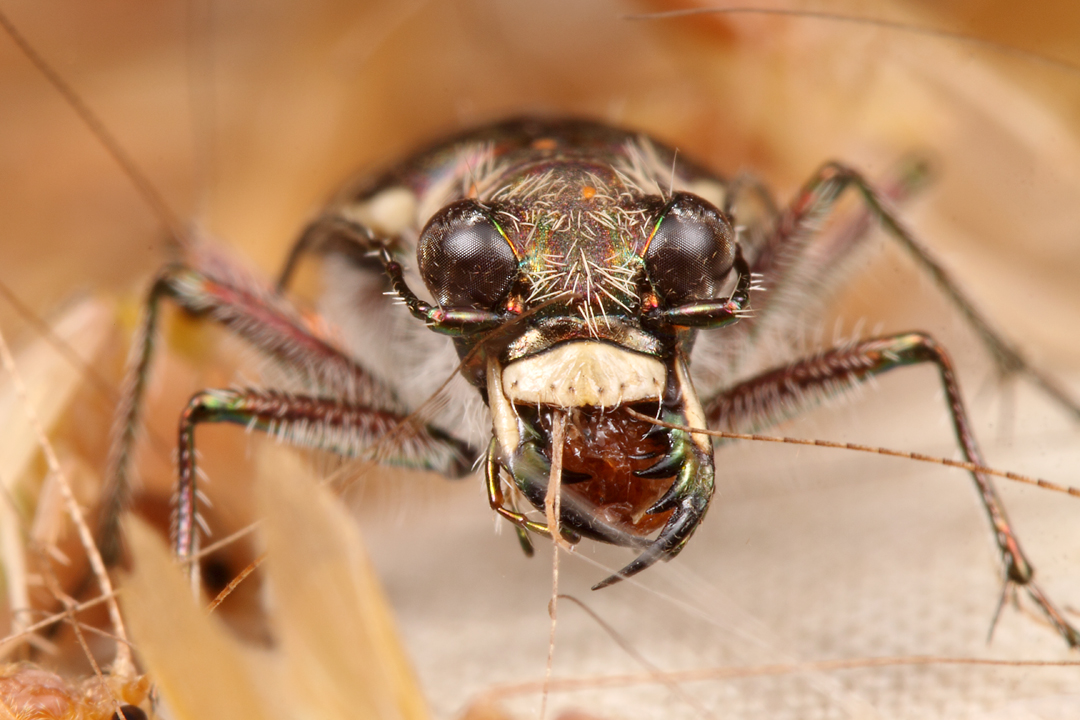
In my post Very wary tigers!, I lamented my inability to photograph one of our state’s less commonly encountered tiger beetles, Ellipsoptera cuprascens (Coppery Tiger Beetle), on an open Mississippi River beach under a blazing sun. There are solutions to such problems, however, one of which is the use of blacklights to attract the beetles at night when cooler temperatures and readily available prey make the beetles much more approachable. Of course, this only works for those certain species that are attracted to blacklights, of which fortunately E. cuprascens is one, and not long afterwards I was able to photograph individuals of this species that came to a blacklight placed further south along the Mississippi River in New Madrid Co., Missouri. The photos were adequate, but none were what I would consider a true winner, so when I found the species again while blacklighting at another Mississippi River beach in southeast Missouri I continued with my attempts to photograph them.

Heavy lime coating the antennae must feel to this fellow like like breathing in concrete does to us!

The species was much less abundant this time, and none of the few individuals that showed up at the light actually spent any time on the ground where I could take reasonably natural looking photographs. This time I decided to look for them along the beach away from the light and succeeded in finding a few. As is typical, the first several that I tried to photograph were too wary to approach, but I’ve learned to keep trying until I find that one (slightly) more cooperative individual. As I crossed over the concrete boat ramp I saw one that seemed not at all flighty. I’ve seen the ubiquitous Cicindela repanda commonly on concrete boat ramps, so I checked carefully to be sure it wasn’t that species, and after confirming its E. cuprascens identity I began the slow, cautious approach that ended with me flat on my belly and the camera lens inches from the beetle. Nighttime photography is tricky because… uhm… it’s dark, and I don’t find my flash unit’s focusing lamps all that helpful (they tend to time out right before I’ve composed the shot to my satisfaction). Instead, I place my headlamp on the ground and position it so that it continuously illuminates the subject so I can concentrate on getting multiple shots without having to constantly divert my attention to the focusing lamp button. The concrete was hard, and my elbows were mad at me for a time afterwards, but the beetle was generously cooperative and took on some very nice poses during the session, leaving me with the impression that I’d gotten that “perfect” shot as I walked back to the blacklight.

The obligatory face-shot—especially stark in its white lime surroundings!

Sadly, these photos are far from perfect. Their composition is good, as is their focus and lighting and the natural-looking poses that I captured. But the beetle is absolutely filthy! I didn’t realize it at the time, but apparently its wanderings across the decaying lower reaches of the concrete boat ramp resulted in a thick coating of lime on just about every part of its body. Now, few tiger beetles that I photograph are perfectly clean and spotless, and although a few grains of sand around the mouth or on the legs are tolerable, I am not above cloning out debris that detracts from the beauty of the beetle—especially when it is on the eyes or its shiny, glabrous dorsal surface. This beetle, however, is simply beyond repair. I’m by no means a Photoshop expert, but I’m not sure even the most fluent PS whiz could fix this beetle. So, my quest for the “perfect” E. cuprascens photo will continue…

Copyright © Ted C. MacRae 2012

Life at 8X—Guide to lepidopteran eggs on soybean

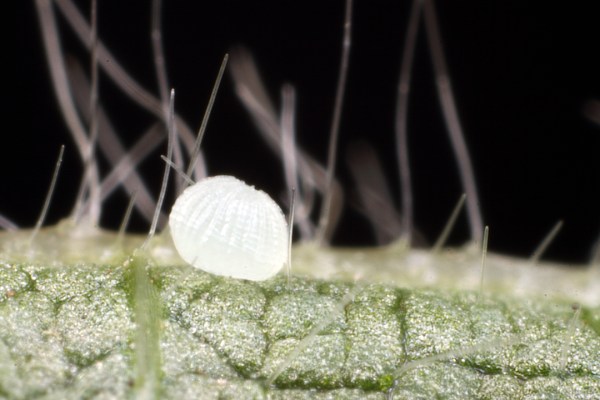
Most of you are aware of my passion for beetles, but in reality that is just my evenings-and-weekends gig. By day, I am an agricultural entomologist conducting research on insect pests of soybean. I’m not sure how many latent soybean entomologists there may be among readers of this blog, but for this installment of “Life at 8X” I thought it would be interesting to feature eggs of several of the more important lepidopteran species that infest soybean in the U.S. Soybean is primarily a New World crop, and of the many lepidopteran species that attack soybean on these two continents, most belong to the great family Noctuidae (owlet moths). The species shown here include the most important species in North America, and in some cases South America as well.

See this post for details on photographic technique; however, note that most of the photos in this post that were shot at 8X have been cropped slightly (~10–15%) for composition (should I call this post “Life at 9X”?).


Anticarsia gemmatalis. Velvetbean caterpillar (“oruga de las leguminosas” in Argentina; “lagarta-da-soja” in Brazil) has long been the most important lepidopteran soybean pest throughout the New World. In North America its attacks are confined to the lower Mississippi River delta and southeastern Coastal Plain, but in South America nearly 100% of the soybean growing area is subject to attack. Eggs of this species are laid almost exclusively on leaf undersides throughout the canopy and are intermediate in size compared to the other species shown below (~7,000 eggs per gram). They are distinctive in their slightly flattened spherical shape and turn pinkish as they age and the developing larva takes form inside the egg.

Anticarsia gemmatalis—velvetbean caterpillar


Chrysodeixis includens (=Pseudoplusia includens). Soybean looper (“oruga medidora falsa” in Argentina; “lagarta falsa-medideira” in Brazil) was until recently primarily a North American pest with the same southern occurrence as velvetbean caterpillar. In recent years, however, it has gained importance in Brazil and northern Argentina as well, with its impact magnified by the capacity to develop resistance against most of the insecticides that have been used to control it. The egg of this species is quite small (~10,000 eggs per gram) and are are irregularly spherical with a somewhat translucent, crystalline appearance. Like velvetbean caterpillar, eggs of this species are laid almost exclusively on the leaf undersides, but the moths exhibit a clear preference for the middle or upper canopy depending upon plant growth stage.

Chrysodeixis includens (= Pseudoplusia includens)—soybean looper


Helicoverpa zea. Soybean podworm is better known in other crops as corn earworm, cotton bollworm, or tomato fruitworm (a testament to its polyphagous nature), and in South America the common names are even more diverse depending on both crop and country (“gusano bellotero,” “gusano cogollero del algodón,” “gusano elotero,” “isoca de la espiga en maíz,” or simply “bolillero” in Argentina; “lagarta-da-espiga-do-milho” or “broca-grande-do-fruto in Brazil). While it has long been considered a secondary pest of soybean in North America, recent years have seen a marked increase in its incidence across the mid-south growing areas. Unlike the above two insects, larvae of this species feed not only on foliage but also directly on pods, typically breaching the pod wall and consuming the developing seeds inside. This method of feeding not only causes direct yield impacts but also affords some protection to larvae from insecticide applications.

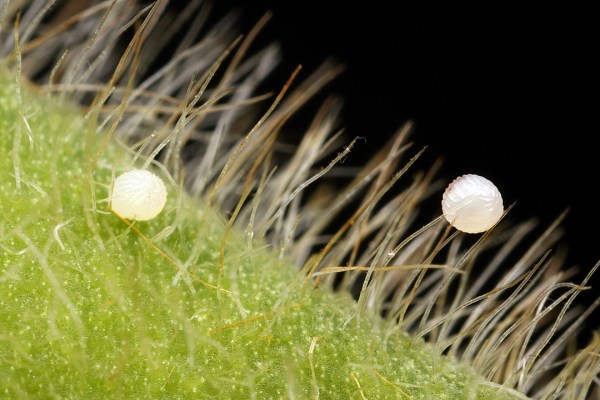
Also unlike the first two insects, eggs of this species can be laid anywhere on the plant—leaves (upper or lower surface), petioles, stems, pods, and even flowers. The eggs are rather large compared to the other species shown here (~3,500 eggs per gram) and assume a distinctive barrel shape when laid on the leaf. The creamy-white coloration, often with a light brown ring below the apex, is also distinctive compared to the previous two species. Eggs laid on pods tend to be attached to trichomes (hairs) rather than the pod surface, in which case they take on an almost perfectly spherical shape.

Helicoverpa zea—soybean podworm

Helicoverpa zea eggs on soybean pod


Heliothis virescens. Like the previous species, tobacco budworm has only recently gained attention as a pest of soybean. This importance, however, seems to be confined to Brazil (where it is known as “lagarta-das-maçãs”), while in North America it is usually found in combination with H. zea at minor levels. This is bad news for South American farmers; like soybean looper, tobacco budworm has developed resistance to all the insecticides that have been used against it in significant quantities. The oviposition and feeding behaviors of this species are very similar to those of H. zea, with eggs again laid on all parts of the plant and being very similar in appearance to those of H. zea except their slightly smaller (approx. 5,000 eggs per gram). In practical terms, eggs and young larvae of H. virescens and H. zea can be reliably distinguished only through species-specific immunoassay (Greenstone 1995) or feeding disruption bioassay using a diagnostic concentration of Bacillus thuringiensis ( Bailey et al. 2001).

Heliothis virescens—tobacco budworm

Heliothis virescens eggs on soybean pod.

As with H. zea, H. virescens eggs laid on pods tend to be stuck to hairs and assume a spherical shape.

This H. virescens egg has apparently died—note the shriveling and uniform black coloration.


Spodoptera frugiperda. Fall armyworm is a minor pest of soybean that rarely reaches economically damaging levels. However, its incidence in South America (where it is called “oruga militar tarde in Argentina and “lagarta-militar” in Brazil) has increased somewhat with the adoption of no-till cultivation of soybean. The species prefers grass hosts, but when these are knocked down by applications of post-emergence herbicides the larvae then move onto the soybean plants and continue feeding. Unlike any of the above species, eggs are laid in distinctive masses that are covered by abdominal setae and wing scales for protection. These eggs are also small (~8,500 eggs per gram), exhibit much finer and more numerous ridges than the above species, and are often colored orange, pink, or light green.

Spodoptera frugiperda—fall armyworm

Individual eggs inside the mass are covered by abdominal setae and wing scales.


REFERENCES:

Bailey, W. D., C. Brownie, J. S. Bacheler, F. Gould, G. G. Kennedy, C. E. Sorenson & R. M. Roe. 2001. Species diagnosis and Bacillus thuringiensis resistance monitoring of Heliothis virescens and Helicoverpa zea (Lepidoptera: Noctuidae) field strains from the southern United States using feeding disruption bioassays. Journal of Economic Entomology 94 (1):76–85.

Greenstone, M. H. 1995. Bollworm or budworm? Squashblot immunoassay distinguishes eggs of Helicoverpa zea and Heliothis virescens (Lepidoptera: Noctuidae). Journal of Economic Entomology 88(2):213–218.

Copyright © Ted C. MacRae 2012

Unexpected visitors

Cicindela repanda (Bronzed Tiger Beetle) | Lewis Co., Missouri

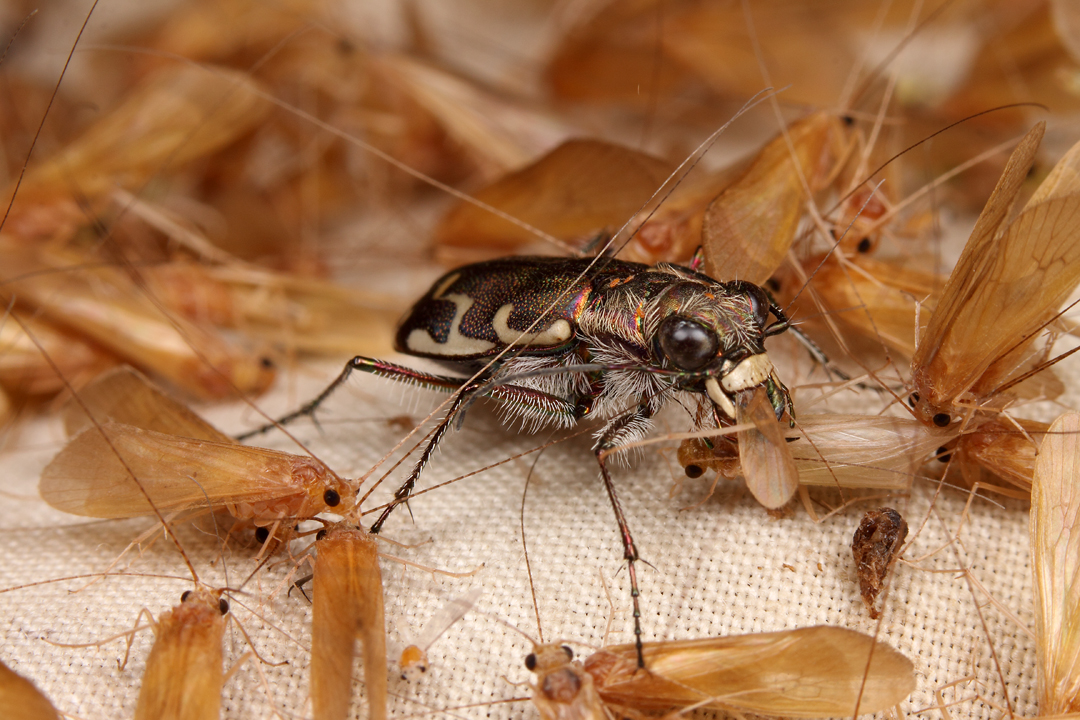
In late July I began blacklighting on a weekly basis at different locations along the Mississippi River in an effort to gain more detailed information on the distribution of certain tiger beetles along that great watercourse. While attraction of tiger beetles to ultraviolet lights is well documented, it seems to me to be an underutilized method for collecting tiger beetles and recording distributions. Perhaps this is because only certain species are attracted to lights—principally members of the genera Ellipsoptera and Habroscelimorpha [and even one species, Habroscelimorpha striga (Elusive Tiger Beetle), that is seen almost exclusively at blacklights], while others, including the more commonly encountered and speciose genus Cicindela, are rarely attracted to lights. As a result, when I setup a blacklight on a sandy beach along the Mississippi River in La Grange in far northeastern Missouri, I expected to see Ellipsoptera cuprascens (Coppery Tiger Beetle), which I had seen there during the day many years ago, and hoped to see Ellipsoptera macra (Sandy Stream Tiger Beetle), which I have so far seen only in northwestern Missouri. I did not see either of these species, but what I did see was even more unexpected—Cicindela repanda (Bronzed Tiger Beetle).

Feasting on the bounty!

It is ironic that I should be so excited to see this species—it is only the most common species of tiger beetle in Missouri (and probably across much of eastern North America), where chokingly thick populations develop each summer along every waterway in the state. As a species, it is remarkable infidel when it comes to habitat selection, proximity to water appearing to be its only real requirement. I have seen them on virtually every type of stream/river/pondbank regardless of soil type—sand, mud, or any mixture of the two—and note them to be common even on concrete boat ramps (although I have yet to find larval burrows in the latter habitat!). Yet, I have never seen them at a blacklight! Perhaps it was just a matter of time, as until this year I myself hadn’t done much blacklighting for tiger beetles. Populations of this species build as the summer progresses, and it could be that once numbers reach their peak in mid- to late August, a few will find their way to a light that happens to be placed in their midst while the majority of individuals bed down in their overnight burrows.

A macerated bolus is all that remains of the caddisfly meal.

It’s easy to see what might attract them to the light other than the light itself—prey! At every location along the Mississippi River that I’ve blacklighted this summer, choking throngs of caddisflies inundate the sheet within the first half-hour after sunset. Piling up in layers beneath the stupefying light, the caddisflies are a limitless bounty of easy pickings for the tiger beetles, who greedily grab the hapless trichopterans in their toothy, sickle-shaped mandibles and then use their maxillae and digestive juices to macerate them to a juicy pulp that can be sucked dry. I have watched tiger beetle adults feeding on many occasions, but I never noticed until examining these photographs that the feeding beetles hold their antennae back and out of the way against their head and pronotum. Contrast the antennal position of the feeding beetles in the above photographs with the forward position of the antennae in the non-feeding beetles in the remaining photographs. Perhaps this is an adaptation to prevent the antennae from being grabbed and damaged by struggling prey.

A male in more natural-looking surroundings.

Recall also my recent lamentations about lacking good photographs of this species, due initially to lack of effort and later to a rare failure when I did try to photograph them. A half dozen individuals made their way to the light this night, and I was able to coax a few of them off the sheet and onto the surrounding sand for a few photographs in more realistic and natural surroundings. I still don’t consider these to be the photographs that I want for this species, as they do not show any of the thermoregulatory behaviors exhibited during the day such as stilting, sun-facing, or shade-seeking that make for such marvelously iconic tiger beetle poses. For that, I will need to give them another shot on a hot day while summoning every ounce of tiger beetle stalking skill that I can possibly muster. Still, these last two photos (and a few others not shown) are several steps above the single, frustratingly distant lateral profile shot that I had for this species before this night.

All jaws, eyes, legs, and hair!

Copyright © Ted C. MacRae 2012

Ghosts in the night

This summer I’ve spent quite a few nights hanging out along the Mississippi River—lamp on my head, vials in my pocket, and an ultraviolet (UV) light setup on the sandy banks. UV light collecting for insects (also called “blacklighting”) is a popular method among us beetlers, but for a number of reasons it’s been a while since I’ve done a lot of heavy blacklighting myself. That all changed this year when I decided I needed to get a better handle on the Missouri distribution of two species of tiger beetles, Ellipsoptera cuprascens and E. macra, found only in sandy habitats along the shores of the state’s two big rivers—the Missouri and Mississippi—and, fortuitously, attracted to blacklights at night. Blacklighting alongside these big rivers is a relatively new experience for me, as my previous experiences have been mostly in forests—either here in the Midwest or out in the desert southwest. Along the big rivers, as soon as the sun dips below the horizon hordes of hungry mosquitos descend upon me and choking swarms of caddisflies quickly envelop the blacklight. Liberal application of Deet keeps the mosquitoes at bay, but checking the sheet behind the blacklight to see if anything of interest has landed requires a bit of a mad dash and a quick retreat, all the while holding my breath and clamping the shirt cuff around my neck to prevent the swarming bugs from flying into spaces where I don’t want them.

Arctosa littoralis (beach wolf spider) | Lewis Co., Missouri

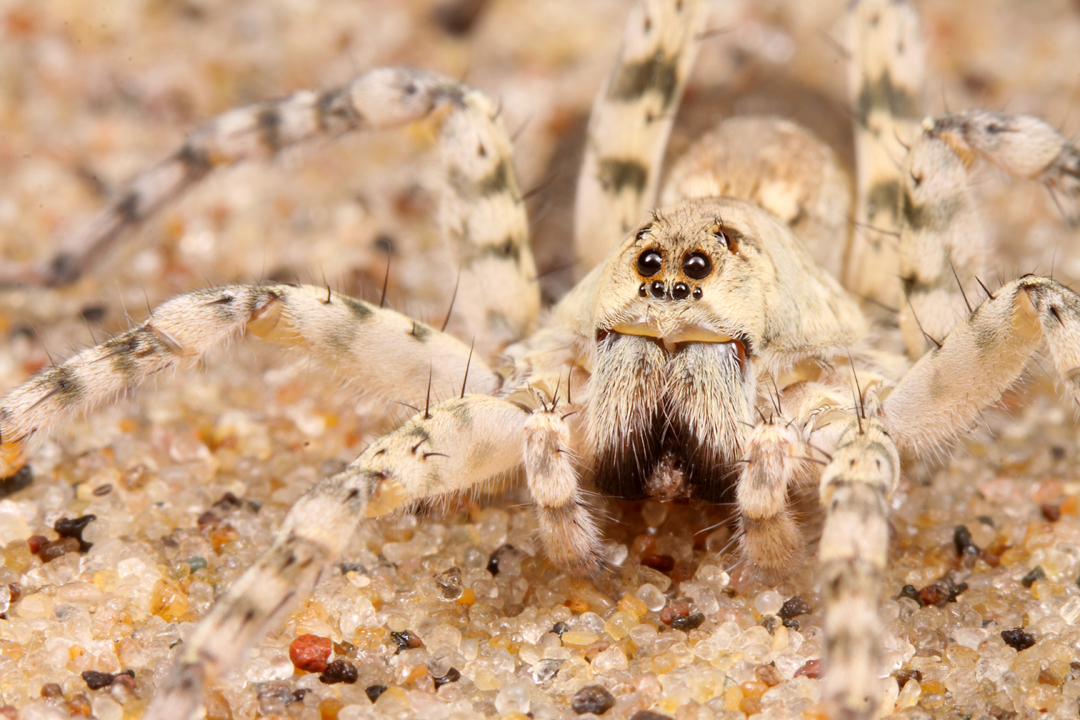
Wandering away from the blacklight and exploring along the beach in the black of night is also a relatively new experience. While I’ve done a fair bit of night collecting away from the light, again this has tended to be in forests and woodlands with a beating sheet in hand looking for jewel beetles, which still hang out on the same host plants they can be found on during the day but are far less inclined to zip away as soon as they hit the sheet like they do when the sun is high overhead. I haven’t spent much time shining a lamp on the sand of a big river beach, so I wasn’t quite sure what to expect (other than hopefully a tiger beetle!). As I walked along the beach, I occasionally saw blue-green glowing dots on the sand—I recognized these fairly quickly as the eyes of spiders reflecting the light from my headlamp. However, at first when looked closer at the spot where I thought a spider should be sitting I didn’t see anything. It took a few tries before finally I saw ghost-like movement on the sand, and when I moved cautiously and got down close to the sand I finally saw a magnificent, white wolf spider sitting motionless—perfectly colored to blend into the sand on which it was sitting.

The mottled, white coloration is conspicuous on wet sand…

I quickly hurried back to the car and got my camera, set it up with a 100mm macro lens and extension tubes (hoping I could get real close), and went back to the spot where I’d seen the spider to see if I could find it again. I didn’t, but not too much searching was required before I found another one. Unfortunately, I didn’t succeed in photographing that one either. It was apparent to me that I was going to have to use the same ultra-cautious and slow movements that I use with tiger beetles if I was going to succeed in photographing one or more of these spiders. I quickly figured out that they were easier to see if I looked right along the water’s edge, as in that situation the white coloration of the spider actually stood out against the darkened, wet sand. (Of course, photographing them on the wet sand was a tad dirtier for me, but I’m not afraid to get filthy dirty when it comes to photographing arthropods.) I also figured out that I could more easily find the spiders on the wet sand and then follow them up to the drier sand for photos that better showed just how marvelously cryptic their coloration was.

…but provides perfect camouflage on the dry sand further away from the water’s edge.

Those of you familiar with my work know that I love frontal portraits, but I found this to be almost impossible during my first attempts. It was hard enough approaching the spider from the front without it bolting before I could get set behind the camera, but in the few cases where I did actually manage this then it would bolt as soon as I made any microadjustment in the position of the camera to compose the shot. It occurred to me that the spider was sensing vibration from moving the camera on the ground (ground-resting the camera is a technique that I use commonly to get the lowest possible angle on my subjects)—makes sense, as spiders are intensely tuned into vibrations for  prey capture. Once I began keeping my hand flat under the camera as sort of a makeshift “beanbag” I was able to make the final adjustments necessary to get shots like the one shown below and in ID Challenge #20.

Active primarily at night, the spider’s eyes glow blue-green when hit by light.

According to Dondale & Redner (1983) this should be Arctosa littoralis—widespread in littoral habitats across North America but, at least at the time of their revision, not recorded from Missouri [in fact, it seems no species of Arctosa was known from Missouri until A. virgo was recorded from oak-hickory forests in the southern part of the state by Bultman (1992)]. I’ll leave it to the spiderphiles to determine if this actually represents a new state record or (more likely) if I just haven’t dug deep enough into the literature.

Congratulations to 3-time champ Ben Coulter, who swooped in from his hiding place with 30 pts to win ID Challenge #20—the final challenge of BitB Challenge Session #6. It wasn’t enough, however, to disturb the overall standings, and Brady Richards maintained his overall lead with 28 pts to win Session #6. Sam Heads was just one point away from the win in this challenge, but his 29 pts were enough to earn a tie for 2nd place in the overall standings with Mr. Phidippus, who finished a respectable 4th place in this challenge. Nobody else came close to these three gentlemen in the overalls, so they deserve their accolades and loot (please contact me for details on the available choices). In case you haven’t been following along, here is a summary of the BitB Challenge champions to this point, listed by session:

  1. Ben Coulter
  2. Ben Coulter
  3. Max Barclay
  4. Ben Coulter
  5. Mr. Phidippus
  6. Brady Richards

REFERENCES:

Bultman, T. L. 1992. Abundance and association of cursorial spiders from calcareous fens in southern Missouri. Journal of Arachnology 20:165–172.

Dondale, C. D. & J. H. Redner. 1983. Revision of the wolf spiders of the genus Arctosa C . L. Koch in North and Central America (Araneae: Lycosidae). Journal of Arachnology 11:1–30.

Copyright © Ted C. MacRae 2012

Program Announcment: 2012 ESA Annual Meeting

The Entomological Society of America recently posted the 2012 Program for their Annual Meeting this November in Knoxville, Tennessee, and I’m honored to announce that I’ll be giving a presentation in the Section A Symposium “Entomologists Beyond Borders: Hands on Macrophotography to Help Think Globally.” Let me say this straight out: this looks like a fabulous symposium, but I’m a bit intimidated at the prospect of sharing the stage with such renowned insect macrophotographers as Alex Wild, Thomas Shahan, Marlin Rice, etc. Nevertheless, I hope that the techniques I plan to share on locating and photographing live, often wary insects in their native habitats will be considered useful by at least some members of the audience. At this point, my talk is still an amorphous collection of ideas swirling around in my head (although, as you might predict, there will be many photos of tiger beetles!), thus, if there are any particular points you would like to see addressed now is the time to let me know.

I have been to a number of ESA meeting in the past, but the last was many years ago. I look forward to attending once again, reconnecting with old acquaintances and (hopefully) meeting many new ones. I hope to see you at the Entomologists Beyond Borders Symposium, and please don’t hesitate to come up and say hello.

When: Tuesday, November 13, 2012: 8:00 AM-12:45 PM
Where: Ballroom A, Floor Three (Knoxville Convention Center)
Organizers: Cheri M. Abraham and Ric Bessin
 
8:00 AM Welcoming Remarks
8:05 AM Introduction to insect macrophotography
Robert K. D. Peterson
, Montana State University
8:35 AM This is not that difficult: Techniques for shooting digital macro-photography images of insects
Marlin E. Rice
, Pioneer Hi-Bred International, Inc.
9:05 AM Approaching the unapproachable: Tips and tricks for photographing live insects in their native habitats
Ted C. MacRae
, Monsanto Company
9:25 AM Digital Imagery: Tips, tricks and tools to make impressive insect images
Jocelyn Gill
, Agriculture and Agri-Food Canada
9:45 AM Methods of magnification
Thomas Shahan
, N/a
10:15 AM Photographing insects on a budget
Alexander L. Wild
, University of Illinois
10:45 AM Digital image processing: One perspective on organization, correction and retrieval of images
Eugene D. White
, Rose Pest Solutions
11:15 AM Concluding Remarks
11:20 AM Hands on workshop

Copyright © Ted C. MacRae 2012

Life at 8X—soybean aphid

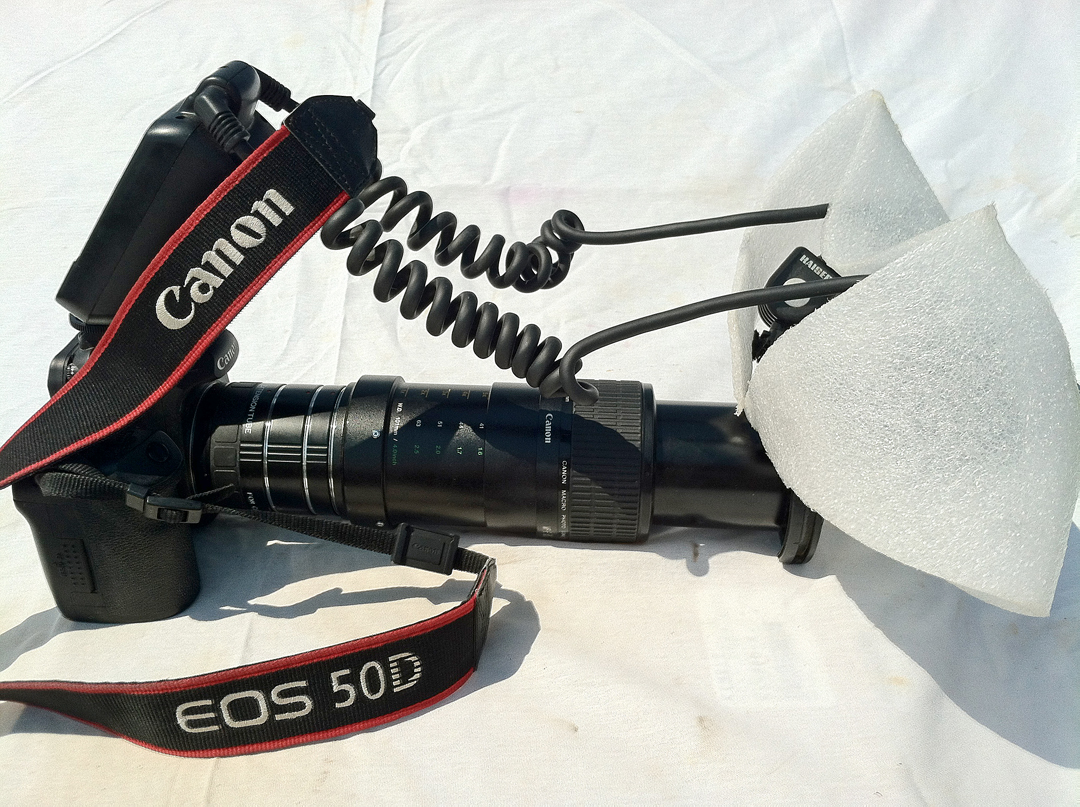
Although my first attempt at adding extension tubes to my Canon MP-E 65mm macro lens, effectively converting it from a 1–5X to a 1.7–8.0X lens, was nearly a year ago, it has only been recently that I’ve actually started experimenting with this combination to obtain high-mag photographs of very small insects in the field. The first example that I showed of such a photograph was a tiny seed weevil (Althaeus sp.) on its hibiscus host plant. I’ve since photographed a number of other insect subjects at high-mag using this setup and am getting a better feel for the capabilities—and limitations—inherent in using it. First, here is what the setup actually looks like:

Canon 50D body, MP-E 65mm macro lens on 68mm extension, MT-24EX twin flash w/ DIY diffuser.

Not the normal photo quality for this site (just a quick field setup photographed with my I-Phone), but it shows just how long the lens component becomes when fully extended to achieve 8X magnification. The camera is quite front-heavy, making the camera difficult to use hand-held, and the very shallow DOF (depth of field) due to the extreme level of magnification makes precise focusing difficult and magnifies the effect of any motion between the camera and subject. Obviously, one solution for these problems is to mount the camera on a tripod and place the subject on a stable surface; however, for reasons I’ve mentioned elsewhere, it is unlikely that I will ever take to bringing a tripod into the field, and the whole point of this exercise is to develop the capability for getting usable hand-held field photographs no matter what level of magnification they may require. As an alternative, I use a number of other techniques, discussed in my prior post on the subject, to stabilize the camera without using a tripod.

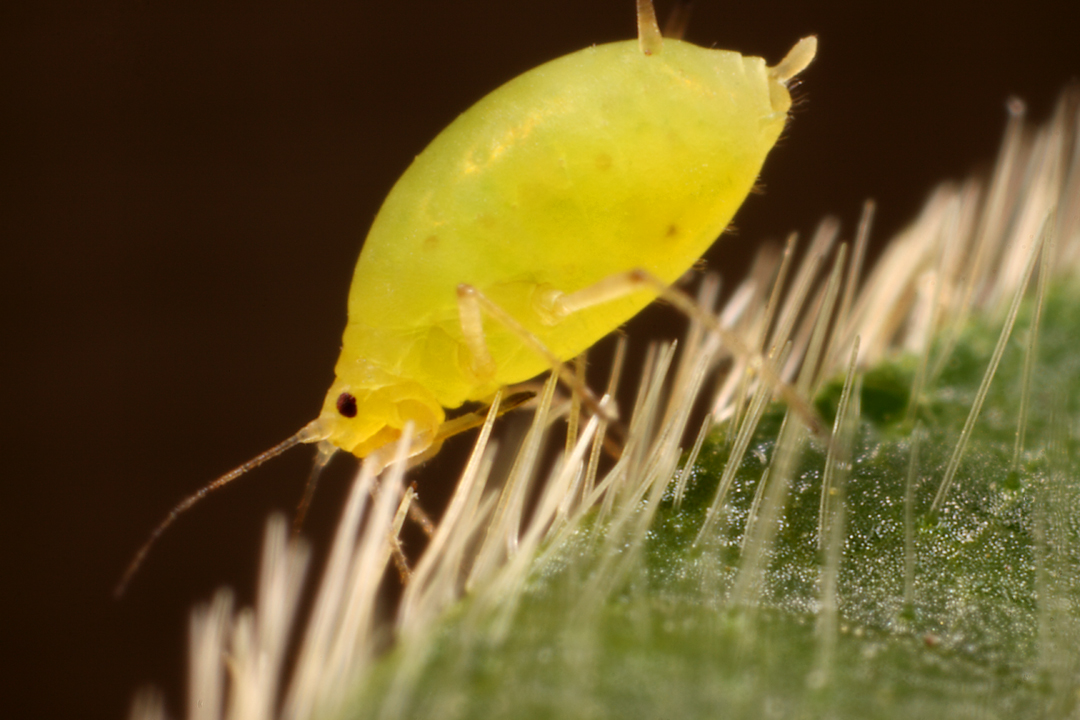
One of the recent subjects I photographed with this setup is the soybean aphid, Aphis glycines (order Hemiptera, family Aphididae). This distinctive Asian species has recently established in the U.S. as invasive pest of soybeans; adult females measure only 1–2 mm in length (and the nymphs are even smaller) and can quickly develop very high densities on the leaves and upper stems of soybean plants. The following photograph was taken at the camera setup’s minimum magnification of 1.7X and provides a typical view of adult aphids and their progeny:

Aphis glycines (soybean aphid) | Warren Co., Illinois

While the above photograph does a very good job of showing the colonial appearance of infestations by these aphids on soybean foliage, what about the aphids themselves? It would be nice to get a better look at individual aphids. The following photographs were all taken with the lens fully extended to achieve 8X magnification (and completely hand-held):

Adult female aphid—note the eye spots of the unborn nymphs visible within the body.

Another adult female navigates the hairs on the surface of the soybean leaf (I never knew soybean leaves were so hairy!).

A mother surrounded by her progeny. As above, eye spots of unborn nymphs can be seen inside her body.

These photographs are not without their problems—they are a bit soft, probably due to motion blur that results from the camera being hand-held and the extremely thin DOF that makes it difficult to get all of the desired components of the photos equally in focus. Lighting also is a challenge, as the very small subject-to-lens distance forces light from the flash to come from directly above or even behind the subject while minimizing front lighting (especially evident in the last photo with its straight down view). Nevertheless, these are decent, usable photographs that provide an uncommon view of these exceedingly tiny insects—without the encumbrance of carrying a tripod in the field, the time investment of studio photography and/or focus-stacking, or the expense of a microscope-mounted camera system (for those of us without access to such systems).

Copyright © Ted C. MacRae 2012