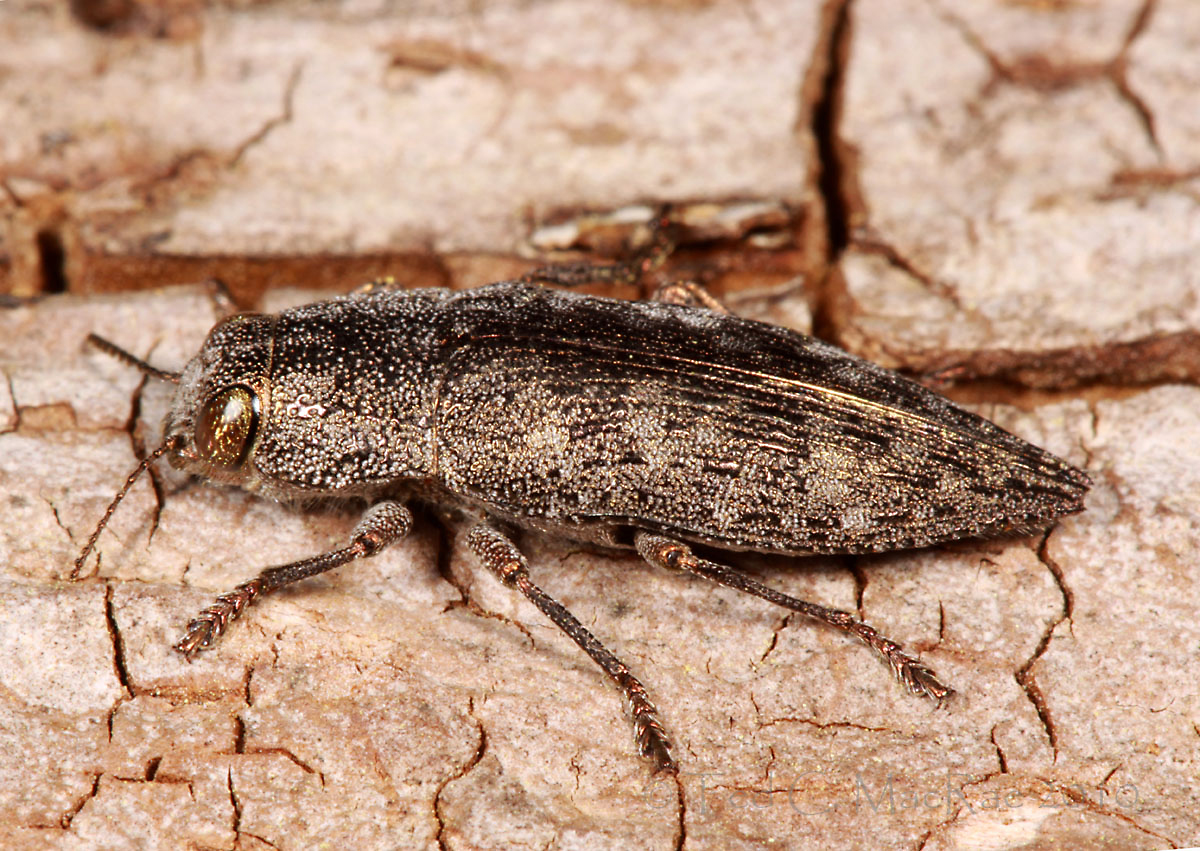
 This set of photographs comes from my June 2009 trip to northwestern Oklahoma, which I found at Boiling Springs State Park in Woodward County. They represent only the second buprestid species that I attempted to photograph with my (then) new camera and macro lens setup, the first being Chrysobothris ignicollis which I found at nearby Four Canyon Preserve. The latter species is commonly associated with Juniperus throughout much of western North America – indeed, the individuals I photographed were found on freshly cut J. virginiana (eastern redcedar), and I have reared the beetle from dead branches of this and other Juniperus species. The individual in these photographs represents another species in the same genus – Chrysobothris caddo. It was also found on cut redcedar; however, it is not normally associated with that plant. In fact, it is not very well-known at all, as it was only just described in 2007 (and these may well be the first ever identified photographs of the species).
 Chrysobothris caddo is one of a number of new species that were described by Wellso and Manley (2007) in their revision of the Chrysobothris femorata species-group from North America. I’ve previously mentioned the taxonomic difficulties associated with this group, last revised by Fisher (1942), and it had been known for some time that several species – including some unnamed – were masquerading under the “catch-all” taxon of Chrysobothris femorata. Normally, the only people who care about such situations are taxonomists and those who enjoy placing ID labels on specimens (me on both counts – I just hated those “Chrysobothris femorata species-group” labels). However, there was farther reaching impact in this case since C. femorata is a widespread and important economic pest of shade and fruit trees (eggs are laid on the trunks of the trees, which are then damaged by the boring actions of the larvae that hatch from them). The Wellso/Manley revision has brought some degree of clarity to species limits within the group (doubling its number of described species), but they remain difficult to identify since their recognition relies upon “suites” of characters rather than single “key” characters. For example, we know this individual (a female, based on the form of the pygidium, or upper surface of the tip of the abdomen) represents C. caddo because (see if you can find the characters in the photos as we go here):
- the antennae are narrowed to the apex (eliminating C. rugosiceps, which has the last antennal segment strongly quadrate)
- the post-median (back of middle) foveae (circular impressions) of the elytra (wing covers) are joined (eliminating C. viridiceps, which has the foveae distinctly separated)
- the pygidium is deeply impressed on each side of the middle (eliminating C. quadriimpressa, which has the pygidium shallowly impressed)
- the pygidium lacks a hyaline (membranous) lateral margin (eliminating C. adelpha, which is unique in possessing this character)
- the elytra have the posteriolateral margins arcuate and the tips bronze (eliminating C. femorata, in which the margins are straight and the tips reddish)
- the elytral costae (longitudinal ridges) are connected by cross-veins and interrupted by the foveae (eliminating C. comanche, which lacks cross veins and has indistinct foveae)
- the frons (face) has the callosities (elevated patches) transverse and bronze (eliminating C. shawnee, which has larger, bronze-black callosities)
Are you cross-eyed yet?! If not, there are four additional species in the group that are distinguished by similarly subtle character suites but whose geographical occurrence outside of Oklahoma (see checklist below) automatically eliminates them from consideration.
 Chrysobothris caddo is primarily associated with Celtis (hackberry), and my finding it on redcedar is simply an incidental association. There was a large tree dump in the back area of the park with freshly cut wood from a variety of plant species – such tree dumps are famous collecting grounds for woodboring beetles in the families Buprestidae and Cerambycidae. However, little importance can be given to beetle-plant associations observed in such situations, with multiple potential host plant species in such close proximity to each other. The third photograph shows another female probing cracks in the bark of cut Ulmus rubra (slippery elm) with her ovipositor – perhaps she will have laid an egg or perhaps not, and if she did it is unknown whether the larva that hatched would be able to feed and develop successfully to adulthood on this non-preferred host.
For those with an interest in this group, following is a checklist of the species with their geographical distribution and preferred hosts:
- Chrysobothris adelpha Harold – eastern US and southern Canada west to Texas. Primarily associated with Carya, also reared from Amelanchier and Prosopis.
- Chrysobothris caddo Wellso and Manley – Florida west to Arizona and north to Missouri, abundant in Texas. Primarily associated with Celtis, reared also from Cercis and Ebanopsis [= Pithecellobium].
- Chrysobothris comanche Wellso and Manley – New Mexico, Texas, and Utah. Associated exclusively with Juglans.
- Chrysobothris femorata (Olivier) – all continental states and Canada. Associated with a wide variety of woody plant species, especially those in landscape and orchard settings.
- Chrysobothris mescalero Wellso and Manley – New Mexico and Texas. Associated exclusively with Quercus.
- Chrysobothris quadriimpressa Gory and Laporte – eastern US west to Continental Divide. Primarily associated with Quercus, reared also from Juglans, Liquidamber, and Sapindus.
- Chrysobothris rugosiceps Melsheimer – eastern US and southern Canada west to Texas. Primarily associated with Quercus, reared also from Castanea.
- Chrysobothris seminole Wellso and Manley – Georgia and Florida. Associated exclusively with root crowns of Chrysoma, making it the only species associated with a non-woody host.
- Chrysobothris shawnee Wellso and Manley – eastern US west to Colorado. Primarily associated with Quercus, reared also from Salix and Prunus.
- Chrysobothris sloicola Manley and Wellso – Known only from Michigan in association with Prunus.
- Chrysobothris viridiceps Melsheimer – eastern US and southern Canada west to Continental Divide. Associated primarily with Quercus, reared also from Carya, Prosopis, and Ulmus.
- Chrysobothris wintu Wellso and Manley – Arizona and California. Primarily associated with Quercus, reared also from Salix and Prunus.
I have, over the years, collected numerous specimens of most of the species in this group (lacking only mescalero, seminole, and sloicola in my collection), with specimens now assignable to caddo, comanche, shawnee, and wintu included in the original type series as paratypes.
Photo Details: Canon 50D (ISO 100, 1/250 sec, f/14-16), Canon 100mm macro lens, Canon MT-24EX flash (1/4 ratio) w/ Sto-Fen diffusers. Typical post-processing (levels, unsharp mask, minimal cropping).
REFERENCES:
Fisher, W. S. 1942. A revision of North American species of buprestid beetles belonging to the tribe Chrysobothrini. U. S. Department of Agriculture, Miscellaneous Publication 470, 275 pp.
Wellso, S. G. and G. V. Manley. 2007. A revision of the Chrysobothris femorata (Olivier, 1790) species group from North America, north of Mexico (Coleoptera: Buprestidae). Zootaxa 1652:1–26 (first page only).
Copyright © Ted C. MacRae 2010







 Beetles In The Bush
