Botanizing w/ the WGNSS Botany Group at Salt Lick Point

After missing the last three weeks, I was happy to rejoin the WGNSS botanists on their regular weekly outing this past Monday. This week’s destination—Salt Lick Point Land & Water Reserve in western Monroe Co., Illinois—features a mosaic of loess hill prairie and limestone glades amidst dry to dry-mesic upland forest atop limestone bluffs towering up to 400 feet above the Mississippi River valley below.
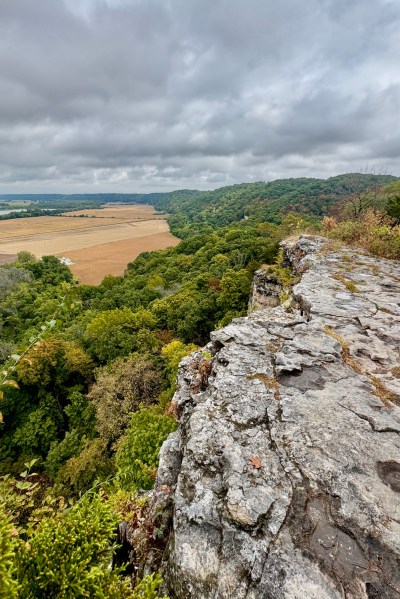
View from the Newman Trail at Salt Lick Point.

It has been an exceptionally dry August and September, so much that fall blooming plants are noticeably delayed and sparse in their blooms. Nevertheless, welcome rains just in the past few days have breathed some “fall life” into the woods and brought with them the pungent, earthy aromas that one expects to accompany a landscaping morphing from the dull greens of summer to the vibrant ambers, tawnies, and golds of fall.

View from the Salt Lick Trail at Salt Lick Point.

The group first explored the upland and blufftop habitats along the challenging terrain of the Salt Lick and Newman Trails, then returned through flat lowlands along the bluff bottoms via the Johnson Trail. Although still just beginning to bloom, a diverse palette of “fall asters” gave us an opportunity to reacquaint ourselves with the characters that distinguish these often “easy-to-identify-to-genus but difficult-to-identify-to-species” plants. The bulk of these fell into one of two groups—the true asters (genus Symphyotrichum) and the goldenrods (genus Solidago).
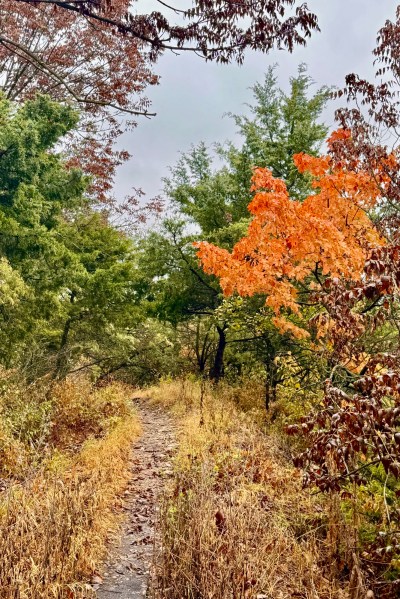
Salt Lick Trail at Salt Lick Point.

Symphyotrichum patens (late purple aster) was the first true aster that we noticed, a rather common species distinguished by its purple (of course) flowers with loose but not recurved phyllaries and leaves broadly clasping the stem. It wasn’t long before we had a chance to test our knowledge when we encountered the similar appearing Symphyotrichum anomalum (manyray aster), also with purple flowers but distinguished from S. patens by its distinctly recurved phyllaries and petiolate rather than clasping leaves. Eventually, we would encounter a third species of the genus—Symphyotrichum lateriflorum (calico aster), distinguished by its numerous small white flowers at the tips of numerous lateral branches rather than the terminus of the stem.
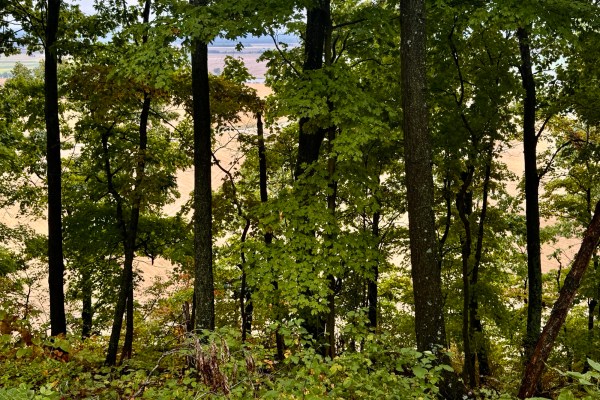
View from the Newman Trail at Salt Lick Point.

Goldenrods, on the other hand, were not only more diverse but also comprised some quite conservative species. The first of these was Solidago drummondii (Drummond’s goldenrod). This near-endemic species is restricted to eastern Missouri and adjacent parts of Illinois and Arkansas and grows almost exclusively on limestone or dolomite bluffs. However, we found it growing on limestone boulders placed at the trailhead next to the parking lot. Its wide, toothed leaves on short petioles (along with habitat) make this species easy to identify. Another quite conservative goldenrod was found as we entered the dry to dry-mesic forest further up the trail—Solidago buckleyi (Buckley’s goldenrod). Restricted to the Ozarks and adjacent areas, it is a showy species with relatively large flowers and spready phyllaries. In this and other respects, it greatly resembles the much more common Soldago petiolaris (downy goldenrod); however, it differs from that species by its narrower leaves that lack distinct teeth. A third species was seen as we approached one of the larger loess hilltop prairie remnants—Solidago altissima (tall goldenrod). Unlike the previous two species, this is one of the commonest and weediest species of goldenrod in the region. Relatively tall and with pyramidal inflorescences, this species often aggressively monopolizes roadsides and fallow fields. It greatly resembles another fairly common species—Solidago gigantea (late goldenrod), which we would later see during the return hike along the edge of the river valley. Leaf texture, however, differs between these two species—S. altissima has leaves with rough surfaces (caused by stiff, unidirectionally recurved hairs that cause the leaf to move only one direction when rubbed between the thumb and forefinger), while S. gigantea has smooth leaves (that move in any direction when rubbed).
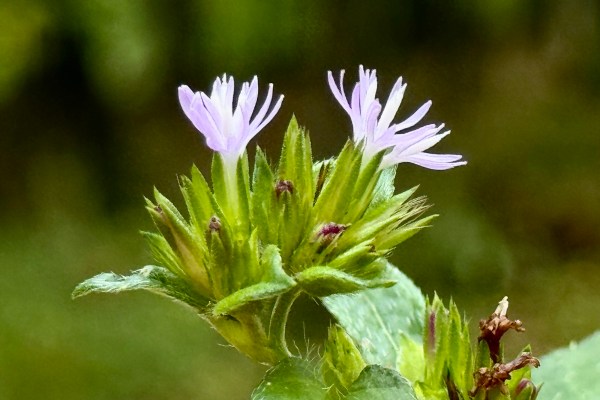
Elephantopus carolinianus (Carolina elephantsfoot, leafy elephant’s foot—family Asteraceae).

The group not only spent its time with its eyes down, but also out—across the vast Mississippi River valley spread out below the several lookout points dotting the trails. Tawny fields of near-ready-to-harvest corn provided a beautiful backdrop against the resplendent red sumacs and brilliant orange maples lining the blufftops.
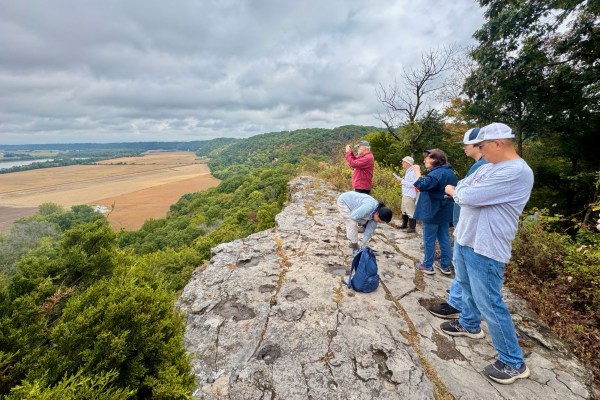
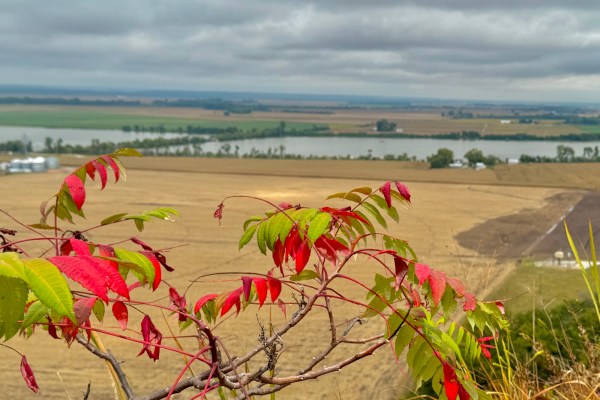
Members of the WGNSS Botany Group admire the view from the Newman Trail at Salt Lick Point.
View from the Newman Trail at Salt Lick Point.

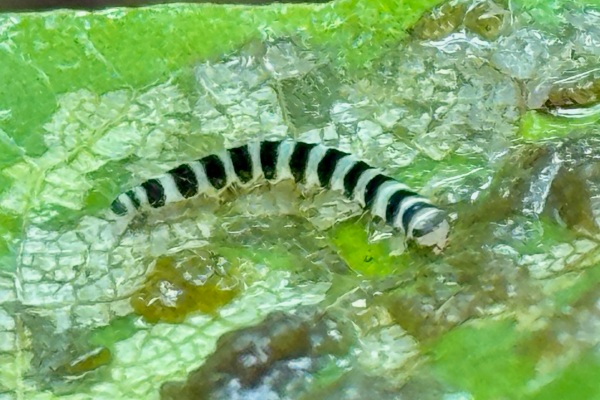
As the group’s lone entomologist/botanist (“entomotanist”?), I also kept an eye out for insects and was richly rewarded. A tiny “thorn” on the stem of S. buckleyi proved to be Enchenopa latipes (wide-footed treehopper), and unfolding the “folded” leaves of Cercis canadensis (eastern redbud) revealed the culprits—zebra-striped caterpillars of Fascista cercerisella (redbud leaffolder moth).

Enchenopa latipes (wide-footed treehopper—family Membracidae) on stem of Solidago buckleyi (Buckley’s goldenrod).
Fascista cercerisella (redbud leaffolder—family Gelechiidae) on Cercis canadensis (eastern redbud).

A spectacular earth boring beetle, Geotrupes splendidus, was seen lumbering clumsily along the trail in its endless quest for mammal dung to bury and lay an egg upon, while Bombus impatiens (common eastern bumble bee) worked the flowers of Eupatorium altissimum (tall boneset) and Eupatorium serotinum (late boneset).

Geotrupes splendidus (splendid earth-boring beetle—family Geotrupidae) on trail through dry-mesic loess woodland.
Bombus impatiens (common eastern bumblebee—family Apidae) on flower of Eupatorium altissimum (tall boneset).

A nearly mature Euchaetes egle (milkweed tussock moth) consumed the dwindling foliage of Cynanchum laeve (climbing milkweed), and Piezogaster calcarator (leaf-footed bugs) congregated on the inflorescences of Verbesina alternifolia (yellow ironweed).
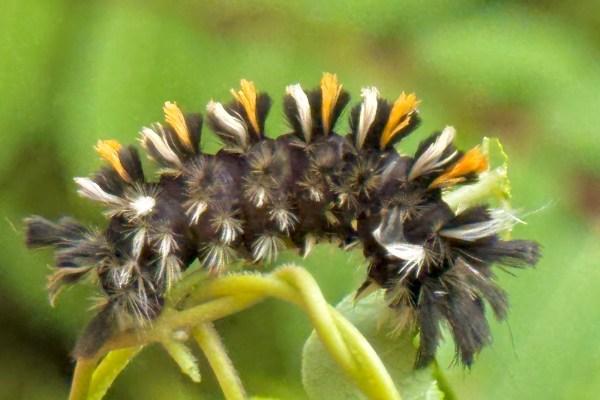
Euchaetes egle (milkweed tiger moth, milkweed tussock—family Erebidae) on Cynanchum laeve (climbing milkweed).
Piezogaster calcarator (leaf-footed bug—family Coreidae) on flower of Verbesina alternifolia (yellow ironweed).

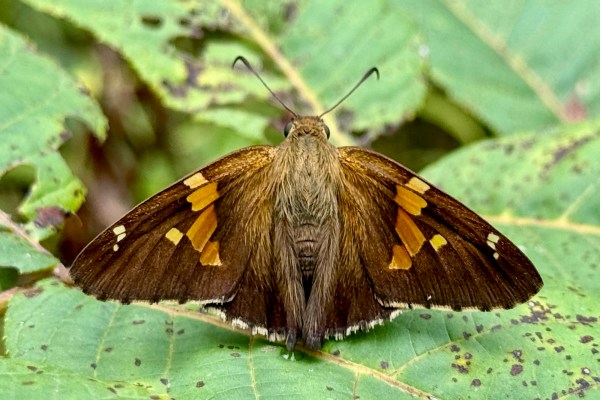
Nowhere, however, was insect activity more abundant than on the goldenrods, particularly the abundant stands of S. altissima in the uplands and S. gigantea below. Overwhelming numbers of Chauliognathus pennsylvanicus (goldenrod soldier beetles) and Lycomorpha pholus (black and yellow lichen moths) were accompanied by a cacophony of bees, wasps, and flies—a situation tailor made for Phymata sp. (jagged ambush bugs) to lay in wait while Epargyreus clarus (silver-spotted skipper) flew erratically overhead.

Phymata sp. (jagged ambush bug—family Reduviidae) mating pair on flower of Solidago altissima (tall goldenrod).
Epargyreus clarus (silver-spotted skipper—family Hesperiidae) perched on Solidago altissima (tall goldenrod).

Even in the deeply shaded mesic forest, Cyllopsis gemma (eastern gemmed satyrs) flitted deftly through the undergrowth.

Cyllopsis gemma (eastern gemmed satyr—family Nymphalidae) in mesic riparian forest.

The most unusual find, however, was a bizarre, green, jewel of a caterpillar found crawling on the forest floor—Isa textula (crowned slug moth or skiff moth), fringed with lacy projections that make it look more like a sea slug than an insect!

Isa textula (crowned slug moth, skiff moth—family Limacodidae) in leaf litter of mesic riparian forest.

Of course, a Monday WGNSS Botany Group outing isn’t truly consummated until it has enjoyed lunch at a local establishment—the choice this time being Tequila Mexican Restaurant in nearby Waterloo (best fish tacos I’ve ever had!).

©️ Ted C. MacRae 2025

Best of BitB 2013

Welcome to the 6th Annual “Best of BitB”, where I pick my favorite photographs from the past year. Like last year, 2013 was another year of heavy travel. For work I did my annual tour of soybean field sites throughout Argentina during late February and early March, then cranked it up for my own field season with frequent travel to sites in Illinois and Tennessee from May to October. In the meantime I spent a week at company meetings in Las Vegas in August, toured field sites across the southeastern U.S. for two weeks in September, visited Argentina again in October to finalize research plans for their upcoming season, and finished off the travel year by attending the Entomological Society of America (ESA) Meetings in Austin, Texas during November. On top of all this, I managed to slip in two of the best insect collecting trips I’ve had in years, with 10 days in northwestern Oklahoma in early June and another 10 days in California, Nevada, Utah, and Colorado during late August, and I got to play “visiting scientist” during short trips to Montana State University in late July and the Illinois Natural History Survey in late October! Of course, during my brief interludes at home I wasn’t sitting still, giving entomology seminars to several local nature societies and hosting two ESA webinars on insect photography. Needless to say, come December I was more than ready to spend some quite time at home (well, except for hiking most weekends) and am happy to report that I’ve successfully become reacquainted with my family and office mates. It’s a peripatetic life—and I wouldn’t have it any other way!

Okay, let’s get down to business. Here are my favorite BitB photographs from 2013. This year was less about learning new techniques as it was about refining the techniques I’ve found most useful for the style I’ve chosen as a photographer, i.e., hand-held, in situ field shots that (hopefully) excel at both natural history and aesthetic beauty. Links to original posts are provided for each photo selection, and I welcome any comments you may have regarding which (if any) is your favorite and why—such feedback will be helpful for me as I continue to hone my craft. If you’re interested, here are my previous years’ picks for 2008, 2009, 2010, 2011, and 2012. Once again, thank you for your readership, and I hope to see you in 2014!


Tremex columba, female ovipositing | Sam A. Baker State Park, Missouri

Tremex columba female drilling for oviposition into hardwood trunk | Sam A. Baker State Park, Missouri

From Ovipositing Pigeon Horntail (posted 6 Jan). I like this photo for the combination of vibrant, contrasting colors between the wasp and moss-covered wood and the visualization it provides of the remarkable depth to which this wasp will insert its ovipositor into solid wood!


Eurhinus cf. adonis on Solidago chilensis | Chaco Province, Argentina

Eurhinus cf. adonis on Solidago chilensis flowers | Chaco Province, Argentina

From Giving me the weevil eye! (posted 28 Apr). While a little soft, the color combination is pleasing and the pose taken by the beetle almost comically inquisitive.


Helicoverpa gelotopeon feeding on soybean pod | Buenos Aires Prov., Argentina

Helicoverpa gelotopeon feeding on soybean pod | Buenos Aires Prov., Argentina

From Bollworms rising! (posted 30 Mar). This is the first photo of an economic pest that has made one of my “Best of BitB” lists. The two holes in the soybean pod, one with the caterpillar and its head still completely inserted, visualizes how the feeding habits of these insects can so dramatically affect yield of the crop.


cf. Eremochrysa punctinervis | Gloss Mountains, Major Co., Oklahoma

cf. Eremochrysa punctinervis | Gloss Mountains, Major Co., Oklahoma

From “Blue-sky” tips and tricks (posted 1 July). Insects with a lot of delicate detail and long, thin appendages are especially difficult to photograph against the sky due to wind movement. See how I dealt with the antennae of this delicate lacewing without resorting to the standard black background typical of full-flash macrophotography.


Cicindela scutellaris lecontei x s. unicolor

Cicindela scutellaris lecontei x s. unicolor intergrade | Holly Ridge Natural Area, Stoddard Co., Missouri

From The Festive Tiger Beetle in Southeast Missouri (posted 25 Oct). I like this photo a lot more now than I did when I first took it. Its shadowy feel and the beetle “peering” from behind a leaf edge give a sense of this beetle’s attempts to hide and then checking to see if the “coast is clear”


Batyle suturalis on paperflower (Psilostrophe villosa) | Alabaster Caverns State Park, Woodward Co., Oklahoma

Batyle suturalis on Psilostrophe villosa flowers | Alabaster Caverns State Park, Woodward Co., Oklahoma

From Tips for photographing shiny beetles on yellow flowers (posted 10 Aug). “Bug on a flower” photos are a dime a dozen, but shiny beetles on yellow flowers with natural sky background can be quite difficult to take. All of the techniques for dealing with the problems posed by such a photo came together nicely in this photo.


Agrilus walsinghami | Davis Creek Regional Park, Washoe Co., Nevada

Agrilus walsinghami | Davis Creek Regional Park, Washoe Co., Nevada

From Sunset for another great collecting trip (posted 1 Sep). This photo is not without its problems, with a little blurring of the backlit fuzz on the plant, but the placement of the sun behind the subject’s head and resulting color combination make it my favorite in my first attempts at achieving a “sun-in-the-sky” background with a true insect macrophotograph.


A tiny male mates with the ginormous female.

Pyrota bilineata on Chrysothamnus viscidflorus | San Juan Co., Utah

From Midget male meloid mates with mega mama (posted 8 Nov). Another blue-sky-background photograph with good color contrast, its real selling point is the natural history depicted. with some of the most extreme size dimorphism among mating insects that I’ve ever seen.


Phymata sp.

Phymata sp. on Croton eleagnifolium foliage | Austin, Texas

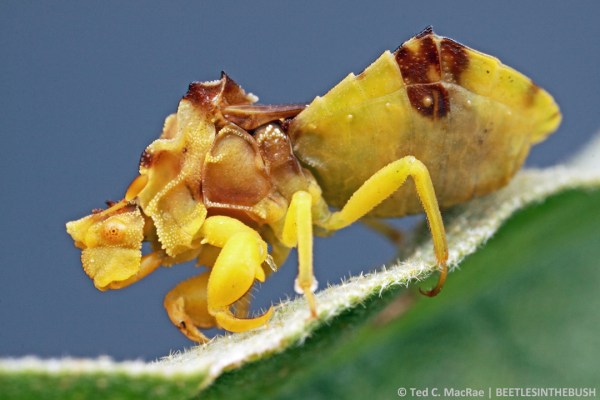
From ESA Insect Macrophotography Workshop (posted 13 Nov). The oddly sculpted and chiseled body parts of ambush bugs makes them look like they were assembled from robots. Contrasting the body against a blue sky gives a more unconventional view of these odd beasts than the typical top-down-while-sitting-on-a-flower view.


Fourth attempt - holding detached pad up against sky for cleaner background.

Moneilema armata on Opuntia macrorhiza | Alabaster Caverns State Park, Woodward Co., Oklahoma

From Q: How do you photograph cactus beetles? (posted 24 Nov). Photographing cactus beetles requires patience, persistence, long forceps, and strong forearms. Natural sky provides a much more pleasing background than a clutter of cactus pads and jutting spines.


I hope you’ve enjoyed this 2013 version of “Best of BitB” and look forward to seeing everyone in 2014.

Copyright © Ted C. MacRae 2013

ESA Insect Macrophotography Workshop

Today is the last day of the Entomological Society of America (ESA) Annual Meeting in Austin, Texas, and it has been an action packed week for me. Annual meetings such as this serve several purposes. In addition to seeing talks on a variety of subjects—in my case covering subjects ranging from insect resistance management to scientific outreach to beetle systematics—they also offer the chance to establish new connections with other entomologists that share common interests and reinforce existing ones. Of course, a major part of my interest in entomology revolves around insect macrophotography, and in recent years ESA has begun to cater to the entomological photographer contingent within the society. Last year’s meetings featured a macrophotography symposium titled, “Entomologists Beyond Borders” (for which I was one of the invited speakers), and this year featured an Insect Macrophotography Workshop led by Austin-based entomologist/photographer Ian Wright. Having done this for a few years now I figured a lot of the workshop might be review for me, but I still have much to learn and am willing to accept new ideas from any source. Besides, the workshop involved a field trip to a local habitat to try out our insect photography skills, and for a field junkie like me time in the field at an otherwise all-indoor event spanning close to a week is always welcome. The location of the meetings in Austin this year made this possible, as even in mid-November there still remain insects out and about that can be photographed if the weather cooperates (and it did).

This will be a somewhat different post than what I usually post here. Rather than featuring photos of a certain species and using them as a backdrop for a more detailed look at their taxonomy or natural history, I’m just going to post all the photos that I ended up keeping from the field trip portion of the workshop with just a comment or two about each. We went to the city’s nearby waste-water treatment facility, the grounds of which are wild and woolly enough to provide habitat for insects, and spent about an hour and a half seeing what we could find. For myself, it was a chance to photograph some insects I’ve not normally tried to photograph (i.e., dragonflies, ambush bugs) and get more practice on my blue sky technique. I did appreciate the chance to spend some time talking to Ian during while we traveled to the site and back, and I also ended up helping other participants with their camera equipment questions and technique suggestions. With that, here are the photos I took—I’ll be curious to see what readers think of this post format versus my more typical style.

Micrutalis calva

Micrutalis calva (Hemiptera: Membracidae) on silverleaf nightshade (Solanum elaeagnifolium).

Micrutalis calva

This species of treehopper is restricted to herbaceous plant hosts.

Anax junius

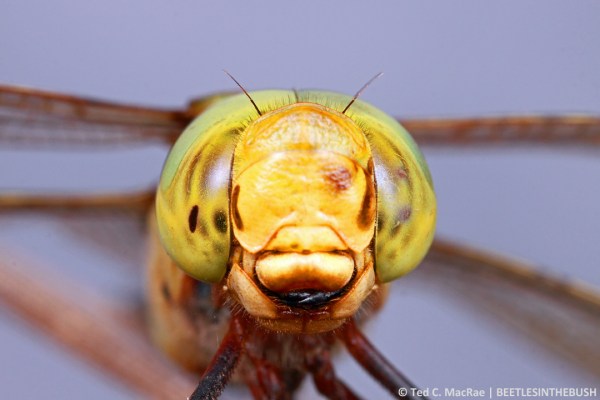
Anax junius (Odonata: Aeshnidae), one of the darner species of dragonfly.

Anax junius

This adult was perched on a dead twig tip and seemed to be “asleep.”

Anax junius

I clipped the perch and held it up for these “in-your-face” shots – it then awoke with a start and flew off.

Phymata sp.

Phymata sp. (Hemiptera: Reduviidae), one of the so-called “jagged ambush bugs.”

Phymata sp.

Formerly a separate family, ambush bugs are now combined with assassin bugs (family Reduviidae).

Acmaeodera flavomarginata

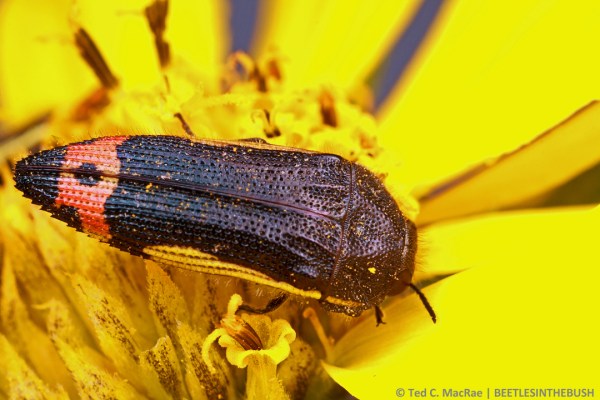
Acmaeodera flavomarginata (Coleoptera: Buprestidae).

Acmaeodera flavomarginata

This is one of a few species of jewel beetle in the southcentral US that are active during the fall.

Mecaphesa sp.

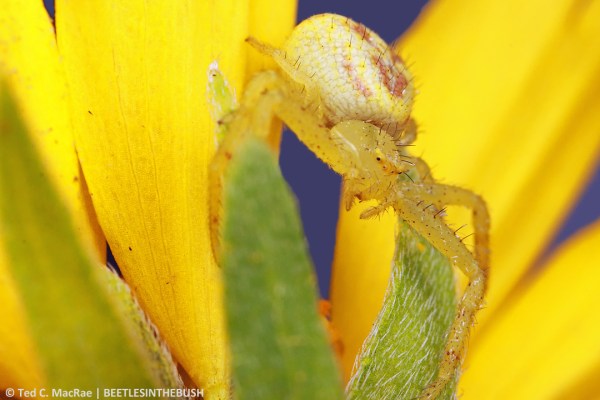
Mecaphesa sp. (Araneae: Thomisidae), one of the crab spiders

Mecaphesa sp.

Cryptic coloration allows the spider to lurk unseen by potential insect prey visiting the flower.

Gratiana pallidula

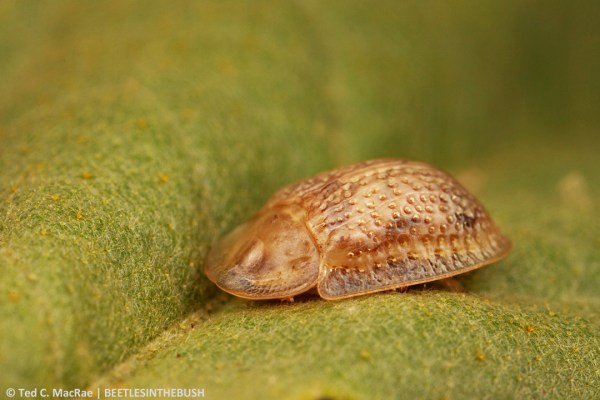
Gratiana pallidula (Coleoptera: Chrysomelidae) on silverleaf nightshade (Solanum eleagnifolium).

Gratiana pallidula

A type of tortoise beetle, adults “clamp” down against the leaf as a defense against predators.

Copyright © Ted C. MacRae 2013